TOPIC:
NATURAL RESOURCES IN
PAKISTAN
“Pakistan Rich In Resources
BUT
Poor In Management”
What are Resources?
There are four major types of
resources:
*Natural Resources
*Mineral Resources
*Forest Resources
*Energy Resources
WATER
INTRODUCTION
 Water resources are sources of water that are useful
or potentially useful. Uses of water include agricultural,
industrial, household, recreational and environmental
activities. The majority of human uses require fresh
water.
 97% of the water on earth is salt water. However, only
3% is fresh water.
 Fresh water is renewable resource.
SOURCES OF WATER IN PAKISTAN
Sources from which water is available for water supply
schemes are called water resources.
Some important sources of water are as follows.
Surface water
Frozen water
Ground water
Rain water
WHERE IT FOUND
Punjab:
 79% water9.78 million areas are underline with ground water of less than
1000 mg/itds.
 3.26 million areas qwith saltinity more than 3000 mg/itds.
Sindh:
Large area with ground water of poor quality.
 28% freshwater found at 20.25 mem.
Baluchistan:
 Local communities use ground water as high as 3000 mg. for drinking
process.
 Makran coastal zone with highly brakish ground water.
USES OF WATER
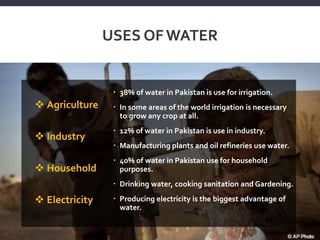
 38% of water in Pakistan is use for irrigation.
 In some areas of the world irrigation is necessary
to grow any crop at all.
 12% of water in Pakistan is use in industry.
 Manufacturing plants and oil refineries use water.
 40% of water in Pakistan use for household
purposes.
 Drinking water, cooking sanitation and Gardening.
 Producing electricity is the biggest advantage of
water.
 Agriculture
 Industry
 Household
 Electricity
INTRODUCTION
At the same time it will enable us to utilize every drop
of our water for our bright future .
So please don’t waste the water
Thank You
LAND
INTRODUCTION
 Land resources determine the nature of
the economy of a country.
The country’s geographical area is 79.61
million hectares.
AGRICULTURE IN PAKISTAN
About 57% of Pakistan's total land area is under
cultivation and is watered by one of the largest irrigation
systems in the world.The most important crops are
cotton, wheat, rice, sugarcane, corn, pulses, oil seeds,
barley, fruits and vegetables.
Type of Land (mha) %
Geographical Area 79.61 100.00
Total Reported Area 57.07 71.7
Forest Area 4.02 5.1
CulturableWaste 8.12 10.2
Area Cultivated for
Agriculture
22.05 27.7
AGRICULTURE: BACKBONE OF ECONOMY
 Agriculture is the main player of the economy of Pakistan with 21%
contribution to GDP and more than 45% contribution in labor force.
 Pakistan’s agriculture rely heavily on irrigation.
 Pakistan has the world’s largest contiguous irrigation system.
 Pakistan ranks 4th in the world as for as irrigated area (About 7%) is
concerned.About 36 MA (About 75% of the cultivated area) in
Pakistan is irrigated land.
 Pakistan has invested heavily in the irrigation sector. Allocated
about $ 8 billion in this sector up to the year 2011-12.
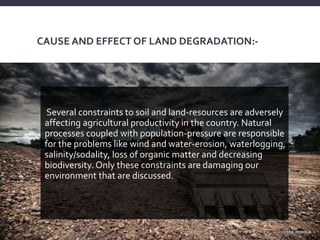
CAUSE AND EFFECT OF LAND DEGRADATION:-
Several constraints to soil and land-resources are adversely
affecting agricultural productivity in the country. Natural
processes coupled with population-pressure are responsible
for the problems like wind and water-erosion, waterlogging,
salinity/sodality, loss of organic matter and decreasing
biodiversity. Only these constraints are damaging our
environment that are discussed.
NATURAL
GAS
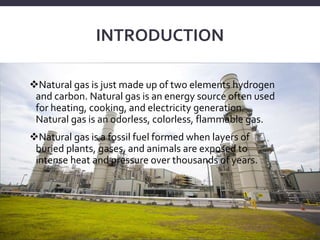
INTRODUCTION
Natural gas is just made up of two elements hydrogen
and carbon. Natural gas is an energy source often used
for heating, cooking, and electricity generation.
Natural gas is an odorless, colorless, flammable gas.
Natural gas is a fossil fuel formed when layers of
buried plants, gases, and animals are exposed to
intense heat and pressure over thousands of years.
FIELDS OF NATURAL GAS:
 Adkhi
 Badim
 Bhit gas field
 Khasan gas field
 Kandanwari gas field
 Toot gas field
 Sui gas field etc
The Sui gas field is the biggest natural gas field in the Pakistan. It
is located near Sui in Baluchistan.The gas field was discovered in
the late 1952 and the commercial exploitation of the field began
in 1955.
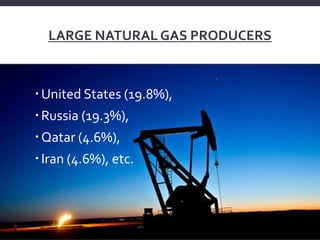
LARGE NATURAL GAS PRODUCERS
United States (19.8%),
Russia (19.3%),
Qatar (4.6%),
Iran (4.6%), etc.
ECONOMIC DEVELOPMENT:
The discovery of huge reservoirs of natural gas
is a great blessing of GOD in Pakistan. The
recent discovery of oil and gas reserves at
Dement is very significant. As April, 1, 2007,
the recoverable reserves of natural gas have
been estimated at 31.81 trillion cubic feet. The
average production of natural gas by 13
different gas companies is 3876 million cubic
feet per day.
USES OF NATURAL GAS:
Power generation
Fertilizers
Transportation
Hydrogen
GAS CRISES:
 HOME USER:
 Home user is one of big an important factor of gas user who use
gas for cooking, for hot water etc.
 CNG USER:
 CNG meets the big fuel necessarily of transport. Compressed
natural gas (CNG) is used in rural homes without connections to
piped-in public utility services, or with portable grills.
 INDUSTRY:
 Industry converts from other energy sources to CNG rapidly.
 MISSMANGEMENT:
 M.M is one of the biggest factors in gas crises
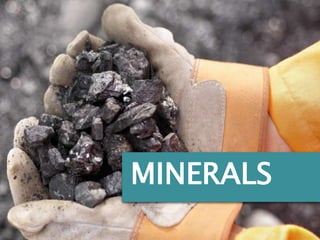
MINERALS
INTRODUCTION
 Modern urbanization, industrialization, transportation and
communication systems are the achievements of worldwide
sustainable mineral resource development and their proper
utilization in various sectors.
MINING AND QUARRYING:
 For development of these mineral resources through
private national / international investment and
investment friendly National Mineral Policy (NMP) has
been formulated with the consensus of all the provinces
and stake holders.
 Due to existence of these investment friendly polices
various international companies have started exploration
and mining in Pakistan.
MINES AND MINERAL DEVELOPMENT DEPARTMENT:
This department was created in Sindh in 2001 in
pursuance of the National Mineral Policy, 1995.The
department has taken all necessary steps for further
establishing its field office.The province of Sindh has
large quantities of minerals. In all there are 24 minerals
which are being mined at present.
MINES AND MINERAL DEVELOPMENT DEPARTMENT:
This department was created in Sindh in 2001 in
pursuance of the National Mineral Policy, 1995.The
department has taken all necessary steps for further
establishing its field office.The province of Sindh has
large quantities of minerals. In all there are 24 minerals
which are being mined at present.
TYPES OF MINERAL:
Metallic Minerals
 1. Iron ore.
 2. Chromite’s.
 3. Copper etc.
Non-Metallic Minerals
 1. Rock Salt.
 2. Limestone.
 3. Gypsum.
 4. Marble and Granite etc.
MINERALS IN PAKISTAN:
 Iron Ore
 Chromite
 Copper
 Rock Salt
 Lime Stone
 Gypsum
 Marble and Granite
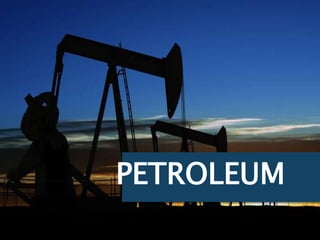
PETROLEUM
WHAT IS PETROLEUM?
Petroleum is crude form of oil which is the
mixture of petrol, Diesel, Mobil oil, Furnace oil
and many other things when it is heated it is
converted into fractions.
FRACTIONS OF PETROLEUM:
Petrol (gasoline)
Diesel
Mobil oil (lubricating oil)
Kerosene oil (paraffin oil)
Furnace oil
Asphalt
Naphtha
RESOURCES OF PETROLEUM IN PAKISTAN
Baluchistan
Bolan Khuzdar Lasbela
Sindh
Mirpur Badin Sanghar
RESOURCES OF PETROLEUM IN
PAKISTAN
Total assets of petroleum in Pakistan 39,838 millions
Pakistani rupees
Province Total Assets
Punjab 15,485 tonnes
Sindh 95,833 tonnes
Kpk 44,586 tonnes
Baluchistan 190546 tonnes
CAUSES AND EFFECTS
 Bad technology
 Ignorance of our assets
 Corruption of govt.
 Companies contract
REASONS BEHIND POOR
MANAGEMENT
 Political Instability
 Worst law and Order
 Corruption
 Lack of vision and planning
 Dependence on foreign aid
 Flawed policies
 Lack of human resources and development
 Poor governance of country
“Sitting on treasure, but ye
End

Natural resources

  • 2.
    TOPIC: NATURAL RESOURCES IN PAKISTAN “PakistanRich In Resources BUT Poor In Management”
  • 3.
    What are Resources? Thereare four major types of resources: *Natural Resources *Mineral Resources *Forest Resources *Energy Resources
  • 8.
  • 9.
    INTRODUCTION  Water resourcesare sources of water that are useful or potentially useful. Uses of water include agricultural, industrial, household, recreational and environmental activities. The majority of human uses require fresh water.  97% of the water on earth is salt water. However, only 3% is fresh water.  Fresh water is renewable resource.
  • 10.
    SOURCES OF WATERIN PAKISTAN Sources from which water is available for water supply schemes are called water resources. Some important sources of water are as follows. Surface water Frozen water Ground water Rain water
  • 11.
    WHERE IT FOUND Punjab: 79% water9.78 million areas are underline with ground water of less than 1000 mg/itds.  3.26 million areas qwith saltinity more than 3000 mg/itds. Sindh: Large area with ground water of poor quality.  28% freshwater found at 20.25 mem. Baluchistan:  Local communities use ground water as high as 3000 mg. for drinking process.  Makran coastal zone with highly brakish ground water.
  • 12.
    USES OF WATER 38% of water in Pakistan is use for irrigation.  In some areas of the world irrigation is necessary to grow any crop at all.  12% of water in Pakistan is use in industry.  Manufacturing plants and oil refineries use water.  40% of water in Pakistan use for household purposes.  Drinking water, cooking sanitation and Gardening.  Producing electricity is the biggest advantage of water.  Agriculture  Industry  Household  Electricity
  • 13.
    INTRODUCTION At the sametime it will enable us to utilize every drop of our water for our bright future . So please don’t waste the water Thank You
  • 14.
  • 15.
    INTRODUCTION  Land resourcesdetermine the nature of the economy of a country. The country’s geographical area is 79.61 million hectares.
  • 16.
    AGRICULTURE IN PAKISTAN About57% of Pakistan's total land area is under cultivation and is watered by one of the largest irrigation systems in the world.The most important crops are cotton, wheat, rice, sugarcane, corn, pulses, oil seeds, barley, fruits and vegetables. Type of Land (mha) % Geographical Area 79.61 100.00 Total Reported Area 57.07 71.7 Forest Area 4.02 5.1 CulturableWaste 8.12 10.2 Area Cultivated for Agriculture 22.05 27.7
  • 17.
    AGRICULTURE: BACKBONE OFECONOMY  Agriculture is the main player of the economy of Pakistan with 21% contribution to GDP and more than 45% contribution in labor force.  Pakistan’s agriculture rely heavily on irrigation.  Pakistan has the world’s largest contiguous irrigation system.  Pakistan ranks 4th in the world as for as irrigated area (About 7%) is concerned.About 36 MA (About 75% of the cultivated area) in Pakistan is irrigated land.  Pakistan has invested heavily in the irrigation sector. Allocated about $ 8 billion in this sector up to the year 2011-12.
  • 18.
    CAUSE AND EFFECTOF LAND DEGRADATION:- Several constraints to soil and land-resources are adversely affecting agricultural productivity in the country. Natural processes coupled with population-pressure are responsible for the problems like wind and water-erosion, waterlogging, salinity/sodality, loss of organic matter and decreasing biodiversity. Only these constraints are damaging our environment that are discussed.
  • 19.
  • 20.
    INTRODUCTION Natural gas isjust made up of two elements hydrogen and carbon. Natural gas is an energy source often used for heating, cooking, and electricity generation. Natural gas is an odorless, colorless, flammable gas. Natural gas is a fossil fuel formed when layers of buried plants, gases, and animals are exposed to intense heat and pressure over thousands of years.
  • 21.
    FIELDS OF NATURALGAS:  Adkhi  Badim  Bhit gas field  Khasan gas field  Kandanwari gas field  Toot gas field  Sui gas field etc The Sui gas field is the biggest natural gas field in the Pakistan. It is located near Sui in Baluchistan.The gas field was discovered in the late 1952 and the commercial exploitation of the field began in 1955.
  • 22.
    LARGE NATURAL GASPRODUCERS United States (19.8%), Russia (19.3%), Qatar (4.6%), Iran (4.6%), etc.
  • 23.
    ECONOMIC DEVELOPMENT: The discoveryof huge reservoirs of natural gas is a great blessing of GOD in Pakistan. The recent discovery of oil and gas reserves at Dement is very significant. As April, 1, 2007, the recoverable reserves of natural gas have been estimated at 31.81 trillion cubic feet. The average production of natural gas by 13 different gas companies is 3876 million cubic feet per day.
  • 24.
    USES OF NATURALGAS: Power generation Fertilizers Transportation Hydrogen
  • 25.
    GAS CRISES:  HOMEUSER:  Home user is one of big an important factor of gas user who use gas for cooking, for hot water etc.  CNG USER:  CNG meets the big fuel necessarily of transport. Compressed natural gas (CNG) is used in rural homes without connections to piped-in public utility services, or with portable grills.  INDUSTRY:  Industry converts from other energy sources to CNG rapidly.  MISSMANGEMENT:  M.M is one of the biggest factors in gas crises
  • 26.
  • 27.
    INTRODUCTION  Modern urbanization,industrialization, transportation and communication systems are the achievements of worldwide sustainable mineral resource development and their proper utilization in various sectors.
  • 28.
    MINING AND QUARRYING: For development of these mineral resources through private national / international investment and investment friendly National Mineral Policy (NMP) has been formulated with the consensus of all the provinces and stake holders.  Due to existence of these investment friendly polices various international companies have started exploration and mining in Pakistan.
  • 29.
    MINES AND MINERALDEVELOPMENT DEPARTMENT: This department was created in Sindh in 2001 in pursuance of the National Mineral Policy, 1995.The department has taken all necessary steps for further establishing its field office.The province of Sindh has large quantities of minerals. In all there are 24 minerals which are being mined at present.
  • 30.
    MINES AND MINERALDEVELOPMENT DEPARTMENT: This department was created in Sindh in 2001 in pursuance of the National Mineral Policy, 1995.The department has taken all necessary steps for further establishing its field office.The province of Sindh has large quantities of minerals. In all there are 24 minerals which are being mined at present.
  • 31.
    TYPES OF MINERAL: MetallicMinerals  1. Iron ore.  2. Chromite’s.  3. Copper etc. Non-Metallic Minerals  1. Rock Salt.  2. Limestone.  3. Gypsum.  4. Marble and Granite etc.
  • 32.
    MINERALS IN PAKISTAN: Iron Ore  Chromite  Copper  Rock Salt  Lime Stone  Gypsum  Marble and Granite
  • 33.
  • 34.
    WHAT IS PETROLEUM? Petroleumis crude form of oil which is the mixture of petrol, Diesel, Mobil oil, Furnace oil and many other things when it is heated it is converted into fractions.
  • 35.
    FRACTIONS OF PETROLEUM: Petrol(gasoline) Diesel Mobil oil (lubricating oil) Kerosene oil (paraffin oil) Furnace oil Asphalt Naphtha
  • 36.
    RESOURCES OF PETROLEUMIN PAKISTAN Baluchistan Bolan Khuzdar Lasbela Sindh Mirpur Badin Sanghar
  • 37.
    RESOURCES OF PETROLEUMIN PAKISTAN Total assets of petroleum in Pakistan 39,838 millions Pakistani rupees Province Total Assets Punjab 15,485 tonnes Sindh 95,833 tonnes Kpk 44,586 tonnes Baluchistan 190546 tonnes
  • 38.
    CAUSES AND EFFECTS Bad technology  Ignorance of our assets  Corruption of govt.  Companies contract
  • 39.
    REASONS BEHIND POOR MANAGEMENT Political Instability  Worst law and Order  Corruption  Lack of vision and planning  Dependence on foreign aid  Flawed policies  Lack of human resources and development  Poor governance of country
  • 40.
  • 42.