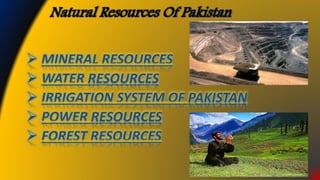
Natural Resources Of Pakistan
 MINERAL RESOURCES
 WATER RESOURCES
 IRRIGATION SYSTEM OF PAKISTAN
 POWER RESOURCES
 FOREST RESOURCES
Danish Riaz
Adil Mubarak
Arslan
Mukhtar
BBA
Introduction
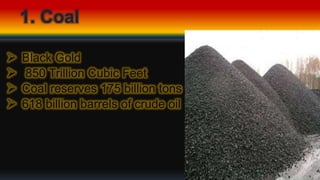
1. Coal
 Black Gold
 850 Trillion Cubic Feet
 Coal reserves 175 billion tons
 618 billion barrels of crude oil
2. Natural Gas
885.3 billion cubic meters
Daily production 19 million
cubic meters
3. Crude Oil
Covers 122.67 square
kilometres
322 Barrels Of Oil
5. Mineral Salt
Minned in the region since 320 BC
 Khewra Salt Mines
110 square kilometres (42 Sq mi)
220 million tonnes of rock salt
deposits
325,000 tons salt per annum
6. Copper & Gold
 170,000 metric tons of copper
 300,000 ounces of gold a year
 350,000 tons a year of copper
 900,000 ounces of gold
IRRIGATION SYSTEM OF PAKISTAN
1. Wells or Tube-wells
It is the oldest method of irrigation in
Pakistan. Wells and Tube-wells system is
successful where water level is high and where
canal system is not common. Animal power
and electricity is used for to obtain water from
wells and tube-wells. To utilize ground water
0.7 million tube wells have been installed.
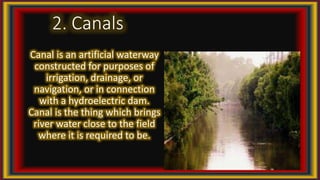
2. Canals
Canal is an artificial waterway
constructed for purposes of
irrigation, drainage, or
navigation, or in connection
with a hydroelectric dam.
Canal is the thing which brings
river water close to the field
where it is required to be.
3. Perennial Canals:
These canals supply water throughout the year.
Perennial canals are the canals that are used to
supply water to the field and these are taken
either from dams or barrages. Important Perennial
Canals of Punjab are Upper Bari Doab, Lower Bari
Doab, Sidhnai Canals, Upper and Lower Chenab,
Upper Jhelum canals originating from Trimmu
Headworks and Canals originating from river
Sutlej at Ferozpur, Islam, Suleimanki and Panjnad
Headworks.
4. Inundation Canals
(Flood Canals):
These canals run only during the rainy season
when water level in river rises. The quantity of
water they supply is uncertain. These canals, like
other canals, are taken from the rivers but the
difference is that they get water when there is a
rise in the water level due to flood. Many old
canals from the Indus and the Chenab fall in this
category.
5. Link Canals
Link canals are those canals which creates link
between one river to an other rives to fulfill the
shortage of water. There are a number of link
canals constructed under Indus water treaty in
Pakistan.
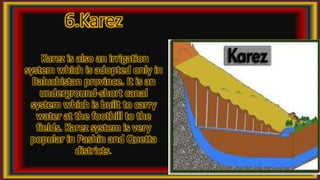
6.Karez
Karez is also an irrigation
system which is adopted only in
Baluchistan province. It is an
underground-short canal
system which is built to carry
water at the foothill to the
fields. Karez system is very
popular in Pashin and Quetta
districts.
POWER RESOURCES
A. HYDRO ELECTRICITY:
Nature has provided suitable environment in Pakistan.
To produce hydroelectricity environment is better for
it. The northern and north western area of Pakistan is
suitable for building of dams. Both public and private
sectors have planned to increase the production of
hydroelectricity in Pakistan. Pakistan's total
hydroelectricity production is 4963 Megawatt.
Pakistan has the capacity of production of 30000 MW
from its river Indus, Jehlum and Chenab.
1. Tarbela Dam
This dam is situated on Indus River. The
Tarbela dam produces 70% of the total
hydroelectricity production of Pakistan. Its
installed generation capacity is 3478 MW.
The Tarbela Dam was constructed in 1976
and its cost was about Rs.18 billions. This
dam is about 9000 feet long. The Tarbela is
one of the biggest dams of the world.
2. Mangla Dam
This dam is located on Jehlum River.
This dam installed generation
capacity of power is 1000 MW which
is 20% of total hydroelectricity of the
country. This dam was constructed
and completed in 1967 the height of
this dam is 110 meters. This dam is
made of concrete. This is second
biggest dam in Pakistan.
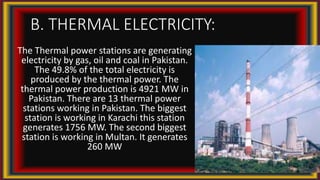
B. THERMAL ELECTRICITY:
The Thermal power stations are generating
electricity by gas, oil and coal in Pakistan.
The 49.8% of the total electricity is
produced by the thermal power. The
thermal power production is 4921 MW in
Pakistan. There are 13 thermal power
stations working in Pakistan. The biggest
station is working in Karachi this station
generates 1756 MW. The second biggest
station is working in Multan. It generates
260 MW
Important Thermal Stations
Future Plans
A large number of projects have
been planned to meet future energy
requirements of Pakistan. This
project is working rapidly. If this
project works better than our country
will make progress by leaps and
bounds.
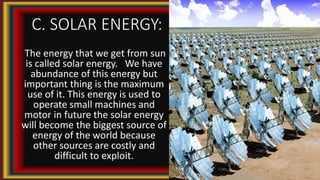
C. SOLAR ENERGY:
The energy that we get from sun
is called solar energy. We have
abundance of this energy but
important thing is the maximum
use of it. This energy is used to
operate small machines and
motor in future the solar energy
will become the biggest source of
energy of the world because
other sources are costly and
difficult to exploit.
Advance Energy
1. Atomic Energy
Atomic energy is the advance source of this
world. Although this source of energy is very
sophisticated and multi disciplinary system.
As the rapid growth of population sources
are also increasing at the same rate. That's
why it is an important source of energy
indeveloping countries
2. Pakistan is an Atomic Power
By the grace of Allah Pakistan has
become a great Atomic Power. Pakistan
has operated Atomic blasts in Chagi in
Balochistan on 28 May 1998. Pakistan
had to face many difficulties to achieve
progress in the atomic program
3. Nuclear Power
Technology
Nuclear Power technology was introduced in Pakistan
in 1971 when a plant of 136 MW capacity namely
Karachi. Nuclear power plant (KANUPP) was installed.
This plant has been operating safely for more than 31
years. IN other important Cheshma nuclear power
project is also working with the help of China. This
has been connected to the national grid on June 13
2000. It has a gross capacity of 325 MW and is located
near Cheshma Barrage on left bank of river Indus.
FOREST RESOURCES
Forests are limited to 4% of
Pakistan’s land; nonetheless the
forests are a main source of food,
lumber, paper, fuel wood and
medicine. The forests are also used
for wildlife conversation and
ecotourism.
1. More Production
Natural resources are helpful
to increase in level of
productivity by applying
modern techniques of
production. If a country is rich
in resources it means there are
more possibilities to enhance
the production.
2. Agriculture Development
Availability of natural resources
like fertile land, favourable
climatic conditions and more
water resources are necessary
for the development of
agriculture sector. Resources
are also required to develop the
agro based industries.
3. Industrial Development
Development of agriculture sector
means the development of industrial
sector. Power and energy resources like
oil and gas etc. are like primary
requirement of industrial development.
Iron and steel resources are helpful to
develop the industrial sector. Furniture
and fishing industries are mainly depend
upon natural resources.
4. Increase in Forex
Pakistan is exporting food items,
textile goods, petroleum and some
other goods which is only and only
possible due to availability of
natural resources. Accordingly
natural resources increase the forex
resources of a country.
5. Infrastructure Development
Development of infrastructure
like water, sanitation, roads,
energy and electricity is possible
only with the help of various
natural resources. Developed
infrastructure is necessary for the
economic and social development
of a country.
6. Transportation
Extraction of resources and
movement of resources
develops the transport
system in a country.
Transportations like railways,
road, water and air transport
is playing a vital role in the
economic and social
development of a country.
7. High Living Standard
Availability and proper use of natural resources is
compulsory to improve the living standard of the population.
Natural resources play very important role in the economic
development that leads to high living standard.
8. More Employments
Natural resources like forests, fisheries and oil
extractions have provided a lot of jobs to population. More
employment opportunities develop the social set up of a
country.
9. Urbanization
Utilization of natural resources has
increased the process of urbanization
in the country. It has developed some
new cities and developed the some
existing cities.
WATER RESOURCES
 As per World Health Organization (WHO) report 80 percent of the
diseases are due to unhygienic conditions and unsafe drinking water.
 65% of population have access to safe drinking water
 0.884 billion people lack access to safe water
 2.5 billion lack access to basic sanitation
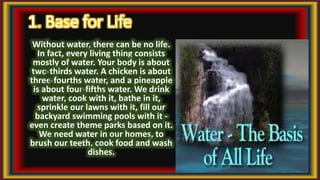
1. Base for Life
Without water, there can be no life.
In fact, every living thing consists
mostly of water. Your body is about
two-thirds water. A chicken is about
three-fourths water, and a pineapple
is about four-fifths water. We drink
water, cook with it, bathe in it,
sprinkle our lawns with it, fill our
backyard swimming pools with it -
even create theme parks based on it.
We need water in our homes, to
brush our teeth, cook food and wash
dishes.
2. Water for Agriculture Sector
Every plant, animal, and human being needs
water to stay alive. We need water for
irrigation, to raise crops in regions that do not
get enough rain. It is estimated that 70% of
world-wide water use is for irrigation. In some
areas of the world, irrigation is necessary to
grow any crop at all, in other areas it permits
more profitable crops to be grown or enhances
crop yield.
3. Water in living things
All living things need a lot of water to
carry out their life processes. Plants,
animals, and human beings must take
in nutrients (food substances). If the
body loses more than 20 per cent of its
normal water content, a person will die
painfully. Human beings must take in
about 2.4 liters of water a day.
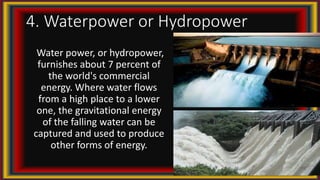
4. Waterpower or Hydropower
Water power, or hydropower,
furnishes about 7 percent of
the world's commercial
energy. Where water flows
from a high place to a lower
one, the gravitational energy
of the falling water can be
captured and used to produce
other forms of energy.
5. Water for Industry
It is estimated that 15% of world-
wide water use in industrial.
Major industrial users include
power plants, which use water
for cooling or as a power source
(i.e. hydroelectric plants), ore
and oil refineries, which use
water in chemical processes, and
manufacturing plants, which use
water as a dissolving something.
6. Water for Recreation
Today, people still depend on
water transportation to carry such
heavy and bulky products as
machinery, coal, grain, and oil.
People build most of their
recreation areas along lakes, rivers,
and seas. They enjoy water sports,
such as swimming, fishing, and
sailing.
7. Environment
Explicit environmental water use
is also a very small but growing
percentage of total water use.
Environmental water usage
includes artificial wetlands,
artificial lakes intended to create
wildlife habitat, fish ladders
around dams, and water releases
from reservoirs timed to help fish
eggs.
Pakistan Natural Resources

Pakistan Natural Resources

  • 2.
    Natural Resources OfPakistan  MINERAL RESOURCES  WATER RESOURCES  IRRIGATION SYSTEM OF PAKISTAN  POWER RESOURCES  FOREST RESOURCES
  • 3.
  • 4.
  • 5.
    1. Coal  BlackGold  850 Trillion Cubic Feet  Coal reserves 175 billion tons  618 billion barrels of crude oil
  • 6.
    2. Natural Gas 885.3billion cubic meters Daily production 19 million cubic meters 3. Crude Oil Covers 122.67 square kilometres 322 Barrels Of Oil
  • 7.
    5. Mineral Salt Minnedin the region since 320 BC  Khewra Salt Mines 110 square kilometres (42 Sq mi) 220 million tonnes of rock salt deposits 325,000 tons salt per annum
  • 8.
    6. Copper &Gold  170,000 metric tons of copper  300,000 ounces of gold a year  350,000 tons a year of copper  900,000 ounces of gold
  • 9.
    IRRIGATION SYSTEM OFPAKISTAN 1. Wells or Tube-wells It is the oldest method of irrigation in Pakistan. Wells and Tube-wells system is successful where water level is high and where canal system is not common. Animal power and electricity is used for to obtain water from wells and tube-wells. To utilize ground water 0.7 million tube wells have been installed.
  • 10.
    2. Canals Canal isan artificial waterway constructed for purposes of irrigation, drainage, or navigation, or in connection with a hydroelectric dam. Canal is the thing which brings river water close to the field where it is required to be.
  • 11.
    3. Perennial Canals: Thesecanals supply water throughout the year. Perennial canals are the canals that are used to supply water to the field and these are taken either from dams or barrages. Important Perennial Canals of Punjab are Upper Bari Doab, Lower Bari Doab, Sidhnai Canals, Upper and Lower Chenab, Upper Jhelum canals originating from Trimmu Headworks and Canals originating from river Sutlej at Ferozpur, Islam, Suleimanki and Panjnad Headworks.
  • 12.
    4. Inundation Canals (FloodCanals): These canals run only during the rainy season when water level in river rises. The quantity of water they supply is uncertain. These canals, like other canals, are taken from the rivers but the difference is that they get water when there is a rise in the water level due to flood. Many old canals from the Indus and the Chenab fall in this category.
  • 13.
    5. Link Canals Linkcanals are those canals which creates link between one river to an other rives to fulfill the shortage of water. There are a number of link canals constructed under Indus water treaty in Pakistan.
  • 14.
    6.Karez Karez is alsoan irrigation system which is adopted only in Baluchistan province. It is an underground-short canal system which is built to carry water at the foothill to the fields. Karez system is very popular in Pashin and Quetta districts.
  • 15.
    POWER RESOURCES A. HYDROELECTRICITY: Nature has provided suitable environment in Pakistan. To produce hydroelectricity environment is better for it. The northern and north western area of Pakistan is suitable for building of dams. Both public and private sectors have planned to increase the production of hydroelectricity in Pakistan. Pakistan's total hydroelectricity production is 4963 Megawatt. Pakistan has the capacity of production of 30000 MW from its river Indus, Jehlum and Chenab.
  • 16.
    1. Tarbela Dam Thisdam is situated on Indus River. The Tarbela dam produces 70% of the total hydroelectricity production of Pakistan. Its installed generation capacity is 3478 MW. The Tarbela Dam was constructed in 1976 and its cost was about Rs.18 billions. This dam is about 9000 feet long. The Tarbela is one of the biggest dams of the world.
  • 17.
    2. Mangla Dam Thisdam is located on Jehlum River. This dam installed generation capacity of power is 1000 MW which is 20% of total hydroelectricity of the country. This dam was constructed and completed in 1967 the height of this dam is 110 meters. This dam is made of concrete. This is second biggest dam in Pakistan.
  • 18.
    B. THERMAL ELECTRICITY: TheThermal power stations are generating electricity by gas, oil and coal in Pakistan. The 49.8% of the total electricity is produced by the thermal power. The thermal power production is 4921 MW in Pakistan. There are 13 thermal power stations working in Pakistan. The biggest station is working in Karachi this station generates 1756 MW. The second biggest station is working in Multan. It generates 260 MW
  • 19.
    Important Thermal Stations FuturePlans A large number of projects have been planned to meet future energy requirements of Pakistan. This project is working rapidly. If this project works better than our country will make progress by leaps and bounds.
  • 20.
    C. SOLAR ENERGY: Theenergy that we get from sun is called solar energy. We have abundance of this energy but important thing is the maximum use of it. This energy is used to operate small machines and motor in future the solar energy will become the biggest source of energy of the world because other sources are costly and difficult to exploit.
  • 21.
    Advance Energy 1. AtomicEnergy Atomic energy is the advance source of this world. Although this source of energy is very sophisticated and multi disciplinary system. As the rapid growth of population sources are also increasing at the same rate. That's why it is an important source of energy indeveloping countries
  • 22.
    2. Pakistan isan Atomic Power By the grace of Allah Pakistan has become a great Atomic Power. Pakistan has operated Atomic blasts in Chagi in Balochistan on 28 May 1998. Pakistan had to face many difficulties to achieve progress in the atomic program
  • 23.
    3. Nuclear Power Technology NuclearPower technology was introduced in Pakistan in 1971 when a plant of 136 MW capacity namely Karachi. Nuclear power plant (KANUPP) was installed. This plant has been operating safely for more than 31 years. IN other important Cheshma nuclear power project is also working with the help of China. This has been connected to the national grid on June 13 2000. It has a gross capacity of 325 MW and is located near Cheshma Barrage on left bank of river Indus.
  • 24.
    FOREST RESOURCES Forests arelimited to 4% of Pakistan’s land; nonetheless the forests are a main source of food, lumber, paper, fuel wood and medicine. The forests are also used for wildlife conversation and ecotourism.
  • 25.
    1. More Production Naturalresources are helpful to increase in level of productivity by applying modern techniques of production. If a country is rich in resources it means there are more possibilities to enhance the production.
  • 26.
    2. Agriculture Development Availabilityof natural resources like fertile land, favourable climatic conditions and more water resources are necessary for the development of agriculture sector. Resources are also required to develop the agro based industries.
  • 27.
    3. Industrial Development Developmentof agriculture sector means the development of industrial sector. Power and energy resources like oil and gas etc. are like primary requirement of industrial development. Iron and steel resources are helpful to develop the industrial sector. Furniture and fishing industries are mainly depend upon natural resources.
  • 28.
    4. Increase inForex Pakistan is exporting food items, textile goods, petroleum and some other goods which is only and only possible due to availability of natural resources. Accordingly natural resources increase the forex resources of a country.
  • 29.
    5. Infrastructure Development Developmentof infrastructure like water, sanitation, roads, energy and electricity is possible only with the help of various natural resources. Developed infrastructure is necessary for the economic and social development of a country.
  • 30.
    6. Transportation Extraction ofresources and movement of resources develops the transport system in a country. Transportations like railways, road, water and air transport is playing a vital role in the economic and social development of a country.
  • 31.
    7. High LivingStandard Availability and proper use of natural resources is compulsory to improve the living standard of the population. Natural resources play very important role in the economic development that leads to high living standard. 8. More Employments Natural resources like forests, fisheries and oil extractions have provided a lot of jobs to population. More employment opportunities develop the social set up of a country.
  • 32.
    9. Urbanization Utilization ofnatural resources has increased the process of urbanization in the country. It has developed some new cities and developed the some existing cities.
  • 33.
    WATER RESOURCES  Asper World Health Organization (WHO) report 80 percent of the diseases are due to unhygienic conditions and unsafe drinking water.  65% of population have access to safe drinking water  0.884 billion people lack access to safe water  2.5 billion lack access to basic sanitation
  • 34.
    1. Base forLife Without water, there can be no life. In fact, every living thing consists mostly of water. Your body is about two-thirds water. A chicken is about three-fourths water, and a pineapple is about four-fifths water. We drink water, cook with it, bathe in it, sprinkle our lawns with it, fill our backyard swimming pools with it - even create theme parks based on it. We need water in our homes, to brush our teeth, cook food and wash dishes.
  • 35.
    2. Water forAgriculture Sector Every plant, animal, and human being needs water to stay alive. We need water for irrigation, to raise crops in regions that do not get enough rain. It is estimated that 70% of world-wide water use is for irrigation. In some areas of the world, irrigation is necessary to grow any crop at all, in other areas it permits more profitable crops to be grown or enhances crop yield.
  • 36.
    3. Water inliving things All living things need a lot of water to carry out their life processes. Plants, animals, and human beings must take in nutrients (food substances). If the body loses more than 20 per cent of its normal water content, a person will die painfully. Human beings must take in about 2.4 liters of water a day.
  • 37.
    4. Waterpower orHydropower Water power, or hydropower, furnishes about 7 percent of the world's commercial energy. Where water flows from a high place to a lower one, the gravitational energy of the falling water can be captured and used to produce other forms of energy.
  • 38.
    5. Water forIndustry It is estimated that 15% of world- wide water use in industrial. Major industrial users include power plants, which use water for cooling or as a power source (i.e. hydroelectric plants), ore and oil refineries, which use water in chemical processes, and manufacturing plants, which use water as a dissolving something.
  • 39.
    6. Water forRecreation Today, people still depend on water transportation to carry such heavy and bulky products as machinery, coal, grain, and oil. People build most of their recreation areas along lakes, rivers, and seas. They enjoy water sports, such as swimming, fishing, and sailing.
  • 40.
    7. Environment Explicit environmentalwater use is also a very small but growing percentage of total water use. Environmental water usage includes artificial wetlands, artificial lakes intended to create wildlife habitat, fish ladders around dams, and water releases from reservoirs timed to help fish eggs.