CHINA Panorama
Markhor
Pakistan
• Leader: Muhammad Asghar Hassan
• Ahmad Latif Virk
• Mujahid Hussain
• Muhammad Asif
• Muhammad Mahran Aslam
Polo
 Over view
 Geography of Pakistan
 The Northern Highlands
 The Indus Plain
 Sistan Basis
 Traditional Geographical Importance of Pakistan
 Modern Geographical Importance of Pakistan
 Climate
 Agriculture
Contents:
Over view
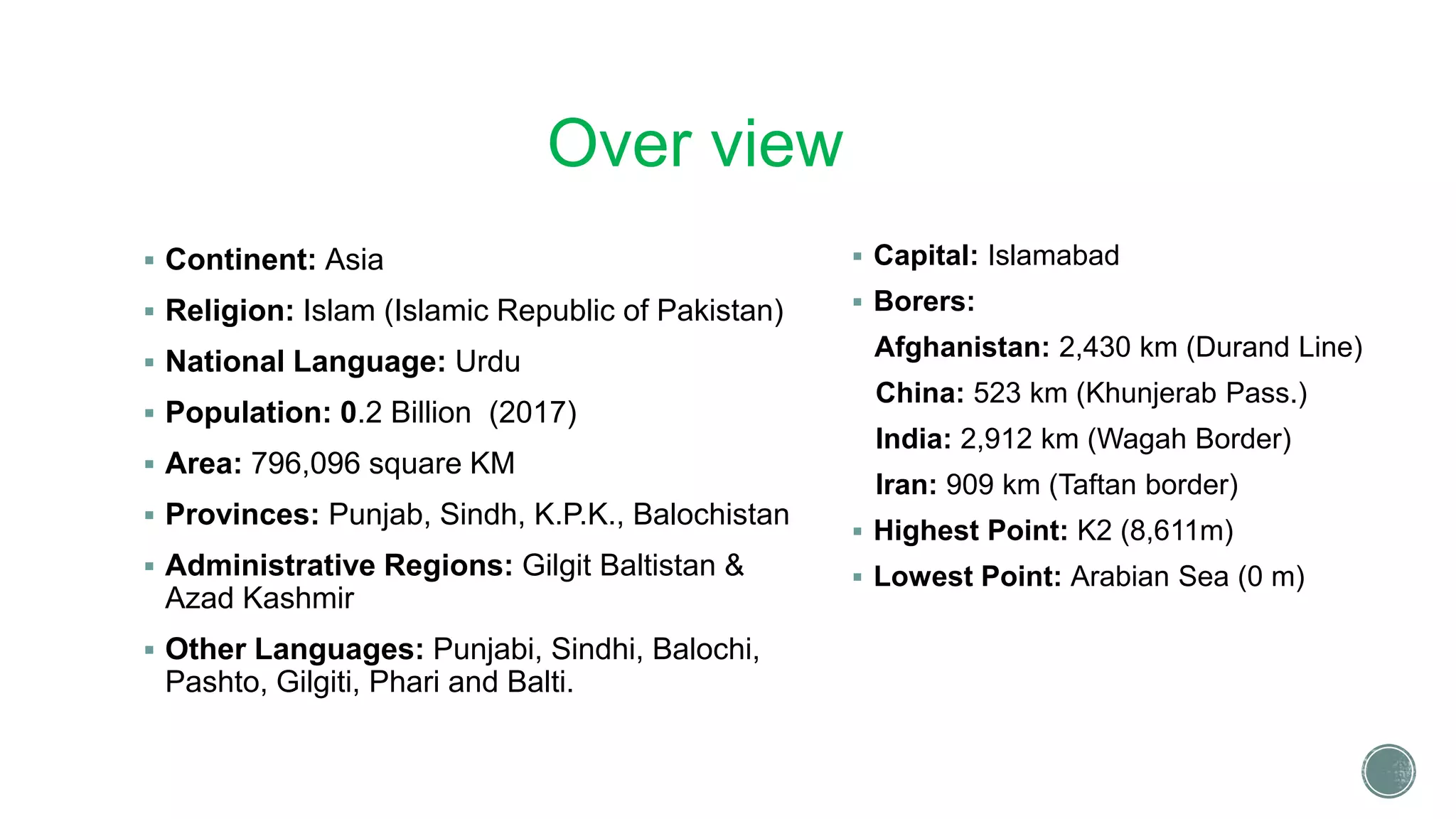
 Capital: Islamabad
 Borers:
Afghanistan: 2,430 km (Durand Line)
China: 523 km (Khunjerab Pass.)
India: 2,912 km (Wagah Border)
Iran: 909 km (Taftan border)
 Highest Point: K2 (8,611m)
 Lowest Point: Arabian Sea (0 m)
 Continent: Asia
 Religion: Islam (Islamic Republic of Pakistan)
 National Language: Urdu
 Population: 0.2 Billion (2017)
 Area: 796,096 square KM
 Provinces: Punjab, Sindh, K.P.K., Balochistan
 Administrative Regions: Gilgit Baltistan &
Azad Kashmir
 Other Languages: Punjabi, Sindhi, Balochi,
Pashto, Gilgiti, Phari and Balti.
Pakistan gained Independence on
14th August, 1947.
China was Liberated on October
1st, 1949.
In 1950, Pakistan was first amongst Muslim countries who recognized Peoples Republic of
China in 1950, and started diplomatic relations in 1951, officially.
INDEPENDENCE
4
CULTURAL RELATIONSHIPS
5
CULTURAL RELATIONSHIPS
6
Muhammad Ali Jinnah (Quaid e Azam) & Allama Muhammad Iqbal (Poet of East)
National Heroes
7
Pakistani Scientists
8
Dr. Abdul Qadeer Khan (Nuclear Scientist) 9
Dr. Samar Mubarakmand (Nuclear Scientist) 10
Recently inducted as “Academician”
of the Chinese Academy of Sciences
(CAS), on 28th May, 2018.
Prof. Atta Ur Rahman (FRS) 11
Nobel Prize Winner
Nobel Prize in Physics
(1979)
12
Nobel Prize Winner
One child, one
teacher, one book, and
one pen can change
the world.
13
Famous Personalities
Edhi Foundation
World’s largest volunteer
ambulance network
along with homeless
shelters, animal shelters,
and orphanages across
Pakistan…
Abdul Sattar Edhi (1928-2016) 14
Pakistan’s Culture: A Bird’s
Eye View
15
Khewra Salt Mines, World’s oldest but 2nd largest,
originated 800 million years ago
16
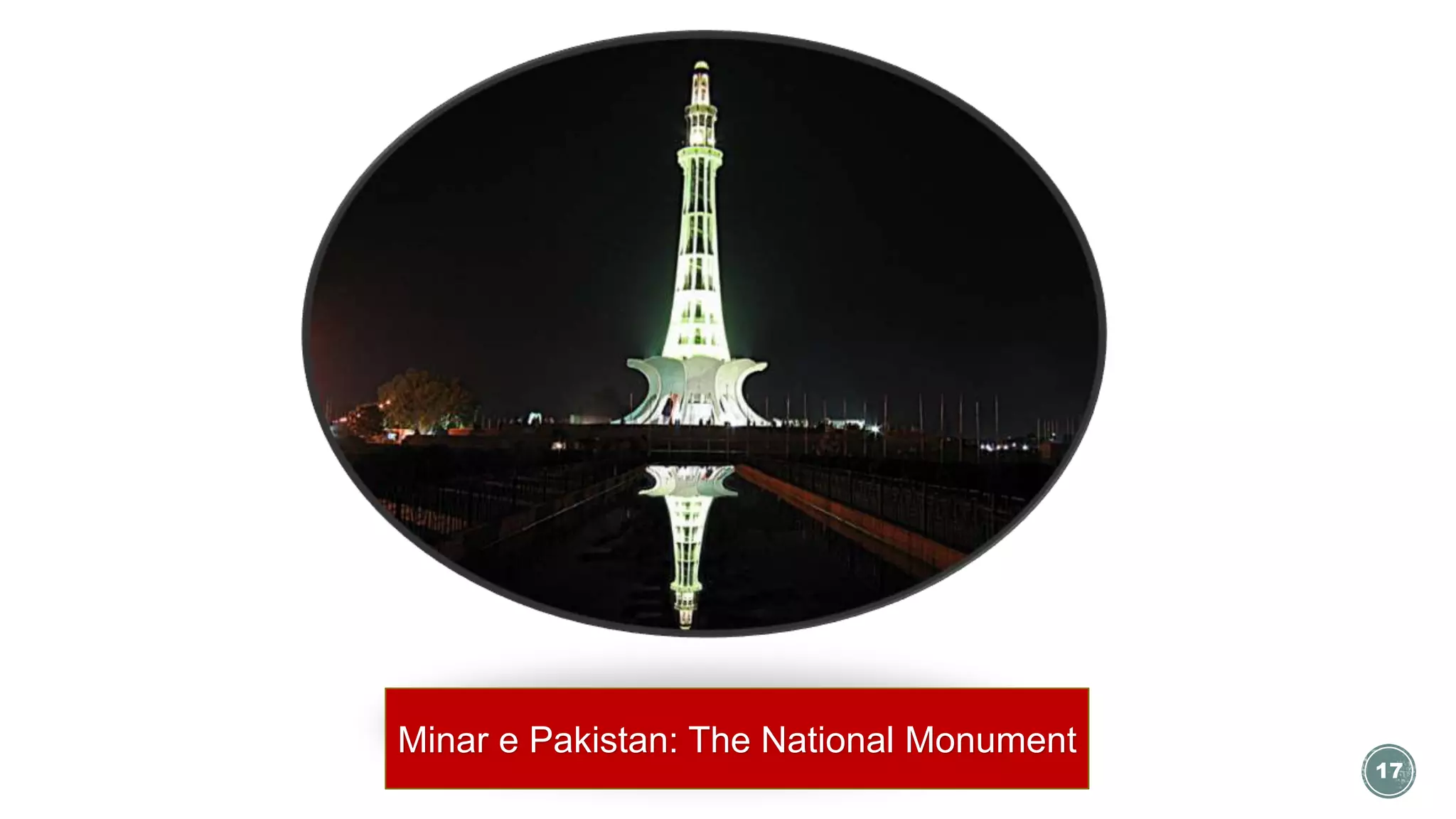
Minar e Pakistan: The National Monument
17
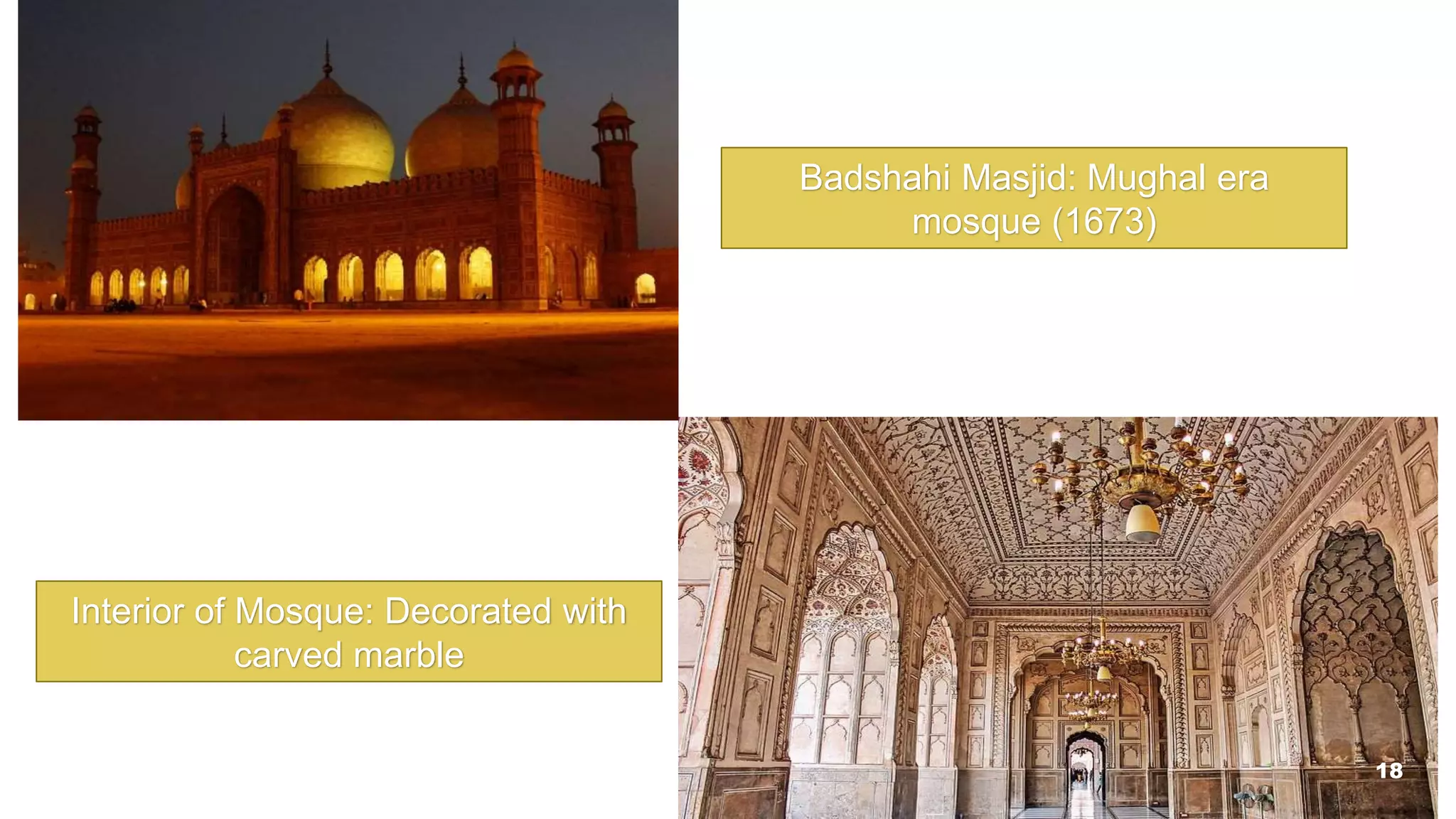
Badshahi Masjid: Mughal era
mosque (1673)
Interior of Mosque: Decorated with
carved marble
18
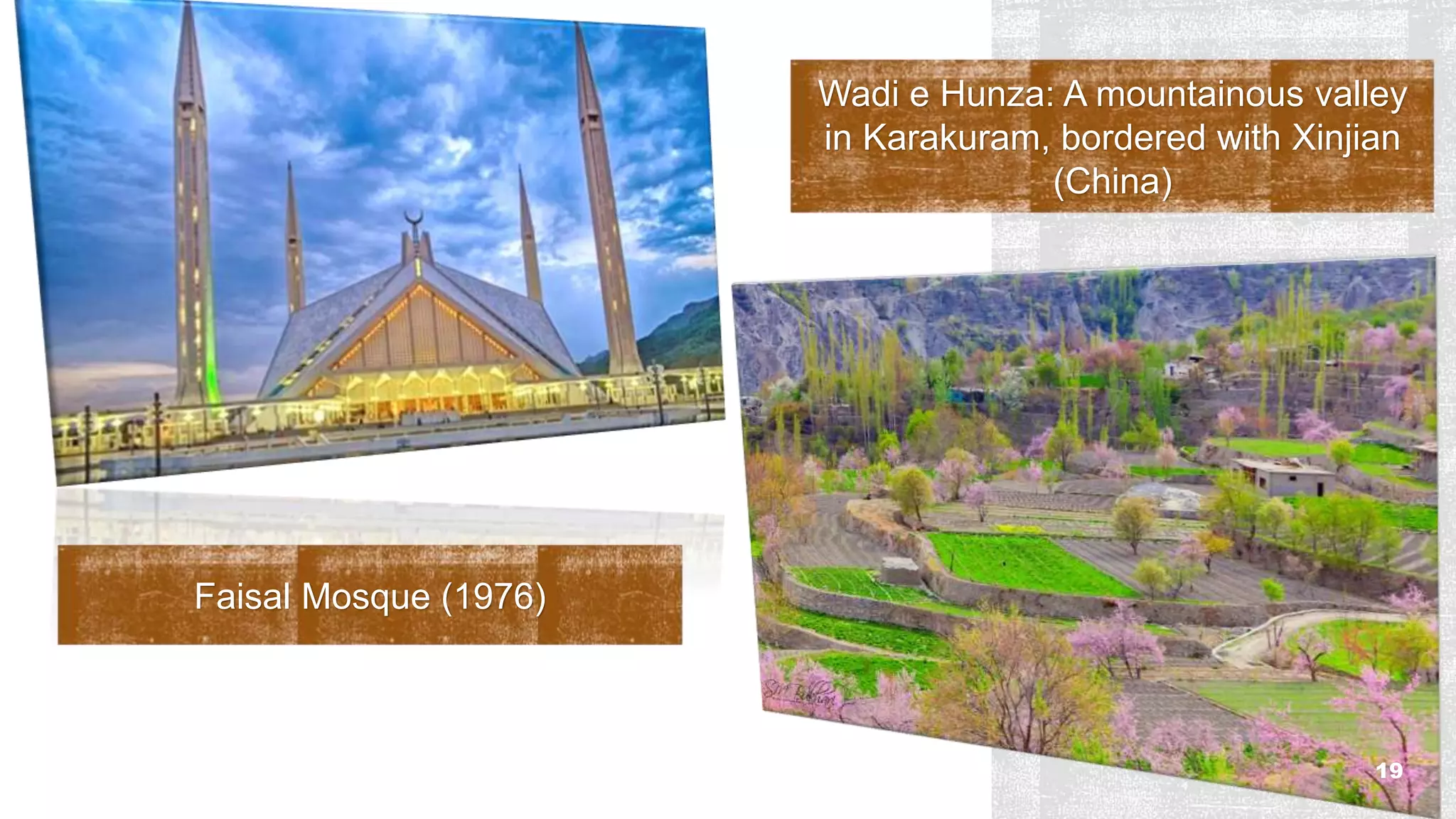
Faisal Mosque (1976)
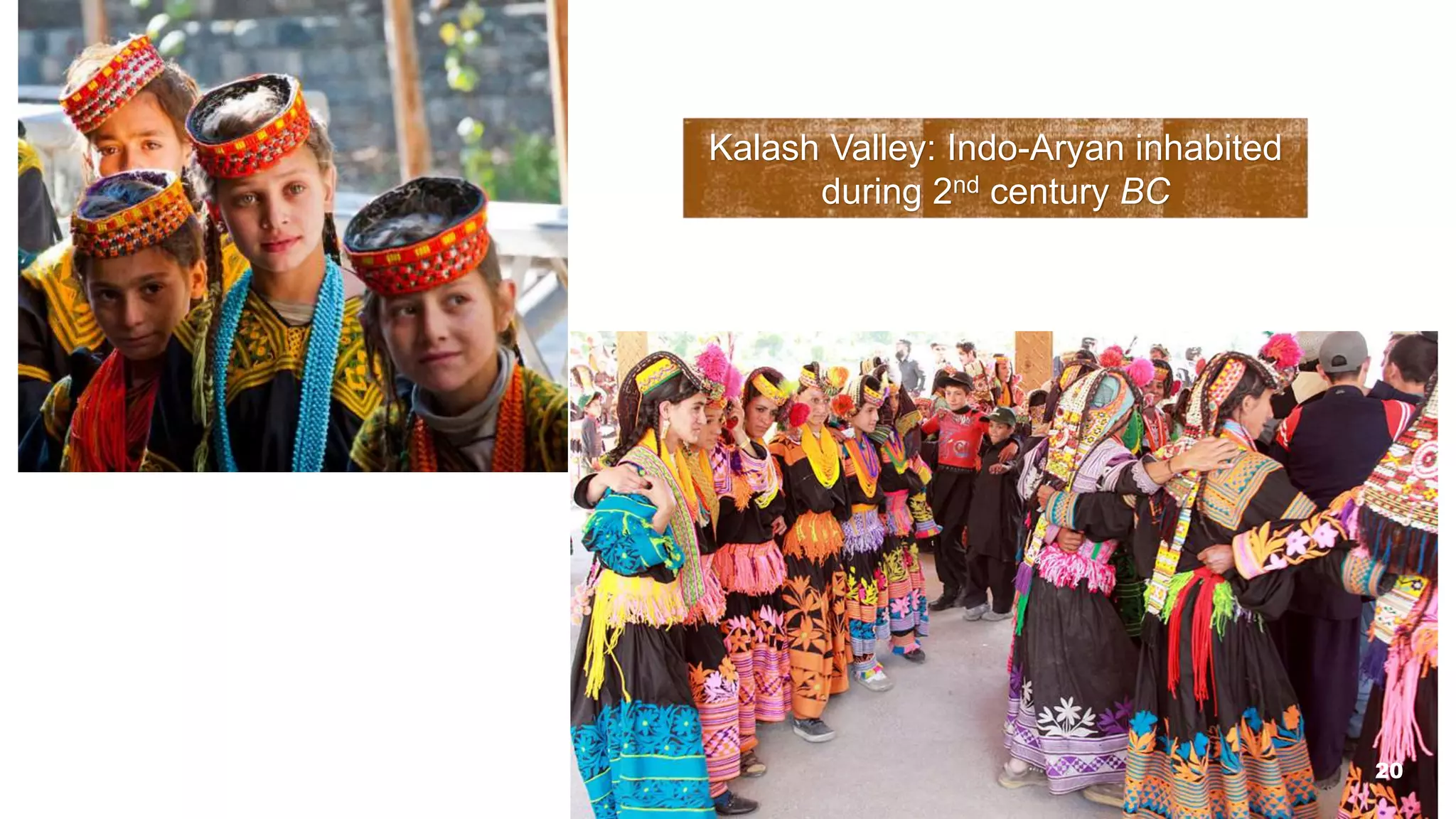
Wadi e Hunza: A mountainous valley
in Karakuram, bordered with Xinjian
(China)
19
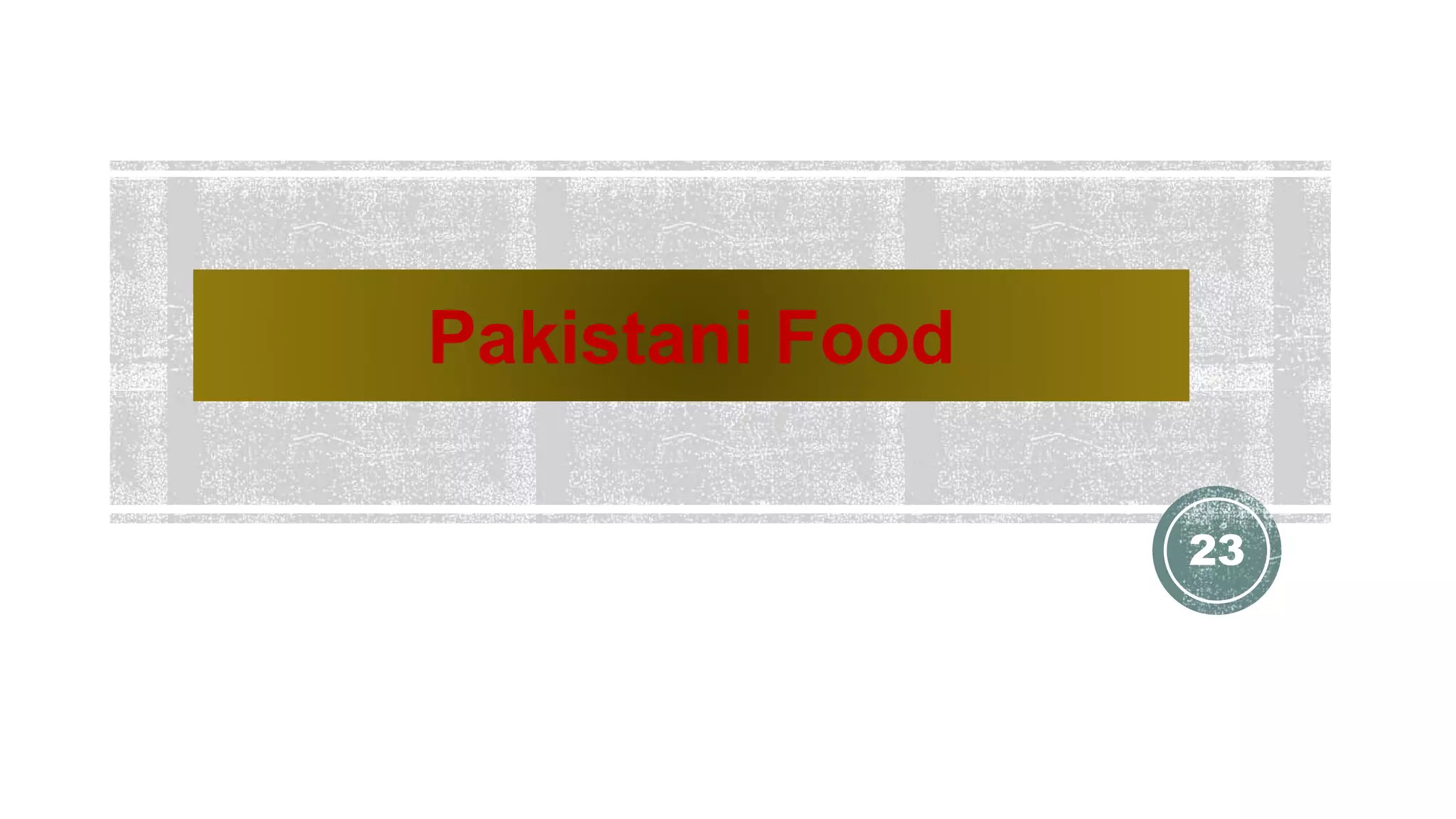
Kalash Valley: Indo-Aryan inhabited
during 2nd century BC
20
Shandur Polo Festival
21
GRAND THAR DESERT
CHOLISTAN: GREAT INDIAN DESERT
Darawar Fort (9th century)
22
Pakistani Food
23
24
25
26
Marriage Ceremony
27
There are four main families of musical instruments in Pakistan and
more than six hundred Pakistani musical instruments; the most well
known are the sitar, tabla, rabab, dhool and bansuri.
Pakistani Music
28
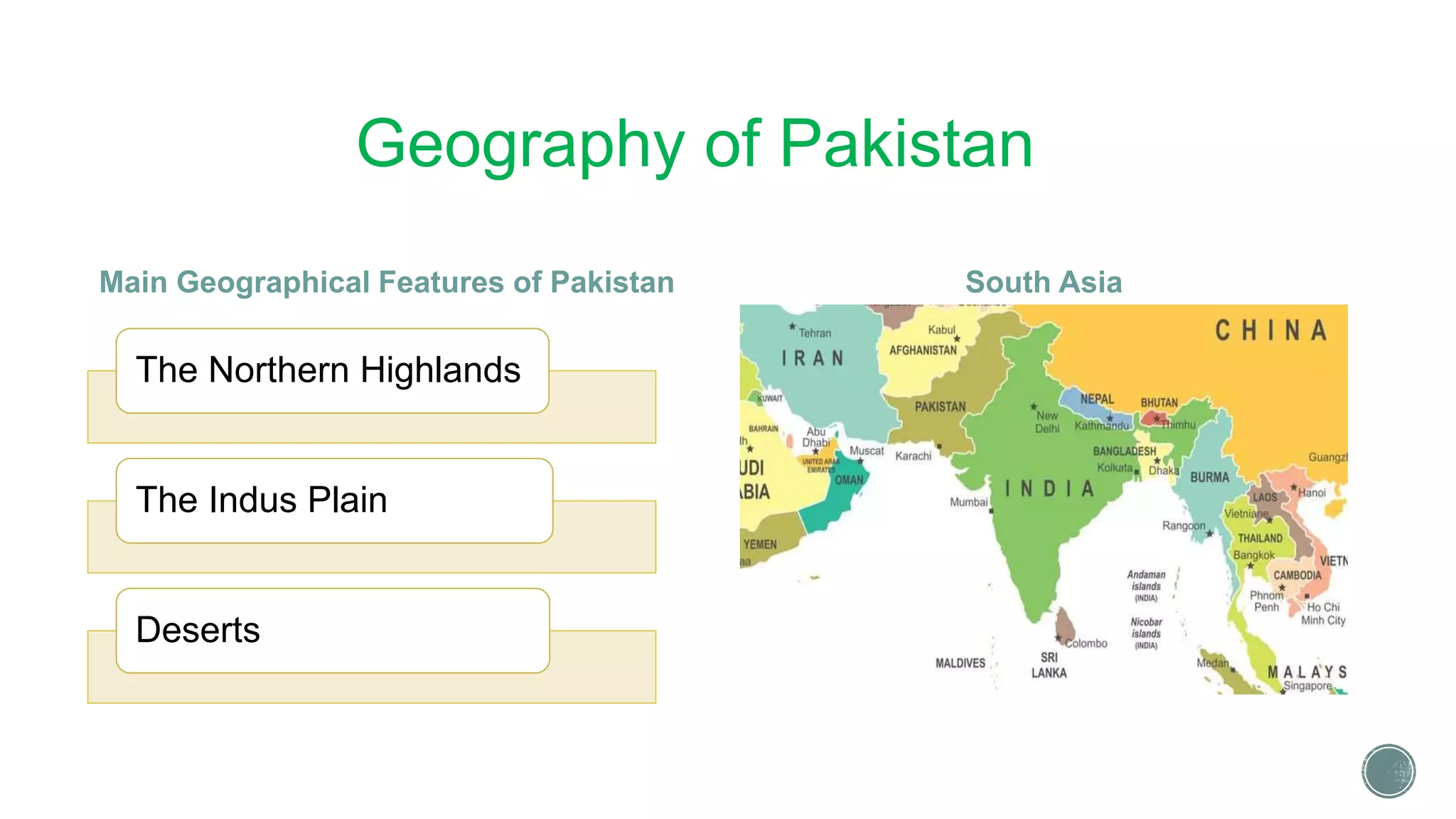
Main Geographical Features of Pakistan South Asia
Geography of Pakistan
The Northern Highlands
The Indus Plain
Deserts
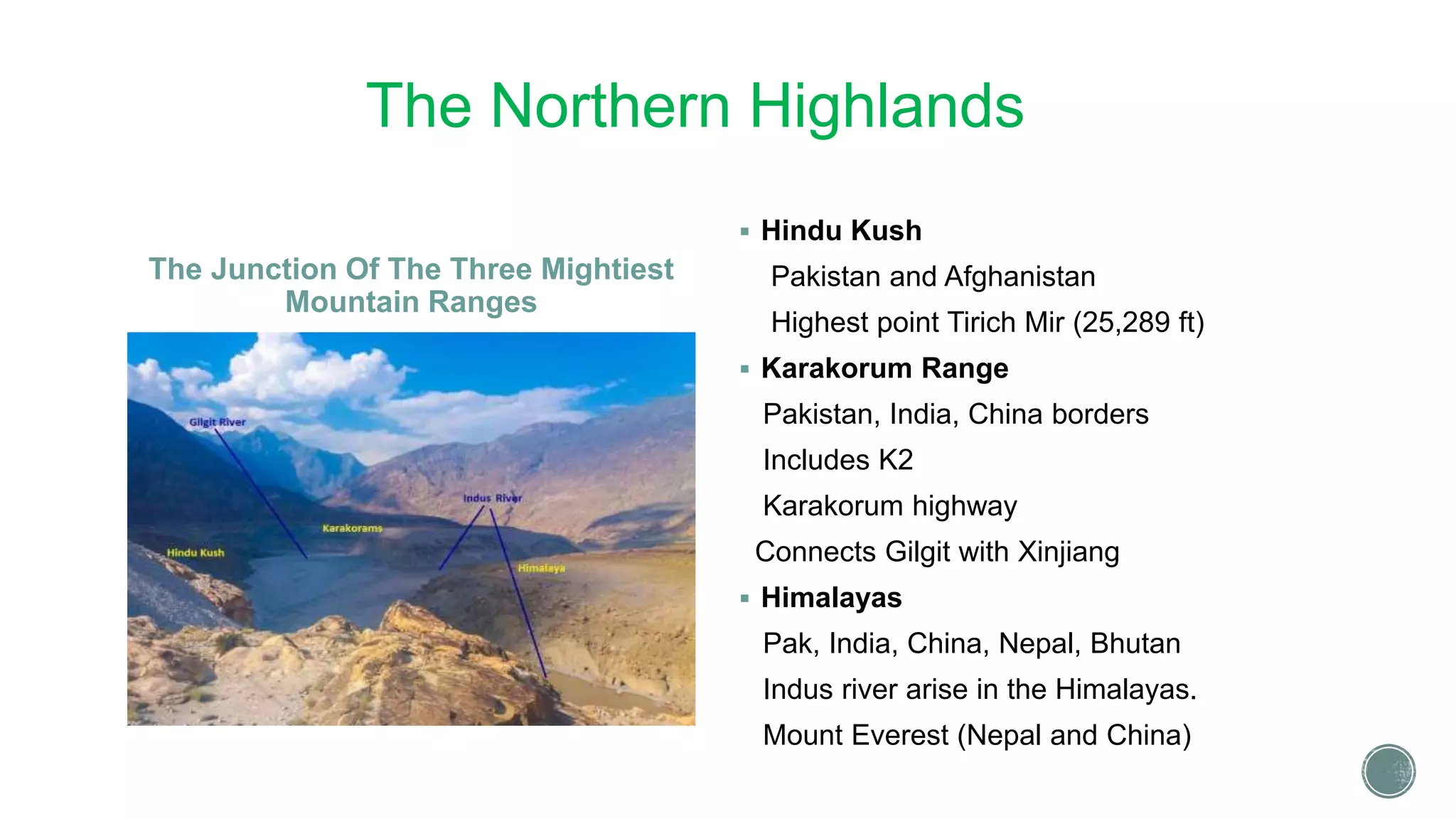
The Junction Of The Three Mightiest
Mountain Ranges
 Hindu Kush
Pakistan and Afghanistan
Highest point Tirich Mir (25,289 ft)
 Karakorum Range
Pakistan, India, China borders
Includes K2
Karakorum highway
Connects Gilgit with Xinjiang
 Himalayas
Pak, India, China, Nepal, Bhutan
Indus river arise in the Himalayas.
Mount Everest (Nepal and China)
The Northern Highlands
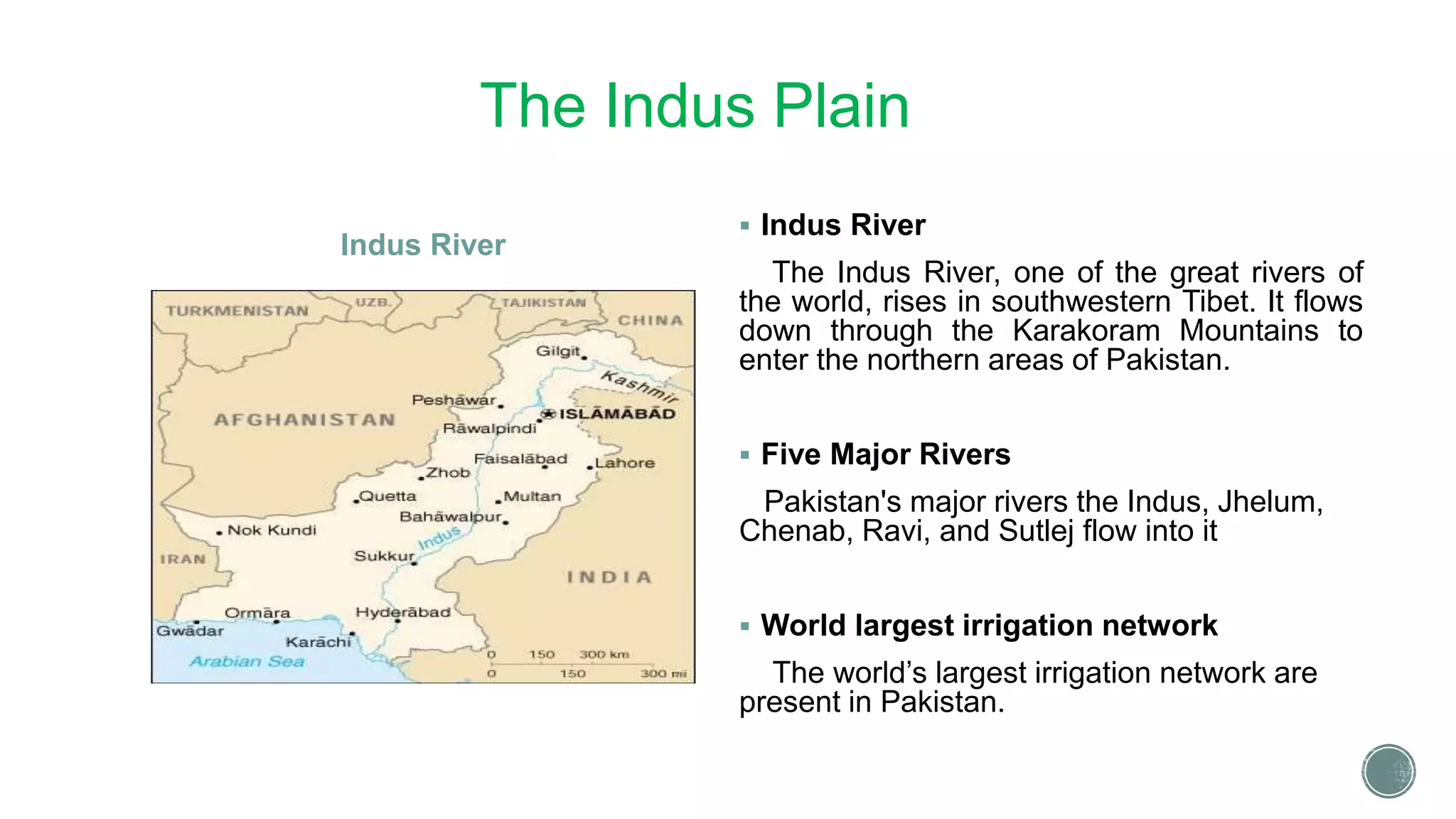
Indus River
The Indus Plain
 Indus River
The Indus River, one of the great rivers of
the world, rises in southwestern Tibet. It flows
down through the Karakoram Mountains to
enter the northern areas of Pakistan.
 Five Major Rivers
Pakistan's major rivers the Indus, Jhelum,
Chenab, Ravi, and Sutlej flow into it
 World largest irrigation network
The world’s largest irrigation network are
present in Pakistan.
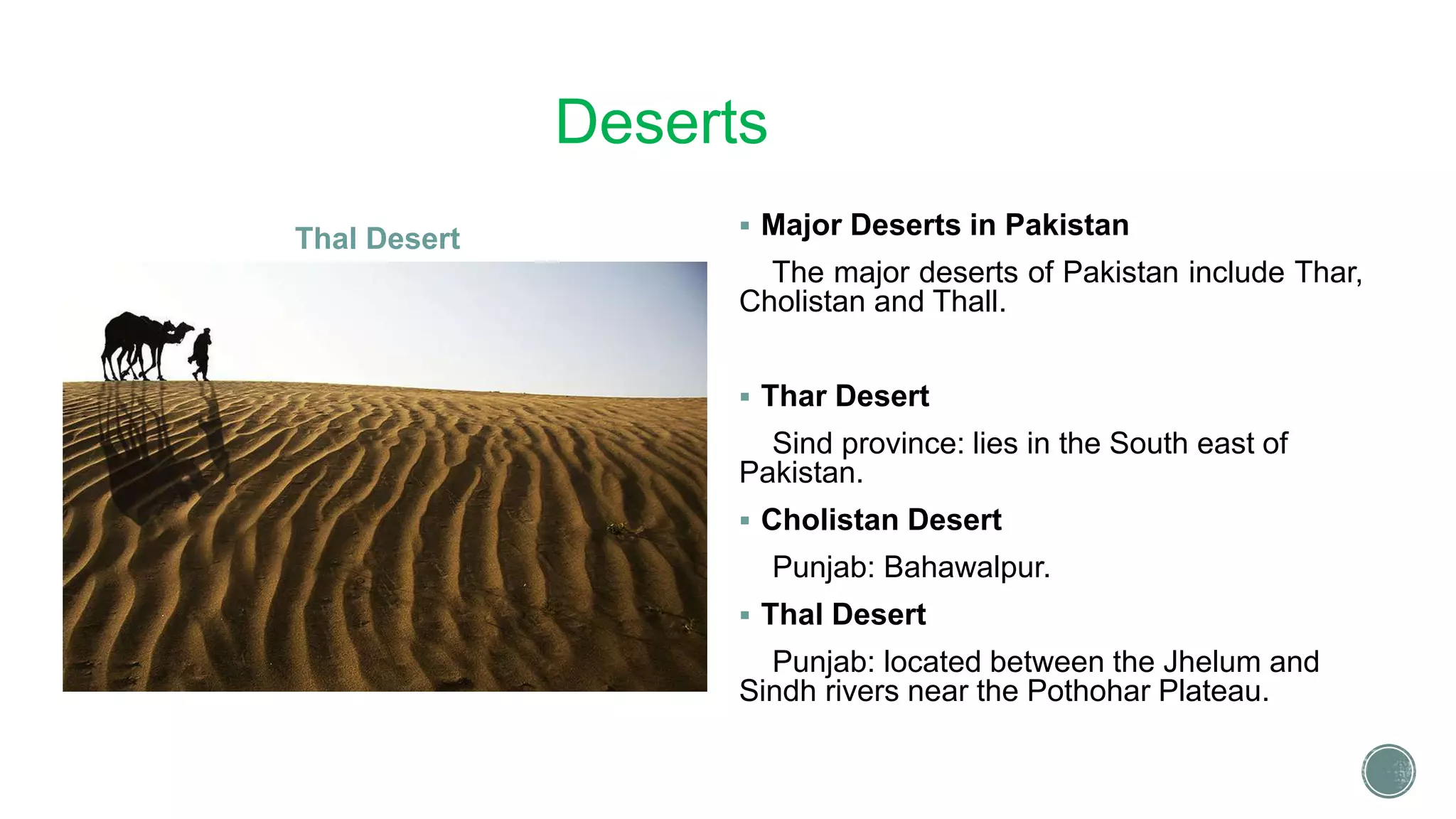
Thal Desert
Deserts
 Major Deserts in Pakistan
The major deserts of Pakistan include Thar,
Cholistan and Thall.
 Thar Desert
Sind province: lies in the South east of
Pakistan.
 Cholistan Desert
Punjab: Bahawalpur.
 Thal Desert
Punjab: located between the Jhelum and
Sindh rivers near the Pothohar Plateau.
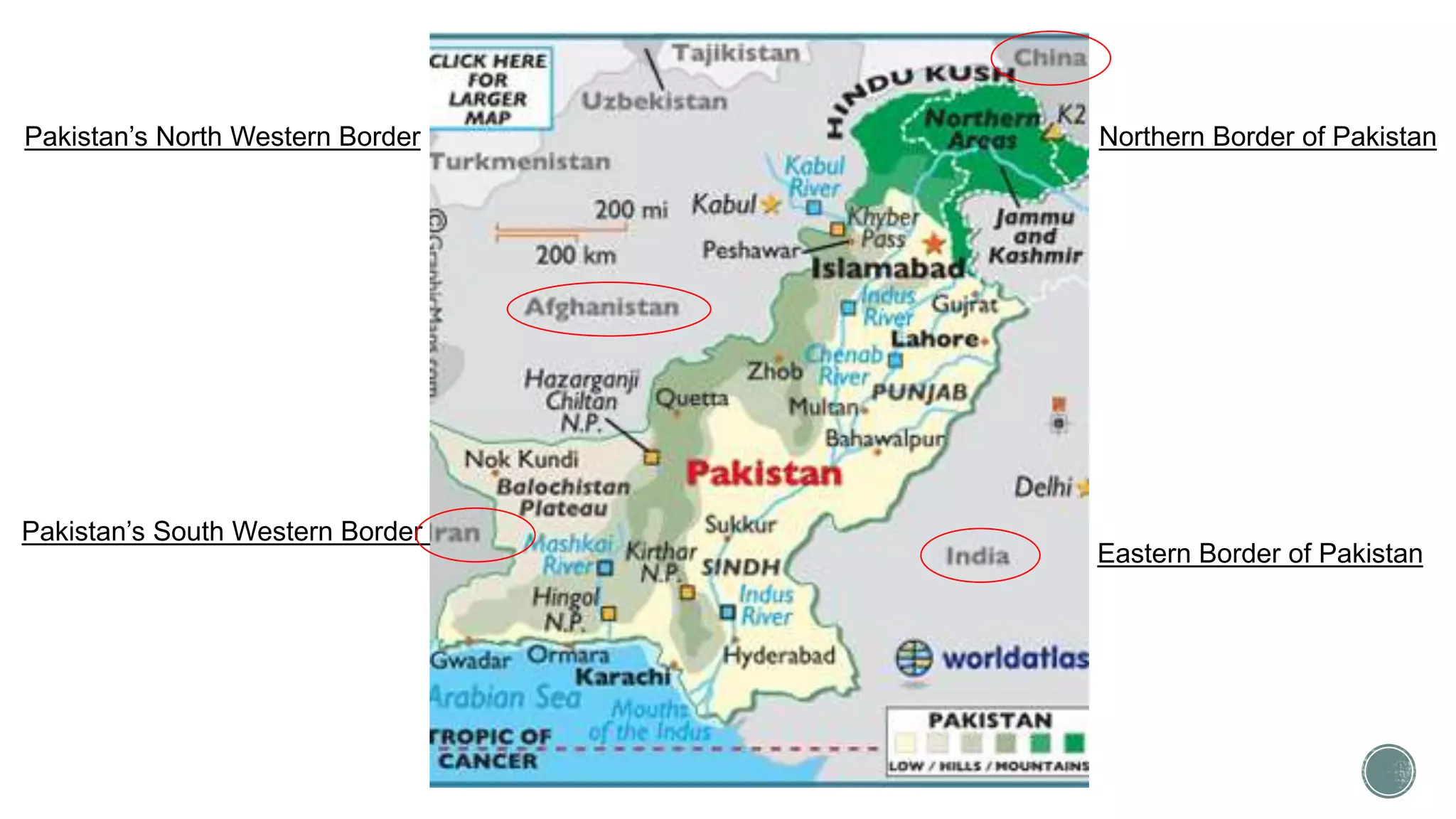
Pakistan’s North Western Border can be used as an access to the Central Asian
Republics rich in natural resources. It’s a narrow strip of Afghan Territory
between Tajikistan and Pakistan which if used as a transit route can benefit all
the countries in trade.
Pakistan’s South Western Border with Iran is of great significance in a trade with
this oil-rich country.
Eastern Border of Pakistan with India has been quite less utilized than the
potential it carries. This can be a free trade route with India if the major conflicts
between both the states are resolved.
Northern Border of Pakistan with China provides another important route for
access of Chinese products in Pakistan
Pakistan’s North Western Border
Pakistan’s South Western Border
Eastern Border of Pakistan
Northern Border of Pakistan
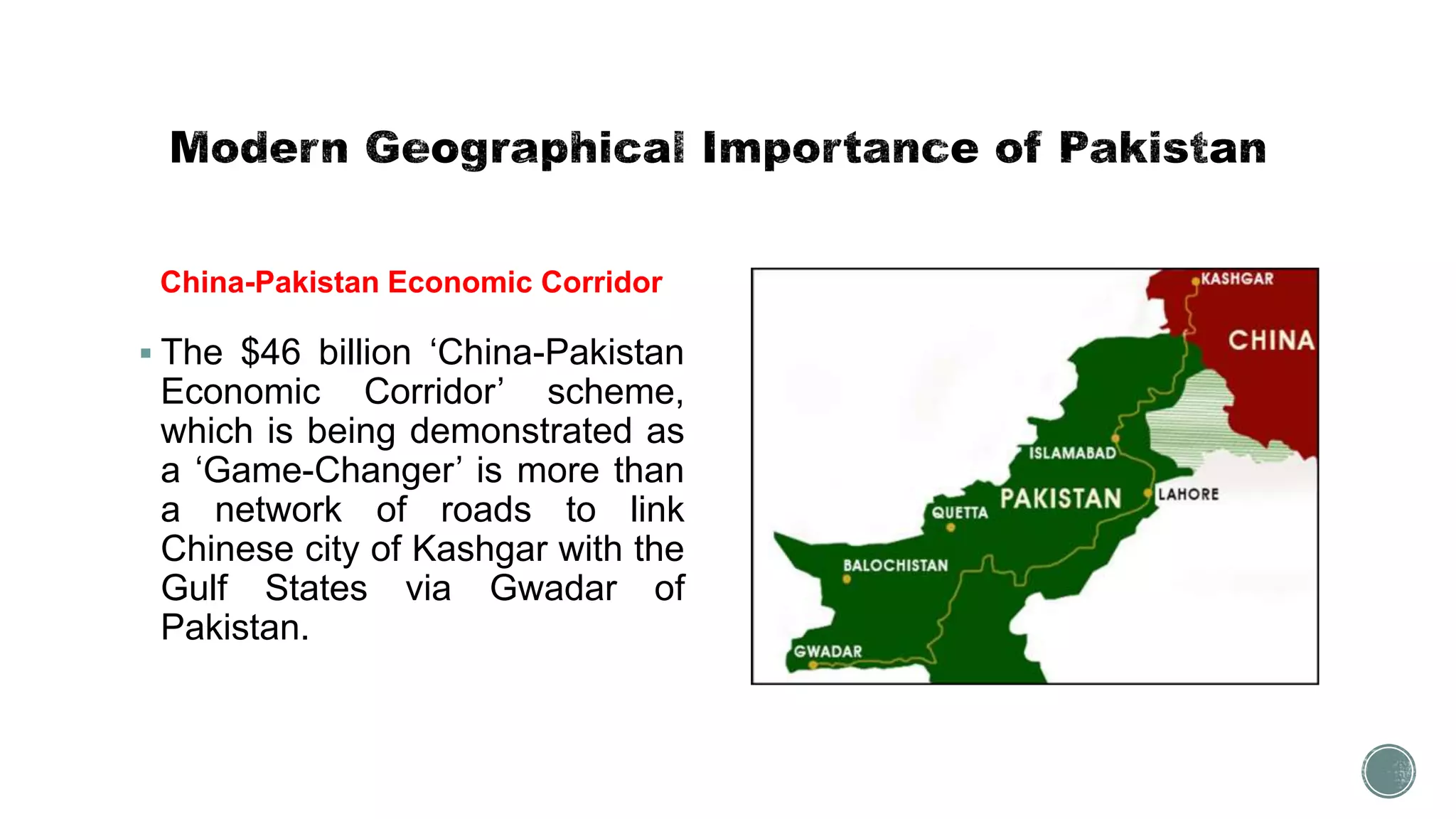
China-Pakistan Economic Corridor
 The $46 billion ‘China-Pakistan
Economic Corridor’ scheme,
which is being demonstrated as
a ‘Game-Changer’ is more than
a network of roads to link
Chinese city of Kashgar with the
Gulf States via Gwadar of
Pakistan.
The Persian Gulf and Pars Gas Field
 Pakistan’s Gwadar Port provides
access to the ‘Gulf of Oman’ which
extends via ‘Strait of Hormuz’ to
form the ‘Persian Gulf’. This gulf is
surrounded by Iran, UAE, Saudi
Araba, Bahrain, Qatar, Kuwait and
Iraq. Access to the Persian Gulf via
Gwadar port means access to all
these countries most of which are
rich in energy resources.
Iran-Pakistan Gas Pipeline
 Also known as the ‘Peace
Pipeline’ the project is another
fruit of Pakistan’s geographic
importance. The pipeline project
was formally inaugurated in
2013, but it’s far from being
operational due to several
controversies.
North Eastren and North Westren
Mountain Areas:
 Very High From Sea Level.
 Snow Fall During Winter
 Pleasant Weather During Summer
 40 Inches Rain Per Year
Plains of Sindh and Punjab:
Climate
 Summer Very Hot Temp > 52 Degrees
 30 Inches Rain Per Year
 Less Rain
 Dry
 Hot Summer
 Pleasant Weather Whole Year.
 7 Inch Rain Per Year
Baluchistan Pleatue
Costal Areas
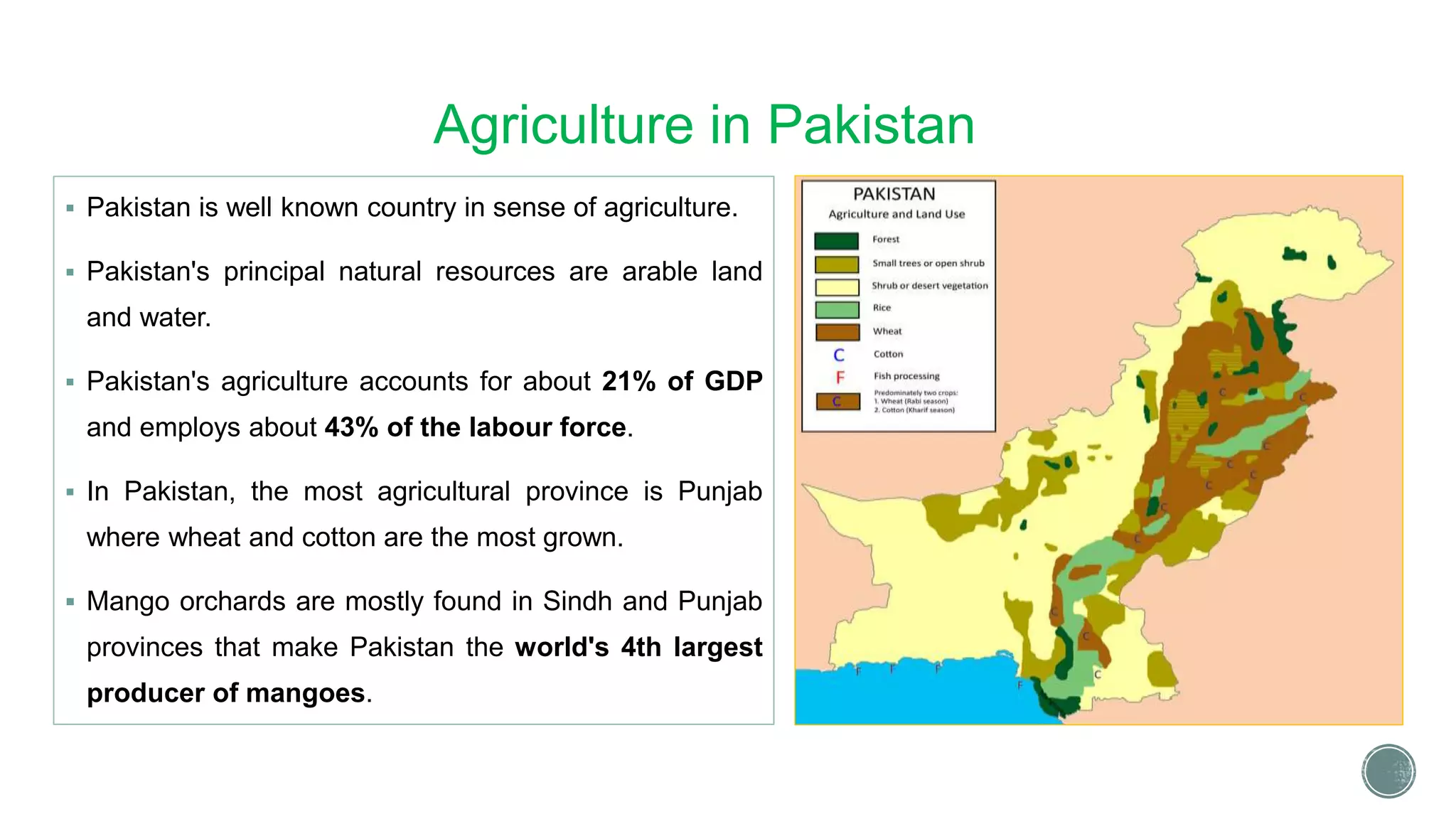
Agriculture in Pakistan
 Pakistan is well known country in sense of agriculture.
 Pakistan's principal natural resources are arable land
and water.
 Pakistan's agriculture accounts for about 21% of GDP
and employs about 43% of the labour force.
 In Pakistan, the most agricultural province is Punjab
where wheat and cotton are the most grown.
 Mango orchards are mostly found in Sindh and Punjab
provinces that make Pakistan the world's 4th largest
producer of mangoes.
Major crops in Pakistan
 There are lot of minor and major and minor crops in Pakistan depending on 4 season
but 7 following major crops in Pakistan are mentioned below.
 Wheat
 Rice
 Cotton
 Maize
 Sugarcane
 Barley
 Millet
An introduction to Pakistan

An introduction to Pakistan

  • 1.
    CHINA Panorama Markhor Pakistan • Leader:Muhammad Asghar Hassan • Ahmad Latif Virk • Mujahid Hussain • Muhammad Asif • Muhammad Mahran Aslam Polo
  • 2.
     Over view Geography of Pakistan  The Northern Highlands  The Indus Plain  Sistan Basis  Traditional Geographical Importance of Pakistan  Modern Geographical Importance of Pakistan  Climate  Agriculture Contents:
  • 3.
    Over view  Capital:Islamabad  Borers: Afghanistan: 2,430 km (Durand Line) China: 523 km (Khunjerab Pass.) India: 2,912 km (Wagah Border) Iran: 909 km (Taftan border)  Highest Point: K2 (8,611m)  Lowest Point: Arabian Sea (0 m)  Continent: Asia  Religion: Islam (Islamic Republic of Pakistan)  National Language: Urdu  Population: 0.2 Billion (2017)  Area: 796,096 square KM  Provinces: Punjab, Sindh, K.P.K., Balochistan  Administrative Regions: Gilgit Baltistan & Azad Kashmir  Other Languages: Punjabi, Sindhi, Balochi, Pashto, Gilgiti, Phari and Balti.
  • 4.
    Pakistan gained Independenceon 14th August, 1947. China was Liberated on October 1st, 1949. In 1950, Pakistan was first amongst Muslim countries who recognized Peoples Republic of China in 1950, and started diplomatic relations in 1951, officially. INDEPENDENCE 4
  • 5.
  • 6.
  • 7.
    Muhammad Ali Jinnah(Quaid e Azam) & Allama Muhammad Iqbal (Poet of East) National Heroes 7
  • 8.
  • 9.
    Dr. Abdul QadeerKhan (Nuclear Scientist) 9
  • 10.
    Dr. Samar Mubarakmand(Nuclear Scientist) 10
  • 11.
    Recently inducted as“Academician” of the Chinese Academy of Sciences (CAS), on 28th May, 2018. Prof. Atta Ur Rahman (FRS) 11
  • 12.
    Nobel Prize Winner NobelPrize in Physics (1979) 12
  • 13.
    Nobel Prize Winner Onechild, one teacher, one book, and one pen can change the world. 13
  • 14.
    Famous Personalities Edhi Foundation World’slargest volunteer ambulance network along with homeless shelters, animal shelters, and orphanages across Pakistan… Abdul Sattar Edhi (1928-2016) 14
  • 15.
    Pakistan’s Culture: ABird’s Eye View 15
  • 16.
    Khewra Salt Mines,World’s oldest but 2nd largest, originated 800 million years ago 16
  • 17.
    Minar e Pakistan:The National Monument 17
  • 18.
    Badshahi Masjid: Mughalera mosque (1673) Interior of Mosque: Decorated with carved marble 18
  • 19.
    Faisal Mosque (1976) Wadie Hunza: A mountainous valley in Karakuram, bordered with Xinjian (China) 19
  • 20.
    Kalash Valley: Indo-Aryaninhabited during 2nd century BC 20
  • 21.
  • 22.
    GRAND THAR DESERT CHOLISTAN:GREAT INDIAN DESERT Darawar Fort (9th century) 22
  • 23.
  • 24.
  • 25.
  • 26.
  • 27.
  • 28.
    There are fourmain families of musical instruments in Pakistan and more than six hundred Pakistani musical instruments; the most well known are the sitar, tabla, rabab, dhool and bansuri. Pakistani Music 28
  • 29.
    Main Geographical Featuresof Pakistan South Asia Geography of Pakistan The Northern Highlands The Indus Plain Deserts
  • 30.
    The Junction OfThe Three Mightiest Mountain Ranges  Hindu Kush Pakistan and Afghanistan Highest point Tirich Mir (25,289 ft)  Karakorum Range Pakistan, India, China borders Includes K2 Karakorum highway Connects Gilgit with Xinjiang  Himalayas Pak, India, China, Nepal, Bhutan Indus river arise in the Himalayas. Mount Everest (Nepal and China) The Northern Highlands
  • 31.
    Indus River The IndusPlain  Indus River The Indus River, one of the great rivers of the world, rises in southwestern Tibet. It flows down through the Karakoram Mountains to enter the northern areas of Pakistan.  Five Major Rivers Pakistan's major rivers the Indus, Jhelum, Chenab, Ravi, and Sutlej flow into it  World largest irrigation network The world’s largest irrigation network are present in Pakistan.
  • 32.
    Thal Desert Deserts  MajorDeserts in Pakistan The major deserts of Pakistan include Thar, Cholistan and Thall.  Thar Desert Sind province: lies in the South east of Pakistan.  Cholistan Desert Punjab: Bahawalpur.  Thal Desert Punjab: located between the Jhelum and Sindh rivers near the Pothohar Plateau.
  • 33.
    Pakistan’s North WesternBorder can be used as an access to the Central Asian Republics rich in natural resources. It’s a narrow strip of Afghan Territory between Tajikistan and Pakistan which if used as a transit route can benefit all the countries in trade. Pakistan’s South Western Border with Iran is of great significance in a trade with this oil-rich country. Eastern Border of Pakistan with India has been quite less utilized than the potential it carries. This can be a free trade route with India if the major conflicts between both the states are resolved. Northern Border of Pakistan with China provides another important route for access of Chinese products in Pakistan
  • 34.
    Pakistan’s North WesternBorder Pakistan’s South Western Border Eastern Border of Pakistan Northern Border of Pakistan
  • 35.
    China-Pakistan Economic Corridor The $46 billion ‘China-Pakistan Economic Corridor’ scheme, which is being demonstrated as a ‘Game-Changer’ is more than a network of roads to link Chinese city of Kashgar with the Gulf States via Gwadar of Pakistan.
  • 36.
    The Persian Gulfand Pars Gas Field  Pakistan’s Gwadar Port provides access to the ‘Gulf of Oman’ which extends via ‘Strait of Hormuz’ to form the ‘Persian Gulf’. This gulf is surrounded by Iran, UAE, Saudi Araba, Bahrain, Qatar, Kuwait and Iraq. Access to the Persian Gulf via Gwadar port means access to all these countries most of which are rich in energy resources.
  • 37.
    Iran-Pakistan Gas Pipeline Also known as the ‘Peace Pipeline’ the project is another fruit of Pakistan’s geographic importance. The pipeline project was formally inaugurated in 2013, but it’s far from being operational due to several controversies.
  • 38.
    North Eastren andNorth Westren Mountain Areas:  Very High From Sea Level.  Snow Fall During Winter  Pleasant Weather During Summer  40 Inches Rain Per Year Plains of Sindh and Punjab: Climate  Summer Very Hot Temp > 52 Degrees  30 Inches Rain Per Year  Less Rain  Dry  Hot Summer  Pleasant Weather Whole Year.  7 Inch Rain Per Year Baluchistan Pleatue Costal Areas
  • 39.
    Agriculture in Pakistan Pakistan is well known country in sense of agriculture.  Pakistan's principal natural resources are arable land and water.  Pakistan's agriculture accounts for about 21% of GDP and employs about 43% of the labour force.  In Pakistan, the most agricultural province is Punjab where wheat and cotton are the most grown.  Mango orchards are mostly found in Sindh and Punjab provinces that make Pakistan the world's 4th largest producer of mangoes.
  • 40.
    Major crops inPakistan  There are lot of minor and major and minor crops in Pakistan depending on 4 season but 7 following major crops in Pakistan are mentioned below.  Wheat  Rice  Cotton  Maize  Sugarcane  Barley  Millet