Simple, Secure and Scalable Messaging
For The Cloud Native Era
Waldemar Quevedo /
All Things Open / October 2017
@wallyqs
1 . 1
Agenda
Intro to the NATS project
NATS & NATS Streaming Overview
Demos
2 . 1
NATS is a simple, high performance open source
messaging system for cloud native applications.
3 . 1
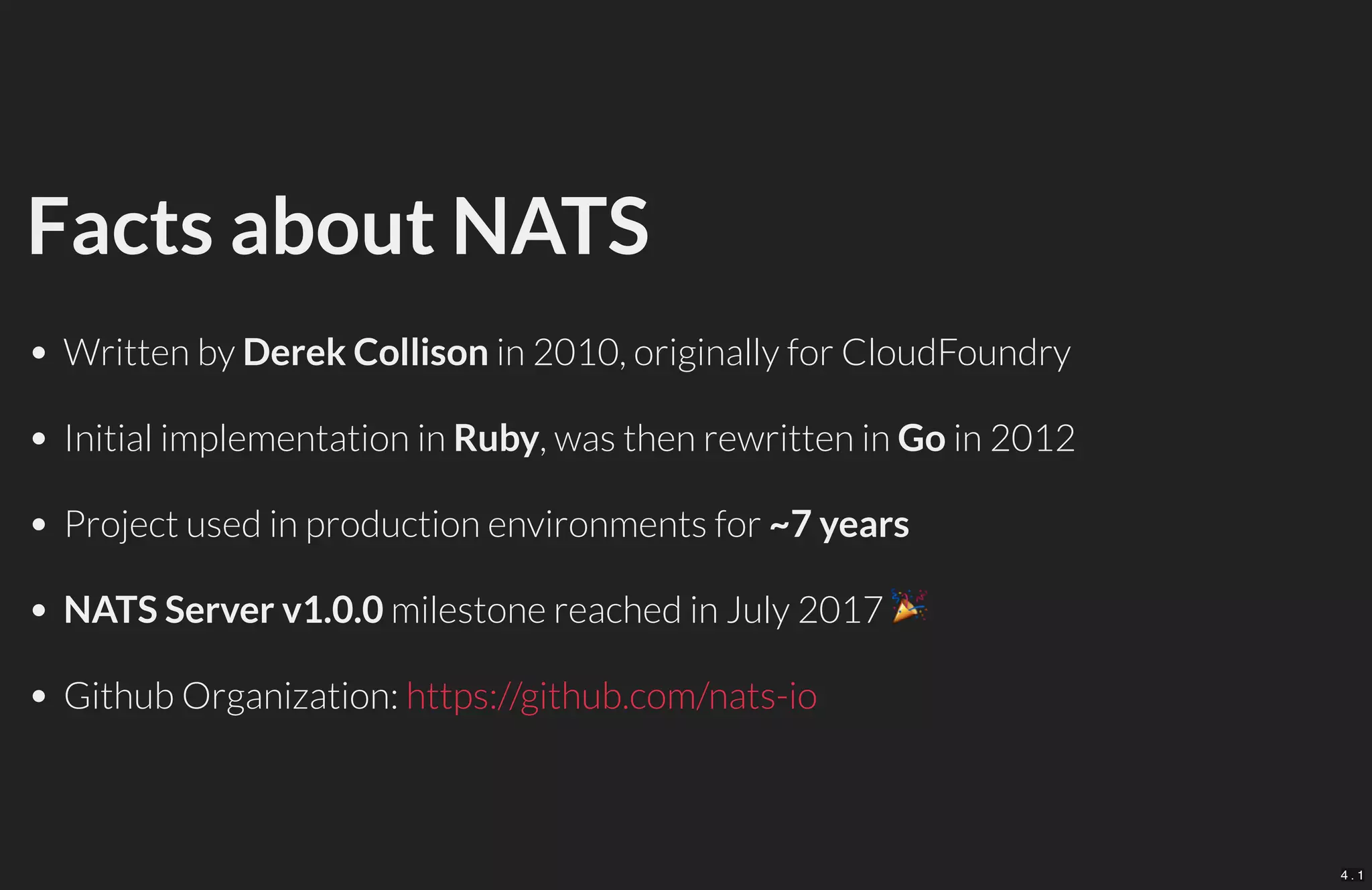
Facts about NATS
Written by Derek Collison in 2010, originally for CloudFoundry
Initial implementation in Ruby, was then rewritten in Go in 2012
Project used in production environments for ~7 years
NATS Server v1.0.0 milestone reached in July 2017
Github Organization: https://github.com/nats-io
4 . 1
NATS is fast
5 . 1
Stats about NATS
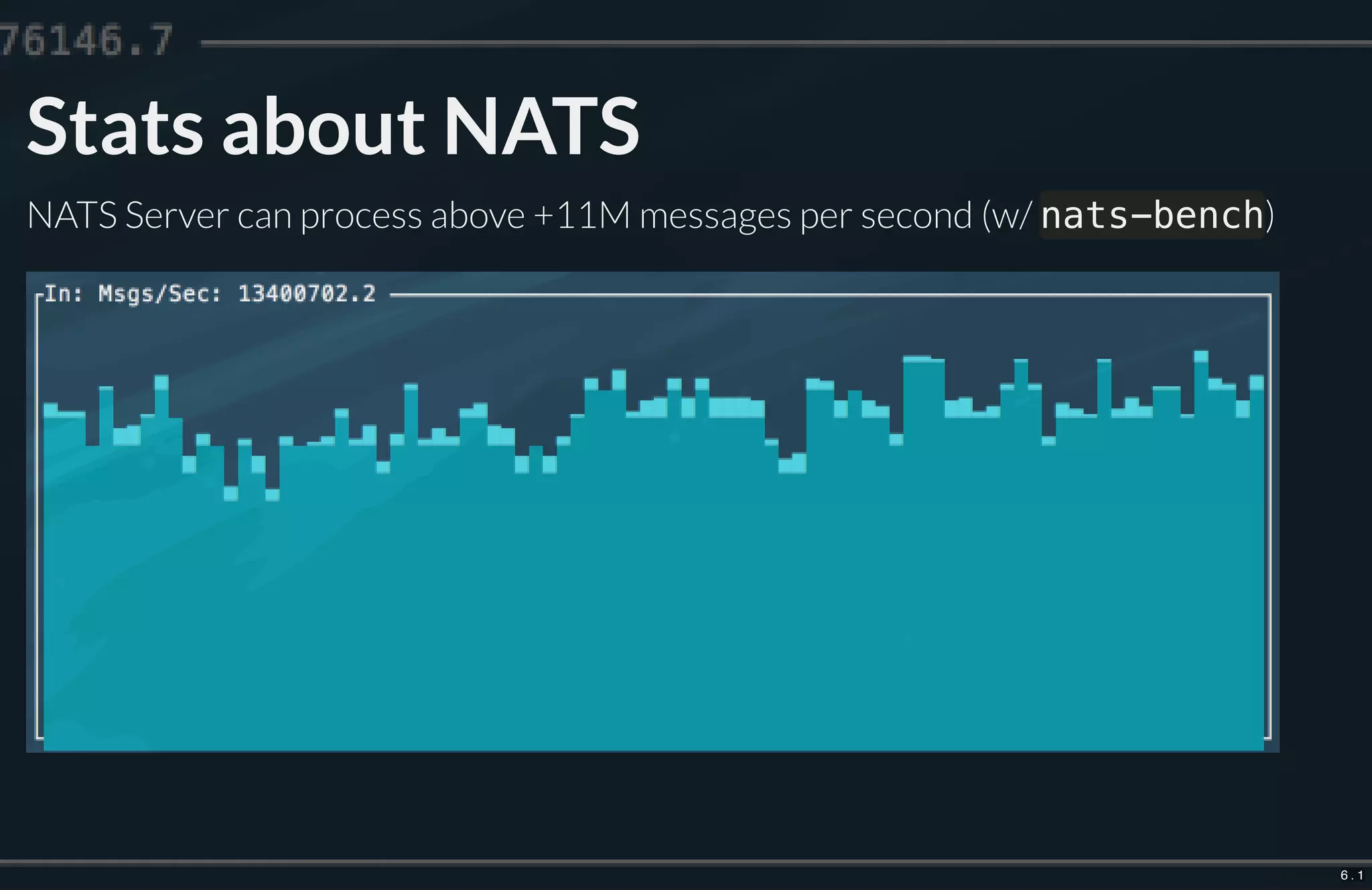
NATS Server can process above +11M messages per second (w/ nats-bench)
6 . 1
Stats about NATS
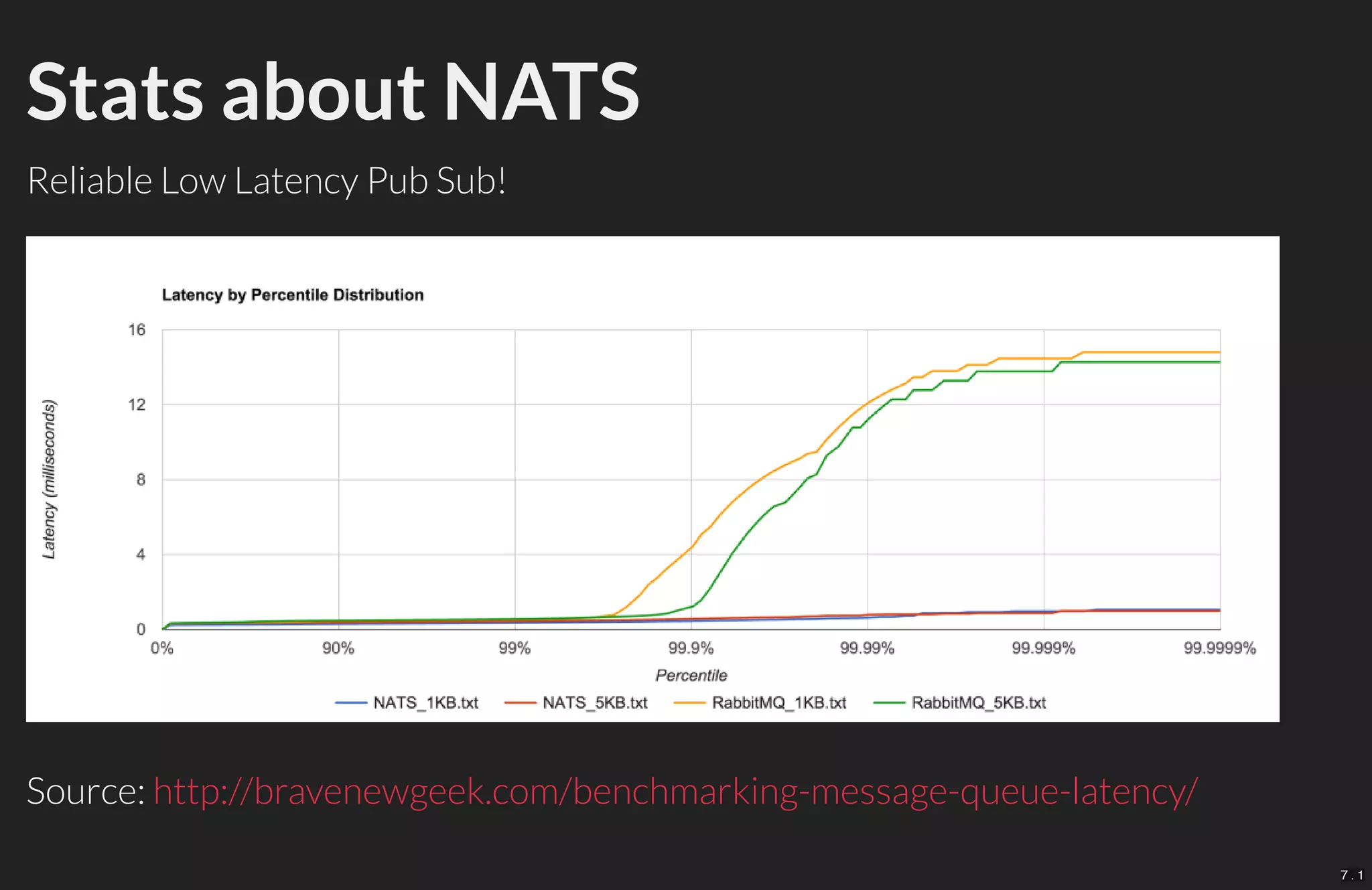
Reliable Low Latency Pub Sub!
Source: http://bravenewgeek.com/benchmarking-message-queue-latency/
7 . 1
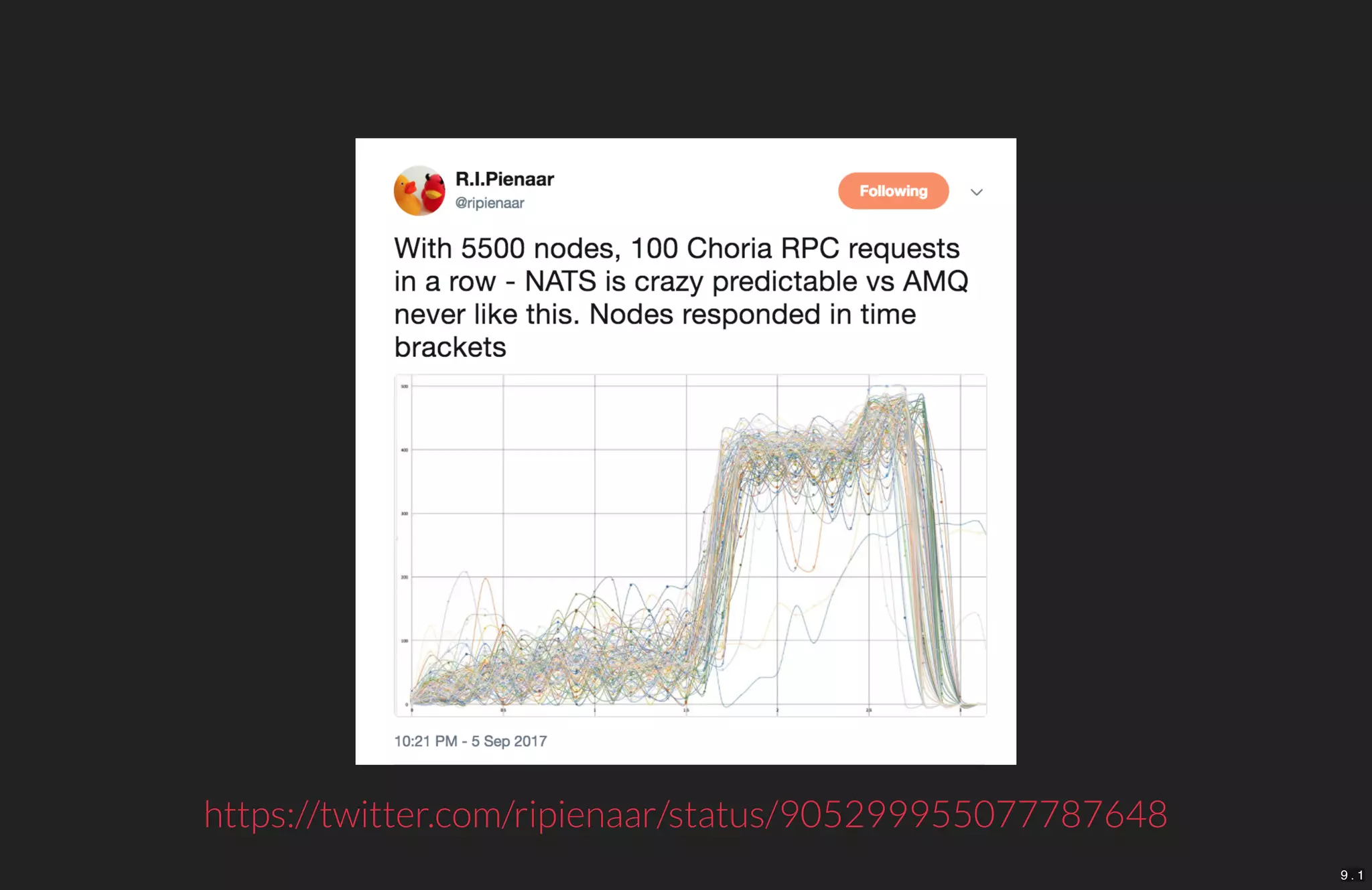
NATS is
predictable
8 . 1
    
https://twitter.com/ripienaar/status/905299955077787648
9 . 1
    
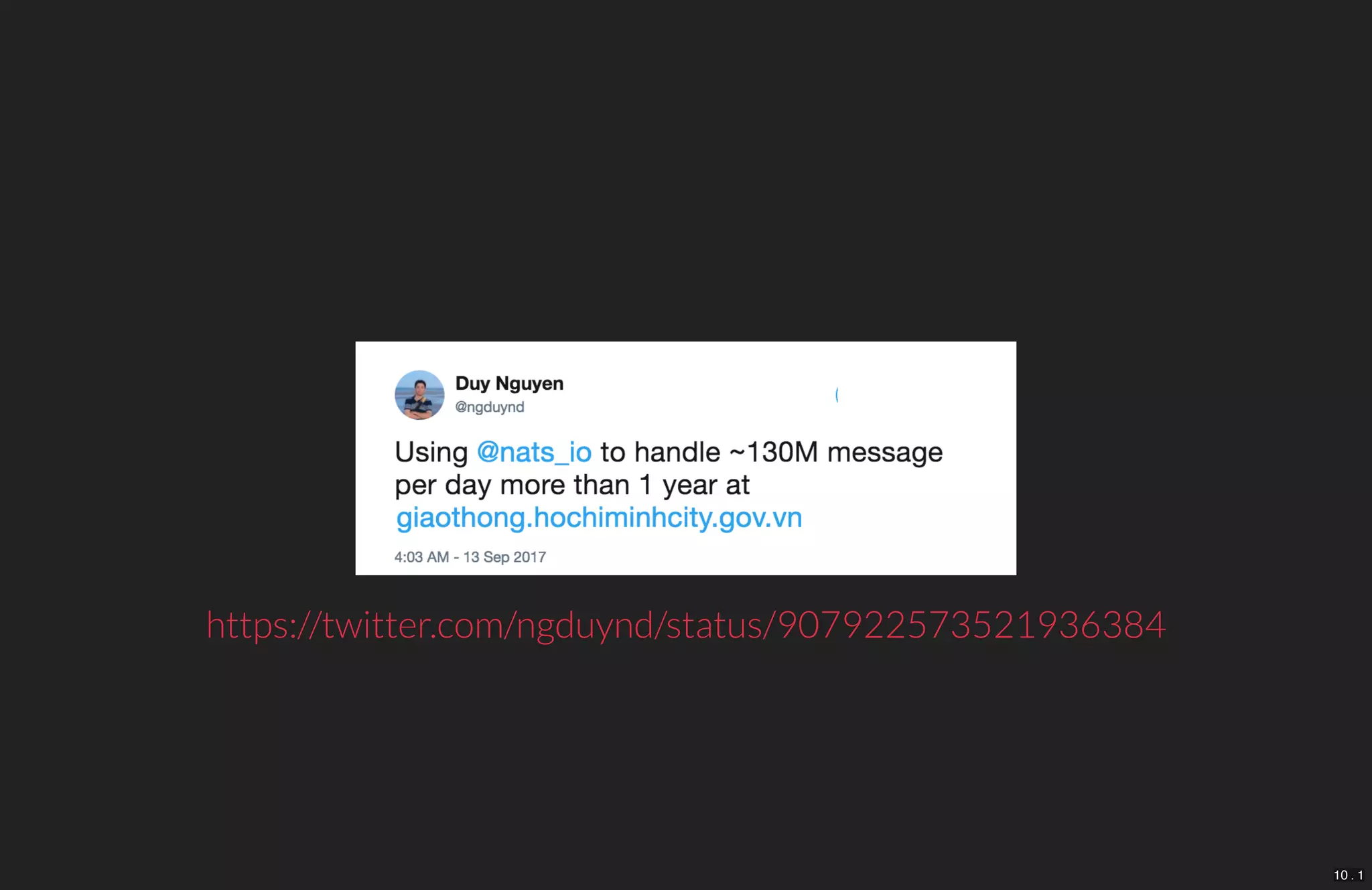
https://twitter.com/ngduynd/status/907922573521936384
10 . 1
NATS is simple
11 . 1
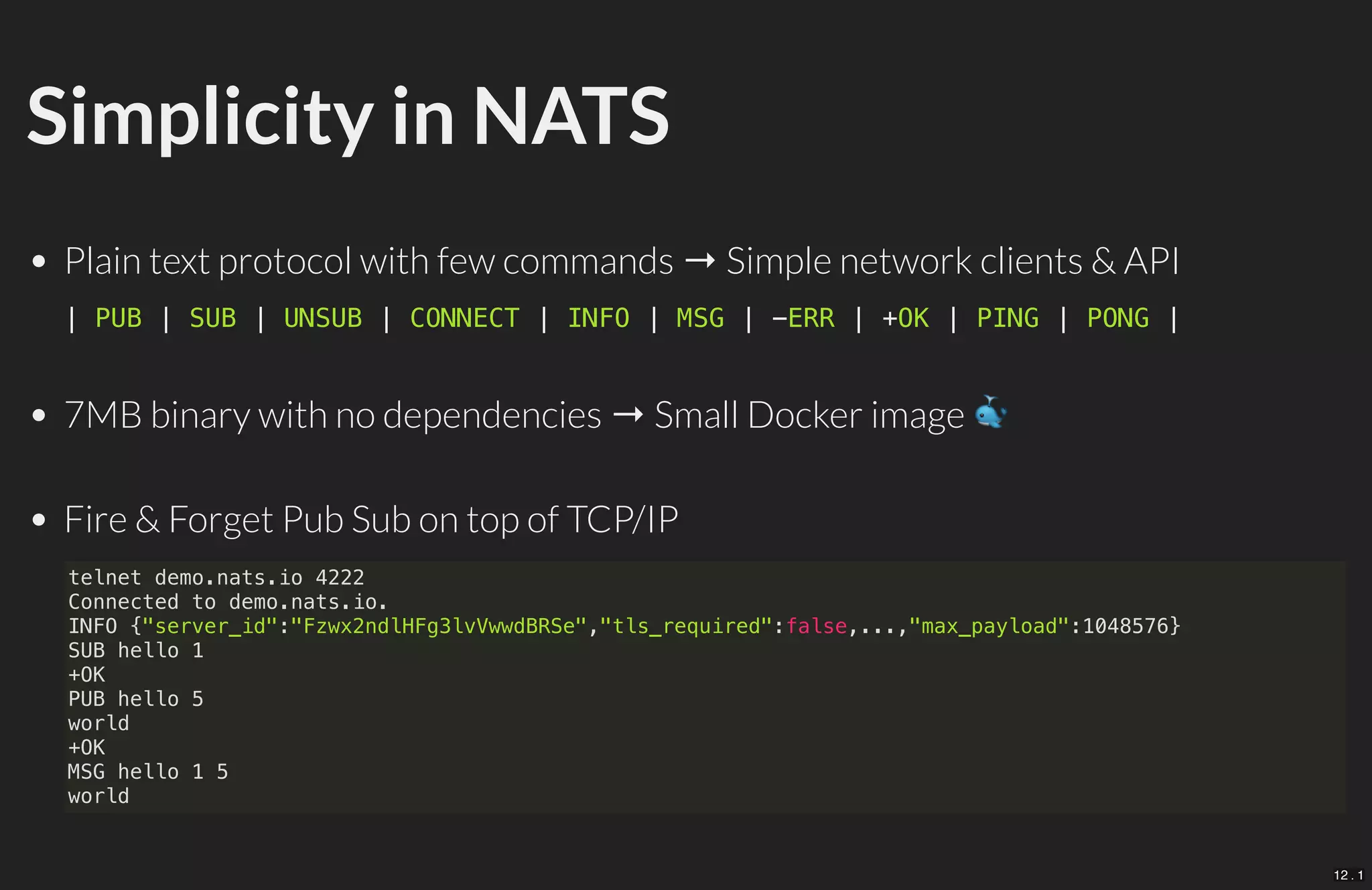
Simplicity in NATS
Plain text protocol with few commands → Simple network clients & API
7MB binary with no dependencies → Small Docker image
Fire & Forget Pub Sub on top of TCP/IP
| PUB | SUB | UNSUB | CONNECT | INFO | MSG | -ERR | +OK | PING | PONG |
telnet demo.nats.io 4222
Connected to demo.nats.io.
INFO {"server_id":"Fzwx2ndlHFg3lvVwwdBRSe","tls_required":false,...,"max_payload":1048576}
SUB hello 1
+OK
PUB hello 5
world
+OK
MSG hello 1 5
world
12 . 1
Basic API: Go Client
package main
import (
"log"
"github.com/nats-io/go-nats"
)
func main(){
nc, err := nats.Connect("nats://127.0.0.1:4222")
if err != nil {
log.Fatalf("Error: %s", err)
}
done := make(chan struct{})
nc.Subscribe("hello", func(m *nats.Msg){
log.Printf("[Received] %s", string(m.Data))
done <- struct{}{}
})
nc.Publish("hello", []byte("world"))
<-done
}
13 . 1
Basic API: Ruby Client
require 'nats/client'
NATS.start do |nc|
nc.subscribe("hello") do |msg|
puts "[Received] #{msg}"
end
nc.publish("hello", "world")
end
14 . 1
Basic API: Python Client
await nc.connect()
async def handler(msg):
print("[Received] {data}".format(
data=msg.data.decode()))
# Coroutine based subscriber
await nc.subscribe("foo", cb=handler)
await nc.publish("foo", "bar")
15 . 1
Basic API: Node.js Client
var nats = require('nats').connect();
// Simple Publisher
nats.publish('foo', 'Hello World!');
// Simple Subscriber
nats.subscribe('foo', function(msg) {
console.log('[Received] ' + msg);
});
16 . 1
Basic API: C Client
natsConnection_Publish(nc,"foo",data,5);
natsConnection_Subscribe(&sub,nc,"foo",onMsg, NULL);
void
onMsg(natsConnection *nc, natsSubscription *sub,
natsMsg *msg, void *closure)
{
printf("[Received] %.*sn",
natsMsg_GetData(msg));
// ...
}
17 . 1
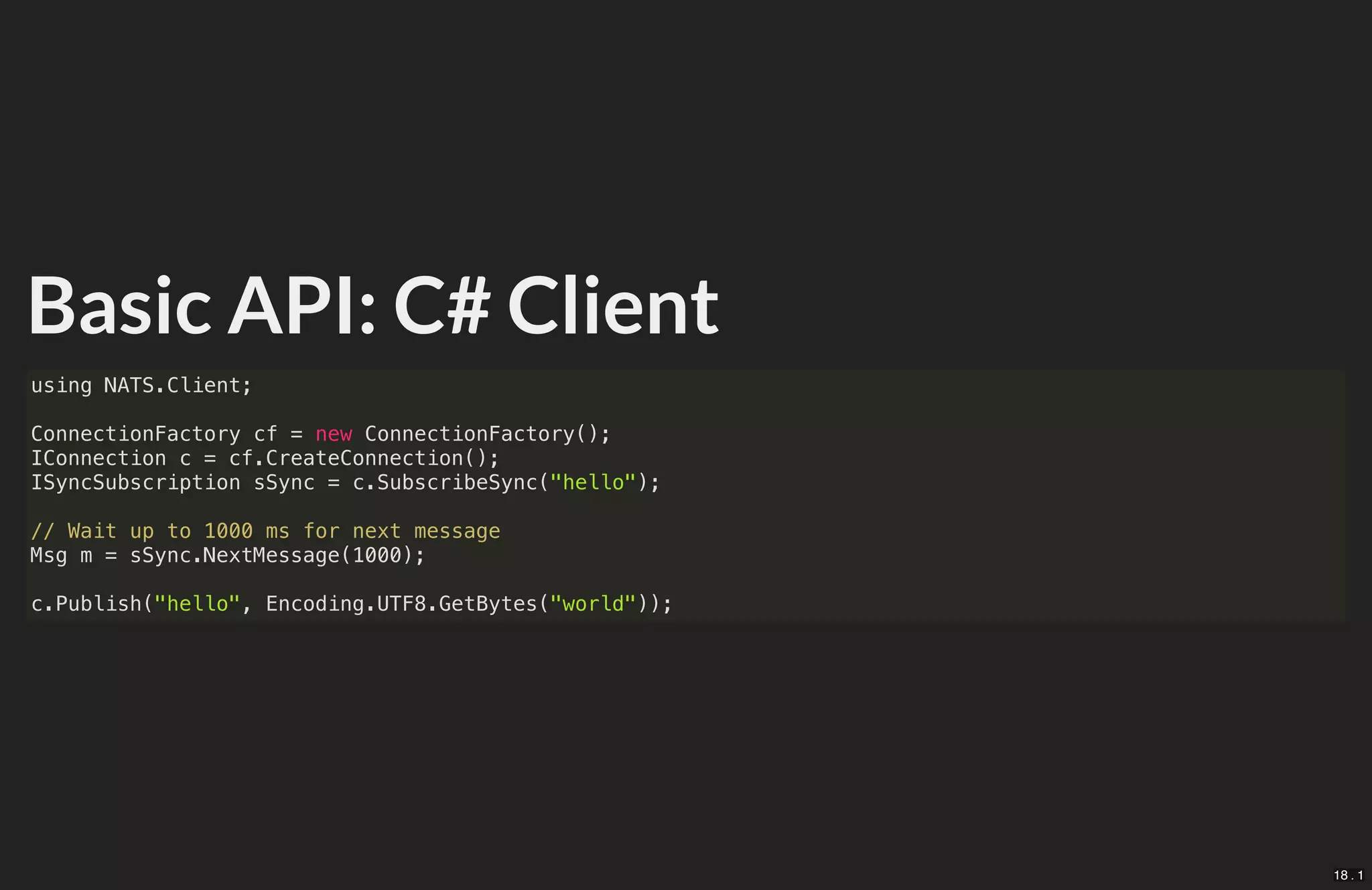
Basic API: C# Client
using NATS.Client;
ConnectionFactory cf = new ConnectionFactory();
IConnection c = cf.CreateConnection();
ISyncSubscription sSync = c.SubscribeSync("hello");
// Wait up to 1000 ms for next message
Msg m = sSync.NextMessage(1000);
c.Publish("hello", Encoding.UTF8.GetBytes("world"));
18 . 1
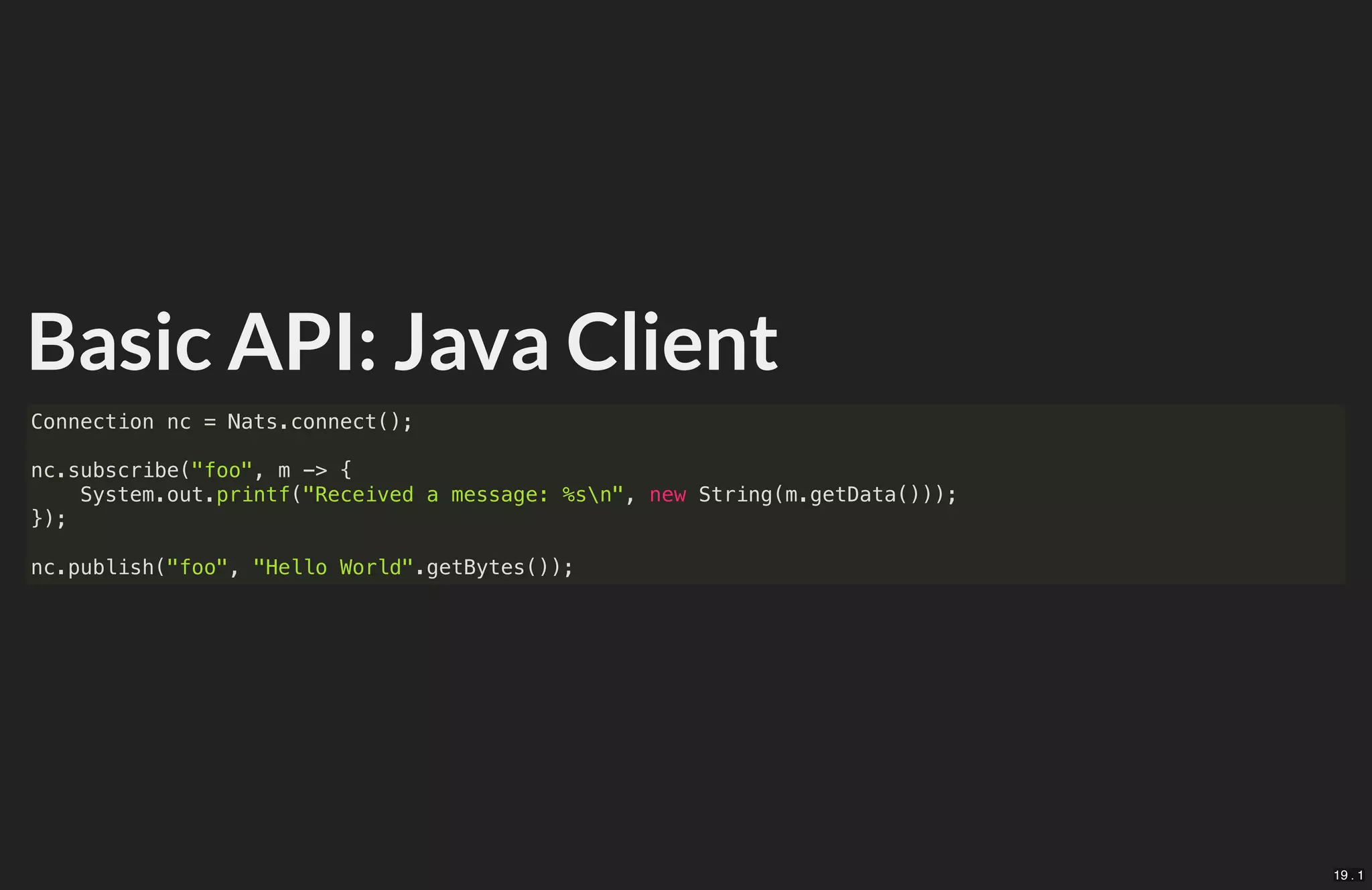
Basic API: Java Client
Connection nc = Nats.connect();
nc.subscribe("foo", m -> {
System.out.printf("Received a message: %sn", new String(m.getData()));
});
nc.publish("foo", "Hello World".getBytes());
19 . 1
Clients of cially supported by the NATS team
20 . 1
NATS is resilient
21 . 1
Protection against Slow Consumers
package main
import (
"log"
"github.com/nats-io/go-nats"
)
func main(){
nc, err := nats.Connect("nats://127.0.0.1:4222")
if err != nil {
log.Fatalf("Error: %s", err)
}
n := 0
total := 1000000000
done := make(chan struct{})
nc.Subscribe("hello", func(m *nats.Msg){
n++
if n == total {
close(done)
}
})
for i := 0; i < total; i++ {
nc.Publish("hello", []byte("world"))
}
select {
case <-done:
}
}
22 . 1
Protection against Slow Consumers
Server disconnects client with Slow Consumer error
Client was too slow at processing the received messages.
[33682] 2017/10/19 07:52:51.647917 [INF] Starting nats-server version 0.9.6
[33682] 2017/10/19 07:52:51.648085 [INF] Starting http monitor on 0.0.0.0:8222
[33682] 2017/10/19 07:52:51.648631 [INF] Listening for client connections on 0.0.0.0:4222
[33682] 2017/10/19 07:52:51.648691 [INF] Server is ready
[33682] 2017/10/19 07:52:55.376292 [INF] 127.0.0.1:63184 - cid:1 - Slow Consumer Detected
[33682] 2017/10/19 07:52:57.424381 [INF] 127.0.0.1:63185 - cid:2 - Slow Consumer Detected
[33682] 2017/10/19 07:52:59.478090 [INF] 127.0.0.1:63186 - cid:3 - Slow Consumer Detected
[33682] 2017/10/19 07:53:01.541496 [INF] 127.0.0.1:63188 - cid:4 - Slow Consumer Detected
23 . 1
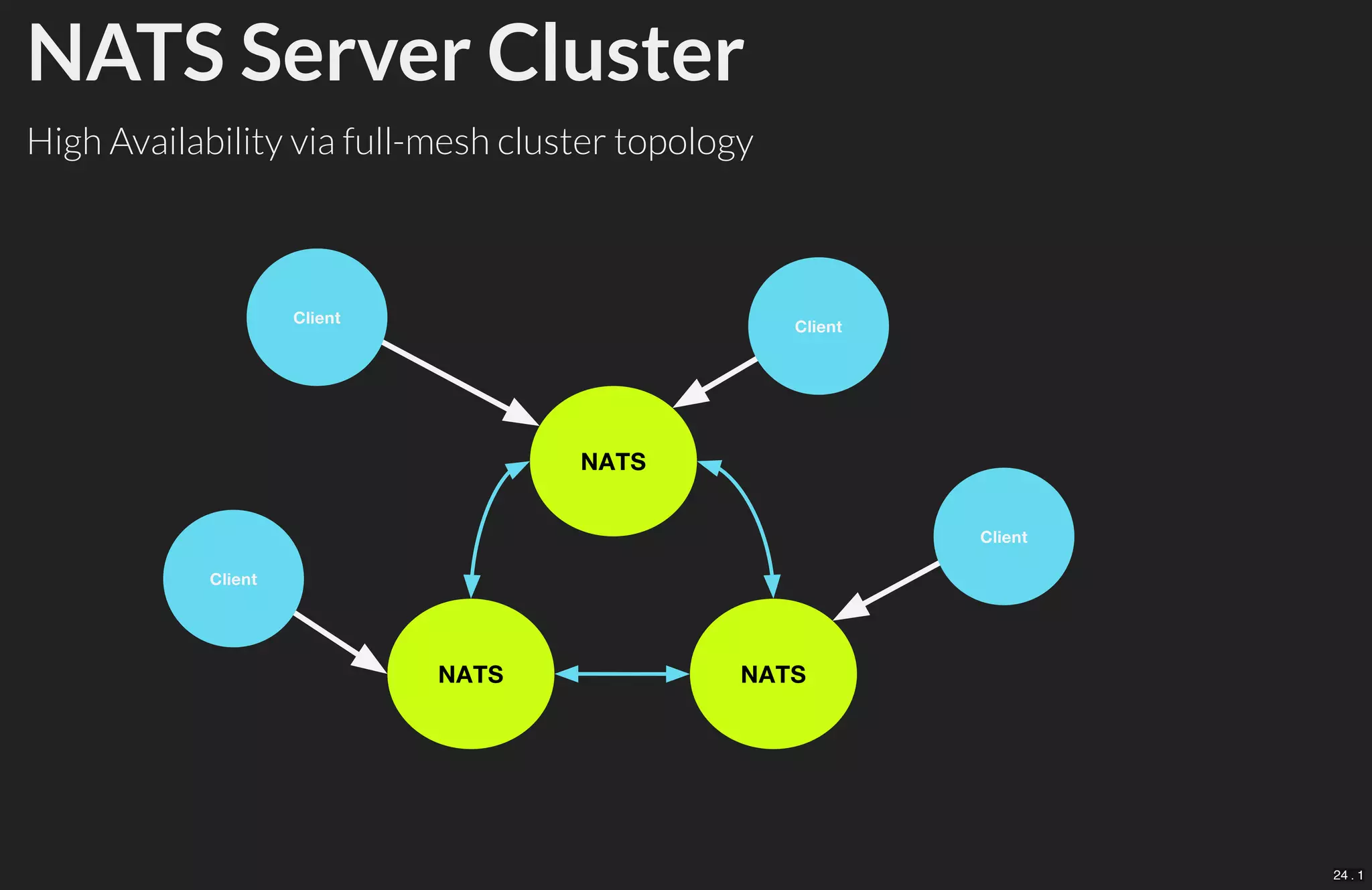
NATS Server Cluster
High Availability via full-mesh cluster topology
24 . 1
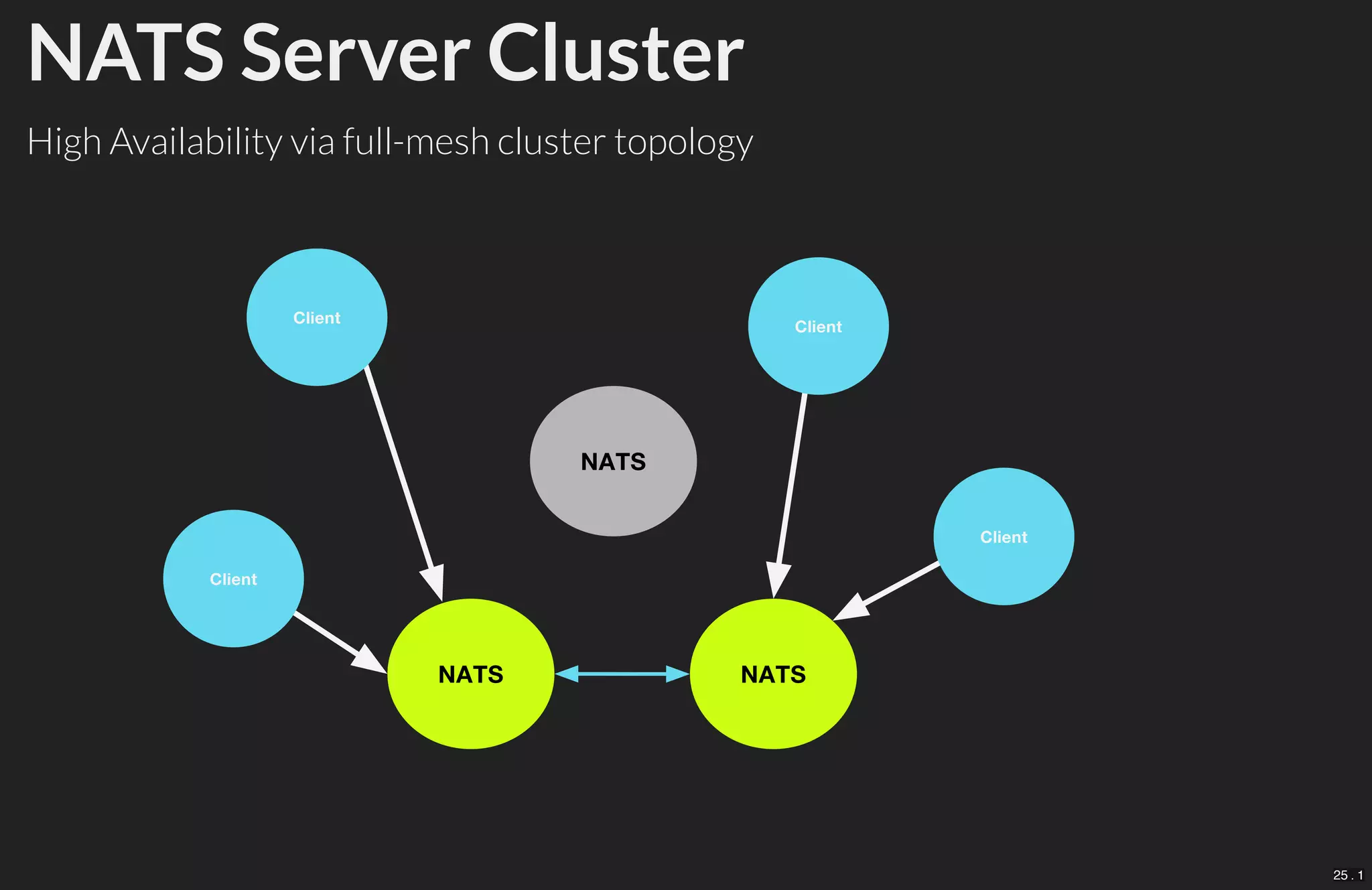
NATS Server Cluster
High Availability via full-mesh cluster topology
25 . 1
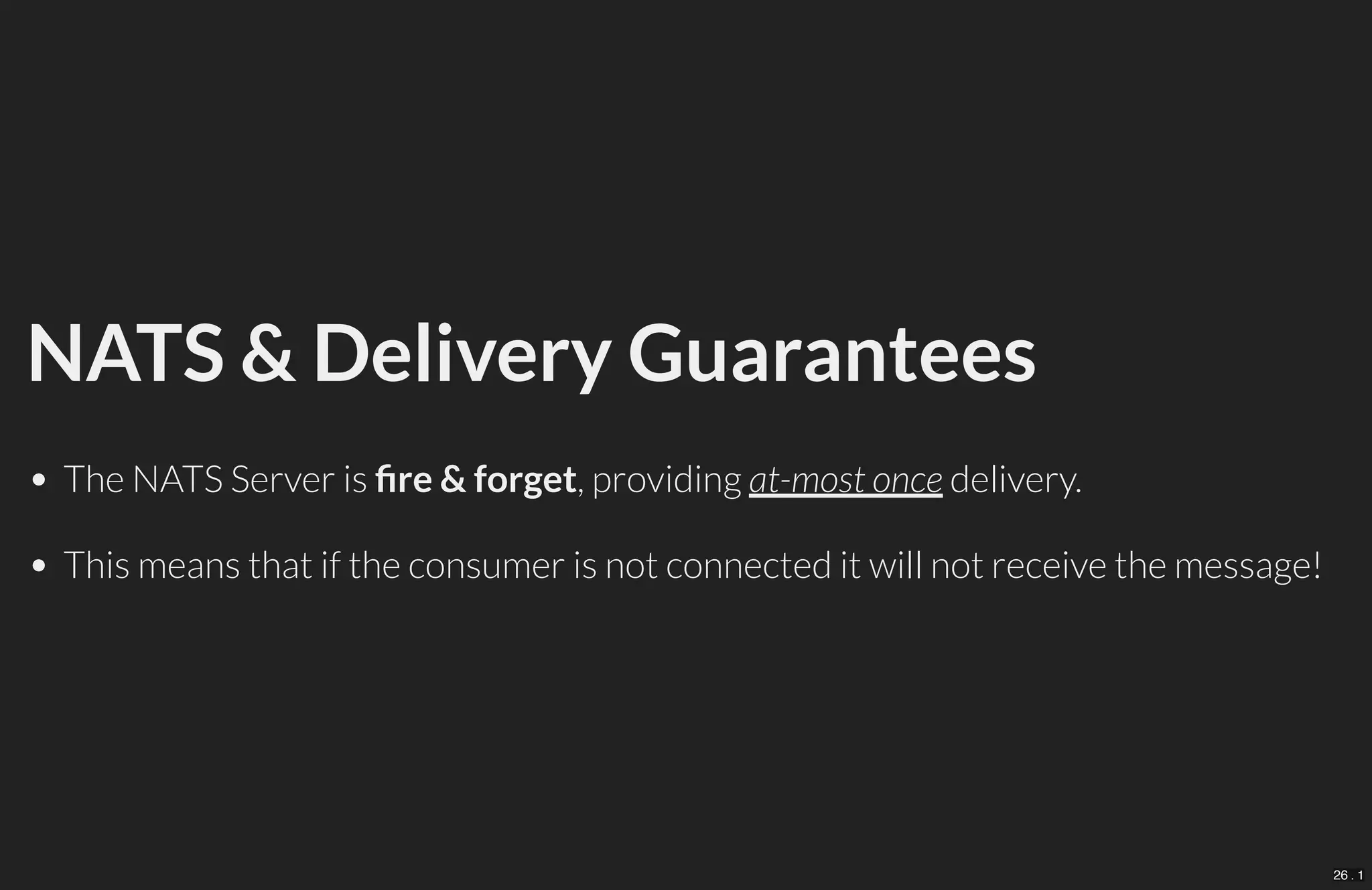
NATS & Delivery Guarantees
The NATS Server is re & forget, providing at-most once delivery.
This means that if the consumer is not connected it will not receive the message!
26 . 1
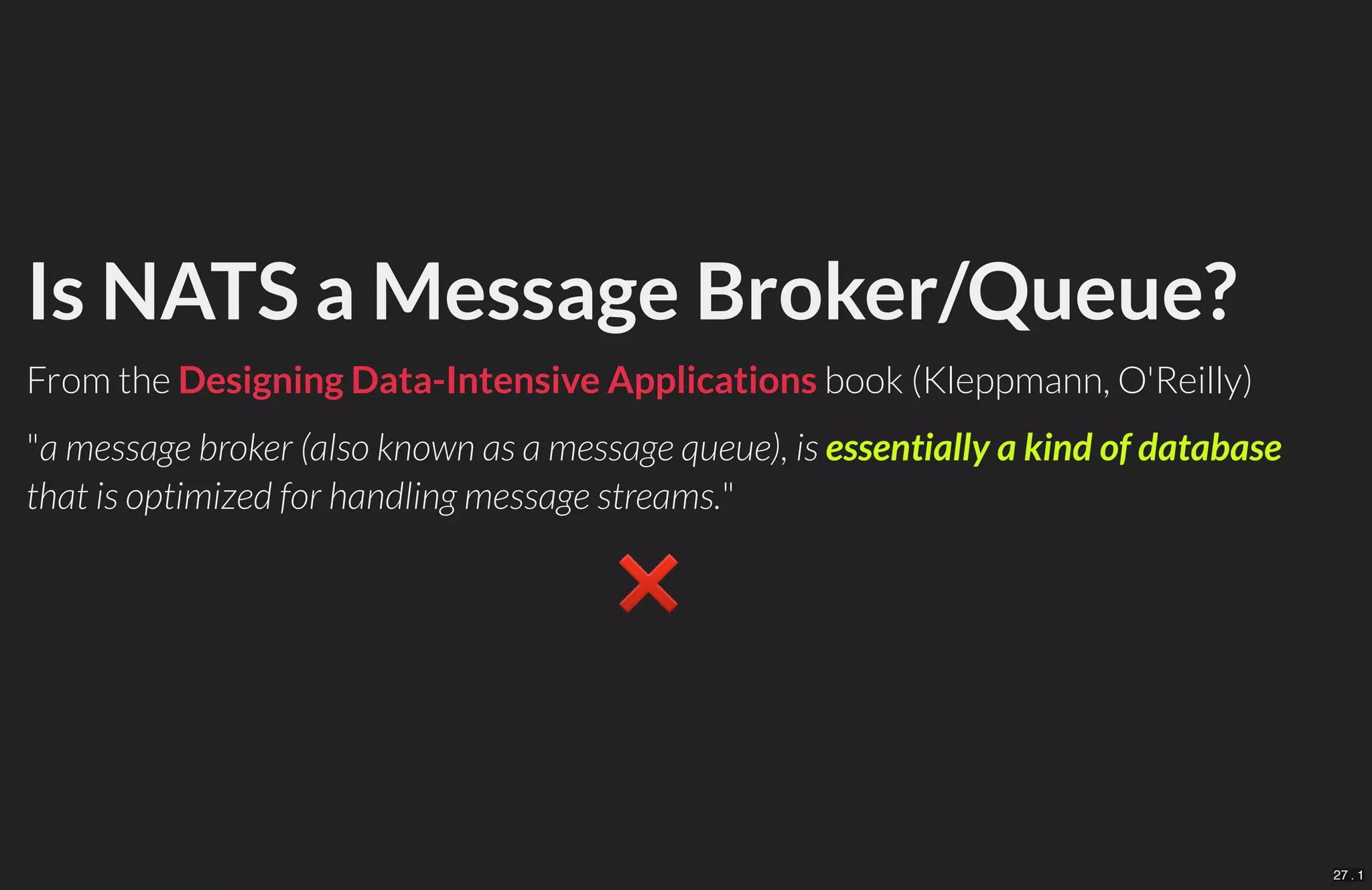
Is NATS a Message Broker/Queue?
From the book (Kleppmann, O'Reilly)
"a message broker (also known as a message queue), is essentially a kind of database
that is optimized for handling message streams."
❌ 
Designing Data-Intensive Applications
27 . 1
Is NATS a Message Broker/Queue?
From the book (Kleppmann, O'Reilly)
"By centralizing the data in the broker, these systems can more easily tolerate clients
that come and go (connect, disconnect, and crash)
"the question of durability is moved to the broker instead
❌ 
Designing Data-Intensive Applications
28 . 1
Is NATS a Message Broker/Queue?
From the book (Kleppmann, O'Reilly)
"Faced with slow consumers, they generally allow unbounded queueing (as opposed to
dropping messages or backpressure)
❌ 
Designing Data-Intensive Applications
29 . 1
The NATS Server does none of that!
It's the total opposite.
30 . 1
 
31 . 1
NATS Streaming
codename: STAN
32 . 1
NATS Streaming
Supports at-least-once delivery model and durability of messages
Rate limiting & message redelivery features
First release in 2016
33 . 1
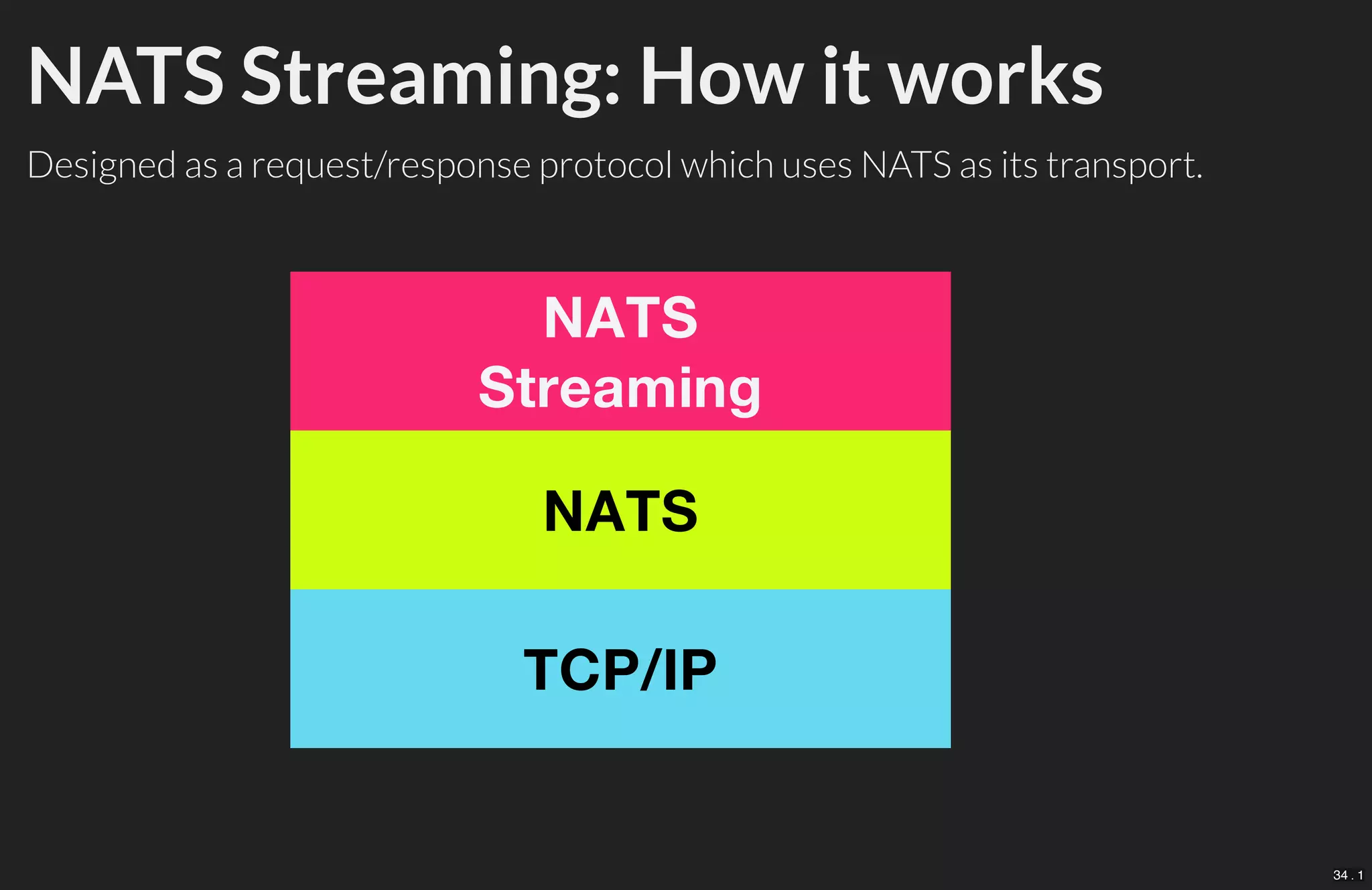
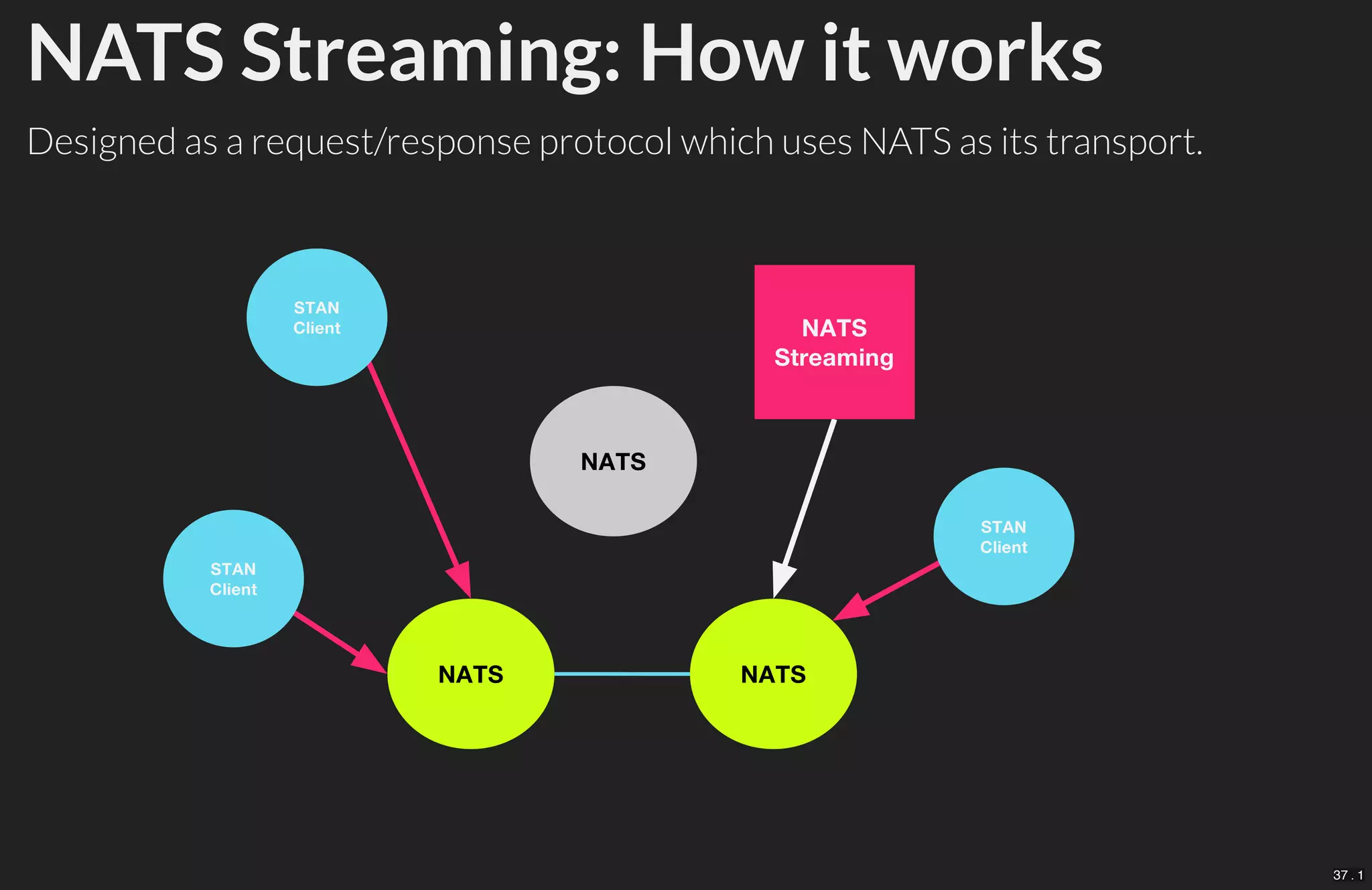
NATS Streaming: How it works
Designed as a request/response protocol which uses NATS as its transport.
34 . 1
NATS Streaming: How it works
Designed as a request/response protocol which uses NATS as its transport.
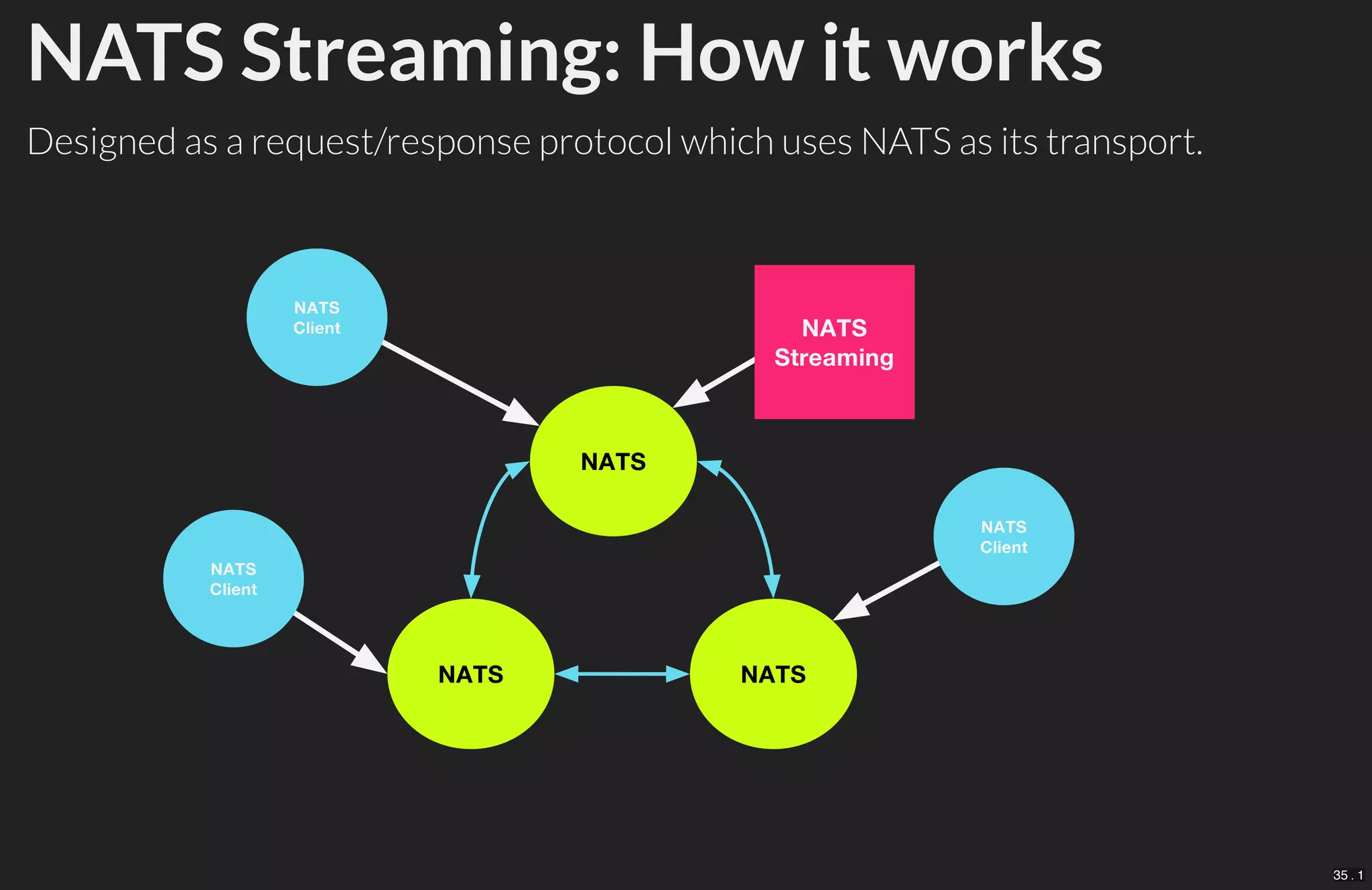
35 . 1
NATS Streaming: How it works
Designed as a request/response protocol which uses NATS as its transport.
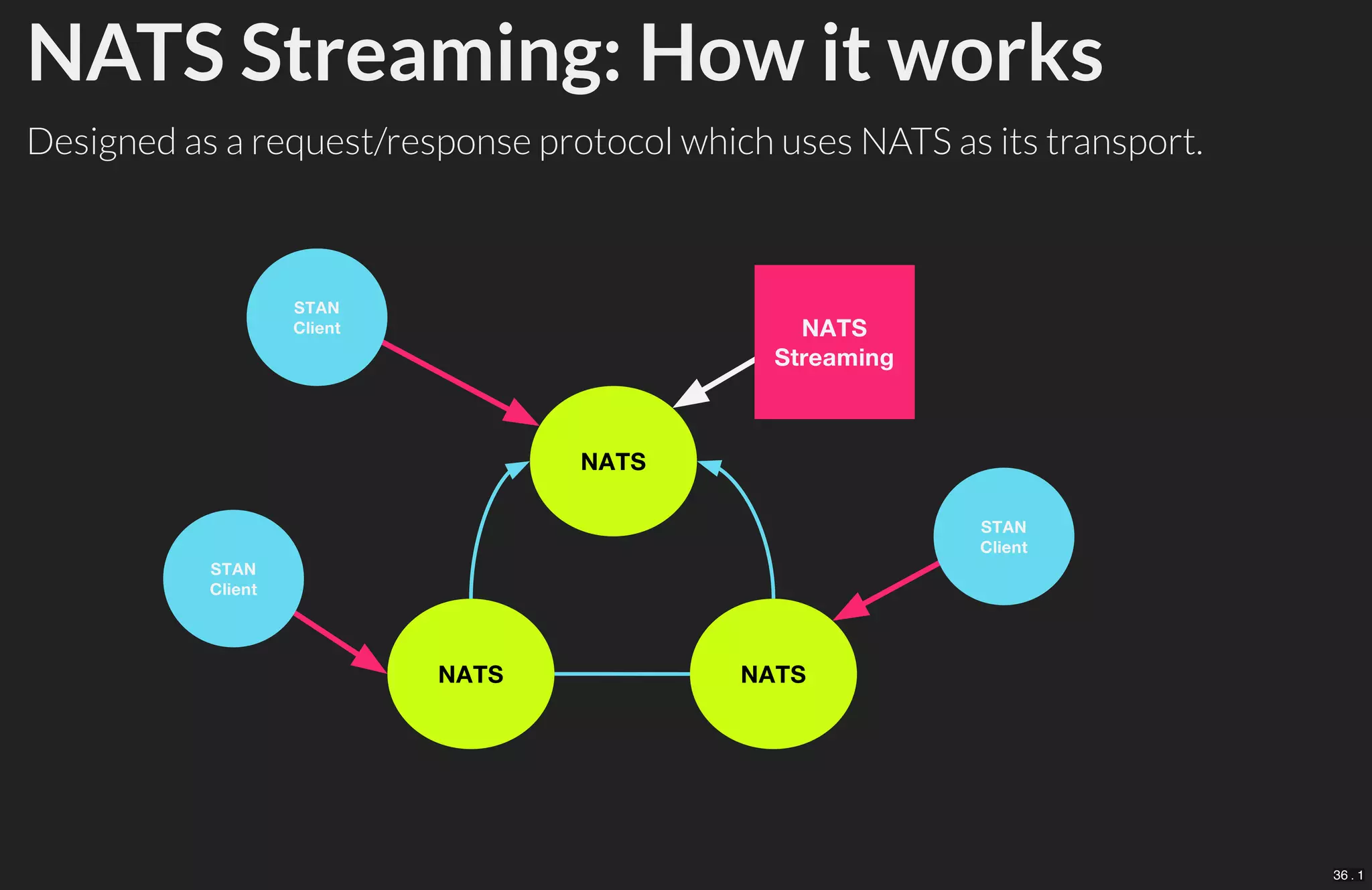
36 . 1
NATS Streaming: How it works
Designed as a request/response protocol which uses NATS as its transport.
37 . 1
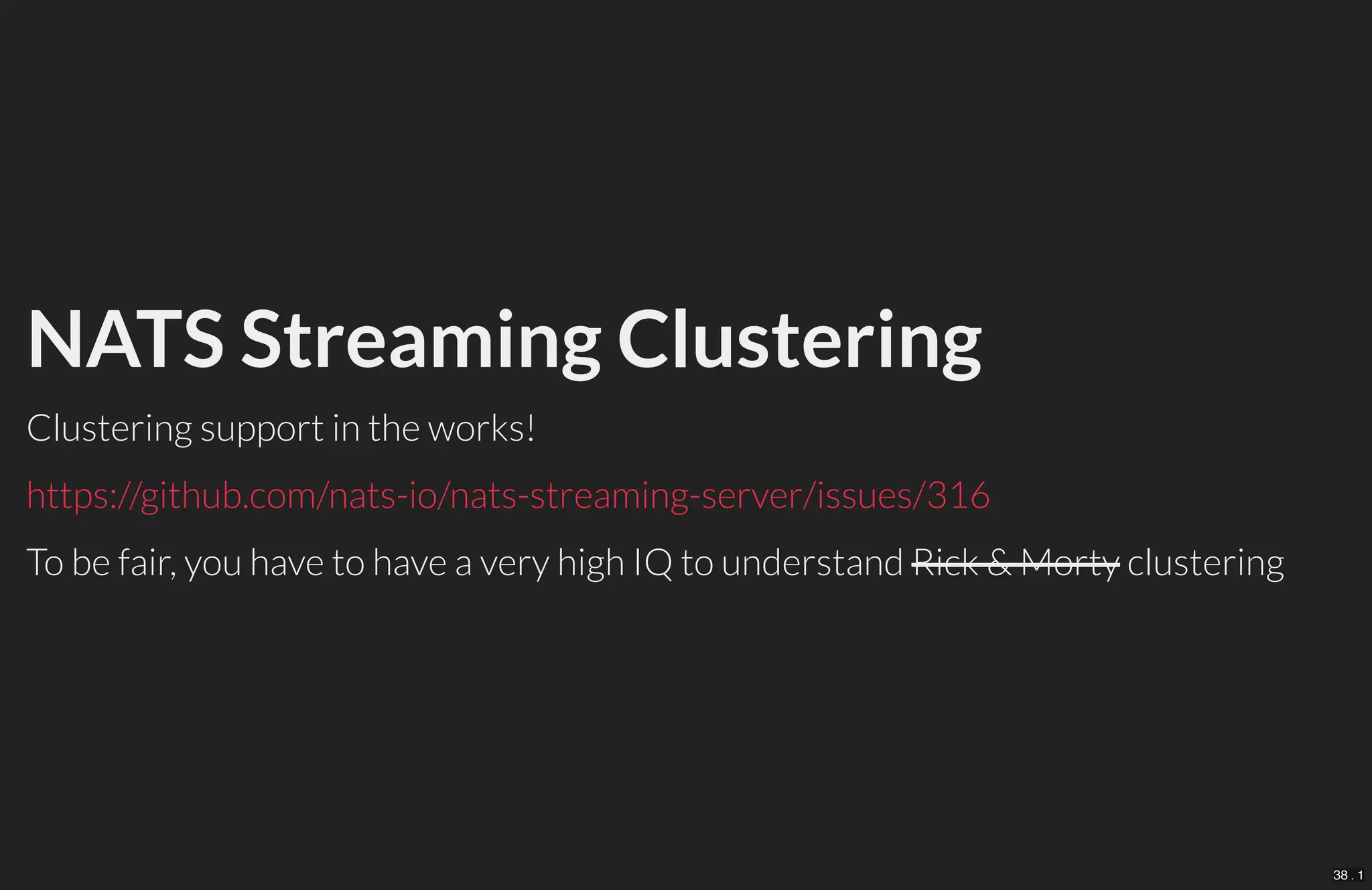
NATS Streaming Clustering
Clustering support in the works!
To be fair, you have to have a very high IQ to understand Rick & Morty clustering
https://github.com/nats-io/nats-streaming-server/issues/316
38 . 1
NATS Streaming: Go Client
Publish and persist a message
Start with last received message
Receive all messages
sc, _ := stan.Connect(clusterID, clientID)
sc.Publish("foo", []byte("Hello World"))
sub, err := sc.Subscribe("foo", func(m *stan.Msg) {
fmt.Printf("Received a message: %sn", string(m.Data))
})
sub, err := sc.Subscribe("foo", func(m *stan.Msg) {
fmt.Printf("Received a message: %sn", string(m.Data))
}, stan.DeliverAllAvailable())
39 . 1
NATS Streaming: Ruby Client
require 'stan/client'
sc = STAN::Client.new
# Customize connection to NATS
opts = { servers: ["nats://127.0.0.1:4222"] }
sc.connect("test-cluster", "client-123", nats: opts)
# Simple async subscriber
sub = sc.subscribe("foo", start_at: :first) do |msg|
puts "Received a message (seq=#{msg.seq}): #{msg.data}"
end
# Synchronous Publisher, does not return until an ack
# has been received from NATS Streaming.
sc.publish("foo", "hello world")
40 . 1
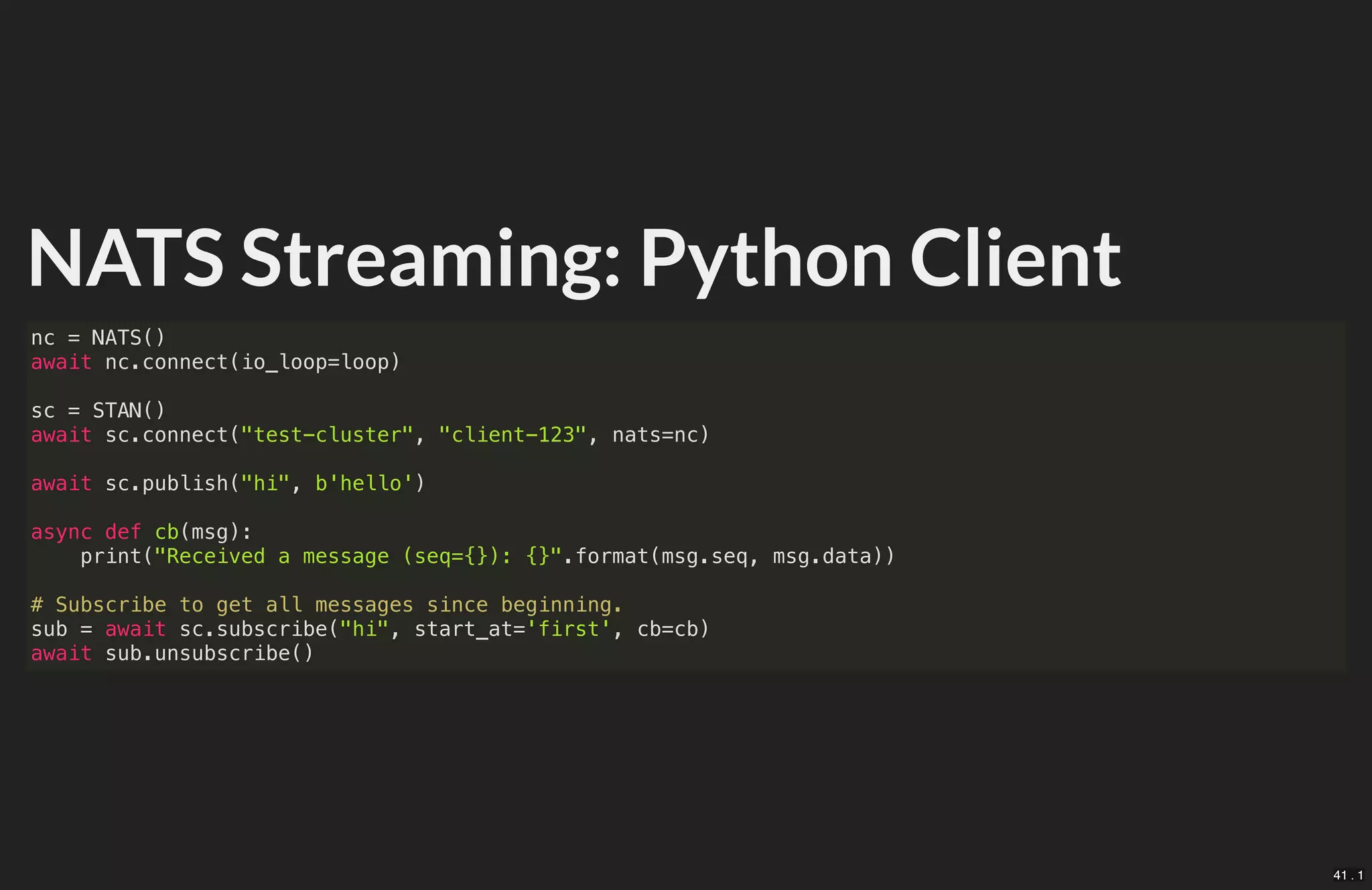
NATS Streaming: Python Client
nc = NATS()
await nc.connect(io_loop=loop)
sc = STAN()
await sc.connect("test-cluster", "client-123", nats=nc)
await sc.publish("hi", b'hello')
async def cb(msg):
print("Received a message (seq={}): {}".format(msg.seq, msg.data))
# Subscribe to get all messages since beginning.
sub = await sc.subscribe("hi", start_at='first', cb=cb)
await sub.unsubscribe()
41 . 1
NATS Streaming: Node.js Client
var stan = require('node-nats-streaming').connect('test-cluster', 'test');
stan.on('connect', function () {
stan.publish('hello', 'world', function(err, guid){ /*...*/ });
var opts = stan.subscriptionOptions().setStartWithLastReceived();
var subscription = stan.subscribe('hello', opts);
subscription.on('message', function (msg) {
console.log('Received [' + msg.getSequence() + '] ' + msg.getData());
});
});
42 . 1
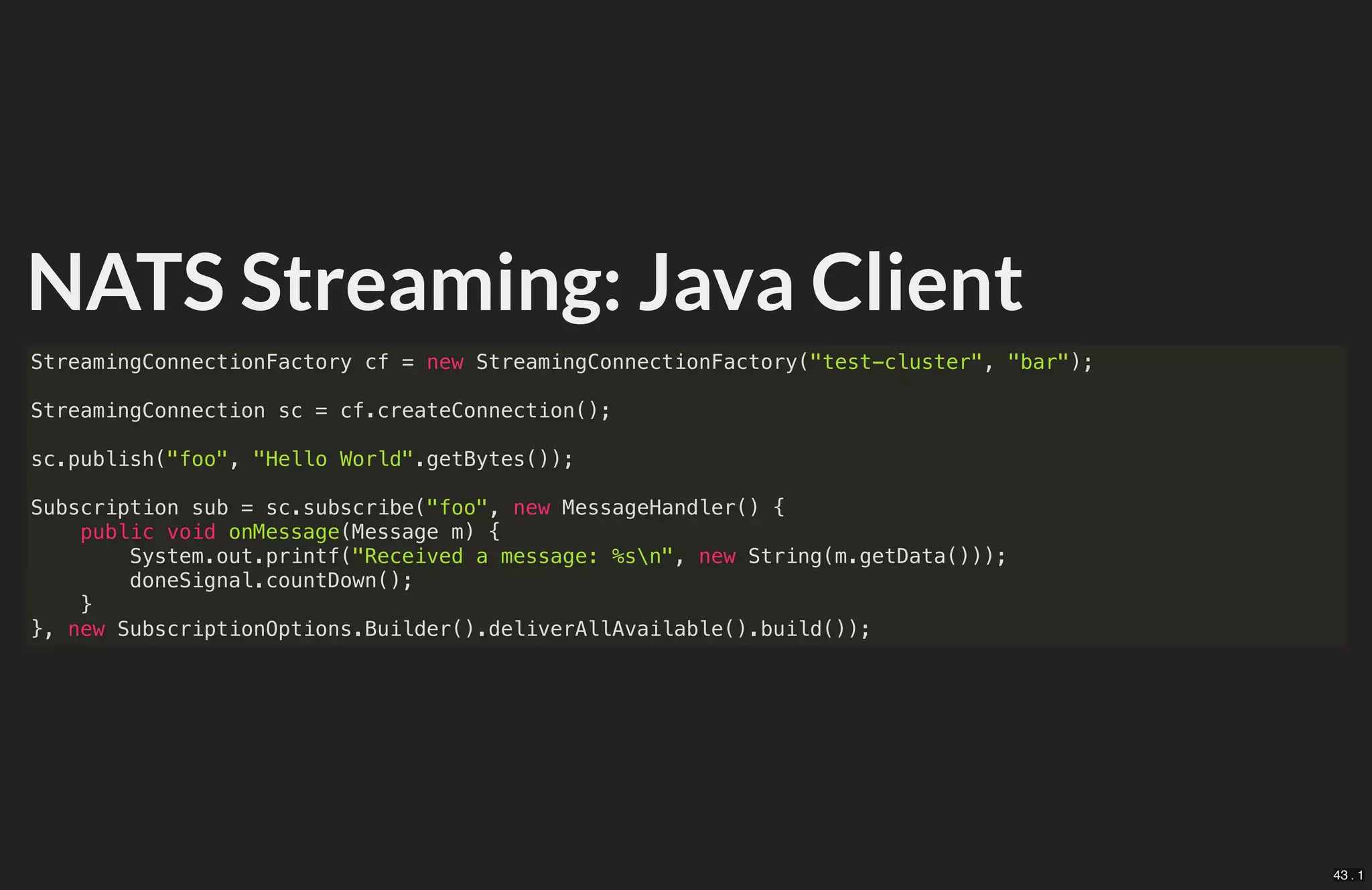
NATS Streaming: Java Client
StreamingConnectionFactory cf = new StreamingConnectionFactory("test-cluster", "bar");
StreamingConnection sc = cf.createConnection();
sc.publish("foo", "Hello World".getBytes());
Subscription sub = sc.subscribe("foo", new MessageHandler() {
public void onMessage(Message m) {
System.out.printf("Received a message: %sn", new String(m.getData()));
doneSignal.countDown();
}
}, new SubscriptionOptions.Builder().deliverAllAvailable().build());
43 . 1
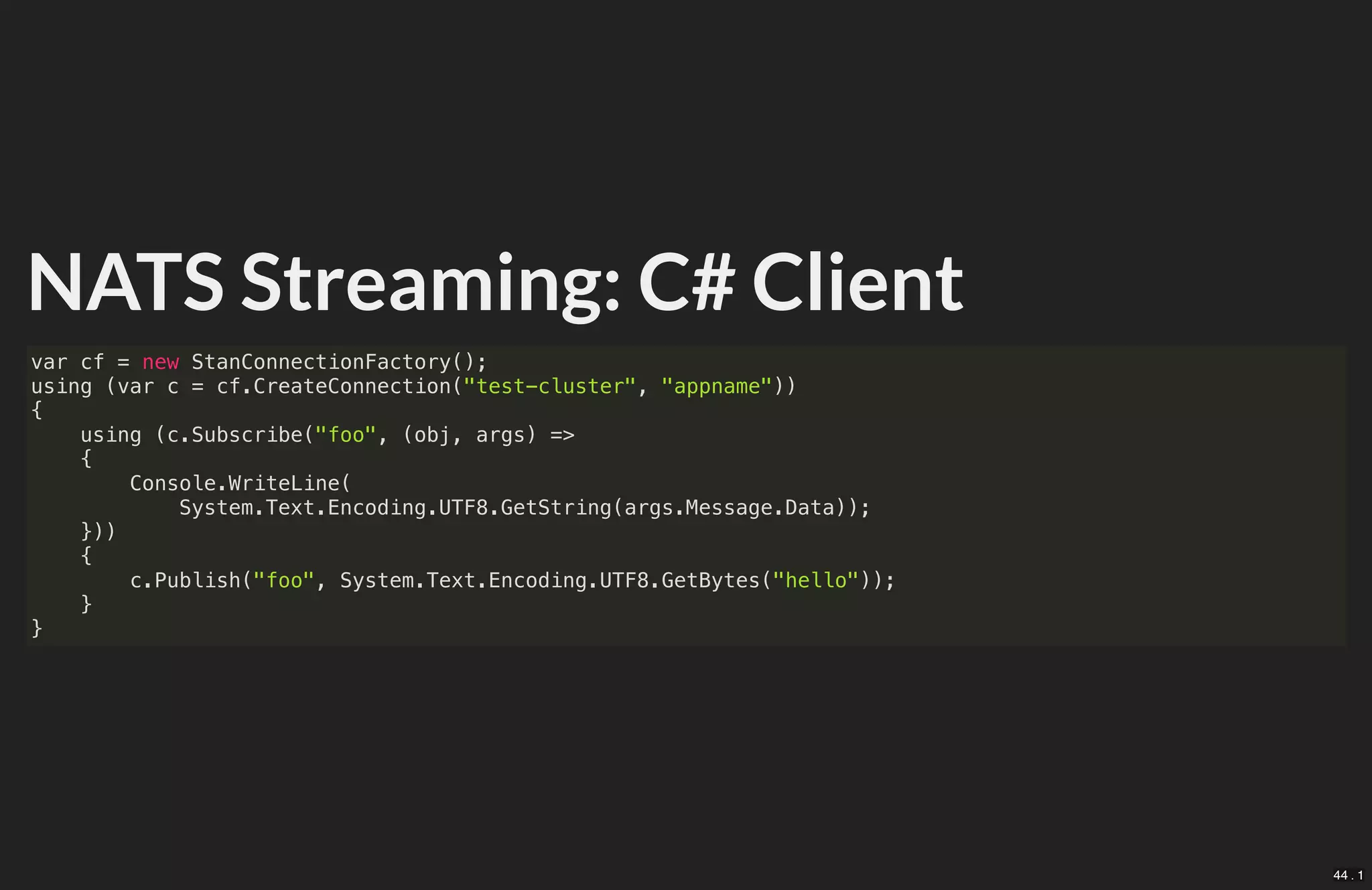
NATS Streaming: C# Client
var cf = new StanConnectionFactory();
using (var c = cf.CreateConnection("test-cluster", "appname"))
{
using (c.Subscribe("foo", (obj, args) =>
{
Console.WriteLine(
System.Text.Encoding.UTF8.GetString(args.Message.Data));
}))
{
c.Publish("foo", System.Text.Encoding.UTF8.GetBytes("hello"));
}
}
44 . 1
Also of cially supported by the NATS team
45 . 1
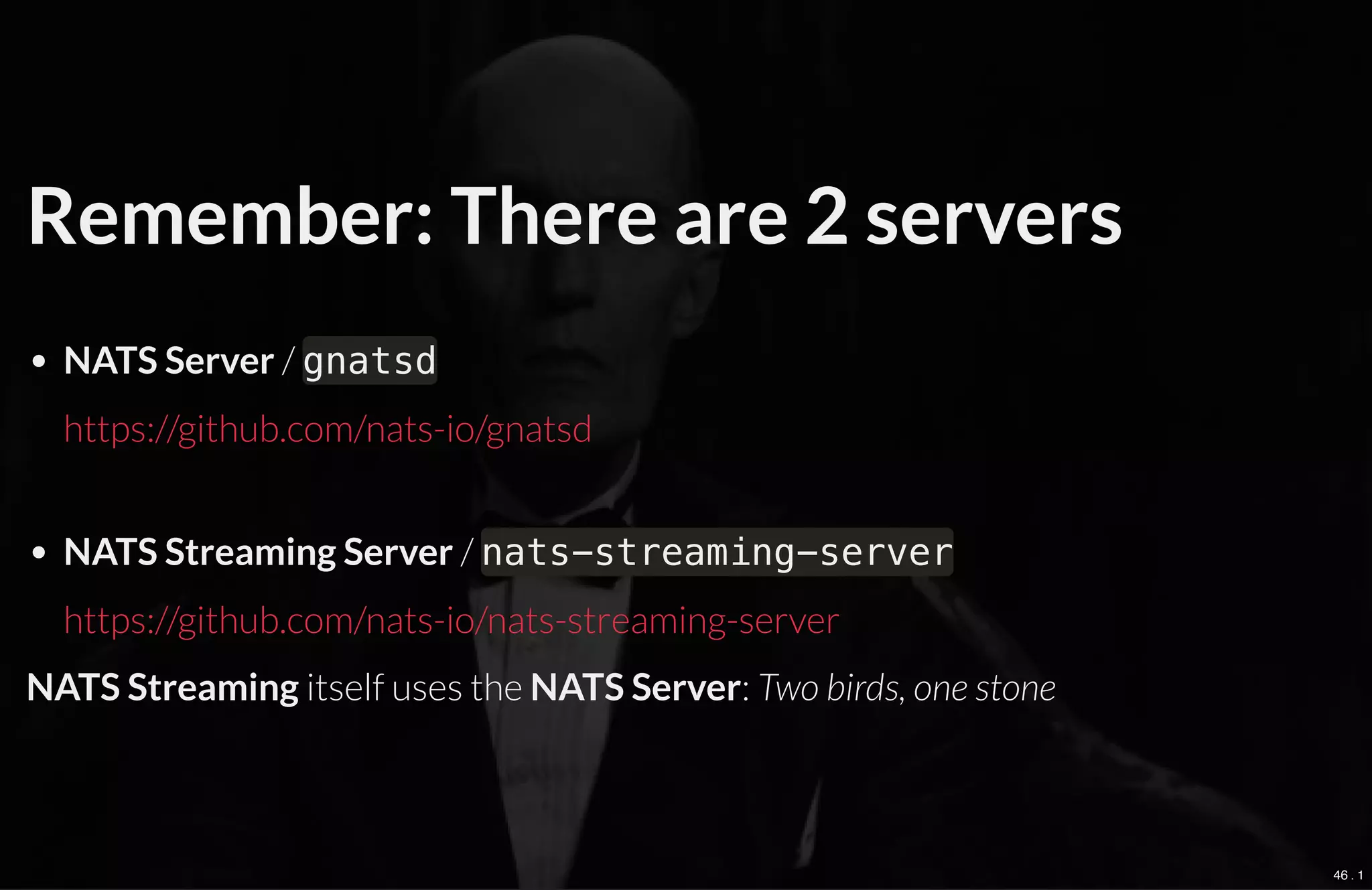
Remember: There are 2 servers
NATS Server / gnatsd
NATS Streaming Server / nats-streaming-server
NATS Streaming itself uses the NATS Server: Two birds, one stone
https://github.com/nats-io/gnatsd
https://github.com/nats-io/nats-streaming-server
46 . 1
Demos
47 . 1
Congrats!
Now you're ready to start using
/github.com/nats-io @nats_io
https://nats.io/
48 . 1

NATS: Simple, Secure, and Scalable Messaging for the Cloud Native Era

  • 1.
         Simple, Secure andScalable Messaging For The Cloud Native Era Waldemar Quevedo / All Things Open / October 2017 @wallyqs 1 . 1
  • 2.
    Agenda Intro to theNATS project NATS & NATS Streaming Overview Demos 2 . 1
  • 3.
    NATS is asimple, high performance open source messaging system for cloud native applications. 3 . 1
  • 4.
    Facts about NATS Writtenby Derek Collison in 2010, originally for CloudFoundry Initial implementation in Ruby, was then rewritten in Go in 2012 Project used in production environments for ~7 years NATS Server v1.0.0 milestone reached in July 2017 Github Organization: https://github.com/nats-io 4 . 1
  • 5.
  • 6.
    Stats about NATS NATSServer can process above +11M messages per second (w/ nats-bench) 6 . 1
  • 7.
    Stats about NATS ReliableLow Latency Pub Sub! Source: http://bravenewgeek.com/benchmarking-message-queue-latency/ 7 . 1
  • 8.
  • 9.
  • 10.
  • 11.
  • 12.
    Simplicity in NATS Plaintext protocol with few commands → Simple network clients & API 7MB binary with no dependencies → Small Docker image Fire & Forget Pub Sub on top of TCP/IP | PUB | SUB | UNSUB | CONNECT | INFO | MSG | -ERR | +OK | PING | PONG | telnet demo.nats.io 4222 Connected to demo.nats.io. INFO {"server_id":"Fzwx2ndlHFg3lvVwwdBRSe","tls_required":false,...,"max_payload":1048576} SUB hello 1 +OK PUB hello 5 world +OK MSG hello 1 5 world 12 . 1
  • 13.
    Basic API: GoClient package main import ( "log" "github.com/nats-io/go-nats" ) func main(){ nc, err := nats.Connect("nats://127.0.0.1:4222") if err != nil { log.Fatalf("Error: %s", err) } done := make(chan struct{}) nc.Subscribe("hello", func(m *nats.Msg){ log.Printf("[Received] %s", string(m.Data)) done <- struct{}{} }) nc.Publish("hello", []byte("world")) <-done } 13 . 1
  • 14.
    Basic API: RubyClient require 'nats/client' NATS.start do |nc| nc.subscribe("hello") do |msg| puts "[Received] #{msg}" end nc.publish("hello", "world") end 14 . 1
  • 15.
    Basic API: PythonClient await nc.connect() async def handler(msg): print("[Received] {data}".format( data=msg.data.decode())) # Coroutine based subscriber await nc.subscribe("foo", cb=handler) await nc.publish("foo", "bar") 15 . 1
  • 16.
    Basic API: Node.jsClient var nats = require('nats').connect(); // Simple Publisher nats.publish('foo', 'Hello World!'); // Simple Subscriber nats.subscribe('foo', function(msg) { console.log('[Received] ' + msg); }); 16 . 1
  • 17.
    Basic API: CClient natsConnection_Publish(nc,"foo",data,5); natsConnection_Subscribe(&sub,nc,"foo",onMsg, NULL); void onMsg(natsConnection *nc, natsSubscription *sub, natsMsg *msg, void *closure) { printf("[Received] %.*sn", natsMsg_GetData(msg)); // ... } 17 . 1
  • 18.
    Basic API: C#Client using NATS.Client; ConnectionFactory cf = new ConnectionFactory(); IConnection c = cf.CreateConnection(); ISyncSubscription sSync = c.SubscribeSync("hello"); // Wait up to 1000 ms for next message Msg m = sSync.NextMessage(1000); c.Publish("hello", Encoding.UTF8.GetBytes("world")); 18 . 1
  • 19.
    Basic API: JavaClient Connection nc = Nats.connect(); nc.subscribe("foo", m -> { System.out.printf("Received a message: %sn", new String(m.getData())); }); nc.publish("foo", "Hello World".getBytes()); 19 . 1
  • 20.
    Clients of ciallysupported by the NATS team 20 . 1
  • 21.
  • 22.
    Protection against SlowConsumers package main import ( "log" "github.com/nats-io/go-nats" ) func main(){ nc, err := nats.Connect("nats://127.0.0.1:4222") if err != nil { log.Fatalf("Error: %s", err) } n := 0 total := 1000000000 done := make(chan struct{}) nc.Subscribe("hello", func(m *nats.Msg){ n++ if n == total { close(done) } }) for i := 0; i < total; i++ { nc.Publish("hello", []byte("world")) } select { case <-done: } } 22 . 1
  • 23.
    Protection against SlowConsumers Server disconnects client with Slow Consumer error Client was too slow at processing the received messages. [33682] 2017/10/19 07:52:51.647917 [INF] Starting nats-server version 0.9.6 [33682] 2017/10/19 07:52:51.648085 [INF] Starting http monitor on 0.0.0.0:8222 [33682] 2017/10/19 07:52:51.648631 [INF] Listening for client connections on 0.0.0.0:4222 [33682] 2017/10/19 07:52:51.648691 [INF] Server is ready [33682] 2017/10/19 07:52:55.376292 [INF] 127.0.0.1:63184 - cid:1 - Slow Consumer Detected [33682] 2017/10/19 07:52:57.424381 [INF] 127.0.0.1:63185 - cid:2 - Slow Consumer Detected [33682] 2017/10/19 07:52:59.478090 [INF] 127.0.0.1:63186 - cid:3 - Slow Consumer Detected [33682] 2017/10/19 07:53:01.541496 [INF] 127.0.0.1:63188 - cid:4 - Slow Consumer Detected 23 . 1
  • 24.
    NATS Server Cluster HighAvailability via full-mesh cluster topology 24 . 1
  • 25.
    NATS Server Cluster HighAvailability via full-mesh cluster topology 25 . 1
  • 26.
    NATS & DeliveryGuarantees The NATS Server is re & forget, providing at-most once delivery. This means that if the consumer is not connected it will not receive the message! 26 . 1
  • 27.
    Is NATS aMessage Broker/Queue? From the book (Kleppmann, O'Reilly) "a message broker (also known as a message queue), is essentially a kind of database that is optimized for handling message streams." ❌  Designing Data-Intensive Applications 27 . 1
  • 28.
    Is NATS aMessage Broker/Queue? From the book (Kleppmann, O'Reilly) "By centralizing the data in the broker, these systems can more easily tolerate clients that come and go (connect, disconnect, and crash) "the question of durability is moved to the broker instead ❌  Designing Data-Intensive Applications 28 . 1
  • 29.
    Is NATS aMessage Broker/Queue? From the book (Kleppmann, O'Reilly) "Faced with slow consumers, they generally allow unbounded queueing (as opposed to dropping messages or backpressure) ❌  Designing Data-Intensive Applications 29 . 1
  • 30.
    The NATS Serverdoes none of that! It's the total opposite. 30 . 1
  • 31.
  • 32.
  • 33.
    NATS Streaming Supports at-least-oncedelivery model and durability of messages Rate limiting & message redelivery features First release in 2016 33 . 1
  • 34.
    NATS Streaming: Howit works Designed as a request/response protocol which uses NATS as its transport. 34 . 1
  • 35.
    NATS Streaming: Howit works Designed as a request/response protocol which uses NATS as its transport. 35 . 1
  • 36.
    NATS Streaming: Howit works Designed as a request/response protocol which uses NATS as its transport. 36 . 1
  • 37.
    NATS Streaming: Howit works Designed as a request/response protocol which uses NATS as its transport. 37 . 1
  • 38.
    NATS Streaming Clustering Clusteringsupport in the works! To be fair, you have to have a very high IQ to understand Rick & Morty clustering https://github.com/nats-io/nats-streaming-server/issues/316 38 . 1
  • 39.
    NATS Streaming: GoClient Publish and persist a message Start with last received message Receive all messages sc, _ := stan.Connect(clusterID, clientID) sc.Publish("foo", []byte("Hello World")) sub, err := sc.Subscribe("foo", func(m *stan.Msg) { fmt.Printf("Received a message: %sn", string(m.Data)) }) sub, err := sc.Subscribe("foo", func(m *stan.Msg) { fmt.Printf("Received a message: %sn", string(m.Data)) }, stan.DeliverAllAvailable()) 39 . 1
  • 40.
    NATS Streaming: RubyClient require 'stan/client' sc = STAN::Client.new # Customize connection to NATS opts = { servers: ["nats://127.0.0.1:4222"] } sc.connect("test-cluster", "client-123", nats: opts) # Simple async subscriber sub = sc.subscribe("foo", start_at: :first) do |msg| puts "Received a message (seq=#{msg.seq}): #{msg.data}" end # Synchronous Publisher, does not return until an ack # has been received from NATS Streaming. sc.publish("foo", "hello world") 40 . 1
  • 41.
    NATS Streaming: PythonClient nc = NATS() await nc.connect(io_loop=loop) sc = STAN() await sc.connect("test-cluster", "client-123", nats=nc) await sc.publish("hi", b'hello') async def cb(msg): print("Received a message (seq={}): {}".format(msg.seq, msg.data)) # Subscribe to get all messages since beginning. sub = await sc.subscribe("hi", start_at='first', cb=cb) await sub.unsubscribe() 41 . 1
  • 42.
    NATS Streaming: Node.jsClient var stan = require('node-nats-streaming').connect('test-cluster', 'test'); stan.on('connect', function () { stan.publish('hello', 'world', function(err, guid){ /*...*/ }); var opts = stan.subscriptionOptions().setStartWithLastReceived(); var subscription = stan.subscribe('hello', opts); subscription.on('message', function (msg) { console.log('Received [' + msg.getSequence() + '] ' + msg.getData()); }); }); 42 . 1
  • 43.
    NATS Streaming: JavaClient StreamingConnectionFactory cf = new StreamingConnectionFactory("test-cluster", "bar"); StreamingConnection sc = cf.createConnection(); sc.publish("foo", "Hello World".getBytes()); Subscription sub = sc.subscribe("foo", new MessageHandler() { public void onMessage(Message m) { System.out.printf("Received a message: %sn", new String(m.getData())); doneSignal.countDown(); } }, new SubscriptionOptions.Builder().deliverAllAvailable().build()); 43 . 1
  • 44.
    NATS Streaming: C#Client var cf = new StanConnectionFactory(); using (var c = cf.CreateConnection("test-cluster", "appname")) { using (c.Subscribe("foo", (obj, args) => { Console.WriteLine( System.Text.Encoding.UTF8.GetString(args.Message.Data)); })) { c.Publish("foo", System.Text.Encoding.UTF8.GetBytes("hello")); } } 44 . 1
  • 45.
    Also of ciallysupported by the NATS team 45 . 1
  • 46.
    Remember: There are2 servers NATS Server / gnatsd NATS Streaming Server / nats-streaming-server NATS Streaming itself uses the NATS Server: Two birds, one stone https://github.com/nats-io/gnatsd https://github.com/nats-io/nats-streaming-server 46 . 1
  • 47.
  • 48.
    Congrats! Now you're readyto start using /github.com/nats-io @nats_io https://nats.io/ 48 . 1