Keystone at Openstack
Multi Sites
Sa Pham @ VCCloud
Who I am?
Sa Pham Dang /
sapd@vccloud.vn
- System Engineer at VCCLoud /
VCCorp
Organizer
Agenda
1. Multi Regions/Sites typical deployment models.
2. Problem with Shared Keystone.
3. How does K2K solve these problem ?
4. Authentication flow with K2K.
5. Demo
6. Future works
1. Multi Regions/Sites deployment models
Some concepts needed to know:
- Availability Zone
- Cells
- Region
- Site
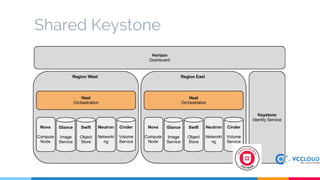
- Shared Keystone
- Federated Keystone
1. Multi Regions/Sites deployment models
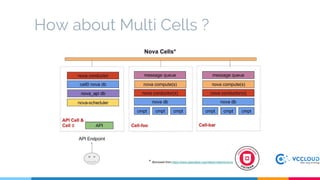
How about Multi Cells ?
Idea:
- One Cell each Region
Problem:
- Only nova has cell. neutron does not
- When Controller node down ?
Shared Keystone
-
2. Problem with shared Keystone
Keystone Deployment
- Centralized: a single Keystone service installed
in some locations, either in “master” region or
totally external as a service to Openstack region
- Distributed: a Keystone service is deployed in
each region.
When deploy Keystone distributed We have to concern
about database deployments
Database replicates:
- Master/Slave Synchronous
- Multi master Synchronous
Database server sharing:
- All database in one site replicated
- Only Keystone database can replicated to other site.
2. Problem with shared Keystone
Keystone Token Type:
- Fernet: distributed, key rotation
- UUID: large Database
- PKI/ PKIZ: Not good for many sites
2. Problem with shared Keystone
Upgrade??
One site upgrade, other sites have to.
Federated Keystone
- Federation is a powerful technology that essentially
allows one cloud to trust the users of another.
- Keystone works as Identity Provider and Service
Provider is known as Keystone to Keystone
- Identity Provider: a system entity that creates,
maintains and manages ID information
- Service Provider: is an entity that provides services
3. How K2K solve these problem?
K2K enables the ability to federate identities between
Keystone instances, with Keystone acting on behalf of
the user to deliver cross-cloud authorized and
homogeneous cross-cloud service list
- Keystone to Keystone is shared nothing, so we can
have more sites than other model.
- K2K use concept Identity Provider and Service Provider
- Upgrade one site does not effect other sites.
- If Keystone Identity Provider not active , local users still
can interactive with their resources
3. How K2K solve these problem?
- Do not concern about sync fernet key between
regions/sites
- Number of Endpoint in Keystone database not large
- Deploy new sites easier
- Does not concern about Database Synchronous
between sites/ regions
3. How K2K solve these problem?
Issues with K2k ?
- Currently K2K does not support
HA
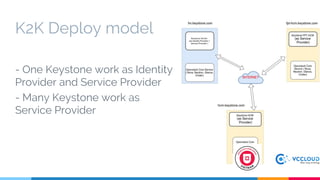
K2K Deploy model
- One Keystone work as Identity
Provider and Service Provider
- Many Keystone work as
Service Provider
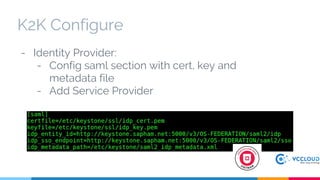
K2K Configure
- Identity Provider:
- Config saml section with cert, key and
metadata file
- Add Service Provider
- Service Provider
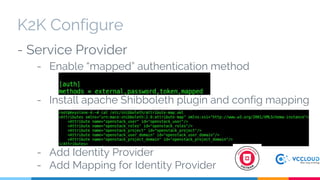
- Enable “mapped” authentication method
- Install apache Shibboleth plugin and config mapping
- Add Identity Provider
- Add Mapping for Identity Provider
K2K Configure
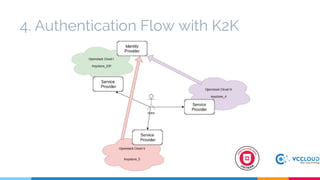
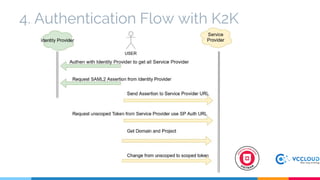
4. Authentication Flow with K2K
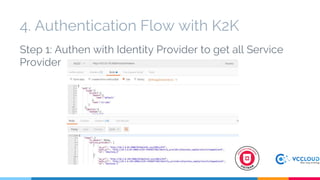
Step 1: Authen with Identity Provider to get all Service
Provider
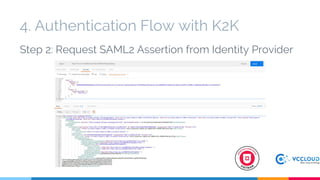
4. Authentication Flow with K2K
Step 2: Request SAML2 Assertion from Identity Provider
4. Authentication Flow with K2K
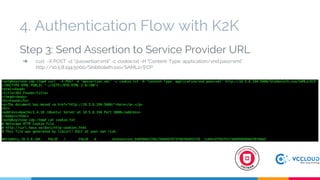
Step 3: Send Assertion to Service Provider URL
➔ curl -X POST -d "@assertion.xml" -c cookie.txt -H "Content-Type: application/vnd.paos+xml"
http://10.5.8.194:5000/Shibboleth.sso/SAML2/ECP
4. Authentication Flow with K2K
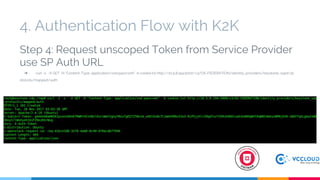
Step 4: Request unscoped Token from Service Provider
use SP Auth URL
➔ curl -s -X GET -H "Content-Type: application/vnd.paos+xml" -b cookie.txt http://10.5.8.194:5000/v3/OS-FEDERATION/identity_providers/keystone_sapd/pr
otocols/mapped/auth
4. Authentication Flow with K2K
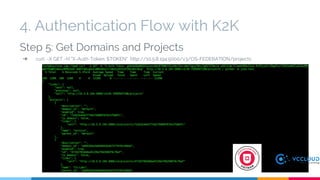
Step 5: Get Domains and Projects
➔ curl -X GET -H "X-Auth-Token: $TOKEN" http://10.5.8.194:5000/v3/OS-FEDERATION/projects
4. Authentication Flow with K2K
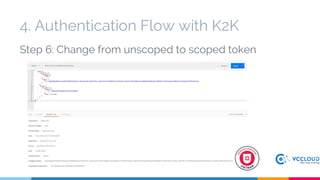
Step 6: Change from unscoped to scoped token
4. Authentication Flow with K2K
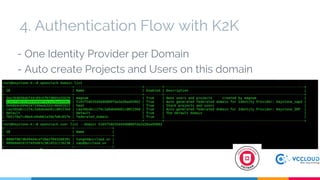
- One Identity Provider per Domain
- Auto create Projects and Users on this domain
4. Authentication Flow with K2K
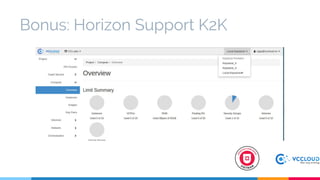
Bonus: Horizon Support K2K
5. Demo
6. Future Works
- High Available for Keystone Identity Provider Site
- DR for Keystone Identity Provider
Discuss Time
Thank you

Keystone at openstack multi sites

  • 1.
    Keystone at Openstack MultiSites Sa Pham @ VCCloud
  • 2.
    Who I am? SaPham Dang / sapd@vccloud.vn - System Engineer at VCCLoud / VCCorp Organizer
  • 3.
    Agenda 1. Multi Regions/Sitestypical deployment models. 2. Problem with Shared Keystone. 3. How does K2K solve these problem ? 4. Authentication flow with K2K. 5. Demo 6. Future works
  • 4.
    1. Multi Regions/Sitesdeployment models Some concepts needed to know: - Availability Zone - Cells - Region - Site
  • 5.
    - Shared Keystone -Federated Keystone 1. Multi Regions/Sites deployment models
  • 6.
  • 7.
    How about MultiCells ? Idea: - One Cell each Region Problem: - Only nova has cell. neutron does not - When Controller node down ?
  • 8.
  • 9.
    2. Problem withshared Keystone Keystone Deployment - Centralized: a single Keystone service installed in some locations, either in “master” region or totally external as a service to Openstack region - Distributed: a Keystone service is deployed in each region.
  • 10.
    When deploy Keystonedistributed We have to concern about database deployments Database replicates: - Master/Slave Synchronous - Multi master Synchronous Database server sharing: - All database in one site replicated - Only Keystone database can replicated to other site. 2. Problem with shared Keystone
  • 11.
    Keystone Token Type: -Fernet: distributed, key rotation - UUID: large Database - PKI/ PKIZ: Not good for many sites 2. Problem with shared Keystone
  • 12.
    Upgrade?? One site upgrade,other sites have to.
  • 13.
    Federated Keystone - Federationis a powerful technology that essentially allows one cloud to trust the users of another. - Keystone works as Identity Provider and Service Provider is known as Keystone to Keystone - Identity Provider: a system entity that creates, maintains and manages ID information - Service Provider: is an entity that provides services
  • 14.
    3. How K2Ksolve these problem? K2K enables the ability to federate identities between Keystone instances, with Keystone acting on behalf of the user to deliver cross-cloud authorized and homogeneous cross-cloud service list
  • 15.
    - Keystone toKeystone is shared nothing, so we can have more sites than other model. - K2K use concept Identity Provider and Service Provider - Upgrade one site does not effect other sites. - If Keystone Identity Provider not active , local users still can interactive with their resources 3. How K2K solve these problem?
  • 16.
    - Do notconcern about sync fernet key between regions/sites - Number of Endpoint in Keystone database not large - Deploy new sites easier - Does not concern about Database Synchronous between sites/ regions 3. How K2K solve these problem?
  • 17.
    Issues with K2k? - Currently K2K does not support HA
  • 18.
    K2K Deploy model -One Keystone work as Identity Provider and Service Provider - Many Keystone work as Service Provider
  • 19.
    K2K Configure - IdentityProvider: - Config saml section with cert, key and metadata file - Add Service Provider
  • 20.
    - Service Provider -Enable “mapped” authentication method - Install apache Shibboleth plugin and config mapping - Add Identity Provider - Add Mapping for Identity Provider K2K Configure
  • 21.
  • 22.
  • 23.
    Step 1: Authenwith Identity Provider to get all Service Provider 4. Authentication Flow with K2K
  • 24.
    Step 2: RequestSAML2 Assertion from Identity Provider 4. Authentication Flow with K2K
  • 25.
    Step 3: SendAssertion to Service Provider URL ➔ curl -X POST -d "@assertion.xml" -c cookie.txt -H "Content-Type: application/vnd.paos+xml" http://10.5.8.194:5000/Shibboleth.sso/SAML2/ECP 4. Authentication Flow with K2K
  • 26.
    Step 4: Requestunscoped Token from Service Provider use SP Auth URL ➔ curl -s -X GET -H "Content-Type: application/vnd.paos+xml" -b cookie.txt http://10.5.8.194:5000/v3/OS-FEDERATION/identity_providers/keystone_sapd/pr otocols/mapped/auth 4. Authentication Flow with K2K
  • 27.
    Step 5: GetDomains and Projects ➔ curl -X GET -H "X-Auth-Token: $TOKEN" http://10.5.8.194:5000/v3/OS-FEDERATION/projects 4. Authentication Flow with K2K
  • 28.
    Step 6: Changefrom unscoped to scoped token 4. Authentication Flow with K2K
  • 29.
    - One IdentityProvider per Domain - Auto create Projects and Users on this domain 4. Authentication Flow with K2K
  • 30.
  • 31.
  • 32.
    6. Future Works -High Available for Keystone Identity Provider Site - DR for Keystone Identity Provider
  • 33.
  • 34.