WELCOME TO THE WORLD
OF NATIONAL PARKS
 National parks generally have several objectives. The area
should be managed using natural means and this
management should contribute to the conservation of species
in the area, the area’s ecology, migration routes, etc. The
areas are often also used to inspire and educate the public,
as well as contributing to the nation’s culture and recreation
facilities, but visitor numbers should be closely managed to
ensure that no damage is done to the area. If indigenous
people are living in the area, these should be supported
including by ensuring that they can access resources that
they need.
Objectives of National
Parks
 National parks also provide an
opportunity for education about
the importance of reducing
climate change and how to
change behaviour to do so, with
many national parks now
providing education programs
demonstrating this to the public.
 National parks are also a source
of sustainable energy. This can
include hydropower, wind energy,
and solar energy. Many countries
are now looking at ways to use
national park areas as renewable
energy sources in order to reduce
the use of fossil fuels and their
impact on the environment.
 They do not contribute to the
environmental damage caused by
humans.
The importance of national parks in
protecting the environment
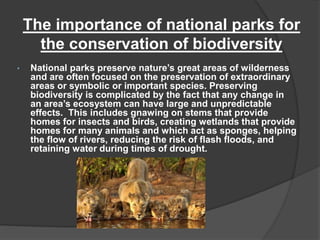
• National parks preserve nature’s great areas of wilderness
and are often focused on the preservation of extraordinary
areas or symbolic or important species. Preserving
biodiversity is complicated by the fact that any change in
an area’s ecosystem can have large and unpredictable
effects. This includes gnawing on stems that provide
homes for insects and birds, creating wetlands that provide
homes for many animals and which act as sponges, helping
the flow of rivers, reducing the risk of flash floods, and
retaining water during times of drought.
The importance of national parks for
the conservation of biodiversity
 National parks have an impact on
both the national economy and
local economies.
 National parks are also important
for the local rural communities that
are near the national parks, known
as “gateway communities”. Tourists
visiting these areas spend money
in hotels, shops, bars, restaurants,
etc, and can be a vital source of
jobs and income for the local
community.
 National parks also contribute to
the economy by
supporting agriculture. In protected
marine areas, fish are allowed to
breed and grow, and they spill over
into the fished areas. This helps to
replenish the fished areas, allowing
more fish to be caught and sold.
The importance of National
parks for the economy
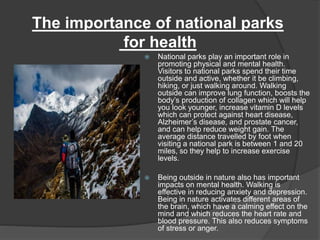
 National parks play an important role in
promoting physical and mental health.
Visitors to national parks spend their time
outside and active, whether it be climbing,
hiking, or just walking around. Walking
outside can improve lung function, boosts the
body’s production of collagen which will help
you look younger, increase vitamin D levels
which can protect against heart disease,
Alzheimer’s disease, and prostate cancer,
and can help reduce weight gain. The
average distance travelled by foot when
visiting a national park is between 1 and 20
miles, so they help to increase exercise
levels.
 Being outside in nature also has important
impacts on mental health. Walking is
effective in reducing anxiety and depression.
Being in nature activates different areas of
the brain, which have a calming effect on the
mind and which reduces the heart rate and
blood pressure. This also reduces symptoms
of stress or anger.
The importance of national parks
for health
Ranthambore National Park welcomes
you…
Introduction and its features:
 Ranthambore National Park is located about 13.5 km from the city
of Sawai Madhapur in Rajasthan, located at the junction of the
Aravali.
 The park covers an area about approximately 400 sq km and Sawai
Man Singh sanctuary is about 500 sq km.
 Ranthambore National Park harbours dry deciduous forests and
open grassy meadow. The flora of the park includes 539 species of
flowering plants.
 The national park covers a total area of 392 km2, including buffer
zone. The core area is about 275 km2. The tiger reserve area was
about 334 km2. Today, it covers an area of 1334 km2. The elevation
is about 215 to 505 meters above mean sea level. The land features
dense tropical dry forest, open bushland and rocky terrain
interspersed with lakes and streams. Ecoregion includes Khathiar-
Gir dry deciduous forests.
HISTORY OF RANTHAMBORE TIGER
RESERVE
Ranthambore National Park was established as
Sawai Madhopur Game Sanctuary in 1955, initially
covering an area of 282 km2 (109 sq mi).
 It was declared one of the Project Tiger reserves in
1973 and became a national park on 1 November
1980.
 In 1984, the adjacent forests were declared the
Sawai Man Singh Sanctuary and Keladevi Sanctuary.
In 1992, the Tiger Reserve was expanded to include
the adjoining Keladevi Sanctuary in the north and
Sawai Mansingh Sanctuary to the south along with
other forests.
SOME IMPORTANT THINGS TO
DO IN RANTHAMBORE
 WILD ANIMALS VISIT
 BIRDS WATCHING
 GYPSY SAFARI
 CANTER SAFARI
 PHOTOGRAPHY
JIMCORBETT NATIONAL PARK
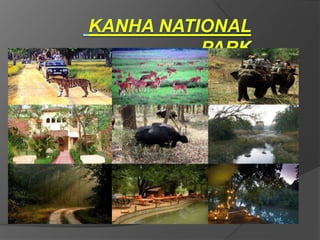
 Kanha Tiger Reserve, also known as Kanha–Kisli National
Park, is one of the tiger reserves of India and the
largest national park of the state of Madhya Pradesh. The
present-day Kanha area is divided into two protected areas,
Hallon and Banjar, of 250 and 300 km2 (97 and 116 sq. mi),
respectively. Kanha National Park was created on 1 June 1955
and was designated a tiger reserve in 1973. Today, it
encompasses an area of 940 km2 (360 sq. mi) in the two
districts Mandla and Balaghat.
 Together with a surrounding buffer zone of
1,067 km2 (412 sq. mi) and the neighbouring
110 km2 (42 sq. mi) Phen Sanctuary, it forms the Kanha Tiger
Reserve, which is one of the biggest in the country. This makes
it the largest national park in central India.
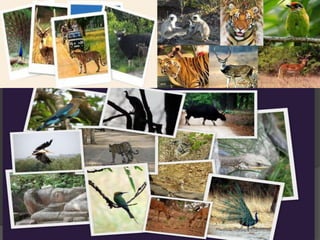
 The park hosts Bengal tiger, Indian leopard, sloth
bear, Barasingha and dhole. It is also the first tiger reserve in
India to officially introduce a mascot, Bhoorsingh the
Barasingha.
KAZIRANGA NATIONAL
PARK
Don't denature the
nature;
it is a gift from
God to us.

National Parks PPT

  • 1.
    WELCOME TO THEWORLD OF NATIONAL PARKS
  • 2.
     National parksgenerally have several objectives. The area should be managed using natural means and this management should contribute to the conservation of species in the area, the area’s ecology, migration routes, etc. The areas are often also used to inspire and educate the public, as well as contributing to the nation’s culture and recreation facilities, but visitor numbers should be closely managed to ensure that no damage is done to the area. If indigenous people are living in the area, these should be supported including by ensuring that they can access resources that they need. Objectives of National Parks
  • 3.
     National parksalso provide an opportunity for education about the importance of reducing climate change and how to change behaviour to do so, with many national parks now providing education programs demonstrating this to the public.  National parks are also a source of sustainable energy. This can include hydropower, wind energy, and solar energy. Many countries are now looking at ways to use national park areas as renewable energy sources in order to reduce the use of fossil fuels and their impact on the environment.  They do not contribute to the environmental damage caused by humans. The importance of national parks in protecting the environment
  • 4.
    • National parkspreserve nature’s great areas of wilderness and are often focused on the preservation of extraordinary areas or symbolic or important species. Preserving biodiversity is complicated by the fact that any change in an area’s ecosystem can have large and unpredictable effects. This includes gnawing on stems that provide homes for insects and birds, creating wetlands that provide homes for many animals and which act as sponges, helping the flow of rivers, reducing the risk of flash floods, and retaining water during times of drought. The importance of national parks for the conservation of biodiversity
  • 5.
     National parkshave an impact on both the national economy and local economies.  National parks are also important for the local rural communities that are near the national parks, known as “gateway communities”. Tourists visiting these areas spend money in hotels, shops, bars, restaurants, etc, and can be a vital source of jobs and income for the local community.  National parks also contribute to the economy by supporting agriculture. In protected marine areas, fish are allowed to breed and grow, and they spill over into the fished areas. This helps to replenish the fished areas, allowing more fish to be caught and sold. The importance of National parks for the economy
  • 6.
     National parksplay an important role in promoting physical and mental health. Visitors to national parks spend their time outside and active, whether it be climbing, hiking, or just walking around. Walking outside can improve lung function, boosts the body’s production of collagen which will help you look younger, increase vitamin D levels which can protect against heart disease, Alzheimer’s disease, and prostate cancer, and can help reduce weight gain. The average distance travelled by foot when visiting a national park is between 1 and 20 miles, so they help to increase exercise levels.  Being outside in nature also has important impacts on mental health. Walking is effective in reducing anxiety and depression. Being in nature activates different areas of the brain, which have a calming effect on the mind and which reduces the heart rate and blood pressure. This also reduces symptoms of stress or anger. The importance of national parks for health
  • 7.
  • 8.
    Introduction and itsfeatures:  Ranthambore National Park is located about 13.5 km from the city of Sawai Madhapur in Rajasthan, located at the junction of the Aravali.  The park covers an area about approximately 400 sq km and Sawai Man Singh sanctuary is about 500 sq km.  Ranthambore National Park harbours dry deciduous forests and open grassy meadow. The flora of the park includes 539 species of flowering plants.  The national park covers a total area of 392 km2, including buffer zone. The core area is about 275 km2. The tiger reserve area was about 334 km2. Today, it covers an area of 1334 km2. The elevation is about 215 to 505 meters above mean sea level. The land features dense tropical dry forest, open bushland and rocky terrain interspersed with lakes and streams. Ecoregion includes Khathiar- Gir dry deciduous forests.
  • 9.
    HISTORY OF RANTHAMBORETIGER RESERVE Ranthambore National Park was established as Sawai Madhopur Game Sanctuary in 1955, initially covering an area of 282 km2 (109 sq mi).  It was declared one of the Project Tiger reserves in 1973 and became a national park on 1 November 1980.  In 1984, the adjacent forests were declared the Sawai Man Singh Sanctuary and Keladevi Sanctuary. In 1992, the Tiger Reserve was expanded to include the adjoining Keladevi Sanctuary in the north and Sawai Mansingh Sanctuary to the south along with other forests.
  • 10.
    SOME IMPORTANT THINGSTO DO IN RANTHAMBORE  WILD ANIMALS VISIT  BIRDS WATCHING  GYPSY SAFARI  CANTER SAFARI  PHOTOGRAPHY
  • 11.
  • 13.
     Kanha TigerReserve, also known as Kanha–Kisli National Park, is one of the tiger reserves of India and the largest national park of the state of Madhya Pradesh. The present-day Kanha area is divided into two protected areas, Hallon and Banjar, of 250 and 300 km2 (97 and 116 sq. mi), respectively. Kanha National Park was created on 1 June 1955 and was designated a tiger reserve in 1973. Today, it encompasses an area of 940 km2 (360 sq. mi) in the two districts Mandla and Balaghat.  Together with a surrounding buffer zone of 1,067 km2 (412 sq. mi) and the neighbouring 110 km2 (42 sq. mi) Phen Sanctuary, it forms the Kanha Tiger Reserve, which is one of the biggest in the country. This makes it the largest national park in central India.  The park hosts Bengal tiger, Indian leopard, sloth bear, Barasingha and dhole. It is also the first tiger reserve in India to officially introduce a mascot, Bhoorsingh the Barasingha.
  • 15.
  • 19.
    Don't denature the nature; itis a gift from God to us.