NATIONAL VTE AUDIT CALL TO ACTION SEPTEMBER 10, 2014 
Artemis Diamantouros, Bill Geerts & Virginia Flintoft 
Gina Peck, Anne MacLaurin and Alex Titeu
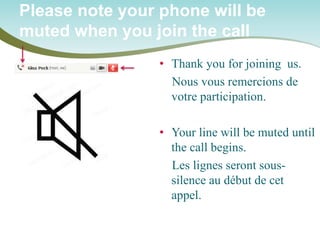
Please note your phone will be muted when you join the call 
• 
Thank you for joining us. 
Nous vous remercions de votre participation. 
• 
Your line will be muted until the call begins. 
Les lignes seront sous- silence au début de cet appel.
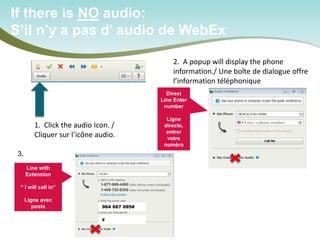
If there is NO audio: 
S’il n’y a pas d’ audio de WebEx 
1. Click the audio Icon. / 
Cliquer sur l’icône audio. 
2. A popup will display the phone information./ Une boîte de dialogue offre l’information téléphonique 
Direct Line Enter number Ligne directe, entrer votre numéro 
Line with Extension “ I will call in” Ligne avec poste 
Or/ou 
964 667 095# 
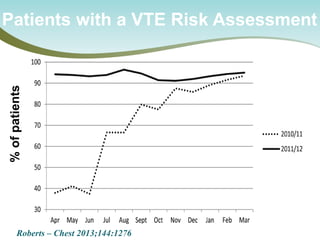
# 
3.
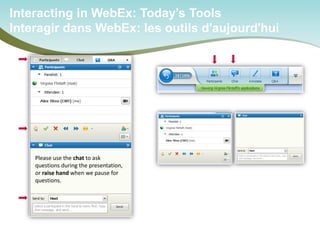
Interacting in WebEx: Today’s Tools Interagir dans WebEx: les outils d'aujourd'hui 
Please use the chat to ask questions during the presentation, or raise hand when we pause for questions.
• 
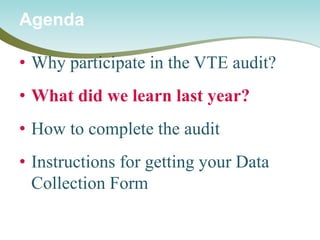
Why participate in the VTE audit? 
• 
What did we learn last year? 
• 
How to complete the audit 
• 
Instructions for getting and using your Data Collection Form 
Agenda
 
Why participate in the VTE audit? 
 
What did we learn last year? 
 
How to complete the audit 
 
Instructions for getting your Data Collection Form 
Agenda
Bill Geerts, MD, FRCPC 
Thromboembolism Specialist, Sunnybrook Health Sciences Centre 
Professor of Medicine, University of Toronto 
National lead, VTE Prevention, Safer Healthcare Now! 
Why participate in the VTE audit?
Why participate in the VTE audit? 
1. Because 60% of all venous thromboembolism (VTE) in the population is hospital-acquired
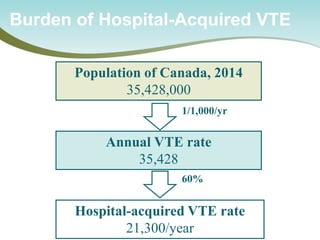
Burden of Hospital-Acquired VTE 
Population of Canada, 2014 
35,428,000 
Annual VTE rate 
35,428 
1/1,000/yr 
60% 
Hospital-acquired VTE rate 21,300/year
Why participate in the VTE audit? 
1. 
Because 60% of all VTE in the population is hospital-acquired 
2. 
Because HA-VTE produces substantial patient harm
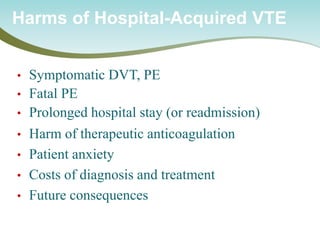
Harms of Hospital-Acquired VTE 
•Symptomatic DVT, PE 
•Fatal PE 
•Prolonged hospital stay (or readmission) 
•Harm of therapeutic anticoagulation 
•Patient anxiety 
•Costs of diagnosis and treatment 
•Future consequences
Why participate in the VTE audit? 
1. 
Because 60% of all VTE in the population are hospital-acquired 
2. 
Because HA-VTE produces patient harm 
3. 
Because HA-VTE can be prevented (effectively, safely, inexpensively)
Why participate in the VTE audit? 
4. Because comprehensive thromboprophylaxis programs are expected by Accreditation Canada and are expected by our PATIENTS
Why participate in the VTE audit? 
4. Because comprehensive thromboprophylaxis programs are expected by Accreditation Canada and are expected by our PATIENTS 5. Because it is essential to measure our compliance with this safety standard of care
Thromboprophylaxis improves clinically-important outcomes: 
4 examples 
Why participate in the VTE audit?
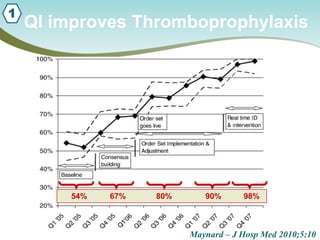
QI improves Thromboprophylaxis 
1 
Maynard – J Hosp Med 2010;5:10 
54% 67% 80% 90% 98%
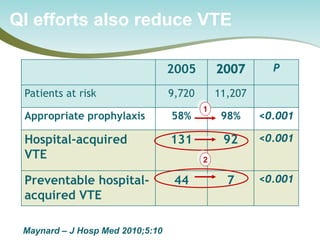
QI efforts also reduce VTE 
Maynard – J Hosp Med 2010;5:10 
2005 
P 
Patients at risk 
9,720 
11,207 
Appropriate prophylaxis 
58% 
98% 
<0.001 
Hospital-acquired VTE 
131 
92 
<0.001 
Preventable hospital- acquired VTE 
44 
7 
<0.001 
1 
2
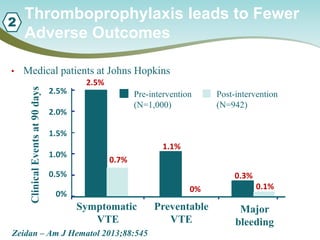
Thromboprophylaxis leads to Fewer Adverse Outcomes 
Zeidan – Am J Hematol 2013;88:545 
2.5% 
1.1% 
0% 
0.5% 
1.0% 
1.5% 
2.0% 
2.5% 
Symptomatic VTE 
Preventable VTE 
Clinical Events at 90 days 
Major bleeding 
0.7% 
0% 
0.3% 
0.1% 
Pre-intervention (N=1,000) 
Post-intervention (N=942) 
• 
Medical patients at Johns Hopkins 
2
• 
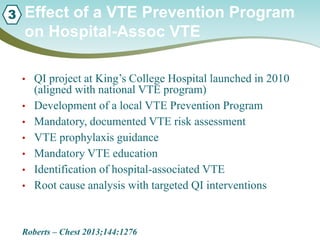
QI project at King’s College Hospital launched in 2010 (aligned with national VTE program) 
• 
Development of a local VTE Prevention Program 
• 
Mandatory, documented VTE risk assessment 
• 
VTE prophylaxis guidance 
• 
Mandatory VTE education 
• 
Identification of hospital-associated VTE 
• 
Root cause analysis with targeted QI interventions 
Effect of a VTE Prevention Program on Hospital-Assoc VTE 
Roberts – Chest 2013;144:1276 
3
Patients with a VTE Risk Assessment 
Roberts – Chest 2013;144:1276 
% of patients
• 
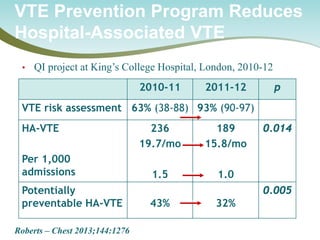
QI project at King’s College Hospital, London, 2010-12 
VTE Prevention Program Reduces Hospital-Associated VTE 
2010-11 
2011-12 
p 
VTE risk assessment 
63% (38-88) 
93% (90-97) 
HA-VTE 
Per 1,000 admissions 
236 
19.7/mo 
1.5 
189 
15.8/mo 
1.0 
0.014 
Potentially preventable HA-VTE 
43% 
32% 
0.005 
Roberts – Chest 2013;144:1276
• 
All patients admitted to all 163 NHS trusts, 2010-12 
• 
Mandatory reporting of use of the VTE risk tool 
Use of the UK National VTE Risk Assessment Tool 
Lester – Heart – 2013;99:1734 
Rate of VTE risk assessments performed [IQR] 
100% 
0% 
50% 
July 2010 
March 2012 
51% [27,71] 
93% [91,96] 
4
• 
All 4 million patients admitted to all 163 NHS hospital trusts >3 days, 2010-12 
Hospital-Acquired Fatal VTE is Reduced in Adherent Hospitals 
Lester – Heart – 2013;99:1734 
Fatal VTE <90 days after hospital discharge 
Rel Risk for hospitals with VTE risk assessment >90% vs <90% 
All 
0.85 [0.75-0.96; p=0.01] 
Post-discharge 
0.81 [0.67-0.79; p=0.03] 
Achieving >90% VTE risk assessment is associated with significant lower VTE mortality
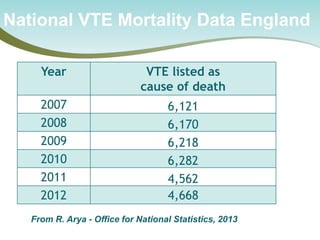
National VTE Mortality Data England 
Year 
VTE listed as 
cause of death 
2007 
6,121 
2008 
6,170 
2009 
6,218 
2010 
6,282 
2011 
4,562 
2012 
4,668 
From R. Arya - Office for National Statistics, 2013
• 
Why participate in the VTE audit? 
• 
What did we learn last year? 
• 
How to complete the audit 
• 
Instructions for getting your Data Collection Form 
Agenda
2013 National VTE Audit RESULTS
• 
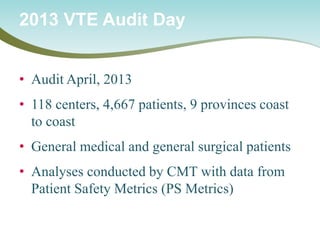
Audit April, 2013 
• 
118 centers, 4,667 patients, 9 provinces coast to coast 
• 
General medical and general surgical patients 
• 
Analyses conducted by CMT with data from Patient Safety Metrics (PS Metrics) 
2013 VTE Audit Day
• 
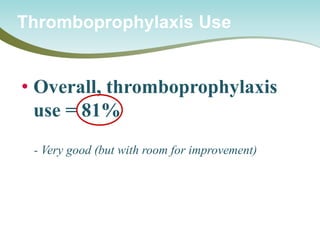
Overall, thromboprophylaxis use = 81% 
- Very good (but with room for improvement) 
Thromboprophylaxis Use
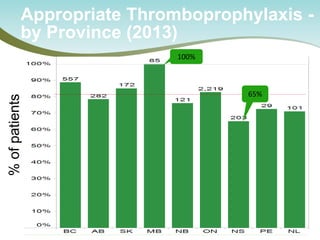
Appropriate Thromboprophylaxis - by Province (2013) 
% of patients 
100% 
65%
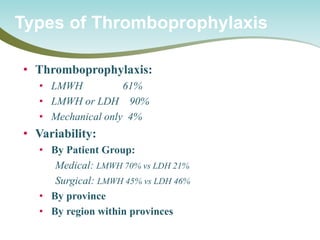
Types of Thromboprophylaxis 
• 
Thromboprophylaxis: 
• 
LMWH 61% 
• 
LMWH or LDH 90% 
• 
Mechanical only 4% 
• 
Variability: 
• 
By Patient Group: Medical: LMWH 70% vs LDH 21% Surgical: LMWH 45% vs LDH 46% 
• 
By province 
• 
By region within provinces
• 
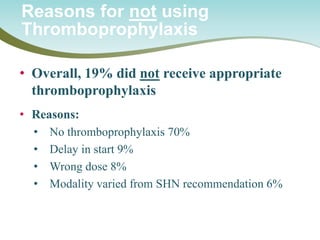
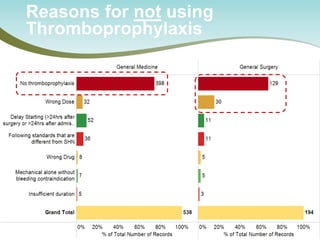
Overall, 19% did not receive appropriate thromboprophylaxis 
• 
Reasons: 
• 
No thromboprophylaxis 70% 
• 
Delay in start 9% 
• 
Wrong dose 8% 
• 
Modality varied from SHN recommendation 6% 
Reasons for not using Thromboprophylaxis
• 
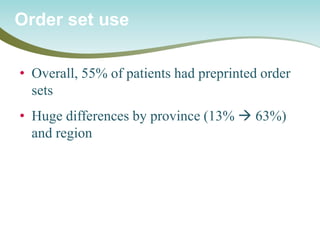
Overall, 55% of patients had preprinted order sets 
• 
Huge differences by province (13%  63%) and region 
Order set use
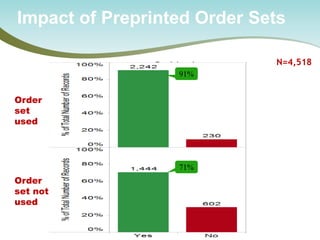
Impact of Preprinted Order Sets 
N=4,518 
Order set used 
Order set not used 
91% 
71%
2014 National VTE Audit
• 
Why participate in the VTE audit? 
• 
What did we learn last year? 
• 
How to complete the audit 
• 
Instructions for getting your Data Collection Form 
Agenda
• 
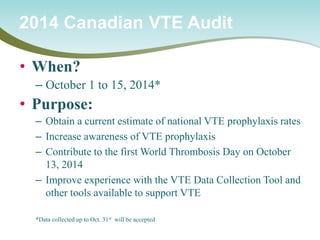
When? 
– 
October 1 to 15, 2014* 
• 
Purpose: 
– 
Obtain a current estimate of national VTE prophylaxis rates 
– 
Increase awareness of VTE prophylaxis 
– 
Contribute to the first World Thrombosis Day on October 13, 2014 
– 
Improve experience with the VTE Data Collection Tool and other tools available to support VTE 
*Data collected up to Oct. 31st will be accepted 
2014 Canadian VTE Audit
• 
Your commitment: 
– 
Approximately 60 minutes 
• 
Your essential contribution: 
– 
Helping to improve the delivery of safe and effective care for patients 
Canadian VTE Audit 2014
• 
The VTE audit will again focus on: 
– 
Internal Medicine 
– 
General Surgery 
• 
Audit sample can be: 
– 
Both Medical AND General Surgical patients (preferred option) 
– 
OR, either Medical or Surgical patients 
Patients include
• 
At least 20 patients from each group (medical, surgical) 
• 
4 options for determining audit sample: 
1. 
All eligible medical AND general surgical patients 
2. 
All eligible medical OR surgical patients 
3. 
A sample of eligible medical AND surgical patients (consecutive patients, random sample, 1 or more nursing units) 
4. 
A sample of eligible medical OR a sample of eligible surgical patients 
Step 1: Identifying Audit Sample
• 
Inclusion: 
– 
Patients in hospital on Oct. 1 AND with an actual or expected LOS of more than 2 calendar days 
– 
Patients admitted between Oct. 1-15* with an actual or expected LOS of more than 2 calendar days 
• 
Exclusions: 
– 
Patients in hospital >30 calendar days 
– 
Patients receiving therapeutic doses of anticoagulants 
*May extend to Oct. 31st if required 
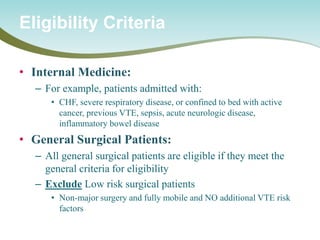
Eligibility Criteria
• 
Internal Medicine: 
– 
For example, patients admitted with: 
• 
CHF, severe respiratory disease, or confined to bed with active cancer, previous VTE, sepsis, acute neurologic disease, inflammatory bowel disease 
• 
General Surgical Patients: 
– 
All general surgical patients are eligible if they meet the general criteria for eligibility 
– 
Exclude Low risk surgical patients 
• 
Non-major surgery and fully mobile and NO additional VTE risk factors 
Eligibility Criteria
• 
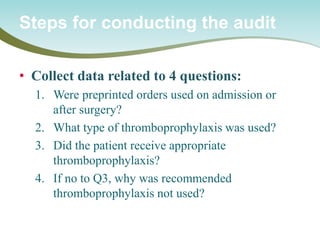
Collect data related to 4 questions: 
1. 
Were preprinted orders used on admission or after surgery? 
2. 
What type of thromboprophylaxis was used? 
3. 
Did the patient receive appropriate thromboprophylaxis? 
4. 
If no to Q3, why was recommended thromboprophylaxis not used? 
Steps for conducting the audit
• 
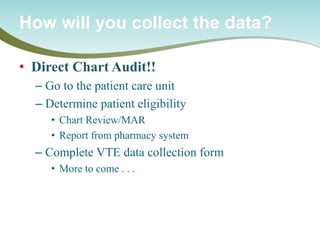
Direct Chart Audit!! 
– 
Go to the patient care unit 
– 
Determine patient eligibility 
• 
Chart Review/MAR 
• 
Report from pharmacy system 
– 
Complete VTE data collection form 
• 
More to come . . . 
How will you collect the data?
 
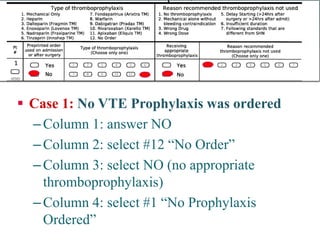
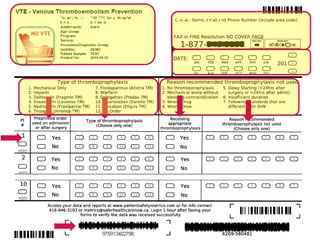
Case 1: No VTE Prophylaxis was ordered 
– 
Column 1: answer NO 
– 
Column 2: select #12 “No Order” 
– 
Column 3: select NO (no appropriate thromboprophylaxis) 
– 
Column 4: select #1 “No Prophylaxis Ordered” 
Reviewing the chart
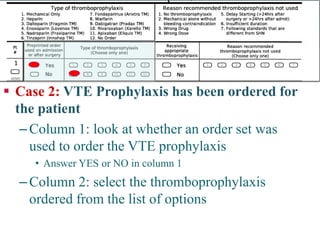
 
Case 2: VTE Prophylaxis has been ordered for the patient 
– 
Column 1: look at whether an order set was used to order the VTE prophylaxis 
• 
Answer YES or NO in column 1 
– 
Column 2: select the thromboprophylaxis ordered from the list of options 
Reviewing the chart
 
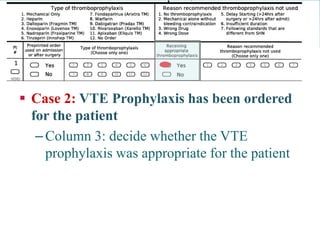
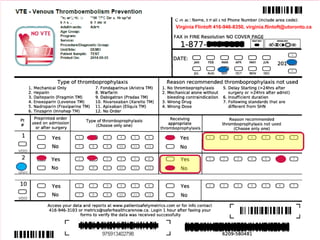
Case 2: VTE Prophylaxis has been ordered for the patient 
– 
Column 3: decide whether the VTE prophylaxis was appropriate for the patient 
Reviewing the chart
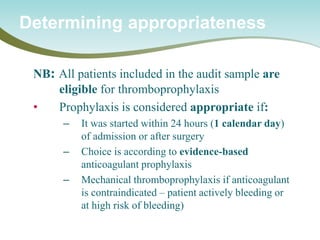
NB: All patients included in the audit sample are eligible for thromboprophylaxis 
• 
Prophylaxis is considered appropriate if: 
– 
It was started within 24 hours (1 calendar day) of admission or after surgery 
– 
Choice is according to evidence-based anticoagulant prophylaxis 
– 
Mechanical thromboprophylaxis if anticoagulant is contraindicated – patient actively bleeding or at high risk of bleeding) 
Determining appropriateness
 
Case 2: VTE Prophylaxis has been ordered for the patient 
– 
Column 4: if you answered NO to column 3, choose the reason(s) why the order was not appropriate 
Reviewing the chart
How to participate in the VTE Audit
1. 
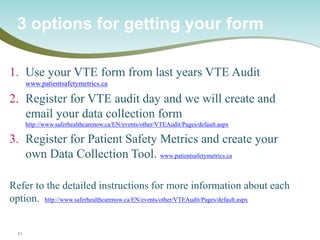
Use your VTE form from last years VTE Audit www.patientsafetymetrics.ca 
2. 
Register for VTE audit day and we will create and email your data collection form http://www.saferhealthcarenow.ca/EN/events/other/VTEAudit/Pages/default.aspx 
3. 
Register for Patient Safety Metrics and create your own Data Collection Tool. www.patientsafetymetrics.ca 
Refer to the detailed instructions for more information about each option. http://www.saferhealthcarenow.ca/EN/events/other/VTEAudit/Pages/default.aspx 
3 options for getting your form 
51
52 
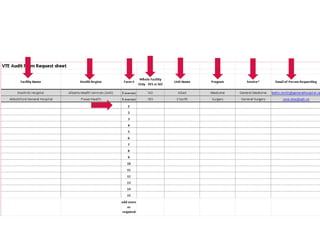
How to Request a Data Collection (Audit) Form
Completing Audit Form Request
Patient Safety Metrics An Overview
Features: 
• 
Cloud-based data collection and reporting tool 
• 
User friendly and simple to navigate 
• 
Accessible from website with login details 
• 
Tracks >100 process and outcome measures over 14 interventions 
• 
Provides real time reporting. 
• 
Reduces burden of data collection, entry and analysis 
• 
Capacity to customize measures and reports 
Patient Safety Metrics
• 
Data Collection Forms 
– 
Patient-level data (de-identified) - daily 
– 
Multiple data elements 
– 
Print form  Collect data  Fax form 
– 
Automatic roll-up to Measurement Worksheets 
• 
Measurement Worksheets 
– 
Aggregate data - monthly 
– 
Numerator and Denominator 
Worksheets vs Data Collection Forms
PS Metrics can be used to support: 
• 
Small and Large Scale Improvement Initiatives 
• 
Roll Up or Drill Down Reports [e.g. Unit Site  Program Corporation Region Province  Node  National] 
• 
Produce automated run charts 
• 
Reporting for accountability 
• 
Possible to customize indicators to meet provincial, regional and local reporting needs 
Potential applications of the system
Completing Audit Form - #1
Completing Audit Form - #1 
Virginia Flintoft 416-946-8350, virginia.flintoft@utoronto.ca
Access to PS Metrics 
60 
https://psmetrics.utoronto.ca/metrics/login.aspx https://psmetrics.utoronto.ca/metrics/Login.aspx?language=french
• 
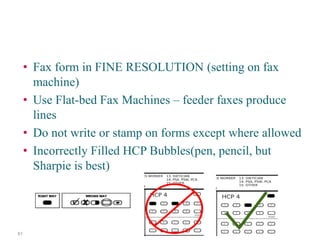
Fax form in FINE RESOLUTION (setting on fax machine) 
• 
Use Flat-bed Fax Machines – feeder faxes produce lines 
• 
Do not write or stamp on forms except where allowed 
• 
Incorrectly Filled HCP Bubbles(pen, pencil, but Sharpie is best) 
Beware of Common Errors! 61
Thank you … Questions? 
62
Poll 
Sondage
Thank you! 
For any questions, contact: Virginia Flintoft – 416-946-8350 Artemis Diamantouros– 416-480-6100 x3654 Email: artemis.diamantouros@sunnybrook.ca

Canadian VTE Audit - Information Call

  • 1.
    NATIONAL VTE AUDITCALL TO ACTION SEPTEMBER 10, 2014 Artemis Diamantouros, Bill Geerts & Virginia Flintoft Gina Peck, Anne MacLaurin and Alex Titeu
  • 2.
    Please note yourphone will be muted when you join the call • Thank you for joining us. Nous vous remercions de votre participation. • Your line will be muted until the call begins. Les lignes seront sous- silence au début de cet appel.
  • 3.
    If there isNO audio: S’il n’y a pas d’ audio de WebEx 1. Click the audio Icon. / Cliquer sur l’icône audio. 2. A popup will display the phone information./ Une boîte de dialogue offre l’information téléphonique Direct Line Enter number Ligne directe, entrer votre numéro Line with Extension “ I will call in” Ligne avec poste Or/ou 964 667 095# # 3.
  • 4.
    Interacting in WebEx:Today’s Tools Interagir dans WebEx: les outils d'aujourd'hui Please use the chat to ask questions during the presentation, or raise hand when we pause for questions.
  • 5.
    • Why participatein the VTE audit? • What did we learn last year? • How to complete the audit • Instructions for getting and using your Data Collection Form Agenda
  • 6.
     Why participatein the VTE audit?  What did we learn last year?  How to complete the audit  Instructions for getting your Data Collection Form Agenda
  • 7.
    Bill Geerts, MD,FRCPC Thromboembolism Specialist, Sunnybrook Health Sciences Centre Professor of Medicine, University of Toronto National lead, VTE Prevention, Safer Healthcare Now! Why participate in the VTE audit?
  • 8.
    Why participate inthe VTE audit? 1. Because 60% of all venous thromboembolism (VTE) in the population is hospital-acquired
  • 9.
    Burden of Hospital-AcquiredVTE Population of Canada, 2014 35,428,000 Annual VTE rate 35,428 1/1,000/yr 60% Hospital-acquired VTE rate 21,300/year
  • 10.
    Why participate inthe VTE audit? 1. Because 60% of all VTE in the population is hospital-acquired 2. Because HA-VTE produces substantial patient harm
  • 11.
    Harms of Hospital-AcquiredVTE •Symptomatic DVT, PE •Fatal PE •Prolonged hospital stay (or readmission) •Harm of therapeutic anticoagulation •Patient anxiety •Costs of diagnosis and treatment •Future consequences
  • 12.
    Why participate inthe VTE audit? 1. Because 60% of all VTE in the population are hospital-acquired 2. Because HA-VTE produces patient harm 3. Because HA-VTE can be prevented (effectively, safely, inexpensively)
  • 13.
    Why participate inthe VTE audit? 4. Because comprehensive thromboprophylaxis programs are expected by Accreditation Canada and are expected by our PATIENTS
  • 14.
    Why participate inthe VTE audit? 4. Because comprehensive thromboprophylaxis programs are expected by Accreditation Canada and are expected by our PATIENTS 5. Because it is essential to measure our compliance with this safety standard of care
  • 15.
    Thromboprophylaxis improves clinically-importantoutcomes: 4 examples Why participate in the VTE audit?
  • 16.
    QI improves Thromboprophylaxis 1 Maynard – J Hosp Med 2010;5:10 54% 67% 80% 90% 98%
  • 17.
    QI efforts alsoreduce VTE Maynard – J Hosp Med 2010;5:10 2005 P Patients at risk 9,720 11,207 Appropriate prophylaxis 58% 98% <0.001 Hospital-acquired VTE 131 92 <0.001 Preventable hospital- acquired VTE 44 7 <0.001 1 2
  • 18.
    Thromboprophylaxis leads toFewer Adverse Outcomes Zeidan – Am J Hematol 2013;88:545 2.5% 1.1% 0% 0.5% 1.0% 1.5% 2.0% 2.5% Symptomatic VTE Preventable VTE Clinical Events at 90 days Major bleeding 0.7% 0% 0.3% 0.1% Pre-intervention (N=1,000) Post-intervention (N=942) • Medical patients at Johns Hopkins 2
  • 19.
    • QI projectat King’s College Hospital launched in 2010 (aligned with national VTE program) • Development of a local VTE Prevention Program • Mandatory, documented VTE risk assessment • VTE prophylaxis guidance • Mandatory VTE education • Identification of hospital-associated VTE • Root cause analysis with targeted QI interventions Effect of a VTE Prevention Program on Hospital-Assoc VTE Roberts – Chest 2013;144:1276 3
  • 20.
    Patients with aVTE Risk Assessment Roberts – Chest 2013;144:1276 % of patients
  • 21.
    • QI projectat King’s College Hospital, London, 2010-12 VTE Prevention Program Reduces Hospital-Associated VTE 2010-11 2011-12 p VTE risk assessment 63% (38-88) 93% (90-97) HA-VTE Per 1,000 admissions 236 19.7/mo 1.5 189 15.8/mo 1.0 0.014 Potentially preventable HA-VTE 43% 32% 0.005 Roberts – Chest 2013;144:1276
  • 22.
    • All patientsadmitted to all 163 NHS trusts, 2010-12 • Mandatory reporting of use of the VTE risk tool Use of the UK National VTE Risk Assessment Tool Lester – Heart – 2013;99:1734 Rate of VTE risk assessments performed [IQR] 100% 0% 50% July 2010 March 2012 51% [27,71] 93% [91,96] 4
  • 23.
    • All 4million patients admitted to all 163 NHS hospital trusts >3 days, 2010-12 Hospital-Acquired Fatal VTE is Reduced in Adherent Hospitals Lester – Heart – 2013;99:1734 Fatal VTE <90 days after hospital discharge Rel Risk for hospitals with VTE risk assessment >90% vs <90% All 0.85 [0.75-0.96; p=0.01] Post-discharge 0.81 [0.67-0.79; p=0.03] Achieving >90% VTE risk assessment is associated with significant lower VTE mortality
  • 24.
    National VTE MortalityData England Year VTE listed as cause of death 2007 6,121 2008 6,170 2009 6,218 2010 6,282 2011 4,562 2012 4,668 From R. Arya - Office for National Statistics, 2013
  • 25.
    • Why participatein the VTE audit? • What did we learn last year? • How to complete the audit • Instructions for getting your Data Collection Form Agenda
  • 26.
    2013 National VTEAudit RESULTS
  • 27.
    • Audit April,2013 • 118 centers, 4,667 patients, 9 provinces coast to coast • General medical and general surgical patients • Analyses conducted by CMT with data from Patient Safety Metrics (PS Metrics) 2013 VTE Audit Day
  • 28.
    • Overall, thromboprophylaxisuse = 81% - Very good (but with room for improvement) Thromboprophylaxis Use
  • 29.
    Appropriate Thromboprophylaxis -by Province (2013) % of patients 100% 65%
  • 30.
    Types of Thromboprophylaxis • Thromboprophylaxis: • LMWH 61% • LMWH or LDH 90% • Mechanical only 4% • Variability: • By Patient Group: Medical: LMWH 70% vs LDH 21% Surgical: LMWH 45% vs LDH 46% • By province • By region within provinces
  • 31.
    • Overall, 19%did not receive appropriate thromboprophylaxis • Reasons: • No thromboprophylaxis 70% • Delay in start 9% • Wrong dose 8% • Modality varied from SHN recommendation 6% Reasons for not using Thromboprophylaxis
  • 32.
    Reasons for notusing Thromboprophylaxis
  • 33.
    • Overall, 55%of patients had preprinted order sets • Huge differences by province (13%  63%) and region Order set use
  • 34.
    Impact of PreprintedOrder Sets N=4,518 Order set used Order set not used 91% 71%
  • 35.
  • 36.
    • Why participatein the VTE audit? • What did we learn last year? • How to complete the audit • Instructions for getting your Data Collection Form Agenda
  • 37.
    • When? – October 1 to 15, 2014* • Purpose: – Obtain a current estimate of national VTE prophylaxis rates – Increase awareness of VTE prophylaxis – Contribute to the first World Thrombosis Day on October 13, 2014 – Improve experience with the VTE Data Collection Tool and other tools available to support VTE *Data collected up to Oct. 31st will be accepted 2014 Canadian VTE Audit
  • 38.
    • Your commitment: – Approximately 60 minutes • Your essential contribution: – Helping to improve the delivery of safe and effective care for patients Canadian VTE Audit 2014
  • 39.
    • The VTEaudit will again focus on: – Internal Medicine – General Surgery • Audit sample can be: – Both Medical AND General Surgical patients (preferred option) – OR, either Medical or Surgical patients Patients include
  • 40.
    • At least20 patients from each group (medical, surgical) • 4 options for determining audit sample: 1. All eligible medical AND general surgical patients 2. All eligible medical OR surgical patients 3. A sample of eligible medical AND surgical patients (consecutive patients, random sample, 1 or more nursing units) 4. A sample of eligible medical OR a sample of eligible surgical patients Step 1: Identifying Audit Sample
  • 41.
    • Inclusion: – Patients in hospital on Oct. 1 AND with an actual or expected LOS of more than 2 calendar days – Patients admitted between Oct. 1-15* with an actual or expected LOS of more than 2 calendar days • Exclusions: – Patients in hospital >30 calendar days – Patients receiving therapeutic doses of anticoagulants *May extend to Oct. 31st if required Eligibility Criteria
  • 42.
    • Internal Medicine: – For example, patients admitted with: • CHF, severe respiratory disease, or confined to bed with active cancer, previous VTE, sepsis, acute neurologic disease, inflammatory bowel disease • General Surgical Patients: – All general surgical patients are eligible if they meet the general criteria for eligibility – Exclude Low risk surgical patients • Non-major surgery and fully mobile and NO additional VTE risk factors Eligibility Criteria
  • 43.
    • Collect datarelated to 4 questions: 1. Were preprinted orders used on admission or after surgery? 2. What type of thromboprophylaxis was used? 3. Did the patient receive appropriate thromboprophylaxis? 4. If no to Q3, why was recommended thromboprophylaxis not used? Steps for conducting the audit
  • 44.
    • Direct ChartAudit!! – Go to the patient care unit – Determine patient eligibility • Chart Review/MAR • Report from pharmacy system – Complete VTE data collection form • More to come . . . How will you collect the data?
  • 45.
     Case 1:No VTE Prophylaxis was ordered – Column 1: answer NO – Column 2: select #12 “No Order” – Column 3: select NO (no appropriate thromboprophylaxis) – Column 4: select #1 “No Prophylaxis Ordered” Reviewing the chart
  • 46.
     Case 2:VTE Prophylaxis has been ordered for the patient – Column 1: look at whether an order set was used to order the VTE prophylaxis • Answer YES or NO in column 1 – Column 2: select the thromboprophylaxis ordered from the list of options Reviewing the chart
  • 47.
     Case 2:VTE Prophylaxis has been ordered for the patient – Column 3: decide whether the VTE prophylaxis was appropriate for the patient Reviewing the chart
  • 48.
    NB: All patientsincluded in the audit sample are eligible for thromboprophylaxis • Prophylaxis is considered appropriate if: – It was started within 24 hours (1 calendar day) of admission or after surgery – Choice is according to evidence-based anticoagulant prophylaxis – Mechanical thromboprophylaxis if anticoagulant is contraindicated – patient actively bleeding or at high risk of bleeding) Determining appropriateness
  • 49.
     Case 2:VTE Prophylaxis has been ordered for the patient – Column 4: if you answered NO to column 3, choose the reason(s) why the order was not appropriate Reviewing the chart
  • 50.
    How to participatein the VTE Audit
  • 51.
    1. Use yourVTE form from last years VTE Audit www.patientsafetymetrics.ca 2. Register for VTE audit day and we will create and email your data collection form http://www.saferhealthcarenow.ca/EN/events/other/VTEAudit/Pages/default.aspx 3. Register for Patient Safety Metrics and create your own Data Collection Tool. www.patientsafetymetrics.ca Refer to the detailed instructions for more information about each option. http://www.saferhealthcarenow.ca/EN/events/other/VTEAudit/Pages/default.aspx 3 options for getting your form 51
  • 52.
    52 How toRequest a Data Collection (Audit) Form
  • 53.
  • 54.
  • 55.
    Features: • Cloud-baseddata collection and reporting tool • User friendly and simple to navigate • Accessible from website with login details • Tracks >100 process and outcome measures over 14 interventions • Provides real time reporting. • Reduces burden of data collection, entry and analysis • Capacity to customize measures and reports Patient Safety Metrics
  • 56.
    • Data CollectionForms – Patient-level data (de-identified) - daily – Multiple data elements – Print form  Collect data  Fax form – Automatic roll-up to Measurement Worksheets • Measurement Worksheets – Aggregate data - monthly – Numerator and Denominator Worksheets vs Data Collection Forms
  • 57.
    PS Metrics canbe used to support: • Small and Large Scale Improvement Initiatives • Roll Up or Drill Down Reports [e.g. Unit Site  Program Corporation Region Province  Node  National] • Produce automated run charts • Reporting for accountability • Possible to customize indicators to meet provincial, regional and local reporting needs Potential applications of the system
  • 58.
  • 59.
    Completing Audit Form- #1 Virginia Flintoft 416-946-8350, virginia.flintoft@utoronto.ca
  • 60.
    Access to PSMetrics 60 https://psmetrics.utoronto.ca/metrics/login.aspx https://psmetrics.utoronto.ca/metrics/Login.aspx?language=french
  • 61.
    • Fax formin FINE RESOLUTION (setting on fax machine) • Use Flat-bed Fax Machines – feeder faxes produce lines • Do not write or stamp on forms except where allowed • Incorrectly Filled HCP Bubbles(pen, pencil, but Sharpie is best) Beware of Common Errors! 61
  • 62.
    Thank you …Questions? 62
  • 63.
  • 64.
    Thank you! Forany questions, contact: Virginia Flintoft – 416-946-8350 Artemis Diamantouros– 416-480-6100 x3654 Email: artemis.diamantouros@sunnybrook.ca