Adult patient characteristics, management and
outcomes from acute lower gastrointestinal bleeding:
Liverpool, 2015
Raimundas Lunevicius, Jūratė Noreikaitė, Mohammed Elniel
Aintree University Hospital NHS FoundationTrust
Liverpool, England
International Colorectal Forum, Klaipėda, Lithuania
May 4th, 2018
21/10/2020 1
Agenda
• The rationale
• Method
• Results
• Interpretations
• Take home message
Introduction
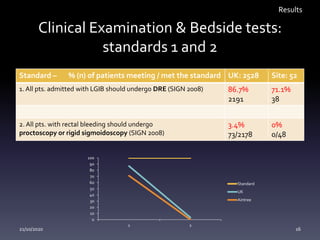
21/10/2020 2
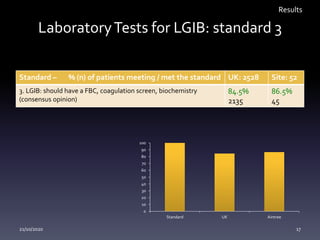
Problem
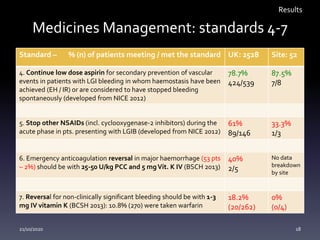
• 19,000 admissions with LGIB / UK / year
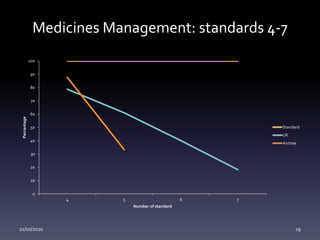
• Becoming much more common
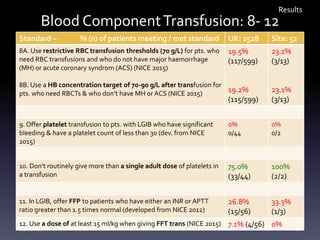
• Practice is suboptimal; assumption based on concerns:
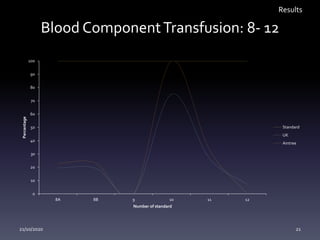
– re inappropriate use of blood components in GIB
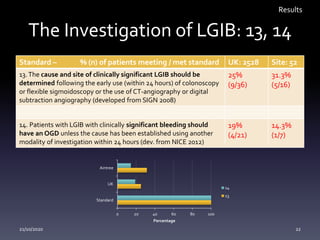
– re too small proportion of pts undergoes investigations during index adm.
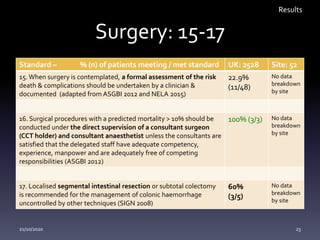
• An objective evaluation of performance against a set of standards was
required to produce a piece of evidence and to understand the processes
of care and outcomes, and to identify areas for improvement
Introduction
21/10/2020 3
Initiatives and funding
• Stakeholders
– NHS Blood and Transplant
– Association of Coloproctology of Great Britain and Ireland
– British Society of Gastroenterology
– British Society of Interventional Radiology
• Funding
– NHS Blood and Transplant & the Bowel Disease Research Foundation
• Report on results at national level
– Online
21/10/2020 4
Introduction
Hospitals, criteria, time-frame
• 174 hospitals of 4 countries of the UK
• Duration: two months (Sep - Oct 2015)
• Inclusion criteria:
– Adults ≥16
– Admission with PR bleeding without haematemesis
– Admission and ≥24 hours stay in the hospital
– Inpatient with other underlying illness and PR bleeding
• 28 days to observe
• 180 questions
• Set of 17 standards declared
Methods
21/10/2020 5
Standards for audit
• Guidelines adapted for this audit
• From six resources as 17 specific point standards
• Resources:
1. SIGN 2008 (Scotland)
2. NCEPOD report on GI bleeding
3. BSG and NICE guidelines on UGIB
4. BCSH and NICE guidelines on the use of blood components
5. Recommendations made by ASGBI, NELA, BSIR
6. Consensus opinions
Methods
21/10/2020 6
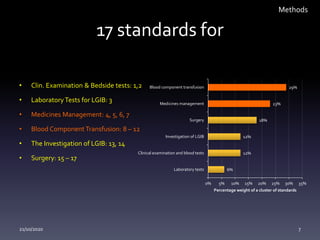
17 standards for
• Clin. Examination & Bedside tests: 1,2
• LaboratoryTests for LGIB: 3
• Medicines Management: 4, 5, 6, 7
• Blood ComponentTransfusion: 8 – 12
• The Investigation of LGIB: 13, 14
• Surgery: 15 – 17
Methods
6%
12%
12%
18%
23%
29%
0% 5% 10% 15% 20% 25% 30% 35%
Laboratory tests
Clinical examination and blood tests
Investigation of LGIB
Surgery
Medicines management
Blood component transfusion
Percentage weight of a cluster of standards
21/10/2020 7
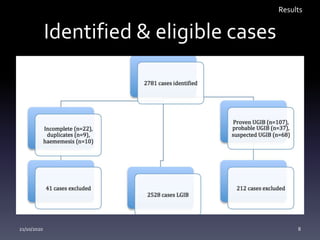
Identified & eligible cases
Results
21/10/2020 8
Participation: UK
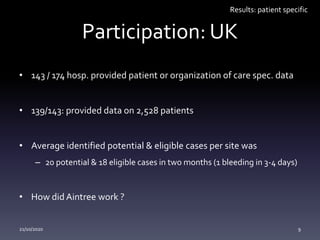
• 143 / 174 hosp. provided patient or organization of care spec. data
• 139/143: provided data on 2,528 patients
• Average identified potential & eligible cases per site was
– 20 potential & 18 eligible cases in two months (1 bleeding in 3-4 days)
• How did Aintree work ?
21/10/2020 9
Results: patient specific
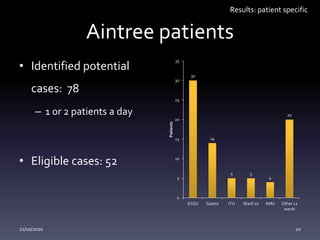
Aintree patients
• Identified potential
cases: 78
– 1 or 2 patients a day
• Eligible cases: 52
21/10/2020 10
30
14
5 5
4
20
0
5
10
15
20
25
30
35
EGSU Gastro ITU Ward 20 AMU Other 12
wards
Patients
Results: patient specific
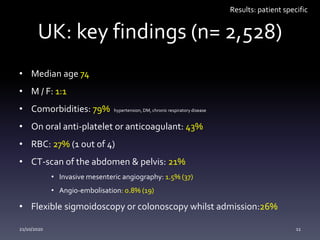
UK: key findings (n= 2,528)
• Median age 74
• M / F: 1:1
• Comorbidities: 79% hypertension, DM, chronic respiratory disease
• On oral anti-platelet or anticoagulant: 43%
• RBC: 27% (1 out of 4)
• CT-scan of the abdomen & pelvis: 21%
• Invasive mesenteric angiography: 1.5% (37)
• Angio-embolisation: 0.8% (19)
• Flexible sigmoidoscopy or colonoscopy whilst admission:26%
Results: patient specific
21/10/2020 11
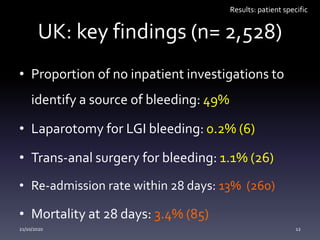
UK: key findings (n= 2,528)
• Proportion of no inpatient investigations to
identify a source of bleeding: 49%
• Laparotomy for LGI bleeding: 0.2% (6)
• Trans-anal surgery for bleeding: 1.1% (26)
• Re-admission rate within 28 days: 13% (260)
• Mortality at 28 days: 3.4% (85)
Results: patient specific
21/10/2020 12
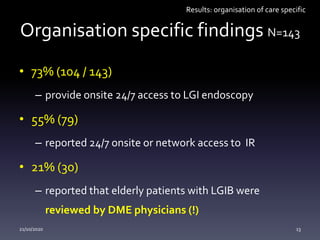
Organisation specific findings N=143
• 73% (104 / 143)
– provide onsite 24/7 access to LGI endoscopy
• 55% (79)
– reported 24/7 onsite or network access to IR
• 21% (30)
– reported that elderly patients with LGIB were
reviewed by DME physicians (!)
Results: organisation of care specific
21/10/2020 13
Performance against 17 standards
• UK
• Aintree (site)
Results
21/10/2020 14
0%
10%
20%
30%
40%
50%
60%
70%
80%
90%
100%
1 2 3 4 5 6 7 8A 8B 9 10 11 12 13 14 15 16 17
Number of a standard
Performance (practice) = standards (theory)
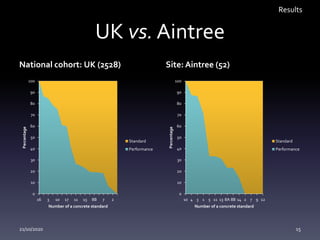
UK vs. Aintree
National cohort: UK (2528) Site: Aintree (52)
0
10
20
30
40
50
60
70
80
90
100
16 3 10 17 11 15 8B 7 2
Percentage
Number of a concrete standard
Standard
Performance
0
10
20
30
40
50
60
70
80
90
100
10 4 3 1 5 11 13 8A 8B 14 2 7 9 12
Percentage
Number of a concrete standard
Standard
Performance
Results
21/10/2020 15
Clinical Examination & Bedside tests:
standards 1 and 2
Standard – % (n) of patients meeting / met the standard UK: 2528 Site: 52
1. All pts. admitted with LGIB should undergo DRE (SIGN 2008) 86.7%
2191
71.1%
38
2. All pts. with rectal bleeding should undergo
proctoscopy or rigid sigmoidoscopy (SIGN 2008)
3.4%
73/2178
0%
0/48
Results
0
10
20
30
40
50
60
70
80
90
100
1 2
Standard
UK
Aintree
21/10/2020 16
LaboratoryTests for LGIB: standard 3
Standard – % (n) of patients meeting / met the standard UK: 2528 Site: 52
3. LGIB: should have a FBC, coagulation screen, biochemistry
(consensus opinion)
84.5%
2135
86.5%
45
Results
21/10/2020 17
0
10
20
30
40
50
60
70
80
90
100
Standard UK Aintree
Medicines Management: standards 4-7
Standard – % (n) of patients meeting / met the standard UK: 2528 Site: 52
4. Continue low dose aspirin for secondary prevention of vascular
events in patients with LGI bleeding in whom haemostasis have been
achieved (EH / IR) or are considered to have stopped bleeding
spontaneously (developed from NICE 2012)
78.7%
424/539
87.5%
7/8
5. Stop other NSAIDs (incl. cyclooxygenase-2 inhibitors) during the
acute phase in pts. presenting with LGIB (developed from NICE 2012)
61%
89/146
33.3%
1/3
6. Emergency anticoagulation reversal in major haemorrhage (53 pts
– 2%) should be with 25-50 U/kg PCC and 5 mgVit. K IV (BSCH 2013)
40%
2/5
No data
breakdown
by site
7. Reversal for non-clinically significant bleeding should be with 1-3
mg IV vitamin K (BCSH 2013): 10.8% (270) were taken warfarin
18.2%
(20/262)
0%
(0/4)
Results
21/10/2020 18
Medicines Management: standards 4-7
21/10/2020 19
0
10
20
30
40
50
60
70
80
90
100
4 5 6 7
Percentage
Number of standard
Standard
UK
Aintree
Blood ComponentTransfusion: 8- 12
Standard – % (n) of patients meeting / met standard UK: 2528 Site: 52
8A. Use restrictive RBC transfusion thresholds (70 g/L) for pts. who
need RBC transfusions and who do not have major haemorrhage
(MH) or acute coronary syndrom (ACS) (NICE 2015)
8B. Use a HB concentration target of 70-90 g/L after transfusion for
pts. who need RBCTs & who don’t have MH or ACS (NICE 2015)
19.5%
(117/599)
19.2%
(115/599)
23.1%
(3/13)
23.1%
(3/13)
9. Offer platelet transfusion to pts. with LGIB who have significant
bleeding & have a platelet count of less than 30 (dev. from NICE
2015)
0%
0/44
0%
0/2
10. Don’t routinely give more than a single adult dose of platelets in
a transfusion
75.0%
(33/44)
100%
(2/2)
11. In LGIB, offer FFP to patients who have either an INR or APTT
ratio greater than 1.5 times normal (developed from NICE 2012)
26.8%
(15/56)
33.3%
(1/3)
12. Use a dose of at least 15 ml/kg when giving FFT trans (NICE 2015) 7.1% (4/56) 0%
Results
21/10/2020 20
Blood ComponentTransfusion: 8- 12
0
10
20
30
40
50
60
70
80
90
100
8A 8B 9 10 11 12
Percentage
Number of standard
Standard
UK
Aintree
Results
21/10/2020 21
The Investigation of LGIB: 13, 14
Standard – % (n) of patients meeting / met standard UK: 2528 Site: 52
13.The cause and site of clinically significant LGIB should be
determined following the early use (within 24 hours) of colonoscopy
or flexible sigmoidoscopy or the use of CT-angiography or digital
subtraction angiography (developed from SIGN 2008)
25%
(9/36)
31.3%
(5/16)
14. Patients with LGIB with clinically significant bleeding should
have an OGD unless the cause has been established using another
modality of investigation within 24 hours (dev. from NICE 2012)
19%
(4/21)
14.3%
(1/7)
Results
0 20 40 60 80 100
Standard
UK
Aintree
Percentage
14
13
21/10/2020 22
Surgery: 15-17
Standard – % (n) of patients meeting / met standard UK: 2528 Site: 52
15.When surgery is contemplated, a formal assessment of the risk
death & complications should be undertaken by a clinician &
documented (adapted from ASGBI 2012 and NELA 2015)
22.9%
(11/48)
No data
breakdown
by site
16. Surgical procedures with a predicted mortality > 10% should be
conducted under the direct supervision of a consultant surgeon
(CCT holder) and consultant anaesthetist unless the consultants are
satisfied that the delegated staff have adequate competency,
experience, manpower and are adequately free of competing
responsibilities (ASGBI 2012)
100% (3/3) No data
breakdown
by site
17. Localised segmental intestinal resection or subtotal colectomy
is recommended for the management of colonic haemorrhage
uncontrolled by other techniques (SIGN 2008)
60%
(3/5)
No data
breakdown
by site
Results
21/10/2020 23
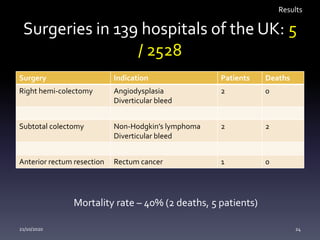
Surgeries in 139 hospitals of the UK: 5
/ 2528
Surgery Indication Patients Deaths
Right hemi-colectomy Angiodysplasia
Diverticular bleed
2 0
Subtotal colectomy Non-Hodgkin’s lymphoma
Diverticular bleed
2 2
Anterior rectum resection Rectum cancer 1 0
21/10/2020 24
Mortality rate – 40% (2 deaths, 5 patients)
Results
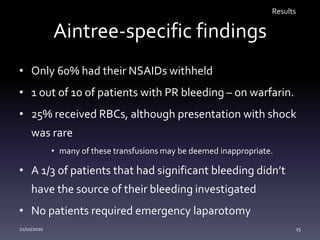
Aintree-specific findings
• Only 60% had their NSAIDs withheld
• 1 out of 10 of patients with PR bleeding – on warfarin.
• 25% received RBCs, although presentation with shock
was rare
• many of these transfusions may be deemed inappropriate.
• A 1/3 of patients that had significant bleeding didn’t
have the source of their bleeding investigated
• No patients required emergency laparotomy
21/10/2020 25
Results
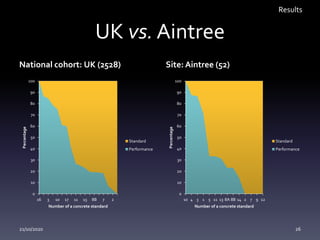
UK vs. Aintree
National cohort: UK (2528) Site: Aintree (52)
0
10
20
30
40
50
60
70
80
90
100
16 3 10 17 11 15 8B 7 2
Percentage
Number of a concrete standard
Standard
Performance
0
10
20
30
40
50
60
70
80
90
100
10 4 3 1 5 11 13 8A 8B 14 2 7 9 12
Percentage
Number of a concrete standard
Standard
Performance
Results
21/10/2020 26
Interpretation
21/10/2020 27
Water drop-6 , NGS. ©mohammad reza shojaee
#1:The term: acute GI bleeding
• NOT acute UGI bleeding
• NOT acute LGI bleeding
21/10/2020 28
Water drop-8, NGS. ©mohammad reza shojaee
Interpretation
#2:Concentration: gastroenterology
For an elderly patient
major comorbidities,
taking a ‘blood thinner’
Requiring limited transfusions
5%: large vol. transfusion
Requiring radiology & endoscopy
Not requiring urgent surgery
Not having clinical diagnosis
21/10/2020 29
Water drop-4, NGS. ©mohammad reza shojaee
Interpretation
#3: Effects of centralization
• Experience
• Regular and easy audits
• Solid leading
• Development of guidelines, pathways and SOPs
• Quality of teaching & research
• Collaboration with DME
• Less biased communication
• Urgent or semi-urgent endoscopies
• Reduction of duplication of functions & variations in care provision
• Better service at a lower cost
21/10/2020 30
Interpretation
The take-home message
GI bleeding:
Under One Roof of Gastroenterology
21/10/2020 31Getting it right for every patient every time

2018 Lunevicius LGI bleeding_Klaipeda LT

  • 1.
    Adult patient characteristics,management and outcomes from acute lower gastrointestinal bleeding: Liverpool, 2015 Raimundas Lunevicius, Jūratė Noreikaitė, Mohammed Elniel Aintree University Hospital NHS FoundationTrust Liverpool, England International Colorectal Forum, Klaipėda, Lithuania May 4th, 2018 21/10/2020 1
  • 2.
    Agenda • The rationale •Method • Results • Interpretations • Take home message Introduction 21/10/2020 2
  • 3.
    Problem • 19,000 admissionswith LGIB / UK / year • Becoming much more common • Practice is suboptimal; assumption based on concerns: – re inappropriate use of blood components in GIB – re too small proportion of pts undergoes investigations during index adm. • An objective evaluation of performance against a set of standards was required to produce a piece of evidence and to understand the processes of care and outcomes, and to identify areas for improvement Introduction 21/10/2020 3
  • 4.
    Initiatives and funding •Stakeholders – NHS Blood and Transplant – Association of Coloproctology of Great Britain and Ireland – British Society of Gastroenterology – British Society of Interventional Radiology • Funding – NHS Blood and Transplant & the Bowel Disease Research Foundation • Report on results at national level – Online 21/10/2020 4 Introduction
  • 5.
    Hospitals, criteria, time-frame •174 hospitals of 4 countries of the UK • Duration: two months (Sep - Oct 2015) • Inclusion criteria: – Adults ≥16 – Admission with PR bleeding without haematemesis – Admission and ≥24 hours stay in the hospital – Inpatient with other underlying illness and PR bleeding • 28 days to observe • 180 questions • Set of 17 standards declared Methods 21/10/2020 5
  • 6.
    Standards for audit •Guidelines adapted for this audit • From six resources as 17 specific point standards • Resources: 1. SIGN 2008 (Scotland) 2. NCEPOD report on GI bleeding 3. BSG and NICE guidelines on UGIB 4. BCSH and NICE guidelines on the use of blood components 5. Recommendations made by ASGBI, NELA, BSIR 6. Consensus opinions Methods 21/10/2020 6
  • 7.
    17 standards for •Clin. Examination & Bedside tests: 1,2 • LaboratoryTests for LGIB: 3 • Medicines Management: 4, 5, 6, 7 • Blood ComponentTransfusion: 8 – 12 • The Investigation of LGIB: 13, 14 • Surgery: 15 – 17 Methods 6% 12% 12% 18% 23% 29% 0% 5% 10% 15% 20% 25% 30% 35% Laboratory tests Clinical examination and blood tests Investigation of LGIB Surgery Medicines management Blood component transfusion Percentage weight of a cluster of standards 21/10/2020 7
  • 8.
    Identified & eligiblecases Results 21/10/2020 8
  • 9.
    Participation: UK • 143/ 174 hosp. provided patient or organization of care spec. data • 139/143: provided data on 2,528 patients • Average identified potential & eligible cases per site was – 20 potential & 18 eligible cases in two months (1 bleeding in 3-4 days) • How did Aintree work ? 21/10/2020 9 Results: patient specific
  • 10.
    Aintree patients • Identifiedpotential cases: 78 – 1 or 2 patients a day • Eligible cases: 52 21/10/2020 10 30 14 5 5 4 20 0 5 10 15 20 25 30 35 EGSU Gastro ITU Ward 20 AMU Other 12 wards Patients Results: patient specific
  • 11.
    UK: key findings(n= 2,528) • Median age 74 • M / F: 1:1 • Comorbidities: 79% hypertension, DM, chronic respiratory disease • On oral anti-platelet or anticoagulant: 43% • RBC: 27% (1 out of 4) • CT-scan of the abdomen & pelvis: 21% • Invasive mesenteric angiography: 1.5% (37) • Angio-embolisation: 0.8% (19) • Flexible sigmoidoscopy or colonoscopy whilst admission:26% Results: patient specific 21/10/2020 11
  • 12.
    UK: key findings(n= 2,528) • Proportion of no inpatient investigations to identify a source of bleeding: 49% • Laparotomy for LGI bleeding: 0.2% (6) • Trans-anal surgery for bleeding: 1.1% (26) • Re-admission rate within 28 days: 13% (260) • Mortality at 28 days: 3.4% (85) Results: patient specific 21/10/2020 12
  • 13.
    Organisation specific findingsN=143 • 73% (104 / 143) – provide onsite 24/7 access to LGI endoscopy • 55% (79) – reported 24/7 onsite or network access to IR • 21% (30) – reported that elderly patients with LGIB were reviewed by DME physicians (!) Results: organisation of care specific 21/10/2020 13
  • 14.
    Performance against 17standards • UK • Aintree (site) Results 21/10/2020 14 0% 10% 20% 30% 40% 50% 60% 70% 80% 90% 100% 1 2 3 4 5 6 7 8A 8B 9 10 11 12 13 14 15 16 17 Number of a standard Performance (practice) = standards (theory)
  • 15.
    UK vs. Aintree Nationalcohort: UK (2528) Site: Aintree (52) 0 10 20 30 40 50 60 70 80 90 100 16 3 10 17 11 15 8B 7 2 Percentage Number of a concrete standard Standard Performance 0 10 20 30 40 50 60 70 80 90 100 10 4 3 1 5 11 13 8A 8B 14 2 7 9 12 Percentage Number of a concrete standard Standard Performance Results 21/10/2020 15
  • 16.
    Clinical Examination &Bedside tests: standards 1 and 2 Standard – % (n) of patients meeting / met the standard UK: 2528 Site: 52 1. All pts. admitted with LGIB should undergo DRE (SIGN 2008) 86.7% 2191 71.1% 38 2. All pts. with rectal bleeding should undergo proctoscopy or rigid sigmoidoscopy (SIGN 2008) 3.4% 73/2178 0% 0/48 Results 0 10 20 30 40 50 60 70 80 90 100 1 2 Standard UK Aintree 21/10/2020 16
  • 17.
    LaboratoryTests for LGIB:standard 3 Standard – % (n) of patients meeting / met the standard UK: 2528 Site: 52 3. LGIB: should have a FBC, coagulation screen, biochemistry (consensus opinion) 84.5% 2135 86.5% 45 Results 21/10/2020 17 0 10 20 30 40 50 60 70 80 90 100 Standard UK Aintree
  • 18.
    Medicines Management: standards4-7 Standard – % (n) of patients meeting / met the standard UK: 2528 Site: 52 4. Continue low dose aspirin for secondary prevention of vascular events in patients with LGI bleeding in whom haemostasis have been achieved (EH / IR) or are considered to have stopped bleeding spontaneously (developed from NICE 2012) 78.7% 424/539 87.5% 7/8 5. Stop other NSAIDs (incl. cyclooxygenase-2 inhibitors) during the acute phase in pts. presenting with LGIB (developed from NICE 2012) 61% 89/146 33.3% 1/3 6. Emergency anticoagulation reversal in major haemorrhage (53 pts – 2%) should be with 25-50 U/kg PCC and 5 mgVit. K IV (BSCH 2013) 40% 2/5 No data breakdown by site 7. Reversal for non-clinically significant bleeding should be with 1-3 mg IV vitamin K (BCSH 2013): 10.8% (270) were taken warfarin 18.2% (20/262) 0% (0/4) Results 21/10/2020 18
  • 19.
    Medicines Management: standards4-7 21/10/2020 19 0 10 20 30 40 50 60 70 80 90 100 4 5 6 7 Percentage Number of standard Standard UK Aintree
  • 20.
    Blood ComponentTransfusion: 8-12 Standard – % (n) of patients meeting / met standard UK: 2528 Site: 52 8A. Use restrictive RBC transfusion thresholds (70 g/L) for pts. who need RBC transfusions and who do not have major haemorrhage (MH) or acute coronary syndrom (ACS) (NICE 2015) 8B. Use a HB concentration target of 70-90 g/L after transfusion for pts. who need RBCTs & who don’t have MH or ACS (NICE 2015) 19.5% (117/599) 19.2% (115/599) 23.1% (3/13) 23.1% (3/13) 9. Offer platelet transfusion to pts. with LGIB who have significant bleeding & have a platelet count of less than 30 (dev. from NICE 2015) 0% 0/44 0% 0/2 10. Don’t routinely give more than a single adult dose of platelets in a transfusion 75.0% (33/44) 100% (2/2) 11. In LGIB, offer FFP to patients who have either an INR or APTT ratio greater than 1.5 times normal (developed from NICE 2012) 26.8% (15/56) 33.3% (1/3) 12. Use a dose of at least 15 ml/kg when giving FFT trans (NICE 2015) 7.1% (4/56) 0% Results 21/10/2020 20
  • 21.
    Blood ComponentTransfusion: 8-12 0 10 20 30 40 50 60 70 80 90 100 8A 8B 9 10 11 12 Percentage Number of standard Standard UK Aintree Results 21/10/2020 21
  • 22.
    The Investigation ofLGIB: 13, 14 Standard – % (n) of patients meeting / met standard UK: 2528 Site: 52 13.The cause and site of clinically significant LGIB should be determined following the early use (within 24 hours) of colonoscopy or flexible sigmoidoscopy or the use of CT-angiography or digital subtraction angiography (developed from SIGN 2008) 25% (9/36) 31.3% (5/16) 14. Patients with LGIB with clinically significant bleeding should have an OGD unless the cause has been established using another modality of investigation within 24 hours (dev. from NICE 2012) 19% (4/21) 14.3% (1/7) Results 0 20 40 60 80 100 Standard UK Aintree Percentage 14 13 21/10/2020 22
  • 23.
    Surgery: 15-17 Standard –% (n) of patients meeting / met standard UK: 2528 Site: 52 15.When surgery is contemplated, a formal assessment of the risk death & complications should be undertaken by a clinician & documented (adapted from ASGBI 2012 and NELA 2015) 22.9% (11/48) No data breakdown by site 16. Surgical procedures with a predicted mortality > 10% should be conducted under the direct supervision of a consultant surgeon (CCT holder) and consultant anaesthetist unless the consultants are satisfied that the delegated staff have adequate competency, experience, manpower and are adequately free of competing responsibilities (ASGBI 2012) 100% (3/3) No data breakdown by site 17. Localised segmental intestinal resection or subtotal colectomy is recommended for the management of colonic haemorrhage uncontrolled by other techniques (SIGN 2008) 60% (3/5) No data breakdown by site Results 21/10/2020 23
  • 24.
    Surgeries in 139hospitals of the UK: 5 / 2528 Surgery Indication Patients Deaths Right hemi-colectomy Angiodysplasia Diverticular bleed 2 0 Subtotal colectomy Non-Hodgkin’s lymphoma Diverticular bleed 2 2 Anterior rectum resection Rectum cancer 1 0 21/10/2020 24 Mortality rate – 40% (2 deaths, 5 patients) Results
  • 25.
    Aintree-specific findings • Only60% had their NSAIDs withheld • 1 out of 10 of patients with PR bleeding – on warfarin. • 25% received RBCs, although presentation with shock was rare • many of these transfusions may be deemed inappropriate. • A 1/3 of patients that had significant bleeding didn’t have the source of their bleeding investigated • No patients required emergency laparotomy 21/10/2020 25 Results
  • 26.
    UK vs. Aintree Nationalcohort: UK (2528) Site: Aintree (52) 0 10 20 30 40 50 60 70 80 90 100 16 3 10 17 11 15 8B 7 2 Percentage Number of a concrete standard Standard Performance 0 10 20 30 40 50 60 70 80 90 100 10 4 3 1 5 11 13 8A 8B 14 2 7 9 12 Percentage Number of a concrete standard Standard Performance Results 21/10/2020 26
  • 27.
    Interpretation 21/10/2020 27 Water drop-6, NGS. ©mohammad reza shojaee
  • 28.
    #1:The term: acuteGI bleeding • NOT acute UGI bleeding • NOT acute LGI bleeding 21/10/2020 28 Water drop-8, NGS. ©mohammad reza shojaee Interpretation
  • 29.
    #2:Concentration: gastroenterology For anelderly patient major comorbidities, taking a ‘blood thinner’ Requiring limited transfusions 5%: large vol. transfusion Requiring radiology & endoscopy Not requiring urgent surgery Not having clinical diagnosis 21/10/2020 29 Water drop-4, NGS. ©mohammad reza shojaee Interpretation
  • 30.
    #3: Effects ofcentralization • Experience • Regular and easy audits • Solid leading • Development of guidelines, pathways and SOPs • Quality of teaching & research • Collaboration with DME • Less biased communication • Urgent or semi-urgent endoscopies • Reduction of duplication of functions & variations in care provision • Better service at a lower cost 21/10/2020 30 Interpretation
  • 31.
    The take-home message GIbleeding: Under One Roof of Gastroenterology 21/10/2020 31Getting it right for every patient every time

Editor's Notes

  • #2 Ladies and Gentlemen, It is my fourth presentation on Results of the National Comparative Audit of Lower Gastrointestinal Bleeding and the Use of Blood.
  • #3 I spoke about results - from the detailed technical point of view - that time. Today, I have decided to pay more attention to interpretations of this audit.
  • #4 It is known that 19,000 patients are admitted with LGIB to the hospitals of the UK each year. It is known that tt is becoming much more common due to the ageing population and the increasing use of GI mucosa damaging medications which can cause bleeding. It was felt that current practice managing LGIB in the countries of the UK has potential to be better; this assumption was based on concerns raised REGARDING inappropriate use of blood components in patients admitted with GIB AND too small proportion of pts undergoes investigations during index admission to identify a cause of significant bleeding An objective evaluation of performance against a set of standards to produce a piece of evidence was required to understand the processes of care and outcomes, and to identify areas for improvement.
  • #5 There are 4 stakeholders of this audit: NHS Blood and Transplant, the Association of Coloproctology of Great Britain and Ireland, the British Society of Gastroenterology and the British Society of Interventional Radiology. The project has been funded by NHS Blood and Transplant and the Bowel Disease Research Foundation. Summary report is available on line. Aintree specific results are not available online. THEY ARE IN MY HANDS, ON MY DESK and in my folders.
  • #6 174 hospitals of England, Scotland, Wales, and Northern Ireland were invited to participate in this 2 months duration audit which had 4 inclusion criteria. THESE ARE: Adults Admission with PR bleeding of any kind without haematemesis More than ≥24 hours stay in the hospital Inpatient with other underlying illness and PR bleeding 28 days were given for observation of a patient and data collection. The electronic questionnaire included 180 questions. Set of 17 standards was declared before this audit.
  • #7 As there is no British guidelines for LGIB, a question ‘How the standards for the audit have been selected’ was important. THUS, guidelines on specific aspects of the management of LGIB from 6 resources were taken into account & adapted for this audit as 17 specific point standards. SIGN - Scottish Intercollegiate Guidelines Network. NCEPOD – National Confidential Enquiry into Patient Outcome and Death BSG – British Society of gastroenterology. BCSH – British Committee for Standards in Haematology
  • #8 17 standards covered Clinical Examination and Bedside tests, Laboratory Tests, Medicines Management, Blood Component Transfusion, The Investigation of LGIB, and Surgery. This clustered bar chart illustrates the percentage proportion of an each cluster of standards for this audit. Two bars for blood component transfusion and medicines management are protuberant. This indicates the importance of transfusion medicine and clinical pharmacology managing patients admitted with acute LGIB.
  • #9 2,781 potential cases identified and data submitted from hospitals of England, Scotland, Wales and Northern Ireland. After exclusion of proven (107 cases), probable (37 cases), suspected (68 cases) UGIB (THAT IS 8% OF ALL CASES), duplications and not quality data, 2528 cases were declared as eligible cases for further analysis. That made this study on GI bleeding management the largest in the world.
  • #10 143 hospitals of 174 provided patient or organization of care specific data. 139/143: provided data on 2,528 patients. National average identified potential & eligible cases per site was 20 potential & 18 eligible cases in two months (1 bleeding in 3-4 days) HOW DID THREE AINTREE AUDITORS WORK?
  • #11 We have identified 78 potential cases – 1-2 patients a day. We have identified 30 patients in EGSU setting, 14 in gastroenterology wards, other 34 patients were identified in other wards of the hospital. 52 patients were eligible for this audit.
  • #12 KEY FINDINGS AT THE NATIONAL LEVEL ARE AS FOLLOWS: Median age 74 M / F ratio : 1:1 Comorbidities: 79% hypertension, DM, chronic respiratory disease On oral anti-platelet or anticoagulant: 43% 27% of patients have been transfused. CT-scan of the abdomen & pelvis performed to 21% of patients Invasive mesenteric angiography: 1.5% (37) Angio-embolisation: 0.8% (19) Flexible sigmoidoscopy or colonoscopy was carried out whilst admission to 26% of patients.
  • #14 Organization specific findings: 73% of hospitals (104/143) were able to provide 24/7 access to onsite colon & rectum endoscopy 55% of them reported 24/7 onsite or network access to IR Unexpectedly, 21% (30/143) hospitals reported that elderly patients admitted with LGIB were routinely reviewed by Care of the Elderly physicians.
  • #15 The next our task is to briefly overview performance against a set of 17 standards. Ideally, performance (i.e. practice) should correspond all standards (i.e. theory) at the specific point of time in a specific geographic site. When it is a case, a percentage expression of performance against the individual standard is 100, AND a 100% stacked area chart, therefore, would bring to us one colour.
  • #16 This slide - combined from two 100% stacked area charts for the UK, and Aintree - depicts the National and Site-specific levels of performance against 17 standards for management of LGIB in between 1st of Sep and 31st Oct 2015. It shows that both - the UK’s hospitals per se and one individual Hospital - underperformed grossly against the standards. To understand a performance better, we have to assess our performance against each particular standard.
  • #17 TWO standards are for Clinical Examination & Bedside tests – i.e. Digital Rectal Examination and proctoscopy / rigid sigmoidoscopy. MOST PATIENTS MET THE STANDARD NO. 1: digital rectal examination (but not all) HOWEVER, MOST PATIENTS DID NOT MEET THE STANDARD NO. 2, ie we do not perform proctoscopy or rigid sigmoidoscopy Below is the expression of the results via the linear graph.
  • #18 Standard No. 3 is about laboratory tests. Overall, most patients had appropriate blood tests. The test most infrequently performed was a coagulation test. Interestingly, the frequency of abnormal clotting screen was high - 19%.
  • #19 Four standards on medicines management. They are aspirin, NSADs management, and anticoagulation reversal with Octaplex. Findings are as follows: Standard No. 4 for aspirin: . MOST PATIENTS HAD APPROPRIATE SECONDARY PREVENTION OF VASCULAR EVENTS. Performance on other three standards was poor: Standard No. 5 for NSAIDs: 61% OF PATIENTS MET THE STANDARD AT NATIONAL LEVEL. AT AINTREE – JUST 33%. Standards No. 6 – 7: EMERGENCY ANTICOAGULANT REVERSAL WAS NOT APPROPRIATE.
  • #20 This is a linear graph expressing performance against the standards 4, 5, 6 and 7. In general, both UK and Aintree grossly underperformed against standards for medicines management.
  • #21 There are FIVE blood component transfusion standards. They all are about restrictive RBC transfusion policy, a HB concentration target, platelet transfusion indication, FFP transfusion indication and a dose of FFT. So, nearly all numbers are in red color at both levels – national and site specific. Only performance against the standard 10 - i.e. don’t routinely give more than a single dose of platelets in a transfusion, was good.
  • #22 It is a graph showing a linear relationship between the blood component transfusion standards (yellow color line) and performance against these standards both in the UK and Aintree. Aintree Looks Better Than The UK As A Whole In This Respect.
  • #23 INVESTIGATIONS (mainly, ENDOSCOPIES): both the UK and Aintree underperformed grossly against the standards. Two comments on that. The first: A significant number of patients with clinically significant LGIB are not investigated as an inpatient - 75% in the UK and 69% at Aintree. Some doctors like to stratify the risk of recurrent bleeding, and they name these patients as high-risk for recurrent bleeding patients. That is quite right. However, only 25% of them were investigated properly within index admission. And That is NOT right. The second: some patients presenting with LGIB will have a source in the UGI tract, particularly those with massive hematochezia or melena. In this group of patients with clinically significant bleeding, only 19% of patients at the national level and 14.3% at Aintree underwent an urgent OGD. That is Not right.
  • #24 Three standards on emergency surgery were used. They are about a formal assessment of the risk of death and complications, a consultant surgeon, and removal of a source of bleeding during surgery. It is imperative to note that ONLY FIVE EMERGENCY LAPAROTOMIES were performed for the management of colonic haemorrhage uncontrolled by other techniques in all four countries, within two months. To remind, 2,528 patients constituted audit group.
  • #25 5 patients underwent segmental resection for colon or rectum haemorrhage: one – anterior resection for rectal cancer, two right hemi-colectomies for angiodysplasia and diverticular bleed, and two patients underwent subtotal colectomies for diverticular bleed and NHL (non-Hodgkin’s lymphoma) involving colon. Both patients who underwent subtotal colectomy died. Mortality rate was 40%.
  • #26 A few Aintree-specific findings I would like to stress”: Only 60% of pts. presenting with LGIB had their NSAID withheld. 1 out of 10 of patients with PR bleeding – on warfarin The vast majority (from 10% of pts.) of patients taking warfarin did not receive appropriate PCC or vitamin K in the management of their bleeding. Although presentation with shock & MH was rare, 25% patients receive RBCs; Many of these transfusions may be deemed inappropriate or avoidable. A third of patients that had clinically significant bleeding did not have the source of their bleeding investigated. OF THOSE THAT UNDERWENT INVESTIGATION, MANY WAITED MORE THAN 24 HOURS. No patients required surgical control of bleeding at Aintree.
  • #27 I hope, all that explains these two figures illustrating obvious underperformance against selected 17 standards.
  • #28 Interpretation of the results and findings supposed to be the most exciting part of every audit or study. The difficulty is to make a change in site where we work. This is one of my favorites pictures named as ‘Water drop-6’ by Mohammed Reza Shojaee from Iran at the National Geographic Society.
  • #29 I think that this audit was about one thing – the content of the term ‘Acute GI bleeding’. I think that there is no such thing as acute UGI bleeding or acute LGI bleeding; there is acute GI bleeding, which predominantly is one of a few emergency gastroenterological conditions. Therefore, to divide the GIB patient stream into TWO sub-streams, and to bed one sub-stream with suspected UGI bleeding to the north wing of the hospital (gastroenterology) and another sub-stream to the south wing of the same hospital (general surgery) is the same as to disconnect the head from the body of one GIB DROP.
  • #30 Concentration of patients in one highly specialized unit for GI bleeding management WITHIN GASTROENTEROLOGY CENTRE is the second summary point of this presentation. I DO THINK that gastroenterology ward would be a right site to concentrate all patients presenting with signs of GI bleeding, for a mean patient presenting with this problem is: Firstly, an elderly patient with significant comorbidities, often taking a so-called ‘blood thinner’ (aspirin, NSAIDs, and even steroids) Secondly, requiring limited volume blood transfusions - sometimes, Thirdly, requiring radiological and endoscopic investigations within 24 hours / in a case of clinically significant bleeding. Fourthly, not requiring urgent surgery in the absolute majority of the cases (5 emergency laparotomies in all 4 countries) Fifthly, not having a clinical diagnosis on the day of discharge.
  • #31 I am speaking about it because the effects of centralization in medicine, as well as in any industry, are well know. Examples are:................ …................. AND a better service at a lower cost is one of clinical centralization effects – but not the last one.