PRESENTED BY,
• ANJALI TERESA
• FIRST YEAR M.PHARM
• DEPT:PHARMACEUTICS
• St.JAMES COLLEGE OF
PHARMACEUTICAL
SCIENCES
INTRODUCTION
 Administration of drug through nasal route is
referred as Nasal drug delivery system.
 Nasal mucosa has been considered as a
potential administration route to achieve faster
and higher level of drug absorption.
 It is an ideal alternative to the parenterals for
systemic drug delivery.
NASAL DRUG DELIVERY SYSTEMS 2
 Drugs are administered to the nasal cavity for
a) localised
b)systemic action
c)vaccine delivery
d)possible direct nose - brain delivery.
ADVANTAGES
NASAL DRUG DELIVERY SYSTEMS 3
1. A non invasive route.
2. Hepatic first – pass metabolism is absent.
3. Rapid drug absorption.
4. Quick onset of action.
5. The bioavailability of larger drug molecules can be
improved by means of absorption enhancer or other
approach.
6. Better nasal bioavailability for smaller drug
molecules.
7. Drugs which can not be absorbed orally may be
delivered to the systemic circulation through nasal
drug delivery system.
8. Convenient route when compared with parenteral
route for long term therapy.
LIMITATIONS
NASAL DRUG DELIVERY SYSTEMS 4
1. The absorption enhancers used to improve nasal
drug delivery system may have histological toxicity
which is not yet clearly established
2.Absorption surface area is less when compared to
GIT.
3. Once the drug administered can not be removed.
4. Nasal irritation.
5. There is a risk of local side effects and irreversible
damage of the cilia on the nasal mucosa.
ANATOMY & PHYSIOLOGY OF NASAL CAVITY
NASAL DRUG DELIVERY SYSTEMS 5
• The nasal cavity is divided into two halves by the
nasal septum and extends posterior to the
nasopharynx, while the most anterior part of the
nasal cavity, the nasal vestibule, opens to the face
through the nostril.
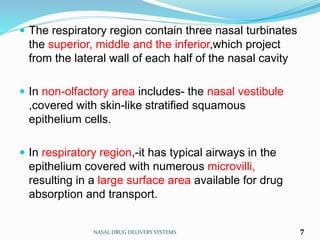
 The nasal cavity consists of three main regions
1) nasal vestibule,
2) olfactory region
3) respiratory region.
NASAL DRUG DELIVERY SYSTEMS 6
 The respiratory region contain three nasal turbinates
the superior, middle and the inferior,which project
from the lateral wall of each half of the nasal cavity
 In non-olfactory area includes- the nasal vestibule
,covered with skin-like stratified squamous
epithelium cells.
 In respiratory region,-it has typical airways in the
epithelium covered with numerous microvilli,
resulting in a large surface area available for drug
absorption and transport.
NASAL DRUG DELIVERY SYSTEMS 7
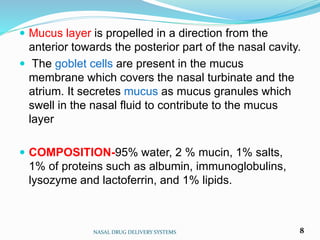
 Mucus layer is propelled in a direction from the
anterior towards the posterior part of the nasal cavity.
 The goblet cells are present in the mucus
membrane which covers the nasal turbinate and the
atrium. It secretes mucus as mucus granules which
swell in the nasal fluid to contribute to the mucus
layer
 COMPOSITION-95% water, 2 % mucin, 1% salts,
1% of proteins such as albumin, immunoglobulins,
lysozyme and lactoferrin, and 1% lipids.
NASAL DRUG DELIVERY SYSTEMS 8
 The mucus secretions give immune protection
against inhaled bacteria and viruses.
 The pH of nasal secretion is 5.5-6.5 in adults & 5.0-
6.7 in infants.
MECHANISM OF NASAL ABSORPTION
The absorbed drug from the nasal cavity must pass
through the mucus layer. It is the first step in
absorption.
Two mechanisms have been predominantly used.
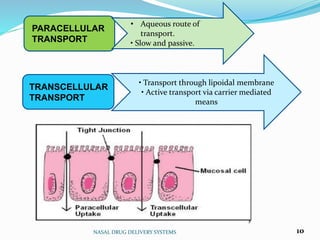
Paracellular transport
Transcellular transport
NASAL DRUG DELIVERY SYSTEMS 9
NASAL DRUG DELIVERY SYSTEMS 10
PARACELLULAR
TRANSPORT
TRANSCELLULAR
TRANSPORT
• Aqueous route of
transport.
• Slow and passive.
• Transport through lipoidal membrane
• Active transport via carrier mediated
means
NASAL DRUG DELIVERY SYSTEMS 11
BARRIERS TO NASAL ABSORPTION
 LOW BIOAVAILABILITY- The most important factor
limiting the nasal absorption of polar drugs and
especially large molecular weight polar drugs such
as peptides and proteins is the low membrane
permeability.
 LOW MEMBRANE TRANSPORT-Another
importance factor is low membrane transport is the
general rapid clearance of the administered
formulation from the nasal cavity due to the
mucociliary clearance mechanism.
NASAL DRUG DELIVERY SYSTEMS 12
 ENZYMATIC DEGRADATION-Another contributing
factor to the low transport of especially peptides and
proteins across the nasal membrane is the possibility
of an enzymatic degradation of the molecule either
within the lumen of the nasal cavity or during
passage across the epithelial barrier.
NASAL DRUG DELIVERY SYSTEMS 13
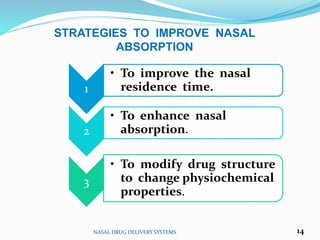
STRATEGIES TO IMPROVE NASAL
ABSORPTION
NASAL DRUG DELIVERY SYSTEMS 14
1
• To improve the nasal
residence time.
2
• To enhance nasal
absorption.
3
• To modify drug structure
to change physiochemical
properties.
 Several methods have been used to facilitate
nasal absorption of drugs include:
1)Nasal enzyme inhibitor
2)Nasal permeation enhancers
3)Pro drug approach
4)Structural modification
5)Particulate drug delivery
6)Bio adhesive polymers as delivery system.
7)Viscocity modifiers.
NASAL DRUG DELIVERY SYSTEMS 15
FORMULATION CONSIDERATION
 Nasal formulation are generally administered in
small volumes in the range 25-200µ L with 100µL
the most common dose volume.
 The excipients should be carefully selected so
as to avoid damage to the muco epithelial layers
and to sustain normal physiological ciliary
movement.
 It has been reported that, particle size
>10µm - deposited in nasal cavity
2-10µm - retained in the lungs
<1µm - they are exhaled
NASAL DRUG DELIVERY SYSTEMS 16
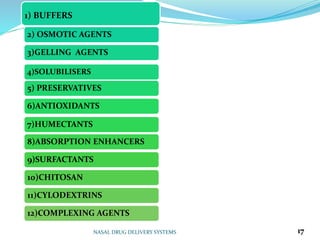
NASAL DRUG DELIVERY SYSTEMS 17
2) OSMOTIC AGENTS
3)GELLING AGENTS
4)SOLUBILISERS
5) PRESERVATIVES
6)ANTIOXIDANTS
7)HUMECTANTS
8)ABSORPTION ENHANCERS
9)SURFACTANTS
10)CHITOSAN
11)CYLODEXTRINS
12)COMPLEXING AGENTS
1) BUFFERS
APPLICATIONS
NASAL DRUG DELIVERY SYSTEMS 18
1)DELIVERY OF PEPTIDE BASED PHARMACEUTICALS
 Peptides & proteins - low oral bioavailability because
of their physico-chemical instability and
susceptibility to hepato gastrointestinal first-pass
elimination
 Eg. Insulin, Calcitonin, Pituitary hormones etc.
 Nasal route is proving to be the best route for such
biotechnological products
2)DELIVERY OF NON-PEPTIDE PHARMACEUTICALS
Low molecular weight small non-peptide lipophyllic
drugs are well absorbed through nasal mucosa.
Eg:adrenal corticosteroids,sex hormone,
vitamin B
NASAL DRUG DELIVERY SYSTEMS 19
3)DELIVERY OF DRUG TO BRAIN THROUGH
NASAL CAVITY
 It is beneficial in conditions like Parkinson’s
disease,Alzheimers disease or pain because it
requires specific targetting of drugs to brain.
 It will increase the fraction of drug that reaches the
C.N.S. after the nasal delivery.
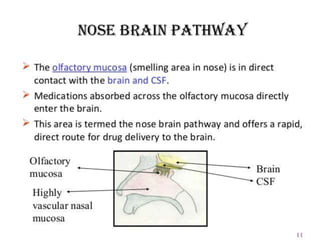
 The olfactory region located at the upper remote
areas of the nasal passages offer the potential for
the compound to circumvent the B.B.B. & enter in to
the brain.
NASAL DRUG DELIVERY SYSTEMS 20
4)DELIVERY OF VACCINES THROUGH NASAL ROUTE
Reason for exploiting the nasal route for vaccine
delivery are,
 Nasal mucosa is the first site of contacts with the inhaled
pathogen.
 Nasal passages are rich in lymphoid tissues.
 Creation of both mucosal and systemic immune
response.
 Low cost , patient friendly,non-injectable,safe.
NASAL DRUG DELIVERY SYSTEMS 21
 Delivering the vaccine to the nasal cavity, stimulates
the production of local secretory IgA antibody as well
as IgG ,providing first line of defense, which helps to
eliminate the pathogens.
5)DELIVERY OF DIAGNOSTIC AGENTS
 Nasal drug delivery system can be used for the
diagnosis of various diseases and disorders in the
body.
 Pancreatic disorders of the diabetic patients were
diagnosed by using the ‘Secretin’.
 The secretory function of gastric acid was
determined by Pentagastrin.
NASAL DRUG DELIVERY SYSTEMS 22
NASAL DRUG DELIVERY SYSTEMS 23
NASAL DRUG DELIVERY FORMULATIONS
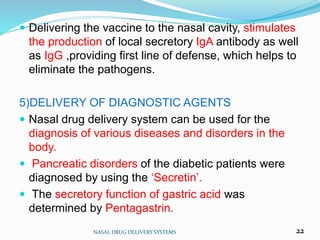
NASAL DROPS
 Most simple and convenient systems
developed for nasal delivery.
It has been reported that nasal drops
deposit human serum albumin in the
nostrils more efficiently than nasal
sprays.
 Disadvantage-lack of the dose precision .
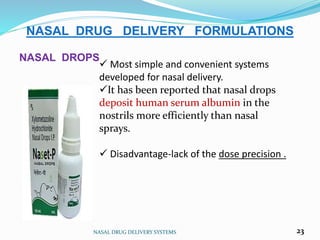
 NASAL SPRAY
NASAL DRUG DELIVERY SYSTEMS 24
Both solution and suspension
formulations can be formulated into
nasal sprays.
Deliver an exact dose from 25 to
200 μm.
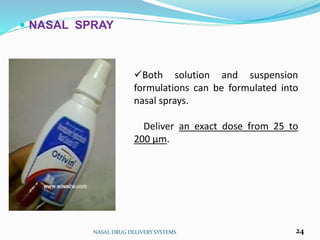
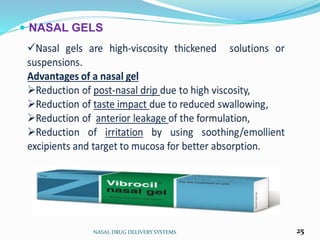
 NASAL GELS
NASAL DRUG DELIVERY SYSTEMS 25
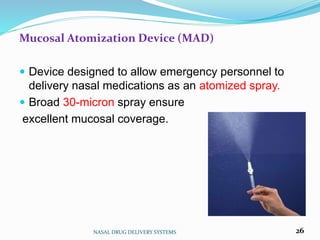
Mucosal Atomization Device (MAD)
 Device designed to allow emergency personnel to
delivery nasal medications as an atomized spray.
 Broad 30-micron spray ensure
excellent mucosal coverage.
NASAL DRUG DELIVERY SYSTEMS 26
NASAL DRUG DELIVERY SYSTEMS 27
MICRO EMULSION
 It is thermodynamically stable, isotropically clear
product.
 Droplet size <0.15 µm
 It consist of oily phase, surfactant,cosurfactant &
aqueous phase.
 o/w microemulsion can be used for development
of formulations suitable for the incorporation of
poorly water soluble drugs because of high
solubilisation capacity as well as the potential for
enhanced absorption by C.S.F.
NASAL DRUG DELIVERY SYSTEMS 28
RECENT ADVANCES
NASAL INSULIN
• Several trials are made with intranasal formulations.
• DESMOPRESSIN was the first drug given nasally.
• Its available as insufflator ,nasal kit etc .
NASAL ANTI-VOMITING
LINCOLN PHARMA :
 Presently in india , anti vomiting agents are
available in the form of tablets and injections which
take longer time to provide relief .
NASAL DRUG DELIVERY SYSTEMS 29
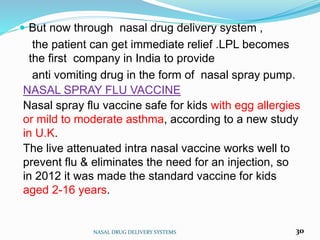
 But now through nasal drug delivery system ,
the patient can get immediate relief .LPL becomes
the first company in India to provide
anti vomiting drug in the form of nasal spray pump.
NASAL SPRAY FLU VACCINE
Nasal spray flu vaccine safe for kids with egg allergies
or mild to moderate asthma, according to a new study
in U.K.
The live attenuated intra nasal vaccine works well to
prevent flu & eliminates the need for an injection, so
in 2012 it was made the standard vaccine for kids
aged 2-16 years.
NASAL DRUG DELIVERY SYSTEMS 30
NASAL DRUG DELIVERY SYSTEMS 31
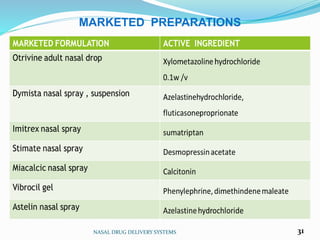
MARKETED PREPARATIONS
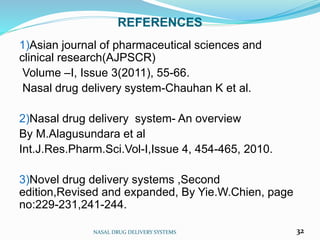
REFERENCES
1)Asian journal of pharmaceutical sciences and
clinical research(AJPSCR)
Volume –I, Issue 3(2011), 55-66.
Nasal drug delivery system-Chauhan K et al.
2)Nasal drug delivery system- An overview
By M.Alagusundara et al
Int.J.Res.Pharm.Sci.Vol-I,Issue 4, 454-465, 2010.
3)Novel drug delivery systems ,Second
edition,Revised and expanded, By Yie.W.Chien, page
no:229-231,241-244.
NASAL DRUG DELIVERY SYSTEMS 32
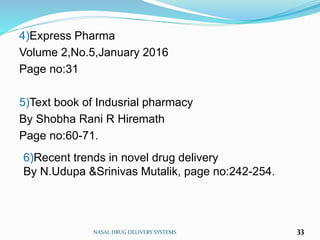
4)Express Pharma
Volume 2,No.5,January 2016
Page no:31
5)Text book of Indusrial pharmacy
By Shobha Rani R Hiremath
Page no:60-71.
NASAL DRUG DELIVERY SYSTEMS 33
6)Recent trends in novel drug delivery
By N.Udupa &Srinivas Mutalik, page no:242-254.
NASAL DRUG DELIVERY SYSTEMS 34

Nasal drug delivery system

  • 1.
    PRESENTED BY, • ANJALITERESA • FIRST YEAR M.PHARM • DEPT:PHARMACEUTICS • St.JAMES COLLEGE OF PHARMACEUTICAL SCIENCES
  • 2.
    INTRODUCTION  Administration ofdrug through nasal route is referred as Nasal drug delivery system.  Nasal mucosa has been considered as a potential administration route to achieve faster and higher level of drug absorption.  It is an ideal alternative to the parenterals for systemic drug delivery. NASAL DRUG DELIVERY SYSTEMS 2
  • 3.
     Drugs areadministered to the nasal cavity for a) localised b)systemic action c)vaccine delivery d)possible direct nose - brain delivery. ADVANTAGES NASAL DRUG DELIVERY SYSTEMS 3 1. A non invasive route. 2. Hepatic first – pass metabolism is absent. 3. Rapid drug absorption. 4. Quick onset of action. 5. The bioavailability of larger drug molecules can be improved by means of absorption enhancer or other approach.
  • 4.
    6. Better nasalbioavailability for smaller drug molecules. 7. Drugs which can not be absorbed orally may be delivered to the systemic circulation through nasal drug delivery system. 8. Convenient route when compared with parenteral route for long term therapy. LIMITATIONS NASAL DRUG DELIVERY SYSTEMS 4 1. The absorption enhancers used to improve nasal drug delivery system may have histological toxicity which is not yet clearly established 2.Absorption surface area is less when compared to GIT.
  • 5.
    3. Once thedrug administered can not be removed. 4. Nasal irritation. 5. There is a risk of local side effects and irreversible damage of the cilia on the nasal mucosa. ANATOMY & PHYSIOLOGY OF NASAL CAVITY NASAL DRUG DELIVERY SYSTEMS 5 • The nasal cavity is divided into two halves by the nasal septum and extends posterior to the nasopharynx, while the most anterior part of the nasal cavity, the nasal vestibule, opens to the face through the nostril.
  • 6.
     The nasalcavity consists of three main regions 1) nasal vestibule, 2) olfactory region 3) respiratory region. NASAL DRUG DELIVERY SYSTEMS 6
  • 7.
     The respiratoryregion contain three nasal turbinates the superior, middle and the inferior,which project from the lateral wall of each half of the nasal cavity  In non-olfactory area includes- the nasal vestibule ,covered with skin-like stratified squamous epithelium cells.  In respiratory region,-it has typical airways in the epithelium covered with numerous microvilli, resulting in a large surface area available for drug absorption and transport. NASAL DRUG DELIVERY SYSTEMS 7
  • 8.
     Mucus layeris propelled in a direction from the anterior towards the posterior part of the nasal cavity.  The goblet cells are present in the mucus membrane which covers the nasal turbinate and the atrium. It secretes mucus as mucus granules which swell in the nasal fluid to contribute to the mucus layer  COMPOSITION-95% water, 2 % mucin, 1% salts, 1% of proteins such as albumin, immunoglobulins, lysozyme and lactoferrin, and 1% lipids. NASAL DRUG DELIVERY SYSTEMS 8
  • 9.
     The mucussecretions give immune protection against inhaled bacteria and viruses.  The pH of nasal secretion is 5.5-6.5 in adults & 5.0- 6.7 in infants. MECHANISM OF NASAL ABSORPTION The absorbed drug from the nasal cavity must pass through the mucus layer. It is the first step in absorption. Two mechanisms have been predominantly used. Paracellular transport Transcellular transport NASAL DRUG DELIVERY SYSTEMS 9
  • 10.
    NASAL DRUG DELIVERYSYSTEMS 10 PARACELLULAR TRANSPORT TRANSCELLULAR TRANSPORT • Aqueous route of transport. • Slow and passive. • Transport through lipoidal membrane • Active transport via carrier mediated means
  • 11.
  • 12.
    BARRIERS TO NASALABSORPTION  LOW BIOAVAILABILITY- The most important factor limiting the nasal absorption of polar drugs and especially large molecular weight polar drugs such as peptides and proteins is the low membrane permeability.  LOW MEMBRANE TRANSPORT-Another importance factor is low membrane transport is the general rapid clearance of the administered formulation from the nasal cavity due to the mucociliary clearance mechanism. NASAL DRUG DELIVERY SYSTEMS 12
  • 13.
     ENZYMATIC DEGRADATION-Anothercontributing factor to the low transport of especially peptides and proteins across the nasal membrane is the possibility of an enzymatic degradation of the molecule either within the lumen of the nasal cavity or during passage across the epithelial barrier. NASAL DRUG DELIVERY SYSTEMS 13
  • 14.
    STRATEGIES TO IMPROVENASAL ABSORPTION NASAL DRUG DELIVERY SYSTEMS 14 1 • To improve the nasal residence time. 2 • To enhance nasal absorption. 3 • To modify drug structure to change physiochemical properties.
  • 15.
     Several methodshave been used to facilitate nasal absorption of drugs include: 1)Nasal enzyme inhibitor 2)Nasal permeation enhancers 3)Pro drug approach 4)Structural modification 5)Particulate drug delivery 6)Bio adhesive polymers as delivery system. 7)Viscocity modifiers. NASAL DRUG DELIVERY SYSTEMS 15
  • 16.
    FORMULATION CONSIDERATION  Nasalformulation are generally administered in small volumes in the range 25-200µ L with 100µL the most common dose volume.  The excipients should be carefully selected so as to avoid damage to the muco epithelial layers and to sustain normal physiological ciliary movement.  It has been reported that, particle size >10µm - deposited in nasal cavity 2-10µm - retained in the lungs <1µm - they are exhaled NASAL DRUG DELIVERY SYSTEMS 16
  • 17.
    NASAL DRUG DELIVERYSYSTEMS 17 2) OSMOTIC AGENTS 3)GELLING AGENTS 4)SOLUBILISERS 5) PRESERVATIVES 6)ANTIOXIDANTS 7)HUMECTANTS 8)ABSORPTION ENHANCERS 9)SURFACTANTS 10)CHITOSAN 11)CYLODEXTRINS 12)COMPLEXING AGENTS 1) BUFFERS
  • 18.
    APPLICATIONS NASAL DRUG DELIVERYSYSTEMS 18 1)DELIVERY OF PEPTIDE BASED PHARMACEUTICALS  Peptides & proteins - low oral bioavailability because of their physico-chemical instability and susceptibility to hepato gastrointestinal first-pass elimination  Eg. Insulin, Calcitonin, Pituitary hormones etc.  Nasal route is proving to be the best route for such biotechnological products
  • 19.
    2)DELIVERY OF NON-PEPTIDEPHARMACEUTICALS Low molecular weight small non-peptide lipophyllic drugs are well absorbed through nasal mucosa. Eg:adrenal corticosteroids,sex hormone, vitamin B NASAL DRUG DELIVERY SYSTEMS 19
  • 20.
    3)DELIVERY OF DRUGTO BRAIN THROUGH NASAL CAVITY  It is beneficial in conditions like Parkinson’s disease,Alzheimers disease or pain because it requires specific targetting of drugs to brain.  It will increase the fraction of drug that reaches the C.N.S. after the nasal delivery.  The olfactory region located at the upper remote areas of the nasal passages offer the potential for the compound to circumvent the B.B.B. & enter in to the brain. NASAL DRUG DELIVERY SYSTEMS 20
  • 21.
    4)DELIVERY OF VACCINESTHROUGH NASAL ROUTE Reason for exploiting the nasal route for vaccine delivery are,  Nasal mucosa is the first site of contacts with the inhaled pathogen.  Nasal passages are rich in lymphoid tissues.  Creation of both mucosal and systemic immune response.  Low cost , patient friendly,non-injectable,safe. NASAL DRUG DELIVERY SYSTEMS 21
  • 22.
     Delivering thevaccine to the nasal cavity, stimulates the production of local secretory IgA antibody as well as IgG ,providing first line of defense, which helps to eliminate the pathogens. 5)DELIVERY OF DIAGNOSTIC AGENTS  Nasal drug delivery system can be used for the diagnosis of various diseases and disorders in the body.  Pancreatic disorders of the diabetic patients were diagnosed by using the ‘Secretin’.  The secretory function of gastric acid was determined by Pentagastrin. NASAL DRUG DELIVERY SYSTEMS 22
  • 23.
    NASAL DRUG DELIVERYSYSTEMS 23 NASAL DRUG DELIVERY FORMULATIONS NASAL DROPS  Most simple and convenient systems developed for nasal delivery. It has been reported that nasal drops deposit human serum albumin in the nostrils more efficiently than nasal sprays.  Disadvantage-lack of the dose precision .
  • 24.
     NASAL SPRAY NASALDRUG DELIVERY SYSTEMS 24 Both solution and suspension formulations can be formulated into nasal sprays. Deliver an exact dose from 25 to 200 μm.
  • 25.
     NASAL GELS NASALDRUG DELIVERY SYSTEMS 25
  • 26.
    Mucosal Atomization Device(MAD)  Device designed to allow emergency personnel to delivery nasal medications as an atomized spray.  Broad 30-micron spray ensure excellent mucosal coverage. NASAL DRUG DELIVERY SYSTEMS 26
  • 27.
  • 28.
    MICRO EMULSION  Itis thermodynamically stable, isotropically clear product.  Droplet size <0.15 µm  It consist of oily phase, surfactant,cosurfactant & aqueous phase.  o/w microemulsion can be used for development of formulations suitable for the incorporation of poorly water soluble drugs because of high solubilisation capacity as well as the potential for enhanced absorption by C.S.F. NASAL DRUG DELIVERY SYSTEMS 28
  • 29.
    RECENT ADVANCES NASAL INSULIN •Several trials are made with intranasal formulations. • DESMOPRESSIN was the first drug given nasally. • Its available as insufflator ,nasal kit etc . NASAL ANTI-VOMITING LINCOLN PHARMA :  Presently in india , anti vomiting agents are available in the form of tablets and injections which take longer time to provide relief . NASAL DRUG DELIVERY SYSTEMS 29
  • 30.
     But nowthrough nasal drug delivery system , the patient can get immediate relief .LPL becomes the first company in India to provide anti vomiting drug in the form of nasal spray pump. NASAL SPRAY FLU VACCINE Nasal spray flu vaccine safe for kids with egg allergies or mild to moderate asthma, according to a new study in U.K. The live attenuated intra nasal vaccine works well to prevent flu & eliminates the need for an injection, so in 2012 it was made the standard vaccine for kids aged 2-16 years. NASAL DRUG DELIVERY SYSTEMS 30
  • 31.
    NASAL DRUG DELIVERYSYSTEMS 31 MARKETED PREPARATIONS
  • 32.
    REFERENCES 1)Asian journal ofpharmaceutical sciences and clinical research(AJPSCR) Volume –I, Issue 3(2011), 55-66. Nasal drug delivery system-Chauhan K et al. 2)Nasal drug delivery system- An overview By M.Alagusundara et al Int.J.Res.Pharm.Sci.Vol-I,Issue 4, 454-465, 2010. 3)Novel drug delivery systems ,Second edition,Revised and expanded, By Yie.W.Chien, page no:229-231,241-244. NASAL DRUG DELIVERY SYSTEMS 32
  • 33.
    4)Express Pharma Volume 2,No.5,January2016 Page no:31 5)Text book of Indusrial pharmacy By Shobha Rani R Hiremath Page no:60-71. NASAL DRUG DELIVERY SYSTEMS 33 6)Recent trends in novel drug delivery By N.Udupa &Srinivas Mutalik, page no:242-254.
  • 34.