Ms. Schuster’s
Introduction to The
Odyssey
Feel free to pause/replay/or skip through this
presentation as needed
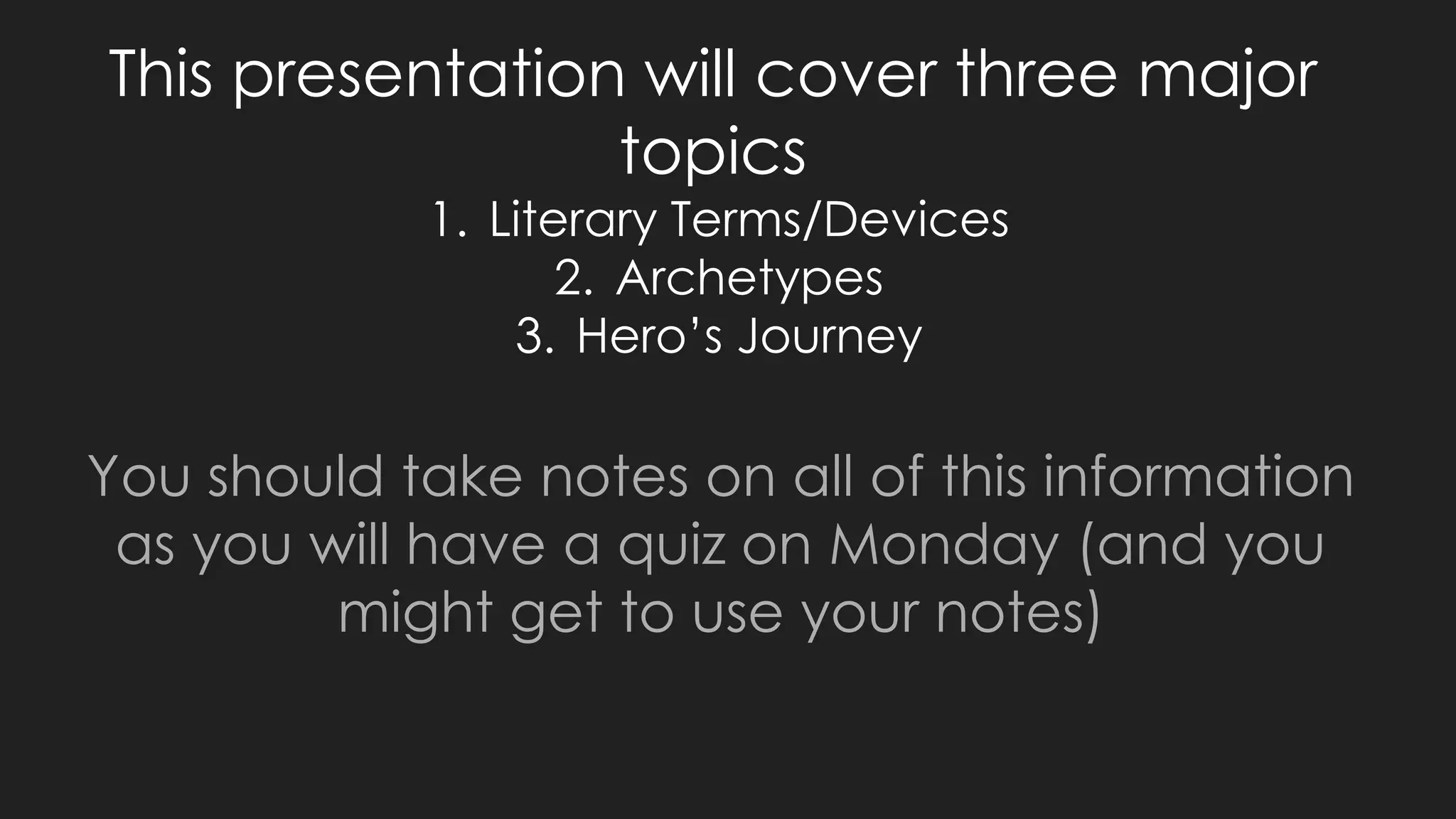
This presentation will cover three major
topics
1. Literary Terms/Devices
2. Archetypes
3. Hero’s Journey
You should take notes on all of this information
as you will have a quiz on Monday (and you
might get to use your notes)
Literary
Terms
and
Devices
Part One
WATCH THIS
VIDEO
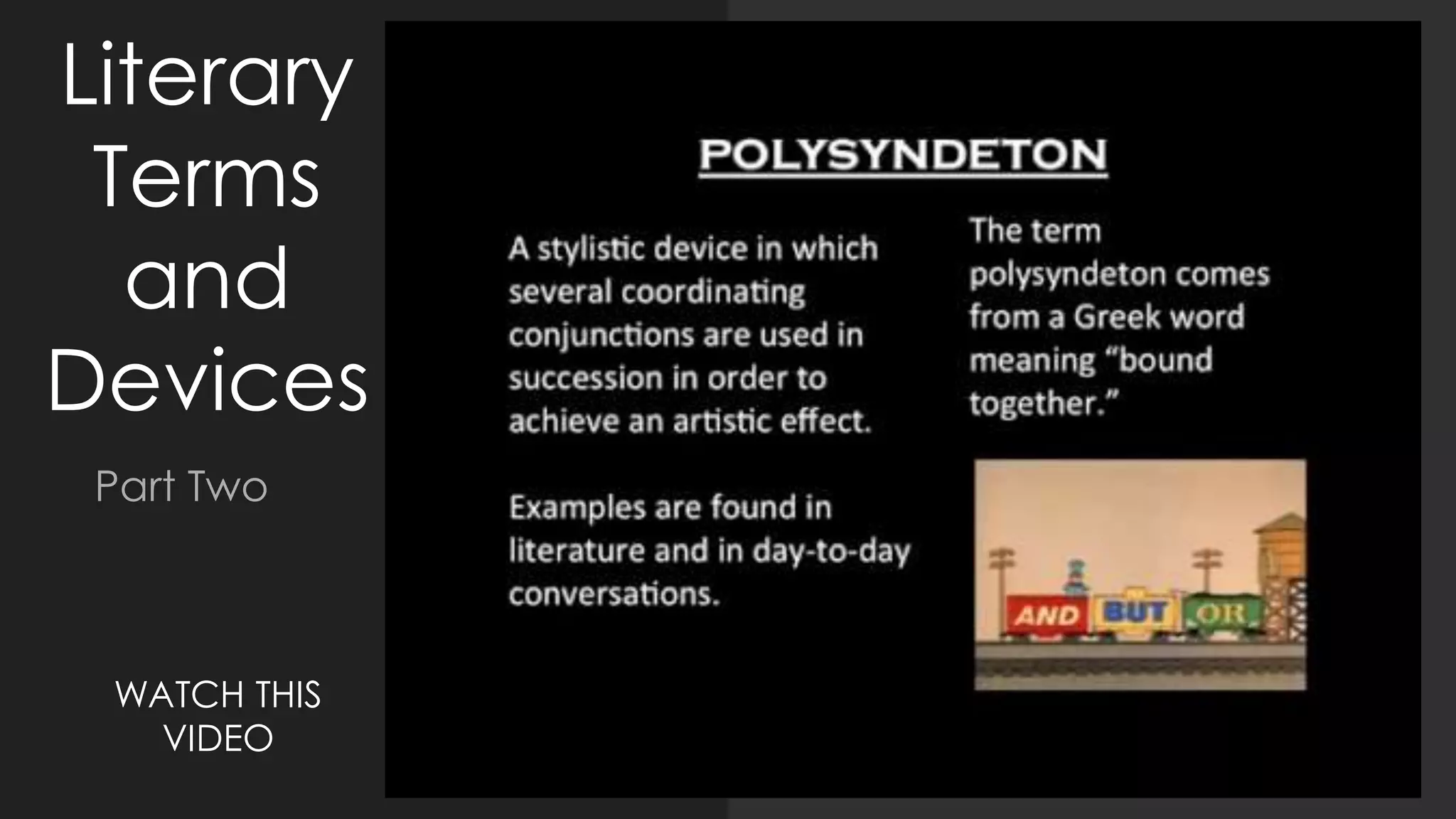
Literary
Terms
and
Devices
Part Two
WATCH THIS
VIDEO
Key Ideas: The Odyssey
•The Odyssey is an epic.
•An epic is a long narrative poem about the
deeds of a hero.
•The epic hero often portrays the goals and
values of the society
•Epics are based in part on historical fact,
blending legend with truth.
Who was HOMER?
• He was the author of The Odyssey
Homer was a blind minstrel (he told
stories to entertain and to make his
living); audiences had to listen
carefully (this is “oral tradition” so
there was a lot of repetition and
improvisation used).
NOT HOMER
SIMPSON
Oral History
•Homer’s epics are all that remains of a series of poems
that told the whole story of the Trojan War.
•In later centuries, the Iliad and the Odyssey were
memorized by professional reciters, who performed them
at religious festivals throughout Greece.
Other traveling poets
(called rhapsodes)
memorized and recited
these epics in the
banquet halls of kings
and noble families
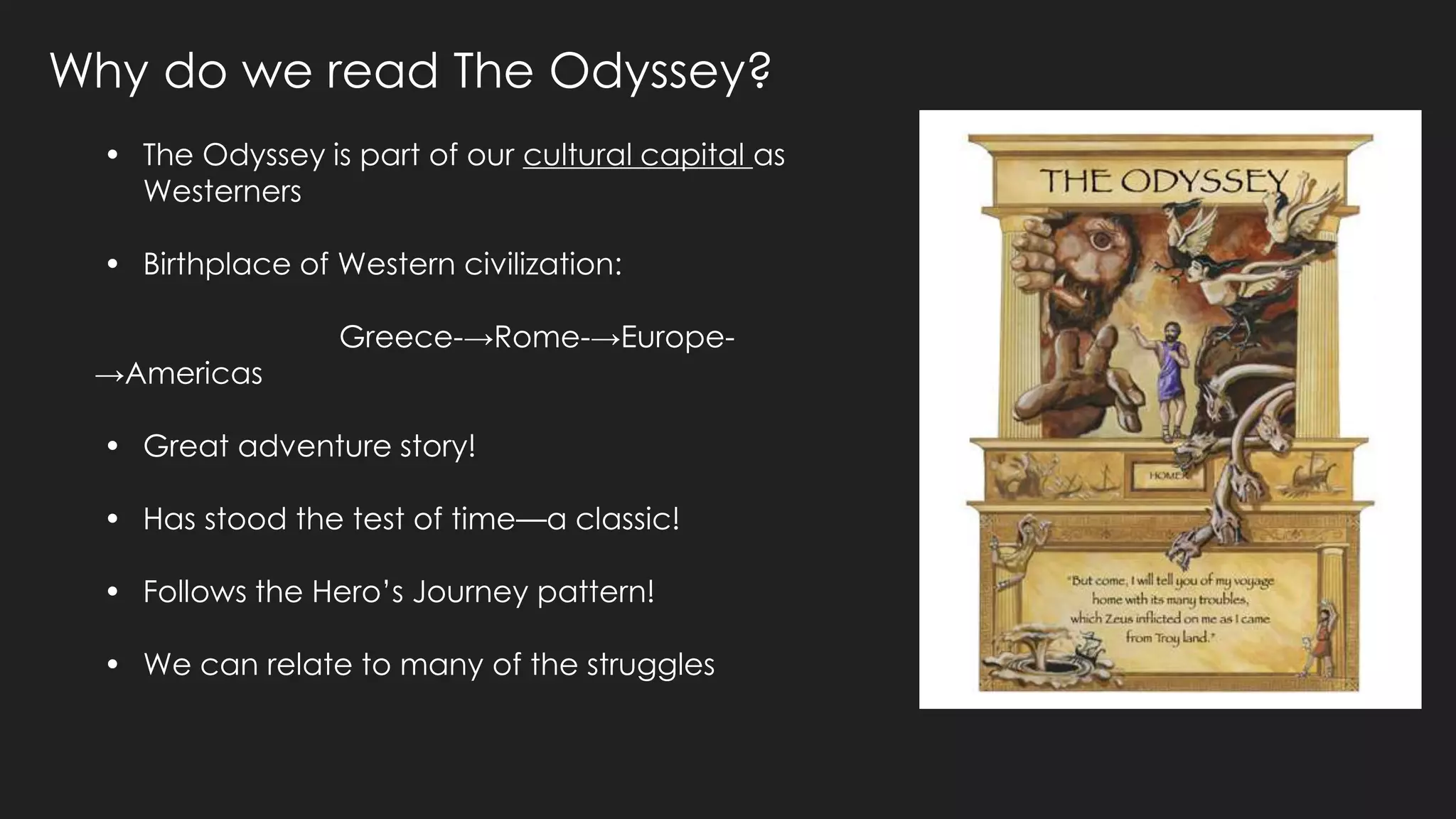
Why do we read The Odyssey?
• The Odyssey is part of our cultural capital as
Westerners
• Birthplace of Western civilization:
Greece-→Rome-→Europe-
→Americas
• Great adventure story!
• Has stood the test of time—a classic!
• Follows the Hero’s Journey pattern!
• We can relate to many of the struggles
Cultural
Capital:
common knowledge that
a group of people from
same culture shares
Cultural Capital knowledge
can come from:
• Literature
• Stories/ History
• Religion
• Famous People
• Media
WATCH THIS
VIDEO
Greek Values
(explains characters’ motivations)
Reciprocity:
• Mutual exchange
between two people
• You give to me, I give
to you
• You help me, later I
have to help you
Hospitality:
• Treat all guests with
respect
• Be nice first, ask
questions later
• A stranger could be
a god in disguise!
Greek Values
(explains characters’ motivations)
Arete:
• Greek idea of
excellence, an ideal
of human perfection
• Intelligence (be
smart and cunning)
• Strength
• Courage
• Duty
Religion:
• Actions should please the
gods
• Fate controlled by the god
• Humans need the gods (man,
without the gods, is nothing)
[Odysseus’ revelation]
• Humans should honor gods
through sacrifices, asking
gods for help, and giving
credit to gods
MYTH AND EPIC
“Myth” is a story that uses fantasy to
express ideas about life not easily
done in realistic terms (it also stresses
the relationship of human beings to a
higher, spiritual realm)
Conventions/Characteristics of Epic
Heroes and Epic Poems
WATCH THIS
VIDEO
Epic Hero: Characteristics
•Possesses superhuman strength, craftiness, and
confidence.
•Is helped and harmed by interfering gods.
•Embodies ideals and values that a culture considers
admirable.
•Emerges victorious from perilous situations
1. Invocation of the
Muse
A formal plea for help to
the Muse Calliope.
Epic Conventions
2. In medias res
The epic plunges right
into the action -- it
begins “in the middle
of things.”
Flashbacks provide
background
information.
3. Epic similes
Use of extended
similes.
These are also
known as
Homeric Similes
(seen above)
Epic Conventions Continued
4. Stock epithets
A descriptive phrase
used
in place of a noun or
proper noun.
“Grey-eyed Athena”
Epithet
A brief descriptive phrase
•Characterizes a person, place or thing
•Gives story-teller a “breather”
•Helps with rhyming or meter
Examples:
rosy-fingered dawn
gray-eyed Athena
The blue-maned god who makes the islands tremble
Son of Laertes and gods of old, master mariner and soldier
Homeric Simile
Compares epic events to
everyday events
“…in one stride he clutched at my companions and
caught two in his hands like squirming puppies to
beat their brains out, spattering the floor.”
In Medias Res
in the middle
In Medias Res: literary technique in which the plot
sequence is out of order; Latin for “in the middle,” the story
begins in the middle of the action, flashes back to the
beginning to catch up, then skips to the end
Example: Forrest Gump
Hubris
What is Hubris?
• Hubris is extreme
arrogance or self-pride.
• Often in Greek tragedies,
hubris would be the fatal
flaw of the main
character, often resulting
in their downfall.
• In Mythology, humans
sometimes
demonstrated hubris,
which angered the gods.
WATCH THIS
VIDEO
Check Point: How are your notes coming
along?
Make sure that your notes contain information about all of the things listed on your notes
page
TAKE A BREAK!
Do something that is not school related for 10 minutes before you continue on
Write down any questions you have
Archetypes:
Recognizing Patterns
in Literature
What is an archetype?
A pattern repeated
through the ages in
folk and literary
expressions. An
original model on
which something is
patterned.
Once upon a time, there was a
man named Carl Jung
- Swiss psychiatrist
- Studied dreams, personalities,
and religious connections
- 1925 "Bugishu Psychological Expedition"
to East Africa
What he figured out:
- People all over the world have the same dreams and stories
- We have a “collective unconscious” from birth
- The collective unconscious comes out in the form of archetypes in our
stories
Types of Archetypes
• For this unit we will focus on three different types of
archetypes
1. Character Archetypes
2. Situational Archetypes
3. Symbolic Archetypes
WATCH THIS
VIDEO
WATCH THIS
VIDEO
Patterns within archetypes:
• Symbol: Concrete object representing an idea
• Motif: Visual detail developed throughout a work. It may
reinforce character, enhance theme or foreshadow plot
developments. A repeating pattern
• ARCHETYPES are what makes readers / listeners / viewers
relate to and enjoy a story. We connect with what we
already know from our “collective unconscious.”
Situational Archetype #1
The quest/Journey: the hero undertakes a
long journey towards a goal. Must perform
impossible tasks, confront errors, learn the
rules, suffer doubts and overcome
insurmountable obstacles.
Situational Archetype #2
The initiation (rite of passage, fall from
innocence): The hero undergoes
series of ordeals passing from
innocence to social/spiritual maturity.
Pattern of separation, transformation,
and return.
Situational Archetype #3
Supernatural Intervention:Spiritual
beings intervene on the side of
the hero or sometimes against
him.
Archetypal Characters
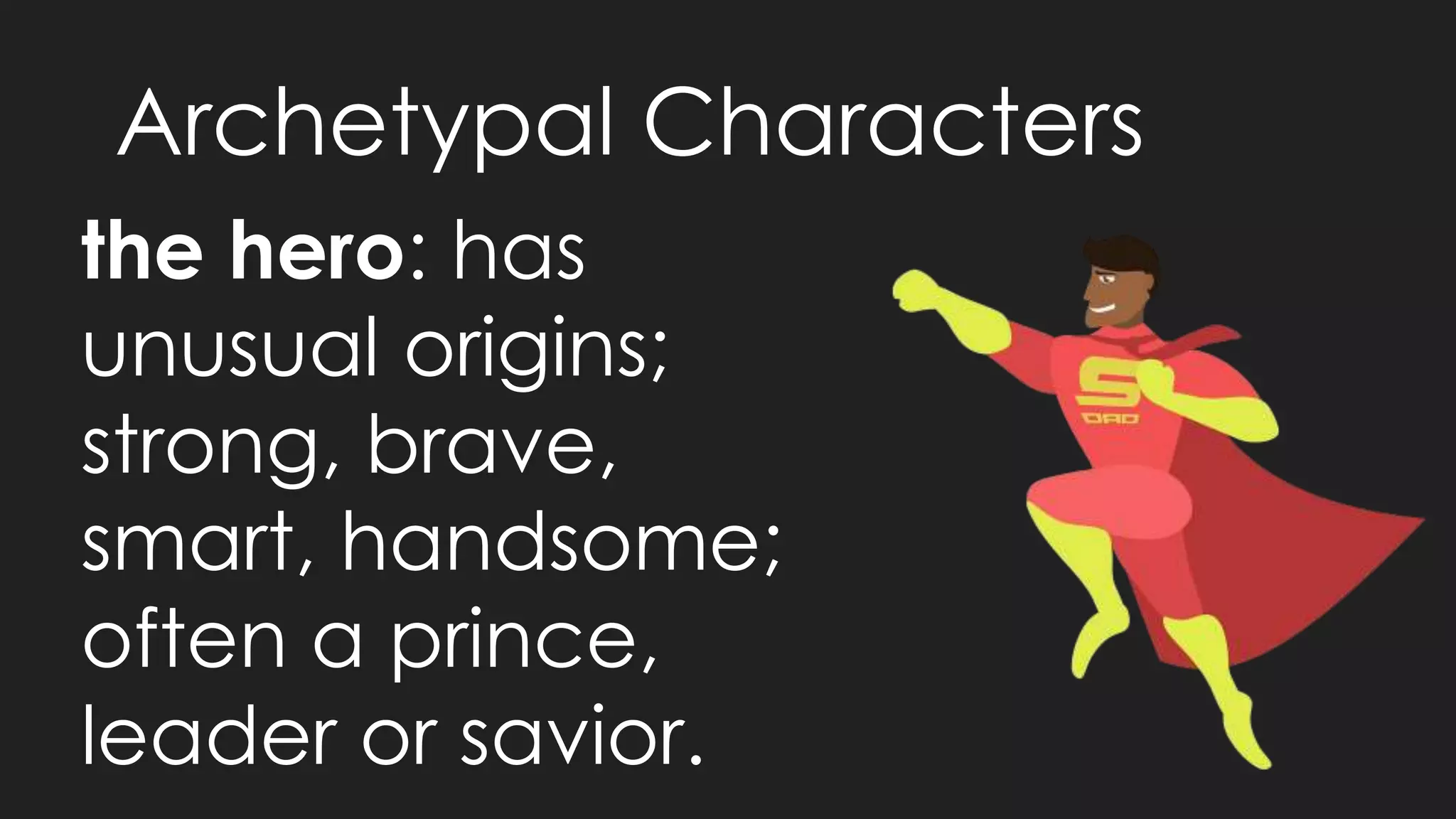
the hero: has
unusual origins;
strong, brave,
smart, handsome;
often a prince,
leader or savior.
Archetypal Characters
the wise
counselor/mentor:
dedicated to order
and good; has
wisdom of
experience; advises
the hero.
Archetypal Characters
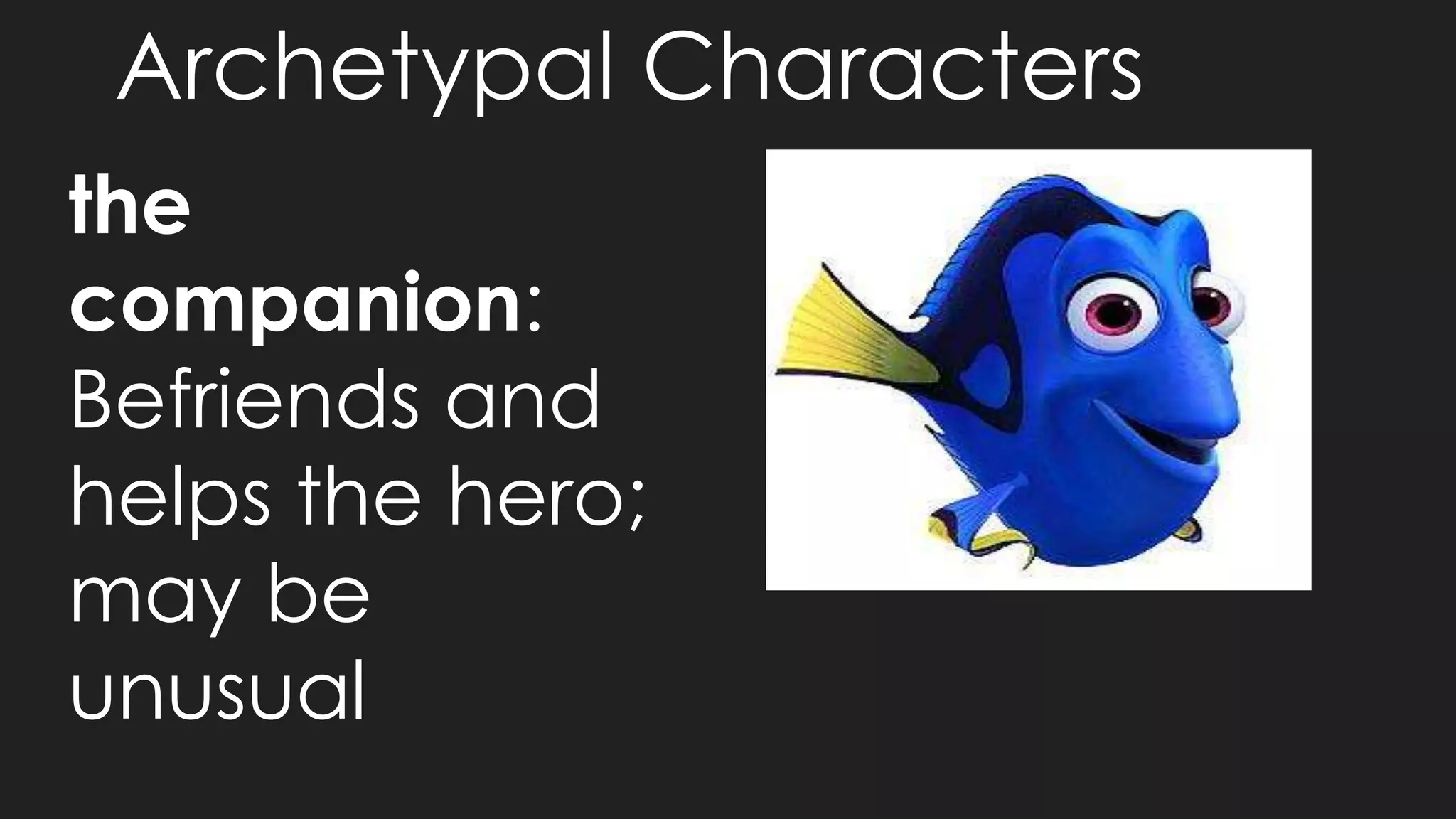
the
companion:
Befriends and
helps the hero;
may be
unusual
Archetypal Characters
the demonic
adversary: a villain;
represents evil;
almost as strong as
hero; may take on
a monstrous form.
Archetypal Characters
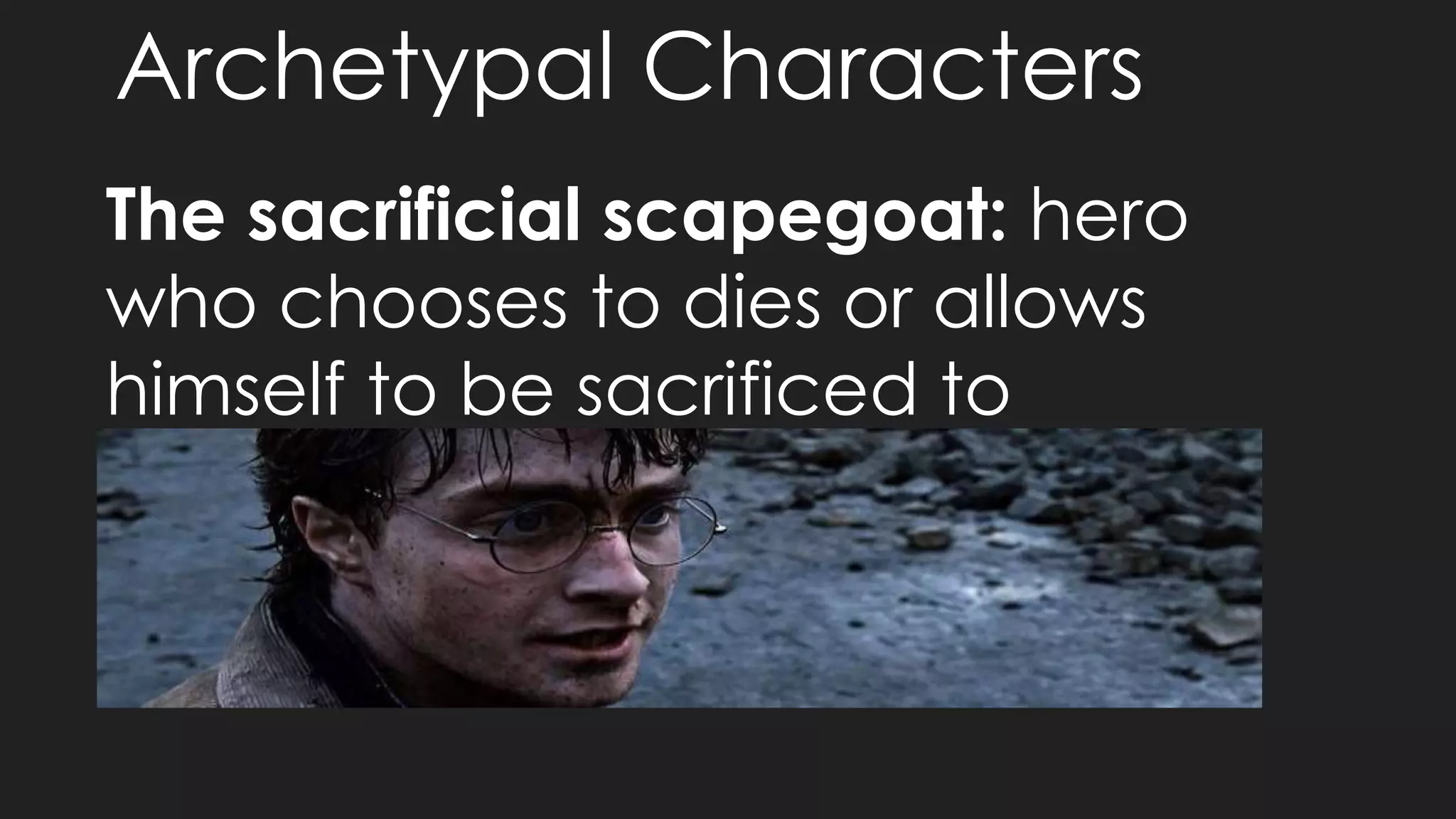
The sacrificial scapegoat: hero
who chooses to dies or allows
himself to be sacrificed to
restore his people or the land
back to fruitfulness
Archetypal Characters
the great mother: the
protector of good,
home, family;
represents warmth,
security, fertility,
growth; may be a
sacred woman who
intercedes for those
who pray for her.
WATCH THIS
VIDEO
Archetypal Characters
the terrible mother:
witch, stepmother,
siren or temptress;
does the exact
opposite of what a
mother should do.
Archetypal Characters
the female soul mate:
represents goodness,
innocence, purity; may
be a princess who is
beautiful, sought after
and remote.
Symbolic Archetypes
Light VS. Darkness: Light usually
suggests hope, renewal, or
intellectual illumination; darkness
implies the unknown, ignorance,
or despair.
Symbolic Archetypes
Fire and Ice
Fire represents
knowledge, light, life,
and rebirth, while ice,
like the desert,
represents ignorance,
darkness, sterility, and
death.
The Underworld
A place of death or
metaphorically an
encounter with the
dark side of the self.
Entering an underworld
is a form of facing a
fear of death.
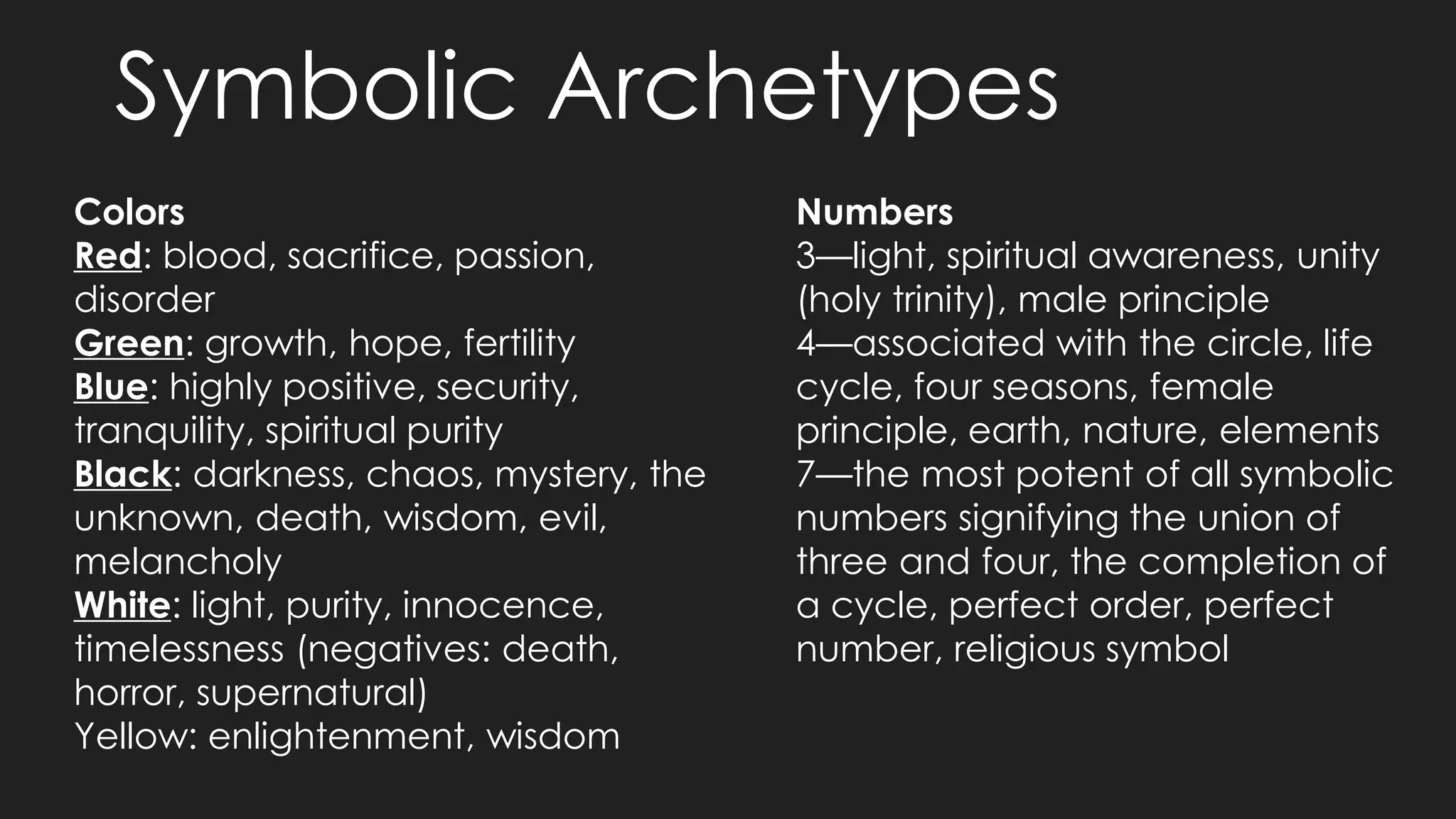
Symbolic Archetypes
Colors
Red: blood, sacrifice, passion,
disorder
Green: growth, hope, fertility
Blue: highly positive, security,
tranquility, spiritual purity
Black: darkness, chaos, mystery, the
unknown, death, wisdom, evil,
melancholy
White: light, purity, innocence,
timelessness (negatives: death,
horror, supernatural)
Yellow: enlightenment, wisdom
Numbers
3—light, spiritual awareness, unity
(holy trinity), male principle
4—associated with the circle, life
cycle, four seasons, female
principle, earth, nature, elements
7—the most potent of all symbolic
numbers signifying the union of
three and four, the completion of
a cycle, perfect order, perfect
number, religious symbol
Check Point: How are your notes coming
along?Make sure that your notes contain information about all of the things listed on your
notes page
TAKE A BREAK!
Do something that is not school related for 10 minutes before you continue on
Write down any questions you have
Make sure that your notes contain information about all of the things listed on your notes
page
TAKE A BREAK!
Do something that is not school related for 10 minutes before you continue on
Write down any questions you have
The Hero’s
Journey (AKA-
The
Monomyth)
More on
the Hero’s
Journey
WATCH THIS
VIDEO

Introduction to the odyssey

  • 1.
    Ms. Schuster’s Introduction toThe Odyssey Feel free to pause/replay/or skip through this presentation as needed
  • 2.
    This presentation willcover three major topics 1. Literary Terms/Devices 2. Archetypes 3. Hero’s Journey You should take notes on all of this information as you will have a quiz on Monday (and you might get to use your notes)
  • 3.
  • 4.
  • 5.
    Key Ideas: TheOdyssey •The Odyssey is an epic. •An epic is a long narrative poem about the deeds of a hero. •The epic hero often portrays the goals and values of the society •Epics are based in part on historical fact, blending legend with truth.
  • 6.
    Who was HOMER? •He was the author of The Odyssey Homer was a blind minstrel (he told stories to entertain and to make his living); audiences had to listen carefully (this is “oral tradition” so there was a lot of repetition and improvisation used). NOT HOMER SIMPSON
  • 7.
    Oral History •Homer’s epicsare all that remains of a series of poems that told the whole story of the Trojan War. •In later centuries, the Iliad and the Odyssey were memorized by professional reciters, who performed them at religious festivals throughout Greece.
  • 8.
    Other traveling poets (calledrhapsodes) memorized and recited these epics in the banquet halls of kings and noble families
  • 9.
    Why do weread The Odyssey? • The Odyssey is part of our cultural capital as Westerners • Birthplace of Western civilization: Greece-→Rome-→Europe- →Americas • Great adventure story! • Has stood the test of time—a classic! • Follows the Hero’s Journey pattern! • We can relate to many of the struggles
  • 10.
    Cultural Capital: common knowledge that agroup of people from same culture shares Cultural Capital knowledge can come from: • Literature • Stories/ History • Religion • Famous People • Media WATCH THIS VIDEO
  • 11.
    Greek Values (explains characters’motivations) Reciprocity: • Mutual exchange between two people • You give to me, I give to you • You help me, later I have to help you Hospitality: • Treat all guests with respect • Be nice first, ask questions later • A stranger could be a god in disguise!
  • 12.
    Greek Values (explains characters’motivations) Arete: • Greek idea of excellence, an ideal of human perfection • Intelligence (be smart and cunning) • Strength • Courage • Duty Religion: • Actions should please the gods • Fate controlled by the god • Humans need the gods (man, without the gods, is nothing) [Odysseus’ revelation] • Humans should honor gods through sacrifices, asking gods for help, and giving credit to gods
  • 13.
    MYTH AND EPIC “Myth”is a story that uses fantasy to express ideas about life not easily done in realistic terms (it also stresses the relationship of human beings to a higher, spiritual realm)
  • 14.
    Conventions/Characteristics of Epic Heroesand Epic Poems WATCH THIS VIDEO
  • 15.
    Epic Hero: Characteristics •Possessessuperhuman strength, craftiness, and confidence. •Is helped and harmed by interfering gods. •Embodies ideals and values that a culture considers admirable. •Emerges victorious from perilous situations
  • 16.
    1. Invocation ofthe Muse A formal plea for help to the Muse Calliope. Epic Conventions 2. In medias res The epic plunges right into the action -- it begins “in the middle of things.” Flashbacks provide background information.
  • 17.
    3. Epic similes Useof extended similes. These are also known as Homeric Similes (seen above) Epic Conventions Continued 4. Stock epithets A descriptive phrase used in place of a noun or proper noun. “Grey-eyed Athena”
  • 18.
    Epithet A brief descriptivephrase •Characterizes a person, place or thing •Gives story-teller a “breather” •Helps with rhyming or meter Examples: rosy-fingered dawn gray-eyed Athena The blue-maned god who makes the islands tremble Son of Laertes and gods of old, master mariner and soldier
  • 19.
    Homeric Simile Compares epicevents to everyday events “…in one stride he clutched at my companions and caught two in his hands like squirming puppies to beat their brains out, spattering the floor.”
  • 20.
    In Medias Res inthe middle In Medias Res: literary technique in which the plot sequence is out of order; Latin for “in the middle,” the story begins in the middle of the action, flashes back to the beginning to catch up, then skips to the end Example: Forrest Gump
  • 21.
    Hubris What is Hubris? •Hubris is extreme arrogance or self-pride. • Often in Greek tragedies, hubris would be the fatal flaw of the main character, often resulting in their downfall. • In Mythology, humans sometimes demonstrated hubris, which angered the gods. WATCH THIS VIDEO
  • 22.
    Check Point: Howare your notes coming along? Make sure that your notes contain information about all of the things listed on your notes page TAKE A BREAK! Do something that is not school related for 10 minutes before you continue on Write down any questions you have
  • 23.
  • 24.
    What is anarchetype? A pattern repeated through the ages in folk and literary expressions. An original model on which something is patterned.
  • 25.
    Once upon atime, there was a man named Carl Jung - Swiss psychiatrist - Studied dreams, personalities, and religious connections - 1925 "Bugishu Psychological Expedition" to East Africa What he figured out: - People all over the world have the same dreams and stories - We have a “collective unconscious” from birth - The collective unconscious comes out in the form of archetypes in our stories
  • 26.
    Types of Archetypes •For this unit we will focus on three different types of archetypes 1. Character Archetypes 2. Situational Archetypes 3. Symbolic Archetypes
  • 27.
  • 28.
  • 29.
    Patterns within archetypes: •Symbol: Concrete object representing an idea • Motif: Visual detail developed throughout a work. It may reinforce character, enhance theme or foreshadow plot developments. A repeating pattern • ARCHETYPES are what makes readers / listeners / viewers relate to and enjoy a story. We connect with what we already know from our “collective unconscious.”
  • 30.
    Situational Archetype #1 Thequest/Journey: the hero undertakes a long journey towards a goal. Must perform impossible tasks, confront errors, learn the rules, suffer doubts and overcome insurmountable obstacles.
  • 31.
    Situational Archetype #2 Theinitiation (rite of passage, fall from innocence): The hero undergoes series of ordeals passing from innocence to social/spiritual maturity. Pattern of separation, transformation, and return.
  • 32.
    Situational Archetype #3 SupernaturalIntervention:Spiritual beings intervene on the side of the hero or sometimes against him.
  • 33.
    Archetypal Characters the hero:has unusual origins; strong, brave, smart, handsome; often a prince, leader or savior.
  • 34.
    Archetypal Characters the wise counselor/mentor: dedicatedto order and good; has wisdom of experience; advises the hero.
  • 35.
  • 36.
    Archetypal Characters the demonic adversary:a villain; represents evil; almost as strong as hero; may take on a monstrous form.
  • 37.
    Archetypal Characters The sacrificialscapegoat: hero who chooses to dies or allows himself to be sacrificed to restore his people or the land back to fruitfulness
  • 38.
    Archetypal Characters the greatmother: the protector of good, home, family; represents warmth, security, fertility, growth; may be a sacred woman who intercedes for those who pray for her. WATCH THIS VIDEO
  • 39.
    Archetypal Characters the terriblemother: witch, stepmother, siren or temptress; does the exact opposite of what a mother should do.
  • 40.
    Archetypal Characters the femalesoul mate: represents goodness, innocence, purity; may be a princess who is beautiful, sought after and remote.
  • 41.
    Symbolic Archetypes Light VS.Darkness: Light usually suggests hope, renewal, or intellectual illumination; darkness implies the unknown, ignorance, or despair.
  • 42.
    Symbolic Archetypes Fire andIce Fire represents knowledge, light, life, and rebirth, while ice, like the desert, represents ignorance, darkness, sterility, and death. The Underworld A place of death or metaphorically an encounter with the dark side of the self. Entering an underworld is a form of facing a fear of death.
  • 43.
    Symbolic Archetypes Colors Red: blood,sacrifice, passion, disorder Green: growth, hope, fertility Blue: highly positive, security, tranquility, spiritual purity Black: darkness, chaos, mystery, the unknown, death, wisdom, evil, melancholy White: light, purity, innocence, timelessness (negatives: death, horror, supernatural) Yellow: enlightenment, wisdom Numbers 3—light, spiritual awareness, unity (holy trinity), male principle 4—associated with the circle, life cycle, four seasons, female principle, earth, nature, elements 7—the most potent of all symbolic numbers signifying the union of three and four, the completion of a cycle, perfect order, perfect number, religious symbol
  • 44.
    Check Point: Howare your notes coming along?Make sure that your notes contain information about all of the things listed on your notes page TAKE A BREAK! Do something that is not school related for 10 minutes before you continue on Write down any questions you have Make sure that your notes contain information about all of the things listed on your notes page TAKE A BREAK! Do something that is not school related for 10 minutes before you continue on Write down any questions you have
  • 45.
  • 46.