HSCO 509
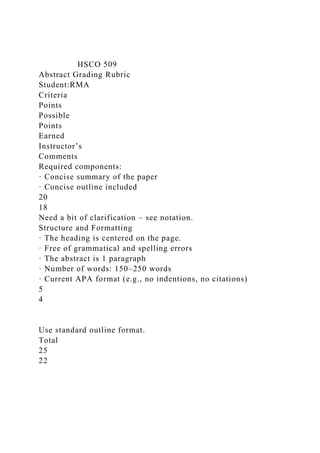
Abstract Grading Rubric
Student:RMA
Criteria
Points
Possible
Points
Earned
Instructor’s
Comments
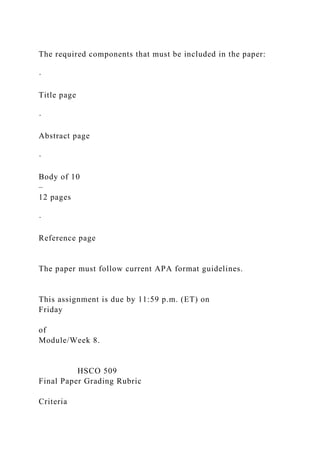
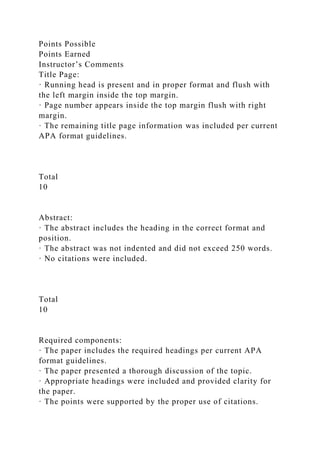
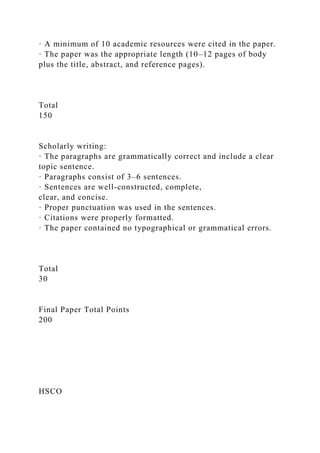
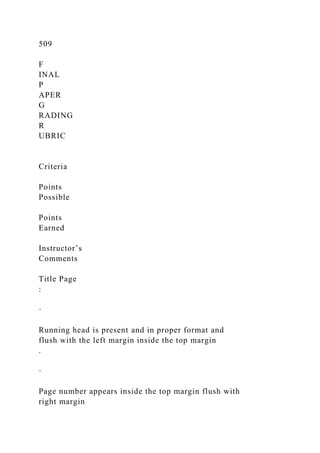
Required components:
· Concise summary of the paper
· Concise outline included
20
18
Need a bit of clarification – see notation.
Structure and Formatting
· The heading is centered on the page.
· Free of grammatical and spelling errors
· The abstract is 1 paragraph
· Number of words: 150–250 words
· Current APA format (e.g., no indentions, no citations)
5
4
Use standard outline format.
Total
25
22
HS
CO
509
A
BSTRACT
G
RADING
R
UBRIC
Student:
RMA
Criteria
Points
Possible
Points
Earned
Instructor’s
Comments
R
equired components
:
·
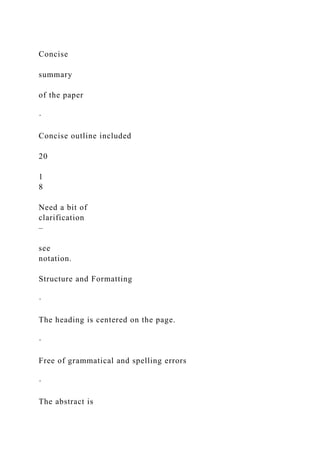
Concise
summary
of the paper
·
Concise outline included
20
1
8
Need a bit of
clarification
–
see
notation.
Structure and Formatting
·
The heading is centered on the page.
·
Free of grammatical and spelling errors
·
The abstract is
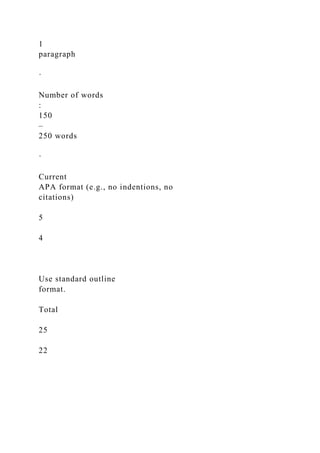
1
paragraph
·
Number of words
:
150
–
250 words
·
Current
APA format (e.g., no indentions, no
citations)
5
4
Use standard outline
format.
Total
25
22
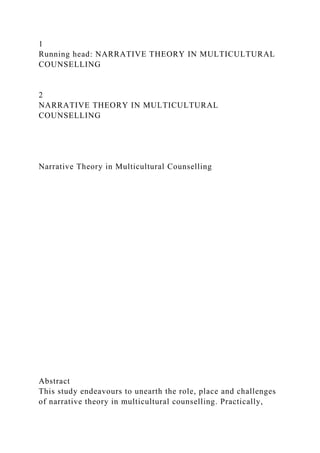
1
Running head: NARRATIVE THEORY IN MULTICULTURAL
COUNSELLING
2
NARRATIVE THEORY IN MULTICULTURAL
COUNSELLING
Narrative Theory in Multicultural Counselling
Abstract
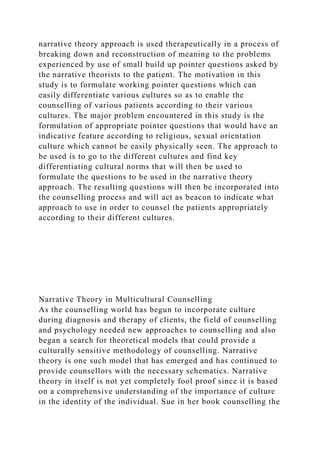
This study endeavours to unearth the role, place and challenges
of narrative theory in multicultural counselling. Practically,
narrative theory approach is used therapeutically in a process of
breaking down and reconstruction of meaning to the problems
experienced by use of small build up pointer questions asked by
the narrative theorists to the patient. The motivation in this
study is to formulate working pointer questions which can
easily differentiate various cultures so as to enable the
counselling of various patients according to their various
cultures. The major problem encountered in this study is the
formulation of appropriate pointer questions that would have an
indicative feature according to religious, sexual orientation
culture which cannot be easily physically seen. The approach to
be used is to go to the different cultures and find key
differentiating cultural norms that will then be used to
formulate the questions to be used in the narrative theory
approach. The resulting questions will then be incorporated into
the counselling process and will act as beacon to indicate what
approach to use in order to counsel the patients appropriately
according to their different cultures.
Narrative Theory in Multicultural Counselling
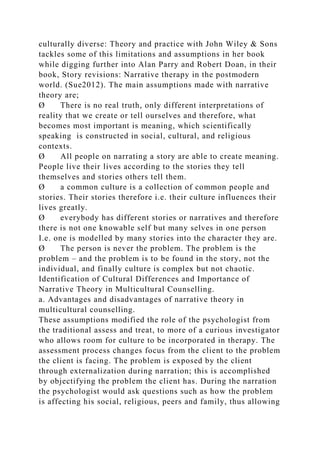
As the counselling world has begun to incorporate culture
during diagnosis and therapy of clients, the field of counselling
and psychology needed new approaches to counselling and also
began a search for theoretical models that could provide a
culturally sensitive methodology of counselling. Narrative
theory is one such model that has emerged and has continued to
provide counsellors with the necessary schematics. Narrative
theory in itself is not yet completely fool proof since it is based
on a comprehensive understanding of the importance of culture
in the identity of the individual. Sue in her book counselling the
culturally diverse: Theory and practice with John Wiley & Sons
tackles some of this limitations and assumptions in her book
while digging further into Alan Parry and Robert Doan, in their
book, Story revisions: Narrative therapy in the postmodern
world. (Sue2012). The main assumptions made with narrative
theory are;
Ø There is no real truth, only different interpretations of
reality that we create or tell ourselves and therefore, what
becomes most important is meaning, which scientifically
speaking is constructed in social, cultural, and religious
contexts.
Ø All people on narrating a story are able to create meaning.
People live their lives according to the stories they tell
themselves and stories others tell them.
Ø a common culture is a collection of common people and
stories. Their stories therefore i.e. their culture influences their
lives greatly.
Ø everybody has different stories or narratives and therefore
there is not one knowable self but many selves in one person
I.e. one is modelled by many stories into the character they are.
Ø The person is never the problem. The problem is the
problem – and the problem is to be found in the story, not the
individual, and finally culture is complex but not chaotic.
Identification of Cultural Differences and Importance of
Narrative Theory in Multicultural Counselling.
a. Advantages and disadvantages of narrative theory in
multicultural counselling.
These assumptions modified the role of the psychologist from
the traditional assess and treat, to more of a curious investigator
who allows room for culture to be incorporated in therapy. The
assessment process changes focus from the client to the problem
the client is facing. The problem is exposed by the client
through externalization during narration; this is accomplished
by objectifying the problem the client has. During the narration
the psychologist would ask questions such as how the problem
is affecting his social, religious, peers and family, thus allowing
the client to express their issues through their own cultural
ideologies, so that during therapy he may know how to
incorporate the clients culture into the treatment bracket while
at the same time decreases the risk of cultural
misunderstanding.
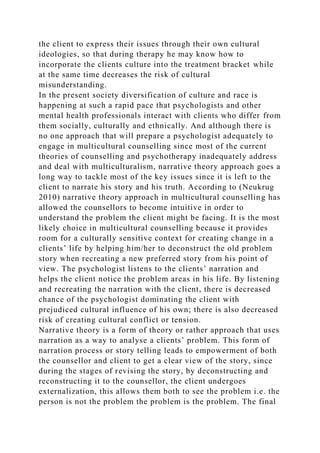
In the present society diversification of culture and race is
happening at such a rapid pace that psychologists and other
mental health professionals interact with clients who differ from
them socially, culturally and ethnically. And although there is
no one approach that will prepare a psychologist adequately to
engage in multicultural counselling since most of the current
theories of counselling and psychotherapy inadequately address
and deal with multiculturalism, narrative theory approach goes a
long way to tackle most of the key issues since it is left to the
client to narrate his story and his truth. According to (Neukrug
2010) narrative theory approach in multicultural counselling has
allowed the counsellors to become intuitive in order to
understand the problem the client might be facing. It is the most
likely choice in multicultural counselling because it provides
room for a culturally sensitive context for creating change in a
clients’ life by helping him/her to deconstruct the old problem
story when recreating a new preferred story from his point of
view. The psychologist listens to the clients’ narration and
helps the client notice the problem areas in his life. By listening
and recreating the narration with the client, there is decreased
chance of the psychologist dominating the client with
prejudiced cultural influence of his own; there is also decreased
risk of creating cultural conflict or tension.
Narrative theory is a form of theory or rather approach that uses
narration as a way to analyse a clients’ problem. This form of
narration process or story telling leads to empowerment of both
the counsellor and client to get a clear view of the story, since
during the stages of revising the story, by deconstructing and
reconstructing it to the counsellor, the client undergoes
externalization, this allows them both to see the problem i.e. the
person is not the problem the problem is the problem. The final
outcome of this is the mapping effect. The counsellor looks at
language and attitude, and cultural ideologies of the client as
symptoms of personal problems and takes them into
consideration.
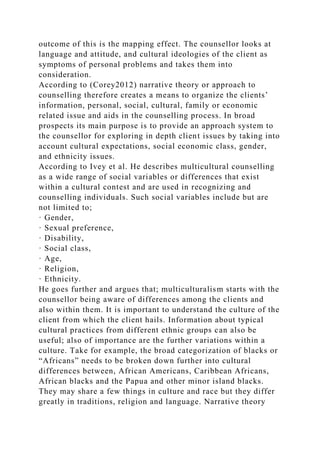
According to (Corey2012) narrative theory or approach to
counselling therefore creates a means to organize the clients’
information, personal, social, cultural, family or economic
related issue and aids in the counselling process. In broad
prospects its main purpose is to provide an approach system to
the counsellor for exploring in depth client issues by taking into
account cultural expectations, social economic class, gender,
and ethnicity issues.
According to Ivey et al. He describes multicultural counselling
as a wide range of social variables or differences that exist
within a cultural contest and are used in recognizing and
counselling individuals. Such social variables include but are
not limited to;
· Gender,
· Sexual preference,
· Disability,
· Social class,
· Age,
· Religion,
· Ethnicity.
He goes further and argues that; multiculturalism starts with the
counsellor being aware of differences among the clients and
also within them. It is important to understand the culture of the
client from which the client hails. Information about typical
cultural practices from different ethnic groups can also be
useful; also of importance are the further variations within a
culture. Take for example, the broad categorization of blacks or
“Africans” needs to be broken down further into cultural
differences between, African Americans, Caribbean Africans,
African blacks and the Papua and other minor island blacks.
They may share a few things in culture and race but they differ
greatly in traditions, religion and language. Narrative theory
attempts to address this by letting the client tell his story and
feelings and in the process of deconstruction and reconstruction
his/her cultural ideologies are brought up to the attention of the
counsellor who will then take it into consideration while
counselling him/her to get a solution.
He secondly argues that; multiculturalism counselling stresses
the importance of family and cultural factors that actually affect
the way clients and everybody sees the world. Many cultures if
not all have stereotypes regarding gender, the roles that men or
women can be allowed to participate in relation to work and
family duties or place in community. How people interact is
also greatly influenced by culture and family ties. Years of
influence by such stereotypes lead to them being inculcated into
everyday life. It is important to note that these stereotypes vary
from culture to culture and what may pass as appropriate in one
culture, may be dubbed as taboo to the other. Therefore use of
narrative theory allows the client to express their ideologies in a
narrative way and this allows the counsellor to gauge what is
appropriate in the clients’ culture and counsels the client
appropriately by incorporating the clients’ ideologies on culture
during therapy.
Finally Ivey goes further to argue that; multiculturalism theory
stimulates practitioners and counsellors to rethink the meaning
and methods of counselling and pay more attention to the
clients cultural concern as in most cases it plays a role in their
problems or in their therapy procedures. Understanding
multiculturalism, level of education, family traditions,
heritages, economic issues and histories of discrimination and
mistreatment can be included during the multicultural
counselling process. It is important to note that cultural identity
especially race or rather skin colour cannot be taken for granted
in the present counselling world. There are different types of
clients, some may be ashamed or proud of their cultures; others
will try to dissociate from their culture mainly due to
stereotypes associated with it while others will stick to it and
reject the main stream culture being forced on them by the
modern society. A more common situation especially among the
young is, they will adopt some values of a new culture while
still maintaining the practice of their old cultures. During
counselling of a client from a multicultural population it can be
difficult to tell which client is which accordingly and that is
where narrative theory comes in. As the client narrates their
story the counsellor can then pick cues that direct him to know
which bracket his client lies.
Narrative theory has provided counsellors with a model plan
that has spear headed their understanding of the numerous and
complex issues that face the diverse multicultural population.
Narrative theory has an advantage of providing the counsellors
with a culture sensitive framework from which they can then be
able to give counsel that takes culture of the client into
consideration during therapy.
According to (Diaz-Comaz 2012) individualism had long
dominated the mental health field and was reflected by the
counselling process. Take for example if a client saw a
psychologist with an issue whether personal or social, it was
always assumed that it was only the client who faced the
problem even if in some cases, which was most, it was a whole
kind of culture of people who faced the problem although in
different proportions, since most learning processes and
ideology building are cemented in the cultural context.
Therefore a culture centred approach had to be created. Since
culture is a dynamic body of entities and keeps changing, it was
approached inclusively of everything rather than narrowly. Here
is where narrative theory played a role in trying to close the gap
in understanding clients’ behaviour in a cultural and socio-
political context relatively accurately without appearing racist.
It provides an almost adequate methodology for incorporating
culture in both its qualitative and quantitative elements.
Its other advantage is that over time the counsellor increases in
self-awareness due to the accumulation of relevant knowledge
from the well-developed cultural awareness created by the
approach of narration. It is not enough to be aware of the
clients’ culture narrative therapy also offers an outlet to
appropriately apply the skills and perspectives gained from
his/her culture during therapy.
According to Corey.G (2012), narrative theory has the
advantage of being used on individuals, couples and families by
helping them view their problems in a social, political or
cultural perspective (by externalization, which creates a
platform of positive interactions and changes negative
comments and responses into more positive and accepting, non-
biased meaningful communication) by helping them see their
own views and personal stories and be the judge themselves
without the danger of the counsellor appearing culturally
insensitive or racial. This objective viewing of problems by
multicultural individuals, couples or families enables them
reconnect and view the problem as it is. He further argues that
this objectification of the problem reduces resistance from the
clients and allows them t to face the issue in a more productive
and mature manner.
In order to have a successful counselling process, the
counselling approach must be inclusive of the clients’ culture,
(Pasupathi, Wainryb & Twali 2012). Therefore the counsellor
must develop multicultural competencies in order to maintain
professionalism during the counselling process. The narrative
theory approach addresses this important aspect by broadening
the counsellors’ awareness and understanding of the clients’
culture during the process of narration and figuring out the
problem or main issue. This approach allows the counsellor to
openly acknowledge cultural differences without appearing rude
or undermining the clients’ culture, identity, religion or gender.
It actually instead shows willingness to learn and accept the
clients culture and create appropriate interventions from the
part of the counsellor.
In counselling without taking culture into the picture, often and
do frequently evoke some defensiveness from the clients
(mostly true when dealing with clients of different races, who
feel they have been historically repressed by other races) this is
obviously because peoples culture are an important part of their
lives and by itself is naturally a powerful part that they
wouldn’t want anybody to judge or belittle it (Scholl,
McGowan, & Hansen, 2012)). This is true even to those clients
who may try to deny their race, religion or gender as a major
part that influences their Culture. Narrative theory attempts to
address this problem as it helps the counsellor not only
understand the clients own belief and culture without appearing
judgemental, it also helps him or her come to terms his own
beliefs and culture. This awareness of culture and beliefs goes a
long way in providing effective therapy to the client.
Using narrative therapy may assist the counsellor to examine
the client and determine if what the client is going through is an
individual behaviour or an organizational behaviour, (which in
this case is cultural behaviours that may be present among large
populations). Normally the influence of organizational
behaviour can be easily picked up with an experienced
counsellor using narrative theory, it’s the exploration of
personal issues concerning sexism, religion and personal
believes that are most importantly facilitated with this narrative
theory approach. This information picked from this approach is
particularly useful during the therapy process.
Most approaches fail to address collective family, community
and individual relationships that exist in any form of society
since they take a total individual approach (Neukrug,
2010).This is so wrong in so many levels since man is a social
being and is influenced by society and surrounding at many
different levels. Narrative theory on the other hand allows space
for these relationships during the process of dissociation from
the problem hence reducing the danger of the counsellor
unknowingly or subconsciously filling in the clients account
with prejudice from their own culture. At the same time
narrative approach allows for the counsellor to be aware of
individual differences and uniqueness of the client while still
exploring at the level of social and cultural ideologies.
Narrative approach allows for the counsellor to be sensitive to
words, body language and other cue’s that may be unique to a
particular culture and if deemed important he or she can
incorporate it during therapy.
Another advantage of narrative theory in multicultural
counselling is that it lets the counsellor personalize his or her
observations about the client and therefore avoid making
premature assumptions. The counsellor becomes aware of the
observations and knowledge about the clients perspectives but
keeps them to him or herself and does not generalize the clients.
This allows the client to continue with their narration until they
are down without any interruptions. The counsellor then works
with the client to see where the problem might be. Little or no
cultural prejudice is experienced by the client from the
counsellor and therefore preventing the client from going into a
defensive state or a very agreeable state to even where their
problem does not apply. In brief, this withholding judgement by
the counsellor allows the sessions to remain objective until
enough information regarding the clients’ world/culture is
gotten and it also allows room for the counsellor to react to new
different and sometimes unpredictable situations or cultural
beliefs without appearing physically perturbed.
Finally narrative theory gives the counsellor to feel and express
sympathy for culturally different clients (Pasupathi, Wainryb, &
Twali, 2012). This is because as the client narrates their story
he or she can be able to place himself in the place of the client,
in order to understand their point of view. The counsellor then
gets to express respect to the clients’ culture in a way that is
human, accepted and appreciated by the client. This doesn’t
necessarily have to be verbal as it can also be expressed via
social cues. This humanly expression and appreciation towards
the client is what makes a good counsellor to be even a better
counsellor according to me.
Effects of Narrative Theory in Multicultural Counselling
and Conclusion
Narrative theory, therefore, according to me is a good approach
to be used consistently while doing culturally sensitive work as
a counsellor. It provides a theoretical framework and provides
room for inclusion of more and larger systems into the
therapeutic process by incorporating the clients’ culture,
identity and gender issues without appearing overly aggressive.
It helps the client and the counsellor alike to reconnect and
identify with their culture and what they want from it. Narrative
theory will also often incorporate culture in the healing process
of the client. (Nelson-Jones, 2010).
Narrative theory provides a way in which the counsellor can
address different culture uniquely and yet at a personal level
without appearing judgemental at all. It promotes diversity in
society such as different behaviours, family structures and
religion of the client. As counsellors work in more and more
diverse societies, it is being used more commonly because I
believe it provides a solid structure that allows each client to
tell their stories in whatever way they want and quite
effectively. Exploration of cultural diversity using narrative
theory allows for appreciation of the uniqueness of each client
and the cultures they hail from. The counsellor being aware of
different cultures allows him or her to differentiate whether a
problem is an individual one or a cultural one and therefore
allows some room to differentiate what therapy to use during
the healing process. Finally the counsellor becomes like a
researcher and keeps on learning each and every day from his
clients and therefore becomes better at what he or she does.
References
Comas-Diaz, L. (2012). Humanism and multiculturalism: An
evolutionary alliance. Psychotherapy, 49(4), 437.
Corey, G. (2012). Case approach to counselling and
psychotherapy. Cengage Learning
Corey, G. (2012). The art of integrative counseling. Cengage
Learning
Ivey, A. E., D'Andrea, M. J., & Ivey, M. B. (2011). Theories of
Counseling and Psychotherapy: A Multicultural Perspective: A
Multicultural Perspective. Sage.
Ivey, A., Ivey, M., & Zalaquett, C. (2013). Intentional
interviewing and counseling: Facilitating client development in
a multicultural society. Cengage Learning.
Nelson-Jones, R. (2010). Theory and practice of counselling and
therapy. Sage.
Neukrug, E. (2010). Counseling theory and practice. Cengage
Learning
Pasupathi, M., Wainryb, C., & Twali, M. (2012). Relations
between narrative construction of ethnicity-based discrimination
and ethnic identity exploration and pride. Identity, 12(1), 53-73.
Scholl, M. B., McGowan, A. S., & Hansen, J. T. (2012).
Introduction to humanistic perspectives on contemporary
counseling issues. Humanistic perspectives on contemporary
counseling issues, 3-14.
Sue, D. W., & Sue, D. (2012). Counseling the culturally
diverse: Theory and practice. John Wiley & Sons
1
Running head:
NARRATIVE THEORY IN MULTICULTURAL
COUNSELLING
Narrative Theory in Multicultural C
ounselling
HSCO 509
Final Paper Instructions
In the final module/week of this course, a final paper is
required. The research topic was submitted in Module/Week 2.
Discuss the relevance of the selected topic to an understanding
of multiculturalism or the application of the topic in
multicultural counseling.
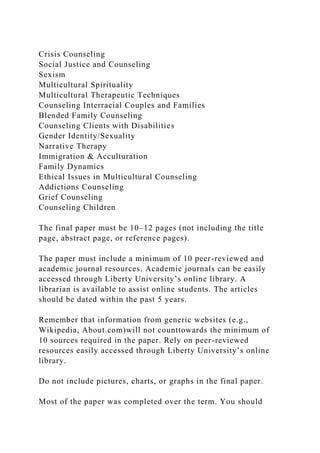
Crisis Counseling
Social Justice and Counseling
Sexism
Multicultural Spirituality
Multicultural Therapeutic Techniques
Counseling Interracial Couples and Families
Blended Family Counseling
Counseling Clients with Disabilities
Gender Identity/Sexuality
Narrative Therapy
Immigration & Acculturation
Family Dynamics
Ethical Issues in Multicultural Counseling
Addictions Counseling
Grief Counseling
Counseling Children
The final paper must be 10–12 pages (not including the title
page, abstract page, or reference pages).
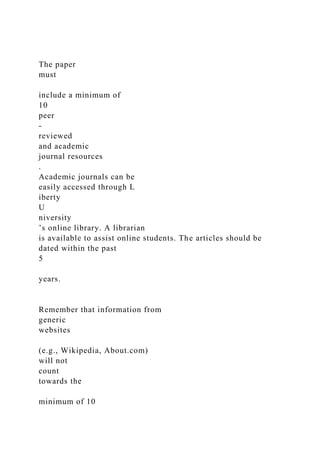
The paper must include a minimum of 10 peer-reviewed and
academic journal resources. Academic journals can be easily
accessed through Liberty University’s online library. A
librarian is available to assist online students. The articles
should be dated within the past 5 years.
Remember that information from generic websites (e.g.,
Wikipedia, About.com)will not counttowards the minimum of
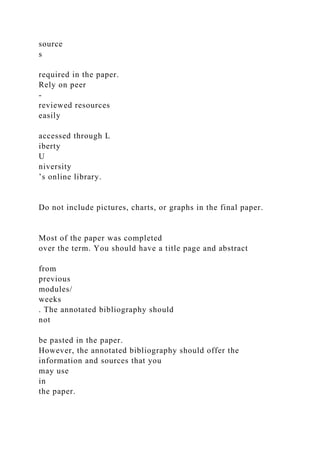
10 sources required in the paper. Rely on peer-reviewed
resources easily accessed through Liberty University’s online
library.
Do not include pictures, charts, or graphs in the final paper.
Most of the paper was completed over the term. You should
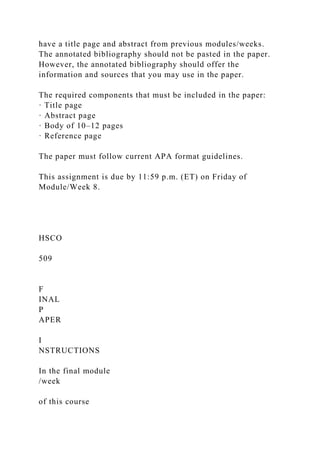
have a title page and abstract from previous modules/weeks.
The annotated bibliography should not be pasted in the paper.
However, the annotated bibliography should offer the
information and sources that you may use in the paper.
The required components that must be included in the paper:
· Title page
· Abstract page
· Body of 10–12 pages
· Reference page
The paper must follow current APA format guidelines.
This assignment is due by 11:59 p.m. (ET) on Friday of
Module/Week 8.
HSCO
509
F
INAL
P
APER
I
NSTRUCTIONS
In the final module
/week
of this course
,
a final paper is required.
The research topic was
submitted in Module/Week 2.
Discuss the
relevance of the
selected topic to an understanding of multiculturalism or
the
application of the topic
in multicultural counseling.
Crisis Counseling
Social Justice and
Counseling
Sexism
Multicultural
Spirituality
Multicultural Therapeutic
Techniques
Counseling
Interracial
Couples and Families
Blended Family
Counseling
Counseling Clients
with Disabilities
Gender Identity/Sexuality
Narrative Therapy
Immigration &
Acculturation
Family Dynamics
Ethical Issues in
Multicultural Counseling
Addictions Counseling
Gr
ief Counseling
Counseling
Children
The
final
paper must be
10
–
12
pages
(not including the title page, abstract page, or reference
page
s
).
The paper
must
include a minimum of
10
peer
-
reviewed
and academic
journal resources
.
Academic journals can be
easily accessed through L
iberty
U
niversity
’s online library. A librarian
is available to assist online students. The articles should be
dated within the past
5
years.
Remember that information from
generic
websites
(e.g., Wikipedia, About.com)
will not
count
towards the
minimum of 10
source
s
required in the paper.
Rely on peer
-
reviewed resources
easily
accessed through L
iberty
U
niversity
’s online library.
Do not include pictures, charts, or graphs in the final paper.
Most of the paper was completed
over the term. You should have a title page and abstract
from
previous
modules/
weeks
. The annotated bibliography should
not
be pasted in the paper.
However, the annotated bibliography should offer the
information and sources that you
may use
in
the paper.
The required components that must be included in the paper:
·
Title page
·
Abstract page
·
Body of 10
–
12 pages
·
Reference page
The paper must follow current APA format guidelines.
This assignment is due by 11:59 p.m. (ET) on
Friday
of
Module/Week 8.
HSCO 509
Final Paper Grading Rubric
Criteria
Points Possible
Points Earned
Instructor’s Comments
Title Page:
· Running head is present and in proper format and flush with
the left margin inside the top margin.
· Page number appears inside the top margin flush with right
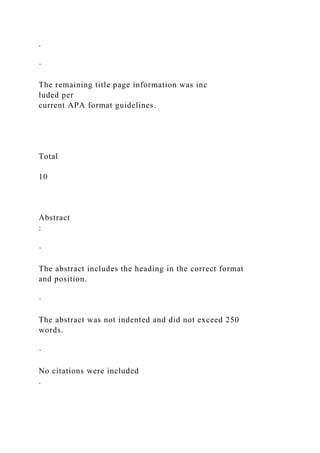
margin.
· The remaining title page information was included per current
APA format guidelines.
Total
10
Abstract:
· The abstract includes the heading in the correct format and
position.
· The abstract was not indented and did not exceed 250 words.
· No citations were included.
Total
10
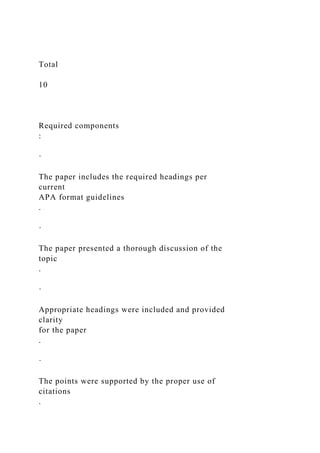
Required components:
· The paper includes the required headings per current APA
format guidelines.
· The paper presented a thorough discussion of the topic.
· Appropriate headings were included and provided clarity for
the paper.
· The points were supported by the proper use of citations.
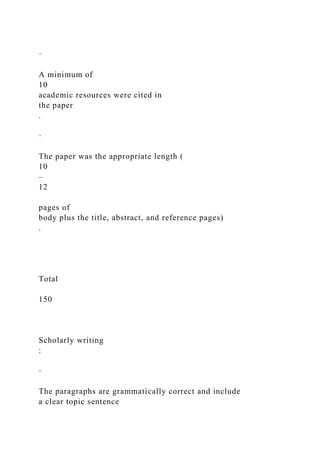
· A minimum of 10 academic resources were cited in the paper.
· The paper was the appropriate length (10–12 pages of body
plus the title, abstract, and reference pages).
Total
150
Scholarly writing:
· The paragraphs are grammatically correct and include a clear
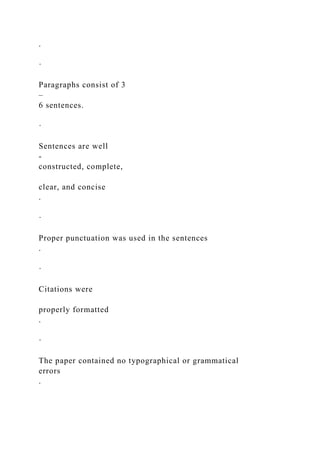
topic sentence.
· Paragraphs consist of 3–6 sentences.
· Sentences are well-constructed, complete,
clear, and concise.
· Proper punctuation was used in the sentences.
· Citations were properly formatted.
· The paper contained no typographical or grammatical errors.
Total
30
Final Paper Total Points
200
HSCO
509
F
INAL
P
APER
G
RADING
R
UBRIC
Criteria
Points
Possible
Points
Earned
Instructor’s
Comments
Title Page
:
·
Running head is present and in proper format and
flush with the left margin inside the top margin
.
·
Page number appears inside the top margin flush with
right margin
.
·
The remaining title page information was inc
luded per
current APA format guidelines.
Total
10
Abstract
:
·
The abstract includes the heading in the correct format
and position.
·
The abstract was not indented and did not exceed 250
words.
·
No citations were included
.
Total
10
Required components
:
·
The paper includes the required headings per
current
APA format guidelines
.
·
The paper presented a thorough discussion of the
topic
.
·
Appropriate headings were included and provided
clarity
for the paper
.
·
The points were supported by the proper use of
citations
.
·
A minimum of
10
academic resources were cited in
the paper
.
·
The paper was the appropriate length (
10
–
12
pages of
body plus the title, abstract, and reference pages)
.
Total
150
Scholarly writing
:
·
The paragraphs are grammatically correct and include
a clear topic sentence
.
·
Paragraphs consist of 3
–
6 sentences.
·
Sentences are well
-
constructed, complete,
clear, and concise
.
·
Proper punctuation was used in the sentences
.
·
Citations were
properly formatted
.
·
The paper contained no typographical or grammatical
errors
.
Total
30
Final Paper
Total
Points
2
00
Running head: NARRATIVE THEORY
NARRATIVE THEORY
Narrative Theory
Rose Maria Anding
Liberty University
Abstract Comment by Joel Laatsch:
Do not underline.
This study endeavours to unearth the role, place and challenges
of narrative theory in multicultural counselling. Practically,
narrative theory approach is used therapeutically in a process of
breaking down and reconstruction of meaning to the problems
experienced by use of small build up pointer questions asked by
the narrative theorists to the patient. The motivation in this
study is to formulate working pointer questions which can
easily differentiate various cultures so as to enable the
counselling of various patients according to their various
cultures. The major problem encountered in this study is the
formulation of appropriate pointer questions that would have an
indicative feature according to religious, sexual orientation
culture which cannot be easily physically seen. The approach to
be used is to go to the different cultures and find key
differentiating cultural norms that will then be used to
formulate the questions to be used in the narrative theory
approach. The resulting questions will then be incorporated into
the counselling process and will act as beacon to indicate what
approach to use in order to counsel the patients appropriately
according to their different cultures.
Subtopics to be discussed
1. Definition of narrative theory in multicultural counselling
2. The motivation of conducting the study.
3. The approach used in conducting the study.
4. Identification of cultural differences
5. Challenges facing different cultures
6. The projected results of the study and conclusion.
Running head: NARRATIVE THEORY
Narrative Theory
Rose Maria Anding
Liberty University

HSCO 509Abstract Grading RubricStudentRMACriteriaPoints.docx

  • 1.
    HSCO 509 Abstract GradingRubric Student:RMA Criteria Points Possible Points Earned Instructor’s Comments Required components: · Concise summary of the paper · Concise outline included 20 18 Need a bit of clarification – see notation. Structure and Formatting · The heading is centered on the page. · Free of grammatical and spelling errors · The abstract is 1 paragraph · Number of words: 150–250 words · Current APA format (e.g., no indentions, no citations) 5 4 Use standard outline format. Total 25 22
  • 2.
  • 3.
    Concise summary of the paper · Conciseoutline included 20 1 8 Need a bit of clarification – see notation. Structure and Formatting · The heading is centered on the page. · Free of grammatical and spelling errors · The abstract is
  • 4.
    1 paragraph · Number of words : 150 – 250words · Current APA format (e.g., no indentions, no citations) 5 4 Use standard outline format. Total 25 22
  • 5.
    1 Running head: NARRATIVETHEORY IN MULTICULTURAL COUNSELLING 2 NARRATIVE THEORY IN MULTICULTURAL COUNSELLING Narrative Theory in Multicultural Counselling Abstract This study endeavours to unearth the role, place and challenges of narrative theory in multicultural counselling. Practically,
  • 6.
    narrative theory approachis used therapeutically in a process of breaking down and reconstruction of meaning to the problems experienced by use of small build up pointer questions asked by the narrative theorists to the patient. The motivation in this study is to formulate working pointer questions which can easily differentiate various cultures so as to enable the counselling of various patients according to their various cultures. The major problem encountered in this study is the formulation of appropriate pointer questions that would have an indicative feature according to religious, sexual orientation culture which cannot be easily physically seen. The approach to be used is to go to the different cultures and find key differentiating cultural norms that will then be used to formulate the questions to be used in the narrative theory approach. The resulting questions will then be incorporated into the counselling process and will act as beacon to indicate what approach to use in order to counsel the patients appropriately according to their different cultures. Narrative Theory in Multicultural Counselling As the counselling world has begun to incorporate culture during diagnosis and therapy of clients, the field of counselling and psychology needed new approaches to counselling and also began a search for theoretical models that could provide a culturally sensitive methodology of counselling. Narrative theory is one such model that has emerged and has continued to provide counsellors with the necessary schematics. Narrative theory in itself is not yet completely fool proof since it is based on a comprehensive understanding of the importance of culture in the identity of the individual. Sue in her book counselling the
  • 7.
    culturally diverse: Theoryand practice with John Wiley & Sons tackles some of this limitations and assumptions in her book while digging further into Alan Parry and Robert Doan, in their book, Story revisions: Narrative therapy in the postmodern world. (Sue2012). The main assumptions made with narrative theory are; Ø There is no real truth, only different interpretations of reality that we create or tell ourselves and therefore, what becomes most important is meaning, which scientifically speaking is constructed in social, cultural, and religious contexts. Ø All people on narrating a story are able to create meaning. People live their lives according to the stories they tell themselves and stories others tell them. Ø a common culture is a collection of common people and stories. Their stories therefore i.e. their culture influences their lives greatly. Ø everybody has different stories or narratives and therefore there is not one knowable self but many selves in one person I.e. one is modelled by many stories into the character they are. Ø The person is never the problem. The problem is the problem – and the problem is to be found in the story, not the individual, and finally culture is complex but not chaotic. Identification of Cultural Differences and Importance of Narrative Theory in Multicultural Counselling. a. Advantages and disadvantages of narrative theory in multicultural counselling. These assumptions modified the role of the psychologist from the traditional assess and treat, to more of a curious investigator who allows room for culture to be incorporated in therapy. The assessment process changes focus from the client to the problem the client is facing. The problem is exposed by the client through externalization during narration; this is accomplished by objectifying the problem the client has. During the narration the psychologist would ask questions such as how the problem is affecting his social, religious, peers and family, thus allowing
  • 8.
    the client toexpress their issues through their own cultural ideologies, so that during therapy he may know how to incorporate the clients culture into the treatment bracket while at the same time decreases the risk of cultural misunderstanding. In the present society diversification of culture and race is happening at such a rapid pace that psychologists and other mental health professionals interact with clients who differ from them socially, culturally and ethnically. And although there is no one approach that will prepare a psychologist adequately to engage in multicultural counselling since most of the current theories of counselling and psychotherapy inadequately address and deal with multiculturalism, narrative theory approach goes a long way to tackle most of the key issues since it is left to the client to narrate his story and his truth. According to (Neukrug 2010) narrative theory approach in multicultural counselling has allowed the counsellors to become intuitive in order to understand the problem the client might be facing. It is the most likely choice in multicultural counselling because it provides room for a culturally sensitive context for creating change in a clients’ life by helping him/her to deconstruct the old problem story when recreating a new preferred story from his point of view. The psychologist listens to the clients’ narration and helps the client notice the problem areas in his life. By listening and recreating the narration with the client, there is decreased chance of the psychologist dominating the client with prejudiced cultural influence of his own; there is also decreased risk of creating cultural conflict or tension. Narrative theory is a form of theory or rather approach that uses narration as a way to analyse a clients’ problem. This form of narration process or story telling leads to empowerment of both the counsellor and client to get a clear view of the story, since during the stages of revising the story, by deconstructing and reconstructing it to the counsellor, the client undergoes externalization, this allows them both to see the problem i.e. the person is not the problem the problem is the problem. The final
  • 9.
    outcome of thisis the mapping effect. The counsellor looks at language and attitude, and cultural ideologies of the client as symptoms of personal problems and takes them into consideration. According to (Corey2012) narrative theory or approach to counselling therefore creates a means to organize the clients’ information, personal, social, cultural, family or economic related issue and aids in the counselling process. In broad prospects its main purpose is to provide an approach system to the counsellor for exploring in depth client issues by taking into account cultural expectations, social economic class, gender, and ethnicity issues. According to Ivey et al. He describes multicultural counselling as a wide range of social variables or differences that exist within a cultural contest and are used in recognizing and counselling individuals. Such social variables include but are not limited to; · Gender, · Sexual preference, · Disability, · Social class, · Age, · Religion, · Ethnicity. He goes further and argues that; multiculturalism starts with the counsellor being aware of differences among the clients and also within them. It is important to understand the culture of the client from which the client hails. Information about typical cultural practices from different ethnic groups can also be useful; also of importance are the further variations within a culture. Take for example, the broad categorization of blacks or “Africans” needs to be broken down further into cultural differences between, African Americans, Caribbean Africans, African blacks and the Papua and other minor island blacks. They may share a few things in culture and race but they differ greatly in traditions, religion and language. Narrative theory
  • 10.
    attempts to addressthis by letting the client tell his story and feelings and in the process of deconstruction and reconstruction his/her cultural ideologies are brought up to the attention of the counsellor who will then take it into consideration while counselling him/her to get a solution. He secondly argues that; multiculturalism counselling stresses the importance of family and cultural factors that actually affect the way clients and everybody sees the world. Many cultures if not all have stereotypes regarding gender, the roles that men or women can be allowed to participate in relation to work and family duties or place in community. How people interact is also greatly influenced by culture and family ties. Years of influence by such stereotypes lead to them being inculcated into everyday life. It is important to note that these stereotypes vary from culture to culture and what may pass as appropriate in one culture, may be dubbed as taboo to the other. Therefore use of narrative theory allows the client to express their ideologies in a narrative way and this allows the counsellor to gauge what is appropriate in the clients’ culture and counsels the client appropriately by incorporating the clients’ ideologies on culture during therapy. Finally Ivey goes further to argue that; multiculturalism theory stimulates practitioners and counsellors to rethink the meaning and methods of counselling and pay more attention to the clients cultural concern as in most cases it plays a role in their problems or in their therapy procedures. Understanding multiculturalism, level of education, family traditions, heritages, economic issues and histories of discrimination and mistreatment can be included during the multicultural counselling process. It is important to note that cultural identity especially race or rather skin colour cannot be taken for granted in the present counselling world. There are different types of clients, some may be ashamed or proud of their cultures; others will try to dissociate from their culture mainly due to stereotypes associated with it while others will stick to it and reject the main stream culture being forced on them by the
  • 11.
    modern society. Amore common situation especially among the young is, they will adopt some values of a new culture while still maintaining the practice of their old cultures. During counselling of a client from a multicultural population it can be difficult to tell which client is which accordingly and that is where narrative theory comes in. As the client narrates their story the counsellor can then pick cues that direct him to know which bracket his client lies. Narrative theory has provided counsellors with a model plan that has spear headed their understanding of the numerous and complex issues that face the diverse multicultural population. Narrative theory has an advantage of providing the counsellors with a culture sensitive framework from which they can then be able to give counsel that takes culture of the client into consideration during therapy. According to (Diaz-Comaz 2012) individualism had long dominated the mental health field and was reflected by the counselling process. Take for example if a client saw a psychologist with an issue whether personal or social, it was always assumed that it was only the client who faced the problem even if in some cases, which was most, it was a whole kind of culture of people who faced the problem although in different proportions, since most learning processes and ideology building are cemented in the cultural context. Therefore a culture centred approach had to be created. Since culture is a dynamic body of entities and keeps changing, it was approached inclusively of everything rather than narrowly. Here is where narrative theory played a role in trying to close the gap in understanding clients’ behaviour in a cultural and socio- political context relatively accurately without appearing racist. It provides an almost adequate methodology for incorporating culture in both its qualitative and quantitative elements. Its other advantage is that over time the counsellor increases in self-awareness due to the accumulation of relevant knowledge from the well-developed cultural awareness created by the approach of narration. It is not enough to be aware of the
  • 12.
    clients’ culture narrativetherapy also offers an outlet to appropriately apply the skills and perspectives gained from his/her culture during therapy. According to Corey.G (2012), narrative theory has the advantage of being used on individuals, couples and families by helping them view their problems in a social, political or cultural perspective (by externalization, which creates a platform of positive interactions and changes negative comments and responses into more positive and accepting, non- biased meaningful communication) by helping them see their own views and personal stories and be the judge themselves without the danger of the counsellor appearing culturally insensitive or racial. This objective viewing of problems by multicultural individuals, couples or families enables them reconnect and view the problem as it is. He further argues that this objectification of the problem reduces resistance from the clients and allows them t to face the issue in a more productive and mature manner. In order to have a successful counselling process, the counselling approach must be inclusive of the clients’ culture, (Pasupathi, Wainryb & Twali 2012). Therefore the counsellor must develop multicultural competencies in order to maintain professionalism during the counselling process. The narrative theory approach addresses this important aspect by broadening the counsellors’ awareness and understanding of the clients’ culture during the process of narration and figuring out the problem or main issue. This approach allows the counsellor to openly acknowledge cultural differences without appearing rude or undermining the clients’ culture, identity, religion or gender. It actually instead shows willingness to learn and accept the clients culture and create appropriate interventions from the part of the counsellor. In counselling without taking culture into the picture, often and do frequently evoke some defensiveness from the clients (mostly true when dealing with clients of different races, who feel they have been historically repressed by other races) this is
  • 13.
    obviously because peoplesculture are an important part of their lives and by itself is naturally a powerful part that they wouldn’t want anybody to judge or belittle it (Scholl, McGowan, & Hansen, 2012)). This is true even to those clients who may try to deny their race, religion or gender as a major part that influences their Culture. Narrative theory attempts to address this problem as it helps the counsellor not only understand the clients own belief and culture without appearing judgemental, it also helps him or her come to terms his own beliefs and culture. This awareness of culture and beliefs goes a long way in providing effective therapy to the client. Using narrative therapy may assist the counsellor to examine the client and determine if what the client is going through is an individual behaviour or an organizational behaviour, (which in this case is cultural behaviours that may be present among large populations). Normally the influence of organizational behaviour can be easily picked up with an experienced counsellor using narrative theory, it’s the exploration of personal issues concerning sexism, religion and personal believes that are most importantly facilitated with this narrative theory approach. This information picked from this approach is particularly useful during the therapy process. Most approaches fail to address collective family, community and individual relationships that exist in any form of society since they take a total individual approach (Neukrug, 2010).This is so wrong in so many levels since man is a social being and is influenced by society and surrounding at many different levels. Narrative theory on the other hand allows space for these relationships during the process of dissociation from the problem hence reducing the danger of the counsellor unknowingly or subconsciously filling in the clients account with prejudice from their own culture. At the same time narrative approach allows for the counsellor to be aware of individual differences and uniqueness of the client while still exploring at the level of social and cultural ideologies. Narrative approach allows for the counsellor to be sensitive to
  • 14.
    words, body languageand other cue’s that may be unique to a particular culture and if deemed important he or she can incorporate it during therapy. Another advantage of narrative theory in multicultural counselling is that it lets the counsellor personalize his or her observations about the client and therefore avoid making premature assumptions. The counsellor becomes aware of the observations and knowledge about the clients perspectives but keeps them to him or herself and does not generalize the clients. This allows the client to continue with their narration until they are down without any interruptions. The counsellor then works with the client to see where the problem might be. Little or no cultural prejudice is experienced by the client from the counsellor and therefore preventing the client from going into a defensive state or a very agreeable state to even where their problem does not apply. In brief, this withholding judgement by the counsellor allows the sessions to remain objective until enough information regarding the clients’ world/culture is gotten and it also allows room for the counsellor to react to new different and sometimes unpredictable situations or cultural beliefs without appearing physically perturbed. Finally narrative theory gives the counsellor to feel and express sympathy for culturally different clients (Pasupathi, Wainryb, & Twali, 2012). This is because as the client narrates their story he or she can be able to place himself in the place of the client, in order to understand their point of view. The counsellor then gets to express respect to the clients’ culture in a way that is human, accepted and appreciated by the client. This doesn’t necessarily have to be verbal as it can also be expressed via social cues. This humanly expression and appreciation towards the client is what makes a good counsellor to be even a better counsellor according to me. Effects of Narrative Theory in Multicultural Counselling and Conclusion Narrative theory, therefore, according to me is a good approach
  • 15.
    to be usedconsistently while doing culturally sensitive work as a counsellor. It provides a theoretical framework and provides room for inclusion of more and larger systems into the therapeutic process by incorporating the clients’ culture, identity and gender issues without appearing overly aggressive. It helps the client and the counsellor alike to reconnect and identify with their culture and what they want from it. Narrative theory will also often incorporate culture in the healing process of the client. (Nelson-Jones, 2010). Narrative theory provides a way in which the counsellor can address different culture uniquely and yet at a personal level without appearing judgemental at all. It promotes diversity in society such as different behaviours, family structures and religion of the client. As counsellors work in more and more diverse societies, it is being used more commonly because I believe it provides a solid structure that allows each client to tell their stories in whatever way they want and quite effectively. Exploration of cultural diversity using narrative theory allows for appreciation of the uniqueness of each client and the cultures they hail from. The counsellor being aware of different cultures allows him or her to differentiate whether a problem is an individual one or a cultural one and therefore allows some room to differentiate what therapy to use during the healing process. Finally the counsellor becomes like a researcher and keeps on learning each and every day from his clients and therefore becomes better at what he or she does. References Comas-Diaz, L. (2012). Humanism and multiculturalism: An evolutionary alliance. Psychotherapy, 49(4), 437. Corey, G. (2012). Case approach to counselling and psychotherapy. Cengage Learning Corey, G. (2012). The art of integrative counseling. Cengage Learning
  • 16.
    Ivey, A. E.,D'Andrea, M. J., & Ivey, M. B. (2011). Theories of Counseling and Psychotherapy: A Multicultural Perspective: A Multicultural Perspective. Sage. Ivey, A., Ivey, M., & Zalaquett, C. (2013). Intentional interviewing and counseling: Facilitating client development in a multicultural society. Cengage Learning. Nelson-Jones, R. (2010). Theory and practice of counselling and therapy. Sage. Neukrug, E. (2010). Counseling theory and practice. Cengage Learning Pasupathi, M., Wainryb, C., & Twali, M. (2012). Relations between narrative construction of ethnicity-based discrimination and ethnic identity exploration and pride. Identity, 12(1), 53-73. Scholl, M. B., McGowan, A. S., & Hansen, J. T. (2012). Introduction to humanistic perspectives on contemporary counseling issues. Humanistic perspectives on contemporary counseling issues, 3-14. Sue, D. W., & Sue, D. (2012). Counseling the culturally diverse: Theory and practice. John Wiley & Sons 1 Running head: NARRATIVE THEORY IN MULTICULTURAL
  • 17.
    COUNSELLING Narrative Theory inMulticultural C ounselling HSCO 509 Final Paper Instructions In the final module/week of this course, a final paper is required. The research topic was submitted in Module/Week 2. Discuss the relevance of the selected topic to an understanding of multiculturalism or the application of the topic in multicultural counseling.
  • 18.
    Crisis Counseling Social Justiceand Counseling Sexism Multicultural Spirituality Multicultural Therapeutic Techniques Counseling Interracial Couples and Families Blended Family Counseling Counseling Clients with Disabilities Gender Identity/Sexuality Narrative Therapy Immigration & Acculturation Family Dynamics Ethical Issues in Multicultural Counseling Addictions Counseling Grief Counseling Counseling Children The final paper must be 10–12 pages (not including the title page, abstract page, or reference pages). The paper must include a minimum of 10 peer-reviewed and academic journal resources. Academic journals can be easily accessed through Liberty University’s online library. A librarian is available to assist online students. The articles should be dated within the past 5 years. Remember that information from generic websites (e.g., Wikipedia, About.com)will not counttowards the minimum of 10 sources required in the paper. Rely on peer-reviewed resources easily accessed through Liberty University’s online library. Do not include pictures, charts, or graphs in the final paper. Most of the paper was completed over the term. You should
  • 19.
    have a titlepage and abstract from previous modules/weeks. The annotated bibliography should not be pasted in the paper. However, the annotated bibliography should offer the information and sources that you may use in the paper. The required components that must be included in the paper: · Title page · Abstract page · Body of 10–12 pages · Reference page The paper must follow current APA format guidelines. This assignment is due by 11:59 p.m. (ET) on Friday of Module/Week 8. HSCO 509 F INAL P APER I NSTRUCTIONS In the final module /week of this course
  • 20.
    , a final paperis required. The research topic was submitted in Module/Week 2. Discuss the relevance of the selected topic to an understanding of multiculturalism or the application of the topic in multicultural counseling. Crisis Counseling Social Justice and Counseling Sexism Multicultural Spirituality Multicultural Therapeutic Techniques Counseling Interracial Couples and Families Blended Family Counseling Counseling Clients
  • 21.
    with Disabilities Gender Identity/Sexuality NarrativeTherapy Immigration & Acculturation Family Dynamics Ethical Issues in Multicultural Counseling Addictions Counseling Gr ief Counseling Counseling Children The final paper must be 10 – 12 pages (not including the title page, abstract page, or reference page s ).
  • 22.
    The paper must include aminimum of 10 peer - reviewed and academic journal resources . Academic journals can be easily accessed through L iberty U niversity ’s online library. A librarian is available to assist online students. The articles should be dated within the past 5 years. Remember that information from generic websites (e.g., Wikipedia, About.com) will not count towards the minimum of 10
  • 23.
    source s required in thepaper. Rely on peer - reviewed resources easily accessed through L iberty U niversity ’s online library. Do not include pictures, charts, or graphs in the final paper. Most of the paper was completed over the term. You should have a title page and abstract from previous modules/ weeks . The annotated bibliography should not be pasted in the paper. However, the annotated bibliography should offer the information and sources that you may use in the paper.
  • 24.
    The required componentsthat must be included in the paper: · Title page · Abstract page · Body of 10 – 12 pages · Reference page The paper must follow current APA format guidelines. This assignment is due by 11:59 p.m. (ET) on Friday of Module/Week 8. HSCO 509 Final Paper Grading Rubric Criteria
  • 25.
    Points Possible Points Earned Instructor’sComments Title Page: · Running head is present and in proper format and flush with the left margin inside the top margin. · Page number appears inside the top margin flush with right margin. · The remaining title page information was included per current APA format guidelines. Total 10 Abstract: · The abstract includes the heading in the correct format and position. · The abstract was not indented and did not exceed 250 words. · No citations were included. Total 10 Required components: · The paper includes the required headings per current APA format guidelines. · The paper presented a thorough discussion of the topic. · Appropriate headings were included and provided clarity for the paper. · The points were supported by the proper use of citations.
  • 26.
    · A minimumof 10 academic resources were cited in the paper. · The paper was the appropriate length (10–12 pages of body plus the title, abstract, and reference pages). Total 150 Scholarly writing: · The paragraphs are grammatically correct and include a clear topic sentence. · Paragraphs consist of 3–6 sentences. · Sentences are well-constructed, complete, clear, and concise. · Proper punctuation was used in the sentences. · Citations were properly formatted. · The paper contained no typographical or grammatical errors. Total 30 Final Paper Total Points 200 HSCO
  • 27.
    509 F INAL P APER G RADING R UBRIC Criteria Points Possible Points Earned Instructor’s Comments Title Page : · Running headis present and in proper format and flush with the left margin inside the top margin . · Page number appears inside the top margin flush with right margin
  • 28.
    . · The remaining titlepage information was inc luded per current APA format guidelines. Total 10 Abstract : · The abstract includes the heading in the correct format and position. · The abstract was not indented and did not exceed 250 words. · No citations were included .
  • 29.
    Total 10 Required components : · The paperincludes the required headings per current APA format guidelines . · The paper presented a thorough discussion of the topic . · Appropriate headings were included and provided clarity for the paper . · The points were supported by the proper use of citations .
  • 30.
    · A minimum of 10 academicresources were cited in the paper . · The paper was the appropriate length ( 10 – 12 pages of body plus the title, abstract, and reference pages) . Total 150 Scholarly writing : · The paragraphs are grammatically correct and include a clear topic sentence
  • 31.
    . · Paragraphs consist of3 – 6 sentences. · Sentences are well - constructed, complete, clear, and concise . · Proper punctuation was used in the sentences . · Citations were properly formatted . · The paper contained no typographical or grammatical errors .
  • 32.
    Total 30 Final Paper Total Points 2 00 Running head:NARRATIVE THEORY NARRATIVE THEORY Narrative Theory Rose Maria Anding Liberty University Abstract Comment by Joel Laatsch: Do not underline. This study endeavours to unearth the role, place and challenges of narrative theory in multicultural counselling. Practically, narrative theory approach is used therapeutically in a process of breaking down and reconstruction of meaning to the problems experienced by use of small build up pointer questions asked by
  • 33.
    the narrative theoriststo the patient. The motivation in this study is to formulate working pointer questions which can easily differentiate various cultures so as to enable the counselling of various patients according to their various cultures. The major problem encountered in this study is the formulation of appropriate pointer questions that would have an indicative feature according to religious, sexual orientation culture which cannot be easily physically seen. The approach to be used is to go to the different cultures and find key differentiating cultural norms that will then be used to formulate the questions to be used in the narrative theory approach. The resulting questions will then be incorporated into the counselling process and will act as beacon to indicate what approach to use in order to counsel the patients appropriately according to their different cultures. Subtopics to be discussed 1. Definition of narrative theory in multicultural counselling 2. The motivation of conducting the study. 3. The approach used in conducting the study. 4. Identification of cultural differences 5. Challenges facing different cultures 6. The projected results of the study and conclusion. Running head: NARRATIVE THEORY Narrative Theory
  • 34.