Anna Mylan
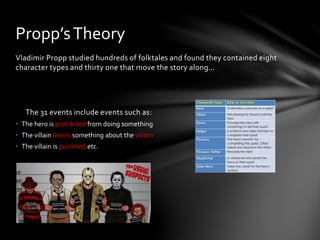
Vladimir Propp studied hundreds of folktales and found they contained eight
character types and thirty one that move the story along…
The 31 events include events such as:
• The hero is prohibited from doing something
• The villain learns something about the victim
• The villain is punished etc.
Propp’sTheory
Propp’s theory fits in with our genre idea for the opening sequence in that it:
• Contains a few of the character types and
• Follows some of the events
Our characters consist of the Villain (Murderer), Hero (person who gets killed
last), Princess (Victim of the murderer), False Hero (friend of Hero),
Dispatcher (Police), Helper (Friends)
Through the theme of Propp’s events:
• Hero prohibited – Person stopped fromVigilantism
• Villain Learns - Finds out something about the princess which makes them angry and
murderous
• Villain Punished – Eventually gets found out (Not in the sequence)
Our idea fits in with a typicalTeen horror movie and Propp’s Narrative theory
through the types of character used and the events that happen throughout.
Propp’sTheory
Levi-Strauss suggested that binary oppositions are key to the meaning making
in narrative – he argued the constant creation of conflict and opposition propels
narrative, and that narrative can only end on a resolution of conflict
Examples of binary oppositions:
• Good/Evil
• Men/Women
• Truth/Lies
• Normal/Abnormal
• Strong/Weak
• Natural/Artificial
• Young/Old
• Light/Dark
It is important to note that we judge one half of each binary opposition in a
more negative way; therefore the meanings of the binaries are ideological as
they are culturally constructed
Levi- Strauss
Levi-Strauss’s theory fits in with our genre idea for the opening sequence in that
it:
• Judges one half of a binary composition in a negative way and
• Contains more than one binary composition
One of the main binary compositions in our opening sequence is Good/Evil.This
fits in with our characters of the Hero (person who gets killed last), and the
Villain (Murderer). A majority of viewers will be biased positively towards the
Hero and negatively towards the Villain which fits with Levi-Strauss’s theory
A few more binary compositions that work with our genre are:
• Truth/Lies
• Strong/Weak
• Normal/Abnormal
• Light/Dark
• It is important to note that we judge one half of each binary opposition in a more negative
way; therefore the meanings of the binaries are ideological as they are culturally
constructed
Levi- Strauss
Propp’s
Although this theory does not apply to every Teen Horror movie, it does
apply to the film ‘Scream’ as it contains at least 5 of the 8 characters in
Propp’s theory (Sydney being the Hero, Ghost face being the Villain, Gale
being the Donor, Dewey being the Helper and many characters acting as a
False Hero)
Levi-Strauss
This theory applies to almost all movies within the Genre of Teen Horror they
all contain at least 5 of the 8 binary compositions that consist of – Good/Evil,
Men/Women, Truth/Lies, Strong/Weak and Light/Dark
Some movies (such as Texas Chainsaw) also include the other binary
compositions that are - Normal/Abnormal, Natural/Artificial and
Young/Old
This applies to…
• Barthes’ enigma code was a theory putting forward the notion that media
(whether it be film, television or texts) are to entice people and draw them in
through a sense of mystery.The main aim of this is to get the audience
asking questions. If, at the start of a film, for example, there is lots of out of
focus images with a shallow depth of field. A murder mystery for example
will usually have the murder happen at the start but the murderer will not be
revealed until the end of the film. This allows us to ask the question ‘who is
the murderer?’ We can also come up with our own theories on who it is, this
makes the film experience more exciting, engaging and audience orientated.
• The different codes are:
-The Hermeneutic Code (HER)
-The Proairetic Code (ACT)
-The Semantic Code (SEM)
-The Symbolic Code (SYM)
-The Cultural Code (REF)
Roland Barthes
This fits in withTeen Horror as it
most definitely includes the
mystery of who the Killer is which
will have the audience asking
questions

Narrative Theory

  • 1.
  • 2.
    Vladimir Propp studiedhundreds of folktales and found they contained eight character types and thirty one that move the story along… The 31 events include events such as: • The hero is prohibited from doing something • The villain learns something about the victim • The villain is punished etc. Propp’sTheory
  • 3.
    Propp’s theory fitsin with our genre idea for the opening sequence in that it: • Contains a few of the character types and • Follows some of the events Our characters consist of the Villain (Murderer), Hero (person who gets killed last), Princess (Victim of the murderer), False Hero (friend of Hero), Dispatcher (Police), Helper (Friends) Through the theme of Propp’s events: • Hero prohibited – Person stopped fromVigilantism • Villain Learns - Finds out something about the princess which makes them angry and murderous • Villain Punished – Eventually gets found out (Not in the sequence) Our idea fits in with a typicalTeen horror movie and Propp’s Narrative theory through the types of character used and the events that happen throughout. Propp’sTheory
  • 4.
    Levi-Strauss suggested thatbinary oppositions are key to the meaning making in narrative – he argued the constant creation of conflict and opposition propels narrative, and that narrative can only end on a resolution of conflict Examples of binary oppositions: • Good/Evil • Men/Women • Truth/Lies • Normal/Abnormal • Strong/Weak • Natural/Artificial • Young/Old • Light/Dark It is important to note that we judge one half of each binary opposition in a more negative way; therefore the meanings of the binaries are ideological as they are culturally constructed Levi- Strauss
  • 5.
    Levi-Strauss’s theory fitsin with our genre idea for the opening sequence in that it: • Judges one half of a binary composition in a negative way and • Contains more than one binary composition One of the main binary compositions in our opening sequence is Good/Evil.This fits in with our characters of the Hero (person who gets killed last), and the Villain (Murderer). A majority of viewers will be biased positively towards the Hero and negatively towards the Villain which fits with Levi-Strauss’s theory A few more binary compositions that work with our genre are: • Truth/Lies • Strong/Weak • Normal/Abnormal • Light/Dark • It is important to note that we judge one half of each binary opposition in a more negative way; therefore the meanings of the binaries are ideological as they are culturally constructed Levi- Strauss
  • 6.
    Propp’s Although this theorydoes not apply to every Teen Horror movie, it does apply to the film ‘Scream’ as it contains at least 5 of the 8 characters in Propp’s theory (Sydney being the Hero, Ghost face being the Villain, Gale being the Donor, Dewey being the Helper and many characters acting as a False Hero) Levi-Strauss This theory applies to almost all movies within the Genre of Teen Horror they all contain at least 5 of the 8 binary compositions that consist of – Good/Evil, Men/Women, Truth/Lies, Strong/Weak and Light/Dark Some movies (such as Texas Chainsaw) also include the other binary compositions that are - Normal/Abnormal, Natural/Artificial and Young/Old This applies to…
  • 7.
    • Barthes’ enigmacode was a theory putting forward the notion that media (whether it be film, television or texts) are to entice people and draw them in through a sense of mystery.The main aim of this is to get the audience asking questions. If, at the start of a film, for example, there is lots of out of focus images with a shallow depth of field. A murder mystery for example will usually have the murder happen at the start but the murderer will not be revealed until the end of the film. This allows us to ask the question ‘who is the murderer?’ We can also come up with our own theories on who it is, this makes the film experience more exciting, engaging and audience orientated. • The different codes are: -The Hermeneutic Code (HER) -The Proairetic Code (ACT) -The Semantic Code (SEM) -The Symbolic Code (SYM) -The Cultural Code (REF) Roland Barthes This fits in withTeen Horror as it most definitely includes the mystery of who the Killer is which will have the audience asking questions