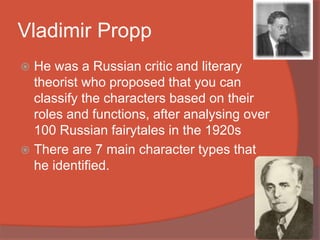
Vladimir Propp
 He was a Russian critic and literary
theorist who proposed that you can
classify the characters based on their
roles and functions, after analysing over
100 Russian fairytales in the 1920s
 There are 7 main character types that
he identified.
Propp’s Character Roles
 The hero – seeks something
 The villain – opposes the hero
 The donor – helps the hero by giving them a
magic object
 The dispatcher – sends the hero on his way
 The false hero – falsely assuming the role of
the hero. Perceived as a good character
before emerging as evil
 The helper – gives support to the hero
 The princess – the hero’s reward, but needs
protection from the villain
Examples within Horror
 Often, within horror, Propp’s theory is
subverted. This is because Propp’s theory
states that there is a reward for the hero at
the end of the film (usually the princess).
However, the main purpose of a horror film
for the characters (victims) is to just survive
the events in the film. It is less about good
vs evil, and more about survival aginst the
villan. An example of this would be a film
like Scream
 However, there is always a villain who
opposes the hero, and has to be defeated.
Tzvetan Torodov
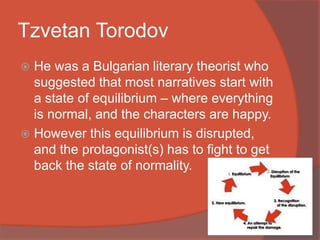
 He was a Bulgarian literary theorist who
suggested that most narratives start with
a state of equilibrium – where everything
is normal, and the characters are happy.
 However this equilibrium is disrupted,
and the protagonist(s) has to fight to get
back the state of normality.
The theory applied to The
Shining
 The film begins with an equilibrium – a
family arrives at a hotel
 Then it is disturbed – Jacks deterioration
into a crazed murder
 The equilibrium is resolved at the end,
with Jack freezing to death in the maze
Claude Levi-Strauss
 He was a French anthropologist,
who believed that binary opposites are
important when it comes to
understanding narrative.
 The creation of conflict between two
binary opposites pushes a narrative to a
resolving conclusion
Examples of binary
opposites
 Good and evil
 Male and female
 Strong and weak
 Young and old
 Dark and Light
Binary opposites in Horror
 They are often used in Horror films, for example,
in Silence of The Lambs:
 There hwero clearly has a hero (Clarice) vs a
villain (Buffalo Bill). However, there is a third main
character (Hiannibal Lecter) He doesn’t quite
apply tho the roles because, despite helping find
the villain, he is also a criminal himself, as he is a
convicted cannibal and killer. Therefore, do
doesn’t apply to the structure of binary opposites,
because he commits the same crime as the
person he is helping the hero catch.
- The hero depends on one killers knowledge to cat
another.
Roland Barthes
 He was a French semiologsit who
suggested that a narrative works with 5
codes woven into it, that allows the
reader to make sense of it.
The five codes
 Hermeneutic Code – an element of the story not
fully explained – an enigma
 Proairetic Code – Refers to an event indicating
something else is going to happen. – Builds
tension – Action codes
 Semantic Code – A connotation within the
narrative that gives additional meaning
 Symbolic Code – similar to the semantic code, but
at a wider level
 Cultural Code – Anything within the narrative that
cannot be challenged or recognised as the truth
Work
together
to keep
the
audience
interested
The codes in horror films:
Hermeneutic Code in the opening of
Se7en:
 Tight close ups of the mans fingers –
who is he and what is he doing
 Fast cuts mean that the audience only
gets a very short time to see something,
enigmas are formed about what they
see.
Another Example:

Narrative theory

  • 2.
    Vladimir Propp  Hewas a Russian critic and literary theorist who proposed that you can classify the characters based on their roles and functions, after analysing over 100 Russian fairytales in the 1920s  There are 7 main character types that he identified.
  • 3.
    Propp’s Character Roles The hero – seeks something  The villain – opposes the hero  The donor – helps the hero by giving them a magic object  The dispatcher – sends the hero on his way  The false hero – falsely assuming the role of the hero. Perceived as a good character before emerging as evil  The helper – gives support to the hero  The princess – the hero’s reward, but needs protection from the villain
  • 4.
    Examples within Horror Often, within horror, Propp’s theory is subverted. This is because Propp’s theory states that there is a reward for the hero at the end of the film (usually the princess). However, the main purpose of a horror film for the characters (victims) is to just survive the events in the film. It is less about good vs evil, and more about survival aginst the villan. An example of this would be a film like Scream  However, there is always a villain who opposes the hero, and has to be defeated.
  • 5.
    Tzvetan Torodov  Hewas a Bulgarian literary theorist who suggested that most narratives start with a state of equilibrium – where everything is normal, and the characters are happy.  However this equilibrium is disrupted, and the protagonist(s) has to fight to get back the state of normality.
  • 6.
    The theory appliedto The Shining  The film begins with an equilibrium – a family arrives at a hotel  Then it is disturbed – Jacks deterioration into a crazed murder  The equilibrium is resolved at the end, with Jack freezing to death in the maze
  • 7.
    Claude Levi-Strauss  Hewas a French anthropologist, who believed that binary opposites are important when it comes to understanding narrative.  The creation of conflict between two binary opposites pushes a narrative to a resolving conclusion
  • 8.
    Examples of binary opposites Good and evil  Male and female  Strong and weak  Young and old  Dark and Light
  • 9.
    Binary opposites inHorror  They are often used in Horror films, for example, in Silence of The Lambs:  There hwero clearly has a hero (Clarice) vs a villain (Buffalo Bill). However, there is a third main character (Hiannibal Lecter) He doesn’t quite apply tho the roles because, despite helping find the villain, he is also a criminal himself, as he is a convicted cannibal and killer. Therefore, do doesn’t apply to the structure of binary opposites, because he commits the same crime as the person he is helping the hero catch. - The hero depends on one killers knowledge to cat another.
  • 10.
    Roland Barthes  Hewas a French semiologsit who suggested that a narrative works with 5 codes woven into it, that allows the reader to make sense of it.
  • 11.
    The five codes Hermeneutic Code – an element of the story not fully explained – an enigma  Proairetic Code – Refers to an event indicating something else is going to happen. – Builds tension – Action codes  Semantic Code – A connotation within the narrative that gives additional meaning  Symbolic Code – similar to the semantic code, but at a wider level  Cultural Code – Anything within the narrative that cannot be challenged or recognised as the truth Work together to keep the audience interested
  • 12.
    The codes inhorror films: Hermeneutic Code in the opening of Se7en:  Tight close ups of the mans fingers – who is he and what is he doing  Fast cuts mean that the audience only gets a very short time to see something, enigmas are formed about what they see.
  • 13.