Carol P. Savare
DIT – 1A
Narrative
Derived from the Latin word “gnarus”
and the Indo-European root “ gnu”
meaning “to know”
Some kind of retelling, often in words of
something that happened.
“Oral narrative”“Written narrative”
is about two things:
The Story (content of the
story)
The Plot (form used to
tell the story)
Answer the questions: “who”, “what”,
“where”
Answer the questions: “how” & “when”
The story elements shape not only
your writing but your reporting.
“who” can be name & some basic
details
“when” a time and date
“where” a place
“Setting” demands description &
relationship in time & place to other
events & places.
“Plot” not a set of events, but a series
of events, each flowing from the one
before and leading to the next
“Conflict” demands resolution, or
explanation of the inability to resolve
Story elements may help
you write your lead.
Which is the most important
element for this story?
What is the climax?
If a quote just gives the reader
information, perhaps you
should do that in your own
words.
Quotes as dialogue
Help the reader picture the
characters, setting and
action of your story. Use
your senses to complete the
experience for the reader
In shorter narratives,
you have to identify
the most important
elements, the most
compelling
characters, the key
moments, and the
most telling details.
A type of strategy for
cognitive literacy for
elementary school students.
It aims to improve students’
comprehension in reading by
giving them framework they
can use when reading stories.
The three basic elements
were: setting, plot & theme.
Templates that provide students a concrete
framework for identifying the elements of the
narrative stories.
•Setting – when & where the story occurs
•Characters – the most important players in the story
•Problems/Conflict – the focal point around which
the story is centered
•Events – the attempts by the main character(s) to
resolve the problem or conflict
•Resolution/Solution/Conclusion – the outcome of
the attempts to resolve the problems or conflict
•Theme – main idea or moral of the story
The story of 3 little pigs
(play)
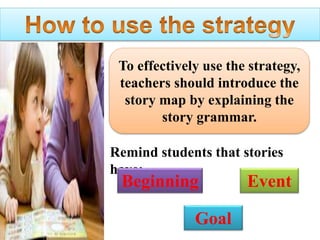
To effectively use the strategy,
teachers should introduce the
story map by explaining the
story grammar.
Remind students that stories
have:
Beginning Event
Goal
•Setting – where did the story occur?
•Characters– who is the main character?
•Problem/Conflict – What major problem
does the main character face? What was
the character hope to achieve?
•Events – What did the main character
do?
•Resolution/Conclusion – Does the
character solve the problem? How does
the character solve the problem? How did
“Why are story maps an excellent tool to
summarize a story?”
“How can story maps be used in developing
original stories?”
“How did this strategy help you as a
reader?”
Students can use story maps as pre-reading strategy
Students can use their story maps as notes for oral
book reports
Students can use their story maps
in preparing media presentations
Students can use story maps as
prewriting tool in developing their
own stories
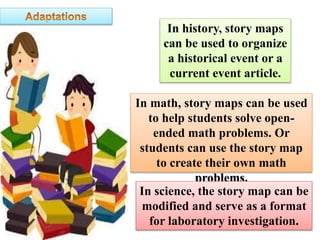
In history, story maps
can be used to organize
a historical event or a
current event article.
In math, story maps can be used
to help students solve open-
ended math problems. Or
students can use the story map
to create their own math
problems.
In science, the story map can be
modified and serve as a format
for laboratory investigation.
Narrative Structure

Narrative Structure

  • 1.
  • 2.
    Narrative Derived from theLatin word “gnarus” and the Indo-European root “ gnu” meaning “to know” Some kind of retelling, often in words of something that happened. “Oral narrative”“Written narrative”
  • 3.
    is about twothings: The Story (content of the story) The Plot (form used to tell the story) Answer the questions: “who”, “what”, “where” Answer the questions: “how” & “when”
  • 4.
    The story elementsshape not only your writing but your reporting. “who” can be name & some basic details “when” a time and date “where” a place
  • 5.
    “Setting” demands description& relationship in time & place to other events & places. “Plot” not a set of events, but a series of events, each flowing from the one before and leading to the next “Conflict” demands resolution, or explanation of the inability to resolve
  • 6.
    Story elements mayhelp you write your lead. Which is the most important element for this story? What is the climax?
  • 7.
    If a quotejust gives the reader information, perhaps you should do that in your own words. Quotes as dialogue
  • 8.
    Help the readerpicture the characters, setting and action of your story. Use your senses to complete the experience for the reader
  • 9.
    In shorter narratives, youhave to identify the most important elements, the most compelling characters, the key moments, and the most telling details.
  • 10.
    A type ofstrategy for cognitive literacy for elementary school students. It aims to improve students’ comprehension in reading by giving them framework they can use when reading stories. The three basic elements were: setting, plot & theme.
  • 11.
    Templates that providestudents a concrete framework for identifying the elements of the narrative stories. •Setting – when & where the story occurs •Characters – the most important players in the story
  • 12.
    •Problems/Conflict – thefocal point around which the story is centered •Events – the attempts by the main character(s) to resolve the problem or conflict •Resolution/Solution/Conclusion – the outcome of the attempts to resolve the problems or conflict •Theme – main idea or moral of the story The story of 3 little pigs (play)
  • 13.
    To effectively usethe strategy, teachers should introduce the story map by explaining the story grammar. Remind students that stories have: Beginning Event Goal
  • 14.
    •Setting – wheredid the story occur? •Characters– who is the main character? •Problem/Conflict – What major problem does the main character face? What was the character hope to achieve? •Events – What did the main character do? •Resolution/Conclusion – Does the character solve the problem? How does the character solve the problem? How did
  • 15.
    “Why are storymaps an excellent tool to summarize a story?” “How can story maps be used in developing original stories?” “How did this strategy help you as a reader?”
  • 16.
    Students can usestory maps as pre-reading strategy Students can use their story maps as notes for oral book reports Students can use their story maps in preparing media presentations Students can use story maps as prewriting tool in developing their own stories
  • 17.
    In history, storymaps can be used to organize a historical event or a current event article. In math, story maps can be used to help students solve open- ended math problems. Or students can use the story map to create their own math problems. In science, the story map can be modified and serve as a format for laboratory investigation.