Narrative & Screenplays Media Studies @ StG 1
NARRATIVE & SCREENPLAYS
The foundations ofscreenplay construction were laid in the early days ofHollywood (albeitappropriated from
well-established principles ofmythology and narrative) and have since remained largely intact. A screenplay
tells a visual story in which plotevents follow a rigid internal logic ofcause and effectso that the audience
knows what is happening to whom and why. …[T]he plotnormally pivots around the
protagonist, a dynamic central character with clear needs, desires and problems who
encounters an antagonistic force while in pursuit ofhis goals. His attempts to overcome
this opposition as he undergoes a life-changing series ofevents drive the narrative,
building to a climax where he emerges victorious butalso mindful ofhow close he came
to defeatand of what he learned along the way. Modern variations are surprise,
downbeatand/or ambiguous endings, where the protagonisteither snatches defeatfrom
the jaws ofsuccess, fails miserably or loses so much in reaching his goal that it brings
the wisdom ofthe whole enterprise into question. …[W]hen done well they are amongst
the mostmemorable examples ofcinema: Chinatown, Apocalypse Now, Seven, Get
Carter, The Long Good Friday….1
Costello, John (2004) Writing a Screenplay. Pocket Essentials Film. Harpenden: Pocket
Essentials, p. 51.
By the way, I’ve just given a lengthy quote from a book; in your academic life, you generally won’t
quote such a long fragment – if its more than two sentences you’ll usually put it into your own
words. If it’s a single line, you’d incorporate it into a sentence, two lines or more and typically you’d
use a colon and indent it, using a font such as Arial Narrow, below your paragraph. But you will try to
break up large chunks of text with headings and sub-headings as I do below…
TODOROV’S 5-PART NARRATIVE FORMULA
Every narrative can be broken down into three basic stages: situation, conflict, resolution (or equilibrium,
dis-equilibrium, new equilibrium). Crucially, your protagonist is not the same as at the outset, but has
been changed in some way from events. Your old friend Tzvetan Todorov posited five stages:
1. a state of equilibrium at the outset;
2. a disruption of the equilibrium by some action;
3. a recognition that there has been a disruption;
4. an attempt to repair the disruption;
5. a reinstatement of the equilibrium 2
Does YOUR narrative reflect this?
1 To this list you could add Easy Rider and Boys Don’t Cry amongst others.
2 Taken from http://www.watershed.co.uk/east/content/narrative.html You can find a much more detailed breakdown
of a typical narrative at http://en.wikipedia.org/wiki/Propp#Narrative_Structure, a summary of Propp’s theory.
Narrative & Screenplays Media Studies @ StG 2
EXPOSITION & THE OPENING SCENE
This is critical: get the opening scene right and you’ve grabbed your
audience, whose eyeballs are twitching to go elsewhere in our media-
saturated world…
The essential elements ofa strong opening are: introduce atleast one
major character (usually the Protagonistand/or Antagonist); setthe tone (mood/atmosphere); setthe pace;
and introduce the world of the story [diegesis]via a powerful incidentor situation which sets in motion the
events ofthe plot.3
Exposition is important, but clunky, stilted dialogue isn’t going to keep those eyeballs gripped:
Exposition is a technique by which background information aboutthe characters, events, or setting is
conveyed … . This information can be presented through dialogue, description, flashbacks, or even directly
through narrative.
As exposition generally does notadvance plotand may impede present-time action, it is usually bestkeptin
short and succinctform, though in some genres,such as the mystery, exposition is central to the story
structure itself. The alternative to exposition is to convey background information indirectly though action,
which, though more dramatic, is more time consuming and less concise.4
THURLOW ON ‘THE ACTIVE QUESTION’
‘Each story will have running through it what is called the Active Question:
Will they get married? Will she stop using drugs and run in the Olympics?
Will he get revenge? Will they escape – the robbers with the bank haul,
Thelma and Louise from the tyranny of men? If the characters we create
have a tale worth telling, they will want something: to get the girl, exact
revenge, achieve justice, steal the goose that laid the golden egg…. A story
becomes interesting when the writer sets up obstacles that prevent the hero
getting what they want (Thelma and Louise first lose their money, essential
for their fight). The story hooks us as they overcome those obstacles and/or
villains and thereby grow and change in the process.
In order to grip the audience, the characters must be seen to go through a
range of emotions: fear, self-doubt, sorrow, elation. The screenwriter
achieves this through conflict (you will never marry that man; …you’ll never
be good enough to run in the Olympics). As the conflict unwinds, the
audience will be seeing themselves in the hero or heroine and will be sharing those emotions. Conflict is
to drama what sound is to music. It is the heart of drama, the soul of drama, the secret of suspense, the key
to emotional engagement, that thing that keeps filmgoers on the edge of their seats. If you laugh out loud
while reading a book or feel a tear jerk into your eye while you are watching a movie, the writer has done
his job.’
Thurlow, Clifford (2008) Making Short Films: The Complete Guide From Script to Screen. 2nd edition. Oxford
& New York: Berg, p.34.
3 Costello, 2002, p. 53.
4 Taken from http://en.wikipedia.org/wiki/Exposition_(literary_technique)
Places to go, people to see…
Narrative & Screenplays Media Studies @ StG 3
PROPP’S CHARACTER ARCHETYPES
As well as proposing that narratives can be broken down into 31 basic functions, Vladimir Propp (in his
study of fairytales which continues to influence literary and media studies today) argued that there are
essentially just eight basic character types, or archetypes:
1. The villain — struggles against the hero.
2. The donor — prepares the hero or gives the hero some magical object.
3. The (magical) helper — helps the hero in the quest.
4. The princess or prize — the hero deserves her throughout the story but is unable to marry her
because of an unfair evil, usually because of the villain. The hero's journey is often ended when
he marries the princess, thereby beating the villain.
5. The princess and her father — gives the task to the hero, identifies the false hero, marries the
hero, often sought for during the narrative. Propp noted that functionally, the princess and the
father can not be clearly distinguished.
6. The dispatcher — character who makes the lack known and sends the hero off.
7. The hero or victim/seeker hero — reacts to the donor, weds the princess.
8. False hero/anti-hero/usurper — takes credit for the hero’s actions or tries to marry the princess.
These roles could sometimes be distributed among various characters, as the hero kills the villain
dragon, and the dragon's sisters take on the villainous role of chasing him. Conversely, one
character could engage in acts as more than one role, as a father could send his son on the
quest and give him a sword, acting as both dispatcher and donor.5
Think about how this can be applied to Star Wars as a straightforward example, but also your film.
FURTHERRESOURCES:
Perhaps the most useful online resource is http://www.screenwriting.info/ This is targeted at
actual, would-be, US, scriptwriters, and has links to sections on each ofthe specific
components ofa screenplay. Like a greatmany other sites, it rather unsubtly extols the virtues
of screenwriting software which automatically formats your work. You could arguably use one if
you can find a shareware version.
At http://www.dailyscript.com/index.html you’ll find a daily free script(such as
http://www.dailyscript.com/scripts/ford-fairlane_early.html)
The BBC has a briefguide, featuring guidance from two veteran scriptwriters:
http://www.bbc.co.uk/worldservice/arts/features/howtowrite/screenplay.shtml
You can pick from an extensive listofHollywood feature-length movie scripts at
http://www.script-o-rama.com/table.shtml
The Leeds-based ‘Re-thinking the Screenplay Network’, at
http://ics.leeds.ac.uk/papers/vp01.cfm?outfit=llp&folder=56&paper=57, poses some fundamental questions aboutthe role
of the screenplay
Film Education provide a useful downloadable guide at
http://www.filmeducation.org/secondary/StudyGuides/screenplay.pdf
Part ofthe PocketEssentials range (small-form books originally sold at£3.99, now £4.99), Writing a Screenplay (John
Costello 2004, 2006) is a very accessible guide.
5 Taken from http://en.wikipedia.org/wiki/Propp#Narrative_Structure
Narrative & Screenplays Media Studies @ StG 4
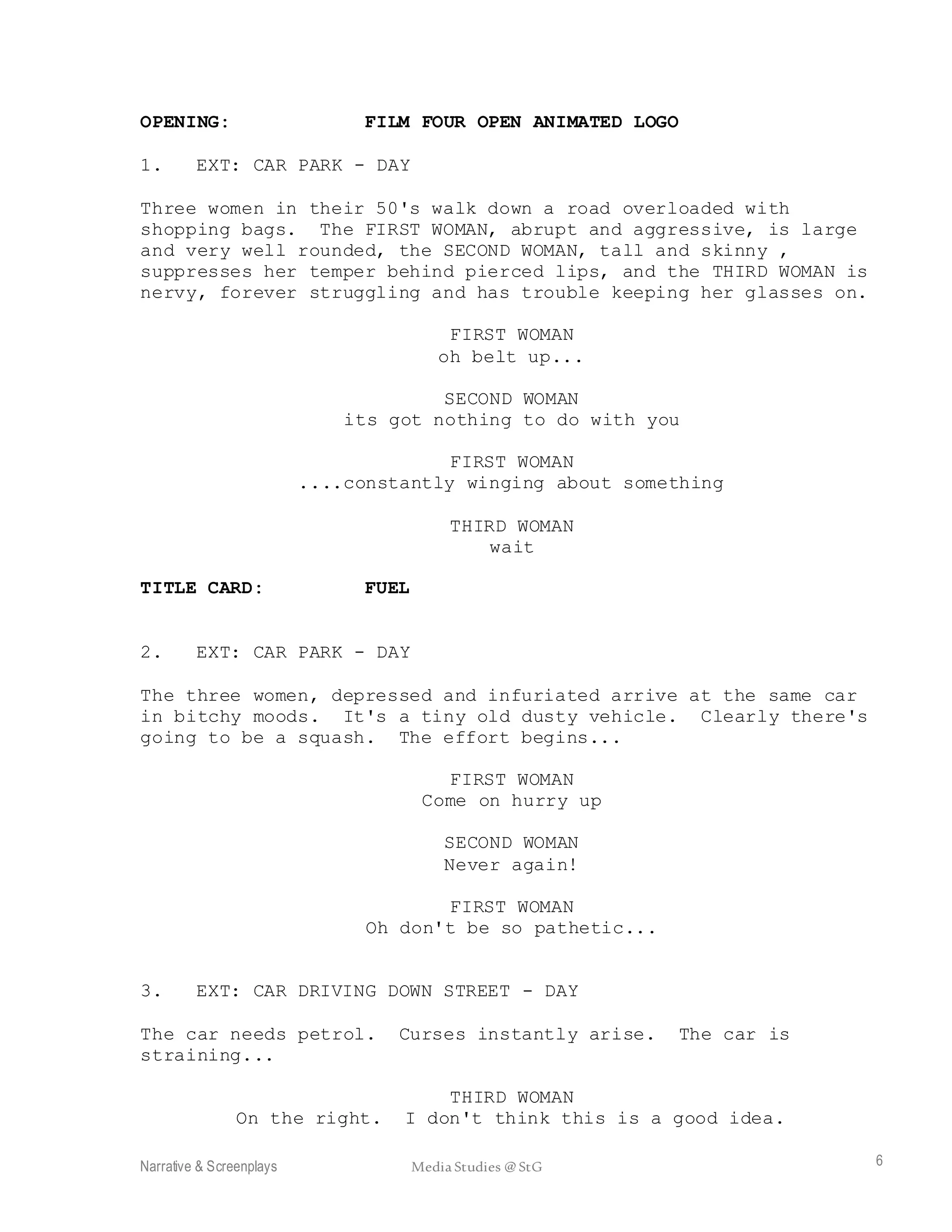
For a bit oflight relief, you can read up on the true adventures ofa Hollywood screenplay writer in Set Up, Joke, Set Up,
Joke by Rob Long (2007) – currently available from £0.01 on Amazon.
THE SCREENPLAY TEMPLATE
Attached is a copy of a short film FUEL, for you to use as a guide to your screenplay layout.
Details of screenplay layout are as follows:
1) Font
The font should be courier 12pt. Use A4 paper and single space.
2) Slug lines
Each scene begins with a heading that tells the reader the
location and approximate time of day. The slug line should be in
CAPS. Scenes are not usually numbered, pages must be numbered.
eg. INT. HOTEL ROOM - NIGHT
3) Dialogue
As each character speaks, their name is put above their dialogue
in CAPS. Dialogue is indented and does not run across the whole
page. Any actor direction for the character is written underneath
the character name before they speak.
eg. JACK
(looking very worried)
It wasn't me, it wasn't me.
4) Narrative description
You will need at times to describe what the audience will be
seeing on the screen. This may include what the character is
doing, the look of a location, props, weather conditions etc.
Description is written across the page like normal prose text.
This distinguishes it clearly from dialogue. When you are
introducing a character for the first time, their name should
appear in CAPS in the narrative.
5) Page numbering
Number each page in the right hand top corner of the script. (That
hasn’t been done with this script)
6) Cover page
Your script cover page should include the name of the script, the
name of the author and contact details, including address,
telephone and email.
‘Everymomentin a screenplaytakesplaceNOW.
Usethe activevoice(awindowslamsshut)notthe
passivevoice(awindowisslammed shut).’
http://www.screenwriting.info/05.php
Narrative & Screenplays Media Studies @ StG 5
F U E L
By Rachel Tillotson
POST PRODUCTION SCRIPT - 27th March 2001
JUMP MONK FILMS
c/o Tall Stories
Studio 40
1 Clink Street
London, SE1 9DG
Tel: 020 7357 8050
Fax: 020 7357 0889
Email: tallstories@compuserve
Narrative & Screenplays Media Studies @ StG 6
OPENING: FILM FOUR OPEN ANIMATED LOGO
1. EXT: CAR PARK - DAY
Three women in their 50's walk down a road overloaded with
shopping bags. The FIRST WOMAN, abrupt and aggressive, is large
and very well rounded, the SECOND WOMAN, tall and skinny ,
suppresses her temper behind pierced lips, and the THIRD WOMAN is
nervy, forever struggling and has trouble keeping her glasses on.
FIRST WOMAN
oh belt up...
SECOND WOMAN
its got nothing to do with you
FIRST WOMAN
....constantly winging about something
THIRD WOMAN
wait
TITLE CARD: FUEL
2. EXT: CAR PARK - DAY
The three women, depressed and infuriated arrive at the same car
in bitchy moods. It's a tiny old dusty vehicle. Clearly there's
going to be a squash. The effort begins...
FIRST WOMAN
Come on hurry up
SECOND WOMAN
Never again!
FIRST WOMAN
Oh don't be so pathetic...
3. EXT: CAR DRIVING DOWN STREET - DAY
The car needs petrol. Curses instantly arise. The car is
straining...
THIRD WOMAN
On the right. I don't think this is a good idea.
Narrative & Screenplays Media Studies @ StG 7
A garage is spied. It's an old dusty half derelict East end type
of affair. No one's around.
4. EXT: FORECOURT OF GARAGE - DAY
Their car rolls in. It comes to a stop with a splutter.
FIRST WOMAN
Who the hell's in charge here?
5. INT: WOMEN'S CAR - DAY
A Greek, DANNY, (owner of the boots) mid 30's calmly leans down
into the corner frame of the cars window where it is now a few
inches open. His sudden appearance makes the FIRST WOMAN jump.
She clasps her heaving bosom. He is so smoooooooth.
DANNY
Problem ladies?
FIRST WOMAN
Yes (passing out £20). Fuel. Lots of it.
DANNY (not surprised)
Of course. No problem. (Pause) and perhaps - a little something
else?
He holds her stare as...
6. EXT: FORECOURT OF GARAGE - DAY
...a wide garage door opens. From behind, one after the other men
appear. GREEK MEN. Tall, short, lean and muscular Gods. They
stride calmly and confidently towards the car. They seem to be on
automatic.
… [I’ve cut out the remaining 15 scenes] …
END CARD ONE
END CARD TWO
CUT IN: Shot of AMAZONIAN WOMAN winking at Camera
END CARD THREE
Narrative & Screenplays Media Studies @ StG 8
The End.

Narrative and screenplays with sample screenplay and guide

  • 1.
    Narrative & ScreenplaysMedia Studies @ StG 1 NARRATIVE & SCREENPLAYS The foundations ofscreenplay construction were laid in the early days ofHollywood (albeitappropriated from well-established principles ofmythology and narrative) and have since remained largely intact. A screenplay tells a visual story in which plotevents follow a rigid internal logic ofcause and effectso that the audience knows what is happening to whom and why. …[T]he plotnormally pivots around the protagonist, a dynamic central character with clear needs, desires and problems who encounters an antagonistic force while in pursuit ofhis goals. His attempts to overcome this opposition as he undergoes a life-changing series ofevents drive the narrative, building to a climax where he emerges victorious butalso mindful ofhow close he came to defeatand of what he learned along the way. Modern variations are surprise, downbeatand/or ambiguous endings, where the protagonisteither snatches defeatfrom the jaws ofsuccess, fails miserably or loses so much in reaching his goal that it brings the wisdom ofthe whole enterprise into question. …[W]hen done well they are amongst the mostmemorable examples ofcinema: Chinatown, Apocalypse Now, Seven, Get Carter, The Long Good Friday….1 Costello, John (2004) Writing a Screenplay. Pocket Essentials Film. Harpenden: Pocket Essentials, p. 51. By the way, I’ve just given a lengthy quote from a book; in your academic life, you generally won’t quote such a long fragment – if its more than two sentences you’ll usually put it into your own words. If it’s a single line, you’d incorporate it into a sentence, two lines or more and typically you’d use a colon and indent it, using a font such as Arial Narrow, below your paragraph. But you will try to break up large chunks of text with headings and sub-headings as I do below… TODOROV’S 5-PART NARRATIVE FORMULA Every narrative can be broken down into three basic stages: situation, conflict, resolution (or equilibrium, dis-equilibrium, new equilibrium). Crucially, your protagonist is not the same as at the outset, but has been changed in some way from events. Your old friend Tzvetan Todorov posited five stages: 1. a state of equilibrium at the outset; 2. a disruption of the equilibrium by some action; 3. a recognition that there has been a disruption; 4. an attempt to repair the disruption; 5. a reinstatement of the equilibrium 2 Does YOUR narrative reflect this? 1 To this list you could add Easy Rider and Boys Don’t Cry amongst others. 2 Taken from http://www.watershed.co.uk/east/content/narrative.html You can find a much more detailed breakdown of a typical narrative at http://en.wikipedia.org/wiki/Propp#Narrative_Structure, a summary of Propp’s theory.
  • 2.
    Narrative & ScreenplaysMedia Studies @ StG 2 EXPOSITION & THE OPENING SCENE This is critical: get the opening scene right and you’ve grabbed your audience, whose eyeballs are twitching to go elsewhere in our media- saturated world… The essential elements ofa strong opening are: introduce atleast one major character (usually the Protagonistand/or Antagonist); setthe tone (mood/atmosphere); setthe pace; and introduce the world of the story [diegesis]via a powerful incidentor situation which sets in motion the events ofthe plot.3 Exposition is important, but clunky, stilted dialogue isn’t going to keep those eyeballs gripped: Exposition is a technique by which background information aboutthe characters, events, or setting is conveyed … . This information can be presented through dialogue, description, flashbacks, or even directly through narrative. As exposition generally does notadvance plotand may impede present-time action, it is usually bestkeptin short and succinctform, though in some genres,such as the mystery, exposition is central to the story structure itself. The alternative to exposition is to convey background information indirectly though action, which, though more dramatic, is more time consuming and less concise.4 THURLOW ON ‘THE ACTIVE QUESTION’ ‘Each story will have running through it what is called the Active Question: Will they get married? Will she stop using drugs and run in the Olympics? Will he get revenge? Will they escape – the robbers with the bank haul, Thelma and Louise from the tyranny of men? If the characters we create have a tale worth telling, they will want something: to get the girl, exact revenge, achieve justice, steal the goose that laid the golden egg…. A story becomes interesting when the writer sets up obstacles that prevent the hero getting what they want (Thelma and Louise first lose their money, essential for their fight). The story hooks us as they overcome those obstacles and/or villains and thereby grow and change in the process. In order to grip the audience, the characters must be seen to go through a range of emotions: fear, self-doubt, sorrow, elation. The screenwriter achieves this through conflict (you will never marry that man; …you’ll never be good enough to run in the Olympics). As the conflict unwinds, the audience will be seeing themselves in the hero or heroine and will be sharing those emotions. Conflict is to drama what sound is to music. It is the heart of drama, the soul of drama, the secret of suspense, the key to emotional engagement, that thing that keeps filmgoers on the edge of their seats. If you laugh out loud while reading a book or feel a tear jerk into your eye while you are watching a movie, the writer has done his job.’ Thurlow, Clifford (2008) Making Short Films: The Complete Guide From Script to Screen. 2nd edition. Oxford & New York: Berg, p.34. 3 Costello, 2002, p. 53. 4 Taken from http://en.wikipedia.org/wiki/Exposition_(literary_technique) Places to go, people to see…
  • 3.
    Narrative & ScreenplaysMedia Studies @ StG 3 PROPP’S CHARACTER ARCHETYPES As well as proposing that narratives can be broken down into 31 basic functions, Vladimir Propp (in his study of fairytales which continues to influence literary and media studies today) argued that there are essentially just eight basic character types, or archetypes: 1. The villain — struggles against the hero. 2. The donor — prepares the hero or gives the hero some magical object. 3. The (magical) helper — helps the hero in the quest. 4. The princess or prize — the hero deserves her throughout the story but is unable to marry her because of an unfair evil, usually because of the villain. The hero's journey is often ended when he marries the princess, thereby beating the villain. 5. The princess and her father — gives the task to the hero, identifies the false hero, marries the hero, often sought for during the narrative. Propp noted that functionally, the princess and the father can not be clearly distinguished. 6. The dispatcher — character who makes the lack known and sends the hero off. 7. The hero or victim/seeker hero — reacts to the donor, weds the princess. 8. False hero/anti-hero/usurper — takes credit for the hero’s actions or tries to marry the princess. These roles could sometimes be distributed among various characters, as the hero kills the villain dragon, and the dragon's sisters take on the villainous role of chasing him. Conversely, one character could engage in acts as more than one role, as a father could send his son on the quest and give him a sword, acting as both dispatcher and donor.5 Think about how this can be applied to Star Wars as a straightforward example, but also your film. FURTHERRESOURCES: Perhaps the most useful online resource is http://www.screenwriting.info/ This is targeted at actual, would-be, US, scriptwriters, and has links to sections on each ofthe specific components ofa screenplay. Like a greatmany other sites, it rather unsubtly extols the virtues of screenwriting software which automatically formats your work. You could arguably use one if you can find a shareware version. At http://www.dailyscript.com/index.html you’ll find a daily free script(such as http://www.dailyscript.com/scripts/ford-fairlane_early.html) The BBC has a briefguide, featuring guidance from two veteran scriptwriters: http://www.bbc.co.uk/worldservice/arts/features/howtowrite/screenplay.shtml You can pick from an extensive listofHollywood feature-length movie scripts at http://www.script-o-rama.com/table.shtml The Leeds-based ‘Re-thinking the Screenplay Network’, at http://ics.leeds.ac.uk/papers/vp01.cfm?outfit=llp&folder=56&paper=57, poses some fundamental questions aboutthe role of the screenplay Film Education provide a useful downloadable guide at http://www.filmeducation.org/secondary/StudyGuides/screenplay.pdf Part ofthe PocketEssentials range (small-form books originally sold at£3.99, now £4.99), Writing a Screenplay (John Costello 2004, 2006) is a very accessible guide. 5 Taken from http://en.wikipedia.org/wiki/Propp#Narrative_Structure
  • 4.
    Narrative & ScreenplaysMedia Studies @ StG 4 For a bit oflight relief, you can read up on the true adventures ofa Hollywood screenplay writer in Set Up, Joke, Set Up, Joke by Rob Long (2007) – currently available from £0.01 on Amazon. THE SCREENPLAY TEMPLATE Attached is a copy of a short film FUEL, for you to use as a guide to your screenplay layout. Details of screenplay layout are as follows: 1) Font The font should be courier 12pt. Use A4 paper and single space. 2) Slug lines Each scene begins with a heading that tells the reader the location and approximate time of day. The slug line should be in CAPS. Scenes are not usually numbered, pages must be numbered. eg. INT. HOTEL ROOM - NIGHT 3) Dialogue As each character speaks, their name is put above their dialogue in CAPS. Dialogue is indented and does not run across the whole page. Any actor direction for the character is written underneath the character name before they speak. eg. JACK (looking very worried) It wasn't me, it wasn't me. 4) Narrative description You will need at times to describe what the audience will be seeing on the screen. This may include what the character is doing, the look of a location, props, weather conditions etc. Description is written across the page like normal prose text. This distinguishes it clearly from dialogue. When you are introducing a character for the first time, their name should appear in CAPS in the narrative. 5) Page numbering Number each page in the right hand top corner of the script. (That hasn’t been done with this script) 6) Cover page Your script cover page should include the name of the script, the name of the author and contact details, including address, telephone and email. ‘Everymomentin a screenplaytakesplaceNOW. Usethe activevoice(awindowslamsshut)notthe passivevoice(awindowisslammed shut).’ http://www.screenwriting.info/05.php
  • 5.
    Narrative & ScreenplaysMedia Studies @ StG 5 F U E L By Rachel Tillotson POST PRODUCTION SCRIPT - 27th March 2001 JUMP MONK FILMS c/o Tall Stories Studio 40 1 Clink Street London, SE1 9DG Tel: 020 7357 8050 Fax: 020 7357 0889 Email: tallstories@compuserve
  • 6.
    Narrative & ScreenplaysMedia Studies @ StG 6 OPENING: FILM FOUR OPEN ANIMATED LOGO 1. EXT: CAR PARK - DAY Three women in their 50's walk down a road overloaded with shopping bags. The FIRST WOMAN, abrupt and aggressive, is large and very well rounded, the SECOND WOMAN, tall and skinny , suppresses her temper behind pierced lips, and the THIRD WOMAN is nervy, forever struggling and has trouble keeping her glasses on. FIRST WOMAN oh belt up... SECOND WOMAN its got nothing to do with you FIRST WOMAN ....constantly winging about something THIRD WOMAN wait TITLE CARD: FUEL 2. EXT: CAR PARK - DAY The three women, depressed and infuriated arrive at the same car in bitchy moods. It's a tiny old dusty vehicle. Clearly there's going to be a squash. The effort begins... FIRST WOMAN Come on hurry up SECOND WOMAN Never again! FIRST WOMAN Oh don't be so pathetic... 3. EXT: CAR DRIVING DOWN STREET - DAY The car needs petrol. Curses instantly arise. The car is straining... THIRD WOMAN On the right. I don't think this is a good idea.
  • 7.
    Narrative & ScreenplaysMedia Studies @ StG 7 A garage is spied. It's an old dusty half derelict East end type of affair. No one's around. 4. EXT: FORECOURT OF GARAGE - DAY Their car rolls in. It comes to a stop with a splutter. FIRST WOMAN Who the hell's in charge here? 5. INT: WOMEN'S CAR - DAY A Greek, DANNY, (owner of the boots) mid 30's calmly leans down into the corner frame of the cars window where it is now a few inches open. His sudden appearance makes the FIRST WOMAN jump. She clasps her heaving bosom. He is so smoooooooth. DANNY Problem ladies? FIRST WOMAN Yes (passing out £20). Fuel. Lots of it. DANNY (not surprised) Of course. No problem. (Pause) and perhaps - a little something else? He holds her stare as... 6. EXT: FORECOURT OF GARAGE - DAY ...a wide garage door opens. From behind, one after the other men appear. GREEK MEN. Tall, short, lean and muscular Gods. They stride calmly and confidently towards the car. They seem to be on automatic. … [I’ve cut out the remaining 15 scenes] … END CARD ONE END CARD TWO CUT IN: Shot of AMAZONIAN WOMAN winking at Camera END CARD THREE
  • 8.
    Narrative & ScreenplaysMedia Studies @ StG 8 The End.