Financial Management
PROJECT
Group 11
Abhinav Jha - DM2520002
Ansh Kachhwal - DM252010
Govind Goel - DM252025
Onkar Agashe - DM252049
Vishnu Priya V - DM252085
Vasudev Misra - DM252082
CONTENT
01
02
03
04
05
06
07
ABOUT NARAYANA HEALTH
Current Facilities in India
Economy
Healthcare Industry
Competitors
Timeline
Dilemma and Why IPO?
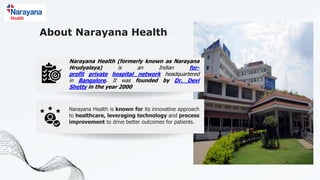
About Narayana Health
Narayana Health (formerly known as Narayana
Hrudyalaya) is an Indian for-
profit private hospital network headquartered
in Bangalore. It was founded by Dr. Devi
Shetty in the year 2000
Narayana Health is known for its innovative approach
to healthcare, leveraging technology and process
improvement to drive better outcomes for patients.
NORTH INDIA
CURRENT FACILITIES IN INDIA
1. Shri Mata Vaishno Devi Narayana
Super Speciality Hospital, Jammu
2. Narayana Superspeciality Hospital,
Gurugram
3. Dharamshila Cancer Hospital and
Research Centre Delhi
WEST INDIA
1. Narayana Multispeciality Hospital,
Ahmedabad
2. Narayana Multispeciality Hospital,
Jaipur
3. SRCC Children's Hospital, Mumbai
SOUTH INDIA
1. Mazumdar Shaw Medical Centre,
Bangalore
2. MS Ramaiah Narayana Heart
Centre, Bangalore
3. Narayana Institute of Cardiac
Sciences, Bangalore
4. Narayana Medical Centre,
Langford Town, Bangalore
5. Narayana Multispeciality Clinic,
Jayanagar, Bangalore
EAST INDIA
1. Brahmananda Narayana
Multispeciality Hospital,
Jamshedpur
2. MMI Narayana
Multispeciality Hospital,
Raipur
3. Narayana Multispeciality
Hospital, Barasat, Kolkata
4. Narayana Multispeciality
Hospital, Howrah[19]
5. Narayana Superspeciality
Hospital, Guwahati
Economy & Healthcare Industry
• In FY 2014–2015, the Indian economy grew by 7.3%, and it was
projected to grow at 7.3% and 7.5% in FY 2015–2016 and FY
2016–2017
• As of 2014 data of the World Bank, India was ranked as the 9th
largest economy with a gross domestic product (GDP) of $2
trillion, but in terms of per capita GDP, India was ranked very low, at
127th among 199 countries.
• In 2014, global crude oil prices fell to $57.33 per barrel,
registering a 47% decline in the global market, and they were
expected to drop further to $30 per barrel by the end of 2015.
• Sectors like information technology, healthcare, telecom,
infrastructure, and retail were key to the growth of the
economy
• According to the World Health Organization (WHO), India’s total
expenditure on healthcare was only 4% of its GDP, compared to
developed countries like the United States, which spent 18% of its GDP. In
2013, annual expenditure on health was just $215 per capita.
• In terms of revenue and employment, healthcare had become one of India’s
largest sectors. The Indian healthcare industry was worth $100 billion, and it
was expected to grow by a compound annual growth rate of 22.9%
to $280 billion by 2020.
1. The lack of quality healthcare programs in rural India, the growth of the health insurance market, a growing pharmaceutical
sector, and an underdeveloped medical devices sector made the Indian healthcare industry a potential investment destination.
2. According to the World Economic Forum and the Harvard School of Public Health, it was estimated that India would incur a loss of $5
trillion between 2012 and 2030 due to noncommunicable diseases.
3. India accounted for 21% of world diseases, had just 1.3 beds per 1,000 people and 0.702 doctors per 1,000 people; WHO
guidelines, 3.5 beds per 1,000 people was the minimum requirement for the healthcare sector.
Economy & Healthcare Industry
The healthcare system in India was in dire need of investment from domestic as well as foreign private players.
Competitors
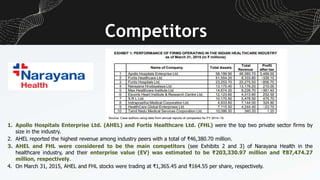
1. Apollo Hospitals Enterprise Ltd. (AHEL) and Fortis Healthcare Ltd. (FHL) were the top two private sector firms by
size in the industry.
2. AHEL reported the highest revenue among industry peers with a total of ₹46,380.70 million.
3. AHEL and FHL were considered to be the main competitors (see Exhibits 2 and 3) of Narayana Health in the
healthcare industry, and their enterprise value (EV) was estimated to be ₹203,330.97 million and ₹87,474.27
million, respectively.
4. On March 31, 2015, AHEL and FHL stocks were trading at ₹1,365.45 and ₹164.55 per share, respectively.
TIMELINE
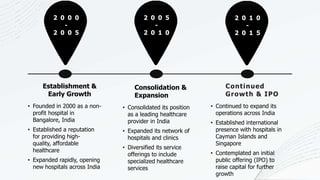
2 0 0 0
-
2 0 0 5
Establishment &
Early Growth
• Founded in 2000 as a non-
profit hospital in
Bangalore, India
• Established a reputation
for providing high-
quality, affordable
healthcare
• Expanded rapidly, opening
new hospitals across India
Consolidation &
Expansion
• Consolidated its position
as a leading healthcare
provider in India
• Expanded its network of
hospitals and clinics
• Diversified its service
offerings to include
specialized healthcare
services
Continued
Growth & IPO
• Continued to expand its
operations across India
• Established international
presence with hospitals in
Cayman Islands and
Singapore
• Contemplated an initial
public offering (IPO) to
raise capital for further
growth
2 0 0 5
-
2 0 1 0
2 0 1 0
-
2 0 1 5
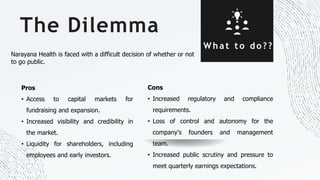
The Dilemma
Narayana Health is faced with a difficult decision of whether or not
to go public.
What to do??
Pros
• Access to capital markets for
fundraising and expansion.
• Increased visibility and credibility in
the market.
• Liquidity for shareholders, including
employees and early investors.
Cons
• Increased regulatory and compliance
requirements.
• Loss of control and autonomy for the
company's founders and management
team.
• Increased public scrutiny and pressure to
meet quarterly earnings expectations.
Why IPO?
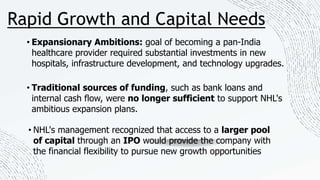
Rapid Growth and Capital Needs
• Traditional sources of funding, such as bank loans and
internal cash flow, were no longer sufficient to support NHL's
ambitious expansion plans.
• NHL's management recognized that access to a larger pool
of capital through an IPO would provide the company with
the financial flexibility to pursue new growth opportunities
• Expansionary Ambitions: goal of becoming a pan-India
healthcare provider required substantial investments in new
hospitals, infrastructure development, and technology upgrades.
IPO as a Solution
• Reduced Reliance on PE investment: While PE firms had
played a significant role in NHL's early growth, the company's
management recognized the limitations of this funding source and
sought greater autonomy and control over its future direction.
• Market Condition: The IPO market in India was also particularly
active in 2015. This strong IPO activity further validated NHL's decision
to pursue an IPO, as it demonstrated that investors were receptive to
new investment opportunities in the Indian market.
• Elevated Brand Reputation: Going public would elevate NHL's
brand reputation, enhancing its visibility among investors, patients, and
healthcare professionals.
THANK
YOU!

Narayana Health.pptx

  • 1.
    Financial Management PROJECT Group 11 AbhinavJha - DM2520002 Ansh Kachhwal - DM252010 Govind Goel - DM252025 Onkar Agashe - DM252049 Vishnu Priya V - DM252085 Vasudev Misra - DM252082
  • 2.
    CONTENT 01 02 03 04 05 06 07 ABOUT NARAYANA HEALTH CurrentFacilities in India Economy Healthcare Industry Competitors Timeline Dilemma and Why IPO?
  • 3.
    About Narayana Health NarayanaHealth (formerly known as Narayana Hrudyalaya) is an Indian for- profit private hospital network headquartered in Bangalore. It was founded by Dr. Devi Shetty in the year 2000 Narayana Health is known for its innovative approach to healthcare, leveraging technology and process improvement to drive better outcomes for patients.
  • 4.
    NORTH INDIA CURRENT FACILITIESIN INDIA 1. Shri Mata Vaishno Devi Narayana Super Speciality Hospital, Jammu 2. Narayana Superspeciality Hospital, Gurugram 3. Dharamshila Cancer Hospital and Research Centre Delhi WEST INDIA 1. Narayana Multispeciality Hospital, Ahmedabad 2. Narayana Multispeciality Hospital, Jaipur 3. SRCC Children's Hospital, Mumbai SOUTH INDIA 1. Mazumdar Shaw Medical Centre, Bangalore 2. MS Ramaiah Narayana Heart Centre, Bangalore 3. Narayana Institute of Cardiac Sciences, Bangalore 4. Narayana Medical Centre, Langford Town, Bangalore 5. Narayana Multispeciality Clinic, Jayanagar, Bangalore EAST INDIA 1. Brahmananda Narayana Multispeciality Hospital, Jamshedpur 2. MMI Narayana Multispeciality Hospital, Raipur 3. Narayana Multispeciality Hospital, Barasat, Kolkata 4. Narayana Multispeciality Hospital, Howrah[19] 5. Narayana Superspeciality Hospital, Guwahati
  • 5.
    Economy & HealthcareIndustry • In FY 2014–2015, the Indian economy grew by 7.3%, and it was projected to grow at 7.3% and 7.5% in FY 2015–2016 and FY 2016–2017 • As of 2014 data of the World Bank, India was ranked as the 9th largest economy with a gross domestic product (GDP) of $2 trillion, but in terms of per capita GDP, India was ranked very low, at 127th among 199 countries. • In 2014, global crude oil prices fell to $57.33 per barrel, registering a 47% decline in the global market, and they were expected to drop further to $30 per barrel by the end of 2015. • Sectors like information technology, healthcare, telecom, infrastructure, and retail were key to the growth of the economy
  • 6.
    • According tothe World Health Organization (WHO), India’s total expenditure on healthcare was only 4% of its GDP, compared to developed countries like the United States, which spent 18% of its GDP. In 2013, annual expenditure on health was just $215 per capita. • In terms of revenue and employment, healthcare had become one of India’s largest sectors. The Indian healthcare industry was worth $100 billion, and it was expected to grow by a compound annual growth rate of 22.9% to $280 billion by 2020. 1. The lack of quality healthcare programs in rural India, the growth of the health insurance market, a growing pharmaceutical sector, and an underdeveloped medical devices sector made the Indian healthcare industry a potential investment destination. 2. According to the World Economic Forum and the Harvard School of Public Health, it was estimated that India would incur a loss of $5 trillion between 2012 and 2030 due to noncommunicable diseases. 3. India accounted for 21% of world diseases, had just 1.3 beds per 1,000 people and 0.702 doctors per 1,000 people; WHO guidelines, 3.5 beds per 1,000 people was the minimum requirement for the healthcare sector. Economy & Healthcare Industry The healthcare system in India was in dire need of investment from domestic as well as foreign private players.
  • 7.
    Competitors 1. Apollo HospitalsEnterprise Ltd. (AHEL) and Fortis Healthcare Ltd. (FHL) were the top two private sector firms by size in the industry. 2. AHEL reported the highest revenue among industry peers with a total of ₹46,380.70 million. 3. AHEL and FHL were considered to be the main competitors (see Exhibits 2 and 3) of Narayana Health in the healthcare industry, and their enterprise value (EV) was estimated to be ₹203,330.97 million and ₹87,474.27 million, respectively. 4. On March 31, 2015, AHEL and FHL stocks were trading at ₹1,365.45 and ₹164.55 per share, respectively.
  • 8.
  • 9.
    2 0 00 - 2 0 0 5 Establishment & Early Growth • Founded in 2000 as a non- profit hospital in Bangalore, India • Established a reputation for providing high- quality, affordable healthcare • Expanded rapidly, opening new hospitals across India Consolidation & Expansion • Consolidated its position as a leading healthcare provider in India • Expanded its network of hospitals and clinics • Diversified its service offerings to include specialized healthcare services Continued Growth & IPO • Continued to expand its operations across India • Established international presence with hospitals in Cayman Islands and Singapore • Contemplated an initial public offering (IPO) to raise capital for further growth 2 0 0 5 - 2 0 1 0 2 0 1 0 - 2 0 1 5
  • 10.
    The Dilemma Narayana Healthis faced with a difficult decision of whether or not to go public. What to do?? Pros • Access to capital markets for fundraising and expansion. • Increased visibility and credibility in the market. • Liquidity for shareholders, including employees and early investors. Cons • Increased regulatory and compliance requirements. • Loss of control and autonomy for the company's founders and management team. • Increased public scrutiny and pressure to meet quarterly earnings expectations.
  • 11.
  • 12.
    Rapid Growth andCapital Needs • Traditional sources of funding, such as bank loans and internal cash flow, were no longer sufficient to support NHL's ambitious expansion plans. • NHL's management recognized that access to a larger pool of capital through an IPO would provide the company with the financial flexibility to pursue new growth opportunities • Expansionary Ambitions: goal of becoming a pan-India healthcare provider required substantial investments in new hospitals, infrastructure development, and technology upgrades.
  • 13.
    IPO as aSolution • Reduced Reliance on PE investment: While PE firms had played a significant role in NHL's early growth, the company's management recognized the limitations of this funding source and sought greater autonomy and control over its future direction. • Market Condition: The IPO market in India was also particularly active in 2015. This strong IPO activity further validated NHL's decision to pursue an IPO, as it demonstrated that investors were receptive to new investment opportunities in the Indian market. • Elevated Brand Reputation: Going public would elevate NHL's brand reputation, enhancing its visibility among investors, patients, and healthcare professionals.
  • 14.