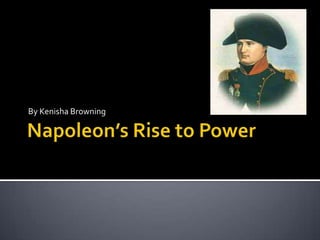
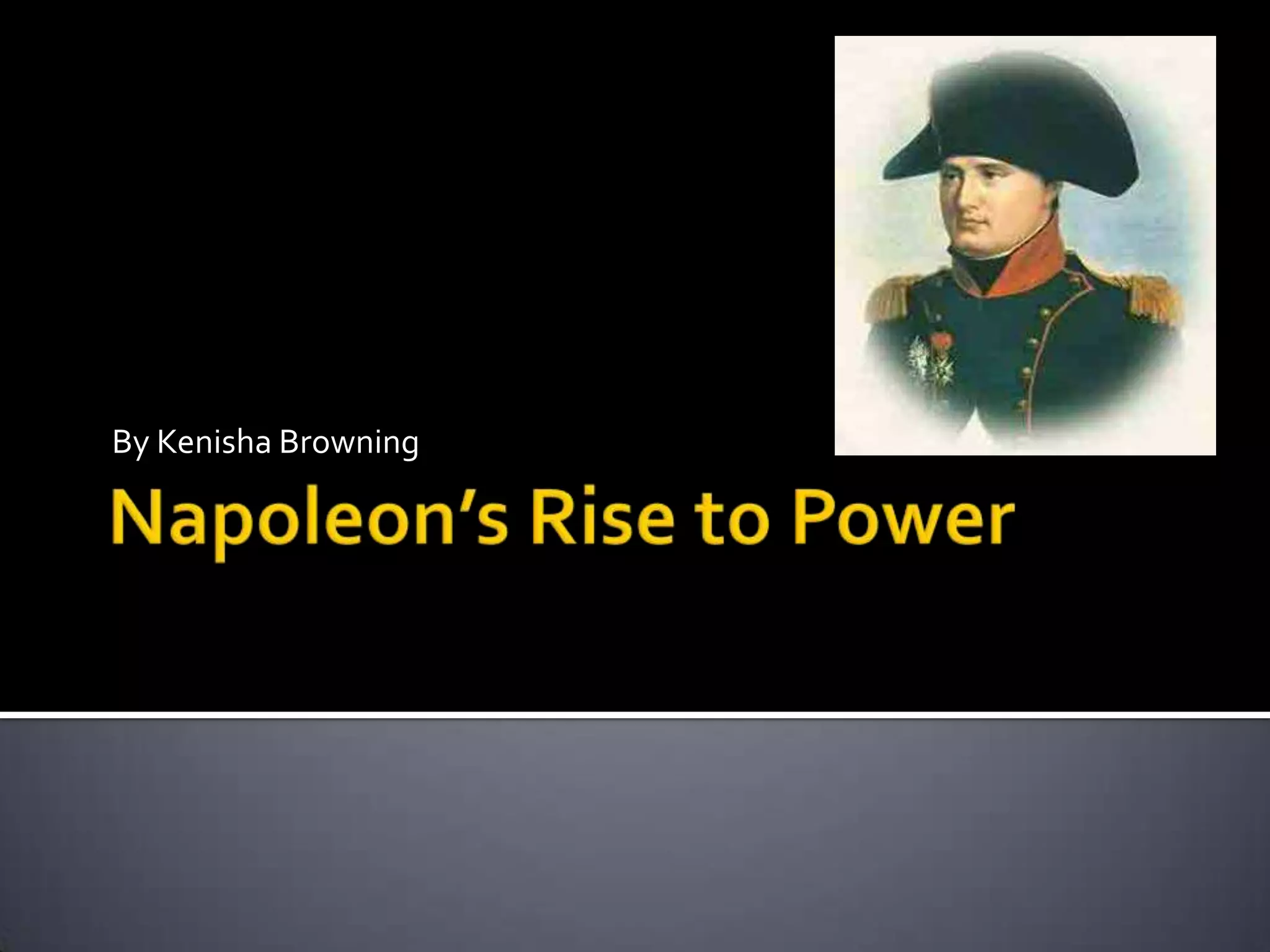
Napoleon’s Rise to PowerBy Kenisha Browning
Introduction‘ To do all that one is able to do, is to be a man; to do all that one would like to do, is to be a God’ Napoleon BonaparteUndoubted genius, megalomaniac, general, statesmanand ruthless dictator, Napoleon Bonaparte is one of themost controversial characters in world history. In 20years from the base of revolutionary France hetransformed Europe into a largely personal Empire – buthis eventual fall was as fast as his meteoric rise to power.To the French for a time he was a superstar, to Europe’smonarchies he was ‘the enemy of humanity’. His legacyis perhaps the foundation of modern Europe. Thispresentation traces the major events in the life of the‘little corporal’ that led him to power in France.
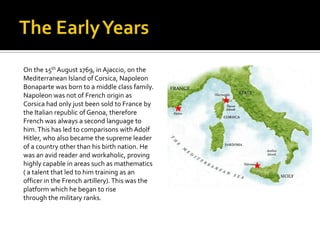
The Early YearsOn the 15th August 1769, in Ajaccio, on theMediterranean Island of Corsica, NapoleonBonaparte was born to a middle class family.Napoleon was not of French origin asCorsica had only just been sold to France bythe Italian republic of Genoa, thereforeFrench was always a second language tohim. This has led to comparisons with AdolfHitler, who also became the supreme leaderof a country other than his birth nation. Hewas an avid reader and workaholic, provinghighly capable in areas such as mathematics( a talent that led to him training as anofficer in the French artillery). This was theplatform which he began to risethrough the military ranks.
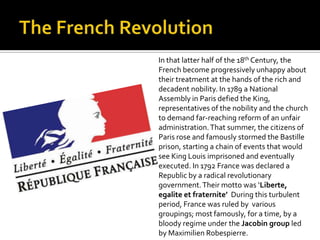
The French RevolutionIn that latter half of the 18th Century, theFrench become progressively unhappy abouttheir treatment at the hands of the rich anddecadent nobility. In 1789 a NationalAssembly in Paris defied the King,representatives of the nobility and the churchto demand far-reaching reform of an unfairadministration. That summer, the citizens ofParis rose and famously stormed the Bastilleprison, starting a chain of events that wouldsee King Louis imprisoned and eventuallyexecuted. In 1792 France was declared aRepublic by a radical revolutionarygovernment. Their motto was ‘Liberte,egalite et fraternite’  During this turbulentperiod, France was ruled by  variousgroupings; most famously, for a time, by abloody regime under the Jacobin group ledby Maximilien Robespierre.
First CoalitionThere was a rise in anti-royalist political factions as the French Revolution sent shockwaves through the constitutional monarchies of Europe. Several countries of Europe, led mainly by the Austrian Empire, Prussia, Russia and Great Britain desired to put down this revolution, so they went to war against the French Republic which a view to restoring the French monarchy.The first of these grand coalitions led to the rise of Napoleon as first a general of great skill and tenacity and ultimately to self-styled Emperor. During and after this rise there were several further coalitions against France. The wars against these later coalitions are regarded as the so-called Napoleonic Wars proper.In 1779, Napoleon Bonaparte was admitted to the French military academy at Brienne . Napoleon was never truly accepted by his peers but this drove him to throw all his weight into his studies. Napoleon, after a while, managed to upgrade to the military academy in Paris because he did have certain connections to the revolutionary leadership in Paris. Due to his mathematical brilliance he was trained in artillery, even though he initially wanted to be a naval officer.When Austria, Great Britain and Prussia declared war on France in 1792, France found herself at a disadvantage. Many of France’s finest generals had been killed or driven away because of the terror that had arisen during France’s post-revolutionary excesses. Therefore, at first things went badly for them with their armies consisting largely of poorly-trained mobs under often unimaginative leadership.
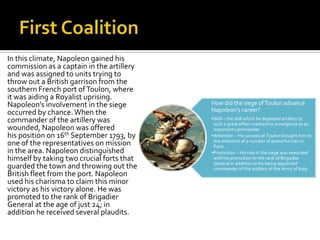
First CoalitionIn this climate, Napoleon gained hiscommission as a captain in the artilleryand was assigned to units trying tothrow out a British garrison from thesouthern French port of Toulon, whereit was aiding a Royalist uprising.Napoleon’s involvement in the siegeoccurred by chance. When thecommander of the artillery waswounded, Napoleon was offeredhis position on 16th September 1793, byone of the representatives on missionin the area. Napoleon distinguishedhimself by taking two crucial forts thatguarded the town and throwing out theBritish fleet from the port. Napoleonused his charisma to claim this minorvictory as his victory alone. He waspromoted to the rank of BrigadierGeneral at the age of just 24; inaddition he received several plaudits.
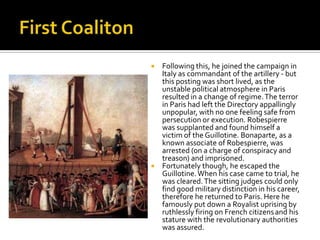
First CoalitonFollowing this, he joined the campaign in Italy as commandant of the artillery - but this posting was short lived, as the unstable political atmosphere in Paris resulted in a change of regime. The terror in Paris had left the Directory appallingly unpopular, with no one feeling safe from persecution or execution. Robespierre was supplanted and found himself a victim of the Guillotine. Bonaparte, as a known associate of Robespierre, was arrested (on a charge of conspiracy and treason) and imprisoned. Fortunately though, he escaped the Guillotine. When his case came to trial, he was cleared. The sitting judges could only find good military distinction in his career, therefore he returned to Paris. Here he famously put down a Royalist uprising by ruthlessly firing on French citizensand his stature with the revolutionary authorities was assured.
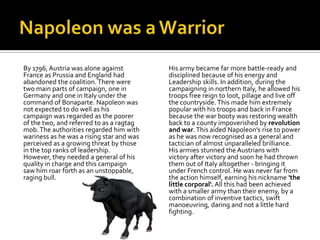
Napoleon was a WarriorBy 1796, Austria was alone againstFrance as Prussia and England hadabandoned the coalition. There weretwo main parts of campaign, one inGermany and one in Italy under thecommand of Bonaparte. Napoleon wasnot expected to do well as hiscampaign was regarded as the poorerof the two, and referred to as a ragtagmob. The authorities regarded him withwariness as he was a rising star and wasperceived as a growing threat by thosein the top ranks of leadership.However, they needed a general of hisquality in charge and this campaignsaw him roar forth as an unstoppable,raging bull.His army became far more battle-ready anddisciplined because of his energy andLeadership skills. In addition, during thecampaigning in northern Italy, he allowed histroops free reign to loot, pillage and live offthe countryside. This made him extremelypopular with his troops and back in Francebecause the war booty was restoring wealthback to a county impoverished by revolutionand war. This aided Napoleon’s rise to poweras he was now recognised as a general andtactician of almost unparalleled brilliance.His armies stunned the Austrians withvictory after victory and soon he had thrownthem out of Italy altogether - bringing itunder French control. He was never far fromthe action himself, earning his nickname 'thelittle corporal'. All this had been achievedwith a smaller army than their enemy, by acombination of inventive tactics, swiftmanoeuvring, daring and not a little hardfighting.
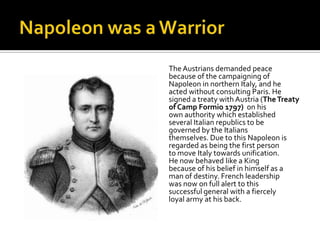
Napoleon was a WarriorThe Austrians demanded peacebecause of the campaigning ofNapoleon in northern Italy, and heacted without consulting Paris. Hesigned a treaty with Austria (The Treatyof Camp Formio 1797)  on hisown authority which establishedseveral Italian republics to begoverned by the Italiansthemselves. Due to this Napoleon isregarded as being the first personto move Italy towards unification.He now behaved like a Kingbecause of his belief in himself as aman of destiny. French leadershipwas now on full alert to thissuccessful general with a fiercelyloyal army at his back.
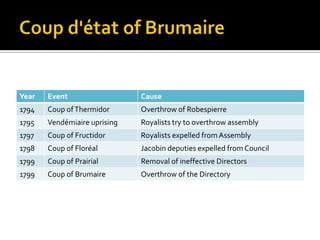
Coup d'état of Brumaire
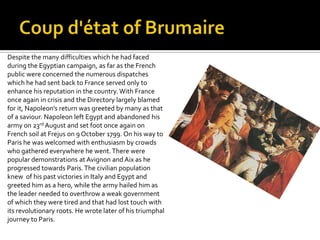
Coup d'état of BrumaireDespite the many difficulties which he had facedduring the Egyptian campaign, as far as the Frenchpublic were concerned the numerous dispatcheswhich he had sent back to France served only toenhance his reputation in the country. With Franceonce again in crisis and the Directory largely blamedfor it, Napoleon’s return was greeted by many as thatof a saviour. Napoleon left Egypt and abandoned hisarmy on 23rd August and set foot once again onFrench soil at Frejus on 9 October 1799. On his way toParis he was welcomed with enthusiasm by crowdswho gathered everywhere he went. There werepopular demonstrations at Avignon and Aix as heprogressed towards Paris. The civilian populationknew  of his past victories in Italy and Egypt andgreeted him as a hero, while the army hailed him asthe leader needed to overthrow a weak governmentof which they were tired and that had lost touch withits revolutionary roots. He wrote later of his triumphaljourney to Paris.
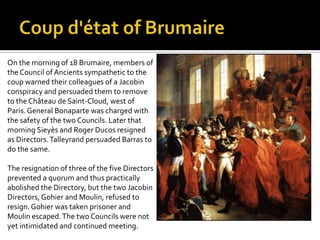
Coup d'état of BrumaireOn the morning of 18 Brumaire, members ofthe Council of Ancients sympathetic to thecoup warned their colleagues of a Jacobinconspiracy and persuaded them to removeto the Château de Saint-Cloud, west of Paris. General Bonaparte was charged withthe safety of the two Councils. Later thatmorning Sieyès and Roger Ducos resignedas Directors. Talleyrand persuaded Barras todo the same.The resignation of three of the five Directorsprevented a quorum and thus practicallyabolished the Directory, but the two JacobinDirectors, Gohier and Moulin, refused toresign. Gohier was taken prisoner andMoulin escaped. The two Councils were notyet intimidated and continued meeting.
Coup d'état of BrumaireNapoleon withdrew to thechateau's Orangerie, where theCouncil of Five Hundred wasmeeting. His reception here waseven more hostile. Napoleon andhis grenadiers entered just as thelegality of Barras' resignationwas being challenged by theJacobins in the chamber. Uponentering, Napoleon was firstjostled, and then outrightassaulted. It was not Napoleonhimself, but his brother Lucien,President of the Council, who calledupon the grenadiers to defend theirleader. Napoleon escaped, butonly through the use of militaryforce.By the following day, the deputieshad, for the most part, realized thatthey were facing an attempted couprather than being protected from aJacobin rebellion. Faced with theirrebellion, Napoleon stormed into thechambers, escorted by a small force ofgrenadiers. While perhaps unplanned,this proved to be the coup within thecoup: from this point, this was a militaryaffair. Napoleon was immediatelygreeted with cries of ‘outlaw thedictator’. This was a dangerousdevelopment, for if a decree of outlawrywere agreed, it would mean summaryexecution by a firing squad.
Coup d'état of BrumaireA motion was raised in the Council of Five Hundred todeclare Napoleon an outlaw. At this point, Lucien Bonaparteapparently slipped out of the chamber and told the soldiersguarding the Councils that the majority of the Five Hundredwere being terrorized by a group of deputies brandishingdaggers. Then, according to Michael Rapport, "He pointed toNapoleon's bloody, pallid face as proof. Then, in a theatricalgesture, he seized a sword and promised to plunge itthrough his own brother's heart if he were a traitor." Lucienordered the troops to expel the violent deputies from thechamber. Grenadiers under the command of General Muratmarched into the Orangerie and dispersed the Council. Thiswas effectively the end of the Directory.
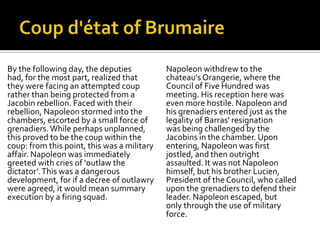
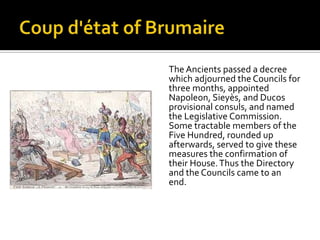
Coup d'état of BrumaireThe Ancients passed a decreewhich adjourned the Councils forthree months, appointedNapoleon, Sieyès, and Ducosprovisional consuls, and namedthe Legislative Commission.Some tractable members of theFive Hundred, rounded upafterwards, served to give thesemeasures the confirmation oftheir House. Thus the Directoryand the Councils came to anend.
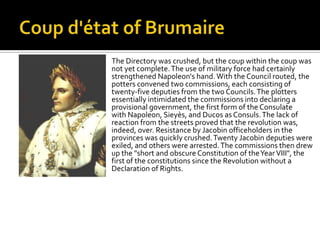
Coup d'état of BrumaireThe Directory was crushed, but the coup within the coup wasnot yet complete. The use of military force had certainlystrengthened Napoleon's hand. With the Council routed, thepotters convened two commissions, each consisting oftwenty-five deputies from the two Councils. The plottersessentially intimidated the commissions into declaring aprovisional government, the first form of the Consulatewith Napoleon, Sieyès, and Ducos as Consuls. The lack ofreaction from the streets proved that the revolution was,indeed, over. Resistance by Jacobin officeholders in theprovinces was quickly crushed. Twenty Jacobin deputies wereexiled, and others were arrested. The commissions then drewup the "short and obscure Constitution of the Year VIII", thefirst of the constitutions since the Revolution without aDeclaration of Rights.
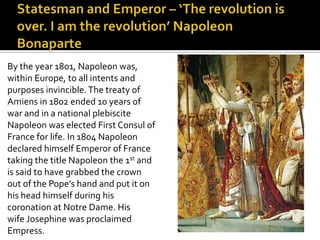
Statesman and Emperor – ‘The revolution is over. I am the revolution’ Napoleon BonaparteBy the year 1801, Napoleon was,within Europe, to all intents andpurposes invincible. The treaty ofAmiens in 1802 ended 10 years ofwar and in a national plebisciteNapoleon was elected First Consul ofFrance for life. In 1804 Napoleondeclared himself Emperor of Francetaking the title Napoleon the 1st andis said to have grabbed the crownout of the Pope’s hand and put it onhis head himself during hiscoronation at Notre Dame. Hiswife Josephine was proclaimedEmpress.
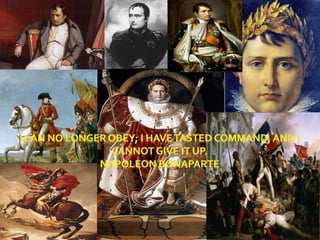
I can no longer obey; I have tasted command, and I cannot give it up. Napoleon Bonaparte

Napoleon’s rise to power

  • 1.
    Napoleon’s Rise toPowerBy Kenisha Browning
  • 2.
    Introduction‘ To doall that one is able to do, is to be a man; to do all that one would like to do, is to be a God’ Napoleon BonaparteUndoubted genius, megalomaniac, general, statesmanand ruthless dictator, Napoleon Bonaparte is one of themost controversial characters in world history. In 20years from the base of revolutionary France hetransformed Europe into a largely personal Empire – buthis eventual fall was as fast as his meteoric rise to power.To the French for a time he was a superstar, to Europe’smonarchies he was ‘the enemy of humanity’. His legacyis perhaps the foundation of modern Europe. Thispresentation traces the major events in the life of the‘little corporal’ that led him to power in France.
  • 3.
    The Early YearsOnthe 15th August 1769, in Ajaccio, on theMediterranean Island of Corsica, NapoleonBonaparte was born to a middle class family.Napoleon was not of French origin asCorsica had only just been sold to France bythe Italian republic of Genoa, thereforeFrench was always a second language tohim. This has led to comparisons with AdolfHitler, who also became the supreme leaderof a country other than his birth nation. Hewas an avid reader and workaholic, provinghighly capable in areas such as mathematics( a talent that led to him training as anofficer in the French artillery). This was theplatform which he began to risethrough the military ranks.
  • 4.
    The French RevolutionInthat latter half of the 18th Century, theFrench become progressively unhappy abouttheir treatment at the hands of the rich anddecadent nobility. In 1789 a NationalAssembly in Paris defied the King,representatives of the nobility and the churchto demand far-reaching reform of an unfairadministration. That summer, the citizens ofParis rose and famously stormed the Bastilleprison, starting a chain of events that wouldsee King Louis imprisoned and eventuallyexecuted. In 1792 France was declared aRepublic by a radical revolutionarygovernment. Their motto was ‘Liberte,egalite et fraternite’ During this turbulentperiod, France was ruled by variousgroupings; most famously, for a time, by abloody regime under the Jacobin group ledby Maximilien Robespierre.
  • 5.
    First CoalitionThere wasa rise in anti-royalist political factions as the French Revolution sent shockwaves through the constitutional monarchies of Europe. Several countries of Europe, led mainly by the Austrian Empire, Prussia, Russia and Great Britain desired to put down this revolution, so they went to war against the French Republic which a view to restoring the French monarchy.The first of these grand coalitions led to the rise of Napoleon as first a general of great skill and tenacity and ultimately to self-styled Emperor. During and after this rise there were several further coalitions against France. The wars against these later coalitions are regarded as the so-called Napoleonic Wars proper.In 1779, Napoleon Bonaparte was admitted to the French military academy at Brienne . Napoleon was never truly accepted by his peers but this drove him to throw all his weight into his studies. Napoleon, after a while, managed to upgrade to the military academy in Paris because he did have certain connections to the revolutionary leadership in Paris. Due to his mathematical brilliance he was trained in artillery, even though he initially wanted to be a naval officer.When Austria, Great Britain and Prussia declared war on France in 1792, France found herself at a disadvantage. Many of France’s finest generals had been killed or driven away because of the terror that had arisen during France’s post-revolutionary excesses. Therefore, at first things went badly for them with their armies consisting largely of poorly-trained mobs under often unimaginative leadership.
  • 6.
    First CoalitionIn thisclimate, Napoleon gained hiscommission as a captain in the artilleryand was assigned to units trying tothrow out a British garrison from thesouthern French port of Toulon, whereit was aiding a Royalist uprising.Napoleon’s involvement in the siegeoccurred by chance. When thecommander of the artillery waswounded, Napoleon was offeredhis position on 16th September 1793, byone of the representatives on missionin the area. Napoleon distinguishedhimself by taking two crucial forts thatguarded the town and throwing out theBritish fleet from the port. Napoleonused his charisma to claim this minorvictory as his victory alone. He waspromoted to the rank of BrigadierGeneral at the age of just 24; inaddition he received several plaudits.
  • 7.
    First CoalitonFollowing this,he joined the campaign in Italy as commandant of the artillery - but this posting was short lived, as the unstable political atmosphere in Paris resulted in a change of regime. The terror in Paris had left the Directory appallingly unpopular, with no one feeling safe from persecution or execution. Robespierre was supplanted and found himself a victim of the Guillotine. Bonaparte, as a known associate of Robespierre, was arrested (on a charge of conspiracy and treason) and imprisoned. Fortunately though, he escaped the Guillotine. When his case came to trial, he was cleared. The sitting judges could only find good military distinction in his career, therefore he returned to Paris. Here he famously put down a Royalist uprising by ruthlessly firing on French citizensand his stature with the revolutionary authorities was assured.
  • 8.
    Napoleon was aWarriorBy 1796, Austria was alone againstFrance as Prussia and England hadabandoned the coalition. There weretwo main parts of campaign, one inGermany and one in Italy under thecommand of Bonaparte. Napoleon wasnot expected to do well as hiscampaign was regarded as the poorerof the two, and referred to as a ragtagmob. The authorities regarded him withwariness as he was a rising star and wasperceived as a growing threat by thosein the top ranks of leadership.However, they needed a general of hisquality in charge and this campaignsaw him roar forth as an unstoppable,raging bull.His army became far more battle-ready anddisciplined because of his energy andLeadership skills. In addition, during thecampaigning in northern Italy, he allowed histroops free reign to loot, pillage and live offthe countryside. This made him extremelypopular with his troops and back in Francebecause the war booty was restoring wealthback to a county impoverished by revolutionand war. This aided Napoleon’s rise to poweras he was now recognised as a general andtactician of almost unparalleled brilliance.His armies stunned the Austrians withvictory after victory and soon he had thrownthem out of Italy altogether - bringing itunder French control. He was never far fromthe action himself, earning his nickname 'thelittle corporal'. All this had been achievedwith a smaller army than their enemy, by acombination of inventive tactics, swiftmanoeuvring, daring and not a little hardfighting.
  • 9.
    Napoleon was aWarriorThe Austrians demanded peacebecause of the campaigning ofNapoleon in northern Italy, and heacted without consulting Paris. Hesigned a treaty with Austria (The Treatyof Camp Formio 1797) on hisown authority which establishedseveral Italian republics to begoverned by the Italiansthemselves. Due to this Napoleon isregarded as being the first personto move Italy towards unification.He now behaved like a Kingbecause of his belief in himself as aman of destiny. French leadershipwas now on full alert to thissuccessful general with a fiercelyloyal army at his back.
  • 10.
  • 11.
    Coup d'état ofBrumaireDespite the many difficulties which he had facedduring the Egyptian campaign, as far as the Frenchpublic were concerned the numerous dispatcheswhich he had sent back to France served only toenhance his reputation in the country. With Franceonce again in crisis and the Directory largely blamedfor it, Napoleon’s return was greeted by many as thatof a saviour. Napoleon left Egypt and abandoned hisarmy on 23rd August and set foot once again onFrench soil at Frejus on 9 October 1799. On his way toParis he was welcomed with enthusiasm by crowdswho gathered everywhere he went. There werepopular demonstrations at Avignon and Aix as heprogressed towards Paris. The civilian populationknew of his past victories in Italy and Egypt andgreeted him as a hero, while the army hailed him asthe leader needed to overthrow a weak governmentof which they were tired and that had lost touch withits revolutionary roots. He wrote later of his triumphaljourney to Paris.
  • 12.
    Coup d'état ofBrumaireOn the morning of 18 Brumaire, members ofthe Council of Ancients sympathetic to thecoup warned their colleagues of a Jacobinconspiracy and persuaded them to removeto the Château de Saint-Cloud, west of Paris. General Bonaparte was charged withthe safety of the two Councils. Later thatmorning Sieyès and Roger Ducos resignedas Directors. Talleyrand persuaded Barras todo the same.The resignation of three of the five Directorsprevented a quorum and thus practicallyabolished the Directory, but the two JacobinDirectors, Gohier and Moulin, refused toresign. Gohier was taken prisoner andMoulin escaped. The two Councils were notyet intimidated and continued meeting.
  • 13.
    Coup d'état ofBrumaireNapoleon withdrew to thechateau's Orangerie, where theCouncil of Five Hundred wasmeeting. His reception here waseven more hostile. Napoleon andhis grenadiers entered just as thelegality of Barras' resignationwas being challenged by theJacobins in the chamber. Uponentering, Napoleon was firstjostled, and then outrightassaulted. It was not Napoleonhimself, but his brother Lucien,President of the Council, who calledupon the grenadiers to defend theirleader. Napoleon escaped, butonly through the use of militaryforce.By the following day, the deputieshad, for the most part, realized thatthey were facing an attempted couprather than being protected from aJacobin rebellion. Faced with theirrebellion, Napoleon stormed into thechambers, escorted by a small force ofgrenadiers. While perhaps unplanned,this proved to be the coup within thecoup: from this point, this was a militaryaffair. Napoleon was immediatelygreeted with cries of ‘outlaw thedictator’. This was a dangerousdevelopment, for if a decree of outlawrywere agreed, it would mean summaryexecution by a firing squad.
  • 14.
    Coup d'état ofBrumaireA motion was raised in the Council of Five Hundred todeclare Napoleon an outlaw. At this point, Lucien Bonaparteapparently slipped out of the chamber and told the soldiersguarding the Councils that the majority of the Five Hundredwere being terrorized by a group of deputies brandishingdaggers. Then, according to Michael Rapport, "He pointed toNapoleon's bloody, pallid face as proof. Then, in a theatricalgesture, he seized a sword and promised to plunge itthrough his own brother's heart if he were a traitor." Lucienordered the troops to expel the violent deputies from thechamber. Grenadiers under the command of General Muratmarched into the Orangerie and dispersed the Council. Thiswas effectively the end of the Directory.
  • 15.
    Coup d'état ofBrumaireThe Ancients passed a decreewhich adjourned the Councils forthree months, appointedNapoleon, Sieyès, and Ducosprovisional consuls, and namedthe Legislative Commission.Some tractable members of theFive Hundred, rounded upafterwards, served to give thesemeasures the confirmation oftheir House. Thus the Directoryand the Councils came to anend.
  • 16.
    Coup d'état ofBrumaireThe Directory was crushed, but the coup within the coup wasnot yet complete. The use of military force had certainlystrengthened Napoleon's hand. With the Council routed, thepotters convened two commissions, each consisting oftwenty-five deputies from the two Councils. The plottersessentially intimidated the commissions into declaring aprovisional government, the first form of the Consulatewith Napoleon, Sieyès, and Ducos as Consuls. The lack ofreaction from the streets proved that the revolution was,indeed, over. Resistance by Jacobin officeholders in theprovinces was quickly crushed. Twenty Jacobin deputies wereexiled, and others were arrested. The commissions then drewup the "short and obscure Constitution of the Year VIII", thefirst of the constitutions since the Revolution without aDeclaration of Rights.
  • 17.
    Statesman and Emperor– ‘The revolution is over. I am the revolution’ Napoleon BonaparteBy the year 1801, Napoleon was,within Europe, to all intents andpurposes invincible. The treaty ofAmiens in 1802 ended 10 years ofwar and in a national plebisciteNapoleon was elected First Consul ofFrance for life. In 1804 Napoleondeclared himself Emperor of Francetaking the title Napoleon the 1st andis said to have grabbed the crownout of the Pope’s hand and put it onhis head himself during hiscoronation at Notre Dame. Hiswife Josephine was proclaimedEmpress.
  • 18.
    I can nolonger obey; I have tasted command, and I cannot give it up. Napoleon Bonaparte

Editor's Notes

  • #4 His father, Carlo Buonaparte, was a lawyer whose family – of ancient Tuscan nobility – had emigrated to Corsica in the 16th Century.Corsica is an island that to this day has a proud and independent tradition. But in the late- 18th Century it sat uneasily in the power of the Bourbon dynasty, headed by the doomed Louis XVI. This led the young Napoleon to have natural leanings towards the revolutionary passion that was sweeping France and its territories at the time.
  • #5 Liberty, equality and brotherhoodJacobin group – The society of the Friends of the constitution, the most extreme of the political clubs in Paris.The French Revolution removed a lot of the barriers to progress that once prevented the lower classes from attainting positions of influence and power in France. For a man of skill, charisma and talent such as young Bonaparte, this allowed a career progression that would not have been previously possible.
  • #6 1) In particular he became well acquainted with Robsepierre’s brother.
  • #8 1) This legendary ‘whiff of grapeshot’ further advanced his level of notoriety.
  • #9 Interestingly it didn't worry the locals too much either as they regarded this behaviour as little different to that meted out to them by their old noble masters.Loading field guns in the thick of the fighting was a job usually done by corporals.
  • #10 1) Napoleon, despite his later reputation, was certainly a progressive force within Europe.
  • #11 Brumaire – Second month in the French Republican Calendar The coup of 18 Brumairewas the coup d'étatby which General Napoleon Bonaparte overthrew the French Directory, replacing it with the French Consulate. This occurred on 9 November 1799, which was 18 Brumaire, Year VIII under the French Republican Calendar.
  • #17 1) Bonaparte therefore completed his coup within a coup by the adoption of a constitution under which the First Consul, a position he was sure to hold, had greater power than the other two. In particular, he appointed the Senate and the Senate interpreted the constitution. The Senate allowed him to rule by decree, so the more independent State Council and Tribunate degenerated into impotence, serving merely as window dressing.