1
Multi-Layer DDoS Mitigation Strategies
Logan Best
Senior Infrastructure Engineer
logan@webair.com
2
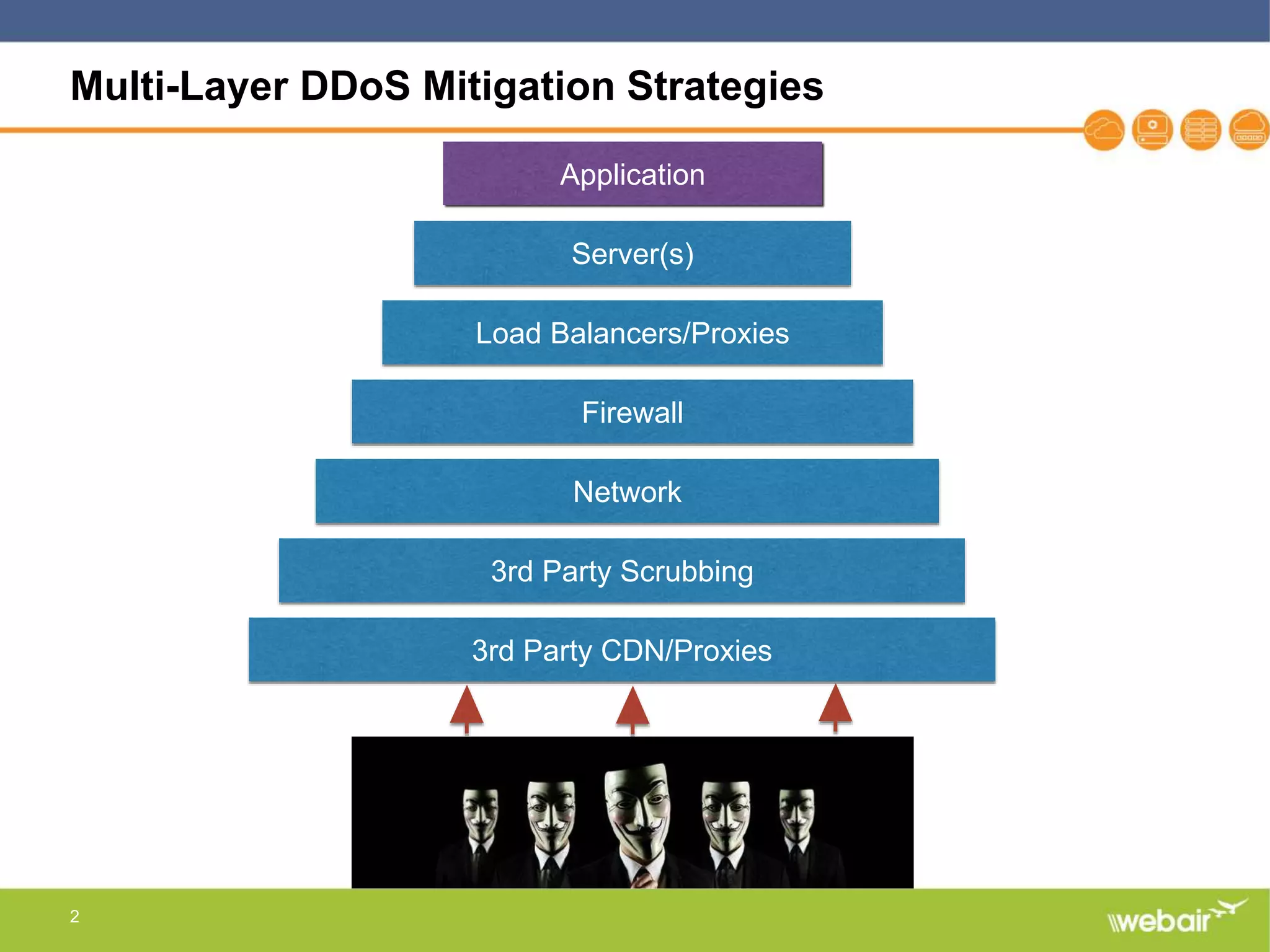
Multi-Layer DDoS Mitigation Strategies
Application
Server(s)
Load Balancers/Proxies
Firewall
Network
3rd Party Scrubbing
3rd Party CDN/Proxies
3
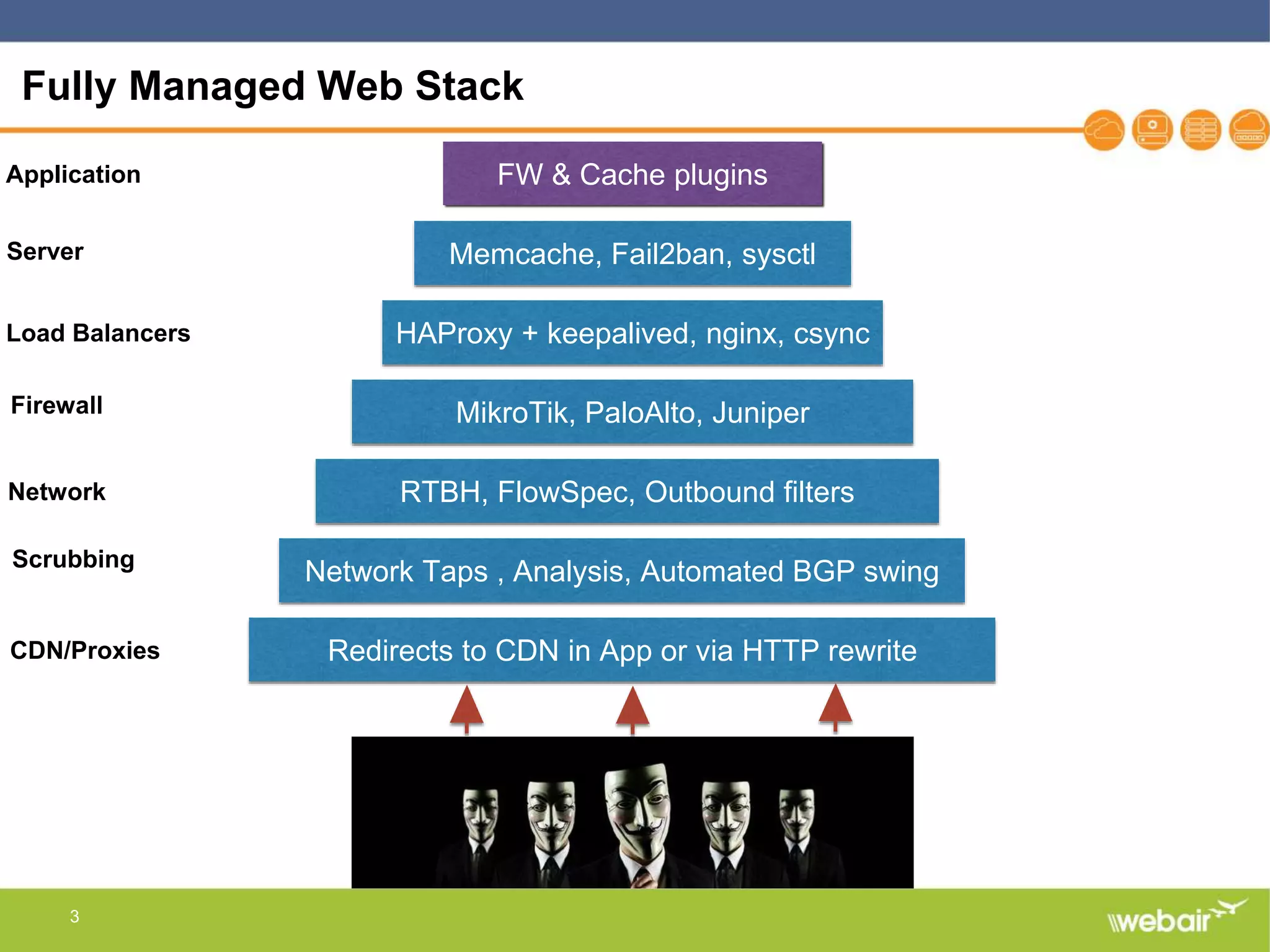
Fully Managed Web Stack
FW & Cache plugins
Memcache, Fail2ban, sysctl
HAProxy + keepalived, nginx, csync
MikroTik, PaloAlto, Juniper
RTBH, FlowSpec, Outbound filters
Network Taps , Analysis, Automated BGP swing
Redirects to CDN in App or via HTTP rewrite
Application
Server
Load Balancers
Firewall
Network
Scrubbing
CDN/Proxies
4
Why? - New Attack Landscape
• DDoS Ransom on the rise with Bitcoins - Attackers becoming more
anonymous
• Multiple governments issue warnings about DD4BC
• Stress Testers
• Used to be called “booters’, available on IRC (EFnet anyone?)
• DDoS-as-a-Service
• Christmas 2014, Lizard Squad “stress tested” PSN and Xbox
Live. Sets up lizardstresser.su to monetize.
• Inexpensive - as little as $5/attack
• Technically legal, RageBooter.net claims legal,
provides full phone support.
5
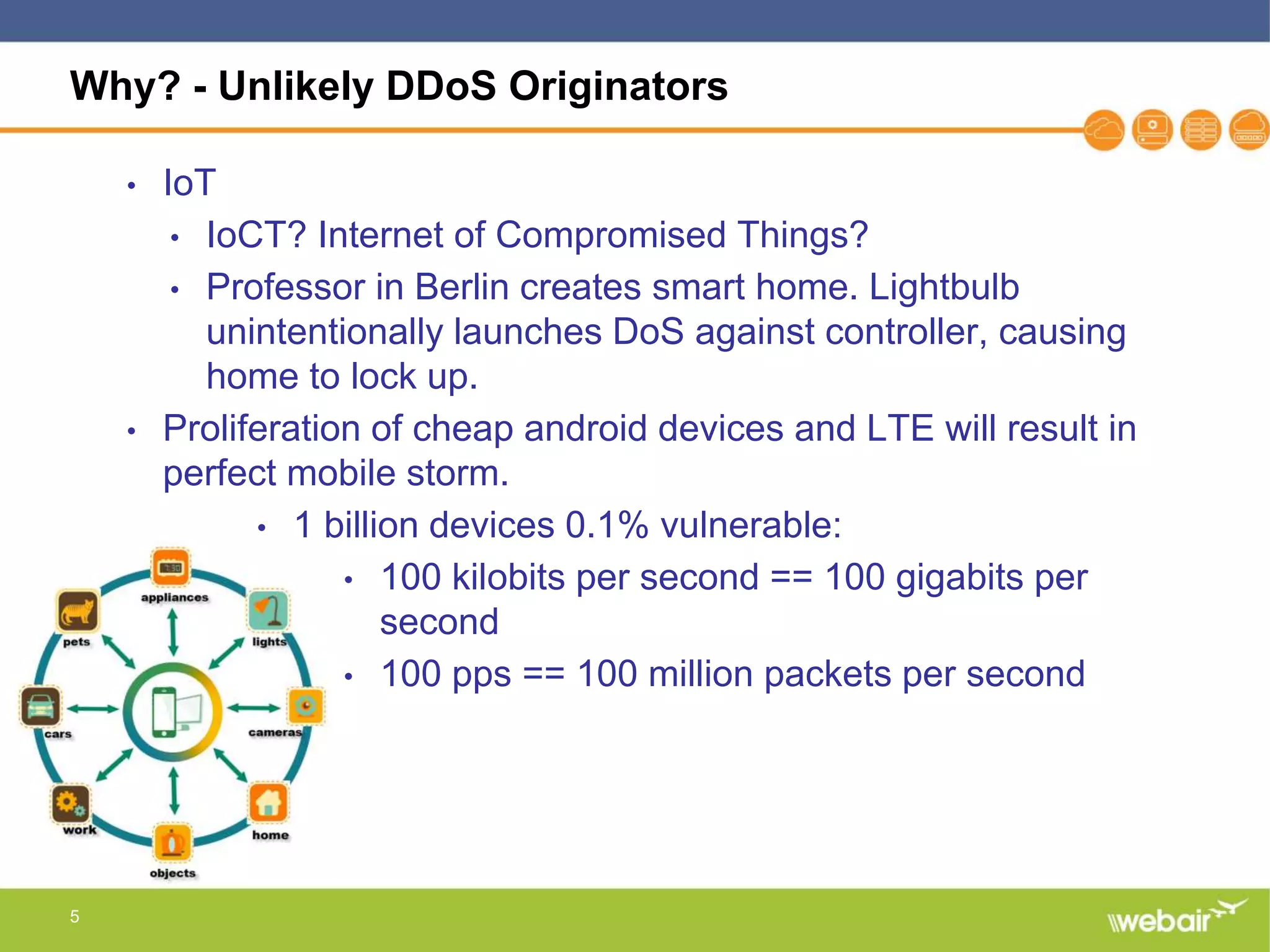
Why? - Unlikely DDoS Originators
• IoT
• IoCT? Internet of Compromised Things?
• Professor in Berlin creates smart home. Lightbulb
unintentionally launches DoS against controller, causing
home to lock up.
• Proliferation of cheap android devices and LTE will result in
perfect mobile storm.
• 1 billion devices 0.1% vulnerable:
• 100 kilobits per second == 100 gigabits per
second
• 100 pps == 100 million packets per second
6
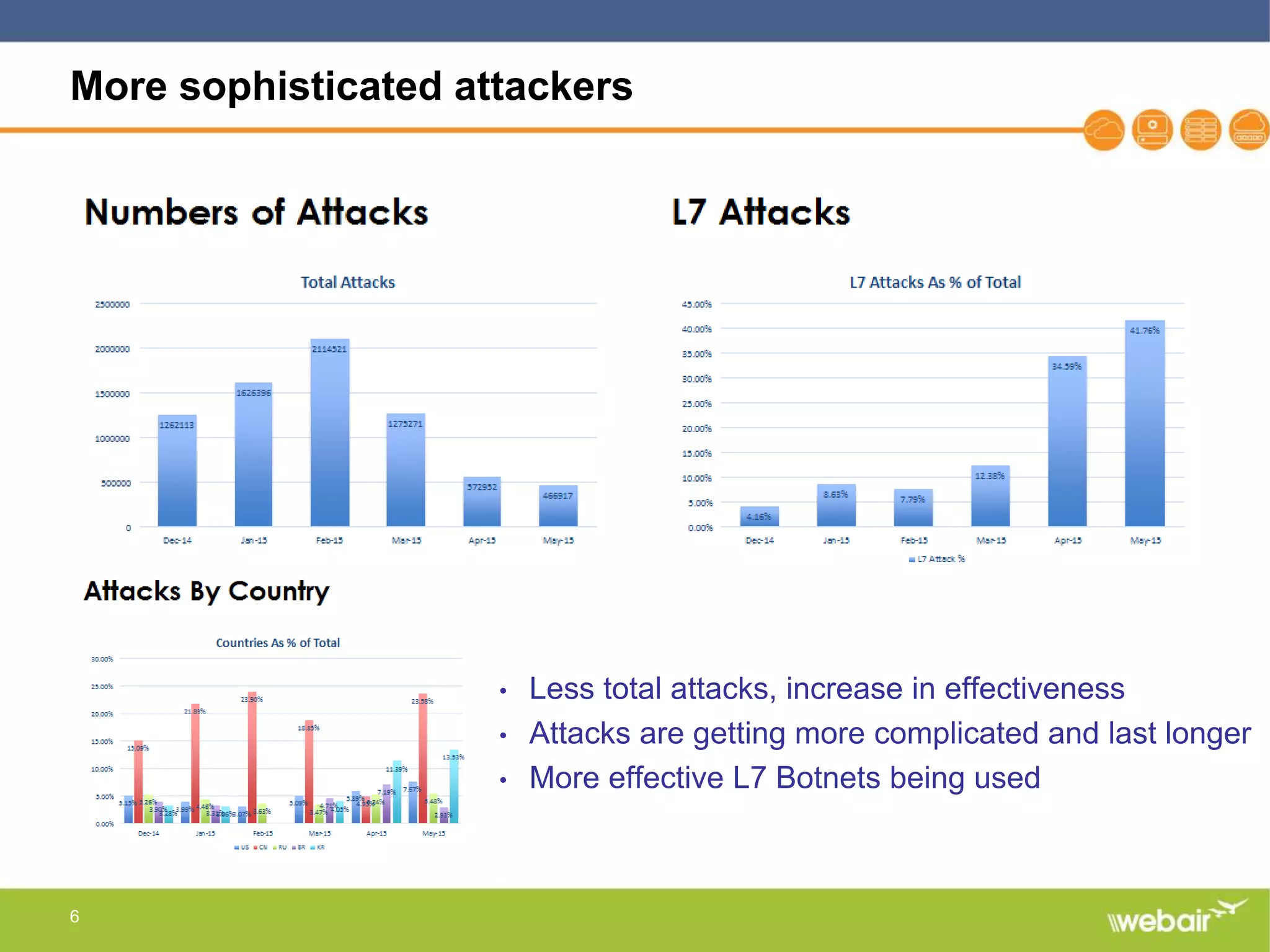
More sophisticated attackers
• Less total attacks, increase in effectiveness
• Attacks are getting more complicated and last longer
• More effective L7 Botnets being used
7
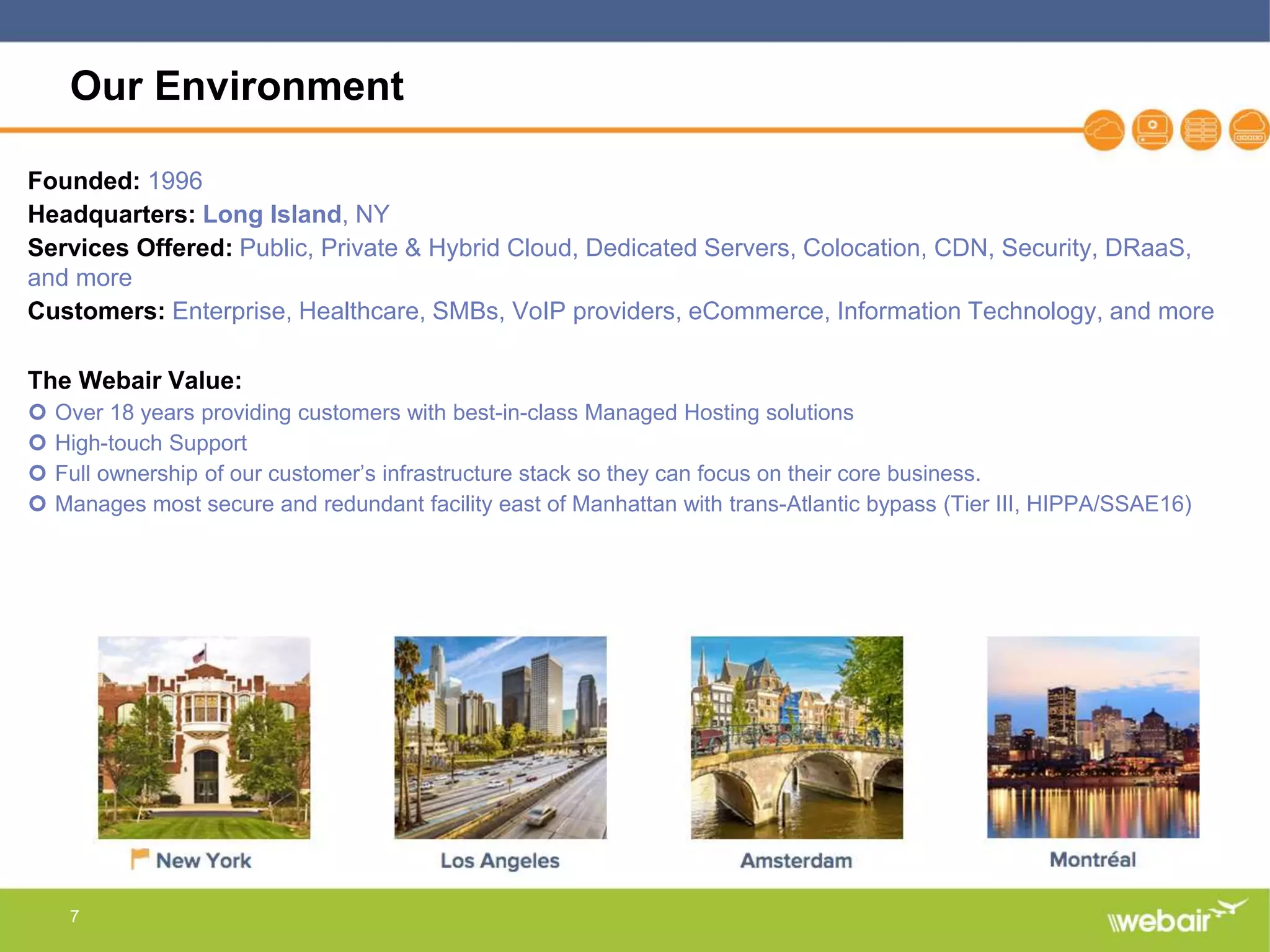
Our Environment
Founded: 1996
Headquarters: Long Island, NY
Services Offered: Public, Private & Hybrid Cloud, Dedicated Servers, Colocation, CDN, Security, DRaaS,
and more
Customers: Enterprise, Healthcare, SMBs, VoIP providers, eCommerce, Information Technology, and more
The Webair Value:
 Over 18 years providing customers with best-in-class Managed Hosting solutions
 High-touch Support
 Full ownership of our customer’s infrastructure stack so they can focus on their core business.
 Manages most secure and redundant facility east of Manhattan with trans-Atlantic bypass (Tier III, HIPPA/SSAE16)
8
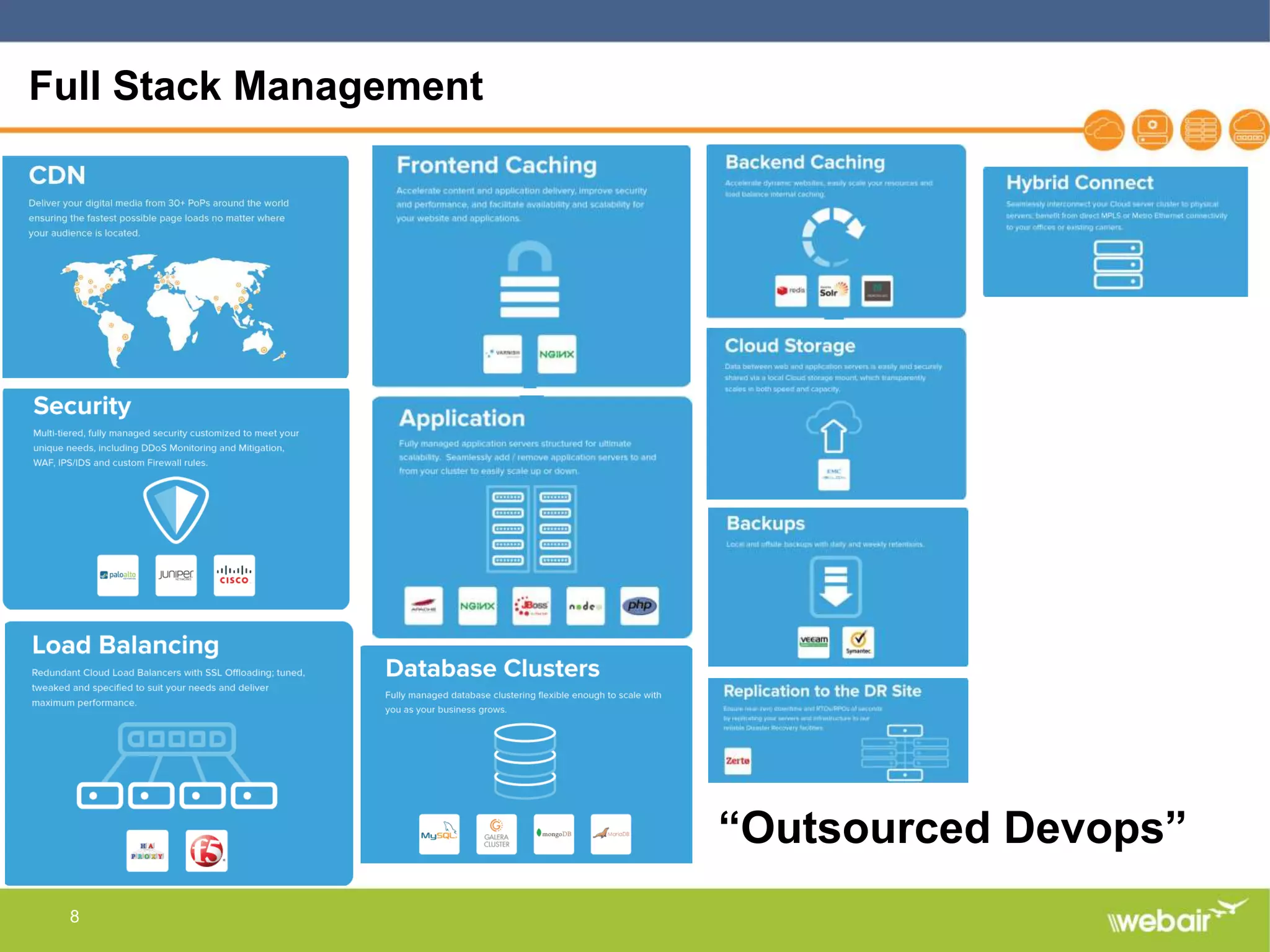
Full Stack Management
“Outsourced Devops”
9
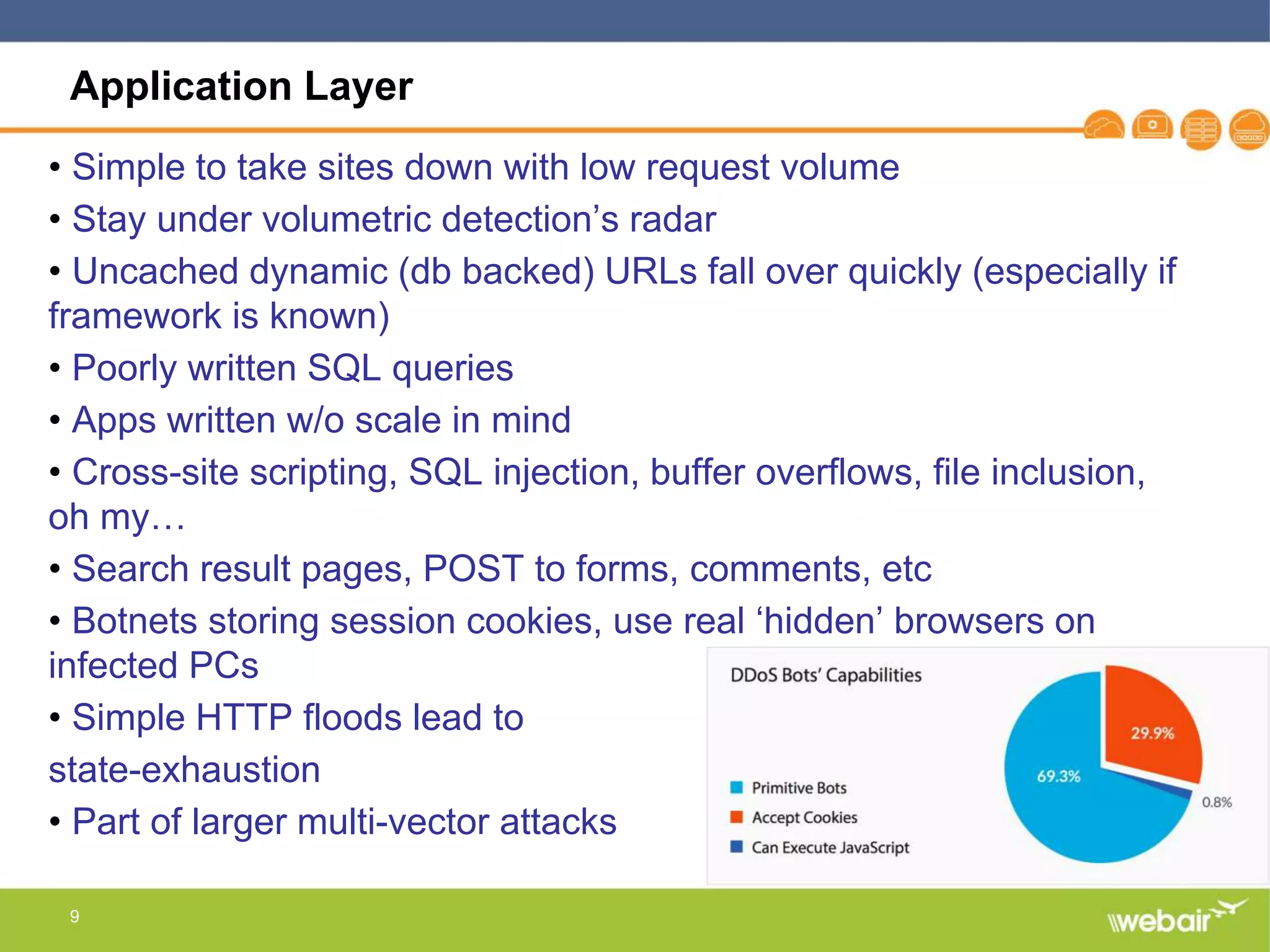
Application Layer
• Simple to take sites down with low request volume
• Stay under volumetric detection’s radar
• Uncached dynamic (db backed) URLs fall over quickly (especially if
framework is known)
• Poorly written SQL queries
• Apps written w/o scale in mind
• Cross-site scripting, SQL injection, buffer overflows, file inclusion,
oh my…
• Search result pages, POST to forms, comments, etc
• Botnets storing session cookies, use real ‘hidden’ browsers on
infected PCs
• Simple HTTP floods lead to
state-exhaustion
• Part of larger multi-vector attacks
10
Application Layer Protection
• Framework or App specific plugins - WP (NinjaFirewall, Wordfence)
• HTTP server modules - mod_evasive, mod_security
• Common caching layers can perform rate limiting based on specific
request attributes (nginx, varnish)
• Cache for security
• In memory - (memcache, redis)
• Opcode caching - (APC, xcache, eAccelerator)
• SQL - (sphinx search, solr, elasticsearch)
• File
• Follow best practices for web scale:
• Disable all unnecessary logging
• Scale-out architecture
• In-memory session management
• (many more!..)
11
Server Layer
Linux Kernel /etc/sysctl.conf customization:
• Prevent against the common 'syn flood attack'
#net.ipv4.tcp_syncookies = 1
• Increase the number of outstanding syn requests allowed
#net.ipv4.tcp_max_syn_backlog = 4096
• Reduce # of potential ACK replies (default 5)
#net.ipv4.tcp_synack_retries = 3
• Reduce # of connections in TIME_WAIT state
#net.ipv4.tcp_fin_timeout = 15
• Enable IP spoofing protection (turn on source route verification)
#net.ipv4.conf.all.rp_filter = 1
#net.ipv4.conf.default.rp_filter = 1
• Decrease the time default value for tcp_keepalive_time connection
#net.ipv4.tcp_keepalive_time = 1800
12
Server Layer
IPTables rules:
• Rate limit and block syn flooding:
#iptables -N syn-flood
#iptables -A syn-flood -m limit --limit 100/second --limit-burst 150 -j RETURN
#iptables -A syn-flood -j LOG --log-prefix "SYN flood: “
#iptables -A syn-flood -j DROP
• Drop excessive RST packets to avoid smurf attacks
#iptables -A INPUT -p tcp -m tcp --tcp-flags RST RST -m limit --limit 2/second --limit-burst 2
-j ACCEPT
#iptables -A INPUT -p icmp -m icmp --icmp-type address-mask-request -j DROP
#iptables -A INPUT -p icmp -m icmp --icmp-type timestamp-request -j DROP
#iptables -A INPUT -p icmp -m icmp -j DROP
• Drop Invalid Packets
#iptables -A INPUT -m state --state INVALID -j DROP
#iptables -A FORWARD -m state --state INVALID -j DROP
#iptables -A OUTPUT -m state --state INVALID -j DROP
13
Server Layer
IPTables rules:
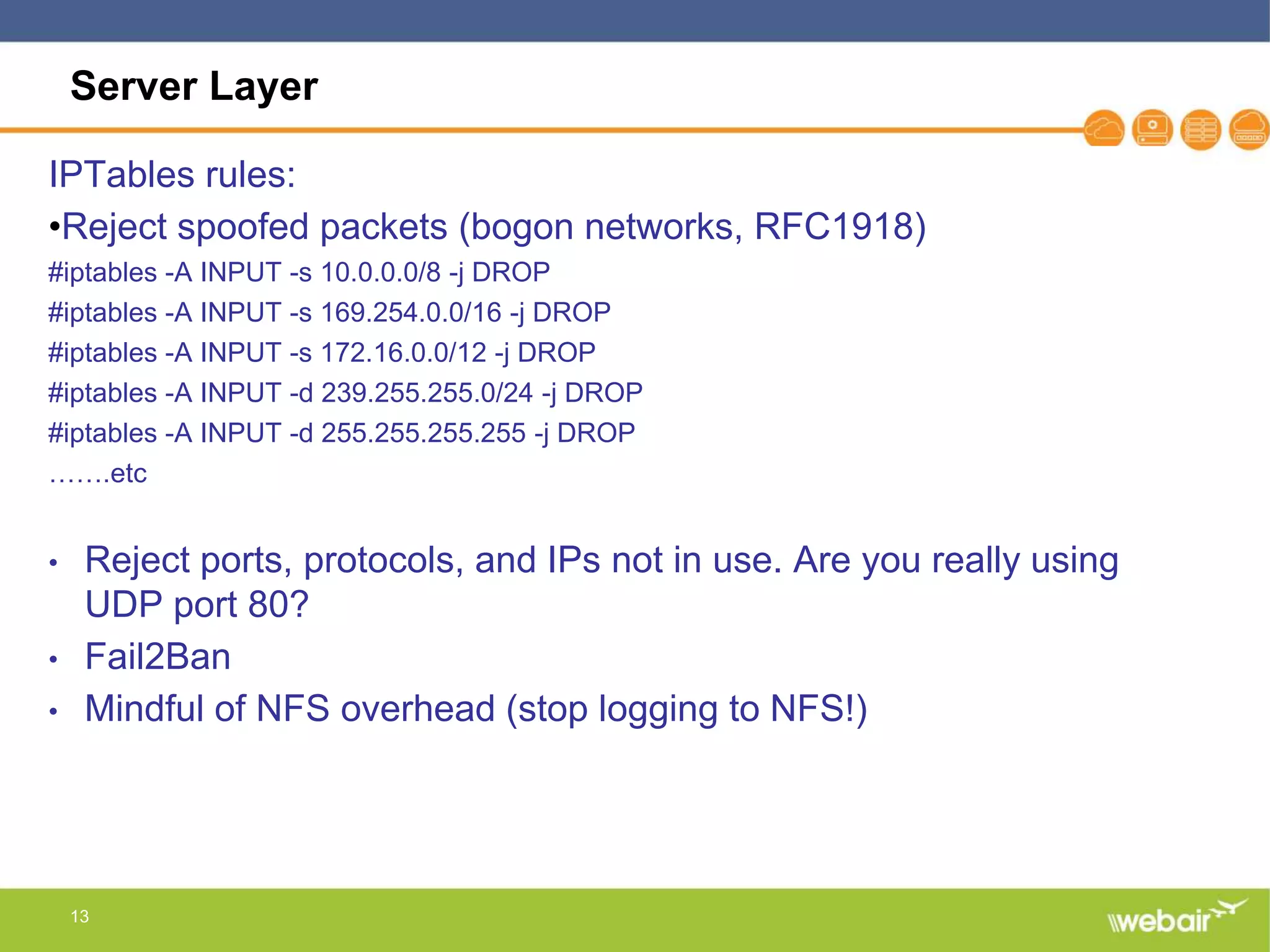
•Reject spoofed packets (bogon networks, RFC1918)
#iptables -A INPUT -s 10.0.0.0/8 -j DROP
#iptables -A INPUT -s 169.254.0.0/16 -j DROP
#iptables -A INPUT -s 172.16.0.0/12 -j DROP
#iptables -A INPUT -d 239.255.255.0/24 -j DROP
#iptables -A INPUT -d 255.255.255.255 -j DROP
…….etc
• Reject ports, protocols, and IPs not in use. Are you really using
UDP port 80?
• Fail2Ban
• Mindful of NFS overhead (stop logging to NFS!)
14
Load Balancers
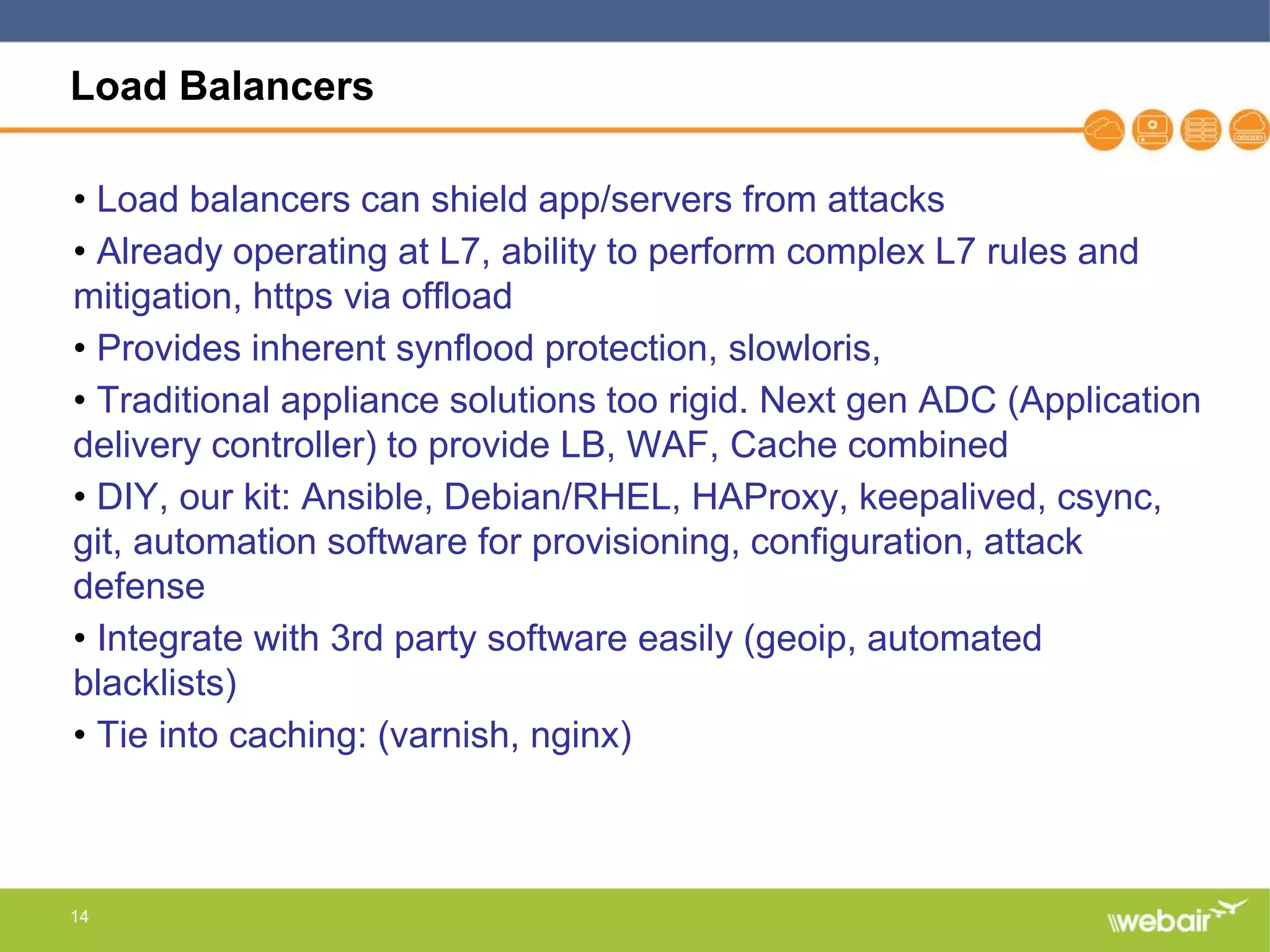
• Load balancers can shield app/servers from attacks
• Already operating at L7, ability to perform complex L7 rules and
mitigation, https via offload
• Provides inherent synflood protection, slowloris,
• Traditional appliance solutions too rigid. Next gen ADC (Application
delivery controller) to provide LB, WAF, Cache combined
• DIY, our kit: Ansible, Debian/RHEL, HAProxy, keepalived, csync,
git, automation software for provisioning, configuration, attack
defense
• Integrate with 3rd party software easily (geoip, automated
blacklists)
• Tie into caching: (varnish, nginx)
15
Load Balancers (HAProxy)
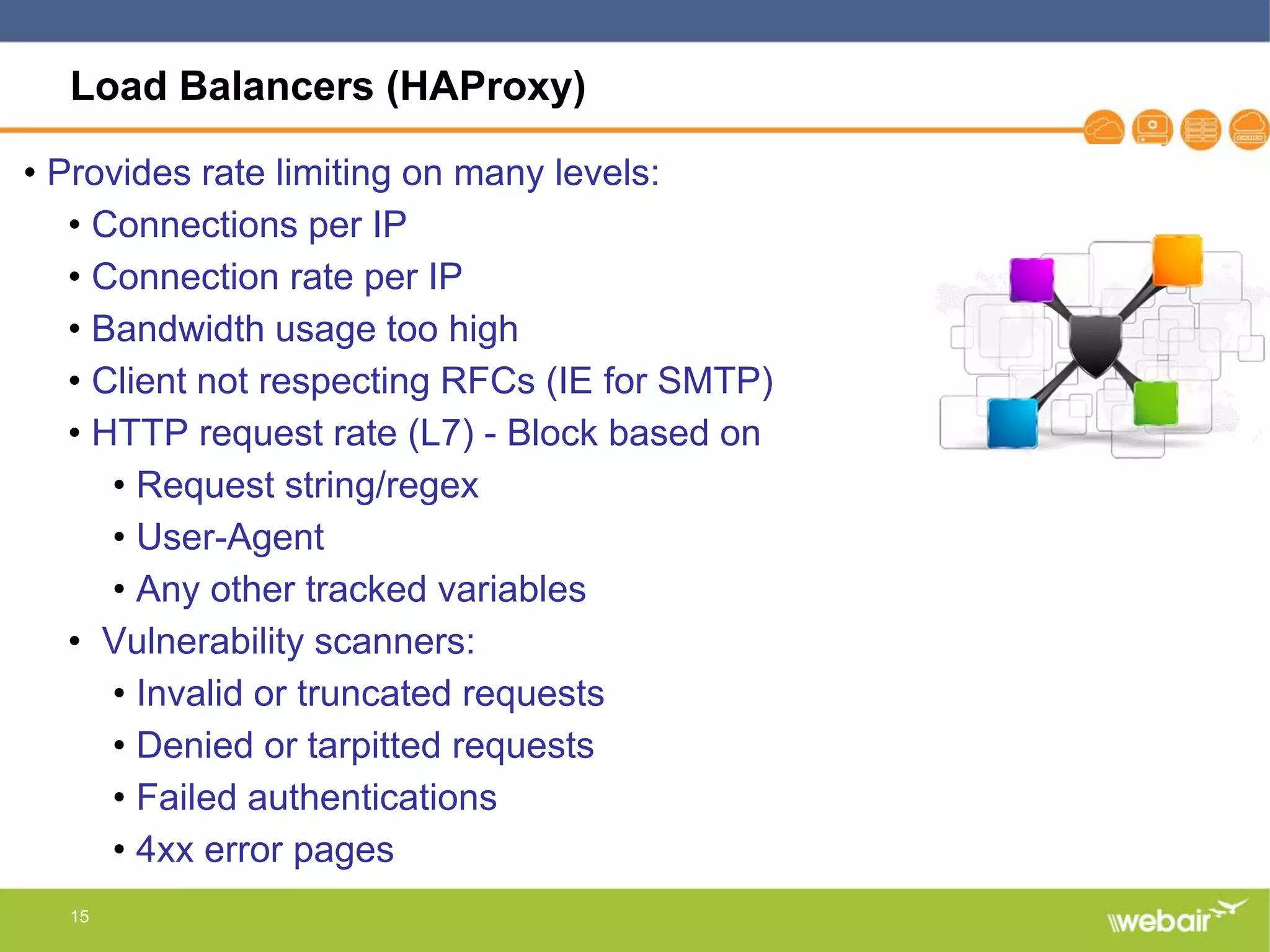
• Provides rate limiting on many levels:
• Connections per IP
• Connection rate per IP
• Bandwidth usage too high
• Client not respecting RFCs (IE for SMTP)
• HTTP request rate (L7) - Block based on
• Request string/regex
• User-Agent
• Any other tracked variables
• Vulnerability scanners:
• Invalid or truncated requests
• Denied or tarpitted requests
• Failed authentications
• 4xx error pages
16
HAProxy examples
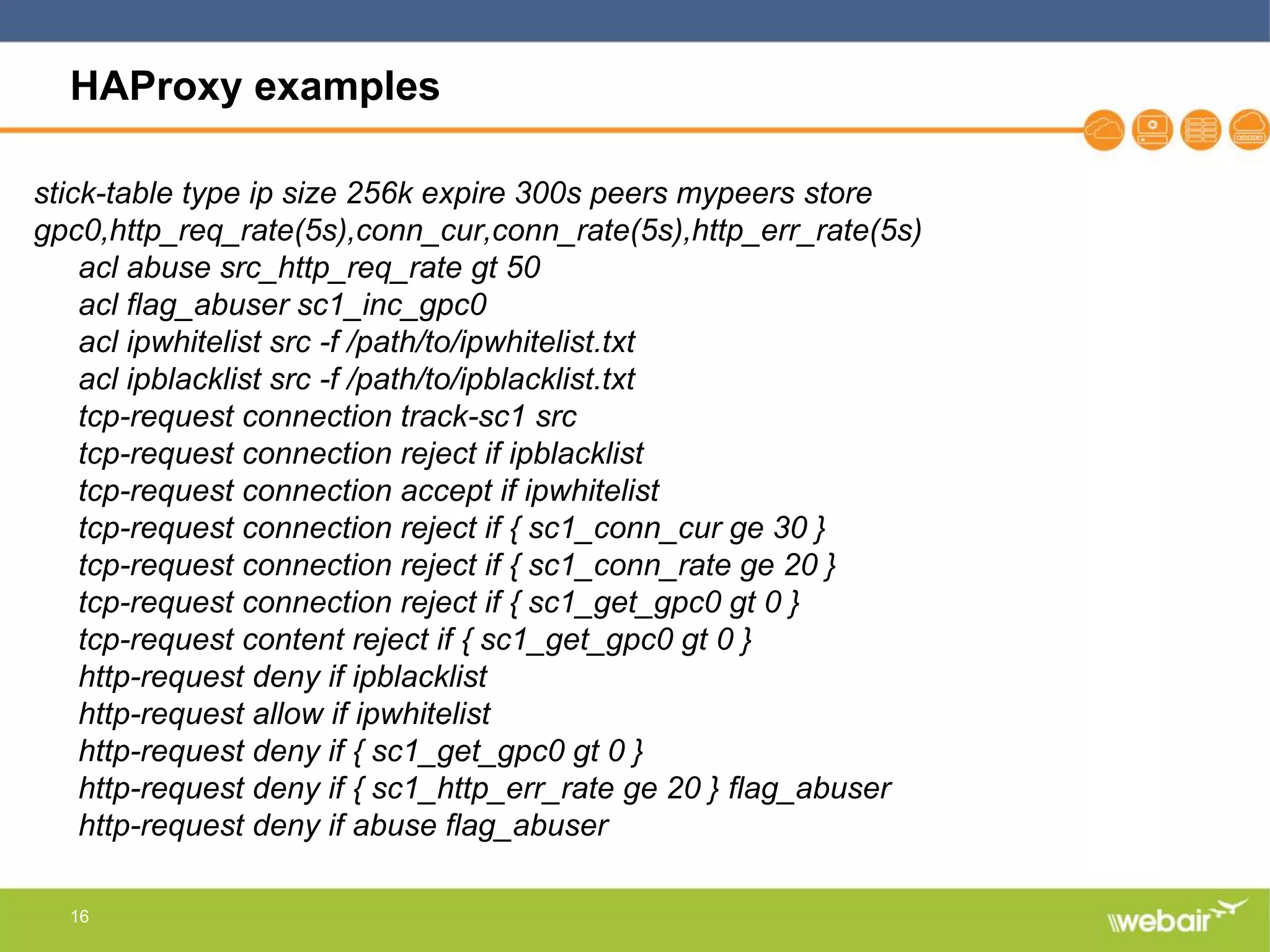
stick-table type ip size 256k expire 300s peers mypeers store
gpc0,http_req_rate(5s),conn_cur,conn_rate(5s),http_err_rate(5s)
acl abuse src_http_req_rate gt 50
acl flag_abuser sc1_inc_gpc0
acl ipwhitelist src -f /path/to/ipwhitelist.txt
acl ipblacklist src -f /path/to/ipblacklist.txt
tcp-request connection track-sc1 src
tcp-request connection reject if ipblacklist
tcp-request connection accept if ipwhitelist
tcp-request connection reject if { sc1_conn_cur ge 30 }
tcp-request connection reject if { sc1_conn_rate ge 20 }
tcp-request connection reject if { sc1_get_gpc0 gt 0 }
tcp-request content reject if { sc1_get_gpc0 gt 0 }
http-request deny if ipblacklist
http-request allow if ipwhitelist
http-request deny if { sc1_get_gpc0 gt 0 }
http-request deny if { sc1_http_err_rate ge 20 } flag_abuser
http-request deny if abuse flag_abuser
17
Firewalls
• WAF capabilities becoming standard w/ all new FWs
• Is WAF even enough? (Palo Alto says no. RASP overtaking WAF)
• L7 SSL inspect via passthrough certs
• Many great OSS options still exist
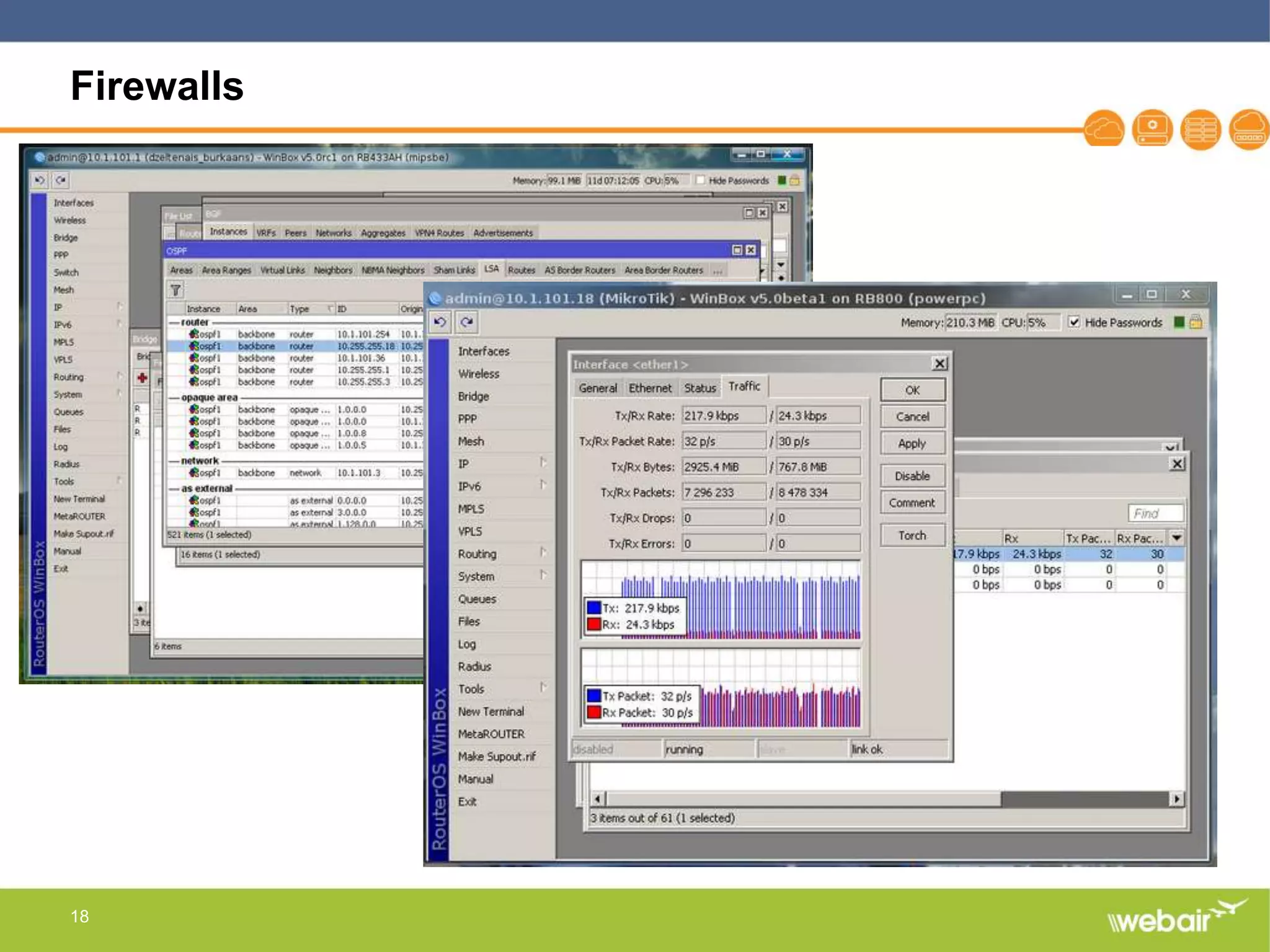
• MikroTik:
• SSH/GUI w/ built in easy packet sniffing
• L7 regex matching
• VPN (IPSec, PPTP, SSTP, L2TP), BGP, OSPF, etc..
• Run a whole ISP on it :)
• HW appliance, w/ support and built in virtualization
• Dynamic address lists based on multitude of rules
• ‘Good’ IPv6 support FTW!
18
Firewalls
19
Network
20
Network
• Block Martian and Bogon routes (automate if possible)
• Unicast Reverse Path Forwarding (w/ full routes)
• Filter unknown outbound packets to prevent spoofing + retaliation
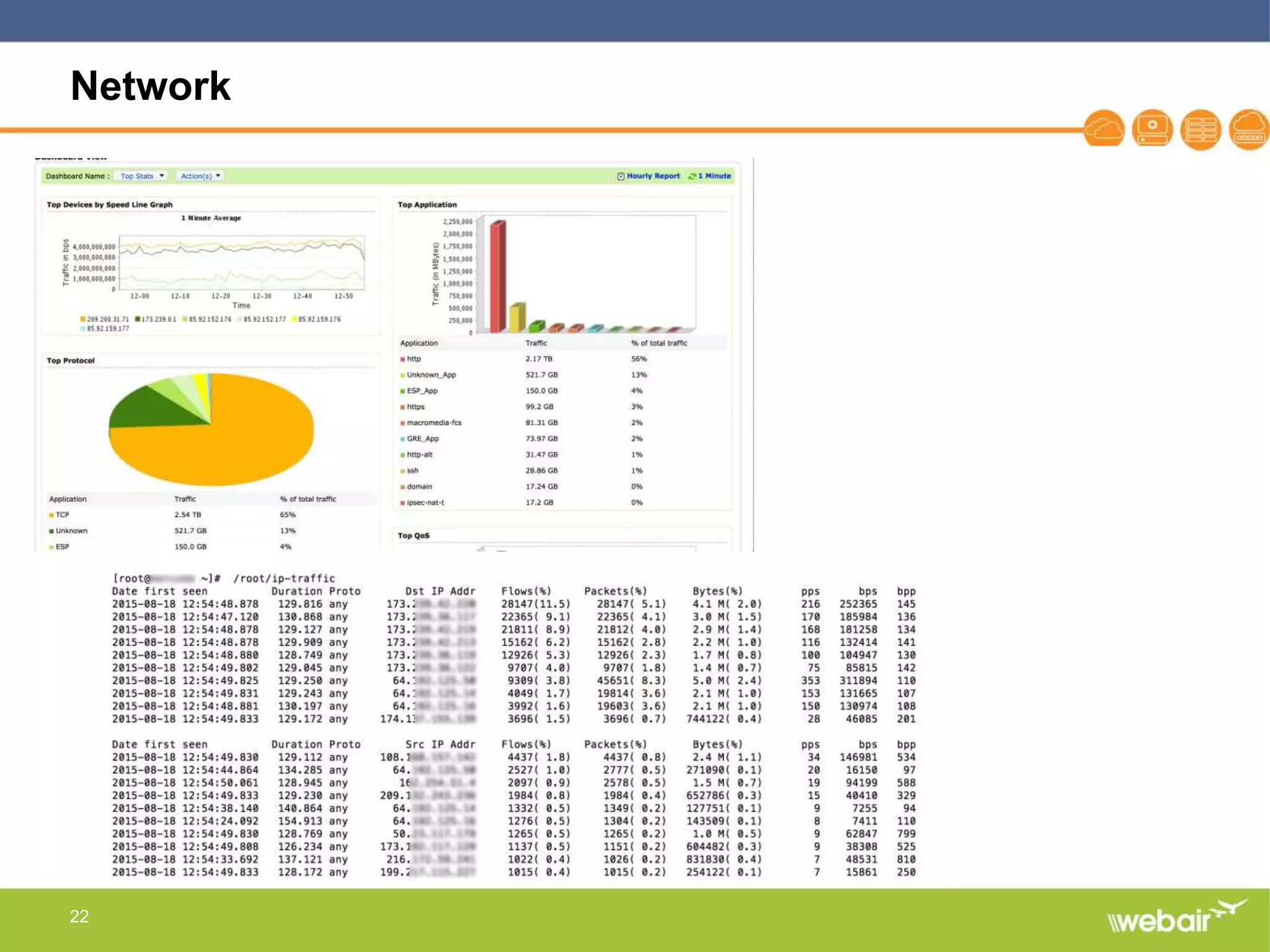
• Proper flow monitoring at the edge - CLI + GUI
• Packet sniffing
• Strategy around reflection attacks:
• Detect internally
• Run scan and patch?
• Block outbound if you can or redirect to internal server(s)
•IPv6 /64 assignments are bad - NDP exhaustion
21
Network
• RTBH (remotely triggered blackhole) on your network (but kills dst)
• Blackhole srcs upstream via community strings
• Automate ^^ via scripts/software
• BGP Flowspec: Use BGP to distribute flow specification filters and
dynamically filter on routers.
• communities based actions (accept, discard, rate-limit, sample,
redirect)
• Match on combination of source/dest prefix, source/dest port,
ICMP type/code, packet size, DSCP, TCP flag, fragment
encoding, etc
• Leverage ASIC filtering in routers
• Available today
22
Network
23
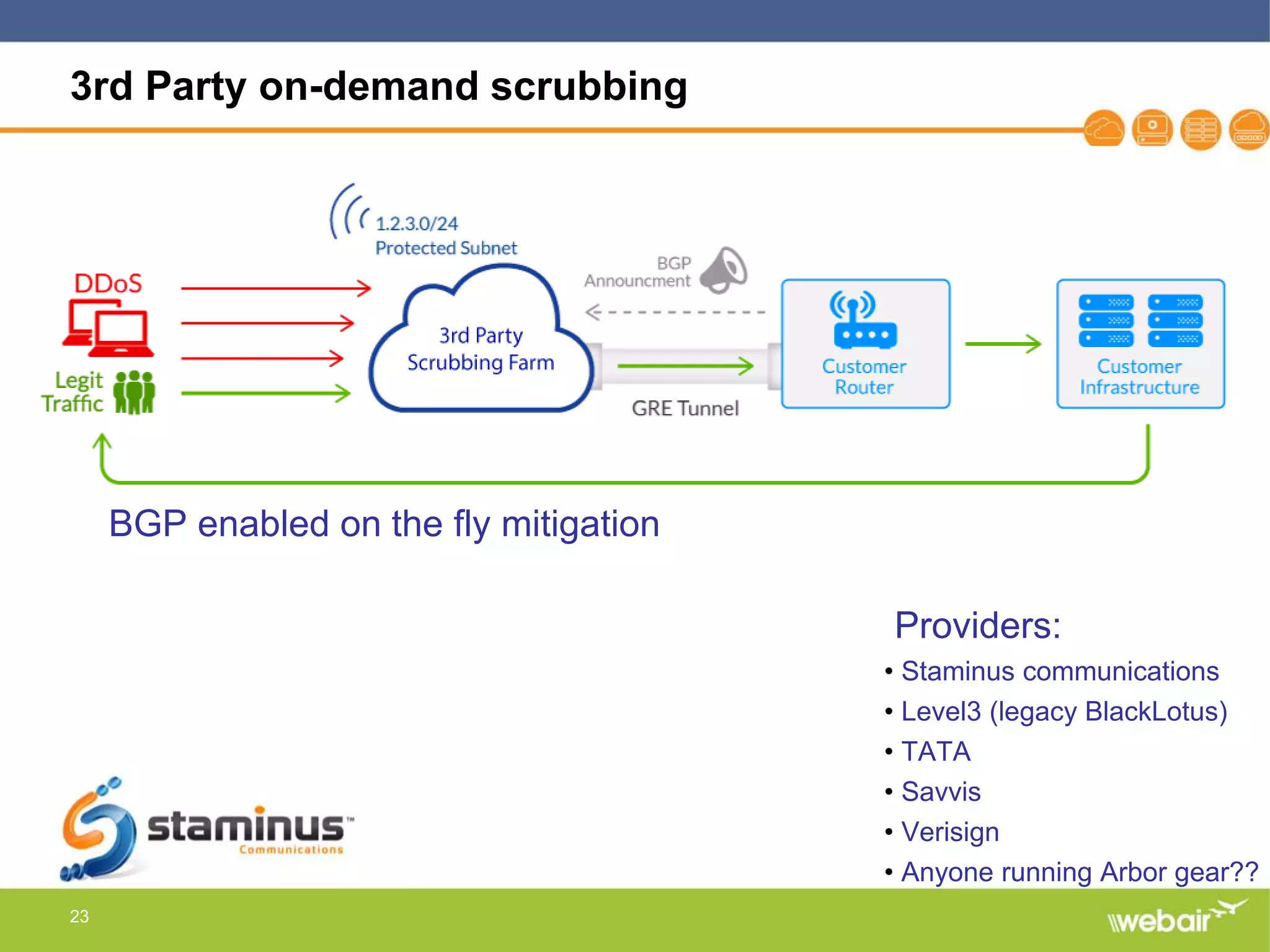
3rd Party on-demand scrubbing
Providers:
• Staminus communications
• Level3 (legacy BlackLotus)
• TATA
• Savvis
• Verisign
• Anyone running Arbor gear??
BGP enabled on the fly mitigation
24
3rd Party on-demand scrubbing
• On Demand: Enable Mitigation only when needed. “Insurance Policy”
• Assume potential attack will always have more BW than you
• Many providers now support L7 mitigation via BGP swing
• Upgrading capacity as needed via contracts, not hardware
• On prem device detects attacks and auto-swings on its own (automation)
• “Big Data” play - view details on attack, portal, reports
• A ‘required’ value add these days
• If BGP cannot be maintained to provider, route withdraws, attack comes b
25
3rd Party CDN/Proxies
• “Always on” - All connections proxies via 3rd party (for better, or worse)
• Usually work well out of the box with popular applications
• Simple way to handle many security touch points:
• Caching & CDN
• WAF capabilities and common injection detection
• SSL offload
• Custom Rules
• Easy to use for Beginners
• Enterprise offerings can:
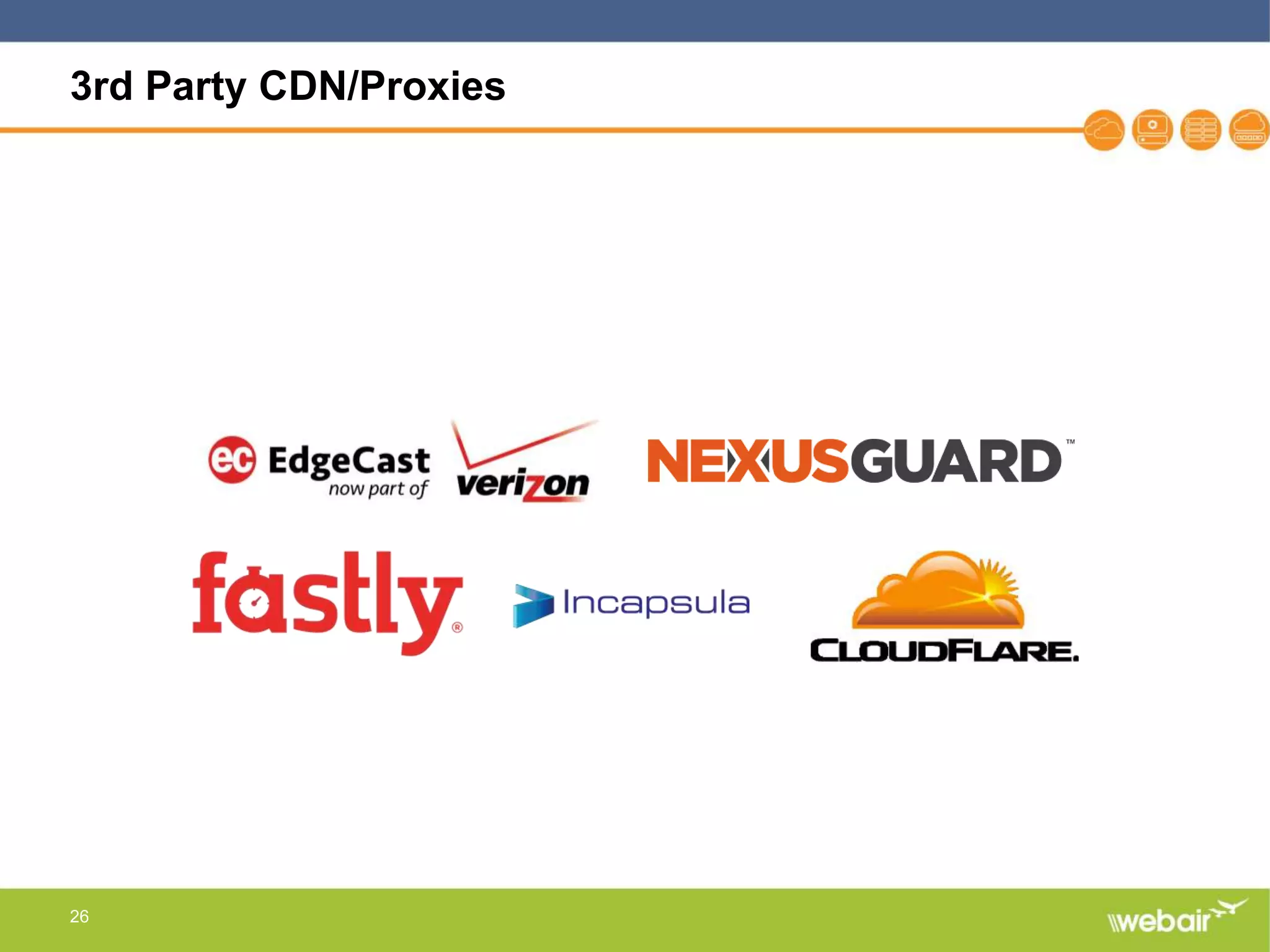
• Cache dynamic applications (EdgeCast/VZW + Fast.ly)
• Work with Varnish VCLs and other common formats
• Mid-tier origin caching
• Option of last resort: CAPTCHA for user verification (eww)
• Not a complete solution, origins are usually found
26
3rd Party CDN/Proxies
27
THANK YOU!
Logan Best
Senior Infrastructure Engineer
logan@webair.com
*Research data provided via Staminus Communication

Multi-Layer DDoS Mitigation Strategies

  • 1.
    1 Multi-Layer DDoS MitigationStrategies Logan Best Senior Infrastructure Engineer logan@webair.com
  • 2.
    2 Multi-Layer DDoS MitigationStrategies Application Server(s) Load Balancers/Proxies Firewall Network 3rd Party Scrubbing 3rd Party CDN/Proxies
  • 3.
    3 Fully Managed WebStack FW & Cache plugins Memcache, Fail2ban, sysctl HAProxy + keepalived, nginx, csync MikroTik, PaloAlto, Juniper RTBH, FlowSpec, Outbound filters Network Taps , Analysis, Automated BGP swing Redirects to CDN in App or via HTTP rewrite Application Server Load Balancers Firewall Network Scrubbing CDN/Proxies
  • 4.
    4 Why? - NewAttack Landscape • DDoS Ransom on the rise with Bitcoins - Attackers becoming more anonymous • Multiple governments issue warnings about DD4BC • Stress Testers • Used to be called “booters’, available on IRC (EFnet anyone?) • DDoS-as-a-Service • Christmas 2014, Lizard Squad “stress tested” PSN and Xbox Live. Sets up lizardstresser.su to monetize. • Inexpensive - as little as $5/attack • Technically legal, RageBooter.net claims legal, provides full phone support.
  • 5.
    5 Why? - UnlikelyDDoS Originators • IoT • IoCT? Internet of Compromised Things? • Professor in Berlin creates smart home. Lightbulb unintentionally launches DoS against controller, causing home to lock up. • Proliferation of cheap android devices and LTE will result in perfect mobile storm. • 1 billion devices 0.1% vulnerable: • 100 kilobits per second == 100 gigabits per second • 100 pps == 100 million packets per second
  • 6.
    6 More sophisticated attackers •Less total attacks, increase in effectiveness • Attacks are getting more complicated and last longer • More effective L7 Botnets being used
  • 7.
    7 Our Environment Founded: 1996 Headquarters:Long Island, NY Services Offered: Public, Private & Hybrid Cloud, Dedicated Servers, Colocation, CDN, Security, DRaaS, and more Customers: Enterprise, Healthcare, SMBs, VoIP providers, eCommerce, Information Technology, and more The Webair Value:  Over 18 years providing customers with best-in-class Managed Hosting solutions  High-touch Support  Full ownership of our customer’s infrastructure stack so they can focus on their core business.  Manages most secure and redundant facility east of Manhattan with trans-Atlantic bypass (Tier III, HIPPA/SSAE16)
  • 8.
  • 9.
    9 Application Layer • Simpleto take sites down with low request volume • Stay under volumetric detection’s radar • Uncached dynamic (db backed) URLs fall over quickly (especially if framework is known) • Poorly written SQL queries • Apps written w/o scale in mind • Cross-site scripting, SQL injection, buffer overflows, file inclusion, oh my… • Search result pages, POST to forms, comments, etc • Botnets storing session cookies, use real ‘hidden’ browsers on infected PCs • Simple HTTP floods lead to state-exhaustion • Part of larger multi-vector attacks
  • 10.
    10 Application Layer Protection •Framework or App specific plugins - WP (NinjaFirewall, Wordfence) • HTTP server modules - mod_evasive, mod_security • Common caching layers can perform rate limiting based on specific request attributes (nginx, varnish) • Cache for security • In memory - (memcache, redis) • Opcode caching - (APC, xcache, eAccelerator) • SQL - (sphinx search, solr, elasticsearch) • File • Follow best practices for web scale: • Disable all unnecessary logging • Scale-out architecture • In-memory session management • (many more!..)
  • 11.
    11 Server Layer Linux Kernel/etc/sysctl.conf customization: • Prevent against the common 'syn flood attack' #net.ipv4.tcp_syncookies = 1 • Increase the number of outstanding syn requests allowed #net.ipv4.tcp_max_syn_backlog = 4096 • Reduce # of potential ACK replies (default 5) #net.ipv4.tcp_synack_retries = 3 • Reduce # of connections in TIME_WAIT state #net.ipv4.tcp_fin_timeout = 15 • Enable IP spoofing protection (turn on source route verification) #net.ipv4.conf.all.rp_filter = 1 #net.ipv4.conf.default.rp_filter = 1 • Decrease the time default value for tcp_keepalive_time connection #net.ipv4.tcp_keepalive_time = 1800
  • 12.
    12 Server Layer IPTables rules: •Rate limit and block syn flooding: #iptables -N syn-flood #iptables -A syn-flood -m limit --limit 100/second --limit-burst 150 -j RETURN #iptables -A syn-flood -j LOG --log-prefix "SYN flood: “ #iptables -A syn-flood -j DROP • Drop excessive RST packets to avoid smurf attacks #iptables -A INPUT -p tcp -m tcp --tcp-flags RST RST -m limit --limit 2/second --limit-burst 2 -j ACCEPT #iptables -A INPUT -p icmp -m icmp --icmp-type address-mask-request -j DROP #iptables -A INPUT -p icmp -m icmp --icmp-type timestamp-request -j DROP #iptables -A INPUT -p icmp -m icmp -j DROP • Drop Invalid Packets #iptables -A INPUT -m state --state INVALID -j DROP #iptables -A FORWARD -m state --state INVALID -j DROP #iptables -A OUTPUT -m state --state INVALID -j DROP
  • 13.
    13 Server Layer IPTables rules: •Rejectspoofed packets (bogon networks, RFC1918) #iptables -A INPUT -s 10.0.0.0/8 -j DROP #iptables -A INPUT -s 169.254.0.0/16 -j DROP #iptables -A INPUT -s 172.16.0.0/12 -j DROP #iptables -A INPUT -d 239.255.255.0/24 -j DROP #iptables -A INPUT -d 255.255.255.255 -j DROP …….etc • Reject ports, protocols, and IPs not in use. Are you really using UDP port 80? • Fail2Ban • Mindful of NFS overhead (stop logging to NFS!)
  • 14.
    14 Load Balancers • Loadbalancers can shield app/servers from attacks • Already operating at L7, ability to perform complex L7 rules and mitigation, https via offload • Provides inherent synflood protection, slowloris, • Traditional appliance solutions too rigid. Next gen ADC (Application delivery controller) to provide LB, WAF, Cache combined • DIY, our kit: Ansible, Debian/RHEL, HAProxy, keepalived, csync, git, automation software for provisioning, configuration, attack defense • Integrate with 3rd party software easily (geoip, automated blacklists) • Tie into caching: (varnish, nginx)
  • 15.
    15 Load Balancers (HAProxy) •Provides rate limiting on many levels: • Connections per IP • Connection rate per IP • Bandwidth usage too high • Client not respecting RFCs (IE for SMTP) • HTTP request rate (L7) - Block based on • Request string/regex • User-Agent • Any other tracked variables • Vulnerability scanners: • Invalid or truncated requests • Denied or tarpitted requests • Failed authentications • 4xx error pages
  • 16.
    16 HAProxy examples stick-table typeip size 256k expire 300s peers mypeers store gpc0,http_req_rate(5s),conn_cur,conn_rate(5s),http_err_rate(5s) acl abuse src_http_req_rate gt 50 acl flag_abuser sc1_inc_gpc0 acl ipwhitelist src -f /path/to/ipwhitelist.txt acl ipblacklist src -f /path/to/ipblacklist.txt tcp-request connection track-sc1 src tcp-request connection reject if ipblacklist tcp-request connection accept if ipwhitelist tcp-request connection reject if { sc1_conn_cur ge 30 } tcp-request connection reject if { sc1_conn_rate ge 20 } tcp-request connection reject if { sc1_get_gpc0 gt 0 } tcp-request content reject if { sc1_get_gpc0 gt 0 } http-request deny if ipblacklist http-request allow if ipwhitelist http-request deny if { sc1_get_gpc0 gt 0 } http-request deny if { sc1_http_err_rate ge 20 } flag_abuser http-request deny if abuse flag_abuser
  • 17.
    17 Firewalls • WAF capabilitiesbecoming standard w/ all new FWs • Is WAF even enough? (Palo Alto says no. RASP overtaking WAF) • L7 SSL inspect via passthrough certs • Many great OSS options still exist • MikroTik: • SSH/GUI w/ built in easy packet sniffing • L7 regex matching • VPN (IPSec, PPTP, SSTP, L2TP), BGP, OSPF, etc.. • Run a whole ISP on it :) • HW appliance, w/ support and built in virtualization • Dynamic address lists based on multitude of rules • ‘Good’ IPv6 support FTW!
  • 18.
  • 19.
  • 20.
    20 Network • Block Martianand Bogon routes (automate if possible) • Unicast Reverse Path Forwarding (w/ full routes) • Filter unknown outbound packets to prevent spoofing + retaliation • Proper flow monitoring at the edge - CLI + GUI • Packet sniffing • Strategy around reflection attacks: • Detect internally • Run scan and patch? • Block outbound if you can or redirect to internal server(s) •IPv6 /64 assignments are bad - NDP exhaustion
  • 21.
    21 Network • RTBH (remotelytriggered blackhole) on your network (but kills dst) • Blackhole srcs upstream via community strings • Automate ^^ via scripts/software • BGP Flowspec: Use BGP to distribute flow specification filters and dynamically filter on routers. • communities based actions (accept, discard, rate-limit, sample, redirect) • Match on combination of source/dest prefix, source/dest port, ICMP type/code, packet size, DSCP, TCP flag, fragment encoding, etc • Leverage ASIC filtering in routers • Available today
  • 22.
  • 23.
    23 3rd Party on-demandscrubbing Providers: • Staminus communications • Level3 (legacy BlackLotus) • TATA • Savvis • Verisign • Anyone running Arbor gear?? BGP enabled on the fly mitigation
  • 24.
    24 3rd Party on-demandscrubbing • On Demand: Enable Mitigation only when needed. “Insurance Policy” • Assume potential attack will always have more BW than you • Many providers now support L7 mitigation via BGP swing • Upgrading capacity as needed via contracts, not hardware • On prem device detects attacks and auto-swings on its own (automation) • “Big Data” play - view details on attack, portal, reports • A ‘required’ value add these days • If BGP cannot be maintained to provider, route withdraws, attack comes b
  • 25.
    25 3rd Party CDN/Proxies •“Always on” - All connections proxies via 3rd party (for better, or worse) • Usually work well out of the box with popular applications • Simple way to handle many security touch points: • Caching & CDN • WAF capabilities and common injection detection • SSL offload • Custom Rules • Easy to use for Beginners • Enterprise offerings can: • Cache dynamic applications (EdgeCast/VZW + Fast.ly) • Work with Varnish VCLs and other common formats • Mid-tier origin caching • Option of last resort: CAPTCHA for user verification (eww) • Not a complete solution, origins are usually found
  • 26.
  • 27.
    27 THANK YOU! Logan Best SeniorInfrastructure Engineer logan@webair.com *Research data provided via Staminus Communication

Editor's Notes

  • #2 Speaker: Logan
  • #3 Speaker: Logan
  • #4 Speaker: Logan
  • #5 Speaker: Logan
  • #6 Speaker: Logan 100Gbps attack, being generous - How exactly do you reboot your home?
  • #7 Speaker: Logan lower # of total attacks can do with less attacks, with low BW L7 attacks bonnets ingest and follow cookies, parse JS
  • #8 Speaker: Logan MSP cloud service prov.
  • #9 Speaker: Logan full stack mgmt, full infra outsourcing. a lot we have to do as a company at each layer to make sure they’re secure value proposition
  • #10 Speaker: Logan 1st layer, talking about OSS (WP, drupal, frameworks like CakePHP, Django), enterprise apps, java apps search engine example
  • #11 Speaker: Logan what can the application do itself to protect itself? caching with speed cache cron
  • #12 Speaker: Logan Simple things like per-IP rate limiting, flooding rate limits, and syn cookies should be enabled without a question. The sysctl variables improves the overall network handling efficiency and protects about common SYN/ACK Denial of service attacks. In syslog on server, I saw lots of "nf_conntrack: table full, dropping packet". And netstat showed lots of TIME_WAIT.
  • #13 Speaker: Logan In syslog on server, I saw lots of "nf_conntrack: table full, dropping packet". And netstat showed lots of TIME_WAIT.
  • #14 Speaker: Logan alternative: sshguard
  • #15 Speaker: Logan An application delivery controller (ADC) is a computer network device in a datacenter, often part of an application delivery network (ADN), that helps perform common tasks such as those done by web sites to remove load from the web servers themselves. Many also provide load balancing.
  • #16 Speaker: Logan
  • #17 Speaker: Logan Our Basic HAP ddos config ACL’s. Many many more options to harden applications of all types
  • #18 Speaker: Logan
  • #19 Speaker: Logan
  • #20 Speaker: Logan L3 distribution islands
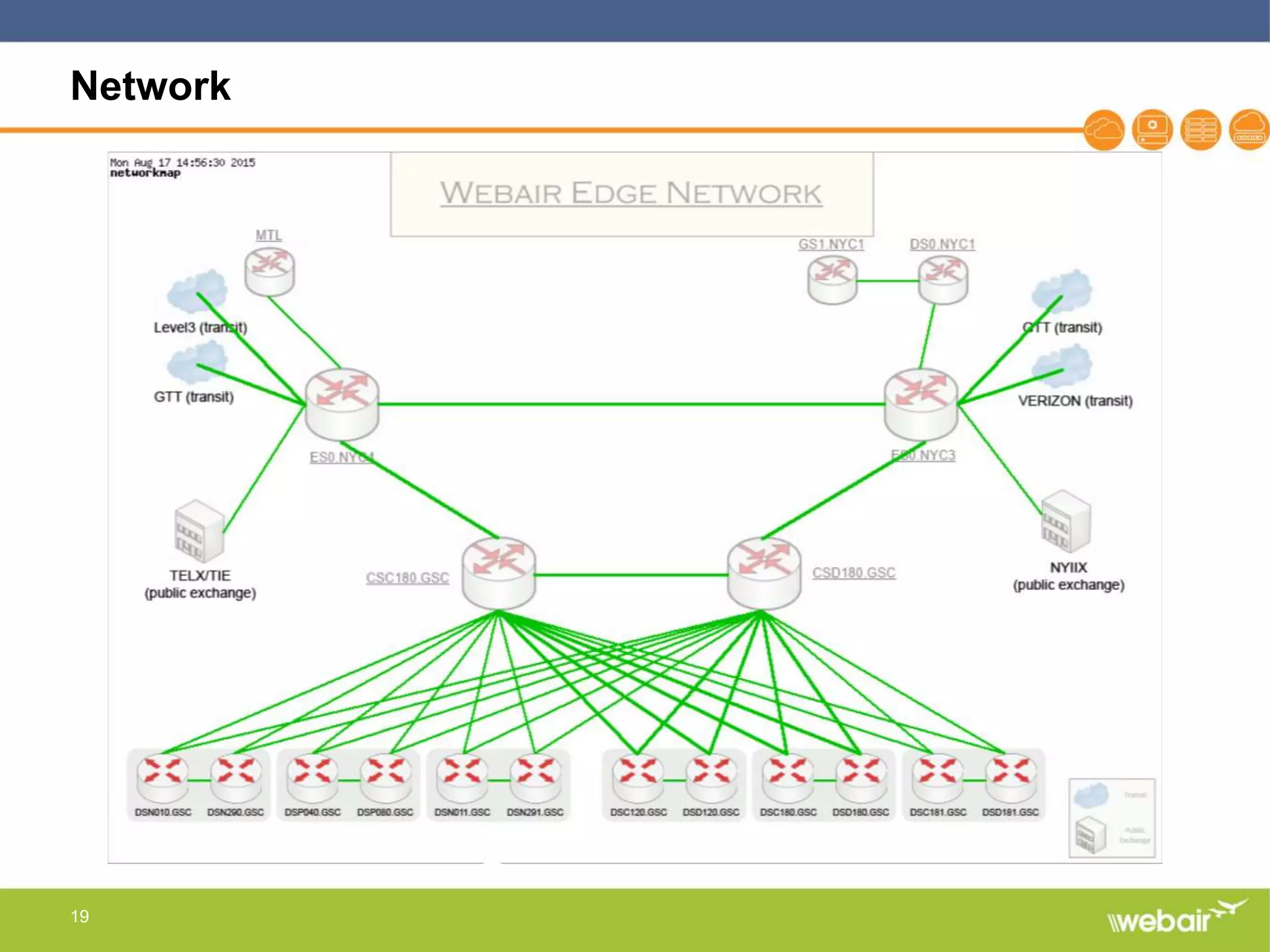
  • #21 Speaker: Logan bogons are pubic ranges not allocated yet, cron to update URPF, packet comes in, want to be sure your routing table is telling you that it’s a source IP that you can route back to. if spoofed you don’t want to accept it. outbound as well filter_outbound acl NetFlow/sFlow collectors, arbor stuff mention NTP and DNS reflection specifically, we block all inbound/outbound NTP. can’t sync, reroute outbound NTP to our own detail IPv6 Allocation/Assignment flow (Allocate /64 to client, assign /120 etc to vlan)
  • #22 Speaker: Logan Being able to tell transit prove to block upstream doing attackers dirty work, letting them win flowspec, new protocol being adopted. more abilities at the phys layer, instead of black holing build policies to rate limit, police it , reroute to internal scrubbing farms.
  • #23 Speaker: Logan OOB access
  • #24 Speaker: Logan Prolexic/Black Lotus? announcing IP space to providers, who are then propagating it to the rest of the internet. attack clogs pipes. when attack comes in, tell scrubbing farm to announce that /24 to the Internet, routing table updates in 30 sec. Been around since around 2002.
  • #25 Speaker: Logan SLA on attack BW traditionally L4 w/DNS swing combine mitigation with automated swing learn & understand packet patterns, std deviation
  • #26 Speaker: Logan change DNS custom rules (pay to play) captcha not a complete solution. provider gave up
  • #28 Speaker: Logan going to see more proactive defense, deploying honeypots building data signatures to prevent attacks earlier 3rd party proxies are probably already doing that.