Nano-based
Drug Delivery
Systems
Zeeshan Yaseen (16536)
Definition
by NIH USA
• “Formulation of device that enables
the introduction of therapeutic agent
in the body and improves efficiency
and safety by control the rate, time
and place of release of drug.”
• Mainly, there are two ways of
introduction of drug into the body;
1. Non-invasive administration
2. Invasive administration
Why there is a
need of nano-
systems
Traditional drug delivery systems have some
problems;
• Poor bio-availability
• Poor solubility
• Poor absorption
• In-vivo instability
• Adverse effects of drug (if being not
released in controlled way)
How nano-
based DDSs
are a help
Nano-based DDS has following abilities that
make them preferable.
• Drug delivery is targeted
• There is controlled dosage and release-time
• Improved bioavailability, solubility,
saturation and reduced plasma fluctuation
• Effective drug carriers (NPs) because they
are stable and travel throughout the blood
stream without sedimentation
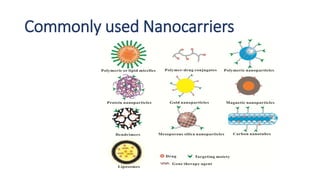
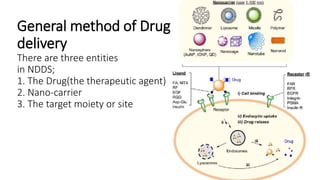
Commonly used Nanocarriers
General method of Drug
delivery
There are three entities
in NDDS;
1. The Drug(the therapeutic agent)
2. Nano-carrier
3. The target moiety or site
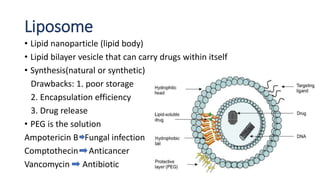
Liposome
• Lipid nanoparticle (lipid body)
• Lipid bilayer vesicle that can carry drugs within itself
• Synthesis(natural or synthetic)
Drawbacks: 1. poor storage
2. Encapsulation efficiency
3. Drug release
• PEG is the solution
Ampotericin B Fungal infection
Comptothecin Anticancer
Vancomycin Antibiotic
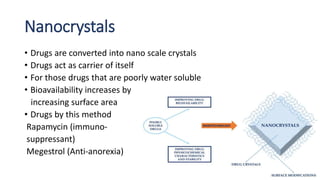
Nanocrystals
• Drugs are converted into nano scale crystals
• Drugs act as carrier of itself
• For those drugs that are poorly water soluble
• Bioavailability increases by
increasing surface area
• Drugs by this method
Rapamycin (immuno-
suppressant)
Megestrol (Anti-anorexia)
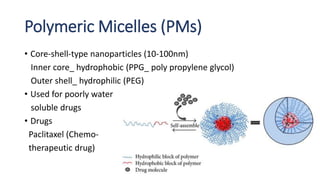
Polymeric Micelles (PMs)
• Core-shell-type nanoparticles (10-100nm)
Inner core_ hydrophobic (PPG_ poly propylene glycol)
Outer shell_ hydrophilic (PEG)
• Used for poorly water
soluble drugs
• Drugs
Paclitaxel (Chemo-
therapeutic drug)
Dendrimers
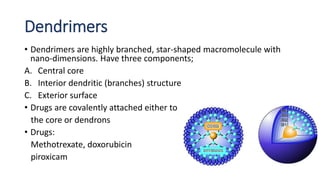
• Dendrimers are highly branched, star-shaped macromolecule with
nano-dimensions. Have three components;
A. Central core
B. Interior dendritic (branches) structure
C. Exterior surface
• Drugs are covalently attached either to
the core or dendrons
• Drugs:
Methotrexate, doxorubicin
piroxicam
Carbon Nanotubes (CNTs)
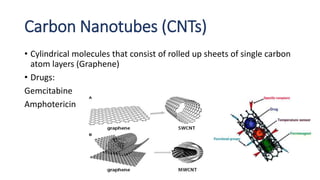
• Cylindrical molecules that consist of rolled up sheets of single carbon
atom layers (Graphene)
• Drugs:
Gemcitabine
Amphotericin
Other NDDSs
1. Nanobots
2. Nanoghosts
3. Nanoclews
4. Nanoneedles
5. Nanoclusters
6. Nanobubbles
7. Niosome
Thank you!
For your attention.

Nano based drug delivery systems

  • 1.
  • 2.
    Definition by NIH USA •“Formulation of device that enables the introduction of therapeutic agent in the body and improves efficiency and safety by control the rate, time and place of release of drug.” • Mainly, there are two ways of introduction of drug into the body; 1. Non-invasive administration 2. Invasive administration
  • 3.
    Why there isa need of nano- systems Traditional drug delivery systems have some problems; • Poor bio-availability • Poor solubility • Poor absorption • In-vivo instability • Adverse effects of drug (if being not released in controlled way)
  • 4.
    How nano- based DDSs area help Nano-based DDS has following abilities that make them preferable. • Drug delivery is targeted • There is controlled dosage and release-time • Improved bioavailability, solubility, saturation and reduced plasma fluctuation • Effective drug carriers (NPs) because they are stable and travel throughout the blood stream without sedimentation
  • 5.
  • 6.
    General method ofDrug delivery There are three entities in NDDS; 1. The Drug(the therapeutic agent) 2. Nano-carrier 3. The target moiety or site
  • 7.
    Liposome • Lipid nanoparticle(lipid body) • Lipid bilayer vesicle that can carry drugs within itself • Synthesis(natural or synthetic) Drawbacks: 1. poor storage 2. Encapsulation efficiency 3. Drug release • PEG is the solution Ampotericin B Fungal infection Comptothecin Anticancer Vancomycin Antibiotic
  • 8.
    Nanocrystals • Drugs areconverted into nano scale crystals • Drugs act as carrier of itself • For those drugs that are poorly water soluble • Bioavailability increases by increasing surface area • Drugs by this method Rapamycin (immuno- suppressant) Megestrol (Anti-anorexia)
  • 9.
    Polymeric Micelles (PMs) •Core-shell-type nanoparticles (10-100nm) Inner core_ hydrophobic (PPG_ poly propylene glycol) Outer shell_ hydrophilic (PEG) • Used for poorly water soluble drugs • Drugs Paclitaxel (Chemo- therapeutic drug)
  • 10.
    Dendrimers • Dendrimers arehighly branched, star-shaped macromolecule with nano-dimensions. Have three components; A. Central core B. Interior dendritic (branches) structure C. Exterior surface • Drugs are covalently attached either to the core or dendrons • Drugs: Methotrexate, doxorubicin piroxicam
  • 11.
    Carbon Nanotubes (CNTs) •Cylindrical molecules that consist of rolled up sheets of single carbon atom layers (Graphene) • Drugs: Gemcitabine Amphotericin
  • 12.
    Other NDDSs 1. Nanobots 2.Nanoghosts 3. Nanoclews 4. Nanoneedles 5. Nanoclusters 6. Nanobubbles 7. Niosome
  • 13.