INTRODUCTION TO
MEDICAL
TERMINOLOGY
(1)
DR. HAYAT AL AKOUM
INTRODUCTION
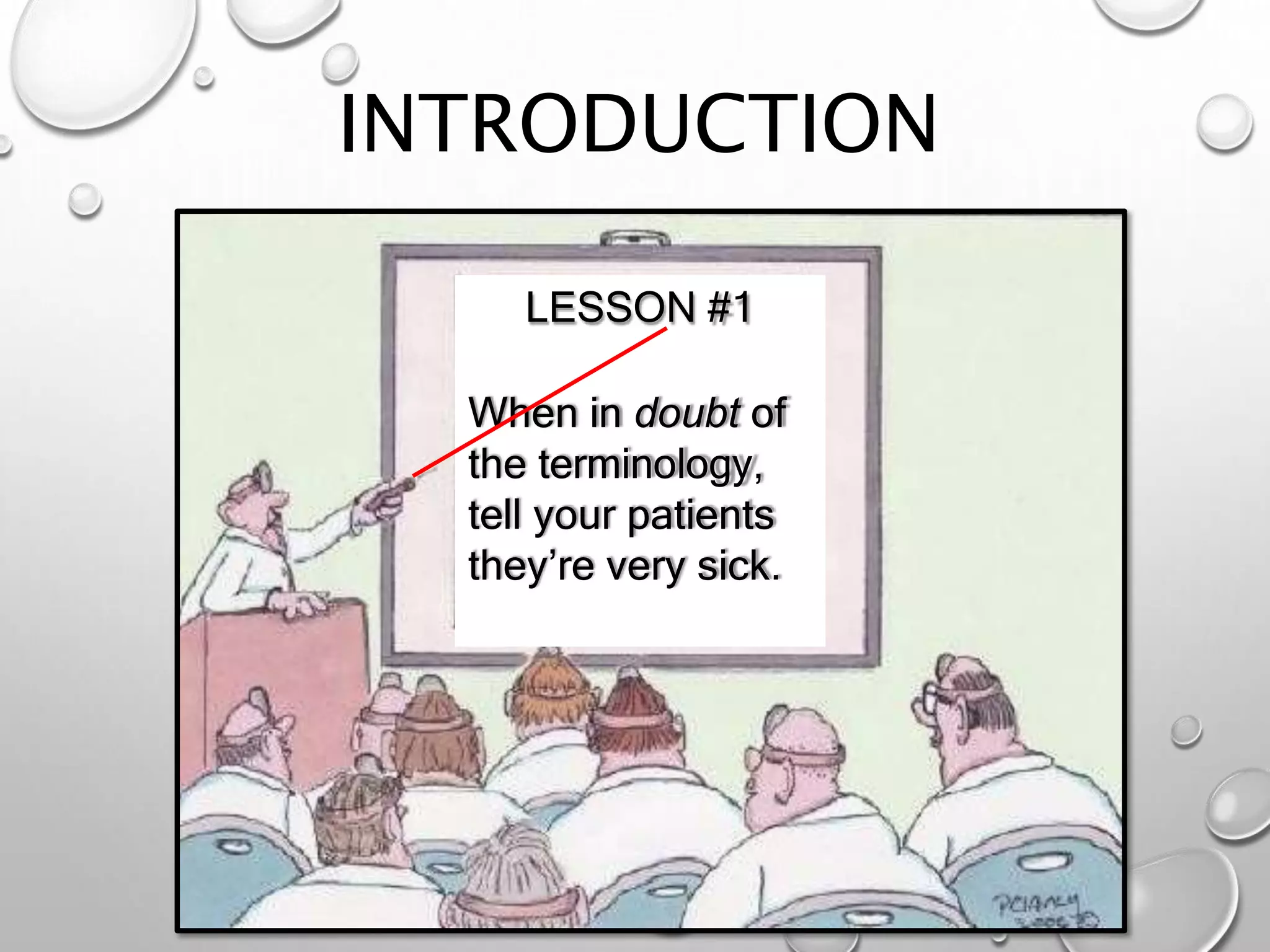
LESSON #1
When in doubt of
the terminology,
tell your patients
they’re very sick.
OBJECTIVES
• Definition of Medical terminology
• Importance of medical terminology
• Medical word elements
• Word roots
• Combining forms
• Suffixes
• Prefixes
• Basic rules
OBJECTIVES
• Defining medical words
• Building medical words
• Pronunciation Guidelines
DEFINITION
• Medical terminology is language that is used
to accurately describe the human body and
associated components, conditions, processes
and procedures in a science-based manner.
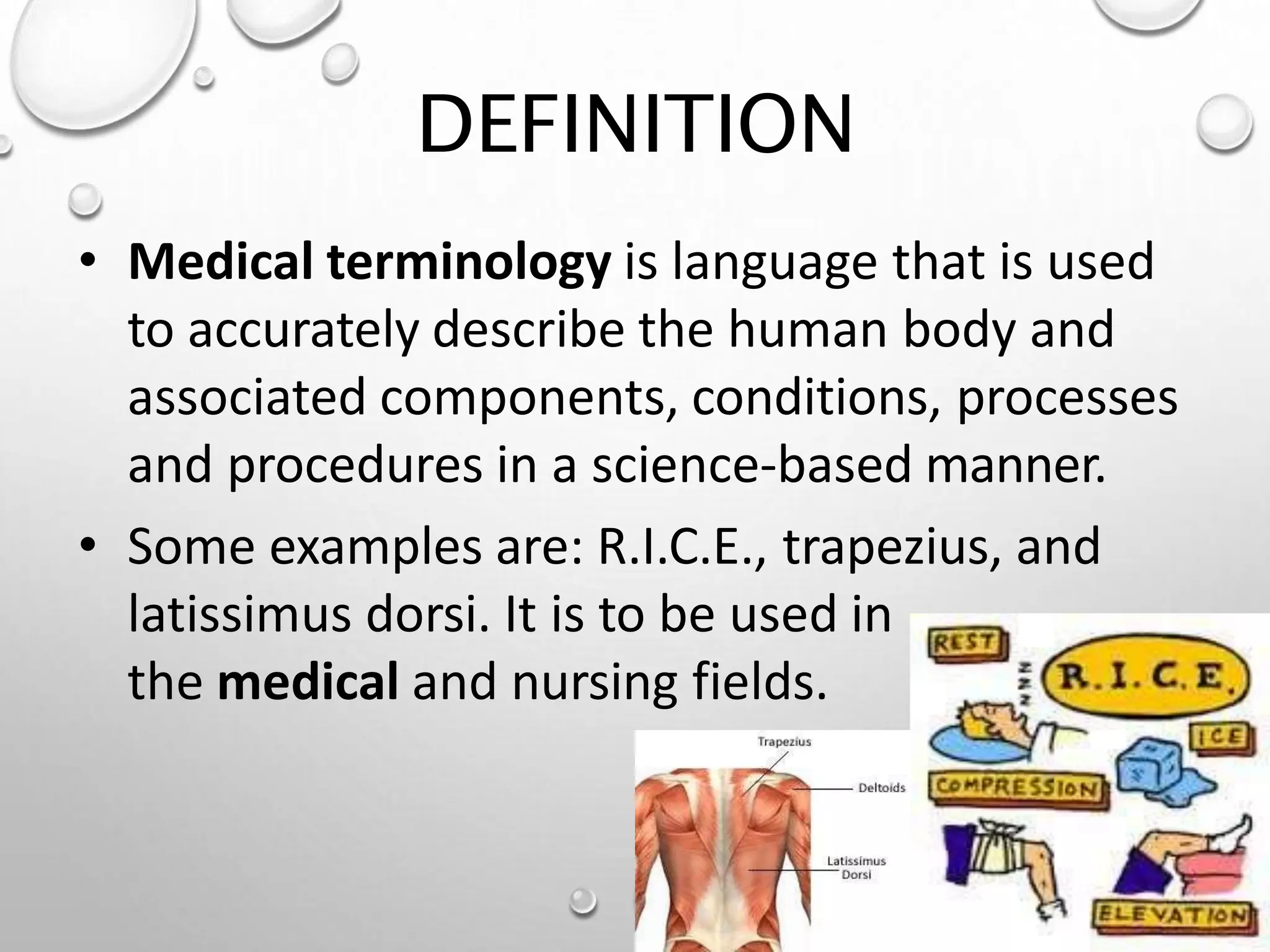
• Some examples are: R.I.C.E., trapezius, and
latissimus dorsi. It is to be used in
the medical and nursing fields.
DEFINITION
• The words – or terms – which make up the language of
medicine are referred to as the terminology of the medical
field…known as medical terminology.
• Like every other language, medical terminology has
changed over time and will continue to change.
• Most medical terms come from the Greek and Latin
languages.
6
IMPORTANCE OF THE
MEDICAL
TERMINOLOGY
• Simplify communication/break down the
language barrier.
• Easy understanding(common language)
• They are specific terminologies, thus makes
no need to use general terminology
WORD ELEMENTS
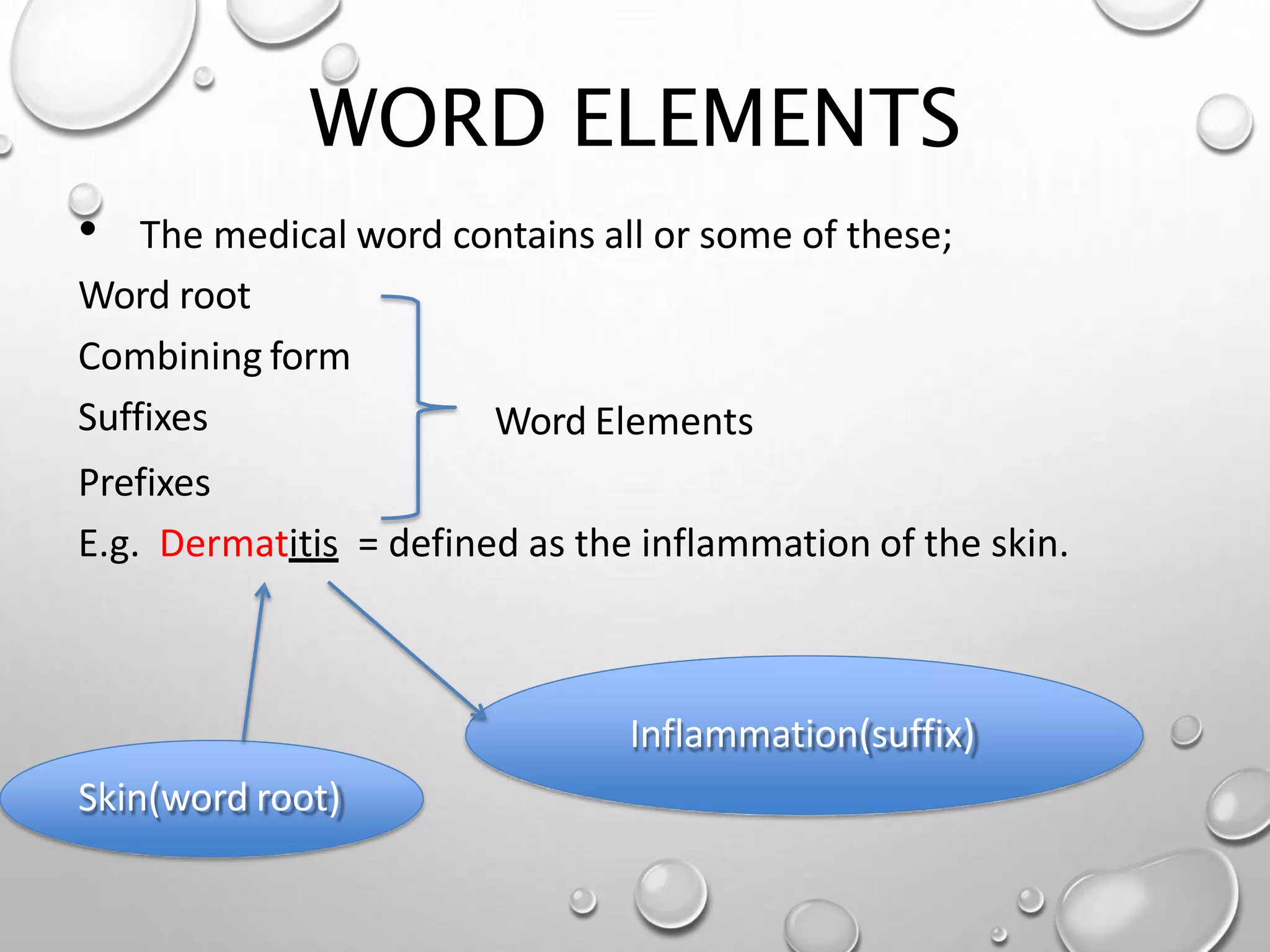
• The medical word contains all or some of these;
Word Elements
Word root
Combining form
Suffixes
Prefixes
E.g. Dermatitis = defined as the inflammation of the skin.
Skin(word root)
Inflammation(suffix)
WORD ELEMENTS
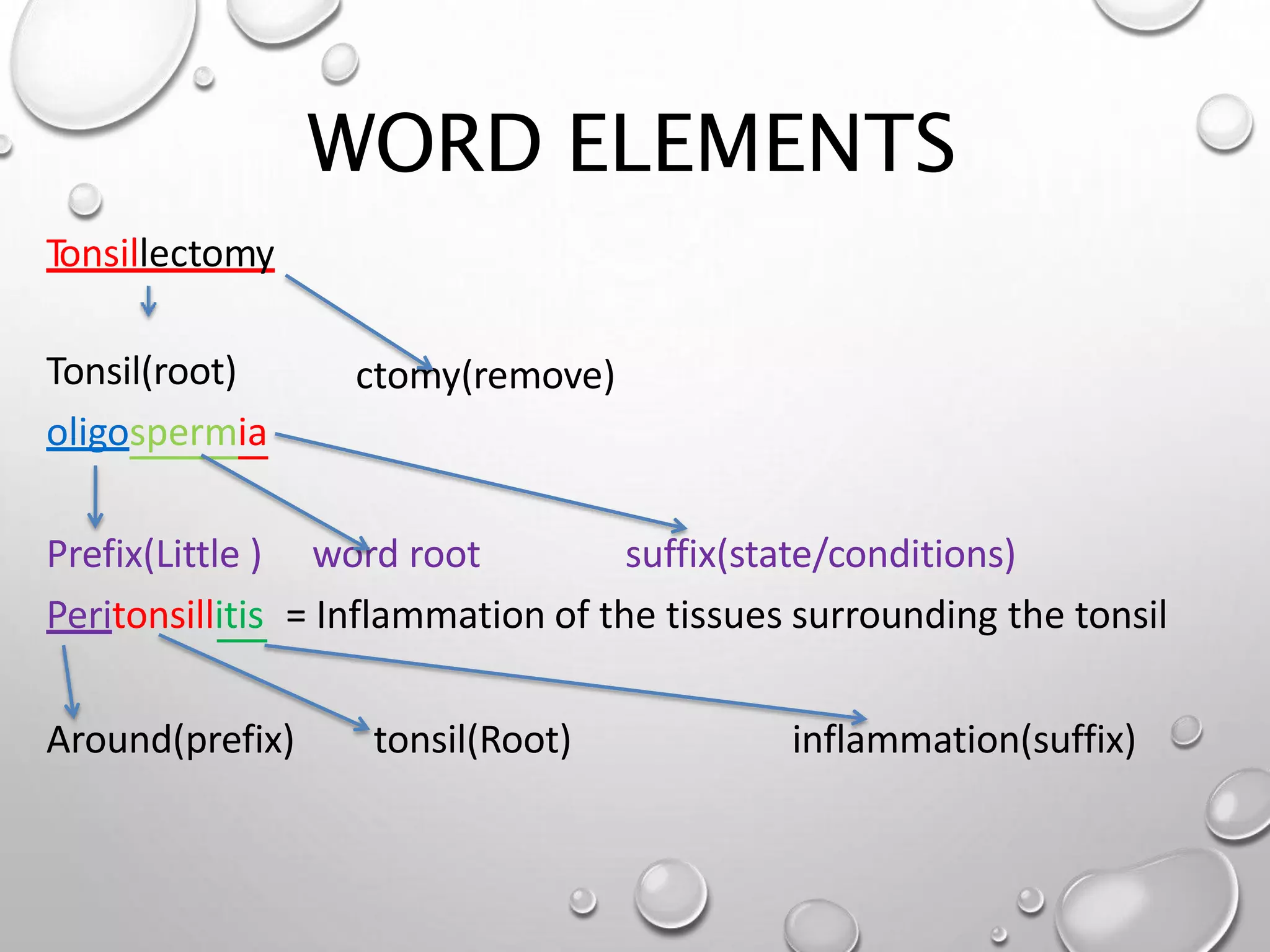
Tonsillectomy
ctomy(remove)
Tonsil(root)
oligospermia
Prefix(Little ) word root suffix(state/conditions)
Peritonsillitis = Inflammation of the tissues surrounding the tonsil
Around(prefix) tonsil(Root) inflammation(suffix)
WORD ROOT
A root is the basic element of a word, and it is the foundation on
which the meaning of a word is built.
Many roots are real words in their own right and term.
Although these roots can have other elements, they don't
need other elements to be complete.
A root can be a whole word or a part of a
word. Roots come from many different
languages, mainly Greek and Latin, and find
their way into English.
10
WORD ROOTS
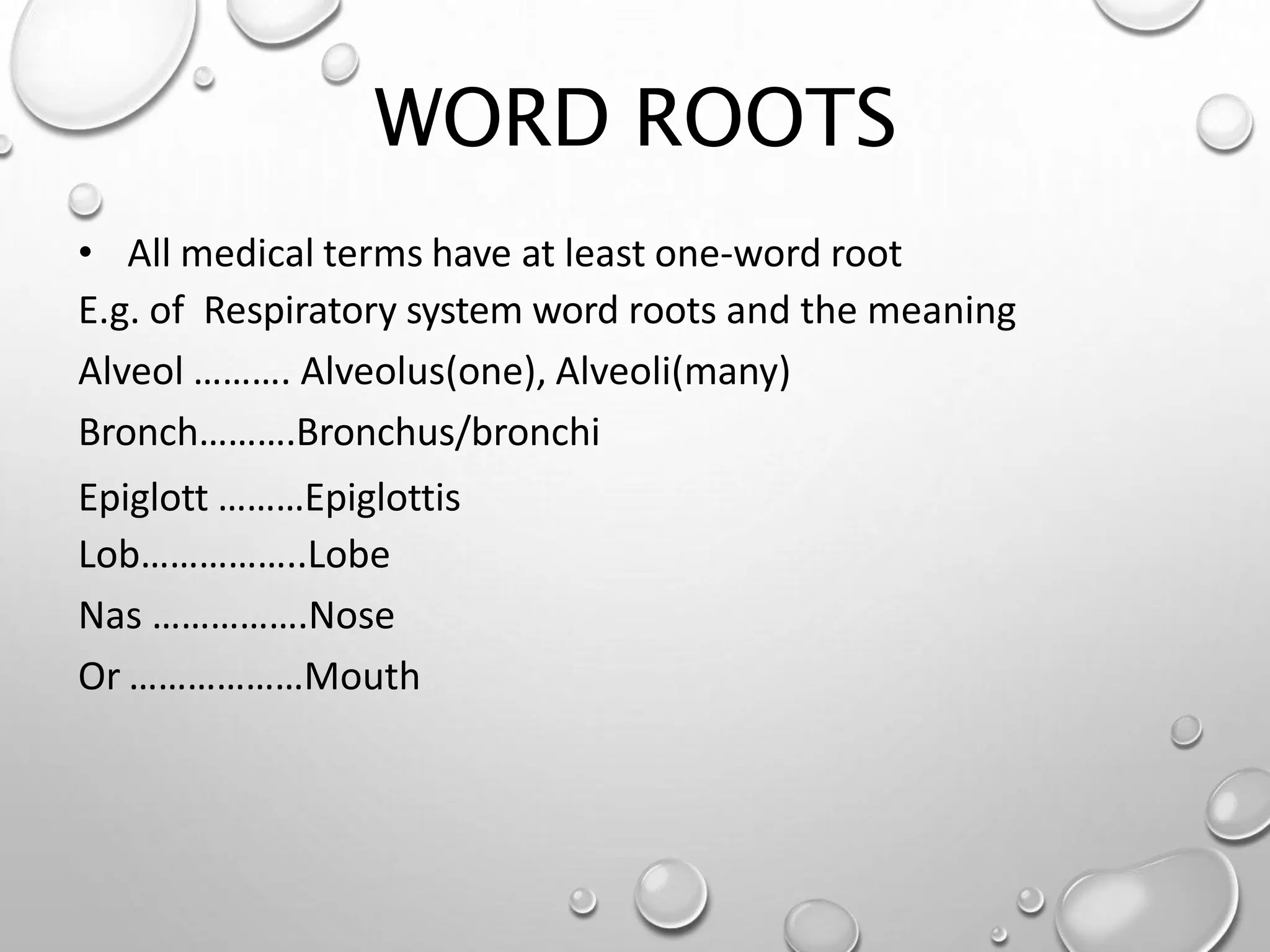
• All medical terms have at least one-word root
E.g. of Respiratory system word roots and the meaning
Alveol ………. Alveolus(one), Alveoli(many)
Bronch……….Bronchus/bronchi
Epiglott ………Epiglottis
Lob……………..Lobe
Nas …………….Nose
Or ………………Mouth
COMBINING FORMS
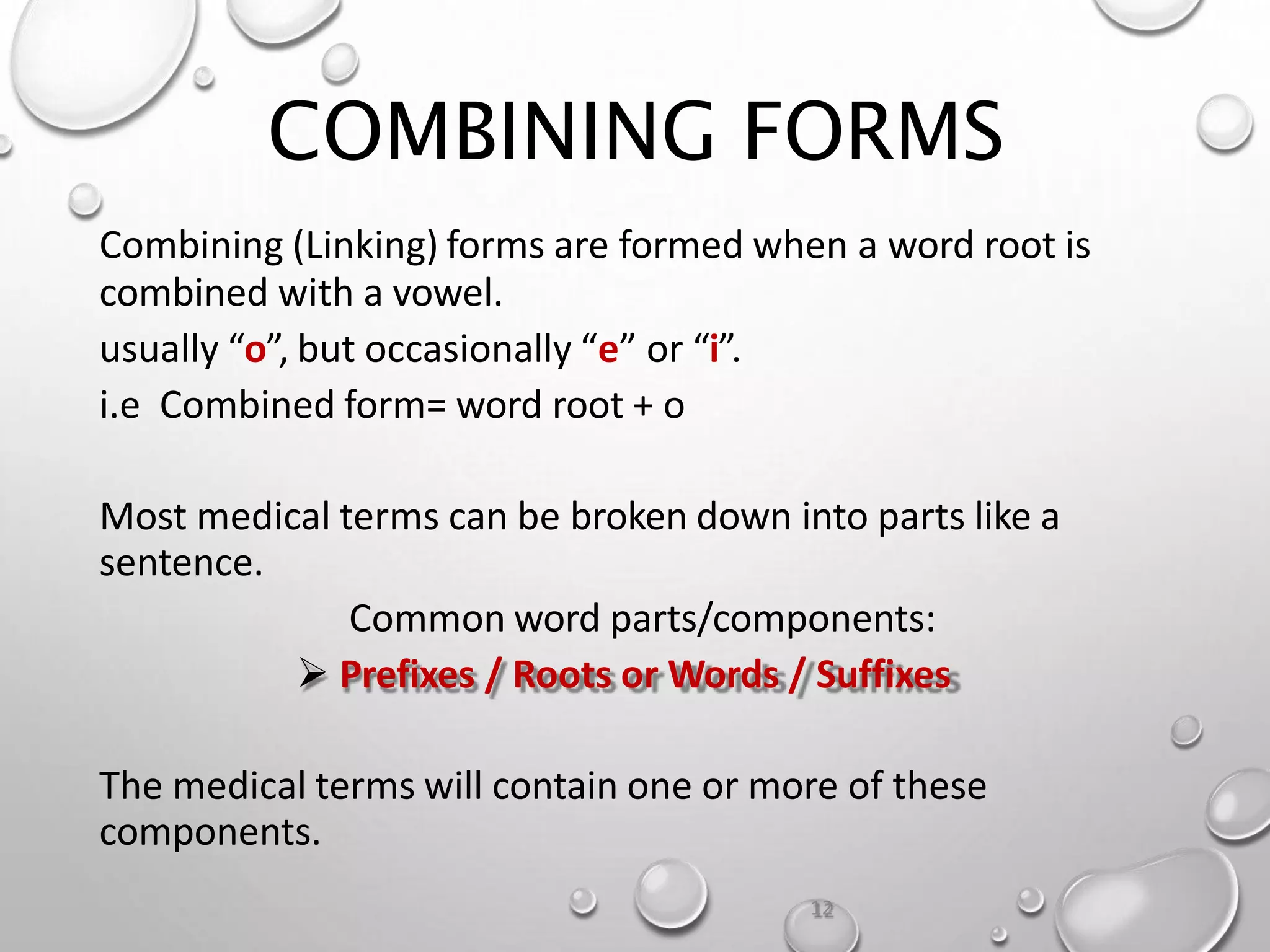
Combining (Linking) forms are formed when a word root is
combined with a vowel.
usually “o”, but occasionally “e” or “i”.
i.e Combined form= word root + o
Most medical terms can be broken down into parts like a
sentence.
Common word parts/components:
 Prefixes / Roots or Words / Suffixes
The medical terms will contain one or more of these
components.
12
COMBINING FORMS
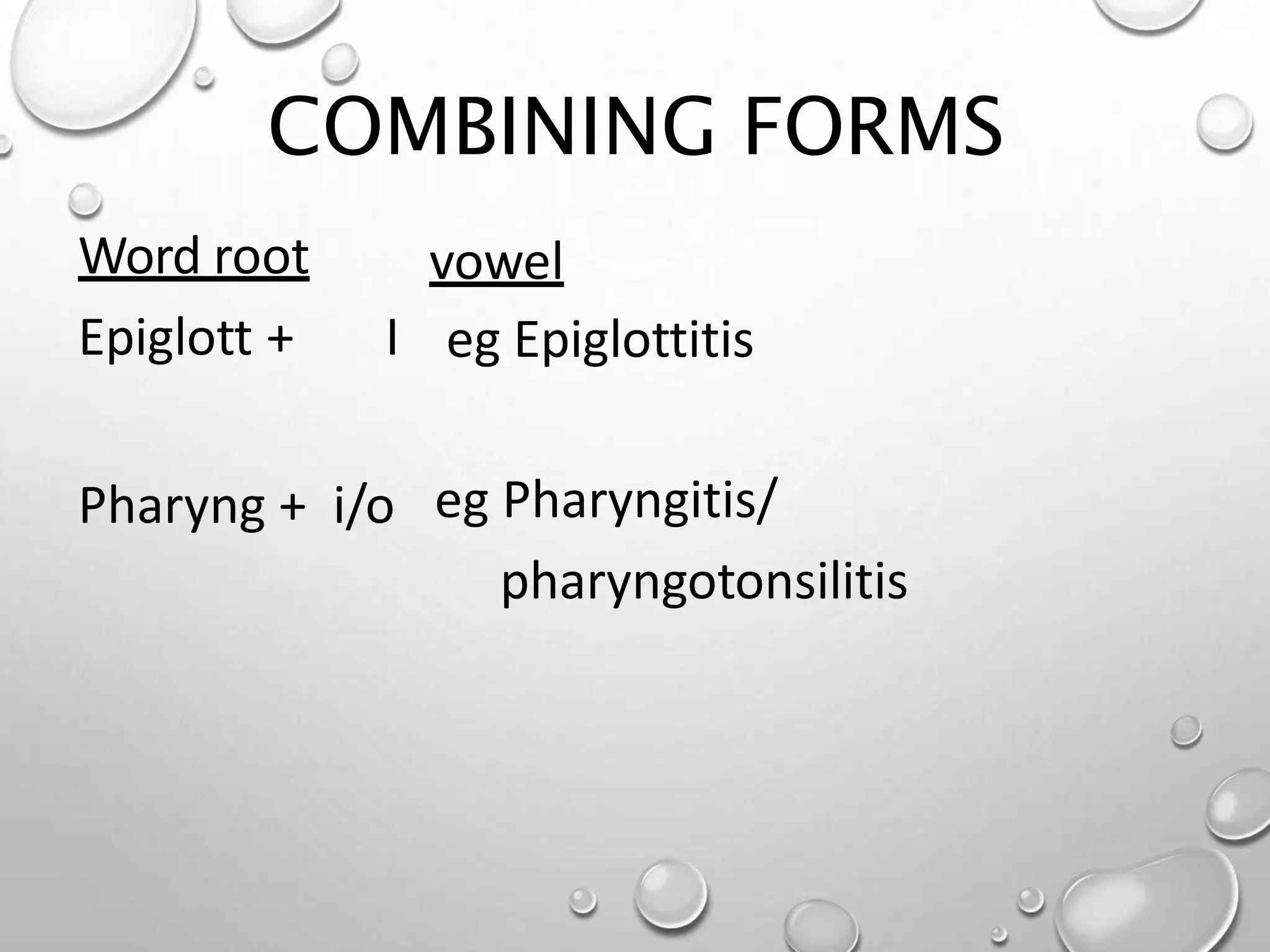
vowel
Word root
Epiglott + I eg Epiglottitis
Pharyng + i/o eg Pharyngitis/
pharyngotonsilitis
PREFIX
14
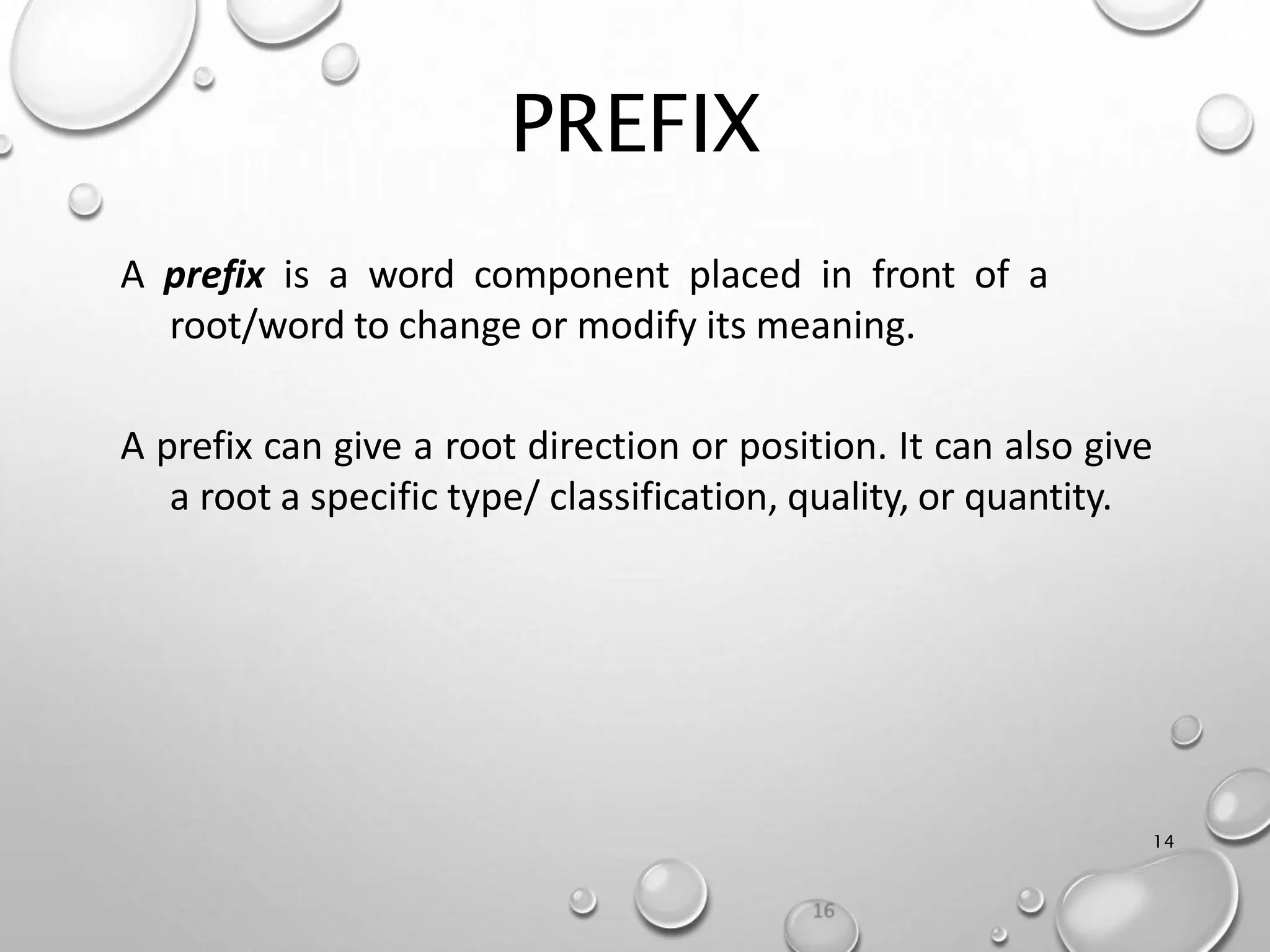
A prefix is a word component placed in front of a
root/word to change or modify its meaning.
A prefix can give a root direction or position. It can also give
a root a specific type/ classification, quality, or quantity.
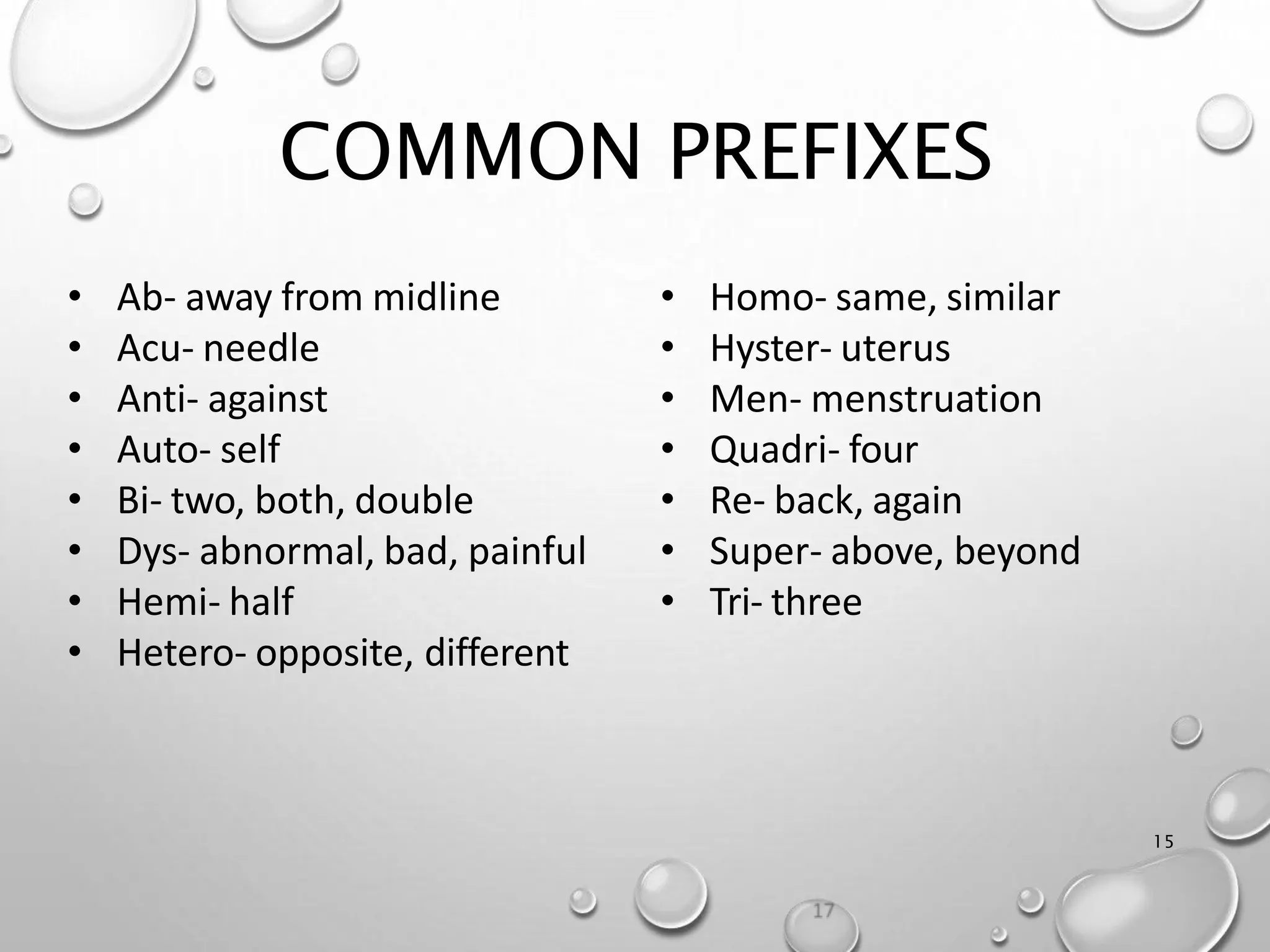
COMMON PREFIXES
15
• Homo- same, similar
• Hyster- uterus
• Men- menstruation
• Quadri- four
• Re- back, again
• Super- above, beyond
• Tri- three
• Ab- away from midline
• Acu- needle
• Anti- against
• Auto- self
• Bi- two, both, double
• Dys- abnormal, bad, painful
• Hemi- half
• Hetero- opposite, different
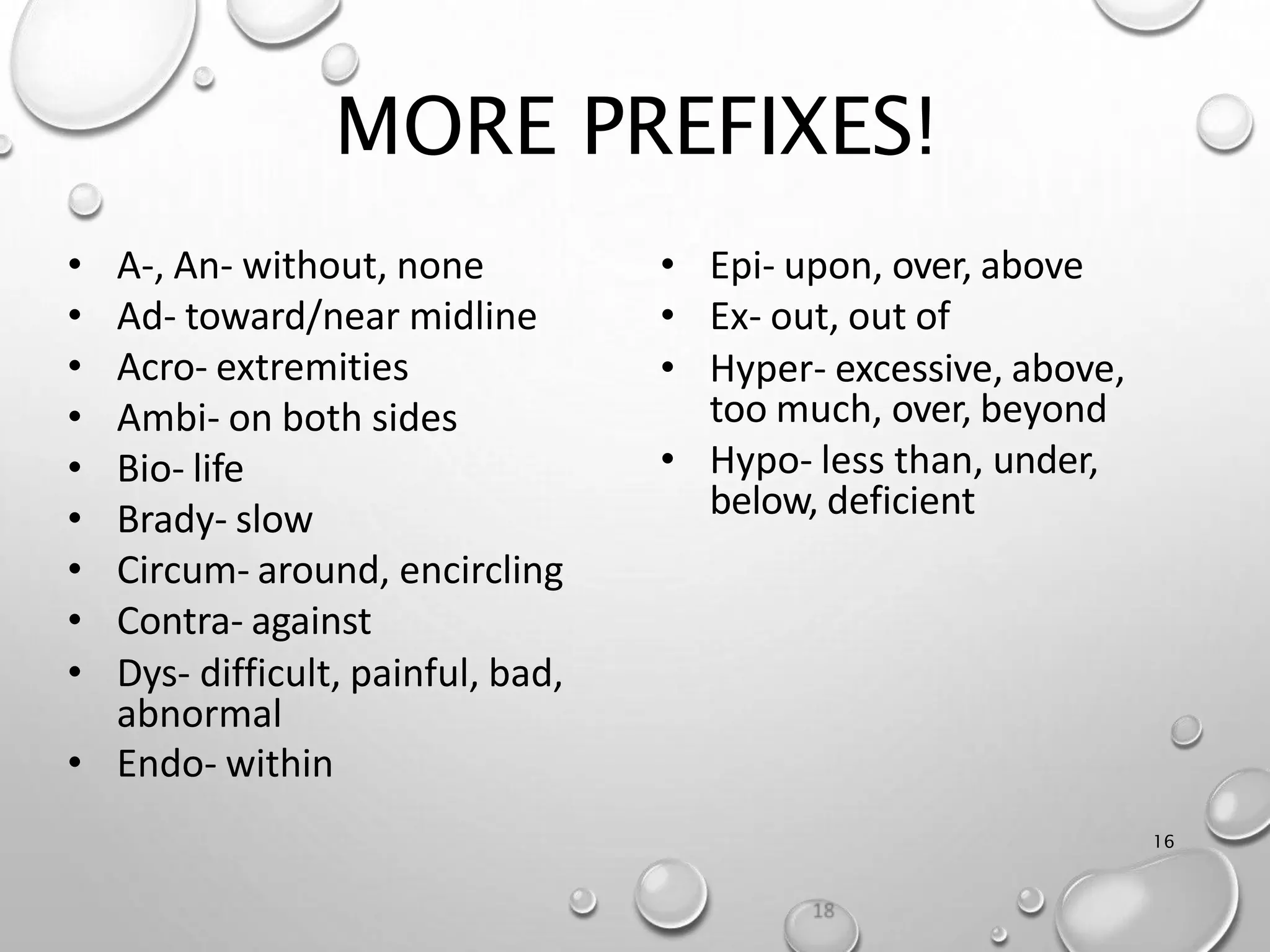
MORE PREFIXES!
16
• Epi- upon, over, above
• Ex- out, out of
• Hyper- excessive, above,
too much, over, beyond
• Hypo- less than, under,
below, deficient
• A-, An- without, none
• Ad- toward/near midline
• Acro- extremities
• Ambi- on both sides
• Bio- life
• Brady- slow
• Circum- around, encircling
• Contra- against
• Dys- difficult, painful, bad,
abnormal
• Endo- within
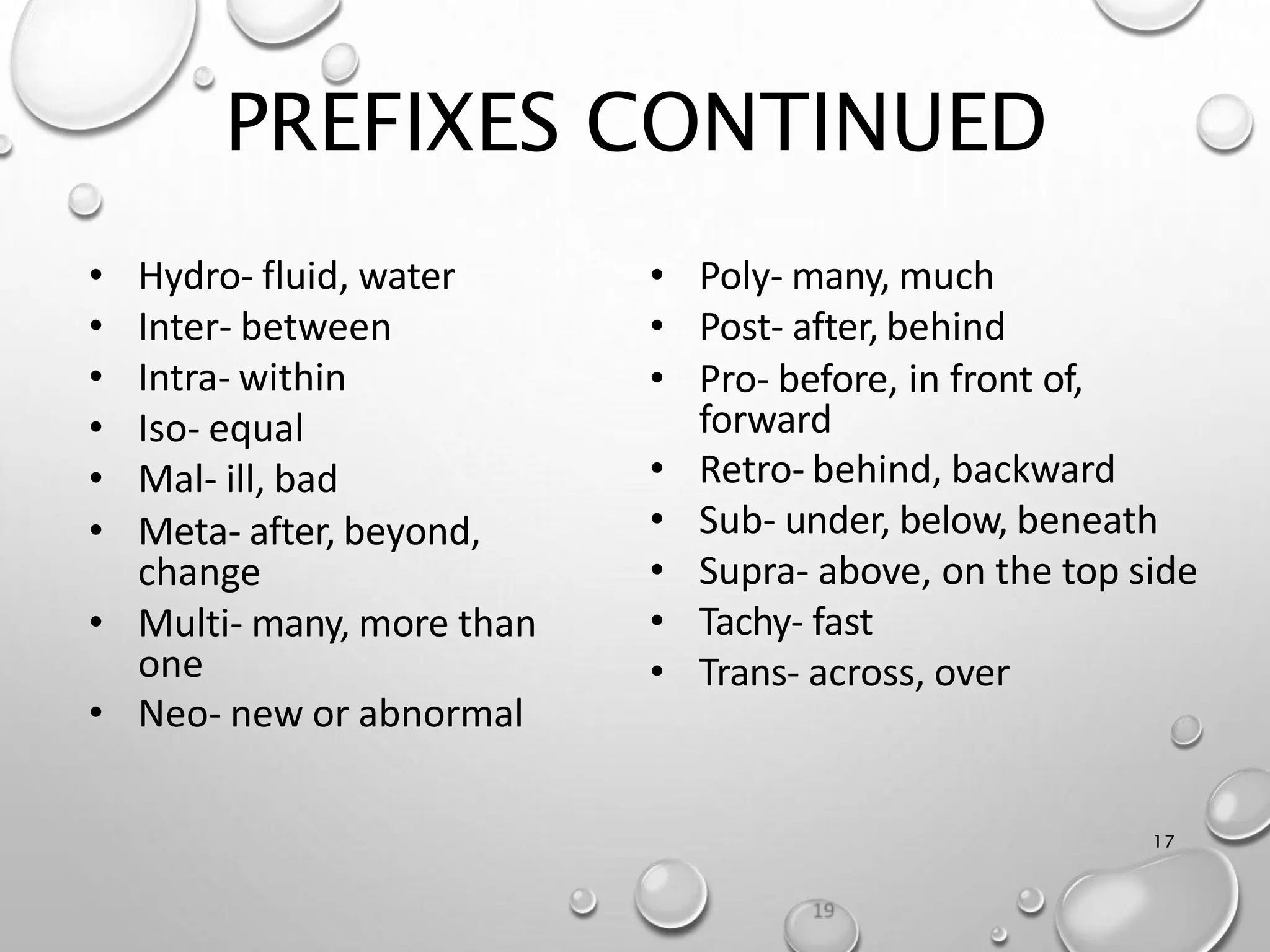
PREFIXES CONTINUED
17
• Poly- many, much
• Post- after, behind
• Pro- before, in front of,
forward
• Retro- behind, backward
• Sub- under, below, beneath
• Supra- above, on the top side
• Tachy- fast
• Trans- across, over
• Hydro- fluid, water
• Inter- between
• Intra- within
• Iso- equal
• Mal- ill, bad
• Meta- after, beyond,
change
• Multi- many, more than
one
• Neo- new or abnormal
SUFFIX
A suffix is a word component added to the end of a
root/word that changes or modifies its usage,
function, or meaning.
SUFFIX
18
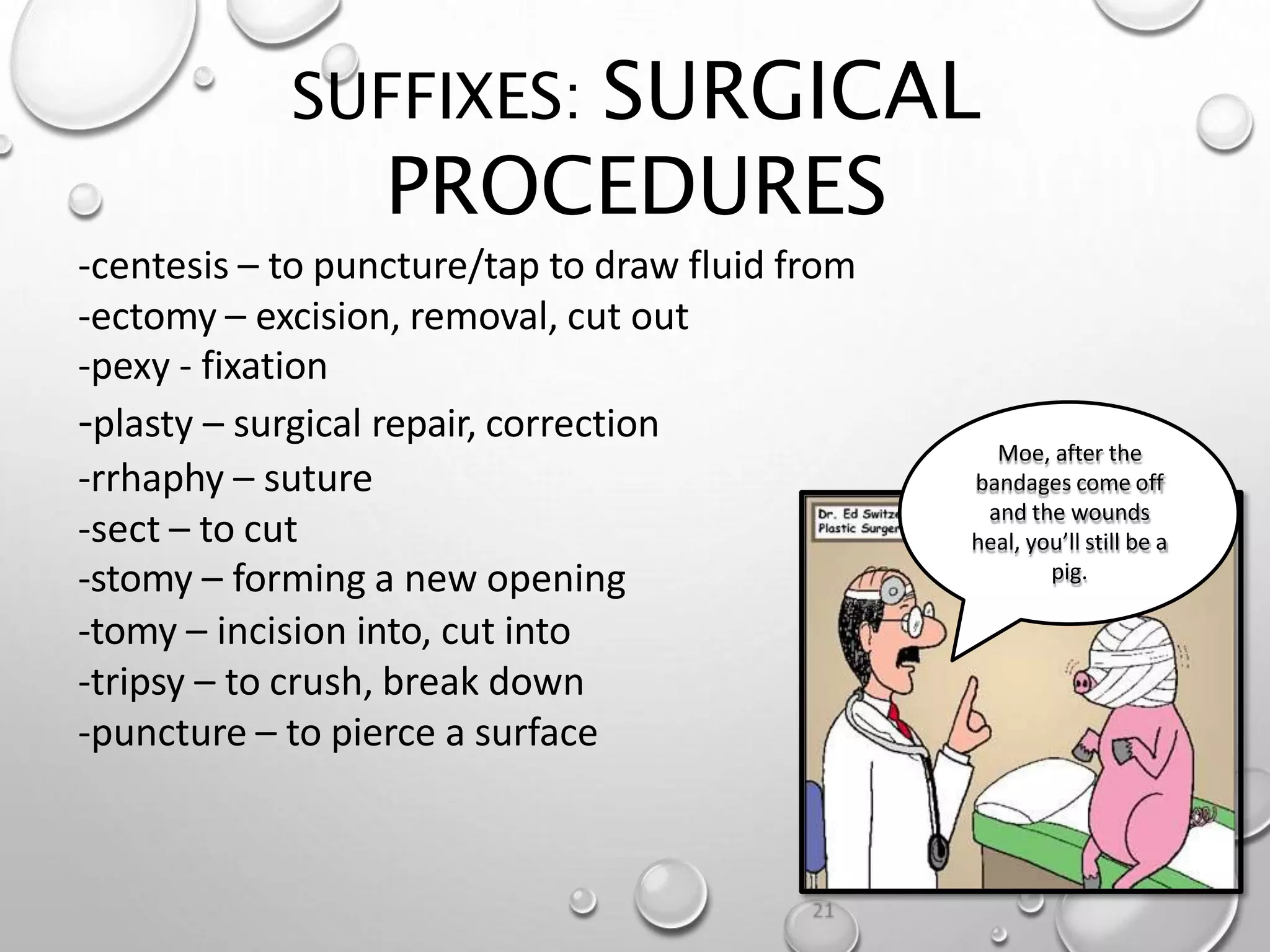
SUFFIXES: SURGICAL
PROCEDURES
19
-centesis – to puncture/tap to draw fluid from
-ectomy – excision, removal, cut out
-pexy - fixation
-plasty – surgical repair, correction
-rrhaphy – suture
-sect – to cut
-stomy – forming a new opening
-tomy – incision into, cut into
-tripsy – to crush, break down
-puncture – to pierce a surface
Moe, after the
bandages come off
and the wounds
heal, you’ll still be a
pig.
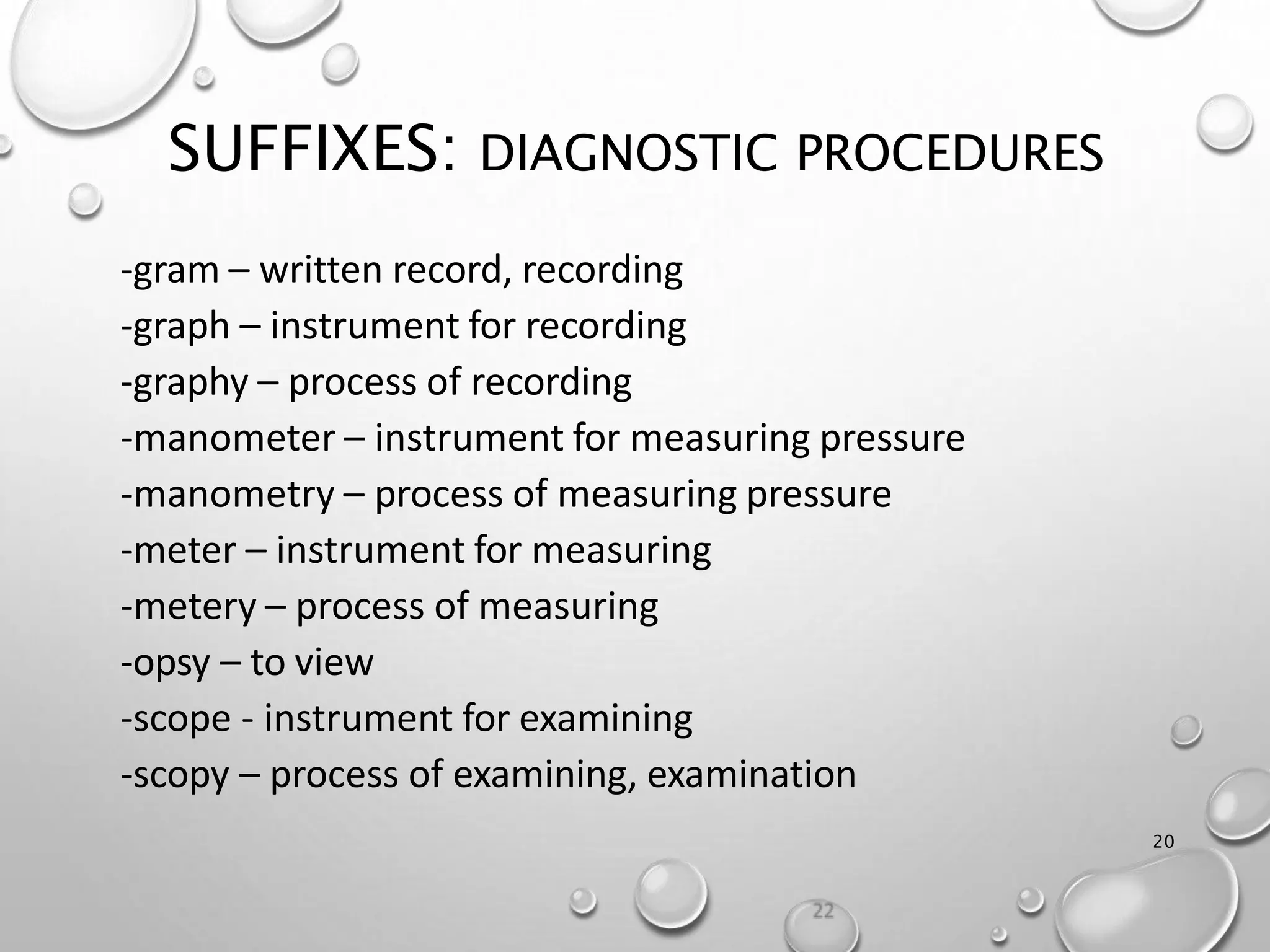
SUFFIXES: DIAGNOSTIC PROCEDURES
20
-gram – written record, recording
-graph – instrument for recording
-graphy – process of recording
-manometer – instrument for measuring pressure
-manometry – process of measuring pressure
-meter – instrument for measuring
-metery – process of measuring
-opsy – to view
-scope - instrument for examining
-scopy – process of examining, examination
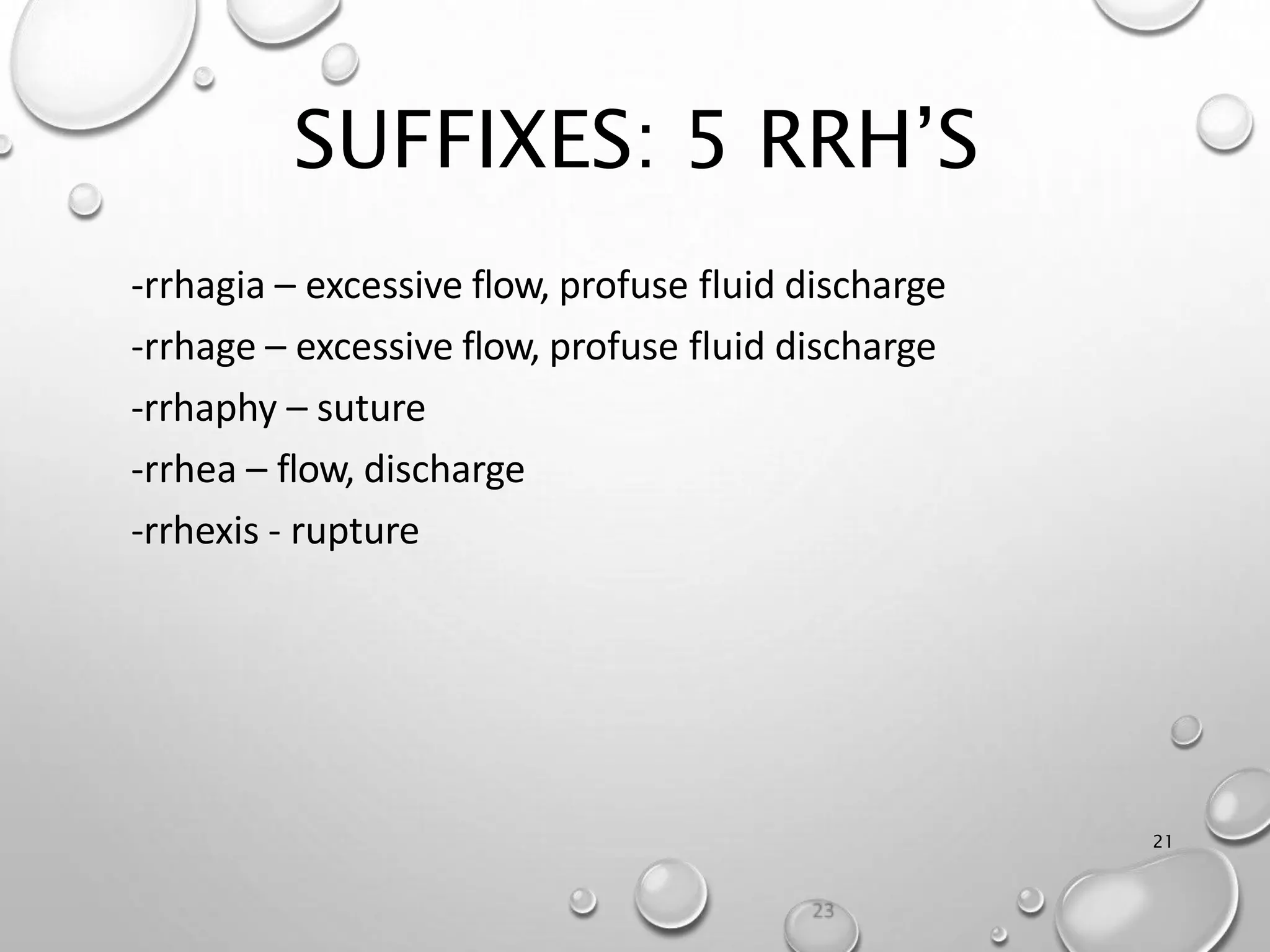
SUFFIXES: 5 RRH’S
21
-rrhagia – excessive flow, profuse fluid discharge
-rrhage – excessive flow, profuse fluid discharge
-rrhaphy – suture
-rrhea – flow, discharge
-rrhexis - rupture
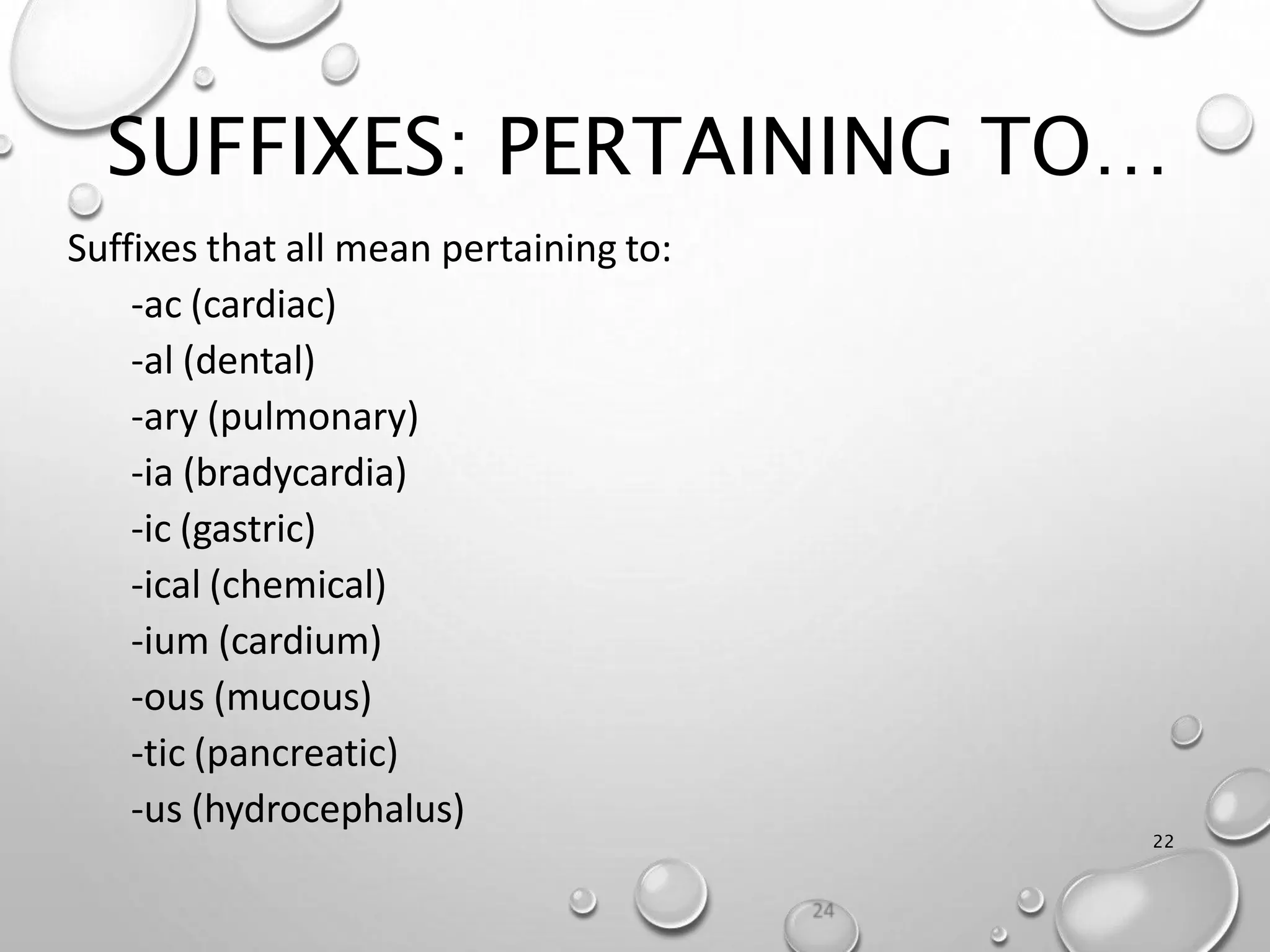
SUFFIXES: PERTAINING TO…
22
Suffixes that all mean pertaining to:
-ac (cardiac)
-al (dental)
-ary (pulmonary)
-ia (bradycardia)
-ic (gastric)
-ical (chemical)
-ium (cardium)
-ous (mucous)
-tic (pancreatic)
-us (hydrocephalus)
MORE SUFFIXES!
23
-algia, -algesia – pain
-cele – herniation, swelling
-cide – killing, agent that kills
-cyte - cell
-emia – blood condition
-ist – specialist
-itis – inflammation
-logist – one who studies, specialist
-logia, -logy – the study of
-lysis – destruction, breakdown
-megaly – enlarged
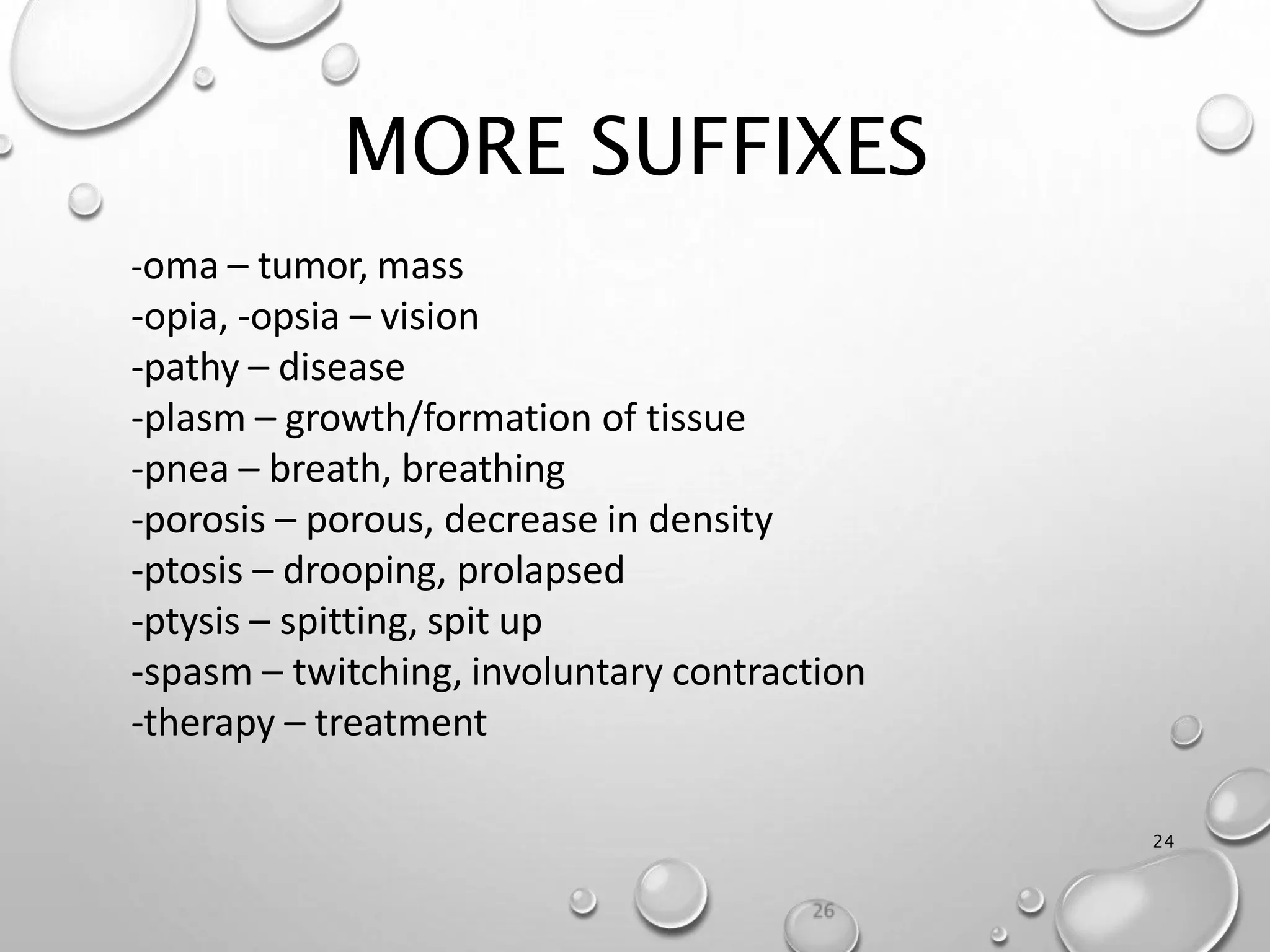
MORE SUFFIXES
24
-oma – tumor, mass
-opia, -opsia – vision
-pathy – disease
-plasm – growth/formation of tissue
-pnea – breath, breathing
-porosis – porous, decrease in density
-ptosis – drooping, prolapsed
-ptysis – spitting, spit up
-spasm – twitching, involuntary contraction
-therapy – treatment
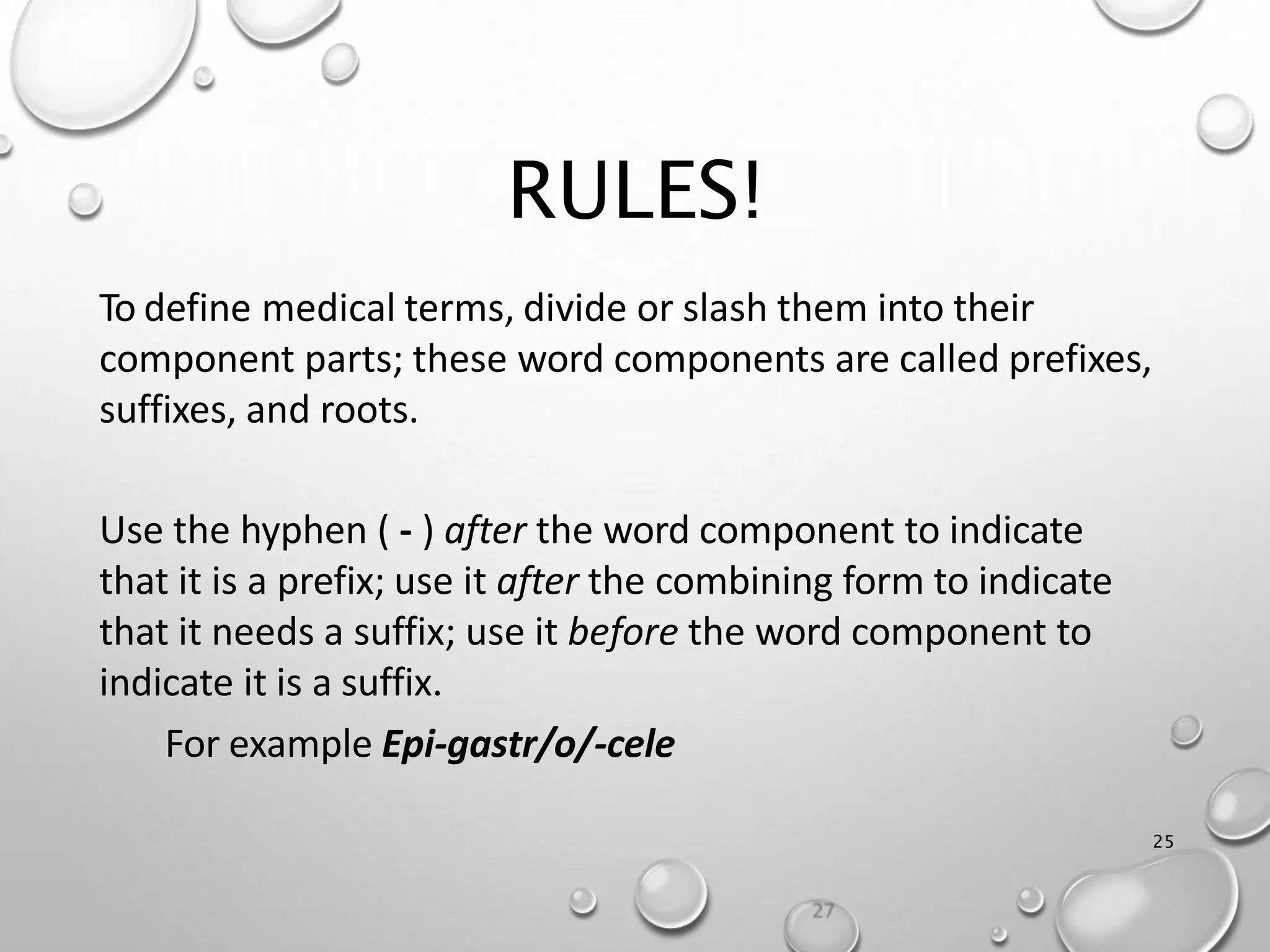
RULES!
25
To define medical terms, divide or slash them into their
component parts; these word components are called prefixes,
suffixes, and roots.
Use the hyphen ( - ) after the word component to indicate
that it is a prefix; use it after the combining form to indicate
that it needs a suffix; use it before the word component to
indicate it is a suffix.
For example Epi-gastr/o/-cele
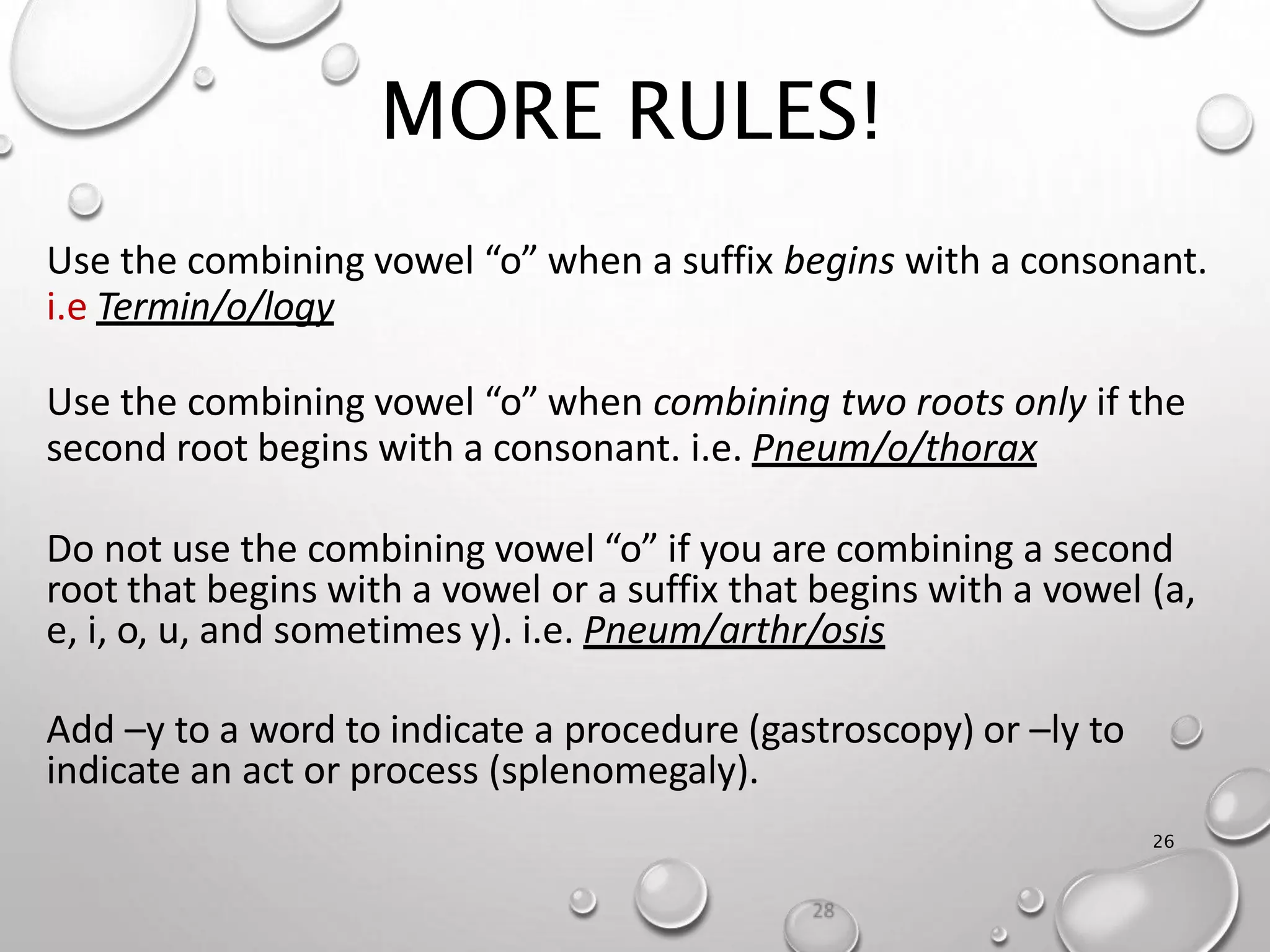
MORE RULES!
26
Use the combining vowel “o” when a suffix begins with a consonant.
i.e Termin/o/logy
Use the combining vowel “o” when combining two roots only if the
second root begins with a consonant. i.e. Pneum/o/thorax
Do not use the combining vowel “o” if you are combining a second
root that begins with a vowel or a suffix that begins with a vowel (a,
e, i, o, u, and sometimes y). i.e. Pneum/arthr/osis
Add –y to a word to indicate a procedure (gastroscopy) or –ly to
indicate an act or process (splenomegaly).
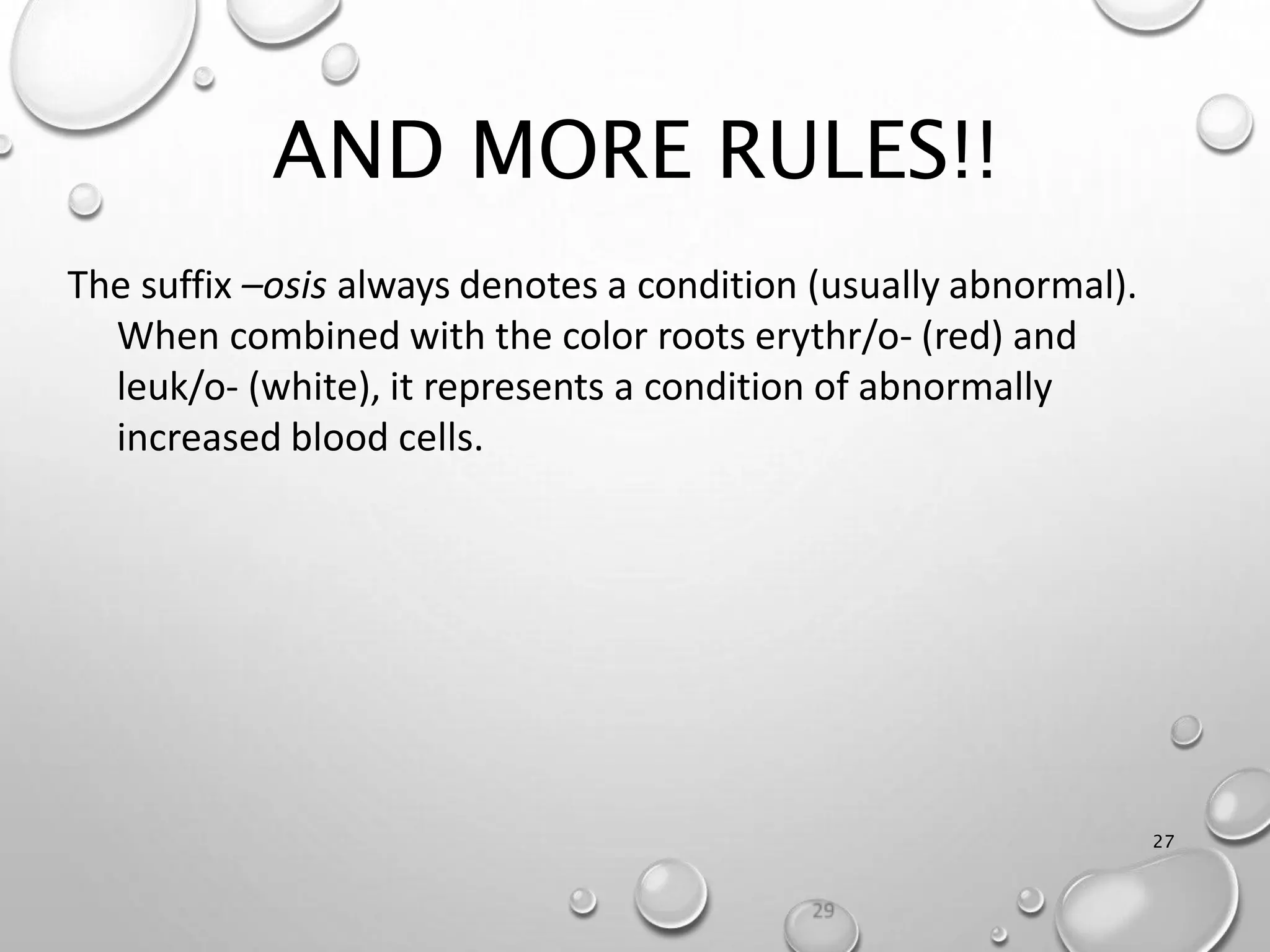
AND MORE RULES!!
27
The suffix –osis always denotes a condition (usually abnormal).
When combined with the color roots erythr/o- (red) and
leuk/o- (white), it represents a condition of abnormally
increased blood cells.
CASE STUDY
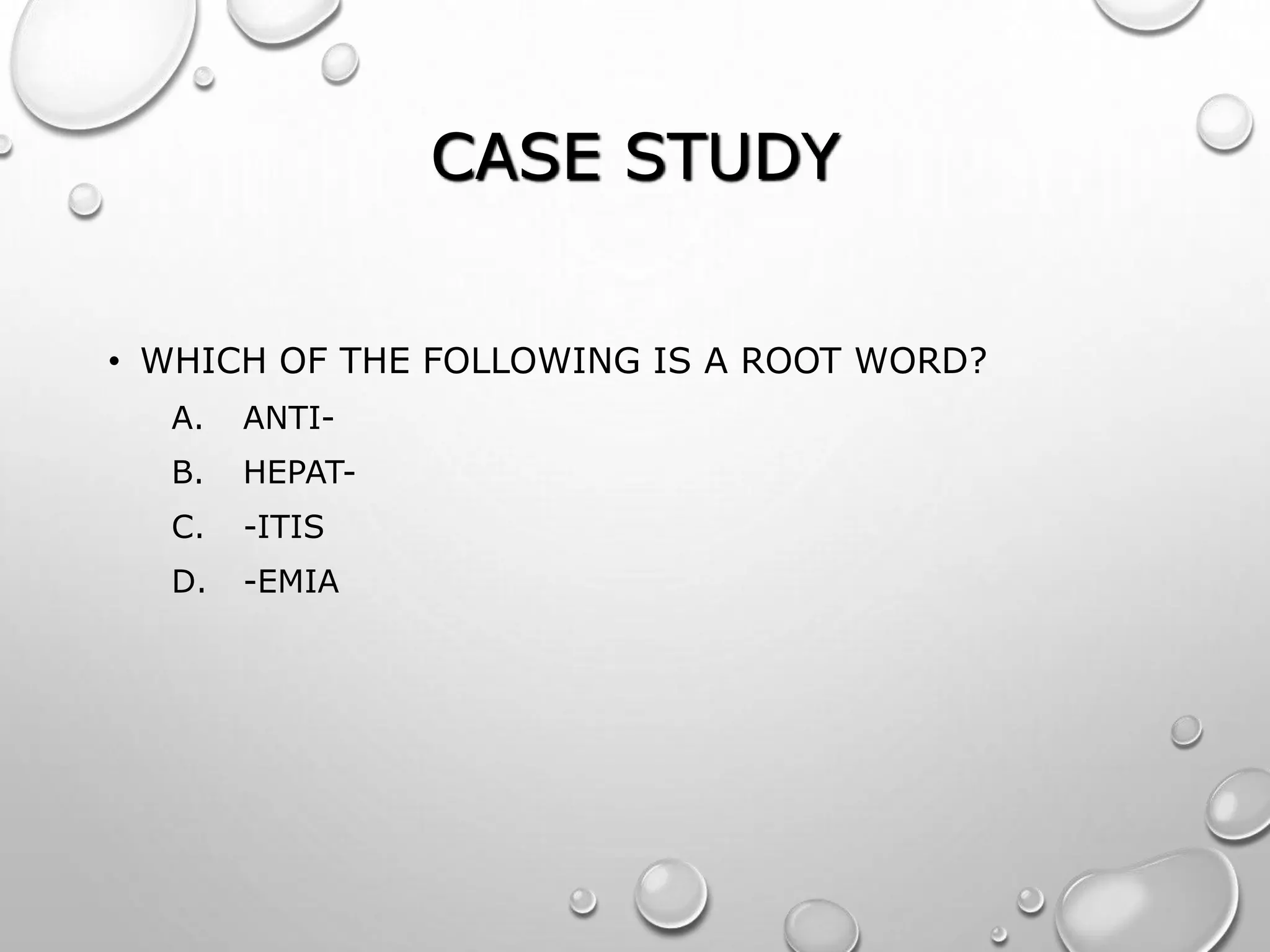
• WHICH OF THE FOLLOWING IS A ROOT WORD?
A. ANTI-
B. HEPAT-
C. -ITIS
D. -EMIA
CASE STUDY
• THE PREFIX “TACHY-” MEANS:
A. ABOVE
B. OUTSIDE
C. FAST
D. HIGHER
CASE STUDY
• THE SUFFIX “-LOGY” REFERS TO:
A. STUDY OF
B. OCCURRING AFTER
C. WITHIN
D. PERTAINING TO
CASE STUDY
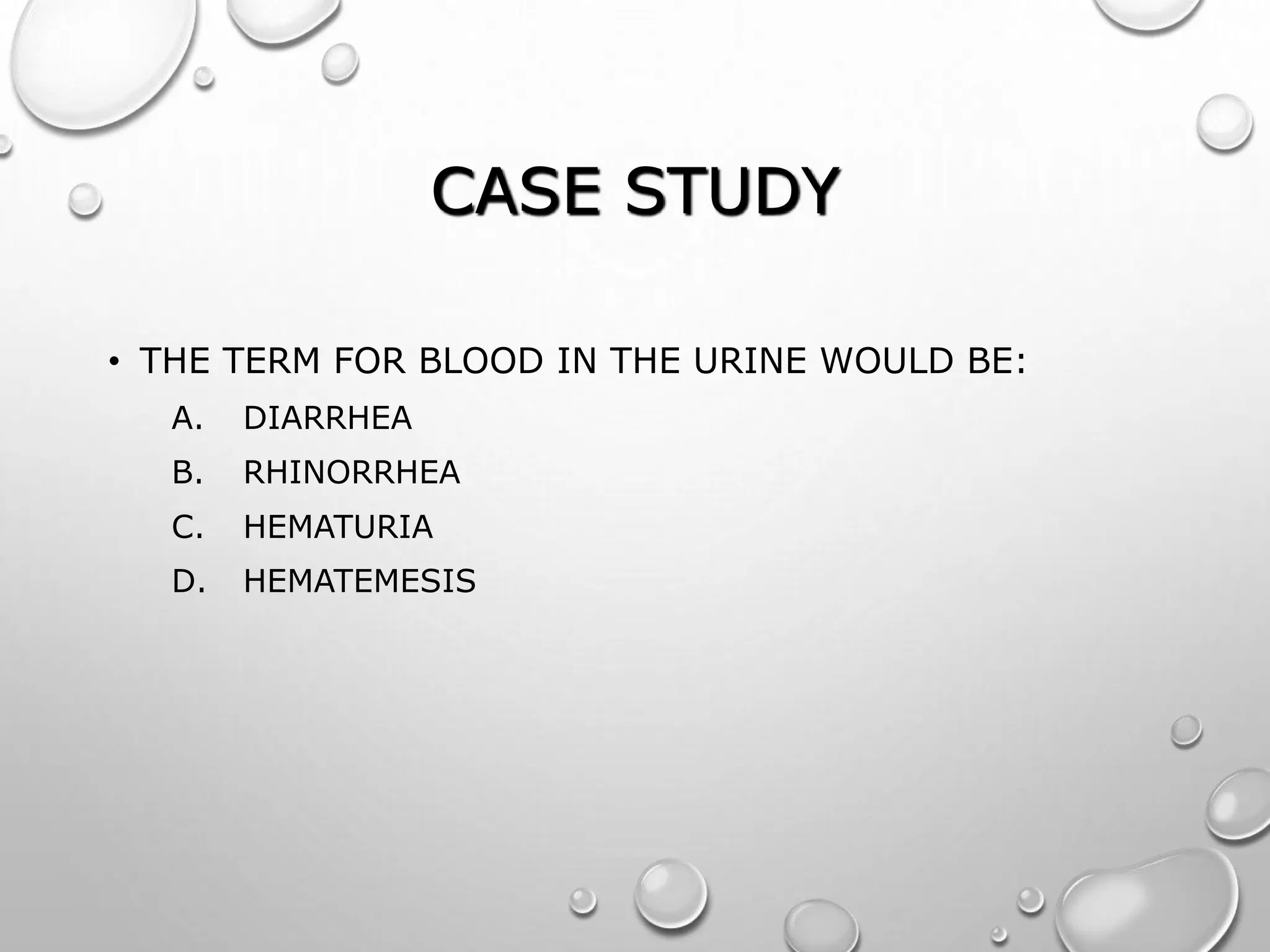
• THE TERM FOR BLOOD IN THE URINE WOULD BE:
A. DIARRHEA
B. RHINORRHEA
C. HEMATURIA
D. HEMATEMESIS
CASE STUDY
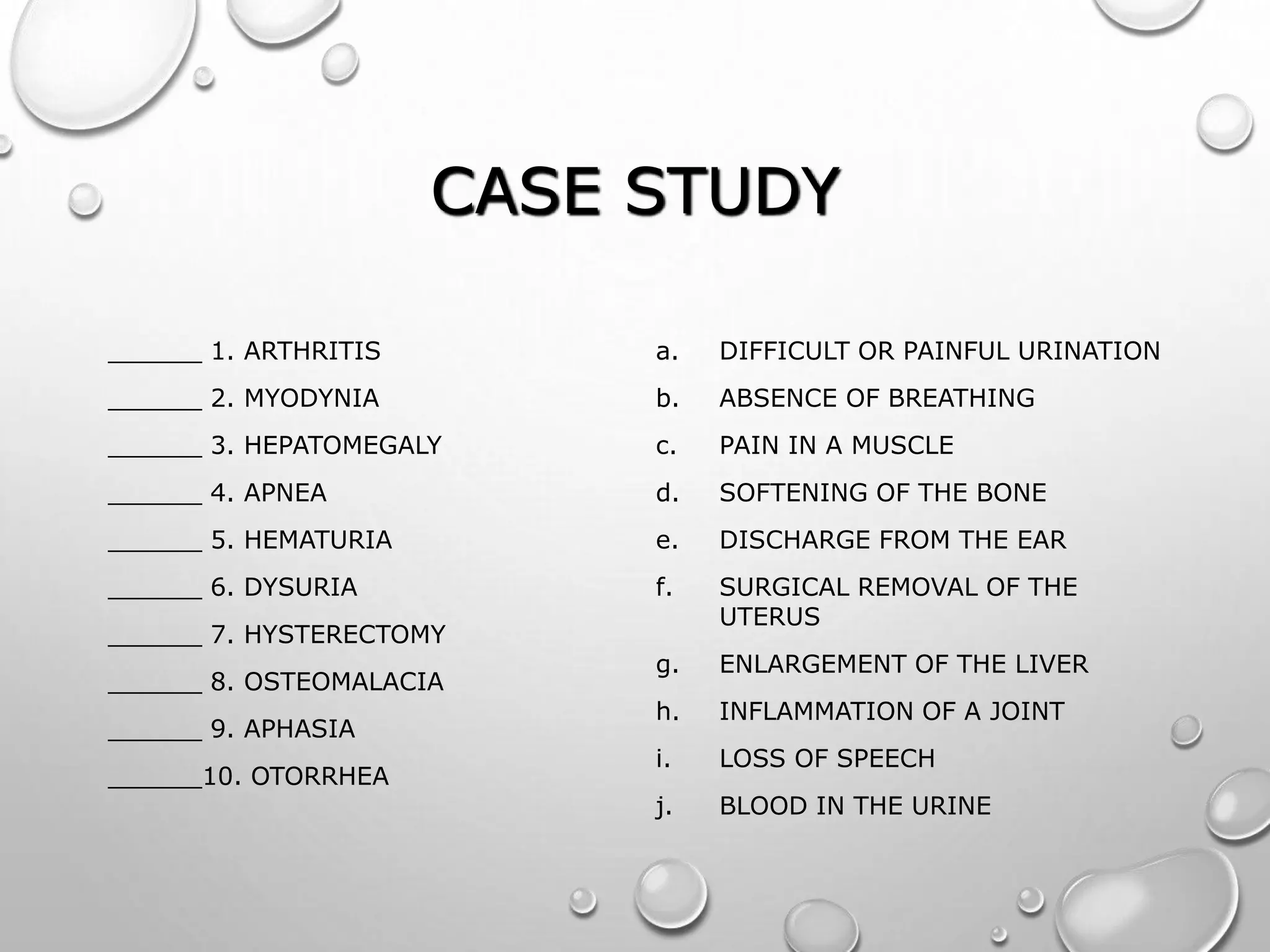
______ 1. ARTHRITIS
______ 2. MYODYNIA
______ 3. HEPATOMEGALY
______ 4. APNEA
______ 5. HEMATURIA
______ 6. DYSURIA
______ 7. HYSTERECTOMY
______ 8. OSTEOMALACIA
______ 9. APHASIA
______10. OTORRHEA
a. DIFFICULT OR PAINFUL URINATION
b. ABSENCE OF BREATHING
c. PAIN IN A MUSCLE
d. SOFTENING OF THE BONE
e. DISCHARGE FROM THE EAR
f. SURGICAL REMOVAL OF THE
UTERUS
g. ENLARGEMENT OF THE LIVER
h. INFLAMMATION OF A JOINT
i. LOSS OF SPEECH
j. BLOOD IN THE URINE
QUESTIO
NS?

chapter 1.pptx

  • 1.
  • 2.
    INTRODUCTION LESSON #1 When indoubt of the terminology, tell your patients they’re very sick.
  • 3.
    OBJECTIVES • Definition ofMedical terminology • Importance of medical terminology • Medical word elements • Word roots • Combining forms • Suffixes • Prefixes • Basic rules
  • 4.
    OBJECTIVES • Defining medicalwords • Building medical words • Pronunciation Guidelines
  • 5.
    DEFINITION • Medical terminologyis language that is used to accurately describe the human body and associated components, conditions, processes and procedures in a science-based manner. • Some examples are: R.I.C.E., trapezius, and latissimus dorsi. It is to be used in the medical and nursing fields.
  • 6.
    DEFINITION • The words– or terms – which make up the language of medicine are referred to as the terminology of the medical field…known as medical terminology. • Like every other language, medical terminology has changed over time and will continue to change. • Most medical terms come from the Greek and Latin languages. 6
  • 7.
    IMPORTANCE OF THE MEDICAL TERMINOLOGY •Simplify communication/break down the language barrier. • Easy understanding(common language) • They are specific terminologies, thus makes no need to use general terminology
  • 8.
    WORD ELEMENTS • Themedical word contains all or some of these; Word Elements Word root Combining form Suffixes Prefixes E.g. Dermatitis = defined as the inflammation of the skin. Skin(word root) Inflammation(suffix)
  • 9.
    WORD ELEMENTS Tonsillectomy ctomy(remove) Tonsil(root) oligospermia Prefix(Little )word root suffix(state/conditions) Peritonsillitis = Inflammation of the tissues surrounding the tonsil Around(prefix) tonsil(Root) inflammation(suffix)
  • 10.
    WORD ROOT A rootis the basic element of a word, and it is the foundation on which the meaning of a word is built. Many roots are real words in their own right and term. Although these roots can have other elements, they don't need other elements to be complete. A root can be a whole word or a part of a word. Roots come from many different languages, mainly Greek and Latin, and find their way into English. 10
  • 11.
    WORD ROOTS • Allmedical terms have at least one-word root E.g. of Respiratory system word roots and the meaning Alveol ………. Alveolus(one), Alveoli(many) Bronch……….Bronchus/bronchi Epiglott ………Epiglottis Lob……………..Lobe Nas …………….Nose Or ………………Mouth
  • 12.
    COMBINING FORMS Combining (Linking)forms are formed when a word root is combined with a vowel. usually “o”, but occasionally “e” or “i”. i.e Combined form= word root + o Most medical terms can be broken down into parts like a sentence. Common word parts/components:  Prefixes / Roots or Words / Suffixes The medical terms will contain one or more of these components. 12
  • 13.
    COMBINING FORMS vowel Word root Epiglott+ I eg Epiglottitis Pharyng + i/o eg Pharyngitis/ pharyngotonsilitis
  • 14.
    PREFIX 14 A prefix isa word component placed in front of a root/word to change or modify its meaning. A prefix can give a root direction or position. It can also give a root a specific type/ classification, quality, or quantity.
  • 15.
    COMMON PREFIXES 15 • Homo-same, similar • Hyster- uterus • Men- menstruation • Quadri- four • Re- back, again • Super- above, beyond • Tri- three • Ab- away from midline • Acu- needle • Anti- against • Auto- self • Bi- two, both, double • Dys- abnormal, bad, painful • Hemi- half • Hetero- opposite, different
  • 16.
    MORE PREFIXES! 16 • Epi-upon, over, above • Ex- out, out of • Hyper- excessive, above, too much, over, beyond • Hypo- less than, under, below, deficient • A-, An- without, none • Ad- toward/near midline • Acro- extremities • Ambi- on both sides • Bio- life • Brady- slow • Circum- around, encircling • Contra- against • Dys- difficult, painful, bad, abnormal • Endo- within
  • 17.
    PREFIXES CONTINUED 17 • Poly-many, much • Post- after, behind • Pro- before, in front of, forward • Retro- behind, backward • Sub- under, below, beneath • Supra- above, on the top side • Tachy- fast • Trans- across, over • Hydro- fluid, water • Inter- between • Intra- within • Iso- equal • Mal- ill, bad • Meta- after, beyond, change • Multi- many, more than one • Neo- new or abnormal
  • 18.
    SUFFIX A suffix isa word component added to the end of a root/word that changes or modifies its usage, function, or meaning. SUFFIX 18
  • 19.
    SUFFIXES: SURGICAL PROCEDURES 19 -centesis –to puncture/tap to draw fluid from -ectomy – excision, removal, cut out -pexy - fixation -plasty – surgical repair, correction -rrhaphy – suture -sect – to cut -stomy – forming a new opening -tomy – incision into, cut into -tripsy – to crush, break down -puncture – to pierce a surface Moe, after the bandages come off and the wounds heal, you’ll still be a pig.
  • 20.
    SUFFIXES: DIAGNOSTIC PROCEDURES 20 -gram– written record, recording -graph – instrument for recording -graphy – process of recording -manometer – instrument for measuring pressure -manometry – process of measuring pressure -meter – instrument for measuring -metery – process of measuring -opsy – to view -scope - instrument for examining -scopy – process of examining, examination
  • 21.
    SUFFIXES: 5 RRH’S 21 -rrhagia– excessive flow, profuse fluid discharge -rrhage – excessive flow, profuse fluid discharge -rrhaphy – suture -rrhea – flow, discharge -rrhexis - rupture
  • 22.
    SUFFIXES: PERTAINING TO… 22 Suffixesthat all mean pertaining to: -ac (cardiac) -al (dental) -ary (pulmonary) -ia (bradycardia) -ic (gastric) -ical (chemical) -ium (cardium) -ous (mucous) -tic (pancreatic) -us (hydrocephalus)
  • 23.
    MORE SUFFIXES! 23 -algia, -algesia– pain -cele – herniation, swelling -cide – killing, agent that kills -cyte - cell -emia – blood condition -ist – specialist -itis – inflammation -logist – one who studies, specialist -logia, -logy – the study of -lysis – destruction, breakdown -megaly – enlarged
  • 24.
    MORE SUFFIXES 24 -oma –tumor, mass -opia, -opsia – vision -pathy – disease -plasm – growth/formation of tissue -pnea – breath, breathing -porosis – porous, decrease in density -ptosis – drooping, prolapsed -ptysis – spitting, spit up -spasm – twitching, involuntary contraction -therapy – treatment
  • 25.
    RULES! 25 To define medicalterms, divide or slash them into their component parts; these word components are called prefixes, suffixes, and roots. Use the hyphen ( - ) after the word component to indicate that it is a prefix; use it after the combining form to indicate that it needs a suffix; use it before the word component to indicate it is a suffix. For example Epi-gastr/o/-cele
  • 26.
    MORE RULES! 26 Use thecombining vowel “o” when a suffix begins with a consonant. i.e Termin/o/logy Use the combining vowel “o” when combining two roots only if the second root begins with a consonant. i.e. Pneum/o/thorax Do not use the combining vowel “o” if you are combining a second root that begins with a vowel or a suffix that begins with a vowel (a, e, i, o, u, and sometimes y). i.e. Pneum/arthr/osis Add –y to a word to indicate a procedure (gastroscopy) or –ly to indicate an act or process (splenomegaly).
  • 27.
    AND MORE RULES!! 27 Thesuffix –osis always denotes a condition (usually abnormal). When combined with the color roots erythr/o- (red) and leuk/o- (white), it represents a condition of abnormally increased blood cells.
  • 28.
    CASE STUDY • WHICHOF THE FOLLOWING IS A ROOT WORD? A. ANTI- B. HEPAT- C. -ITIS D. -EMIA
  • 29.
    CASE STUDY • THEPREFIX “TACHY-” MEANS: A. ABOVE B. OUTSIDE C. FAST D. HIGHER
  • 30.
    CASE STUDY • THESUFFIX “-LOGY” REFERS TO: A. STUDY OF B. OCCURRING AFTER C. WITHIN D. PERTAINING TO
  • 31.
    CASE STUDY • THETERM FOR BLOOD IN THE URINE WOULD BE: A. DIARRHEA B. RHINORRHEA C. HEMATURIA D. HEMATEMESIS
  • 32.
    CASE STUDY ______ 1.ARTHRITIS ______ 2. MYODYNIA ______ 3. HEPATOMEGALY ______ 4. APNEA ______ 5. HEMATURIA ______ 6. DYSURIA ______ 7. HYSTERECTOMY ______ 8. OSTEOMALACIA ______ 9. APHASIA ______10. OTORRHEA a. DIFFICULT OR PAINFUL URINATION b. ABSENCE OF BREATHING c. PAIN IN A MUSCLE d. SOFTENING OF THE BONE e. DISCHARGE FROM THE EAR f. SURGICAL REMOVAL OF THE UTERUS g. ENLARGEMENT OF THE LIVER h. INFLAMMATION OF A JOINT i. LOSS OF SPEECH j. BLOOD IN THE URINE
  • 33.