Naming and Necessity:   Sherborn’s Context
Nomina si pereunt, perit et cognitio rerum “ Names are the foundation of knowledge: and unless they have a ‘a name’ as well as a ‘local habitation’ with us, the zoological treasures that we so highly prize might almost as well have been left to perish in their native deserts or forests, as have grown mouldy in our drawers or repositories. But when once an animal subject is named and described, it becomes a possession for ever, and the value of every individual specimen of it, even in a mercantile view, is enhanced.” William Kirby, Foundational Address of the Zoological Club, 1823.
Language and Meaning   in the 1842  Rules of Zoological Nomenclature , drafted by a committee headed by Hugh Edwin Strickland (1811-1853)
Early draft of the “Strickland Rules” with corrections (Courtesy of Zoological Museum, Cambridge University)
 
The overarching priority  of priority
John Edward Gray (1800-1875) and the types of things at the  British Museum. Opposing the Rules
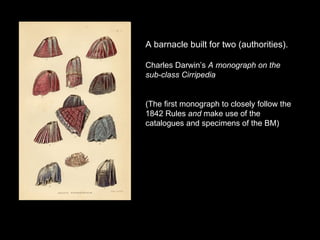
A barnacle built for two (authorities). Charles Darwin’s  A monograph on the sub-class Cirripedia  (The first monograph to closely follow the 1842 Rules  and  make use of the catalogues and specimens of the BM)
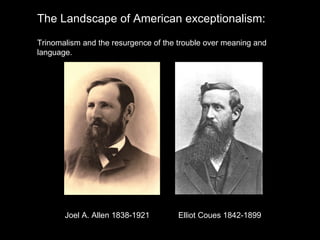
The Landscape of American exceptionalism: Trinomalism and the resurgence of the trouble over meaning and language. Joel A. Allen 1838-1921 Elliot Coues 1842-1899
 
Confrontation at the British Museum (Natural History) -1884 -- language, meaning, reform and authority -- who rules?
 
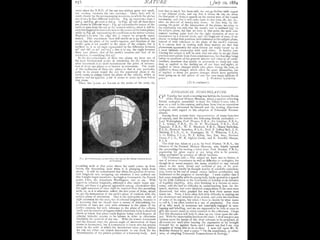
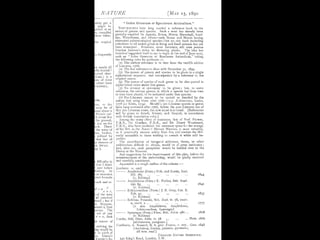
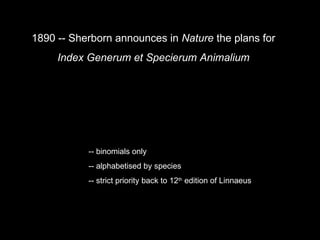
1890 -- Sherborn announces in  Nature  the plans for  Index Generum et Specierum Animalium   -- binomials only -- alphabetised by species -- strict priority back to 12 th  edition of Linnaeus

Sherborn: McOuat - Naming and Necessity: Sherborn’s Context in the late 19th Century

  • 1.
    Naming and Necessity: Sherborn’s Context
  • 2.
    Nomina si pereunt,perit et cognitio rerum “ Names are the foundation of knowledge: and unless they have a ‘a name’ as well as a ‘local habitation’ with us, the zoological treasures that we so highly prize might almost as well have been left to perish in their native deserts or forests, as have grown mouldy in our drawers or repositories. But when once an animal subject is named and described, it becomes a possession for ever, and the value of every individual specimen of it, even in a mercantile view, is enhanced.” William Kirby, Foundational Address of the Zoological Club, 1823.
  • 3.
    Language and Meaning in the 1842 Rules of Zoological Nomenclature , drafted by a committee headed by Hugh Edwin Strickland (1811-1853)
  • 4.
    Early draft ofthe “Strickland Rules” with corrections (Courtesy of Zoological Museum, Cambridge University)
  • 5.
  • 6.
  • 7.
    John Edward Gray(1800-1875) and the types of things at the British Museum. Opposing the Rules
  • 8.
    A barnacle builtfor two (authorities). Charles Darwin’s A monograph on the sub-class Cirripedia (The first monograph to closely follow the 1842 Rules and make use of the catalogues and specimens of the BM)
  • 9.
    The Landscape ofAmerican exceptionalism: Trinomalism and the resurgence of the trouble over meaning and language. Joel A. Allen 1838-1921 Elliot Coues 1842-1899
  • 10.
  • 11.
    Confrontation at theBritish Museum (Natural History) -1884 -- language, meaning, reform and authority -- who rules?
  • 12.
  • 13.
    1890 -- Sherbornannounces in Nature the plans for Index Generum et Specierum Animalium -- binomials only -- alphabetised by species -- strict priority back to 12 th edition of Linnaeus