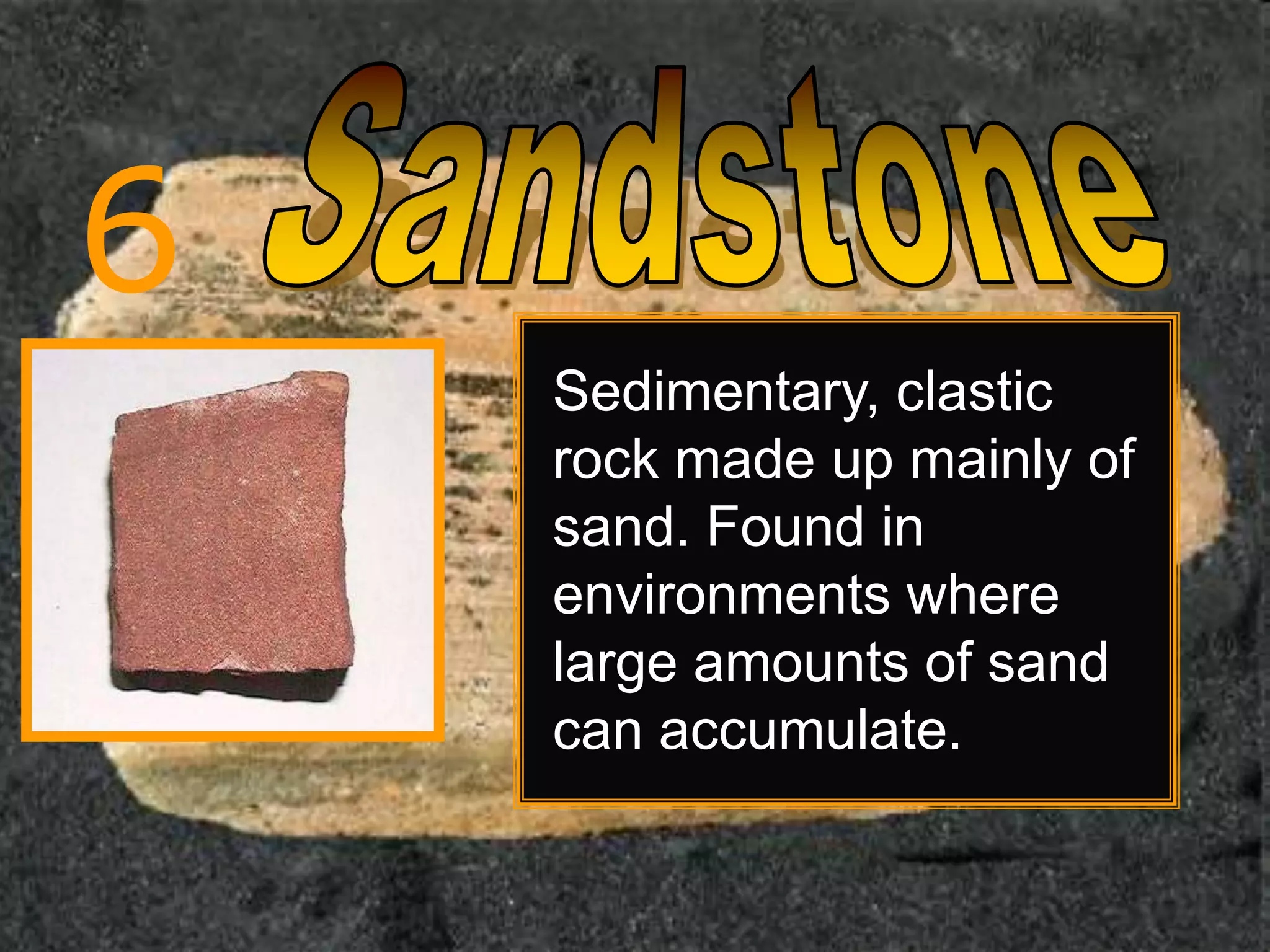

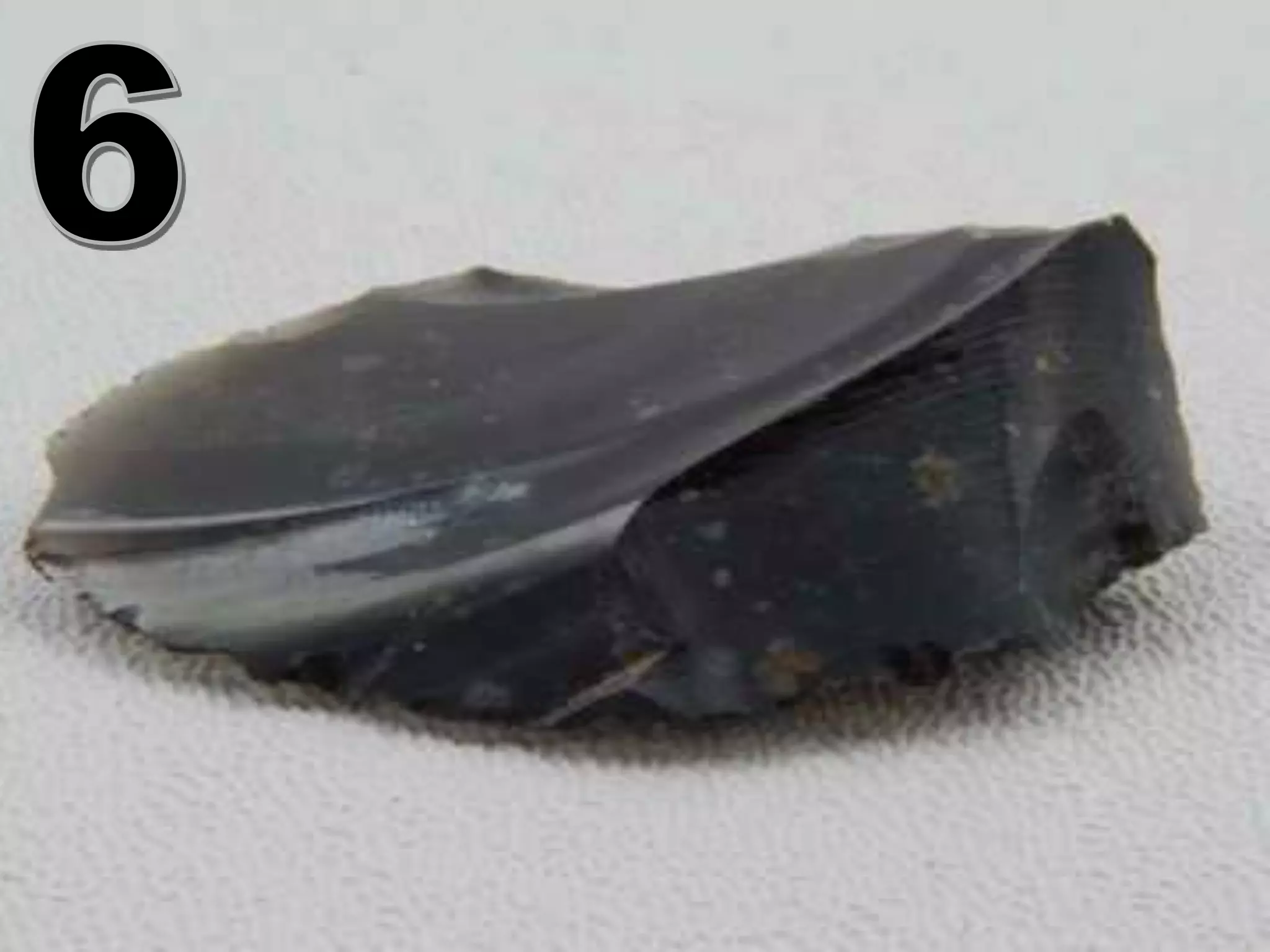






6
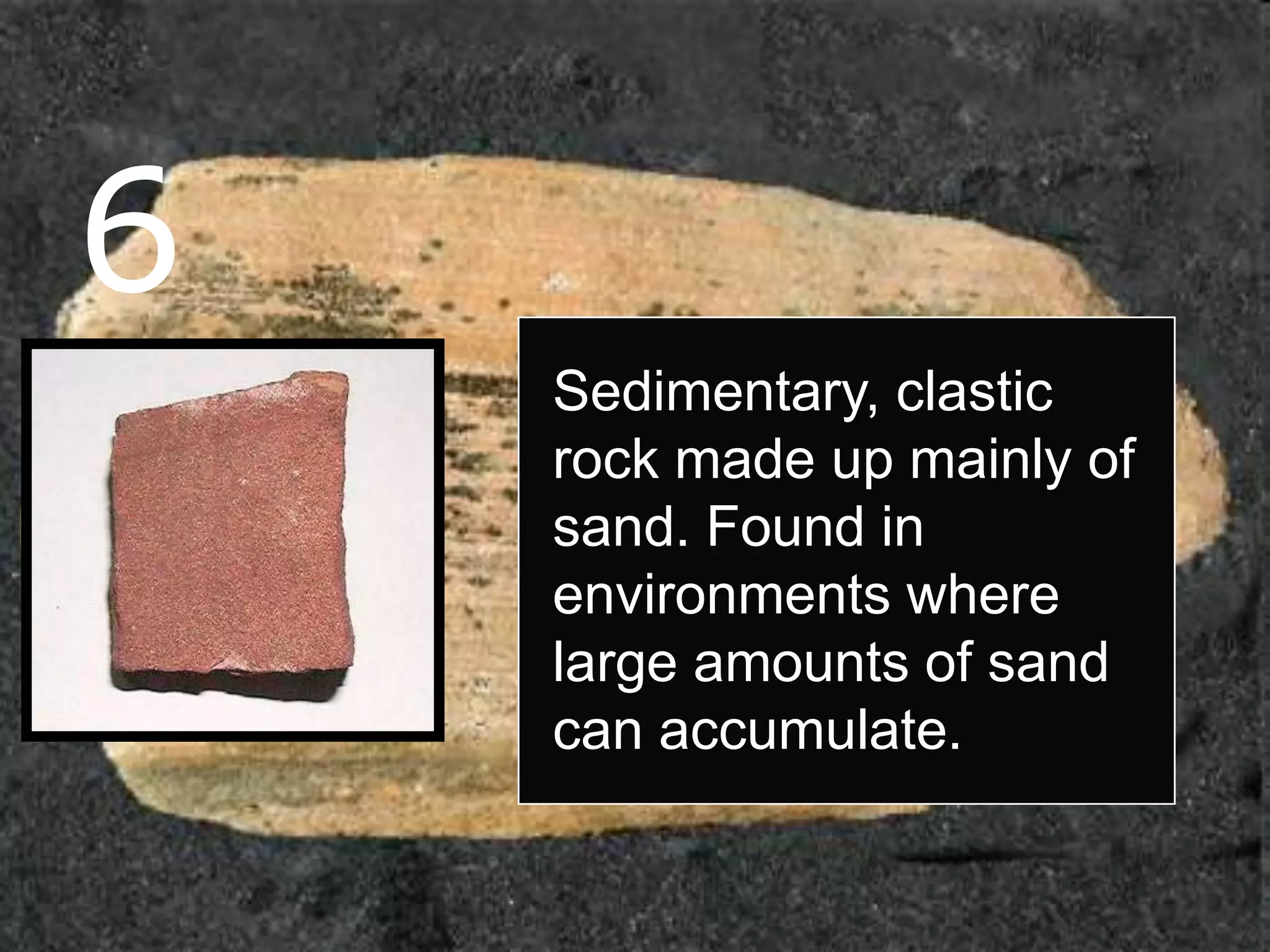
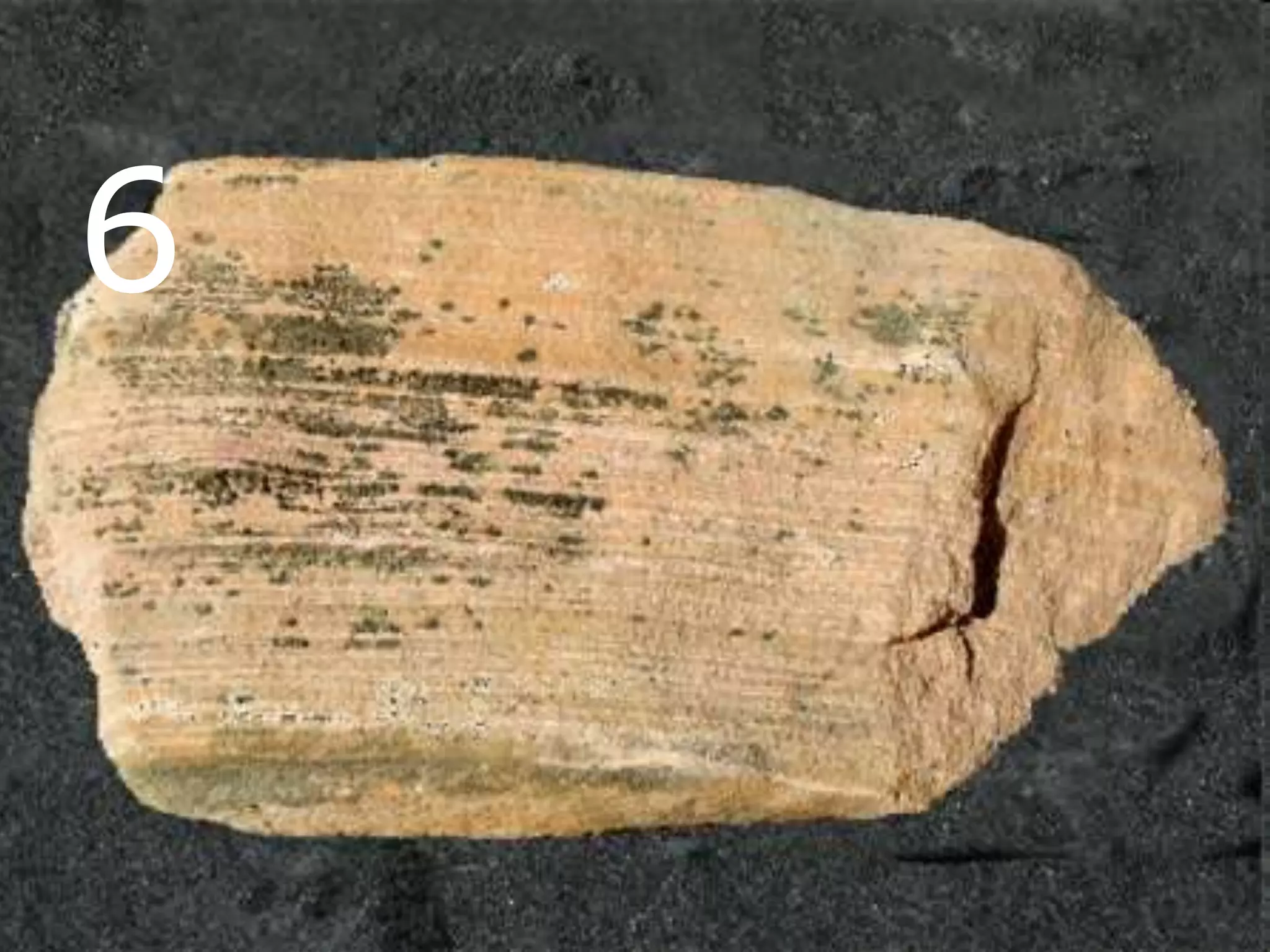
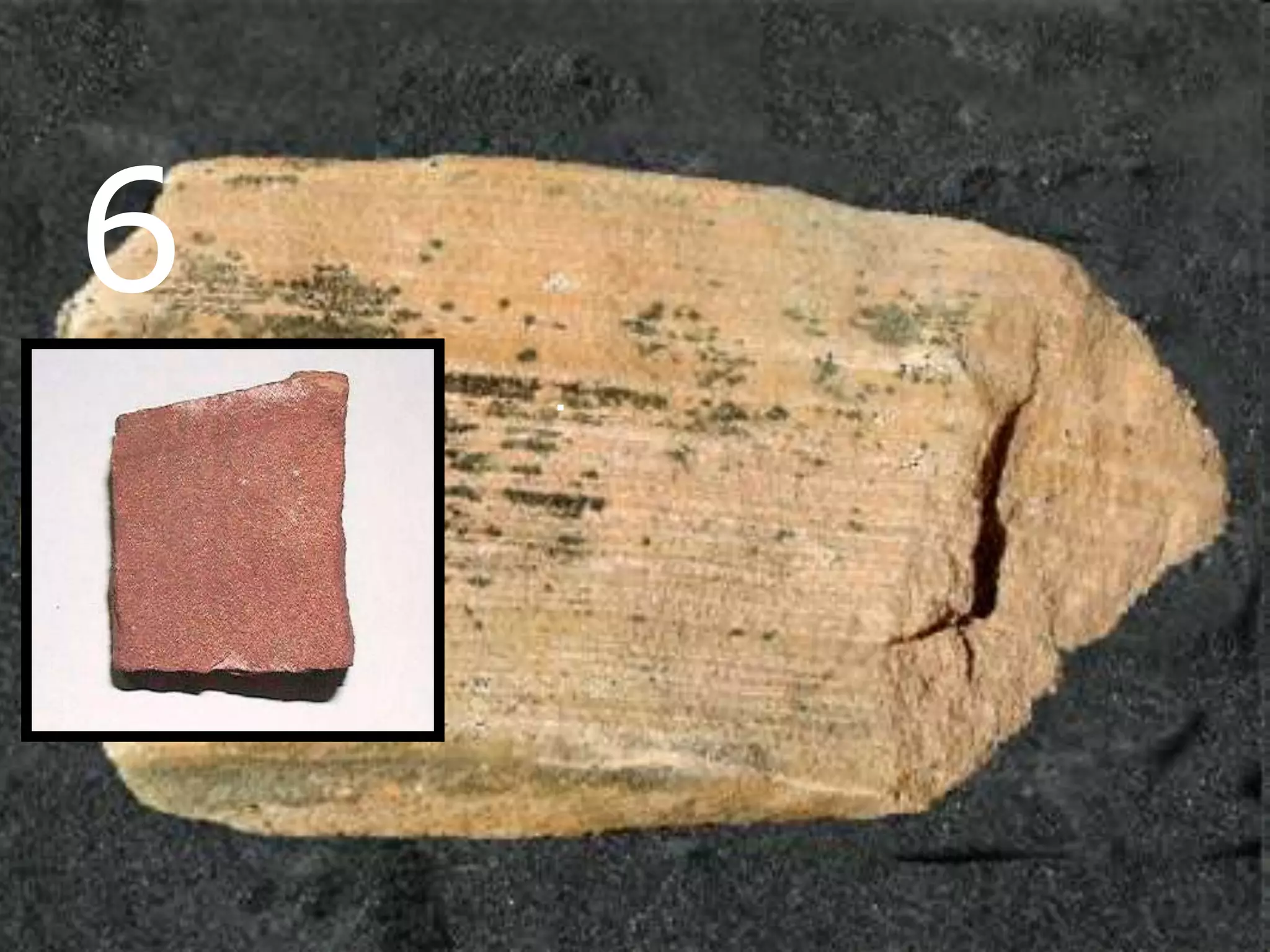
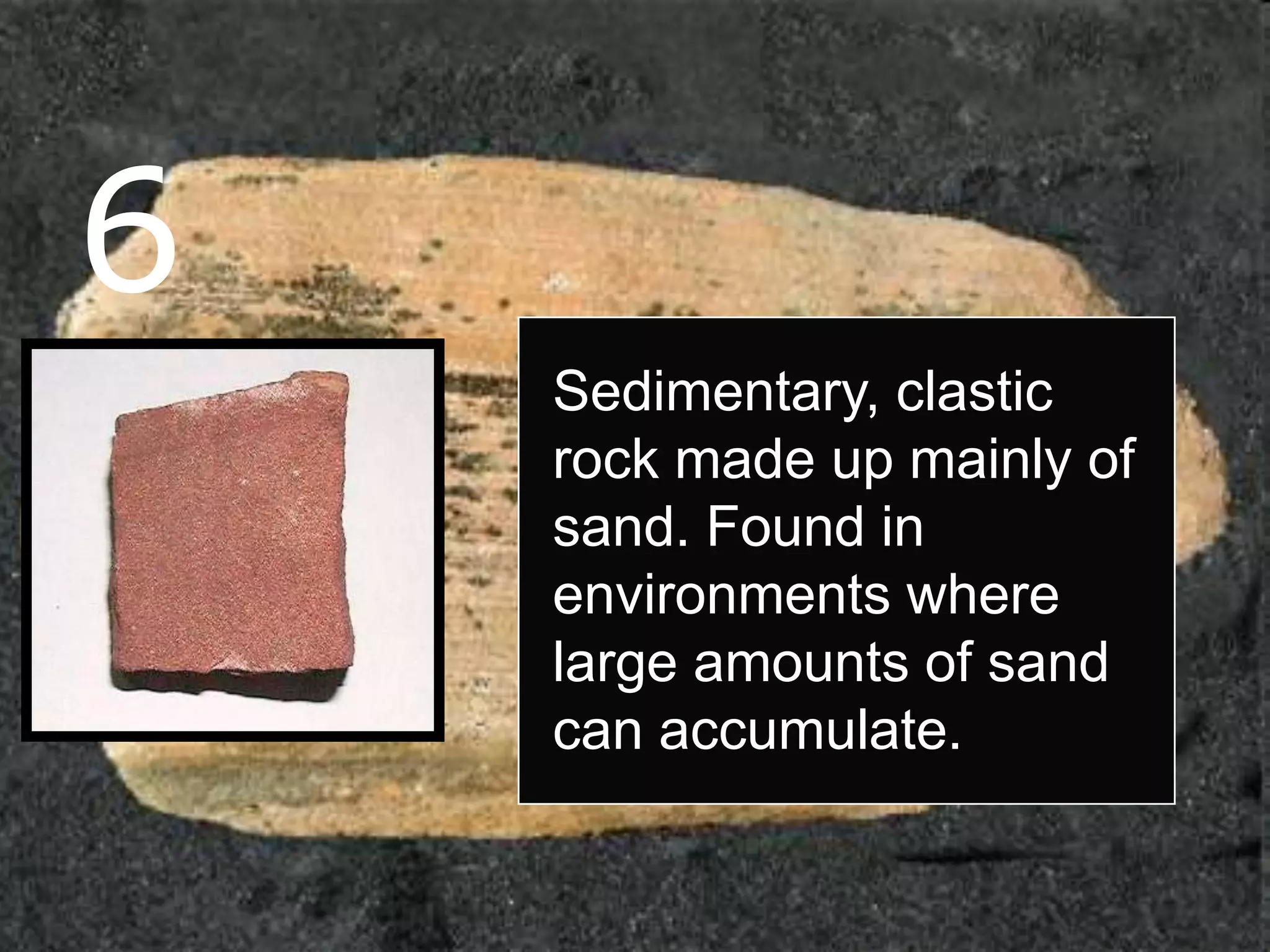
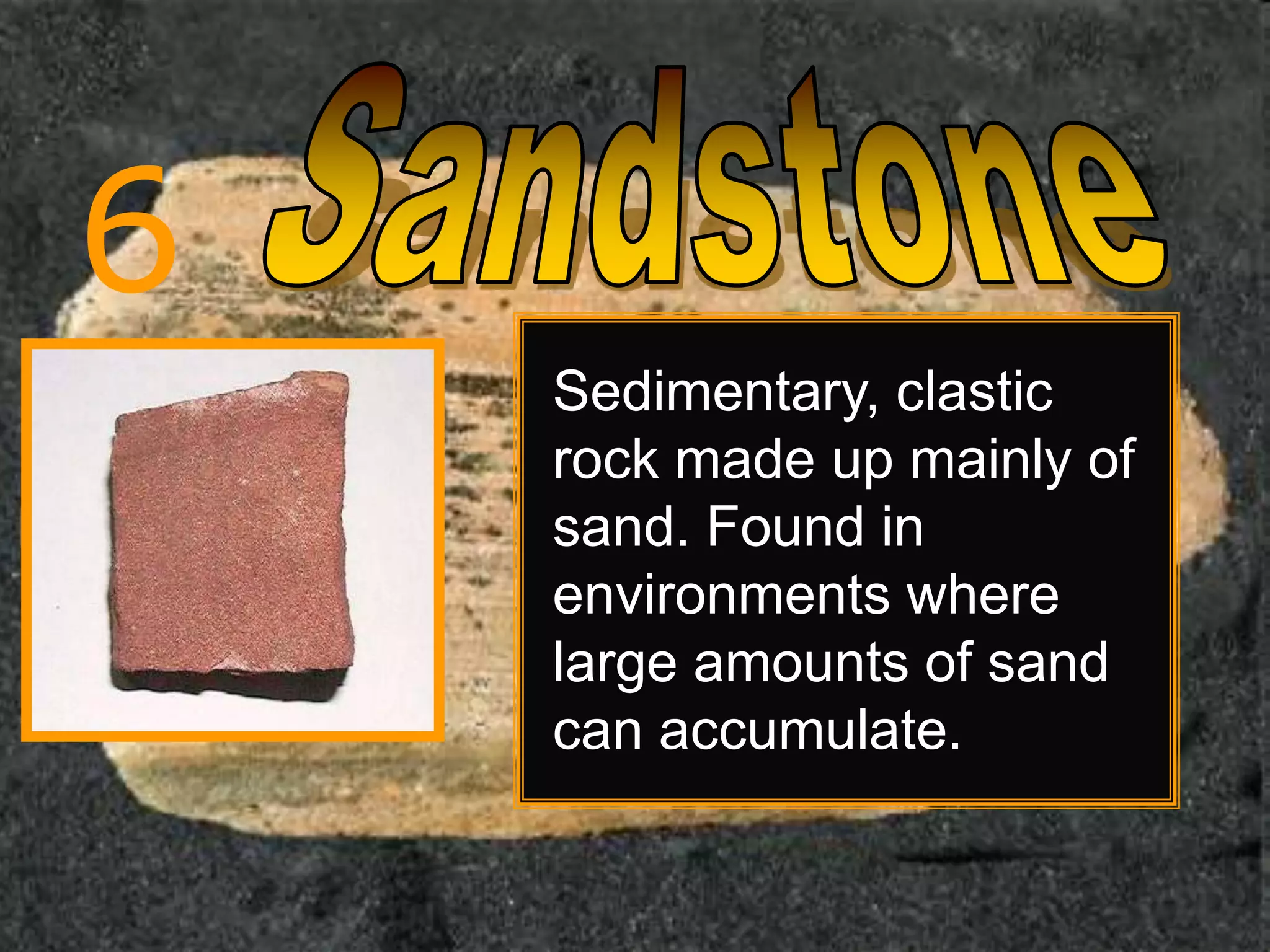
Sedimentary, clastic
rock made up mainly of
sand. Found in
environments where
large amounts of sand
can accumulate.
• RED SLIDE: These are notes that are very
important and should be recorded in your
science journal.
Copyright © 2010 Ryan P. Murphy
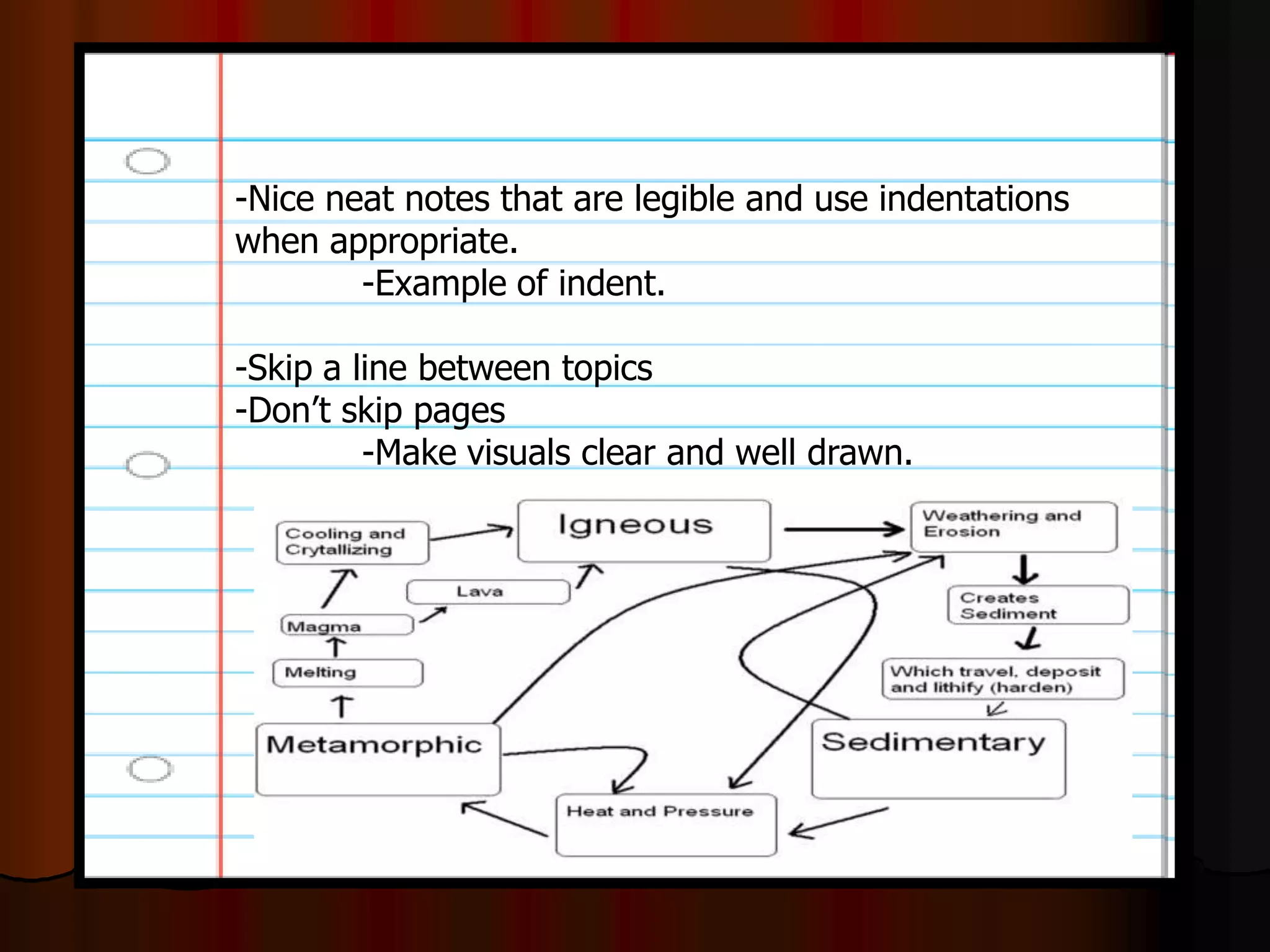
-Nice neat notes that are legible and use indentations
when appropriate.
-Example of indent.
-Skip a line between topics
-Don’t skip pages
-Make visuals clear and well drawn.
• RED SLIDE: These are notes that are very
important and should be recorded in your
science journal.
• BLACK SLIDE: Pay attention, follow
directions, complete projects as described
and answer required questions neatly.
Copyright © 2010 Ryan P. Murphy
http://sciencepowerpoint.com/Website Link:
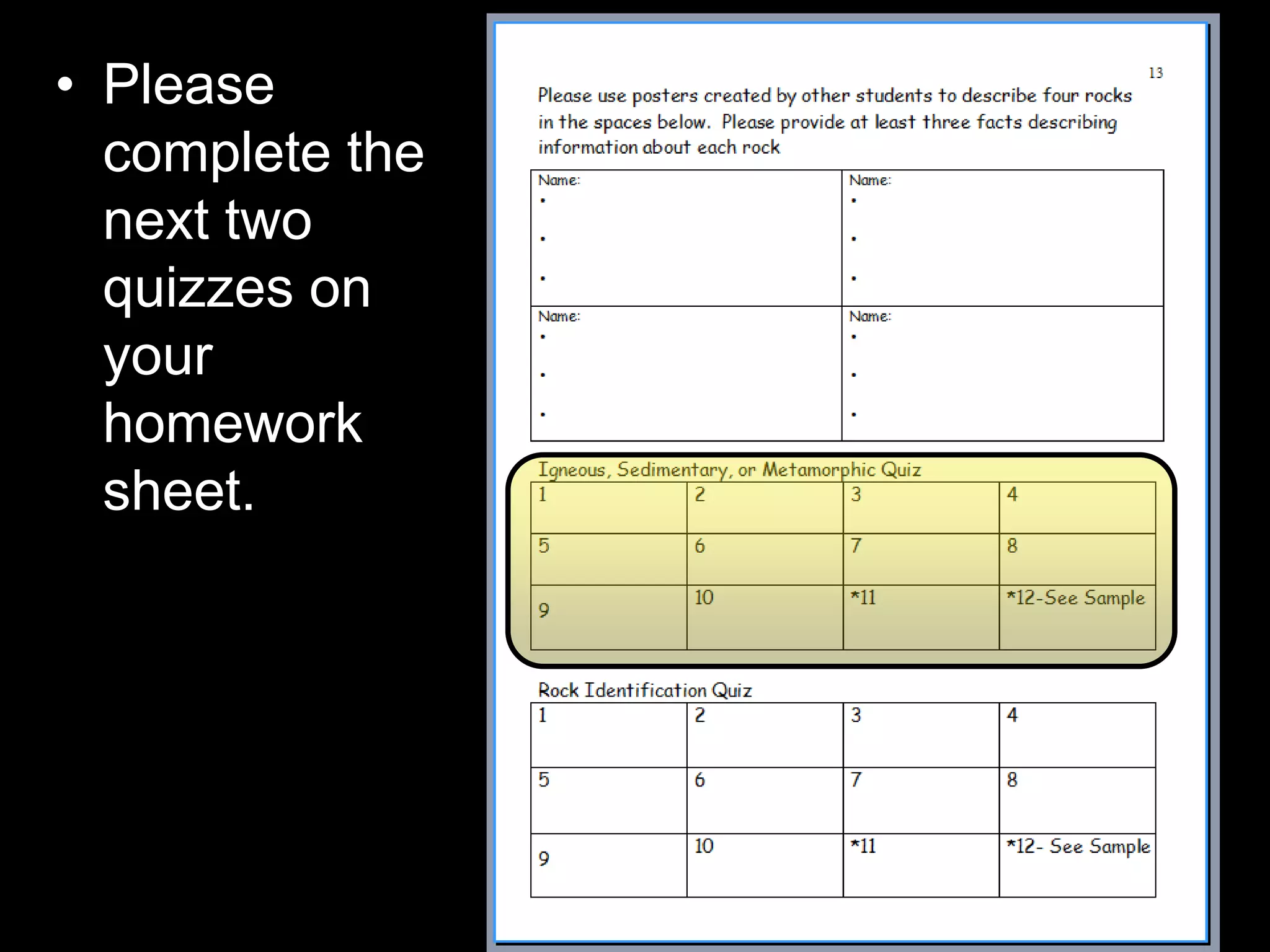
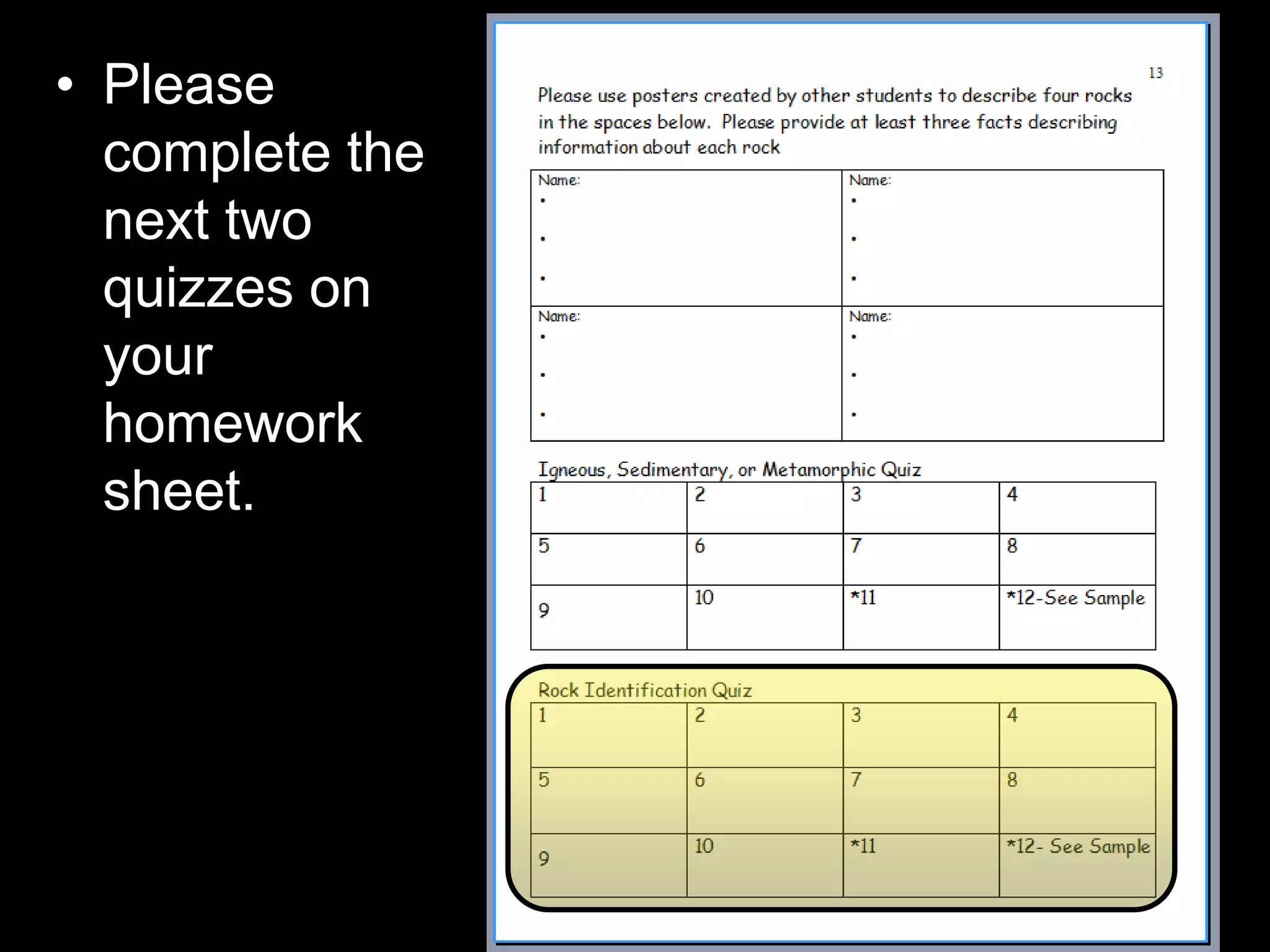
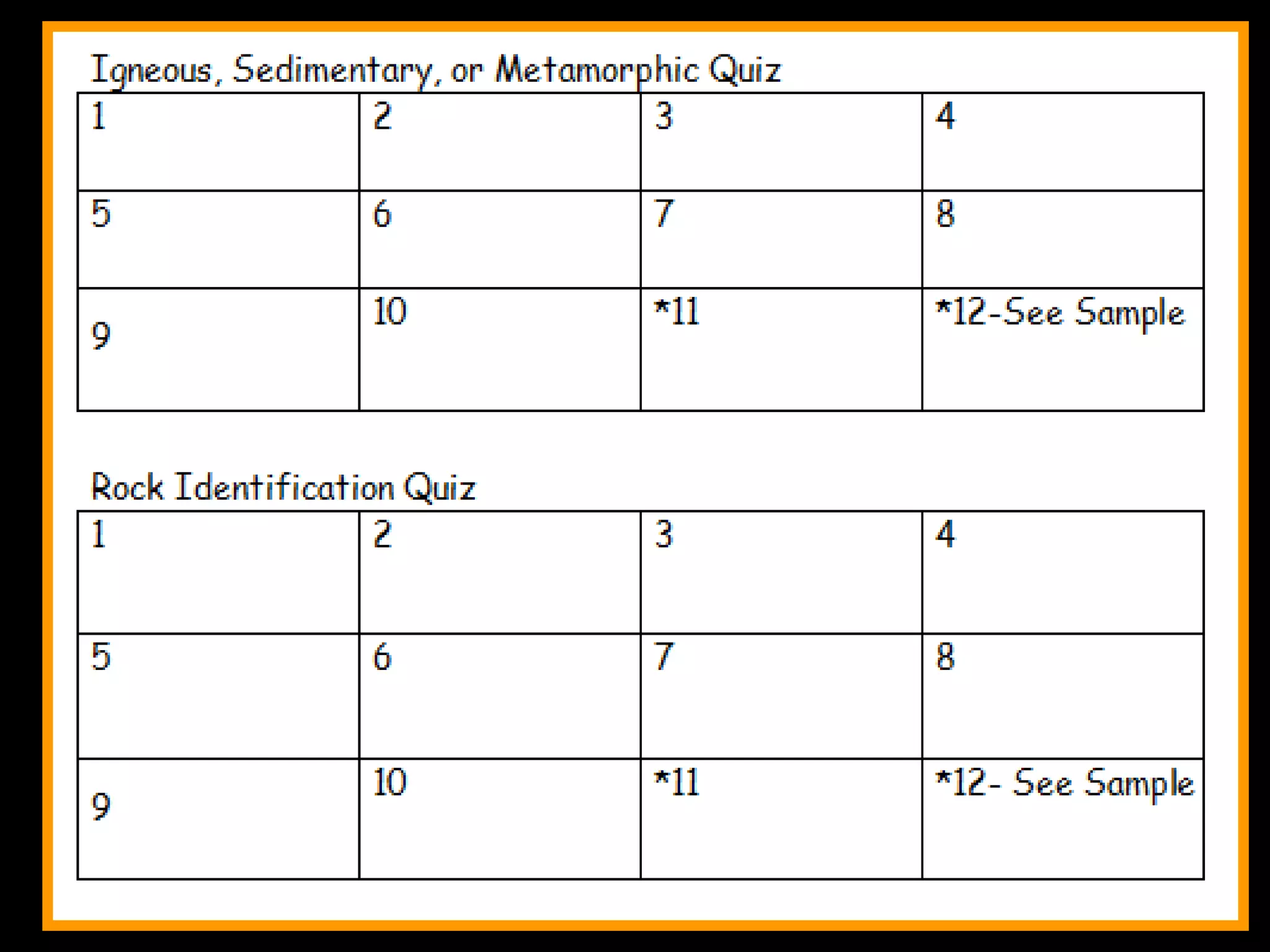
• Please
complete the
next two
quizzes on
your
homework
sheet.
• Quiz Wiz 1-10 Igneous, Metamorphic,
Sedimentary + Name the rock for a bonus.
• Work on Unit Assessment
Copyright © 2010 Ryan P. Murphy
Teacher will invite groups up
to the mystery rock.
• What movie is this?
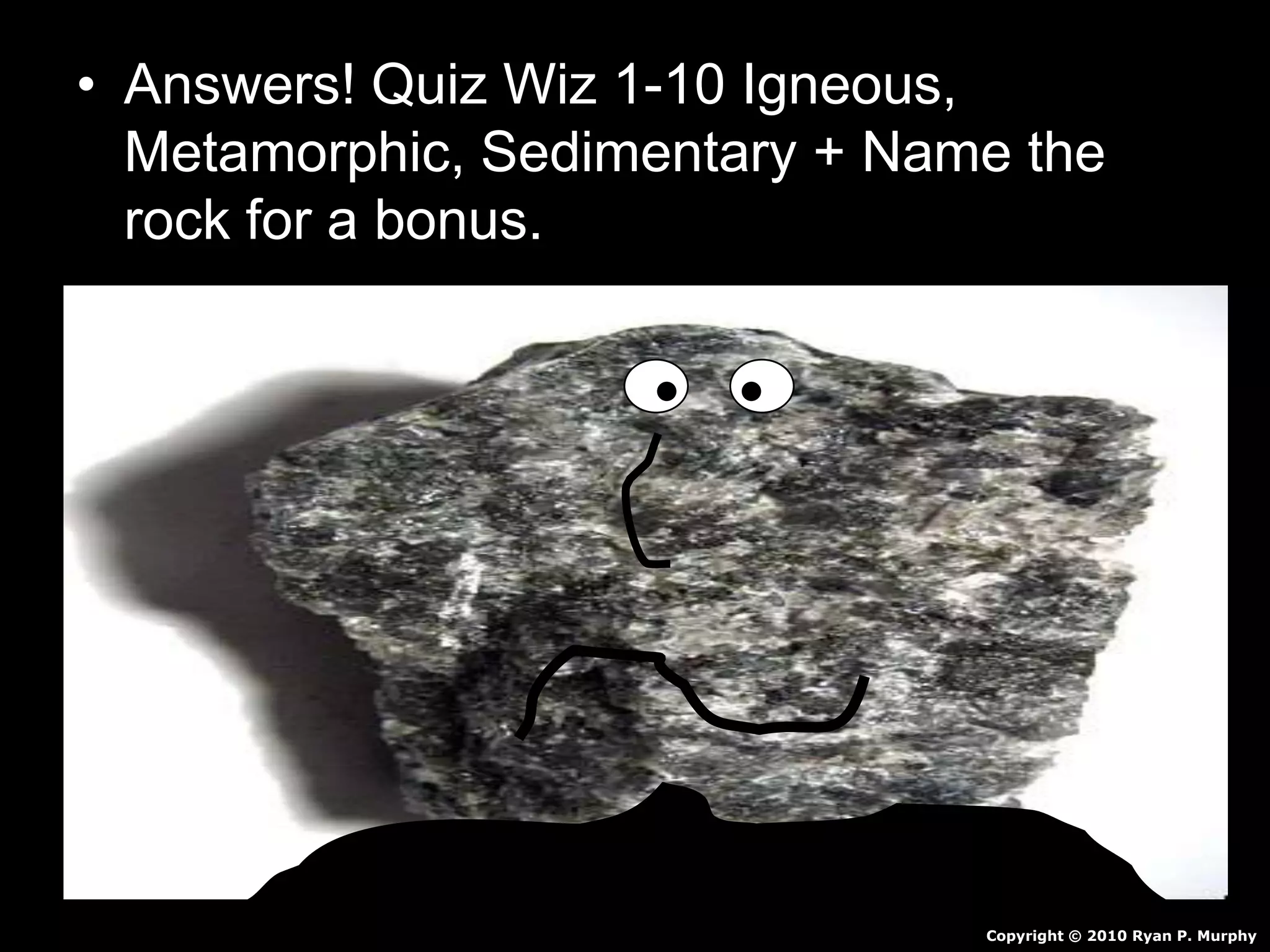
• Answers! Quiz Wiz 1-10 Igneous,
Metamorphic, Sedimentary + Name the
rock for a bonus.
Copyright © 2010 Ryan P. Murphy
Teacher will invite groups up
to the mystery rock.
• What movie is this?
• Answer! School of Rock (2003).
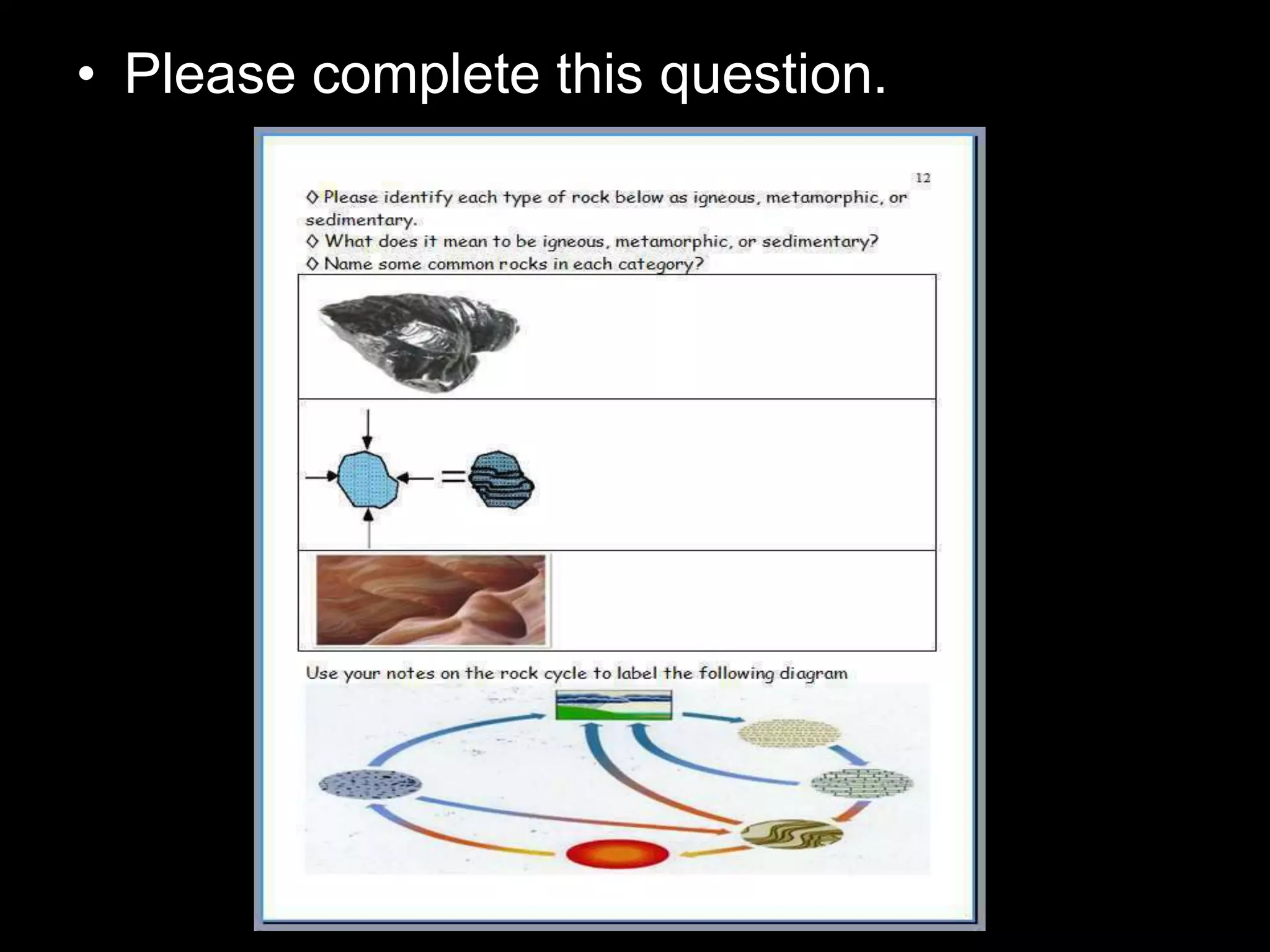
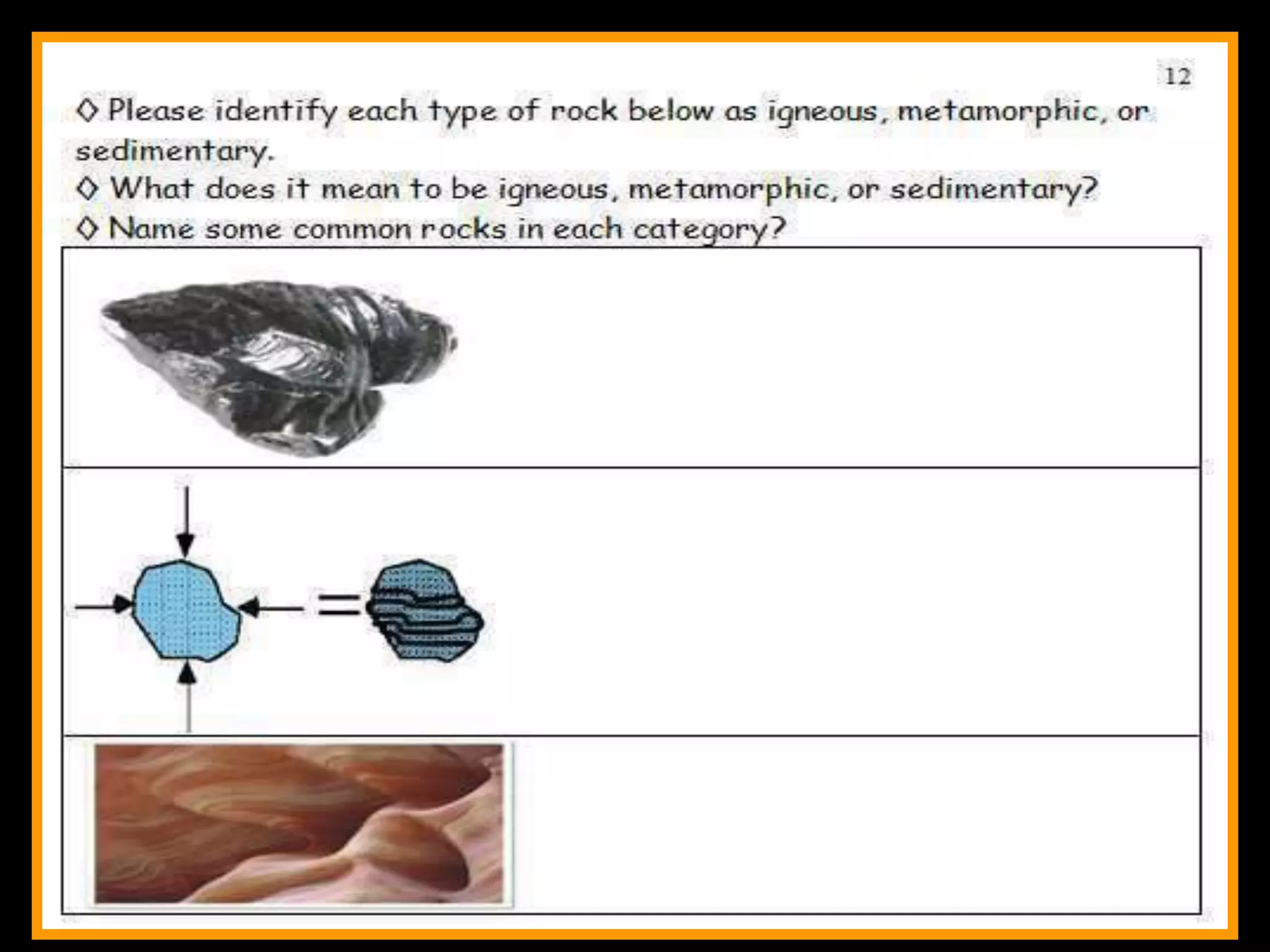
• Please complete this question.
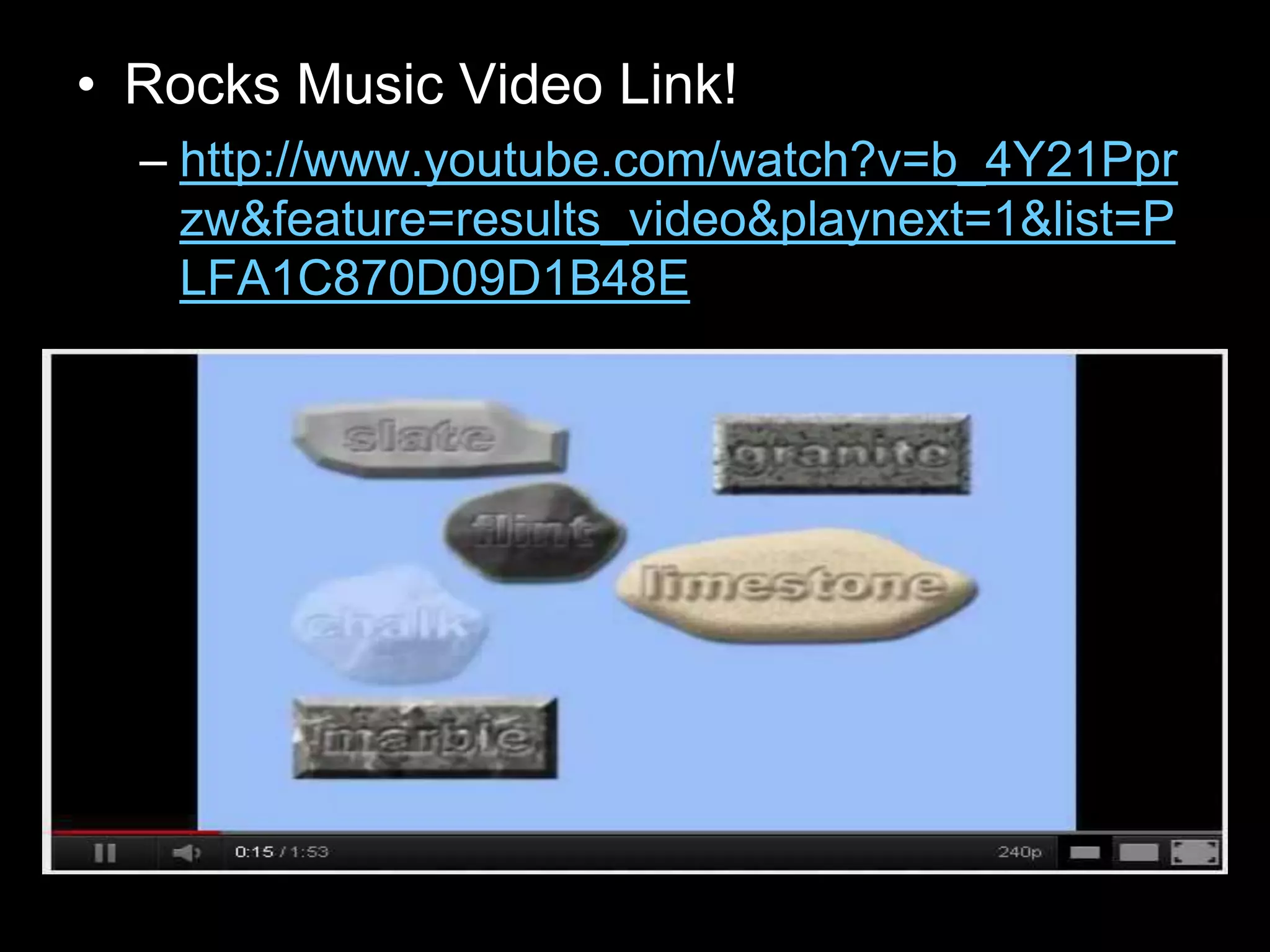
• Rocks Music Video Link!
– http://www.youtube.com/watch?v=b_4Y21Ppr
zw&feature=results_video&playnext=1&list=P
LFA1C870D09D1B48E
• Please
complete the
next two
quizzes on
your
homework
sheet.
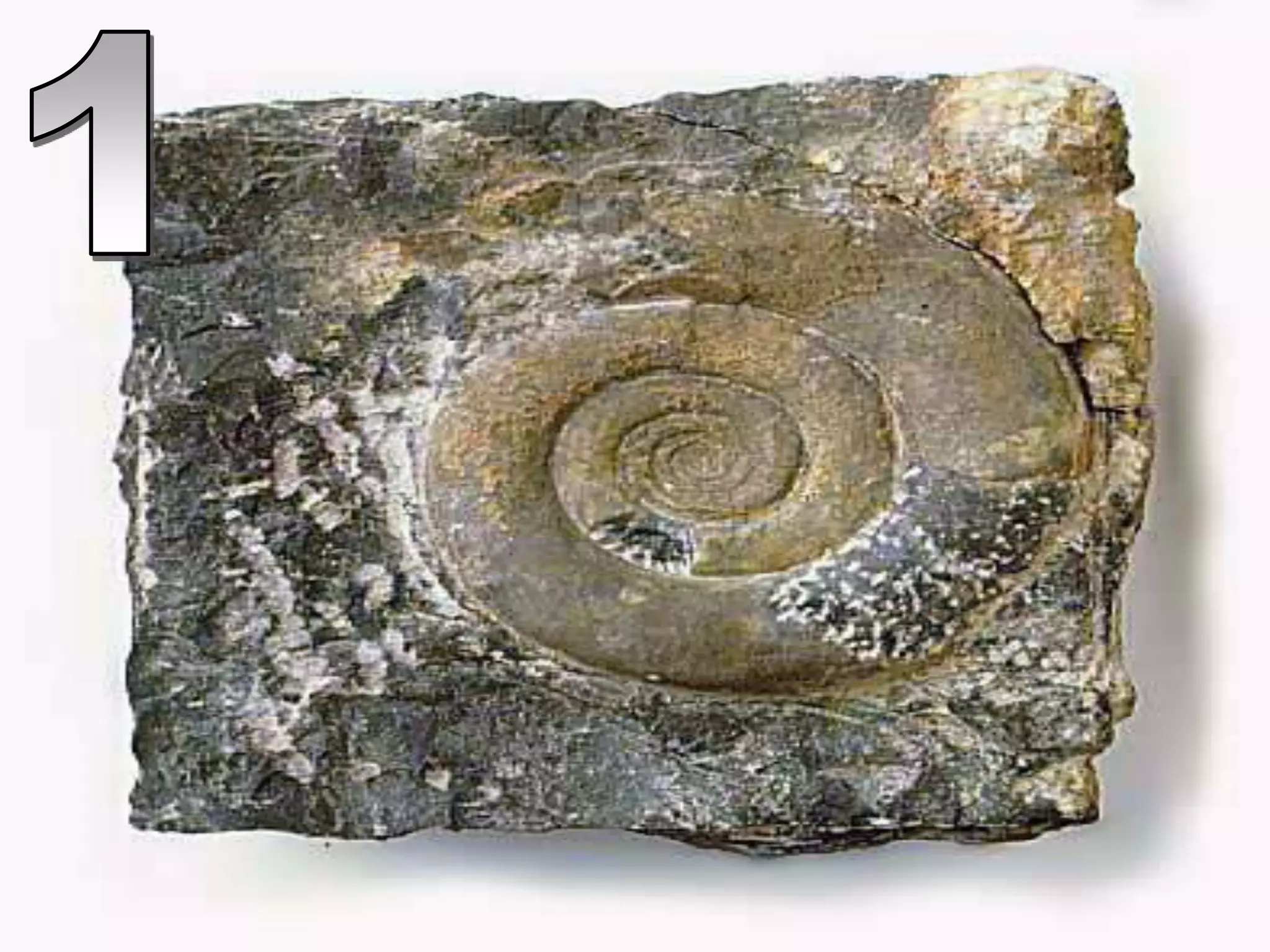
• Quiz Wiz 1-10 Name the rock.
Copyright © 2010 Ryan P. Murphy
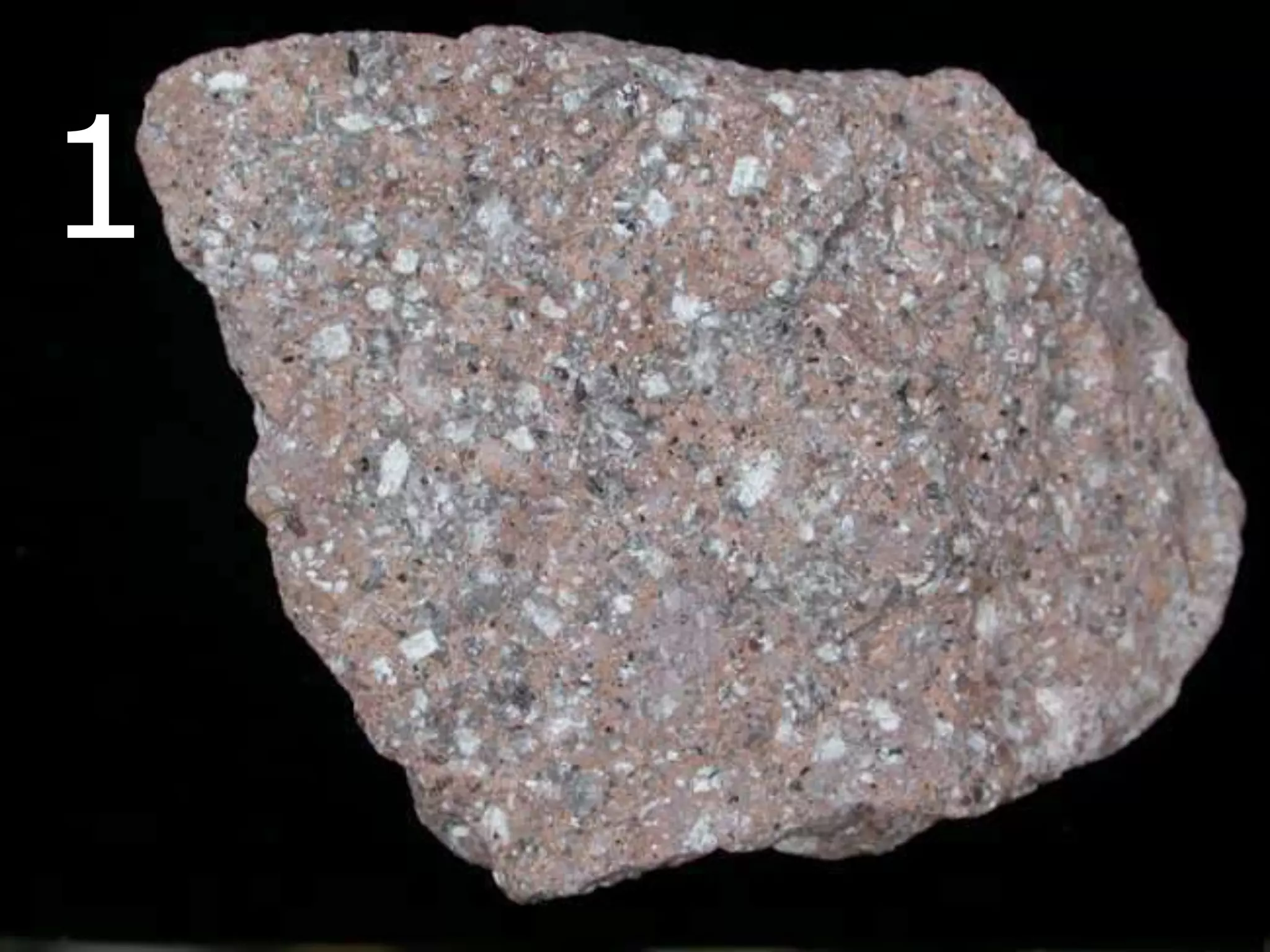
1
1
1
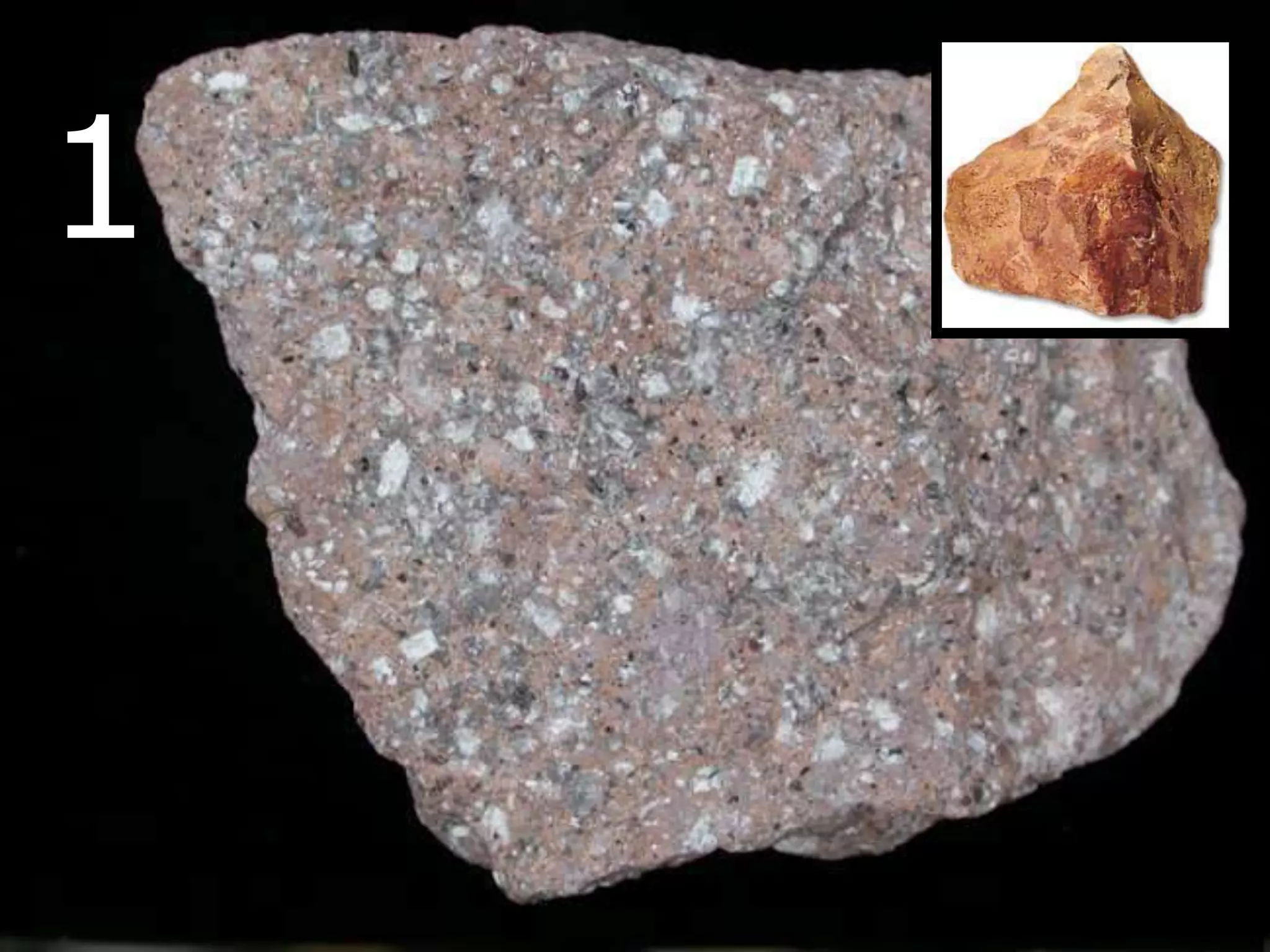
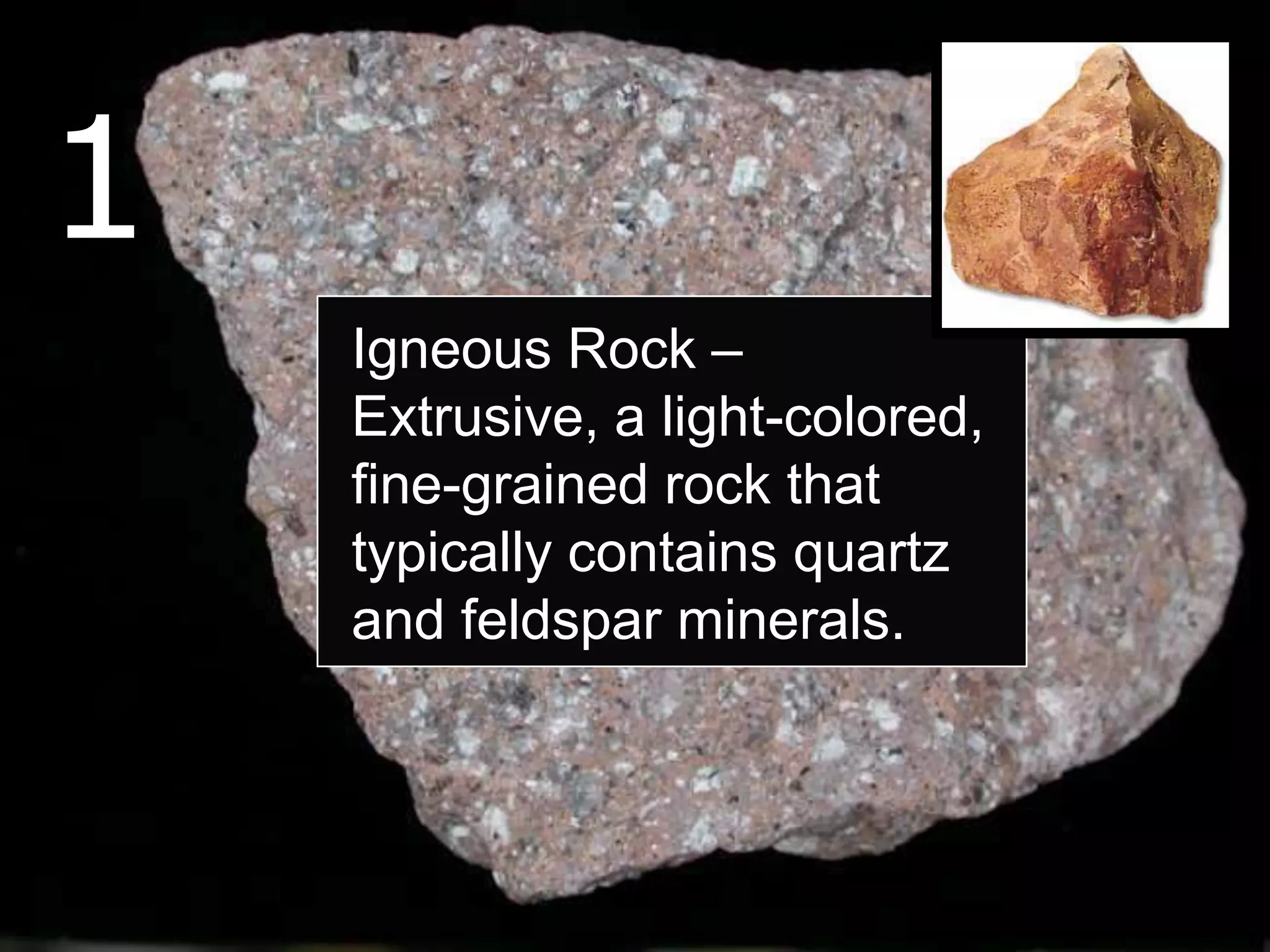
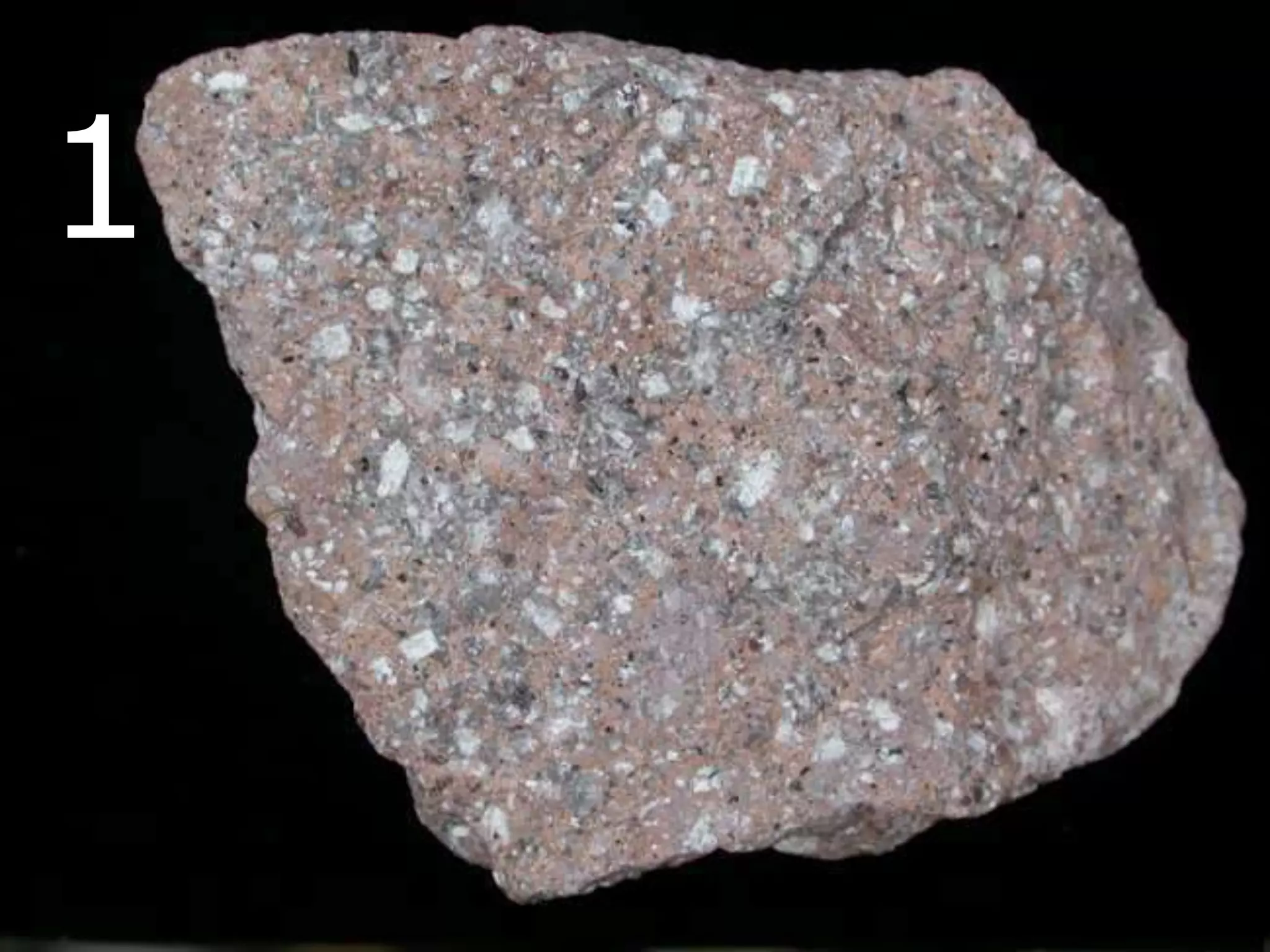
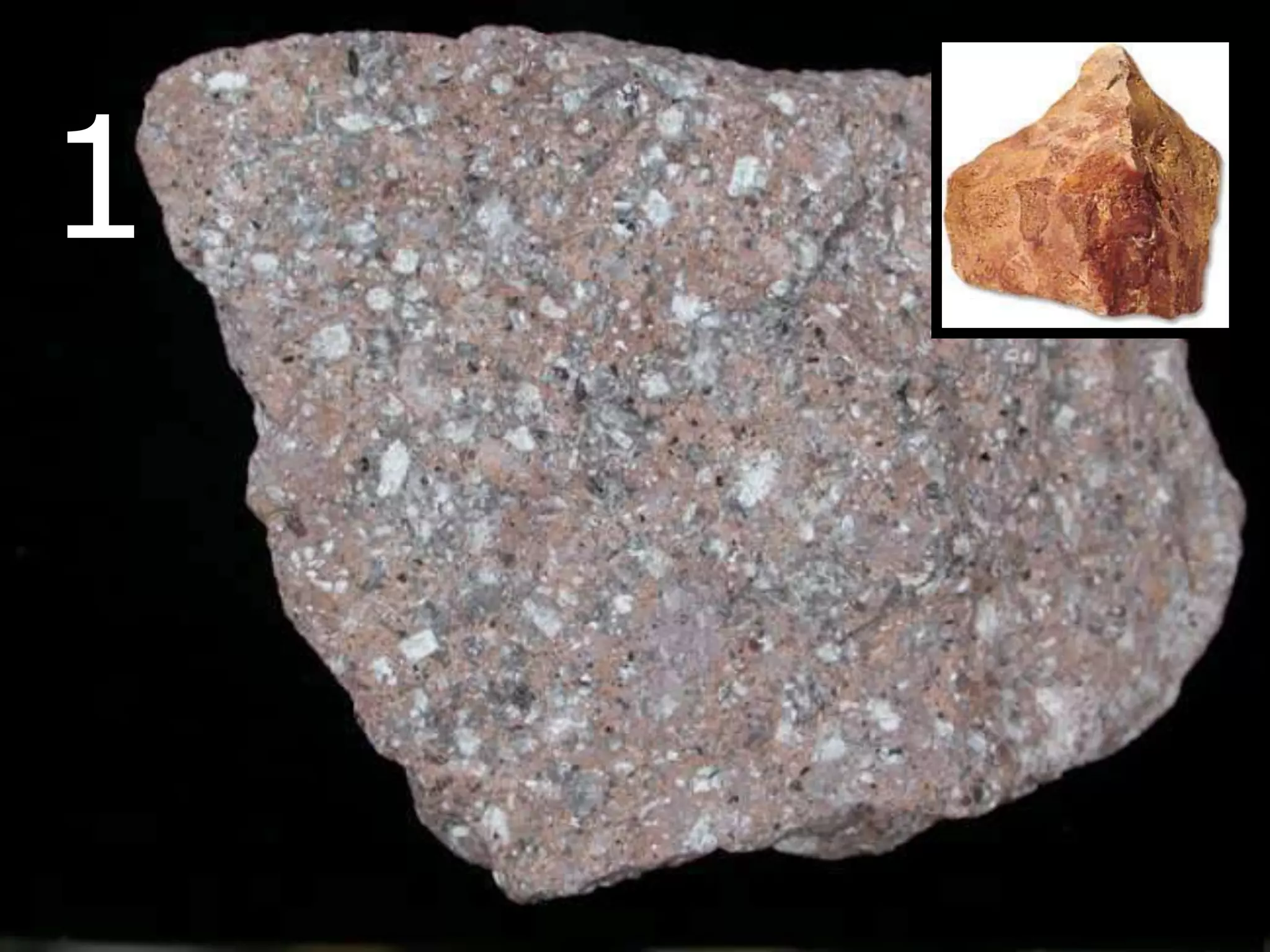
Igneous Rock –
Extrusive, a light-colored,
fine-grained rock that
typically contains quartz
and feldspar minerals.
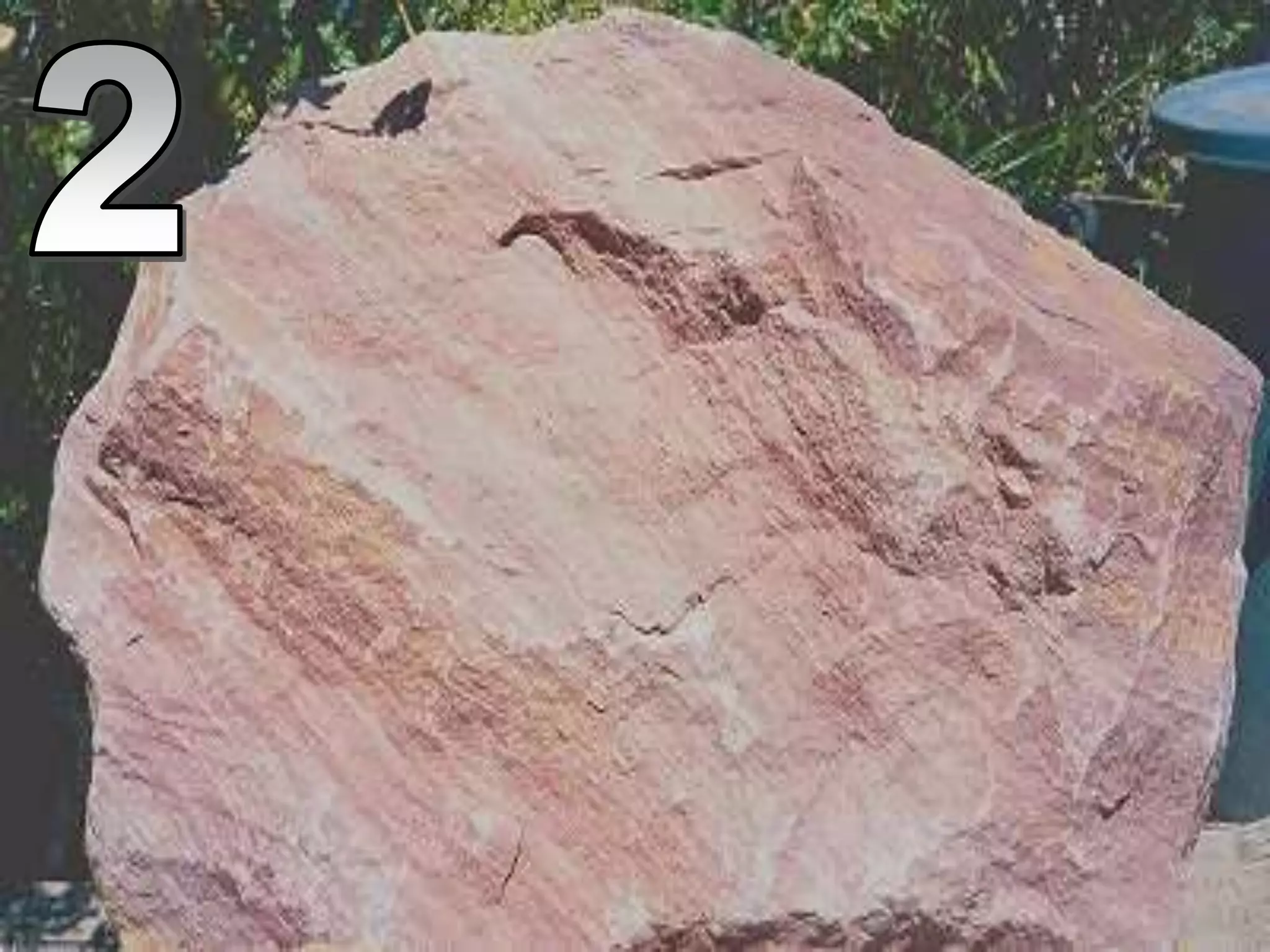
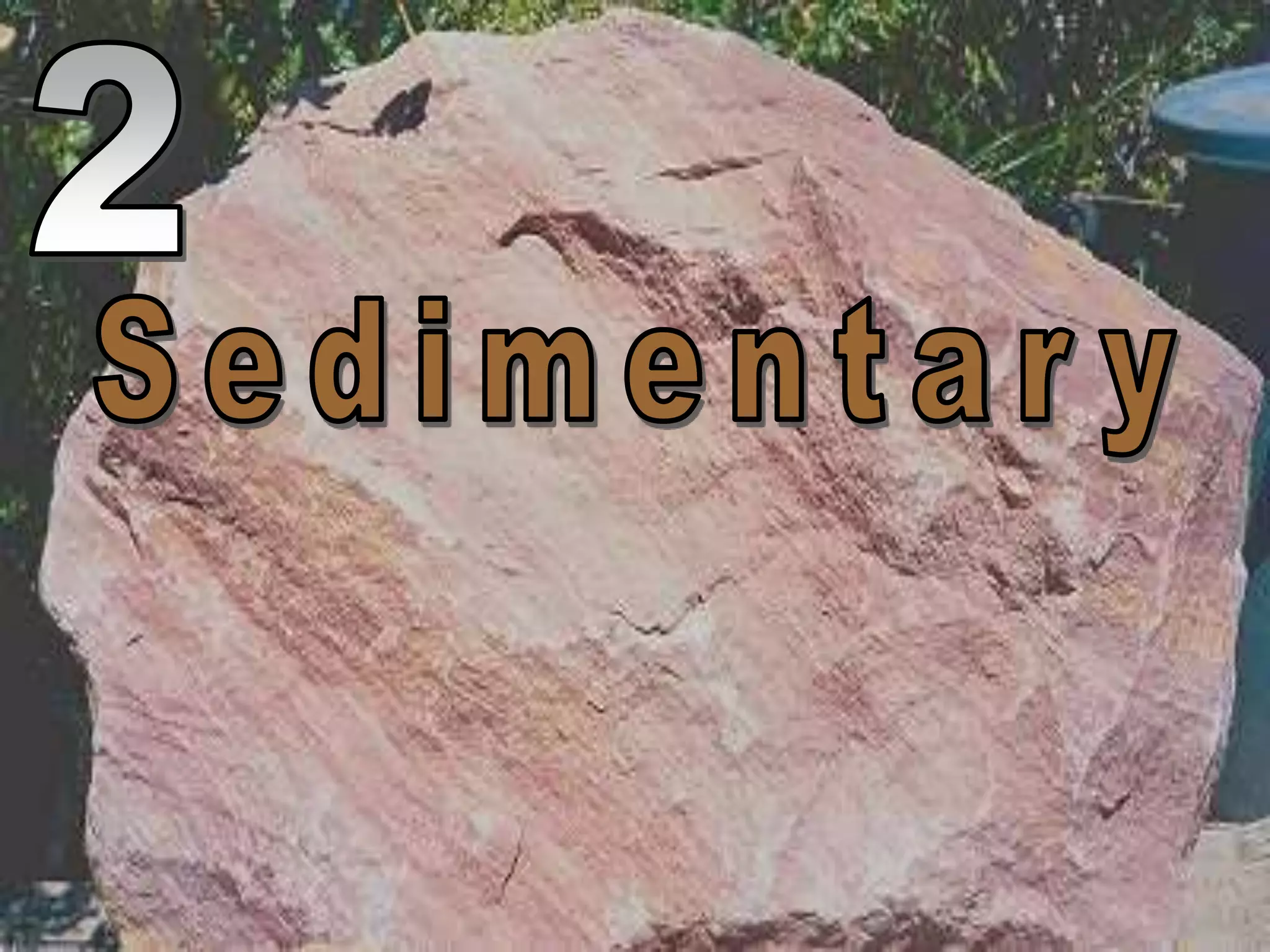
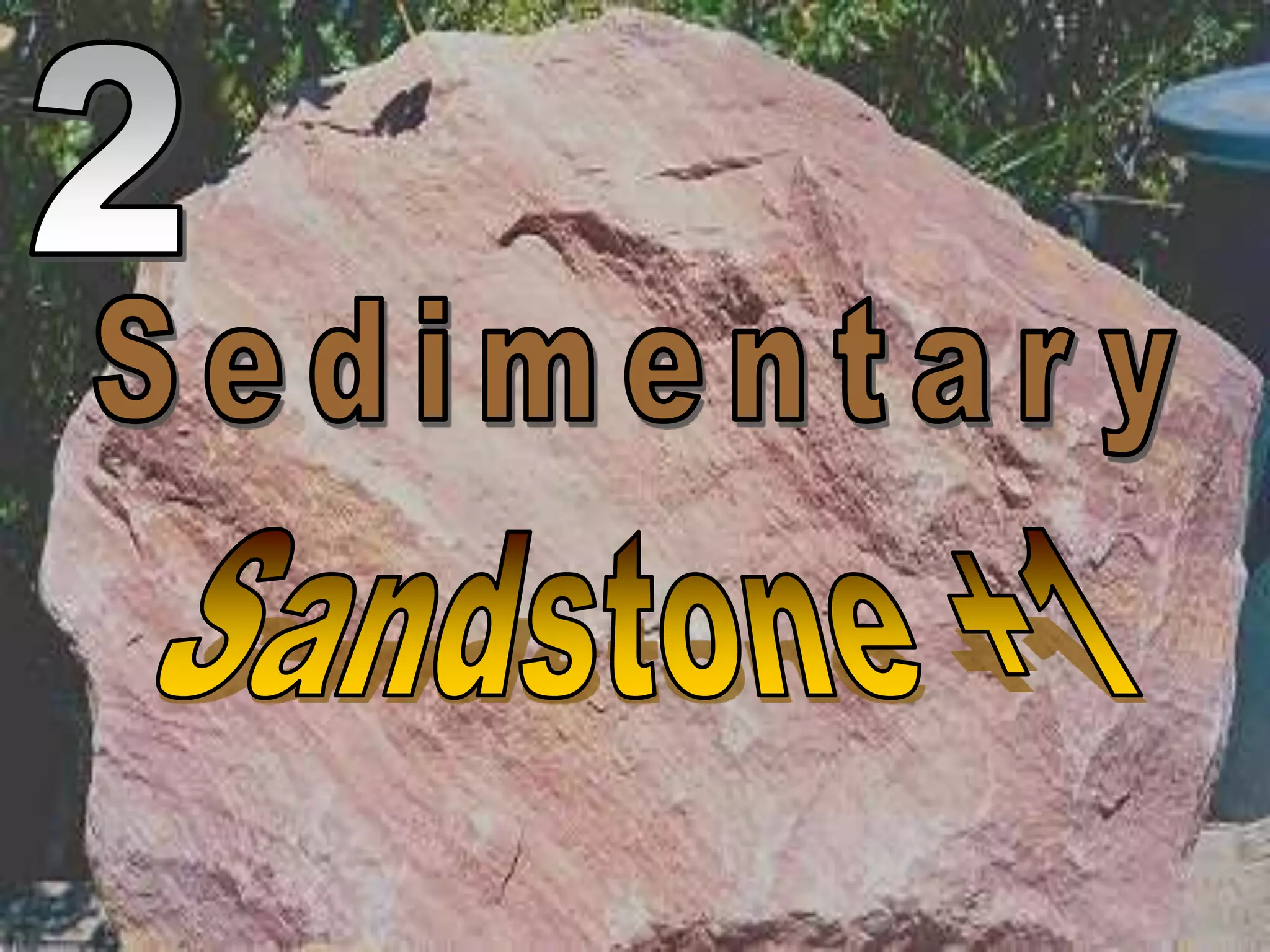
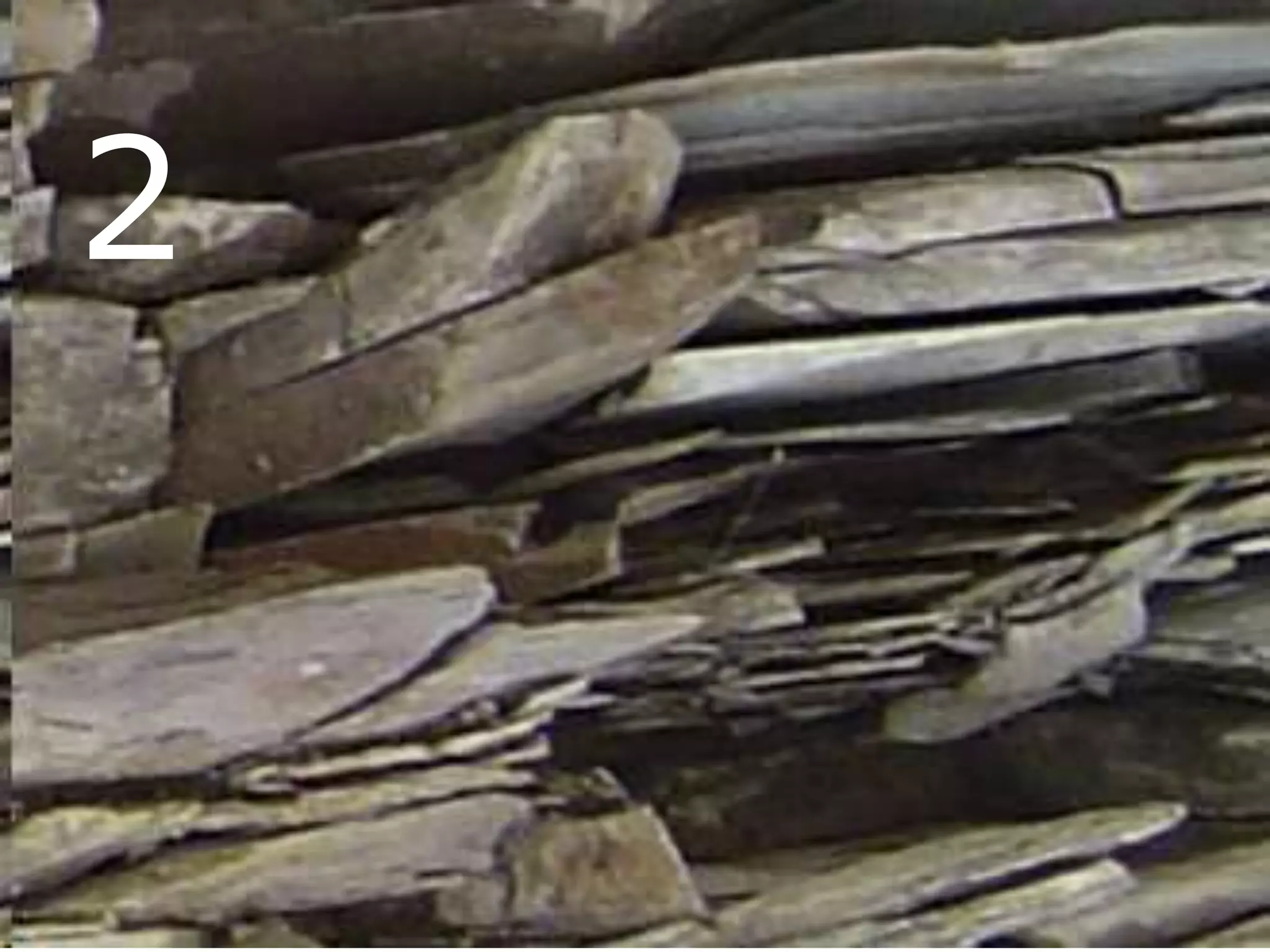
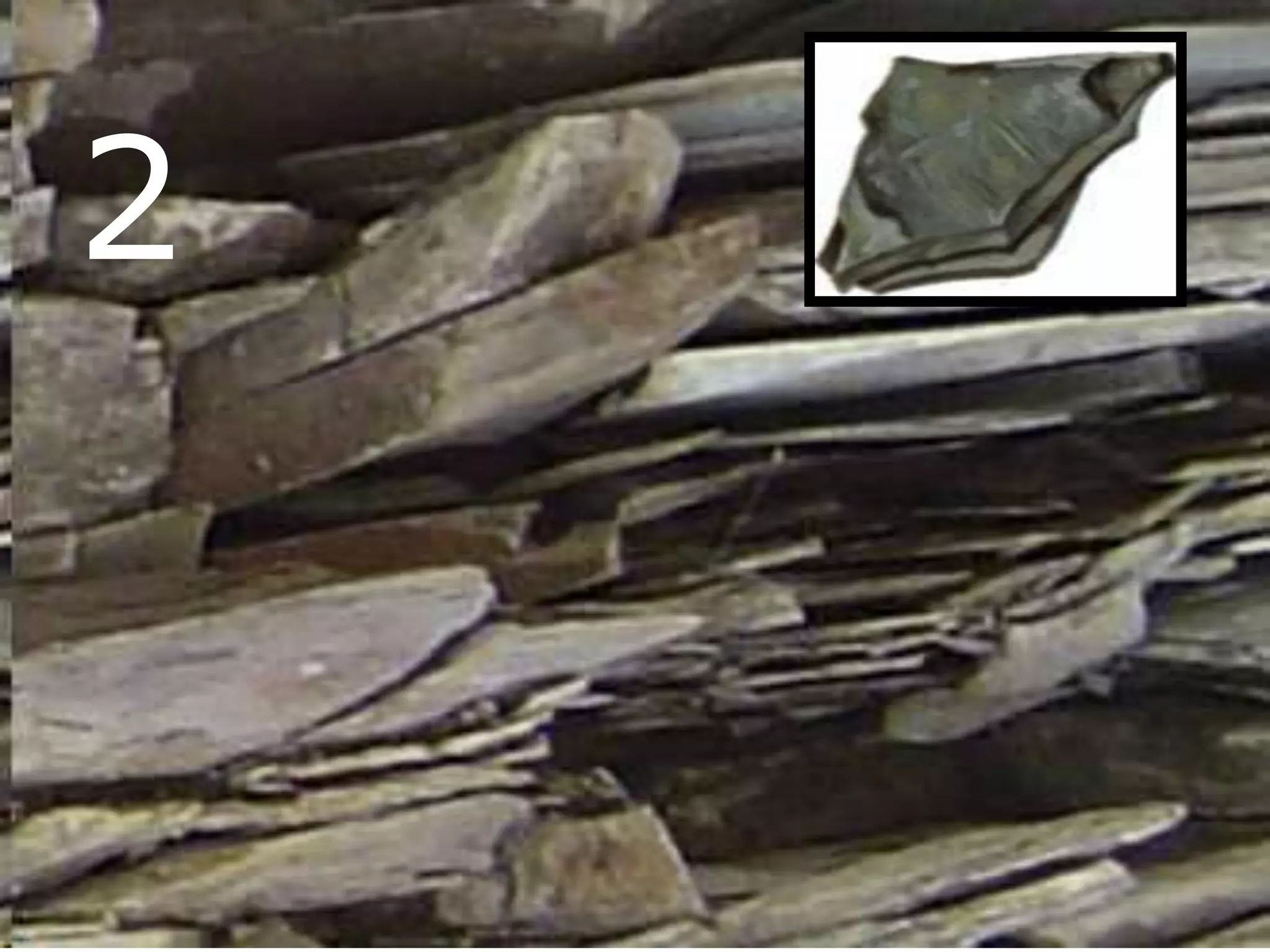
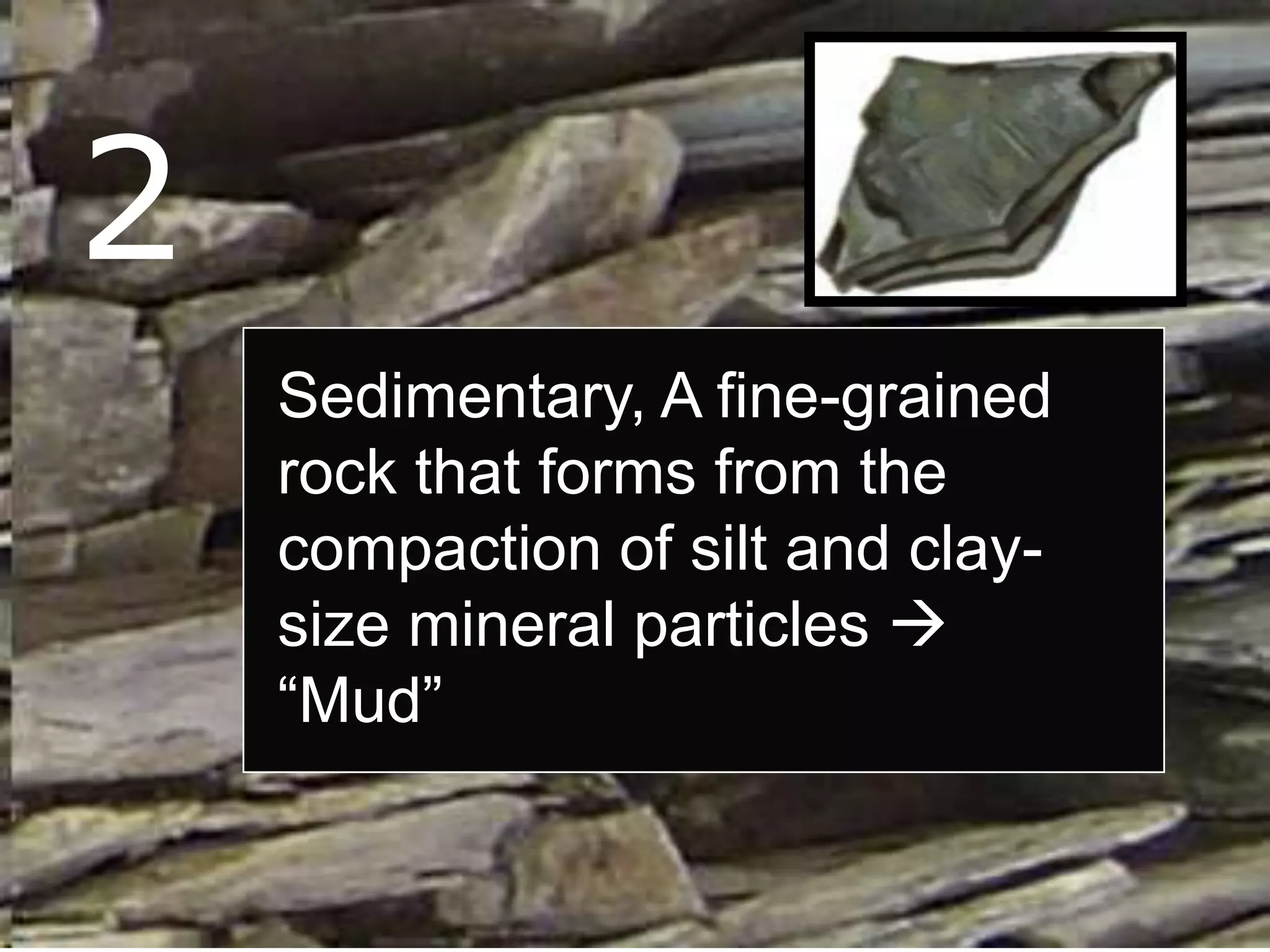
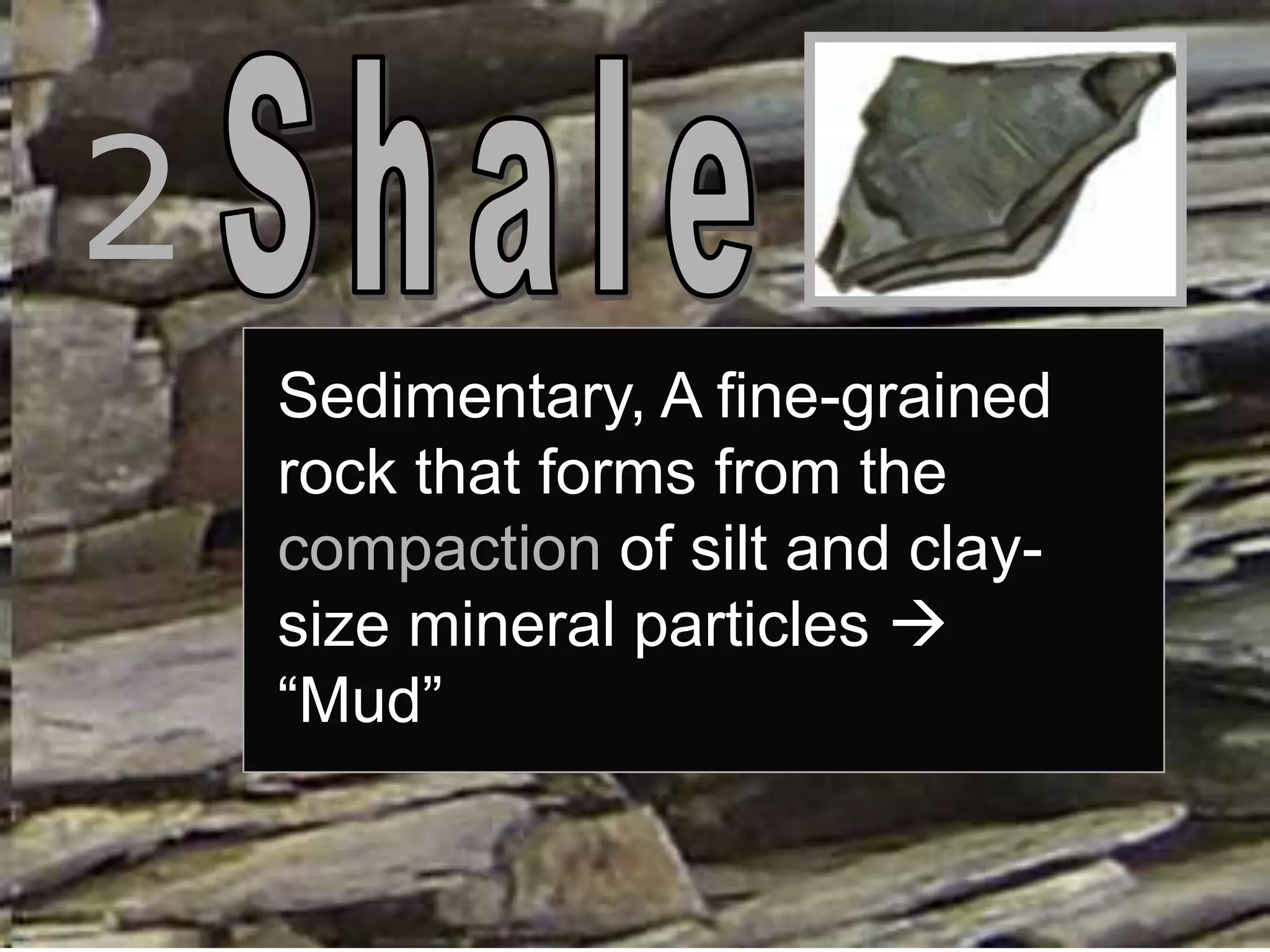
2
2
2
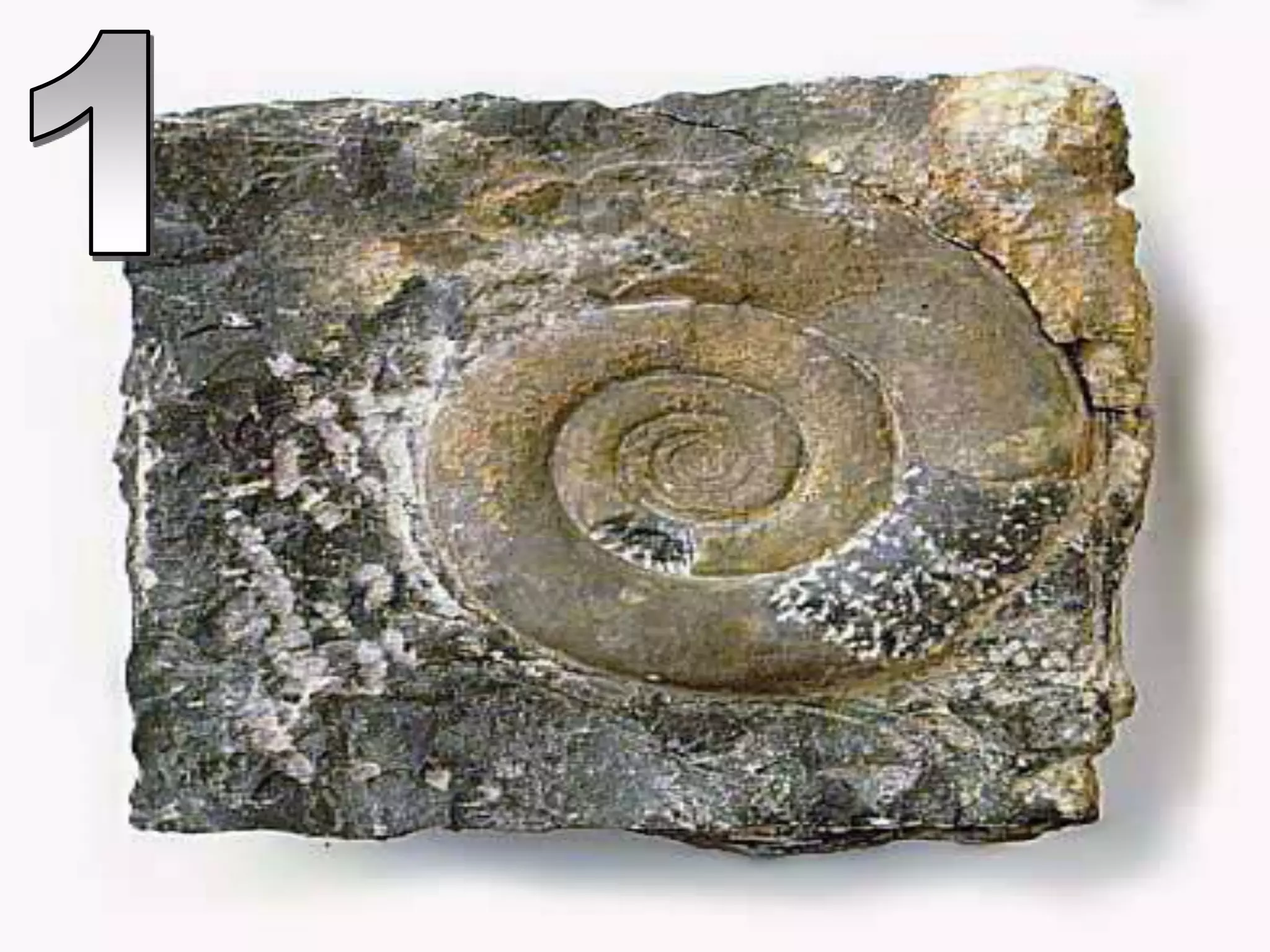
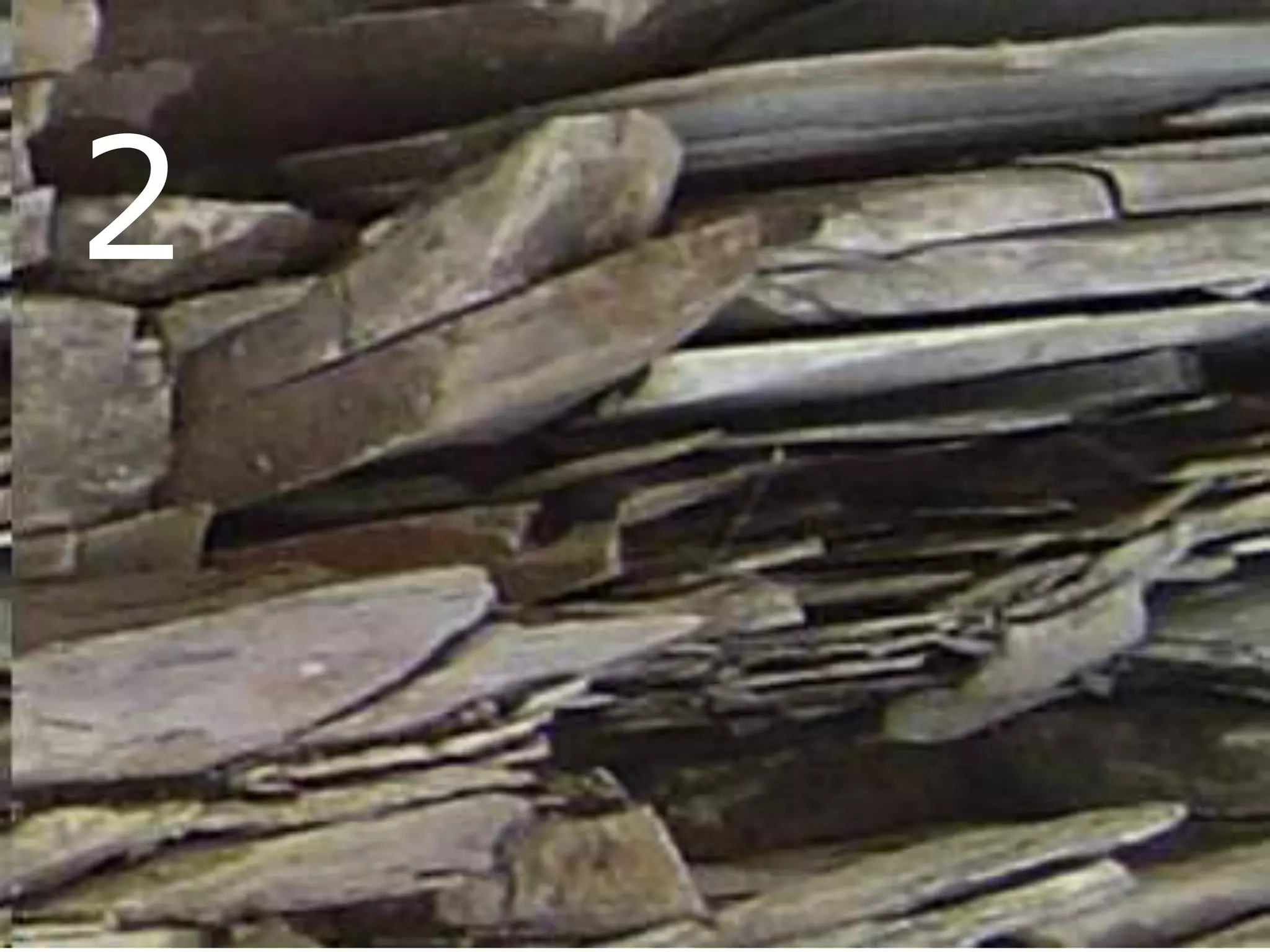
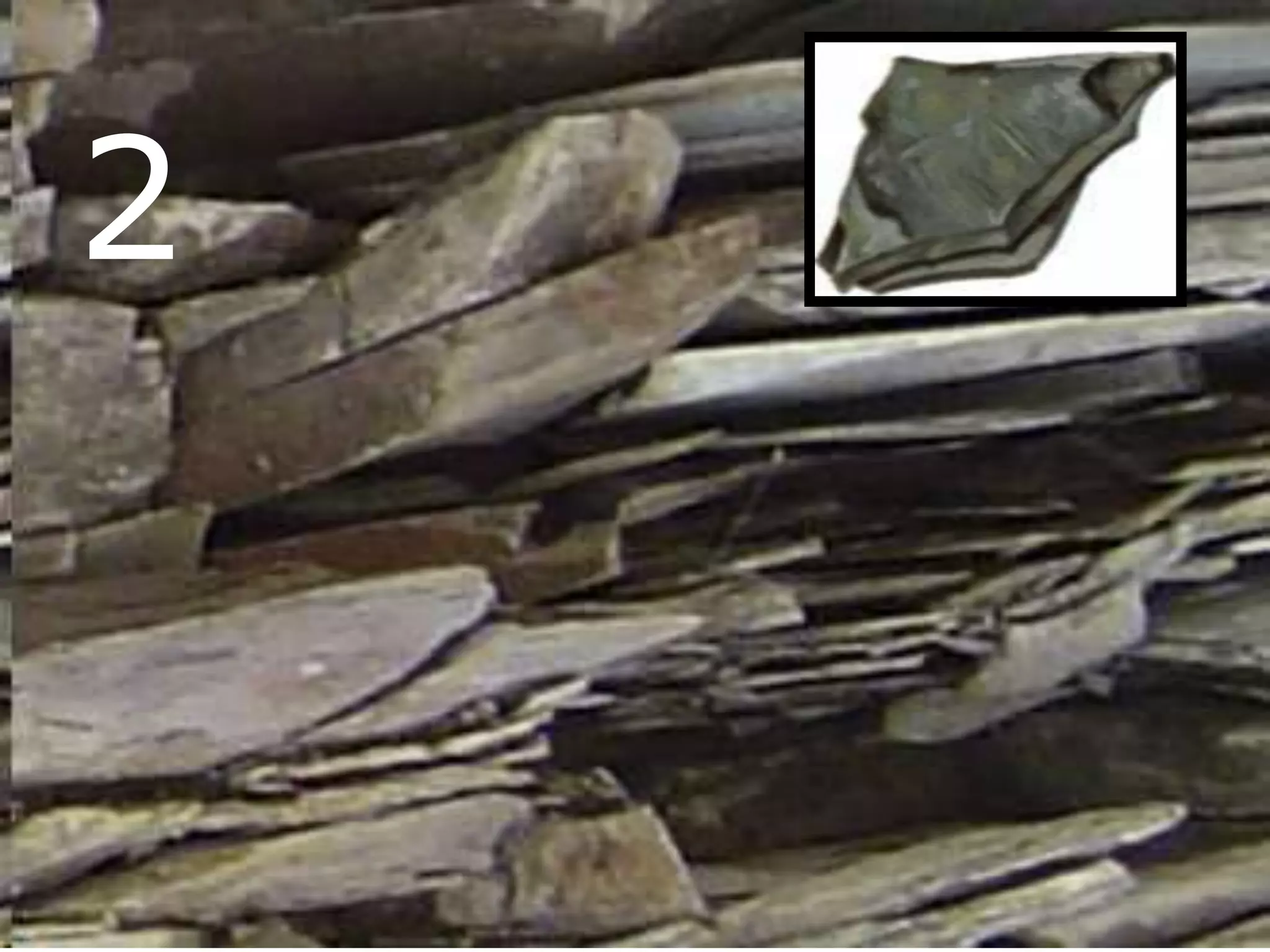
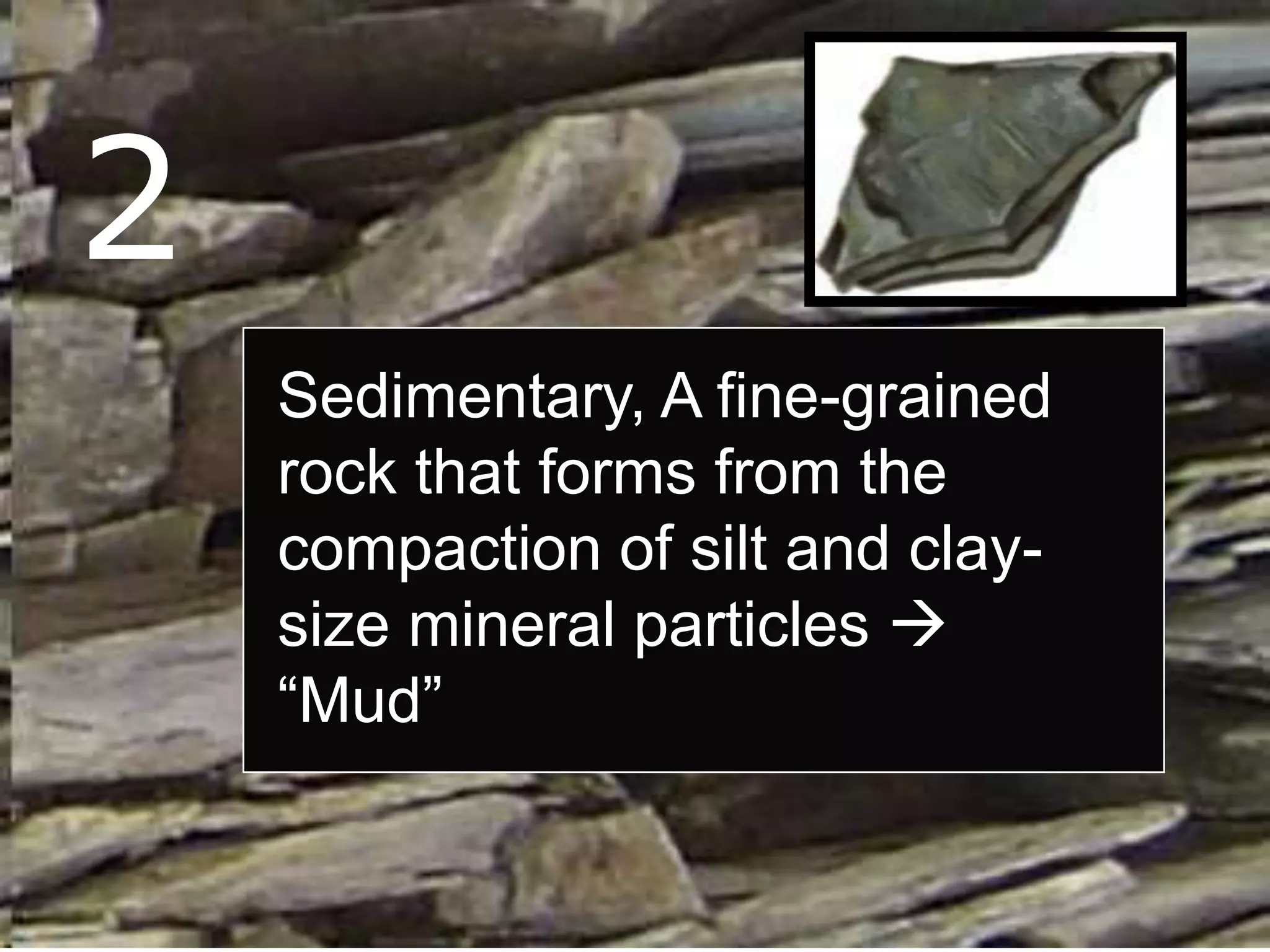
Sedimentary, A fine-grained
rock that forms from the
compaction of silt and clay-
size mineral particles 
“Mud”
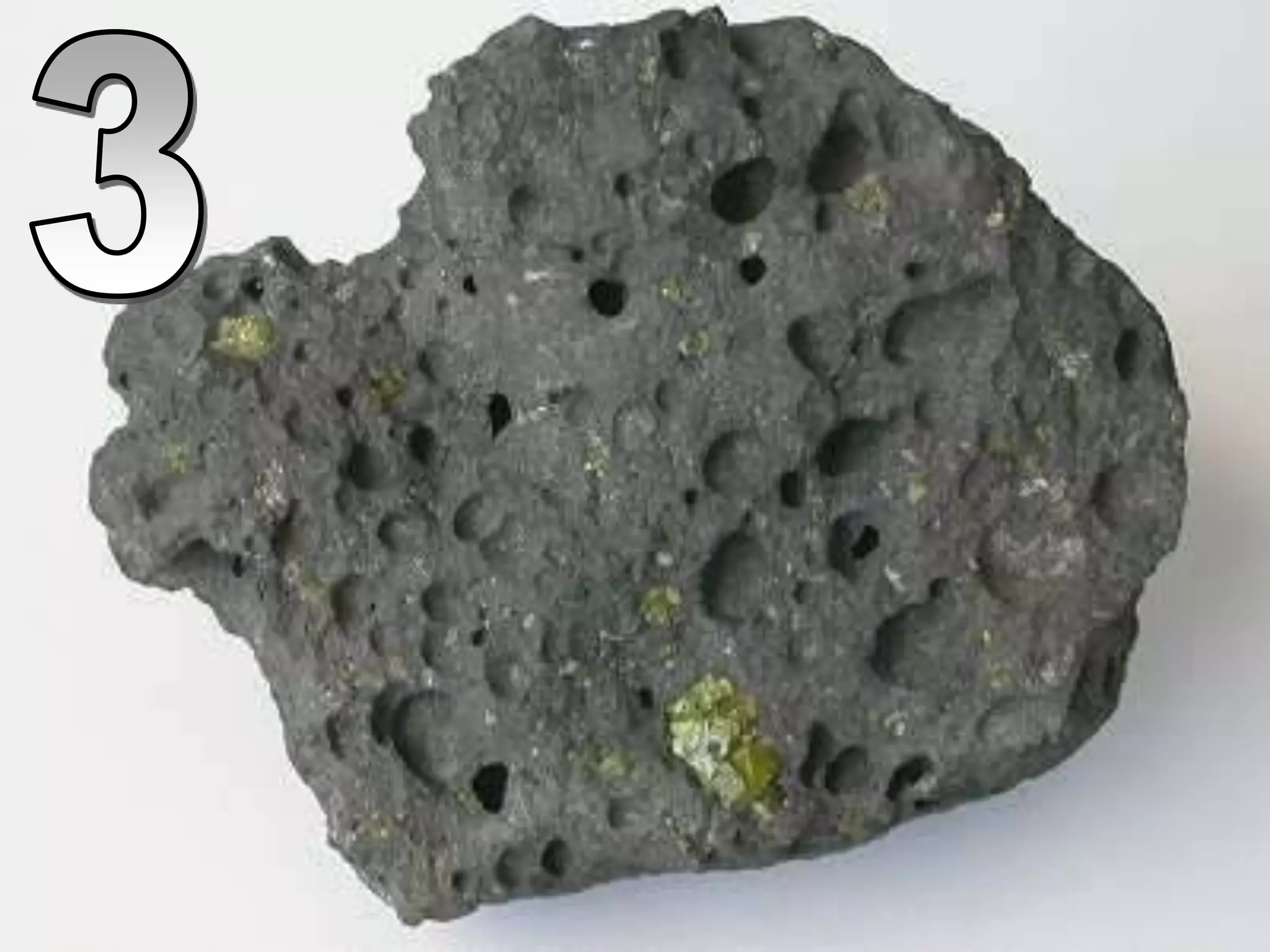
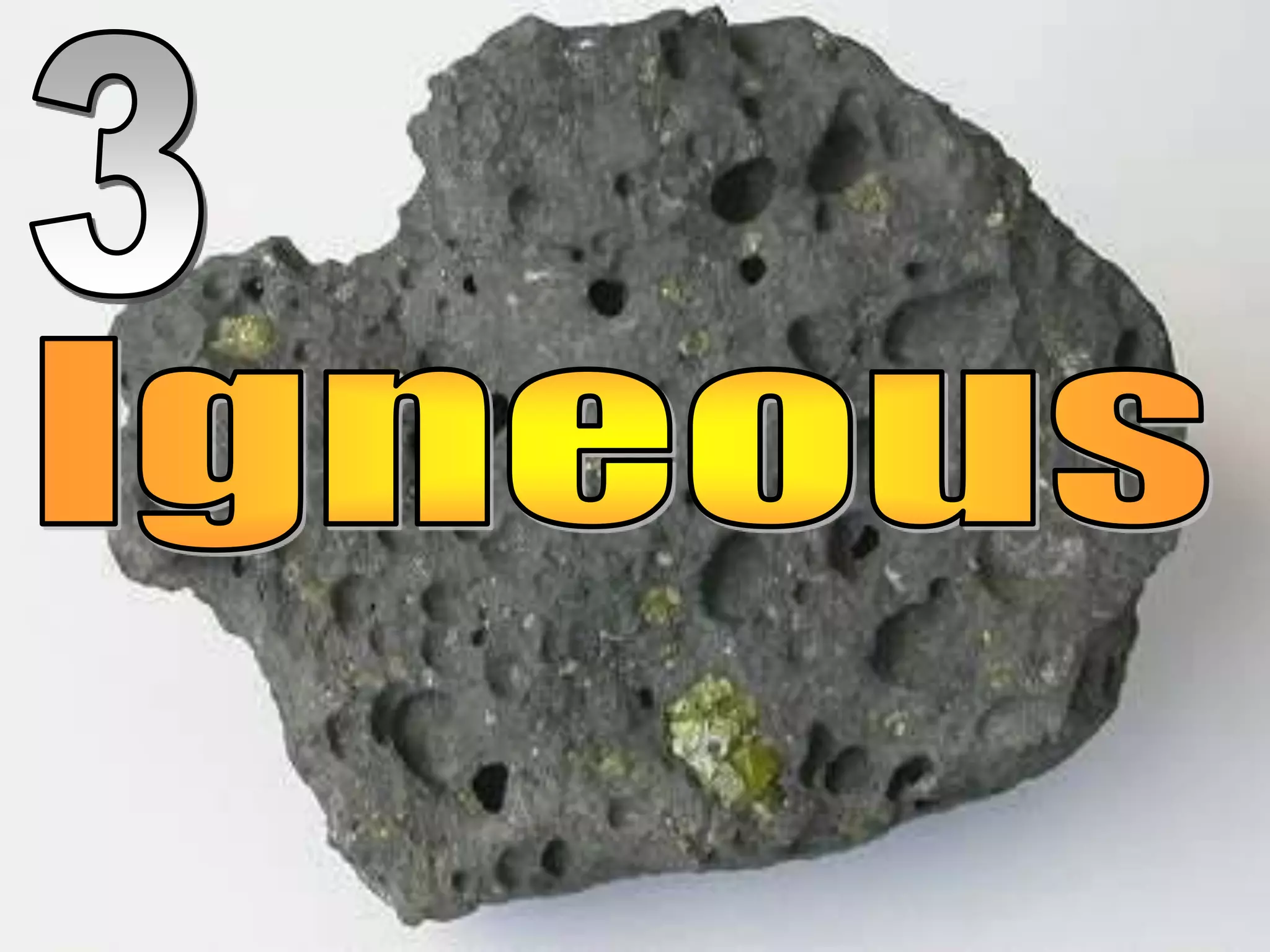
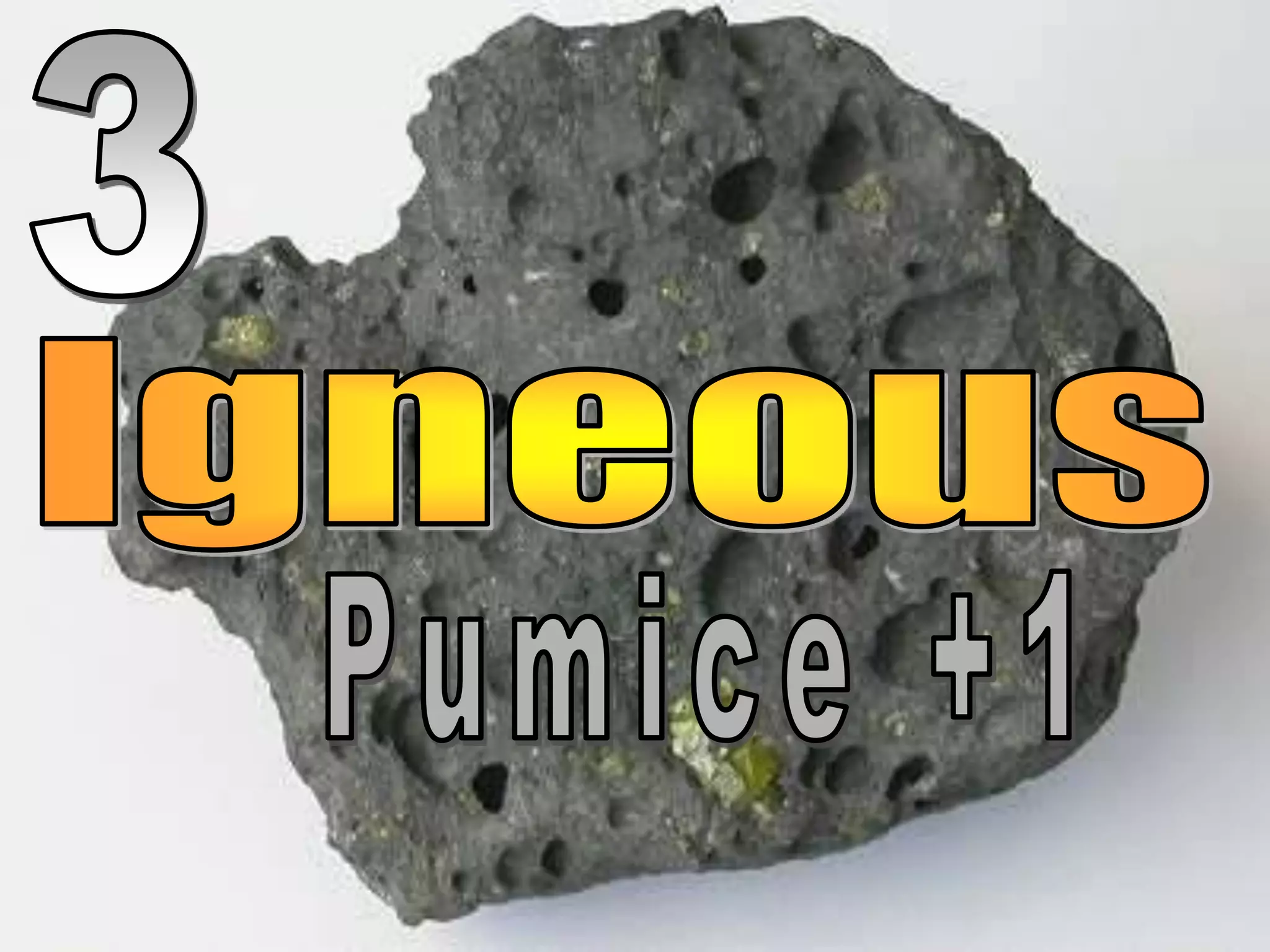
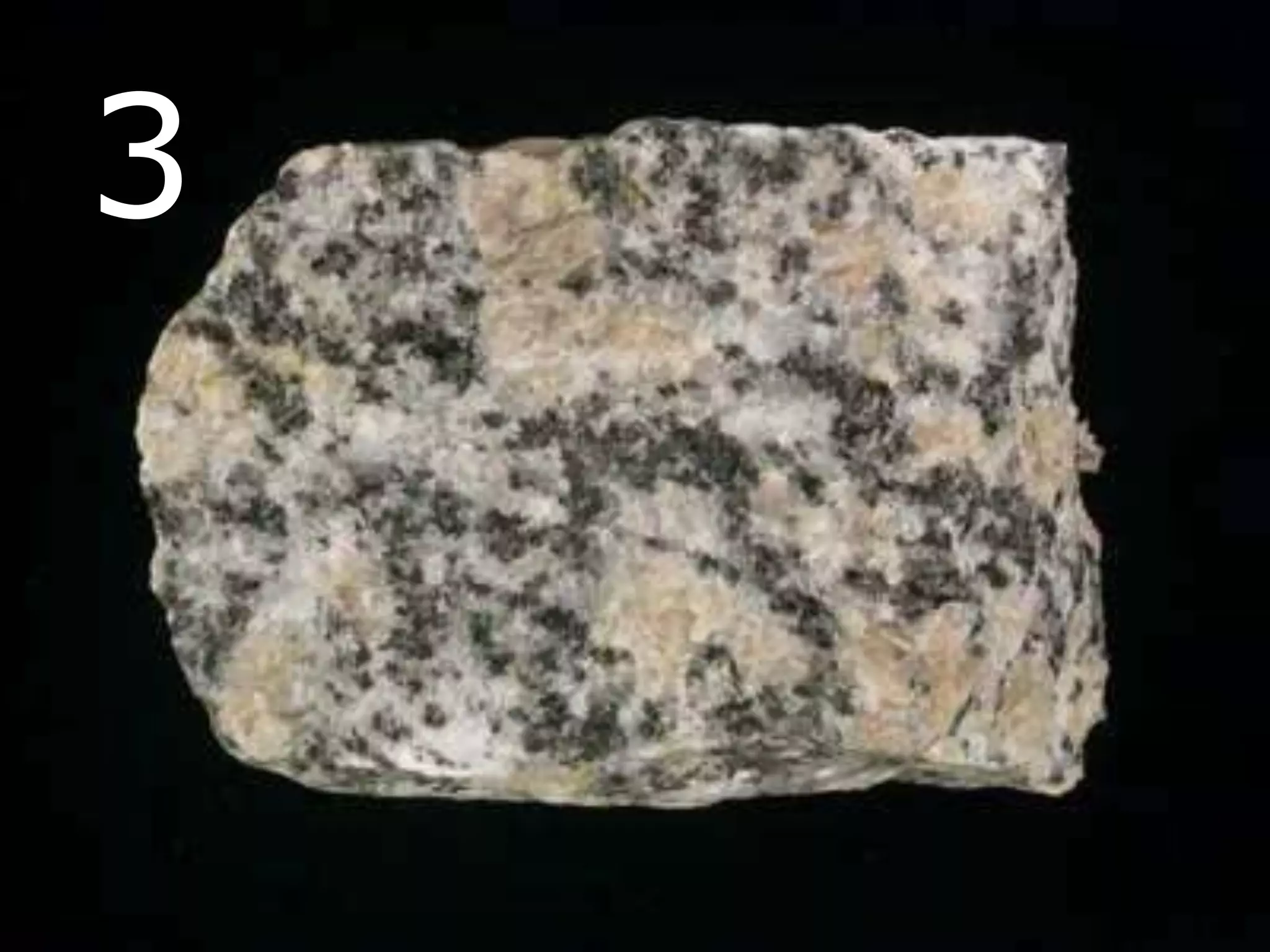
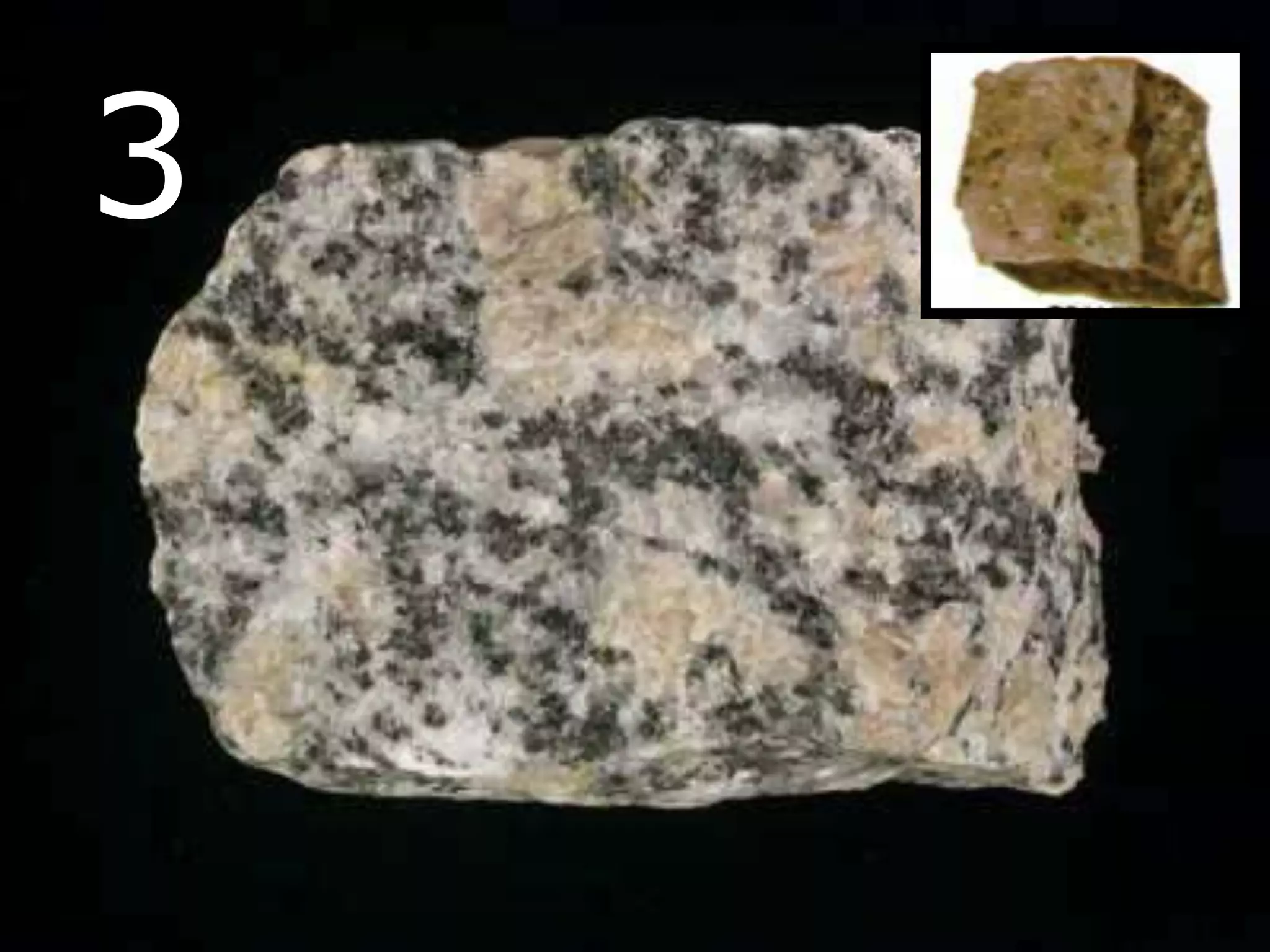
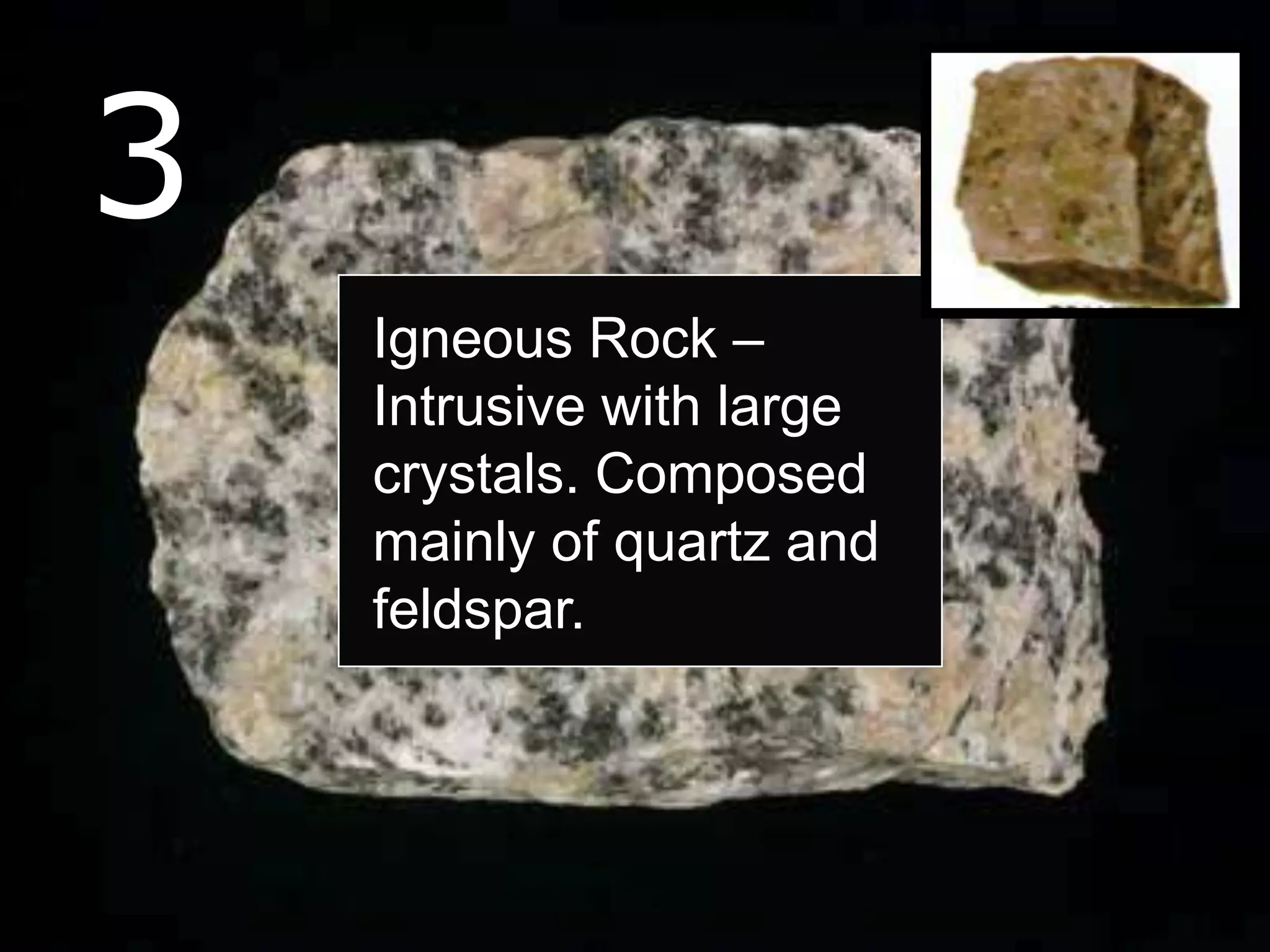
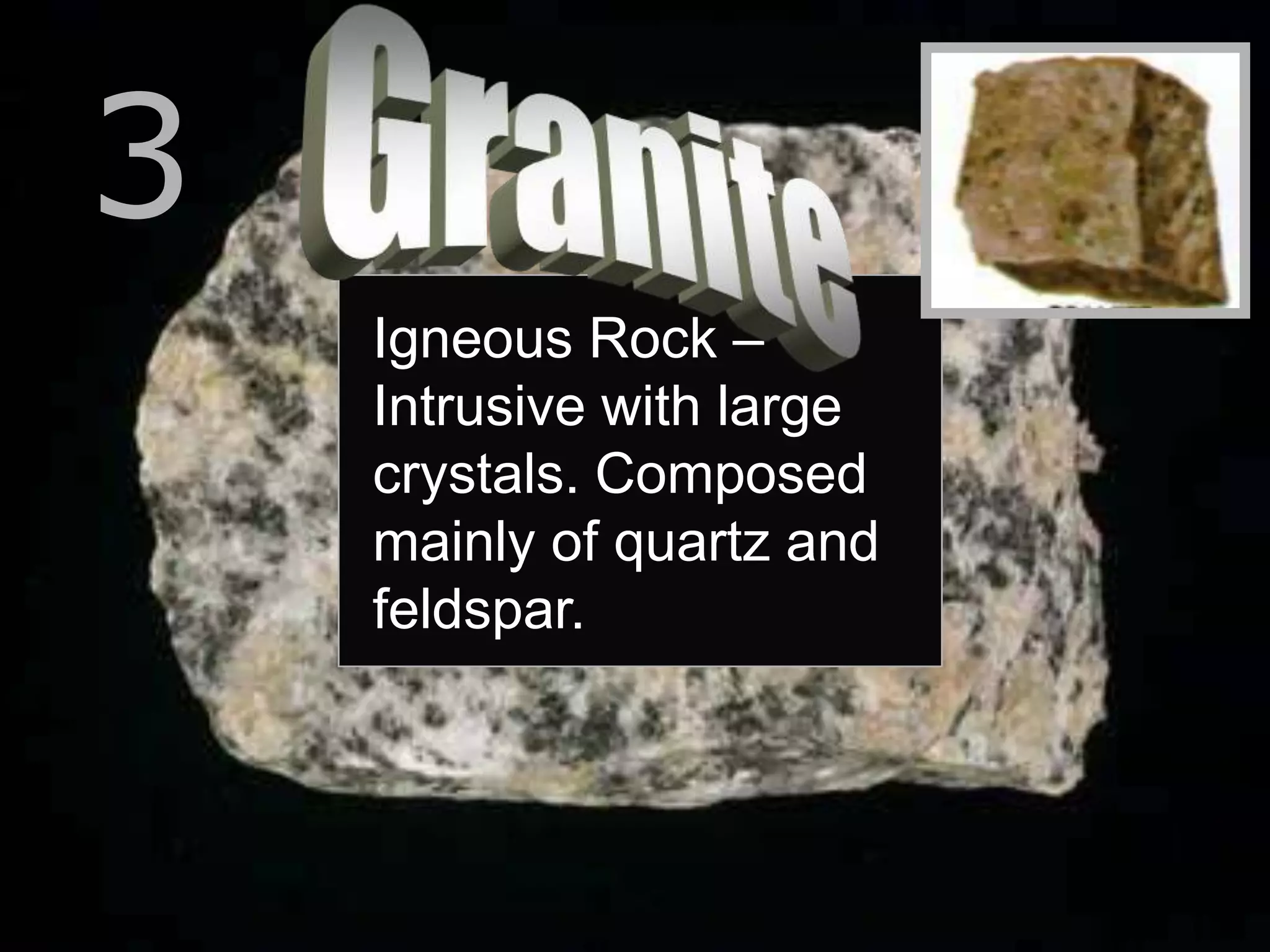
3
3
3
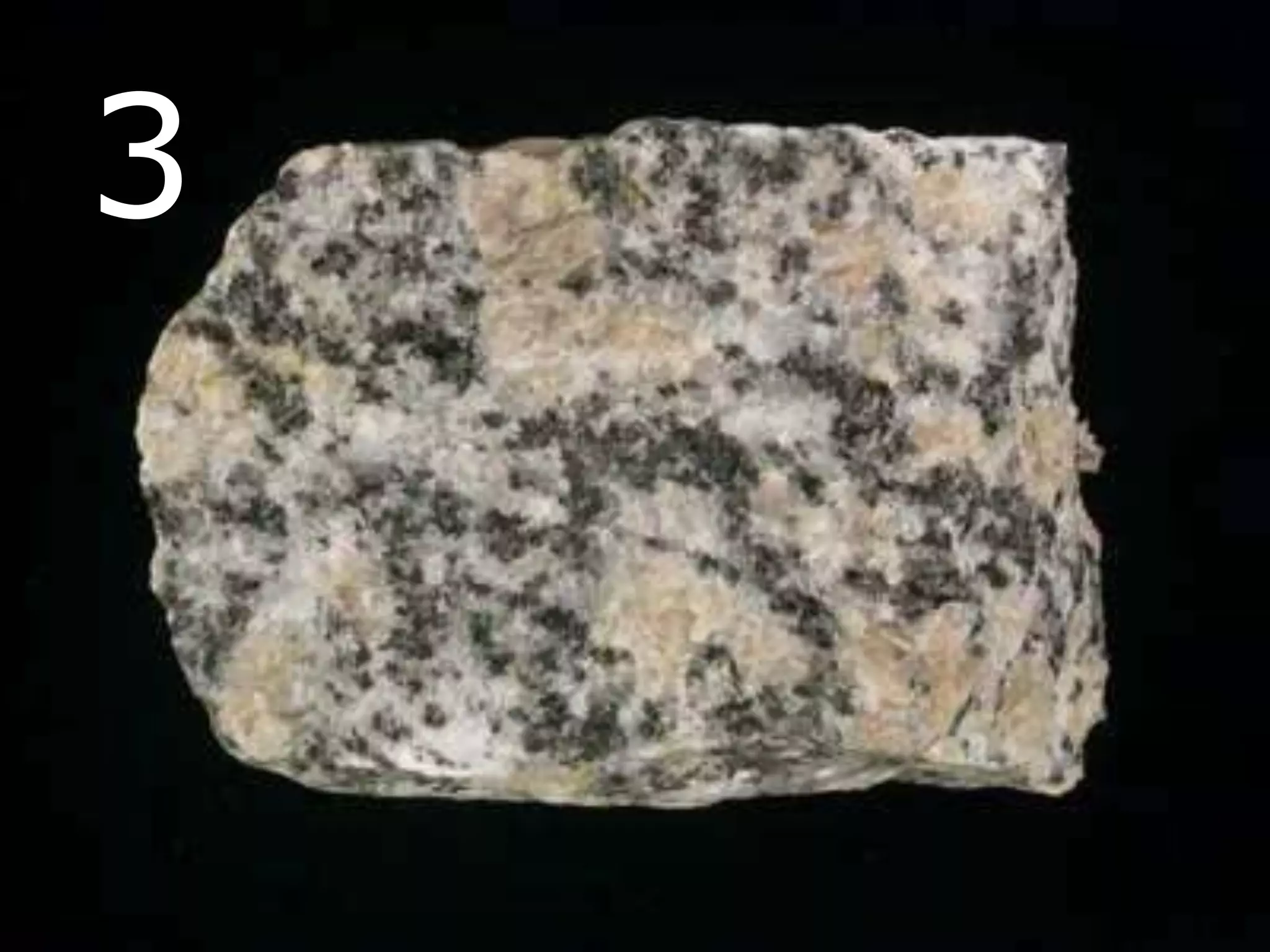
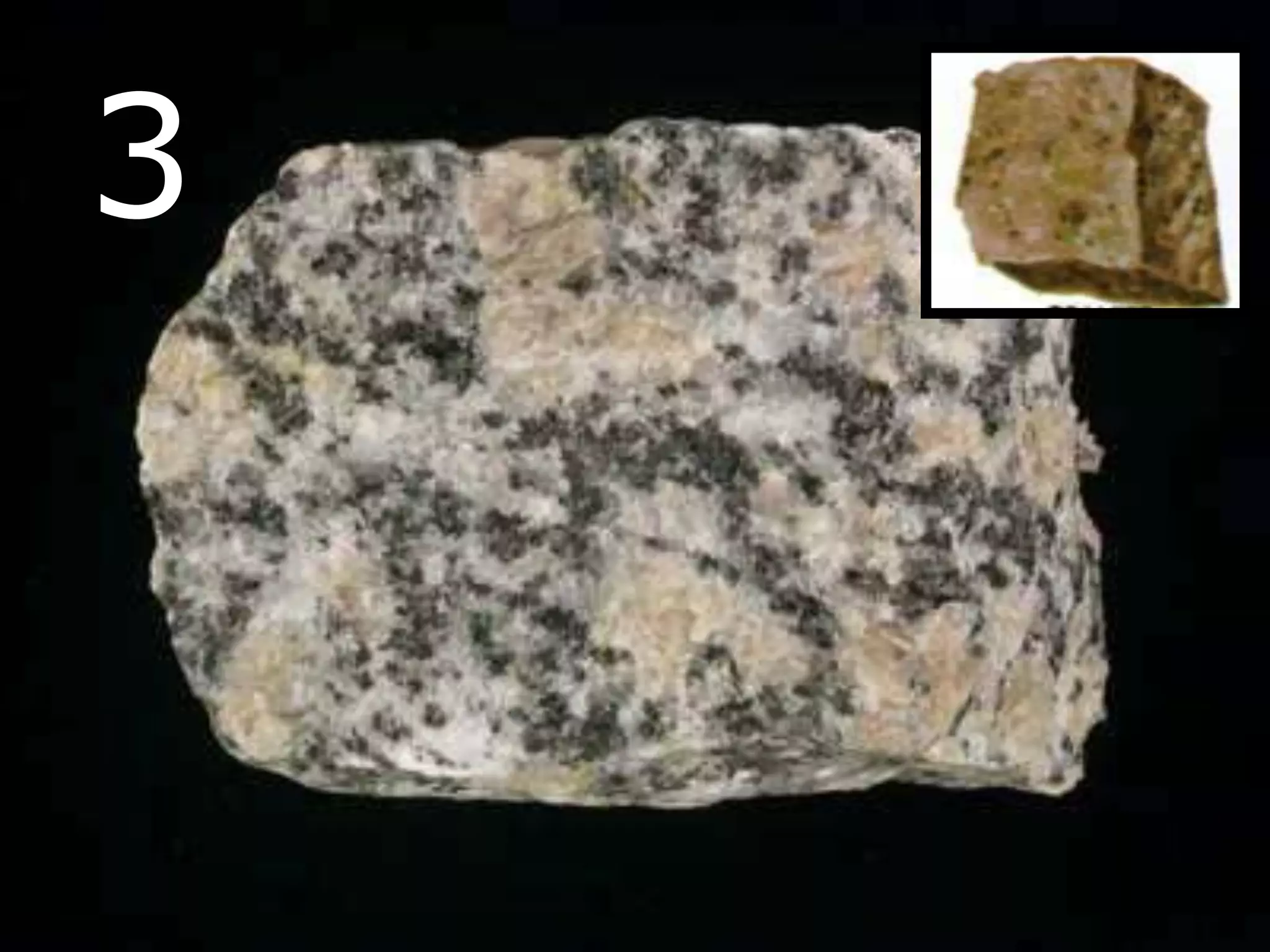
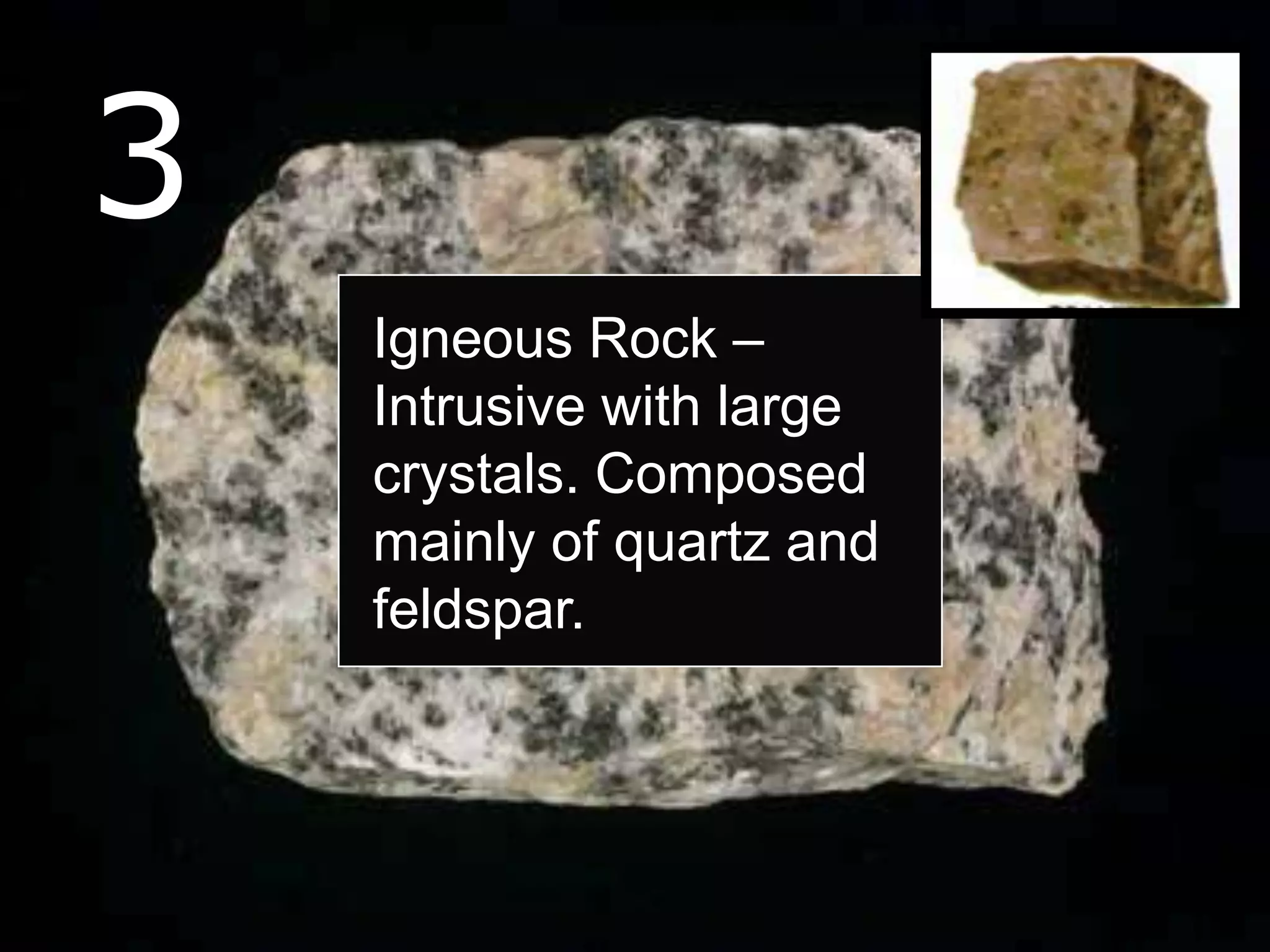
Igneous Rock –
Intrusive with large
crystals. Composed
mainly of quartz and
feldspar.
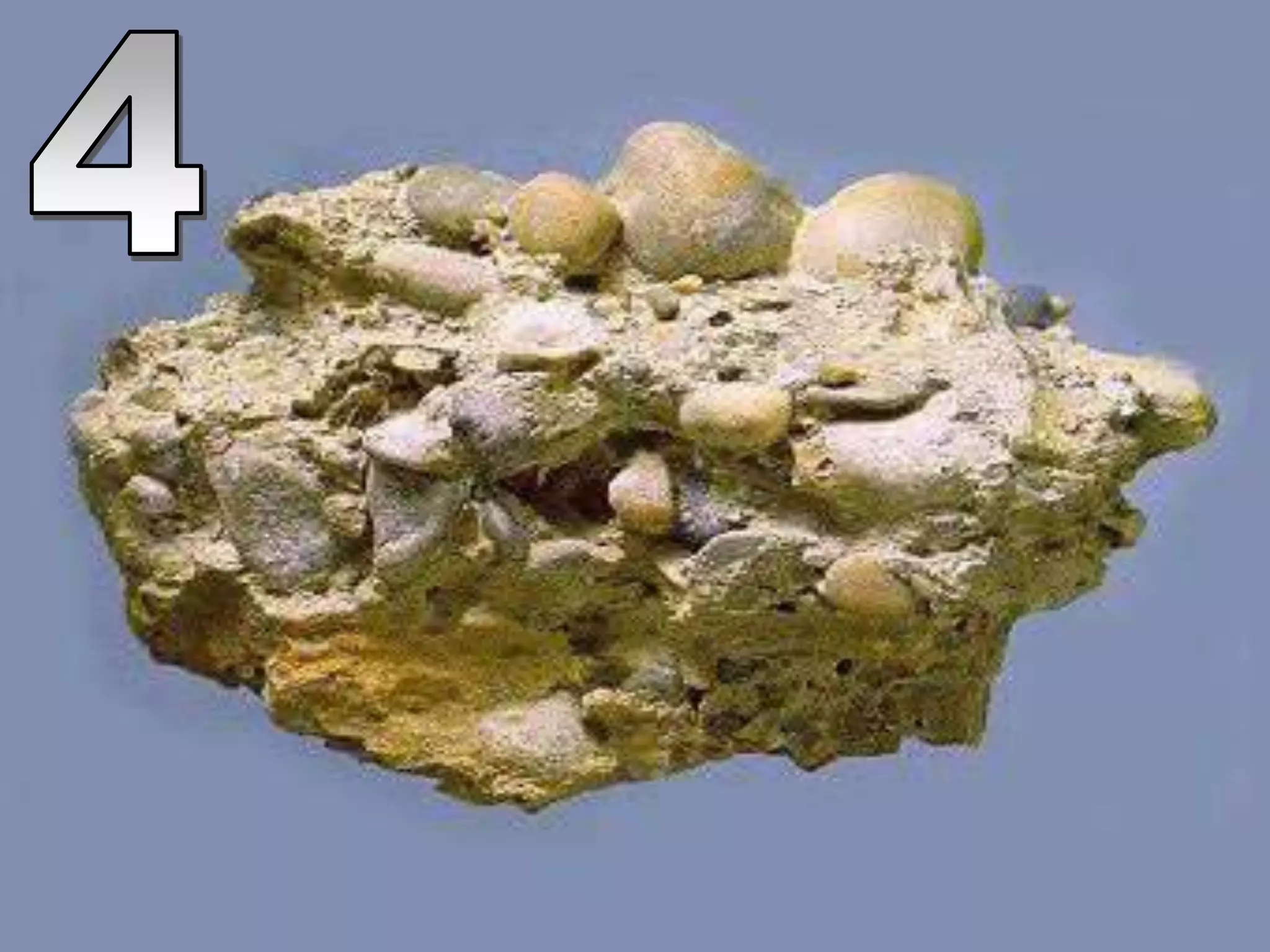
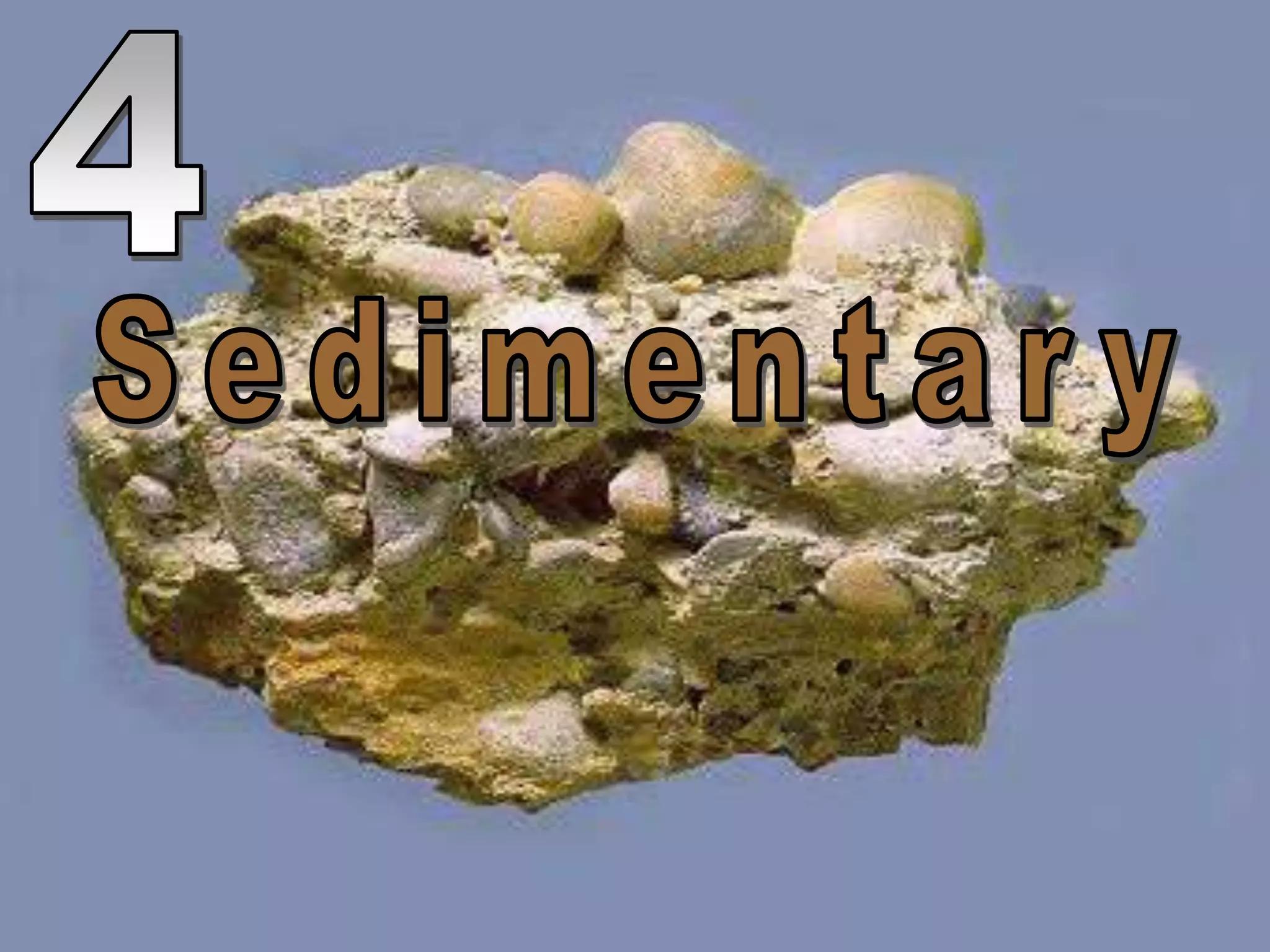
4
4
4
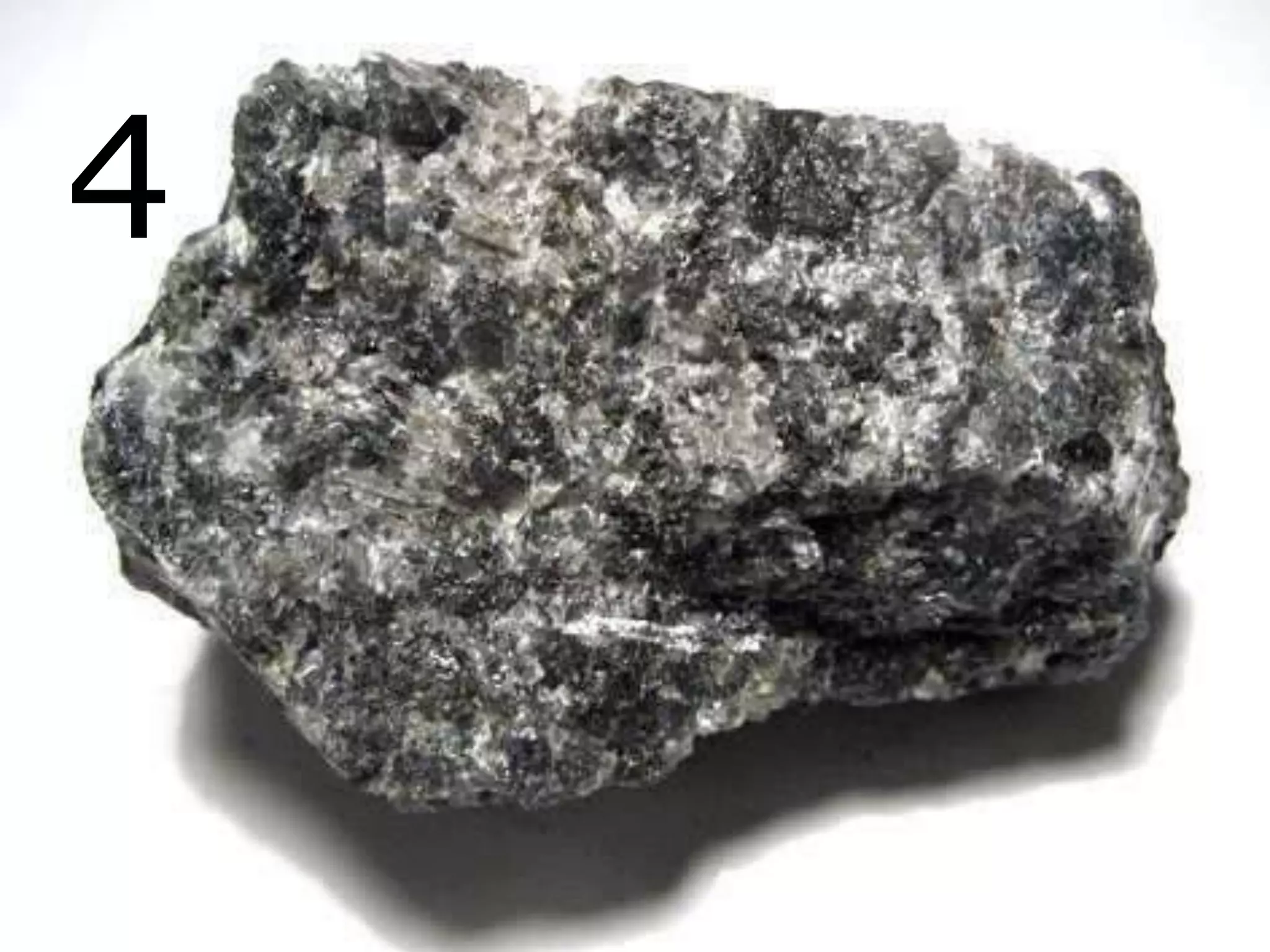
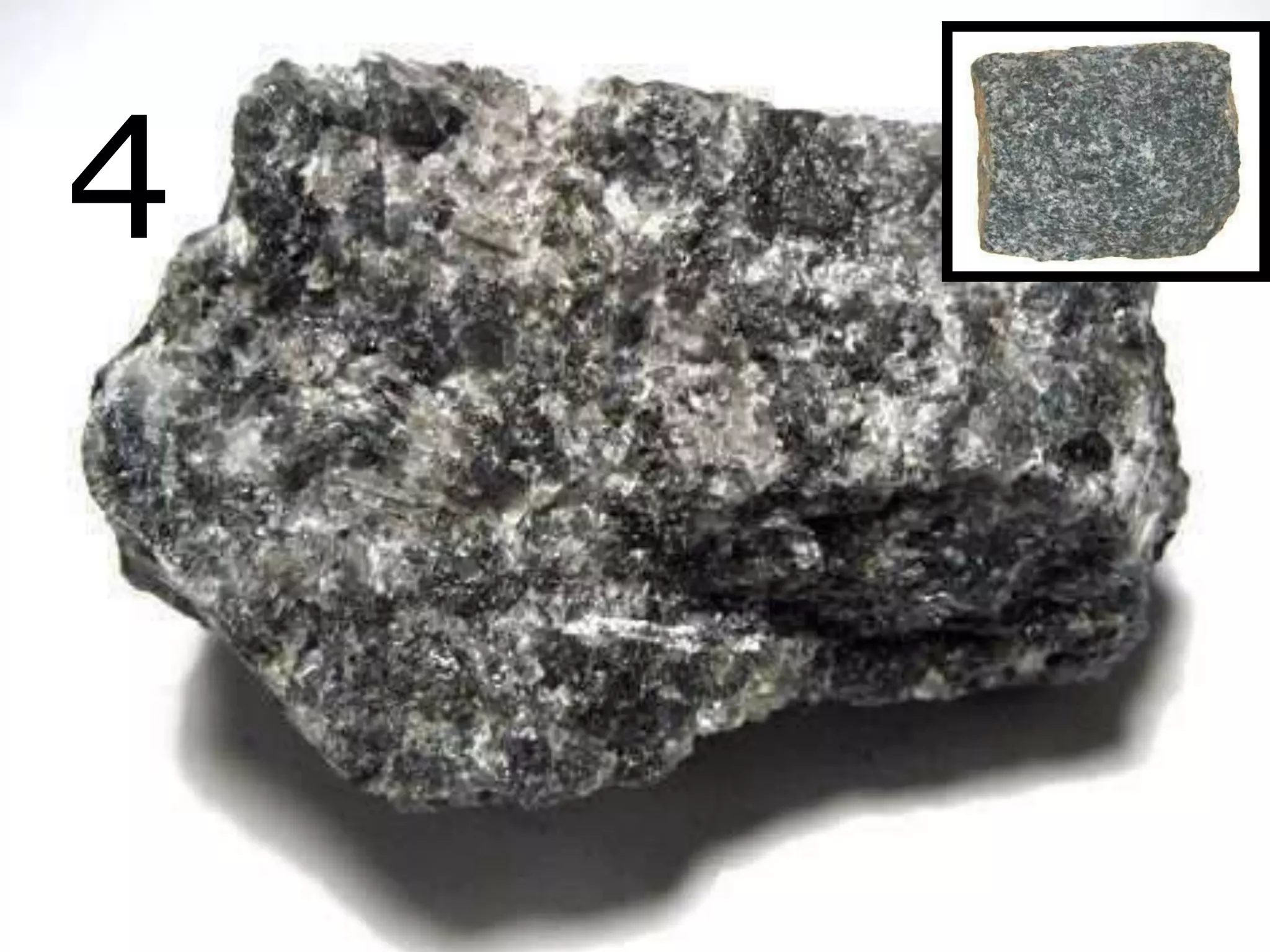
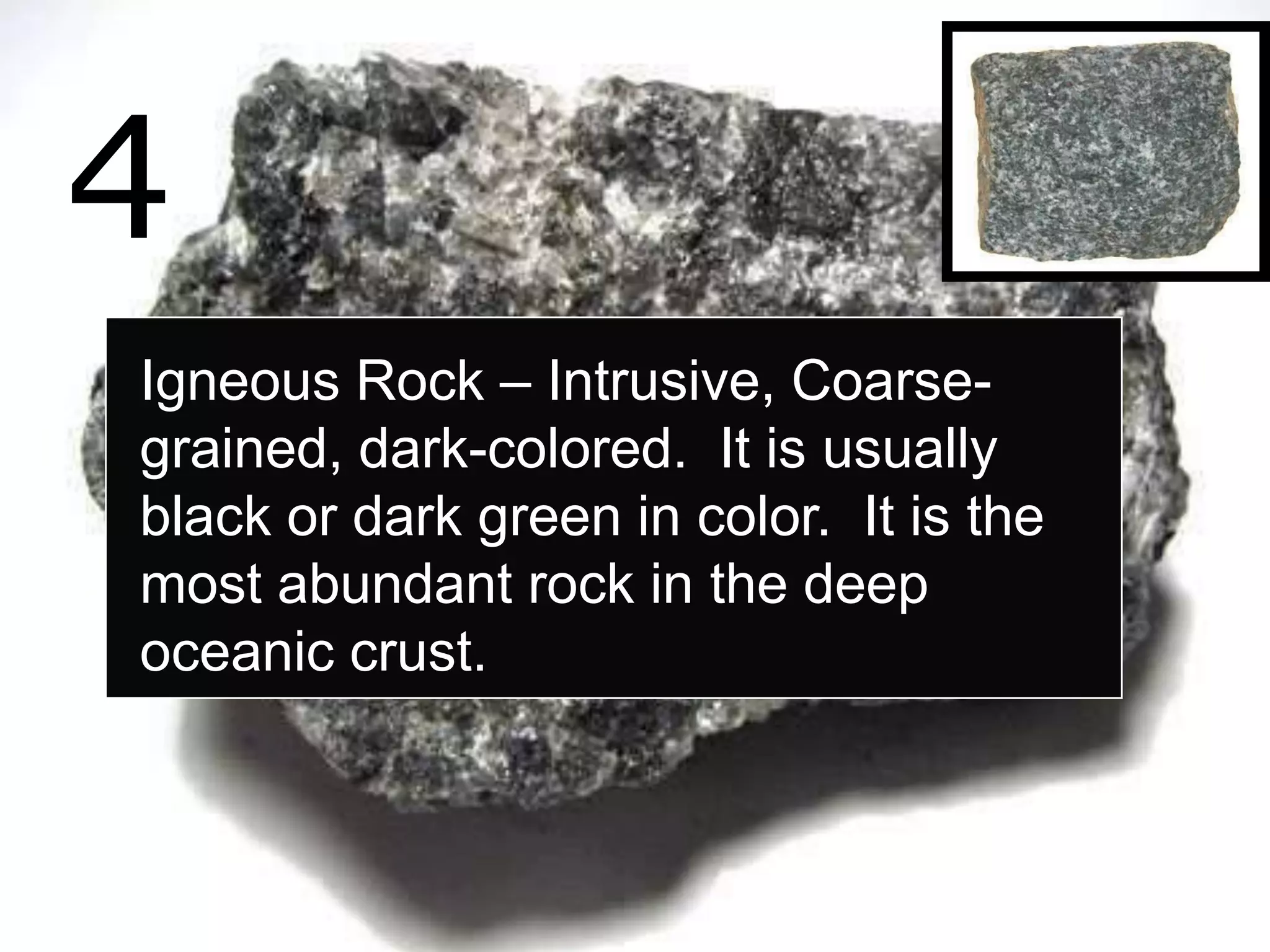
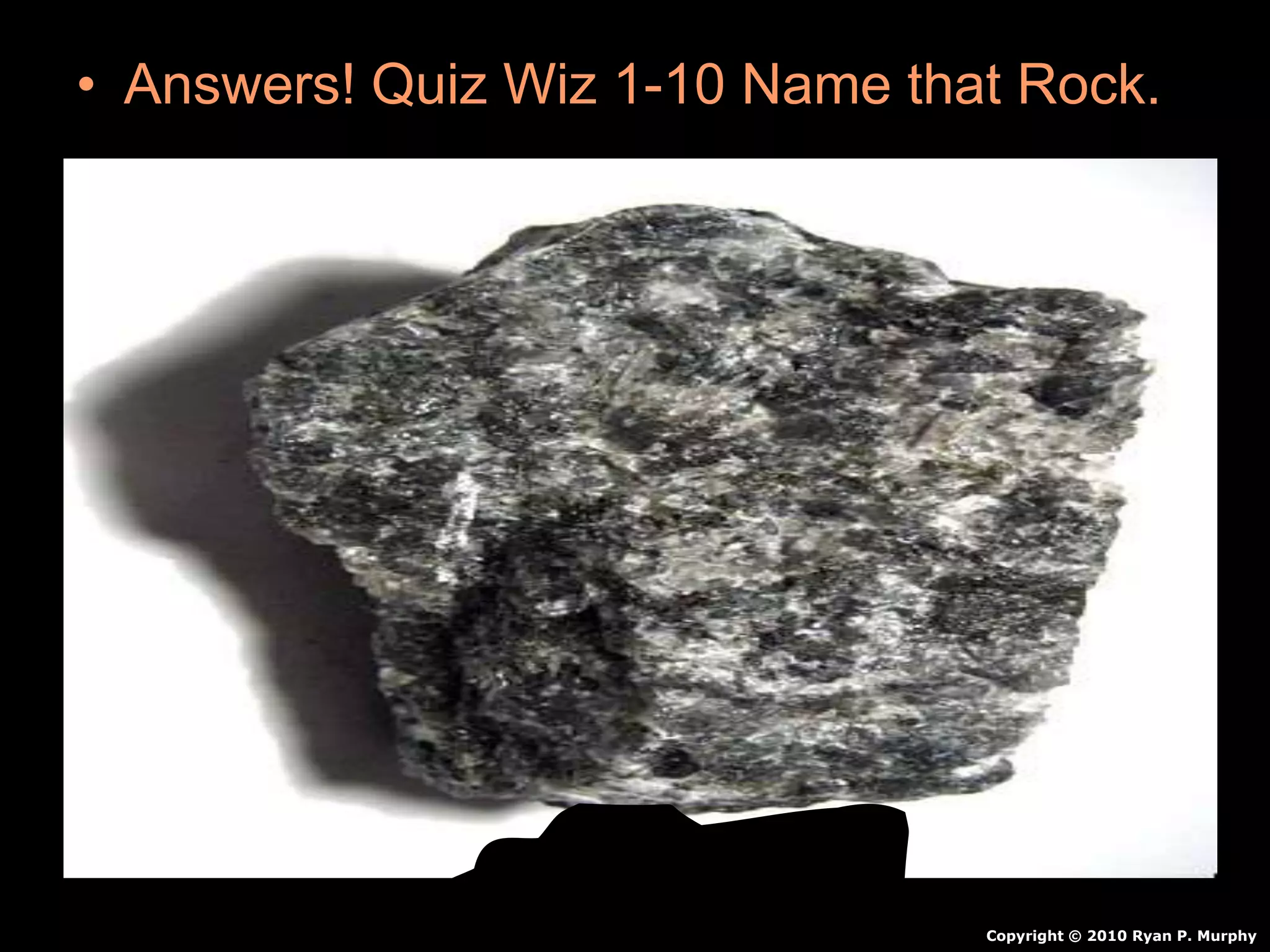
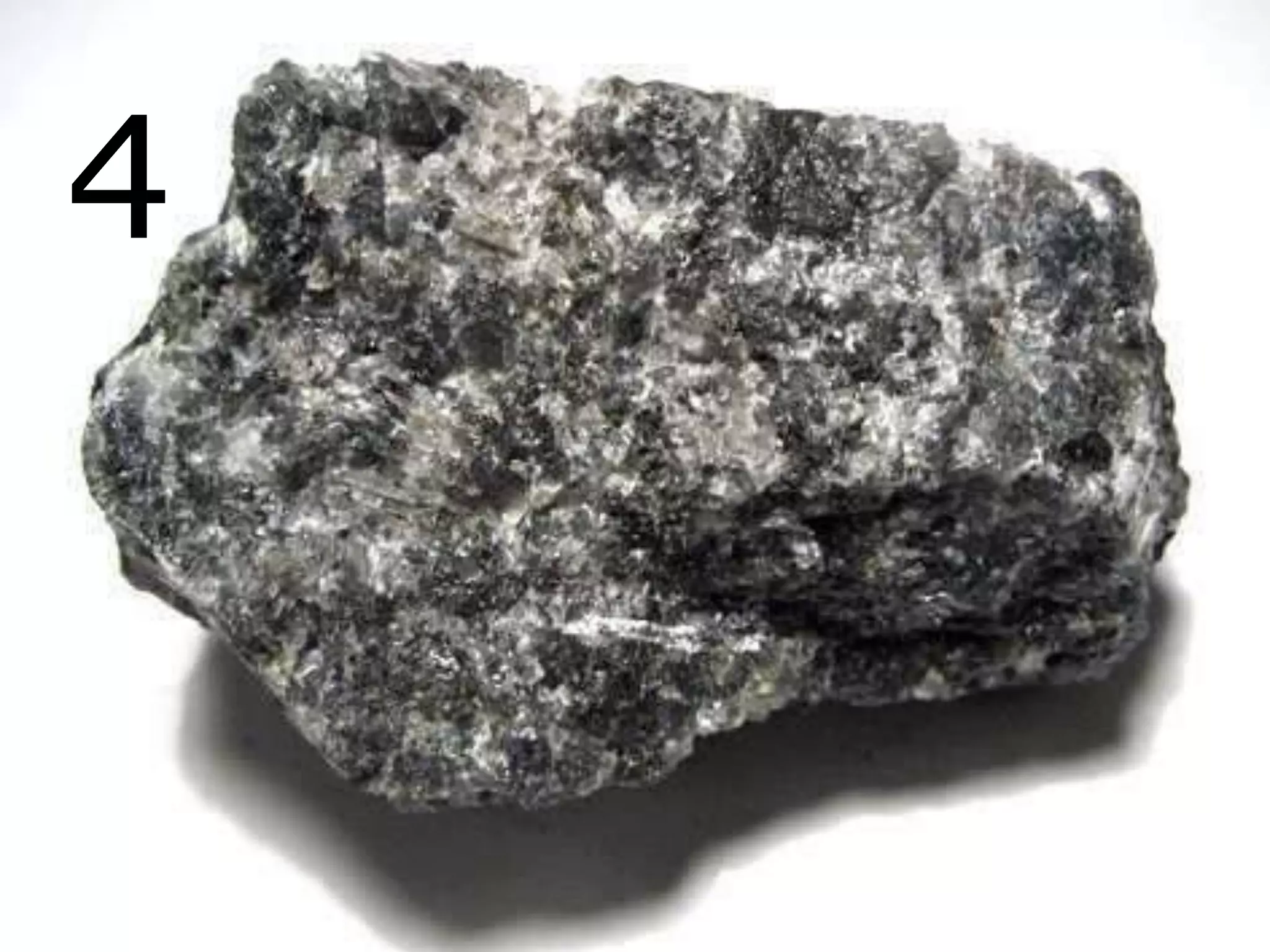
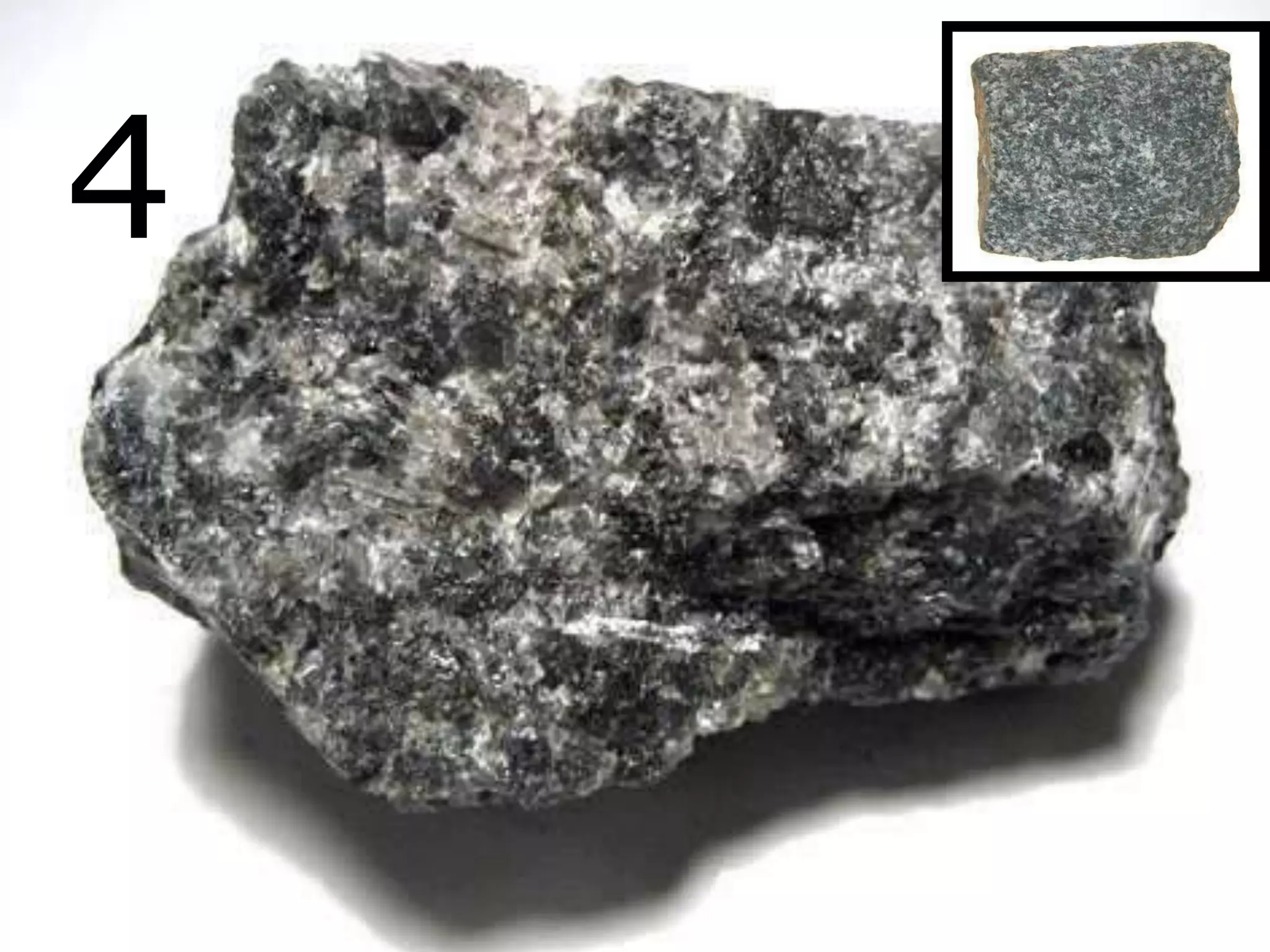
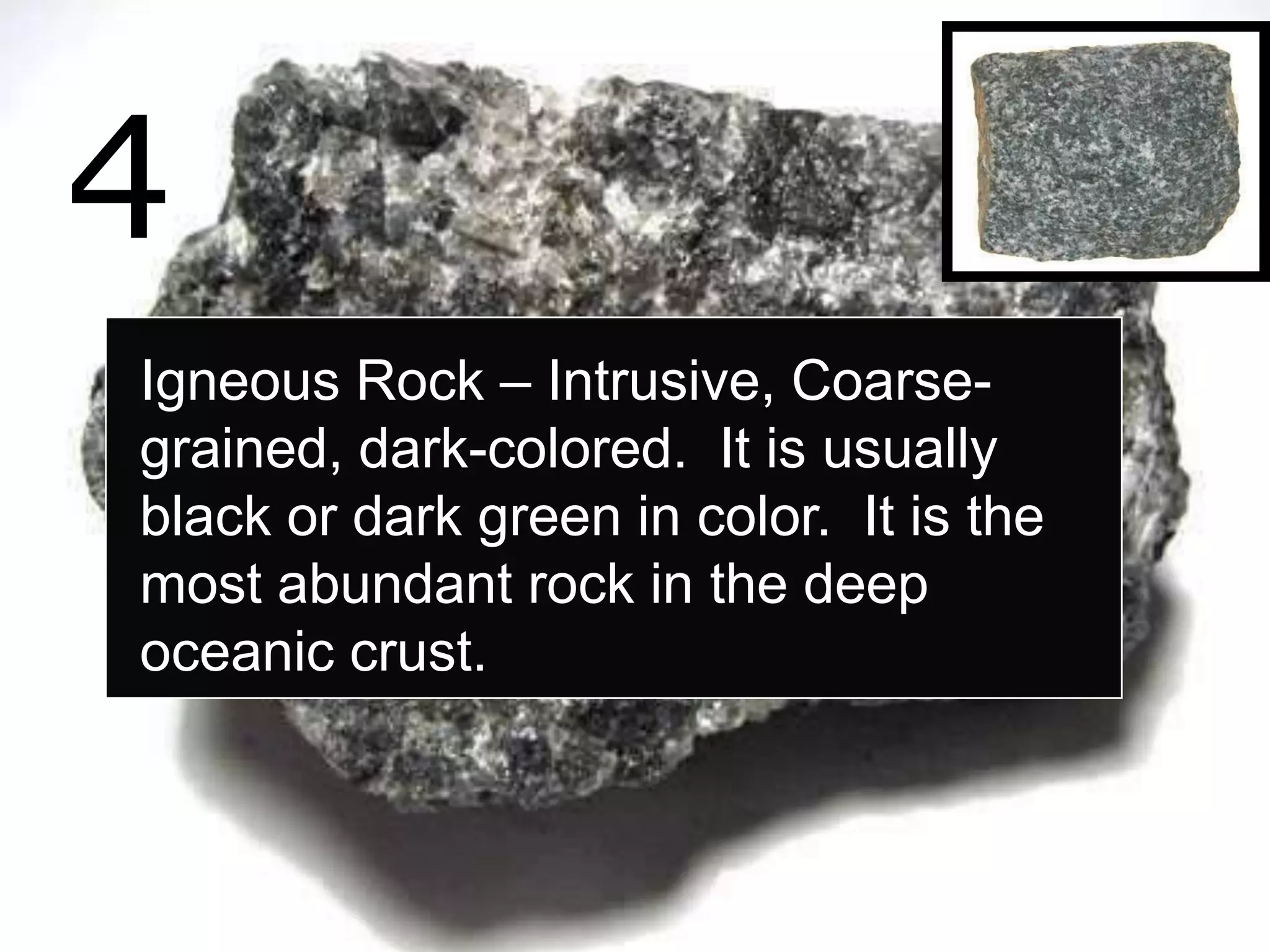
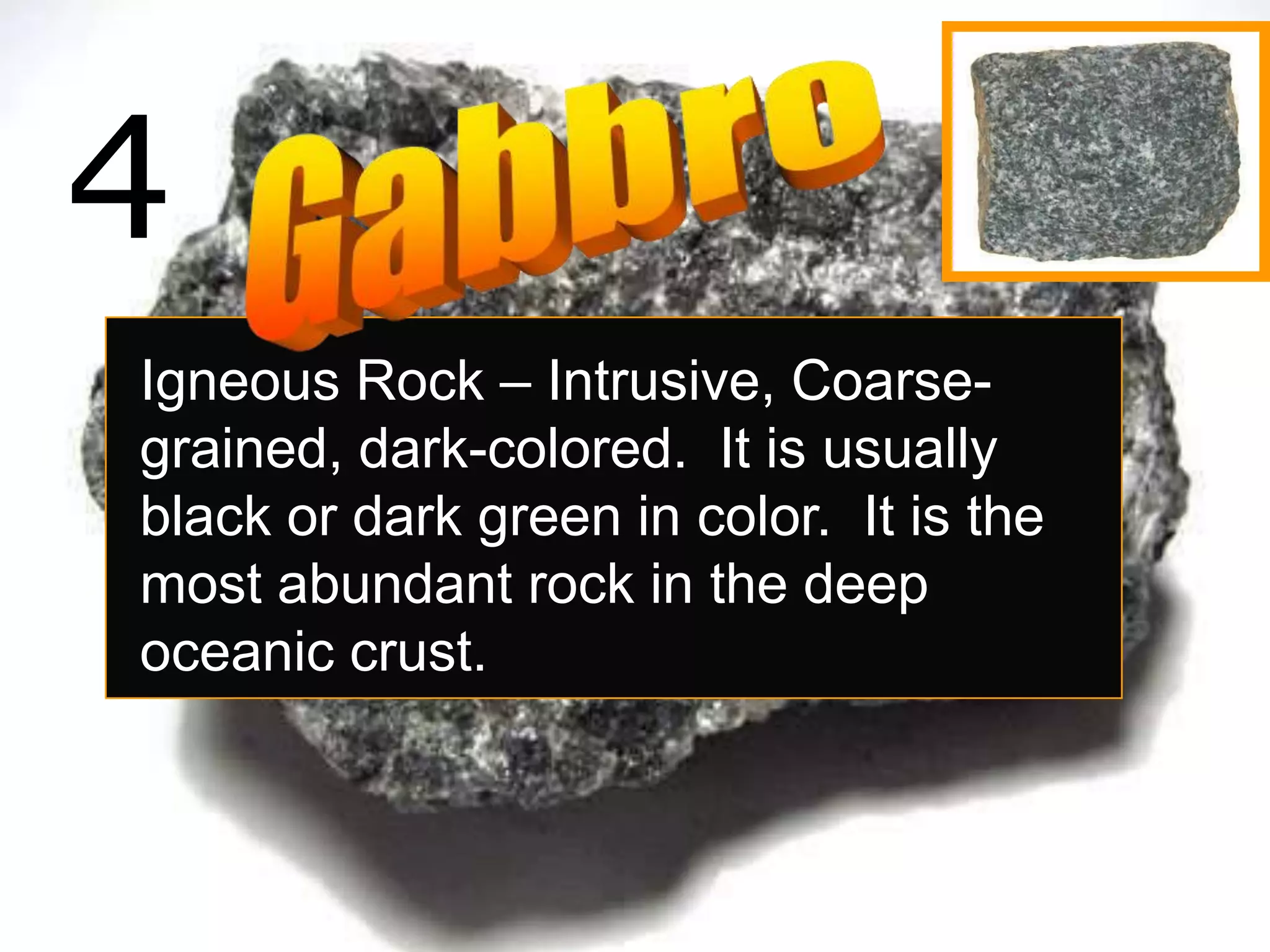
Igneous Rock – Intrusive, Coarse-
grained, dark-colored. It is usually
black or dark green in color. It is the
most abundant rock in the deep
oceanic crust.
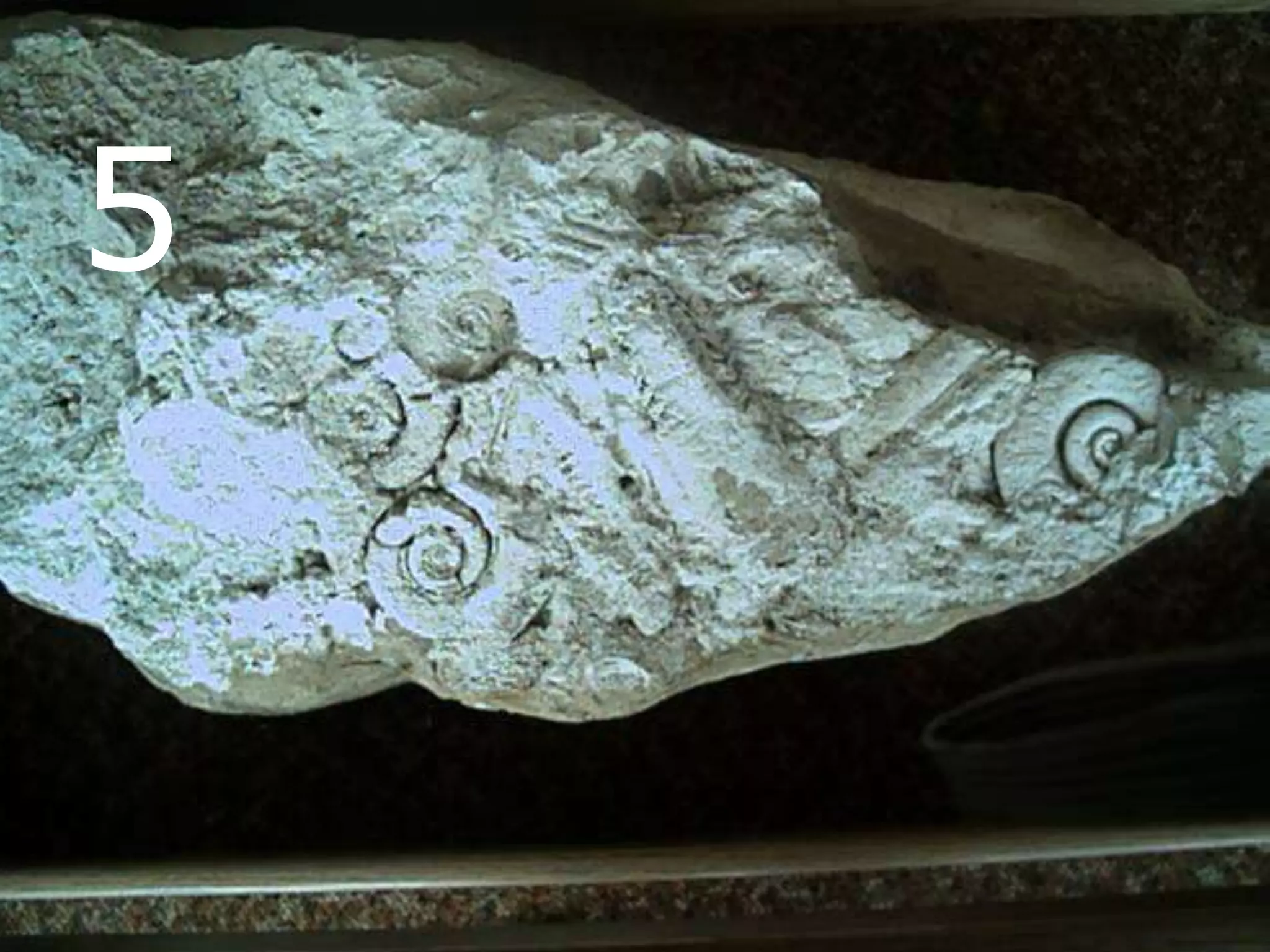
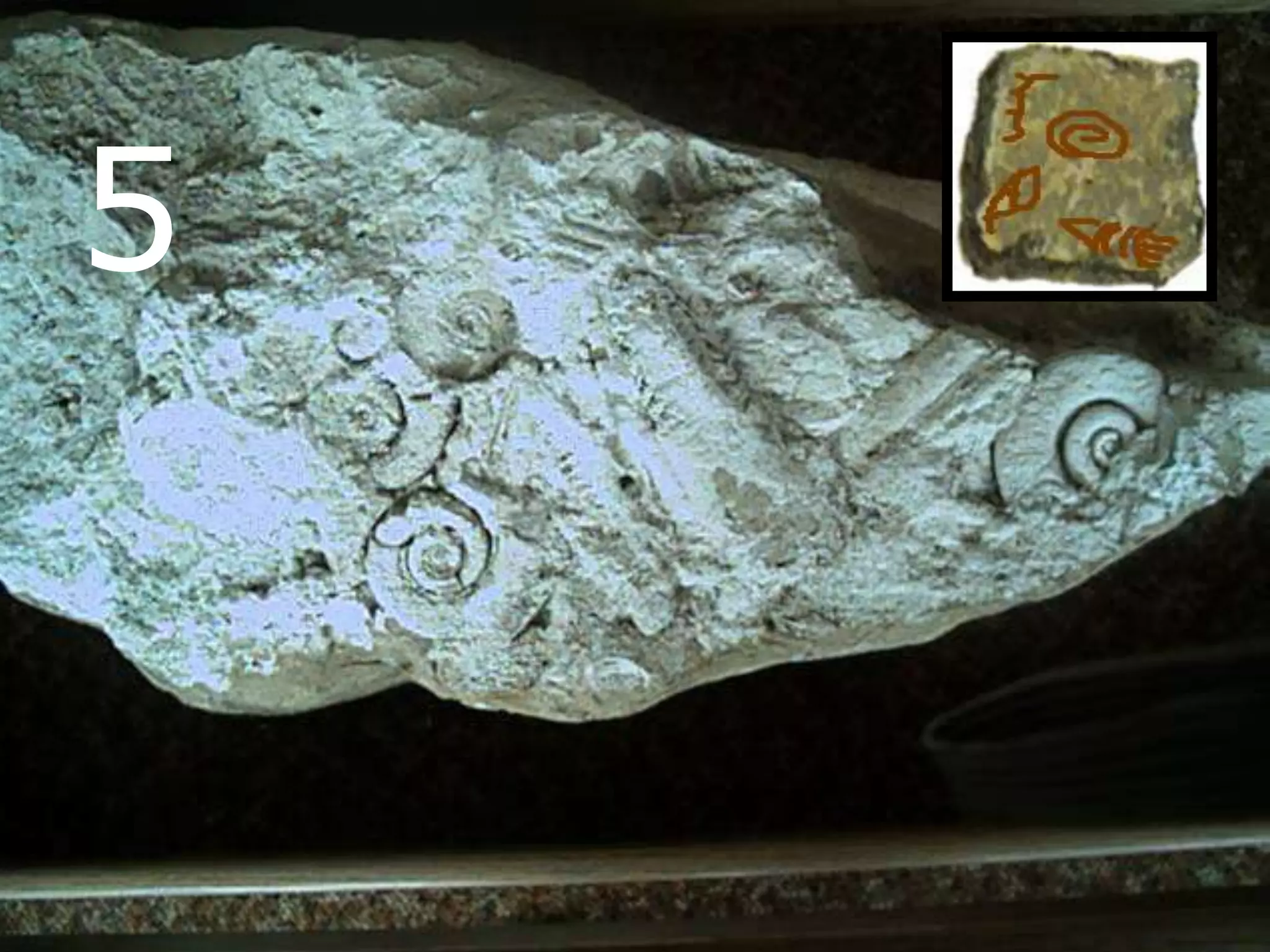
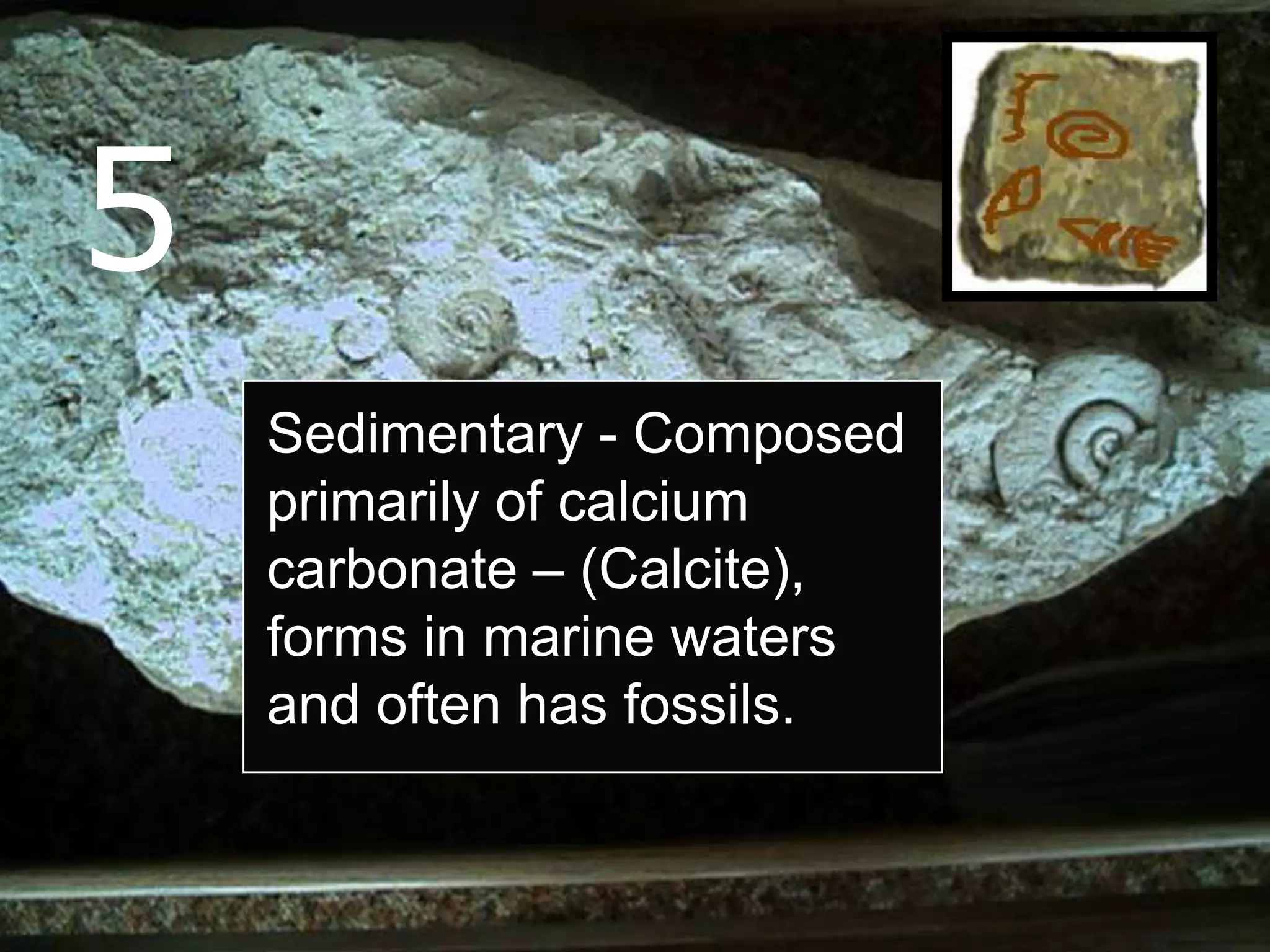
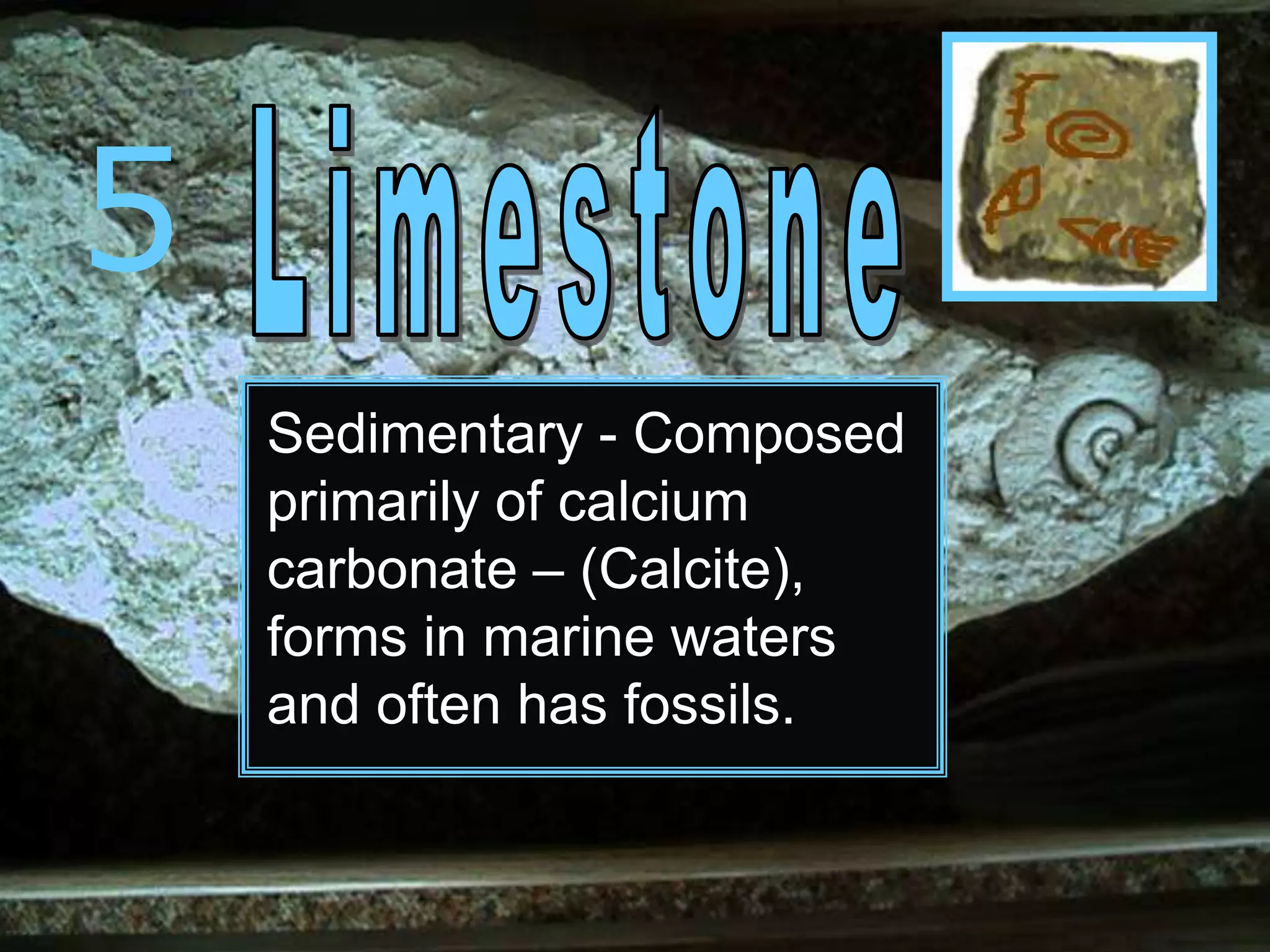
5
5
5
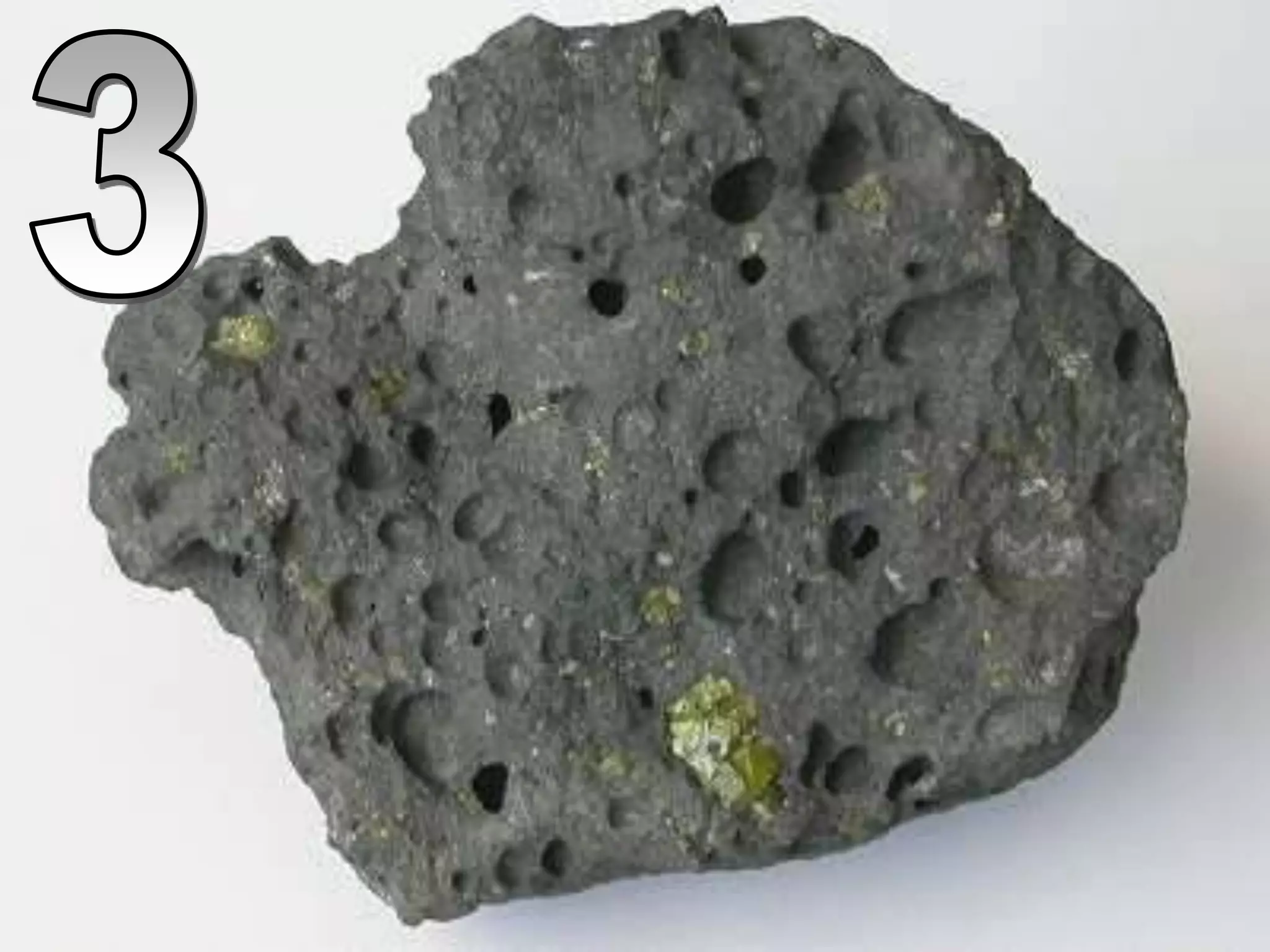
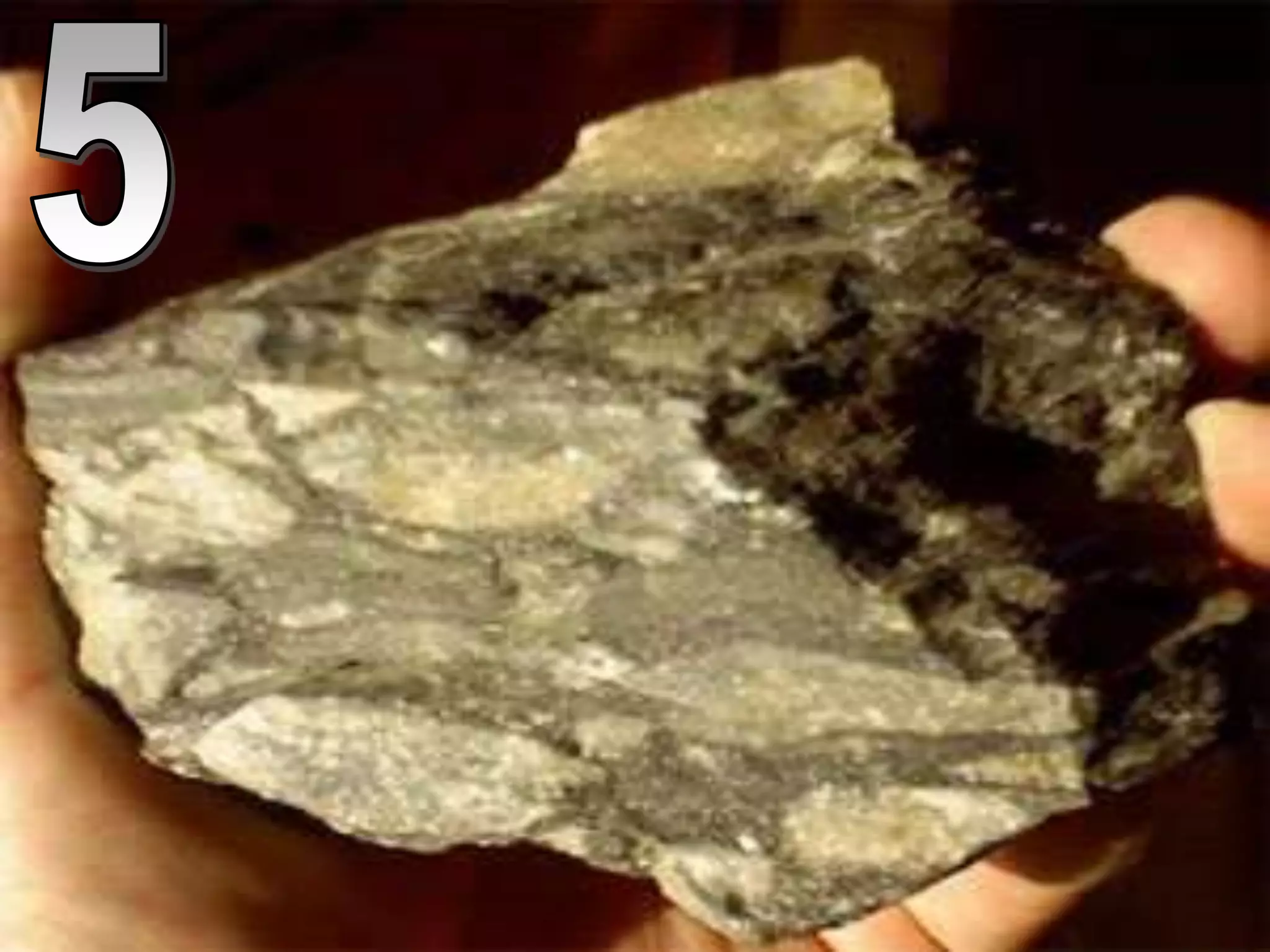
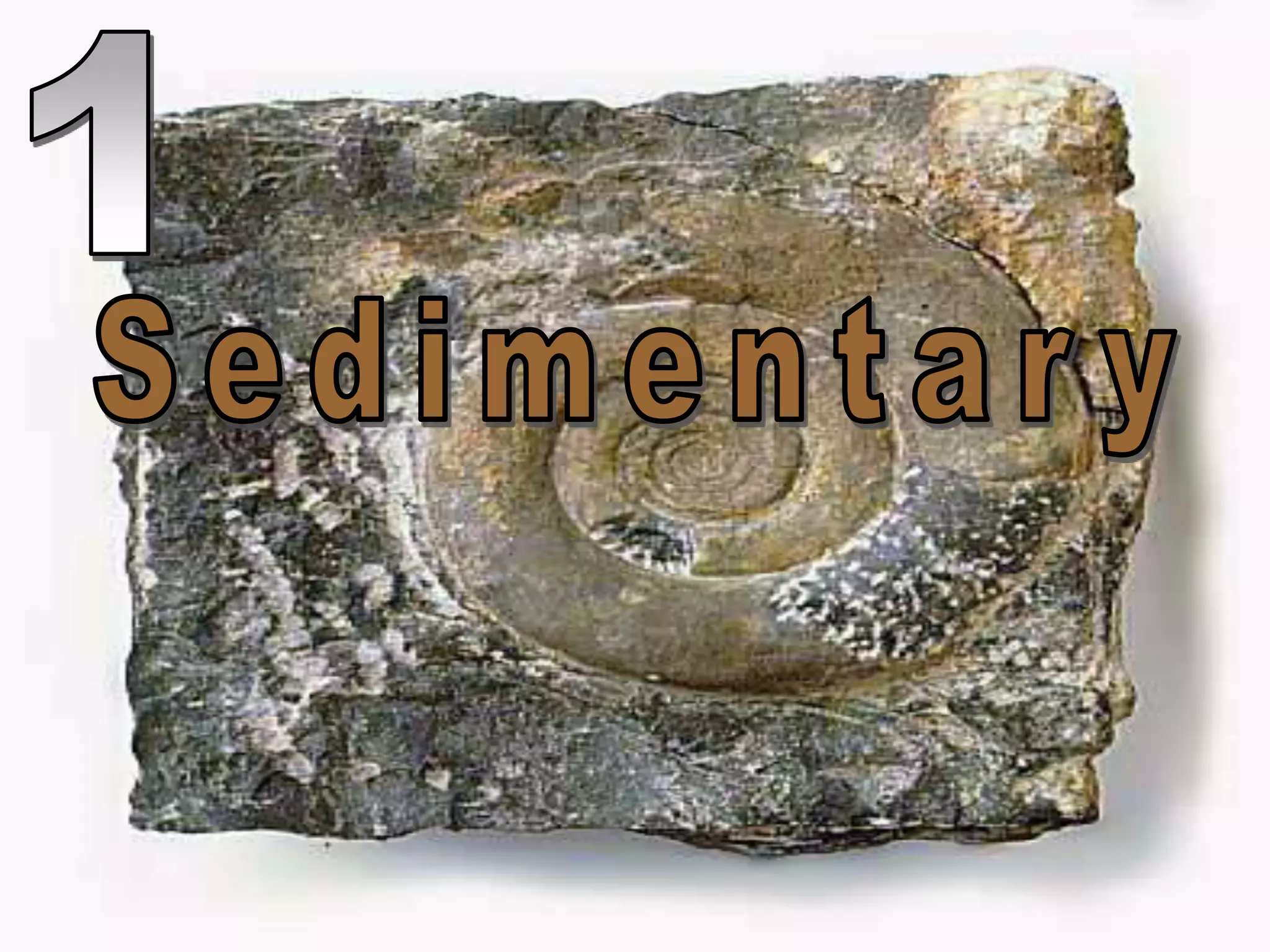
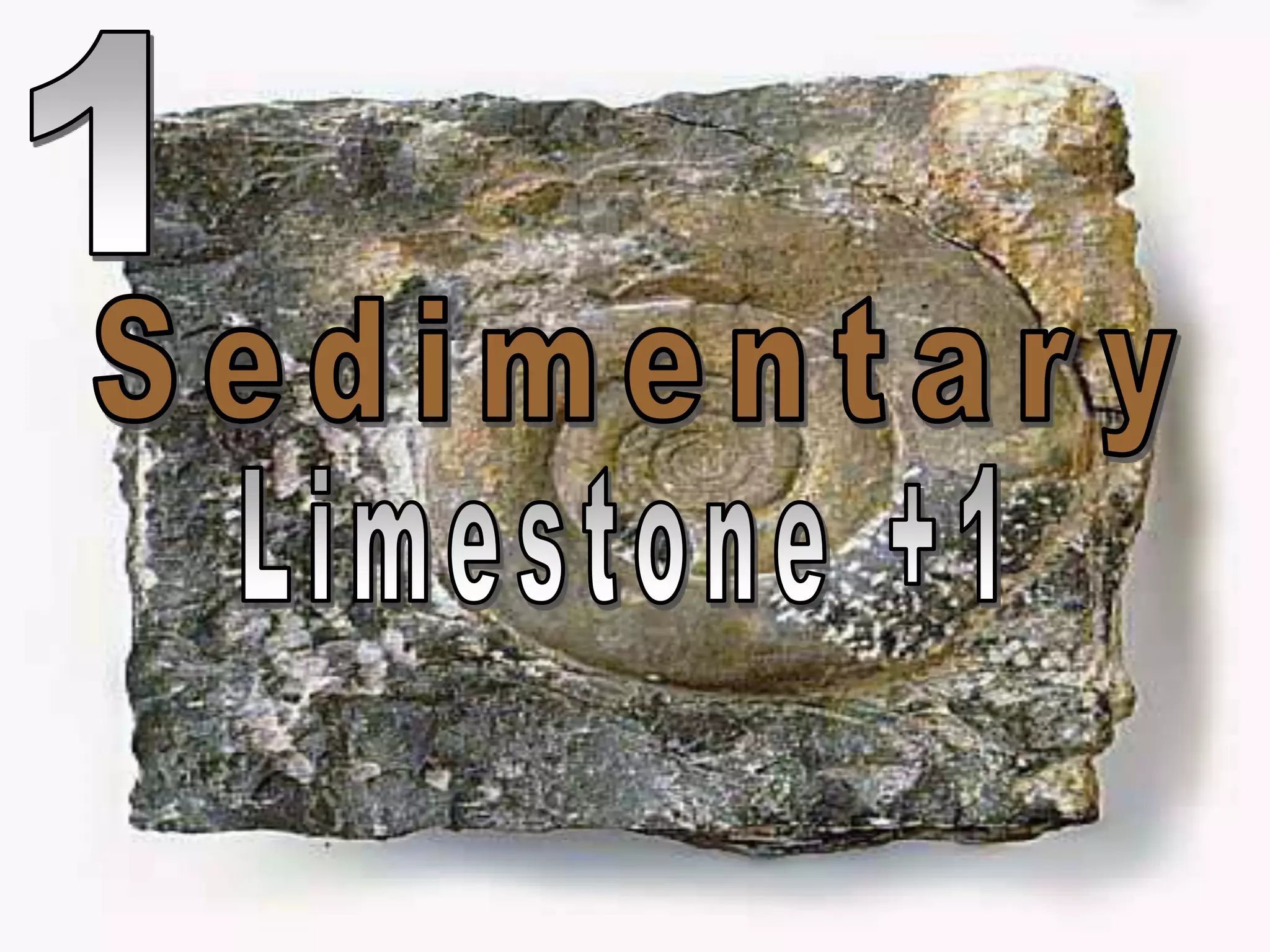
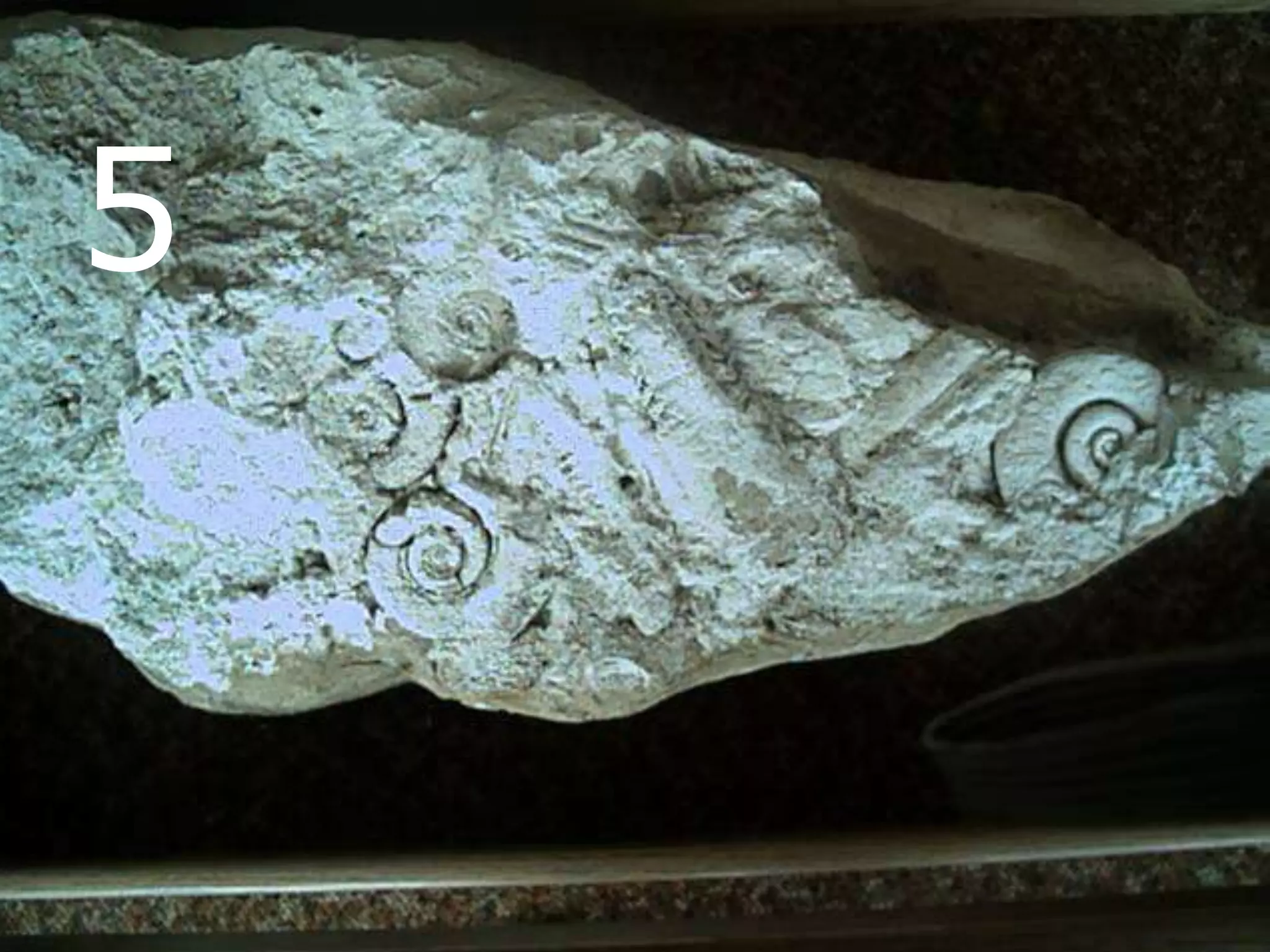
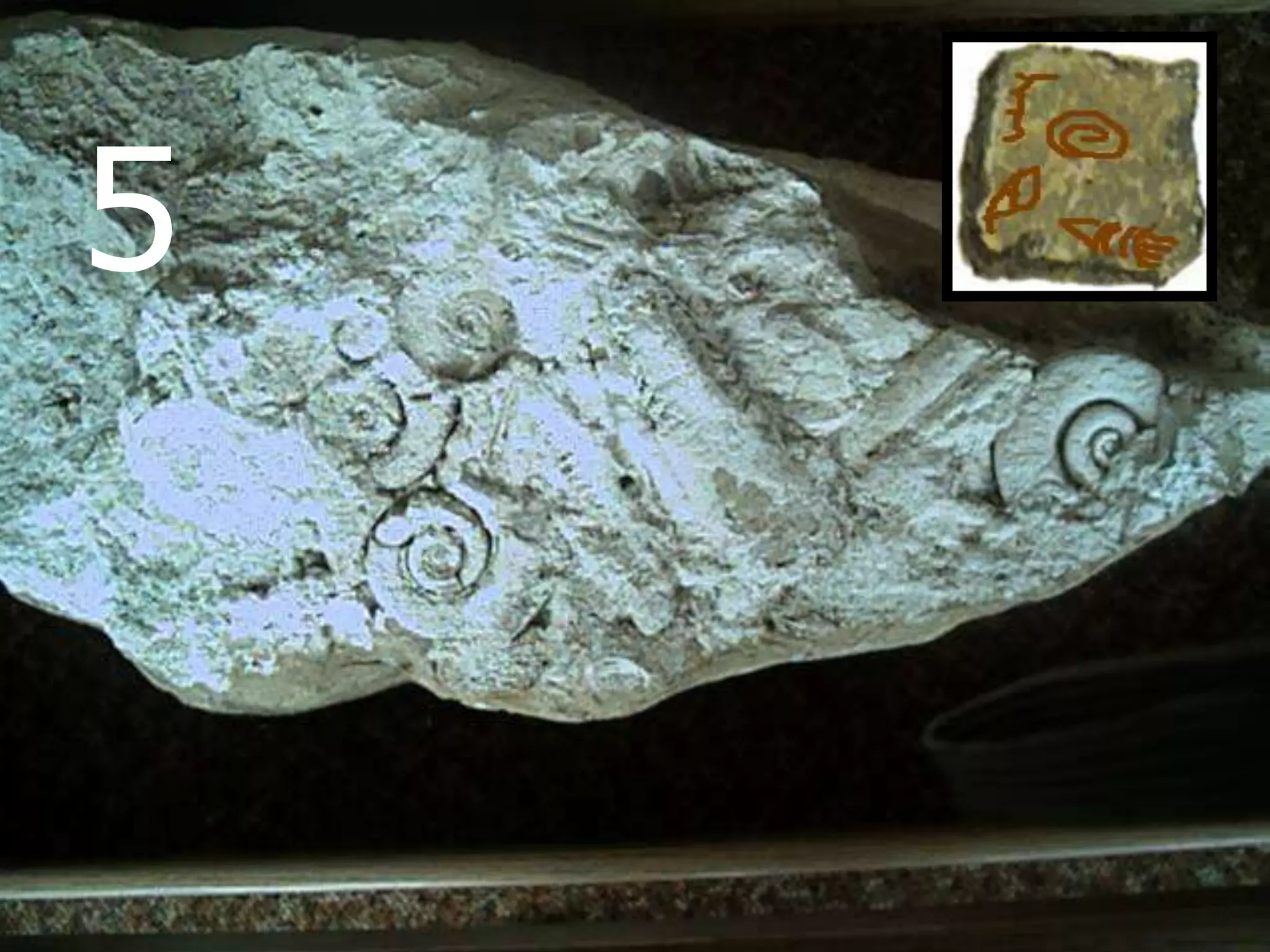
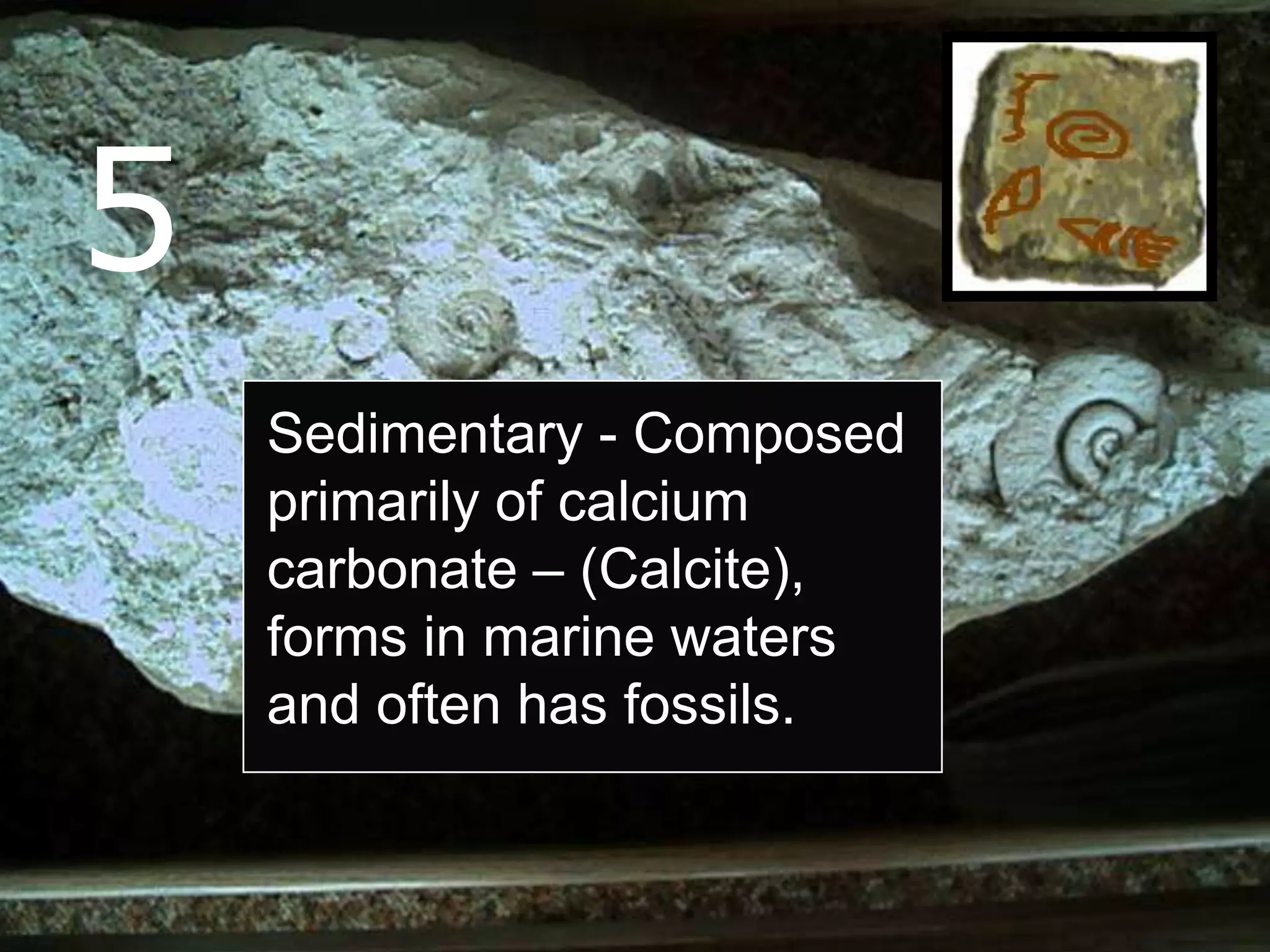
Sedimentary - Composed
primarily of calcium
carbonate – (Calcite),
forms in marine waters
and often has fossils.
6
6
.
6
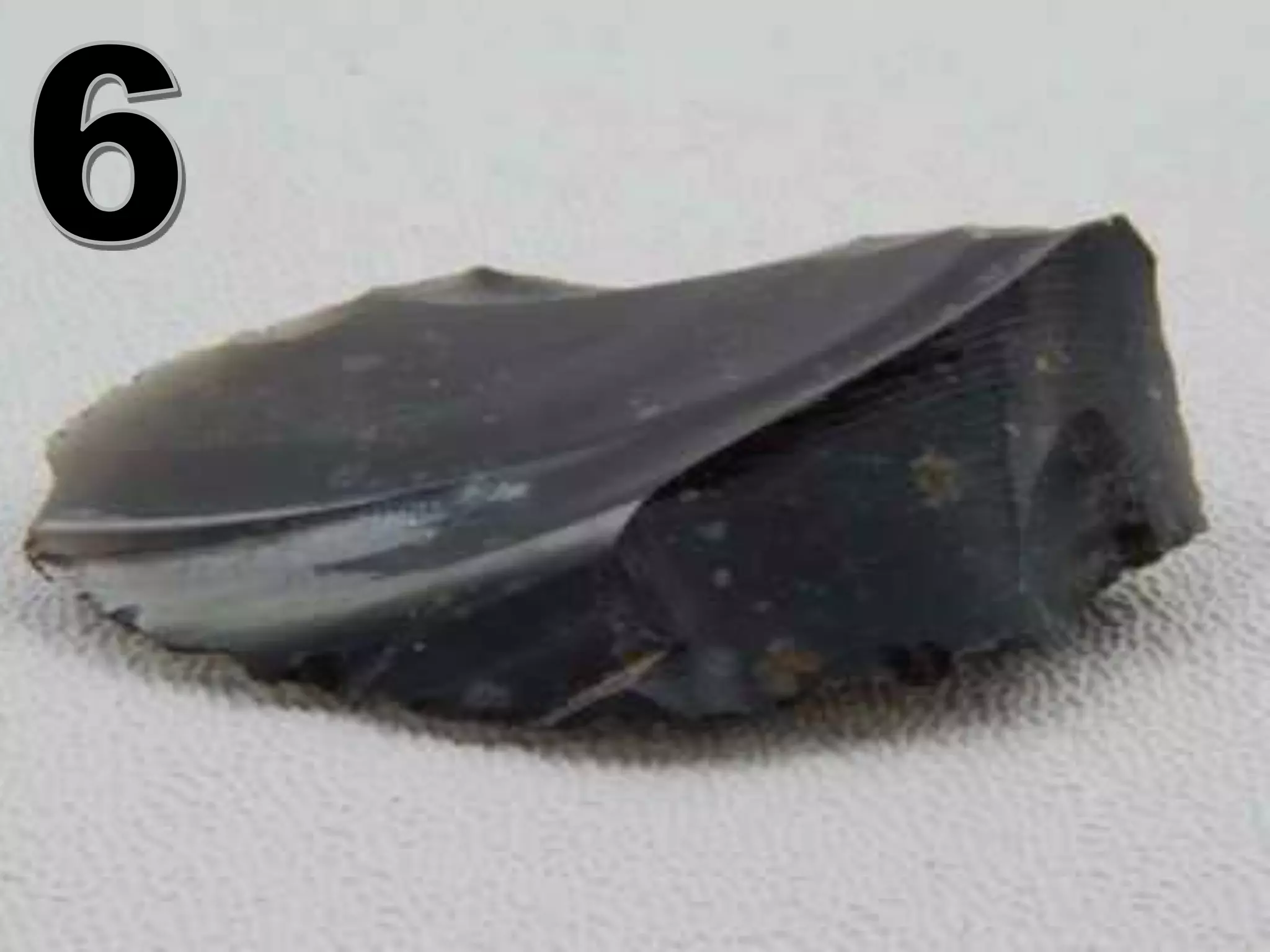
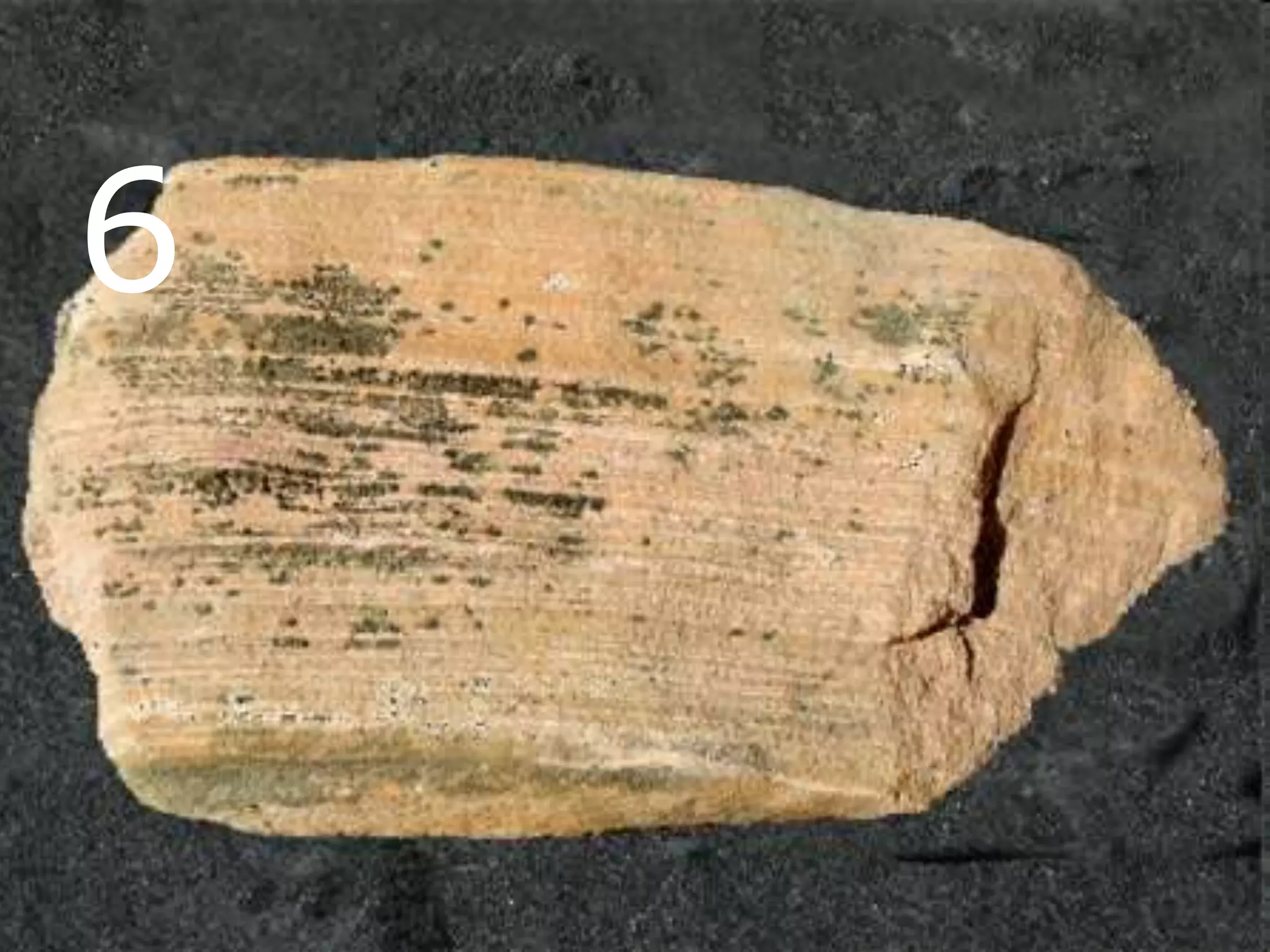
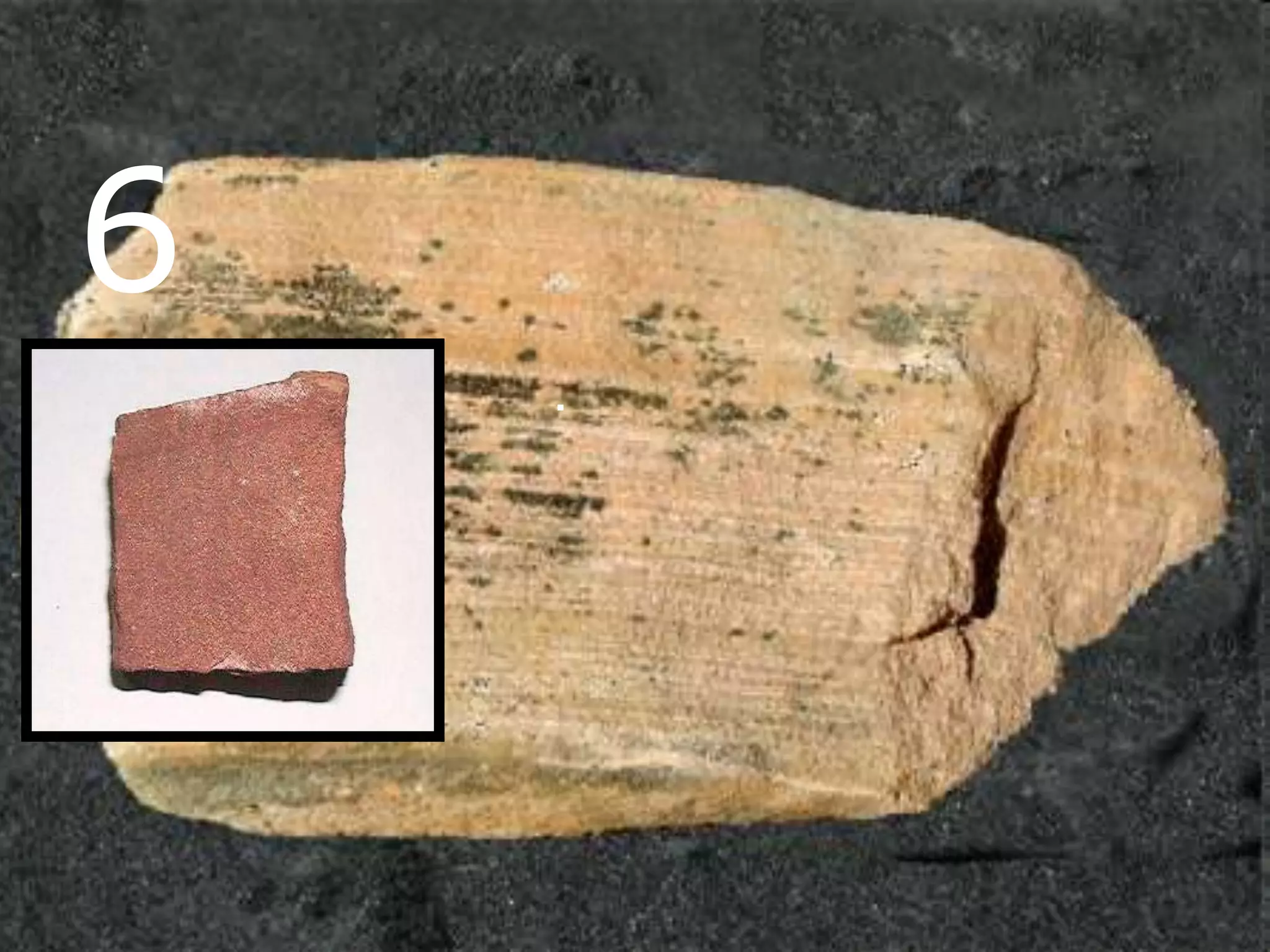
Sedimentary, clastic
rock made up mainly of
sand. Found in
environments where
large amounts of sand
can accumulate.
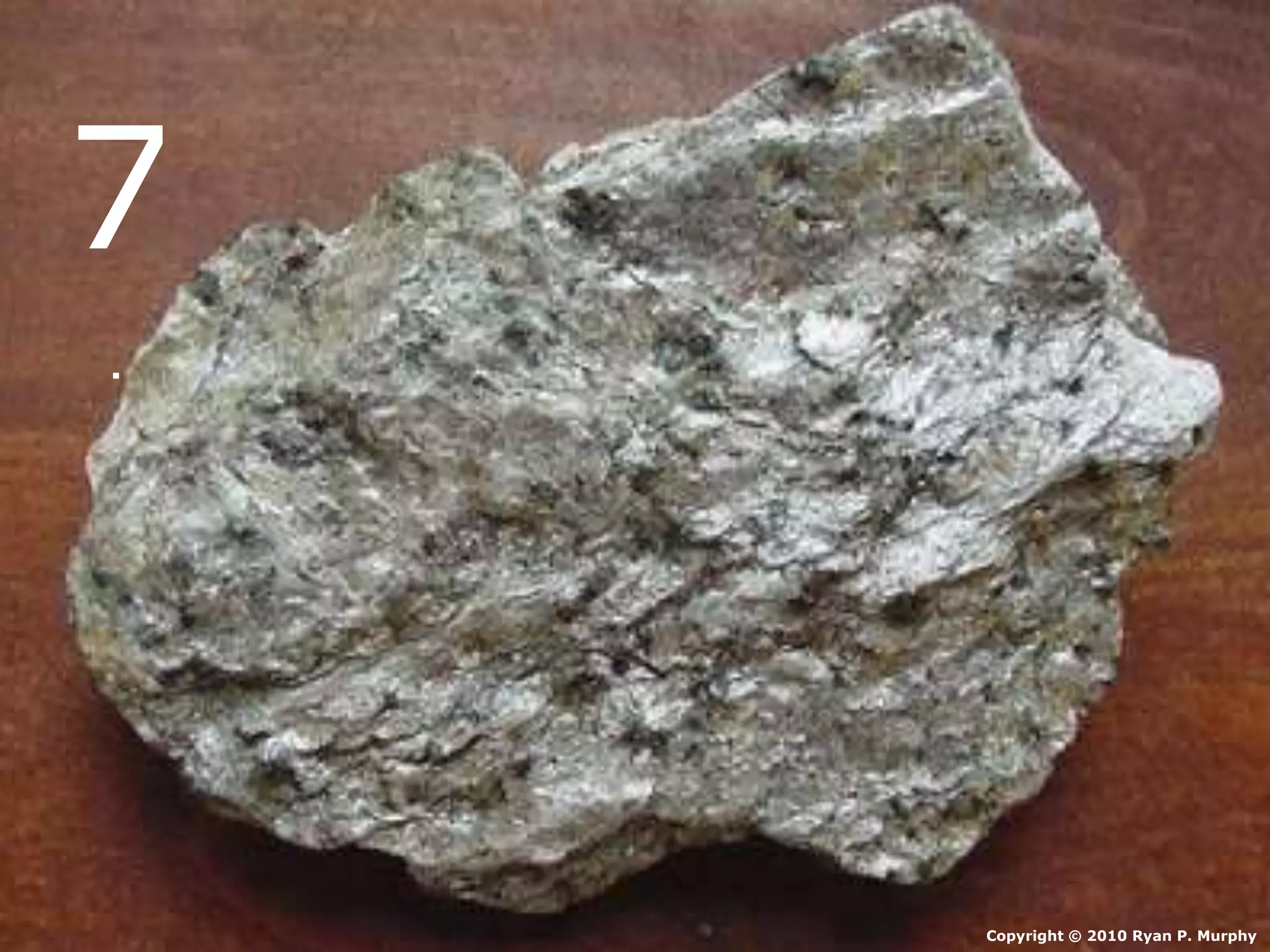
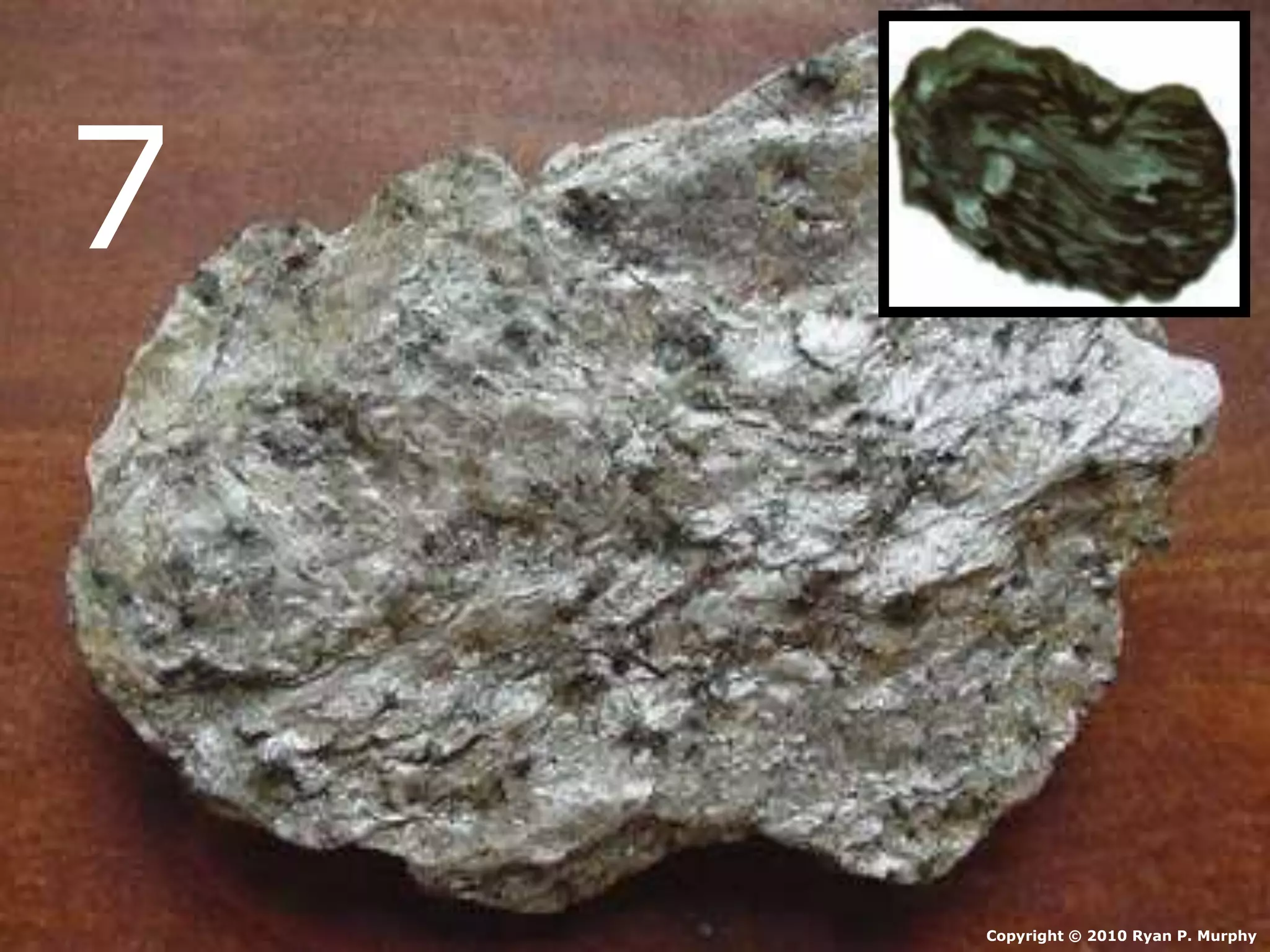
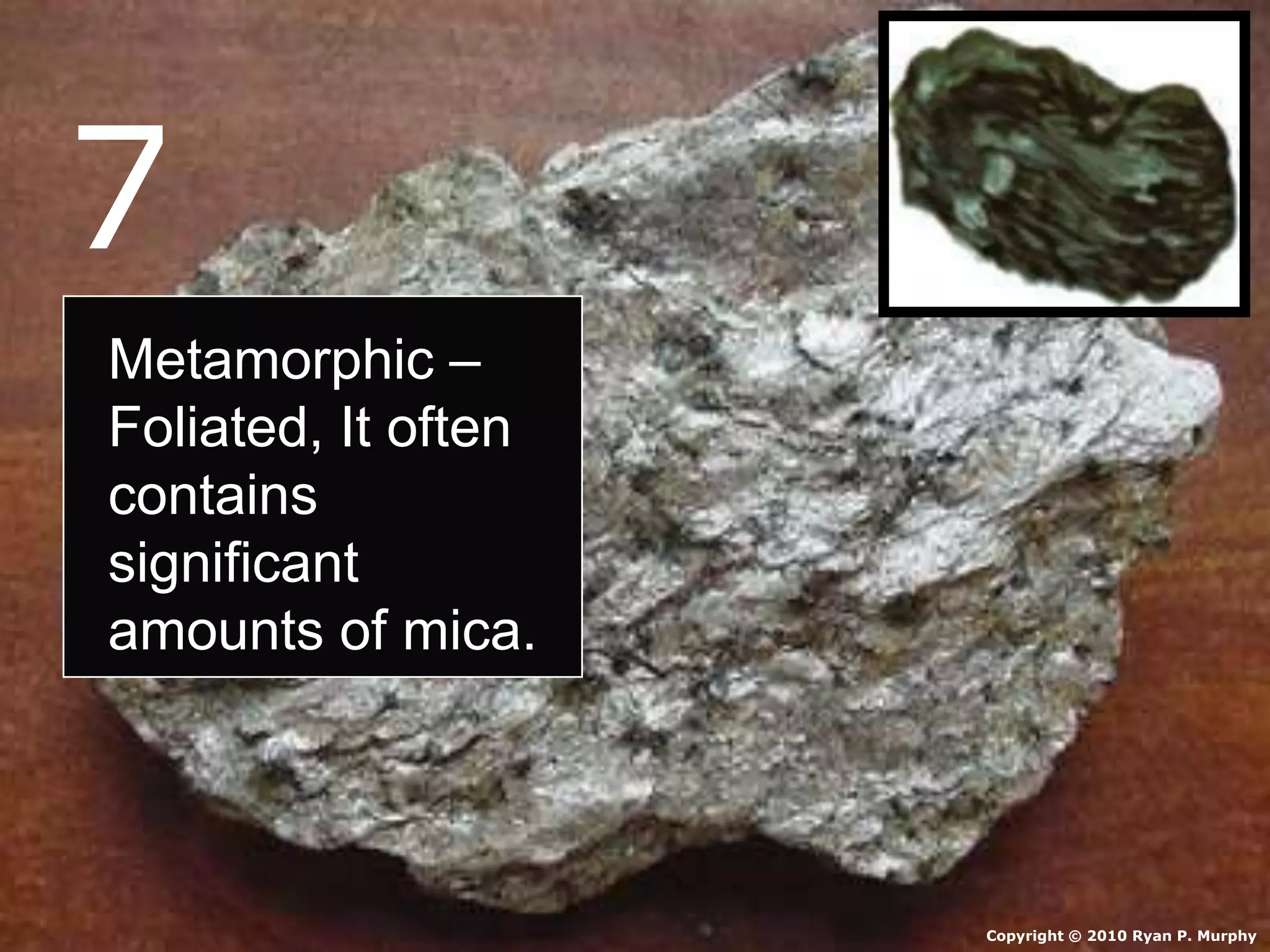
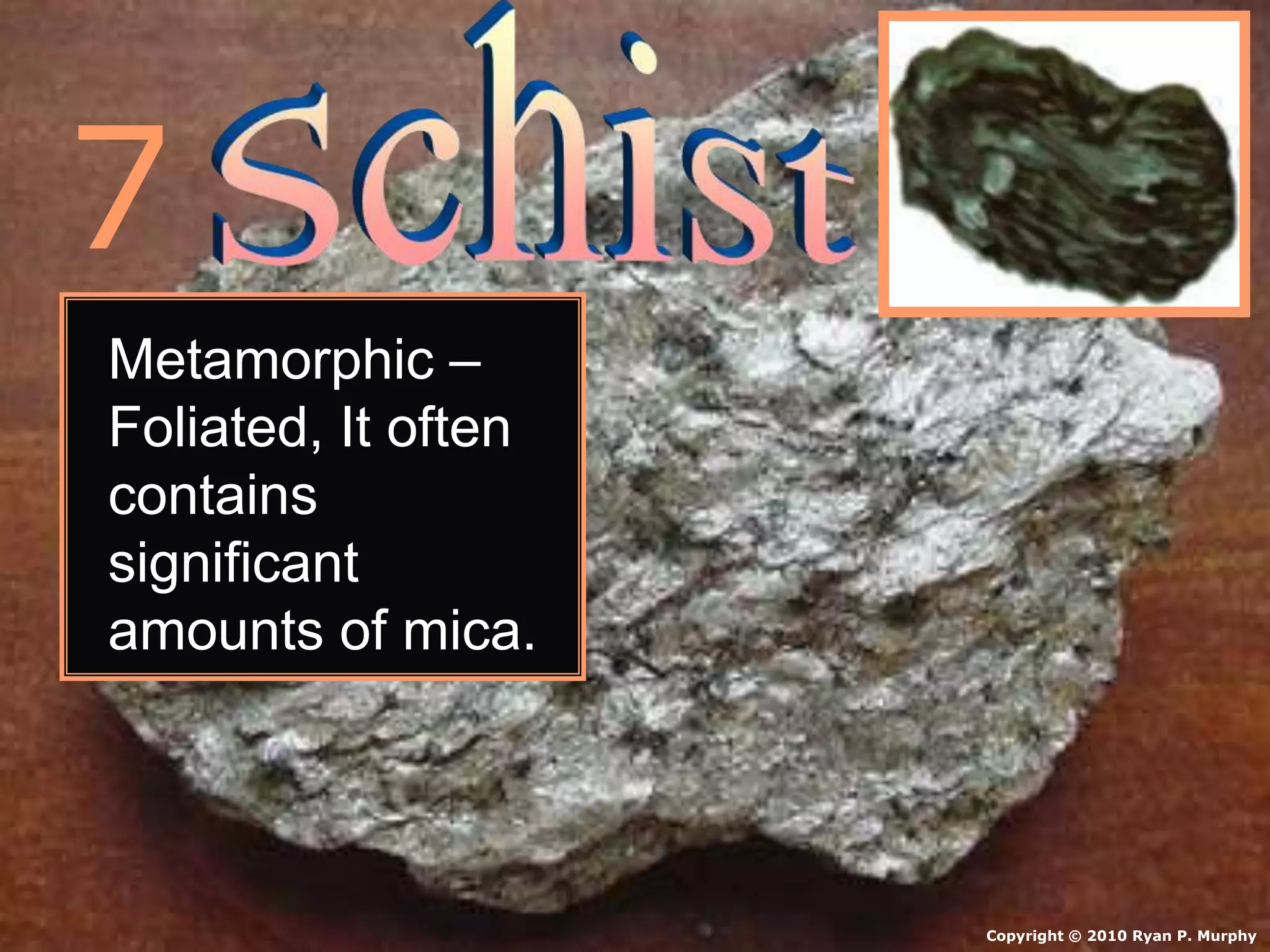
• Schist.
Copyright © 2010 Ryan P. Murphy
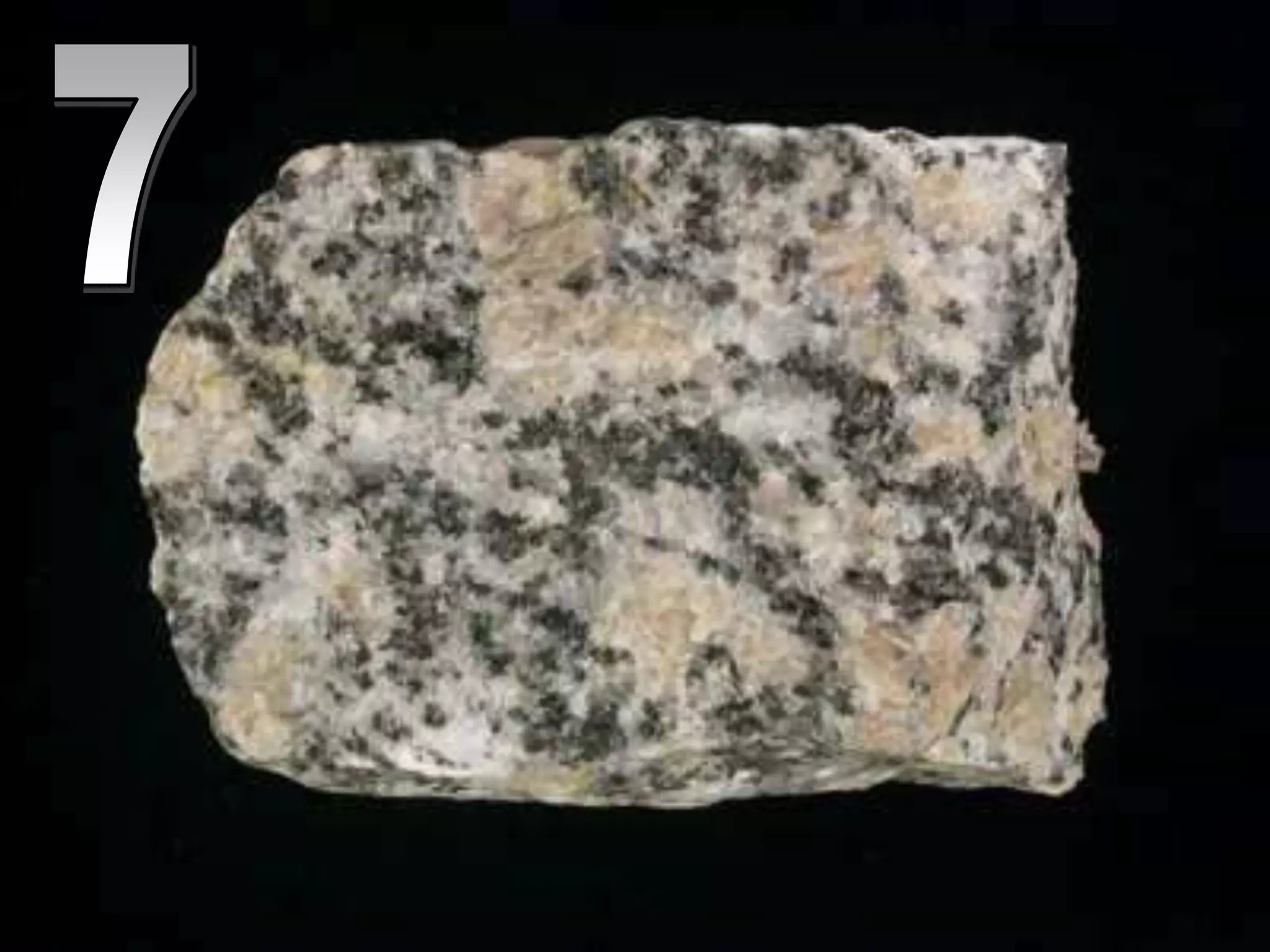
7
.
• Schist.
Copyright © 2010 Ryan P. Murphy
7
• Schist.
Copyright © 2010 Ryan P. Murphy
7
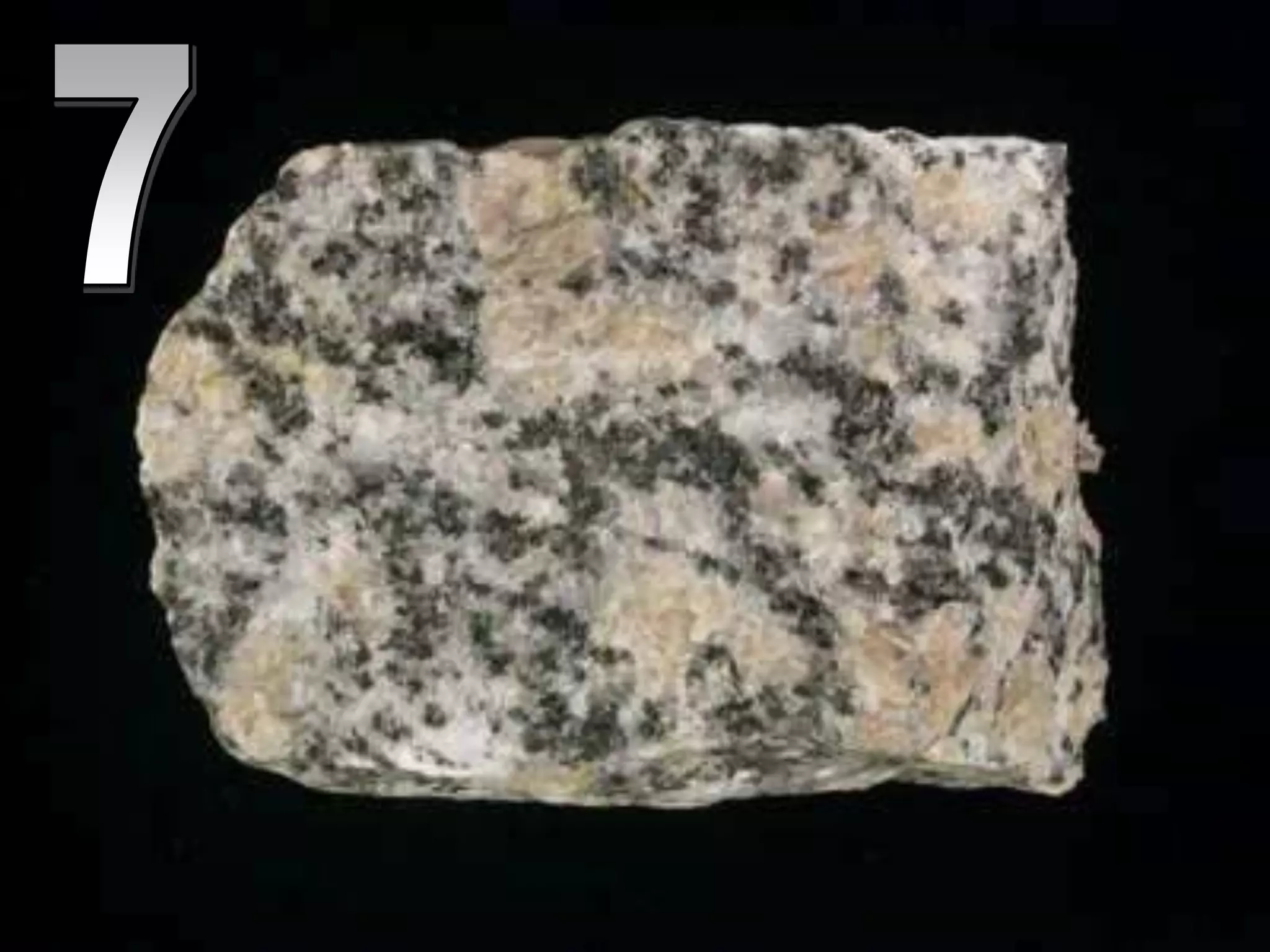
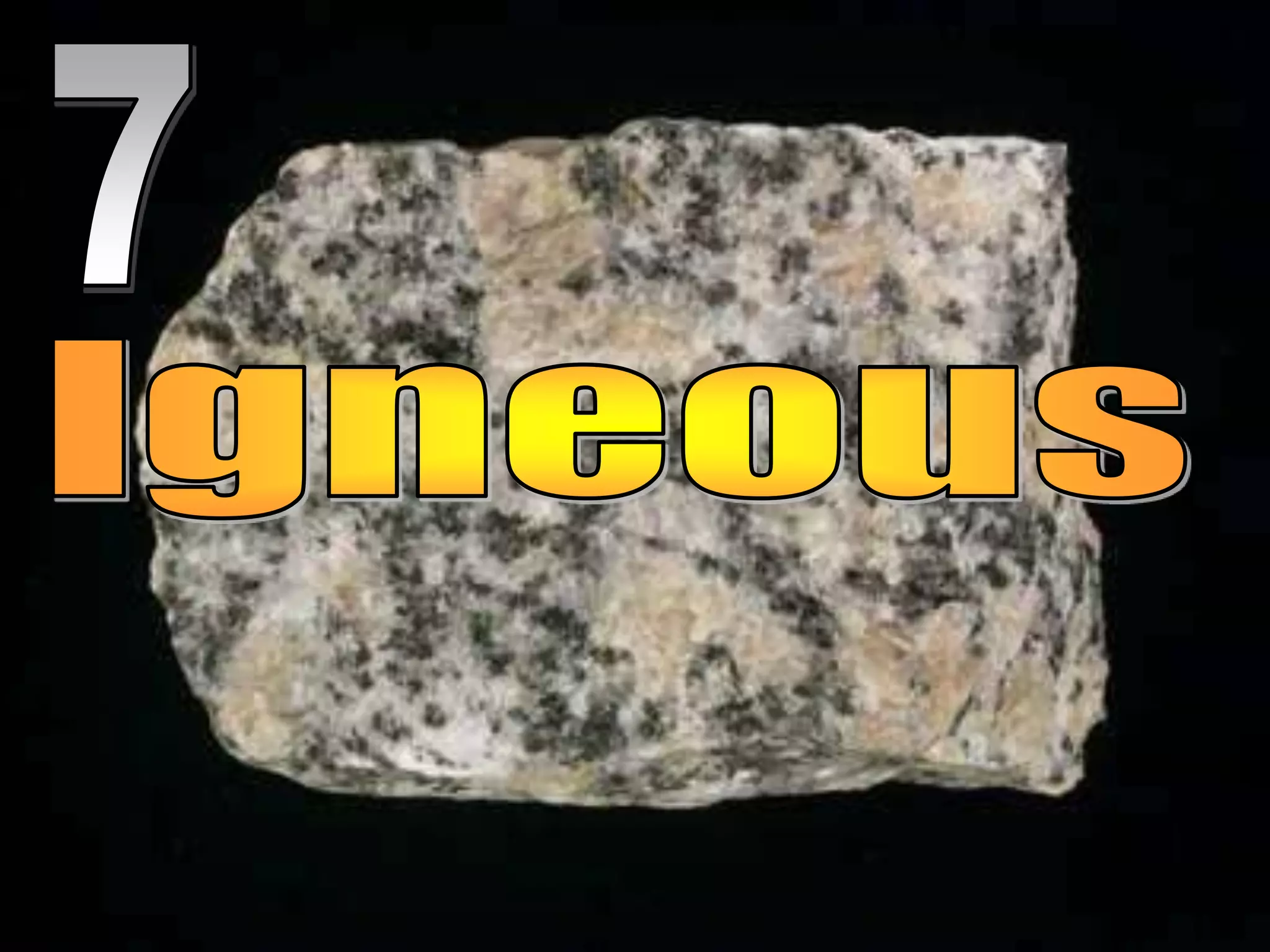
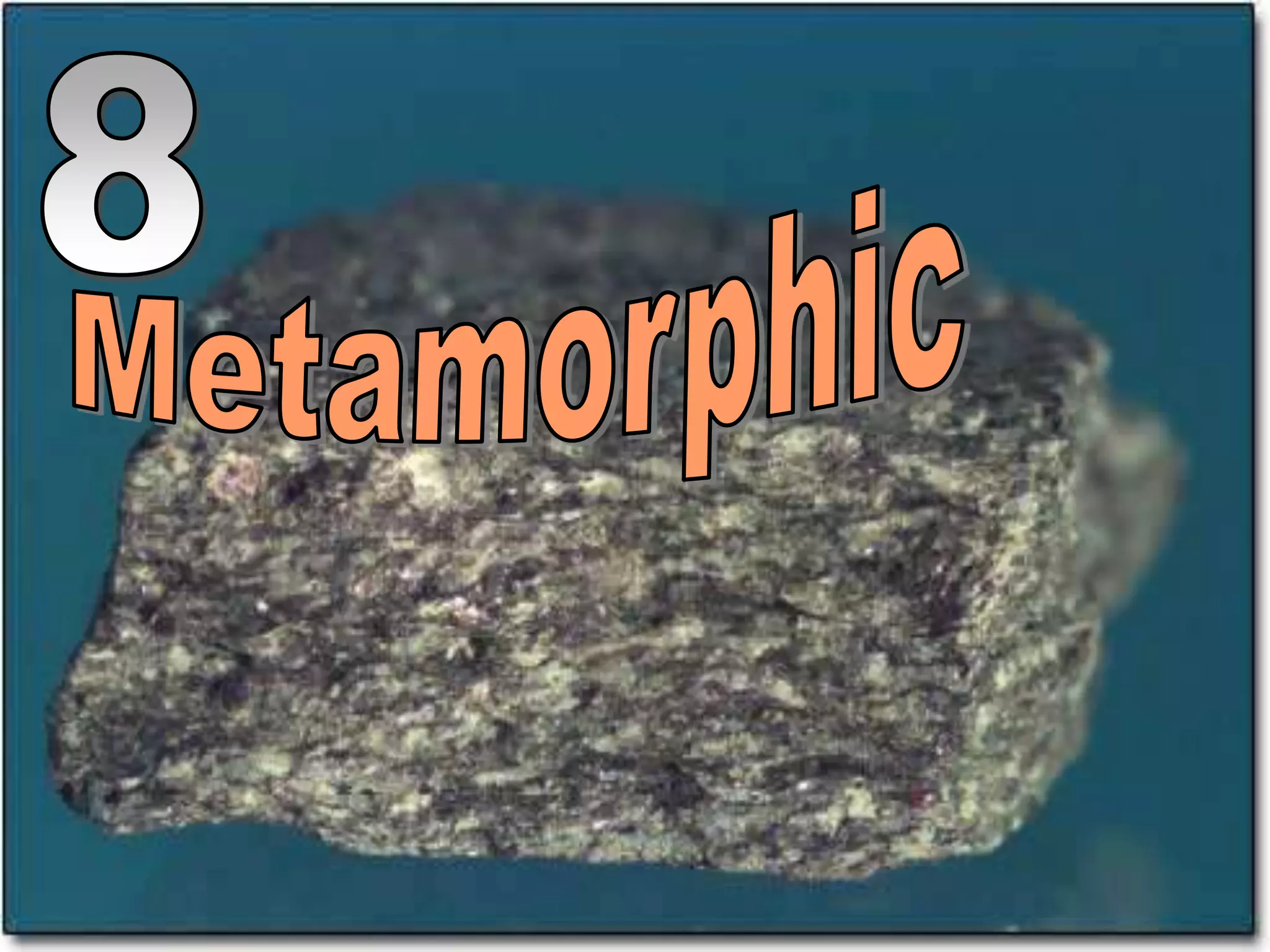
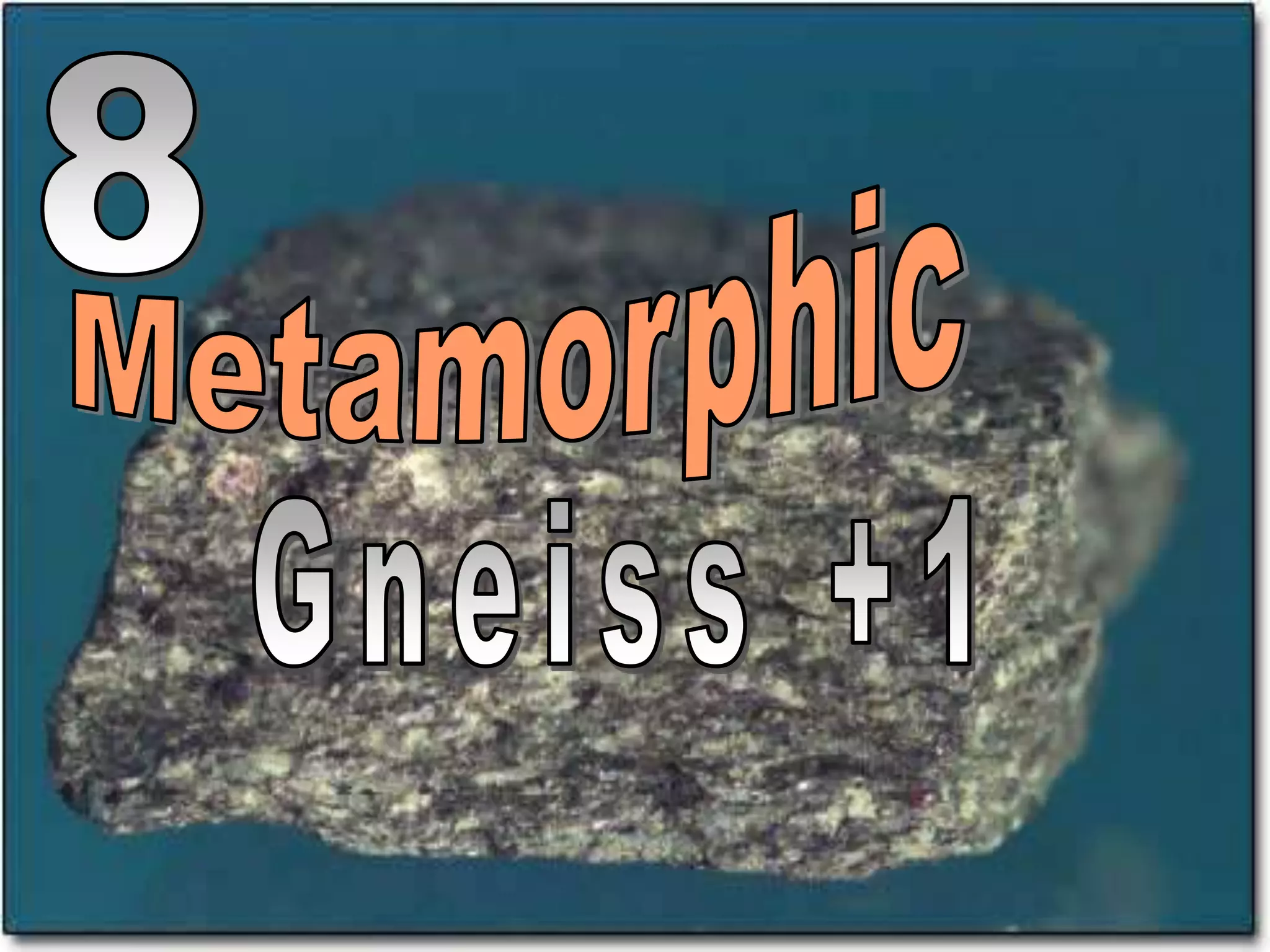
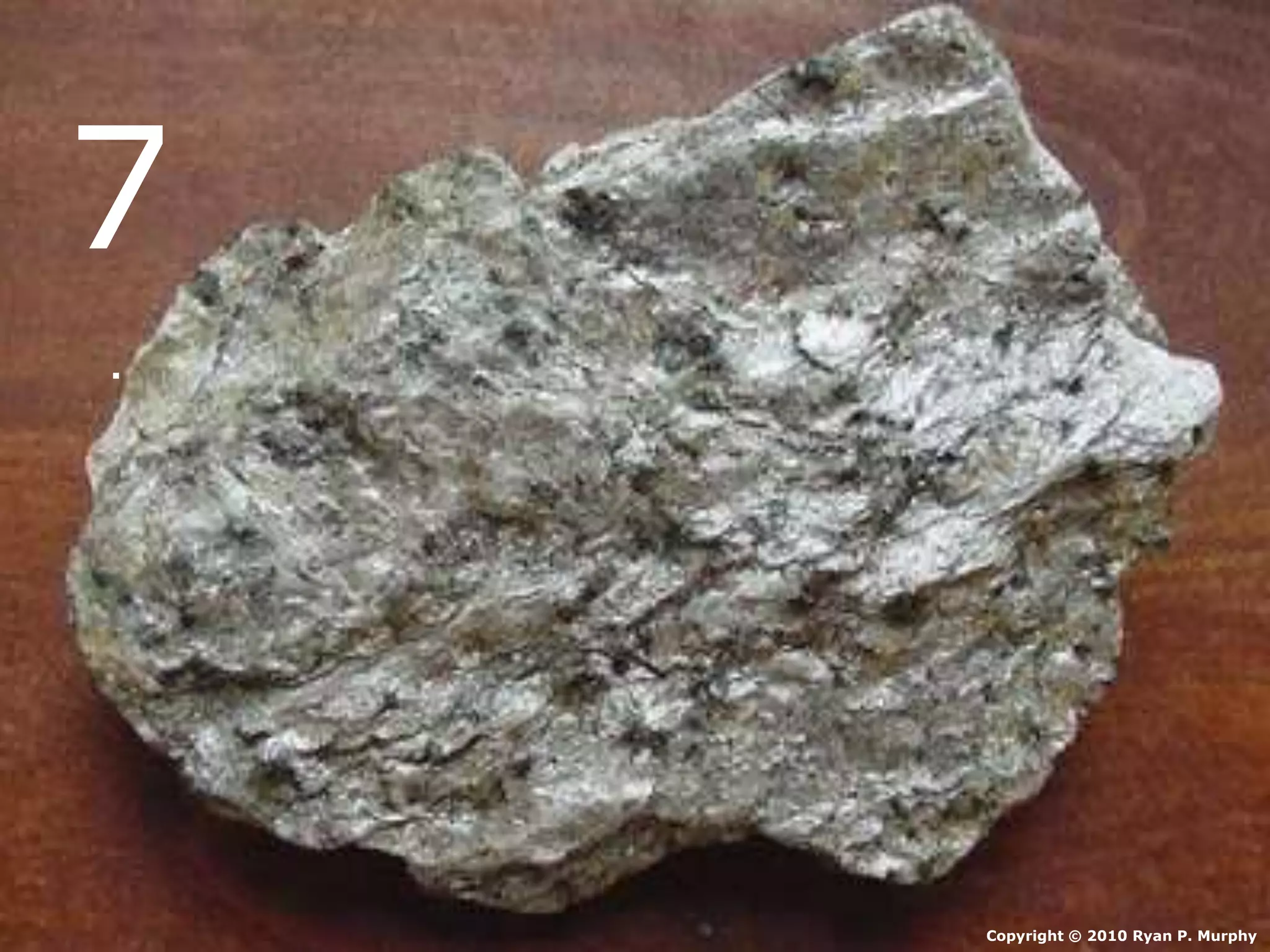
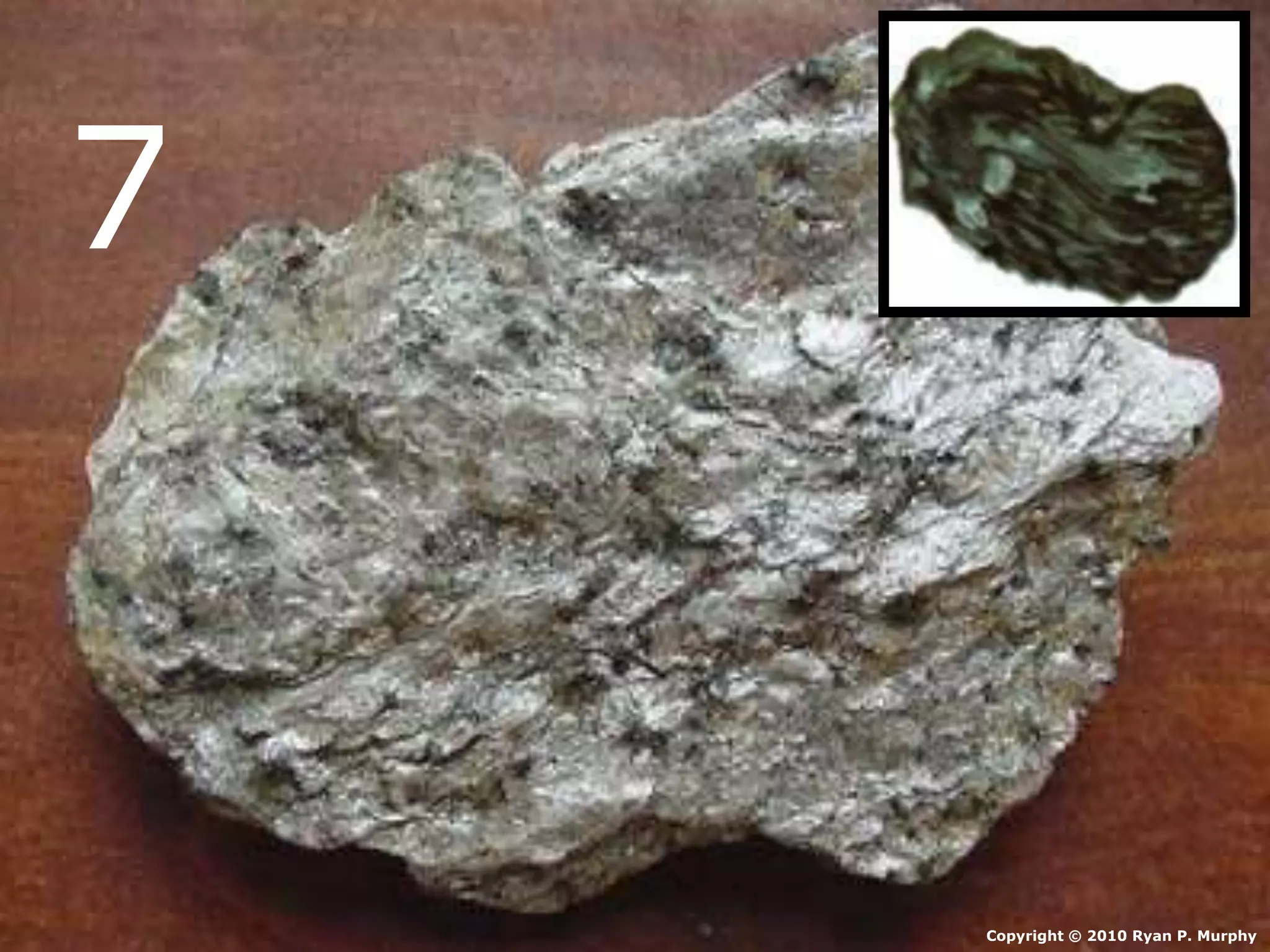
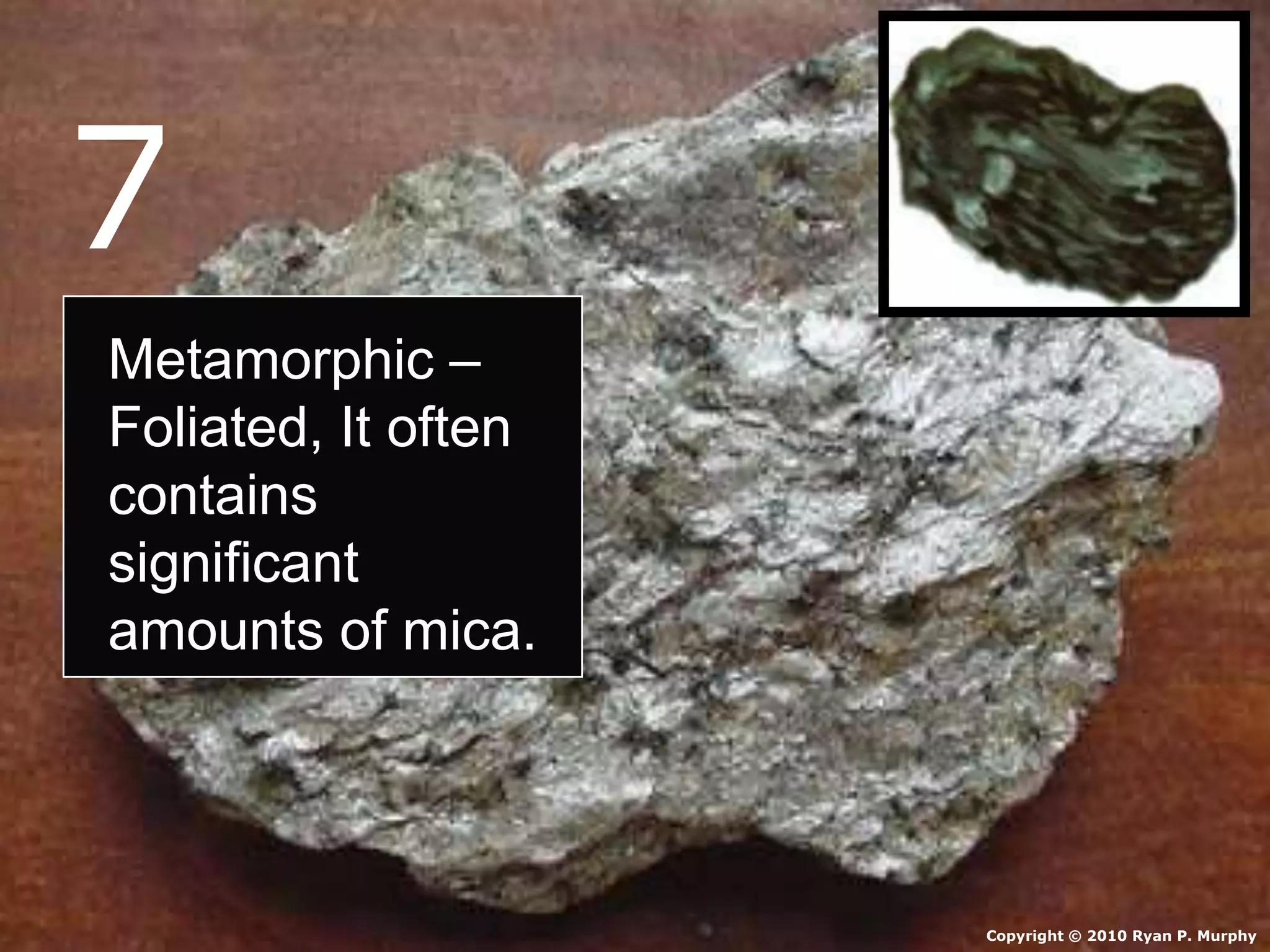
Metamorphic –
Foliated, It often
contains
significant
amounts of mica.
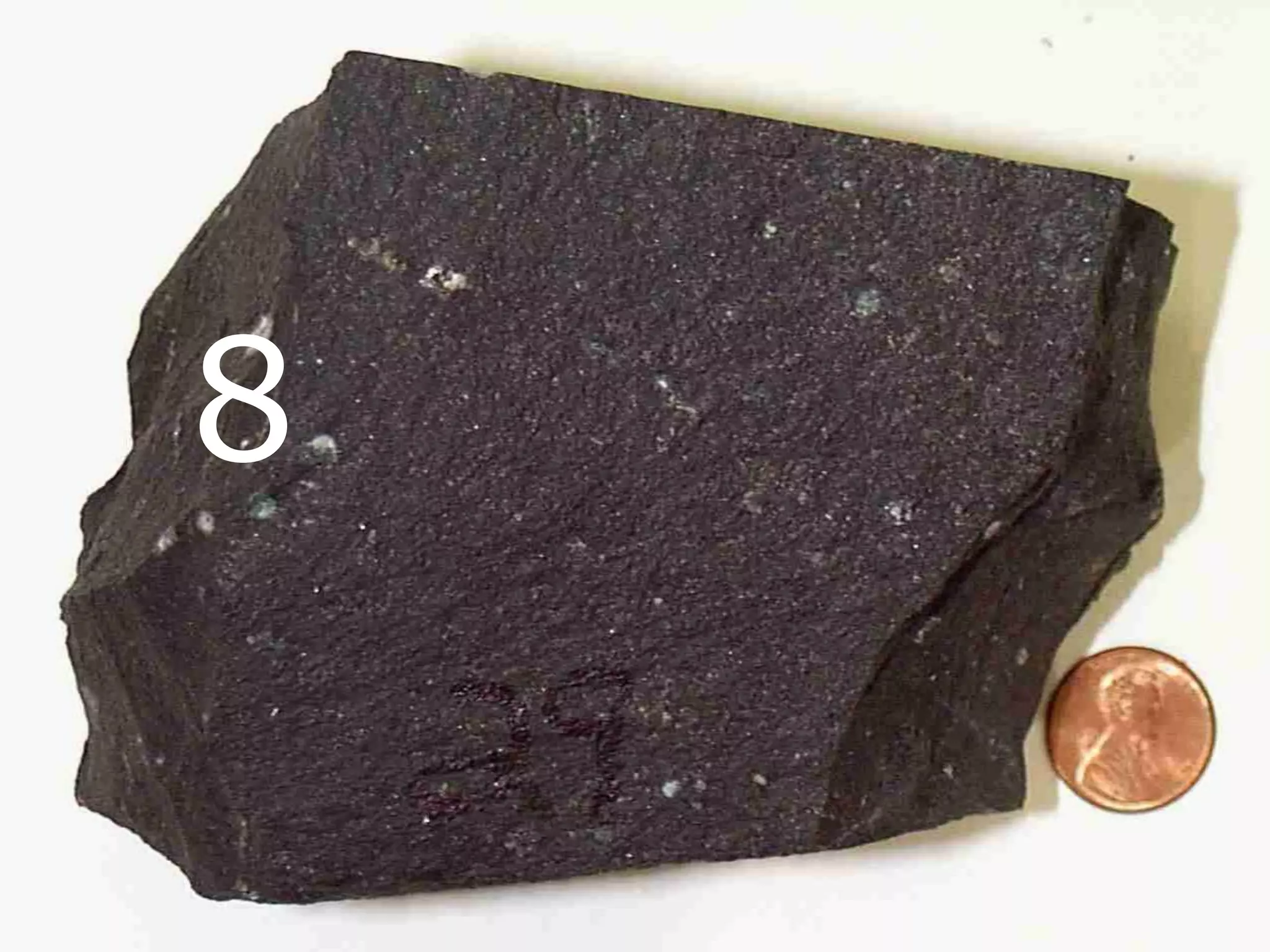
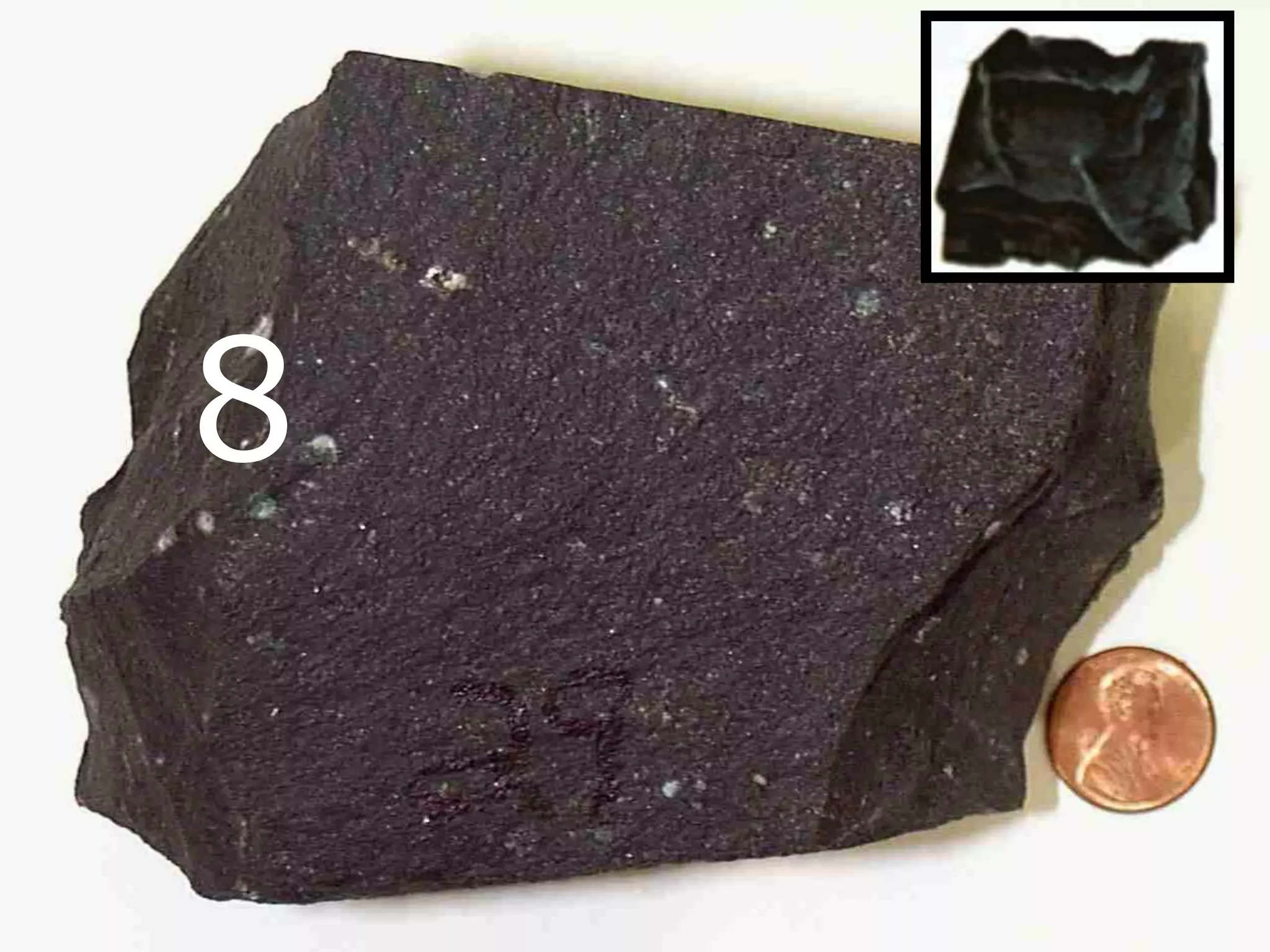
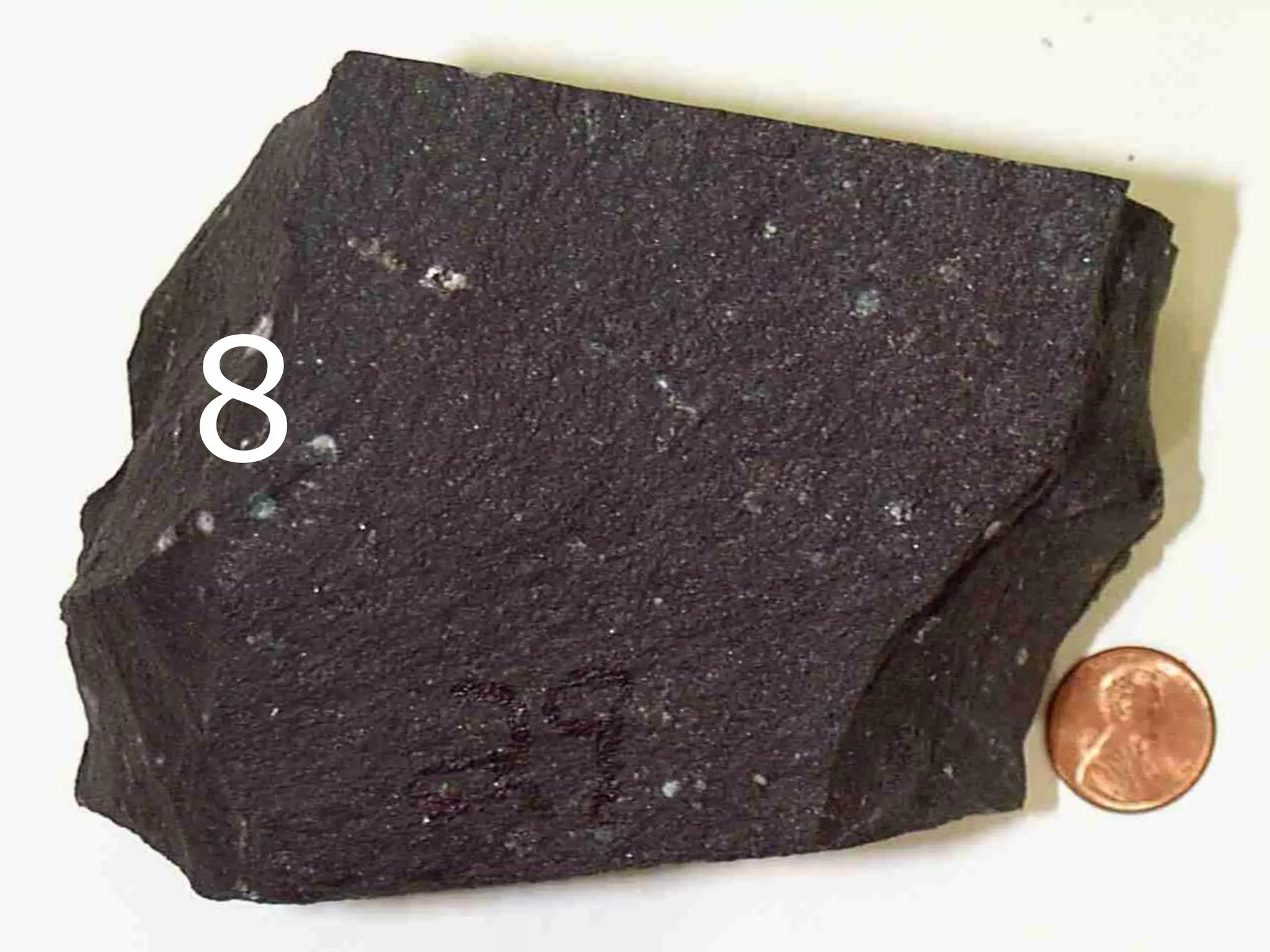
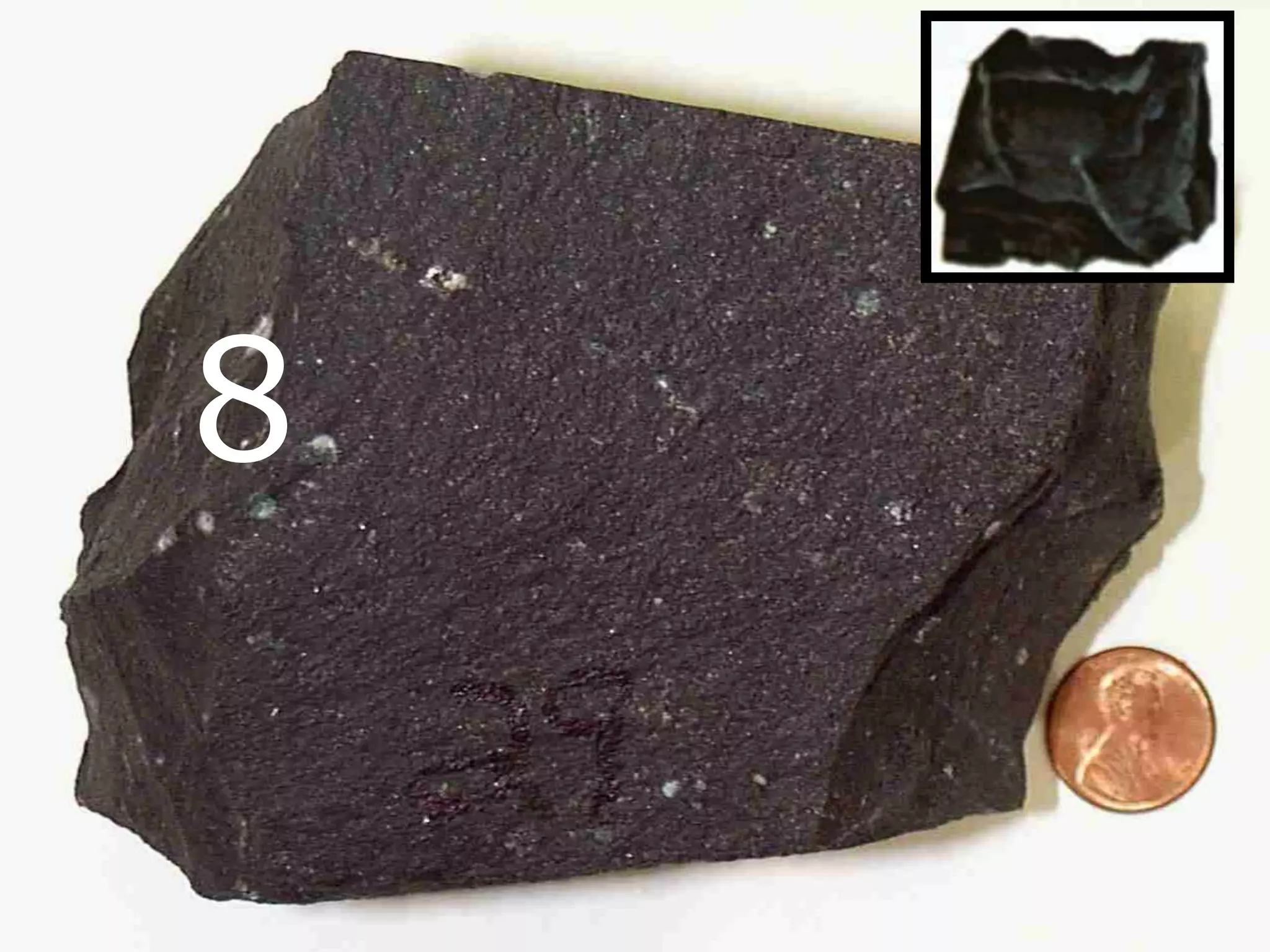
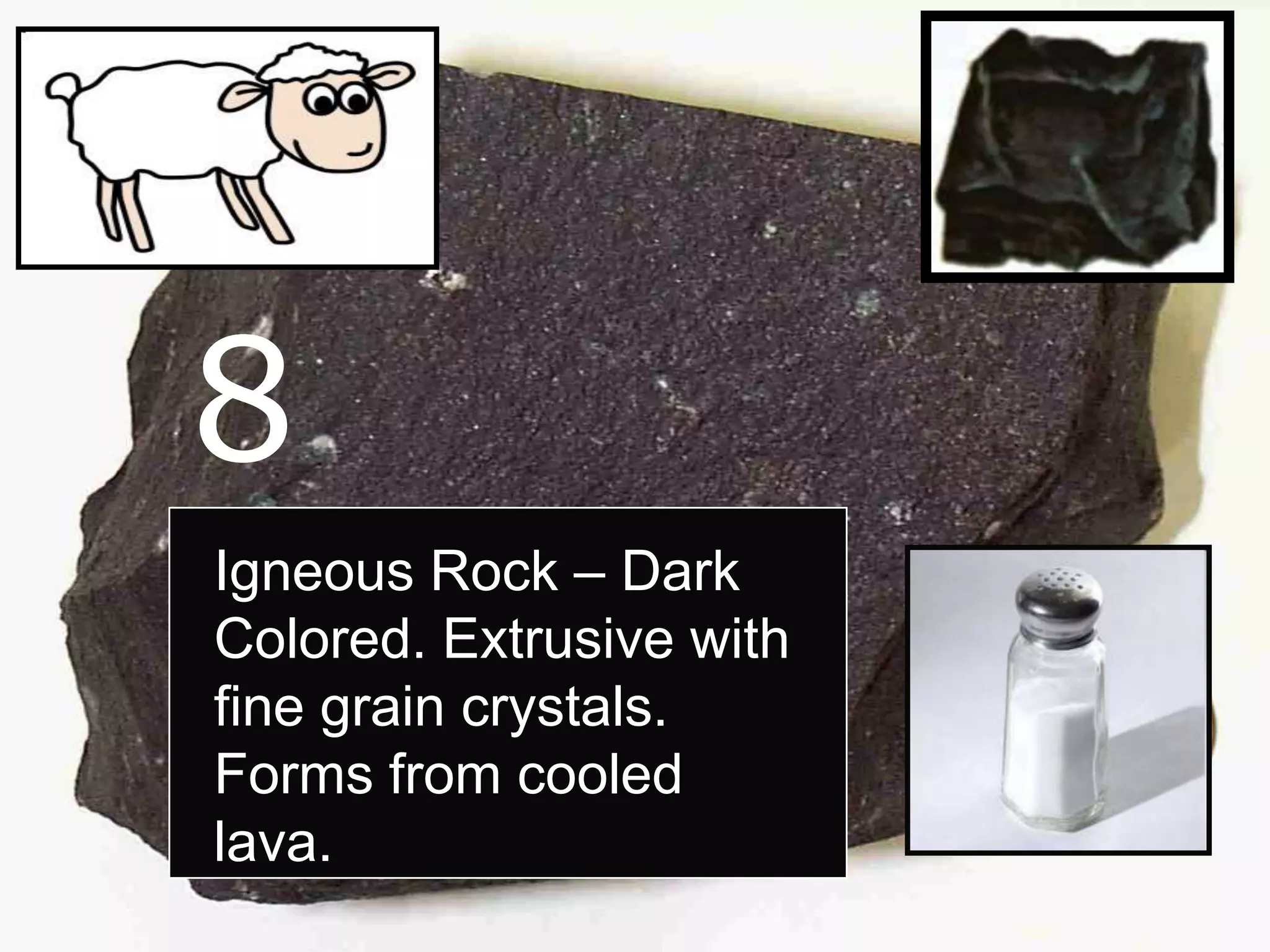
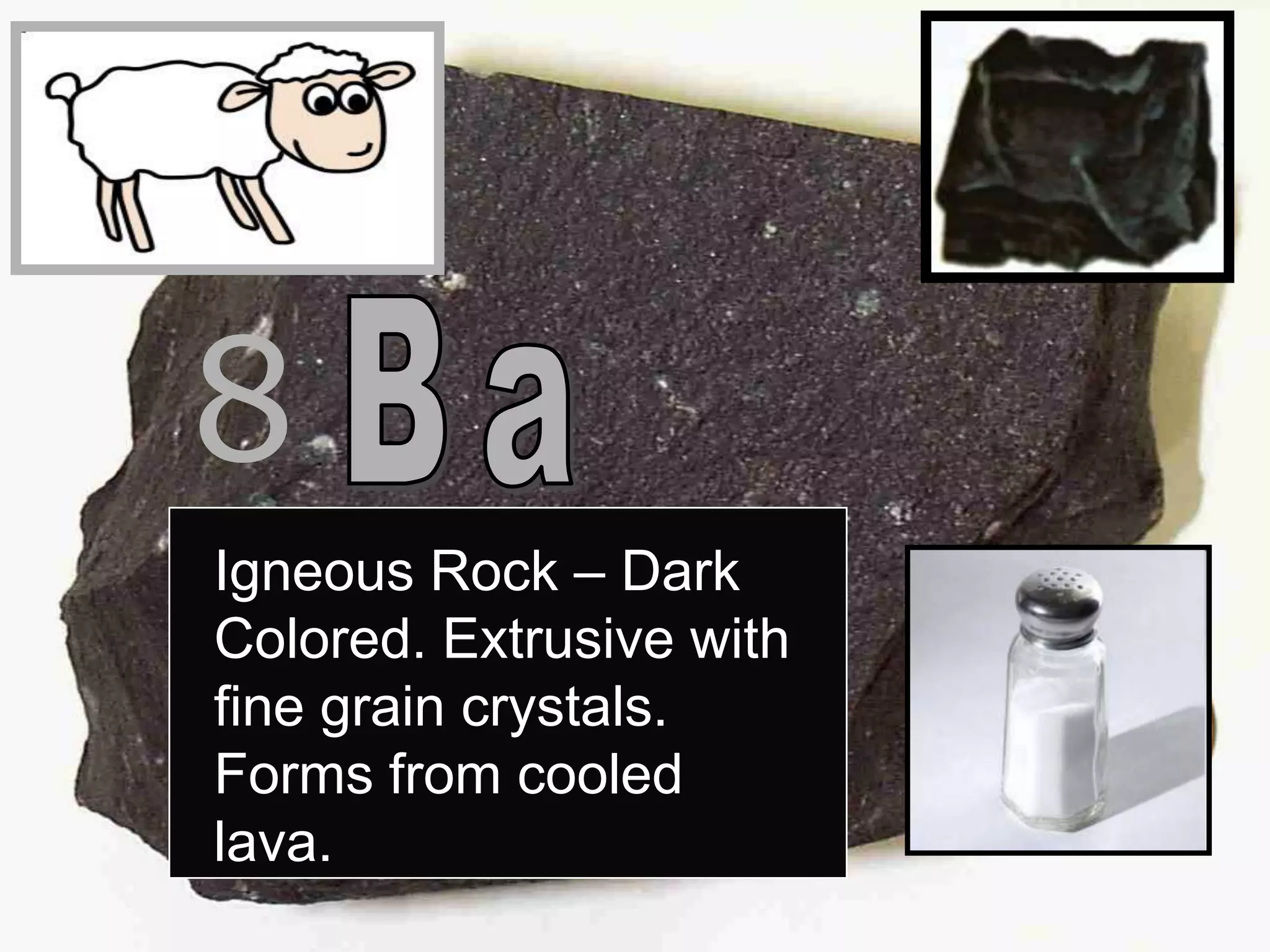
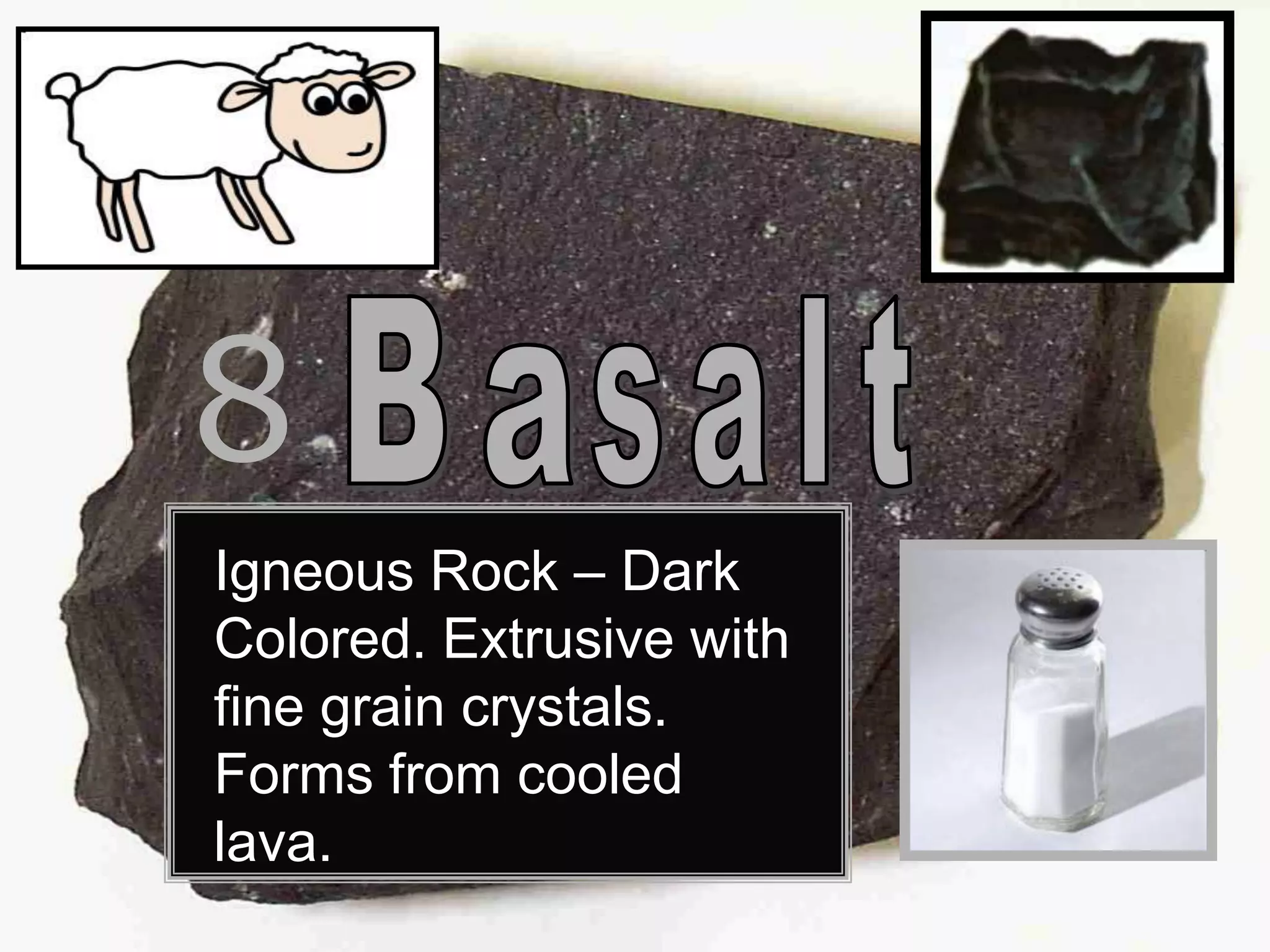
8
8
8
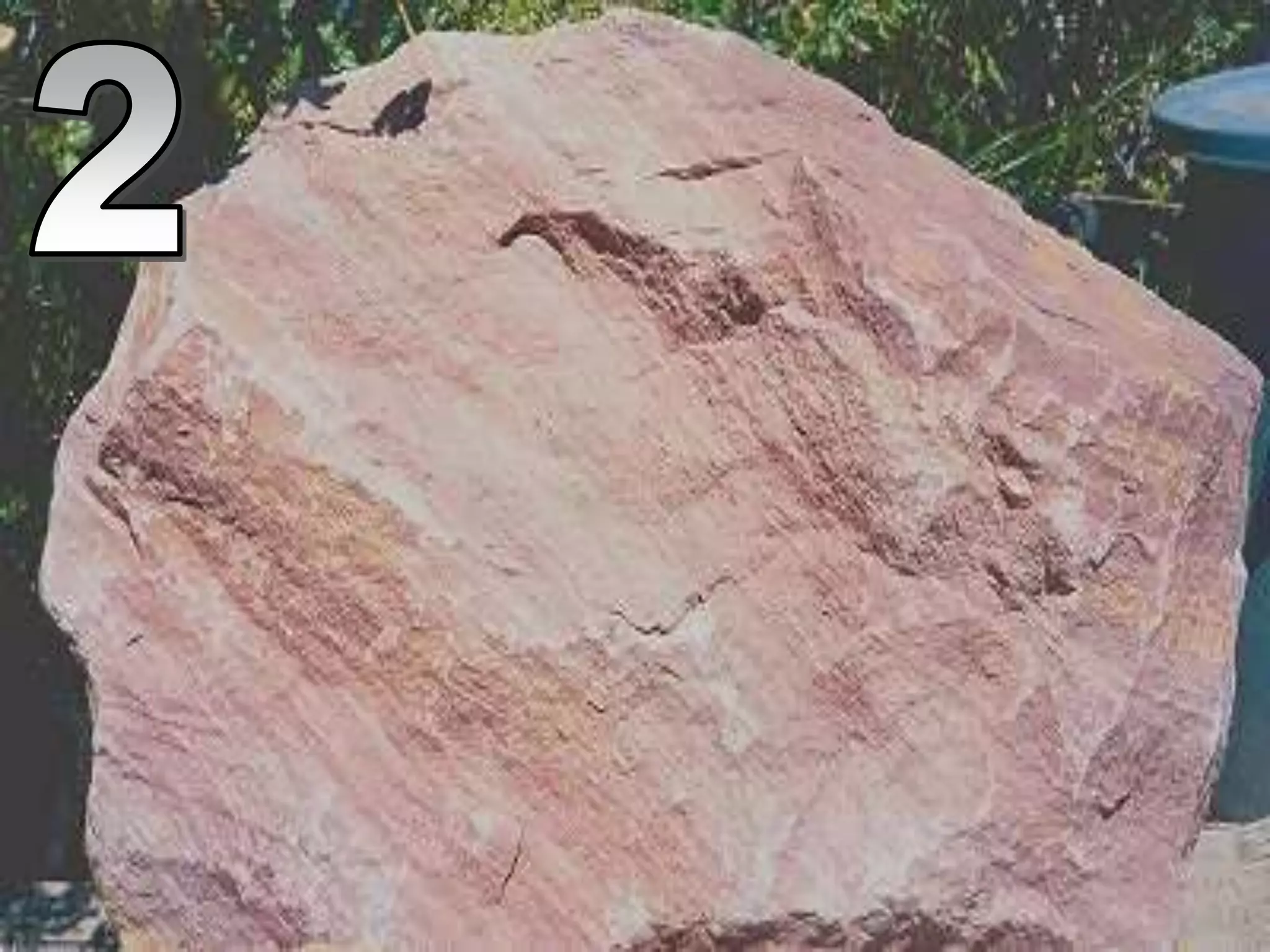
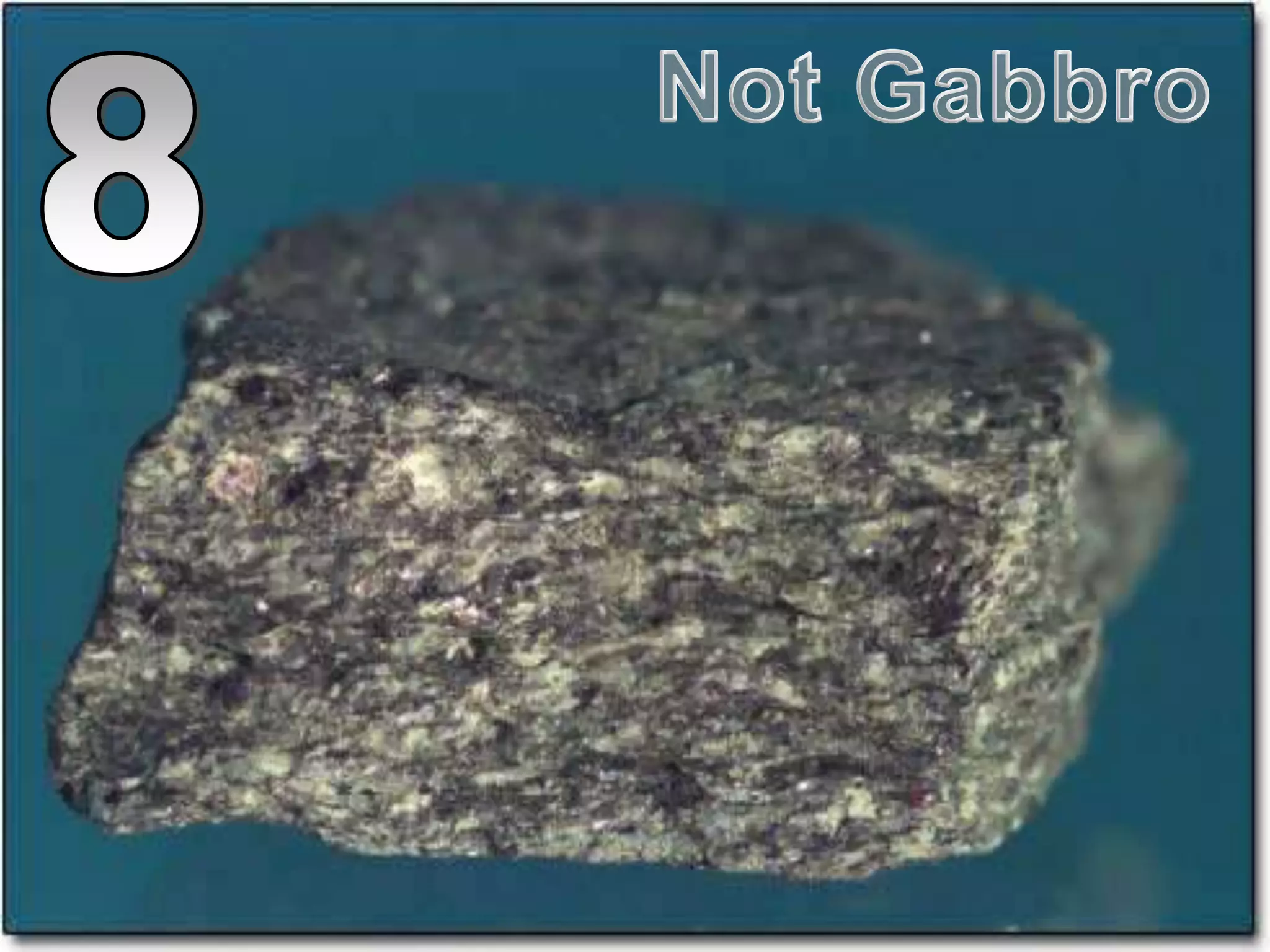
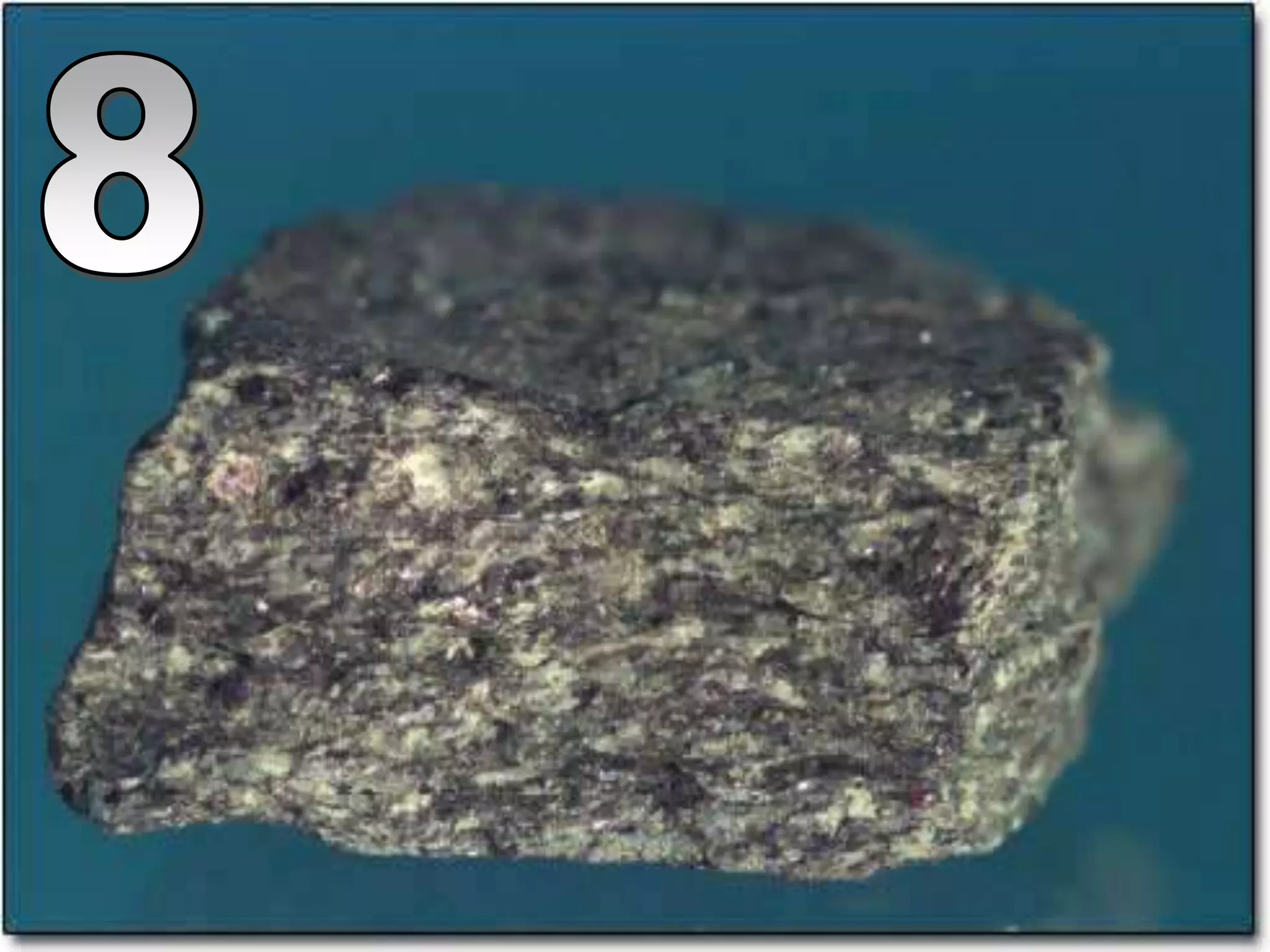
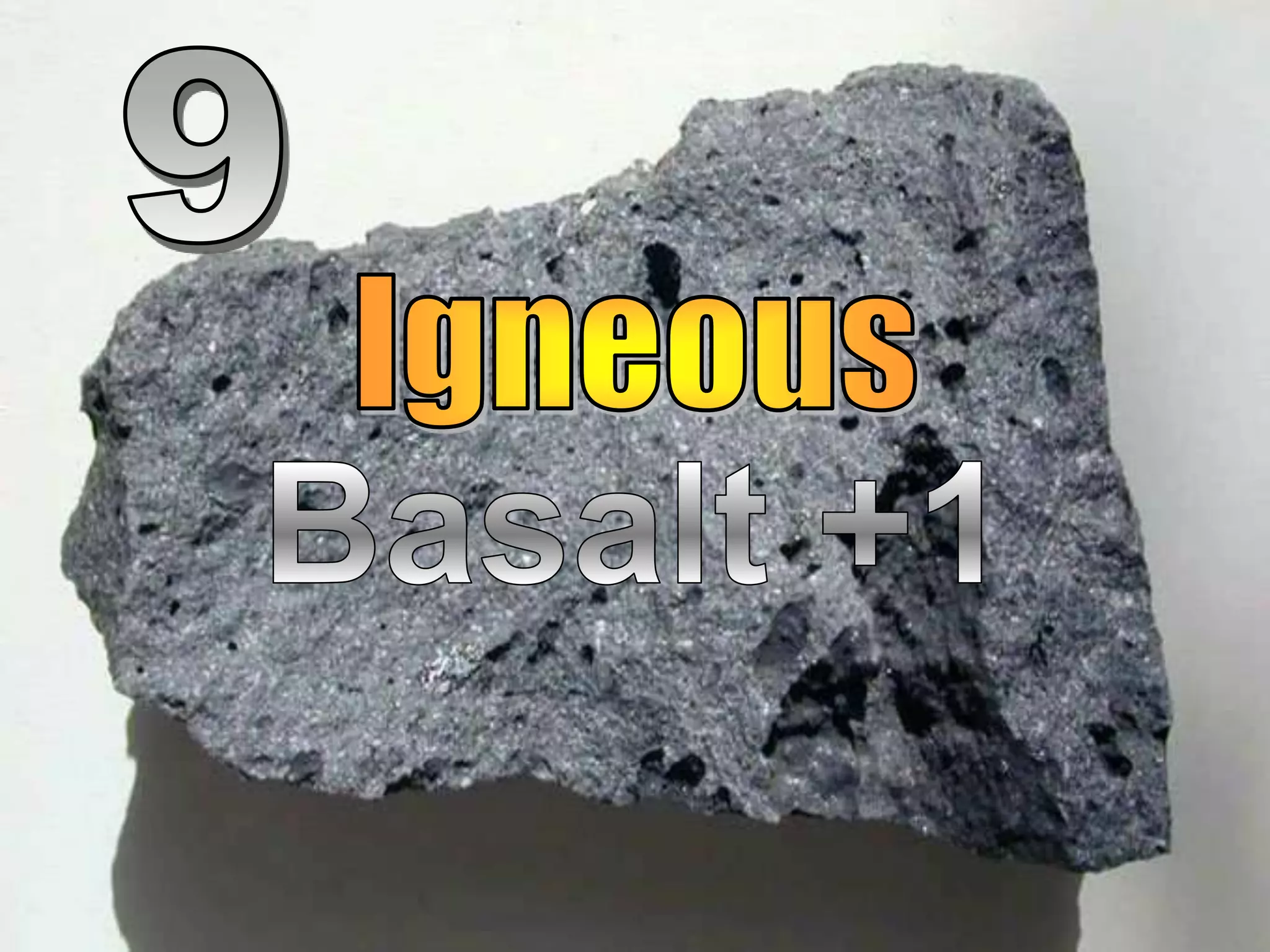
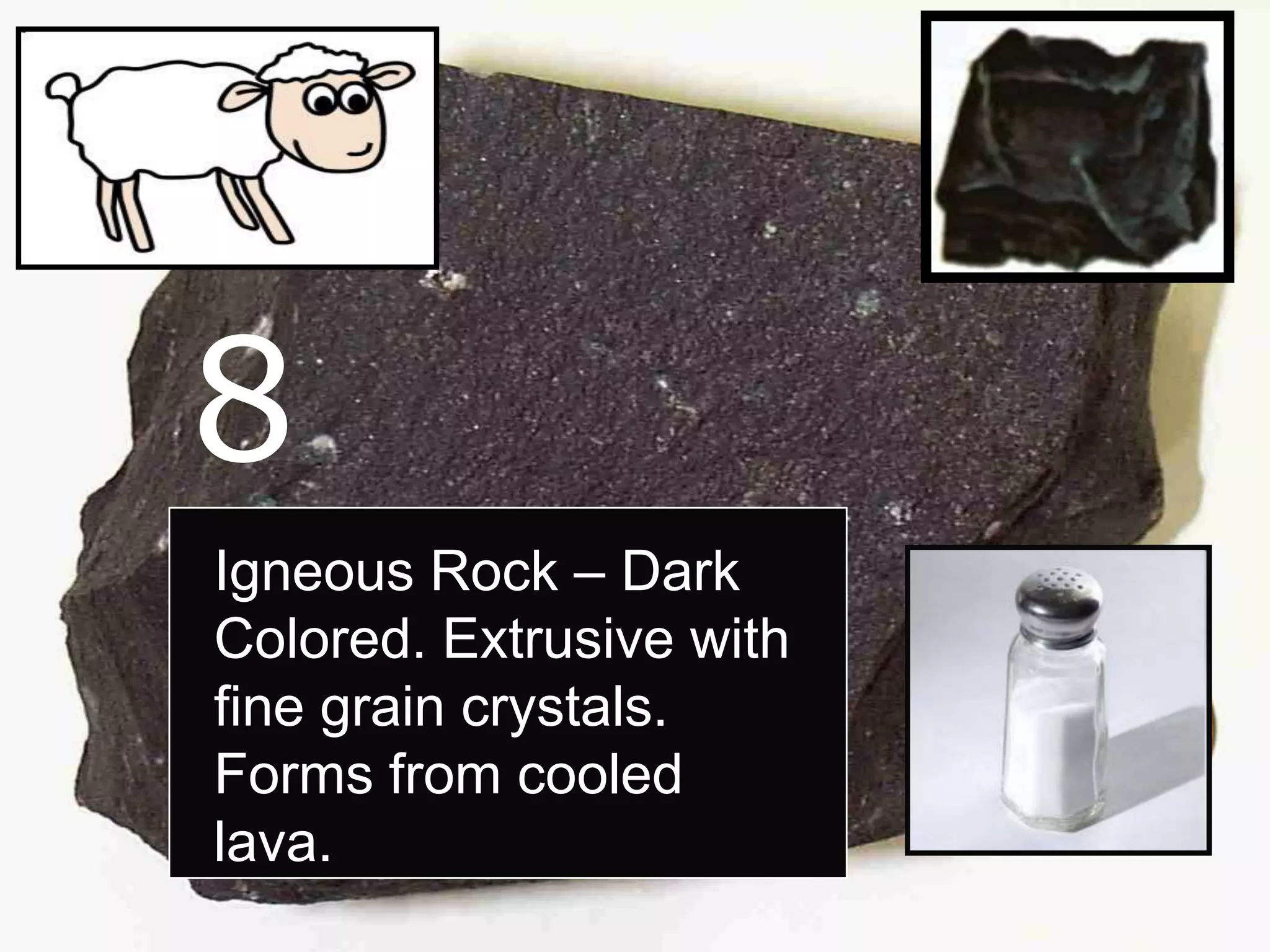
Igneous Rock – Dark
Colored. Extrusive with
fine grain crystals.
Forms from cooled
lava.
8
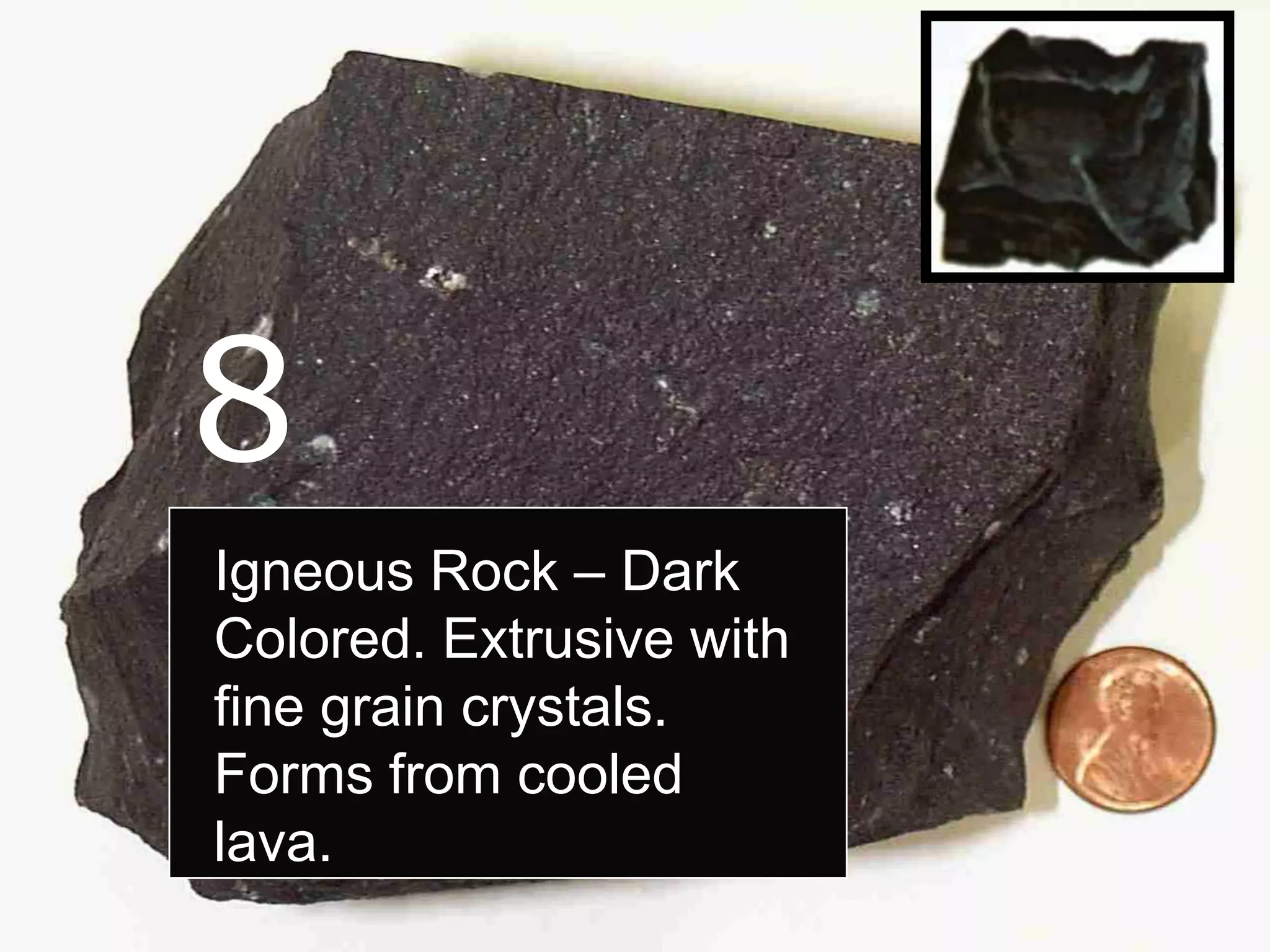
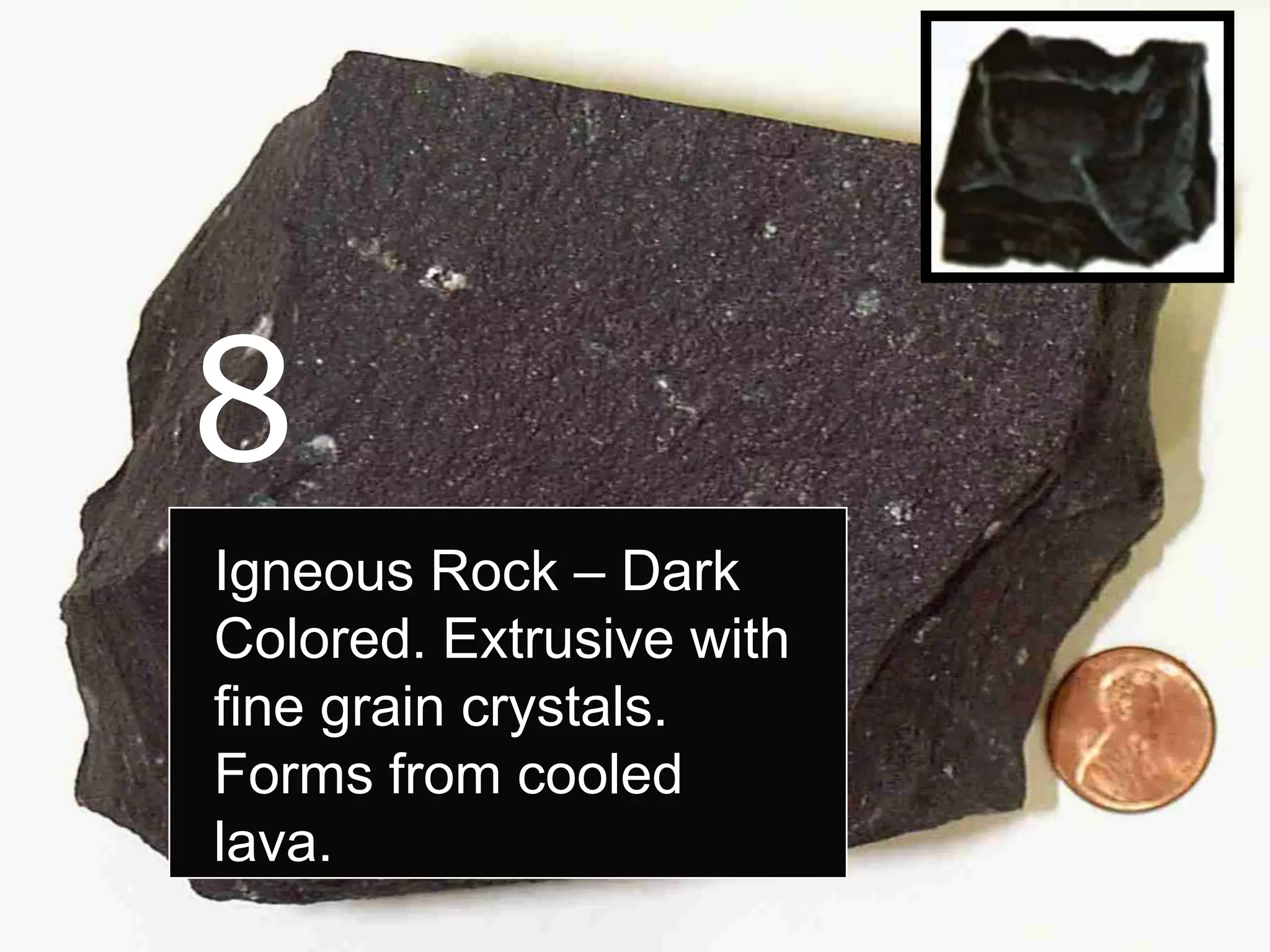
Igneous Rock – Dark
Colored. Extrusive with
fine grain crystals.
Forms from cooled
lava.
8
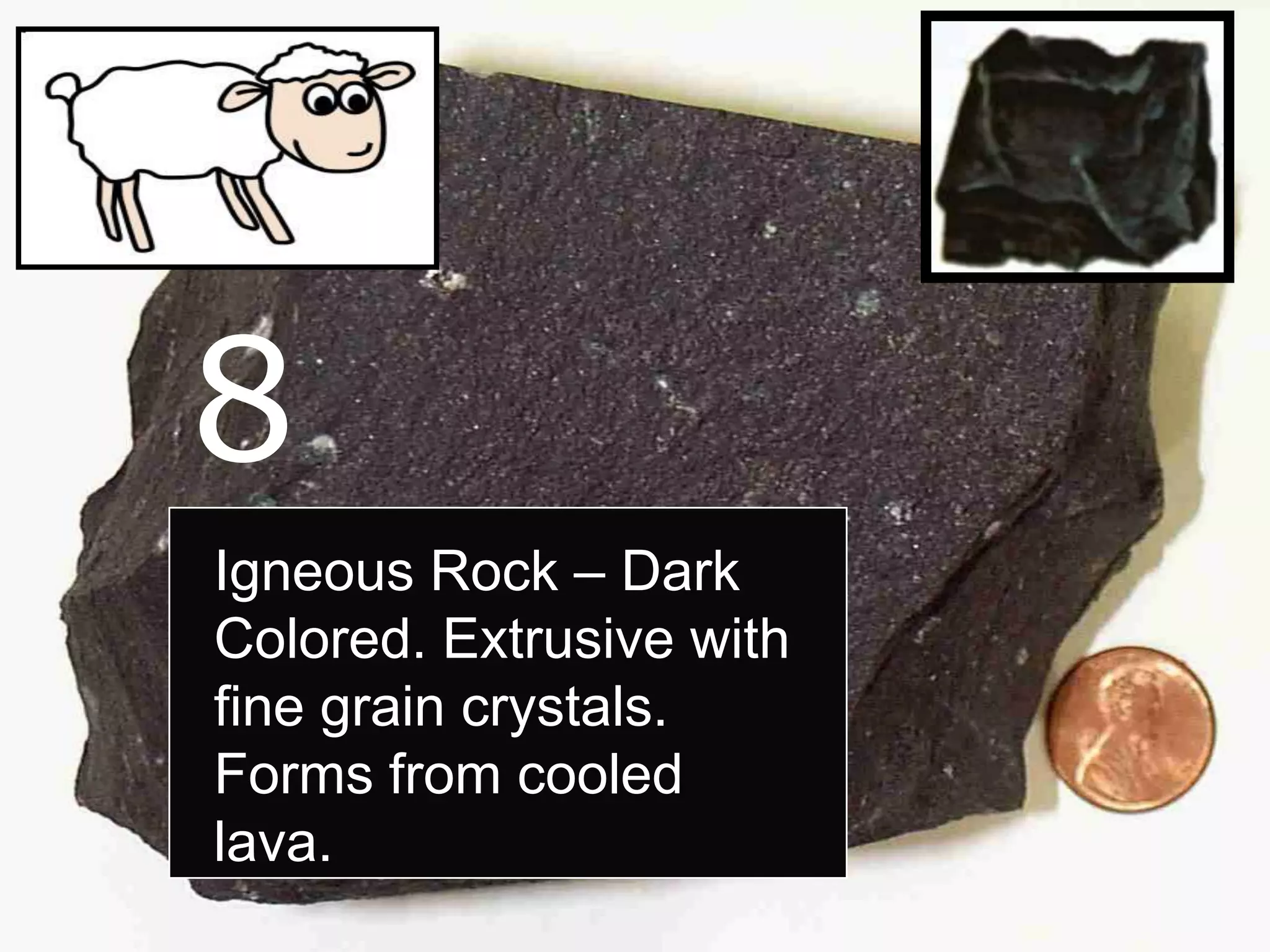
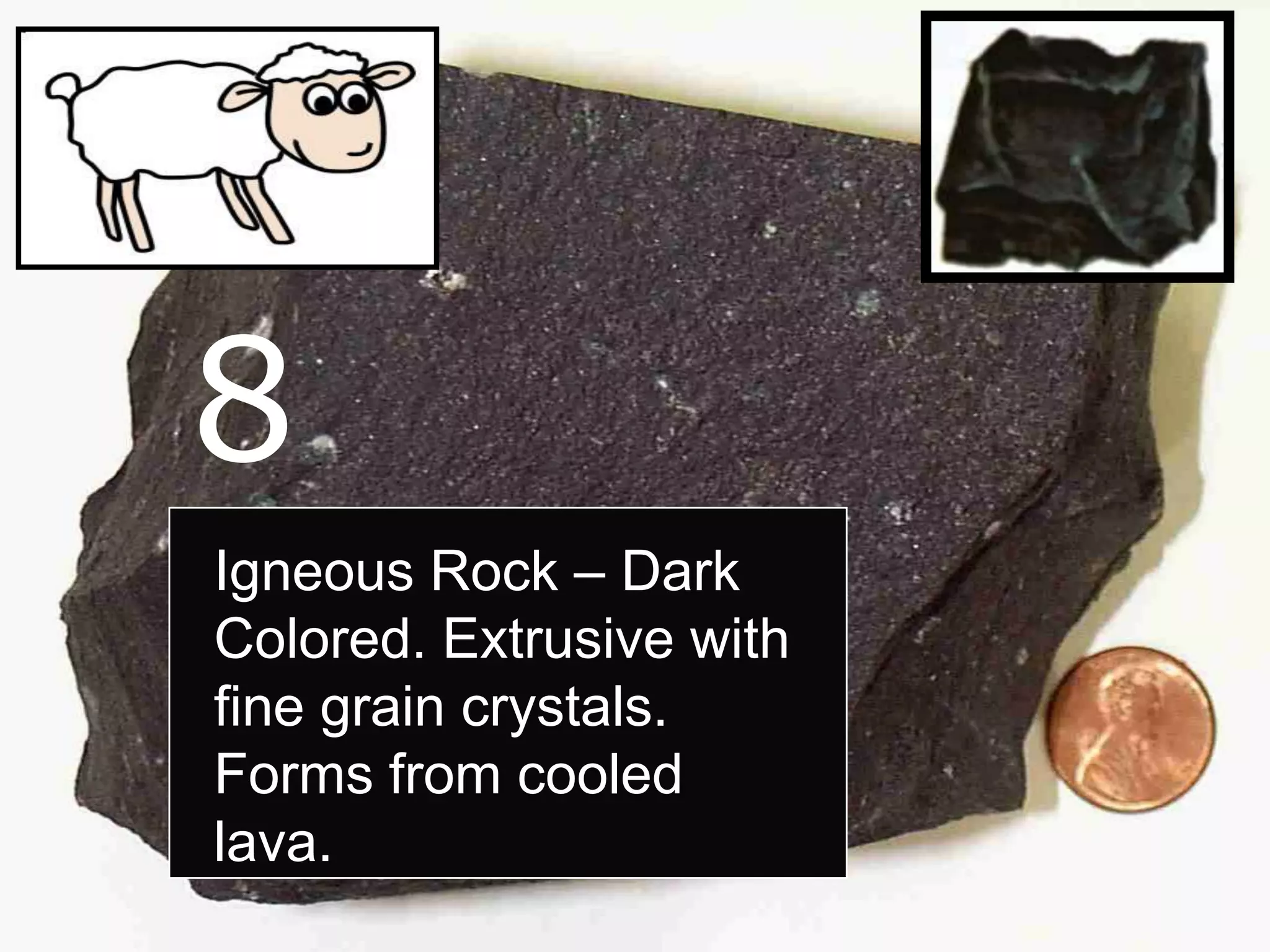
Igneous Rock – Dark
Colored. Extrusive with
fine grain crystals.
Forms from cooled
lava.
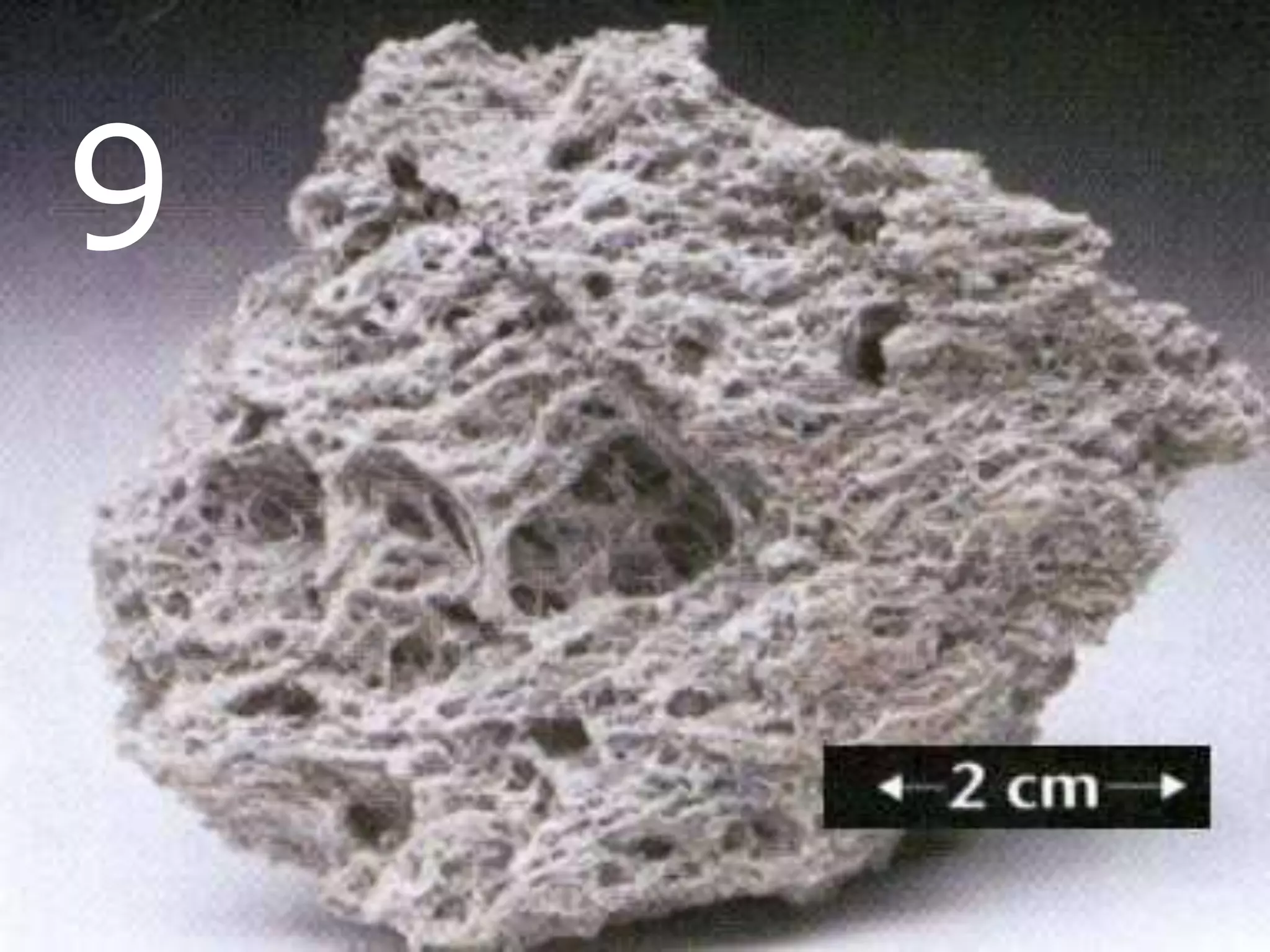
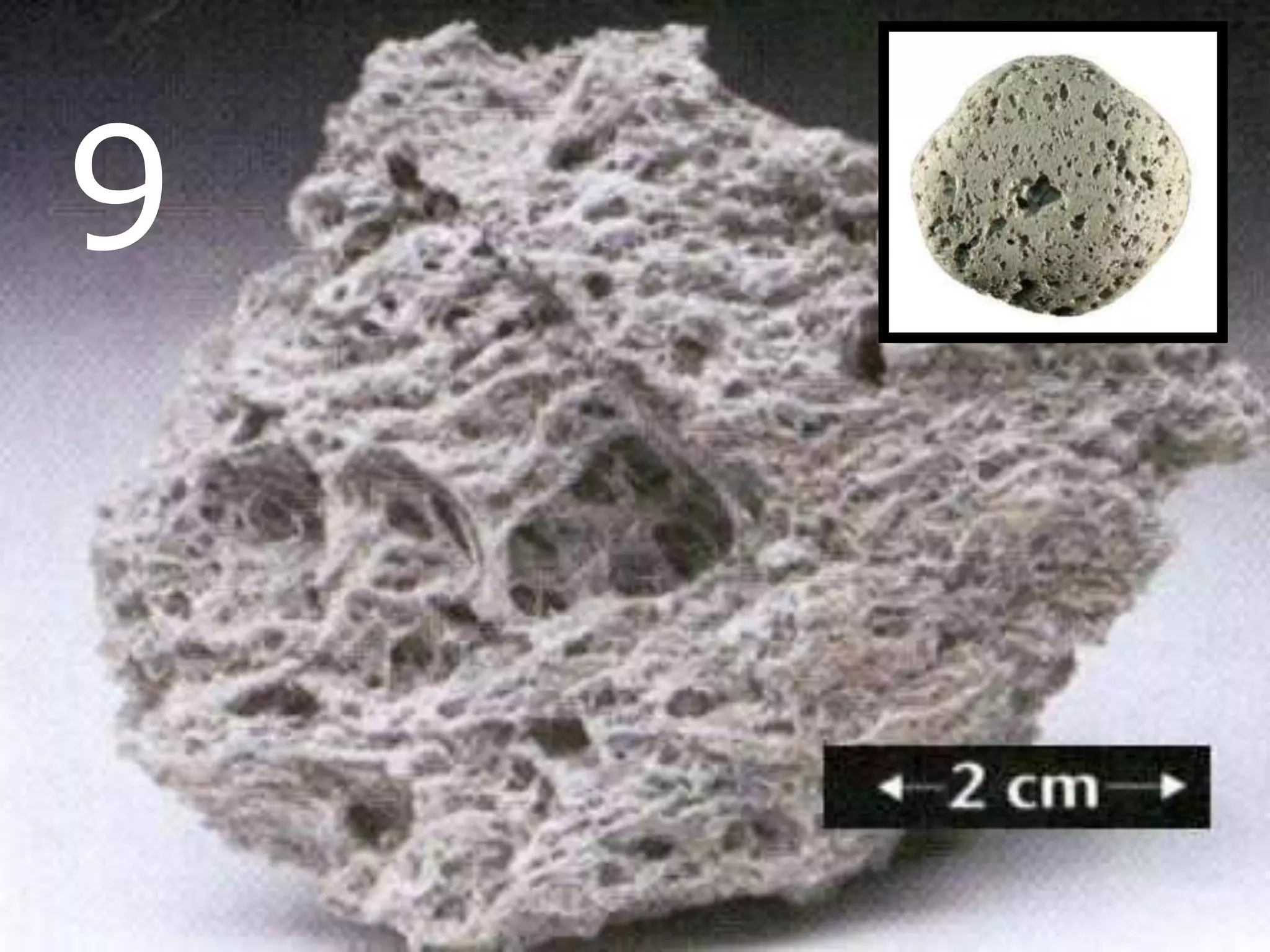
9
9
9
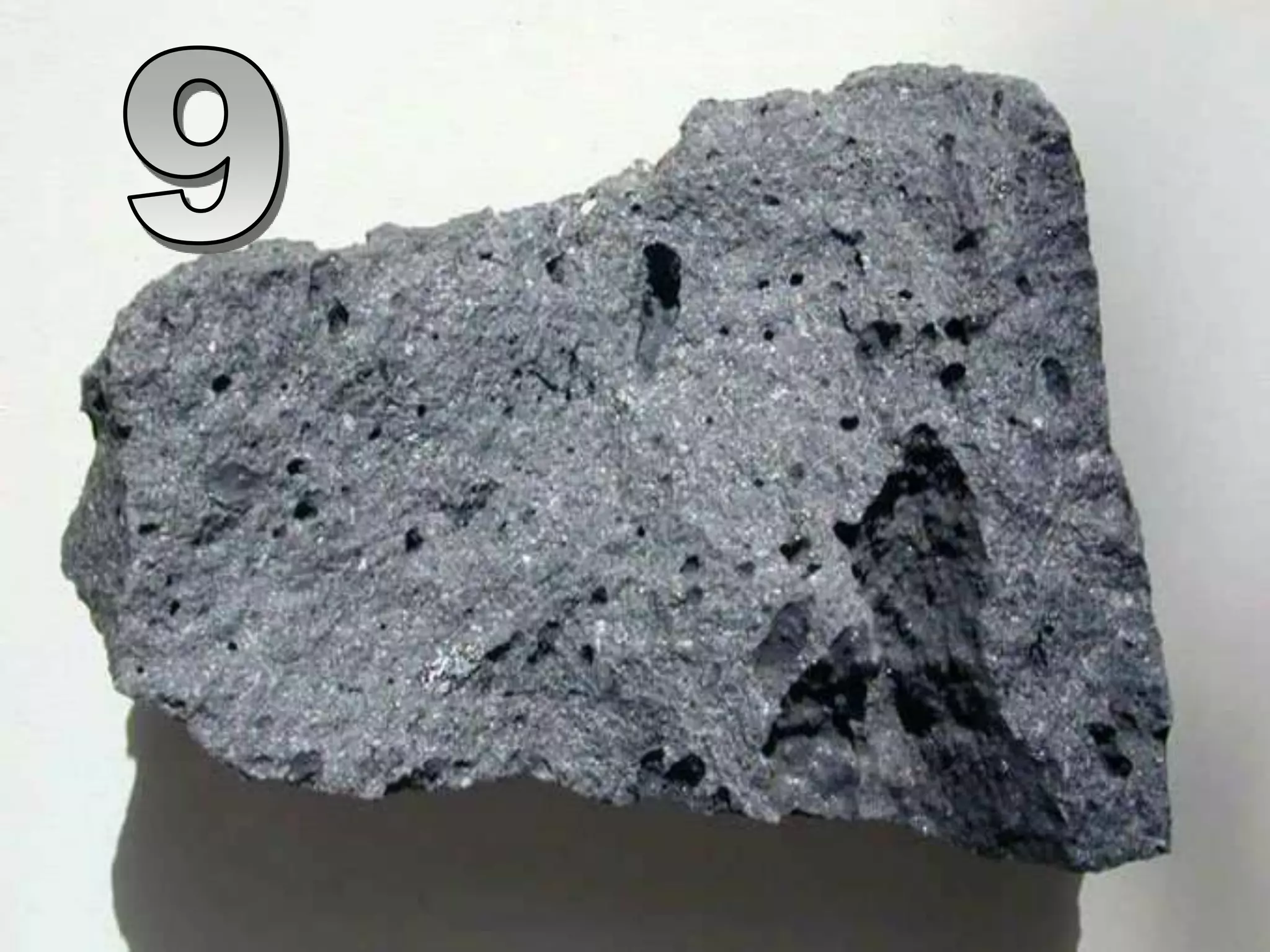
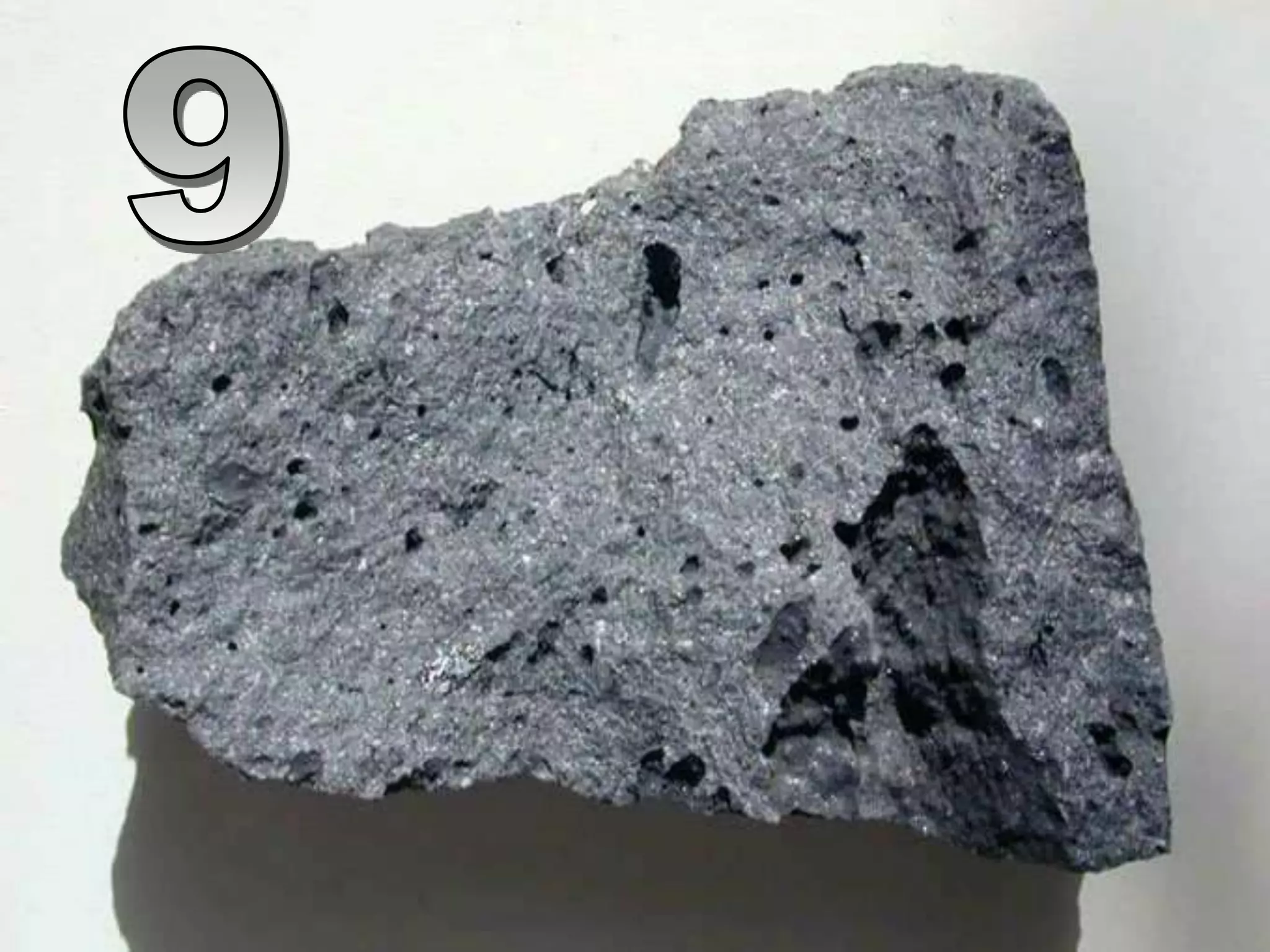
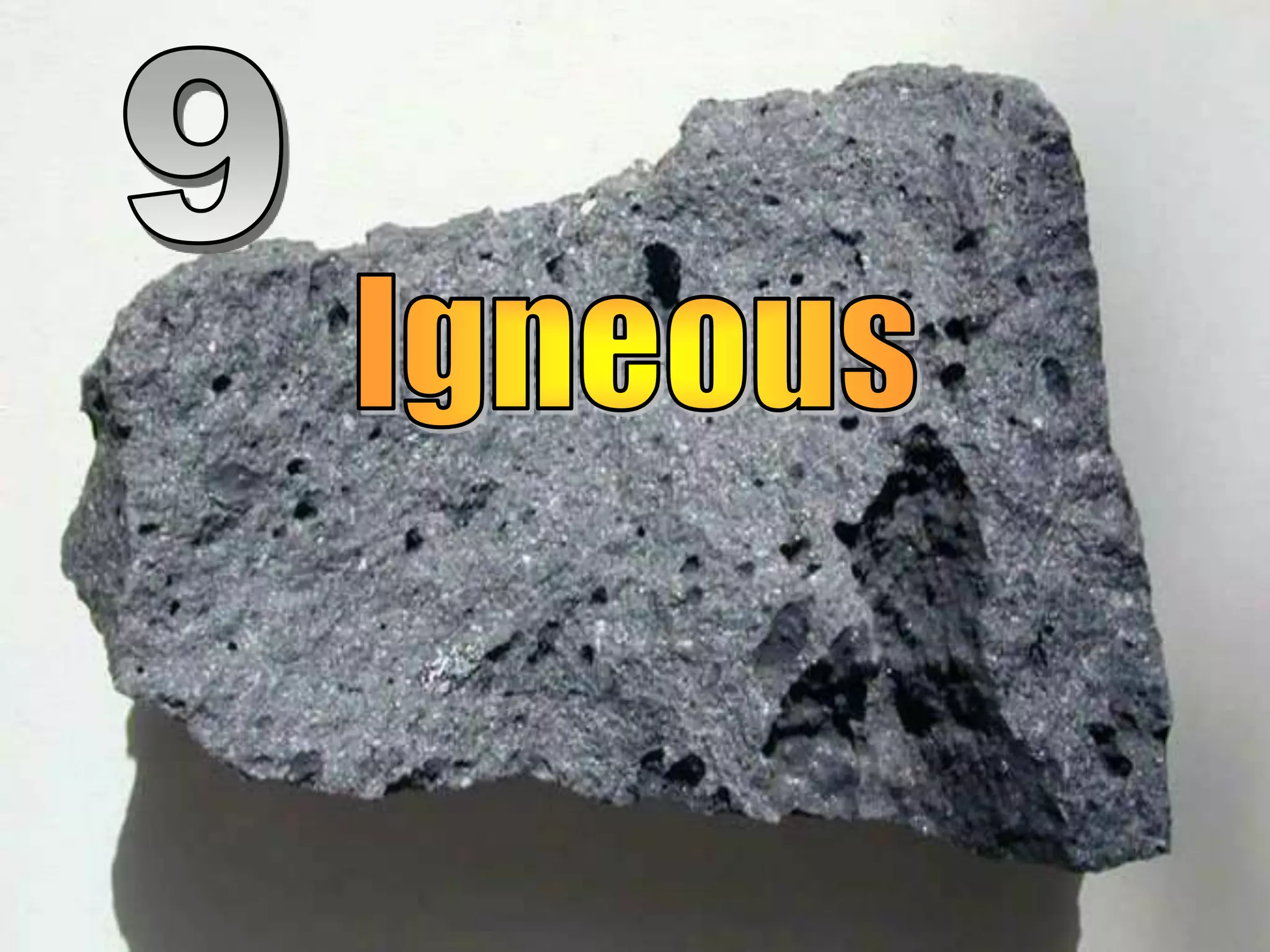
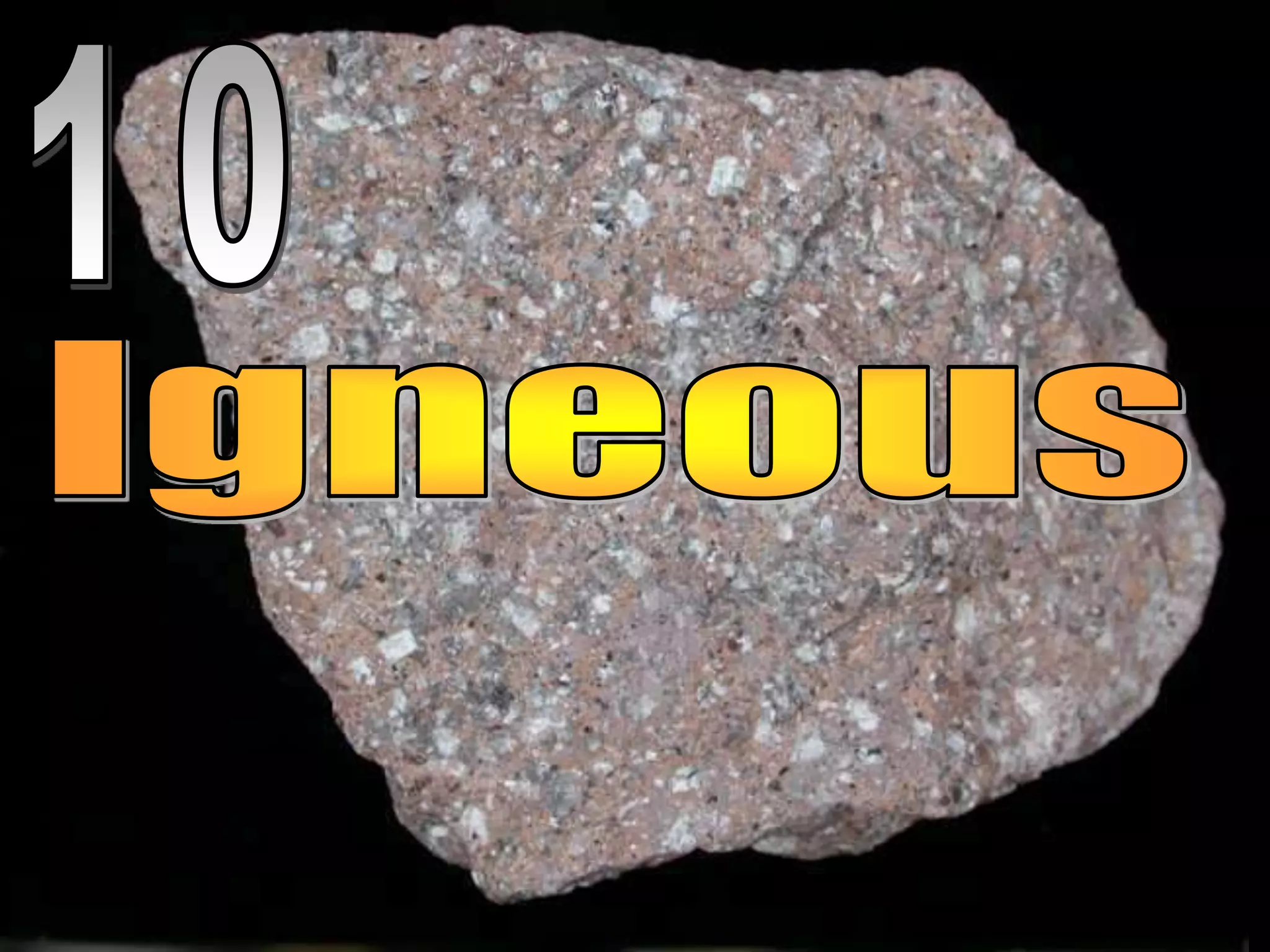
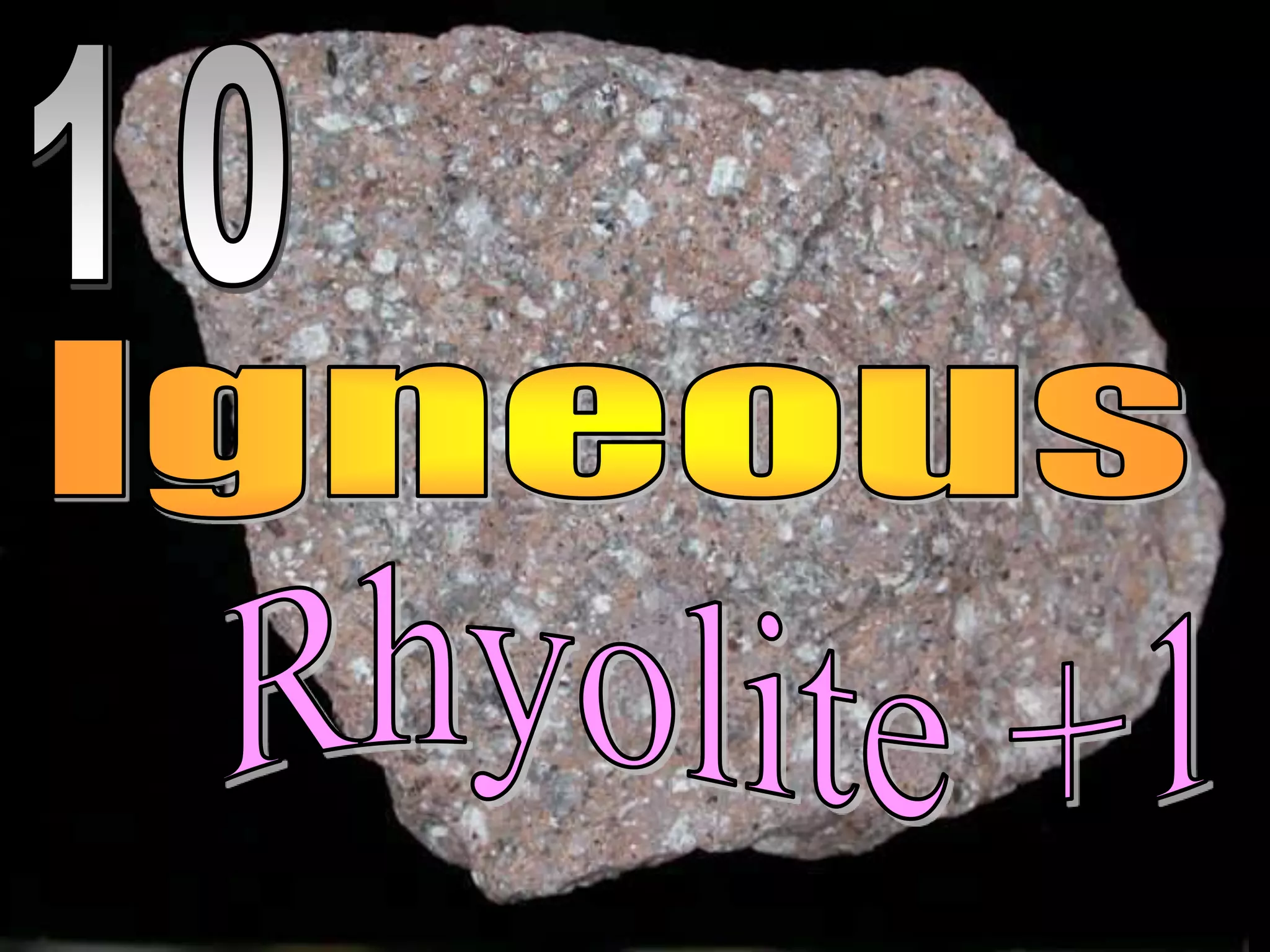
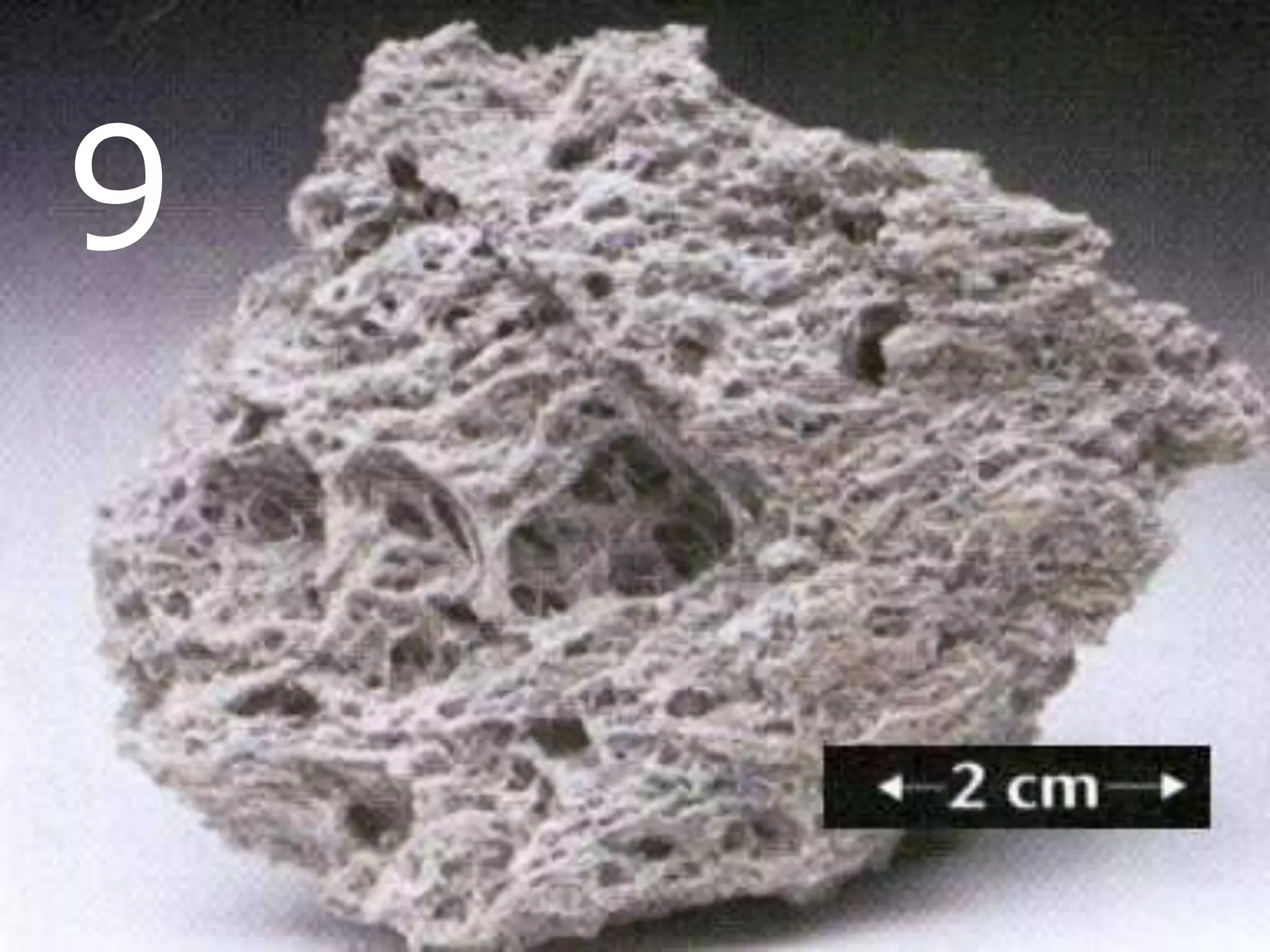
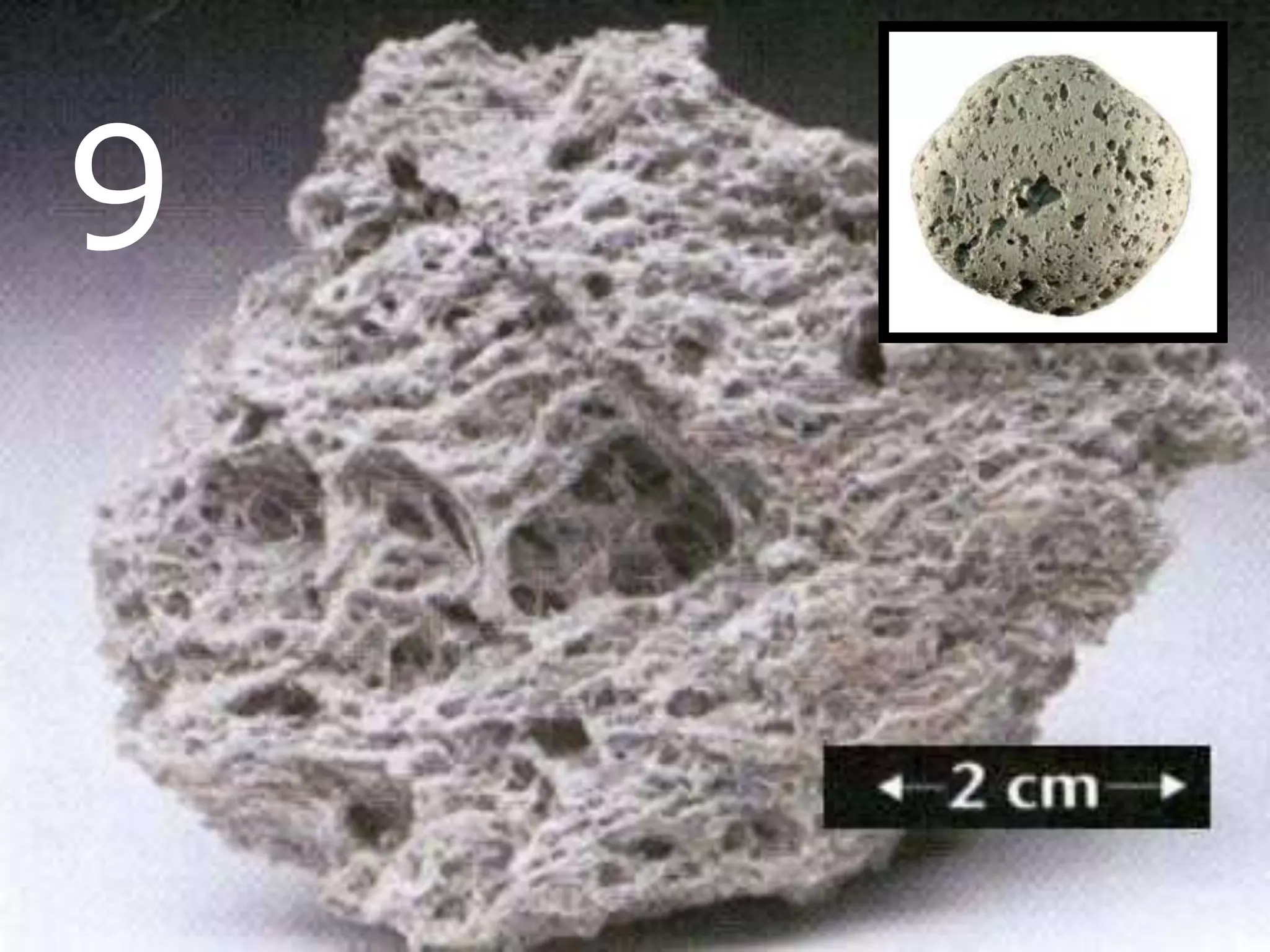
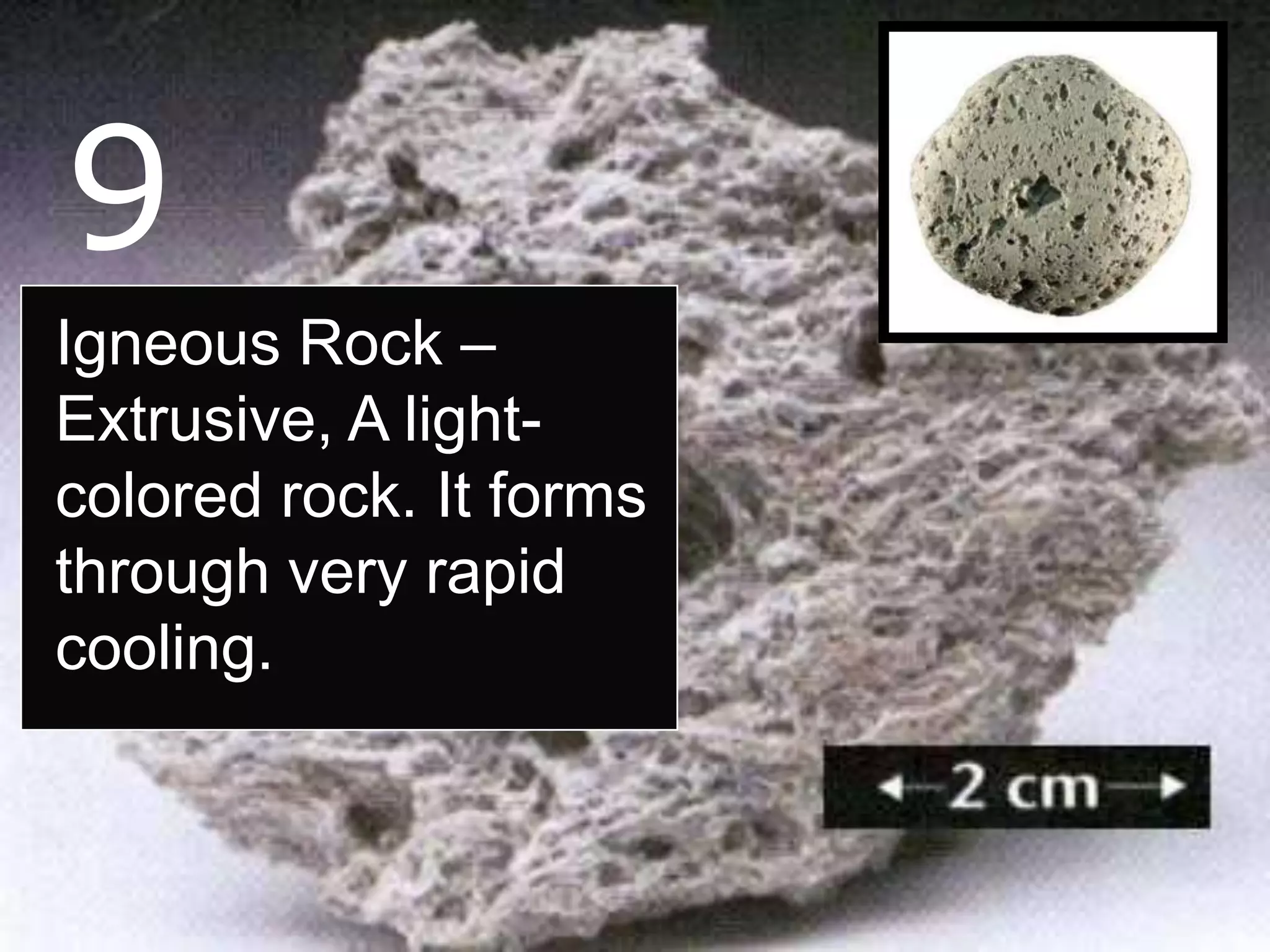
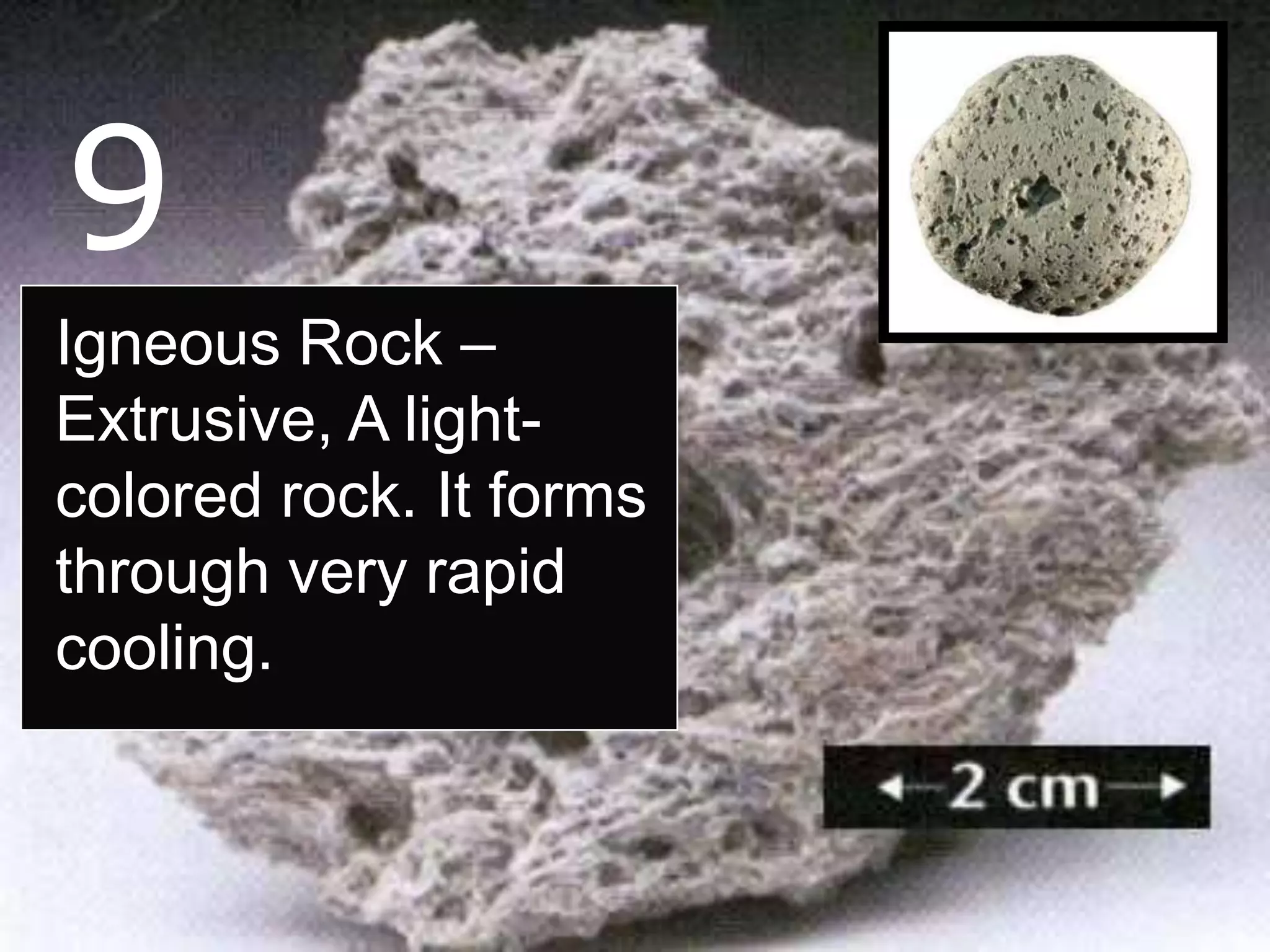
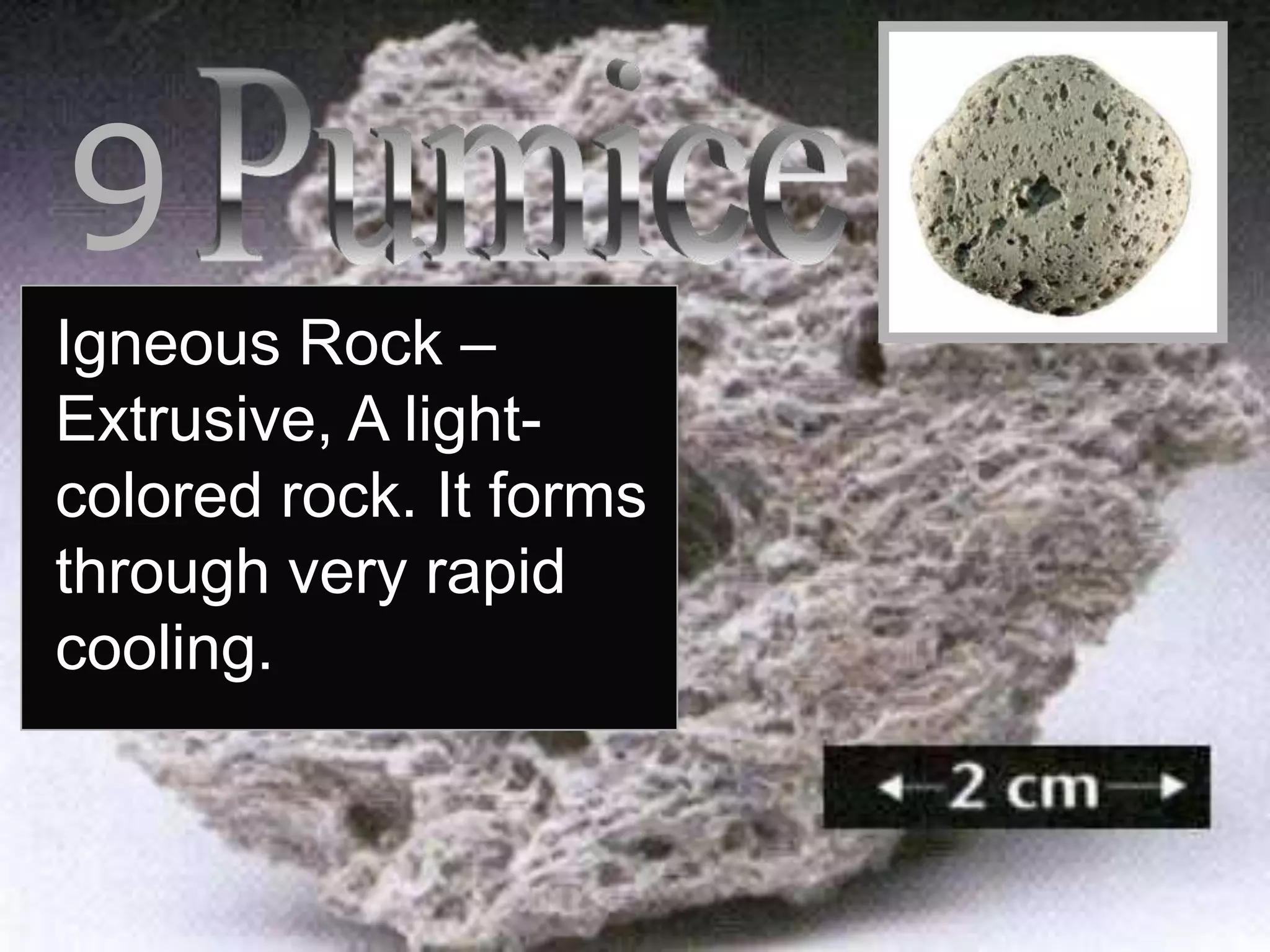
Igneous Rock –
Extrusive, A light-
colored rock. It forms
through very rapid
cooling.
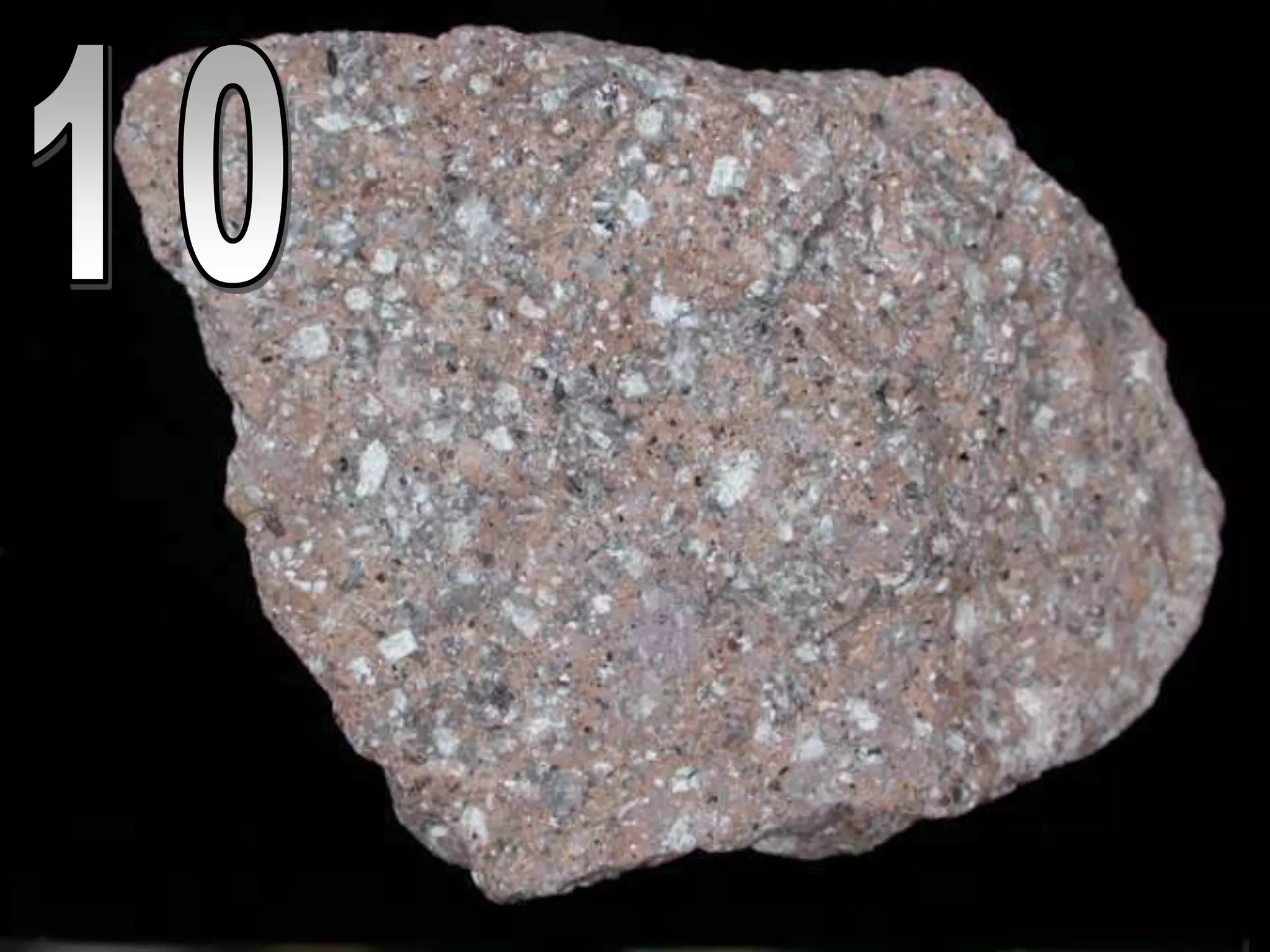
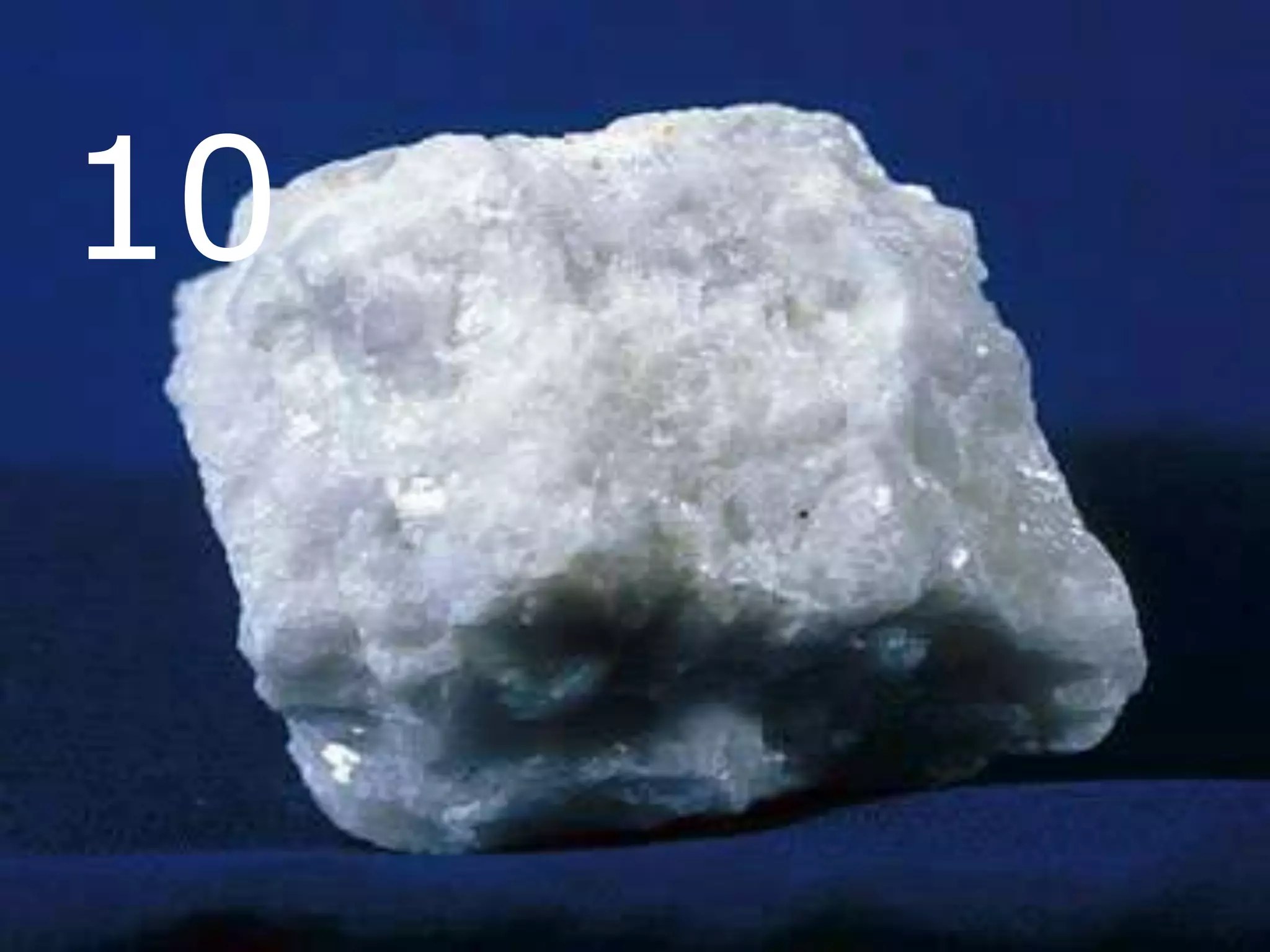
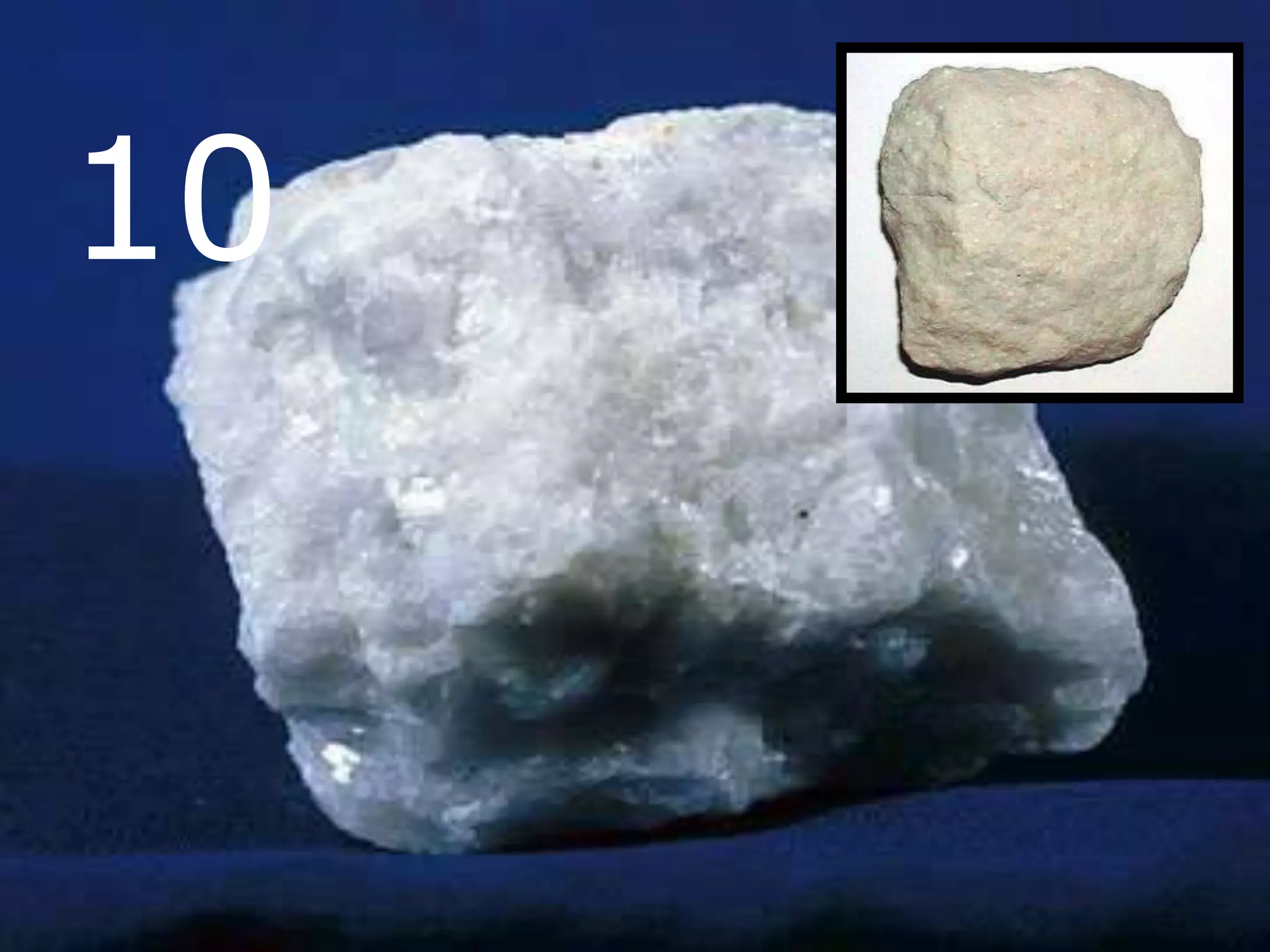
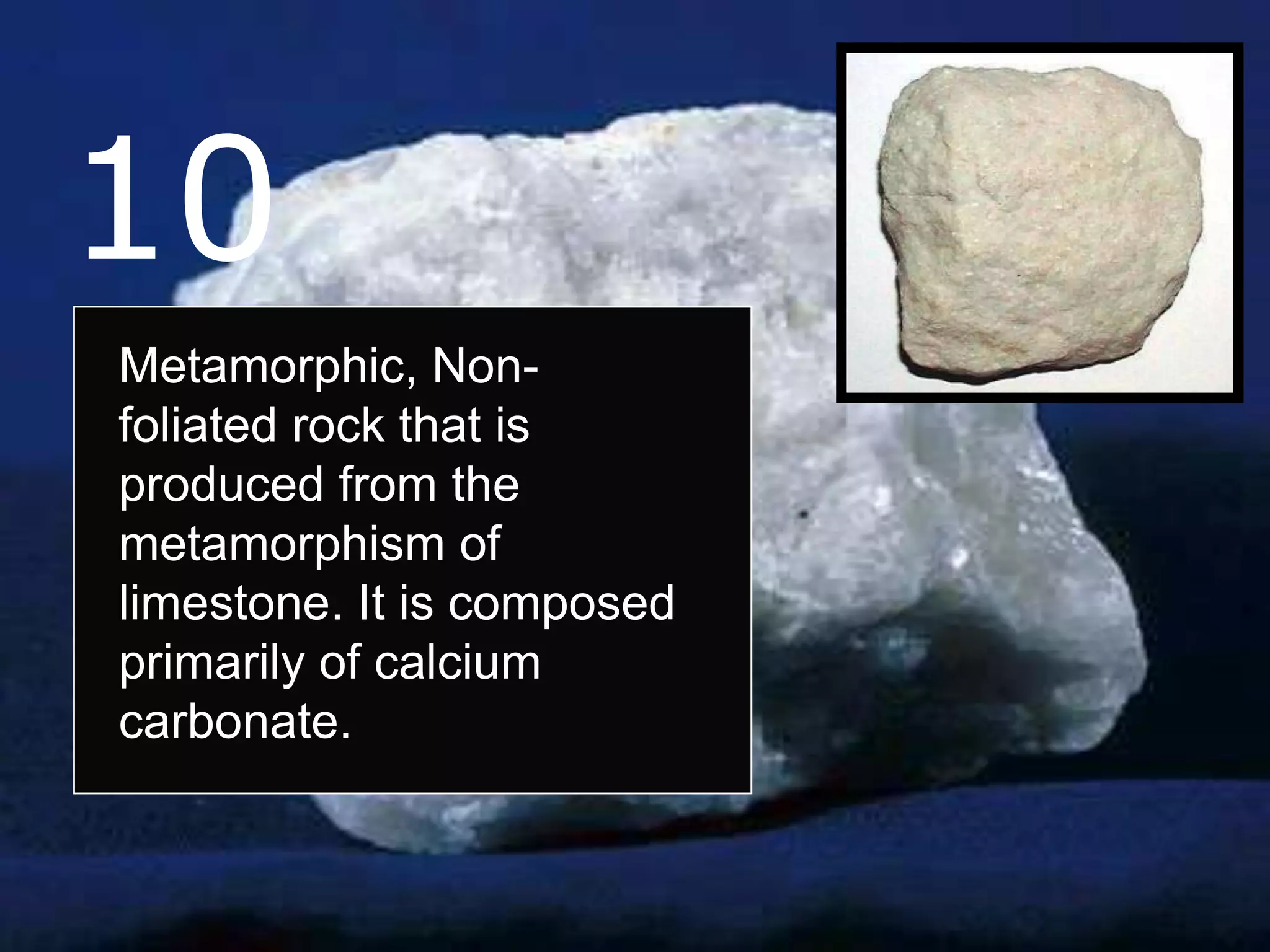
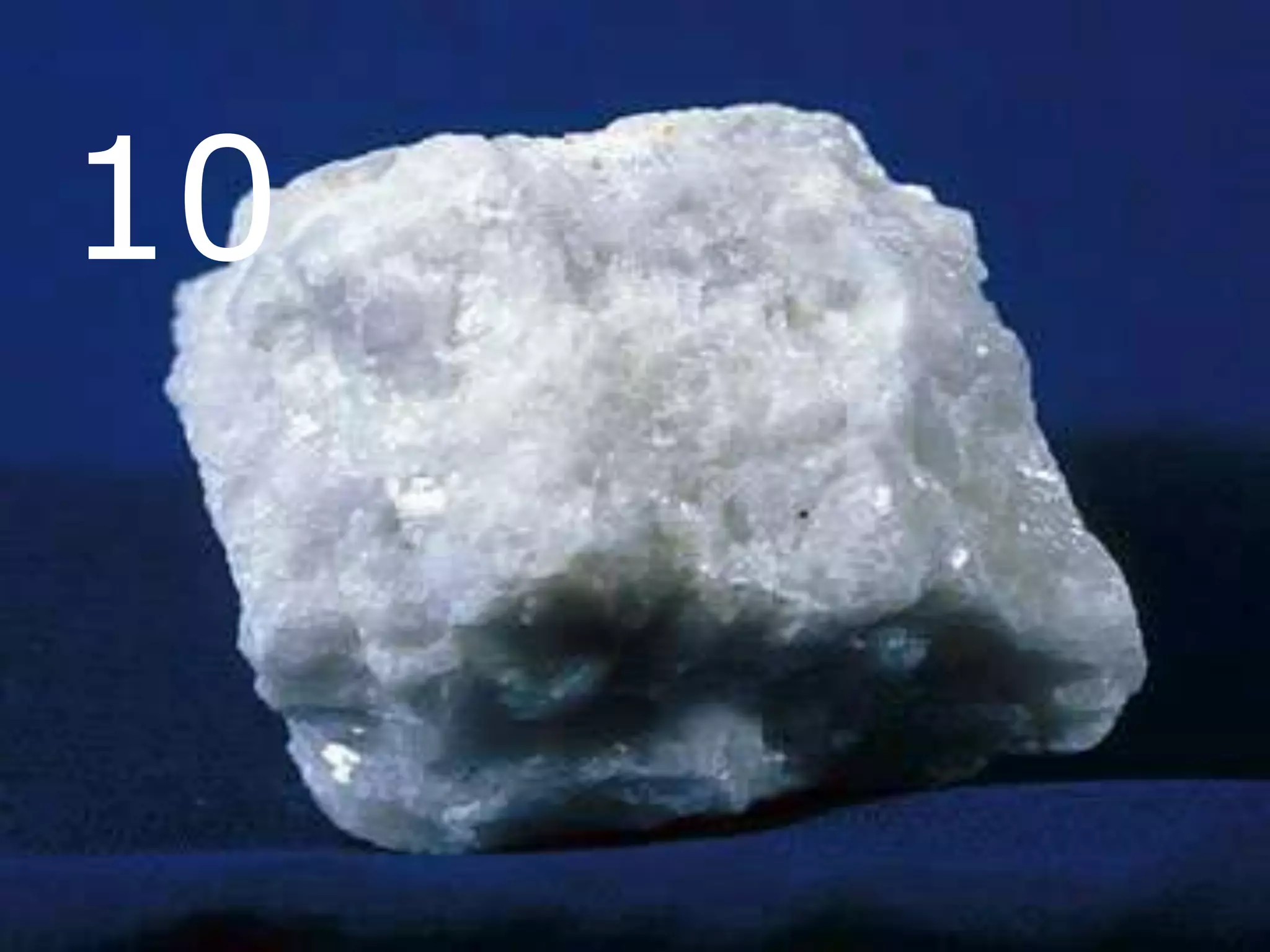
10
10
10
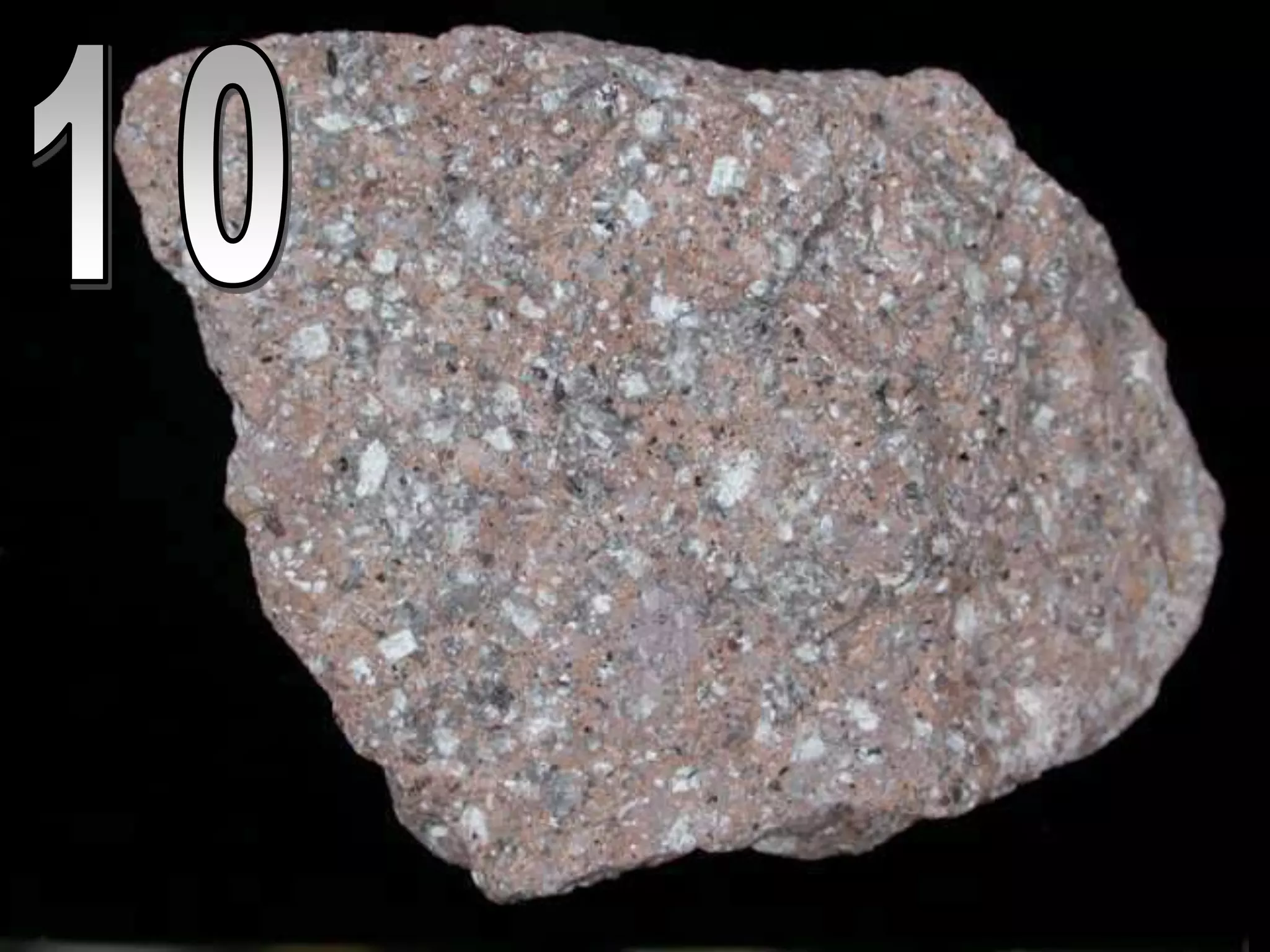
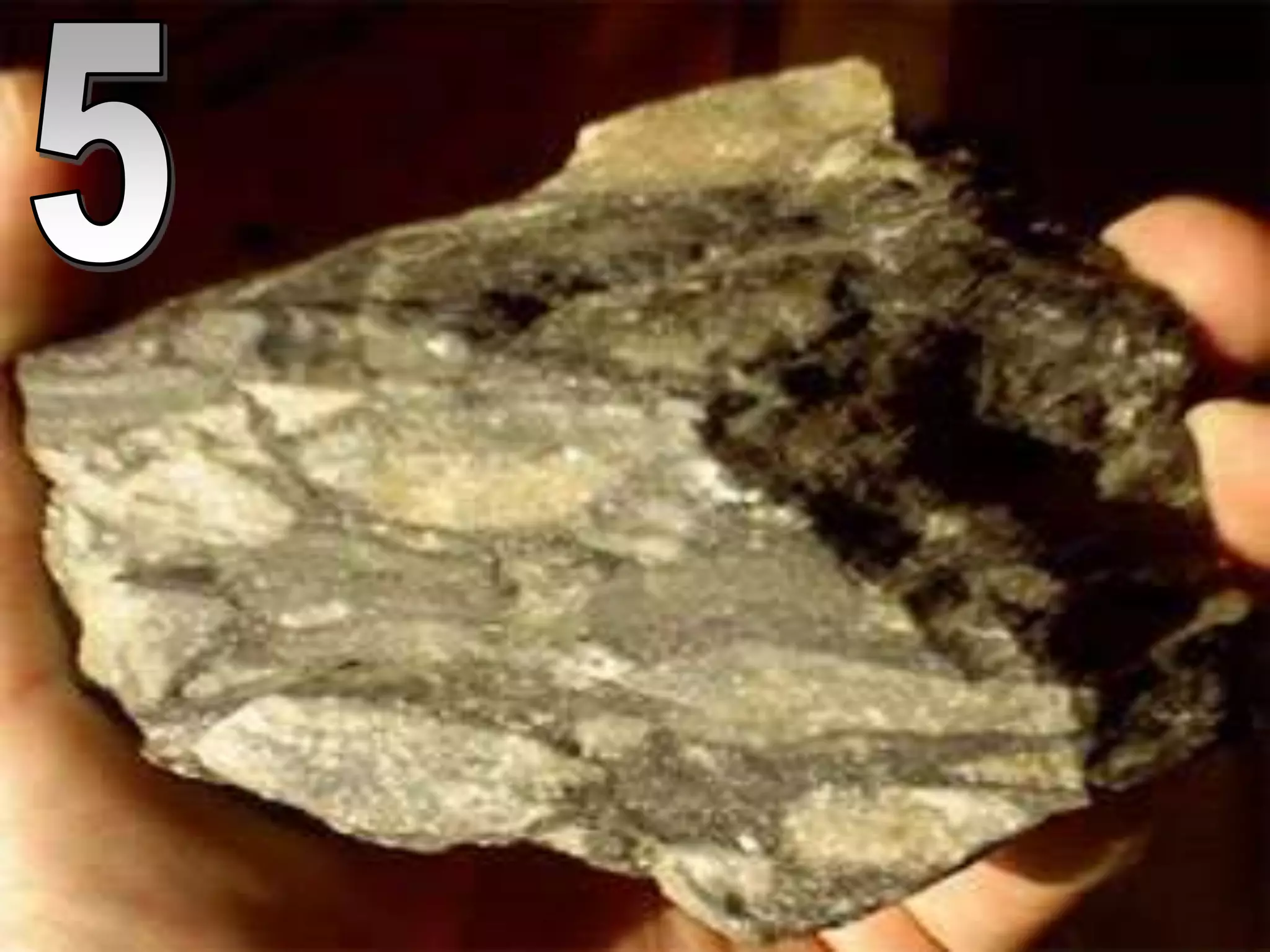
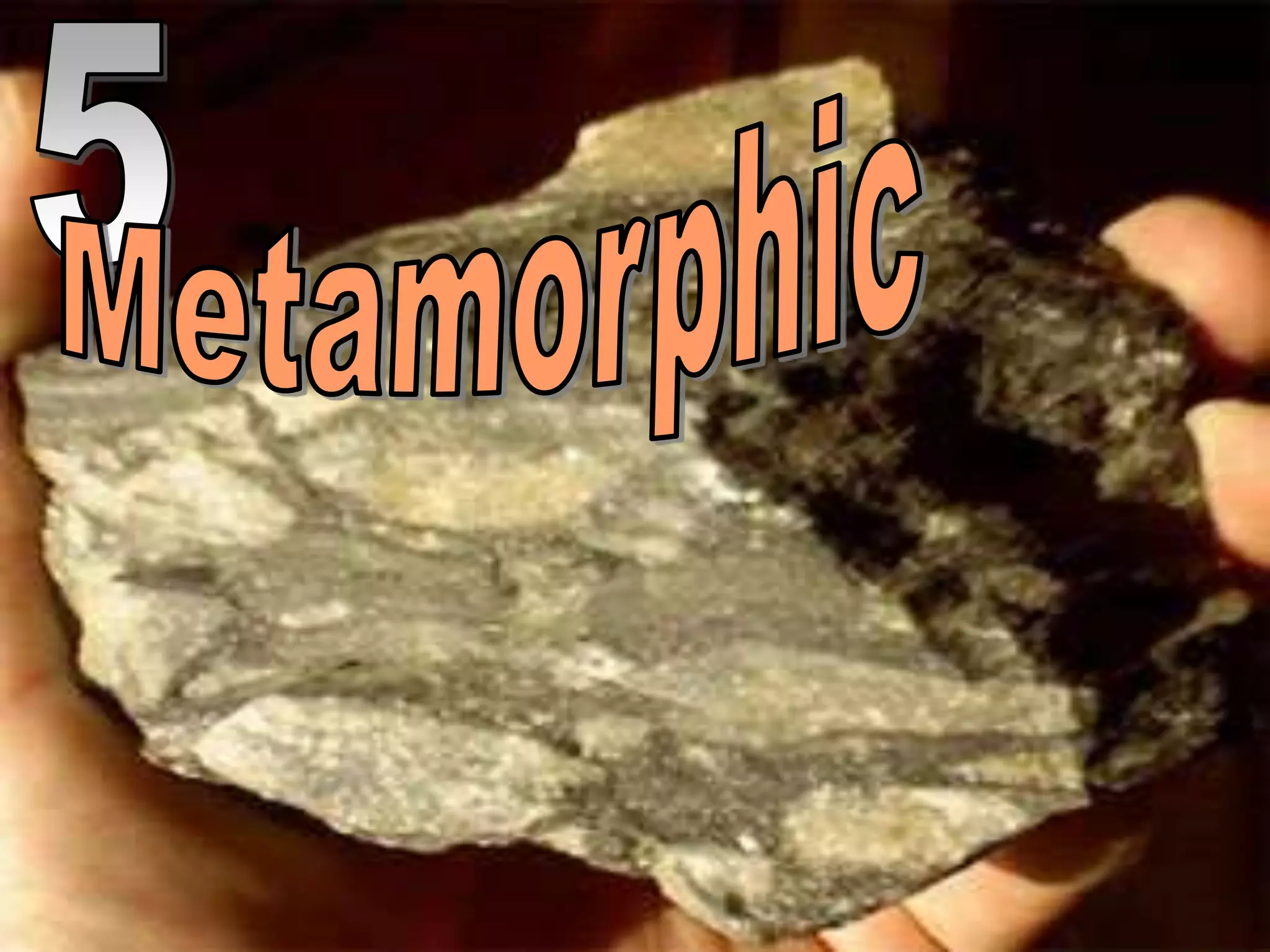
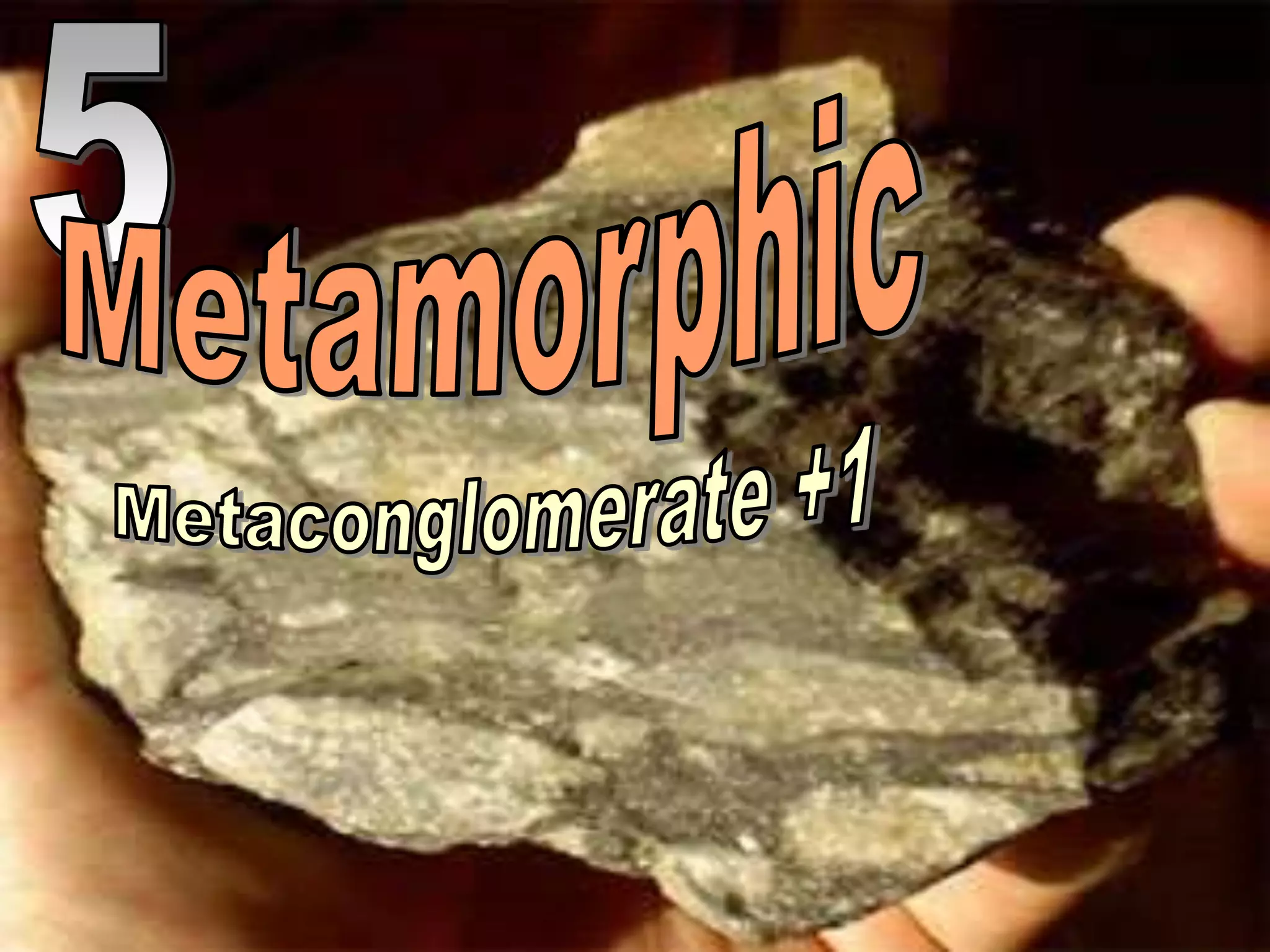
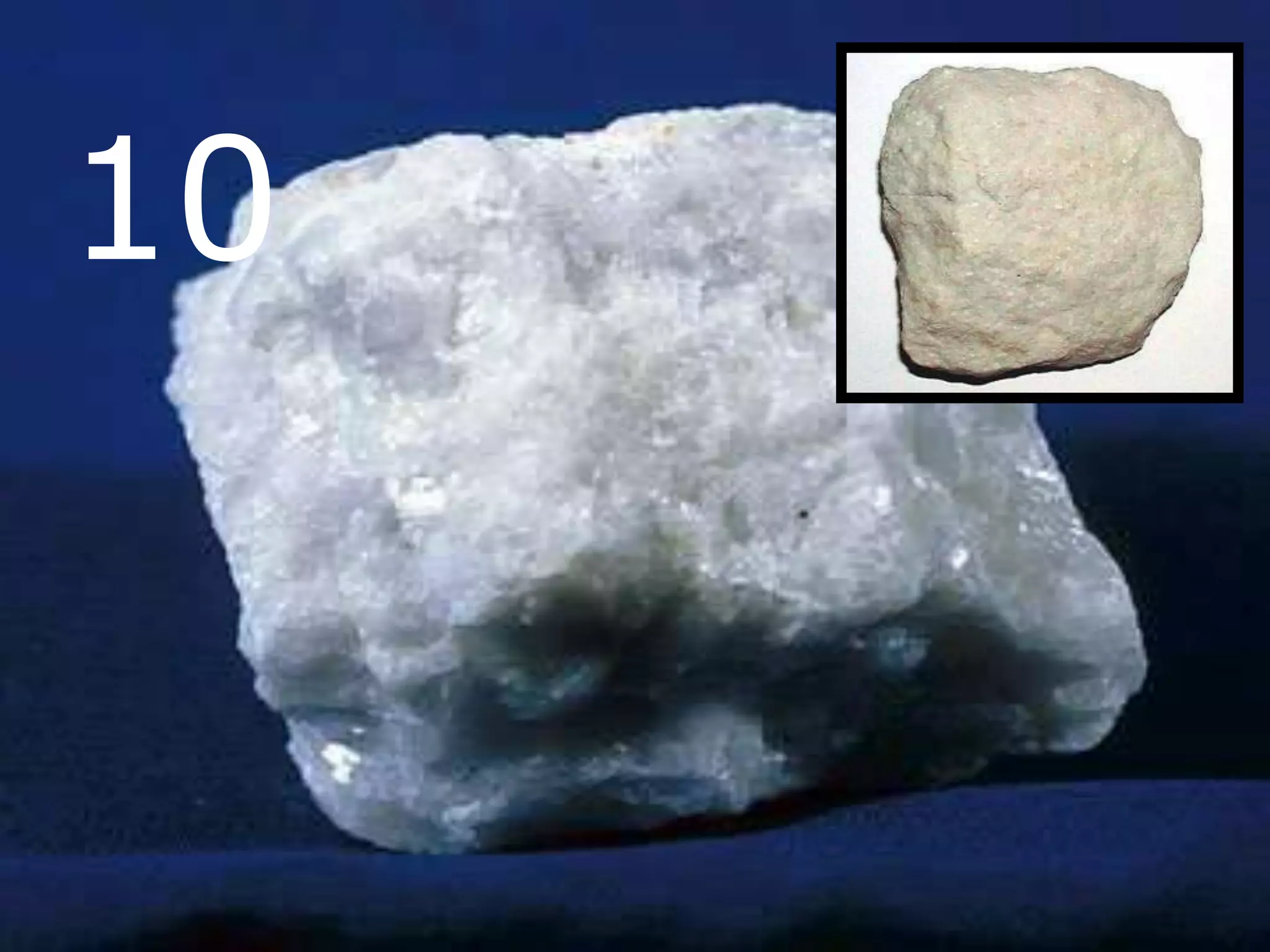
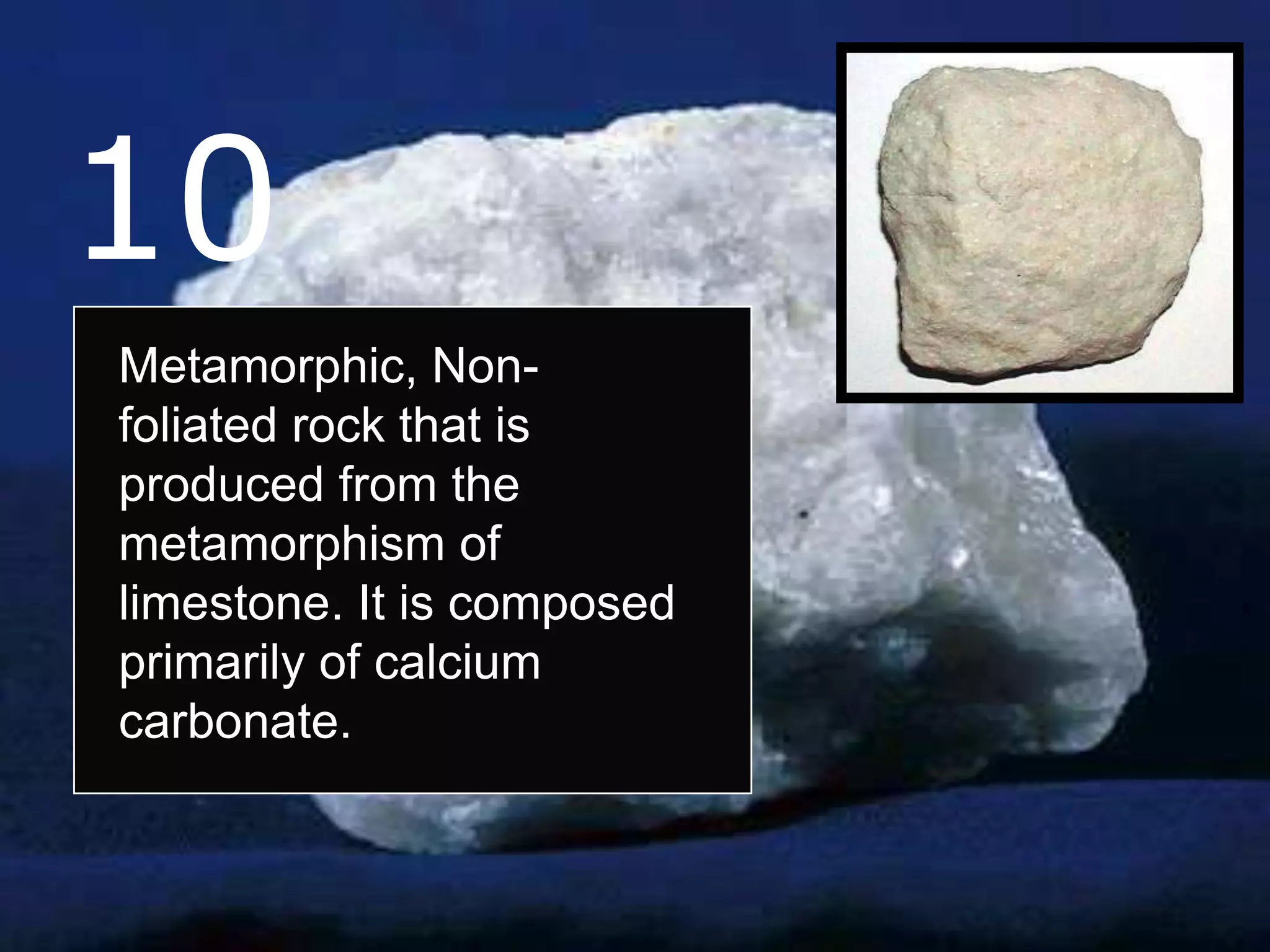
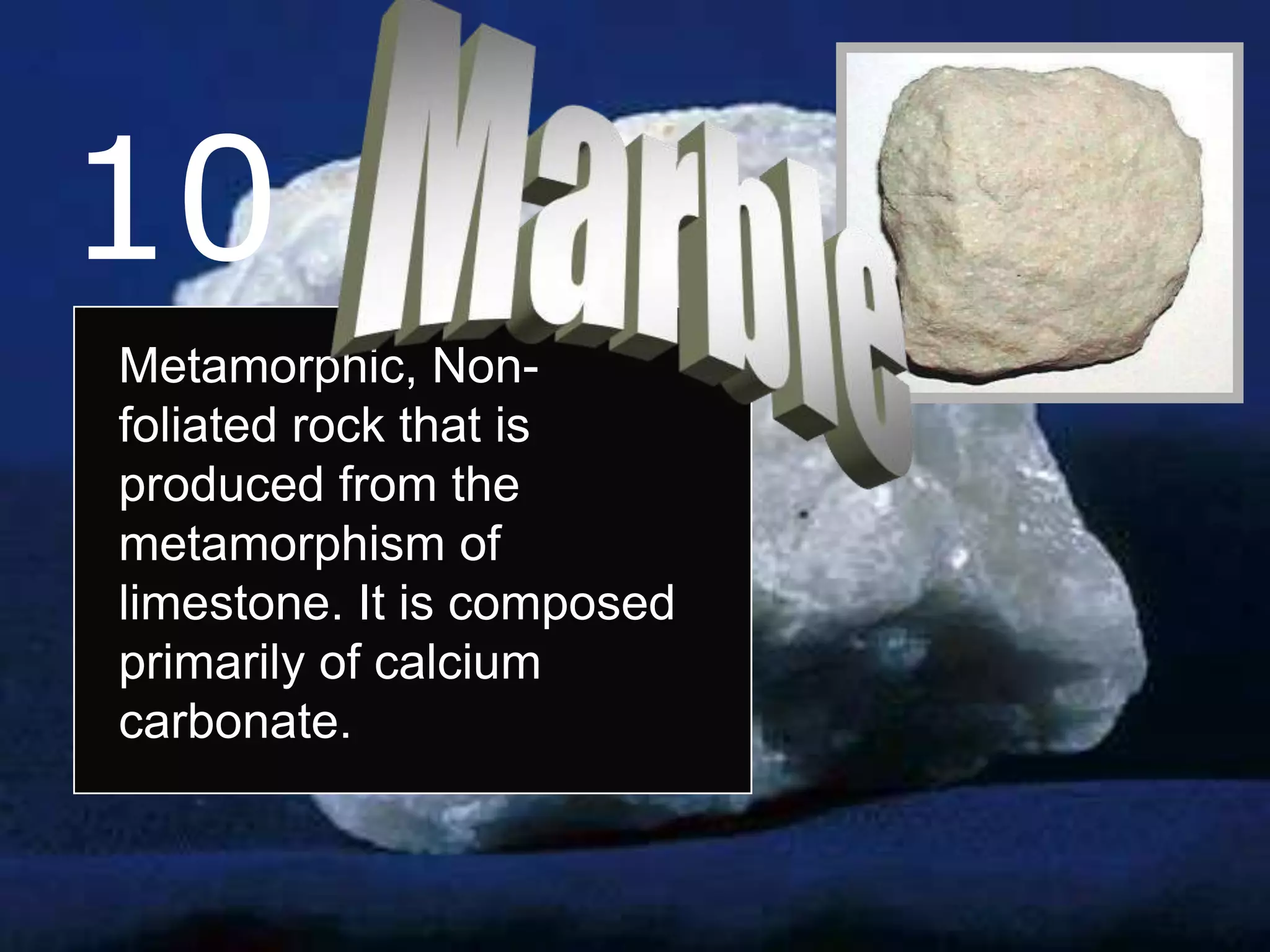
Metamorphic, Non-
foliated rock that is
produced from the
metamorphism of
limestone. It is composed
primarily of calcium
carbonate.
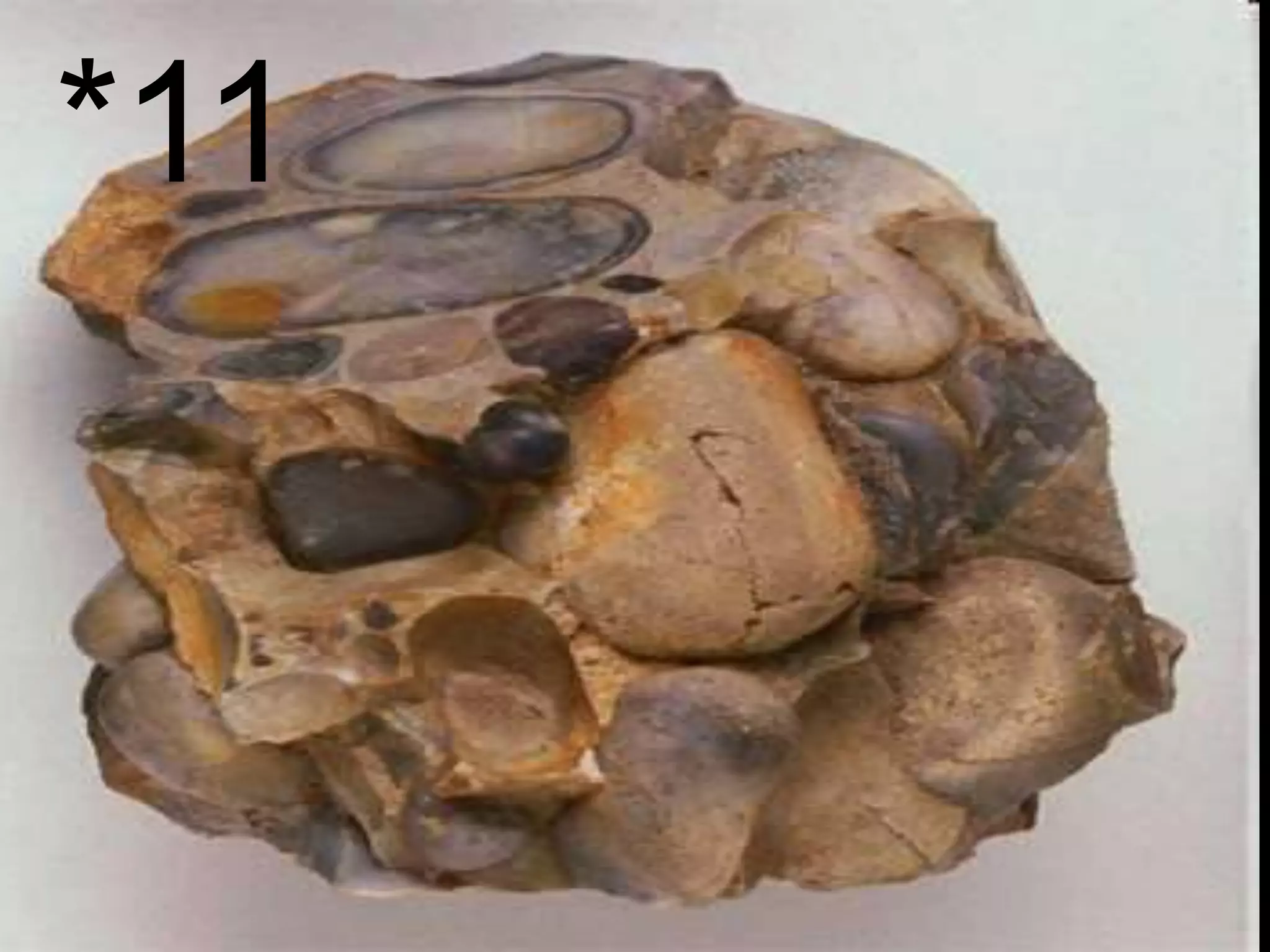
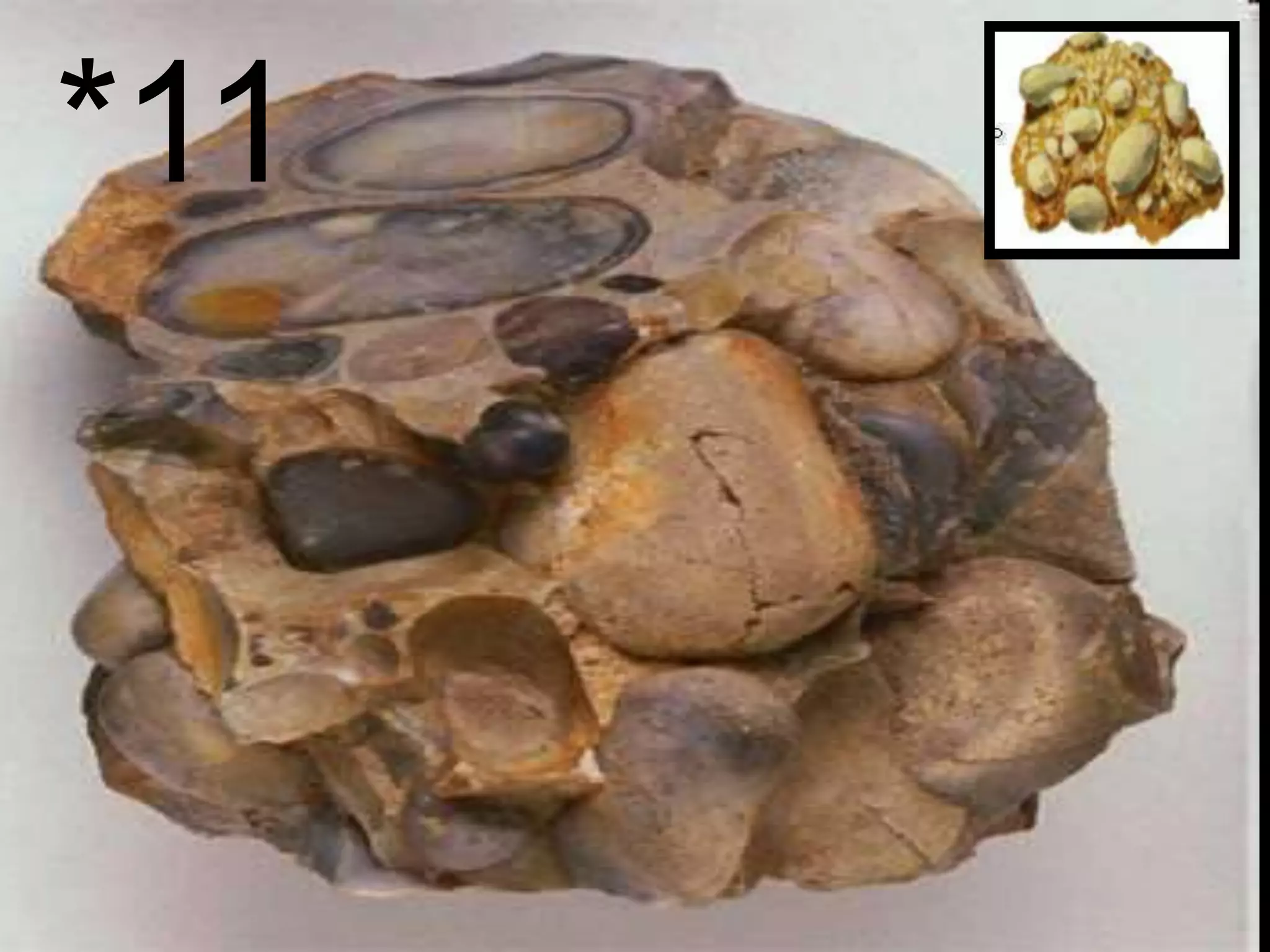
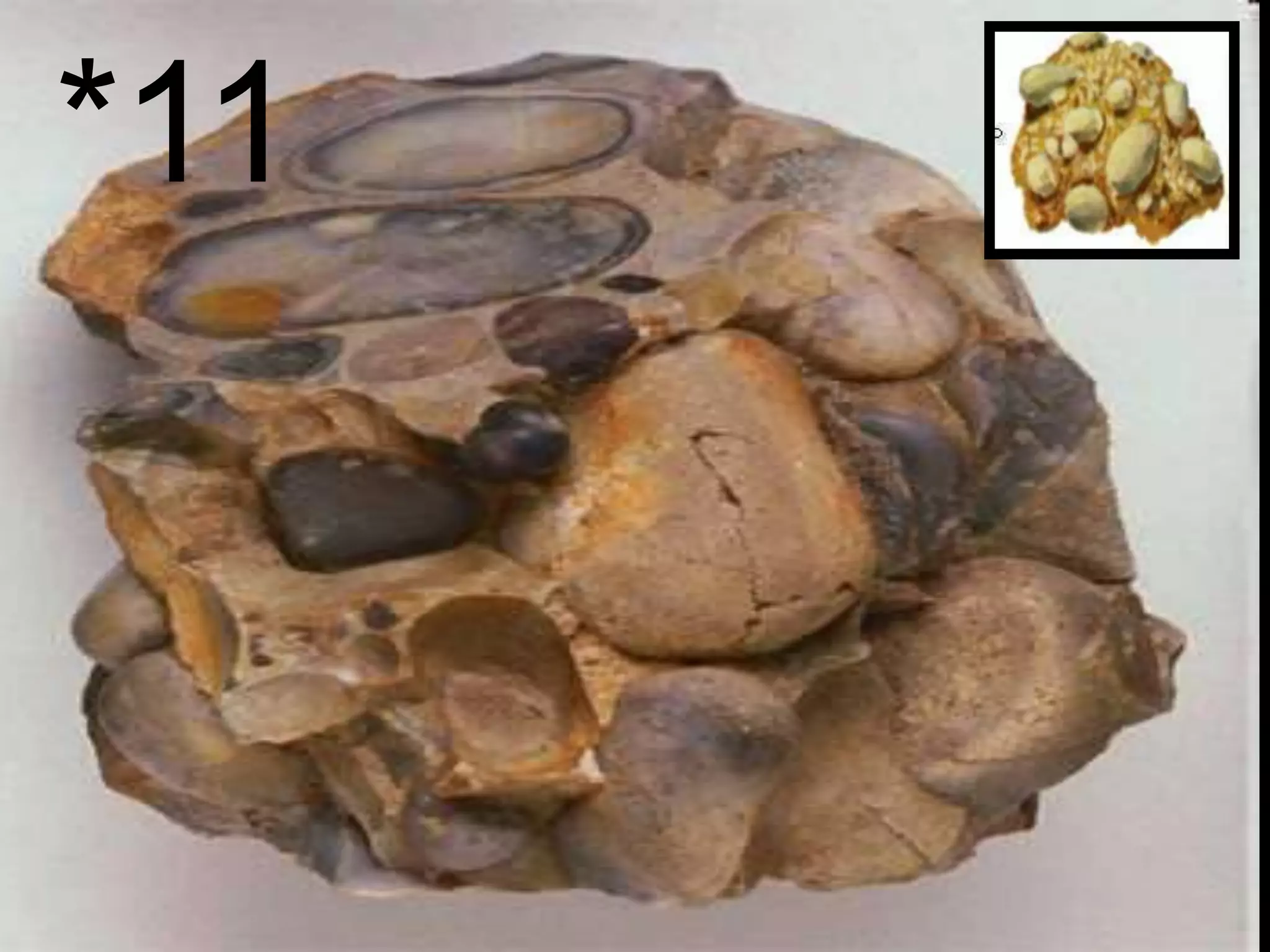
*11
*11
*11
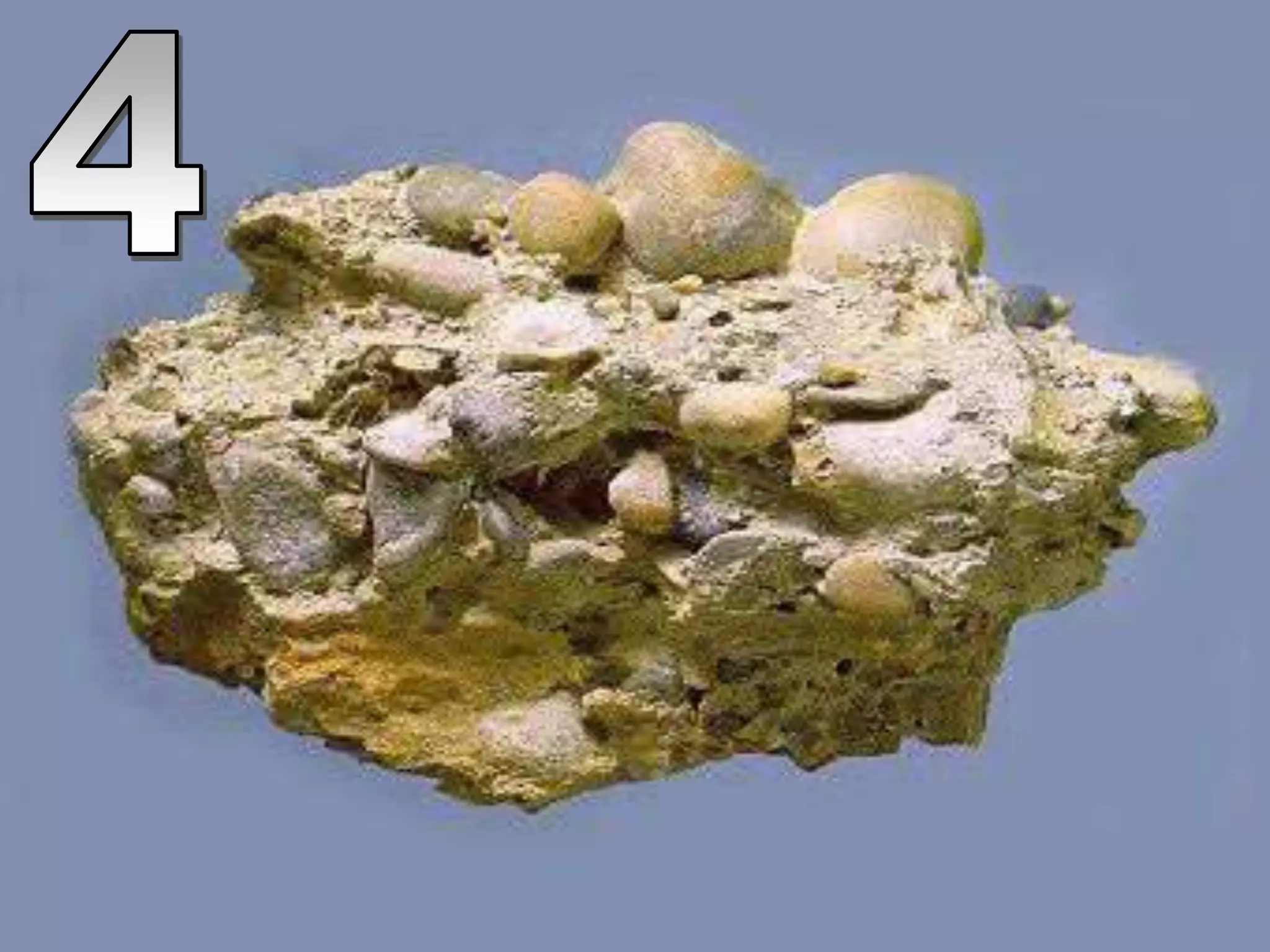
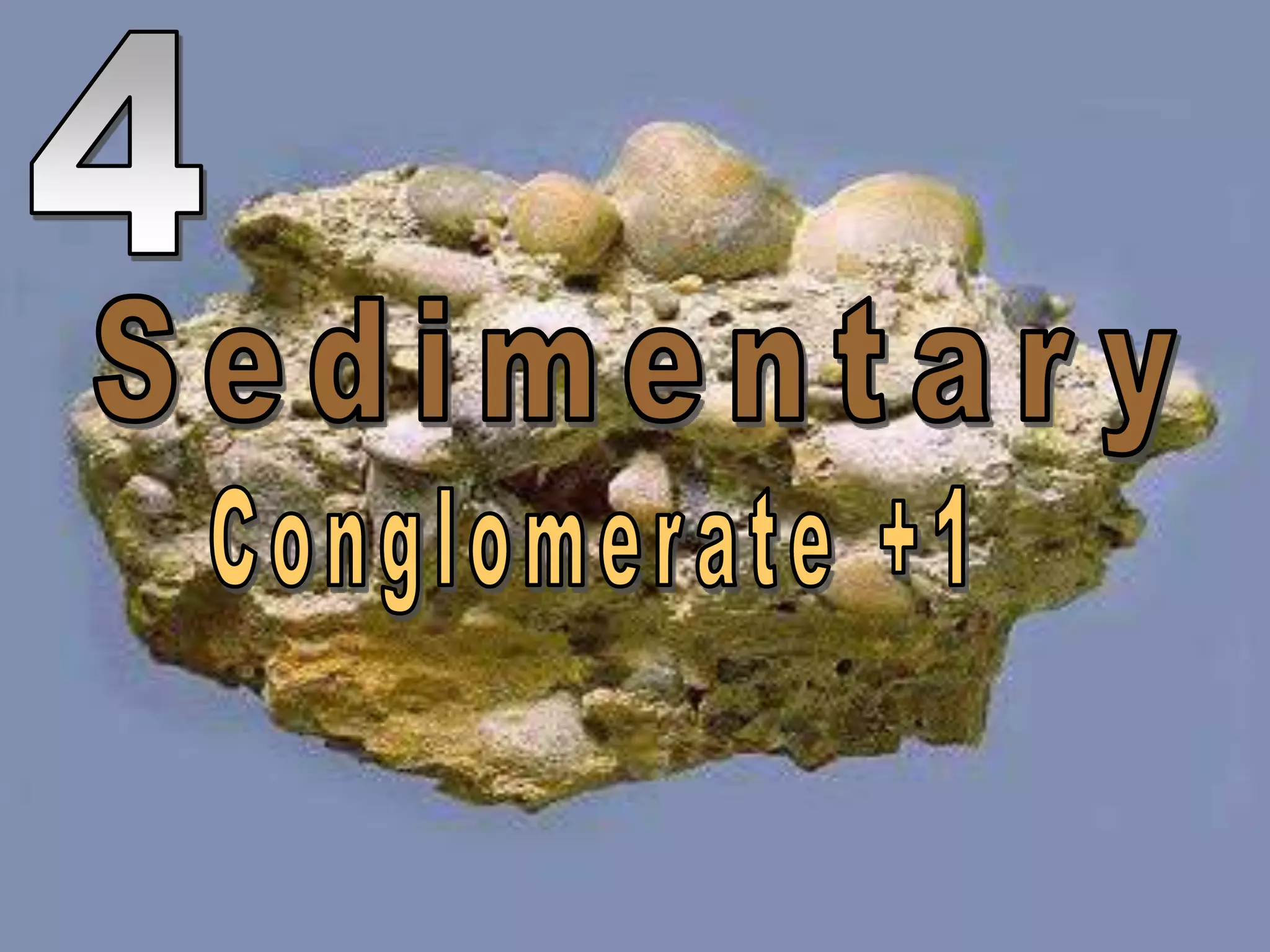
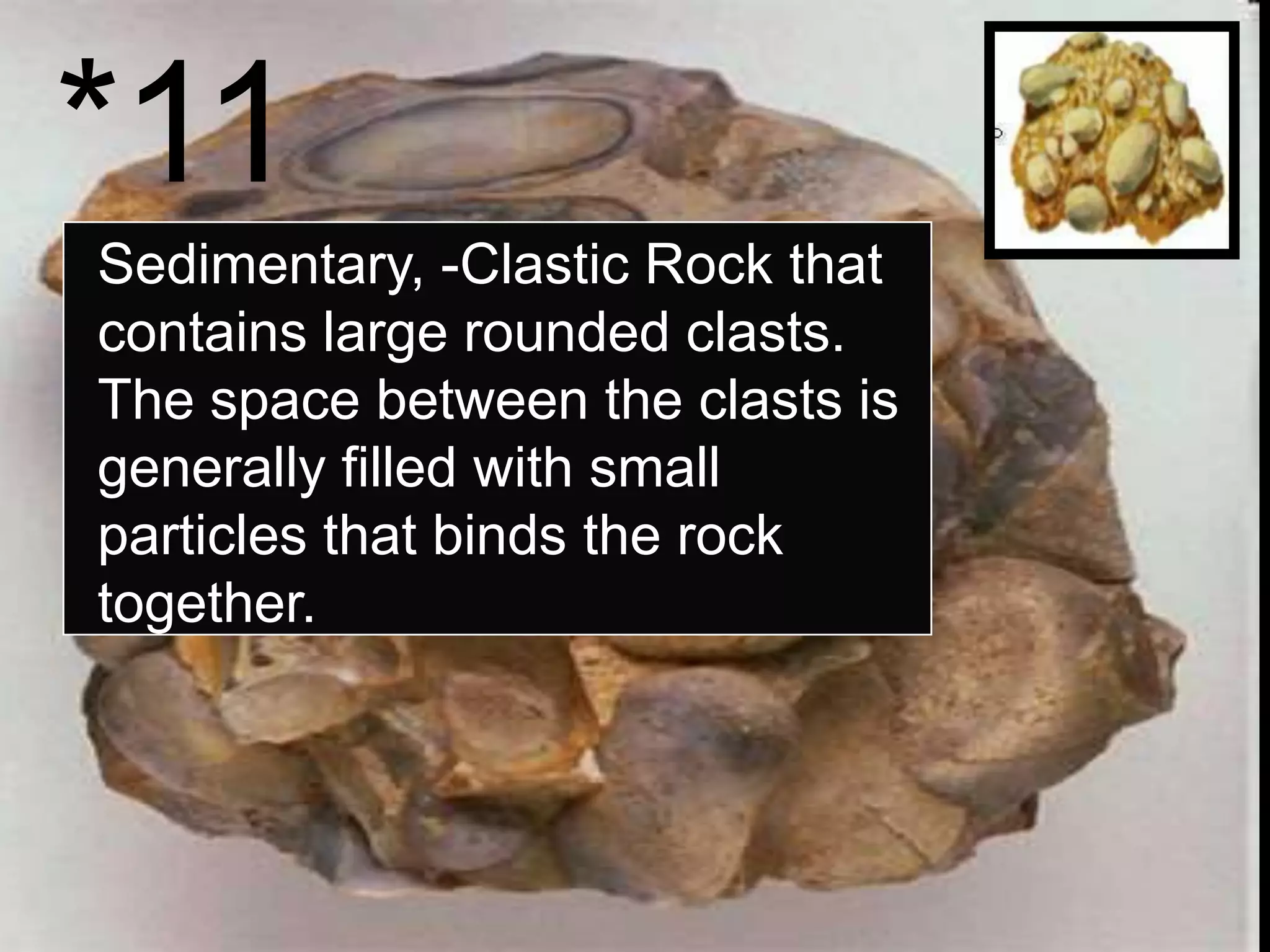
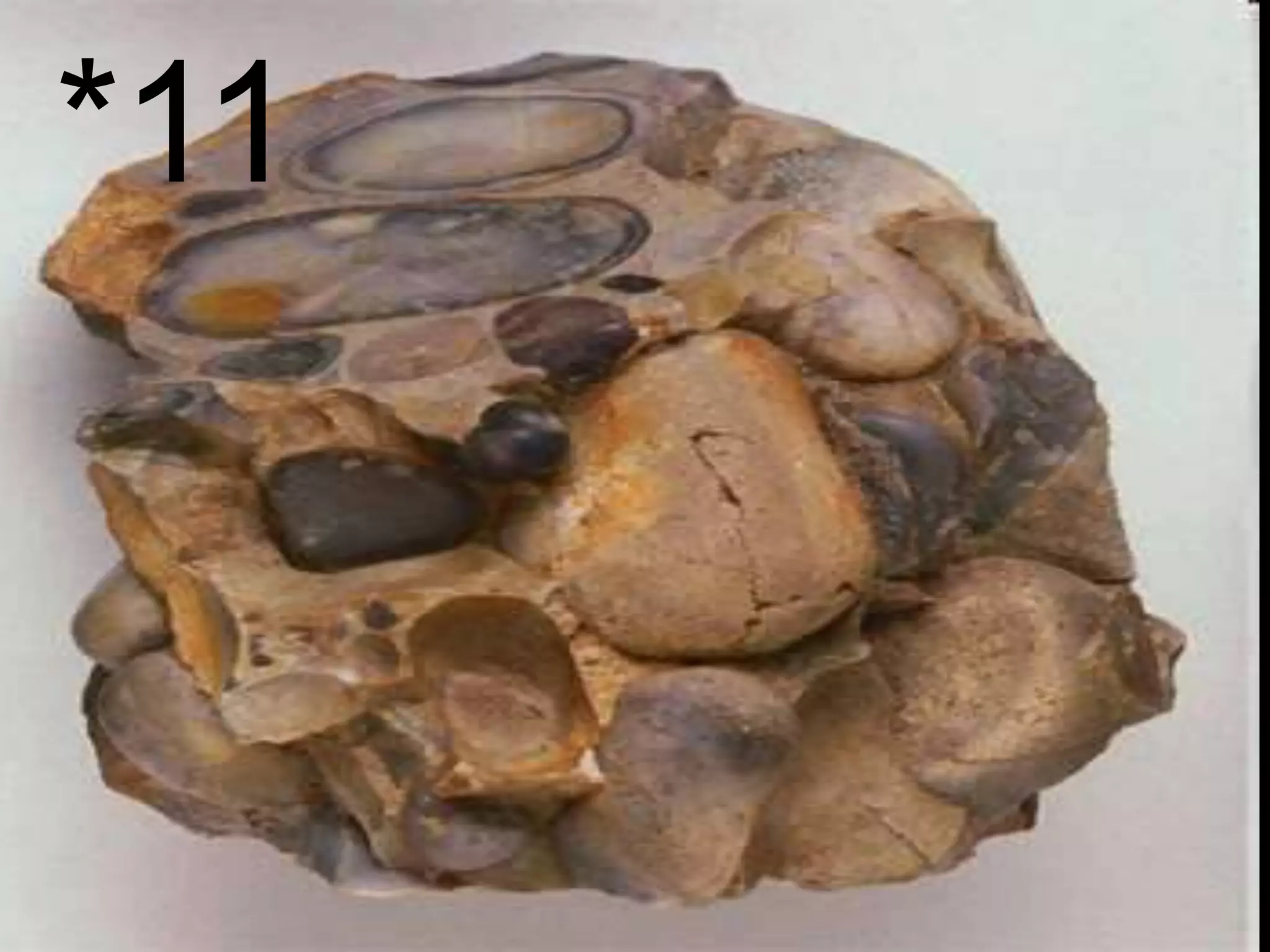
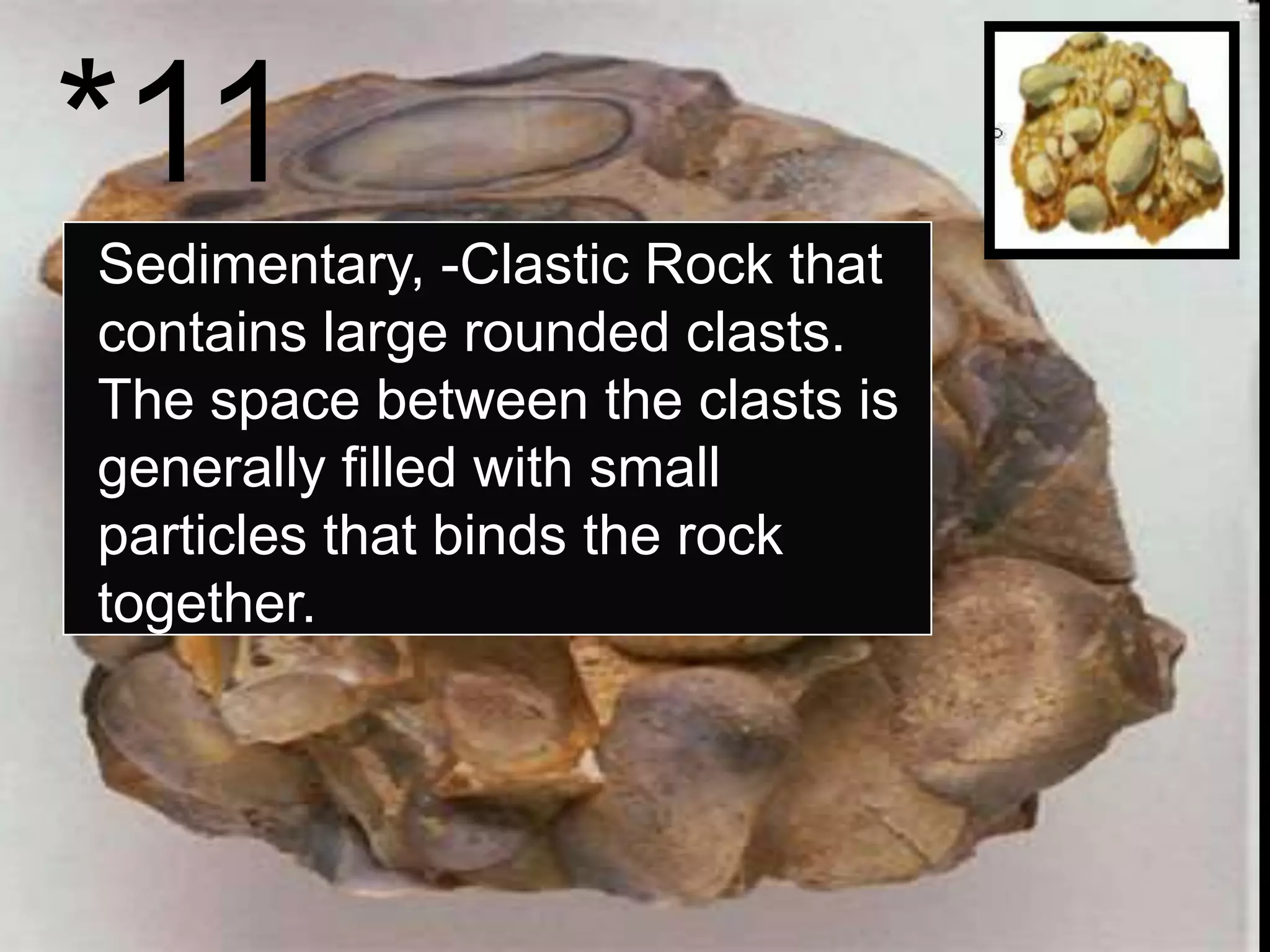
Sedimentary, -Clastic Rock that
contains large rounded clasts.
The space between the clasts is
generally filled with small
particles that binds the rock
together.
*12
“Who am I?”
• Answers! Quiz Wiz 1-10 Name that Rock.
Copyright © 2010 Ryan P. Murphy
• Answers! Quiz Wiz 1-10 Name that Rock.
Copyright © 2010 Ryan P. Murphy
1
1
1
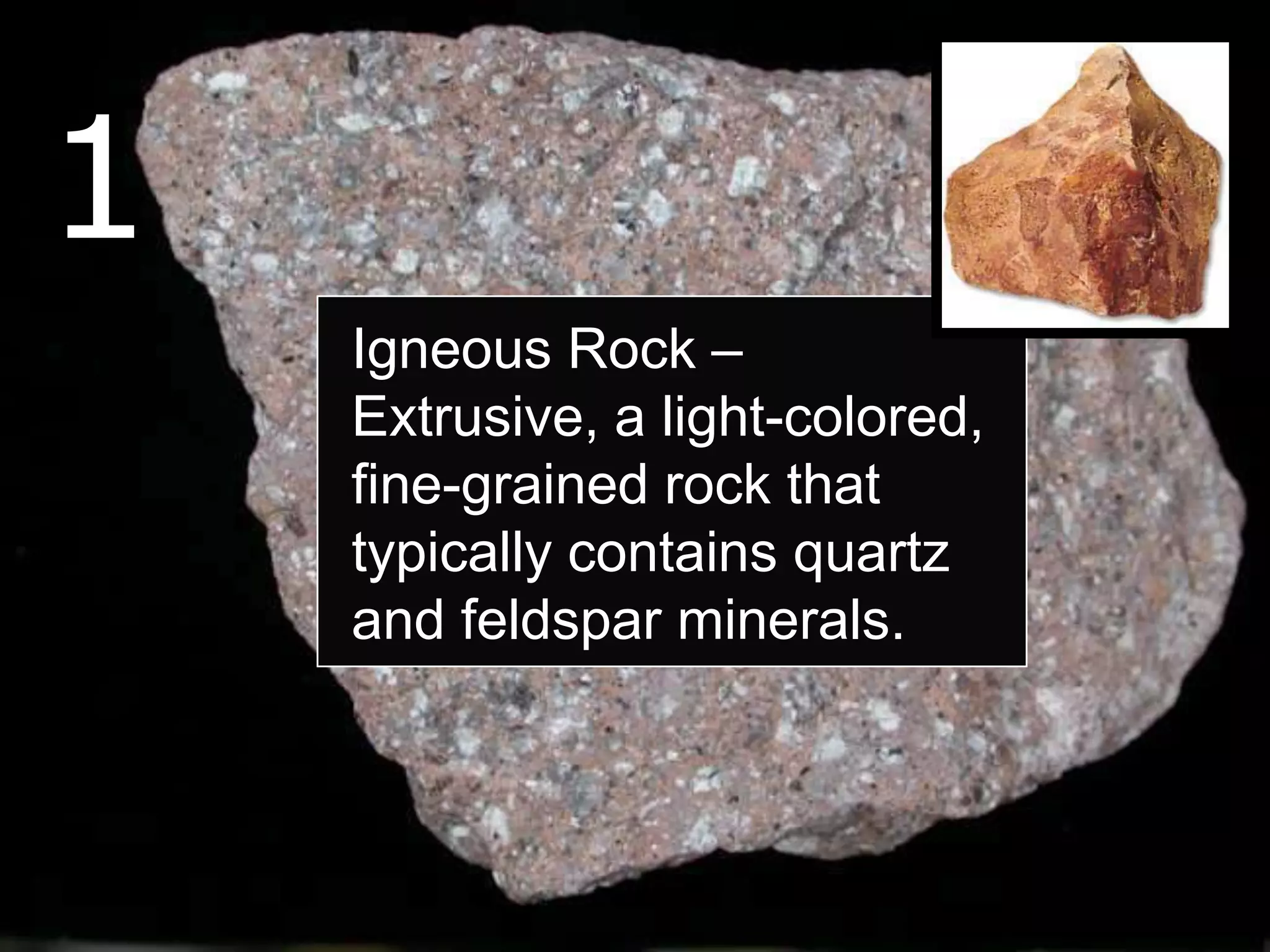
Igneous Rock –
Extrusive, a light-colored,
fine-grained rock that
typically contains quartz
and feldspar minerals.
1
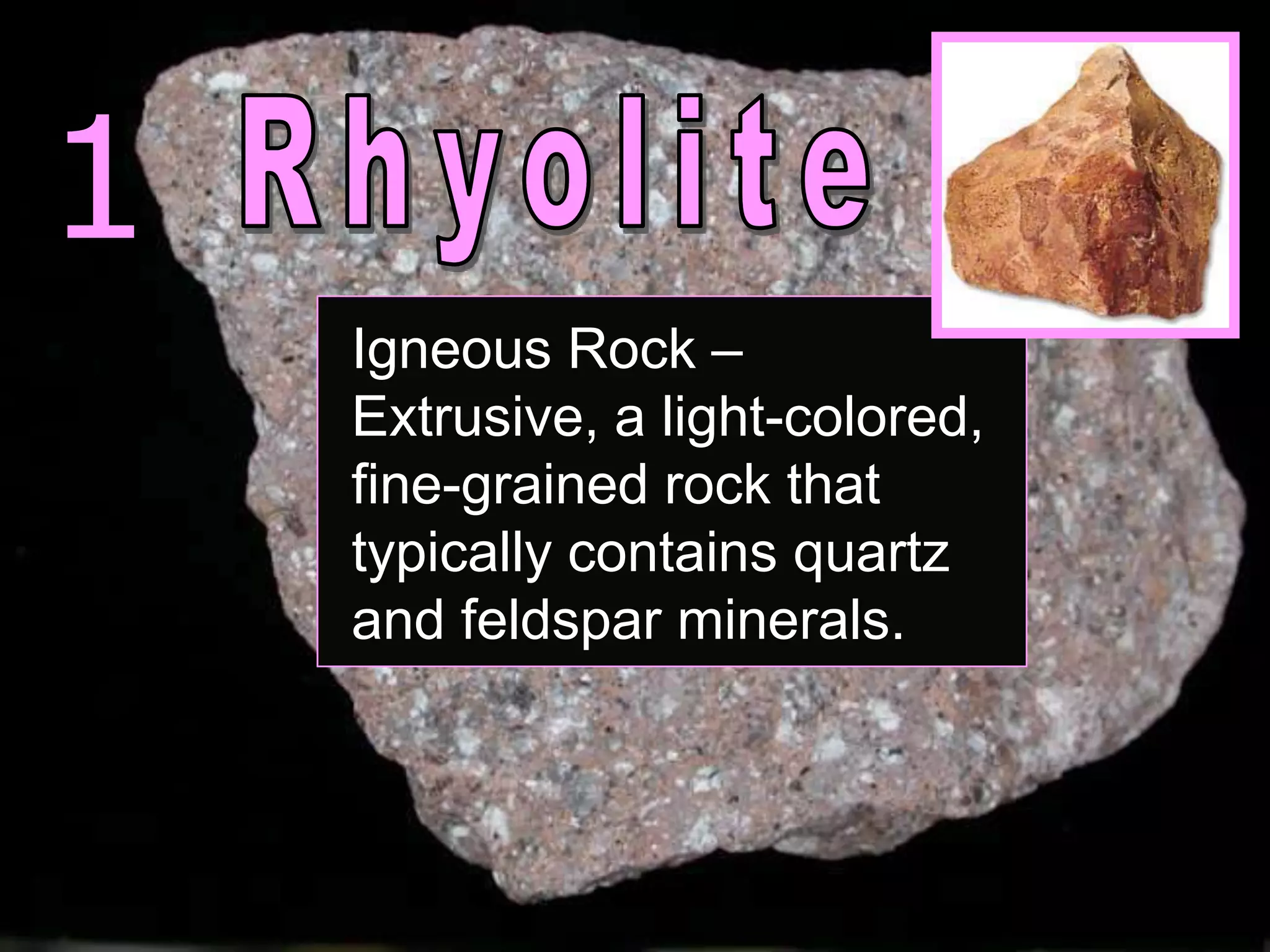
Igneous Rock –
Extrusive, a light-colored,
fine-grained rock that
typically contains quartz
and feldspar minerals.
2
2
2
Sedimentary, A fine-grained
rock that forms from the
compaction of silt and clay-
size mineral particles 
“Mud”
2
Sedimentary, A fine-grained
rock that forms from the
compaction of silt and clay-
size mineral particles 
“Mud”
3
3
3
Igneous Rock –
Intrusive with large
crystals. Composed
mainly of quartz and
feldspar.
3
Igneous Rock –
Intrusive with large
crystals. Composed
mainly of quartz and
feldspar.
4
4
4
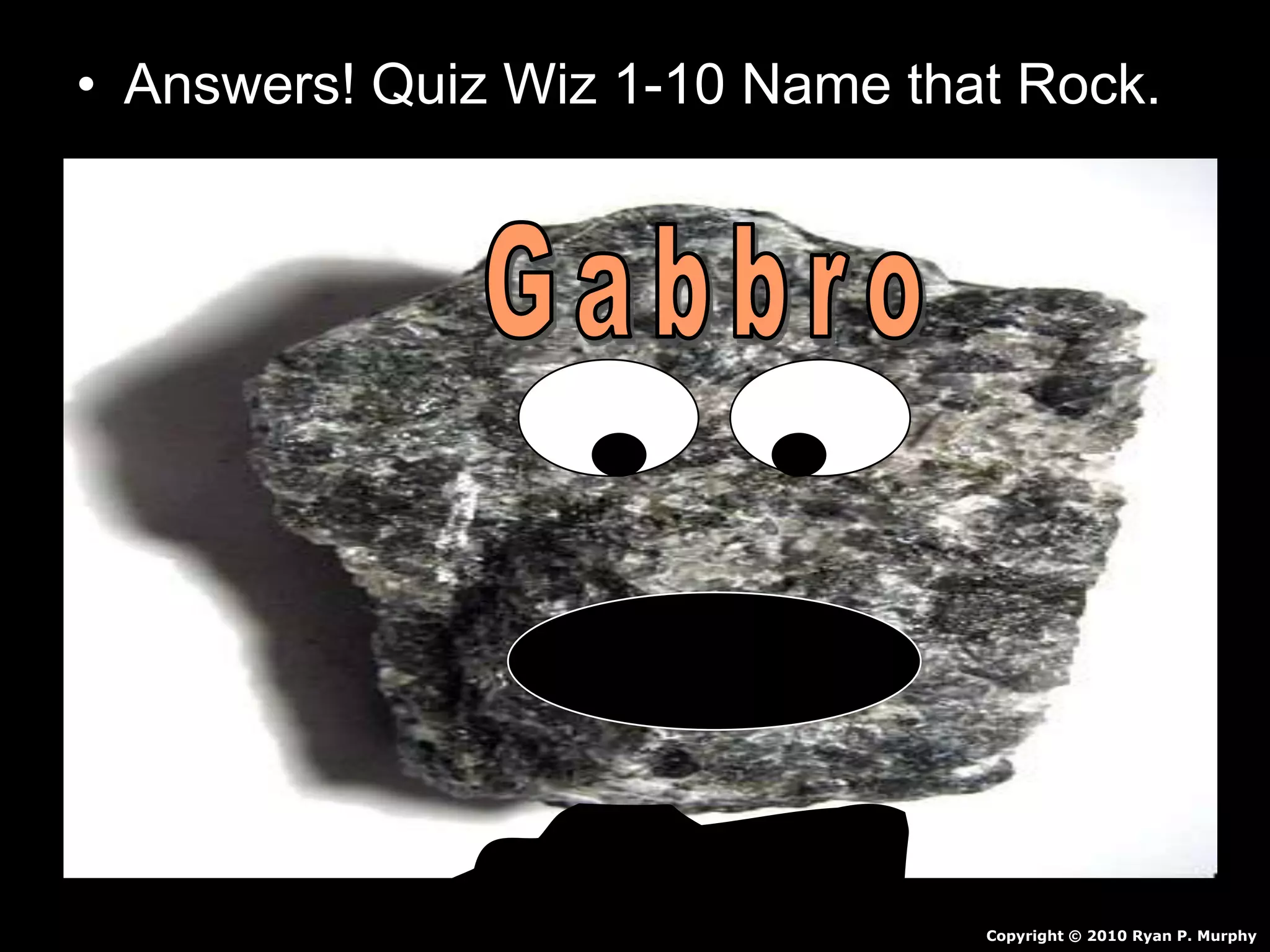
Igneous Rock – Intrusive, Coarse-
grained, dark-colored. It is usually
black or dark green in color. It is the
most abundant rock in the deep
oceanic crust.
4
Igneous Rock – Intrusive, Coarse-
grained, dark-colored. It is usually
black or dark green in color. It is the
most abundant rock in the deep
oceanic crust.
5
5
5
Sedimentary - Composed
primarily of calcium
carbonate – (Calcite),
forms in marine waters
and often has fossils.
5
Sedimentary - Composed
primarily of calcium
carbonate – (Calcite),
forms in marine waters
and often has fossils.
6
6
.
6
Sedimentary, clastic
rock made up mainly of
sand. Found in
environments where
large amounts of sand
can accumulate.
6
Sedimentary, clastic
rock made up mainly of
sand. Found in
environments where
large amounts of sand
can accumulate.
• Schist.
Copyright © 2010 Ryan P. Murphy
7
.
• Schist.
Copyright © 2010 Ryan P. Murphy
7
• Schist.
Copyright © 2010 Ryan P. Murphy
7
Metamorphic –
Foliated, It often
contains
significant
amounts of mica.
• Schist.
Copyright © 2010 Ryan P. Murphy
7
Metamorphic –
Foliated, It often
contains
significant
amounts of mica.
8
8
8
Igneous Rock – Dark
Colored. Extrusive with
fine grain crystals.
Forms from cooled
lava.
8
Igneous Rock – Dark
Colored. Extrusive with
fine grain crystals.
Forms from cooled
lava.
8
Igneous Rock – Dark
Colored. Extrusive with
fine grain crystals.
Forms from cooled
lava.
8
Igneous Rock – Dark
Colored. Extrusive with
fine grain crystals.
Forms from cooled
lava.
8
Igneous Rock – Dark
Colored. Extrusive with
fine grain crystals.
Forms from cooled
lava.
9
9
9
Igneous Rock –
Extrusive, A light-
colored rock. It forms
through very rapid
cooling.
9
Igneous Rock –
Extrusive, A light-
colored rock. It forms
through very rapid
cooling.
10
10
10
Metamorphic, Non-
foliated rock that is
produced from the
metamorphism of
limestone. It is composed
primarily of calcium
carbonate.
10
Metamorphic, Non-
foliated rock that is
produced from the
metamorphism of
limestone. It is composed
primarily of calcium
carbonate.
*11
*11
*11
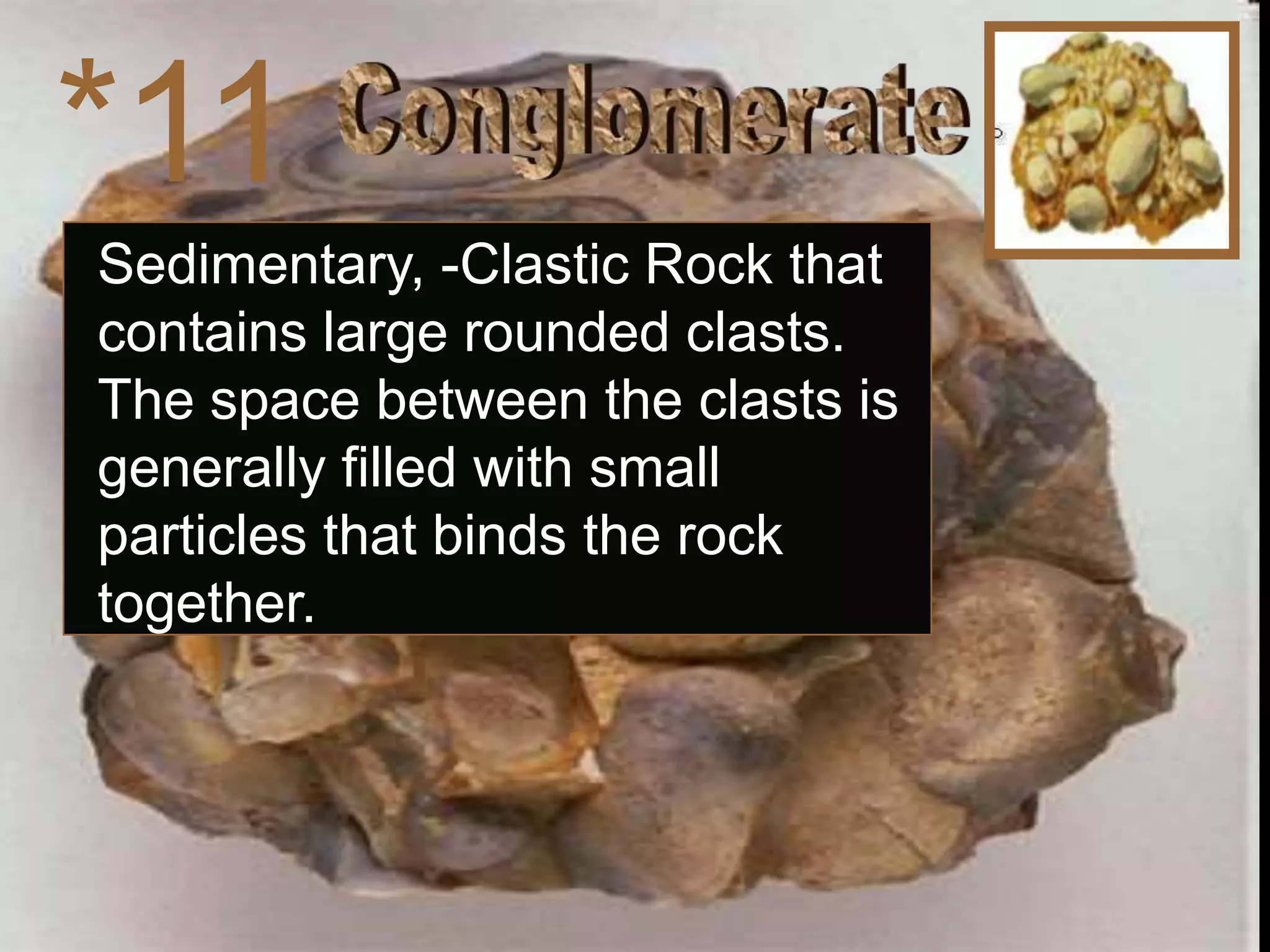
Sedimentary, -Clastic Rock that
contains large rounded clasts.
The space between the clasts is
generally filled with small
particles that binds the rock
together.
*11
Sedimentary, -Clastic Rock that
contains large rounded clasts.
The space between the clasts is
generally filled with small
particles that binds the rock
together.
*12
“Who am I?”
*12 “It’s gneiss
being Kid-rock”
• Write down a number from 1-500 on the
note card and write your name under it.
– Teacher to collect note cards at end.
Copyright © 2010 Ryan P. Murphy
• Rock and Mineral Auction Project
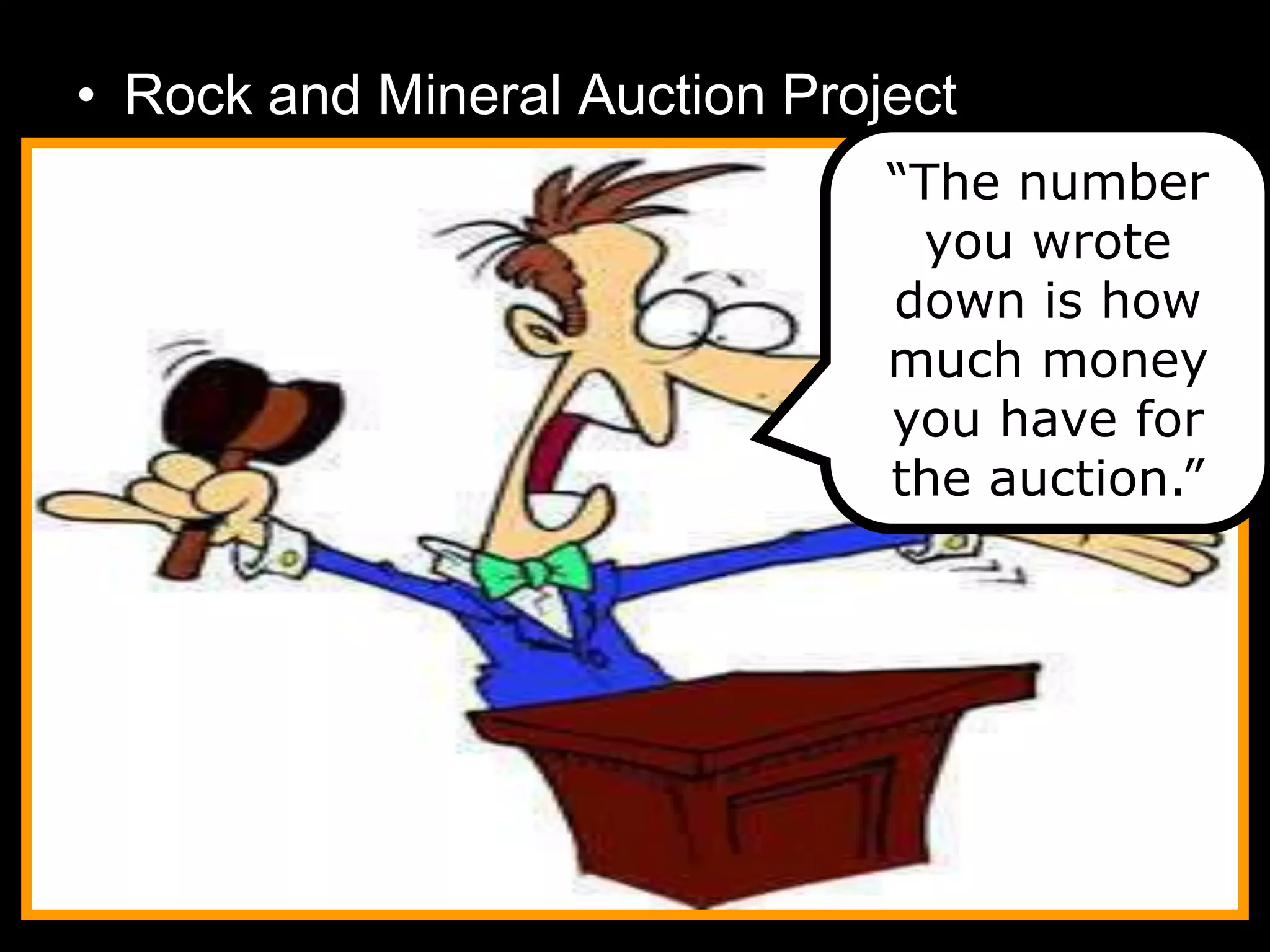
“The number
you wrote
down is how
much money
you have for
the auction.”
• Auction Rules
– Do not bid higher than the monopoly money that
you have.
– Raise hand and or murmur something such as
“Yuup” or “Here” or “Yah” when you want to bid.
– Do not be vocal unless you are bidding.
– Once you’ve bid, see cashier to collect rock /
mineral and pay.
– No giving away your money. You can only bid
once.
– All rocks / minerals will be passed out at the end
to all that not win a bid.
– Your rock / mineral becomes the focus of your
research and poster.
If you win a rock / mineral you get a
prize when you hand-in your money
to the auction banker.
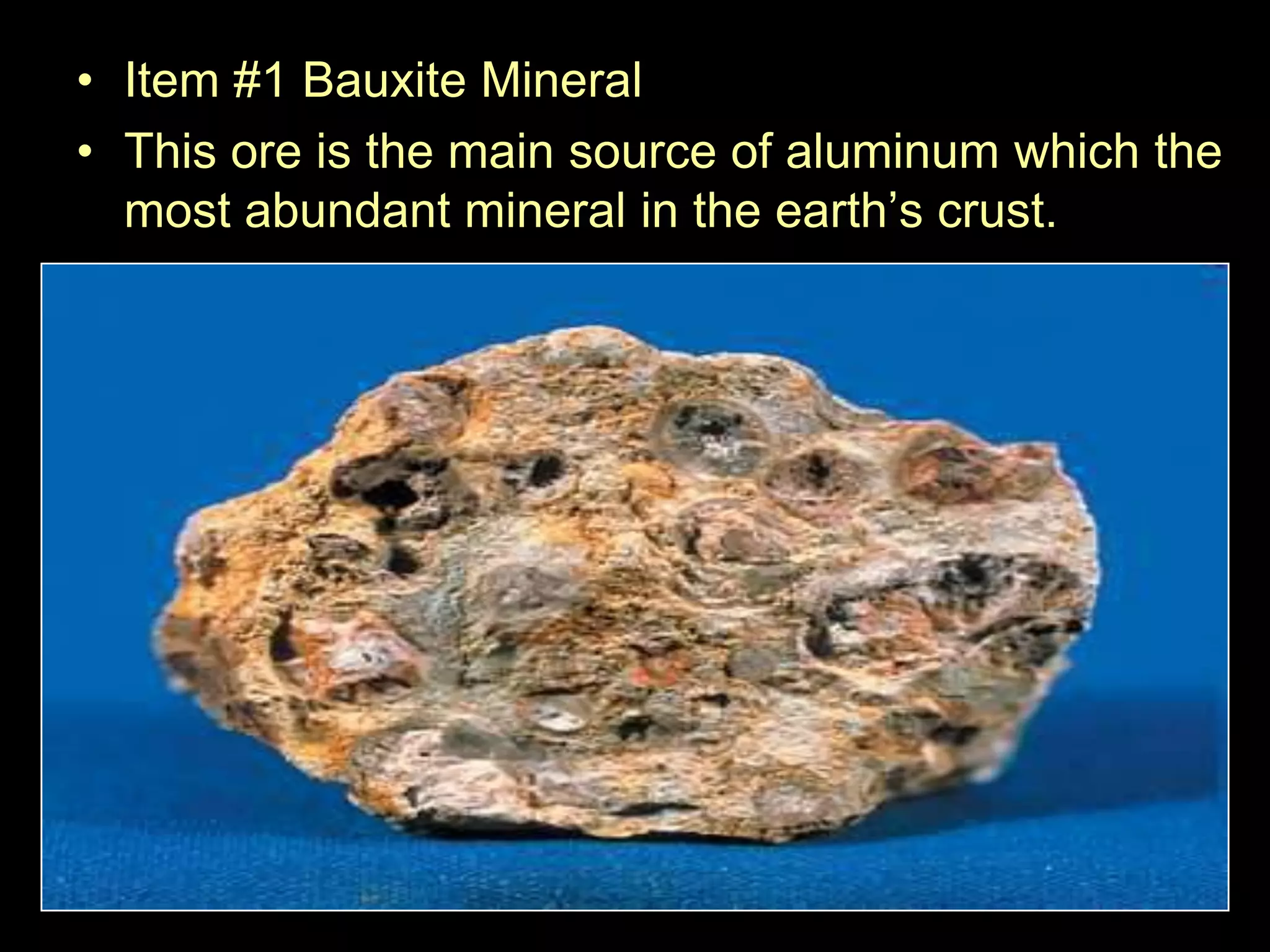
• Item #1 Bauxite Mineral
• This ore is the main source of aluminum which the
most abundant mineral in the earth’s crust.
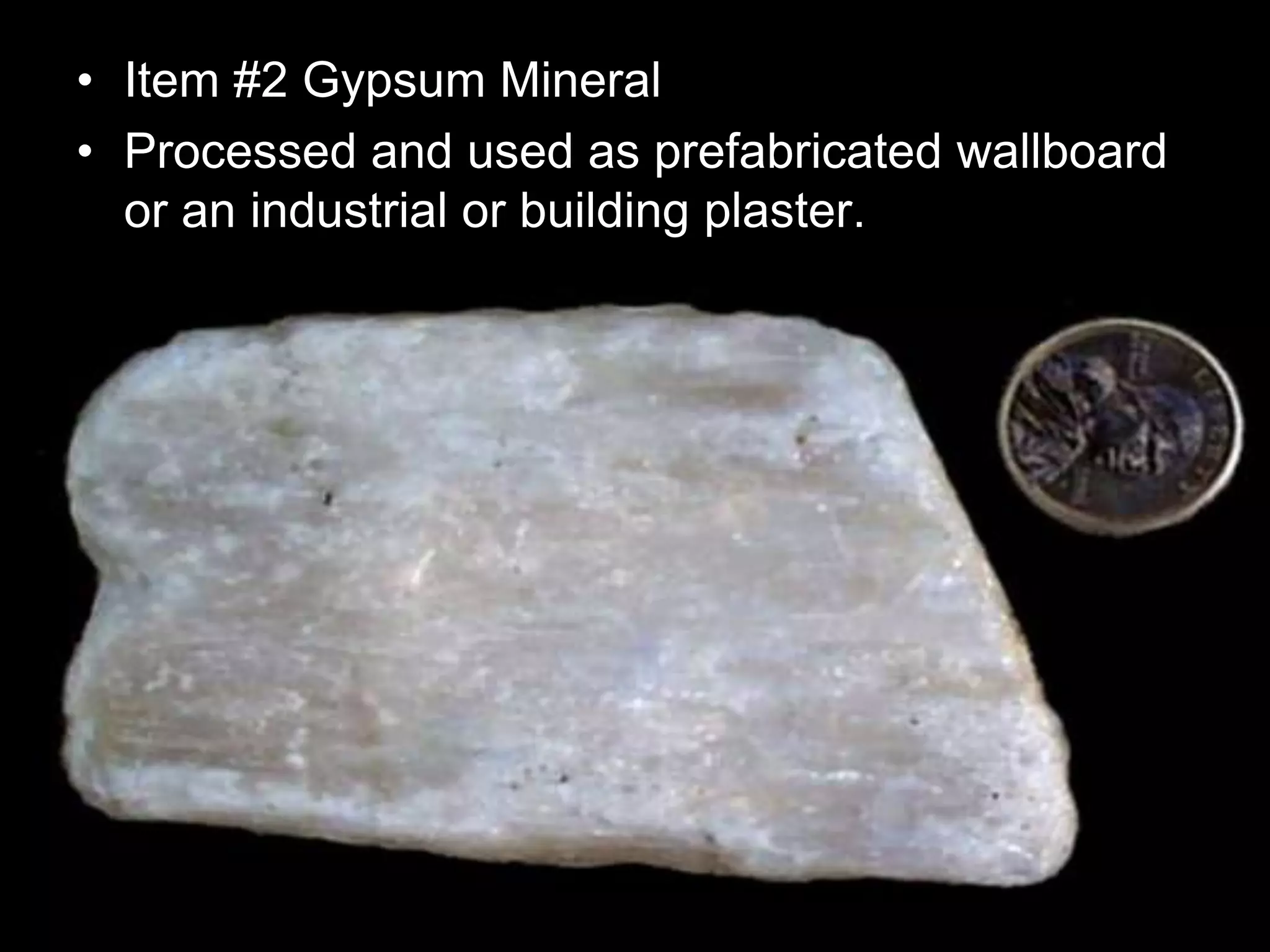
• Item #2 Gypsum Mineral
• Processed and used as prefabricated wallboard
or an industrial or building plaster.
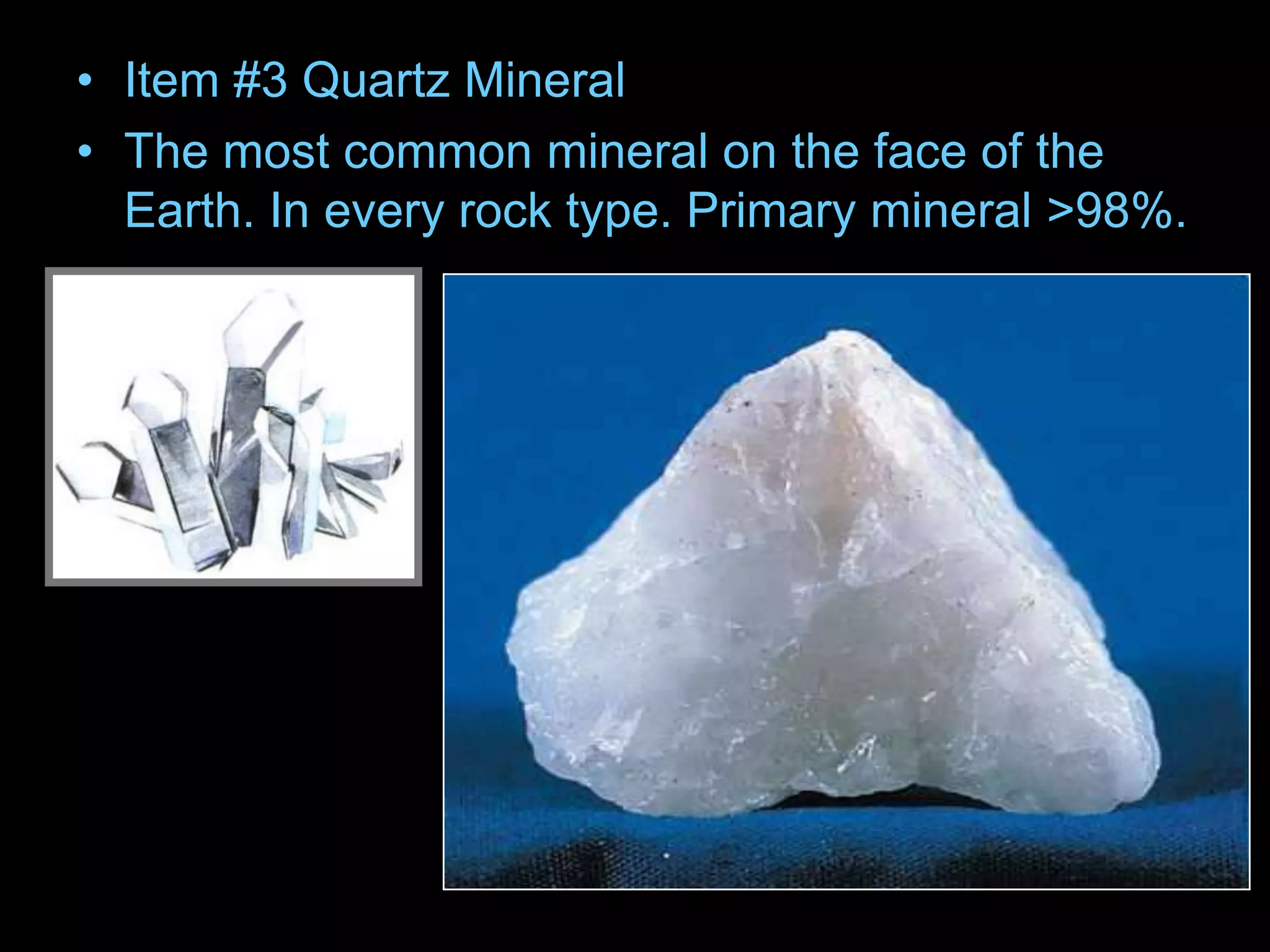
• Item #3 Quartz Mineral
• The most common mineral on the face of the
Earth. In every rock type. Primary mineral >98%.
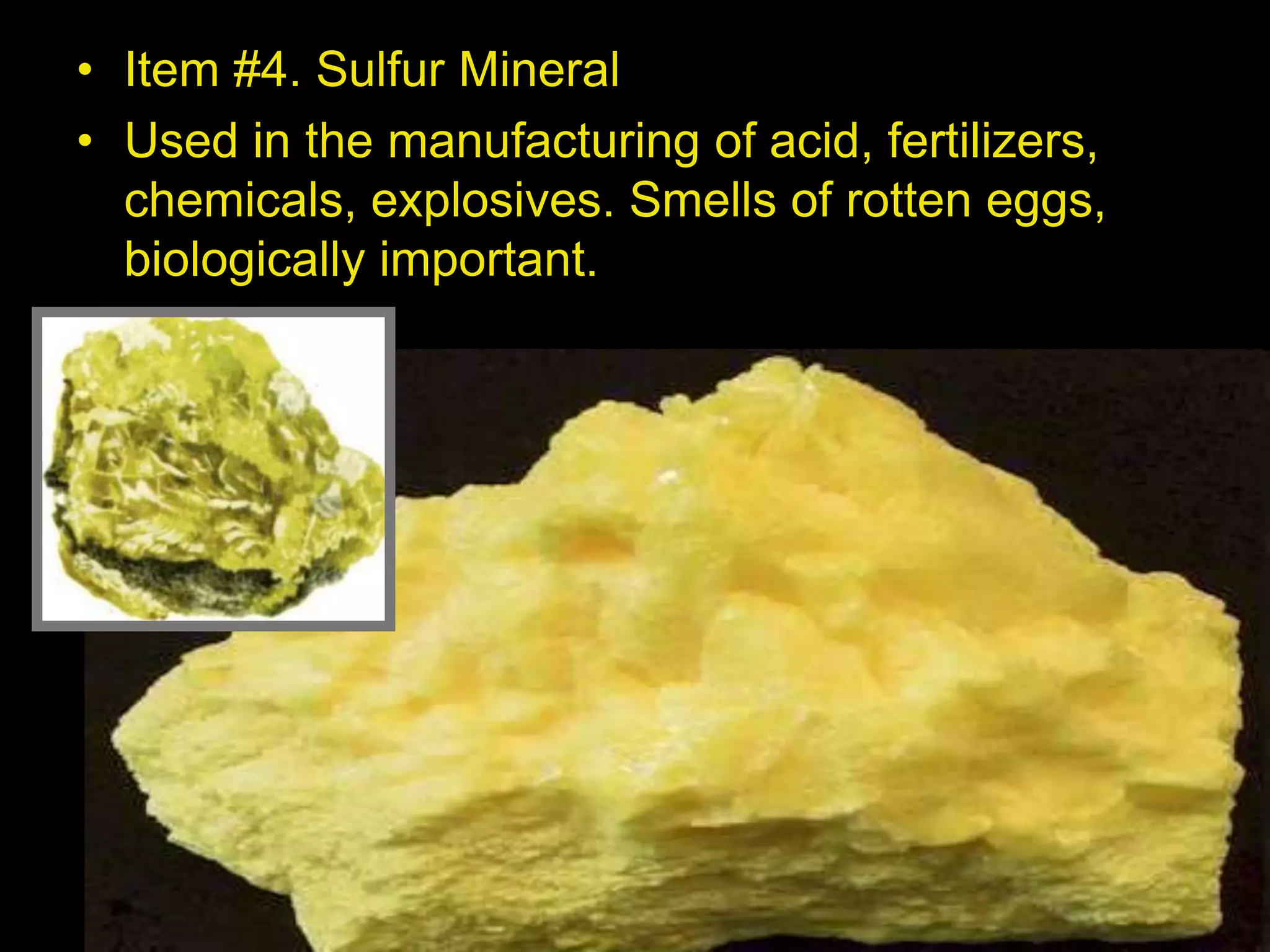
• Item #4. Sulfur Mineral
• Used in the manufacturing of acid, fertilizers,
chemicals, explosives. Smells of rotten eggs,
biologically important.
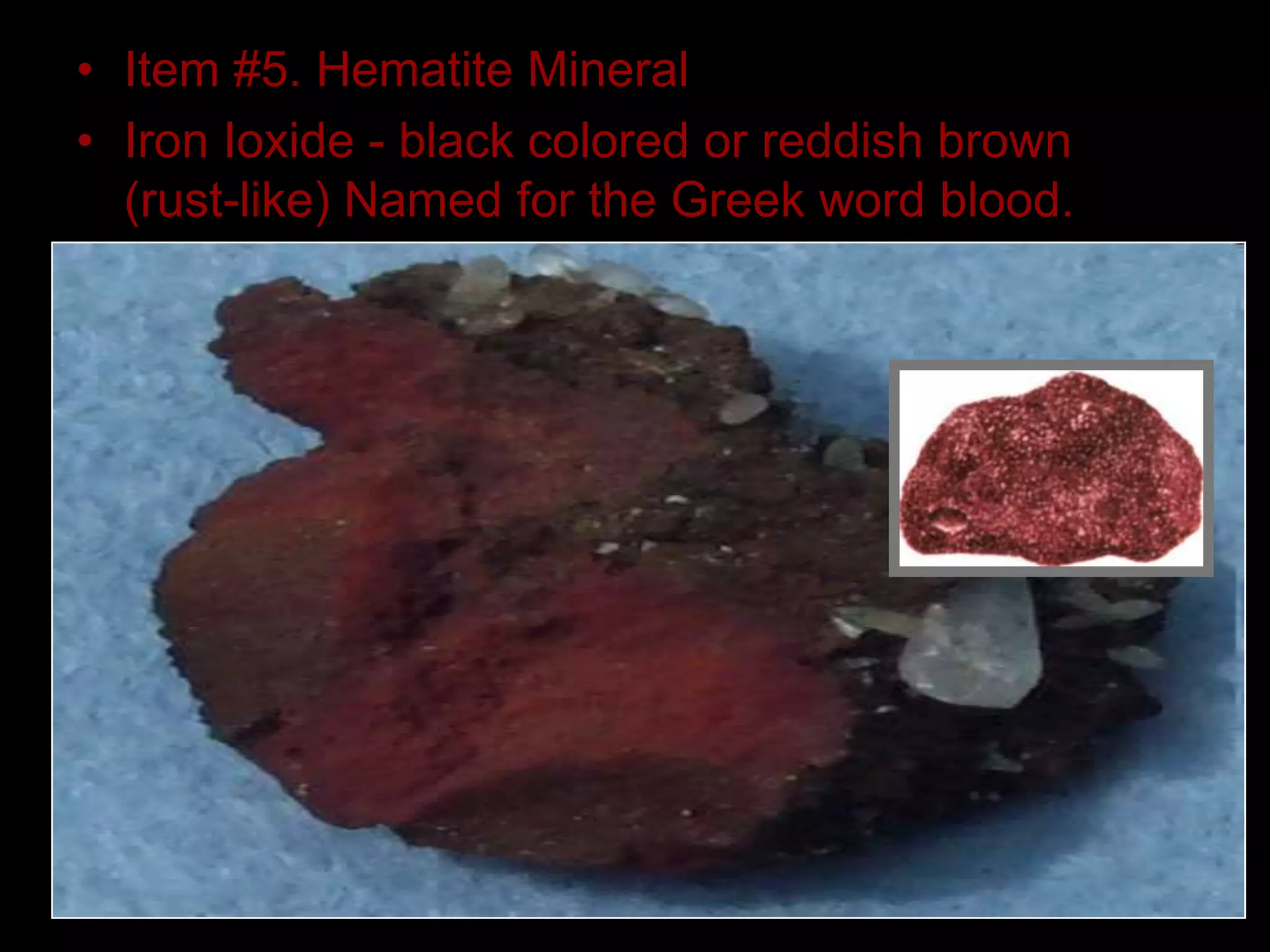
• Item #5. Hematite Mineral
• Iron Ioxide - black colored or reddish brown
(rust-like) Named for the Greek word blood.
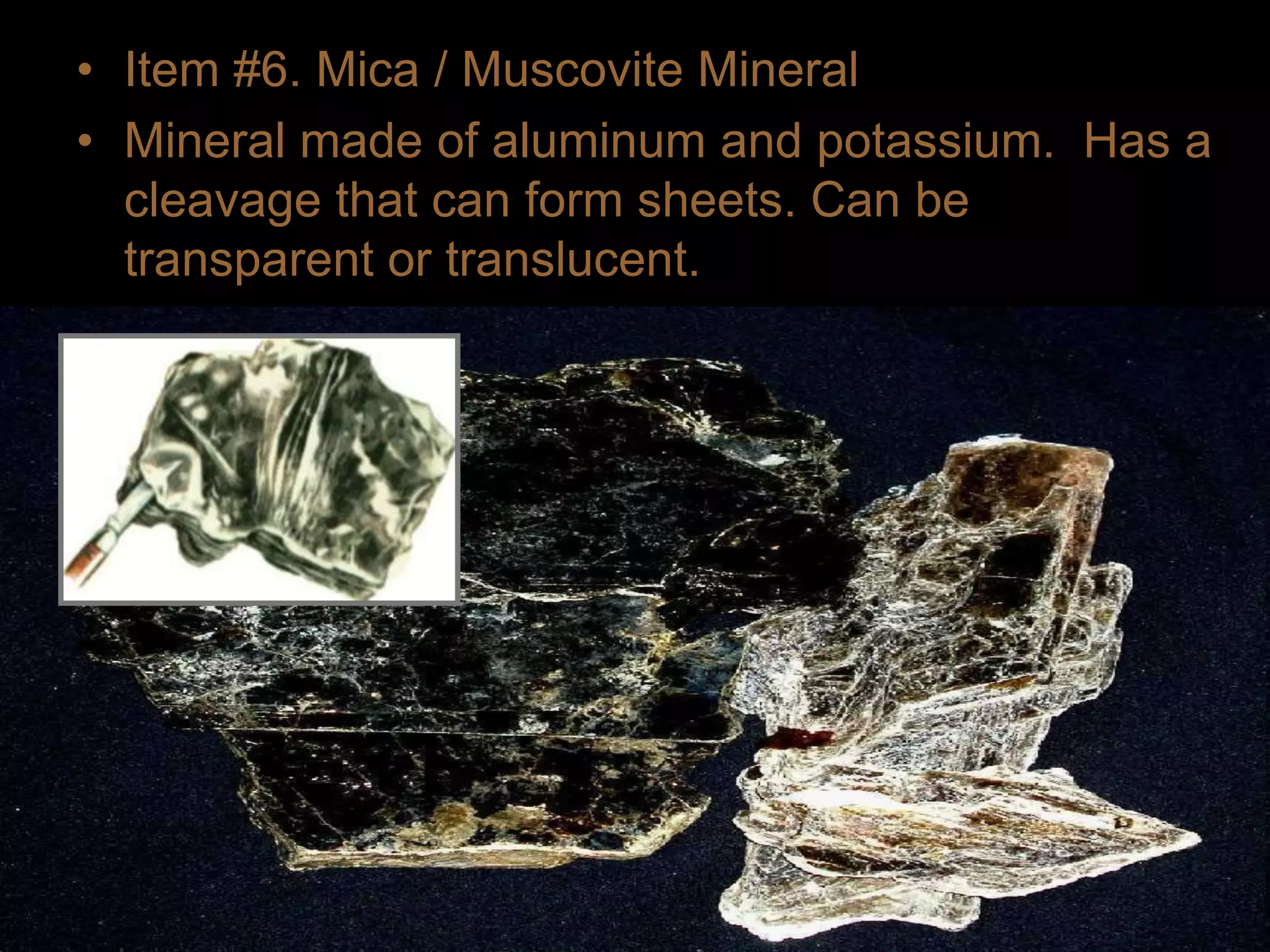
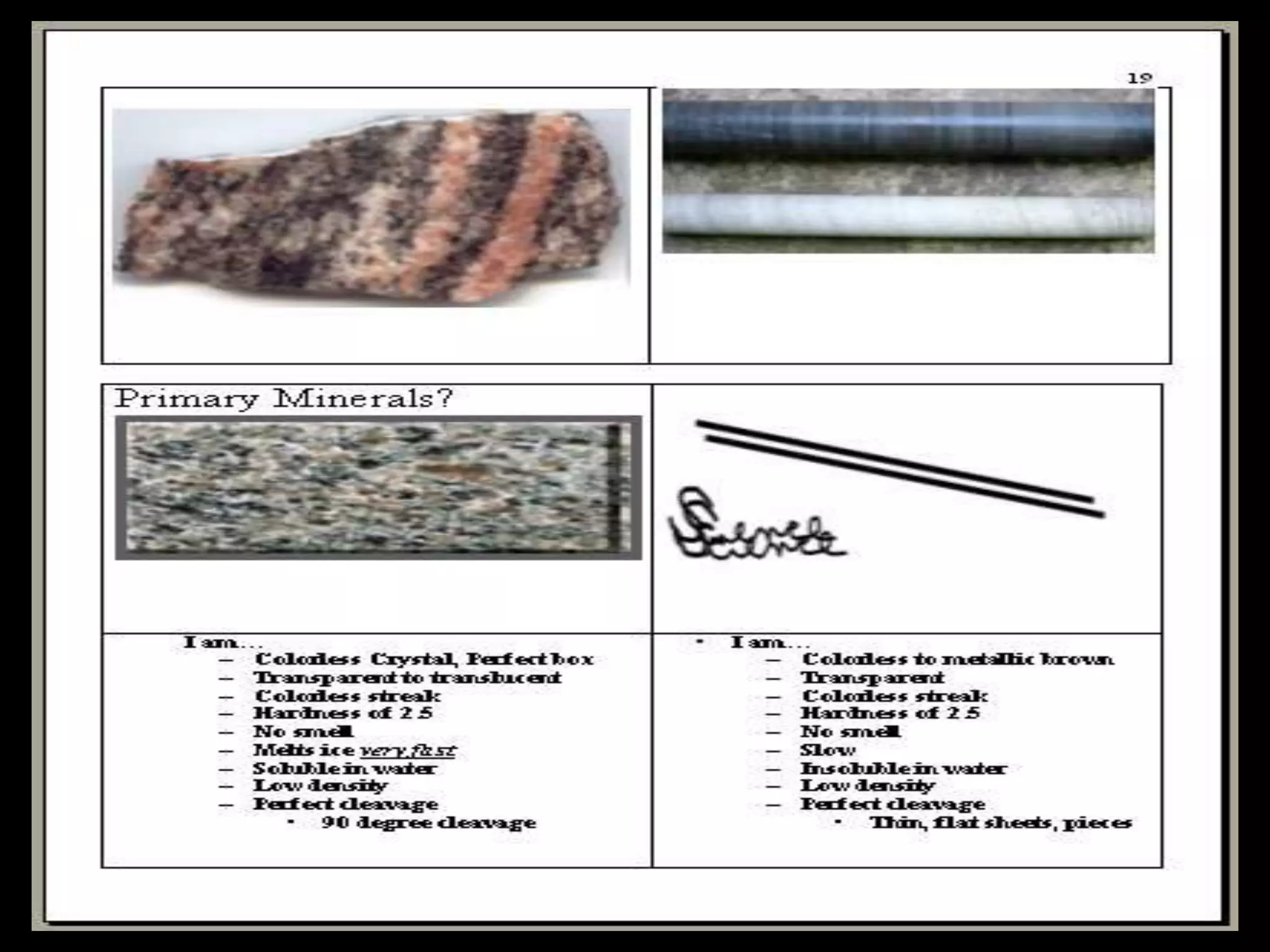
• Item #6. Mica / Muscovite Mineral
• Mineral made of aluminum and potassium. Has a
cleavage that can form sheets. Can be
transparent or translucent.
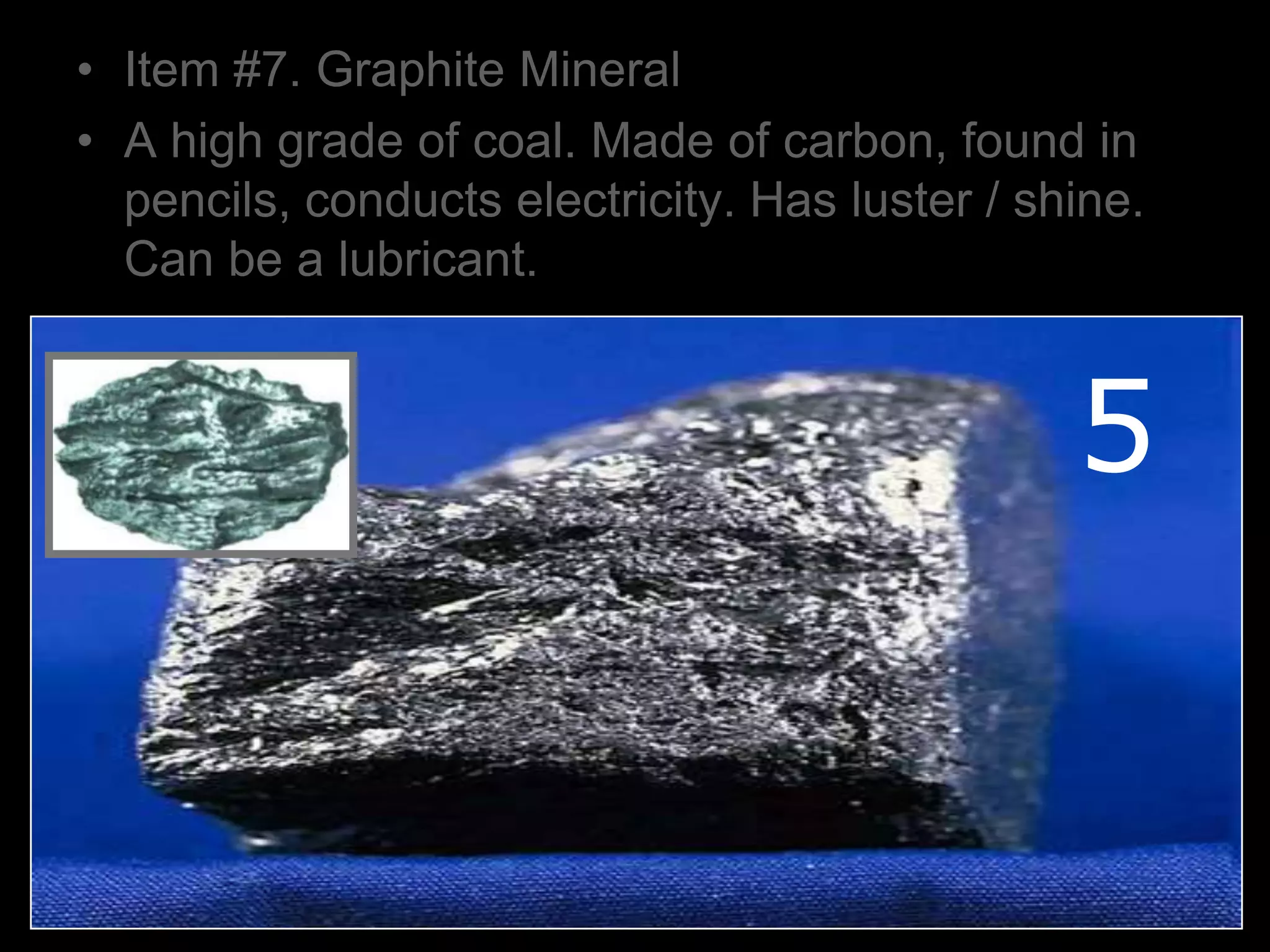
• Item #7. Graphite Mineral
• A high grade of coal. Made of carbon, found in
pencils, conducts electricity. Has luster / shine.
Can be a lubricant.
5
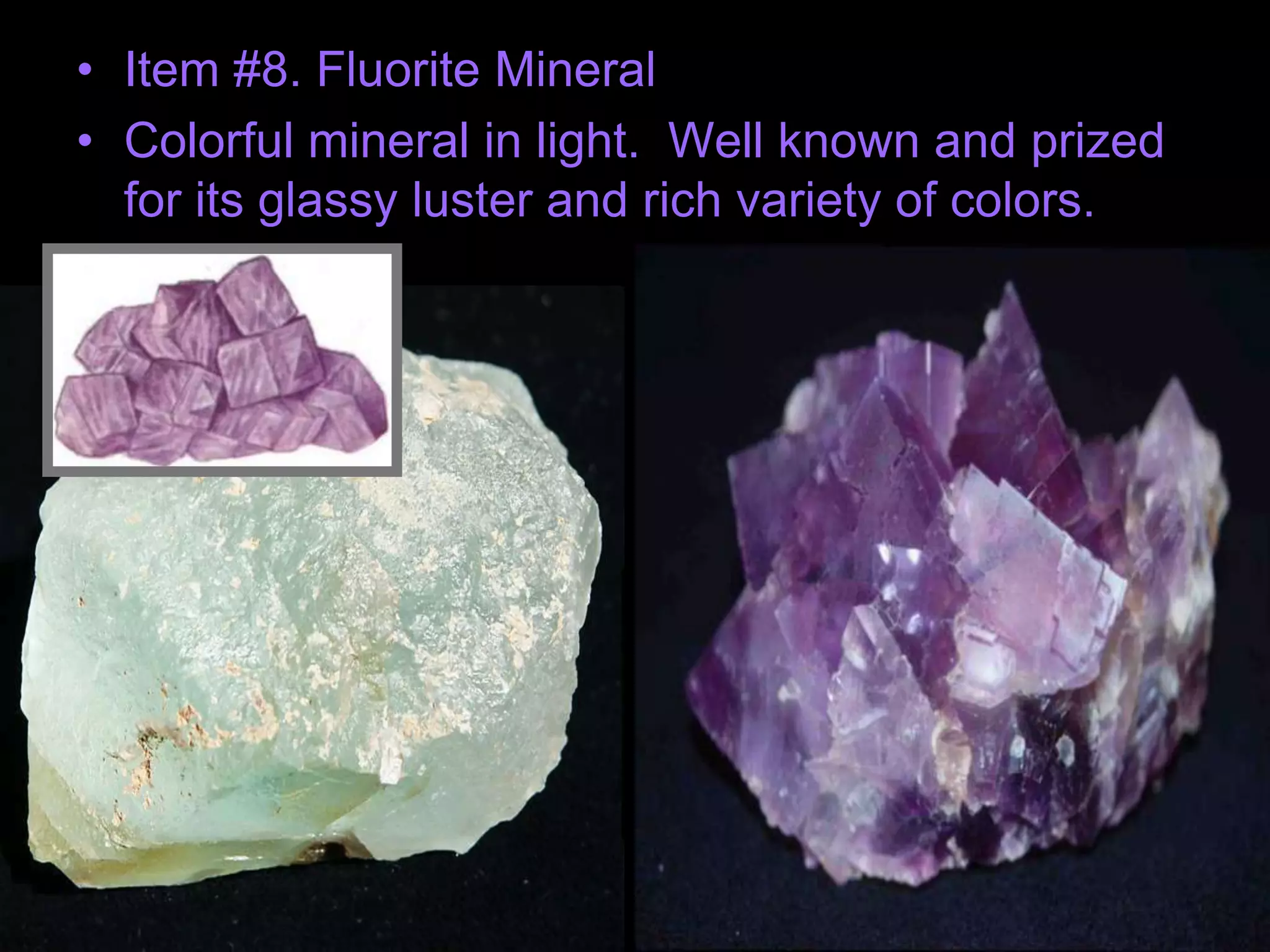
• Item #8. Fluorite Mineral
• Colorful mineral in light. Well known and prized
for its glassy luster and rich variety of colors.
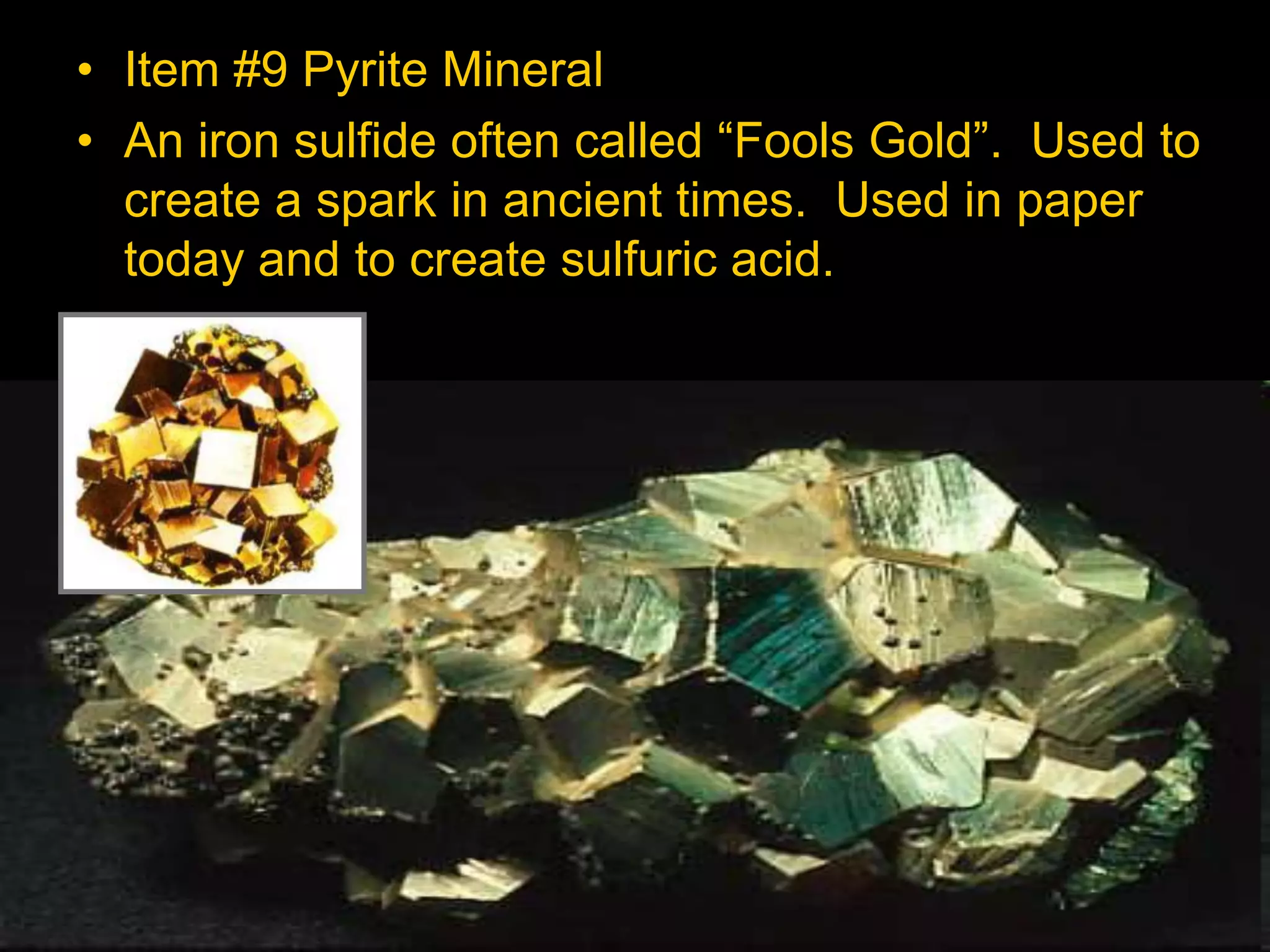
• Item #9 Pyrite Mineral
• An iron sulfide often called “Fools Gold”. Used to
create a spark in ancient times. Used in paper
today and to create sulfuric acid.
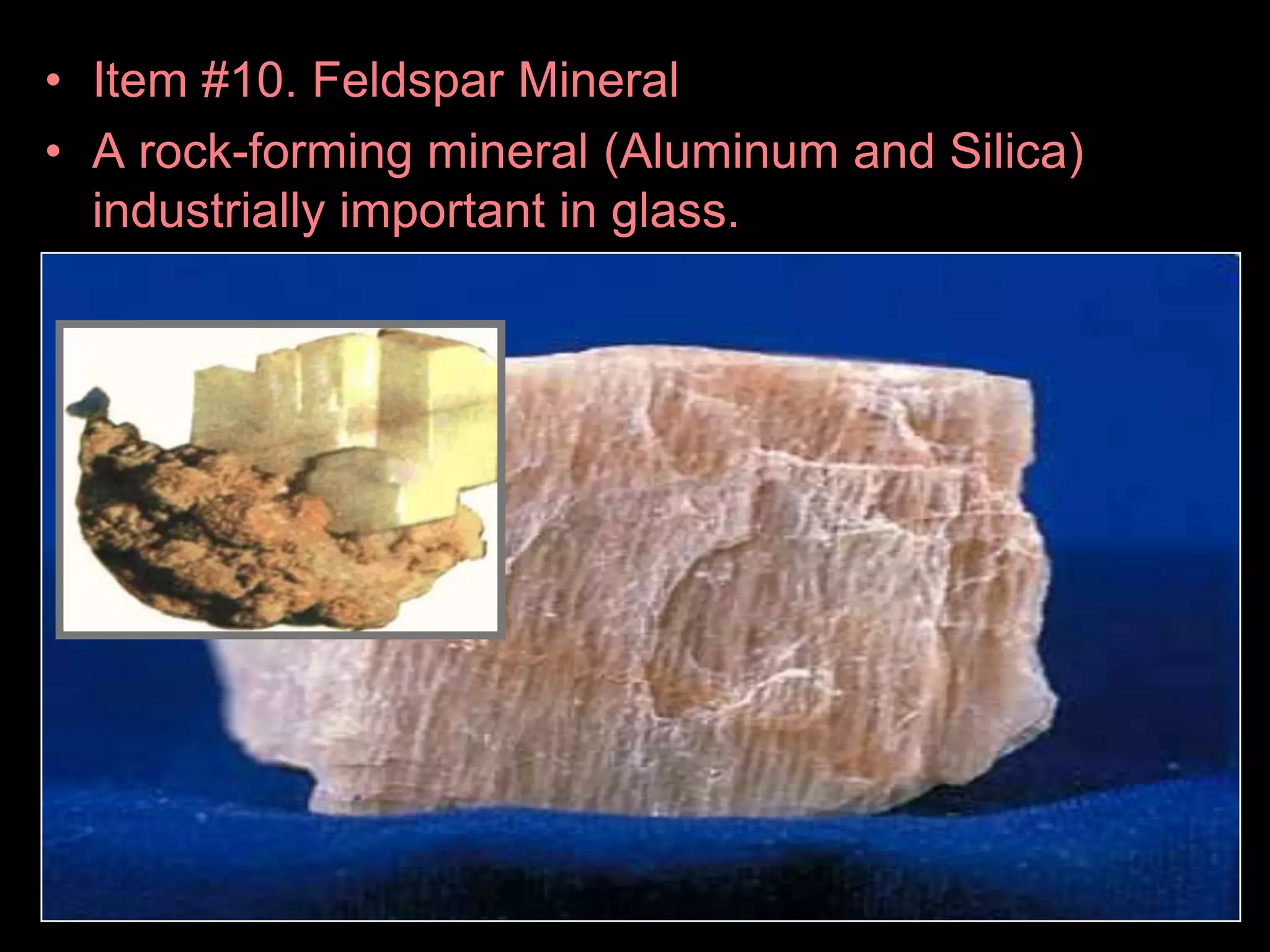
• Item #10. Feldspar Mineral
• A rock-forming mineral (Aluminum and Silica)
industrially important in glass.
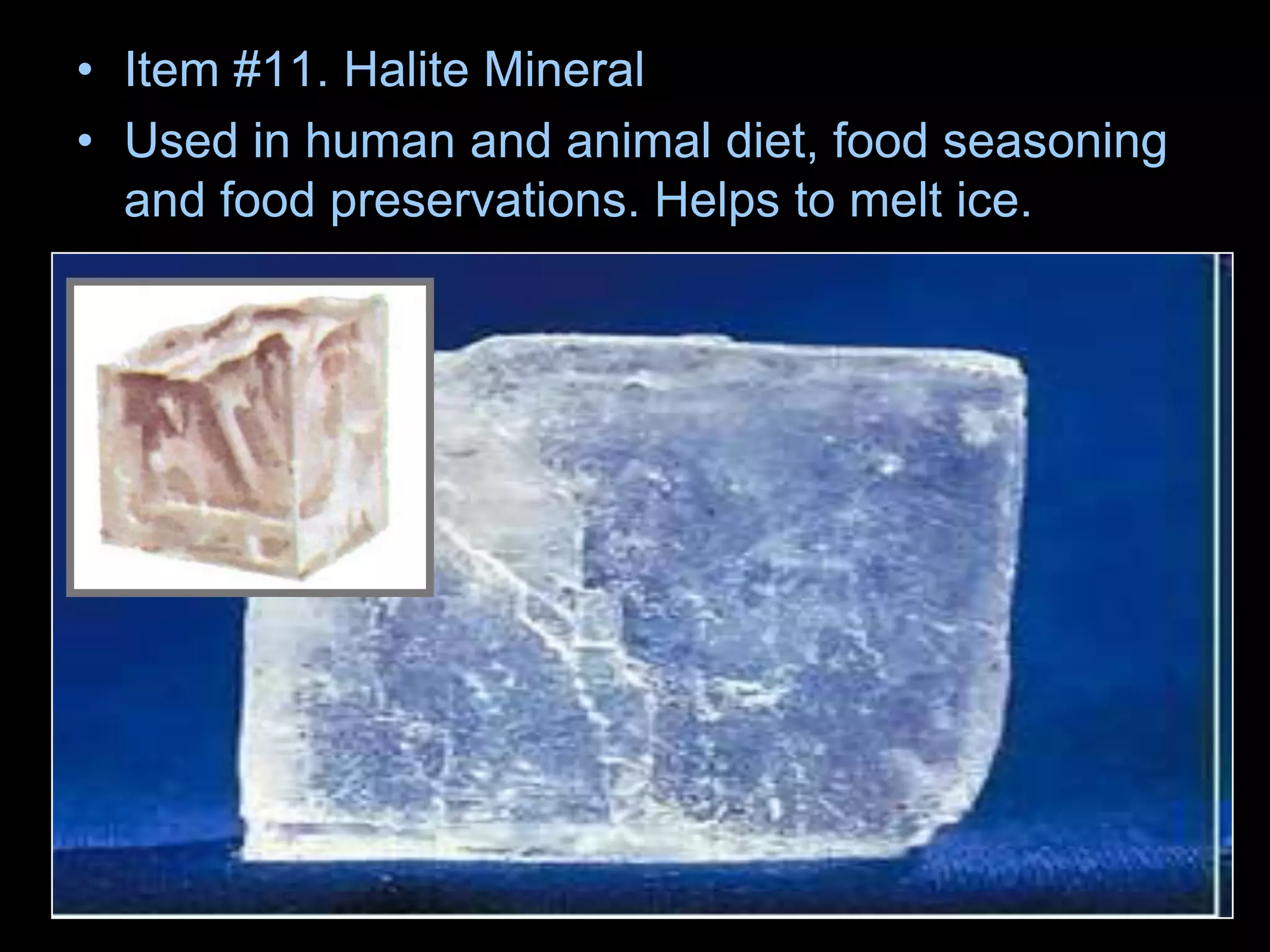
• Item #11. Halite Mineral
• Used in human and animal diet, food seasoning
and food preservations. Helps to melt ice.
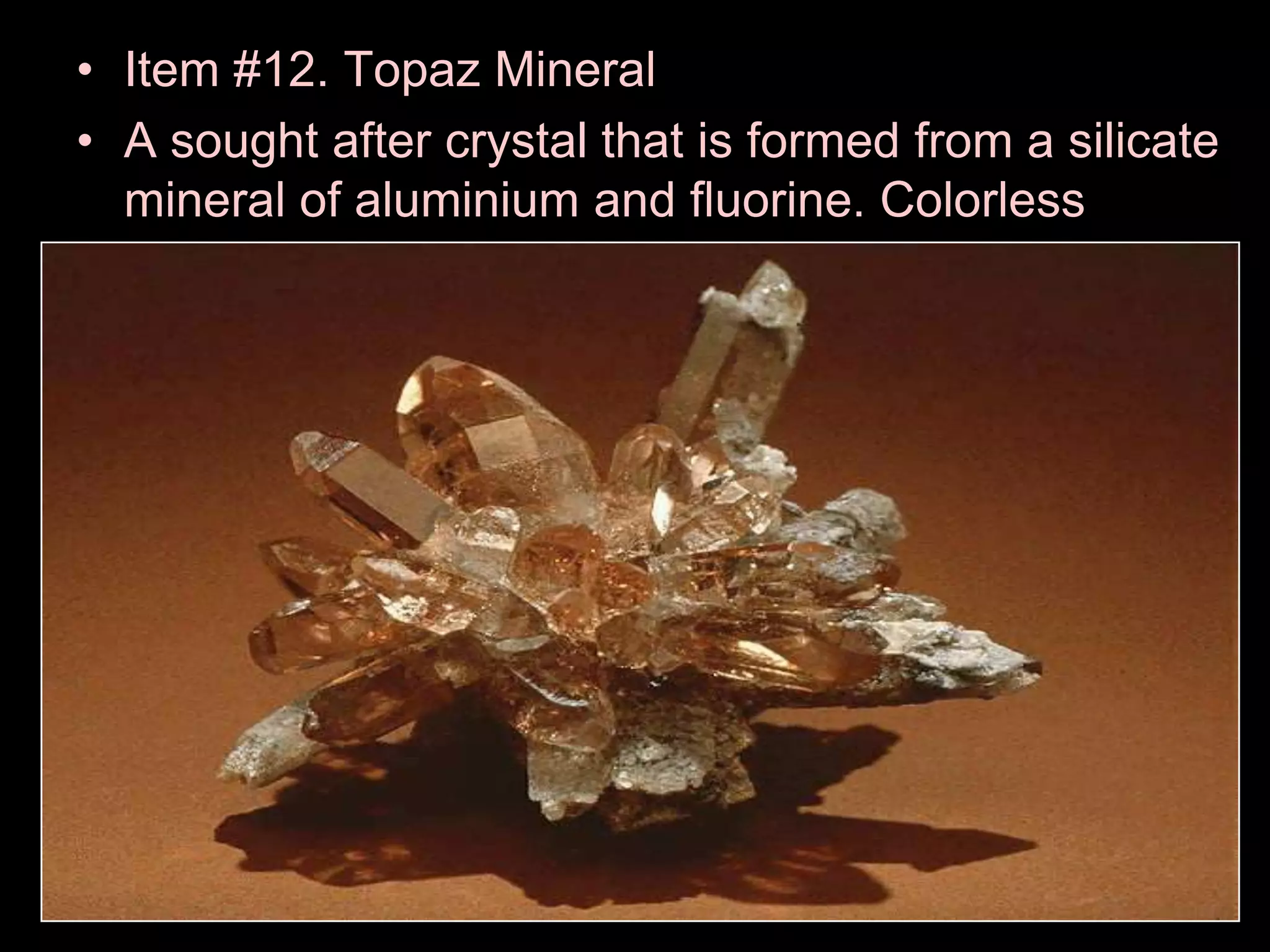
• Item #12. Topaz Mineral
• A sought after crystal that is formed from a silicate
mineral of aluminium and fluorine. Colorless
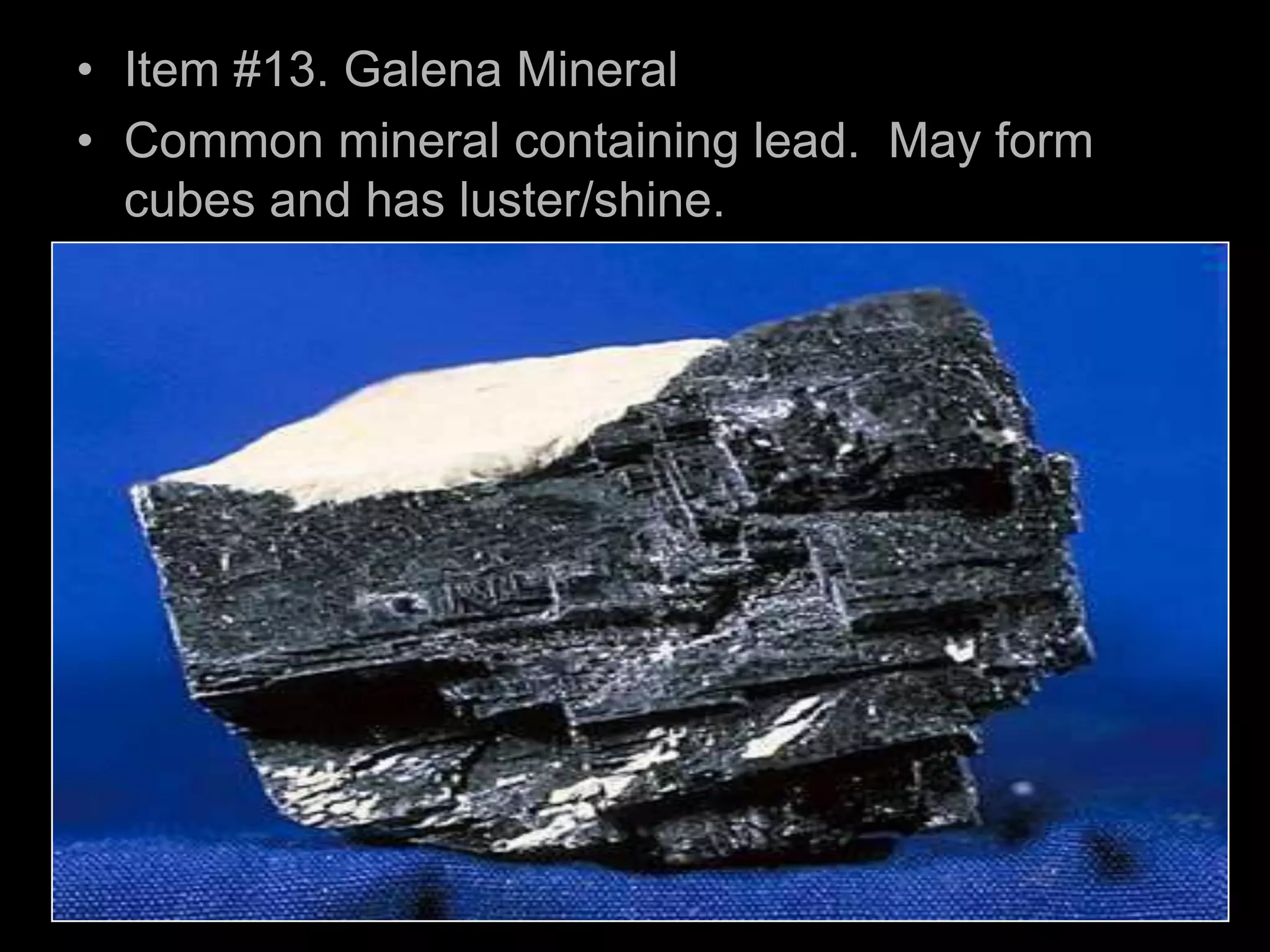
• Item #13. Galena Mineral
• Common mineral containing lead. May form
cubes and has luster/shine.
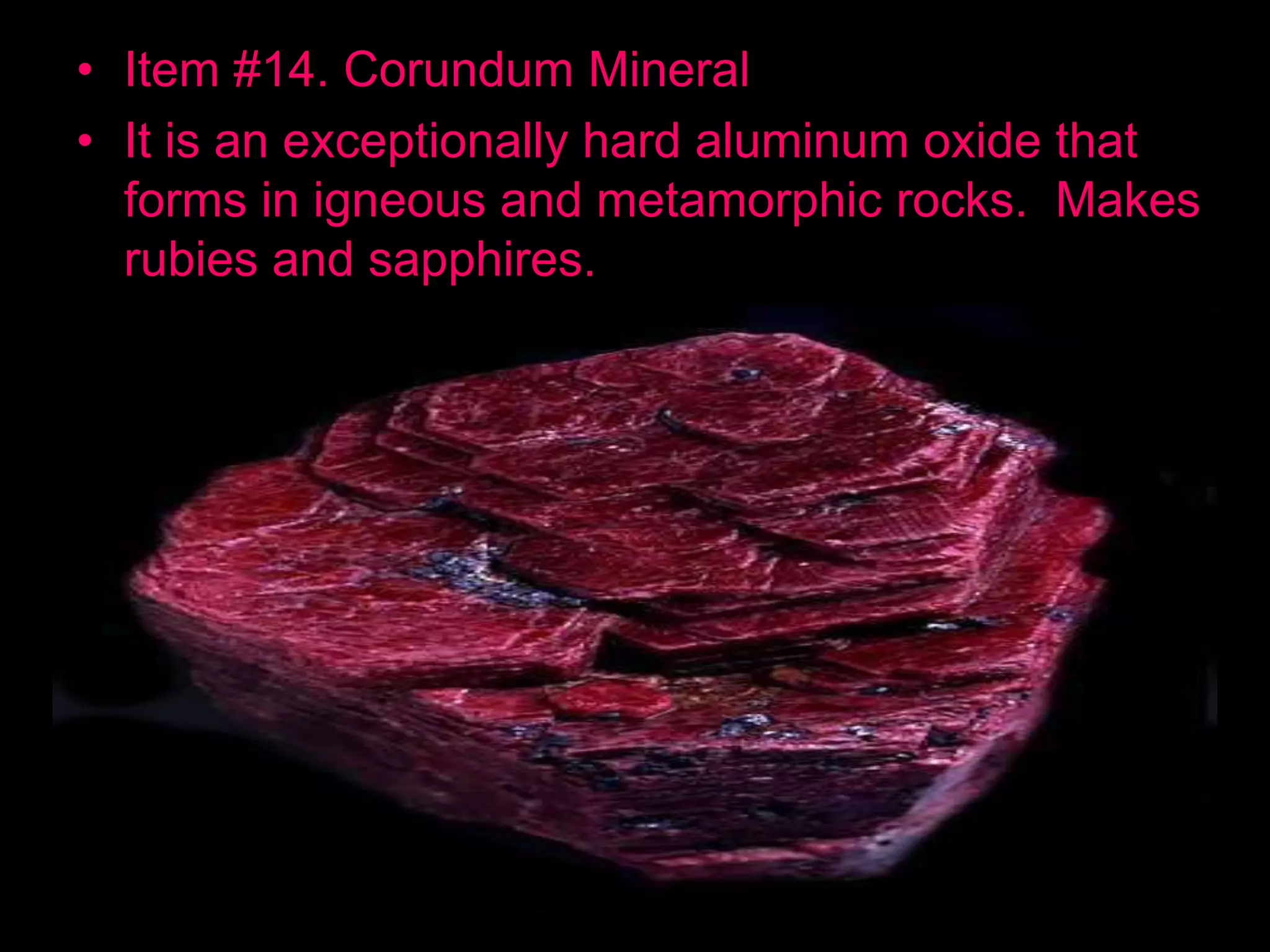
• Item #14. Corundum Mineral
• It is an exceptionally hard aluminum oxide that
forms in igneous and metamorphic rocks. Makes
rubies and sapphires.
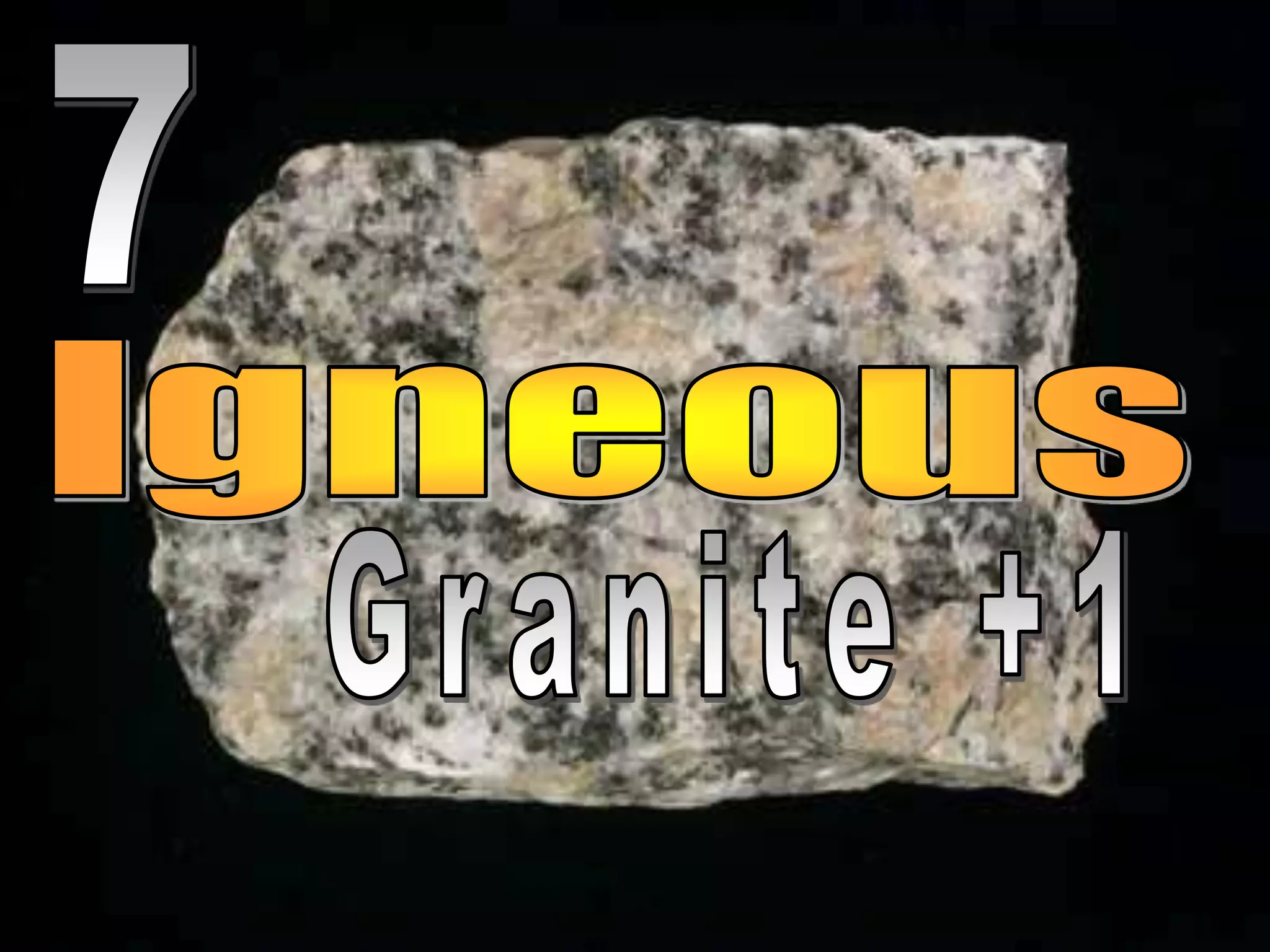
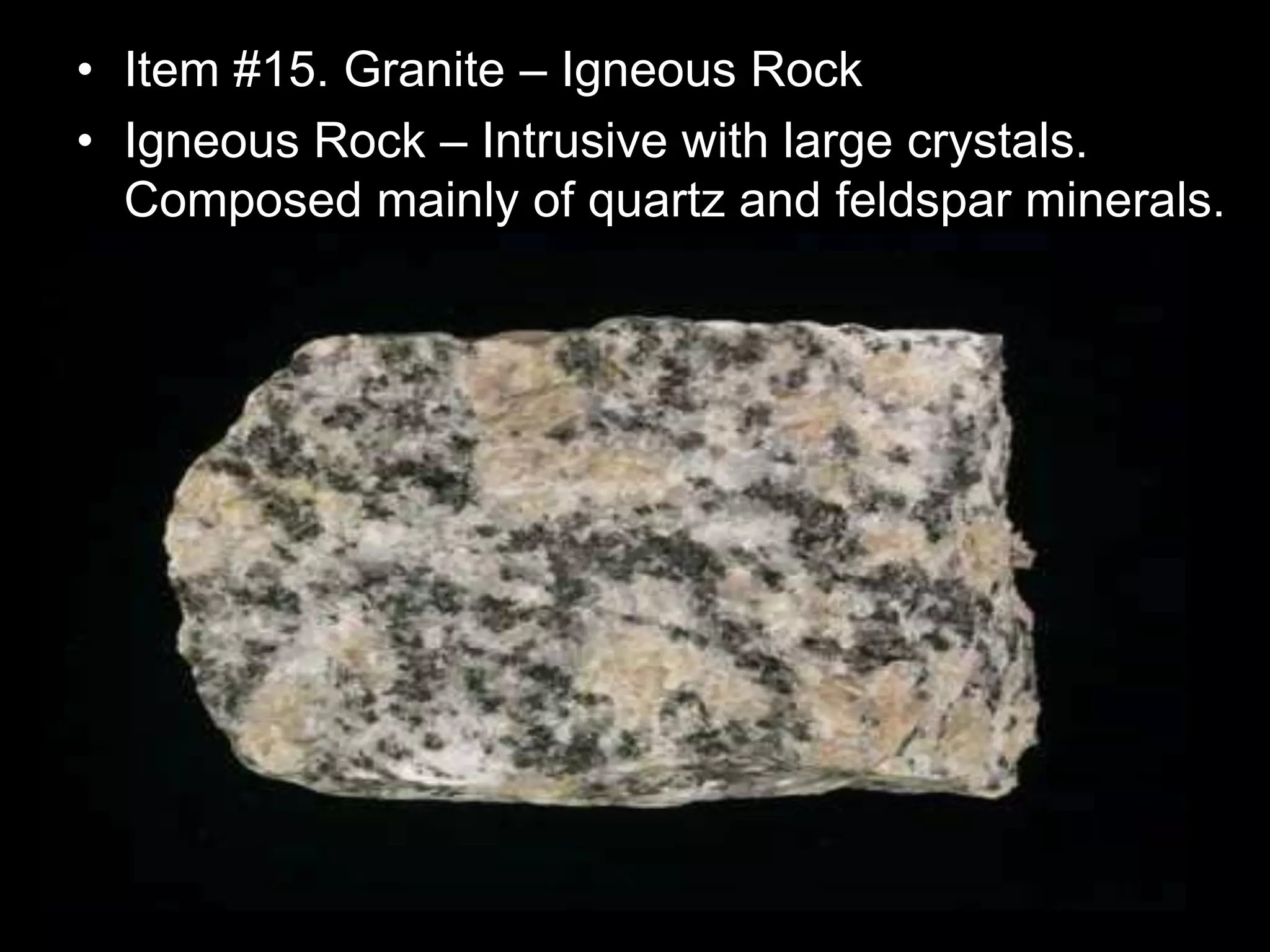
• Item #15. Granite – Igneous Rock
• Igneous Rock – Intrusive with large crystals.
Composed mainly of quartz and feldspar minerals.
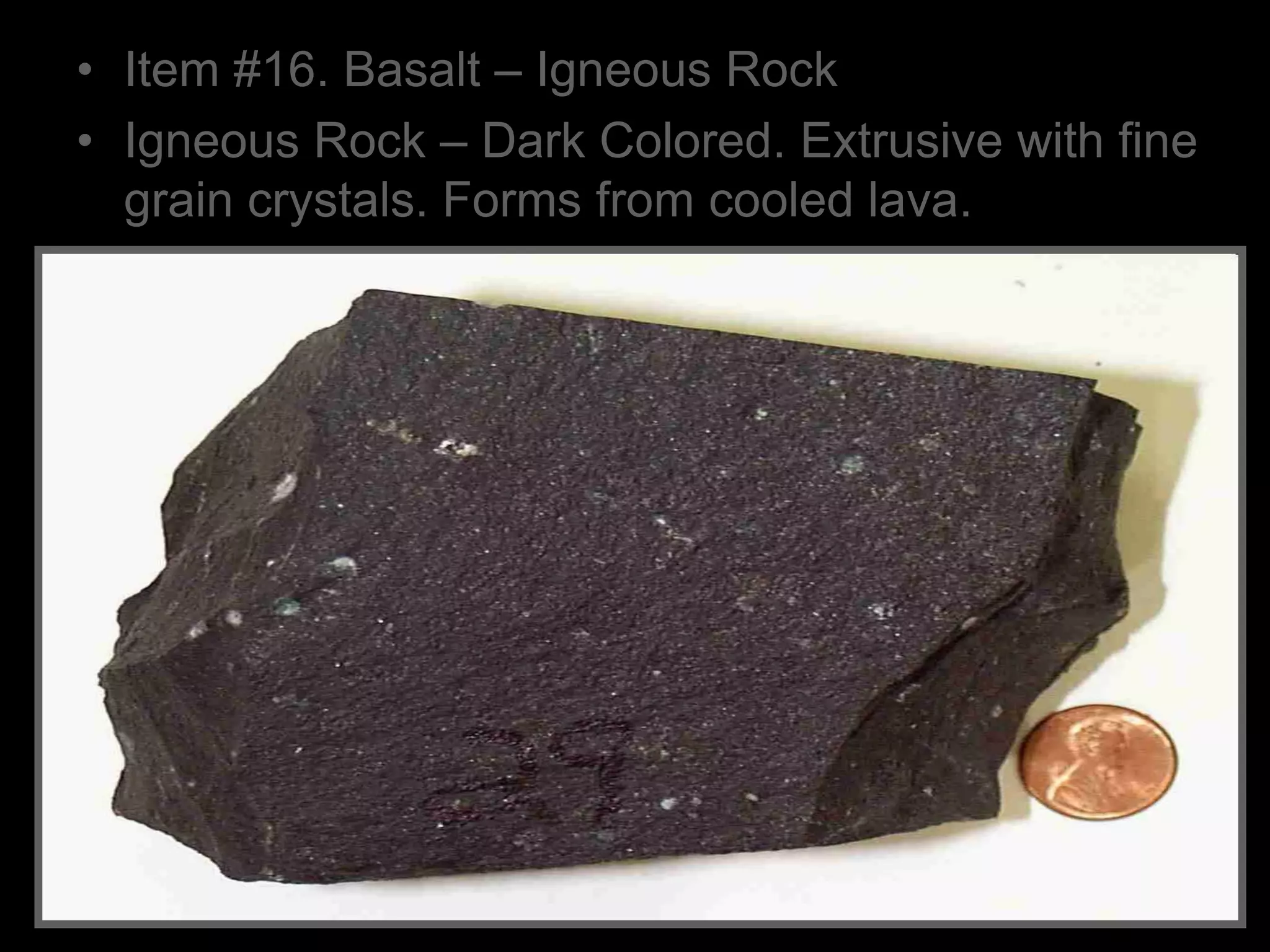
• Item #16. Basalt – Igneous Rock
• Igneous Rock – Dark Colored. Extrusive with fine
grain crystals. Forms from cooled lava.
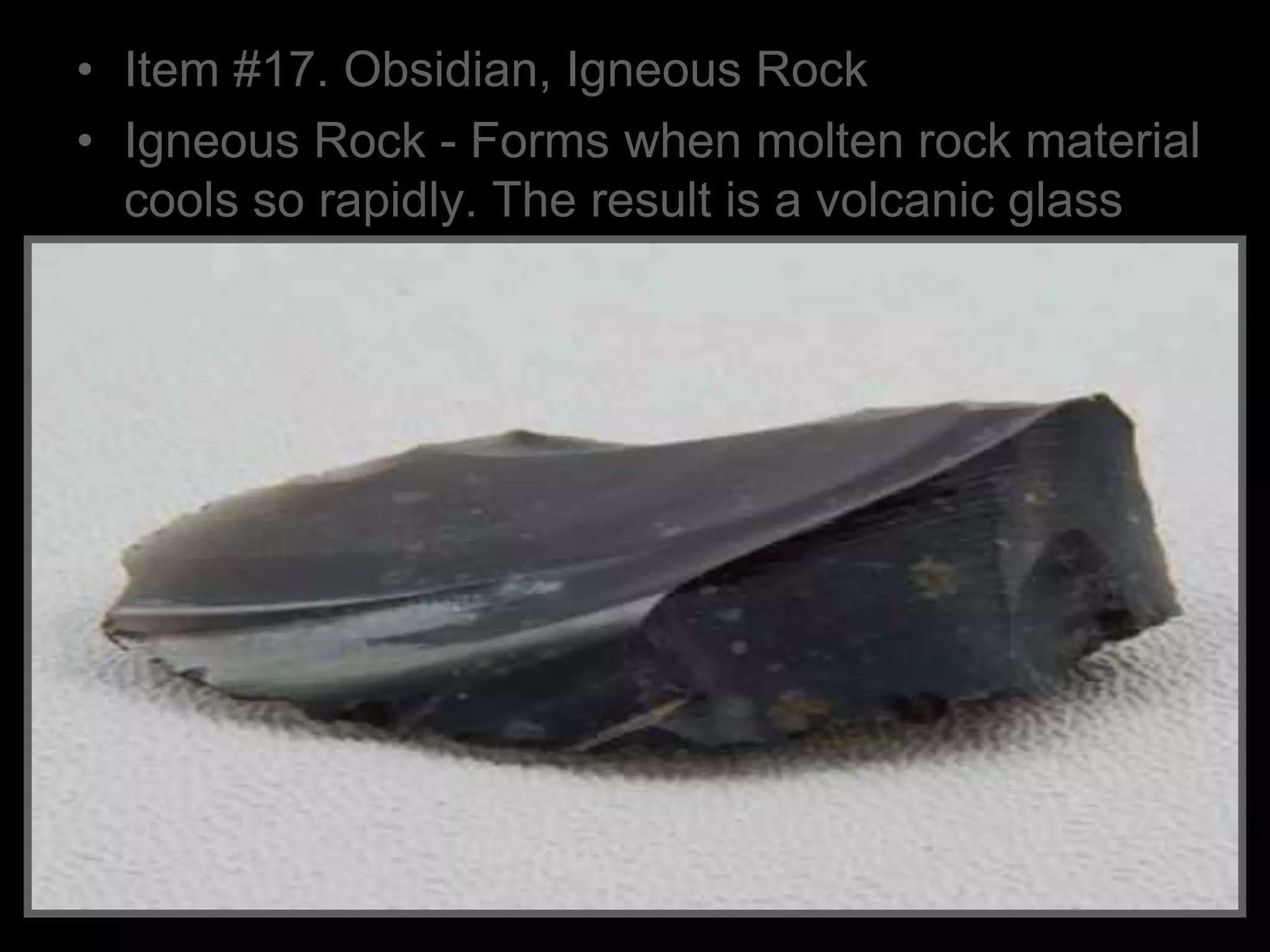
• Item #17. Obsidian, Igneous Rock
• Igneous Rock - Forms when molten rock material
cools so rapidly. The result is a volcanic glass
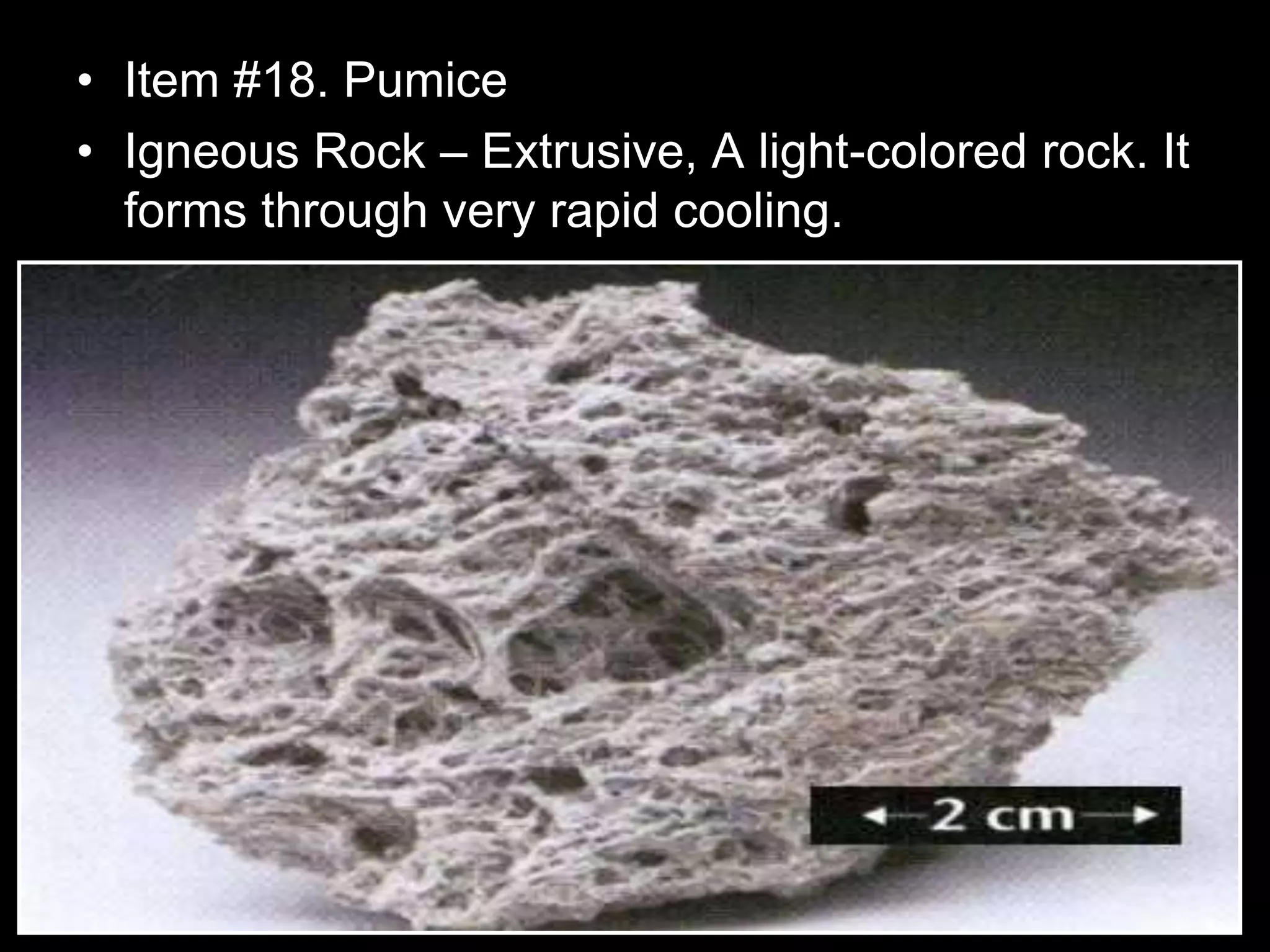
• Item #18. Pumice
• Igneous Rock – Extrusive, A light-colored rock. It
forms through very rapid cooling.
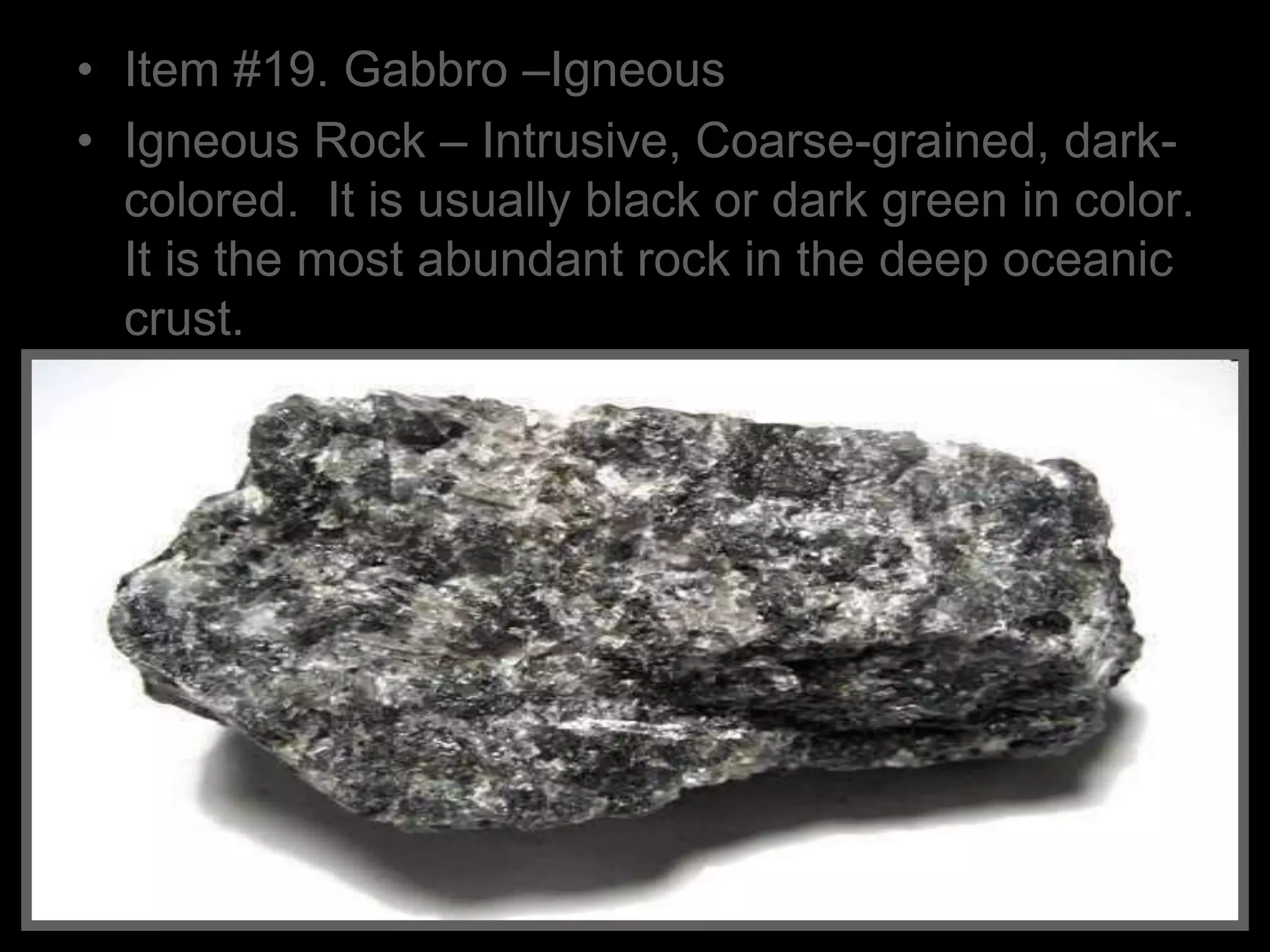
• Item #19. Gabbro –Igneous
• Igneous Rock – Intrusive, Coarse-grained, dark-
colored. It is usually black or dark green in color.
It is the most abundant rock in the deep oceanic
crust.
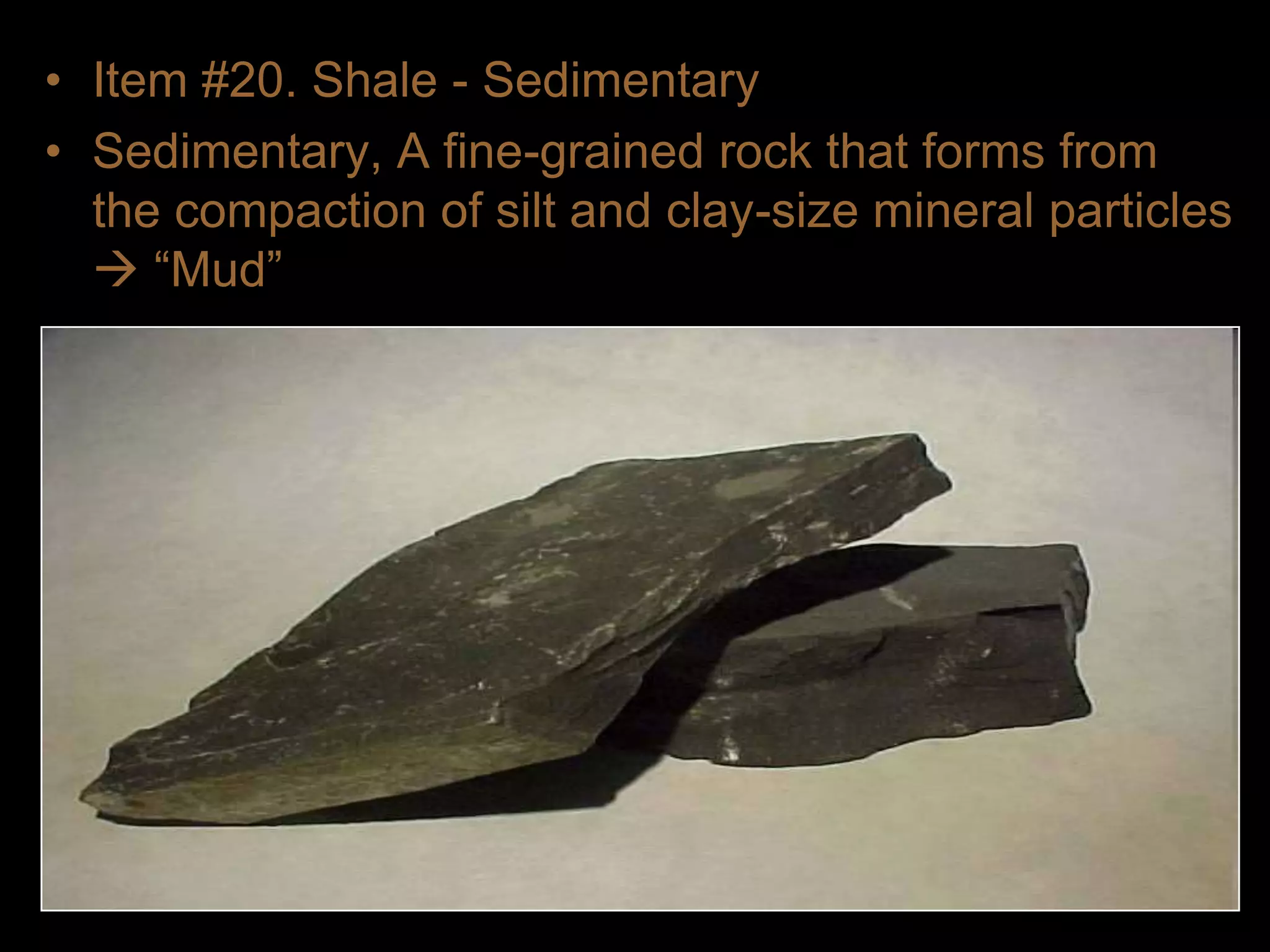
• Item #20. Shale - Sedimentary
• Sedimentary, A fine-grained rock that forms from
the compaction of silt and clay-size mineral particles
 “Mud”
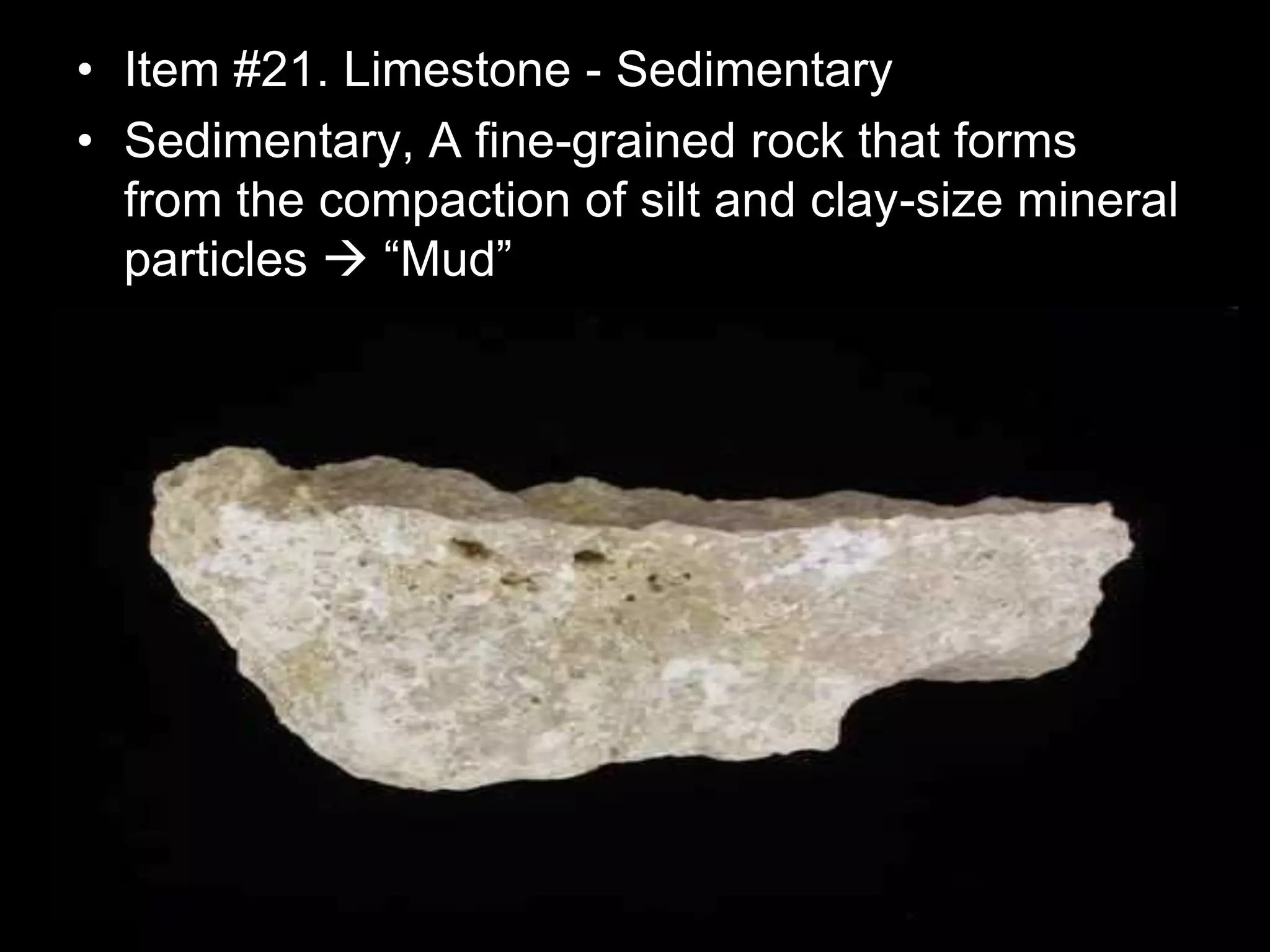
• Item #21. Limestone - Sedimentary
• Sedimentary, A fine-grained rock that forms
from the compaction of silt and clay-size mineral
particles  “Mud”
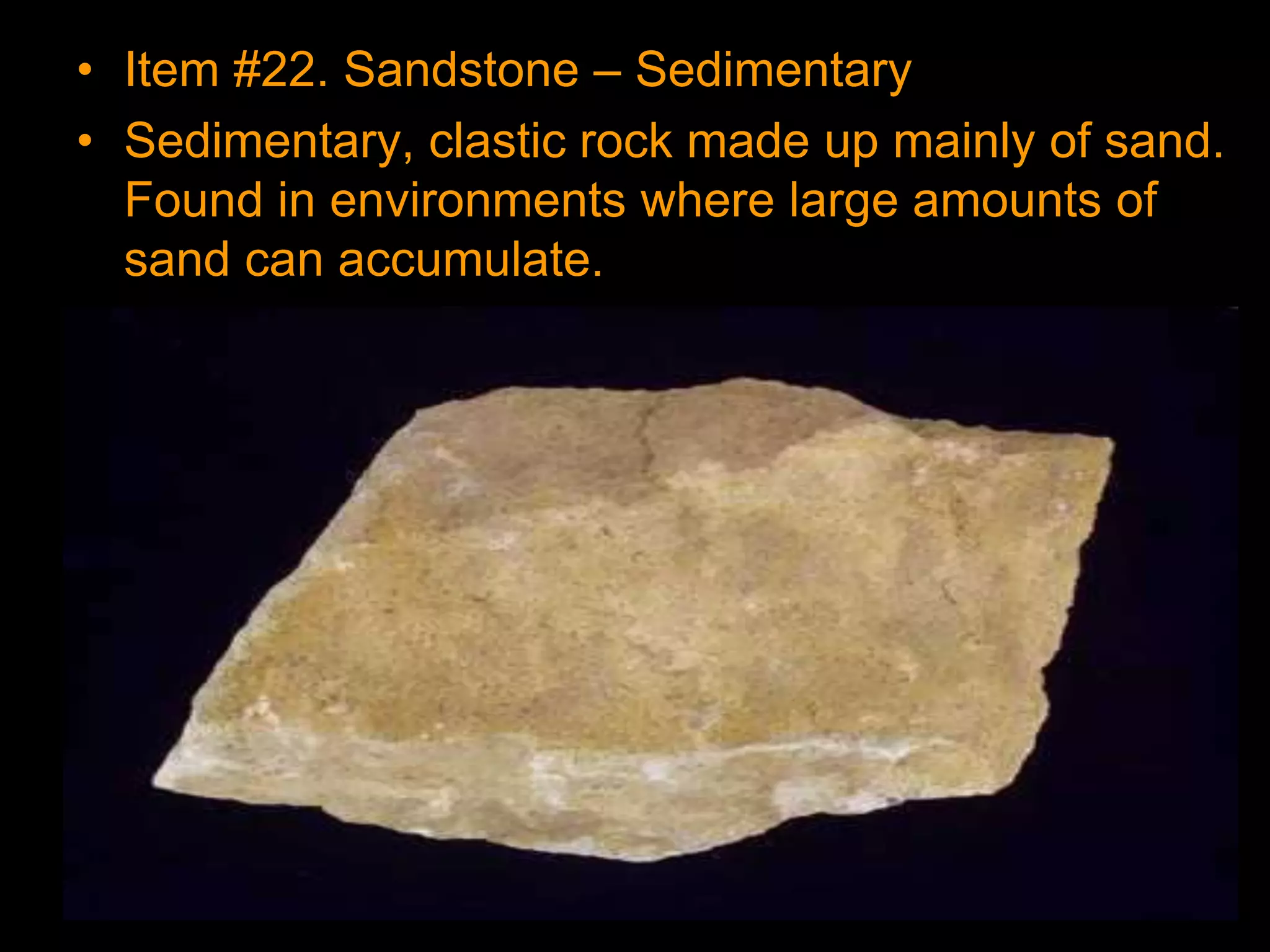
• Item #22. Sandstone – Sedimentary
• Sedimentary, clastic rock made up mainly of sand.
Found in environments where large amounts of
sand can accumulate.
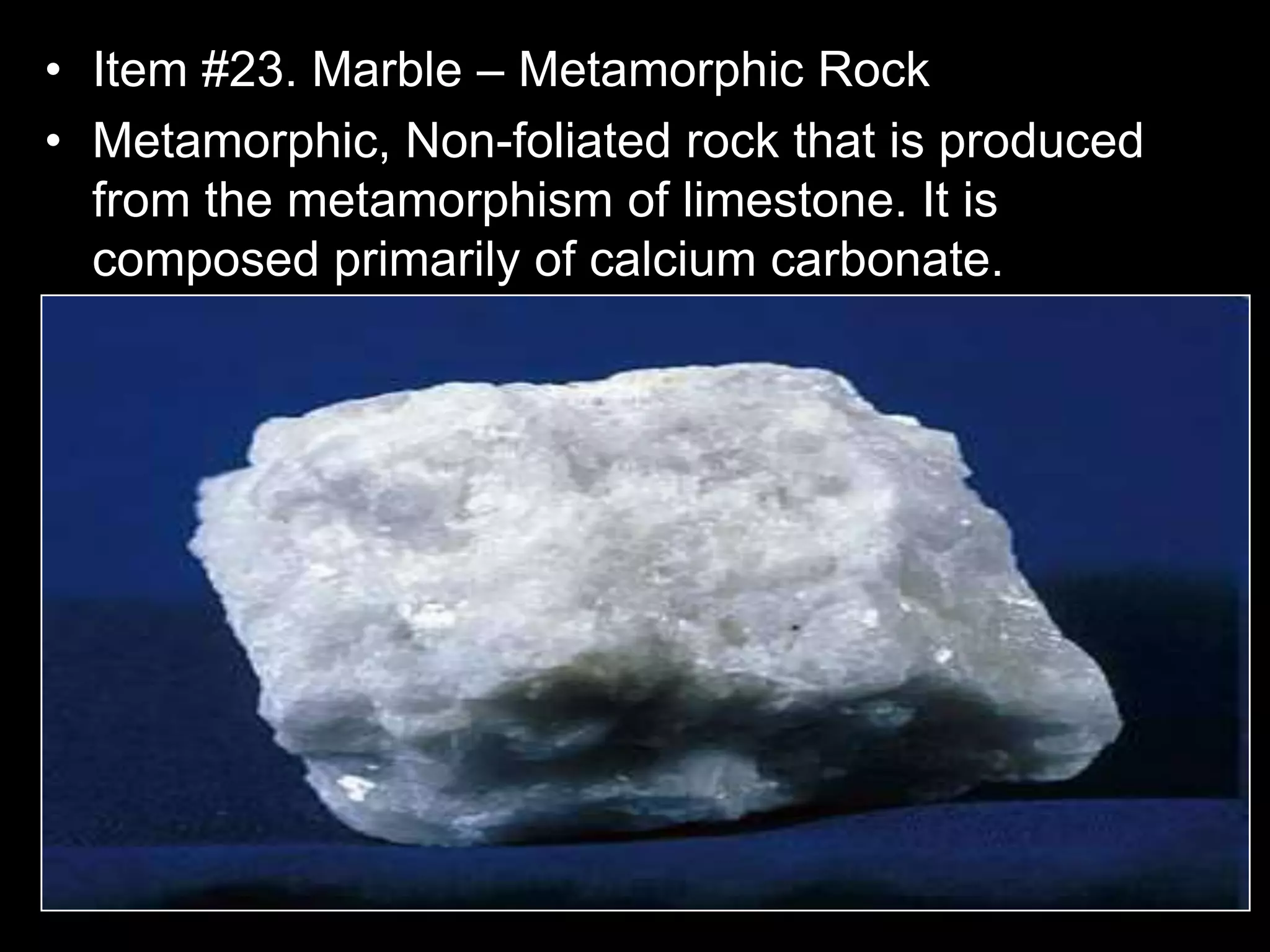
• Item #23. Marble – Metamorphic Rock
• Metamorphic, Non-foliated rock that is produced
from the metamorphism of limestone. It is
composed primarily of calcium carbonate.
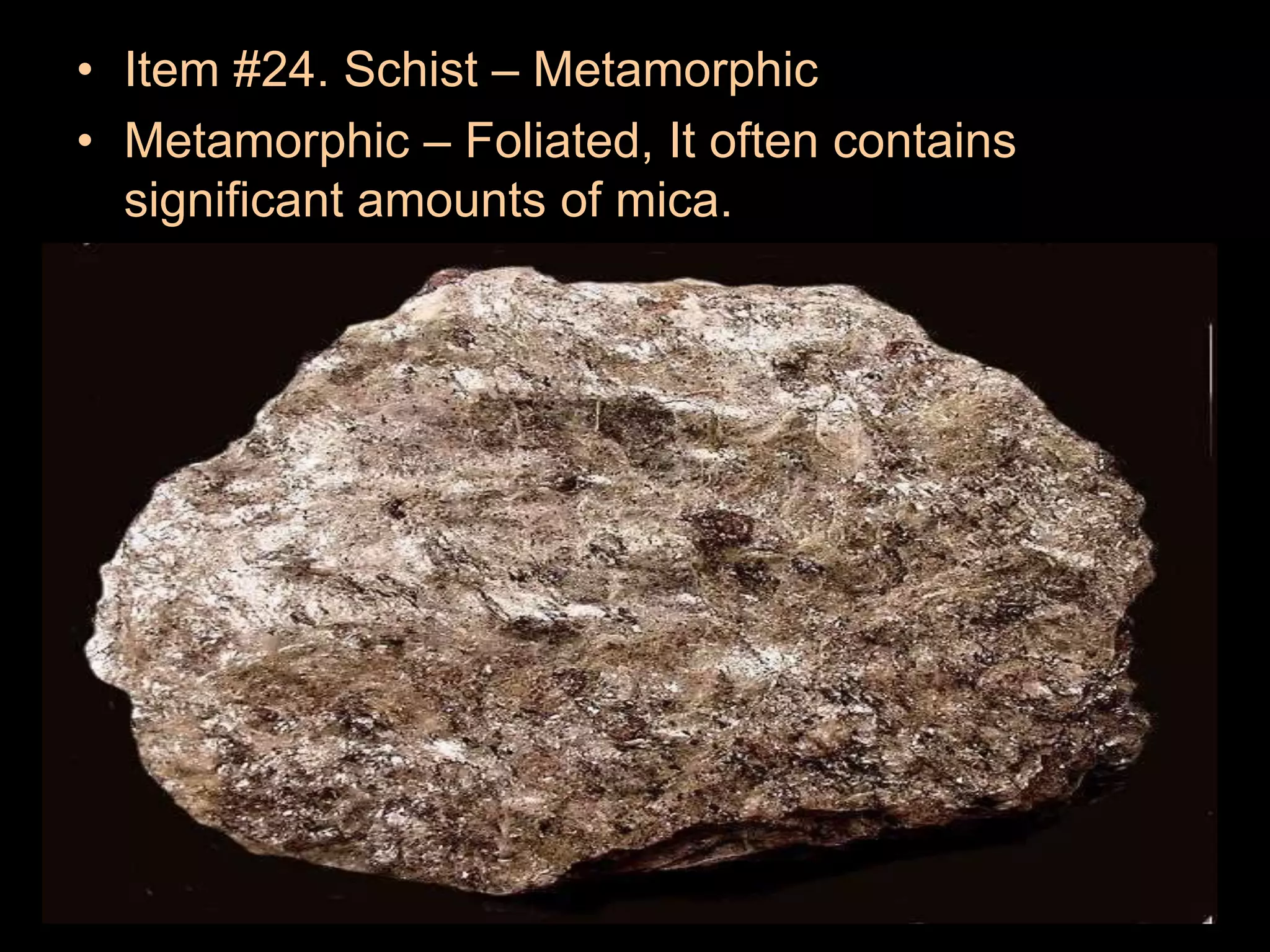
• Item #24. Schist – Metamorphic
• Metamorphic – Foliated, It often contains
significant amounts of mica.
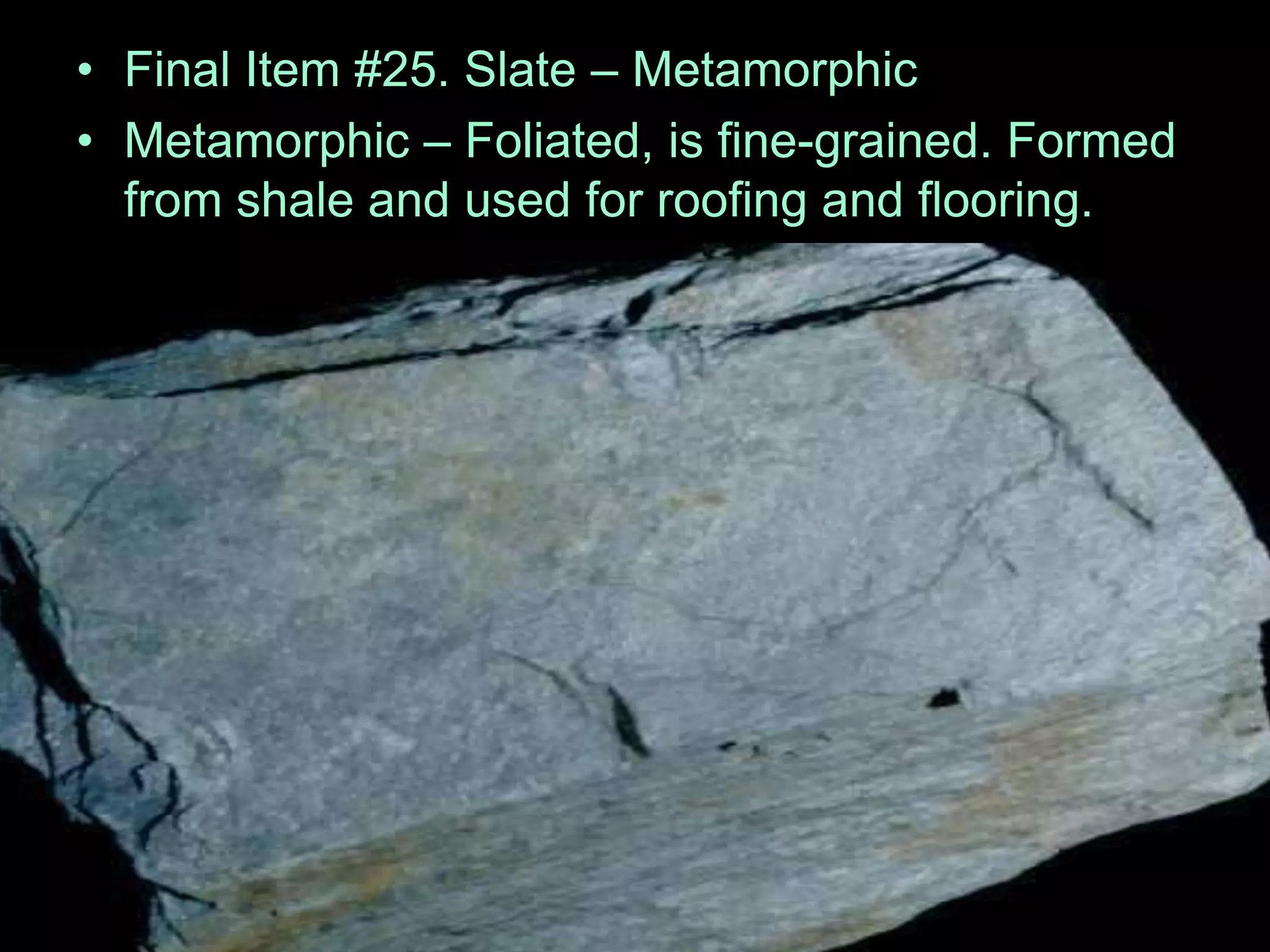
Final Item
• Final Item #25. Slate – Metamorphic
• Metamorphic – Foliated, is fine-grained. Formed
from shale and used for roofing and flooring.
Rocks can be
very…
Rocks can be
very…
Resourceful
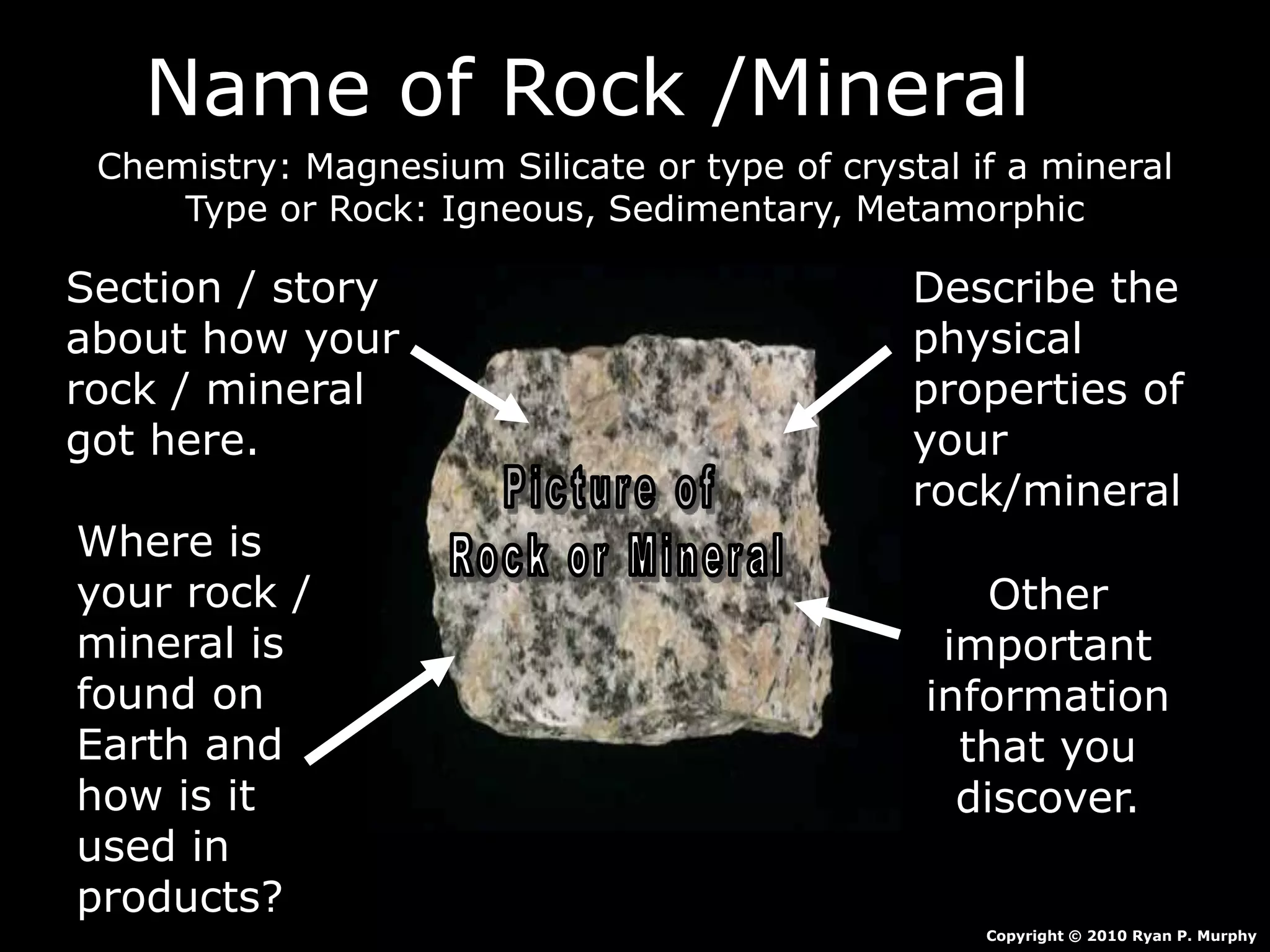
Name of Rock /Mineral
Chemistry: Magnesium Silicate or type of crystal if a mineral
Type or Rock: Igneous, Sedimentary, Metamorphic
Section / story
about how your
rock / mineral
got here.
Describe the
physical
properties of
your
rock/mineral
Where is
your rock /
mineral is
found on
Earth and
how is it
used in
products?
Other
important
information
that you
discover.
Copyright © 2010 Ryan P. Murphy
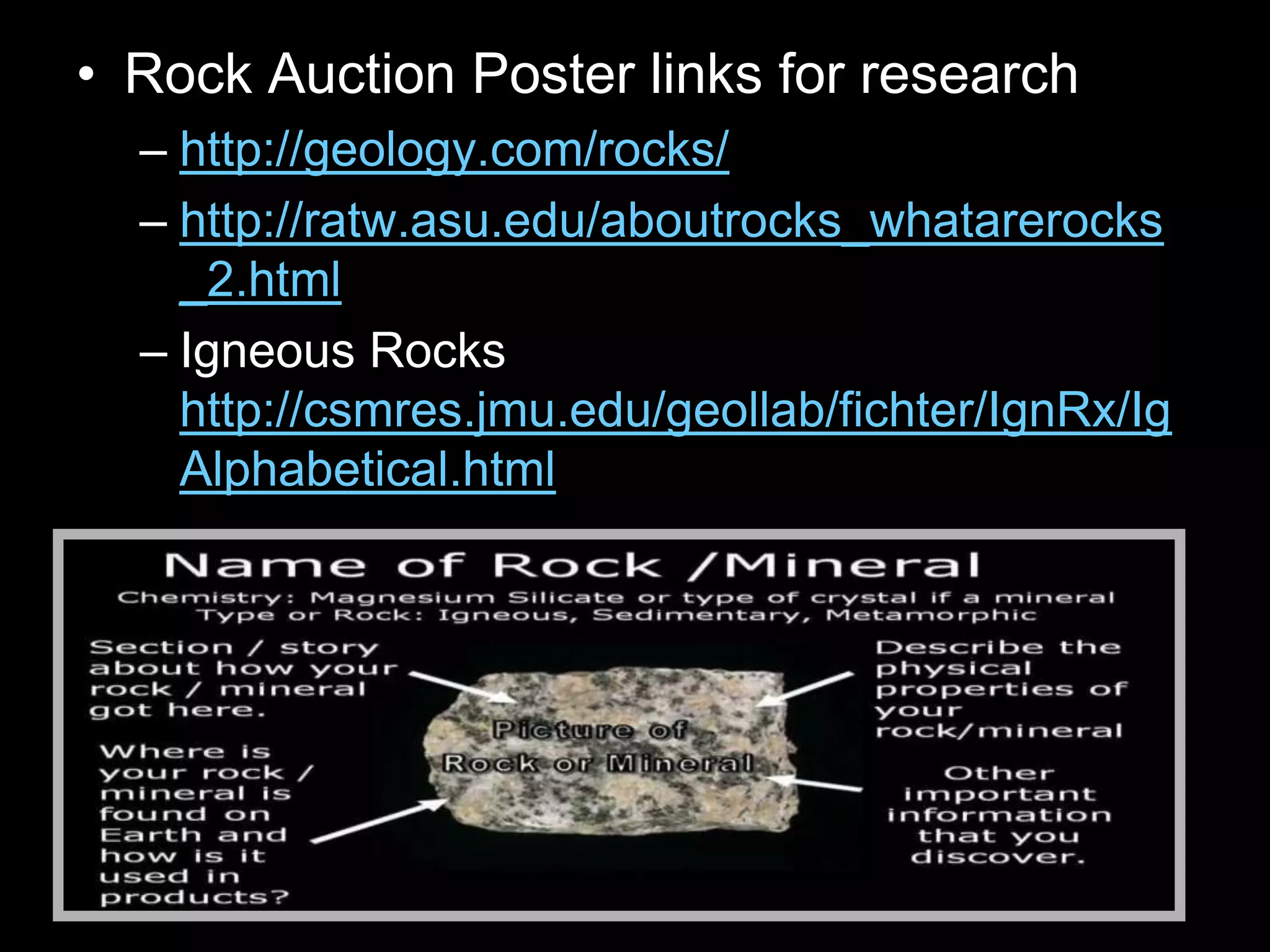
• Rock Auction Poster links for research
– http://geology.com/rocks/
– http://ratw.asu.edu/aboutrocks_whatarerocks
_2.html
– Igneous Rocks
http://csmres.jmu.edu/geollab/fichter/IgnRx/Ig
Alphabetical.html
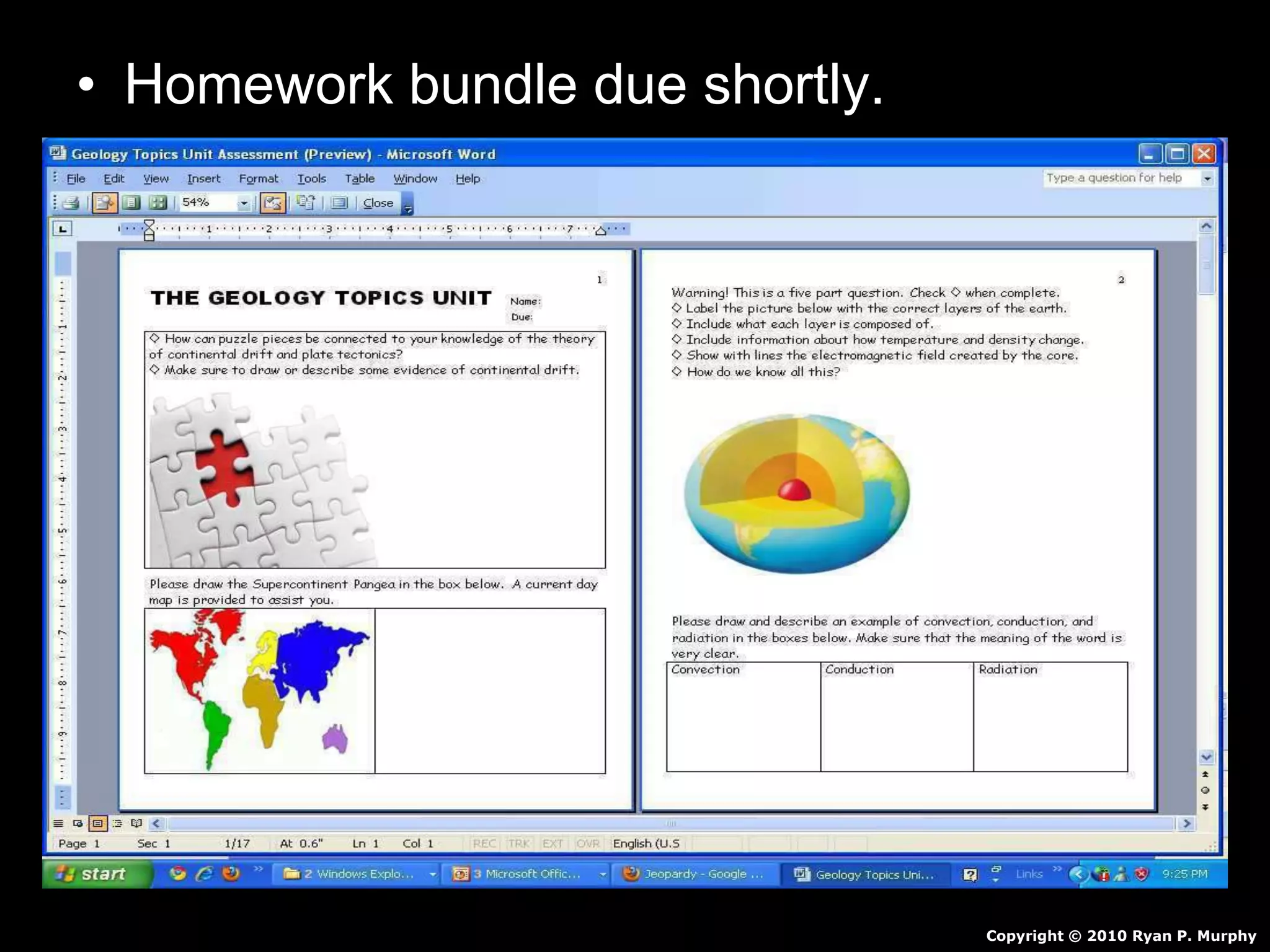
• Homework bundle due shortly.
Copyright © 2010 Ryan P. Murphy
http://sciencepowerpoint.com/Website Link:
• This part of the PowerPoint roadmap is just one small
part of my Geology Topics Unit. This unit includes…
• A six part 6,000 Slide PowerPoint Presentation / unit
roadmap full of activities, review questions, games, video
links, flashcards, materials list, and much more.
• A 18 bundled homework package, modified version, 19
pages of unit notes, 6 PowerPoint Review Games of
100+ slides each, videos, rubrics, and much more that
all chronologically follow the unit slideshow.
• This is a fantastic unit for any Earth Science Class.
• http://sciencepowerpoint.com/Geology_Unit.html
Areas of Focus within The Geology Topics Unit:
-Areas of Focus within The Geology Topics Unit: Plate Tectonics, Evidence for
Plate Tectonics, Pangea, Energy Waves, Layers of the Earth, Heat Transfer,
Types of Crust, Plate Boundaries, Hot Spots, Volcanoes, Positives and
Negatives of Volcanoes, Types of Volcanoes, Parts of a Volcano, Magma, Types
of Lava, Viscosity, Earthquakes, Faults, Folds, Seismograph, Richter Scale,
Seismograph, Tsunami’s, Rocks, Minerals, Crystals, Uses of Minerals, Types of
Crystals, Physical Properties of Minerals, Rock Cycle, Common Igneous Rocks,
Common Sedimentary Rocks, Common Metamorphic Rocks., Age of the Earth,
Uniformitarianism, Principle of Superposition, Earth History, Time Units,
Timeline of Events, Basic Evolution, Mass Extinction Events, Dinosaurs, Early
Mammals, and more.
Full Unit can be found at…
http://sciencepowerpoint.com/Geology_Unit.html
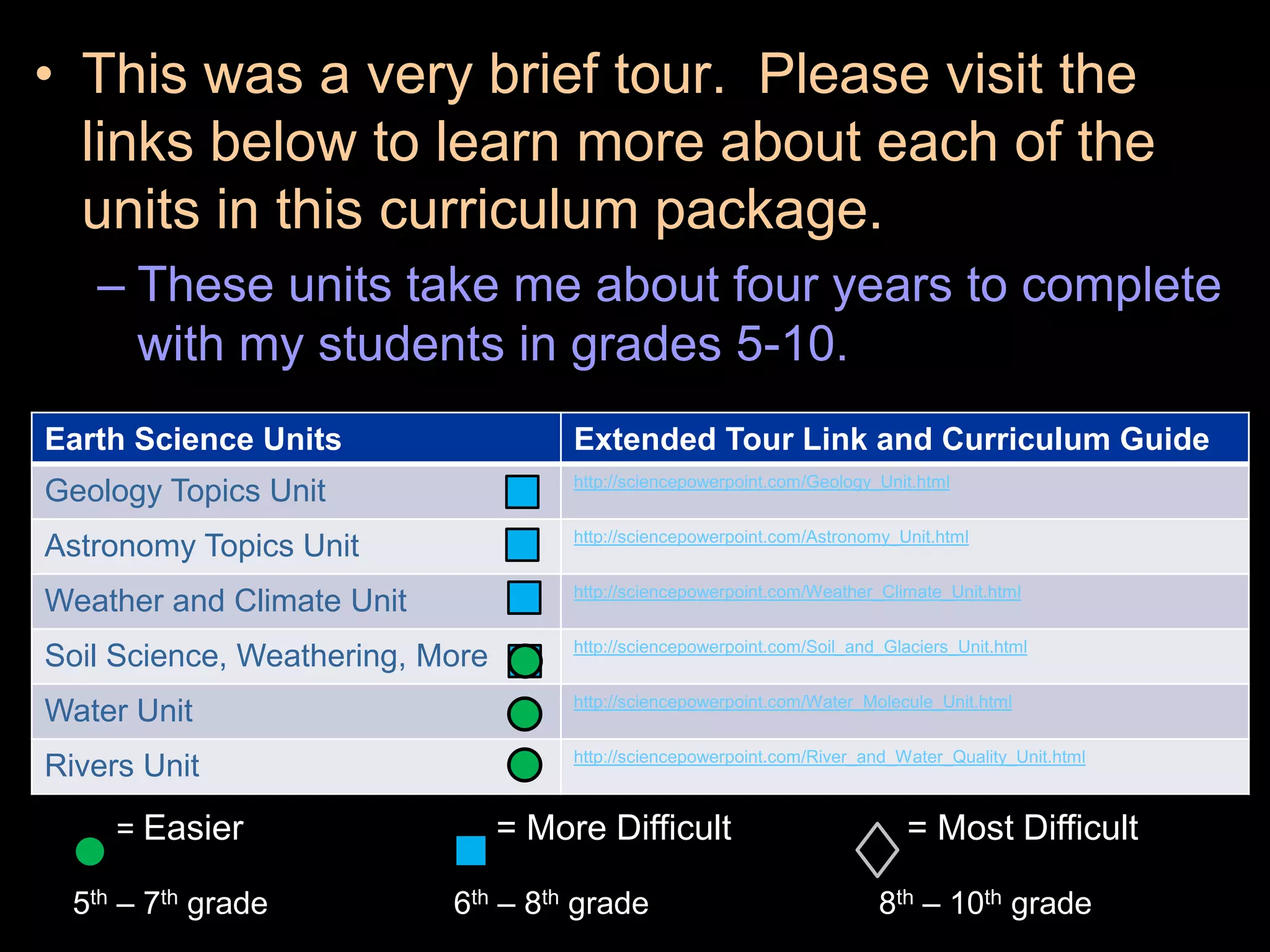
• This was a very brief tour. Please visit the
links below to learn more about each of the
units in this curriculum package.
– These units take me about four years to complete
with my students in grades 5-10.
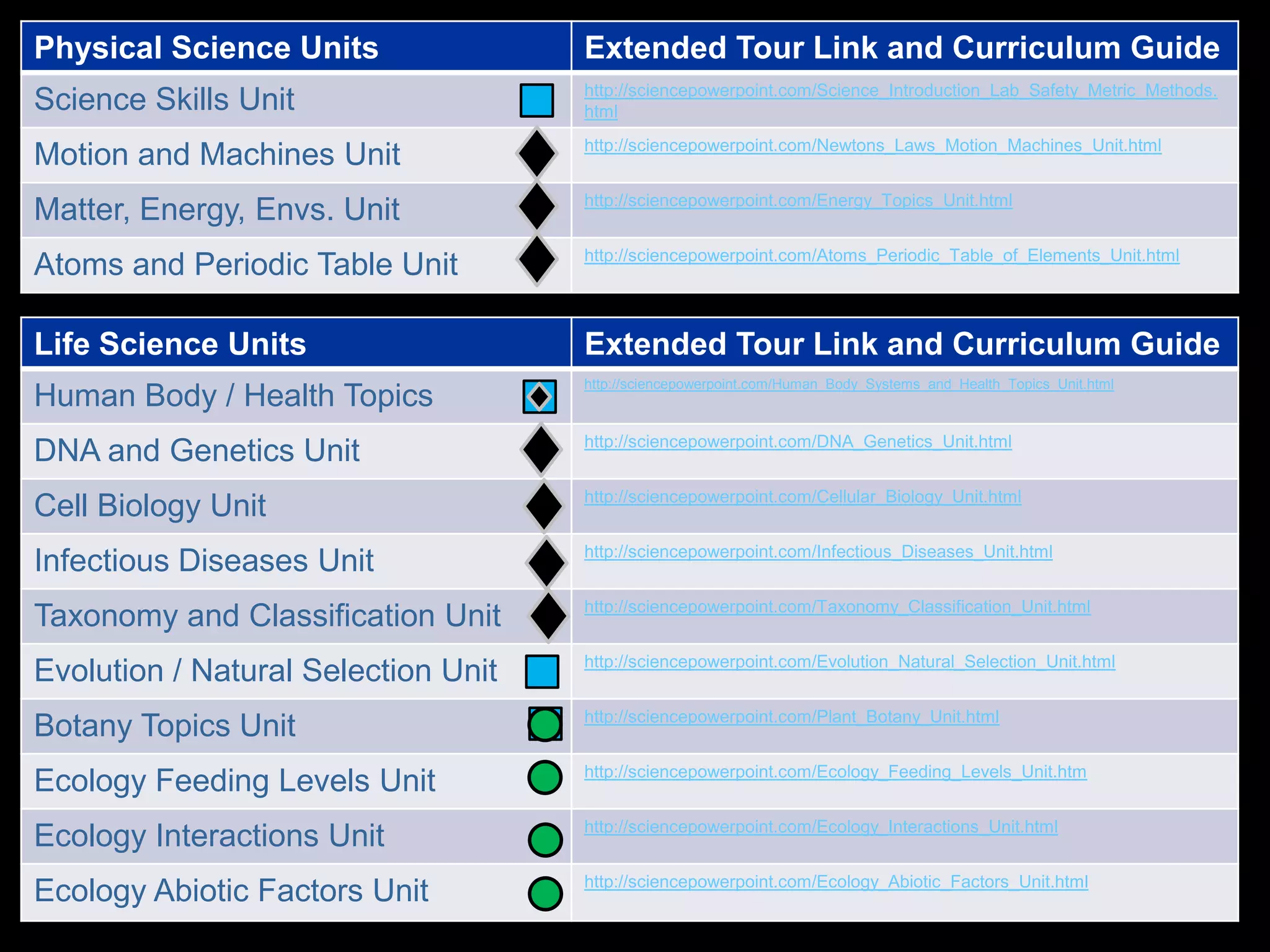
Earth Science Units Extended Tour Link and Curriculum Guide
Geology Topics Unit http://sciencepowerpoint.com/Geology_Unit.html
Astronomy Topics Unit http://sciencepowerpoint.com/Astronomy_Unit.html
Weather and Climate Unit http://sciencepowerpoint.com/Weather_Climate_Unit.html
Soil Science, Weathering, More http://sciencepowerpoint.com/Soil_and_Glaciers_Unit.html
Water Unit http://sciencepowerpoint.com/Water_Molecule_Unit.html
Rivers Unit http://sciencepowerpoint.com/River_and_Water_Quality_Unit.html
= Easier = More Difficult = Most Difficult
5th – 7th grade 6th – 8th grade 8th – 10th grade
Physical Science Units Extended Tour Link and Curriculum Guide
Science Skills Unit http://sciencepowerpoint.com/Science_Introduction_Lab_Safety_Metric_Methods.
html
Motion and Machines Unit http://sciencepowerpoint.com/Newtons_Laws_Motion_Machines_Unit.html
Matter, Energy, Envs. Unit http://sciencepowerpoint.com/Energy_Topics_Unit.html
Atoms and Periodic Table Unit http://sciencepowerpoint.com/Atoms_Periodic_Table_of_Elements_Unit.html
Life Science Units Extended Tour Link and Curriculum Guide
Human Body / Health Topics
http://sciencepowerpoint.com/Human_Body_Systems_and_Health_Topics_Unit.html
DNA and Genetics Unit http://sciencepowerpoint.com/DNA_Genetics_Unit.html
Cell Biology Unit http://sciencepowerpoint.com/Cellular_Biology_Unit.html
Infectious Diseases Unit http://sciencepowerpoint.com/Infectious_Diseases_Unit.html
Taxonomy and Classification Unit http://sciencepowerpoint.com/Taxonomy_Classification_Unit.html
Evolution / Natural Selection Unit http://sciencepowerpoint.com/Evolution_Natural_Selection_Unit.html
Botany Topics Unit http://sciencepowerpoint.com/Plant_Botany_Unit.html
Ecology Feeding Levels Unit http://sciencepowerpoint.com/Ecology_Feeding_Levels_Unit.htm
Ecology Interactions Unit http://sciencepowerpoint.com/Ecology_Interactions_Unit.html
Ecology Abiotic Factors Unit http://sciencepowerpoint.com/Ecology_Abiotic_Factors_Unit.html
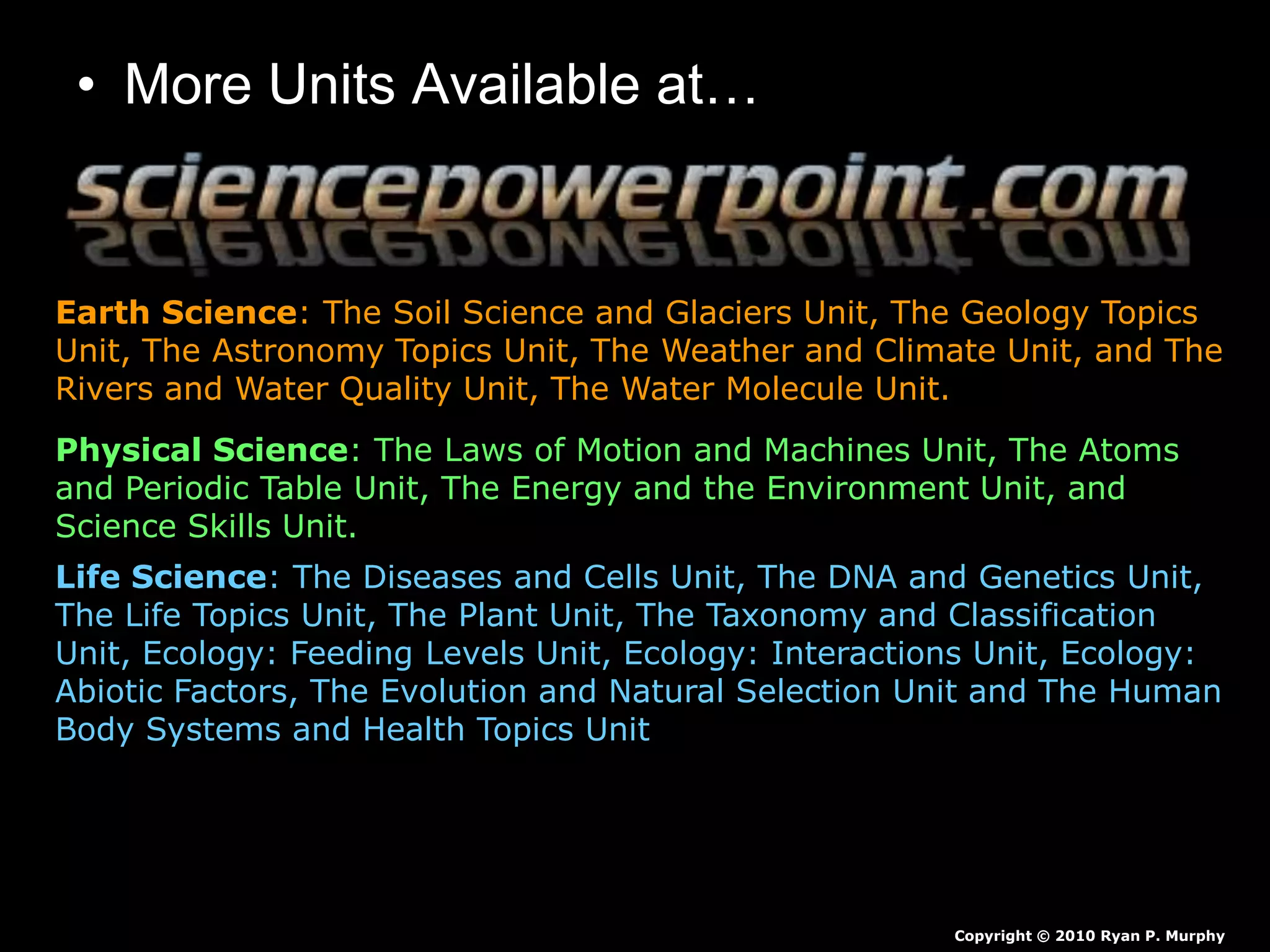
• More Units Available at…
Earth Science: The Soil Science and Glaciers Unit, The Geology Topics
Unit, The Astronomy Topics Unit, The Weather and Climate Unit, and The
Rivers and Water Quality Unit, The Water Molecule Unit.
Physical Science: The Laws of Motion and Machines Unit, The Atoms
and Periodic Table Unit, The Energy and the Environment Unit, and
Science Skills Unit.
Life Science: The Diseases and Cells Unit, The DNA and Genetics Unit,
The Life Topics Unit, The Plant Unit, The Taxonomy and Classification
Unit, Ecology: Feeding Levels Unit, Ecology: Interactions Unit, Ecology:
Abiotic Factors, The Evolution and Natural Selection Unit and The Human
Body Systems and Health Topics Unit
Copyright © 2010 Ryan P. Murphy
• The entire four year curriculum can be found at...
http://sciencepowerpoint.com/ Please feel free to
contact me with any questions you may have.
Thank you for your interest in this curriculum.
Sincerely,
Ryan Murphy M.Ed
www.sciencepowerpoint@gmail.com
http://sciencepowerpoint.com/Website Link:

Name that Rock Quiz, Rock Cycle, Earth Science Lesson PowerPoint

  • 1.
    6 Sedimentary, clastic rock madeup mainly of sand. Found in environments where large amounts of sand can accumulate.
  • 3.
    • RED SLIDE:These are notes that are very important and should be recorded in your science journal. Copyright © 2010 Ryan P. Murphy
  • 4.
    -Nice neat notesthat are legible and use indentations when appropriate. -Example of indent. -Skip a line between topics -Don’t skip pages -Make visuals clear and well drawn.
  • 5.
    • RED SLIDE:These are notes that are very important and should be recorded in your science journal. • BLACK SLIDE: Pay attention, follow directions, complete projects as described and answer required questions neatly. Copyright © 2010 Ryan P. Murphy
  • 6.
  • 7.
    • Please complete the nexttwo quizzes on your homework sheet.
  • 8.
    • Quiz Wiz1-10 Igneous, Metamorphic, Sedimentary + Name the rock for a bonus. • Work on Unit Assessment Copyright © 2010 Ryan P. Murphy
  • 20.
    Teacher will invitegroups up to the mystery rock.
  • 21.
  • 22.
    • Answers! QuizWiz 1-10 Igneous, Metamorphic, Sedimentary + Name the rock for a bonus. Copyright © 2010 Ryan P. Murphy
  • 53.
    Teacher will invitegroups up to the mystery rock.
  • 54.
  • 55.
    • Answer! Schoolof Rock (2003).
  • 56.
    • Please completethis question.
  • 58.
    • Rocks MusicVideo Link! – http://www.youtube.com/watch?v=b_4Y21Ppr zw&feature=results_video&playnext=1&list=P LFA1C870D09D1B48E
  • 59.
    • Please complete the nexttwo quizzes on your homework sheet.
  • 60.
    • Quiz Wiz1-10 Name the rock. Copyright © 2010 Ryan P. Murphy
  • 62.
  • 63.
  • 64.
    1 Igneous Rock – Extrusive,a light-colored, fine-grained rock that typically contains quartz and feldspar minerals.
  • 65.
  • 66.
  • 67.
    2 Sedimentary, A fine-grained rockthat forms from the compaction of silt and clay- size mineral particles  “Mud”
  • 68.
  • 69.
  • 70.
    3 Igneous Rock – Intrusivewith large crystals. Composed mainly of quartz and feldspar.
  • 71.
  • 72.
  • 73.
    4 Igneous Rock –Intrusive, Coarse- grained, dark-colored. It is usually black or dark green in color. It is the most abundant rock in the deep oceanic crust.
  • 74.
  • 75.
  • 76.
    5 Sedimentary - Composed primarilyof calcium carbonate – (Calcite), forms in marine waters and often has fossils.
  • 77.
  • 78.
  • 79.
    6 Sedimentary, clastic rock madeup mainly of sand. Found in environments where large amounts of sand can accumulate.
  • 80.
    • Schist. Copyright ©2010 Ryan P. Murphy 7 .
  • 81.
    • Schist. Copyright ©2010 Ryan P. Murphy 7
  • 82.
    • Schist. Copyright ©2010 Ryan P. Murphy 7 Metamorphic – Foliated, It often contains significant amounts of mica.
  • 83.
  • 84.
  • 85.
    8 Igneous Rock –Dark Colored. Extrusive with fine grain crystals. Forms from cooled lava.
  • 86.
    8 Igneous Rock –Dark Colored. Extrusive with fine grain crystals. Forms from cooled lava.
  • 87.
    8 Igneous Rock –Dark Colored. Extrusive with fine grain crystals. Forms from cooled lava.
  • 88.
  • 89.
  • 90.
    9 Igneous Rock – Extrusive,A light- colored rock. It forms through very rapid cooling.
  • 91.
  • 92.
  • 93.
    10 Metamorphic, Non- foliated rockthat is produced from the metamorphism of limestone. It is composed primarily of calcium carbonate.
  • 94.
  • 95.
  • 96.
    *11 Sedimentary, -Clastic Rockthat contains large rounded clasts. The space between the clasts is generally filled with small particles that binds the rock together.
  • 97.
  • 98.
    • Answers! QuizWiz 1-10 Name that Rock. Copyright © 2010 Ryan P. Murphy
  • 99.
    • Answers! QuizWiz 1-10 Name that Rock. Copyright © 2010 Ryan P. Murphy
  • 100.
  • 101.
  • 102.
    1 Igneous Rock – Extrusive,a light-colored, fine-grained rock that typically contains quartz and feldspar minerals.
  • 103.
    1 Igneous Rock – Extrusive,a light-colored, fine-grained rock that typically contains quartz and feldspar minerals.
  • 104.
  • 105.
  • 106.
    2 Sedimentary, A fine-grained rockthat forms from the compaction of silt and clay- size mineral particles  “Mud”
  • 107.
    2 Sedimentary, A fine-grained rockthat forms from the compaction of silt and clay- size mineral particles  “Mud”
  • 108.
  • 109.
  • 110.
    3 Igneous Rock – Intrusivewith large crystals. Composed mainly of quartz and feldspar.
  • 111.
    3 Igneous Rock – Intrusivewith large crystals. Composed mainly of quartz and feldspar.
  • 112.
  • 113.
  • 114.
    4 Igneous Rock –Intrusive, Coarse- grained, dark-colored. It is usually black or dark green in color. It is the most abundant rock in the deep oceanic crust.
  • 115.
    4 Igneous Rock –Intrusive, Coarse- grained, dark-colored. It is usually black or dark green in color. It is the most abundant rock in the deep oceanic crust.
  • 116.
  • 117.
  • 118.
    5 Sedimentary - Composed primarilyof calcium carbonate – (Calcite), forms in marine waters and often has fossils.
  • 119.
    5 Sedimentary - Composed primarilyof calcium carbonate – (Calcite), forms in marine waters and often has fossils.
  • 120.
  • 121.
  • 122.
    6 Sedimentary, clastic rock madeup mainly of sand. Found in environments where large amounts of sand can accumulate.
  • 123.
    6 Sedimentary, clastic rock madeup mainly of sand. Found in environments where large amounts of sand can accumulate.
  • 124.
    • Schist. Copyright ©2010 Ryan P. Murphy 7 .
  • 125.
    • Schist. Copyright ©2010 Ryan P. Murphy 7
  • 126.
    • Schist. Copyright ©2010 Ryan P. Murphy 7 Metamorphic – Foliated, It often contains significant amounts of mica.
  • 127.
    • Schist. Copyright ©2010 Ryan P. Murphy 7 Metamorphic – Foliated, It often contains significant amounts of mica.
  • 128.
  • 129.
  • 130.
    8 Igneous Rock –Dark Colored. Extrusive with fine grain crystals. Forms from cooled lava.
  • 131.
    8 Igneous Rock –Dark Colored. Extrusive with fine grain crystals. Forms from cooled lava.
  • 132.
    8 Igneous Rock –Dark Colored. Extrusive with fine grain crystals. Forms from cooled lava.
  • 133.
    8 Igneous Rock –Dark Colored. Extrusive with fine grain crystals. Forms from cooled lava.
  • 134.
    8 Igneous Rock –Dark Colored. Extrusive with fine grain crystals. Forms from cooled lava.
  • 135.
  • 136.
  • 137.
    9 Igneous Rock – Extrusive,A light- colored rock. It forms through very rapid cooling.
  • 138.
    9 Igneous Rock – Extrusive,A light- colored rock. It forms through very rapid cooling.
  • 139.
  • 140.
  • 141.
    10 Metamorphic, Non- foliated rockthat is produced from the metamorphism of limestone. It is composed primarily of calcium carbonate.
  • 142.
    10 Metamorphic, Non- foliated rockthat is produced from the metamorphism of limestone. It is composed primarily of calcium carbonate.
  • 143.
  • 144.
  • 145.
    *11 Sedimentary, -Clastic Rockthat contains large rounded clasts. The space between the clasts is generally filled with small particles that binds the rock together.
  • 146.
    *11 Sedimentary, -Clastic Rockthat contains large rounded clasts. The space between the clasts is generally filled with small particles that binds the rock together.
  • 147.
  • 148.
  • 149.
    • Write downa number from 1-500 on the note card and write your name under it. – Teacher to collect note cards at end. Copyright © 2010 Ryan P. Murphy
  • 150.
    • Rock andMineral Auction Project
  • 151.
    • Rock andMineral Auction Project “The number you wrote down is how much money you have for the auction.”
  • 152.
    • Auction Rules –Do not bid higher than the monopoly money that you have. – Raise hand and or murmur something such as “Yuup” or “Here” or “Yah” when you want to bid. – Do not be vocal unless you are bidding. – Once you’ve bid, see cashier to collect rock / mineral and pay. – No giving away your money. You can only bid once. – All rocks / minerals will be passed out at the end to all that not win a bid. – Your rock / mineral becomes the focus of your research and poster.
  • 153.
    If you wina rock / mineral you get a prize when you hand-in your money to the auction banker.
  • 154.
    • Item #1Bauxite Mineral • This ore is the main source of aluminum which the most abundant mineral in the earth’s crust.
  • 155.
    • Item #2Gypsum Mineral • Processed and used as prefabricated wallboard or an industrial or building plaster.
  • 156.
    • Item #3Quartz Mineral • The most common mineral on the face of the Earth. In every rock type. Primary mineral >98%.
  • 157.
    • Item #4.Sulfur Mineral • Used in the manufacturing of acid, fertilizers, chemicals, explosives. Smells of rotten eggs, biologically important.
  • 158.
    • Item #5.Hematite Mineral • Iron Ioxide - black colored or reddish brown (rust-like) Named for the Greek word blood.
  • 159.
    • Item #6.Mica / Muscovite Mineral • Mineral made of aluminum and potassium. Has a cleavage that can form sheets. Can be transparent or translucent.
  • 160.
    • Item #7.Graphite Mineral • A high grade of coal. Made of carbon, found in pencils, conducts electricity. Has luster / shine. Can be a lubricant. 5
  • 161.
    • Item #8.Fluorite Mineral • Colorful mineral in light. Well known and prized for its glassy luster and rich variety of colors.
  • 162.
    • Item #9Pyrite Mineral • An iron sulfide often called “Fools Gold”. Used to create a spark in ancient times. Used in paper today and to create sulfuric acid.
  • 163.
    • Item #10.Feldspar Mineral • A rock-forming mineral (Aluminum and Silica) industrially important in glass.
  • 164.
    • Item #11.Halite Mineral • Used in human and animal diet, food seasoning and food preservations. Helps to melt ice.
  • 165.
    • Item #12.Topaz Mineral • A sought after crystal that is formed from a silicate mineral of aluminium and fluorine. Colorless
  • 166.
    • Item #13.Galena Mineral • Common mineral containing lead. May form cubes and has luster/shine.
  • 167.
    • Item #14.Corundum Mineral • It is an exceptionally hard aluminum oxide that forms in igneous and metamorphic rocks. Makes rubies and sapphires.
  • 168.
    • Item #15.Granite – Igneous Rock • Igneous Rock – Intrusive with large crystals. Composed mainly of quartz and feldspar minerals.
  • 169.
    • Item #16.Basalt – Igneous Rock • Igneous Rock – Dark Colored. Extrusive with fine grain crystals. Forms from cooled lava.
  • 170.
    • Item #17.Obsidian, Igneous Rock • Igneous Rock - Forms when molten rock material cools so rapidly. The result is a volcanic glass
  • 171.
    • Item #18.Pumice • Igneous Rock – Extrusive, A light-colored rock. It forms through very rapid cooling.
  • 172.
    • Item #19.Gabbro –Igneous • Igneous Rock – Intrusive, Coarse-grained, dark- colored. It is usually black or dark green in color. It is the most abundant rock in the deep oceanic crust.
  • 173.
    • Item #20.Shale - Sedimentary • Sedimentary, A fine-grained rock that forms from the compaction of silt and clay-size mineral particles  “Mud”
  • 174.
    • Item #21.Limestone - Sedimentary • Sedimentary, A fine-grained rock that forms from the compaction of silt and clay-size mineral particles  “Mud”
  • 175.
    • Item #22.Sandstone – Sedimentary • Sedimentary, clastic rock made up mainly of sand. Found in environments where large amounts of sand can accumulate.
  • 176.
    • Item #23.Marble – Metamorphic Rock • Metamorphic, Non-foliated rock that is produced from the metamorphism of limestone. It is composed primarily of calcium carbonate.
  • 177.
    • Item #24.Schist – Metamorphic • Metamorphic – Foliated, It often contains significant amounts of mica.
  • 178.
  • 179.
    • Final Item#25. Slate – Metamorphic • Metamorphic – Foliated, is fine-grained. Formed from shale and used for roofing and flooring.
  • 180.
  • 181.
  • 182.
    Name of Rock/Mineral Chemistry: Magnesium Silicate or type of crystal if a mineral Type or Rock: Igneous, Sedimentary, Metamorphic Section / story about how your rock / mineral got here. Describe the physical properties of your rock/mineral Where is your rock / mineral is found on Earth and how is it used in products? Other important information that you discover. Copyright © 2010 Ryan P. Murphy
  • 183.
    • Rock AuctionPoster links for research – http://geology.com/rocks/ – http://ratw.asu.edu/aboutrocks_whatarerocks _2.html – Igneous Rocks http://csmres.jmu.edu/geollab/fichter/IgnRx/Ig Alphabetical.html
  • 184.
    • Homework bundledue shortly. Copyright © 2010 Ryan P. Murphy
  • 188.
  • 189.
    • This partof the PowerPoint roadmap is just one small part of my Geology Topics Unit. This unit includes… • A six part 6,000 Slide PowerPoint Presentation / unit roadmap full of activities, review questions, games, video links, flashcards, materials list, and much more. • A 18 bundled homework package, modified version, 19 pages of unit notes, 6 PowerPoint Review Games of 100+ slides each, videos, rubrics, and much more that all chronologically follow the unit slideshow. • This is a fantastic unit for any Earth Science Class. • http://sciencepowerpoint.com/Geology_Unit.html
  • 191.
    Areas of Focuswithin The Geology Topics Unit: -Areas of Focus within The Geology Topics Unit: Plate Tectonics, Evidence for Plate Tectonics, Pangea, Energy Waves, Layers of the Earth, Heat Transfer, Types of Crust, Plate Boundaries, Hot Spots, Volcanoes, Positives and Negatives of Volcanoes, Types of Volcanoes, Parts of a Volcano, Magma, Types of Lava, Viscosity, Earthquakes, Faults, Folds, Seismograph, Richter Scale, Seismograph, Tsunami’s, Rocks, Minerals, Crystals, Uses of Minerals, Types of Crystals, Physical Properties of Minerals, Rock Cycle, Common Igneous Rocks, Common Sedimentary Rocks, Common Metamorphic Rocks., Age of the Earth, Uniformitarianism, Principle of Superposition, Earth History, Time Units, Timeline of Events, Basic Evolution, Mass Extinction Events, Dinosaurs, Early Mammals, and more. Full Unit can be found at… http://sciencepowerpoint.com/Geology_Unit.html
  • 198.
    • This wasa very brief tour. Please visit the links below to learn more about each of the units in this curriculum package. – These units take me about four years to complete with my students in grades 5-10. Earth Science Units Extended Tour Link and Curriculum Guide Geology Topics Unit http://sciencepowerpoint.com/Geology_Unit.html Astronomy Topics Unit http://sciencepowerpoint.com/Astronomy_Unit.html Weather and Climate Unit http://sciencepowerpoint.com/Weather_Climate_Unit.html Soil Science, Weathering, More http://sciencepowerpoint.com/Soil_and_Glaciers_Unit.html Water Unit http://sciencepowerpoint.com/Water_Molecule_Unit.html Rivers Unit http://sciencepowerpoint.com/River_and_Water_Quality_Unit.html = Easier = More Difficult = Most Difficult 5th – 7th grade 6th – 8th grade 8th – 10th grade
  • 199.
    Physical Science UnitsExtended Tour Link and Curriculum Guide Science Skills Unit http://sciencepowerpoint.com/Science_Introduction_Lab_Safety_Metric_Methods. html Motion and Machines Unit http://sciencepowerpoint.com/Newtons_Laws_Motion_Machines_Unit.html Matter, Energy, Envs. Unit http://sciencepowerpoint.com/Energy_Topics_Unit.html Atoms and Periodic Table Unit http://sciencepowerpoint.com/Atoms_Periodic_Table_of_Elements_Unit.html Life Science Units Extended Tour Link and Curriculum Guide Human Body / Health Topics http://sciencepowerpoint.com/Human_Body_Systems_and_Health_Topics_Unit.html DNA and Genetics Unit http://sciencepowerpoint.com/DNA_Genetics_Unit.html Cell Biology Unit http://sciencepowerpoint.com/Cellular_Biology_Unit.html Infectious Diseases Unit http://sciencepowerpoint.com/Infectious_Diseases_Unit.html Taxonomy and Classification Unit http://sciencepowerpoint.com/Taxonomy_Classification_Unit.html Evolution / Natural Selection Unit http://sciencepowerpoint.com/Evolution_Natural_Selection_Unit.html Botany Topics Unit http://sciencepowerpoint.com/Plant_Botany_Unit.html Ecology Feeding Levels Unit http://sciencepowerpoint.com/Ecology_Feeding_Levels_Unit.htm Ecology Interactions Unit http://sciencepowerpoint.com/Ecology_Interactions_Unit.html Ecology Abiotic Factors Unit http://sciencepowerpoint.com/Ecology_Abiotic_Factors_Unit.html
  • 200.
    • More UnitsAvailable at… Earth Science: The Soil Science and Glaciers Unit, The Geology Topics Unit, The Astronomy Topics Unit, The Weather and Climate Unit, and The Rivers and Water Quality Unit, The Water Molecule Unit. Physical Science: The Laws of Motion and Machines Unit, The Atoms and Periodic Table Unit, The Energy and the Environment Unit, and Science Skills Unit. Life Science: The Diseases and Cells Unit, The DNA and Genetics Unit, The Life Topics Unit, The Plant Unit, The Taxonomy and Classification Unit, Ecology: Feeding Levels Unit, Ecology: Interactions Unit, Ecology: Abiotic Factors, The Evolution and Natural Selection Unit and The Human Body Systems and Health Topics Unit Copyright © 2010 Ryan P. Murphy
  • 201.
    • The entirefour year curriculum can be found at... http://sciencepowerpoint.com/ Please feel free to contact me with any questions you may have. Thank you for your interest in this curriculum. Sincerely, Ryan Murphy M.Ed www.sciencepowerpoint@gmail.com
  • 202.