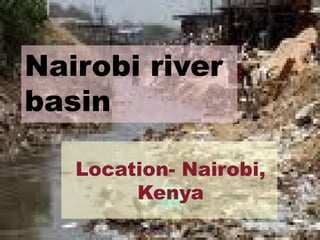
Nairobi river
basin
Location- Nairobi,
Kenya
Type of environmental
degradation
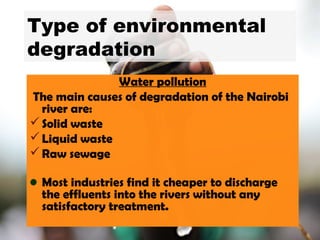
Water pollution
The main causes of degradation of the Nairobi
river are:
Solid waste
Liquid waste
Raw sewage
• Most industries find it cheaper to discharge
the effluents into the rivers without any
satisfactory treatment.
Causes of degradation
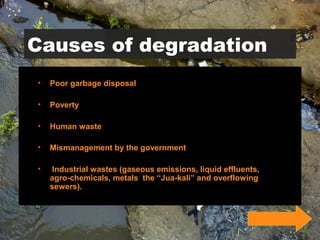
• Poor garbage disposal
• Poverty
• Human waste
• Mismanagement by the government
• Industrial wastes (gaseous emissions, liquid effluents,
agro-chemicals, metals the “Jua-kali” and overflowing
sewers).
Effects of degradation
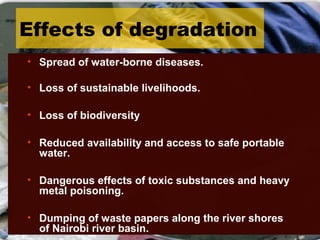
• Spread of water-borne diseases.
• Loss of sustainable livelihoods.
• Loss of biodiversity
• Reduced availability and access to safe portable
water.
• Dangerous effects of toxic substances and heavy
metal poisoning.
• Dumping of waste papers along the river shores
of Nairobi river basin.
Rehabilitation
Launched in 1999, Nairobi River Basin Program
(NRBP) is a multi-initiative consisting of:
o The Government of Kenya
o UNEP
o UN-Habitat
o The private sector
o The civil society
o National Environmental Management Authority
(NEMA)
The aim is to rehabilitate restore and manage
the Nairobi river ecosystem in order to provide a
sustainable supply of water for domestic,
industrial, recreational and emergency use.
The main aim was to focus on four
key areas:
1.Environmental education.
2.Awareness creation and public
communication.
3.Conservation of the riparian reserve.
4.Integrated waste management and
the restoration of Nairobi Dam.
ACHIEVEMENTS
a) NRBP has generated sufficient
environmental awareness.
b) Private sector partners have expressed the
desire to work with NRBP to rehabilitate the
rivers.
c) Activities such as tree-planting, bee-keeping,
mushroom growing, solid waste
management, cleaner production in industry
and water quality monitoring are carried out
in aid of restoring the Nairobi river basin.
Through its endeavor the program has faced
some challenges.
CHALLENGES
• Changing Kenyans’ attitude towards waste
disposal.
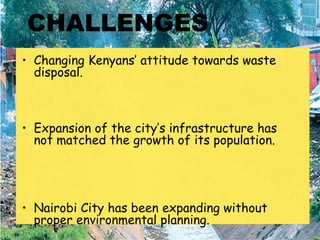
• Expansion of the city’s infrastructure has
not matched the growth of its population.
• Nairobi City has been expanding without
proper environmental planning. 
Done by.…..
• M James
Done by.…..
• M James

Nairobi river basin by MJ

  • 1.
  • 2.
    Type of environmental degradation Waterpollution The main causes of degradation of the Nairobi river are: Solid waste Liquid waste Raw sewage • Most industries find it cheaper to discharge the effluents into the rivers without any satisfactory treatment.
  • 3.
    Causes of degradation •Poor garbage disposal • Poverty • Human waste • Mismanagement by the government • Industrial wastes (gaseous emissions, liquid effluents, agro-chemicals, metals the “Jua-kali” and overflowing sewers).
  • 4.
    Effects of degradation •Spread of water-borne diseases. • Loss of sustainable livelihoods. • Loss of biodiversity • Reduced availability and access to safe portable water. • Dangerous effects of toxic substances and heavy metal poisoning. • Dumping of waste papers along the river shores of Nairobi river basin.
  • 5.
    Rehabilitation Launched in 1999,Nairobi River Basin Program (NRBP) is a multi-initiative consisting of: o The Government of Kenya o UNEP o UN-Habitat o The private sector o The civil society o National Environmental Management Authority (NEMA) The aim is to rehabilitate restore and manage the Nairobi river ecosystem in order to provide a sustainable supply of water for domestic, industrial, recreational and emergency use.
  • 6.
    The main aimwas to focus on four key areas: 1.Environmental education. 2.Awareness creation and public communication. 3.Conservation of the riparian reserve. 4.Integrated waste management and the restoration of Nairobi Dam.
  • 7.
    ACHIEVEMENTS a) NRBP hasgenerated sufficient environmental awareness. b) Private sector partners have expressed the desire to work with NRBP to rehabilitate the rivers. c) Activities such as tree-planting, bee-keeping, mushroom growing, solid waste management, cleaner production in industry and water quality monitoring are carried out in aid of restoring the Nairobi river basin. Through its endeavor the program has faced some challenges.
  • 8.
    CHALLENGES • Changing Kenyans’attitude towards waste disposal. • Expansion of the city’s infrastructure has not matched the growth of its population. • Nairobi City has been expanding without proper environmental planning. 
  • 9.
  • 10.