CHAPTER 16

                ENVIRONMENTAL ISSUES

                      POINTS TO REMEMBER
Pollution : Undesirable physical/chemical/biological characteristics of air/water/
land which cause damage to the animals/plants/humans and architectural
structures.
Pollutants : Agents which cause pollution.
Slash and Burn Agriculture (Jhum Cultivation) : Farmers cut down trees
and burn the plant remains. Ash is used as a fertiliser and the land is then
used for farming or cattle grazing.
Reforestation : Process of restoring a forest that was removed at some point
of time in the past.
Effluents : Something flowing over a large body of water (may be sewage or
industrial effluents).
CPCB : Central Pollution Control Board
BOD : Biological Oxygen Demand
CNG : Compressed Natural Gas
FOAM : Friends of Arcata Marsh
JFM : Joint Forest Management.
Biochemical Oxygen Demand (BOD)
K   BOD refer to the amount of oxygen that would be consumed if all the
    organic matter is one litre of water were oxidized by bacteria. The BOD
    test measures the rate of uptake of oxygen by micro-organisms in a sample
    of water.
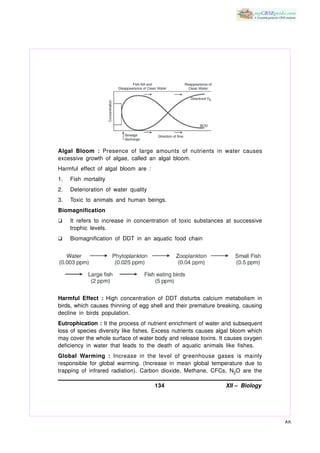
K   Indirectly BOD is a measure of the organic matter present in the water.
    The greater the BOD of waste water, more is its polluting potential.
K   In the given figure the effect of sewage on some imporant characteristic
    of a river is shown:

                                      133                          XII – Biology


                                                                                     AK
Algal Bloom : Presence of large amounts of nutrients in water causes
excessive growth of algae, called an algal bloom.
Harmful effect of algal bloom are :
1.   Fish mortality
2.   Deterioration of water quality
3.   Toxic to animals and human beings.
Biomagnification
K    It refers to increase in concentration of toxic substances at successive
     trophic levels.
K    Biomagnification of DDT in an aquatic food chain


Harmful Effect : High concentration of DDT disturbs calcium metabolism in
birds, which causes thinning of egg shell and their premature breaking, causing
decline in birds population.
Eutrophication : It the process of nutrient enrichment of water and subsequent
loss of species diversity like fishes. Excess nutrients causes algal bloom which
may cover the whole surface of water body and release toxins. It causes oxygen
deficiency in water that leads to the death of aquatic animals like fishes.
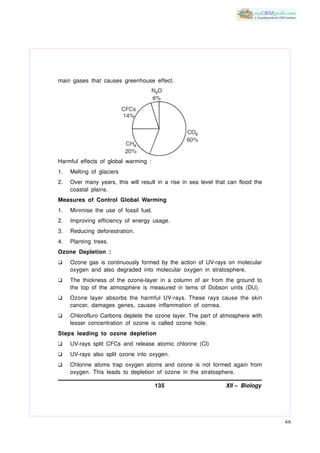
Global Warming : Increase in the level of greenhouse gases is mainly
responsible for global warming. (Increase in mean global temperature due to
trapping of infrared radiation). Carbon dioxide, Methane, CFCs, N2O are the

                                      134                        XII – Biology


                                                                                   AK
main gases that causes greenhouse effect.


Harmful effects of global warming :
1.   Melting of glaciers
2.   Over many years, this will result in a rise in sea level that can flood the
     coastal plains.
Measures of Control Global Warming
1.   Minimise the use of fossil fuel.
2.   Improving efficiency of energy usage.
3.   Reducing deforestration.
4.   Planting trees.
Ozone Depletion :
K    Ozone gas is continuously formed by the action of UV-rays on molecular
     oxygen and also degraded into molecular oxygen in stratosphere.
K    The thickness of the ozone-layer in a column of air from the ground to
     the top of the atmosphere is measured in tems of Dobson units (DU).
K    Ozone layer absorbs the harmful UV-rays. These rays cause the skin
     cancer, damages genes, causes inflammation of cornea.
K    Chlorofluro Carbons deplete the ozone layer. The part of atmosphere with
     lesser concentration of ozone is called ozone hole.
Steps leading to ozone depletion
K    UV-rays split CFCs and release atomic chlorine (Cl)
K    UV-rays also split ozone into oxygen.
K    Chlorine atoms trap oxygen atoms and ozone is not formed again from
     oxygen. This leads to depletion of ozone in the stratosphere.

                                        135                      XII – Biology


                                                                                   AK
Ozone Hole : Large area of thinned ozone layer over Antartica.
Control of Vehicular Air Pollution in Delhi : All the buses of Delhi were
converted to run on CNG by the end of the 2002. Other steps to reduce air
pollution in Delhi include.
1.   Phasing out of old vehicles.
2.   Use of unleaded petrol and low sulphur petrol and diesel.
3.   Use of catalytic converters in vehicles.
4.   Application of Euro-IV norms for vehicles from April, 1, 2010.
Auto Fuel Policy : The Government of India has laid out a road map to cut
down the vehicular air pollution in many cities of India. The goal of this policy
is to reduce Sulphur to 50 ppm in petrol and diesel and reduce levels of
aromatic hydrocarbons to 35% of the fuel. The Bharat Stage II will be applicable
to all automobiles in all cities April, 1, 2005. The cities (like Delhi, Mumbai,
Chennai, Kolkata etc.) will have to meet Euro III emission norms from April 1,
2005 and Euro IV Emission norms from April 1, 2010.


                               QUESTIONS

                               VSA (1 MARK)

1.   Why should the velocity of air between the plates of an electrostatic
     precipitator be low?
2.   PM2.5 is responsible for causing greatest harm to human health. What is
     it? How is it harmful?
3.   What is the noise level that can cause permanent impairment of hearing
     ability of human beings?
4.   Why was the Montreal Protocol signed?
5.   Jhum cultivation has been in practice from earlier days, but its considered
     more problematic these days. Why?
6.   A radiation causes ageing of skin, skin cancer, and inflamation of cornea
     called snow blindness. It also damages DNA. Name the radiation.


                                      136                         XII – Biology


                                                                                    AK
SA-II (2 MARKS)

7.   Landfills are not much a solution for getting rid of solid wastes. Why?
8.   Electrostatic precipitator can remove over 99% particulate matter present
     in exhaust from a thermal power plant. How?
9.   Why is a scrubber used? Which spray is used on exhaust gases passing
     through a scrubber?
10. There is a sharp decline in dissolved oxygen downstream from the point
    of sewage discharge. Why? What are its adverse effects?
11. Catalytic converters use expensive metals as catalysts.
     (a) Name the metals generally used.
     (b) What precaution should be observed while using catalytic converter.
12. What are e-wastes? Why are they creating more problem in developing
    countries in comparision to developed countries?
13. Water logging and salinity are some of the problems that have come in
    the wake of Green revolution. How does water logging create problems of
    salinity?
14. What is the relationship between BOD, mcro-organisms and amount of bio-
    degradable matter?

                               SA-1 (3 MARKS)

15. Deforestation is creating a lot of problems in the environment. List the
    consequences of deforestation.
16. Enlist four harmful effects caused to the humans living in areas having
    polluted air. Suggest two measures to reduce air pollution.
17. People have been actively participating in the efforts for the conservation
    of forests.
     (i)    Name the award instituted in respect of Amrita Devi to promote such
            efforts.
     (ii)   Name the movement launched to protect the trees by hugging them.
     (iii) Name the step Government of India has undertaken in 1980’s to work
           closely with the local communities for protecting and managing forests.


                                      137                          XII – Biology


                                                                                     AK
LA-(5 MARKS)

18. Pollutant released due to human activities (like effluents from industries
    and homes) can radically accelerate the ageing process of the water body.
     (a) Explain how does this process occurs during natural ageing of lake.
     (b) Give the term used for accelerated ageing of water bodies. Also give
     the term used for the natural ageing of lake.
19. In Arcata, the town’s people have created an integrated waste water
    treatment process within a natural system. A citizen group called FOAM
    helps in upkeep of this project.
     (a) What are the main steps in waste water management done in this way?
     (b) ‘Ecosan’ in Kerala and Sri Lanka is also an intiative for water
     conservation. How?
20. What are the contribution of Ahmed Khan in Bangalore and Ramesh
    Chandra Dagar in Sonipat?


                                  ANSWERS

                                  VAS (I MARK)

1.   To allow the dust to fall.
2.   PM2.5 stands for particulate matter of size 2.5 micrometers or less in
     diameter. Its responsible for causing greatest harm to human health as it
     can be inhaled deep into lungs and cause breathing problems.
3.   150 dB or more
4.   To control emission of ozone depleting substances.
5.   Enough time gap is not being given for the natural process of recovery
     of land from the effect of cultivation.
6.   Ultraviolet B rays (UV-B rays)

                              SA-II (2 MARKS)

7.   Landfill sites are getting filled very fast due to large amount of garbage
     generation. Also underground water resources may get polluted due to
     seepage of chemicals.


                                      138                        XII – Biology


                                                                                  AK
8.   Electrode wire at thousand volts, produce corona to release electrons,
     electrons attach to dust particules giving them net negative charge,
     charged dust particules attracted/collected by collecting plates which are
     grounded.
9. To remove gases like sulphur dioxide. Spray of water or lime is used.
10. Following discharge of sewage into river, micro organisms involved in
    biodegradation of organic matter present in sewage consume more oxygen.
    This cause mortality of fish and other aquatic creatures.
11. (a)     Catalysts : platinum - palladium and Rhodium
     (b) Motor vehicles equipped with catalytic converters should use unleaded
         petrol as lead inactivates the catalysts.
12. (a) Irrepairable computers and other electronic wastes.
     (b) Recycling in developing countries involves manual participation thus
         exposing workers to toxic substances. In developed countries its
         mechanised so less dangerous.
13. Water logging draws salt to surface of soil. Salt deposited on land surface
    as a thin crust or at the roots of the plants.
14. Increase in amount of biodegradable matter leads to rapid multiplication
    of micro organisms to degrade it, thereby increasing BOD level of the water
    body.

                                   SAI (3 MARKS)
15. K       Enhanced CO2 concentration in atmosphere
     K      Loss of biodiversity
     K      Soil erosion
     K      Desertification
     K      Disturbed hydrological cycles.
16. Breathing problems, irritation and inflammation, Damage to lungs,
    Premature death.
     K      Reduce emission from automobile exhaust
     K      Growing more trees.
17. (i)     Amrita Devi Bishnoi Wildlife Protection Award.
     (ii)   Chipko movement
     (iii) Joint Forest Management (JFM).

                                        139                      XII – Biology


                                                                                  AK
18. (a) The phenomeon is eutrophication. More nutrients in water, aquatic life
        increases organic remains deposited on lake bottom, lake grows
        shallower and warmer, gradually transforms into land due to deposition
        of silt and organic debris.
    (b) Cultural or Accelerated eutrophication
         Natural ageing is Eutrophication.
19. (a) Conventional sedimentation, filtering and chlorine treatment.
        Absorption and assimilation of pollutants by algae fungi and bacteria.
    (b) ‘Ecosan’ derived from ecological sanitation. Handling human excreta
         using dry composting toilets. Its practical, hygienic and cost effective
         method.
20. Refer page No. 279-280, ncert Text of Biology Class XII (the benefits of
    polyblend and organic farming.)


                                     140                          XII – Biology


                                                                                    AK

12 biology imp_q_ch16_environmental_issues

  • 1.
    CHAPTER 16 ENVIRONMENTAL ISSUES POINTS TO REMEMBER Pollution : Undesirable physical/chemical/biological characteristics of air/water/ land which cause damage to the animals/plants/humans and architectural structures. Pollutants : Agents which cause pollution. Slash and Burn Agriculture (Jhum Cultivation) : Farmers cut down trees and burn the plant remains. Ash is used as a fertiliser and the land is then used for farming or cattle grazing. Reforestation : Process of restoring a forest that was removed at some point of time in the past. Effluents : Something flowing over a large body of water (may be sewage or industrial effluents). CPCB : Central Pollution Control Board BOD : Biological Oxygen Demand CNG : Compressed Natural Gas FOAM : Friends of Arcata Marsh JFM : Joint Forest Management. Biochemical Oxygen Demand (BOD) K BOD refer to the amount of oxygen that would be consumed if all the organic matter is one litre of water were oxidized by bacteria. The BOD test measures the rate of uptake of oxygen by micro-organisms in a sample of water. K Indirectly BOD is a measure of the organic matter present in the water. The greater the BOD of waste water, more is its polluting potential. K In the given figure the effect of sewage on some imporant characteristic of a river is shown: 133 XII – Biology AK
  • 2.
    Algal Bloom :Presence of large amounts of nutrients in water causes excessive growth of algae, called an algal bloom. Harmful effect of algal bloom are : 1. Fish mortality 2. Deterioration of water quality 3. Toxic to animals and human beings. Biomagnification K It refers to increase in concentration of toxic substances at successive trophic levels. K Biomagnification of DDT in an aquatic food chain Harmful Effect : High concentration of DDT disturbs calcium metabolism in birds, which causes thinning of egg shell and their premature breaking, causing decline in birds population. Eutrophication : It the process of nutrient enrichment of water and subsequent loss of species diversity like fishes. Excess nutrients causes algal bloom which may cover the whole surface of water body and release toxins. It causes oxygen deficiency in water that leads to the death of aquatic animals like fishes. Global Warming : Increase in the level of greenhouse gases is mainly responsible for global warming. (Increase in mean global temperature due to trapping of infrared radiation). Carbon dioxide, Methane, CFCs, N2O are the 134 XII – Biology AK
  • 3.
    main gases thatcauses greenhouse effect. Harmful effects of global warming : 1. Melting of glaciers 2. Over many years, this will result in a rise in sea level that can flood the coastal plains. Measures of Control Global Warming 1. Minimise the use of fossil fuel. 2. Improving efficiency of energy usage. 3. Reducing deforestration. 4. Planting trees. Ozone Depletion : K Ozone gas is continuously formed by the action of UV-rays on molecular oxygen and also degraded into molecular oxygen in stratosphere. K The thickness of the ozone-layer in a column of air from the ground to the top of the atmosphere is measured in tems of Dobson units (DU). K Ozone layer absorbs the harmful UV-rays. These rays cause the skin cancer, damages genes, causes inflammation of cornea. K Chlorofluro Carbons deplete the ozone layer. The part of atmosphere with lesser concentration of ozone is called ozone hole. Steps leading to ozone depletion K UV-rays split CFCs and release atomic chlorine (Cl) K UV-rays also split ozone into oxygen. K Chlorine atoms trap oxygen atoms and ozone is not formed again from oxygen. This leads to depletion of ozone in the stratosphere. 135 XII – Biology AK
  • 4.
    Ozone Hole :Large area of thinned ozone layer over Antartica. Control of Vehicular Air Pollution in Delhi : All the buses of Delhi were converted to run on CNG by the end of the 2002. Other steps to reduce air pollution in Delhi include. 1. Phasing out of old vehicles. 2. Use of unleaded petrol and low sulphur petrol and diesel. 3. Use of catalytic converters in vehicles. 4. Application of Euro-IV norms for vehicles from April, 1, 2010. Auto Fuel Policy : The Government of India has laid out a road map to cut down the vehicular air pollution in many cities of India. The goal of this policy is to reduce Sulphur to 50 ppm in petrol and diesel and reduce levels of aromatic hydrocarbons to 35% of the fuel. The Bharat Stage II will be applicable to all automobiles in all cities April, 1, 2005. The cities (like Delhi, Mumbai, Chennai, Kolkata etc.) will have to meet Euro III emission norms from April 1, 2005 and Euro IV Emission norms from April 1, 2010. QUESTIONS VSA (1 MARK) 1. Why should the velocity of air between the plates of an electrostatic precipitator be low? 2. PM2.5 is responsible for causing greatest harm to human health. What is it? How is it harmful? 3. What is the noise level that can cause permanent impairment of hearing ability of human beings? 4. Why was the Montreal Protocol signed? 5. Jhum cultivation has been in practice from earlier days, but its considered more problematic these days. Why? 6. A radiation causes ageing of skin, skin cancer, and inflamation of cornea called snow blindness. It also damages DNA. Name the radiation. 136 XII – Biology AK
  • 5.
    SA-II (2 MARKS) 7. Landfills are not much a solution for getting rid of solid wastes. Why? 8. Electrostatic precipitator can remove over 99% particulate matter present in exhaust from a thermal power plant. How? 9. Why is a scrubber used? Which spray is used on exhaust gases passing through a scrubber? 10. There is a sharp decline in dissolved oxygen downstream from the point of sewage discharge. Why? What are its adverse effects? 11. Catalytic converters use expensive metals as catalysts. (a) Name the metals generally used. (b) What precaution should be observed while using catalytic converter. 12. What are e-wastes? Why are they creating more problem in developing countries in comparision to developed countries? 13. Water logging and salinity are some of the problems that have come in the wake of Green revolution. How does water logging create problems of salinity? 14. What is the relationship between BOD, mcro-organisms and amount of bio- degradable matter? SA-1 (3 MARKS) 15. Deforestation is creating a lot of problems in the environment. List the consequences of deforestation. 16. Enlist four harmful effects caused to the humans living in areas having polluted air. Suggest two measures to reduce air pollution. 17. People have been actively participating in the efforts for the conservation of forests. (i) Name the award instituted in respect of Amrita Devi to promote such efforts. (ii) Name the movement launched to protect the trees by hugging them. (iii) Name the step Government of India has undertaken in 1980’s to work closely with the local communities for protecting and managing forests. 137 XII – Biology AK
  • 6.
    LA-(5 MARKS) 18. Pollutantreleased due to human activities (like effluents from industries and homes) can radically accelerate the ageing process of the water body. (a) Explain how does this process occurs during natural ageing of lake. (b) Give the term used for accelerated ageing of water bodies. Also give the term used for the natural ageing of lake. 19. In Arcata, the town’s people have created an integrated waste water treatment process within a natural system. A citizen group called FOAM helps in upkeep of this project. (a) What are the main steps in waste water management done in this way? (b) ‘Ecosan’ in Kerala and Sri Lanka is also an intiative for water conservation. How? 20. What are the contribution of Ahmed Khan in Bangalore and Ramesh Chandra Dagar in Sonipat? ANSWERS VAS (I MARK) 1. To allow the dust to fall. 2. PM2.5 stands for particulate matter of size 2.5 micrometers or less in diameter. Its responsible for causing greatest harm to human health as it can be inhaled deep into lungs and cause breathing problems. 3. 150 dB or more 4. To control emission of ozone depleting substances. 5. Enough time gap is not being given for the natural process of recovery of land from the effect of cultivation. 6. Ultraviolet B rays (UV-B rays) SA-II (2 MARKS) 7. Landfill sites are getting filled very fast due to large amount of garbage generation. Also underground water resources may get polluted due to seepage of chemicals. 138 XII – Biology AK
  • 7.
    8. Electrode wire at thousand volts, produce corona to release electrons, electrons attach to dust particules giving them net negative charge, charged dust particules attracted/collected by collecting plates which are grounded. 9. To remove gases like sulphur dioxide. Spray of water or lime is used. 10. Following discharge of sewage into river, micro organisms involved in biodegradation of organic matter present in sewage consume more oxygen. This cause mortality of fish and other aquatic creatures. 11. (a) Catalysts : platinum - palladium and Rhodium (b) Motor vehicles equipped with catalytic converters should use unleaded petrol as lead inactivates the catalysts. 12. (a) Irrepairable computers and other electronic wastes. (b) Recycling in developing countries involves manual participation thus exposing workers to toxic substances. In developed countries its mechanised so less dangerous. 13. Water logging draws salt to surface of soil. Salt deposited on land surface as a thin crust or at the roots of the plants. 14. Increase in amount of biodegradable matter leads to rapid multiplication of micro organisms to degrade it, thereby increasing BOD level of the water body. SAI (3 MARKS) 15. K Enhanced CO2 concentration in atmosphere K Loss of biodiversity K Soil erosion K Desertification K Disturbed hydrological cycles. 16. Breathing problems, irritation and inflammation, Damage to lungs, Premature death. K Reduce emission from automobile exhaust K Growing more trees. 17. (i) Amrita Devi Bishnoi Wildlife Protection Award. (ii) Chipko movement (iii) Joint Forest Management (JFM). 139 XII – Biology AK
  • 8.
    18. (a) Thephenomeon is eutrophication. More nutrients in water, aquatic life increases organic remains deposited on lake bottom, lake grows shallower and warmer, gradually transforms into land due to deposition of silt and organic debris. (b) Cultural or Accelerated eutrophication Natural ageing is Eutrophication. 19. (a) Conventional sedimentation, filtering and chlorine treatment. Absorption and assimilation of pollutants by algae fungi and bacteria. (b) ‘Ecosan’ derived from ecological sanitation. Handling human excreta using dry composting toilets. Its practical, hygienic and cost effective method. 20. Refer page No. 279-280, ncert Text of Biology Class XII (the benefits of polyblend and organic farming.) 140 XII – Biology AK