North
American
Free
Trade
Agreement
Presented by:
Parth Hirani 48
Zeel Hisoriya 49
Kunuz Hotelwala 50
Introduction
NAFTA is an agreement signed by the
governments of the United States,
Canada, and Mexico creating a
trilateral trade bloc in North America.
Members: Canada, Mexico & United States
Official languages: English, French, and
Spanish
Secretariats: Mexico City, Ottawa,
Washington D.C.
Establishment: 1 January 1994
GDP of NAFTA alliance: USD 12 trillion
NAFTA supplements: NAAEC & NAALC
Objectives
Objectives
To eliminate trade barriers & facilitate the cross-border
movements of goods and services between the parties
To promote conditions of fair competition
To substantially increase investment opportunities
To provide adequate and effective protection & enforcement of
intellectual property rights in each territory
To create effective procedures for the implementation and
application of this agreement, for its joint administration & for the
resolution of disputes
To establish a framework for further trilateral, regional and
multilateral cooperation to expand and enhance the benefits of
this agreement
North
American
Agreement on
Environmental
Co-operation
NAAEC created Commission for
Environmental Co-operation (CEC)
in 1994
Development of common priorities
for the protection of certain species
Developing North American
Conservation Action Plans for three
shared marine species
Provide tools such as map of
terrestrial eco-regions which
management agencies are using in
this programs
Setting out common mechanism for
planning and monitoring bird
conservation programs
North
American
Agreement on
Labour
Co-operation
NAALC members work together to
protect, enhance and enforce the
basic rights of workers.
Establishment of institutions & creation
of formal process to raise concerns
related to labor law enforcement directly
with government.
Undertaken a wide range of co-operative
programs and technical exchanges on
industrial relations,
∆ Occupational safety and health,
∆ Child labor,
∆ Gender equality,
∆ Protection of migrant workers
NAFTA is a board agreement, but improved market access, including
tariff reductions on merchandise trade, was the major U.S. goal.
After ten years, most tariffs have gone to zero, except for some very
sensitive (mostly agricultural) goods that have limited protection for
up to 15 years. Clearly, U.S. imports increased by 179%, compared to
89% from the world.
From 1994 to 2003, U.S. Exports to Mexico rose 91% compare to 41% to
the world. U.S imports increased by 179%, compared to 89% from the
world.
Trade and Investment
Effects
Benefit’s the importers by reduced or duty free goods.
Can make the exporter more competitive then other non-
participating countries
There has been great increase in trade among the three countries
and market access within each country also increased considerably.
Mexico’s poverty rate decreased and real income increased, even
after economic crisis 1994-1995
NAFTA had been beneficial to business owners and elites in all three
countries.
Effects of NAFTA
Effects of NAFTA
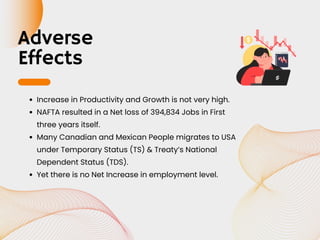
Adverse
Effects
Increase in Productivity and Growth is not very high.
NAFTA resulted in a Net loss of 394,834 Jobs in First
three years itself.
Many Canadian and Mexican People migrates to USA
under Temporary Status (TS) & Treaty’s National
Dependent Status (TDS).
Yet there is no Net Increase in employment level.
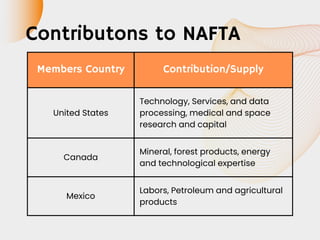
Members Country Contribution/Supply
United States
Technology, Services, and data
processing, medical and space
research and capital
Canada
Mineral, forest products, energy
and technological expertise
Mexico
Labors, Petroleum and agricultural
products
Contributons to NAFTA
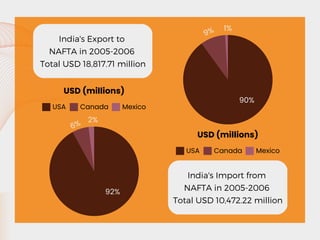
India's Export to
NAFTA in 2005-2006
Total USD 18,817.71 million
India's Import from
NAFTA in 2005-2006
Total USD 10,472.22 million
92%
USD (millions)
USA Canada Mexico
90%
9%
6%
1%
2%
USD (millions)
USA Canada Mexico
Conclusion
The progressive elimination of tariffs & trade
barriers,
Dispute resolution
Commitment to intellectual property &
environmental legislation
Mutual entry into governmental bidding &
the financial and other service sector
NAFTA has played an important role in the
overall development of the three nations
But on the other hand it is also responsible for
causalities like loss of jobs, migration, rising
level of inequality and many others.
Thank You

NAFTA_removed.pdf

  • 1.
  • 2.
    Introduction NAFTA is anagreement signed by the governments of the United States, Canada, and Mexico creating a trilateral trade bloc in North America. Members: Canada, Mexico & United States Official languages: English, French, and Spanish Secretariats: Mexico City, Ottawa, Washington D.C. Establishment: 1 January 1994 GDP of NAFTA alliance: USD 12 trillion NAFTA supplements: NAAEC & NAALC
  • 3.
    Objectives Objectives To eliminate tradebarriers & facilitate the cross-border movements of goods and services between the parties To promote conditions of fair competition To substantially increase investment opportunities To provide adequate and effective protection & enforcement of intellectual property rights in each territory To create effective procedures for the implementation and application of this agreement, for its joint administration & for the resolution of disputes To establish a framework for further trilateral, regional and multilateral cooperation to expand and enhance the benefits of this agreement
  • 4.
    North American Agreement on Environmental Co-operation NAAEC createdCommission for Environmental Co-operation (CEC) in 1994 Development of common priorities for the protection of certain species Developing North American Conservation Action Plans for three shared marine species Provide tools such as map of terrestrial eco-regions which management agencies are using in this programs Setting out common mechanism for planning and monitoring bird conservation programs
  • 5.
    North American Agreement on Labour Co-operation NAALC memberswork together to protect, enhance and enforce the basic rights of workers. Establishment of institutions & creation of formal process to raise concerns related to labor law enforcement directly with government. Undertaken a wide range of co-operative programs and technical exchanges on industrial relations, ∆ Occupational safety and health, ∆ Child labor, ∆ Gender equality, ∆ Protection of migrant workers
  • 6.
    NAFTA is aboard agreement, but improved market access, including tariff reductions on merchandise trade, was the major U.S. goal. After ten years, most tariffs have gone to zero, except for some very sensitive (mostly agricultural) goods that have limited protection for up to 15 years. Clearly, U.S. imports increased by 179%, compared to 89% from the world. From 1994 to 2003, U.S. Exports to Mexico rose 91% compare to 41% to the world. U.S imports increased by 179%, compared to 89% from the world. Trade and Investment Effects
  • 7.
    Benefit’s the importersby reduced or duty free goods. Can make the exporter more competitive then other non- participating countries There has been great increase in trade among the three countries and market access within each country also increased considerably. Mexico’s poverty rate decreased and real income increased, even after economic crisis 1994-1995 NAFTA had been beneficial to business owners and elites in all three countries. Effects of NAFTA Effects of NAFTA
  • 8.
    Adverse Effects Increase in Productivityand Growth is not very high. NAFTA resulted in a Net loss of 394,834 Jobs in First three years itself. Many Canadian and Mexican People migrates to USA under Temporary Status (TS) & Treaty’s National Dependent Status (TDS). Yet there is no Net Increase in employment level.
  • 9.
    Members Country Contribution/Supply UnitedStates Technology, Services, and data processing, medical and space research and capital Canada Mineral, forest products, energy and technological expertise Mexico Labors, Petroleum and agricultural products Contributons to NAFTA
  • 10.
    India's Export to NAFTAin 2005-2006 Total USD 18,817.71 million India's Import from NAFTA in 2005-2006 Total USD 10,472.22 million 92% USD (millions) USA Canada Mexico 90% 9% 6% 1% 2% USD (millions) USA Canada Mexico
  • 11.
    Conclusion The progressive eliminationof tariffs & trade barriers, Dispute resolution Commitment to intellectual property & environmental legislation Mutual entry into governmental bidding & the financial and other service sector NAFTA has played an important role in the overall development of the three nations But on the other hand it is also responsible for causalities like loss of jobs, migration, rising level of inequality and many others.
  • 12.