MyFaces CODI Scopes
Use the right scopes for your CDI beans
Agenda


•   The History
•   CODI in a Nutshell
•   CODI Setup
•   CODI Scopes in Action
•   Coding
•   CODI Conversation - Insights
•   Your Use-Cases
THE HISTORY
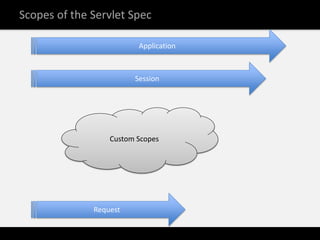
Scopes of the Servlet Spec

                         Application


                        Session


                  Custom Scopes


              Request
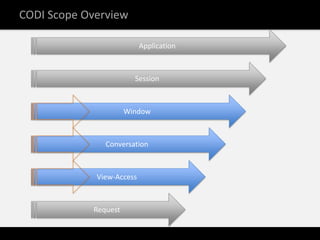
CODI Scope Overview

                           Application


                        Session


                      Window


               Conversation


             View-Access


            Request
Why custom Scopes?


• Request scope too short for most UI-Use-Cases
• Session scope
   – Too long
   – No support for multi-window applications
• Different (conversation) concepts available
   – MyFaces Orchestra
   – CDI Conversation Scope
   – MyFaces CODI Scopes
       • Conversation Scope
       • View-Access Scope
       • Window Scope
MyFaces Orchestra


•   CODI is NOT Orchestra.NEXT
•   Orchestra is for Spring (only)
•   CODI is for CDI (only)
•   Orchestra introduced great concepts!
     CODI was planned as "type-safe Orchestra" for CDI
    Now it’s way more (in most areas) but
    without Persistence-Management!
What‘s about @ConversationScoped of CDI?


• Completely broken for several use-cases!
• More like inflexible sessions per window
• Some of the disadvantages
   –   Overhead e.g. with failed conversion/validation
   –   Lazy termination (after the rendering process)
   –   Restarting conversations during a request isn’t possible
   –   End the whole conversation or nothing
   –   An explicit start is required
   –   Manual check if conversation has been started
• Test them with your use-cases!
   use them or forget them 
MyFaces CODI - Overview


• MyFaces Extensions CDI aka MyFaces CODI is a
  portable CDI extension which can be used with
  Apache OpenWebBeans, JBoss Weld,… and
  in combination with other portable CDI extensions
• CODI-Core is required in any case
• Modules
   –   JSF Module (for 1.2 and 2.0 and 2.1)
   –   JPA Module
   –   BV Module
   –   I18n-Message Module
   –   Scripting Module
   –   Test Support Modules
MyFaces CODI in a Nutshell


•   JSF 1.2 and 2.x          • Type-safe View-Configs
•   Type-safety              • Type-safe Navigation
•   Extensibility            • JPA Integration
•   Advanced Scopes          • Dependency Injection
•   Various Events             Support for BV
•   View-Controller          • Advanced I18n
•   JSF 2 Scope Mappings     • Scripting Integration
                             • And more!
CODI - SETUP
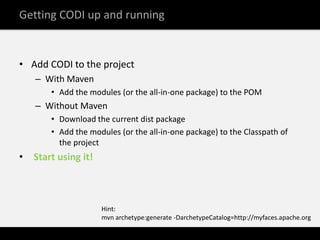
Getting CODI up and running


• Add CODI to the project
    – With Maven
        • Add the modules (or the all-in-one package) to the POM
    – Without Maven
        • Download the current dist package
        • Add the modules (or the all-in-one package) to the Classpath of
          the project
•   Start using it!


                      Hint:
                      mvn archetype:generate -DarchetypeCatalog=http://myfaces.apache.org
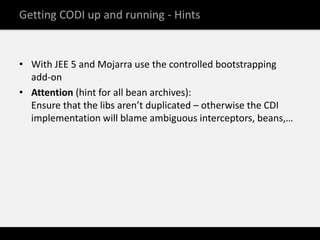
Getting CODI up and running - Hints


• With JEE 5 and Mojarra use the controlled bootstrapping
  add-on
• Attention (hint for all bean archives):
  Ensure that the libs aren’t duplicated – otherwise the CDI
  implementation will blame ambiguous interceptors, beans,…
CODI SCOPES IN ACTION
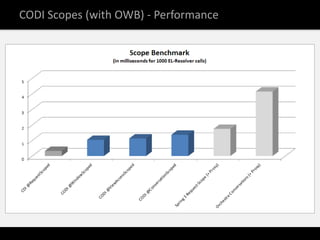
CODI Scopes (with OWB) - Performance
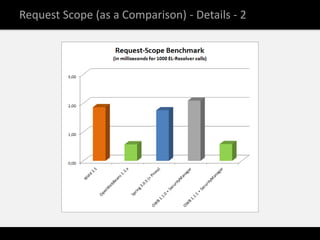
Request Scope (as a Comparison) - Details - 2
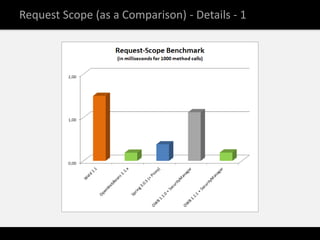
Request Scope (as a Comparison) - Details - 1
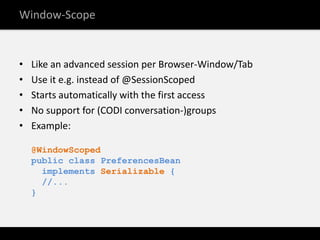
Window-Scope


•   Like an advanced session per Browser-Window/Tab
•   Use it e.g. instead of @SessionScoped
•   Starts automatically with the first access
•   No support for (CODI conversation-)groups
•   Example:

    @WindowScoped
    public class PreferencesBean
      implements Serializable {
      //...
    }
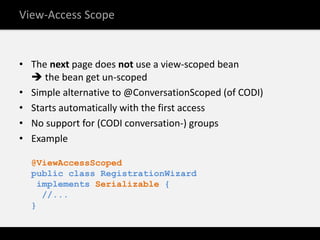
View-Access Scope


• The next page does not use a view-scoped bean
   the bean get un-scoped
• Simple alternative to @ConversationScoped (of CODI)
• Starts automatically with the first access
• No support for (CODI conversation-) groups
• Example

  @ViewAccessScoped
  public class RegistrationWizard
   implements Serializable {
    //...
  }
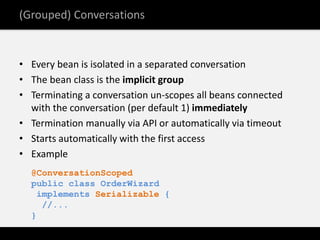
(Grouped) Conversations


• Every bean is isolated in a separated conversation
• The bean class is the implicit group
• Terminating a conversation un-scopes all beans connected
  with the conversation (per default 1) immediately
• Termination manually via API or automatically via timeout
• Starts automatically with the first access
• Example
  @ConversationScoped
  public class OrderWizard
   implements Serializable {
    //...
  }
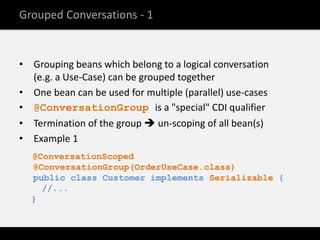
Grouped Conversations - 1


• Grouping beans which belong to a logical conversation
  (e.g. a Use-Case) can be grouped together
• One bean can be used for multiple (parallel) use-cases
• @ConversationGroup is a "special" CDI qualifier
• Termination of the group  un-scoping of all bean(s)
• Example 1
  @ConversationScoped
  @ConversationGroup(OrderUseCase.class)
  public class Customer implements Serializable {
    //...
  }
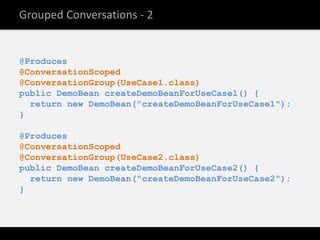
Grouped Conversations - 2


@Produces
@ConversationScoped
@ConversationGroup(UseCase1.class)
public DemoBean createDemoBeanForUseCase1() {
  return new DemoBean("createDemoBeanForUseCase1");
}

@Produces
@ConversationScoped
@ConversationGroup(UseCase2.class)
public DemoBean createDemoBeanForUseCase2() {
  return new DemoBean("createDemoBeanForUseCase2");
}
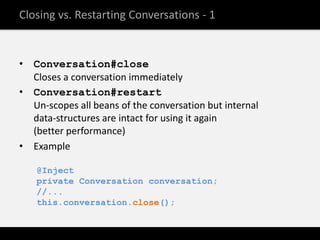
Closing vs. Restarting Conversations - 1


• Conversation#close
  Closes a conversation immediately
• Conversation#restart
  Un-scopes all beans of the conversation but internal
  data-structures are intact for using it again
  (better performance)
• Example

   @Inject
   private Conversation conversation;
   //...
   this.conversation.close();
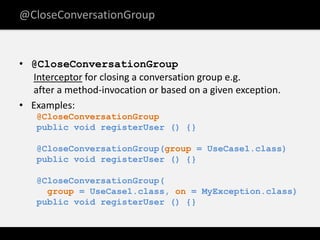
@CloseConversationGroup


• @CloseConversationGroup
  Interceptor for closing a conversation group e.g.
  after a method-invocation or based on a given exception.
• Examples:
   @CloseConversationGroup
   public void registerUser () {}

   @CloseConversationGroup(group = UseCase1.class)
   public void registerUser () {}

   @CloseConversationGroup(
     group = UseCase1.class, on = MyException.class)
   public void registerUser () {}
CODI CONVERSATION - INSIGHTS
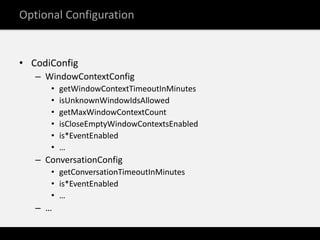
Optional Configuration


• CodiConfig
   – WindowContextConfig
      •   getWindowContextTimeoutInMinutes
      •   isUnknownWindowIdsAllowed
      •   getMaxWindowContextCount
      •   isCloseEmptyWindowContextsEnabled
      •   is*EventEnabled
      •   …
   – ConversationConfig
      • getConversationTimeoutInMinutes
      • is*EventEnabled
      • …
   – …
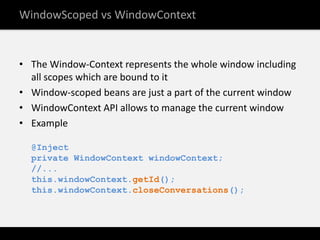
WindowScoped vs WindowContext


• The Window-Context represents the whole window including
  all scopes which are bound to it
• Window-scoped beans are just a part of the current window
• WindowContext API allows to manage the current window
• Example

  @Inject
  private WindowContext windowContext;
  //...
  this.windowContext.getId();
  this.windowContext.closeConversations();
Window-Context

                                   Window(-Context)
                                       API and SPI


    [Scope]            [Scope]             [Scope]          [Scope]    [Scope]

   Window            Conversation       Conversation        View-      View-
                        Group:            Group:            Access     Access
                        Bean1            UseCase1


                                                              Bean 3


                                                                         Bean 4
   Bean 1

            Bean 2


                          Bean 1


                                          Bean 1

                                                   Bean 2

                                       Attributes
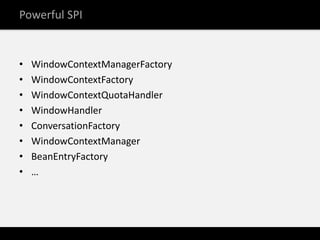
Powerful SPI


•   WindowContextManagerFactory
•   WindowContextFactory
•   WindowContextQuotaHandler
•   WindowHandler
•   ConversationFactory
•   WindowContextManager
•   BeanEntryFactory
•   …
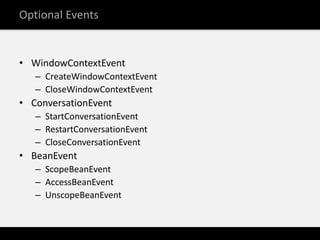
Optional Events


• WindowContextEvent
   – CreateWindowContextEvent
   – CloseWindowContextEvent
• ConversationEvent
   – StartConversationEvent
   – RestartConversationEvent
   – CloseConversationEvent
• BeanEvent
   – ScopeBeanEvent
   – AccessBeanEvent
   – UnscopeBeanEvent
TELL US YOUR USE-CASES!
Links


•   http://myfaces.apache.org/extensions/cdi/
•   https://cwiki.apache.org/confluence/display/EXTCDI/Index
•   https://svn.apache.org/repos/asf/myfaces/extensions/cdi/
•   http://twitter.com/MyFacesTeam
•   http://myfaces.apache.org/extensions/cdi/mail-lists.html
•   Recommended
    – http://openwebbeans.apache.org
    – http://code.google.com/a/apache-extras.org/p/
      myfaces-codi-addons/
    – http://os890.spaaze.com/myfaces-codi

MyFaces CODI Conversations

  • 1.
    MyFaces CODI Scopes Usethe right scopes for your CDI beans
  • 2.
    Agenda • The History • CODI in a Nutshell • CODI Setup • CODI Scopes in Action • Coding • CODI Conversation - Insights • Your Use-Cases
  • 3.
  • 4.
    Scopes of theServlet Spec Application Session Custom Scopes Request
  • 5.
    CODI Scope Overview Application Session Window Conversation View-Access Request
  • 6.
    Why custom Scopes? •Request scope too short for most UI-Use-Cases • Session scope – Too long – No support for multi-window applications • Different (conversation) concepts available – MyFaces Orchestra – CDI Conversation Scope – MyFaces CODI Scopes • Conversation Scope • View-Access Scope • Window Scope
  • 7.
    MyFaces Orchestra • CODI is NOT Orchestra.NEXT • Orchestra is for Spring (only) • CODI is for CDI (only) • Orchestra introduced great concepts!  CODI was planned as "type-safe Orchestra" for CDI Now it’s way more (in most areas) but without Persistence-Management!
  • 8.
    What‘s about @ConversationScopedof CDI? • Completely broken for several use-cases! • More like inflexible sessions per window • Some of the disadvantages – Overhead e.g. with failed conversion/validation – Lazy termination (after the rendering process) – Restarting conversations during a request isn’t possible – End the whole conversation or nothing – An explicit start is required – Manual check if conversation has been started • Test them with your use-cases!  use them or forget them 
  • 9.
    MyFaces CODI -Overview • MyFaces Extensions CDI aka MyFaces CODI is a portable CDI extension which can be used with Apache OpenWebBeans, JBoss Weld,… and in combination with other portable CDI extensions • CODI-Core is required in any case • Modules – JSF Module (for 1.2 and 2.0 and 2.1) – JPA Module – BV Module – I18n-Message Module – Scripting Module – Test Support Modules
  • 10.
    MyFaces CODI ina Nutshell • JSF 1.2 and 2.x • Type-safe View-Configs • Type-safety • Type-safe Navigation • Extensibility • JPA Integration • Advanced Scopes • Dependency Injection • Various Events Support for BV • View-Controller • Advanced I18n • JSF 2 Scope Mappings • Scripting Integration • And more!
  • 11.
  • 12.
    Getting CODI upand running • Add CODI to the project – With Maven • Add the modules (or the all-in-one package) to the POM – Without Maven • Download the current dist package • Add the modules (or the all-in-one package) to the Classpath of the project • Start using it! Hint: mvn archetype:generate -DarchetypeCatalog=http://myfaces.apache.org
  • 13.
    Getting CODI upand running - Hints • With JEE 5 and Mojarra use the controlled bootstrapping add-on • Attention (hint for all bean archives): Ensure that the libs aren’t duplicated – otherwise the CDI implementation will blame ambiguous interceptors, beans,…
  • 14.
  • 15.
    CODI Scopes (withOWB) - Performance
  • 16.
    Request Scope (asa Comparison) - Details - 2
  • 17.
    Request Scope (asa Comparison) - Details - 1
  • 18.
    Window-Scope • Like an advanced session per Browser-Window/Tab • Use it e.g. instead of @SessionScoped • Starts automatically with the first access • No support for (CODI conversation-)groups • Example: @WindowScoped public class PreferencesBean implements Serializable { //... }
  • 19.
    View-Access Scope • Thenext page does not use a view-scoped bean  the bean get un-scoped • Simple alternative to @ConversationScoped (of CODI) • Starts automatically with the first access • No support for (CODI conversation-) groups • Example @ViewAccessScoped public class RegistrationWizard implements Serializable { //... }
  • 20.
    (Grouped) Conversations • Everybean is isolated in a separated conversation • The bean class is the implicit group • Terminating a conversation un-scopes all beans connected with the conversation (per default 1) immediately • Termination manually via API or automatically via timeout • Starts automatically with the first access • Example @ConversationScoped public class OrderWizard implements Serializable { //... }
  • 21.
    Grouped Conversations -1 • Grouping beans which belong to a logical conversation (e.g. a Use-Case) can be grouped together • One bean can be used for multiple (parallel) use-cases • @ConversationGroup is a "special" CDI qualifier • Termination of the group  un-scoping of all bean(s) • Example 1 @ConversationScoped @ConversationGroup(OrderUseCase.class) public class Customer implements Serializable { //... }
  • 22.
    Grouped Conversations -2 @Produces @ConversationScoped @ConversationGroup(UseCase1.class) public DemoBean createDemoBeanForUseCase1() { return new DemoBean("createDemoBeanForUseCase1"); } @Produces @ConversationScoped @ConversationGroup(UseCase2.class) public DemoBean createDemoBeanForUseCase2() { return new DemoBean("createDemoBeanForUseCase2"); }
  • 23.
    Closing vs. RestartingConversations - 1 • Conversation#close Closes a conversation immediately • Conversation#restart Un-scopes all beans of the conversation but internal data-structures are intact for using it again (better performance) • Example @Inject private Conversation conversation; //... this.conversation.close();
  • 24.
    @CloseConversationGroup • @CloseConversationGroup Interceptor for closing a conversation group e.g. after a method-invocation or based on a given exception. • Examples: @CloseConversationGroup public void registerUser () {} @CloseConversationGroup(group = UseCase1.class) public void registerUser () {} @CloseConversationGroup( group = UseCase1.class, on = MyException.class) public void registerUser () {}
  • 25.
  • 26.
    Optional Configuration • CodiConfig – WindowContextConfig • getWindowContextTimeoutInMinutes • isUnknownWindowIdsAllowed • getMaxWindowContextCount • isCloseEmptyWindowContextsEnabled • is*EventEnabled • … – ConversationConfig • getConversationTimeoutInMinutes • is*EventEnabled • … – …
  • 27.
    WindowScoped vs WindowContext •The Window-Context represents the whole window including all scopes which are bound to it • Window-scoped beans are just a part of the current window • WindowContext API allows to manage the current window • Example @Inject private WindowContext windowContext; //... this.windowContext.getId(); this.windowContext.closeConversations();
  • 28.
    Window-Context Window(-Context) API and SPI [Scope] [Scope] [Scope] [Scope] [Scope] Window Conversation Conversation View- View- Group: Group: Access Access Bean1 UseCase1 Bean 3 Bean 4 Bean 1 Bean 2 Bean 1 Bean 1 Bean 2 Attributes
  • 29.
    Powerful SPI • WindowContextManagerFactory • WindowContextFactory • WindowContextQuotaHandler • WindowHandler • ConversationFactory • WindowContextManager • BeanEntryFactory • …
  • 30.
    Optional Events • WindowContextEvent – CreateWindowContextEvent – CloseWindowContextEvent • ConversationEvent – StartConversationEvent – RestartConversationEvent – CloseConversationEvent • BeanEvent – ScopeBeanEvent – AccessBeanEvent – UnscopeBeanEvent
  • 31.
    TELL US YOURUSE-CASES!
  • 32.
    Links • http://myfaces.apache.org/extensions/cdi/ • https://cwiki.apache.org/confluence/display/EXTCDI/Index • https://svn.apache.org/repos/asf/myfaces/extensions/cdi/ • http://twitter.com/MyFacesTeam • http://myfaces.apache.org/extensions/cdi/mail-lists.html • Recommended – http://openwebbeans.apache.org – http://code.google.com/a/apache-extras.org/p/ myfaces-codi-addons/ – http://os890.spaaze.com/myfaces-codi