Workshop of Spring Application Framework at Capegemini


                                        Presented By
                                      Rajkumar Singh


                                 www.rajkrrsingh.blogspot.com
Agenda

Introduction
Spring Architecture
Spring Beans
Spring IOC
Setting up Spring Environment
Beans Life cycles
Spring DAO
Spring ORM
Spring AOP
Q&A


                                 www.rajkrrsingh.blogspot.com
Introduction
Spring framework was initially written by Rod Johnson and
was first released under the Apache 2.0 license in June
2003.

Primary purpose is to reduce the dependencies(loose
couple)

Spring deliver many significant benefits to the developers
reducing development effort and cost while improving test
coverage and quality

Handle the infrastructure so that developer can focus on
the development only

Enables you to build application from POJOs

Spring does not recreate all the framework but make use of
the existing one like ORM,logging,JEE framework.
                                    www.rajkrrsingh.blogspot.com
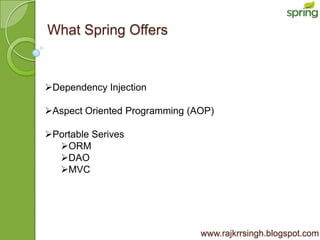
What Spring Offers


Dependency Injection

Aspect Oriented Programming (AOP)

Portable Serives
  ORM
  DAO
  MVC


                               www.rajkrrsingh.blogspot.com
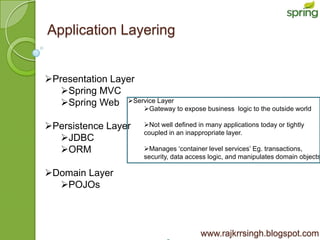
Application Layering


Presentation Layer
   Spring MVC
   Spring Web Service Layer
                      Gateway to expose business logic to the outside world

Persistence Layer    Not well defined in many applications today or tightly
                      coupled in an inappropriate layer.
  JDBC
  ORM                Manages ‘container level services’ Eg. transactions,
                      security, data access logic, and manipulates domain objects

Domain Layer
  POJOs


                                         www.rajkrrsingh.blogspot.com
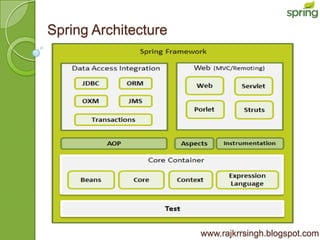
Spring Architecture


                      www.rajkrrsingh.blogspot.com
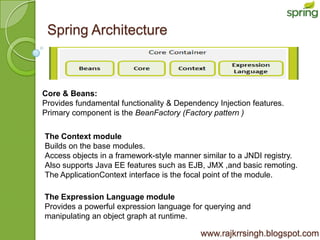
Spring Architecture


Core & Beans:
Provides fundamental functionality & Dependency Injection features.
Primary component is the BeanFactory (Factory pattern )

The Context module
Builds on the base modules.
Access objects in a framework-style manner similar to a JNDI registry.
Also supports Java EE features such as EJB, JMX ,and basic remoting.
The ApplicationContext interface is the focal point of the module.

The Expression Language module
Provides a powerful expression language for querying and
manipulating an object graph at runtime.

                                           www.rajkrrsingh.blogspot.com
Spring Architecture
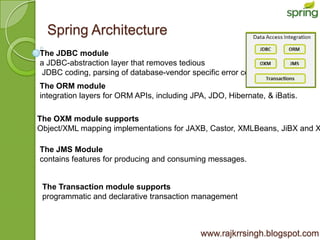
The JDBC module
a JDBC-abstraction layer that removes tedious
JDBC coding, parsing of database-vendor specific error codes.
The ORM module
integration layers for ORM APIs, including JPA, JDO, Hibernate, & iBatis.

The OXM module supports
Object/XML mapping implementations for JAXB, Castor, XMLBeans, JiBX and X

The JMS Module
contains features for producing and consuming messages.


 The Transaction module supports
 programmatic and declarative transaction management


                                             www.rajkrrsingh.blogspot.com
Spring Architecture
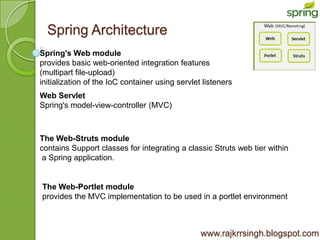
Spring's Web module
provides basic web-oriented integration features
(multipart file-upload)
initialization of the IoC container using servlet listeners
Web Servlet
Spring's model-view-controller (MVC)


The Web-Struts module
contains Support classes for integrating a classic Struts web tier within
 a Spring application.


The Web-Portlet module
provides the MVC implementation to be used in a portlet environment


                                                 www.rajkrrsingh.blogspot.com
Spring IOC
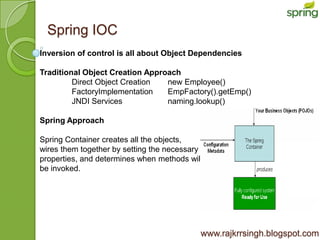
Inversion of control is all about Object Dependencies

Traditional Object Creation Approach
         Direct Object Creation  new Employee()
         FactoryImplementation   EmpFactory().getEmp()
         JNDI Services           naming.lookup()

Spring Approach

Spring Container creates all the objects,
wires them together by setting the necessary
properties, and determines when methods will
be invoked.


                                           www.rajkrrsingh.blogspot.com
Spring Container
Fundamental part of the framework.
Two packages provides the basis for the Spring Framework's IoC container.
– org.springframework.beans
– org.springframework.context

BeanFactory provides the configuration framework and basic functionality,
and the ApplicationContext adds more enterprise-specific functionality.

The org.springframework.beans.factory.BeanFactory is the actual representati
the Spring IoC container

Responsible for containing and managing beans.

The most commonly used BeanFactory implementation is the XmlBeanFactor

The XmlBeanFactory takes XML configuration metadata and uses it to create
configured system or application.


                                            www.rajkrrsingh.blogspot.com
Spring Container

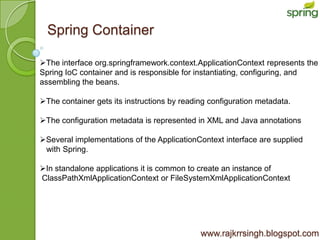
The interface org.springframework.context.ApplicationContext represents the
Spring IoC container and is responsible for instantiating, configuring, and
assembling the beans.

The container gets its instructions by reading configuration metadata.

The configuration metadata is represented in XML and Java annotations

Several implementations of the ApplicationContext interface are supplied
 with Spring.

In standalone applications it is common to create an instance of
ClassPathXmlApplicationContext or FileSystemXmlApplicationContext


                                             www.rajkrrsingh.blogspot.com
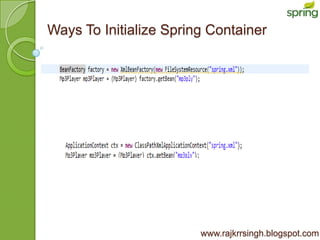
Ways To Initialize Spring Container


                        www.rajkrrsingh.blogspot.com
Type of Dependency Injection

 Setter method Injection

 Constructor Injection

 Configuration File Injection


                                 www.rajkrrsingh.blogspot.com
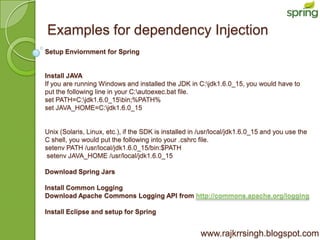
Examples for dependency Injection
Setup Enviornment for Spring


Install JAVA
If you are running Windows and installed the JDK in C:jdk1.6.0_15, you would have to
put the following line in your C:autoexec.bat file.
set PATH=C:jdk1.6.0_15bin;%PATH%
set JAVA_HOME=C:jdk1.6.0_15


Unix (Solaris, Linux, etc.), if the SDK is installed in /usr/local/jdk1.6.0_15 and you use the
C shell, you would put the following into your .cshrc file.
setenv PATH /usr/local/jdk1.6.0_15/bin:$PATH
 setenv JAVA_HOME /usr/local/jdk1.6.0_15

Download Spring Jars

Install Common Logging
Download Apache Commons Logging API from http://commons.apache.org/logging

Install Eclipse and setup for Spring


                                                       www.rajkrrsingh.blogspot.com
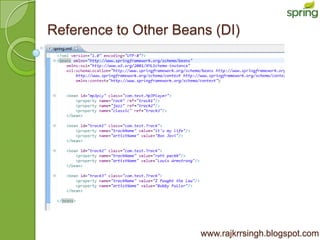
Reference to Other Beans (DI)


                       www.rajkrrsingh.blogspot.com
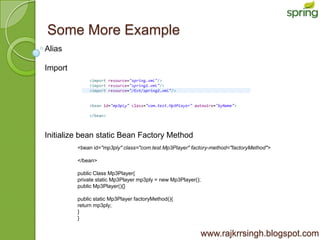
Some More Example
Alias

Import


Initialize bean static Bean Factory Method
         <bean id="mp3ply" class="com.test.Mp3Player" factory-method="factoryMethod">

         </bean>

         public Class Mp3Player{
         private static Mp3Player mp3ply = new Mp3Player();
         public Mp3Player(){}

         public static Mp3Player factoryMethod(){
         return mp3ply;
         }
         }


                                                              www.rajkrrsingh.blogspot.com
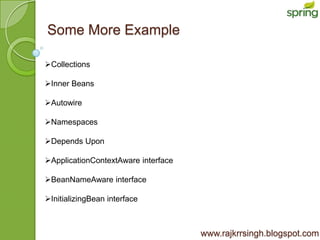
Some More Example

Collections

Inner Beans

Autowire

Namespaces

Depends Upon

ApplicationContextAware interface

BeanNameAware interface

InitializingBean interface


                                     www.rajkrrsingh.blogspot.com
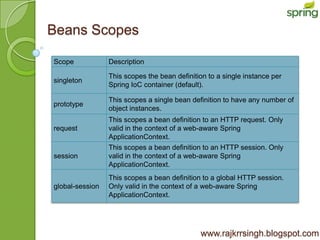
Beans Scopes

Scope            Description

                 This scopes the bean definition to a single instance per
singleton
                 Spring IoC container (default).

                 This scopes a single bean definition to have any number of
prototype
                 object instances.
                 This scopes a bean definition to an HTTP request. Only
request          valid in the context of a web-aware Spring
                 ApplicationContext.
                 This scopes a bean definition to an HTTP session. Only
session          valid in the context of a web-aware Spring
                 ApplicationContext.
                 This scopes a bean definition to a global HTTP session.
global-session   Only valid in the context of a web-aware Spring
                 ApplicationContext.


                                              www.rajkrrsingh.blogspot.com
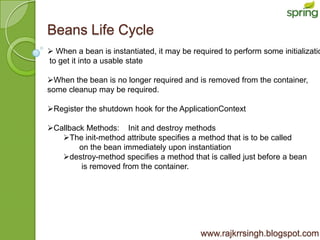
Beans Life Cycle
 When a bean is instantiated, it may be required to perform some initializatio
to get it into a usable state

When the bean is no longer required and is removed from the container,
some cleanup may be required.

Register the shutdown hook for the ApplicationContext

Callback Methods: Init and destroy methods
   The init-method attribute specifies a method that is to be called
        on the bean immediately upon instantiation
   destroy-method specifies a method that is called just before a bean
        is removed from the container.


                                            www.rajkrrsingh.blogspot.com
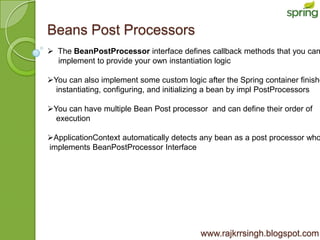
Beans Post Processors
 The BeanPostProcessor interface defines callback methods that you can
  implement to provide your own instantiation logic

You can also implement some custom logic after the Spring container finishe
  instantiating, configuring, and initializing a bean by impl PostProcessors

You can have multiple Bean Post processor and can define their order of
  execution

ApplicationContext automatically detects any bean as a post processor who
implements BeanPostProcessor Interface


                                          www.rajkrrsingh.blogspot.com
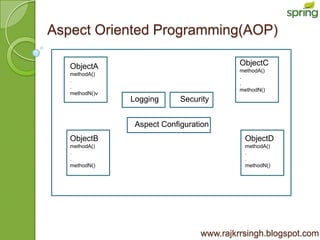
Aspect Oriented Programming(AOP)

   ObjectA                                 ObjectC
                                           methodA()
   methodA()
                                           .
   .
                                           .
   .
                                           methodN()
   methodN()v
                Logging      Security


                 Aspect Configuration
   ObjectB                                  ObjectD
   methodA()                                methodA()
   .                                        .
   .                                        .
   methodN()                                methodN()


                                  www.rajkrrsingh.blogspot.com
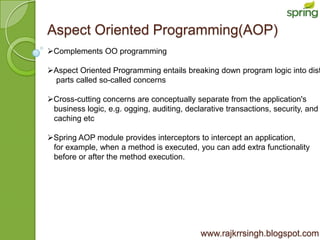
Aspect Oriented Programming(AOP)
Complements OO programming

Aspect Oriented Programming entails breaking down program logic into dist
 parts called so-called concerns

Cross-cutting concerns are conceptually separate from the application's
 business logic, e.g. ogging, auditing, declarative transactions, security, and
 caching etc

Spring AOP module provides interceptors to intercept an application,
 for example, when a method is executed, you can add extra functionality
 before or after the method execution.


                                            www.rajkrrsingh.blogspot.com
Aspect Oriented Programming(AOP)
Components of AOP
   Aspect – unit of modularity for crosscutting concerns

   Join point – well-defined points in the program flow

   Pointcut – join point queries where advice executes

   Advice – the block of code that runs based on the pointcut definition

   Weaving – can be done at runtime or compile time.
   Inserts the advice (crosscutting concerns) into the code (core concerns).


                                          www.rajkrrsingh.blogspot.com
Setting up AOP Environment in Eclipse
AOP Dependencies
   AspectJ: http://www.eclipse.org/aspectj/downloads.php
   AOP Alliance: http://aopalliance.sourceforge.net/
   CGILIB: http://cglib.sourceforge.net/
   Spring 3 ASM: http://asm.ow2.org/


   Examples…..


                                     www.rajkrrsingh.blogspot.com
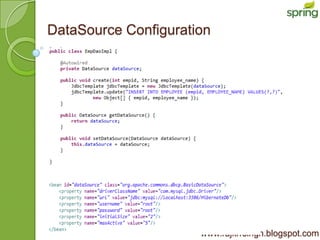
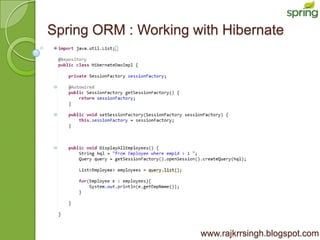
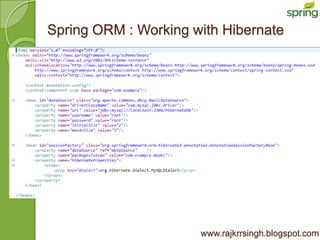
Spring DAO and ORM
 Built in code templates that support JDBC, Hibernate, JDO,
and iBatis SQL Maps

Simplifies data access coding by reducing redundant code and
helps avoid common errors.

 Alleviates opening and closing connections in your DAO code.

No more ThreadLocal or passing Connection/Session objects.

Transaction management is handled by a wired bean

You are dropped into the template with the resources you need
for data access – Session, PreparedStatement, etc.

Optional separate JDBC framework

                                     www.rajkrrsingh.blogspot.com
JdbcTemplate
Central class in the JDBC core package

Handles the creation and release of resources.

Executes the core JDBC workflow like statement creation
and
Execution

 Executes
       – SQL queries
       – update statements
       – stored procedure calls
       – iteration over ResultSets
       – extraction of returned parameter values.

Also catches JDBC exceptions

                                      www.rajkrrsingh.blogspot.com
DataSource Configuration


                      www.rajkrrsingh.blogspot.com
Spring ORM : Working with Hibernate


                      www.rajkrrsingh.blogspot.com
Spring ORM : Working with Hibernate


                      www.rajkrrsingh.blogspot.com
Q&A


      www.rajkrrsingh.blogspot.com
Thanks


if you have any query concerns
            write to me
                 on
     rajkrrsingh@gmail.com


                    www.rajkrrsingh.blogspot.com

Spring framework

  • 1.
    Workshop of SpringApplication Framework at Capegemini Presented By Rajkumar Singh www.rajkrrsingh.blogspot.com
  • 2.
    Agenda Introduction Spring Architecture Spring Beans SpringIOC Setting up Spring Environment Beans Life cycles Spring DAO Spring ORM Spring AOP Q&A www.rajkrrsingh.blogspot.com
  • 3.
    Introduction Spring framework wasinitially written by Rod Johnson and was first released under the Apache 2.0 license in June 2003. Primary purpose is to reduce the dependencies(loose couple) Spring deliver many significant benefits to the developers reducing development effort and cost while improving test coverage and quality Handle the infrastructure so that developer can focus on the development only Enables you to build application from POJOs Spring does not recreate all the framework but make use of the existing one like ORM,logging,JEE framework. www.rajkrrsingh.blogspot.com
  • 4.
    What Spring Offers DependencyInjection Aspect Oriented Programming (AOP) Portable Serives ORM DAO MVC www.rajkrrsingh.blogspot.com
  • 5.
    Application Layering Presentation Layer Spring MVC Spring Web Service Layer Gateway to expose business logic to the outside world Persistence Layer Not well defined in many applications today or tightly coupled in an inappropriate layer. JDBC ORM Manages ‘container level services’ Eg. transactions, security, data access logic, and manipulates domain objects Domain Layer POJOs www.rajkrrsingh.blogspot.com
  • 6.
    Spring Architecture www.rajkrrsingh.blogspot.com
  • 7.
    Spring Architecture Core &Beans: Provides fundamental functionality & Dependency Injection features. Primary component is the BeanFactory (Factory pattern ) The Context module Builds on the base modules. Access objects in a framework-style manner similar to a JNDI registry. Also supports Java EE features such as EJB, JMX ,and basic remoting. The ApplicationContext interface is the focal point of the module. The Expression Language module Provides a powerful expression language for querying and manipulating an object graph at runtime. www.rajkrrsingh.blogspot.com
  • 8.
    Spring Architecture The JDBCmodule a JDBC-abstraction layer that removes tedious JDBC coding, parsing of database-vendor specific error codes. The ORM module integration layers for ORM APIs, including JPA, JDO, Hibernate, & iBatis. The OXM module supports Object/XML mapping implementations for JAXB, Castor, XMLBeans, JiBX and X The JMS Module contains features for producing and consuming messages. The Transaction module supports programmatic and declarative transaction management www.rajkrrsingh.blogspot.com
  • 9.
    Spring Architecture Spring's Webmodule provides basic web-oriented integration features (multipart file-upload) initialization of the IoC container using servlet listeners Web Servlet Spring's model-view-controller (MVC) The Web-Struts module contains Support classes for integrating a classic Struts web tier within a Spring application. The Web-Portlet module provides the MVC implementation to be used in a portlet environment www.rajkrrsingh.blogspot.com
  • 10.
    Spring IOC Inversion ofcontrol is all about Object Dependencies Traditional Object Creation Approach Direct Object Creation new Employee() FactoryImplementation EmpFactory().getEmp() JNDI Services naming.lookup() Spring Approach Spring Container creates all the objects, wires them together by setting the necessary properties, and determines when methods will be invoked. www.rajkrrsingh.blogspot.com
  • 11.
    Spring Container Fundamental partof the framework. Two packages provides the basis for the Spring Framework's IoC container. – org.springframework.beans – org.springframework.context BeanFactory provides the configuration framework and basic functionality, and the ApplicationContext adds more enterprise-specific functionality. The org.springframework.beans.factory.BeanFactory is the actual representati the Spring IoC container Responsible for containing and managing beans. The most commonly used BeanFactory implementation is the XmlBeanFactor The XmlBeanFactory takes XML configuration metadata and uses it to create configured system or application. www.rajkrrsingh.blogspot.com
  • 12.
    Spring Container The interfaceorg.springframework.context.ApplicationContext represents the Spring IoC container and is responsible for instantiating, configuring, and assembling the beans. The container gets its instructions by reading configuration metadata. The configuration metadata is represented in XML and Java annotations Several implementations of the ApplicationContext interface are supplied with Spring. In standalone applications it is common to create an instance of ClassPathXmlApplicationContext or FileSystemXmlApplicationContext www.rajkrrsingh.blogspot.com
  • 13.
    Ways To InitializeSpring Container www.rajkrrsingh.blogspot.com
  • 14.
    Type of DependencyInjection Setter method Injection Constructor Injection Configuration File Injection www.rajkrrsingh.blogspot.com
  • 15.
    Examples for dependencyInjection Setup Enviornment for Spring Install JAVA If you are running Windows and installed the JDK in C:jdk1.6.0_15, you would have to put the following line in your C:autoexec.bat file. set PATH=C:jdk1.6.0_15bin;%PATH% set JAVA_HOME=C:jdk1.6.0_15 Unix (Solaris, Linux, etc.), if the SDK is installed in /usr/local/jdk1.6.0_15 and you use the C shell, you would put the following into your .cshrc file. setenv PATH /usr/local/jdk1.6.0_15/bin:$PATH setenv JAVA_HOME /usr/local/jdk1.6.0_15 Download Spring Jars Install Common Logging Download Apache Commons Logging API from http://commons.apache.org/logging Install Eclipse and setup for Spring www.rajkrrsingh.blogspot.com
  • 16.
    Reference to OtherBeans (DI) www.rajkrrsingh.blogspot.com
  • 17.
    Some More Example Alias Import Initializebean static Bean Factory Method <bean id="mp3ply" class="com.test.Mp3Player" factory-method="factoryMethod"> </bean> public Class Mp3Player{ private static Mp3Player mp3ply = new Mp3Player(); public Mp3Player(){} public static Mp3Player factoryMethod(){ return mp3ply; } } www.rajkrrsingh.blogspot.com
  • 18.
    Some More Example Collections InnerBeans Autowire Namespaces Depends Upon ApplicationContextAware interface BeanNameAware interface InitializingBean interface www.rajkrrsingh.blogspot.com
  • 19.
    Beans Scopes Scope Description This scopes the bean definition to a single instance per singleton Spring IoC container (default). This scopes a single bean definition to have any number of prototype object instances. This scopes a bean definition to an HTTP request. Only request valid in the context of a web-aware Spring ApplicationContext. This scopes a bean definition to an HTTP session. Only session valid in the context of a web-aware Spring ApplicationContext. This scopes a bean definition to a global HTTP session. global-session Only valid in the context of a web-aware Spring ApplicationContext. www.rajkrrsingh.blogspot.com
  • 20.
    Beans Life Cycle When a bean is instantiated, it may be required to perform some initializatio to get it into a usable state When the bean is no longer required and is removed from the container, some cleanup may be required. Register the shutdown hook for the ApplicationContext Callback Methods: Init and destroy methods The init-method attribute specifies a method that is to be called on the bean immediately upon instantiation destroy-method specifies a method that is called just before a bean is removed from the container. www.rajkrrsingh.blogspot.com
  • 21.
    Beans Post Processors The BeanPostProcessor interface defines callback methods that you can implement to provide your own instantiation logic You can also implement some custom logic after the Spring container finishe instantiating, configuring, and initializing a bean by impl PostProcessors You can have multiple Bean Post processor and can define their order of execution ApplicationContext automatically detects any bean as a post processor who implements BeanPostProcessor Interface www.rajkrrsingh.blogspot.com
  • 22.
    Aspect Oriented Programming(AOP) ObjectA ObjectC methodA() methodA() . . . . methodN() methodN()v Logging Security Aspect Configuration ObjectB ObjectD methodA() methodA() . . . . methodN() methodN() www.rajkrrsingh.blogspot.com
  • 23.
    Aspect Oriented Programming(AOP) ComplementsOO programming Aspect Oriented Programming entails breaking down program logic into dist parts called so-called concerns Cross-cutting concerns are conceptually separate from the application's business logic, e.g. ogging, auditing, declarative transactions, security, and caching etc Spring AOP module provides interceptors to intercept an application, for example, when a method is executed, you can add extra functionality before or after the method execution. www.rajkrrsingh.blogspot.com
  • 24.
    Aspect Oriented Programming(AOP) Componentsof AOP Aspect – unit of modularity for crosscutting concerns Join point – well-defined points in the program flow Pointcut – join point queries where advice executes Advice – the block of code that runs based on the pointcut definition Weaving – can be done at runtime or compile time. Inserts the advice (crosscutting concerns) into the code (core concerns). www.rajkrrsingh.blogspot.com
  • 25.
    Setting up AOPEnvironment in Eclipse AOP Dependencies AspectJ: http://www.eclipse.org/aspectj/downloads.php AOP Alliance: http://aopalliance.sourceforge.net/ CGILIB: http://cglib.sourceforge.net/ Spring 3 ASM: http://asm.ow2.org/ Examples….. www.rajkrrsingh.blogspot.com
  • 26.
    Spring DAO andORM  Built in code templates that support JDBC, Hibernate, JDO, and iBatis SQL Maps Simplifies data access coding by reducing redundant code and helps avoid common errors.  Alleviates opening and closing connections in your DAO code. No more ThreadLocal or passing Connection/Session objects. Transaction management is handled by a wired bean You are dropped into the template with the resources you need for data access – Session, PreparedStatement, etc. Optional separate JDBC framework www.rajkrrsingh.blogspot.com
  • 27.
    JdbcTemplate Central class inthe JDBC core package Handles the creation and release of resources. Executes the core JDBC workflow like statement creation and Execution  Executes – SQL queries – update statements – stored procedure calls – iteration over ResultSets – extraction of returned parameter values. Also catches JDBC exceptions www.rajkrrsingh.blogspot.com
  • 28.
    DataSource Configuration www.rajkrrsingh.blogspot.com
  • 29.
    Spring ORM :Working with Hibernate www.rajkrrsingh.blogspot.com
  • 30.
    Spring ORM :Working with Hibernate www.rajkrrsingh.blogspot.com
  • 31.
    Q&A www.rajkrrsingh.blogspot.com
  • 32.
    Thanks if you haveany query concerns write to me on rajkrrsingh@gmail.com www.rajkrrsingh.blogspot.com