Version 3.2023, 12/08/22 © 2022 National Comprehensive Cancer Network®
(NCCN®
), All rights reserved. NCCN Guidelines®
and this illustration may not be reproduced in any form without the express written permission of NCCN.
NCCN Clinical Practice Guidelines in Oncology (NCCN Guidelines®
)
Multiple Myeloma
Version 3.2023 — December 8, 2022
Continue
NCCN.org
NCCN Guidelines for Patients®
available at www.nccn.org/patients
NCCN Guidelines Version 3.2023
Multiple Myeloma
Version 3.2023, 12/08/22 © 2022 National Comprehensive Cancer Network®
(NCCN®
), All rights reserved. NCCN Guidelines®
and this illustration may not be reproduced in any form without the express written permission of NCCN.
NCCN Guidelines Index
Table of Contents
Discussion
NCCN Guidelines Panel Disclosures
ξ Bone marrow transplantation
‡ Hematology
Þ Internal medicine
† Medical oncology
¥ Patient advocacy
* 
Discussion section writing
committee
Continue
*Shaji K. Kumar, MD/Chair ‡ ξ
Mayo Clinic Cancer Center
*Natalie S. Callander, MD/Vice Chair ‡ ξ
University of Wisconsin
Carbone Cancer Center
Kehinde Adekola, MD, MSCI ‡ †
Robert H. Lurie Comprehensive
Cancer Center of Northwestern University
Larry D. Anderson, Jr., MD, PhD ‡ †
UT Southwestern Simmons
Comprehensive Cancer Center
Muhamed Baljevic, MD † ‡ Þ ξ
Vanderbilt-Ingram Cancer Center
Erica Campagnaro, MD ‡
University of Michigan Rogel Cancer Center
*Jorge J. Castillo, MD ‡
Dana-Farber/Brigham and Women’s
Cancer Center | Massachusetts General
Hospital Cancer Center
Caitlin Costello, MD † ‡ ξ
UC San Diego Moores Cancer Center
Christopher D'Angelo, MD † ‡
Fred  Pamela Buffett Cancer Center
Srinivas Devarakonda, MD ‡ †
The Ohio State University Comprehensive
Cancer Center - James Cancer Hospital
and Solove Research Institute
Noura Elsedawy, MD †
St. Jude Children's Research Hospital/
The University of Tennessee
Health Science Center
Alfred Garfall, MD ‡
Abramson Cancer Center
at the University of Pennsylvania
Kelly Godby, MD †
O'Neal Comprehensive
Cancer Center at UAB
Jens Hillengass, MD, PhD ‡
Roswell Park Comprehensive Cancer Center
Leona Holmberg, MD, PhD ξ ‡
Fred Hutchinson Cancer Center
Myo Htut, MD ‡ Þ
City of Hope National Medical Center
Carol Ann Huff, MD † ‡
The Sidney Kimmel Comprehensive
Cancer Center at Johns Hopkins
Malin Hultcrantz, MD, PhD ‡ †
Memorial Sloan Kettering Cancer Center
Yubin Kang, MD ‡ † ξ
Duke Cancer Institute
Sarah Larson, MD †
UCLA Jonsson Comprehensive Cancer Center
Hans C. Lee, MD † ‡
The University of Texas
MD Anderson Cancer Center
Michaela Liedtke, MD ‡
Stanford Cancer Institute
Thomas Martin, MD ‡
UCSF Helen Diller Family
Comprehensive Cancer Center
James Omel, MD ¥
Patient Advocate
Aaron Rosenberg, MD † ‡ ξ
UC Davis Comprehensive Cancer Center
Douglas Sborov, MD, MSc † ‡ Þ ξ
Huntsman Cancer Institute
at the University of Utah
Attaya Suvannasankha, MD † ‡
Indiana University Melvin and Bren Simon
Comprehensive Cancer Center
Jason Valent, MD † ‡
Case Comprehensive Cancer Center/
University Hospitals Seidman Cancer Center
and Cleveland Clinic Taussig Cancer Institute
Asya Nina Varshavsky-Yanovsky, MD † ‡
Fox Chase Cancer Center
NCCN
Ryan Berardi, MSc
Rashmi Kumar, PhD
Printed by Ann Wahba on 5/3/2023 2:47:13 AM. For personal use only. Not approved for distribution. Copyright © 2023 National Comprehensive Cancer Network, Inc., All Rights Reserved.
NCCN Guidelines Version 3.2023
Multiple Myeloma
Version 3.2023, 12/08/22 © 2022 National Comprehensive Cancer Network®
(NCCN®
), All rights reserved. NCCN Guidelines®
and this illustration may not be reproduced in any form without the express written permission of NCCN.
NCCN Guidelines Index
Table of Contents
Discussion
NCCN Multiple Myeloma Panel Members
Summary of Guidelines Updates
Initial Diagnostic Workup and Clinical Findings (MYEL-1)
Solitary Plasmacytoma or Solitary Plasmacytoma with Minimal Marrow Involvement:
Primary Treatment and Follow-up/Surveillance (MYEL-2)
Smoldering Myeloma (Asymptomatic): Primary Treatment and Follow-Up/Surveillance (MYEL-3)
Multiple Myeloma (Symptomatic): Primary Treatment and Follow-Up/Surveillance (MYEL-4)
Multiple Myeloma (Symptomatic): Response After Primary Therapy and Follow-Up Surveillance (MYEL-5)
Multiple Myeloma (Symptomatic): Additional Treatment for Relapse or Progressive Disease (MYEL-6)
Disease Staging and Risk Stratification Systems for Multiple Myeloma (MYEL-A)
Principles of Imaging (MYEL-B)
Definitions of Smoldering and Multiple Myeloma (MYEL-C)
Principles of Radiation Therapy (MYEL-D)
Response Criteria for Multiple Myeloma (MYEL-E)
General Considerations for Myeloma Therapy (MYEL-F)
Myeloma Therapy (MYEL-G)
Supportive Care for Multiple Myeloma (MYEL-H)
Management of Venous Thromboembolism (VTE) in Multiple Myeloma (MYEL-I)
Management of Renal Disease in Multiple Myeloma (MYEL-J)
Monoclonal Gammopathy of Clinical Significance
• Monoclonal Gammopathy of Renal Significance (MGRS-1)
• Monoclonal Gammopathy of Neurological Significance (MGNS-1)
POEMS (Polyneuropathy, Organomegaly, Endocrinopathy, Monoclonal Protein, Skin Changes) (POEMS-1)
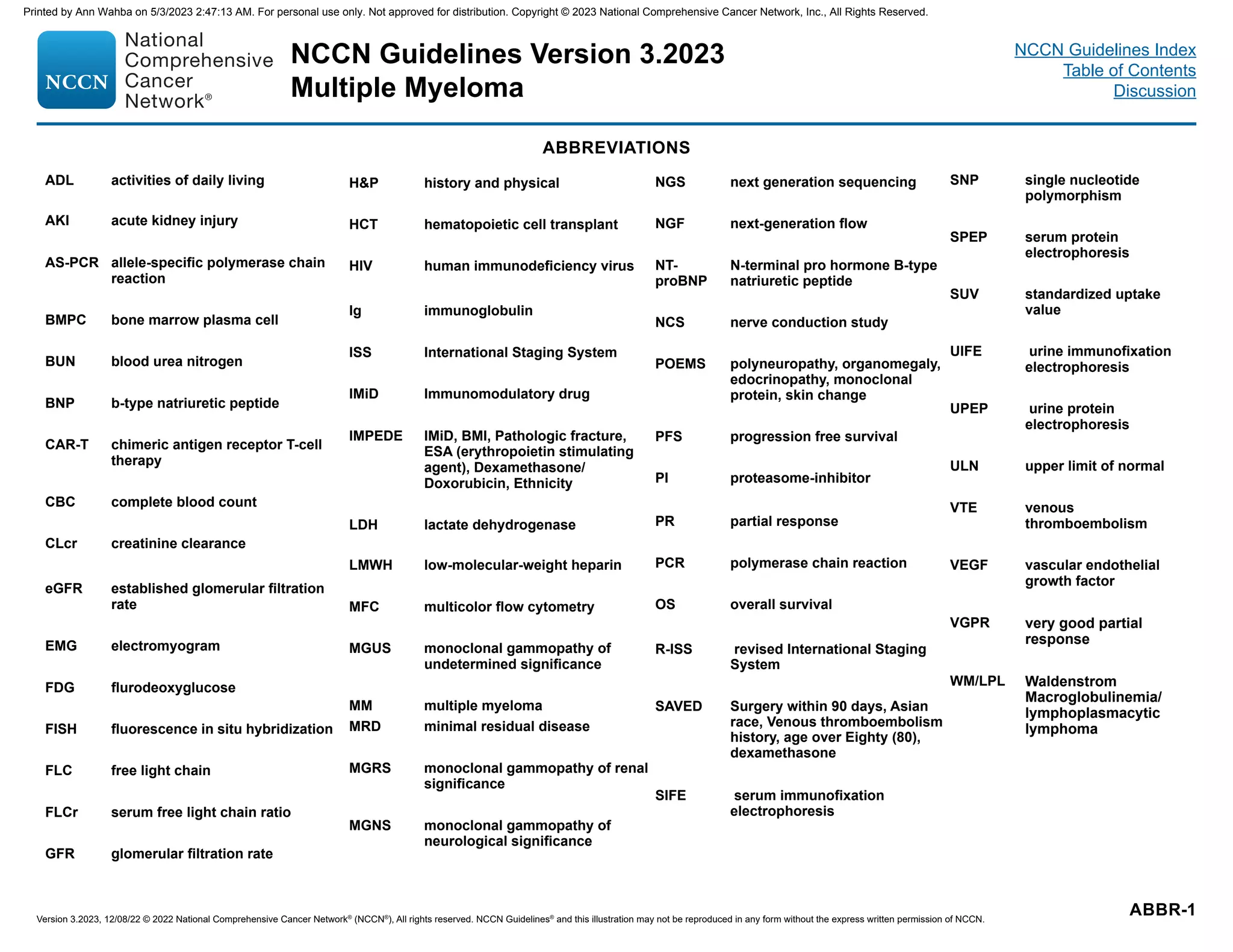
Abbreviations (ABBR-1)
Clinical Trials: NCCN believes
that the best management for
any patient with cancer is in a
clinical trial.
Participation in clinical trials is
especially encouraged.
Find an NCCN Member
Institution: https://www.nccn.org/
home/member-institutions
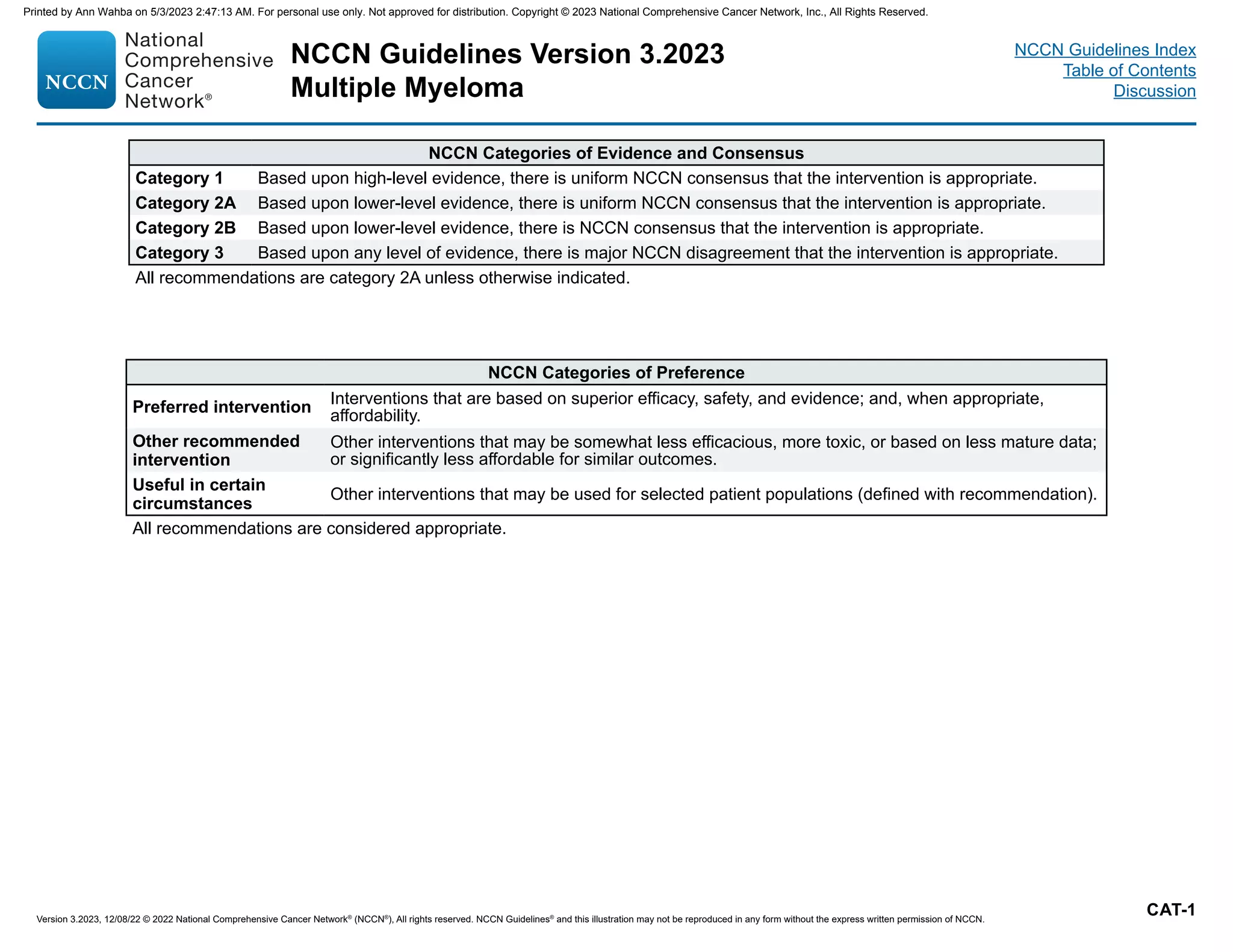
NCCN Categories of
Evidence and Consensus: All
recommendations are category
2A unless otherwise indicated.
See NCCN Categories of
Evidence and Consensus.
NCCN Categories of
Preference:
All recommendations are
considered appropriate.
See NCCN Categories of
Preference.
The NCCN Guidelines®
are a statement of evidence and consensus of the authors regarding their views of currently accepted approaches to
treatment. Any clinician seeking to apply or consult the NCCN Guidelines is expected to use independent medical judgment in the context of individual
clinical circumstances to determine any patient’s care or treatment. The National Comprehensive Cancer Network®
(NCCN®
) makes no representations
or warranties of any kind regarding their content, use or application and disclaims any responsibility for their application or use in any way. The NCCN
Guidelines are copyrighted by National Comprehensive Cancer Network®
. All rights reserved. The NCCN Guidelines and the illustrations herein may not
be reproduced in any form without the express written permission of NCCN. ©2022.
Printed by Ann Wahba on 5/3/2023 2:47:13 AM. For personal use only. Not approved for distribution. Copyright © 2023 National Comprehensive Cancer Network, Inc., All Rights Reserved.
NCCN Guidelines Version 3.2023
Multiple Myeloma
Version 3.2023, 12/08/22 © 2022 National Comprehensive Cancer Network®
(NCCN®
), All rights reserved. NCCN Guidelines®
and this illustration may not be reproduced in any form without the express written permission of NCCN.
Note: All recommendations are category 2A unless otherwise indicated.
Clinical Trials: NCCN believes that the best management of any patient with cancer is in a clinical trial. Participation in clinical trials is especially encouraged.
NCCN Guidelines Index
Table of Contents
Discussion
UPDATES
CONTINUED
Updates in Version 1.2023 of the NCCN Guidelines for Multiple Myeloma from Version 5.2022 include:
MYEL-1
• Initial Diagnostic Workup:
11th bullet modified: Plasma cell fluorescence in situ hybridization (FISH) panel on bone marrow [del(13), del(17p13), t(4;14), t(11;14), t(14;16),
t(14:20), 1q21 gain/1q21 amplification, 1p deletion]
12th bullet added: NT-proBNP/BNP
• Footnote d modified: Skeletal survey is acceptable in certain circumstances. However, it is significantly less sensitive than whole-body low-dose CT
and FDG PET/CT. If whole-body FDG PET/CT or low-dose CT has been performed, then skeletal survey is not needed. FDG PET should always be
performed with CT. (Also on MYEL-4)
• Footnote g added: 1q21 amplification is defined as ≥4 copies detected by FISH, and a gain is defined as 3 copies of 1q21.
• Footnote h added: If NT-proBNP is not available, BNP can be performed.
MYEL-2
• Follow-up/Surveillance, 2nd bullet, 5th sub-bullet modified: Bone marrow aspirate and biopsy as indicated
• Footnote j modified: Whole-body MRI (or PET/CT if MRI is not available) is the first choice for initial evaluation of solitary osseous plasmacytoma (MRI
of the spine and pelvis, whole-body FDG PET/CT, or low-dose whole-body CT under certain circumstances). Whole-body FDG PET/CT is the first
choice for initial evaluation of solitary extraosseous plasmacytoma.
• Footnote o added: Systemic therapy may be considered in patients with high risk of progression based on the clinical context.
• Footnote p modified: Reassess after at least 3 months following radiation as the assessment of response with imaging may not be accurate if the scans
are performed sooner. Patients with soft tissue and head/neck plasmacytoma could be followed less frequently after initial 3-month follow-up.
Updates in Version 2.2023 of the NCCN Guidelines for Multiple Myeloma from Version 1.2023 include:
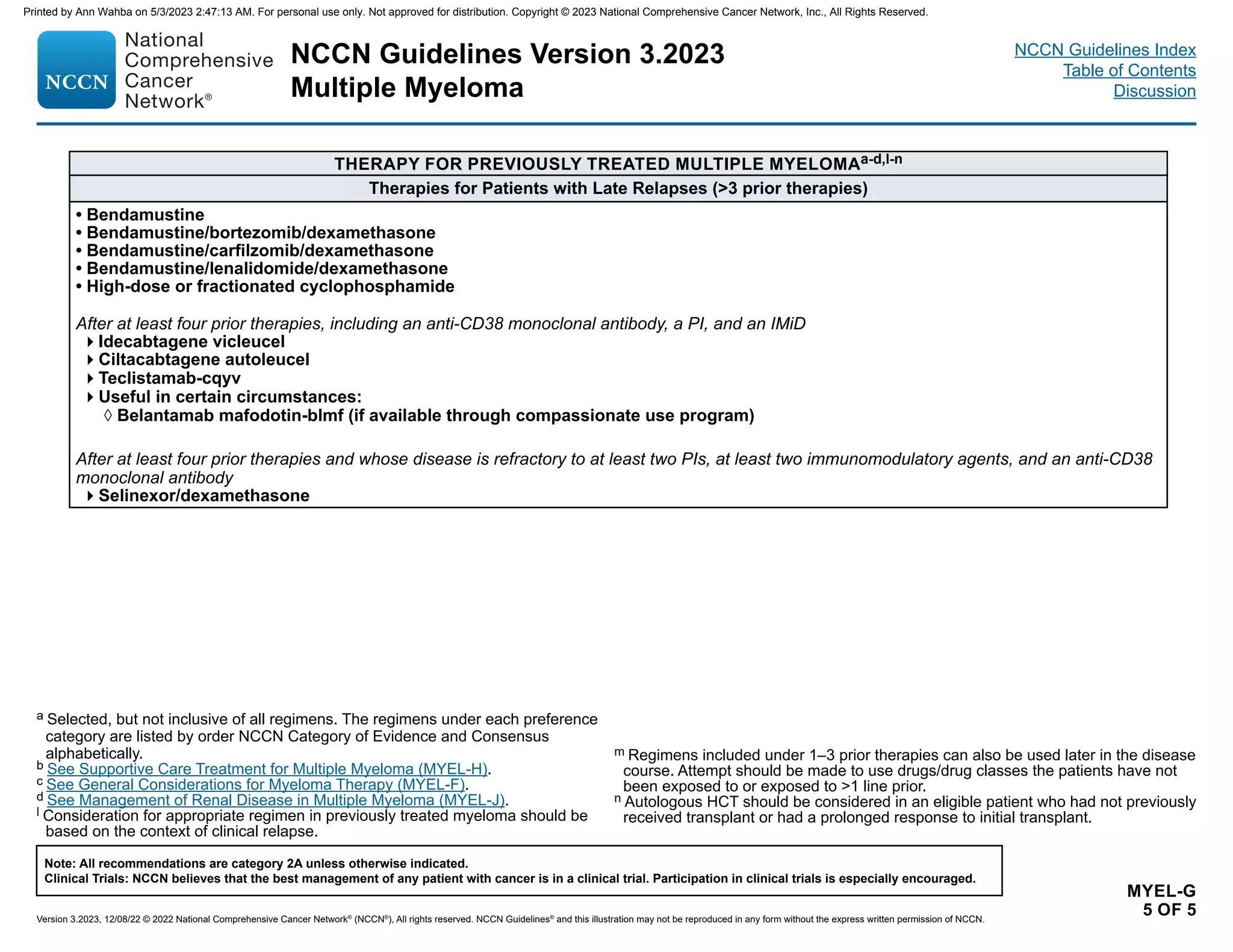
MYEL-G 5 of 5
• Therapy for Previously Treated Multiple Myeloma
Therapies for patients with Late Relapses (3 prior therapies):
◊ Teclistamab-cqyv was added as an option after at least four prior therapies, including an anti-CD38 monoclonal antibody, a PI, and an IMiD.
Updates in Version 3.2023 of the NCCN Guidelines for Multiple Myeloma from Version 2.2023 include:
MYEL-G 5 of 5
• Therapy for Previously Treated Multiple Myeloma
Therapies for patients with Late Relapses (3 prior therapies)
◊ After at least four prior therapies, including an anti-CD38 monoclonal antibody, a PI, and an IMiD:
– Fourth bullet added: Useful in certain circumstances
▪ Belantamab mafodotin-blmf has been moved to useful in certain circumstances: Belantamab mafodotin-blmf (if available through compassionate
use program)
Printed by Ann Wahba on 5/3/2023 2:47:13 AM. For personal use only. Not approved for distribution. Copyright © 2023 National Comprehensive Cancer Network, Inc., All Rights Reserved.
NCCN Guidelines Version 3.2023
Multiple Myeloma
Version 3.2023, 12/08/22 © 2022 National Comprehensive Cancer Network®
(NCCN®
), All rights reserved. NCCN Guidelines®
and this illustration may not be reproduced in any form without the express written permission of NCCN.
Note: All recommendations are category 2A unless otherwise indicated.
Clinical Trials: NCCN believes that the best management of any patient with cancer is in a clinical trial. Participation in clinical trials is especially encouraged.
NCCN Guidelines Index
Table of Contents
Discussion
UPDATES
CONTINUED
Updates in Version 1.2023 of the NCCN Guidelines for Multiple Myeloma from Version 5.2022 include:
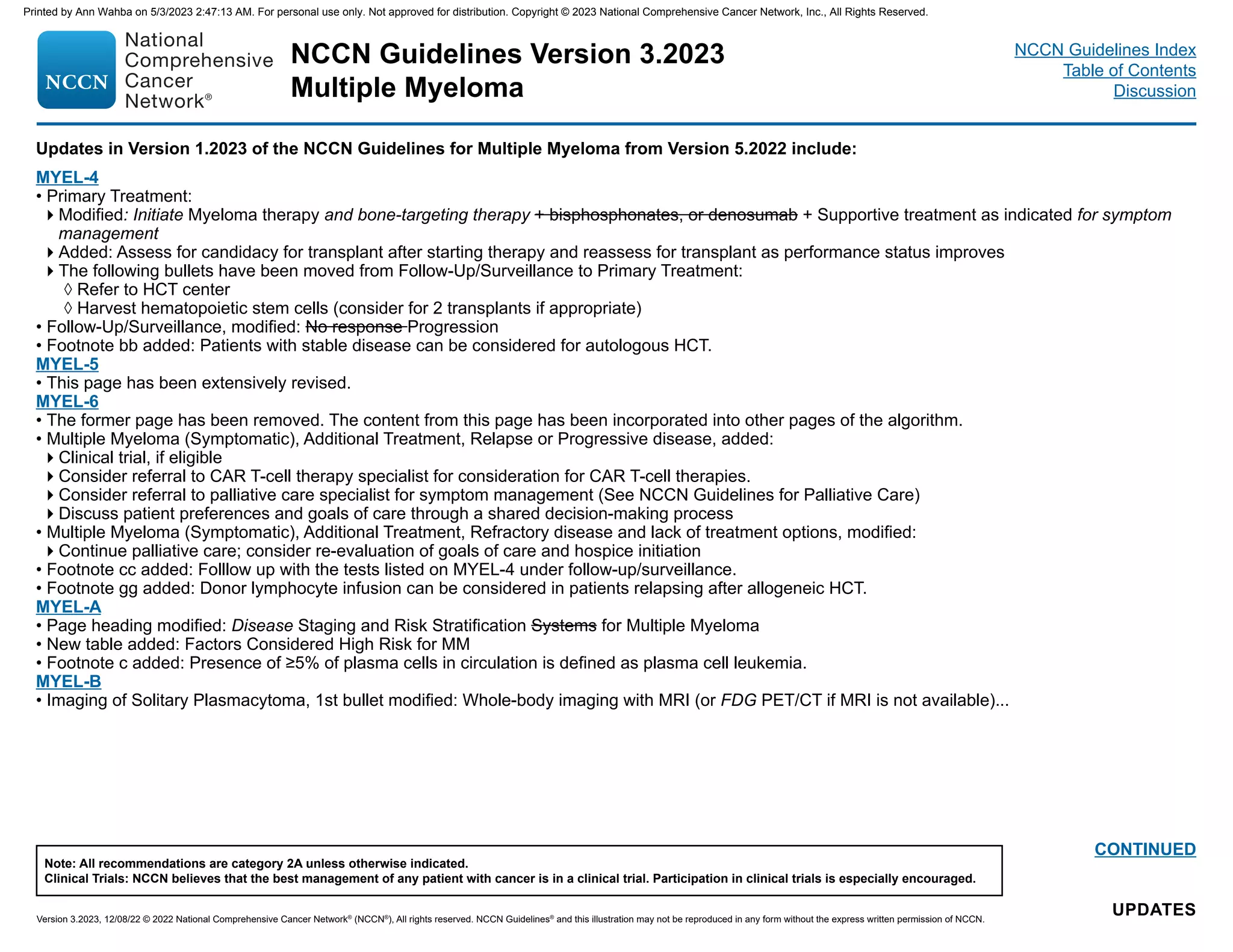
MYEL-4
• Primary Treatment:
Modified: Initiate Myeloma therapy and bone-targeting therapy + bisphosphonates, or denosumab + Supportive treatment as indicated for symptom
management
Added: Assess for candidacy for transplant after starting therapy and reassess for transplant as performance status improves
The following bullets have been moved from Follow-Up/Surveillance to Primary Treatment:
◊ Refer to HCT center
◊ Harvest hematopoietic stem cells (consider for 2 transplants if appropriate)
• Follow-Up/Surveillance, modified: No response Progression
• Footnote bb added: Patients with stable disease can be considered for autologous HCT.
MYEL-5
• This page has been extensively revised.
MYEL-6
• The former page has been removed. The content from this page has been incorporated into other pages of the algorithm.
• Multiple Myeloma (Symptomatic), Additional Treatment, Relapse or Progressive disease, added:
Clinical trial, if eligible
Consider referral to CAR T-cell therapy specialist for consideration for CAR T-cell therapies.
Consider referral to palliative care specialist for symptom management (See NCCN Guidelines for Palliative Care)
Discuss patient preferences and goals of care through a shared decision-making process
• Multiple Myeloma (Symptomatic), Additional Treatment, Refractory disease and lack of treatment options, modified:
Continue palliative care; consider re-evaluation of goals of care and hospice initiation
• Footnote cc added: Folllow up with the tests listed on MYEL-4 under follow-up/surveillance.
• Footnote gg added: Donor lymphocyte infusion can be considered in patients relapsing after allogeneic HCT.
MYEL-A
• Page heading modified: Disease Staging and Risk Stratification Systems for Multiple Myeloma
• New table added: Factors Considered High Risk for MM
• Footnote c added: Presence of ≥5% of plasma cells in circulation is defined as plasma cell leukemia.
MYEL-B
• Imaging of Solitary Plasmacytoma, 1st bullet modified: Whole-body imaging with MRI (or FDG PET/CT if MRI is not available)...
Printed by Ann Wahba on 5/3/2023 2:47:13 AM. For personal use only. Not approved for distribution. Copyright © 2023 National Comprehensive Cancer Network, Inc., All Rights Reserved.
NCCN Guidelines Version 3.2023
Multiple Myeloma
Version 3.2023, 12/08/22 © 2022 National Comprehensive Cancer Network®
(NCCN®
), All rights reserved. NCCN Guidelines®
and this illustration may not be reproduced in any form without the express written permission of NCCN.
Note: All recommendations are category 2A unless otherwise indicated.
Clinical Trials: NCCN believes that the best management of any patient with cancer is in a clinical trial. Participation in clinical trials is especially encouraged.
NCCN Guidelines Index
Table of Contents
Discussion
Updates in Version 1.2023 of the NCCN Guidelines for Multiple Myeloma from Version 5.2022 include:
UPDATES
UPDATES
CONTINUED
MYEL-D
• Solitary Plasmacytoma, Treatment Information/Dosing, 1st bullet, 1st sub-bullet modified: RT (40–50 Gy in 1.8–2.0 Gy fractions [20–25 total fractions])
to involved field site.
• Palliative RT Dosing for MM, 1st bullet modified: Low-dose RT (8 Gy x 1 fraction or 10–30 Gy in 2.0–3.0 Gy fractions [5–10 total fractions]) can be
used as palliative treatment for uncontrolled pain, for impending pathologic fracture, or for impending cord compression. Consider RT postoperatively if
urgent surgical intervention is indicated.
• Palliative RT Dosing for MM, 2nd bullet modified: Limited involved fields sites should be used to limit the impact of irradiation on hematopoietic stem cell
harvest or impact on potential future treatments.
MYEL-F
• General Principles, 1st bullet modified: Patients should receive at least a triplet regimen (2 drug classes and steroids) if they can tolerate it. Triplet
regimens (2 drug classes and steroids) should be used as the standard therapy for patients with MM; however,
• General Principles, 3rd bullet added: Clinical trials with these triplet regimens primarily included patients who were naïve or sensitive to the novel drug
in the doublet comparator arm. Patients with disease refractory to the novel drug in the doublet backbone should be considered for triplet therapy that
does not contain the drug they are progressing on.
• Candidates for Hematopoietic Cell Transplant, 2nd bullet modified: Consider harvesting peripheral blood stem cells after several cycles of therapy prior
to prolonged exposure to lenalidomide and/or daratumumab in patients for whom transplant is being considered.
• Screening Recommendations, 1st bullet modified: Test for hepatitis B before starting daratumumab or carfilzomib as clinically indicated.
• Prophylaxis Recommendations, 1st bullet modified: Pneumocystis jiroveci pneumonia (PJP), herpes zoster, and antifungal prophylaxis should be given
if receiving high-dose dexamethasone steroids.
• Side Effects and Lab Interference, 4th bullet added: In patients intended to receive CAR T-cell therapy, bendamustine should be used with caution
unless after leukapheresis prior to CAR T-cell therapy, since it could impact the success of the patient's T-cell collection.
MYEL-G 1 of 5
• Primary Therapy for Transplant Candidates:
The following regimen was moved from Other Recommended Regimens to Preferred Regimens:
◊ Carfilzomib/lenalidomide/dexamethasone
The following regimen was moved from Other Recommended Regimens to Useful in Certain Circumstances:
◊ Ixazomib/lenalidomide/dexamethasone (category 2B)
• Maintenance Therapy:
The following regimen was added to Other Recommended Regimens:
◊ Daratumumab
The following regimen was added to Useful in Certain Circumstances as an option for high risk MM:
◊ Carfilzomib/lenalidomide
• Footnote a has been modified: Selected, but not inclusive of all regimens. The regimens under each preference category are listed by order NCCN
Category of Evidence and Consensus alphabetically. (Also on MYEL-G 2 of 5, MYEL-G 3 of 5, MYEL-G 4 of 5, MYEL-G 5 of 5)
Printed by Ann Wahba on 5/3/2023 2:47:13 AM. For personal use only. Not approved for distribution. Copyright © 2023 National Comprehensive Cancer Network, Inc., All Rights Reserved.
NCCN Guidelines Version 3.2023
Multiple Myeloma
Version 3.2023, 12/08/22 © 2022 National Comprehensive Cancer Network®
(NCCN®
), All rights reserved. NCCN Guidelines®
and this illustration may not be reproduced in any form without the express written permission of NCCN.
Note: All recommendations are category 2A unless otherwise indicated.
Clinical Trials: NCCN believes that the best management of any patient with cancer is in a clinical trial. Participation in clinical trials is especially encouraged.
NCCN Guidelines Index
Table of Contents
Discussion
Updates in Version 1.2023 of the NCCN Guidelines for Multiple Myeloma from Version 5.2022 include:
UPDATES
UPDATES
CONTINUED
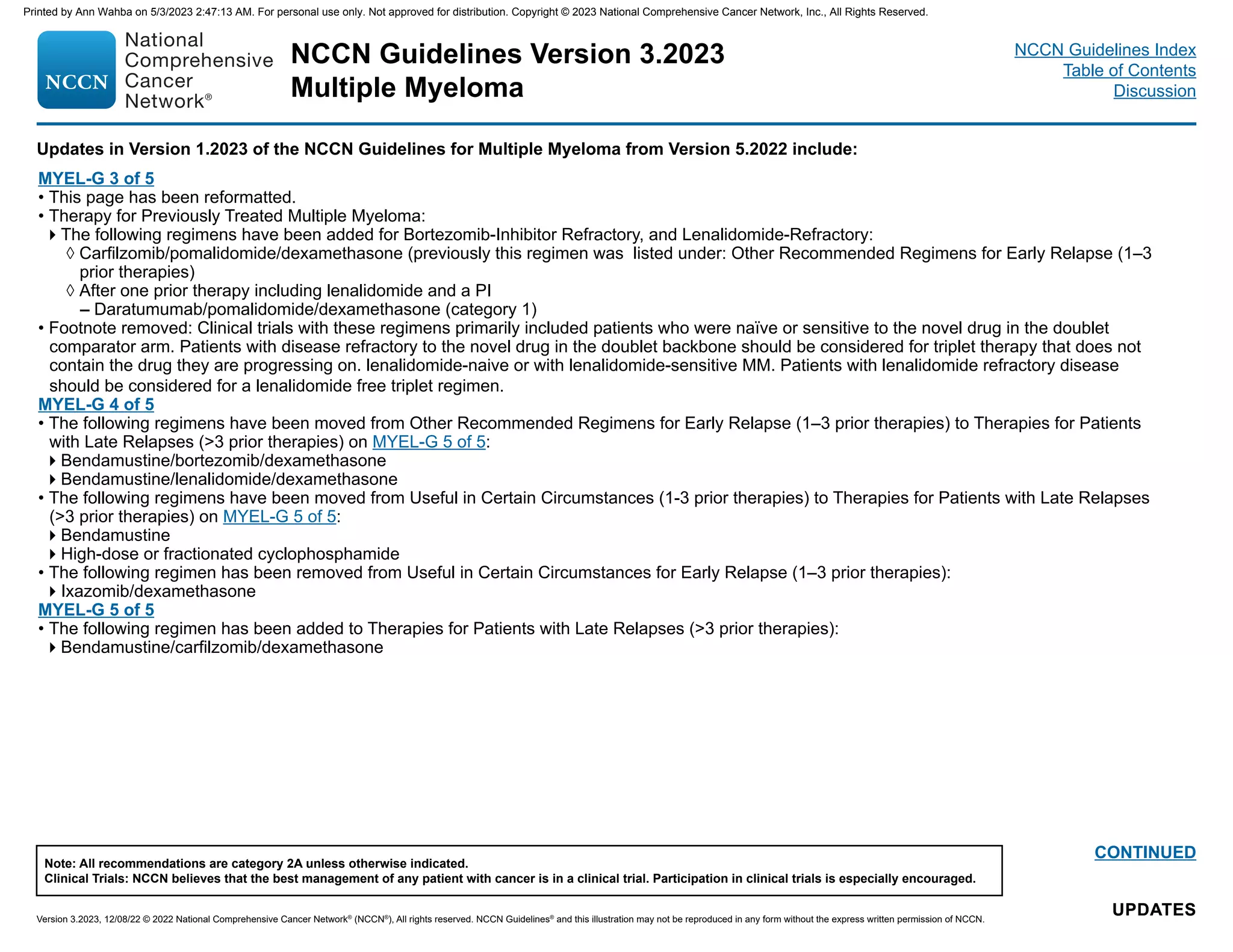
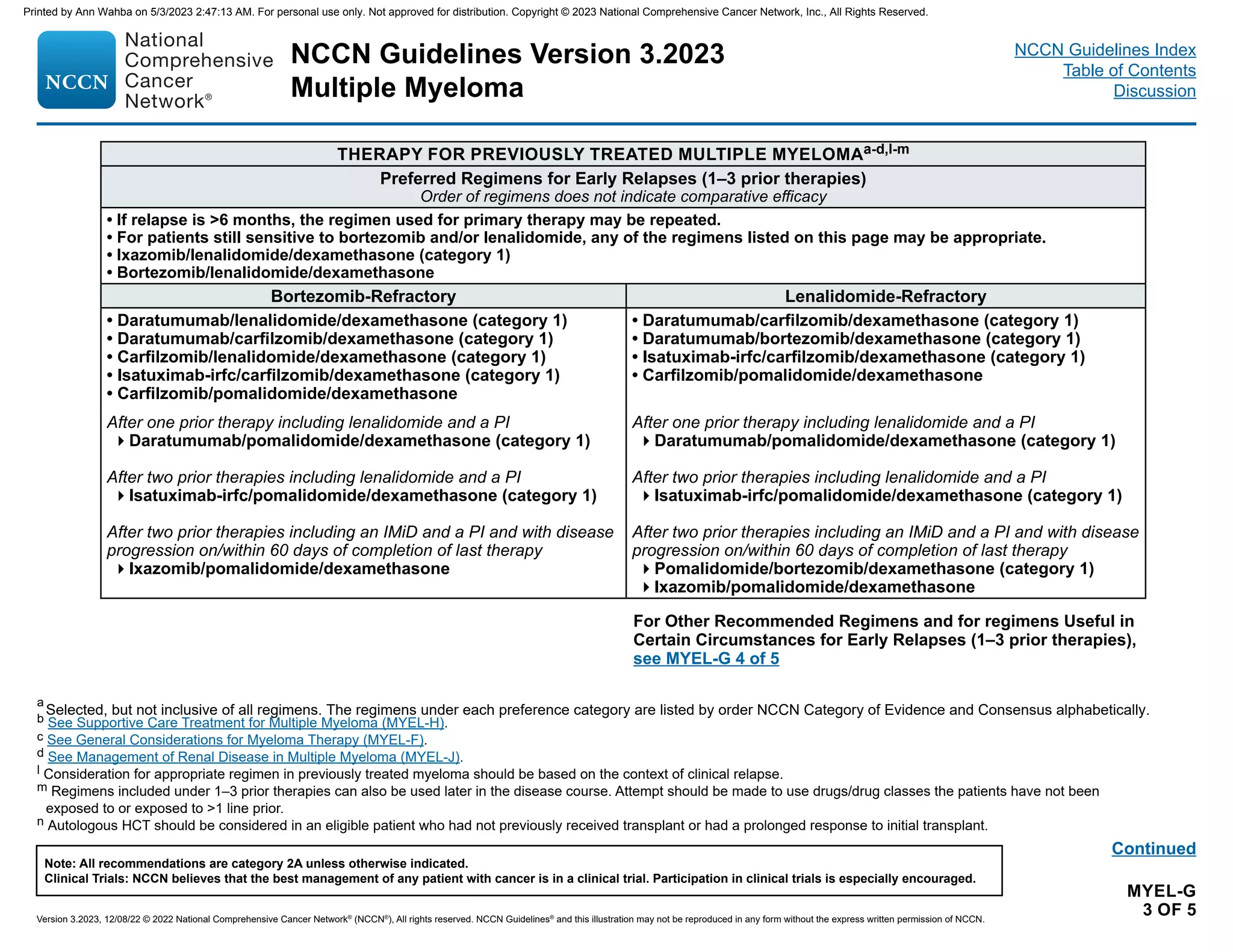
MYEL-G 3 of 5
• This page has been reformatted.
• Therapy for Previously Treated Multiple Myeloma:
The following regimens have been added for Bortezomib-Inhibitor Refractory, and Lenalidomide-Refractory:
◊ Carfilzomib/pomalidomide/dexamethasone (previously this regimen was listed under: Other Recommended Regimens for Early Relapse (1–3
prior therapies)
◊ After one prior therapy including lenalidomide and a PI
– Daratumumab/pomalidomide/dexamethasone (category 1)
• Footnote removed: Clinical trials with these regimens primarily included patients who were naïve or sensitive to the novel drug in the doublet
comparator arm. Patients with disease refractory to the novel drug in the doublet backbone should be considered for triplet therapy that does not
contain the drug they are progressing on. lenalidomide-naive or with lenalidomide-sensitive MM. Patients with lenalidomide refractory disease
should be considered for a lenalidomide free triplet regimen.
MYEL-G 4 of 5
• The following regimens have been moved from Other Recommended Regimens for Early Relapse (1–3 prior therapies) to Therapies for Patients
with Late Relapses (3 prior therapies) on MYEL-G 5 of 5:
Bendamustine/bortezomib/dexamethasone
Bendamustine/lenalidomide/dexamethasone
• The following regimens have been moved from Useful in Certain Circumstances (1-3 prior therapies) to Therapies for Patients with Late Relapses
(3 prior therapies) on MYEL-G 5 of 5:
Bendamustine
High-dose or fractionated cyclophosphamide
• The following regimen has been removed from Useful in Certain Circumstances for Early Relapse (1–3 prior therapies):
Ixazomib/dexamethasone
MYEL-G 5 of 5
• The following regimen has been added to Therapies for Patients with Late Relapses (3 prior therapies):
Bendamustine/carfilzomib/dexamethasone
Printed by Ann Wahba on 5/3/2023 2:47:13 AM. For personal use only. Not approved for distribution. Copyright © 2023 National Comprehensive Cancer Network, Inc., All Rights Reserved.
NCCN Guidelines Version 3.2023
Multiple Myeloma
Version 3.2023, 12/08/22 © 2022 National Comprehensive Cancer Network®
(NCCN®
), All rights reserved. NCCN Guidelines®
and this illustration may not be reproduced in any form without the express written permission of NCCN.
Note: All recommendations are category 2A unless otherwise indicated.
Clinical Trials: NCCN believes that the best management of any patient with cancer is in a clinical trial. Participation in clinical trials is especially encouraged.
NCCN Guidelines Index
Table of Contents
Discussion
Updates in Version 1.2023 of the NCCN Guidelines for Multiple Myeloma from Version 5.2022 include:
UPDATES
UPDATES
CONTINUED
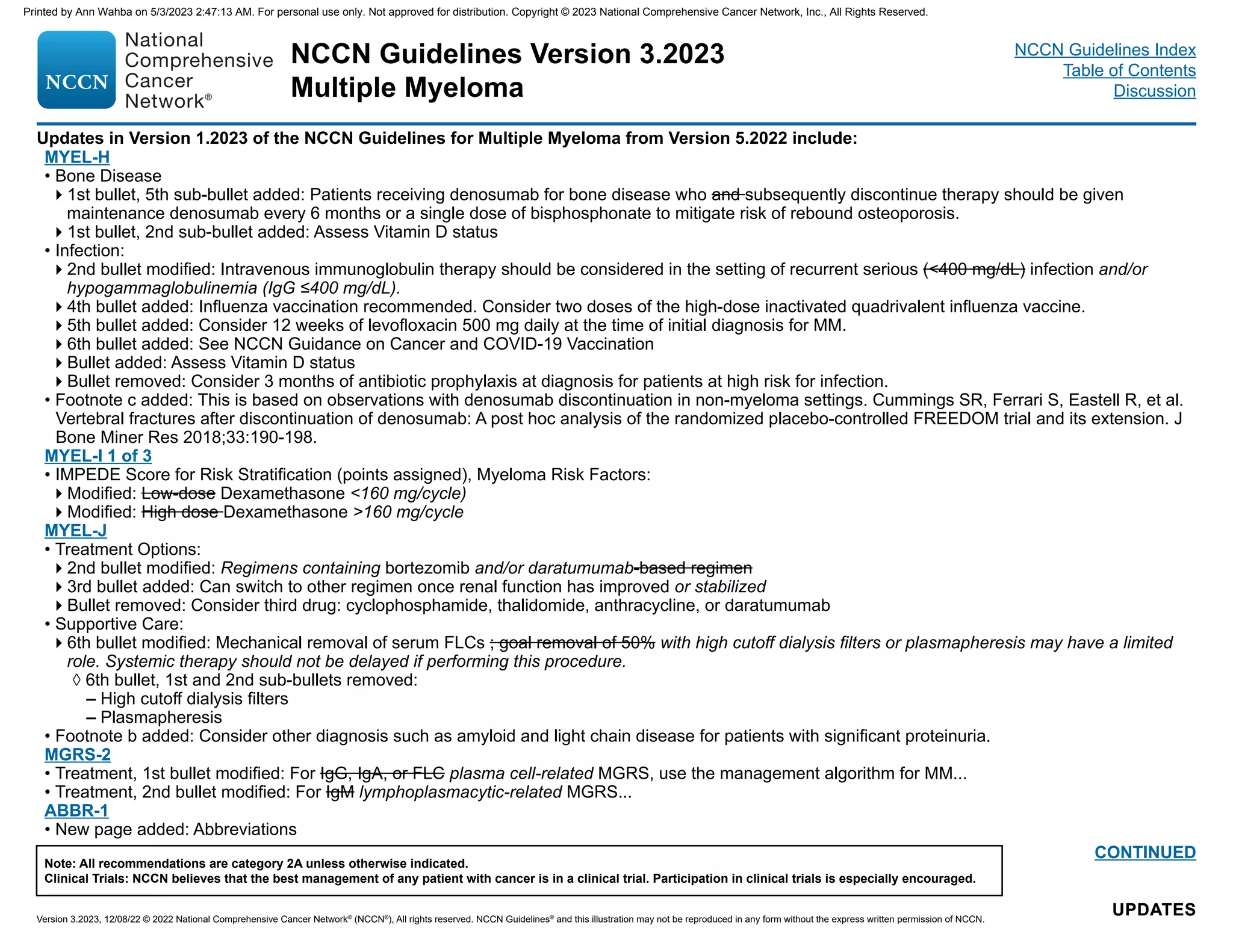
MYEL-H
• Bone Disease
1st bullet, 5th sub-bullet added: Patients receiving denosumab for bone disease who and subsequently discontinue therapy should be given
maintenance denosumab every 6 months or a single dose of bisphosphonate to mitigate risk of rebound osteoporosis.
1st bullet, 2nd sub-bullet added: Assess Vitamin D status
• Infection:
2nd bullet modified: Intravenous immunoglobulin therapy should be considered in the setting of recurrent serious (400 mg/dL) infection and/or
hypogammaglobulinemia (IgG ≤400 mg/dL).
4th bullet added: Influenza vaccination recommended. Consider two doses of the high-dose inactivated quadrivalent influenza vaccine.
5th bullet added: Consider 12 weeks of levofloxacin 500 mg daily at the time of initial diagnosis for MM.
6th bullet added: See NCCN Guidance on Cancer and COVID-19 Vaccination
Bullet added: Assess Vitamin D status
Bullet removed: Consider 3 months of antibiotic prophylaxis at diagnosis for patients at high risk for infection.
• Footnote c added: This is based on observations with denosumab discontinuation in non-myeloma settings. Cummings SR, Ferrari S, Eastell R, et al.
Vertebral fractures after discontinuation of denosumab: A post hoc analysis of the randomized placebo-controlled FREEDOM trial and its extension. J
Bone Miner Res 2018;33:190-198.
MYEL-I 1 of 3
• IMPEDE Score for Risk Stratification (points assigned), Myeloma Risk Factors:
Modified: Low-dose Dexamethasone 160 mg/cycle)
Modified: High dose Dexamethasone 160 mg/cycle
MYEL-J
• Treatment Options:
2nd bullet modified: Regimens containing bortezomib and/or daratumumab-based regimen
3rd bullet added: Can switch to other regimen once renal function has improved or stabilized
Bullet removed: Consider third drug: cyclophosphamide, thalidomide, anthracycline, or daratumumab
• Supportive Care:
6th bullet modified: Mechanical removal of serum FLCs ; goal removal of 50% with high cutoff dialysis filters or plasmapheresis may have a limited
role. Systemic therapy should not be delayed if performing this procedure.
◊ 6th bullet, 1st and 2nd sub-bullets removed:
– High cutoff dialysis filters
– Plasmapheresis
• Footnote b added: Consider other diagnosis such as amyloid and light chain disease for patients with significant proteinuria.
MGRS-2
• Treatment, 1st bullet modified: For IgG, IgA, or FLC plasma cell-related MGRS, use the management algorithm for MM...
• Treatment, 2nd bullet modified: For IgM lymphoplasmacytic-related MGRS...
ABBR-1
• New page added: Abbreviations
Printed by Ann Wahba on 5/3/2023 2:47:13 AM. For personal use only. Not approved for distribution. Copyright © 2023 National Comprehensive Cancer Network, Inc., All Rights Reserved.
NCCN Guidelines Version 3.2023
Multiple Myeloma
Version 3.2023, 12/08/22 © 2022 National Comprehensive Cancer Network®
(NCCN®
), All rights reserved. NCCN Guidelines®
and this illustration may not be reproduced in any form without the express written permission of NCCN.
Note: All recommendations are category 2A unless otherwise indicated.
Clinical Trials: NCCN believes that the best management of any patient with cancer is in a clinical trial. Participation in clinical trials is especially encouraged.
NCCN Guidelines Index
Table of Contents
Discussion
MYEL-1
a Frailty assessment should be considered in older adults. See NCCN Guidelines for Older Adult Oncology.
b These tests are essential for R-ISS staging. See Disease Staging and Risk Stratification for Multiple Myeloma (MYEL-A).
c See Management of Renal Disease in Multiple Myeloma (MYEL-J).
d Skeletal survey is acceptable in certain circumstances. However, it is significantly less sensitive than whole-body low-dose CT and FDG PET/CT. If
whole-body FDG PET/CT or low-dose CT has been performed, then skeletal survey is not needed. FDG PET should always be performed with CT.
e See Principles of Imaging (MYEL-B).
f CD138-positive selected sample is strongly recommended for optimized yield.
g 1q21 amplification is defined as ≥4 copies detected by FISH, and a gain is defined as 3 copies of 1q21.
h If NT-proBNP is not available, BNP can be performed.
i See Definitions of Smoldering and Multiple Myeloma (MYEL-C).
INITIAL DIAGNOSTIC WORKUPa CLINICAL FINDINGS
See Primary
Treatment
(MYEL-2)
See Primary
Treatment
(MYEL-3)
Useful In Certain Circumstances
• If whole-body low-dose CT or FDG PET/
CT is negative, consider whole-body MRI
without contrast to discern smoldering
myeloma from multiple myeloma (MM)
• Tissue biopsy to confirm suspected
plasmacytoma
• Plasma cell proliferation
• Serum viscosity
• Human leukocyte antigen (HLA) typing
• Hepatitis B and hepatitis C testing and
HIV screening as required
• Echocardiogram
• Evaluation for light chain amyloidosis,
if appropriate (See NCCN Guidelines for
Systemic Light Chain Amyloidosis)
• Single nucleotide polymorphism (SNP)
array on bone marrow,f and/or next-
generation sequencing (NGS) panel on
bone marrowf
• Consider baseline clone identification
and storage of aspirate sample for future
minimal residual disease (MRD) testing
by NGS
• Assess for circulating plasma cells as
clinically indicated
Solitary
plasmacytoma
Smoldering
myeloma
(asymptomatic)i
MM (symptomatic)i
• History and physical (HP) exam
• CBC, differential, and platelet count
• Peripheral blood smear
• Serum BUN/creatinine, electrolytes, liver
function tests, albumin,b calcium, serum uric
acid, serum LDH,b and beta-2 microglobulinb
• Creatinine clearance (calculated or measured
directly)c
• Serum quantitative immunoglobulins, serum
protein electrophoresis (SPEP), and serum
immunofixation electrophoresis (SIFE)
• 24-h urine for total protein, urine protein
electrophoresis (UPEP), and urine
immunofixation electrophoresis (UIFE)
• Serum free light chain (FLC) assay
• Whole-body low-dose CT scan or FDG PET/
CTd,e
• Unilateral bone marrow aspirate and biopsy,
including immunohistochemistry (IHC) and/or
multi-parameter flow cytometry
• Plasma cell fluorescence in situ hybridization
(FISH)b panel on bone marrowf [del(13), del
(17p13), t(4;14), t(11;14), t(14;16), t(14:20), 1q21
gain/1q21 amplification, 1p deletion]g
• NT-proBNP/BNPh
See Primary
Treatment
(MYEL-4)
For Monoclonal
Gammopathy
of Renal
Significance see
MGRS-1
Monoclonal
gammopathies
of clinical
significance For Monoclonal
Gammopathy
of Neurological
Significance see
MGNS-1
Printed by Ann Wahba on 5/3/2023 2:47:13 AM. For personal use only. Not approved for distribution. Copyright © 2023 National Comprehensive Cancer Network, Inc., All Rights Reserved.
NCCN Guidelines Version 3.2023
Multiple Myeloma
Version 3.2023, 12/08/22 © 2022 National Comprehensive Cancer Network®
(NCCN®
), All rights reserved. NCCN Guidelines®
and this illustration may not be reproduced in any form without the express written permission of NCCN.
Note: All recommendations are category 2A unless otherwise indicated.
Clinical Trials: NCCN believes that the best management of any patient with cancer is in a clinical trial. Participation in clinical trials is especially encouraged.
NCCN Guidelines Index
Table of Contents
Discussion
MYEL-2
e See Principles of Imaging (MYEL-B).
j Whole-body MRI (or PET/CT if MRI is not available) is the first choice for initial evaluation of solitary osseous plasmacytoma (MRI of the spine and pelvis, whole-body
FDG PET/CT, or low-dose whole-body CT under certain circumstances). Whole-body FDG PET/CT is the first choice for initial evaluation of solitary extraosseous
plasmacytoma.
k All criteria must be present for the diagnosis. For diagnostic criteria, please refer to Rajkumar SV, et al. Lancet Oncol 2014;15:e538-e548.
l Solitary plasmacytoma with 10% or more clonal plasma cells is regarded as active (symptomatic) MM and systemic therapy should be considered.
m See Principles of Radiation Therapy (MYEL-D).
n Consider surgery if structurally unstable or if there is neurologic compromise due to mass effect.
o Systemic therapy may be considered in patients with high risk of progression based on the clinical context.
p Reassess after at least 3 months following radiation as the assessment of response with imaging may not be accurate if the scans are performed sooner. Patients with
soft tissue and head/neck plasmacytoma could be followed less frequently after initial 3-month follow-up.
q See Response Criteria for Multiple Myeloma (MYEL-E).
See Multiple
Myeloma
(symptomatic)
(MYEL-4)
CLINICAL
FINDINGS
PRIMARY
TREATMENT
FOLLOW-UP/SURVEILLANCE
Solitary
plasmacytoma
or
Solitary
plasmacytoma
with minimal
marrow
involvementk,l
Primary
progressiveq
or
Response
followed by
progressionq
Restage
with
myeloma
workup
• Follow-up interval, every 3–6 mo:p
CBC, differential, and platelet count
Serum chemistry for creatinine, albumin, and
corrected calcium
• Tests as needed:
Serum quantitative immunoglobulins, SPEP,
with SIFE
24-h urine for total protein and UPEP with UIFE
Serum FLC assay
Serum LDH and beta-2 microglobulin
Bone marrow aspirate and biopsy as indicated
All plasmacytomas should be imaged yearly,
preferably with the same technique used at
diagnosis, for at least 5 yearse,j
• See NCCN Guidelines for Survivorship
RTm ±
surgeryn,o
or Consider
clinical trial
Printed by Ann Wahba on 5/3/2023 2:47:13 AM. For personal use only. Not approved for distribution. Copyright © 2023 National Comprehensive Cancer Network, Inc., All Rights Reserved.
NCCN Guidelines Version 3.2023
Multiple Myeloma
Version 3.2023, 12/08/22 © 2022 National Comprehensive Cancer Network®
(NCCN®
), All rights reserved. NCCN Guidelines®
and this illustration may not be reproduced in any form without the express written permission of NCCN.
Note: All recommendations are category 2A unless otherwise indicated.
Clinical Trials: NCCN believes that the best management of any patient with cancer is in a clinical trial. Participation in clinical trials is especially encouraged.
NCCN Guidelines Index
Table of Contents
Discussion
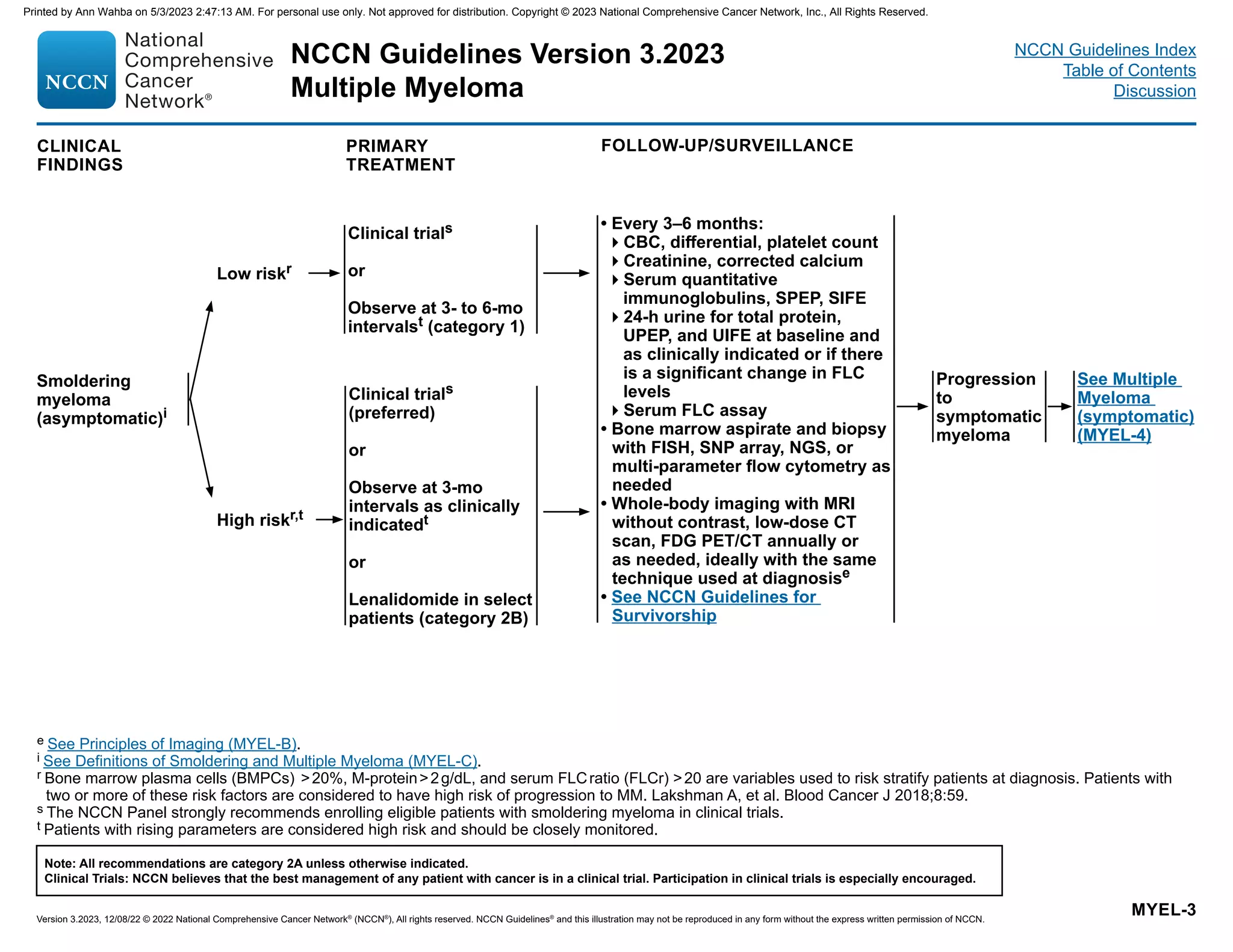
MYEL-3
e See Principles of Imaging (MYEL-B).
i See Definitions of Smoldering and Multiple Myeloma (MYEL-C).
r Bone marrow plasma cells (BMPCs) 20%, M-protein2g/dL, and serum FLCratio (FLCr) 20 are variables used to risk stratify patients at diagnosis. Patients with
two or more of these risk factors are considered to have high risk of progression to MM. Lakshman A, et al. Blood Cancer J 2018;8:59.
s The NCCN Panel strongly recommends enrolling eligible patients with smoldering myeloma in clinical trials.
t Patients with rising parameters are considered high risk and should be closely monitored.
PRIMARY
TREATMENT
FOLLOW-UP/SURVEILLANCE
See Multiple
Myeloma
(symptomatic)
(MYEL-4)
CLINICAL
FINDINGS
Smoldering
myeloma
(asymptomatic)i
Progression
to
symptomatic
myeloma
• Every 3–6 months:
CBC, differential, platelet count
Creatinine, corrected calcium
Serum quantitative
immunoglobulins, SPEP, SIFE
24-h urine for total protein,
UPEP, and UIFE at baseline and
as clinically indicated or if there
is a significant change in FLC
levels
Serum FLC assay
• Bone marrow aspirate and biopsy
with FISH, SNP array, NGS, or
multi-parameter flow cytometry as
needed
• Whole-body imaging with MRI
without contrast, low-dose CT
scan, FDG PET/CT annually or
as needed, ideally with the same
technique used at diagnosise
• See NCCN Guidelines for
Survivorship
Clinical trials
or
Observe at 3- to 6-mo
intervalst (category 1)
Low riskr
High riskr,t
Clinical trials
(preferred)
or
Observe at 3-mo
intervals as clinically
indicatedt
or
Lenalidomide in select
patients (category 2B)
Printed by Ann Wahba on 5/3/2023 2:47:13 AM. For personal use only. Not approved for distribution. Copyright © 2023 National Comprehensive Cancer Network, Inc., All Rights Reserved.
NCCN Guidelines Version 3.2023
Multiple Myeloma
Version 3.2023, 12/08/22 © 2022 National Comprehensive Cancer Network®
(NCCN®
), All rights reserved. NCCN Guidelines®
and this illustration may not be reproduced in any form without the express written permission of NCCN.
Note: All recommendations are category 2A unless otherwise indicated.
Clinical Trials: NCCN believes that the best management of any patient with cancer is in a clinical trial. Participation in clinical trials is especially encouraged.
NCCN Guidelines Index
Table of Contents
Discussion
See
Response
after primary
therapy
(MYEL-5)
See
Additional
Treatment
(MYEL-6)
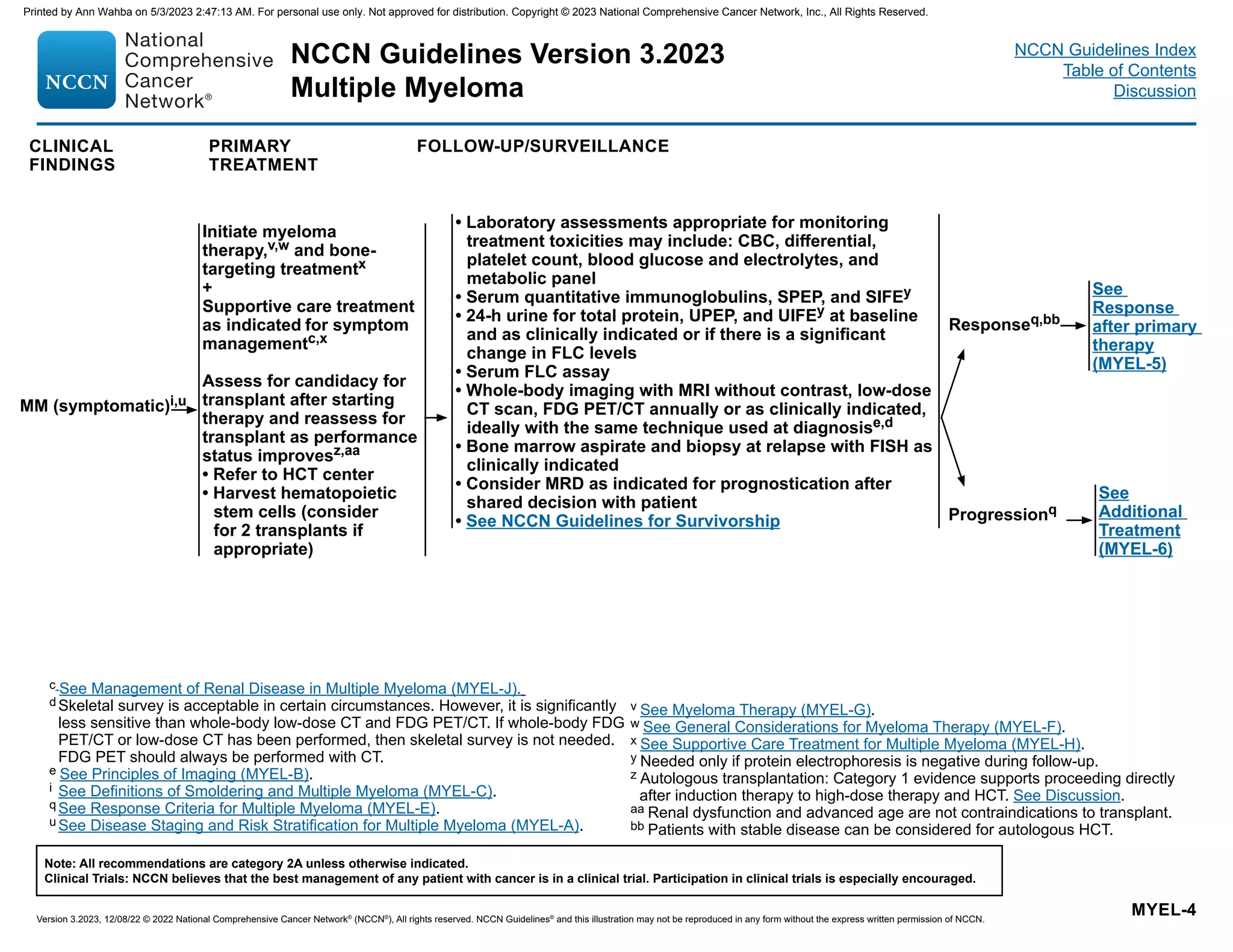
MM (symptomatic)i,u
Initiate myeloma
therapy,v,w and bone-
targeting treatmentx
+
Supportive care treatment
as indicated for symptom
managementc,x
Assess for candidacy for
transplant after starting
therapy and reassess for
transplant as performance
status improvesz,aa
• Refer to HCT center
• Harvest hematopoietic
stem cells (consider
for 2 transplants if
appropriate)
Responseq,bb
Progressionq
• Laboratory assessments appropriate for monitoring
treatment toxicities may include: CBC, differential,
platelet count, blood glucose and electrolytes, and
metabolic panel
• Serum quantitative immunoglobulins, SPEP, and SIFEy
• 24-h urine for total protein, UPEP, and UIFEy at baseline
and as clinically indicated or if there is a significant
change in FLC levels
• Serum FLC assay
• Whole-body imaging with MRI without contrast, low-dose
CT scan, FDG PET/CT annually or as clinically indicated,
ideally with the same technique used at diagnosise,d
• Bone marrow aspirate and biopsy at relapse with FISH as
clinically indicated
• Consider MRD as indicated for prognostication after
shared decision with patient
• See NCCN Guidelines for Survivorship
PRIMARY
TREATMENT
FOLLOW-UP/SURVEILLANCE
CLINICAL
FINDINGS
MYEL-4
c See Management of Renal Disease in Multiple Myeloma (MYEL-J).
d Skeletal survey is acceptable in certain circumstances. However, it is significantly
less sensitive than whole-body low-dose CT and FDG PET/CT. If whole-body FDG
PET/CT or low-dose CT has been performed, then skeletal survey is not needed.
FDG PET should always be performed with CT.
e See Principles of Imaging (MYEL-B).
i See Definitions of Smoldering and Multiple Myeloma (MYEL-C).
q See Response Criteria for Multiple Myeloma (MYEL-E).
u See Disease Staging and Risk Stratification for Multiple Myeloma (MYEL-A).
v See Myeloma Therapy (MYEL-G).
w See General Considerations for Myeloma Therapy (MYEL-F).
x See Supportive Care Treatment for Multiple Myeloma (MYEL-H).
y Needed only if protein electrophoresis is negative during follow-up.
z Autologous transplantation: Category 1 evidence supports proceeding directly
after induction therapy to high-dose therapy and HCT. See Discussion.
aa Renal dysfunction and advanced age are not contraindications to transplant.
bb Patients with stable disease can be considered for autologous HCT.
Printed by Ann Wahba on 5/3/2023 2:47:13 AM. For personal use only. Not approved for distribution. Copyright © 2023 National Comprehensive Cancer Network, Inc., All Rights Reserved.
NCCN Guidelines Version 3.2023
Multiple Myeloma
Version 3.2023, 12/08/22 © 2022 National Comprehensive Cancer Network®
(NCCN®
), All rights reserved. NCCN Guidelines®
and this illustration may not be reproduced in any form without the express written permission of NCCN.
Note: All recommendations are category 2A unless otherwise indicated.
Clinical Trials: NCCN believes that the best management of any patient with cancer is in a clinical trial. Participation in clinical trials is especially encouraged.
NCCN Guidelines Index
Table of Contents
Discussion
MYEL-5
q See Response Criteria for Multiple Myeloma (MYEL-E).
v See Myeloma Therapy (MYEL-G).
w See General Considerations for Myeloma Therapy (MYEL-F).
z Autologous transplantation: Category 1 evidence supports proceeding directly after induction therapy to high-dose therapy and HCT. See Discussion.
aa Renal dysfunction and advanced age are not contraindications to transplant.
cc Follow up with the tests listed on MYEL-4 under Follow-up/Surveillance.
dd Allogeneic HCT should preferentially be done in the context of a trial when possible.
ee The length of therapy should be balanced with toxicity and depth of response and disease status.
MULTIPLE MYELOMA (SYMPTOMATIC) FOLLOW-UP/SURVEILLANCE
Response
after
primary
therapyq
Autologousz,aa HCT (category 1)cc
Continuous myeloma therapy or
maintenance therapyv,w,cc
Tandem autologous or allogeneic
HCT,dd for high-risk patients
under certain circumstancescc
Response or
stable diseaseq
Progressionq
Maintenance therapy
(category 1)v,w,ee Progressionq
Progressionq
Response or
stable diseaseq
Progressionq
Maintenance therapy
(category 1)v,w,ee
For relapse or
progression
(see MYEL-6)
Progressionq
Printed by Ann Wahba on 5/3/2023 2:47:13 AM. For personal use only. Not approved for distribution. Copyright © 2023 National Comprehensive Cancer Network, Inc., All Rights Reserved.
NCCN Guidelines Version 3.2023
Multiple Myeloma
Version 3.2023, 12/08/22 © 2022 National Comprehensive Cancer Network®
(NCCN®
), All rights reserved. NCCN Guidelines®
and this illustration may not be reproduced in any form without the express written permission of NCCN.
Note: All recommendations are category 2A unless otherwise indicated.
Clinical Trials: NCCN believes that the best management of any patient with cancer is in a clinical trial. Participation in clinical trials is especially encouraged.
NCCN Guidelines Index
Table of Contents
Discussion
MYEL-6
Continue palliative care;
consider re-evaluation
of goals of care and
hospice initiation
(See NCCN Guidelines
for Palliative Care)
MULTIPLE MYELOMA
(SYMPTOMATIC)
ADDITIONAL TREATMENT
(FOR PATIENTS TREATED WITH OR WITHOUT A PRIOR TRANSPLANT)
Relapse
or
Progressive diseaseq,cc
Clinical trial, if eligible
or
Therapy for previously treated myelomav,w
or
Autologous HCTff
or
Allogeneic HCTdd,ff,gg
and
• Consider referral to CAR T-cell therapy
specialist for consideration for CAR T-cell
therapies
• Consider referral to palliative care specialist for
symptom management (See NCCN Guidelines
for Palliative Care)
• Discuss patient preferences and goals of care
through a shared decision-making process
Refractory diseasecc and
lack of treatment options
q See Response Criteria for Multiple Myeloma (MYEL-E).
v See Myeloma Therapy (MYEL-G).
w See General Considerations for Myeloma Therapy (MYEL-F).
cc Folllow up with the tests listed on MYEL-4 under Follow-up/Surveillance.
dd Allogeneic HCT should preferentially be done in the context of a trial when possible.
ff Assess for HCT candidacy.
gg Donor lymphocyte infusion can be considered in patients relapsing after allogeneic HCT.
Printed by Ann Wahba on 5/3/2023 2:47:13 AM. For personal use only. Not approved for distribution. Copyright © 2023 National Comprehensive Cancer Network, Inc., All Rights Reserved.
NCCN Guidelines Version 3.2023
Multiple Myeloma
Version 3.2023, 12/08/22 © 2022 National Comprehensive Cancer Network®
(NCCN®
), All rights reserved. NCCN Guidelines®
and this illustration may not be reproduced in any form without the express written permission of NCCN.
Note: All recommendations are category 2A unless otherwise indicated.
Clinical Trials: NCCN believes that the best management of any patient with cancer is in a clinical trial. Participation in clinical trials is especially encouraged.
NCCN Guidelines Index
Table of Contents
Discussion
MYEL-A
DISEASE STAGING AND RISK STRATIFICATION SYSTEMS FOR MULTIPLE MYELOMAa
a
Palumbo A, Avet-Loiseau H, Oliva S, et al. Revised International Staging System for Multiple Myeloma: A Report from International Myeloma Working Group. J Clin
Oncol 2015;33:2863-2869.
b Standard-risk: No high-risk chromosomal abnormality. High-risk: Presence of del(17p) and/or translocation t(4;14) and/or translocation t(14;16).
c Presence of ≥5% of plasma cells in circulation is defined as plasma cell leukemia.
Stage International Staging System (ISS) Revised-ISS (R-ISS)
I
Serum beta-2 microglobulin 3.5 mg/L,
Serum albumin ≥3.5 g/dL
ISS stage I and standard-risk
chromosomal abnormalities by FISHb
and
Serum LDH ≤ the upper limit of normal
II Not ISS stage I or III Not R-ISS stage I or III
III Serum beta-2 microglobulin ≥5.5 mg/L
ISS stage III and either high-risk
chromosomal abnormalities by FISHb
or
Serum LDH  the upper limit of normal
Factors Considered High Risk for MM
Cytogenetic
abnormalities
t(4;14)
t(14;16)
Del(17p)/monosomy 17
1q21 gain/1q21 amplification
MYC translocation
TP53 mutation [with del(17p)]
Tetrasomies
Complex karyotype (when
done) or karyotypic del(13)
Other risk
factors
High-risk gene expression
signature
Extramedullary disease
Circulating plasma cellsc
High plasma cell proliferation
Frailty
Renal failure
Thrombocytopenia
High serum FLC
Lymphopenia
Immunoparesis
Elevated LDH
Printed by Ann Wahba on 5/3/2023 2:47:13 AM. For personal use only. Not approved for distribution. Copyright © 2023 National Comprehensive Cancer Network, Inc., All Rights Reserved.
NCCN Guidelines Version 3.2023
Multiple Myeloma
Version 3.2023, 12/08/22 © 2022 National Comprehensive Cancer Network®
(NCCN®
), All rights reserved. NCCN Guidelines®
and this illustration may not be reproduced in any form without the express written permission of NCCN.
Note: All recommendations are category 2A unless otherwise indicated.
Clinical Trials: NCCN believes that the best management of any patient with cancer is in a clinical trial. Participation in clinical trials is especially encouraged.
NCCN Guidelines Index
Table of Contents
Discussion
MYEL-B
1 OF 2
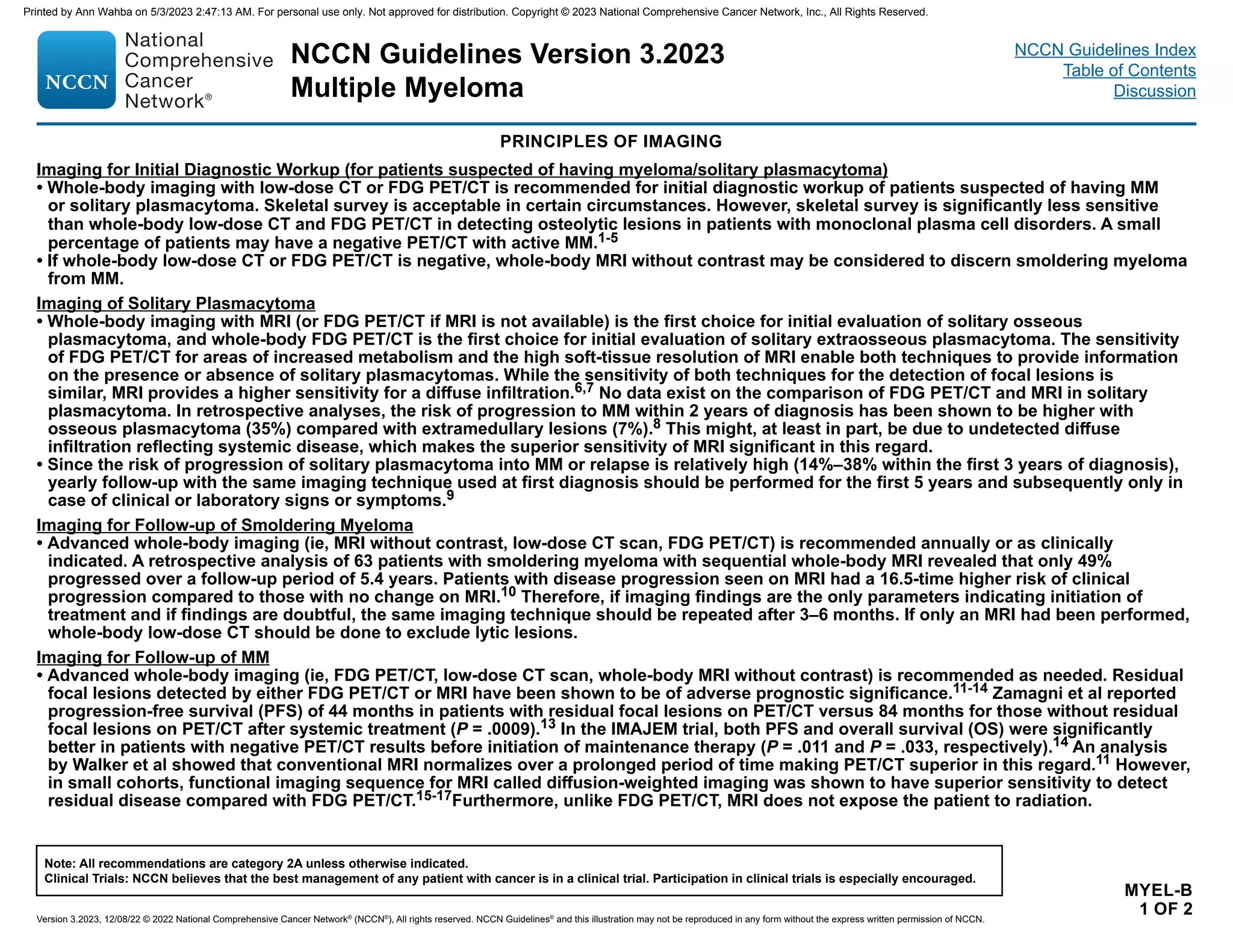
PRINCIPLES OF IMAGING
Imaging for Initial Diagnostic Workup (for patients suspected of having myeloma/solitary plasmacytoma)
• Whole-body imaging with low-dose CT or FDG PET/CT is recommended for initial diagnostic workup of patients suspected of having MM
or solitary plasmacytoma. Skeletal survey is acceptable in certain circumstances. However, skeletal survey is significantly less sensitive
than whole-body low-dose CT and FDG PET/CT in detecting osteolytic lesions in patients with monoclonal plasma cell disorders. A small
percentage of patients may have a negative PET/CT with active MM.1-5
• If whole-body low-dose CT or FDG PET/CT is negative, whole-body MRI without contrast may be considered to discern smoldering myeloma
from MM.
Imaging of Solitary Plasmacytoma
• Whole-body imaging with MRI (or FDG PET/CT if MRI is not available) is the first choice for initial evaluation of solitary osseous
plasmacytoma, and whole-body FDG PET/CT is the first choice for initial evaluation of solitary extraosseous plasmacytoma. The sensitivity
of FDG PET/CT for areas of increased metabolism and the high soft-tissue resolution of MRI enable both techniques to provide information
on the presence or absence of solitary plasmacytomas. While the sensitivity of both techniques for the detection of focal lesions is
similar, MRI provides a higher sensitivity for a diffuse infiltration.6,7 No data exist on the comparison of FDG PET/CT and MRI in solitary
plasmacytoma. In retrospective analyses, the risk of progression to MM within 2 years of diagnosis has been shown to be higher with
osseous plasmacytoma (35%) compared with extramedullary lesions (7%).8 This might, at least in part, be due to undetected diffuse
infiltration reflecting systemic disease, which makes the superior sensitivity of MRI significant in this regard.
• Since the risk of progression of solitary plasmacytoma into MM or relapse is relatively high (14%–38% within the first 3 years of diagnosis),
yearly follow-up with the same imaging technique used at first diagnosis should be performed for the first 5 years and subsequently only in
case of clinical or laboratory signs or symptoms.9
Imaging for Follow-up of Smoldering Myeloma
• Advanced whole-body imaging (ie, MRI without contrast, low-dose CT scan, FDG PET/CT) is recommended annually or as clinically
indicated. A retrospective analysis of 63 patients with smoldering myeloma with sequential whole-body MRI revealed that only 49%
progressed over a follow-up period of 5.4 years. Patients with disease progression seen on MRI had a 16.5-time higher risk of clinical
progression compared to those with no change on MRI.10 Therefore, if imaging findings are the only parameters indicating initiation of
treatment and if findings are doubtful, the same imaging technique should be repeated after 3–6 months. If only an MRI had been performed,
whole-body low-dose CT should be done to exclude lytic lesions.
Imaging for Follow-up of MM
• Advanced whole-body imaging (ie, FDG PET/CT, low-dose CT scan, whole-body MRI without contrast) is recommended as needed. Residual
focal lesions detected by either FDG PET/CT or MRI have been shown to be of adverse prognostic significance.11-14 Zamagni et al reported
progression-free survival (PFS) of 44 months in patients with residual focal lesions on PET/CT versus 84 months for those without residual
focal lesions on PET/CT after systemic treatment (P = .0009).13 In the IMAJEM trial, both PFS and overall survival (OS) were significantly
better in patients with negative PET/CT results before initiation of maintenance therapy (P = .011 and P = .033, respectively).14 An analysis
by Walker et al showed that conventional MRI normalizes over a prolonged period of time making PET/CT superior in this regard.11 However,
in small cohorts, functional imaging sequence for MRI called diffusion-weighted imaging was shown to have superior sensitivity to detect
residual disease compared with FDG PET/CT.15-17Furthermore, unlike FDG PET/CT, MRI does not expose the patient to radiation.
Printed by Ann Wahba on 5/3/2023 2:47:13 AM. For personal use only. Not approved for distribution. Copyright © 2023 National Comprehensive Cancer Network, Inc., All Rights Reserved.
NCCN Guidelines Version 3.2023
Multiple Myeloma
Version 3.2023, 12/08/22 © 2022 National Comprehensive Cancer Network®
(NCCN®
), All rights reserved. NCCN Guidelines®
and this illustration may not be reproduced in any form without the express written permission of NCCN.
Note: All recommendations are category 2A unless otherwise indicated.
Clinical Trials: NCCN believes that the best management of any patient with cancer is in a clinical trial. Participation in clinical trials is especially encouraged.
NCCN Guidelines Index
Table of Contents
Discussion
PRINCIPLES OF IMAGING
References
MYEL-B
2 OF 2
1 Hillengass J, Moulopoulos LA, Delorme S, et al. Findings of whole body computed tomography compared to conventional skeletal survey in patients with monoclonal
plasma cell disorders - a study of the International Myeloma Working Group [Abstract]. Blood 2016;128:4468.
2 Hinge M, Andersen KT, Lund T, et al. Baseline bone involvement in multiple myeloma - a prospective comparison of conventional X-ray, low-dose computed
tomography, and 18flourodeoxyglucose positron emission tomography in previously untreated patients. Haematologica 2016;101:e415-e418.
3 Kropil P, Fenk R, Fritz LB, et al. Comparison of whole-body 64-slice multidetector computed tomography and conventional radiography in staging of multiple myeloma.
Eur Radiol 2008;18:51-58.
4 Wolf MB, Murray F, Kilk K, et al. Sensitivity of whole-body CT and MRI versus projection radiography in the detection of osteolyses in patients with monoclonal plasma
cell disease. Eur J Radiol 2014;83:1222-1230.
5 Siontis B, Kumar S, Dispenzieri A, et al. Positron emission tomography-computed tomography in the diagnostic evaluation of smoldering multiple myeloma:
identification of patients needing therapy. Blood Cancer J 2015;5:e364.
6 Zamagni E, Nanni C, Patriarca F, et al. A prospective comparison of 18F-fluorodeoxyglucose positron emission tomography-computed tomography, magnetic
resonance imaging and whole-body planar radiographs in the assessment of bone disease in newly diagnosed multiple myeloma. Haematologica 2007;92:50-55.
7 Fonti R, Salvatore B, Quarantelli M, et al. 18F-FDG PET/CT, 99mTc-MIBI, and MRI in evaluation of patients with multiple myeloma. J Nucl Med 2008;49:195-200.
8 Nahi H, Genell A, Walinder G, et al. Incidence, characteristics, and outcome of solitary plasmacytoma and plasma cell leukemia. Population-based data from the
Swedish Myeloma Register. Eur J Haematol 2017;99:216-222.
9 Paiva B, Chandia M, Vidriales MB, et al. Multiparameter flow cytometry for staging of solitary bone plasmacytoma: new criteria for risk of progression to myeloma.
Blood 2014;124:1300-1303.
10 Merz M, Hielscher T, Wagner B, et al. Predictive value of longitudinal whole-body magnetic resonance imaging in patients with smoldering multiple myeloma.
Leukemia 2014;28:1902-1908.
11 Walker R, Barlogie B, Haessler J, et al. Magnetic resonance imaging in multiple myeloma: diagnostic and clinical implications. J Clin Oncol 2007;25:1121-1128.
12 Bartel TB, Haessler J, Brown TL, et al. F18-fluorodeoxyglucose positron emission tomography in the context of other imaging techniques and prognostic factors in
multiple myeloma. Blood 2009;114:2068-2076.
13 Zamagni E, Nanni C, Mancuso K, et al. PET/CT improves the definition of complete response and allows to detect otherwise unidentifiable skeletal progression in
multiple myeloma. Clin Cancer Res 2015;21:4384-4390.
14 Moreau P, Attal M, Caillot D, et al. Prospective evaluation of magnetic resonance imaging and [(18)F]fluorodeoxyglucose positron emission tomography-computed
tomography at diagnosis and before maintenance therapy in symptomatic patients with multiple myeloma included in the IFM/DFCI 2009 trial: Results of the IMAJEM
study. J Clin Oncol 2017;35:2911-2918.
15 Pawlyn C, Fowkes L, Otero S, et al. Whole-body diffusion-weighted MRI: a new gold standard for assessing disease burden in patients with multiple myeloma?
Leukemia 2016;30:1446-1448.
16 Rasche L, Angtuaco E, McDonald JE, et al. Low expression of hexokinase-2 is associated with false-negative FDG-positron emission tomography in multiple
myeloma. Blood 2017;130:30-34.
17 Rasche L, Alapat D, Kumar M, et al. Combination of flow cytometry and functional imaging for monitoring of residual disease in myeloma. Leukemia 2019;33:1713-
1722.
Printed by Ann Wahba on 5/3/2023 2:47:13 AM. For personal use only. Not approved for distribution. Copyright © 2023 National Comprehensive Cancer Network, Inc., All Rights Reserved.
Smoldering Myeloma (Asymptomatic)a,b
• Serum monoclonal protein ≥3 g/dL
or
• Bence-Jones protein ≥500 mg/24 h
and/or
• Clonal bone marrow plasma cells (BMPCs) 10%–59%
and
• Absence of myeloma-defining events or amyloidosis
If skeletal survey negative, assess for bone disease with whole-
body MRI, FDG PET/CT, or low-dose CT scan
Multiple Myeloma (Symptomatic)a,c
Clonal BMPCs ≥10% or biopsy-proven bony or extramedullary
plasmacytoma
and
Any one or more of the following myeloma-defining events:
• Calcium 0.25 mmol/L (1 mg/dL) higher than the upper limit of
normal or 2.75 mmol/L (11 mg/dL)
• Renal insufficiency (creatinine 2 mg/dL) [177 µmol/L] or
creatinine clearance 40 mL/min
• Anemia (hemoglobin 10 g/dL or hemoglobin 2 g/dL below the
lower limit of normal)
• One or more osteolytic bone lesions on skeletal radiography, CT, or
FDG PET/CT
• Clonal BMPCs ≥60%
• Involved:uninvolved serum FLC ratio ≥100 and involved FLC
concentration 10 mg/dL or higher
• 1 focal lesions on MRI studies ≥5 mm
a Rajkumar SV, Dimopoulos MA, Palumbo A, et al. International Myeloma Working Group updated criteria for the diagnosis of multiple myeloma. Lancet Oncol
2014;15:e538-e548.
b BMPCs 20%, M-protein 2 g/dL, and FLCr 20 are variables used to risk stratify patients at diagnosis. Patients with two or more of these risk factors are considered
to have a high risk of progression to MM. Lakshman A, et al. Blood Cancer J 2018;8:59.
c Other examples of active disease include: repeated infections, amyloidosis, light chain deposition disease, or hyperviscosity.
DEFINITIONS OF SMOLDERING AND MULTIPLE MYELOMA
NCCN Guidelines Version 3.2023
Multiple Myeloma
Version 3.2023, 12/08/22 © 2022 National Comprehensive Cancer Network®
(NCCN®
), All rights reserved. NCCN Guidelines®
and this illustration may not be reproduced in any form without the express written permission of NCCN.
Note: All recommendations are category 2A unless otherwise indicated.
Clinical Trials: NCCN believes that the best management of any patient with cancer is in a clinical trial. Participation in clinical trials is especially encouraged.
NCCN Guidelines Index
Table of Contents
Discussion
MYEL-C
Printed by Ann Wahba on 5/3/2023 2:47:13 AM. For personal use only. Not approved for distribution. Copyright © 2023 National Comprehensive Cancer Network, Inc., All Rights Reserved.
NCCN Guidelines Version 3.2023
Multiple Myeloma
Version 3.2023, 12/08/22 © 2022 National Comprehensive Cancer Network®
(NCCN®
), All rights reserved. NCCN Guidelines®
and this illustration may not be reproduced in any form without the express written permission of NCCN.
Note: All recommendations are category 2A unless otherwise indicated.
Clinical Trials: NCCN believes that the best management of any patient with cancer is in a clinical trial. Participation in clinical trials is especially encouraged.
NCCN Guidelines Index
Table of Contents
Discussion
PRINCIPLES OF RADIATION THERAPY
MYEL-D
Solitary Plasmacytoma
General Principle:
• Radiation therapy (RT) is the intervention of choice for solitary plasmacytoma.
Treatment Information/Dosing:
• Solitary plasmacytoma (MYEL-2)
RT (40–50 Gy in 1.8–2.0 Gy fractions [20–25 total fractions]) to involved site.
MM
General Principles:
• RT is primarily used for palliation in patients with MM.
• RT should be used judiciously in patients with MM who are undergoing or being considered for systemic therapy.
• Systemic therapy should not be delayed for RT.
• When systemic therapy and palliative RT are used concurrently, patients must be carefully monitored for toxicities.
Palliative RT Dosing for MM:
• Low-dose RT (8 Gy x 1 fraction or 10–30 Gy in 2.0–3.0 Gy fractions [5–10 total fractions]) can be used as palliative treatment for uncontrolled
pain, for impending pathologic fracture, or for impending cord compression. Consider RT postoperatively if urgent surgical intervention is
indicated.
• Limited involved sites should be used to limit the impact of irradiation on hematopoietic stem cell harvest or impact on potential future
treatments.
Printed by Ann Wahba on 5/3/2023 2:47:13 AM. For personal use only. Not approved for distribution. Copyright © 2023 National Comprehensive Cancer Network, Inc., All Rights Reserved.
IMWG criteria for response assessment including criteria for minimal residual disease (MRD)
Response Categorya
Response Criteria
IMWG MRD criteria (requires a complete response as defined below)
Sustained MRD-negative
MRD negativity in the marrow (next-generation flow [NGF], next-generation sequencing [NGS], or both) and by
imaging as defined below, confirmed minimum of 1 year apart. Subsequent evaluations can be used to further
specify the duration of negativity (eg, MRD-negative at 5 years).b
Flow MRD-negative
Absence of phenotypically aberrant clonal plasma cells by NGFc
on bone marrow aspirates using the EuroFlow
standard operation procedure for MRD detection in multiple myeloma (or validated equivalent method) with a
minimum sensitivity of 1 in 105
nucleated cells or higher.
Sequencing MRD-negative
Absence of clonal plasma cells by NGS on bone marrow aspirate in which presence of a clone is defined as less
than two identical sequencing reads obtained after DNA sequencing of bone marrow aspirates using a validated
equivalent method with a minimum sensitivity of 1 in 105
nucleated cellsd
or higher.
Imaging plus MRD-negative
MRD negativity as defined by NGF or NGS plus disappearance of every area of increased tracer uptake found at
baseline or a preceding FDG PET/CT or decrease to less mediastinal blood pool standardized uptake value (SUV) or
decrease to less than that of surrounding normal tissue.e
Standard IMWG response criteriaf
Stringent complete response
Complete response as defined below plus normal FLC ratiog
and absence of clonal cells in bone marrow biopsy by
immunohistochemistry (κ/λ ratio ≤4:1 or ≥1:2 for κ and λ patients, respectively, after counting ≥100 plasma cells).h
Complete responsei Negative immunofixation on the serum and urine and disappearance of any soft tissue plasmacytomas and 5%
plasma cells in bone marrow aspirates.
Very good partial response
Serum and urine M-protein detectable by immunofixation but not on electrophoresis or ≥90% reduction in serum
M-protein plus urine M-protein level 100 mg per 24 h.
Partial response
≥50% reduction of serum M-protein plus reduction in 24-h urinary M-protein by ≥90% or to 200 mg per 24 h.
If the serum and urine M-protein are unmeasurable, a ≥50% decrease in the difference between involved and
uninvolved FLC levels is required in place of the M-protein criteria.
If serum and urine M-protein are unmeasurable, and serum-free light assay is also unmeasurable, ≥50% reduction
in plasma cells is required in place of M-protein, provided baseline bone marrow plasma-cell percentage was ≥30%.
In addition to these criteria, if present at baseline, a ≥50% reduction in the size (sum of the products of the maximal
perpendicular diameters [SPD] of measured lesions)j
of soft tissue plasmacytomas is also required.
Minimal response
≥25% but ≤49% reduction of serum M-protein and reduction in 24-h urine M-protein by 50%–89%. In addition to
the above listed criteria, if present at baseline, a 25%–49% reduction in SPDj
of soft tissue plasmacytomas is also
required.
Reprinted from The Lancet Oncology, 17: Kumar S, Paiva B, Anderson K, et al. International Myeloma Working Group consensus criteria for response and minimal
residual disease assessment in multiple myeloma, e328-e346, Copyright (2016), with permission from Elsevier.
NCCN Guidelines Version 3.2023
Multiple Myeloma
Version 3.2023, 12/08/22 © 2022 National Comprehensive Cancer Network®
(NCCN®
), All rights reserved. NCCN Guidelines®
and this illustration may not be reproduced in any form without the express written permission of NCCN.
Note: All recommendations are category 2A unless otherwise indicated.
Clinical Trials: NCCN believes that the best management of any patient with cancer is in a clinical trial. Participation in clinical trials is especially encouraged.
NCCN Guidelines Index
Table of Contents
Discussion
MYEL-E
1 OF 3
Continued
Footnotes
RESPONSE CRITERIA FOR MULTIPLE MYELOMA
(Revised based on the new criteria by International Myeloma Working Group [IMWG])
Printed by Ann Wahba on 5/3/2023 2:47:13 AM. For personal use only. Not approved for distribution. Copyright © 2023 National Comprehensive Cancer Network, Inc., All Rights Reserved.
Response Categorya
Response Criteria
Stable disease
Not recommended for use as an indicator of response; stability of disease is best described by providing the time-to-
progression estimates. Not meeting criteria for complete response, very good partial response, partial response, minimal
response, or progressive disease.
Progressive diseasek,l
Any one or more of the following criteria:
Increase of 25% from lowest confirmed response value in one or more of the following criteria:
Serum M-protein (absolute increase must be ≥0.5 g/dL);
Serum M-protein increase ≥1 g/dL, if the lowest M component was ≥5 g/dL;
Urine M-protein (absolute increase must be ≥200 mg/24 h);
In patients without measurable serum and urine M-protein levels, the difference between involved and uninvolved FLC levels
(absolute increase must be 10 mg/dL);
In patients without measurable serum and urine M-protein levels and without measurable involved FLC levels, bone marrow
plasma-cell percentage irrespective of baseline status (absolute increase must be ≥10%);
Appearance of a new lesion(s), ≥50% increase from nadir in SPDj of 1 lesion, or ≥50% increase in the longest diameter of a
previous lesion 1 cm in short axis;
≥50% increase in circulating plasma cells (minimum of 200 cells per μL) if this is the only measure of disease.
Clinical relapse
Clinical relapse requires one or more of the following criteria:
Direct indicators of increasing disease and/or end organ dysfunction (calcium elevation, renal failure, anemia, lytic bone
lesions [CRAB features]) related to the underlying clonal plasma cell proliferative disorder. It is not used in calculation of
time to progression or progression-free survival but is listed as something that can be reported optionally or for use in
clinical practice;
Development of new soft tissue plasmacytomas or bone lesions (osteoporotic fractures do not constitute progression);
Definite increase in the size of existing plasmacytomas or bone lesions. A definite increase is defined as a 50% (and ≥1 cm)
increase as measured serially by the SPDj
of the measurable lesion;
Hypercalcemia (11 mg/dL);
Decrease in hemoglobin of ≥2 g/dL not related to therapy or other non–myeloma-related conditions;
Rise in serum creatinine by 2 mg/dL or more from the start of the therapy and attributable to myeloma;
Hyperviscosity related to serum paraprotein.
Relapse from complete
response (to be used only
if the endpoint is
disease-free survival)
Any one or more of the following criteria:
Reappearance of serum or urine M-protein by immunofixation or electrophoresisi
;
Development of ≥5% plasma cells in the bone marrow;
Appearance of any other sign of progression (ie, new plasmacytoma, lytic bone lesion, or hypercalcemia) (see above).
Relapse from MRD
negative (to be used only
if the endpoint is
disease-free survival)
Any one or more of the following criteria:
Loss of MRD negative state (evidence of clonal plasma cells on NGF or NGS, or positive imaging study for recurrence of
myeloma);
Reappearance of serum or urine M-protein by immunofixation or electrophoresis;
Development of ≥5% clonal plasma cells in the bone marrow;
Appearance of any other sign of progression (ie, new plasmacytoma, lytic bone lesion, or hypercalcemia).
Reprinted from The Lancet Oncology, 17: Kumar S, Paiva B, Anderson K, et al. International Myeloma Working Group consensus criteria for response and minimal
residual disease assessment in multiple myeloma, e328-e346, Copyright (2016), with permission from Elsevier.
NCCN Guidelines Version 3.2023
Multiple Myeloma
Version 3.2023, 12/08/22 © 2022 National Comprehensive Cancer Network®
(NCCN®
), All rights reserved. NCCN Guidelines®
and this illustration may not be reproduced in any form without the express written permission of NCCN.
Note: All recommendations are category 2A unless otherwise indicated.
Clinical Trials: NCCN believes that the best management of any patient with cancer is in a clinical trial. Participation in clinical trials is especially encouraged.
NCCN Guidelines Index
Table of Contents
Discussion
MYEL-E
2 OF 3
Footnotes
RESPONSE CRITERIA FOR MULTIPLE MYELOMA
(Revised based on the new criteria by International Myeloma Working Group [IMWG])
Printed by Ann Wahba on 5/3/2023 2:47:13 AM. For personal use only. Not approved for distribution. Copyright © 2023 National Comprehensive Cancer Network, Inc., All Rights Reserved.
aAll response categories require two consecutive assessments made any
time before starting any new therapy; for MRD there is no need for two
consecutive assessments, but information on MRD after each treatment
stage is recommended (eg, after induction, high-dose therapy/ Autologous
stem cell transplants (ASCT), consolidation, maintenance). MRD tests should
be initiated only at the time of suspected complete response. All categories
of response and MRD require no known evidence of progressive or new
bone lesions if radiographic studies were performed. However, radiographic
studies are not required to satisfy these response requirements except for the
requirement of FDG PET if imaging MRD-negative status is reported.
bSustained MRD negativity when reported should also annotate the method
used (eg, sustained flow MRD-negative, sustained sequencing MRD-
negative).
c Bone marrow MFC should follow NGF guidelines. The reference NGF method
is an eight-color two-tube approach, which has been extensively validated.
The two-tube approach improves reliability, consistency, and sensitivity
because of the acquisition of a greater number of cells. The eight-color
technology is widely available globally and the NGF method has already
been adopted in many flow laboratories worldwide. The complete eight-color
method is most efficient using a lyophilised mixture of antibodies, which
reduces errors, time, and costs. Five million cells should be assessed. The
Flow Cytometry Method (FCM) method employed should have a sensitivity of
detection of at least 1 in 10⁵ plasma cells. Paiva B, Gutierrez NC, Rosinol L, et
al, for the GEM (Grupo Españolde MM)/PETHEMA (Programa para el Estudio
de la Terapéutica en Hemopatías Malignas) Cooperative Study Groups. High-
risk cytogenetics and persistent minimal residual disease by multiparameter
flow cytometry predict unsustained complete response after autologous stem
cell transplantation in multiple myeloma. Blood 2012;119: 687-91.
dDNA sequencing assay on bone marrow aspirate should use a validated
assay.
eCriteria used by Zamagni and colleagues, and expert panel (IMPetUs; Italian
Myeloma Criteria for PET Use). Baseline positive lesions were identified by
presence of focal areas of increased uptake within bones, with or without any
underlying lesion identified by CT and present on at least two consecutive
slices. Alternatively, an SUVmax = 2.5 within osteolytic CT areas 1 cm
in size, or SUVmax = 1.5 within osteolytic CT areas ≤1 cm in size were
considered positive. Imaging should be performed once MRD negativity is
determined by MFC or NGS. Zamagni E, Nanni C, Mancuso K, et al. PET/CT
improves the definition of complete response and allows to detect otherwise
unidentifiable skeletal progression in multiple myeloma. Clin Cancer Res
2015;21:4384-90.
Reprinted from The Lancet Oncology, 17: Kumar S, Paiva B, Anderson K, et al. International Myeloma Working Group consensus criteria for response and minimal
residual disease assessment in multiple myeloma, e328-e346, Copyright (2016), with permission from Elsevier.
f Derived from international uniform response criteria for multiple myeloma. Minor response
definition and clarifications derived from Rajkumar and colleagues. When the only
method to measure disease is by serum FLC levels: complete response can be defined
as a normal FLC ratio of 0.26 to 1.65 in addition to the complete response criteria listed
previously. Very good partial response in such patients requires a ≥90% decrease in the
difference between involved and uninvolved FLC levels. All response categories require
two consecutive assessments made at any time before the institution of any new therapy;
all categories also require no known evidence of progressive or new bone lesions or
extramedullary plasmacytomas if radiographic studies were performed. Radiographic
studies are not required to satisfy these response requirements. Bone marrow
assessments do not need to be confirmed. Each category, except for stable disease, will
be considered unconfirmed until the confirmatory test is performed. The date of the initial
test is considered as the date of response for evaluation of time dependent outcomes such
as duration of response. Durie BG, Harousseau JL, Miguel JS, et al, for the International
Myeloma Working Group. International uniform response criteria for multiple myeloma.
Leukemia 2006; 20:1467-73.
gAll recommendations regarding clinical uses relating to serum FLC levels or FLC ratio are
based on results obtained with the validated serum FLC assay.
hPresence/absence of clonal cells on immunohistochemistry is based upon the κ/λ/L ratio.
An abnormal κ/λ ratio by immunohistochemistry requires a minimum of 100 plasma cells
for analysis. An abnormal ratio reflecting presence of an abnormal clone is κ/λ of 4:1 or
1:2.
i Special attention should be given to the emergence of a different monoclonal protein
following treatment, especially in the setting of patients having achieved a conventional
complete response, often related to oligoclonal reconstitution of the immune system.
These bands typically disappear over time and in some studies have been associated with
a better outcome. Also, appearance of monoclonal IgG κ in patients receiving monoclonal
antibodies should be differentiated from the therapeutic antibody.
j Plasmacytoma measurements should be taken from the CT portion of the PET/CT, or MRI
scans, or dedicated CT scans where applicable. For patients with only skin involvement,
skin lesions should be measured with a ruler. Measurement of tumor size will be
determined by the SPD.
k Positive immunofixation alone in a patient previously classified as achieving a complete
response will not be considered progression. For purposes of calculating time to
progression and progression-free survival, patients who have achieved a complete
response and are MRD-negative should be evaluated using criteria listed for progressive
disease. Criteria for relapse from a complete response or relapse from MRD should be
used only when calculating disease-free survival.
l In the case where a value is felt to be a spurious result per physician discretion (eg, a
possible laboratory error), that value will not be considered when determining the lowest
value.
NCCN Guidelines Version 3.2023
Multiple Myeloma
Version 3.2023, 12/08/22 © 2022 National Comprehensive Cancer Network®
(NCCN®
), All rights reserved. NCCN Guidelines®
and this illustration may not be reproduced in any form without the express written permission of NCCN.
Note: All recommendations are category 2A unless otherwise indicated.
Clinical Trials: NCCN believes that the best management of any patient with cancer is in a clinical trial. Participation in clinical trials is especially encouraged.
NCCN Guidelines Index
Table of Contents
Discussion
MYEL-E
3 OF 3
RESPONSE CRITERIA FOR MULTIPLE MYELOMA
Footnotes
Printed by Ann Wahba on 5/3/2023 2:47:13 AM. For personal use only. Not approved for distribution. Copyright © 2023 National Comprehensive Cancer Network, Inc., All Rights Reserved.
NCCN Guidelines Version 3.2023
Multiple Myeloma
Version 3.2023, 12/08/22 © 2022 National Comprehensive Cancer Network®
(NCCN®
), All rights reserved. NCCN Guidelines®
and this illustration may not be reproduced in any form without the express written permission of NCCN.
Note: All recommendations are category 2A unless otherwise indicated.
Clinical Trials: NCCN believes that the best management of any patient with cancer is in a clinical trial. Participation in clinical trials is especially encouraged.
NCCN Guidelines Index
Table of Contents
Discussion
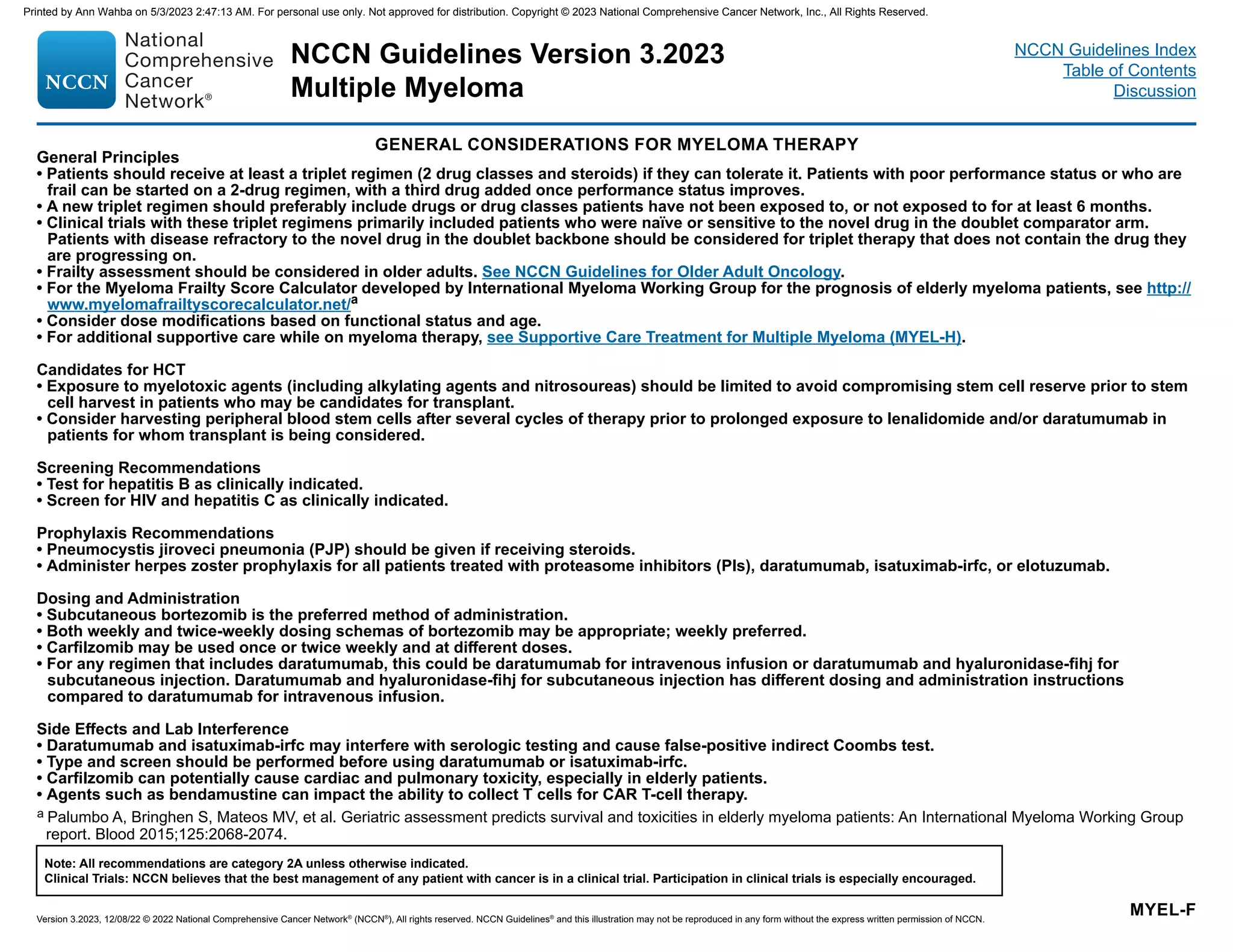
GENERAL CONSIDERATIONS FOR MYELOMA THERAPY
MYEL-F
General Principles
• Patients should receive at least a triplet regimen (2 drug classes and steroids) if they can tolerate it. Patients with poor performance status or who are
frail can be started on a 2-drug regimen, with a third drug added once performance status improves.
• A new triplet regimen should preferably include drugs or drug classes patients have not been exposed to, or not exposed to for at least 6 months.
• Clinical trials with these triplet regimens primarily included patients who were naïve or sensitive to the novel drug in the doublet comparator arm.
Patients with disease refractory to the novel drug in the doublet backbone should be considered for triplet therapy that does not contain the drug they
are progressing on.
• Frailty assessment should be considered in older adults. See NCCN Guidelines for Older Adult Oncology.
• For the Myeloma Frailty Score Calculator developed by International Myeloma Working Group for the prognosis of elderly myeloma patients, see http://
www.myelomafrailtyscorecalculator.net/a
• Consider dose modifications based on functional status and age.
• For additional supportive care while on myeloma therapy, see Supportive Care Treatment for Multiple Myeloma (MYEL-H).
Candidates for HCT
• Exposure to myelotoxic agents (including alkylating agents and nitrosoureas) should be limited to avoid compromising stem cell reserve prior to stem
cell harvest in patients who may be candidates for transplant.
• Consider harvesting peripheral blood stem cells after several cycles of therapy prior to prolonged exposure to lenalidomide and/or daratumumab in
patients for whom transplant is being considered.
Screening Recommendations
• Test for hepatitis B as clinically indicated.
• Screen for HIV and hepatitis C as clinically indicated.
Prophylaxis Recommendations
• Pneumocystis jiroveci pneumonia (PJP) should be given if receiving steroids.
• Administer herpes zoster prophylaxis for all patients treated with proteasome inhibitors (PIs), daratumumab, isatuximab-irfc, or elotuzumab.
Dosing and Administration
• Subcutaneous bortezomib is the preferred method of administration.
• Both weekly and twice-weekly dosing schemas of bortezomib may be appropriate; weekly preferred.
• Carfilzomib may be used once or twice weekly and at different doses.
• For any regimen that includes daratumumab, this could be daratumumab for intravenous infusion or daratumumab and hyaluronidase-fihj for
subcutaneous injection. Daratumumab and hyaluronidase-fihj for subcutaneous injection has different dosing and administration instructions
compared to daratumumab for intravenous infusion.
Side Effects and Lab Interference
• Daratumumab and isatuximab-irfc may interfere with serologic testing and cause false-positive indirect Coombs test.
• Type and screen should be performed before using daratumumab or isatuximab-irfc.
• Carfilzomib can potentially cause cardiac and pulmonary toxicity, especially in elderly patients.
• Agents such as bendamustine can impact the ability to collect T cells for CAR T-cell therapy.
a Palumbo A, Bringhen S, Mateos MV, et al. Geriatric assessment predicts survival and toxicities in elderly myeloma patients: An International Myeloma Working Group
report. Blood 2015;125:2068-2074.
Printed by Ann Wahba on 5/3/2023 2:47:13 AM. For personal use only. Not approved for distribution. Copyright © 2023 National Comprehensive Cancer Network, Inc., All Rights Reserved.
NCCN Guidelines Version 3.2023
Multiple Myeloma
Version 3.2023, 12/08/22 © 2022 National Comprehensive Cancer Network®
(NCCN®
), All rights reserved. NCCN Guidelines®
and this illustration may not be reproduced in any form without the express written permission of NCCN.
Note: All recommendations are category 2A unless otherwise indicated.
Clinical Trials: NCCN believes that the best management of any patient with cancer is in a clinical trial. Participation in clinical trials is especially encouraged.
NCCN Guidelines Index
Table of Contents
Discussion
MYEL-G
1 OF 5
PRIMARY THERAPY FOR TRANSPLANT CANDIDATESa-d
Preferred Regimens
• Bortezomib/lenalidomide/dexamethasone (category 1)
• Carfilzomib/lenalidomide/dexamethasone
Other Recommended Regimens
• Daratumumab/lenalidomide/bortezomib/dexamethasone
Useful In Certain Circumstances
• Bortezomib/thalidomide/dexamethasone (category 1)
• Bortezomib/cyclophosphamide/dexamethasonee
• Bortezomib/doxorubicin/dexamethasone
• Carfilzomib/cyclophosphamide/dexamethasonef
• Cyclophosphamide/lenalidomide/dexamethasone
• Daratumumab/bortezomib/thalidomide/dexamethasone
• Daratumumab/carfilzomib/lenalidomide/dexamethasone
• Daratumumab/cyclophosphamide/bortezomib/dexamethasone
• Dexamethasone/thalidomide/cisplatin/doxorubicin/cyclophosphamide/etoposide/bortezomibg (VTD-PACE)
• Ixazomib/cyclophosphamide/dexamethasonef
• Ixazomib/lenalidomide/dexamethasone (category 2B)
Continued
MAINTENANCE THERAPY
Preferred Regimens
• Lenalidomideh (category 1)
Other Recommended Regimens
• Bortezomib
• Daratumumab
• Ixazomib (category 2B)i
Useful In Certain Circumstances
• Bortezomib/lenalidomide ± dexamethasonej
• Carfilzomib/lenalidomidej
aSelected, but not inclusive of all regimens. The regimens under each preference
category are listed by order NCCN Category of Evidence and Consensus
alphabetically.
b See Supportive Care Treatment for Multiple Myeloma (MYEL-H).
c See General Considerations for Myeloma Therapy (MYEL-F).
d See Management of Renal Disease in Multiple Myeloma (MYEL-J).
e Preferred primarily as initial treatment in patients with acute renal insufficiency or
those who have no access to bortezomib/lenalidomide/dexamethasone. Consider
switching to bortezomib/lenalidomide/dexamethasone after renal function improves.
f Treatment option for patients with renal insufficiency and/or peripheral neuropathy.
g Generally reserved for the treatment of aggressive MM.
h There appears to be an increased risk for secondary cancers, especially with lenalidomide
maintenance following transplant. The benefits and risks of maintenance therapy vs.
secondary cancers should be discussed with patients.
i Results from interim analyses of TOURMALINE MM3 and MM4 trials of ixazomib in the
maintenance setting suggest a potential decrease in overall survival (OS).
j Dual maintenance recommended for high-risk MM.
Printed by Ann Wahba on 5/3/2023 2:47:13 AM. For personal use only. Not approved for distribution. Copyright © 2023 National Comprehensive Cancer Network, Inc., All Rights Reserved.
NCCN Guidelines Version 3.2023
Multiple Myeloma
Version 3.2023, 12/08/22 © 2022 National Comprehensive Cancer Network®
(NCCN®
), All rights reserved. NCCN Guidelines®
and this illustration may not be reproduced in any form without the express written permission of NCCN.
Note: All recommendations are category 2A unless otherwise indicated.
Clinical Trials: NCCN believes that the best management of any patient with cancer is in a clinical trial. Participation in clinical trials is especially encouraged.
NCCN Guidelines Index
Table of Contents
Discussion
MYEL-G
2 OF 5
a Selected, but not inclusive of all regimens. The regimens under each preference
category are listed by order NCCN Category of Evidence and Consensus
alphabetically.
b See Supportive Care Treatment for Multiple Myeloma (MYEL-H).
c See General Considerations for Myeloma Therapy (MYEL-F).
d See Management of Renal Disease in Multiple Myeloma (MYEL-J).
e Preferred primarily as initial treatment in patients with acute renal insufficiency
or those who have no access to bortezomib/lenalidomide/dexamethasone.
Consider switching to bortezomib/lenalidomide/dexamethasone after renal
function improves.
PRIMARY THERAPY FOR NON-TRANSPLANT CANDIDATESa-d
Preferred Regimens
• Bortezomib/lenalidomide/dexamethasone (category 1)
• Daratumumab/lenalidomide/dexamethasone (category 1)
Other Recommended Regimens
• Daratumumab/bortezomib/melphalan/prednisone (category 1)
• Carfilzomib/lenalidomide/dexamethasone
• Daratumumab/cyclophosphamide/bortezomib/dexamethasone
• Ixazomib/lenalidomide/dexamethasone
Useful In Certain Circumstances
• Lenalidomide/low-dose dexamethasone (category 1)k
• Bortezomib/dexamethasone
• Bortezomib/cyclophosphamide/dexamethasonee
• Bortezomib/lenalidomide/dexamethasone (VRD-lite) for frail
patients
• Carfilzomib/cyclophosphamide/dexamethasonef
• Cyclophosphamide/lenalidomide/dexamethasone
Continued
MAINTENANCE THERAPY
Preferred Regimens
• Lenalidomide (category 1)
Other Recommended Regimens
• Bortezomib
• Ixazomib (category 2B)i
Useful In Certain Circumstances
• Bortezomib/lenalidomidej
f
Treatment option for patients with renal insufficiency and/or peripheral neuropathy.
i Results from interim analyses of TOURMALINE MM3 and MM4 trials of ixazomib in
the maintenance setting suggest a potential decrease in OS.
j Dual maintenance recommended for high-risk MM.
k Continuously until progression. Benboubker L, Dimopoulos MA, Dispenzieri A,
et al. Lenalidomide and dexamethasone in transplant-ineligible patients with
myeloma. N Engl J Med 2014;371:906-917.
Printed by Ann Wahba on 5/3/2023 2:47:13 AM. For personal use only. Not approved for distribution. Copyright © 2023 National Comprehensive Cancer Network, Inc., All Rights Reserved.
NCCN Guidelines Version 3.2023
Multiple Myeloma
Version 3.2023, 12/08/22 © 2022 National Comprehensive Cancer Network®
(NCCN®
), All rights reserved. NCCN Guidelines®
and this illustration may not be reproduced in any form without the express written permission of NCCN.
Note: All recommendations are category 2A unless otherwise indicated.
Clinical Trials: NCCN believes that the best management of any patient with cancer is in a clinical trial. Participation in clinical trials is especially encouraged.
NCCN Guidelines Index
Table of Contents
Discussion
MYEL-G
3 OF 5
Continued
THERAPY FOR PREVIOUSLY TREATED MULTIPLE MYELOMAa-d,l-m
Preferred Regimens for Early Relapses (1–3 prior therapies)
Order of regimens does not indicate comparative efficacy
• If relapse is 6 months, the regimen used for primary therapy may be repeated.
• For patients still sensitive to bortezomib and/or lenalidomide, any of the regimens listed on this page may be appropriate.
• Ixazomib/lenalidomide/dexamethasone (category 1)
• Bortezomib/lenalidomide/dexamethasone
Bortezomib-Refractory Lenalidomide-Refractory
• Daratumumab/lenalidomide/dexamethasone (category 1)
• Daratumumab/carfilzomib/dexamethasone (category 1)
• Carfilzomib/lenalidomide/dexamethasone (category 1)
• Isatuximab-irfc/carfilzomib/dexamethasone (category 1)
• Carfilzomib/pomalidomide/dexamethasone
• Daratumumab/carfilzomib/dexamethasone (category 1)
• Daratumumab/bortezomib/dexamethasone (category 1)
• Isatuximab-irfc/carfilzomib/dexamethasone (category 1)
• Carfilzomib/pomalidomide/dexamethasone
After one prior therapy including lenalidomide and a PI
Daratumumab/pomalidomide/dexamethasone (category 1)
After two prior therapies including lenalidomide and a PI
Isatuximab-irfc/pomalidomide/dexamethasone (category 1)
After two prior therapies including an IMiD and a PI and with disease
progression on/within 60 days of completion of last therapy
Ixazomib/pomalidomide/dexamethasone
After one prior therapy including lenalidomide and a PI
Daratumumab/pomalidomide/dexamethasone (category 1)
After two prior therapies including lenalidomide and a PI
Isatuximab-irfc/pomalidomide/dexamethasone (category 1)
After two prior therapies including an IMiD and a PI and with disease
progression on/within 60 days of completion of last therapy
Pomalidomide/bortezomib/dexamethasone (category 1)
Ixazomib/pomalidomide/dexamethasone
a
Selected, but not inclusive of all regimens. The regimens under each preference category are listed by order NCCN Category of Evidence and Consensus alphabetically.
b See Supportive Care Treatment for Multiple Myeloma (MYEL-H).
c See General Considerations for Myeloma Therapy (MYEL-F).
d See Management of Renal Disease in Multiple Myeloma (MYEL-J).
l Consideration for appropriate regimen in previously treated myeloma should be based on the context of clinical relapse.
m Regimens included under 1–3 prior therapies can also be used later in the disease course. Attempt should be made to use drugs/drug classes the patients have not been
exposed to or exposed to 1 line prior.
n Autologous HCT should be considered in an eligible patient who had not previously received transplant or had a prolonged response to initial transplant.
For Other Recommended Regimens and for regimens Useful in
Certain Circumstances for Early Relapses (1–3 prior therapies),
see MYEL-G 4 of 5
Printed by Ann Wahba on 5/3/2023 2:47:13 AM. For personal use only. Not approved for distribution. Copyright © 2023 National Comprehensive Cancer Network, Inc., All Rights Reserved.
NCCN Guidelines Version 3.2023
Multiple Myeloma
Version 3.2023, 12/08/22 © 2022 National Comprehensive Cancer Network®
(NCCN®
), All rights reserved. NCCN Guidelines®
and this illustration may not be reproduced in any form without the express written permission of NCCN.
Note: All recommendations are category 2A unless otherwise indicated.
Clinical Trials: NCCN believes that the best management of any patient with cancer is in a clinical trial. Participation in clinical trials is especially encouraged.
NCCN Guidelines Index
Table of Contents
Discussion
MYEL-G
4 OF 5
Continued
THERAPY FOR PREVIOUSLY TREATED MULTIPLE MYELOMAa-d,l-o
• If relapse is 6 months, the regimen used for primary therapy may be repeated.
• For patients still sensitive to bortezomib and/or lenalidomide, any of the regimens listed on this page may be appropriate.
a Selected, but not inclusive of all regimens. The regimens under each preference
category are listed by order NCCN Category of Evidence and Consensus alphabetically.
b See Supportive Care Treatment for Multiple Myeloma (MYEL-H).
c See General Considerations for Myeloma Therapy (MYEL-F).
d See Management of Renal Disease in Multiple Myeloma (MYEL-J).
l Consideration for appropriate regimen in previously treated myeloma should be based on the
context of clinical relapse.
m Regimens included under 1–3 prior therapies can also be used later in the disease
course. Attempt should be made to use drugs/drug classes the patients have not been
exposed to or exposed to 1 line prior.
n Autologous HCT should be considered in an eligible patient who had not previously
received transplant or had a prolonged response to initial transplant.
o Consider single-agent lenalidomide or pomalidomide for patients with steroid intolerance.
Other Recommended Regimens for Early Relapses (1–3 prior therapies)
• Bortezomib/liposomal doxorubicin/dexamethasone (category 1)
• Carfilzomib (twice weekly)/dexamethasone (category 1)
• Elotuzumab/lenalidomide/dexamethasone (category 1)
• Selinexor/bortezomib/dexamethasone (once weekly) (category 1)
• Bortezomib/cyclophosphamide/dexamethasone
• Carfilzomib/cyclophosphamide/dexamethasone
• Cyclophosphamide/lenalidomide/dexamethasone
• Daratumumab/cyclophosphamide/bortezomib/dexamethasone
• Elotuzumab/bortezomib/dexamethasone
• Ixazomib/cyclophosphamide/dexamethasone
After two prior therapies including an IMiD and a PI and disease progression
on/within 60 days of completion of last therapy
Pomalidomide/cyclophosphamide/dexamethasone
After two prior therapies including lenalidomide and a PI
Elotuzumab/pomalidomide/dexamethasone
Useful in Certain Circumstances for Early Relapses (1–3 prior therapies)
• Bortezomib/dexamethasone (category 1)
• Lenalidomide/dexamethasone (category 1)
• Carfilzomib/cyclophosphamide/thalidomide/dexamethasone
• Carfilzomib (weekly)/dexamethasone
• Selinexor/daratumumab/dexamethasone
• Selinexor/carfilzomib/dexamethasone
• Venetoclax/dexamethasone only for t(11;14) patients
After two prior therapies including IMiD and a PI and with disease progression
on/within 60 days of completion of last therapy
Pomalidomide/dexamethasone (category 1)
Selinexor/pomalidomide/dexamethasone
For treatment of aggressive MM
Dexamethasone/cyclophosphamide/etoposide/cisplatin (DCEP)
Dexamethasone/thalidomide/cisplatin/doxorubicin/cyclophosphamide/
etoposide (DT-PACE) ± bortezomib (VTD-PACE)
After at least three prior therapies including a PI and an IMiD or are double-
refractory to a PI and an IMiD
Daratumumab
Printed by Ann Wahba on 5/3/2023 2:47:13 AM. For personal use only. Not approved for distribution. Copyright © 2023 National Comprehensive Cancer Network, Inc., All Rights Reserved.
NCCN Guidelines Version 3.2023
Multiple Myeloma
Version 3.2023, 12/08/22 © 2022 National Comprehensive Cancer Network®
(NCCN®
), All rights reserved. NCCN Guidelines®
and this illustration may not be reproduced in any form without the express written permission of NCCN.
Note: All recommendations are category 2A unless otherwise indicated.
Clinical Trials: NCCN believes that the best management of any patient with cancer is in a clinical trial. Participation in clinical trials is especially encouraged.
NCCN Guidelines Index
Table of Contents
Discussion
MYEL-G
5 OF 5
THERAPY FOR PREVIOUSLY TREATED MULTIPLE MYELOMAa-d,l-n
a Selected, but not inclusive of all regimens. The regimens under each preference
category are listed by order NCCN Category of Evidence and Consensus
alphabetically.
b See Supportive Care Treatment for Multiple Myeloma (MYEL-H).
c See General Considerations for Myeloma Therapy (MYEL-F).
d See Management of Renal Disease in Multiple Myeloma (MYEL-J).
l Consideration for appropriate regimen in previously treated myeloma should be
based on the context of clinical relapse.
Therapies for Patients with Late Relapses (3 prior therapies)
• Bendamustine
• Bendamustine/bortezomib/dexamethasone
• Bendamustine/carfilzomib/dexamethasone
• Bendamustine/lenalidomide/dexamethasone
• High-dose or fractionated cyclophosphamide
After at least four prior therapies, including an anti-CD38 monoclonal antibody, a PI, and an IMiD
Idecabtagene vicleucel
Ciltacabtagene autoleucel
Teclistamab-cqyv
Useful in certain circumstances:
◊ Belantamab mafodotin-blmf (if available through compassionate use program)
After at least four prior therapies and whose disease is refractory to at least two PIs, at least two immunomodulatory agents, and an anti-CD38
monoclonal antibody
Selinexor/dexamethasone
m Regimens included under 1–3 prior therapies can also be used later in the disease
course. Attempt should be made to use drugs/drug classes the patients have not
been exposed to or exposed to 1 line prior.
n Autologous HCT should be considered in an eligible patient who had not previously
received transplant or had a prolonged response to initial transplant.
Printed by Ann Wahba on 5/3/2023 2:47:13 AM. For personal use only. Not approved for distribution. Copyright © 2023 National Comprehensive Cancer Network, Inc., All Rights Reserved.
NCCN Guidelines Version 3.2023
Multiple Myeloma
Version 3.2023, 12/08/22 © 2022 National Comprehensive Cancer Network®
(NCCN®
), All rights reserved. NCCN Guidelines®
and this illustration may not be reproduced in any form without the express written permission of NCCN.
Note: All recommendations are category 2A unless otherwise indicated.
Clinical Trials: NCCN believes that the best management of any patient with cancer is in a clinical trial. Participation in clinical trials is especially encouraged.
NCCN Guidelines Index
Table of Contents
Discussion
MYEL-H
a Both pamidronate and zoledronic acid have shown equivalence in terms of reducing risk of skeletal-related events in randomized trials.
b Denosumab is preferred in patients with renal insufficiency.
c This is based on observations with denosumab discontinuation in non-myeloma settings. Cummings SR, Ferrari S, Eastell R, et al. Vertebral fractures after
discontinuation of denosumab: A post hoc analysis of the randomized placebo-controlled FREEDOM trial and its extension. J Bone Miner Res 2018;33:190-198.
SUPPORTIVE CARE FOR MULTIPLE MYELOMA
Anemia
• See NCCN Guidelines for Hematopoietic Growth Factors.
• Consider erythropoietin for anemic patients.
Infection
• See NCCN Guidelines for Prevention and Treatment of Cancer-
Related Infections.
• Intravenous immunoglobulin therapy should be considered in the
setting of recurrent serious infection and/or hypogammaglobulinemia
(IgG ≤400 mg/dL).
• The pneumococcal conjugate vaccine should be given followed by
the pneumococcal polysaccharide vaccine one year later.
• Influenza vaccination recommended. Consider two doses of the high-
dose inactivated quadrivalent influenza vaccine.
• Consider 12 weeks of levofloxacin 500 mg daily at the time of initial
diagnosis for MM.
• See NCCN Guidance on Cancer and COVID-19 Vaccination
• See MYEL-F for myeloma therapy-specific prophylaxis
Renal Dysfunction
• See Management of Renal Disease in Multiple Myeloma (MYEL-J)
Venous Thromboembolism (VTE)
• For management of VTE, risk stratification, and VTE prophylaxis, See
MYEL-I
Bone Disease
• All patients receiving primary myeloma therapy should be given
bone-targeting treatment (bisphosphonates (category 1)a or
denosumab.b)
A baseline dental exam is strongly recommended.
Assess Vitamin D status
Monitor for renal dysfunction with use of bisphosphonate therapy.
Monitor for osteonecrosis of the jaw.
Continue bone-targeting treatment (bisphosphonates or
denosumab) for up to 2 years. The frequency of dosing (monthly
vs. every 3 months) would depend on the individual patient criteria
and response to therapy. Continuing beyond 2 years should be
based on clinical judgment.
Patients receiving denosumab for bone disease who subsequently
discontinue therapy should be given maintenance denosumab
every 6months or a single dose of bisphosphonate to mitigate risk
of rebound osteoporosis.c
• RT (See Principles of Radiation Therapy [MYEL-D])
• Orthopedic consultation should be sought for impending or actual
long-bone fractures or bony compression of spinal cord or vertebral
column instability.
• Consider vertebroplasty or kyphoplasty for symptomatic vertebral
compression fractures.
Hypercalcemia
• Hydration, bisphosphonates (zoledronic acid preferred),
denosumab, steroids, and/or calcitonin are recommended.
Hyperviscosity
• Plasmapheresis should be used as adjunctive therapy for
symptomatic hyperviscosity.
Printed by Ann Wahba on 5/3/2023 2:47:13 AM. For personal use only. Not approved for distribution. Copyright © 2023 National Comprehensive Cancer Network, Inc., All Rights Reserved.
MANAGEMENT OF VENOUS THROMBOEMBOLISM (VTE) IN MULTIPLE MYELOMA
a Adapted from Sanfilippo KM, et al. Am J Hematol 2019;94:1176-1184.
b Adapted from: Li A, et al. J Natl Compr Canc Netw 2019;17:840-847.
IMPEDE Scorea
for Risk Stratification (points assigned)
Individual Risk Factors Points Myeloma Risk Factors Points
Positive Factors
Central venous catheter/Tunneled central line +2 Immunomodulatory drug (IMiD) +4
Pelvic, hip, or femur fracture +4 Erythropoiesis-stimulating agent +1
Obesity (Body Mass Index ≥25) +1 Dexamethasone 160 mg/month +2
Previous VTE +5 Dexamethasone 160 mg/month +4
Doxorubicin or multiagent chemotherapy +3
Negative Factors
Ethnicity/Race = Asian/Pacific Islander -3
Existing thromboprophylaxis: prophylactic
LMWH (low-molecular-weight heparin) or aspirin
-3
Existing thromboprophylaxis: therapeutic
LMWH or warfarin
-4
SAVED Scoreb
for Risk Stratification
Variable Points
Surgery within 90 days +2
Asian Race -3
VTE history +3
Age ≥80 years +1
Dexamethasone (regimen dose)
• Standard dose (120–160 mg/cycle)
• High dose (160 mg/cycle)
+1
+2
VTE RISK STRATIFICATION USING IMPEDE OR SAVED SCORING SYSTEM
NCCN Guidelines Version 3.2023
Multiple Myeloma
Version 3.2023, 12/08/22 © 2022 National Comprehensive Cancer Network®
(NCCN®
), All rights reserved. NCCN Guidelines®
and this illustration may not be reproduced in any form without the express written permission of NCCN.
Note: All recommendations are category 2A unless otherwise indicated.
Clinical Trials: NCCN believes that the best management of any patient with cancer is in a clinical trial. Participation in clinical trials is especially encouraged.
NCCN Guidelines Index
Table of Contents
Discussion
MYEL-I
1 OF 3
Continued
Printed by Ann Wahba on 5/3/2023 2:47:13 AM. For personal use only. Not approved for distribution. Copyright © 2023 National Comprehensive Cancer Network, Inc., All Rights Reserved.
NCCN Guidelines Version 3.2023
Multiple Myeloma
Version 3.2023, 12/08/22 © 2022 National Comprehensive Cancer Network®
(NCCN®
), All rights reserved. NCCN Guidelines®
and this illustration may not be reproduced in any form without the express written permission of NCCN.
Note: All recommendations are category 2A unless otherwise indicated.
Clinical Trials: NCCN believes that the best management of any patient with cancer is in a clinical trial. Participation in clinical trials is especially encouraged.
NCCN Guidelines Index
Table of Contents
Discussion
MYEL-I
2 OF 3
MANAGEMENT OF VENOUS THROMBOEMBOLISM (VTE) IN MULTIPLE MYELOMA
General Principles:
• Highest risk for VTE is in the first 6 months following new diagnosis of MM.
• VTE prophylaxis is administered assuming there are no contraindications to anticoagulation agents or anti-platelets (Please see page
VTE-A of the NCCN Guidelines for Cancer-Associated Venous Thromboembolic Disease.)
• All anticoagulants carry increased risk of bleeding; careful consideration needs to be made regarding risks and benefits for each
patient.
• Warfarin at international normalized ratio (INR) 2–3 is not directly comparable to the other agents listed at prophylactic doses with
respect to bleeding and thrombotic risks.
• Patients already on therapeutic anticoagulants for other reasons (eg, atrial fibrillation) should continue anticoagulation therapy.
• If no other coagulopathy, full-dose anticoagulation is contraindicated with thrombocytopenia 50,000/μL; in patients with high risk for
VTE, prophylactic anticoagulation may be appropriate even if platelet count is as low as 25,000/μL.
• Indications for long-term anticoagulation include unprovoked VTE or provoked VTE in the presence of a risk factor that is still present.
• For any patients who develop VTE on IMiD-based therapy, continue using therapeutic dose anticoagulants for as long as IMiD-based
therapy is indicated.
Factors Impacting the Choice of Optimal VTE Prophylaxis Agent:
• Bleeding risk (eg, concurrent coagulopathy, disseminated intravascular coagulation, hyperviscosity)
• Cytopenias (eg, platelet count ± hemoglobin)
• Concurrent medications (eg, strong cytochrome P inducers/inhibitors, single/dual anti-platelets)
• Current renal function (eg, creatinine clearance)
• Patient choice (eg, preference for mode of administration, dietary restrictions)
• Insurance coverage/restrictions (including cost of therapy)
• Availability of reversal agents in case of emergency bleeding
• History of heparin-induced thrombocytopenia
• Extremes of body weight
• Carfilzomib + IMiD therapy
References:
Palumbo A. Leukemia 2008;22:414-423.
Kristinsson SY. Hematology Am Soc Hematol Educ Program 2010;2010:437-444.
Carrier M. N Engl J Med 2019;380:711-719.
Khorana AA. N Engl J Med 2019;380:720-728.
Piedra K. Br J Haematol. 2022;196:105-109.
Wang T-F. J Thromb Haemost 2019;17:1772-1778. Note: The AVERT apixaban trial had only 2.6% myeloma patients, and myeloma patients were excluded from the
CASSINI rivaroxaban trial.
Continued
Printed by Ann Wahba on 5/3/2023 2:47:13 AM. For personal use only. Not approved for distribution. Copyright © 2023 National Comprehensive Cancer Network, Inc., All Rights Reserved.
NCCN Guidelines Version 3.2023
Multiple Myeloma
Version 3.2023, 12/08/22 © 2022 National Comprehensive Cancer Network®
(NCCN®
), All rights reserved. NCCN Guidelines®
and this illustration may not be reproduced in any form without the express written permission of NCCN.
Note: All recommendations are category 2A unless otherwise indicated.
Clinical Trials: NCCN believes that the best management of any patient with cancer is in a clinical trial. Participation in clinical trials is especially encouraged.
NCCN Guidelines Index
Table of Contents
Discussion
MYEL-I
3 OF 3
VTE Prophylaxis Recommendations
≤3 Points by IMPEDE Score or 2 Points by SAVED Score ≥4 Points by IMPEDE Score or ≥2 SAVED Scorec
• Aspirin 81–325 mg once daily • LMWH (equivalent to enoxaparin 40 mg daily) OR
• Rivaroxaban 10 mg daily OR
• Apixaban 2.5 mg twice daily OR
• Fondaparinux 2.5 mg daily OR
• Warfarin (target INR 2.0–3.0)
Duration of VTE Prophylaxis
• Indefinite while on myeloma therapy
• 3–6 months followed by aspirin (longer periods of anticoagulation may be considered in the presence of additional patient, treatment-
specific, or transient VTE risk factors)
c A less common choice of agent includes dalteparin 5,000 units subcutaneously (SC) daily (category 2B).
RECOMMENDATIONS FOR VTE PROPHYLAXIS
MANAGEMENT OF VENOUS THROMBOEMBOLISM (VTE) IN MULTIPLE MYELOMA
Printed by Ann Wahba on 5/3/2023 2:47:13 AM. For personal use only. Not approved for distribution. Copyright © 2023 National Comprehensive Cancer Network, Inc., All Rights Reserved.
NCCN Guidelines Version 3.2023
Multiple Myeloma
Version 3.2023, 12/08/22 © 2022 National Comprehensive Cancer Network®
(NCCN®
), All rights reserved. NCCN Guidelines®
and this illustration may not be reproduced in any form without the express written permission of NCCN.
Note: All recommendations are category 2A unless otherwise indicated.
Clinical Trials: NCCN believes that the best management of any patient with cancer is in a clinical trial. Participation in clinical trials is especially encouraged.
NCCN Guidelines Index
Table of Contents
Discussion
MANAGEMENT OF RENAL DISEASE IN MULTIPLE MYELOMAa
Testsb
• Serum creatinine, electrolytes, and uric acid
• Urinalysis, electrolytes, and sediment
• 24-h urine collection for protein and UPEP/UIFE
• SPEP/SIFE and serum FLCs
• Consider renal ultrasound and renal biopsy
Treatment Options
• Pulse dexamethasone
• Regimens containing bortezomib and/or daratumumab
• Can switch to other regimen once renal function has improved or
stabilized
• Use other plasma cell-directed therapy with caution
• See Response Criteria for Multiple Myeloma (MYEL-E)
• See Myeloma Therapy (MYEL-G)
MYEL-J
a Defined as serum creatinine 2 mg/dL or established glomerular filtration rate (eGFR) 60 mL/min/1.73 sqm.
b Consider other diagnosis such as amyloid and light chain disease for patients with significant proteinuria.
c Patients with creatinine clearance 30 cc/min can experience severe hypocalcemia and should be monitored.
Recommendations for Lenalidomide Dosing in Patients with Multiple Myeloma Who Have Renal Impairment
Category Renal Function (Cockcroft-Gault CLCr
) Lenalidomide Dosing in Multiple Myeloma
Moderate renal impairment CLCr
≥30 mL/min to 60 mL/min 10 mg every 24 h
Severe renal impairment CLCr
30 mL/min (not requiring dialysis) 15 mg every 48 h
End-stage renal disease CLCr
30 mL/min (requiring dialysis) 5 mg once daily; on dialysis days,
dose should be administered after dialysis
CLCr
= creatinine clearance
Bone-Modifying Agent Dosing in Patients with Multiple Myeloma Who Have Renal Impairment
Degree of Renal Impairment Pamidronate
(focal segmental glomerulosclerosis)
Zoledronic Acid
(tubular cell toxicity)
Denosumab
None 90 mg IV over 2 h every 3–4 wks 4 mg IV over 5 min every 3–4 wks 120 mg SQ Q 4 weeks
Mild/moderate renal impairment Use standard dose Reduce dose 120 mg SQ Q 4 weeks
Severe renal impairment 60–90 mg over 4–6 h Not recommended 120 mg SQ Q 4 weeksc
Supportive Care
• Provide hydration to dilute tubular light chains; goal urine output
is 100–150 cc/h
• Monitor fluid status
• Treat hypercalcemia, hyperuricemia, and other metabolic
abnormalities
• Discontinue nephrotoxic medications
• Dialysis
Refractory electrolyte disturbances, uremia, and fluid overload
• Mechanical removal of serum FLCs with high cutoff dialysis
filters or plasmapheresis may have a limited role. Systemic
therapy should not be delayed if performing this procedure.
• Renal dosing of all medications
Printed by Ann Wahba on 5/3/2023 2:47:13 AM. For personal use only. Not approved for distribution. Copyright © 2023 National Comprehensive Cancer Network, Inc., All Rights Reserved.
NCCN Guidelines Version 3.2023
Multiple Myeloma
Version 3.2023, 12/08/22 © 2022 National Comprehensive Cancer Network®
(NCCN®
), All rights reserved. NCCN Guidelines®
and this illustration may not be reproduced in any form without the express written permission of NCCN.
Note: All recommendations are category 2A unless otherwise indicated.
Clinical Trials: NCCN believes that the best management of any patient with cancer is in a clinical trial. Participation in clinical trials is especially encouraged.
NCCN Guidelines Index
Table of Contents
Discussion
MGRS-1
MONOCLONAL GAMMOPATHY OF CLINICAL SIGNIFICANCE
CLINICIAL
FINDINGS
INITIAL WORKUP ADDITIONAL WORKUP
MGRS
(Monoclonal
gammopathy
of renal
significance)
suspected
Evaluate for kidney disease
• Kidney function: eGFR
• Urinalysis
• Metabolic testing
Renal biopsy
recommended if:
• Acute kidney injury
(AKI) stage 3
• eGFR 60 mL/min and
2 mL/min per year
decline
• Proteinuria (1 g/day)
Albumin:creatinine 30
mg/mmol
• Fanconi syndrome
Consider renal biopsy if:
• AKI stage 1 or 2
• eGFR 60 mL/min and
2 mL/min per year
decline
• Albumin:creatinine
3–30 mg/mmol and
glomerular filtration rate
(GFR) 60 mL/min
• Evidence of light chain
proteinuria
Defer renal biopsy if:
• Stable established GFR
(eGFR)
• Normal urinalysis
• No evidence of light
chain proteinuria
To confirm diagnosis of MGRS:
• Light microscopy
• Immunofluorescence staining for
IgG subclasses, IgA and IgM, and
kappa and lambda
Note: M protein detected in
serum and/or urine must 		
match the one found in the 		
renal biopsy
• Electron microscopy
• FDG PET/CT, low-dose CT, or
whole-body MRI as clinically
indicated
• Bone marrow biopsy if suspected
to have MM or Waldenström
macroglobulinemia (WM)
Additional workup as clinically
indicated:
• FISH panel for myeloma and
polymerase chain reaction (PCR)
assay for MYD88 L265P
• Excisional lymph node biopsy,
if other B-cell lymphomas are
suspected
• Peripheral blood flow cytometry for
diagnosis of Chronic Lymphocytic
Leukemia (See NCCN Guidelines
for Chronic Lymphocytic Leukemia/
Small Lymphocytic Lymphoma)
• Evaluate for light chain amyloidosis
(See NCCN Guidelines for Systemic
Light Chain Amyloidosis)
For management
See MGRS-2
MONOCLONAL GAMMOPATHY OF RENAL SIGNIFICANCE
Printed by Ann Wahba on 5/3/2023 2:47:13 AM. For personal use only. Not approved for distribution. Copyright © 2023 National Comprehensive Cancer Network, Inc., All Rights Reserved.
NCCN Guidelines Version 3.2023
Multiple Myeloma
Version 3.2023, 12/08/22 © 2022 National Comprehensive Cancer Network®
(NCCN®
), All rights reserved. NCCN Guidelines®
and this illustration may not be reproduced in any form without the express written permission of NCCN.
Note: All recommendations are category 2A unless otherwise indicated.
Clinical Trials: NCCN believes that the best management of any patient with cancer is in a clinical trial. Participation in clinical trials is especially encouraged.
NCCN Guidelines Index
Table of Contents
Discussion
TREATMENT RESPONSE ASSESSMENT
• For plasma cell-related MGRS, use the
management algorithm for MM (See MYEL-4)
• For lymphoplasmacytic-related MGRS,
See NCCN Guidelines for Waldenström
Macroglobulinemia/Lymphoplasmacytic
Lymphomaa
• For any MGRS with monoclonal B-cell
lymphocytosis (MBL) features, See NCCN
Guidelines for Chronic Lymphocytic
Leukemia/Small Lymphocytic Lymphoma
• For IgG- or IgA-associated MGRS, use the
response criteria for MMb
• For IgM-associated MGRS, use
the response criteria for WM (See
NCCN Guidelines for Waldenström
Macroglobulinemia/Lymphoplasmacytic
Lymphoma)
• For FLC-associated MGRS, use the
response criteria for amyloidosis (See
NCCN Guidelines for Systemic Light Chain
Amyloidosis)
• For cases in which the causal monoclonal
paraprotein is not detectable or is difficult
to measure:
evaluate renal function
evaluate bone marrow involvement or
radiologic findings
Relapse
Individualize
treatment based
on response and
toxicity of prior
therapy, patient’s
performance
status, and renal
function at the
time of relapse
MGRS-2
a Systemic agents associated with neurotoxicity should be used with caution.
b See Response Criteria for Multiple Myeloma (MYEL-E).
MONOCLONAL GAMMOPATHY OF CLINICAL SIGNIFICANCE
MONOCLONAL GAMMOPATHY OF RENAL SIGNIFICANCE
Printed by Ann Wahba on 5/3/2023 2:47:13 AM. For personal use only. Not approved for distribution. Copyright © 2023 National Comprehensive Cancer Network, Inc., All Rights Reserved.
NCCN Guidelines Version 3.2023
Multiple Myeloma
Version 3.2023, 12/08/22 © 2022 National Comprehensive Cancer Network®
(NCCN®
), All rights reserved. NCCN Guidelines®
and this illustration may not be reproduced in any form without the express written permission of NCCN.
Note: All recommendations are category 2A unless otherwise indicated.
Clinical Trials: NCCN believes that the best management of any patient with cancer is in a clinical trial. Participation in clinical trials is especially encouraged.
NCCN Guidelines Index
Table of Contents
Discussion
MONOCLONAL GAMMOPATHY OF CLINICAL SIGNIFICANCE (FOR MGRS, SEE MGRS-1)
MGNS-1
IgMa MGNS
(Monoclonal
gammopathy
of neurological
significance)
suspected
INITIAL WORKUP CLINICAL FINDINGS
• Rule out other causes of neuropathy
Diabetes
Cobalamin deficiency
Thyroid dysfunction
Lyme disease
HIV infection
Syphilis
Autoimmune disease
Cryoglobulinemia
Evaluation for light chain amyloidosis,
(See NCCN Guidelines for Systemic Light
Chain Amyloidosis), WM (See NCCN
Guidelines for WM/LPL), or POEMS (See
POEMS-1), if appropriate.
• Anti-MAG antibodiesa
• Ganglioside antibody panel
• Nerve conduction study (NCS)/
electromyogram (EMG)a
• Neurology consult
• MYD88b L265P allele-specific PCR (AS-PCR)
testing of bone marrow
• Chest/abdominal/pelvic CT with contrast
when possible
Useful in certain circumstances
• Sural nerve biopsy
• CXCR4 gene mutation testing
High suspicion
• Sensory predominant
• Length dependent
• Slow progression (years)
• Bilateral and symmetrical
• Antibodies present
• Demyelination by EMG/NCS
OR intermediate suspicion (not
high or low suspicion) AND
affecting activities of daily
living (ADLs)
Low suspicion
• Motor/pain predominant
• Non-length dependent
• Rapid progression (weeks to
months)
• Unilateral/asymmetrical
• Antibodies not present
• No demyelination by EMG/NCS
OR intermediate/high suspicion
AND not affecting ADLs
See NCCN
Guidelines for
Waldenström
Macroglobulinemia/
Lymphoplasmacytic
Lymphoma
Observation
a In patients presenting with suspected disease related to peripheral neuropathy, rule out amyloidosis in patients presenting with nephrotic syndrome or unexplained
cardiac problems.
b MYD88 wild-type occurs in 10% of patients and should not be used to exclude diagnosis of WM if other criteria are met.
MONOCLONAL GAMMOPATHY OF NEUROLOGICAL SIGNIFICANCE
Printed by Ann Wahba on 5/3/2023 2:47:13 AM. For personal use only. Not approved for distribution. Copyright © 2023 National Comprehensive Cancer Network, Inc., All Rights Reserved.
INITIAL WORKUP ADDITIONAL TESTING
AS INDICATED
POEMS
suspected
• Complete HP
examination
• Evaluate for
organomegaly
• Fundoscopic exam
• Hyperhidrosis
• Diarrhea
• Weight loss
• Menstrual and sexual
function
• Skin examination for
hyperpigmentation,
hypertrichosis,
acrocyanosis,
glomeruloid
hemangiomata,
plethora, flushing,
clubbing, etc.
• Detailed neurologic
history (numbness,
pain, weakness,
balance, orthostasis)
and exam (sensation
and motor function)
• Electrophysiologic (nerve
conduction) studies
• CT chest/abdomen/pelvis to
document lymphadenopathy,
organomegaly, ascites, pleural
effusion, edema
• Testosterone, estradiol, fasting
glucose, thyroid-stimulating
hormone, parathyroid hormone,
prolactin, serum cortisol,
luteinizing hormone
• CBC, complete metabolic panel,
serum immunoglobulins (IgG,
IgA, IgM), electrophoresis and
immunofixation, serum FLC,
24-h urine total protein, vascular
endothelial growth factor (VEGF),
interleukin 6 (IL-6)
• Bone marrow aspirate and biopsy,
FISH panel for myeloma, and PCR
• Echocardiography to assess right
ventricular systolic and pulmonary
artery pressures
• CT body bone windows and or FDG
PET/CT for sclerotic bone lesions
• For criteria for
diagnosis, see
POEMS-3
• Sural nerve biopsy
• Follicle-stimulating
hormone,
adrenocorticotropin
hormone,
cosyntropin
stimulation test
• Biopsy of bone lesion
if needed
• Excisional lymph
node biopsy, if
Castleman disease
or other B-cell
lymphomas are
suspected
• FISH panel for
myeloma
• Evaluate for light
chain amyloidosis,
if appropriate (See
NCCN Guidelines for
Systemic Light Chain
Amyloidosis)
For management of
POEMS syndrome,
see POEM-2
If diagnosis is MM,
follow MM algorithm
If diagnosis is WM,
see NCCN Guidelines
for WM/LPL
If diagnosis is
Castleman disease,
See NCCN Guidelines
for B-Cell Lymphomas
If diagnosis is
Systemic Light Chain
Amyloidosis, see
NCCN Guidelines for
Systemic Light Chain
Amyloidosis
POEMS (POLYNEUROPATHY, ORGANOMEGALY, ENDOCRINOPATHY, MONOCLONAL PROTEIN, SKIN CHANGES)
Adapted with permission: Dispenzieri A. Am J Hematol 2019;94:812-827.
RECOMMENDED INITIAL TESTING DIAGNOSIS
NCCN Guidelines Version 3.2023
Multiple Myeloma
Version 3.2023, 12/08/22 © 2022 National Comprehensive Cancer Network®
(NCCN®
), All rights reserved. NCCN Guidelines®
and this illustration may not be reproduced in any form without the express written permission of NCCN.
Note: All recommendations are category 2A unless otherwise indicated.
Clinical Trials: NCCN believes that the best management of any patient with cancer is in a clinical trial. Participation in clinical trials is especially encouraged.
NCCN Guidelines Index
Table of Contents
Discussion
POEMS-1
Printed by Ann Wahba on 5/3/2023 2:47:13 AM. For personal use only. Not approved for distribution. Copyright © 2023 National Comprehensive Cancer Network, Inc., All Rights Reserved.
NCCN Guidelines Version 3.2023
Multiple Myeloma
Version 3.2023, 12/08/22 © 2022 National Comprehensive Cancer Network®
(NCCN®
), All rights reserved. NCCN Guidelines®
and this illustration may not be reproduced in any form without the express written permission of NCCN.
Note: All recommendations are category 2A unless otherwise indicated.
Clinical Trials: NCCN believes that the best management of any patient with cancer is in a clinical trial. Participation in clinical trials is especially encouraged.
NCCN Guidelines Index
Table of Contents
Discussion
POEMS (POLYNEUROPATHY, ORGANOMEGALY, ENDOCRINOPATHY, MONOCLONAL PROTEIN, SKIN CHANGES)
POEMS-2
TREATMENT RESPONSE ASSESSMENT
• Radiation therapy alone to isolated
bone lesion (3 sites) in patients
without clonal BMPC
• Autologous HCT in patients who
are eligible as sole therapy or as
consolidation after induction therapy
Induction therapy options include:
◊ Lenalidomide/dexamethasone
◊ Bortezomiba/dexamethasone
◊ Melphalan/dexamethasone
◊ Cyclophosphamide/dexamethasone
◊ Pomalidomide/dexamethasone
• In patients who are transplant ineligible,
options include:
Lenalidomide/dexamethasone
Bortezomiba/dexamethasone
Melphalan/dexamethasone
Cyclophosphamide/dexamethasone
Pomalidomide/dexamethasone
See POEMS-4 for Response Criteria
Individualize treatment based
on response and toxicity of
prior therapy and patient’s
performance status at the
time of progression
Progression
a Bortezomib may cause exacerbation of neuropathy.
Printed by Ann Wahba on 5/3/2023 2:47:13 AM. For personal use only. Not approved for distribution. Copyright © 2023 National Comprehensive Cancer Network, Inc., All Rights Reserved.
POEMS (POLYNEUROPATHY, ORGANOMEGALY, ENDOCRINOPATHY, MONOCLONAL PROTEIN, SKIN CHANGES)
Mandatory major criteria 1. Polyneuropathy (typical demyelinating)
2. Monoclonal plasma cell-proliferative disorder (almost always λ)
Other major criteria (one required) 3. Castleman diseaseb
4. Sclerotic bone lesions
5. Vascular endothelial growth factor elevation
Minor criteria 6. Organomegaly (splenomegaly, hepatomegaly, lymphadenopathy)
7. Extravascular volume overload (edema, pleural effusion, or ascites)
8. Endocrinopathy (adrenal, thyroid, pituitary, gonadal, parathyroid, pancreatic)
9. Skin changes (hyperpigmentation, hypertrichosis, glomeruloid hemangiomata, plethora,
acrocyanosis, flushing, white nails)
10. Papilledema
11. Thrombocytosis/polycythemiac
Other signs and symptoms Clubbing, weight loss, hyperhidrosis, pulmonary hypertension, restrictive lung disease, thrombotic
diatheses, diarrhea, low vitamin B12
levels
Table 1 Criteria for the Diagnosis of POEMS Syndromea
The diagnosis of POEMS syndrome is confirmed when both of the mandatory major criteria, one of the other three major criteria, and one of the six minor criteria are
present.
a There is a Castleman disease variant of POEMS that occurs without evidence of a clonal plasma cell disorder that is not accounted for in this table. This entity should
be considered separately.
b Because of the high prevalence of diabetes mellitus and thyroid abnormalities, this diagnosis alone is not sufficient to meet this minor criterion.
c Approximately 50% of patients will have bone marrow changes that distinguish it from a typical MGUS or myeloma bone marrow. Anemia and/or thrombocytopenia are
distinctively unusual in this syndrome unless Castleman disease is present.
Reprinted with permisson: Dispenzieri A. Am J Hematol 2019;94:812-827.
NCCN Guidelines Version 3.2023
Multiple Myeloma
Version 3.2023, 12/08/22 © 2022 National Comprehensive Cancer Network®
(NCCN®
), All rights reserved. NCCN Guidelines®
and this illustration may not be reproduced in any form without the express written permission of NCCN.
Note: All recommendations are category 2A unless otherwise indicated.
Clinical Trials: NCCN believes that the best management of any patient with cancer is in a clinical trial. Participation in clinical trials is especially encouraged.
NCCN Guidelines Index
Table of Contents
Discussion
POEMS-3
Printed by Ann Wahba on 5/3/2023 2:47:13 AM. For personal use only. Not approved for distribution. Copyright © 2023 National Comprehensive Cancer Network, Inc., All Rights Reserved.
POEMS (POLYNEUROPATHY, ORGANOMEGALY, ENDOCRINOPATHY, MONOCLONAL PROTEIN, SKIN CHANGES)
Parameter Evaluable Complete Response Improvement Progressiona
Plasma VEGF 2x ULN Normalb 50% reduction from
baselineb
50% increase from lowest level
Hematologic M-spike 0.5 g/dL,c
1.0 g/dLd,e
Negative serum and urine
IFE and bone marrowb
50% reduction of M-spike
from baselinef
25% increase from lowest level,
which must be 0.5 g/dL
PET/CT At least one lesion with
FDG SUVmax
g
No FDG uptake 50% reduction in sum of
SUVmax
g
30% increase in sum of SUVmax
g
from lowest level which must
be at least 4 SUVmax
g OR
appearance of new FDG avid
lesion
mNIS +7POEMS
All patients ... 15% decrease from
baseline (a minimum of 10
points)
15% increase from lowest value
(a minimum of 10 points)
Ascites/effusion/edema Present Absent Improved by 1 CTCAE
grade from baseline
Worsened by 1 CTCAE grade
from lowest grade
ECHO RVSP ≥40 mm Hg ... 40 mm Hg
Papilledema Present Absent Worsening by 1 CTCAE grade
DLCO 70% predicted ≥70% predicted ... Worsening by 1 CTCAE grade
Table 2 Response Criteria for POEMS Syndrome
a Any progression event (VEGF, hematologic, or clinical will be considered progression, assuming
change is attributable to disease and not an adverse event). To document progression, option
exists for repeating value. If confirmed, progression date is first date of suspected progression.
b For VEGF, M-spike, and IFE response documentation, blood values need to be repeated for
verification.
c For VGPR evaluable.
Reprinted with permisson: Dispenzieri A. Am J Hematol 2019;94:812-827.
d For PR evaluable.
e Quantitative IgA is acceptable surrogate for M-spike
for proteins migrating in the beta region.
f VGPR is defined as no measurable monoclonal protein
on serum or urine electrophoresis, but positive IFE.
g By body weight.
Abbreviations:CTCAE, common terminology criteria for adverse events, IFE, immunofixation electrophoresis, ECHO RVSP, echocardiogram right ventricular systolic pressure, DLCO, diffusing
capacity of carbon monoxide.
NCCN Guidelines Version 3.2023
Multiple Myeloma
Version 3.2023, 12/08/22 © 2022 National Comprehensive Cancer Network®
(NCCN®
), All rights reserved. NCCN Guidelines®
and this illustration may not be reproduced in any form without the express written permission of NCCN.
Note: All recommendations are category 2A unless otherwise indicated.
Clinical Trials: NCCN believes that the best management of any patient with cancer is in a clinical trial. Participation in clinical trials is especially encouraged.
NCCN Guidelines Index
Table of Contents
Discussion
POEMS-4
Printed by Ann Wahba on 5/3/2023 2:47:13 AM. For personal use only. Not approved for distribution. Copyright © 2023 National Comprehensive Cancer Network, Inc., All Rights Reserved.
NCCN Guidelines Version 3.2023
Multiple Myeloma
Version 3.2023, 12/08/22 © 2022 National Comprehensive Cancer Network®
(NCCN®
), All rights reserved. NCCN Guidelines®
and this illustration may not be reproduced in any form without the express written permission of NCCN.
NCCN Guidelines Index
Table of Contents
Discussion
ADL activities of daily living
AKI acute kidney injury
AS-PCR allele-specific polymerase chain
reaction
BMPC bone marrow plasma cell
BUN blood urea nitrogen
BNP b-type natriuretic peptide
CAR-T chimeric antigen receptor T-cell
therapy
CBC complete blood count
CLcr creatinine clearance
eGFR established glomerular filtration
rate
EMG electromyogram
FDG flurodeoxyglucose
FISH fluorescence in situ hybridization
FLC free light chain
FLCr serum free light chain ratio
GFR glomerular filtration rate
HP history and physical
HCT hematopoietic cell transplant
HIV human immunodeficiency virus
Ig immunoglobulin
ISS International Staging System
IMiD Immunomodulatory drug
IMPEDE IMiD, BMI, Pathologic fracture,
ESA (erythropoietin stimulating
agent), Dexamethasone/
Doxorubicin, Ethnicity
LDH lactate dehydrogenase
LMWH low-molecular-weight heparin
MFC multicolor flow cytometry
MGUS monoclonal gammopathy of
undetermined significance
MM multiple myeloma
MRD minimal residual disease
MGRS monoclonal gammopathy of renal
significance
MGNS monoclonal gammopathy of
neurological significance
NGS next generation sequencing
NGF next-generation flow
NT-
proBNP
N-terminal pro hormone B-type
natriuretic peptide
NCS nerve conduction study
POEMS polyneuropathy, organomegaly,
edocrinopathy, monoclonal
protein, skin change
PFS progression free survival
PI proteasome-inhibitor
PR partial response
PCR polymerase chain reaction
OS overall survival
R-ISS revised International Staging
System
SAVED Surgery within 90 days, Asian
race, Venous thromboembolism
history, age over Eighty (80),
dexamethasone
SIFE serum immunofixation
electrophoresis
ABBREVIATIONS
ABBR-1
SNP single nucleotide
polymorphism
SPEP serum protein
electrophoresis
SUV standardized uptake
value
UIFE urine immunofixation
electrophoresis
UPEP urine protein
electrophoresis
ULN upper limit of normal
VTE venous
thromboembolism
VEGF vascular endothelial
growth factor
VGPR very good partial
response
WM/LPL Waldenstrom
Macroglobulinemia/
lymphoplasmacytic
lymphoma
Printed by Ann Wahba on 5/3/2023 2:47:13 AM. For personal use only. Not approved for distribution. Copyright © 2023 National Comprehensive Cancer Network, Inc., All Rights Reserved.
NCCN Guidelines Version 3.2023
Multiple Myeloma
Version 3.2023, 12/08/22 © 2022 National Comprehensive Cancer Network®
(NCCN®
), All rights reserved. NCCN Guidelines®
and this illustration may not be reproduced in any form without the express written permission of NCCN.
NCCN Guidelines Index
Table of Contents
Discussion
NCCN Categories of Evidence and Consensus
Category 1 Based upon high-level evidence, there is uniform NCCN consensus that the intervention is appropriate.
Category 2A Based upon lower-level evidence, there is uniform NCCN consensus that the intervention is appropriate.
Category 2B Based upon lower-level evidence, there is NCCN consensus that the intervention is appropriate.
Category 3 Based upon any level of evidence, there is major NCCN disagreement that the intervention is appropriate.
All recommendations are category 2A unless otherwise indicated.
NCCN Categories of Preference
Preferred intervention
Interventions that are based on superior efficacy, safety, and evidence; and, when appropriate,
affordability.
Other recommended
intervention
Other interventions that may be somewhat less efficacious, more toxic, or based on less mature data;
or significantly less affordable for similar outcomes.
Useful in certain
circumstances
Other interventions that may be used for selected patient populations (defined with recommendation).
All recommendations are considered appropriate.
CAT-1
Printed by Ann Wahba on 5/3/2023 2:47:13 AM. For personal use only. Not approved for distribution. Copyright © 2023 National Comprehensive Cancer Network, Inc., All Rights Reserved.
Version 3.2023 © 2022 National Comprehensive Cancer Network©
(NCCN©
), All rights reserved. NCCN Guidelines® and this illustration may not be reproduced in any form without the express written permission of NCCN.
NCCN Guidelines Version 3.2023
Multiple Myeloma
MS-1
Discussion
Table of Contents
Overview........................................................................................MS-2
Literature Search Criteria and Guidelines Update Methodology.MS-2
Diagnosis and Workup..................................................................MS-2
Solitary Plasmacytoma .................................................................MS-5
Primary Therapy for Solitary Plasmacytoma ............................MS-6
Surveillance/Follow-up Tests for Solitary Plasmacytoma........MS-6
Smoldering (Asymptomatic) Myeloma..........................................MS-6
Primary Therapy for Smoldering (Asymptomatic) Myeloma ....MS-7
Surveillance/Follow-up Tests for Smoldering (Asymptomatic)
Myeloma .....................................................................................MS-8
Active (Symptomatic) Multiple Myeloma ......................................MS-8
Primary Therapy for Active (Symptomatic) Multiple Myeloma.MS-8
Monitoring After Primary Myeloma Therapy of Both Transplant
and Non-Transplant Candidates..............................................MS-20
Hematopoietic Cell Transplantation.......................................MS-20
Follow-Up After Hematopoietic Cell Transplantation .............MS-25
Maintenance Therapy...............................................................MS-25
Therapy for previously treated Multiple Myeloma ..................MS-27
Supportive Care for Multiple Myeloma ...................................... MS-39
Management of Renal Disease in Multiple Myeloma................. MS-42
Monoclonal gammopathy of Clinical significance (MGCS)....... MS-44
Monoclonal Gammopathy of Renal Significance (MGRS)........... MS-44
Initial Workup ............................................................................ MS-44
Treatment ................................................................................. MS-44
Monoclonal Gammopathy of Neurological Significance (MGNS) MS-46
POEMS Syndrome ...................................................................... MS-47
References.................................................................................. MS-48
This discussion corresponds to the NCCN Guidelines for
Multiple Myeloma. Last updated: October 19th, 2020.
Note: Regimens containing panobinostat were removed
due to market withdrawal of the agent (Dec 14th, 2021).
Printed by Ann Wahba on 5/3/2023 2:47:13 AM. For personal use only. Not approved for distribution. Copyright © 2023 National Comprehensive Cancer Network, Inc., All Rights Reserved.
Version 3.2023 © 2022 National Comprehensive Cancer Network©
(NCCN©
), All rights reserved. NCCN Guidelines® and this illustration may not be reproduced in any form without the express written permission of NCCN.
NCCN Guidelines Version 3.2023
Multiple Myeloma
MS-2
Overview
Multiple myeloma (MM) is a malignant neoplasm of plasma cells that
accumulate in bone marrow, leading to bone destruction and marrow
failure. MM accounts for about 1.8% of all cancers and 18% of
hematologic malignancies in the United States.1
MM is most frequently
diagnosed among people aged 65 to 74 years, with the median age being
69 years.2
The American Cancer Society has estimated 32,270 new MM
cases in the United States in 2020, with an estimated 12,830 deaths.1
Literature Search Criteria and Guidelines Update
Methodology
An electronic search of the PubMed database was performed to obtain
key literature in MM published since the last update of this Discussion
section, using the following search terms: Smoldering Multiple Myeloma,
Solitary Plasmacytoma, Multiple Myeloma, Monoclonal Gammopathy of
Undetermined Significance, POEMS syndrome. The PubMed database
was chosen as it remains the most widely used resource for medical
literature and indexes biomedical literature.3
The search results were narrowed by selecting studies in humans
published in English. Results were confined to the following article types:
Clinical Trial, Phase II; Clinical Trial, Phase III; Clinical Trial, Phase IV;
Guideline; Randomized Controlled Trial; Meta-Analysis; Systematic
Reviews; and Validation Studies. The results of the PubMed search were
examined for their potential relevance. The data from key PubMed articles
as well as articles from additional sources deemed as relevant to these
guidelines and discussed by the Panel have been included in this version
of the Discussion section (eg, e-publications ahead of print, meeting
abstracts). Any recommendations for which high-level evidence is lacking
are based on the Panel’s review of lower-level evidence and expert
opinion.
The complete details of the development and update of the NCCN
Guidelines are available at www.NCCN.org.
Diagnosis and Workup
It is important to distinguish MM from other plasma cell
neoplasms/dyscrasias in order to determine prognosis and provide
appropriate treatment.
The initial diagnostic workup in all patients should include a history and
physical examination. To differentiate symptomatic and asymptomatic MM
the following baseline laboratory studies are needed: a complete blood
count (CBC) with differential and platelet counts; examination of peripheral
blood smear; blood urea nitrogen (BUN); serum creatinine; creatinine
clearance (calculated or measured directly) and serum electrolytes; liver
function tests, serum calcium; albumin; lactate dehydrogenase (LDH); and
beta-2 microglobulin.
Peripheral smear may show abnormal distribution of red blood cells such
as the Rouleaux formation (red cells taking on the appearance of a stack
of coins) due to elevated serum proteins.4
Increased BUN and creatinine
indicate decreased kidney function, whereas LDH and beta-2
microglobulin levels reflect tumor cell characteristics.
Serum and Urine Analysis: Serum analysis includes quantitative
immunoglobulin levels (IgG, IgA, and IgM); serum protein electrophoresis
(SPEP) for quantitation of monoclonal protein; and serum immunofixation
electrophoresis (SIFE) to obtain more specific information about the type
of M-protein present. Assessing changes in levels of various proteins,
particularly the M-protein, helps track disease progression and response
to treatment. Urine analysis as a part of the initial diagnostic workup
includes evaluating 24-hour urine for total protein; urine protein
electrophoresis (UPEP), and urine immunofixation electrophoresis (UIFE).
Printed by Ann Wahba on 5/3/2023 2:47:13 AM. For personal use only. Not approved for distribution. Copyright © 2023 National Comprehensive Cancer Network, Inc., All Rights Reserved.
Version 3.2023 © 2022 National Comprehensive Cancer Network©
(NCCN©
), All rights reserved. NCCN Guidelines® and this illustration may not be reproduced in any form without the express written permission of NCCN.
NCCN Guidelines Version 3.2023
Multiple Myeloma
MS-3
Free Light-chain Assay: The serum FLC assay along with serum analyses
(SPEP and SIFE) yields high sensitivity while screening for MM and
related plasma cell disorders.5
It is also helpful in prognostication of
monoclonal gammopathy of undetermined significance (MGUS),
smoldering myeloma, active MM, immunoglobulin light chain amyloidosis,
and solitary plasmacytoma.5,6
The serum FLC assay also allows for
quantitative monitoring of patients with light chain amyloidosis and light
chain myeloma. In addition to all of the above, the FLC ratio (FLCr) is
required for documenting stringent complete response (sCR) according to
the International Myeloma Working Group (IMWG) Uniform Response
Criteria.7
The serum FLC assay cannot replace the 24-hour UPEP for
monitoring patients with measurable urinary M-protein and can also be
affected by renal function. Once the M-protein is quantified, it is important
to use the same test for serial studies to ensure accurate relative
quantification.
Bone Marrow Evaluation: The percentage of clonal bone marrow plasma
cells (≥10%) is a major criterion for the diagnosis of MM. The percentage
of plasma cells in bone marrow is estimated by unilateral bone marrow
aspiration and biopsy. Immunohistochemistry and/or flow cytometry can
be used to confirm presence of monoclonal plasma cells, and to more
accurately quantify plasma cell involvement.8
The cytoplasm of abnormal
plasma cells contain either kappa or lambda light chains, and
predominance of one or the other light chain expressing plasma cells
indicate clonality. Specific immunophenotypic profiles of the myeloma cells
may have prognostic implications.9
Cytogenetic Studies: Although MM may be morphologically similar,
several subtypes of the disease have been identified at the genetic and
molecular level. Bone marrow studies at initial diagnosis should include
chromosome analysis by fluorescence in situ hybridization (FISH)
performed on the plasma cells obtained from bone marrow aspiration.
Metaphase cytogenetics may provide additional information. Specific
chromosomal abnormalities have been identified in patients with MM
involving translocations, deletions, or amplifications.
Deletion of 17p13 (the locus for the tumor-suppressor gene, p53) leads to
loss of heterozygosity of TP53 and is considered a high-risk feature in
MM.10-12
Higher proportion of myeloma cells with the abnormality as well
as mutation of the remaining allele significantly enhances the risk. Other
high-risk chromosomal aberrations in MM are characterized by structural
changes that include specific rearrangements involving the IGH gene
(encoding immunoglobulin heavy chain), located at 14q32. Several
subgroups of patients are identified on the basis of 14q32 translocations.
The main translocations are the t(11;14)(q13;q32), t(4;14)(p16;q32),
t(14;16)(q32;q23), and t(14;20)(q32;q12). Several studies have confirmed
that MM patients with t(4;14), t(14;16), and t(14;20) have a poor prognosis,
while t(11;14) is believed to impart less risk.13-16
del(13q) is a common
abnormality that is observed on FISH studies, but is a negative prognostic
factor only when observed on metaphase cytogenetics. Abnormalities of
chromosome 1 are also among the frequent chromosomal alterations in
MM.17
The short arm is most often associated with deletions and the long
arm with amplifications.18
Gains/amplification of 1q21 as well as 1p
deletion increases the risk of MM progression and incidence of the
amplification is higher in relapsed than in newly diagnosed patients.17,19
Stratification of patients into various risk groups based on the
chromosomal markers is being utilized by some centers for prognostic
counseling, selection, and sequencing of therapy approaches.20,21
According to the NCCN Multiple Myeloma Panel members, the FISH panel
for prognostic estimation of plasma cells should examine for del 13, del
17p13, t(4;14), t(11;14), t(14;16), t(14:20), 1q21 gain/amplification, and 1p
deletion. The utility of this information is to determine biological subtype
Printed by Ann Wahba on 5/3/2023 2:47:13 AM. For personal use only. Not approved for distribution. Copyright © 2023 National Comprehensive Cancer Network, Inc., All Rights Reserved.
Version 3.2023 © 2022 National Comprehensive Cancer Network©
(NCCN©
), All rights reserved. NCCN Guidelines® and this illustration may not be reproduced in any form without the express written permission of NCCN.
NCCN Guidelines Version 3.2023
Multiple Myeloma
MS-4
and for prognostic recommendations as well as candidacy for clinical
trials.
Imaging: A skeletal survey has been the standard for decades for
assessing bone disease for any individual with suspected MM.22
However,
this technique has significant limitations related to lower sensitivity
compared to advanced imaging. CT alone or in combination with FDG
PET has been shown to be significantly superior regarding the sensitivity
to detect osteolytic lesions in patients with monoclonal plasma cell
disorders. In a multi-center analysis by the IMWG conventional skeletal
survey was compared with whole-body CT scans from 212 patients with
monoclonal plasma cell disorders. Whole-body CT was positive in 25.5%
of patients with negative skeletal survey. The sensitivity of the skeletal
survey and whole-body low-dose CT in the long bones is not significantly
different, the difference is mainly in detection of abnormalities in spine and
pelvis.23,24
In a study of 29 patients, 5 (17%) showed osteolytic lesions in
CT while skeletal survey results were negative.25
Furthermore, studies
have shown whole-body low-dose CT is superior to skeletal survey
radiographs in areas that are difficult to visualize with skeletal surveys
such as skull and ribs.26
FDG PET/CT too has been shown to identify more lesions than plain x-
rays and detect lesions in patients with negative skeletal surveys.27-29
It is
important to note that if PET/CT is chosen instead of whole-body low-dose
CT, the imaging quality of the CT part of the PET/CT should be equivalent
to a whole-body low-dose CT. Usually the CT part is used only for
attenuation correction, which may not be sufficient to assess bone disease
due to MM and stability of the spine. Whole body PET/CT is useful in
detecting extramedullary disease outside of the spine.
For initial diagnostic workup of patients suspected of having MM, the
NCCN Panel recommends, either whole-body low-dose CT or FDG
PET/CT. The Panel has also noted that skeletal survey including long
bones is acceptable where advanced imaging is not available (eg. in low
resource settings). CT contrast agents are not necessary for detection of
myeloma bone disease and should be generally avoided in myeloma
patients whenever possible.
Additional Diagnostic Tests
The NCCN Multiple Myeloma Panel recommends additional tests that may
be useful in some circumstances. MRI is useful for discerning smoldering
myeloma from MM. Since the disease burden in patients with smoldering
myeloma is lower than those with MM, imaging techniques with high
sensitivity need to be used and MRI is a sensitive technique for detecting
marrow infiltration by myeloma.30,31
According to the NCCN Panel, if
whole-body low-dose CT or FDG PET/ CT is negative, consider whole-
body MRI without contrast to discern smoldering myeloma from MM.
A tissue biopsy may also be necessary to confirm the presence of
plasmacytomas. Plasma cell proliferation assays may be helpful to identify
the fraction of proliferating myeloma cell population.32
Also, if amyloidosis
is suspected, the diagnosis is established by following the
recommendations outlined in the NCCN Guidelines for Systemic Light
Chain Amyloidosis.
Serum viscosity should be evaluated when clinical symptoms of
hyperviscosity are suspected, particularly in those with high levels of M-
protein.
Human leukocyte antigen (HLA)-type must be obtained, if a patient is
being considered for allogeneic transplant.
Single nucleotide polymorphism (SNP) array and/or next generation
sequencing (NGS) panel on bone marrow help provide a more detailed
evaluation of MM genetics allows for further risk categorization through the
identification of additional abnormalities that may be of prognostic and/or
Printed by Ann Wahba on 5/3/2023 2:47:13 AM. For personal use only. Not approved for distribution. Copyright © 2023 National Comprehensive Cancer Network, Inc., All Rights Reserved.
Version 3.2023 © 2022 National Comprehensive Cancer Network©
(NCCN©
), All rights reserved. NCCN Guidelines® and this illustration may not be reproduced in any form without the express written permission of NCCN.
NCCN Guidelines Version 3.2023
Multiple Myeloma
MS-5
therapeutic value.33
Therefore, the NCCN Multiple Myeloma Panel has
included these tests as useful adjunct in certain circumstances.
The Panel also suggests baseline clone identification or storage of bone
marrow aspirate sample for clone identification for future minimal residual
disease (MRD) testing by NGS if required, and also assessment for
circulating plasma cells in peripheral blood, as clinically indicated.
Clinical Findings
Based on the results of the clinical and laboratory evaluation, patients are
initially classified as either MGUS, solitary plasmacytoma, smoldering
(asymptomatic) disease or active (symptomatic) disease. More recently,
patients with an MGUS who have systemic effect related to the
monoclonal gammopathy have been variably classified as having
monoclonal gammopathy of clinical significance or monoclonal
gammopathy of renal significance, depending on the nature of organ
involvement.
The IMWG recently updated the disease definition of MM to include
biomarkers in addition to existing requirements of CRAB features.34
The
CRAB criteria that define MM include: increased calcium levels (greater
than 11.5 mg/dL), renal insufficiency (creatinine greater than 2 mg/dL or
creatinine clearance less than 40 mL/min), anemia (hemoglobin less than
10 g/dL or 2 g/dL less than normal), and presence of bone lesions. The
IMWG has also clarified that presence of one or more osteolytic lesions
seen on skeletal radiography, whole-body MRI, or whole-body FDG
PET/CT fulfills the criteria for bone disease.34
The MM-defining biomarkers
identified by the IMWG SLiM features (SLiM- stands for Sixty, Light chain
ratio, MRI) features include one or more of the following: greater than or
equal to sixty percent clonal plasma cells in the bone marrow;
involved/uninvolved free light chain ratio of 100 or more with the involved
FLC being greater than or equal 100 mg/L; or MRI with more than one
focal marrow (non-osteolytic) lesion 34
All of these myeloma defining
events are referred to as SLiM-CRAB.
The criteria by the IMWG for smoldering (asymptomatic) patients include
serum M-protein (IgG or IgA) ≥30 g/L and/or clonal bone marrow plasma
cells 10% to 59% and absence of CRAB features, myeloma-defining
events, or amyloidosis.34
The updated IMWG diagnostic criteria for MM
allow initiation of therapy before end-organ damage on the basis of
specific biomarkers, and also allow the use of sensitive imaging criteria to
diagnose MM, including whole-body FDG PET/CT and MRI.34
Recently, a
study analyzed clinical and laboratory information from 421 patients with
smoldering myeloma and identified monoclonal protein greater than 2g/dL,
FLCr of greater than 20, and greater than 20% plasma cells as important
risk factors for progression. Patients with 2 or more of these features had
a median time to progression (TTP) of 29 months.35
Those with active MM can be staged using the International Staging
System (ISS).36
The ISS is based on easily obtained laboratory measures
(serum beta-2 microglobulin and serum albumin) and is easier to use than
the Durie-Salmon Staging System for patients with previously untreated
MM. The ISS has been revised (R-ISS) to include serum beta-2
microglobulin and serum albumin and prognostic information obtained
from the LDH and high-risk chromosomal abnormalities [t(4;14), t(14;16),
17p13 deletion] detected by FISH and is the preferred staging approach.37
Having del(17p) and/or translocation t(4;14) and/or translocation t(14;16)
are considered as high-risk. Those with no high-risk chromosomal
abnormality are considered standard-risk.
Solitary Plasmacytoma
The diagnosis of solitary plasmacytoma requires a thorough evaluation
with advanced imaging studies to rule out the presence of additional
Printed by Ann Wahba on 5/3/2023 2:47:13 AM. For personal use only. Not approved for distribution. Copyright © 2023 National Comprehensive Cancer Network, Inc., All Rights Reserved.
Version 3.2023 © 2022 National Comprehensive Cancer Network©
(NCCN©
), All rights reserved. NCCN Guidelines® and this illustration may not be reproduced in any form without the express written permission of NCCN.
NCCN Guidelines Version 3.2023
Multiple Myeloma
MS-6
lesions or systemic disease, because many patients presumed to have
solitary plasmacytomas are found to have additional sites38,39
Primary Therapy for Solitary Plasmacytoma
The treatment and follow-up options for solitary plasmacytoma or solitary
plasmacytoma with minimal marrow involvement (less than 10% plasma
cells in bone marrow) are similar. Radiation therapy has been shown to
provide excellent local control of solitary plasmacytomas.40-46
The largest
retrospective study (N = 258) included patients with solitary plasmacytoma
(n = 206) or extramedullary plasmacytoma (n = 52).47
Treatments included
RT alone (n = 214), RT plus chemotherapy (n = 34), and surgery alone (n
= 8). Five-year overall survival (OS) was 74%, disease-free survival was
50%, and local control was 85%. Patients who received localized RT had
a lower rate of local relapse (12%) than those who did not (60%).46
The optimal radiation dose for treatment of solitary plasmacytomas is not
known. The dose used in most published papers ranges from 30 to 60
Gy.45,46,48
For those patients with osseous plasmacytoma, the NCCN Panel
recommends primary radiation therapy (40–50 Gy in 1.8–2.0 Gy/fraction)
to the involved field. Occasionally, surgery may be performed if a lesion
causes structural instability or neurologic compromise. For extraosseous
plasmacytomas primary treatment is radiation therapy (40–50 Gy in 1.8–
2.0 Gy/fraction)43
to the involved field with surgery,49
if clinically necessary.
Surveillance/Follow-up Tests for Solitary Plasmacytoma
Follow-up and surveillance tests for solitary plasmacytoma consist of
blood and urine tests and imaging. Serial measurements to check for re-
emergence or appearance of M-protein are required to confirm disease
sensitivity to radiation therapy. The recommended follow-up interval for
these patients is every 3 to 6 months; however, patients with soft tissue
and head/neck plasmacytoma could be followed less frequently after initial
3-month follow-up. According to the NCCN Panel, one should consider
using the same imaging modality used during the initial workup for the
follow-up assessments. Bone surveys are inadequate for this type of
surveillance.
The blood tests include CBC with differential and platelet count; serum
chemistry for creatinine, albumin, and corrected calcium; serum
quantitative immunoglobulins; and SPEP with SIFE as needed. Testing for
serum FLC assay, LDH, and beta-2 microglobulin may be useful in some
circumstances.
The urine tests include 24-hour urine assay for total protein, UPEP, and
UIFE.
Bone marrow aspirate and biopsy, and imaging studies using whole-body
MRI or low-dose CT or whole-body FDG PET/CT are recommended as
clinically indicated. PET imaging may detect early bone marrow
involvement in patients with solitary plasmacytoma.50-52
Imaging studies
are recommended yearly, preferably with the same technique used at
diagnosis, for at least 5 years.
If progression to MM occurs, then the patient should be re-evaluated as
described in Diagnosis and Workup, and systemic therapy must be
administered as clinically indicated.
Smoldering (Asymptomatic) Myeloma
Smoldering (asymptomatic) myeloma describes a stage of disease with no
symptoms and no related organ or tissue impairment.53
Patients with
asymptomatic smoldering MM may have an indolent course for many
years without therapy.
Printed by Ann Wahba on 5/3/2023 2:47:13 AM. For personal use only. Not approved for distribution. Copyright © 2023 National Comprehensive Cancer Network, Inc., All Rights Reserved.
Version 3.2023 © 2022 National Comprehensive Cancer Network©
(NCCN©
), All rights reserved. NCCN Guidelines® and this illustration may not be reproduced in any form without the express written permission of NCCN.
NCCN Guidelines Version 3.2023
Multiple Myeloma
MS-7
Primary Therapy for Smoldering (Asymptomatic) Myeloma
Smoldering myeloma is a precursor to MM. All patients with smoldering
myeloma have a risk of progression to MM.54
However, the rate of
progression varies from months to several years based on certain risk
features.54
The historic approach for management of smoldering myeloma has been
close observation. However, recently there has been mounting evidence
that those with high-risk features may benefit from early intervention.
A relatively small, randomized, prospective, phase III study by the
PETHEMA group investigated whether early treatment with lenalidomide
and dexamethasone in patients (n = 119) with smoldering myeloma, at
high risk of progression to active MM, prolongs the TTP.55
The high-risk
group in the study was defined using the following criteria: plasma cell
bone marrow infiltration of at least 10% and/or a monoclonal component
(defined as an IgG level of greater than or equal to 3 g/dL, an IgA level of
greater than or equal to 2 g/dL, or a urinary Bence Jones protein level of
great than 1 g per 24 hours); and at least 95% phenotypically aberrant
plasma cells in the bone marrow infiltrate. The OS reported in the trial at 3
years was higher in the group treated with the lenalidomide and
dexamethasone arm (94% vs. 80%; HR, 0.31; 95% CI, 0.10–0.91; P =
.03).55
At a median follow-up of 75 months (range, 27–57 months),
treatment with lenalidomide and dexamethasone delayed median TTP to
symptomatic disease compared to no treatment (TTP was not reached in
the treatment arm compared to 23 months in the observation arm; HR,
0.24; 95% CI, 0.14–0.41).56
The high OS rate seen after 3 years was also
maintained (HR, 0.43; 95% CI, 0.20–0.90). According to the NCCN Panel,
the flow cytometry-based high-risk criteria specified in the study is not
uniformly available and participants did not receive advanced imaging.
Based on the criteria used in the trial, some patients with active myeloma
were classified as having high-risk smoldering myeloma.
In a larger multicenter phase III randomized trial, patients with
smoldering myeloma (n= 182) were either treated with lenalidomide until
progression or observed. The lenalidomide group experienced improved
progression-free survival (PFS) and decreased end organ damage (eg,
renal failure, bone lesions) when compared with those who were
observed.57
Grade 3 or 4 adverse events were reported in 41% of
patients treated with lenalidomide.57
On subgroup analysis, the PFS
benefit was seen in those with high-risk smoldering myeloma but was
less clear in those with low- or intermediate-risk disease.57
The Mayo 2018 20/2/20 criteria stratify patients based on risk. The criteria
take into consideration the following risk factors: percentage of bone
marrow plasma cells (BMPC) greater than 20%, M-protein greater than 2
g/dL, and FLCr greater than 20. Patients with two or more of the above
risk factors are considered to have high risk. These risk factors were
developed from a retrospective study of patients with smoldering myeloma
(n= 417). In those with high risk (≥ 2 factors present), the estimated
median TTP was 29 months, in those with intermediate risk (1 factor
present), the estimated median TTP was 68 months, and for those with
low risk (none of the risk factors present), the estimated median TTP
was110 months.35
The Mayo 2018 20/2/20 criteria were validated in a large retrospective
analysis of 2004 patients with smoldering myeloma.58
The estimated
progression rates at 2 years among those with low-, intermediate-, and
high-risk disease were 5%, 17%, and 46% respectively.58
The NCCN Panel suggests using the Mayo 2018/IMWG 20/2/20 criteria to
stratify patients based on risk. According to the NCCN Panel, the low risk
group should be managed by enrolling in a clinical trial or observe at 3- to
6-month intervals (category 1). For the high-risk group, the NCCN Panel
prefers enrollment in an ongoing clinical trial or treatment with single-agent
lenalidomide only in carefully selected patients (category 2B)55,57
or
Printed by Ann Wahba on 5/3/2023 2:47:13 AM. For personal use only. Not approved for distribution. Copyright © 2023 National Comprehensive Cancer Network, Inc., All Rights Reserved.
Version 3.2023 © 2022 National Comprehensive Cancer Network©
(NCCN©
), All rights reserved. NCCN Guidelines® and this illustration may not be reproduced in any form without the express written permission of NCCN.
NCCN Guidelines Version 3.2023
Multiple Myeloma
MS-8
observation at 3-month intervals, as clinically indicated. Those with rising
markers or high-risk factors must be monitored closely.
Surveillance/Follow-up Tests for Smoldering (Asymptomatic)
Myeloma
The surveillance/follow-up tests for smoldering myeloma include CBC with
differential and platelet count; serum chemistry for creatinine, albumin,
corrected calcium, serum quantitative immunoglobulins, SPEP, and SIFE;
and serum FLC assay as clinically indicated. The urine tests include 24-
hour urine assay for total protein, UPEP, and UIFE.
Bone marrow aspirate and biopsy with FISH, SNP array, NGS, or
multiparameter flow cytometry may be used as clinically indicated.
Imaging studies with MRI without contrast, whole-body low-dose CT
and/or CT and/or whole-body FDG PET/CT are recommended annually or
as clinically indicated. The NCCN Panel recommends considering using
the same imaging modality used during the initial workup for the follow-up
assessments.
If the disease progresses to symptomatic myeloma, then patients should
be treated according to the guidelines for symptomatic MM.
Active (Symptomatic) Multiple Myeloma
Newly diagnosed MM is typically sensitive to a variety of classes of drugs:
immunomodulatory drugs (IMiDs), proteasome inhibitors (PIs), and
monoclonal antibodies.
Primary Therapy for Active (Symptomatic) Multiple Myeloma
Patients presenting with active (symptomatic) myeloma are initially treated
with primary therapy and primary therapy is followed by high-dose
chemotherapy with autologous hematopoietic cell transplant (HCT) in
transplant-eligible patients.
Stem cell toxins, such as nitrosoureas or alkylating agents compromise
stem cell reserve. Regimens with these agents (notably melphalan) should
be avoided in patients who are potential candidates for HCT until stem
cells are collected.
One of the first steps in evaluating newly diagnosed patients with MM is to
determine whether they are candidates for high-dose therapy and
transplant, based on age and comorbidities. However, it should be noted
that advanced age and renal dysfunction are not absolute
contraindications to transplant. Therefore, referral to an HCT center to
assess whether patient is eligible for HCT is important.
The page titled Myeloma Therapy in the algorithm has a list of primary
therapy regimens recommended by the NCCN Multiple Myeloma Panel
members for transplant eligible and non-transplant candidates and also
lists drugs recommended for maintenance therapy in each setting. The list
is selected and is not inclusive of all regimens.
The NCCN Multiple Myeloma Panel has categorized all myeloma therapy
regimens as: “preferred,” “other recommended,” or “useful in certain
circumstances.” The purpose of classifying regimens as such is to convey
the sense of the Panel regarding the relative efficacy and toxicity of the
regimens. Factors considered by the Panel include evidence, efficacy,
toxicity, pre-existing comorbidities such as renal insufficiency, and in some
cases access to certain agents.
The NCCN Panel prefers 3-drug regimens as the standard for primary
treatment of all patients who are transplant eligible. This is based on
improved response rates, depth of response, and rates of progression-free
survival (PFS) or OS seen with 3-drug regimens in clinical trials. The
doublet regimens are no longer recommended for transplant candidates
with the rationale that doublets would be recommended for patients who
would not be considered for initial treatment with a three-drug regimen
Printed by Ann Wahba on 5/3/2023 2:47:13 AM. For personal use only. Not approved for distribution. Copyright © 2023 National Comprehensive Cancer Network, Inc., All Rights Reserved.
Version 3.2023 © 2022 National Comprehensive Cancer Network©
(NCCN©
), All rights reserved. NCCN Guidelines® and this illustration may not be reproduced in any form without the express written permission of NCCN.
NCCN Guidelines Version 3.2023
Multiple Myeloma
MS-9
such as those not initially eligible for transplant. For non-transplant
patients, the 2- drug regimens are still listed as options with a note that a
triplet regimen is the standard therapy but patients who cannot tolerate a
3-drug regimen due to poor performance status, can be started with a 2-
drug regimen, and the third drug can be added if the performance status
improves.
It is also important to consider supportive care for all patients at diagnosis.
For example, 80% of patients have bone disease and up to 33% have
renal compromise. In all patients, careful attention to supportive care is
critical to avoid early complications that may compromise therapeutic
outcome.
Bone disease, renal dysfunction, and other complications such as
infections, hypercalcemia, hyperviscosity, and coagulation/thrombosis
should be treated with appropriate adjunctive measures (see Supportive
Care Treatment for Multiple Myeloma in this Discussion).
While weekly and twice-weekly dosing schemas of bortezomib are
considered appropriate, weekly dosing is preferred. Twice-weekly
bortezomib can be associated with neuropathy that may limit efficacy due
to treatment delays or discontinuation. Therefore, Reeder et al modified
the regimen to a once-weekly schedule of bortezomib.59
In the study,
patients treated with weekly bortezomib achieved responses similar to the
twice-weekly schedule (ORR, 93% vs. 88%; very good partial response
(VGPR), 60% vs. 61%). In addition, they experienced less grade 3/4
adverse events (37%/3% vs. 48%/12%). Fewer dose reductions of
bortezomib/dexamethasone were required in the modified schedule and
neuropathy rates were the same in both cohorts, even though the total
bortezomib dose per cycle was higher in the weekly versus the twice-
weekly schedule (6.0 mg/m2
vs. 5.2 mg/m2
).59
The NCCN Panel has noted that subcutaneous administration is the
preferred route for bortezomib. This is based on the results of the MMY-
3021 trial. The trial randomized patients (n=222) to single-agent
bortezomib administered either by the conventional intravenous (IV) route
or by subcutaneous route.60
The findings from the study demonstrate non-
inferior efficacy with subcutaneous versus IV bortezomib with regard to the
primary endpoint (overall response rate [ORR] after 4 cycles of single-
agent bortezomib). The results showed no significant differences in terms
of PFS or 1-year OS between groups.60,61
However, patients receiving
bortezomib subcutaneously had a significant reduction in peripheral
neuropathy.
Carfilzomib can potentially cause cardiac, renal, and pulmonary
toxicities.62
Careful assessment before initiating treatment with carfilzomib
and close monitoring during treatment is recommended.62
Regarding
dosing and administration, carfilzomib may be used once or twice weekly
and at different doses.
A randomized trial has compared two formulations of daratumumab as
monotherapy. The subcutaneous formulation of daratumumab and
hyaluronidase-fihj resulted in a similar ORR, PFS, and safety profile and
fewer infusion-related reactions compared with the IV daratumumab63
.
According to the NCCN Panel, daratumumab IV infusion or
daratumumab and hyaluronidase-fihj, subcutaneous injection may be
used in all daratumumab-containing regimens. Some patients may not be
appropriate for subcutaneous treatment, for example those with
significant thrombocytopenia.
Preferred Primary Therapy Regimens for Newly Diagnosed Transplant
Candidates
The preferred primary therapy options for patients who are HCT eligible
include bortezomib/lenalidomide/dexamethasone and
bortezomib/cyclophosphamide/dexamethasone.
Printed by Ann Wahba on 5/3/2023 2:47:13 AM. For personal use only. Not approved for distribution. Copyright © 2023 National Comprehensive Cancer Network, Inc., All Rights Reserved.
Version 3.2023 © 2022 National Comprehensive Cancer Network©
(NCCN©
), All rights reserved. NCCN Guidelines® and this illustration may not be reproduced in any form without the express written permission of NCCN.
NCCN Guidelines Version 3.2023
Multiple Myeloma
MS-10
Bortezomib/Lenalidomide/Dexamethasone
Phase II and III studies results have shown that primary therapy with
bortezomib/lenalidomide/dexamethasone is active and well tolerated in
newly diagnosed patients with MM, transplant eligible as well as transplant
ineligible.
In the first phase I/II prospective study of
lenalidomide/bortezomib/dexamethasone in patients with newly diagnosed
MM, the rate of partial response (PR) was 100%, with 74% very good
partial response (VGPR) or better and 52% complete response (CR)/near
CR.64
The benefits of bortezomib/lenalidomide/dexamethasone as primary
therapy were also seen in the results of the phase II IFM 2008 trial65
and
phase II EVOLUTION trial.66
In the phase II IFM 2008 trial, patients
received bortezomib, lenalidomide, and dexamethasone as induction
therapy followed by HCT.65
Patients subsequently received two cycles of
bortezomib/lenalidomide/dexamethasone as consolidation cycles and 1-
year lenalidomide maintenance. VGPR rate or better at the completion of
induction was 58%.65
After transplantation and consolidation therapy the
rate of VGPR or better was 70% and 87%, respectively.65
The phase II EVOLUTION trial was designed to examine the tolerability
and efficacy of combining
bortezomib/cyclophosphamide/lenalidomide/dexamethasone versus
bortezomib/lenalidomide/dexamethasone versus
bortezomib/cyclophosphamide/dexamethasone in a randomized
multicenter setting.66
The ORR after primary treatment with
bortezomib/lenalidomide/dexamethasone followed by maintenance with
bortezomib was 85% (51% ≥ VGPR and 24% CR) and corresponding one-
year PFS was 83% in the bortezomib/lenalidomide/dexamethasone arm.66
Bortezomib/lenalidomide/dexamethasone was compared to
lenalidomide/dexamethasone in the multicenter phase III SWOG S077
trial.67
Patients (n = 525) with previously untreated MM were randomly
assigned to receive 6 months of induction therapy with either
bortezomib/lenalidomide/dexamethasone (N = 264) or
lenalidomide/dexamethasone (N = 261), each followed by maintenance
therapy with lenalidomide/dexamethasone until progression or
unacceptable. The triple-drug regimen group had significantly longer PFS
(43 months vs. 30 months; HR, 0.712; 96% CI, 0.56–0.906) and improved
median OS (75 months vs. 64 months; HR, 0.709; 95% CI, 0.524–
0.959).67
As expected, ≥ grade 3 neuropathy was more frequent in the
bortezomib-containing arm (24% vs. 5%; P  .0001) as bortezomib was
administered intravenously in this study.67
With longer-term follow up (median 84 months), the benefits of adding
bortezomib to lenalidomide and dexamethasone were seen to be
maintained.68
The PFS with Bortezomib/lenalidomide/dexamethasone was
41 months versus 29 months for lenalidomide/dexamethasone.68
The OS
was not yet reached (84 months) with the bortezomib regimen versus 69
months for lenalidomide/dexamethasone.68
A randomized multicenter phase 3 trial (ENDURANCE E1A11) studied
newly diagnosed patients (n=1053) with MM treated with either
bortezomib/lenalidomide/dexamethasone or
carfilzomib/lenalidomide/dexamethasone as induction therapy. Patients
with high-risk features (with the exception of patients with t(4;14)) were
not included in this trial. After a median follow-up of 9 months, median
PFS was 34.4 months with the bortezomib-regimen versus 34.6 months
with the carfilzomib regimen.69
A response of VGPR or better was seen
in 65% of patients treated with bortezomib/lenalidomide/dexamethasone
and 74% of patients treated with
carfilzomib/lenalidomide/dexamethasone (P =.0015). With respect to
Printed by Ann Wahba on 5/3/2023 2:47:13 AM. For personal use only. Not approved for distribution. Copyright © 2023 National Comprehensive Cancer Network, Inc., All Rights Reserved.
Version 3.2023 © 2022 National Comprehensive Cancer Network©
(NCCN©
), All rights reserved. NCCN Guidelines® and this illustration may not be reproduced in any form without the express written permission of NCCN.
NCCN Guidelines Version 3.2023
Multiple Myeloma
MS-11
adverse events, the carfilzomib regimen was associated with less
peripheral neuropathy but more cardiac, pulmonary and renal toxicities.69
In order to minimize the toxicities seen with the standard-dose of
bortezomib/lenalidomide/dexamethasone, a phase II study evaluated
the efficacy of dose-adjusted bortezomib/lenalidomide/dexamethasone
(VRd-lite). 70
The VRd-lite regimen included subcutaneous bortezomib
(1.3 mg/m2) on days 1, 8, 15 and 22, and oral dexamethasone (20 mg)
on the day of and the day after bortezomib administration. Lenalidomide
was omitted on days 1, 8 and 15, which are the days of bortezomib
administration. The ORR after four cycles of VRd-lite was 83%, including
a CR of 25%. The ORR and VGPR or better were further improved to
100% and 74%, in those who received autologous HCT.70
Based on with the above results,
bortezomib/lenalidomide/dexamethasone, the NCCN Panel included this
regimen as a category 1, preferred option for primary treatment of
transplant-eligible patients with MM.
Bortezomib/Cyclophosphamide/Dexamethasone
Data from three phase II studies involving newly diagnosed patients with
MM have demonstrated high response rates with cyclophosphamide,
bortezomib, and dexamethasone (CyBorD) as primary treatment.66,71,72
The trial by Reeder et al carried out in the United States and Canada
demonstrated an ORR of 88% including a VGPR or greater of 61% and
39% CR/near CR with CyBorD as the primary regimen.71
The depth of
response seen after primary treatment was maintained after transplant in
those who underwent transplantation (70% rates of CR/near CR; rate of at
least VGPR or better was 74%).71
According to the long-term follow-up
analysis, the 5-year PFS and OS rates were 42% (95% CI, 31–57) and
70% (95% CI, 59–82).73
Analysis of the German DSMM XIa study also demonstrated high
responses with CyBorD as primary treatment (ORR was 84%, with 71.5%
PR rate and 12.5% CR rate). High response rates were seen in patients
with unfavorable cytogenetics.72
In the updated results of the phase II EVOLUTION study, primary
treatment with CyBorD demonstrated an ORR of 75% (22% CR and 41%
≥ VGPR), and the 1-year PFS rate was 93%.66
Based on data from these and other phase II studies, the NCCN Multiple
Myeloma Panel has now included the combination of
cyclophosphamide/bortezomib/dexamethasone to the list of primary
treatment available for transplant candidates. This is a preferred option,
especially in patients with acute renal insufficiency. According to the
NCCN Panel, one can consider switching to
bortezomib/lenalidomide/dexamethasone after renal function improves.
Other Recommended Primary Therapy Regimens for Newly Diagnosed
Transplant Candidates
Carfilzomib/Lenalidomide/Dexamethasone
Carfilzomib is a second-generation PI that binds highly selectively and
irreversibly to the proteasome. It is administered intravenously.
A multicenter phase I/II trial evaluated the combination of carfilzomib,
lenalidomide, and dexamethasone in newly diagnosed patients with MM.74
In this trial, patients (n = 53) received carfilzomib with lenalidomide and
low-dose dexamethasone. After 4 cycles, Hematopoietic cells were
collected from eligible patients.74
Out of 35 patients from whom
hematopoietic cells were collected, 7 proceeded to transplantation, and
the remainder continued with carfilzomib/lenalidomide/dexamethasone.74
With median follow-up of 13 months, 24-month PFS was estimated at
92%.The most common grade 3 and 4 toxicities in ≥10% of patients
included hypophosphatemia (25%), hyperglycemia (23%), anemia (21%),
Printed by Ann Wahba on 5/3/2023 2:47:13 AM. For personal use only. Not approved for distribution. Copyright © 2023 National Comprehensive Cancer Network, Inc., All Rights Reserved.
Version 3.2023 © 2022 National Comprehensive Cancer Network©
(NCCN©
), All rights reserved. NCCN Guidelines® and this illustration may not be reproduced in any form without the express written permission of NCCN.
NCCN Guidelines Version 3.2023
Multiple Myeloma
MS-12
thrombocytopenia (17%), and neutropenia (17%). Peripheral neuropathy
was limited to grade 1/2 (23%).74
Another phase II trial also evaluated the same regimen (carfilzomib in
combination with lenalidomide and dexamethasone) in newly diagnosed
patients (n = 45) with MM. After 8 cycles of treatment, patients with stable
disease (SD) received up to 24 cycles of lenalidomide 10 mg/day on days
1 to 21.75
Thirty-eight patients were evaluable for response and
toxicity. After a median follow-up of 10 months, PFS was 83.3%. Twenty-
five patients completed 8 cycles of the carfilzomib, lenalidomide, and
dexamethasone regimen, of which 24 continued to lenalidomide therapy
and 1 patient opted to exit the study after initial therapy. The most
common non-hematologic and hematologic toxicities (≥ grade 3) in 10%
of patients included electrolyte disturbances (18%), liver function test
elevation (13%), rash/pruritus (11%), fatigue (11%), lymphopenia (63%),
anemia (16%), leukopenia (13%), and thrombocytopenia (11%).76
The results of another phase 2 trial multicenter study of
carfilzomib/lenalidomide/dexamethasone in newly diagnosed transplant-
eligible patients (n = 76) showed that CR or better was seen in 86% of
patients at the end of 18 cycles for
carfilzomib/lenalidomide/dexamethasone plus autologous HCT compared
to 59% for carfilzomib/lenalidomide/dexamethasone and no autologous
HCT. The 3-year PFS was 80% for
carfilzomib/lenalidomide/dexamethasone alone and 86% for
carfilzomib/lenalidomide/dexamethasone with autologous HCT patients.
The three-year OS was 96% for carfilzomib/lenalidomide/dexamethasone
alone and 95% for carfilzomib/lenalidomide/dexamethasone with
autologous HCT. The grade ≥3 adverse events, with autologous HCT
versus autologous HCT, included lymphopenia (25% vs. 45%),
neutropenia (25% vs. 30%), and infection (16% vs. 8%). In the
carfilzomib/lenalidomide/dexamethasone with autologous HCT, the
cardiac adverse events were 4% for all grades (0% grade 3/4),
hypertension was 16% (4% grade 3/4), and dyspnea was 32% (3% grade
3/4).77
The results of the phase III ENDURANCE trial69
showed similar PFS with
carfilzomib/lenalidomide/dexamethasone versus
bortezomib/lenalidomide/dexamethasone. However, as mentioned
previously, high risk patients were not included.
Carfilzomib/lenalidomide/dexamethasone was associated with less
neuropathy but more dyspnea, hypertension, heart failure, and acute
kidney injury compared with bortezomib/lenalidomide/dexamethasone.69
Based on the data from the above studies, the NCCN Panel has included
the carfilzomib/lenalidomide/ dexamethasone regimen as an option for
primary treatment of transplant-eligible patients with MM.
Daratumumab/Lenalidomide/Bortezomib/Dexamethasone
The benefit of adding a fourth drug for the primary treatment transplant-
eligible patients is emerging. In the GRIFFIN trial, transplant-eligible
patients with MM (n= 207) were randomized to daratumumab
bortezomib/lenalidomide/dexamethasone or
bortezomib/lenalidomide/dexamethasone followed by autologous HCT
plus consolidation and maintenance.78
The rate of stringent complete
response rate after autologous HCT and consolidation with 4-drug
regimen was 42% versus 32% with the 3-drug regimen.78
Follow-up after
median of 22 months showed further improved sCR rates for the
daratumumab-containing 4 drug regimen (62.6% vs 45.4%; P = .0177).78
Although the hematological toxicities were higher with the 4-drug
regimen, no major safety concerns were reported in the study.78
The NCCN Panel has included
daratumumab/lenalidomide/bortezomib/dexamethasone as an option for
primary treatment of transplant-eligible patients with MM.
Printed by Ann Wahba on 5/3/2023 2:47:13 AM. For personal use only. Not approved for distribution. Copyright © 2023 National Comprehensive Cancer Network, Inc., All Rights Reserved.
Version 3.2023 © 2022 National Comprehensive Cancer Network©
(NCCN©
), All rights reserved. NCCN Guidelines® and this illustration may not be reproduced in any form without the express written permission of NCCN.
NCCN Guidelines Version 3.2023
Multiple Myeloma
MS-13
Ixazomib/Lenalidomide/Dexamethasone
Ixazomib is an oral PI that was approved by the FDA in combination with
lenalidomide and dexamethasone for the treatment of patients with MM
who have received at least one prior therapy.
In a phase I/II trial, Kumar et al studied an all-oral combination of
ixazomib/lenalidomide/dexamethasone in patients with newly diagnosed
MM.79
The results of this trial show that the regimen was well tolerated and
active in the study population. Out of the 64 patients in whom the
response could be evaluated, 37 (58%; 95% CI, 45–70) had a VGPR or
better. Grade 3 or higher adverse events related to any drug in the
combination were reported in 41 (63%) patients. These included skin and
subcutaneous tissue disorders (11 patients, 17%), neutropenia (8 patients,
12%), and thrombocytopenia (5 patients, 8%); drug-related peripheral
neuropathy of grade 3 or higher occurred in 4 (6%) patients.
A phase III trial (TOURMALINE-MM2) evaluated the addition of ixazomib
to lenalidomide and dexamethasone versus lenalidomide/dexamethasone
plus placebo in newly diagnosed MM patients not eligible for autologous
stem cell transplant.80
The results presented at the Eighth SOHO Annual
Meeting reported higher CR with the addition of ixazomib (26% vs. 14%).
The median TTP was longer in the ixazomib arm (45.8 months vs. 26.8
months; HR, 0.738).80
The median PFS was increased by 13.5 months
with the addition of ixazomib (35.3 months vs. 21.8 months; HR, 0.830; P
=.073).80
This trial did not meet its pre-specified primary endpoint of
improved PFS as the data failed to meet the threshold for statistical
significance.
Based on the above data and pending publication of the phase III
TOURMALINE trial, the NCCN Panel has included
ixazomib/lenalidomide/dexamethasone as an option (category 2B) for
treatment of patients with newly diagnosed MM.
Regimens Useful In Certain Circumstances for Newly Diagnosed
Transplant Candidates
Bortezomib/Doxorubicin/Dexamethasone
The updated results from the HOVON-65/GMMG-HD4 group phase III trial
of newly diagnosed patients with stage II/III MM demonstrated high
response rates after primary therapy with
bortezomib/doxorubicin/dexamethasone versus
vincristine/doxorubicin/dexamethasone (VAD), and this superior response
rate (CR + near CR was 31% vs. 15%; P  .001) was maintained even
after HCT with significantly higher ORR.81
No unexpected toxicities
occurred, and del(13q) did not have a significant impact on response.
Response rates improved with bortezomib maintenance (34% vs. 49%; P
 .001).81
After a median follow-up of 41 months, PFS in patients treated
with bortezomib/doxorubicin/dexamethasone as primary therapy followed
by HCT and bortezomib maintenance was 35 months versus 28 months in
patients treated with VAD followed by HCT and maintenance with
thalidomide. Patients treated with bortezomib/doxorubicin/dexamethasone
had a significantly better PFS (HR, 0.75; 95% CI, 0.62–0.90; P = .002).81
The OS was also found to be better in the bortezomib, doxorubicin, and
dexamethasone arm (HR, 0.77; 95% CI, 0.60–1.00; P = .049). In high-risk
patients presenting with increased creatinine more than 2 mg/dL,
bortezomib significantly improved PFS from a median of 13 months to 30
months (HR, 0.45; 95% CI, 0.26–0.78; P = .004) and OS from a median of
21 months to 54 months (HR, 0.33; 95% CI, 0.16–0.65; P  .001). A
benefit in terms of increased PFS was also observed in patients with
deletion of 17p13.81
The rate of grade 2 to 4 peripheral neuropathy was
higher in those treated with the bortezomib-containing regimen versus
VAD (40% vs. 18%). In addition, newly developed grade 3 to 4 peripheral
neuropathy occurred in 8% of patients during thalidomide maintenance
and 5% of patients during bortezomib maintenance.81
Printed by Ann Wahba on 5/3/2023 2:47:13 AM. For personal use only. Not approved for distribution. Copyright © 2023 National Comprehensive Cancer Network, Inc., All Rights Reserved.
Version 3.2023 © 2022 National Comprehensive Cancer Network©
(NCCN©
), All rights reserved. NCCN Guidelines® and this illustration may not be reproduced in any form without the express written permission of NCCN.
NCCN Guidelines Version 3.2023
Multiple Myeloma
MS-14
Based on data from the HOVON-65/GMMG-HD4 trial and the uniform
consensus among the NCCN Multiple Myeloma Panel members,
bortezomib/doxorubicin/dexamethasone is a category 1 option for primary
therapy for transplant-eligible patients with MM.
Carfilzomib/Cyclophosphamide/Dexamethasone
The carfilzomib/cyclophosphamide/dexamethasone regimen has been
studied in phase I/II trials of transplant-ineligible newly diagnosed patients
with MM. Trials have investigated both once-weekly and twice weekly
carfilzomib dosing combined with fixed dose cyclophosphamide and
dexamethasone.82,83
A pooled analysis of two phase I and II studies
comparing two alternative schedules of carfilzomib, transplant-ineligible
newly diagnosed patients with MM showed similar response rates in those
treated with once-weekly carfilzomib at a dose of 70 mg/m2
compared to
those treated with twice weekly carfilzomib at a dose of 36 mg/m2
. The
PFS and OS were also similar. The median PFS was 35.7 months in the
once-weekly group and 35.5 months in the twice-weekly group (HR =
1.39; P = .26). The 3-year OS was 70% and 72%, respectively (HR =
1.27; P = .5).84
Consistent with the above results, a phase 1b study, CHAMPION-2
evaluated the safety and tolerability of twice-weekly carfilzomib (3 different
doses) in combination with cyclophosphamide and dexamethasone for the
treatment of newly diagnosed MM patients. This study found that 56
mg/m2
carfilzomib combined with weekly cyclophosphamide and
dexamethasone was effective and with manageable toxicity.85
The NCCN Panel has included
carfilzomib/cyclophosphamide/dexamethasone for both transplant and
non-transplant settings as an option useful in certain circumstances such
as those with renal insufficiency and/or peripheral neuropathy.
Ixazomib/cyclophosphamide/dexamethasone: In a phase I trial, this
regimen was shown to be a convenient, all oral combination that is well
tolerated and effective in newly diagnosed patients with MM.86
Subsequently, a multicenter, phase 2 trial investigated the efficacy and
toxicity of ixazomib, cyclophosphamide and low-dose dexamethasone as
induction, followed by single-agent ixazomib maintenance, in elderly,
transplant-ineligible newly diagnosed patients.87
The ORR after initial
therapy with ixazomib/cyclophosphamide/dexamethasone was 73%. After
a median follow-up of 26.1 months, the PFS was 23.5 months.
NCCN Panel has included ixazomib/cyclophosphamide/dexamethasone
for both transplant and non-transplant settings as options useful in certain
circumstances such as those with renal insufficiency and/or peripheral
neuropathy.
Bortezomib/Thalidomide/Dexamethasone
The GIMEMA Italian Multiple Myeloma Network reported results of a
phase III trial investigating bortezomib/thalidomide/dexamethasone (N =
241) versus thalidomide/dexamethasone (N = 239) as primary therapy,
followed by tandem autologous HCT with high-dose melphalan and then
consolidation therapy with the same primary regimen.88
The addition of
bortezomib to thalidomide and dexamethasone significantly improved
ORR after primary treatment. After primary therapy, CR/near CR was
achieved in 73 patients (31%; 95% CI, 25.0–36.8) receiving
bortezomib/thalidomide/dexamethasone, and 27 patients (11%; 95% CI,
7.3–15.4) receiving thalidomide/dexamethasone.88
Rates of CR/near CR
and VGPR or better continued to be significantly higher in the
bortezomib/thalidomide/dexamethasone group than in the
thalidomide/dexamethasone group after the first and second autologous
HCT and subsequent consolidation therapy.88
Patients receiving the
bortezomib-containing regimen experienced grade 3/4 peripheral
neuropathy.
Printed by Ann Wahba on 5/3/2023 2:47:13 AM. For personal use only. Not approved for distribution. Copyright © 2023 National Comprehensive Cancer Network, Inc., All Rights Reserved.
Version 3.2023 © 2022 National Comprehensive Cancer Network©
(NCCN©
), All rights reserved. NCCN Guidelines® and this illustration may not be reproduced in any form without the express written permission of NCCN.
NCCN Guidelines Version 3.2023
Multiple Myeloma
MS-15
Data from a single-institution retrospective study are similar to the interim
data from the GIMEMA trial.89
The findings of this analysis demonstrate
that ORR after primary therapy with
bortezomib/thalidomide/dexamethasone was 94% of the patients (32 of 34
patients showed some response, including a VGPR rate ≥56%).89
The results of the randomized phase III trial by the Spanish Myeloma
Group (PETHEMA/GEM) also demonstrated a significantly higher CR rate
with bortezomib/thalidomide/dexamethasone as primary therapy overall
(35% vs. 14%, P = .001) and in patients with high-risk cytogenetics (35%
vs. 0%, P = .002).90
The CR rate continued to be significantly higher after
autologous HCT (46% vs. 24%) in patients treated with
bortezomib/thalidomide/dexamethasone versus
thalidomide/dexamethasone as primary therapy.90
The phase III IFM 2013-04 trial is evaluating 4 cycles of CyBorD versus 4
cycles of bortezomib/thalidomide/dexamethasone as induction therapy
before autologous HCT in patients (N = 340) with newly diagnosed MM.91
The results reported during the 2015 ASH meeting show that patients who
received bortezomib/thalidomide/dexamethasone as induction therapy
achieved higher ORR (92.3%) compared with those who received CyBorD
(84%). Those who received bortezomib/thalidomide/dexamethasone had
significantly greater VGPR (P = .04) and PR (P = .02) rates.91
The
hematologic toxicity was greater in the CyBorD arm; however, higher rates
of peripheral neuropathy were reported in the
bortezomib/thalidomide/dexamethasone arm.91
No significant difference in
OS was observed in any of the trials with
bortezomib/thalidomide/dexamethasone. A longer follow-up period is
required.
Bortezomib/thalidomide/dexamethasone is listed as a primary treatment
option (category 1) under the category “useful in certain circumstances.”
Thalidomide is not widely used in the United States; however, it is more
easily available and affordable in other resource-constrained parts of the
world.
Cyclophosphamide/Lenalidomide/Dexamethasone
The efficacy and tolerability of
cyclophosphamide/lenalidomide/dexamethasone in newly diagnosed
patients was demonstrated in a phase II study. Of the 53 patients enrolled
in the trial, 85% had a PR or better including VGPR in 47%. The median
PFS was 28 months (95% CI, 22.7–32.6) and at 2 years the OS was 87%
(95% CI, 78–96).92
The Myeloma XI trial compared responses to cyclophosphamide/
lenalidomide/dexamethasone with cyclophosphamide/thalidomide/
dexamethasone.93
The preliminary results reported that the combination
of lenalidomide/cyclophosphamide/dexamethasone is effective and has a
good safety profile in patients of all ages.93
The NCCN Panel included
cyclophosphamide/lenalidomide/dexamethasone as a primary therapy
option for transplant-eligible patients with MM under the category “useful in
certain circumstances” (category 2A).
Daratumumab/Bortezomib/Thalidomide/Dexamethasone
In the CASSIOPEIA trial, patients with newly diagnosed MM (n=1085)
were first randomly assigned to receive induction with four cycles of
bortezomib/thalidomide/dexamethasone with or without daratumumab,
followed by autologous HCT plus two cycles of consolidation with the
induction regimen.94
The primary endpoint of the first part of this trial was
assessment of response 100 days after transplantation. The second
randomization of this trial (randomization to maintenance with
daratumumab) is ongoing.
Printed by Ann Wahba on 5/3/2023 2:47:13 AM. For personal use only. Not approved for distribution. Copyright © 2023 National Comprehensive Cancer Network, Inc., All Rights Reserved.
Version 3.2023 © 2022 National Comprehensive Cancer Network©
(NCCN©
), All rights reserved. NCCN Guidelines® and this illustration may not be reproduced in any form without the express written permission of NCCN.
NCCN Guidelines Version 3.2023
Multiple Myeloma
MS-16
At day 100 after transplantation, the daratumumab arm reported deeper
response rates (CR or better of 39% vs. 26%). Addition of
daratumumab increased neutropenia (28% vs 15%), lymphopenia (17%
vs 10%). Infusion reactions to daratumumab (mostly mild) were reported
in 35%.
The NCCN Panel has included
Daratumumab/bortezomib/thalidomide/dexamethasone as a primary
therapy option for transplant-eligible patients with MM under the category
“useful in certain circumstances” (category 2A) based on the results of
CASSIOPEIA trial and FDA approval for this indication.
Daratumumab/Cyclophosphamide/Bortezomib/Dexamethasone
Patients with MM (n=101) including newly diagnosed patients (n=87) and
patients with relapsed MM (n=14) received
daratumumab,/bortezomib/cyclophosphamide/dexamethasone.95
In
newly diagnosed patients, after 4 cycles of induction therapy, VGPR or
better was seen in 44.2% and the ORR was observed was 79.1%.95
The
median PFS was not reached and the 12‐month PFS rate was 87%. At
the time of clinical cut‐off, the 12‐month OS rate was 98.8% (95% CI,
92.0–99.8%).95
Efficacy was also observed in patients with relapsed MM.
Based on the above results, NCCN Panel has included
Daratumumab/cyclophosphamide/bortezomib/dexamethasone for newly
diagnosed patients with MM (transplant eligible and ineligible patients) as
an option useful in certain circumstances.
Bortezomib, Dexamethasone, Thalidomide, Cisplatin, Doxorubicin,
Cyclophosphamide, and Etoposide (VTD-PACE)
The total therapy 3 (TT3) trial evaluated induction therapy with the multi-
agent regimen, VTD-PACE (bortezomib, dexamethasone, thalidomide,
cisplatin, doxorubicin, cyclophosphamide, and etoposide) prior to high-
dose melphalan-based tandem auto-transplants and later as consolidation
therapy.96
This regimen is a potent combination of newer agents as well as
traditional chemotherapy agents.
This regimen is listed under the category “useful in certain circumstances.”
According to the NCCN Panel, VTD-PACE could be an option for newly
diagnosed patients presenting with high-risk and aggressive
extramedullary disease or plasma cell leukemia.
Preferred Primary Therapy Regimens for Newly Diagnosed Non-Transplant
Candidates
Many of the regimens described above for transplant candidates are also
options for non-transplant candidates. As in transplant-eligible patients,
three-drug regimens are preferred by the NCCN Panel as these regimens
have been shown to induce higher response rates and depth of response
in clinical trials. The 2-drug regimens are reserved for elderly and/or frail
patients. The list of preferred options for non-transplant candidates
includes: bortezomib/cyclophosphamide/dexamethasone,
bortezomib/lenalidomide/dexamethasone, and lenalidomide/low-dose
dexamethasone.
Bortezomib/Lenalidomide/Dexamethasone
Phase II study results (discussed in the transplant setting) have shown
that primary therapy with bortezomib/lenalidomide/dexamethasone is
active and well tolerated in all newly diagnosed patients with MM
regardless of autologous HCT status.64
The randomized phase III SWOG S0777 trial, comparing
bortezomib/lenalidomide/dexamethasone to lenalidomide/dexamethasone
as induction therapy without an intent of immediate transplantation,
reported superior results with the 3-drug regimen.67,68
In transplant-ineligible newly diagnosed patients with MM, a phase II study
with the dose-adjusted VRd-lite regimen, showed that the dose-adjusted
Printed by Ann Wahba on 5/3/2023 2:47:13 AM. For personal use only. Not approved for distribution. Copyright © 2023 National Comprehensive Cancer Network, Inc., All Rights Reserved.
Version 3.2023 © 2022 National Comprehensive Cancer Network©
(NCCN©
), All rights reserved. NCCN Guidelines® and this illustration may not be reproduced in any form without the express written permission of NCCN.
NCCN Guidelines Version 3.2023
Multiple Myeloma
MS-17
regimen had comparable efficacy and better tolerability than the standard
dose regimen. The VRd-lite dosage included lenalidomide 15 mg days
orally on 1–21; bortezomib 1.3 mg/m2 subcutaneously days 1, 8, 15, and
22 and dexamethasone 20 mg orally on the day of and the day after
bortezomib for 9 cycles followed by 6 cycles of consolidation with
lenalidomide and bortezomib. The ORR after 4 cycles of VRd-lite was
86%, with 66% achieving a VGPR or better.97
The NCCN Panel included the bortezomib/lenalidomide/dexamethasone
regimen as a category 1, preferred option for patients with MM not eligible
for HCT.
Daratumumab/lenalidomide/dexamethasone: In transplant-ineligible
patients with newly diagnosed MM, results of a recently reported phase III
trial (MAIA) showed that daratumumab/lenalidomide/dexamethasone
significantly reduced the risk of disease progression or death by 44% (HR,
0.56 (95% CI = 0.43–0.73; P  .001).98
The addition of daratumumab to
lenalidomide/dexamethasone resulted in deeper responses compared with
lenalidomide/dexamethasone, including increased rates of complete
response (CR) or better (48% vs 25%), VGPR or better (VGPR) (79% vs
53%), and ORR (93% vs 81%).98
The rates of pneumonia, neutropenia,
and leukopenia were higher in those receiving daratumumab.98
Based on
the results of this study, the FDA has approved the use of
daratumumab/lenalidomide/dexamethasone in this setting.
The NCCN Panel has also included
daratumumab/lenalidomide/dexamethasone as a category 1, preferred
option for newly diagnosed patients who are transplant ineligible.
Bortezomib/Cyclophosphamide/Dexamethasone
The role of bortezomib/cyclophosphamide/dexamethasone as initial
therapy for patients with MM ineligible for HCT was studied in a small
phase II trial (n = 20).99
The median age of patients in this study was 76
years (range 66–90 years). After a median of 5 cycles, the ORR was 95%
with 70% of patients achieving VGPR or better response. With respect to
toxicity, 6 patients experienced non-hematologic grade 3/4 adverse events
(20%), including muscle weakness, sepsis, and pneumonia. Neutropenia
and thrombocytopenia were seen in 2 patients (10%).99
Based on the above and the results from the EVOLUTION trial66
(described earlier) that had included transplant-ineligible patients and the
above phase II trial results,99
the NCCN Panel has included
bortezomib/cyclophosphamide/dexamethasone as a preferred option for
non-transplant candidates. This is a preferred option, especially in patients
with acute renal insufficiency. According to the NCCN Panel, one can
consider switching to bortezomib/lenalidomide/dexamethasone after renal
function improves.
Lenalidomide/Low-dose Dexamethasone
The results of the SWOG SO232 trial100
that included transplant-ineligible
patients and the ECOG E4A03 trial101
that included elderly patients with
MM demonstrate that lenalidomide in combination with low-dose
dexamethasone is a well-tolerated and effective regimen for these groups
of patients. In the ECOG E4A03 trial the OS rate was significantly higher
in the lenalidomide plus low-dose dexamethasone arm compared with the
lenalidomide plus high-dose dexamethasone arm (also discussed under
Preferred Primary Therapy Regimens for Newly Diagnosed Transplant
Candidates).101
The inferior survival outcome seen with high-dose
dexamethasone was greatest in patients aged 65 years and older. At 2
years, patients who did not proceed to transplant had an OS rate of 91%
with lenalidomide and low-dose dexamethasone.101
The international, multicenter trial (FIRST trial) evaluated efficacy and
safety of lenalidomide/dexamethasone given continuously or for 72 weeks
with melphalan/prednisone/thalidomide (MPT) in elderly (n = 1623)
transplantation-ineligible patients with newly diagnosed MM.102
The
Printed by Ann Wahba on 5/3/2023 2:47:13 AM. For personal use only. Not approved for distribution. Copyright © 2023 National Comprehensive Cancer Network, Inc., All Rights Reserved.
Version 3.2023 © 2022 National Comprehensive Cancer Network©
(NCCN©
), All rights reserved. NCCN Guidelines® and this illustration may not be reproduced in any form without the express written permission of NCCN.
NCCN Guidelines Version 3.2023
Multiple Myeloma
MS-18
primary endpoint of this trial was PFS, and secondary endpoints were OS
and adverse events, including the incidence of secondary malignancies.
After a median of 37 months of follow-up, the risk of progression or death
was reduced by 28% in patients receiving continuous
lenalidomide/dexamethasone versus MPT (HR, 0.72; 95% CI, 0.61–0.85;
P  .001).102
Continuous lenalidomide/dexamethasone also reduced the
risk of progression or death compared with 18 cycles of
lenalidomide/dexamethasone (HR, 0.70; 95% CI, 0.89–1.20; P = .70). In
the interim analysis, an OS benefit was seen in the
lenalidomide/dexamethasone arm versus MPT (HR, 0.78; CI, 0.64–0.96; P
= .02).102
There are several reports showing higher incidences of secondary
malignancies when lenalidomide is used as a maintenance therapy post-
transplantation or in a melphalan-containing regimen.103-106
In the FIRST
trial, the overall incidence of secondary malignancies, including
hematologic malignancies, was lower in the continuous
lenalidomide/dexamethasone arm. The overall rates of second primary
cancers were 3.0% in the continuous lenalidomide/dexamethasone arm,
6.0% in the arm receiving 18 cycles of lenalidomide/dexamethasone, and
5.0% in the MPT arm.102
In an analysis based on renal function of patients
enrolled in the FIRST trial, continuous lenalidomide/low-dose
dexamethasone compared with MPT reduced the risk of progression or
death in patients with normal, mild, and moderate renal impairment by
33%, 30%, and 35%, respectively.107
Lenalidomide/low-dose dexamethasone is considered a category 1,
preferred option by the NCCN Multiple Myeloma Panel for transplant-
ineligible patients with MM. The Panel recommends appropriate
thromboprophylaxis for patients receiving this therapy. Based on the
results of the FIRST trial,102,108
the NCCN Panel recommends considering
treatment with continuous lenalidomide/dexamethasone until disease
progression for patients who are not eligible for transplant.
Other Recommended Primary Therapy Regimens for Newly Diagnosed
Non-Transplant Candidates
Carfilzomib/Lenalidomide/Dexamethasone
The results of a phase I/II trial demonstrated that the combination of
carfilzomib/lenalidomide/dexamethasone is well-tolerated and is also
effective in all newly diagnosed patients.74
An updated follow-up analysis
of the subset of 23 elderly patients (aged ≥65 years) showed that use of
the carfilzomib, lenalidomide, and low-dose dexamethasone regimen for
an extended period of time resulted in deep and durable responses. All
patients achieved at least a PR. With a median follow-up of 30.5 months,
the reported PFS rate was 79.6% (95% CI, 53.5–92.0) and OS was
100%.109
The phase II trial by Korde et al76
also showed that treatment with the
carfilzomib/lenalidomide/dexamethasone regimen results in high rates of
deep remission. The results were very similar across age groups, with the
oldest patient on the trial being 88 years of age,76
and the regimen was
found to be effective in individuals with high-risk disease.110
Based on the above phase II studies that did not exclude transplant-
ineligible patients, the NCCN Panel has included carfilzomib/
lenalidomide/dexamethasone as an option for treatment of all patients with
newly diagnosed MM, including those who are not eligible for HCT.
Ixazomib/Lenalidomide/Dexamethasone
A phase I/II study (discussed in the previous section for HCT-eligible
candidates) evaluated the safety and efficacy of the all-oral combination of
ixazomib with lenalidomide and dexamethasone in patients with newly
diagnosed MM treated with combination lenalidomide and
dexamethasone.79
Both tolerability and activity of this regimen in older
Printed by Ann Wahba on 5/3/2023 2:47:13 AM. For personal use only. Not approved for distribution. Copyright © 2023 National Comprehensive Cancer Network, Inc., All Rights Reserved.
Version 3.2023 © 2022 National Comprehensive Cancer Network©
(NCCN©
), All rights reserved. NCCN Guidelines® and this illustration may not be reproduced in any form without the express written permission of NCCN.
NCCN Guidelines Version 3.2023
Multiple Myeloma
MS-19
patients (those ≥65 years of age) was similar to that in younger patients in
this study.
Based on the above phase II study, the NCCN Panel has included
ixazomib in combination with lenalidomide and dexamethasone as a
primary treatment option for all patients with newly diagnosed MM,
including those not eligible for HCT.
Daratumumab/Bortezomib/Melphalan/Prednisone
In the randomized phase III trial (ALCYONE), randomized patients (n
=706) with newly diagnosed MM ineligible for transplant were to receive
bortezomib/melphalan/prednisone with or without daratumumab until
disease progression.111
The addition of daratumumab increased the ORR
(90.9% vs. 73.9%) and PFS at 18 months was 72% versus 50%. With
respect to toxicity, there was an increased rate of grade 3 or 4 infections
(23% vs. 15%) and daratumumab-related infusion reactions were seen in
27.7% of patients.
Based on the results of the ALCYCLONE trial, the NCCN Panel has
included daratumumab/bortezomib/melphalan/prednisone as a category 1
option for treatment of patients with newly diagnosed MM not eligible for
HCT. Since regimens containing melphalan are rarely used in North
America, the regimen daratumumab in combination with
bortezomib/lenalidomide/dexamethasone has now been listed under
“Other Recommended Regimens” in this setting.
Daratumumab/cyclophosphamide/bortezomib/dexamethasone
Based on the results of the LYRA study (described above),95
the NCCN
Panel has included
Daratumumab/bortezomib/thalidomide/dexamethasone as a treatment
option for both transplant and non-transplant settings as options useful in
certain circumstances.
Regimens Useful In Certain Circumstances for Newly Diagnosed Non-
Transplant Candidates
Bortezomib/Dexamethasone
A U.S. community-based, randomized, open-label, multicenter, phase IIIb
UPFRONT trial compared the safety and efficacy of three highly active
bortezomib-based regimens in previously untreated elderly patients with
MM ineligible for HCT.112
The patients with symptomatic, measurable MM
were randomized (1:1:1) to one of the following regimens:
bortezomib/dexamethasone (n = 168);
bortezomib/thalidomide/dexamethasone (n = 167); or
melphalan/prednisone/bortezomib (n = 167) followed by maintenance
therapy with bortezomib. The primary endpoint was PFS; secondary
endpoints included ORR, CR/near CR and VGPR rates, OS, and safety.
All three induction regimens exhibited substantial activity, with an ORR of
73% (bortezomib/dexamethasone), 80%
(bortezomib/thalidomide/dexamethasone), and 70%
(melphalan/prednisone/bortezomib) during the treatment period.113
After a
median follow-up of 42.7 months, the median PFS and OS were not
significantly different between the three treatment arms.112
Response
rates, including CR and ≥VGPR, improved after bortezomib maintenance,
with no concomitant increase in the incidence of peripheral neuropathy.
While the triple regimen with bortezomib/lenalidomide/dexamethasone is
the preferred therapy for patients with newly diagnosed MM, elderly or frail
patients may be treated with doublet regimens. The NCCN Multiple
Myeloma Panel has included bortezomib/dexamethasone as a primary
therapy as an option that is useful in certain circumstances for patients
with MM who are ineligible for HCT.
Cyclophosphamide/lenalidomide/dexamethasone
Based on results of the phase II trial by Kumar et al,92
and the Myeloma
X1,93
the NCCN Panel has included cyclophosphamide/
Printed by Ann Wahba on 5/3/2023 2:47:13 AM. For personal use only. Not approved for distribution. Copyright © 2023 National Comprehensive Cancer Network, Inc., All Rights Reserved.
Version 3.2023 © 2022 National Comprehensive Cancer Network©
(NCCN©
), All rights reserved. NCCN Guidelines® and this illustration may not be reproduced in any form without the express written permission of NCCN.
NCCN Guidelines Version 3.2023
Multiple Myeloma
MS-20
lenalidomide/dexamethasone as an option for treatment of all patients with
newly diagnosed MM, including those who are not eligible for HCT.
Carfilzomib/Cyclophosphamide/Dexamethasone
A phase II study examined the safety and efficacy of
carfilzomib/cyclophosphamide/dexamethasone in patients ≥65 years of
age with newly diagnosed MM and ineligible for autologous HCT.82
Out of
55 patients, 52 (95%) had at least a PR, 39 of 55 (71%) patients had at
least a VGPR, 27 of 55 (49%) patients had a near CR or CR, and 11 of 55
(20%) patients had a stringent CR. After a median follow-up of 18 months,
the 2-year PFS and OS rates were 76% and 87%, respectively.82
Frequently reported grade 3 to 5 toxicities were neutropenia (20%),
anemia (11%), and cardiopulmonary events (7%). Peripheral neuropathy
was limited to grades 1 and 2 (9%).
The NCCN Panel has included
carfilzomib/cyclophosphamide/dexamethasone as an option for treatment
of patients with newly diagnosed MM not eligible for HCT.
Monitoring After Primary Myeloma Therapy of Both Transplant and
Non-Transplant Candidates
Response Criteria
Assessing the response to treatment is a key determinant of MM
treatment. Patients on treatment should be monitored for response to
therapy and for symptoms related to disease and/or treatment.
The updated IMWG response criteria definitions7,114,115
for CR, stringent
CR, immunophenotypic CR, molecular CR, VGPR, PR, minimal response
(MR) for relapsed/refractory MM, SD, and progressive disease (PD) are
outlined in Response Criteria for Multiple Myeloma in the algorithm. This
has been recently updated to include measures of MRD assessments. It is
recommended that the IMWG uniform response criteria should be used in
all clinical trials.116
According to the NCCN Panel, response should be
assessed using the IMWG criteria.7
The same imaging modality used during the initial workup should ideally
be used for the follow-up assessments. Follow-up tests after primary MM
therapy include those used for initial diagnosis: a CBC with differential and
platelet counts; serum creatinine and corrected serum calcium; and
quantification of M-protein. The serum immunoglobulins and FLC
(especially in patients with oligo- or non-secretory MM) may be assessed
as clinically indicated.
The NCCN Panel recommends considering harvesting peripheral blood
hematopoietic stem cells prior to prolonged exposure to lenalidomide
and/or daratumumab in patients for whom transplant is being considered.
Collecting enough hematopoietic stem cells for two transplants (depending
on the intended number of transplants and age) in anticipation of a tandem
transplant or a second transplant as subsequent therapy is recommended.
Alternatively, all patients may consider continuation of primary therapy
until the best response is reached. The optimal duration of primary therapy
after achieving maximal response is unknown; hence, maintenance
therapy (see section on Maintenance Therapy) or observation can be
considered beyond maximal response.
Hematopoietic Cell Transplantation
Transplant Eligibility
All patients are assessed to determine eligibility for HCT. The NCCN
Panel recommends that all patients eligible for HCT should be referred for
evaluation by HCT center and hematopoietic stem cells (for at least two
transplants, in younger patients) should be harvested.
High-dose therapy with hematopoietic stem cell support is a critical
component in the treatment plan of eligible patients newly diagnosed with
Printed by Ann Wahba on 5/3/2023 2:47:13 AM. For personal use only. Not approved for distribution. Copyright © 2023 National Comprehensive Cancer Network, Inc., All Rights Reserved.
Version 3.2023 © 2022 National Comprehensive Cancer Network©
(NCCN©
), All rights reserved. NCCN Guidelines® and this illustration may not be reproduced in any form without the express written permission of NCCN.
NCCN Guidelines Version 3.2023
Multiple Myeloma
MS-21
MM. The types of HCT may be single autologous HCT, a tandem HCT (a
planned second course of high-dose therapy and HCT within 6 months of
the first course), or an allogeneic HCT.
The NCCN Guidelines for Multiple Myeloma indicate that all types of HCT
are appropriate in different clinical settings; these indications are
discussed further below. In general, all candidates for high-dose
chemotherapy must have sufficient hepatic, renal, pulmonary, and cardiac
function. However, renal dysfunction is not an absolute contraindication to
transplant.
Autologous Hematopoietic Cell Transplantation
Autologous HCT results in high response rates and remains the standard
of care after primary therapy for eligible patients. In 1996, results of the
first randomized trial were reported; this trial demonstrated that autologous
HCT is associated with statistically significantly higher response rates and
increased OS and event-free survival (EFS) when compared with the
response of similar patients treated with conventional therapy.117
In 2003,
results of a second trial comparing high-dose therapy to standard therapy
showed an increase in the CR rate and an improvement in OS (54 months
in the high-dose group compared to 42 months for standard therapy).118
Barlogie and colleagues reported on the results of an American trial that
randomized 510 patients to receive high-dose therapy with autologous
hematopoietic cell transplant or standard therapy.119
With a median
follow-up of 76 months, there were no differences in response rates, PFS,
or OS between the two groups. The reason for the discrepant results is not
clear, but may be related to differences in the specific high-dose and
conventional regimens between the American and French study. For
example, the American study included total body irradiation (TBI) as part
of the high-dose regimen; TBI has subsequently been found to be inferior
to high-dose melphalan.120
Another trial included 190 patients 55 to 65 years of age randomized to
standard or high-dose therapy.121
This study was specifically designed to
include older patients, since the median age of the participants in other
trials ranged from 54 to 57 years and the median age in this trial was 61
years. After 120 months of follow-up, there was no significant difference in
OS, although there was a trend toward improved EFS in the high-dose
group (P = .7). Additionally, the period of time without symptoms,
treatment, or treatment toxicity was significantly longer in the high-dose
group. The study concluded that the equivalent survival suggests that the
treatment choice between high-dose and conventional-dose
chemotherapy should be based on personal choice in older patients. For
example, an early transplant may be favored because patients can enjoy a
longer interval of symptom-free time.
A phase III study compared high-dose melphalan followed by autologous
HCT with MPR (melphalan, prednisone, and lenalidomide) consolidation
after induction. Patients (n = 402) were randomly assigned (in a 1:1:1:1
ratio) to one of the four groups: high-dose therapy and autologous HCT
followed by maintenance with lenalidomide; high-dose therapy and HCT
alone; primary therapy with MPR followed by lenalidomide; and primary
therapy with lenalidomide alone.122
At a median follow-up of 51 months,
HCT resulted in longer median PFS (43 vs. 22 months; HR 0.44; 95% CI,
0.32–0.61) and OS (82% vs. 65% at 4 years; HR 0.55; 95% CI, 0.32–
0.93).122
Results from the IFM 2005/01 study of patients with symptomatic MM
receiving primary therapy with bortezomib and dexamethasone versus
VAD showed a marked improvement in ORR with bortezomib and
dexamethasone over VAD (see Preferred Primary Therapy Regimens for
Newly Diagnosed Transplant Candidates).123
Responses were evaluated
after primary treatment and post-autologous HCT. After the first
autologous HCT, CR/near-CR rates were 35.0% in the bortezomib plus
Printed by Ann Wahba on 5/3/2023 2:47:13 AM. For personal use only. Not approved for distribution. Copyright © 2023 National Comprehensive Cancer Network, Inc., All Rights Reserved.
Version 3.2023 © 2022 National Comprehensive Cancer Network©
(NCCN©
), All rights reserved. NCCN Guidelines® and this illustration may not be reproduced in any form without the express written permission of NCCN.
NCCN Guidelines Version 3.2023
Multiple Myeloma
MS-22
dexamethasone arm, compared with 18.4% in the VAD arm.123
The VGPR
rates were 54.3% versus 37.2%. Median PFS was 36.0 months versus
29.7 months (P = .064) with bortezomib plus dexamethasone versus VAD
after a median follow-up of 32.2 months.123
Also, PFS was also
significantly longer in the patients achieving greater than or equal to a
VGPR after primary treatment than in patients achieving a less than VGPR
(median 36 vs. 29.7 months).123
In another study, 474 patients were randomized to primary therapy with
bortezomib/dexamethasone/thalidomide (n = 236) or
thalidomide/dexamethasone (n = 238) before double autologous HCT and
as consolidation therapy after HCT.124
The 3-drug regimen yielded high
response rates compared with the 2-drug regimen, with a CR rate of 19%
(vs. 5%) and greater than or equal to a VGPR of 62% (vs. 31%). After
HCT, improved incremental responses were still seen with
bortezomib/dexamethasone/thalidomide compared with thalidomide plus
dexamethasone.124
The IFM 2009 phase III trial compared the efficacy and
safety of bortezomib/lenalidomide/dexamethasone alone versus
bortezomib/lenalidomide/dexamethasone plus autologous HCT for the
treatment of newly diagnosed MM in patients 65 years or younger.125
The
reported CR rate was 48% in the group that received induction therapy
alone versus 59% in the transplantation group (P = .03). No MRD was
detected in 65% of the patients who received
bortezomib/lenalidomide/dexamethasone alone versus no MRD in 79% of
the patients who received induction therapy plus autologous HCT (P 
.001).125
There was a clear improvement in PFS with HCT (50 months vs.
36 months). These results clearly show the benefit of autologous HCT,
with higher rates of durable responses in those with no MRD after initial
therapy.125
Taken together, the studies suggest that improved responses
with the primary regimen result in improved outcomes after transplantation
even for patients receiving an IMiD and PI-based triplet regimen.
The OS of patients in the IFM 2009 phase III trial was high in both groups,
the one that received autologous HCT and the one that did not. 125
Although autologous HCT improved PFS it did not improve OS,
suggesting that delaying HCT is an option and is not associated with
negative effects on OS.
According to the NCCN Guidelines, for transplant-eligible patients
autologous HCT is the preferred option after primary induction therapy
while a delayed HCT after early stem cell collection and storage is
appropriate as well. (category 1) A repeat HCT can be considered for
treatment of progressive/refractory disease after primary treatment in
patients with prolonged response to initial HCT.
Tandem Hematopoietic Cell Transplantation
Tandem HCT refers to a planned second course of high-dose therapy and
HCT within 6 months of the first course. Planned tandem transplants have
been studied in several randomized trials. The IFM94 trial reported by
Attal et al randomized newly diagnosed patients with MM to single or
tandem autologous transplants.126
A total of 78% of patients assigned to
the tandem transplant group received the second transplant at a median
time of 2.5 months after the first. A variety of options for therapy of
relapsed disease were provided. For example, relapsing patients in either
group underwent either no therapy, additional conventional therapy, or
another HCT. The probability of EFS for 7 years after the diagnosis was
10% in the single transplant group compared to 20% in the double
transplant group. In a subset analysis, those patients who did not achieve
a complete CR or VGPR within 3 months after the first transplant
appeared to benefit the most from a second transplant. The investigators
of the IFM94 study have suggested that the improvement in projected
survival associated with tandem transplant is related not to improved
response rates, but to longer durations of response. Four other
randomized trials have compared single versus tandem transplant.121,127-129
Printed by Ann Wahba on 5/3/2023 2:47:13 AM. For personal use only. Not approved for distribution. Copyright © 2023 National Comprehensive Cancer Network, Inc., All Rights Reserved.
Version 3.2023 © 2022 National Comprehensive Cancer Network©
(NCCN©
), All rights reserved. NCCN Guidelines® and this illustration may not be reproduced in any form without the express written permission of NCCN.
NCCN Guidelines Version 3.2023
Multiple Myeloma
MS-23
None of these trials showed a significant improvement in OS. However,
since the median follow-up in these trials ranged from 42 to 53 months,
the lack of significant improvement is not surprising. The trial by Cavo et
al127
found that patients not in CR or near CR after the first transplant
benefited the most from a second transplant. This confirms the
observations of the IFM94 trial using non-TBI–based high-dose regimens.
In both the French and Italian trials, the benefit of a second autologous
HCT was seen in patients who do not achieve a CR or VGPR (90%
reduction in M-protein level) with the first procedure. These two studies
were not adequately powered to evaluate the equivalence of one versus
two transplants in patients achieving a CR or VGPR after the first
transplantation.
A review of long-term outcomes of several trials of autologous
transplantation by Barlogie et al found that tandem transplantations were
superior to both single transplantations and standard therapies.130
Also,
post-relapse survival was longer when EFS was sustained for at least 3.5
years after tandem transplantation.130-131
Results of the multicenter, phase
III study (EMN02/HO95 MM trial) suggested that tandem autologous HCT
for newly diagnosed MM may be superior in extending PFS compared with
single autologous HCT after induction therapy with a bortezomib-based
regimen.132
In another more recent study, after initial HCT patients were
randomly assigned to receive a second HCT followed
by lenalidomide maintenance; or four cycles of bortezomib, lenalidomide,
and dexamethasone followed by lenalidomide maintenance; or
lenalidomide maintenance alone.133
At 38 months, all three arms showed
similar PFS and OS.133
The NCCN Multiple Myeloma Panel recommends collecting enough
hematopoietic stem cells for at least one HCT in all eligible patients, and
for 2 transplants in the younger patients if tandem transplant or salvage
transplant would be considered. According to the NCCN Multiple Myeloma
Panel, a tandem transplant with or without maintenance therapy can be
considered for all patients who are candidates for HCT and is an option for
patients who do not achieve at least a VGPR after the first autologous
HCT and those with high-risk features. The support for use of
maintenance therapy after tandem transplant comes from the study by
Palumbo et al,122
which addressed the role of maintenance therapy with
lenalidomide after autologous transplantation.122
Although associated with
more frequent grade 3 or 4 neutropenia and infections, maintenance
therapy with lenalidomide was found to significantly reduce risk of disease
progression or death (HR, 0.47) after both single and tandem
transplantation compared with no maintenance.122
A second autologous HCT can be considered at the time of disease
relapse. A retrospective case-matched control analysis was performed
comparing patients who underwent a second autologous HCT to those
treated with conventional chemotherapy for relapsed MM.134
Similar to
previously published smaller studies,135-137
this retrospective analysis
demonstrated that a second autologous HCT is associated with superior
relapse-associated mortality compared with conventional chemotherapy
(68% vs. 78%), along with improved OS (32% vs. 22%) at 4 years. In this
analysis, factors associated with improved OS and PFS included younger
age (55 years), beta-2 microglobulin 2.5 mg/L at diagnosis, a remission
duration of 9 months, and a greater than PR to their first autologous
HCT. This analysis indicates that a second autologous transplant, for
relapsed or progressive MM, may be an option for carefully selected
patients. Some of these patients can achieve durable complete or partial
remission.137,138
A multicenter, randomized phase III trial compared treatment with high-
dose melphalan plus second autologous HCT with cyclophosphamide in
patients with relapsed MM who had received autologous HCT as primary
treatment.139
The patients included in the study were greater than 18 years
Printed by Ann Wahba on 5/3/2023 2:47:13 AM. For personal use only. Not approved for distribution. Copyright © 2023 National Comprehensive Cancer Network, Inc., All Rights Reserved.
Version 3.2023 © 2022 National Comprehensive Cancer Network©
(NCCN©
), All rights reserved. NCCN Guidelines® and this illustration may not be reproduced in any form without the express written permission of NCCN.
NCCN Guidelines Version 3.2023
Multiple Myeloma
MS-24
of age and needed treatment for progressive or relapsed disease at least
18 months after a previous autologous HCT. All patients first received
bortezomib/doxorubicin/dexamethasone induction therapy. Patients with
adequately harvested hematopoietic stem cells were then randomized to
high-dose melphalan plus second autologous HCT (n = 89) or oral
cyclophosphamide (n = 85). The primary endpoint was time to disease
progression.139
After a median follow-up of 31 months, median TTP in
patients who underwent second autologous HCT after induction therapy
was 19 months versus 11 months for those treated with
cyclophosphamide (HR, 0.36; 95% CI, 0.25–0.53; P  .0001). Grade 3-4
neutropenia (76% vs. 13%) and thrombocytopenia (51% vs. 5%) were
higher in the group that underwent autologous HCT versus
cyclophosphamide.139
Median OS in the HCT group was 67 months versus
52 months in the cyclophosphamide maintenance group.140
According to the NCCN Multiple Myeloma Panel, repeat autologous HCT
for relapsed disease may be considered either on or off clinical trial
depending on the time interval between the preceding HCT and
documented progression.
The prognosis of patients who relapse after autologous HCT appears to
differ depending on the timing of the relapse.141-145
Data from retrospective
studies146-149
suggest 2 to 3 years as the minimum length of remission for
consideration of second autologous HCT for relapsed disease.
Allogeneic Hematopoietic Cell Transplantation
Allogeneic HCT includes either myeloablative or nonmyeloablative (ie,
“mini” transplant) transplants. Allogeneic HCT has been investigated as an
alternative to autologous HCT to avoid the contamination of reinfused
autologous tumor cells, but also to take advantage of the beneficial graft-
versus-tumor effect associated with allogeneic transplants. However, lack
of a suitable donor and increased morbidity has limited this approach,
particularly for the typical older MM population. Non-myeloablative
transplants are designed to decrease the morbidity of the high-dose
chemotherapy but preserve the beneficial graft-versus-tumor effect.
Therefore, the principal difference between myeloablative and
nonmyeloablative transplants relates to the chemotherapy regimen used.
Specific preparatory regimens have not been a focus of the NCCN
Guidelines, and therefore these guidelines do not make a distinction
between these approaches.
Given the small candidate pool, it is not surprising that there have been no
randomized clinical trials comparing myeloablative allogeneic to
autologous HCT, but multiple case series have been published describing
allogeneic HCT as an initial therapy or as therapy for relapsed/refractory
MM. In a 1999 review, Kyle reported a mortality rate of 25% within 100
days and overall transplant-related mortality of approximately 40% and
few patients were cured.150
Other reviews have also reported increased
morbidity without convincing proof of improved survival.151,152
However,
there are intriguing data from the SWOG randomized trial of autologous
transplant versus conventional chemotherapy.119
The original trial had an
ablative, allogeneic transplant group consisting of patients with HLA
identical siblings. Thirty-six patients received allografts, and due to the
high 6-month mortality of 45%, the allogeneic arm was closed. After 7
years of follow-up the OS of the conventional chemotherapy, autologous,
and allogeneic arms were all identical at 39%. The autologous and
conventional chemotherapy arms do not demonstrate a plateau, whereas
the allogenic curve was flat at 39%. This suggests that a proportion of
these patients are long-term survivors. Thus, there is ongoing interest in
myeloablative allogeneic HCT, particularly given the lack of a significant
cure rate for single or tandem autologous HCT.
Patients whose disease either does not respond to or relapses after
allogeneic hematopoietic cell grafting may receive donor lymphocyte
Printed by Ann Wahba on 5/3/2023 2:47:13 AM. For personal use only. Not approved for distribution. Copyright © 2023 National Comprehensive Cancer Network, Inc., All Rights Reserved.
Version 3.2023 © 2022 National Comprehensive Cancer Network©
(NCCN©
), All rights reserved. NCCN Guidelines® and this illustration may not be reproduced in any form without the express written permission of NCCN.
NCCN Guidelines Version 3.2023
Multiple Myeloma
MS-25
infusions to stimulate a beneficial graft-versus-myeloma effect153-160
or
other myeloma therapies on or off a clinical trial.
Follow-Up After Hematopoietic Cell Transplantation
Follow-up tests after HCT are similar to those done after primary myeloma
therapy. In addition, MRD assessment is increasingly being incorporated
into post-treatment assessments. MRD has been identified as an
important prognostic factor. A prospective study of patients with newly
diagnosed MM evaluated MRD in bone marrow samples and showed that
at a median follow-up of 57 months, MRD negativity after autologous HCT
translated to significantly improved PFS and OS rates.161
Similarly, in
another study, MRD negativity after autologous HCT was predictive of
favorable PFS and OS.162
Similar results have also been reported in the
allogeneic HCT setting where the presence of MRD after allogeneic HCT
has been associated with a significantly adverse PFS and OS.163
The
NCCN Panel recommends assessing for MRD during follow-up as
indicated prognostication after shared decision with patient.116
Maintenance Therapy
The NCCN Panel has clarified in the algorithm section the maintenance
regimens appropriate for those who received autologous HCT versus
those who did not and classified them as either preferred”; “other
recommended”; or “useful in certain circumstances”
Lenalidomide as Maintenance
Lenalidomide as maintenance therapy after autologous transplantation
has been evaluated in two independent randomized phase III
studies.103,104
In the CALGB 100104 trial, patients were randomized to maintenance
therapy with lenalidomide (n = 231) versus placebo (n = 229) after
autologous HCT.104
At a median follow-up of 34 months, 37% of the
patients who received lenalidomide versus 58% who received placebo had
disease progression or died. The median TTP in the lenalidomide group
was 46 months versus 27 months in the placebo group (P  .001). Second
primary cancers occurred in 18 patients who received lenalidomide (8%)
and in 6 patients who received placebo (3%).104
Data from the international, randomized, double-blind phase III IFM
2005-02 trial (n = 614) show that patients treated with lenalidomide as
consolidation therapy after an autologous HCT followed by lenalidomide
as maintenance therapy had upgraded responses. Of the 614 patients
enrolled in the trial, 307 were randomly assigned to lenalidomide
maintenance therapy and 307 to placebo. Maintenance treatment was
continued until the patient withdrew consent, the disease progressed, or
unacceptable toxic effects occurred. The final analysis of the IFM 2005-02
trial was performed after a median follow-up of 30 months and 264
patients had disease progression (104 in the lenalidomide group and 160
in the placebo group). The median PFS was 41 months in the
lenalidomide group, compared with 23 months in the placebo group (HR,
0.50; P  .001; median follow-up period was 30 months). The probability of
surviving without progression for 3 years after randomization was 59% in
those treated with lenalidomide and 35% in those who received the
placebo. The benefit of lenalidomide maintenance therapy, evidenced by
rate of PFS at 3 years after randomization, was higher in all patients who
received lenalidomide maintenance therapy compared with those who
received placebo. This benefit was observed in patients who had a VGPR
at randomization (64% vs. 49%, P = .006) and those who did not (51% vs.
18%, P  .001).103
An increased incidence of second primary cancers was
observed in the lenalidomide group (32 had second primary cancers in the
lenalidomide group and 12 in the placebo group).103
The updated survival
analysis of the same study after 91 months for follow-up reported median
TTP of 57.3 months (95% CI, 44.2–73.3) with lenalidomide and 28.9
months (23.0–36.3) with placebo (HR, 0.57; 95% CI, 0.46–0.71; P 
Printed by Ann Wahba on 5/3/2023 2:47:13 AM. For personal use only. Not approved for distribution. Copyright © 2023 National Comprehensive Cancer Network, Inc., All Rights Reserved.
Version 3.2023 © 2022 National Comprehensive Cancer Network©
(NCCN©
), All rights reserved. NCCN Guidelines® and this illustration may not be reproduced in any form without the express written permission of NCCN.
NCCN Guidelines Version 3.2023
Multiple Myeloma
MS-26
.0001).164
The most common grade 3-4 adverse events in the lenalidomide
group compared to placebo were neutropenia (50% vs. 18%) and
thrombocytopenia (15% vs. 5%). An increased rate of second primary
malignancies (hematologic plus solid tumor) were diagnosed in the
lenalidomide group compared with placebo (14% vs. 4%).164
The study by Palumbo et al122
(discussed in Autologous Hematopoietic
Cell Transplantation) showed that although maintenance therapy with
lenalidomide is associated with more frequent grade 3 or 4 neutropenia
and infections, it significantly reduced risk of disease progression or death
(HR, 0.47) compared with no maintenance.122
The benefit of lenalidomide maintenance was studied in a meta-analysis of
data from 1209 patients enrolled in the trials discussed above randomized
to maintenance with lenalidomide or placebo.165
The study showed
improved median PFS with lenalidomide maintenance (52.8 vs. 23.5
months; HR 0.48; 95% CI, 0.42–0.55). At 7 years, the OS was 62% in the
group receiving lenalidomide maintenance versus 50% in the group
receiving placebo. In those with high-risk cytogenetics, a PFS benefit, but
not an OS benefit was seen with lenalidomide maintenance versus
placebo.
The lenalidomide group had higher rates of second primary malignancy
occurring before progression, and the rates of PD were higher in the group
receiving placebo.
A report from the HOVON 76 trial indicates that lenalidomide maintenance
may not be a feasible option after mini-allogeneic HCT.166
However,
another recently reported study has shown the feasibility of maintenance
therapy with low-dose lenalidomide after allogeneic HCT in patients with
high-risk MM.167
Data from the phase III MM-015 study show that lenalidomide
maintenance after primary therapy with
melphalan/prednisone/lenalidomide (MPL) significantly reduced the risk of
disease progression and also increased PFS.168
In this study, newly
diagnosed patients with MM (n = 459) aged ≥ 65 years were randomized
to receive MP followed by placebo, MPL, or MPL followed by lenalidomide
until progression. Maintenance with lenalidomide significantly prolonged
PFS. The PFS of patients treated with MPL followed by maintenance
lenalidomide was significantly prolonged (n = 152; median, 31 months)
compared with the other two arms: MPL (n = 153; median, 14 months; HR,
0.49; P  .001) or MP (n = 154; median, 13 months; HR, 0.40; P  .001).
Lenalidomide maintenance therapy improved PFS by 66% compared with
placebo, regardless of age.168
In the FIRST trial, use of lenalidomide
indefinitely until progression was associated with a superior PFS
compared with a fixed duration of 18 months.
Based on the evidence from the phase III trials,103,104,168
the NCCN Multiple
Myeloma Panel lists single-agent lenalidomide as one of the preferred
maintenance regimens (category 1). Lenalidomide lacks the neurologic
toxicity seen with thalidomide. However, there seems to be an increased
risk for secondary cancers, especially post-transplantation,103-105
or after a
melphalan-containing regimen.106
According to the results of the FIRST
trial, in the continuous lenalidomide/dexamethasone arm, the absence of
the alkylator melphalan seems to be more effective in terms of improving
PFS and lowering incidence of second malignancies.102
A meta-analysis of 4 randomized controlled trials examined patients
treated with lenalidomide maintenance versus patients with no
maintenance or placebo in both the transplant and non-transplant
settings.169
The analysis showed that patients treated with lenalidomide
maintenance had significantly improved PFS (HR, 0.49; P  .001) and a
trend toward OS (HR, 0.77; P = .071) versus no maintenance or
Printed by Ann Wahba on 5/3/2023 2:47:13 AM. For personal use only. Not approved for distribution. Copyright © 2023 National Comprehensive Cancer Network, Inc., All Rights Reserved.
Version 3.2023 © 2022 National Comprehensive Cancer Network©
(NCCN©
), All rights reserved. NCCN Guidelines® and this illustration may not be reproduced in any form without the express written permission of NCCN.
NCCN Guidelines Version 3.2023
Multiple Myeloma
MS-27
placebo.169
There was significantly more grade 3/4 neutropenia with the
use of lenalidomide and a 2-fold increased risk of secondary malignancies.
The benefits of improved PFS with lenalidomide maintenance must be
weighed against the increased rate of severe (grade 3 and 4) neutropenia,
risk of second cancers, and other toxicities.170
The NCCN Panel notes that
the benefits and risks of maintenance therapy with lenalidomide versus
secondary cancers should be discussed with patients.
Bortezomib as Maintenance Therapy
The results from the HOVON study show that maintenance with single-
agent bortezomib after autologous HCT is well tolerated and is associated
with improvement of ORR.81
Patients in the HOVON trial were randomly
assigned to one of the two arms consisting of either primary treatment with
VAD followed by autologous HCT and maintenance with thalidomide or
with bortezomib/doxorubicin/dexamethasone followed by autologous HCT
and bortezomib as maintenance therapy for 2 years. The study reported
high near-CR/CR rates after primary treatment with the bortezomib-based
regimen. Bortezomib as maintenance therapy was well tolerated and
associated with additional improvement of response rates81
(see Preferred
Primary Therapy Regimens for Transplant Candidates).
A multicenter phase III trial in newly diagnosed patients with MM showed
that consolidation with bortezomib after autologous HCT improved PFS
only in patients not achieving at least VGPR after autologous HCT.171
There was no difference in PFS in patients with ≥VGPR after autologous
HCT.
Bortezomib as Maintenance Therapy
The results of the phase III UPFRONT study also show that maintenance
with single-agent bortezomib is well-tolerated when administered after
treatment with bortezomib-based primary therapy.112
Newly diagnosed
patients with MM ineligible for high-dose therapy and HCT enrolled in the
UPFRONT trial were randomized (1:1:1) and treated with one of the
following bortezomib-based primary regimens: bortezomib and
dexamethasone; bortezomib in combination with thalidomide and
dexamethasone; or bortezomib with melphalan and prednisone followed
by maintenance treatment with bortezomib. The results show that the
response rates, including CR and ≥VGPR, improved after bortezomib
maintenance in all arms, with no concomitant increase in the incidence of
peripheral neuropathy.112
The NCCN Multiple Myeloma Panel members have added bortezomib as
a maintenance therapy option for transplant eligible as well as ineligible
patients.
Ixazomib as Maintenance Therapy After Autologous HCT
The TOURMALINE-MM3 trial studied two years of maintenance with
ixazomib versus placebo in patients who had achieved at least a partial
response (PR) following induction therapy and a single autologous HCT.
Ixazomib improved PFS (median 26.5 [95% CI 23·7-33·8] vs.21.3 months;
HR 0.72, 95% CI 0.58-0.89).172
The risk of developing secondary
malignancies was similar in control arm and with maintenance ixazomib.
Based on the results of the phase III TOURMALINE-MM3 trial, the NCCN
Panel has included ixazomib as “other recommended” maintenance option
for transplant-eligible patients.
Therapy for previously treated Multiple Myeloma
A variety of therapies are available for previously treated MM. The choice
of appropriate therapy for a patient would depend on the context of
clinical relapse such as prior treatment and duration of response.
Therapy for previously treated relapsed/refractory MM is considered in the
following clinical situations: patients with relapsed disease after allogeneic
or autologous HCT; patients with primary PD after initial autologous or
Printed by Ann Wahba on 5/3/2023 2:47:13 AM. For personal use only. Not approved for distribution. Copyright © 2023 National Comprehensive Cancer Network, Inc., All Rights Reserved.
Version 3.2023 © 2022 National Comprehensive Cancer Network©
(NCCN©
), All rights reserved. NCCN Guidelines® and this illustration may not be reproduced in any form without the express written permission of NCCN.
NCCN Guidelines Version 3.2023
Multiple Myeloma
MS-28
allogeneic HCT; and patients ineligible for HCT with progressive or
relapsing disease after initial primary therapy.
A variety of therapies are available as options for previously treated MM
depending on the prior therapy and duration of response. The options
include systemic therapy; HCT (for eligible patients who did not receive
HCT as part of their initial treatment); or clinical trial. For those who had
autologous HCT as part of initial treatment and had a durable response or
had SD, consideration must be given to a second transplantation on or off
clinical trial at the time of relapse/disease progression.
If the relapse occurs at greater than 6 months after completion of the initial
primary therapy, patients may be retreated with the same primary
regimen.
Preferred Regimens for Previously Treated Multiple Myeloma
Bortezomib/Lenalidomide/Dexamethasone
Data from preclinical studies showed lenalidomide sensitizes myeloma
cells to bortezomib and dexamethasone. The results of phase I and phase
II studies show that bortezomib/lenalidomide/dexamethasone is well
tolerated and active, with durable responses in heavily pretreated patients
with relapsed and/or refractory MM, including patients who have had prior
lenalidomide, bortezomib, thalidomide, and HCT.173,174
After a median
follow-up of 44 months, the median PFS was 9.5 months and median OS
was 30 months (95% CI, 24–37).174
The NCCN Multiple Myeloma Panel
members have included bortezomib/lenalidomide/dexamethasone as a
preferred option for relapsed/refractory MM.
Daratumumab/Lenalidomide/Dexamethasone
In a multicenter, open-label phase 3 trial (POLLUX), patients (n= 569)
with relapsed/refractory MM were randomized to
lenalidomide/dexamethasone with or without daratumumab until disease
progression or unacceptable toxicity.175
After a median follow-up of 13.5 months, daratumumab in combination
with lenalidomide and dexamethasone was associated with better PFS
and ORR compared with lenalidomide/dexamethasone alone. After a
median follow-up of 25.4 months, a subsequent analysis reported that the
higher ORR (92.9% versus 76.4%, P  .001), and PFS (83% vs. 60% at
12 months; 68% vs. 41% at 24 months; HR 0.41, 95% CI 0.31-0.53) was
maintained in those who received daratumumab.175
The most common adverse events of grade 3 or 4 in patients treated with
the daratumumab regimen versus lenalidomide/dexamethasone were
neutropenia (51.9 vs. 37.0%), thrombocytopenia (12.7% vs. 13.5%), and
anemia (12.4% vs. 19.6%). Daratumumab-associated infusion-related
reactions (mostly grade 1 or 2) were reported in 47.7% of the patients.
With an extended follow-up of 3.5 years, the improvements in PFS and
ORR continued to be maintained in patients treated with the daratumumab
regimen (16.7 vs. 7.1 months; HR, 0.31; 95%; CI, 0.25-0.40; P  .0001).
In subgroup of patients with one prior line of therapy, the median PFS was
27.0 months with daratumumab versus 7.9 months with bortezomib and
lenalidomide (HR, 0.22; 95% CI, 0.15-0.32; P  .0001). The ORR rates for
patients with one prior line of therapy for those receiving daratumuab-
regimen was 92% compared with 74% in those receiving
bortezomib/dexamethasone.176
Based on the above data, the NCCN Panel has added
daratumumab/lenalidomide/dexamethasone as a category 1, preferred
option for the treatment of patients with relapsed/refractory MM.
Carfilzomib/Lenalidomide/Dexamethasone
Printed by Ann Wahba on 5/3/2023 2:47:13 AM. For personal use only. Not approved for distribution. Copyright © 2023 National Comprehensive Cancer Network, Inc., All Rights Reserved.
Version 3.2023 © 2022 National Comprehensive Cancer Network©
(NCCN©
), All rights reserved. NCCN Guidelines® and this illustration may not be reproduced in any form without the express written permission of NCCN.
NCCN Guidelines Version 3.2023
Multiple Myeloma
MS-29
A randomized, multicenter, phase III trial of 792 patients (ASPIRE) studied
the combination of lenalidomide and dexamethasone with or without
carfilzomib in patients with relapsed/refractory MM who had received one
to three prior lines of therapy. The primary endpoint of the study was PFS.
The results showed that addition of carfilzomib to lenalidomide and
dexamethasone significantly improved PFS by 8.7 months (26.3 months
for the carfilzomib arm vs. 17.6 months for lenalidomide and low-dose
dexamethasone; HR for progression or death, 0.69; 95% CI, 0.57–0.83; P
= .0001). The median duration of treatment was longer in the carfilzomib
group (88.0 weeks vs. 57 weeks). The incidence of peripheral neuropathy
was nearly identical in both arms (17%). Non-hematologic adverse effects
(≥ grade 3) that were higher in the carfilzomib group compared with
lenalidomide and dexamethasone included dyspnea (2.8% vs. 1.8%),
cardiac failure (3.8% vs. 1.8%), and hypertension (4.3% and 1.8%). There
were fewer discontinuations due to side effects in the carfilzomib arm
(15.3% vs. 17.7%). Patients in the carfilzomib arm reported superior
health-related quality of life than those who received lenalidomide and
dexamethasone.177
Based on the above data, the NCCN Multiple Myeloma Panel has included
the combination of carfilzomib with lenalidomide and dexamethasone as a
category 1, preferred option for patients with relapsed/refractory MM.
Daratumumab/Bortezomib/Dexamethasone
A phase III trial showed that adding daratumumab to bortezomib and
dexamethasone markedly improved outcomes for patients with
recurrent/refractory MM.178
Patients (n = 498) were randomized to receive
daratumumab/bortezomib/dexamethasone or bortezomib/dexamethasone.
The ORR in the daratumumab arm was 82.9% compared to 63.2% in the
control arm (P  .001).178
The rates of VGPR and CR were double in the
daratumumab arm compared to the control arm (59.2% vs. 29.1%, P 
.001 and 19.2% vs. 9.0%, P = .001, respectively). The 12-month estimated
rate of PFS was significantly higher in the daratumumab arm compared to
the control arm (60.7% vs. 26.9%).178
The most common grade 3 or 4
adverse events reported in the daratumumab and control groups were
thrombocytopenia (45.3% and 32.9%, respectively), anemia (14.4% and
16.0%, respectively), and neutropenia (12.8% and 4.2%, respectively).178
Grade 1 or 2 infusion-related reactions associated with daratumumab
were reported in 45.3% of the patients in the daratumumab group and
grade 3 in 8.6% of the patients. These infusion-related reaction rates are
consistent with findings from previous trials of daratumumab.179,180
After a median follow-up of 40 months, patients receiving the
daratumumab containing regimen demonstrated a 69% reduction in the
risk of disease progression or death (median PFS, 16.7 months vs
7.1 months; HR, 0.31; 95% CI, 0.25–0.40; P  .0001); showed
significantly better ORR (85% vs 63%; P  .0001).181
Patients who
received a prior line of therapy demonstrated the greatest benefit with
daratumumab (median PFS, 27.0 months vs 7.9 months; HR, 0.22; 95%
CI, 0.15–0.32; P .0001).
Based on the above phase III data, the NCCN Panel has added
daratumumab/bortezomib/dexamethasone as a category 1, preferred
option for the treatment of patients with relapsed/refractory MM.
Daratumumab/carfilzomib/dexamethasone
A phase 1b, open-label, non-randomized, multicenter trial first studied this
regimen in patients (n= 82) with relapsed or refractory MM. At a median
follow-up of 16 months, the ORR was 84%. In the overall treatment
population, while the median PFS was not reached, the 12-month and 18-
month PFS rates were 74% and 66%, respectively.182
In a multicenter,
open-label phase 3 trial (CANDOR), the addition of daratumumab to
carfilzomib plus dexamethasone showed deeper responses and improved
PFS. Based on the above data and the FDA approval, the NCCN Panel
Printed by Ann Wahba on 5/3/2023 2:47:13 AM. For personal use only. Not approved for distribution. Copyright © 2023 National Comprehensive Cancer Network, Inc., All Rights Reserved.
Version 3.2023 © 2022 National Comprehensive Cancer Network©
(NCCN©
), All rights reserved. NCCN Guidelines® and this illustration may not be reproduced in any form without the express written permission of NCCN.
NCCN Guidelines Version 3.2023
Multiple Myeloma
MS-30
has included this regimen as a category 1, preferred regimen option for
relapsed/refractory MM, for patients with relapsed or refractory MM.
Isatuximab-irfc/pomalidomide/dexamethasone
In an open-label, multicenter, phase 3 trial (ICARIA-MM), patients (n= 307)
with MM who had received at least two lines of prior therapy, including
lenalidomide and a PI were randomized to receive
pomalidomide/dexamethasone with or without isatuximab-irfc.183
After a
median follow-up of 12 months, a higher ORR (60% vs. 35%) and
improved PFS (median 11.5 months vs. 6.5 months; HR 0.6, 95% CI 0.44-
0.81) was reported in the isatuximab-irfc/pomalidomide/dexamethasone
arm. In a prespecified subgroup analysis of this study, the addition of
isatuximab-irfc showed improved ORR and PFS in patients with renal
impairment.184
The NCCN Panel has included Isatuximab-
irfc/pomalidomide/dexamethasone as a category 1, preferred option for
the treatment of patients with relapsed/refractory MM
Ixazomib/Lenalidomide/Dexamethasone
A double-blind, randomized, placebo-controlled, phase III TOURMALINE
MM1 trial randomized 722 patients with relapsed and/or refractory MM to a
combination of ixazomib plus lenalidomide and dexamethasone or
lenalidomide and dexamethasone alone (control group). This trial was
designed based on the promising results of a phase I/II study (discussed
under Other Recommended Primary Therapy Regimens for Transplant
Candidates).79
The results of the TOURMALINE MM1 trial show a significant
improvement in PFS with the ixazomib-containing regimen. After a median
follow-up of almost 15 months, a 35% improvement in PFS was seen in
the group treated with the ixazomib regimen compared with the control
group (HR, 0.74; P = .01).185
Median PFS was 20.6 months in the
ixazomib-treated group versus 14.7 months in the group receiving
lenalidomide and dexamethasone alone. In the ixazomib-treated group
versus the control group, the ORR (78% vs. 72%, P = .035) and CR
(11.7% vs. 6.6%, P = .019) were also improved. Of note, patients with
high-risk cytogenetics enrolled in the trial receiving ixazomib had a similar
HR for PFS as the entire study population (HR, 0.596 and 0.543,
respectively).185
Grade ≥3 adverse events were reported in 74% and 69%
of patients in the ixazomib-treated and control groups, respectively. These
included anemia (9% with ixazomib/lenalidomide/dexamethasone vs. 13%
with lenalidomide/dexamethasone), thrombocytopenia (19% vs. 9%), and
neutropenia (23% vs. 24%).185
The addition of the
ixazomib/lenalidomide/dexamethasone group had a slightly higher rate of
peripheral neuropathy compared to lenalidomide/dexamethasone (27% vs.
22%).
Based on the results of the phase III TOURMALINE MM1 trial185
the
NCCN Panel has included ixazomib/lenalidomide/dexamethasone as a
category 1, preferred regimen option for previously treated MM.
Ixazomib/Pomalidomide/Dexamethasone
In the phase I Alliance A061202 study (n= 22), 32% of patients were
refractory to a lenalidomide/PI combination and 68% were refractory to the
sequential use of these drugs. The majority of patients (65%) had high-risk
cytogenetics. More than half of the patients experienced grade 3 and 4
neutropenia, lymphopenia, and reductions in white blood cell count.
Peripheral neuropathy, rash, diarrhea, and other side effects were limited
to grades 1 and 2. The ORR was 55% in those with PI- or lenalidomide-
refractory disease and responses were found to be durable over time.186
Another phase I/II study studied the safety and efficacy of
ixazomib/pomalidomide/dexamethasone in patients who had multiple prior
therapies, were refractory to lenalidomide alone, or were refractory to
lenalidomide and bortezomib, or lenalidomide, bortezomib, and
Printed by Ann Wahba on 5/3/2023 2:47:13 AM. For personal use only. Not approved for distribution. Copyright © 2023 National Comprehensive Cancer Network, Inc., All Rights Reserved.
Version 3.2023 © 2022 National Comprehensive Cancer Network©
(NCCN©
), All rights reserved. NCCN Guidelines® and this illustration may not be reproduced in any form without the express written permission of NCCN.
NCCN Guidelines Version 3.2023
Multiple Myeloma
MS-31
carfilzomib.187
The ORR was 33% and 40% with two different doses of
ixazomib.187
Considering promising preliminary response rates, especially in patients
refractory to both lenalidomide and a PI, the NCCN Panel has included
ixazomib/pomalidomide/dexamethasone as a treatment option for patients
with relapsed/refractory MM who have received at least two prior therapies
including an IMiD and a PI and have demonstrated disease progression
on or within 60 days of completion of the last therapy.
Based on the above results the NCCN Panel has included
ixazomib/pomalidomide/dexamethasone as a preferred regimen option for
previously treated MM.
Pomalidomide/Bortezomib/Dexamethasone
A phase 3 open-label, multicenter, randomized, trail (OPTIMISMM)
evaluated pomalidomide/bortezomib/dexamethasone (n=281) versus
bortezomib/dexamethasone in patients (n= 278)
with relapsed or refractory MM who previously received lenalidomide.188
After a median follow-up of 15.9 months, a significantly improved PFS was
seen in the pomalidomide arm (median 11.20 months vs. 7.10 months;
HR, 0.61; 95% CI, 0.49–0.77; P  .0001). The most common grade 3/4
treatment-related adverse events in the pomalidomide arm reported in this
trial were neutropenia, infections, and thrombocytopenia.188
Based on the above data, NCCN Panel had included
pomalidomide/bortezomib/dexamethasone as a category 1, preferred
option in patients who have received at least two prior therapies,
including an immunomodulator (IMiD) and bortezomib, and have
demonstrated disease progression on or within 60 days of completion of
the last therapy.
Other Recommended Regimens for Previously Treated MM
Belantamab mafodotin-blmf
Belantamab mafodotin-blmf is an anti-B cell maturation antigen (BCMA)
antibody, conjugated to a microtubule disrupting agent— monomethyl
auristatin—via a stable, protease resistant linker. It is the first in its class.
In the open-label phase II trial (DREAMM-2), belantamab mafodotin was
evaluated in patients whose MM was refractory to multiple agents.
Responses were seen in approximately one-third of patients.189
The most
common grade 3/4 adverse events in the safety population were
keratopathy, thrombocytopenia, and anemia.189
Based on the results of the DREAMM-2 trial and FDA approval, the NCCN
Panel has included this as a treatment option for patients with relapsed
MM who received at least four previous therapies (including a PI, an IMiD,
and an anti-CD38 monoclonal antibody).
Bendamustine/Bortezomib/Dexamethasone
A phase II study evaluated bendamustine/bortezomib/dexamethasone
administered over six 28-day cycles and then every 56 days for six more
cycles in patients (n = 75; median age 68 years) with relapsed/refractory
MM treated with multiple prior therapies and not refractory to bortezomib.
The PR rate was 71.5% (16% CR, 18.5% VGPR, 37% partial remission).
At 12-month follow-up, median TTP was 16.5 months and 1-year OS was
78%.190
Bendamustine/Lenalidomide/Dexamethasone
A multicenter phase I/II trial investigated the combination of bendamustine,
lenalidomide, and dexamethasone as treatment for patients (n = 29) with
relapsed/refractory MM.191
PR rate was seen in 52% (n = 13) of patients,
with VGPR in 24% (n = 6) of patients. The median PFS in the trial was 6.1
months (95% CI, 3.7–9.4 months), and the one-year PFS rate was 20%
(95% CI, 6%–41%).191
The NCCN Panel has included lenalidomide in
Printed by Ann Wahba on 5/3/2023 2:47:13 AM. For personal use only. Not approved for distribution. Copyright © 2023 National Comprehensive Cancer Network, Inc., All Rights Reserved.
Version 3.2023 © 2022 National Comprehensive Cancer Network©
(NCCN©
), All rights reserved. NCCN Guidelines® and this illustration may not be reproduced in any form without the express written permission of NCCN.
NCCN Guidelines Version 3.2023
Multiple Myeloma
MS-32
combination with bendamustine and dexamethasone as a treatment option
for relapsed/refractory MM.
Bortezomib/Liposomal Doxorubicin/Dexamethasone
Bortezomib with liposomal doxorubicin (PLD) was approved by the FDA as
a treatment option for patients with MM who have not previously received
bortezomib and have received at least one prior therapy. The approval
was based on a priority review of data from an international phase III trial
(n = 646) showing that use of the combination significantly extended the
median time to disease progression compared with bortezomib alone (9.3
vs. 6.5 months).192
Median duration of response was increased from 7.0
months to 10.2 months with the combination therapy. Based on these
results, the NCCN Multiple Myeloma Panel considers bortezomib with the
PLD regimen as a category 1 option for patients with relapsed/refractory
MM.
Bortezomib/Cyclophosphamide/Dexamethasone
The effects of adding of an alkylating agent (such as cyclophosphamide)
and a novel agent (such as lenalidomide or bortezomib) to
dexamethasone have been investigated for patients with
relapsed/refractory MM. The combination of bortezomib, dexamethasone,
and cyclophosphamide was found to be effective in patients with
relapsed/refractory MM with an acceptable toxicity profile.193,194
The NCCN
Multiple Myeloma Panel members have included
bortezomib/cyclophosphamide/dexamethasone to the list of options for
relapsed/refractory MM.
Carfilzomib/Cyclophosphamide/Dexamethasone
A phase II trial compared the safety and toxicity of
carfilzomib/cyclophosphamide/dexamethasone with
bortezomib/cyclophosphamide/dexamethasone in patients who had
received one prior regimen for relapsed/refractory MM.195
The study
reported carfilzomib/cyclophosphamide/dexamethasone as well tolerated
with the toxicity profile of carfilzomib being similar to that seen in other
trials.195
This regimen is included in the NCCN Guidelines for Multiple
Myeloma as an option for patients with relapsed/refractory MM.
Carfilzomib (twice weekly)/Dexamethasone
The results of the phase III ENDEAVOR trial in patients with
relapsed/refractory MM treated with multiple prior lines of therapy showed
a two-fold improvement in median PFS with carfilzomib/dexamethasone
compared to bortezomib/dexamethasone (18.7 months vs. 9.4 months;
HR, 0.53; P  .0001).196
ORR was 77% in the carfilzomib group versus
63% in the bortezomib group; rates of CR or better were 13% and 6% and
rates of VGPR were 42% and 22%, respectively. Median duration of
response was 21.3 months in the carfilzomib group and 10.4 months in the
bortezomib group. Adverse events (grade 3 or higher) in the carfilzomib
arm compared to the bortezomib arm included hypertension (6% vs. 3%),
anemia (12% vs. 9%), thrombocytopenia (10% vs. 14%), and dyspnea
(5% vs. 2%). Rate of grade ≥2 peripheral neuropathy was 6% in the
carfilzomib group and 32% in the bortezomib group.196
The OS analysis showed that those treated with carfilzomib/
dexamethasone lived 7.6 months longer (median OS was 47.6 months in
the carfilzomib group vs. 40 months in the bortezomib group; HR, 0.791
[95% CI, 0.648–0.964]; P = .010).197
The most frequent grade 3 or worse
adverse events in the carfilzomib arm compared to the bortezomib arm
included hypertension (15% vs. 3%), anemia (16 % vs. 10%), dyspnea
(6% vs. 2%), decreased lymphocyte count (6% vs. 2%), diarrhea (4% vs.
9%), and peripheral neuropathy (1% vs. 6%).197
Rates of
thrombocytopenia, pneumonia, and fatigue were similar in both groups.197
Based on the above phase III data, the NCCN Multiple Myeloma Panel
has included the combination of carfilzomib (twice weekly) and
Printed by Ann Wahba on 5/3/2023 2:47:13 AM. For personal use only. Not approved for distribution. Copyright © 2023 National Comprehensive Cancer Network, Inc., All Rights Reserved.
Version 3.2023 © 2022 National Comprehensive Cancer Network©
(NCCN©
), All rights reserved. NCCN Guidelines® and this illustration may not be reproduced in any form without the express written permission of NCCN.
NCCN Guidelines Version 3.2023
Multiple Myeloma
MS-33
dexamethasone as a category 1, preferred option for patients with
relapsed/refractory MM.
Cyclophosphamide/Lenalidomide/Dexamethasone
A retrospective analysis to assess the efficacy of lenalidomide in
combination with cyclophosphamide and dexamethasone showed that this
regimen is effective in heavily pre-treated patients with manageable
adverse effects.198
Daratumumab/Cyclophosphamide/Bortezomib/Dexamethasone
In the LYRA study,95
among the small cohort of patients with relapsed
MM (n = 14), after 4 cycles of induction therapy ORR was 12.3% and
VGPR or better was seen in 57.1% of patients.95
The ORR after 4
induction cycles was 71.4%. The median PFS was 13.3 months (95% CI,
6.8–13.3). At 12‐months, the OS rate was 54.5% (95% CI, 8.6%–
86.1%).95
Based on this, the NCCN Panel has included
Daratumumab/bortezomib/thalidomide/dexamethasone as treatment
option for relapsed/refractory MM.
Daratumumab/Pomalidomide/Dexamethasone
The combination of daratumumab/pomalidomide/dexamethasone was
evaluated in an open-label, multicenter, phase 1b study (MMY1001). This
study included patients (n = 103 patients) who had received at least two
prior lines of therapy (excluding daratumumab or pomalidomide).199
At a
median follow-up of 13.1 months, the ORR was 60%. The median PFS
and median OS were 8.8 and 17.5 months, respectively, and estimated
survival at 1 year was 66%.199
Toxicities reported were similar to those
seen in other trials of pomalidomide and daratumumab, except for
increase in neutropenia.199
Based on the above data, the NCCN Panel has included
daratumumab/pomalidomide/dexamethasone as a treatment option for
patients with relapsed/refractory MM who have received at least 2 prior
therapies including an IMiD and a PI and have demonstrated disease
progression on or within 60 days of completion of the last therapy.
Elotuzumab/Bortezomib/Dexamethasone
Numerous randomized trials have shown that 3-drug combinations have
been shown to be consistently more effective than 2-drug combinations for
the treatment of MM. A phase II trial studied the effect of addition of
elotuzumab to bortezomib/dexamethasone in patients with
relapsed/refractory MM.200
Interim analysis results demonstrated a 28% reduction in risk of disease
progression or death for patients in the elotuzumab-containing triple-drug
arm compared to patients treated with bortezomib/dexamethasone (HR,
0.72; 70% CI, 0.59–0.88). Median PFS was significantly higher in the
elotuzumab-containing arm (9.7 months vs. 6.9 months). After 2 years the
addition of elotuzumab continued to show an efficacy benefit compared to
bortezomib/dexamethasone alone with a 24% relative risk reduction in
PFS (HR, 0.76; 70% CI, 0.63–0.91).200
Based on the above phase II trial data, the NCCN Panel has included
elotuzumab/bortezomib/dexamethasone as a treatment option for patients
with relapsed/refractory MM who have received at least one prior therapy.
Elotuzumab/Lenalidomide/Dexamethasone
Elotuzumab is a humanized monoclonal antibody targeted against
signaling lymphocytic activation molecule F7 (SLAMF7). SLAMF7, also
called CS1 (cell-surface glycoprotein CD2 subset 1) is a glycoprotein
expressed on myeloma and natural killer cells but not on normal tissues.201
The FDA has approved elotuzumab in combination with lenalidomide and
dexamethasone for the treatment of patients with MM who have received
Printed by Ann Wahba on 5/3/2023 2:47:13 AM. For personal use only. Not approved for distribution. Copyright © 2023 National Comprehensive Cancer Network, Inc., All Rights Reserved.
Version 3.2023 © 2022 National Comprehensive Cancer Network©
(NCCN©
), All rights reserved. NCCN Guidelines® and this illustration may not be reproduced in any form without the express written permission of NCCN.
NCCN Guidelines Version 3.2023
Multiple Myeloma
MS-34
one to three prior therapies. This is based on the results of the phase III
trial, ELOQUENT-2. The trial randomized 646 patients (1:1) to receive
either elotuzumab in combination with lenalidomide and dexamethasone
or lenalidomide and dexamethasone alone.202
The rates of PFS at the end of 1 and 2 years were higher for those
receiving the elotuzumab-containing regimen (68% at 1 year and 41% at 2
years) compared with those receiving lenalidomide and dexamethasone
alone (57% at 1 year and 27% at 2 years).202
Median PFS in the group
receiving the elotuzumab-containing regimen was 19.4 months versus
14.9 months in those receiving lenalidomide and dexamethasone alone
(HR for progression or death in the elotuzumab group, 0.70; 95% CI,
0.57–0.85; P  .001) indicating a relative reduction of 30% in the risk of
disease progression or death.202
Common grade 3 or 4 adverse events in
both arms of the trial were lymphocytopenia, neutropenia, fatigue, and
pneumonia. Infusion reactions occurred in 33 patients (10%) in the
elotuzumab group and were grade 1 or 2 in 29 patients.202
Consistent with the above findings, a subset analysis of 3-year follow-up
reported a reduced risk of progression by 27% with the
elotuzumab/lenalidomide/dexamethasone combination compared with
lenalidomide/dexamethasone.203
The final results of the ELOQUENT-2 study have demonstrated that the
addition of elotuzumab to lenalidomide/dexamethasone improved OS in
patients with MM who received 1–3 prior lines of therapy (48.3 months vs
39.6 months).204
Based on the above data and FDA approval the NCCN Panel has included
elotuzumab in combination with lenalidomide and dexamethasone as a
category 1 option for previously treated MM.
Elotuzumab/Pomalidomide/Dexamethasone
In a phase II study, patients (n= 117) with refractory/relapsed MM and
refractory to lenalidomide and a PI were randomized to receive
pomalidomide/dexamethasone or
pomalidomide/dexamethasone/elotuzumab.205
After a follow-up of 9.1
months, the median PFS and ORR were both more than double with
elotuzumab (PFS, 10.3 months vs. 4.7; ORR, 53% vs. 26%).
The NCCN Panel has included the combination of
pomalidomide/dexamethasone/elotuzumab as an option for patients who
have received at least two prior therapies including an iMID and a PI.
Ixazomib/cyclophosphamide/dexamethasone
This regimen has been shown to be tolerable and efficacious in newly
diagnosed patients.86, 87
A phase II study evaluated this regimen in the
relapsed/refractory setting in patients with a median age of 63.5 years and
found that it is well tolerated. At a median follow-up of 15.2 months in the
phase II study, median PFS was 14.2 months. The PFS trend with this
regimen was better in patients aged 65 and older compared with those
less than 65 years (median 18.7 months vs. 12·0 months; HR 0.62,
P = .14).206
The NCCN Panel has included this all oral regimen under the
list of “other recommended regimens” for relapsed/refractory MM.
Pomalidomide/Carfilzomib/Dexamethasone
Based on the encouraging results of the phase I study,207
a phase II study
was carried out to evaluate the safety and efficacy of pomalidomide,
carfilzomib, and dexamethasone in lenalidomide-refractory and
proteasome-naïve/sensitive patients with relapsed/refractory MM. After a
median of 7.2 cycles (range = 0.6–27.1 cycles), PR was 84%, MR was
91%, VGPR was 26%, and CR/near CR was 12%.208
After a median
follow-up of 18 months (range = 1–39 months), the median PFS for all 55
patients was 12.9 months and the estimated 18-month OS was 86.5%.208
Printed by Ann Wahba on 5/3/2023 2:47:13 AM. For personal use only. Not approved for distribution. Copyright © 2023 National Comprehensive Cancer Network, Inc., All Rights Reserved.
Version 3.2023 © 2022 National Comprehensive Cancer Network©
(NCCN©
), All rights reserved. NCCN Guidelines® and this illustration may not be reproduced in any form without the express written permission of NCCN.
NCCN Guidelines Version 3.2023
Multiple Myeloma
MS-35
The NCCN Panel has included this regimen
pomalidomide/carfilzomib/dexamethasone as a therapeutic option in
patients who have received at least two prior therapies, including an IMiD
and bortezomib, and have demonstrated disease progression on or within
60 days of completion of the last therapy.
Pomalidomide/Cyclophosphamide/Dexamethasone
A phase II study compared the combination of
pomalidomide/cyclophosphamide/dexamethasone to
pomalidomide/dexamethasone in patients (n = 70) with relapsed/refractory
MM who had received more than two prior therapies.209
The triple-drug combination significantly improved the ORR (≥PR, 64.7%
vs. 38.9%; P = .0355). The median PFS reported was 9.5 months versus
4.4 months. There were no significant differences in adverse event reports
between the treatment arms; grade 3 and 4 anemia, neutropenia, and
thrombocytopenia, respectively, were reported in 11%, 31%, and 6% of
patients treated with pomalidomide/dexamethasone and 24%, 52%, and
15% of patients treated with the triplet regimen.209
Similar results were
reported by a single-center retrospective study of patients (n = 20) with
relapsed/refractory MM who received
pomalidomide/cyclophosphamide/dexamethasone until transplant or
disease progression was reported.210
Response to the triple-drug regimen
was 63%, with nearly half of patients (42%) responding after 1 cycle with a
median time to response of 3 cycles. One-year median PFS was 80.7%
and 65% of patients were relapse-free.210
Based on the above phase II trial data, the NCCN Panel has included
pomalidomide/cyclophosphamide/dexamethasone as a treatment option
for patients with relapsed/refractory MM who have received at least one
prior therapy.
Regimens Useful In Certain Circumstances for Previously Treated MM
Bendamustine: In a trial by Knop and colleagues, 31 patients who had
experienced relapse after autologous transplantation were enrolled to
receive increasing doses of bendamustine.211
The ORR was 55%, with a
median PFS of 26 weeks for all patients and 36 weeks for patients who
received higher doses of bendamustine (90–100 mg/m2
). Toxicity was mild
and mainly hematologic. A retrospective analysis of 39 patients has
reported that bendamustine is effective and tolerable in patients with
advanced progressive MM, with an ORR of 36%.212
The ECOG studied treatment with high-dose cyclophosphamide in
patients with poor-risk features who had disease that was refractory to
prior chemotherapy.213
The ORR reported was 43% (29% response rate in
patients refractory to prior therapy with cyclophosphamide).213
Bendamustine is currently a treatment option for relapsed/refractory MM.
Carfilzomib/cyclophosphamide/thalidomide/dexamethasone: The results of
the phase I/II trial (CYCLONE) showed that this 4-drug regimen is
efficacious with an ORR of 91%, with 76% achieving VGPR or greater
after 4 cycles in patients with MM.214
This regimen has now been included
under the list of regimens “useful in certain circumstances” for
relapsed/refractory MM.
Bortezomib/Dexamethasone
The addition of dexamethasone to bortezomib in patients with relapsed/
refractory MM who had PD during bortezomib monotherapy resulted in
improvement of response in 18% to 34% of patients.215-217
The NCCN
Multiple Myeloma Panel members have included the bortezomib and
dexamethasone regimen as an option for patients with relapsed/refractory
MM (category 1).
Printed by Ann Wahba on 5/3/2023 2:47:13 AM. For personal use only. Not approved for distribution. Copyright © 2023 National Comprehensive Cancer Network, Inc., All Rights Reserved.
Version 3.2023 © 2022 National Comprehensive Cancer Network©
(NCCN©
), All rights reserved. NCCN Guidelines® and this illustration may not be reproduced in any form without the express written permission of NCCN.
NCCN Guidelines Version 3.2023
Multiple Myeloma
MS-36
Lenalidomide/Dexamethasone
Lenalidomide combined with dexamethasone received approval from the
FDA as a treatment option for patients with MM who had received at least
one prior treatment. This was based on the results of two studies of a total
of 692 patients randomized to receive dexamethasone either with or
without lenalidomide. The primary efficacy endpoint in both studies was
TTP. A pre-planned interim analysis of both studies reported that the
median TTP was significantly longer in the lenalidomide arm compared to
the control group.218,219
The updated clinical data from the pivotal North
American phase III trial (MM-009) in 353 previously treated patients with
MM reported increased OS and median time to disease progression in
patients receiving lenalidomide plus dexamethasone compared to patients
receiving dexamethasone plus placebo.219
Similar results were seen in the
international trial MM-010.218
Patients in both of these trials had been
heavily treated before enrollment. Many had three or more prior lines of
therapies with other agents and more than 50% of patients having
undergone HCT.218,219
Most adverse events and grade 3/4 adverse events
were more frequent in patients with MM who received the combination of
lenalidomide/dexamethasone compared to placebo and dexamethasone.
Thrombocytopenia (61.5%) and neutropenia (58.8%) were the most
frequently reported adverse events observed. The NCCN Multiple
Myeloma Panel now considers this regimen as a category 1 option as
therapy for patients with relapsed/refractory MM. Lenalidomide
monotherapy has also been investigated and found effective in patients
with relapsed/refractory MM.220
The NCCN Multiple Myeloma Panel
suggests considering lenalidomide monotherapy for steroid-intolerant
individuals.
Pomalidomide/Dexamethasone
Pomalidomide, like lenalidomide, is an analogue of thalidomide. It
possesses potent immunomodulatory and significant anti-myeloma
properties.221
A phase III, multicenter, randomized, open-label study (MM-003)
conducted in Europe compared the efficacy and safety of pomalidomide
and low-dose dexamethasone (n = 302) versus high-dose dexamethasone
(n = 153) in patients with relapsed MM who were refractory to both
lenalidomide and bortezomib.222
After a median follow-up of 10 months,
PFS, the primary endpoint of the study, was significantly longer in patients
who received pomalidomide and low-dose dexamethasone compared with
those who received high-dose dexamethasone (4 months vs. 1.9 months;
HR, 0.45; P  .0001).222
The median OS was significantly longer in the
patients who received pomalidomide and low-dose dexamethasone as
well (12.7 months vs. 8.1 months; HR, 0.74; P = .0285).222
The most
common hematologic grade 3 and 4 adverse effects found to be higher
with the low-dose dexamethasone compared with the high-dose
dexamethasone were neutropenia and pneumonia.222
Other phase III
studies of pomalidomide plus low-dose dexamethasone in combination
with other agents (eg, bortezomib) are currently ongoing (Clinical Trial ID:
NCT01734928). A European multicenter, single-arm, open-label, phase
IIIb trial evaluated the safety and efficacy of pomalidomide and low-dose
dexamethasone in a large patient population (N = 604).223
The median
PFS reported was 4.2 months and OS was 11.9 months. Whether the
patients received prior lenalidomide or bortezomib, the PFS, OS, and ORR
reported were similar.223
The results of this trial are consistent with those
observed in the pivotal MM-003 trial.222
In addition, several complementary phase II studies have been published
evaluating the use of pomalidomide and dexamethasone in patients with
MM relapsed/refractory to lenalidomide and/or bortezomib. A phase II
study investigated two different dose regimens of pomalidomide and
dexamethasone in 84 patients with advanced MM. Pomalidomide (4 mg)
was given orally on days 1 to 21 or continuously over a 28-day cycle, and
dexamethasone (40 mg) was given orally once weekly.224
ORR was 35%
and 34% for patients in the 21-day and 28-day groups, respectively. With
Printed by Ann Wahba on 5/3/2023 2:47:13 AM. For personal use only. Not approved for distribution. Copyright © 2023 National Comprehensive Cancer Network, Inc., All Rights Reserved.
Version 3.2023 © 2022 National Comprehensive Cancer Network©
(NCCN©
), All rights reserved. NCCN Guidelines® and this illustration may not be reproduced in any form without the express written permission of NCCN.
NCCN Guidelines Version 3.2023
Multiple Myeloma
MS-37
a median follow-up of 23 months, median duration of response, PFS, and
OS were 7.3, 4.6, and 14.9 months across both groups, respectively. All
patients experienced similar adverse events in both groups. The adverse
events were primarily due to myelosuppression.224
Another phase II trial
evaluated two doses of pomalidomide 2 or 4 mg/day with dexamethasone
40 mg weekly in heavily pre-treated patients (n = 35).225
The ORR in the 2-
mg cohort was 49% versus 43% in the 4-mg cohort. OS at 6 months was
78% and 67% in the 2- and 4-mg cohort, respectively. Myelosuppression
was the most common toxicity.225
The FDA has approved pomalidomide for patients with MM who have
received at least two prior therapies including lenalidomide and
bortezomib and have demonstrated disease progression on or within 60
days of completion of the last therapy. The FDA-recommended dose and
schedule of pomalidomide is 4 mg orally on days 1 to 21 of repeated 28-
day cycles with cycles repeated until disease progression along with the
recommendation to monitor patients for hematologic toxicities, especially
neutropenia.
Based on the above data, the NCCN Panel has included pomalidomide
plus dexamethasone as a therapeutic option in patients who have
received at least two prior therapies, including an IMiD and bortezomib,
and have demonstrated disease progression on or within 60 days of
completion of the last therapy (category 1). For steroid-intolerant
individuals, the NCCN Multiple Myeloma Panel suggests considering
pomalidomide monotherapy.
Daratumumab
Daratumumab is a human IgG kappa monoclonal antibody that targets the
CD38 surface protein on myeloma cells.179
In a phase I/II study, patients
who had received more than three lines of therapy including an IMiD and a
PI or were double refractory to PI and IMiD were randomized to two
different doses of daratumumab (8 mg/kg vs. 16 mg/kg). ORR was 29.2%
(3 sCR, 10 VGPR, and 18 PR). Median duration of response was 7.4
months and median TTP was 3.7 months. The estimated 1-year OS rate
was 65%.180
Adverse events reported were fatigue (39.6%), anemia
(33.0%), nausea (29.2%), and thrombocytopenia (25.5%). Grade 1 and 2
infusion-related reactions were seen in 42.5% of patients, mainly during
first infusion. No patients discontinued the study due to infusion-related
reactions.180
Based on the above phase II results and FDA approval, the Panel has
added daratumumab as an option for the treatment of patients with MM
who have received at least three prior lines of therapy including a PI and
an IMiD or who are double refractory to a PI and IMiD.
Ixazomib/Dexamethasone
Data from two phase I studies of single-agent ixazomib in patients with
relapsed/refractory MM established the maximum tolerated dose of
ixazomib to be 2.0 mg/m2
on a twice-weekly schedule and 2.97 mg/m2
on
a weekly schedule.226,227
The patients in these studies had multiple prior
lines of therapy (median of four prior lines of therapy in both studies). In
the study with the weekly schedule,226
out of 30 evaluable patients the rate
of PR or better (≥PR) was 27%. In the twice-weekly schedule, out of 55
evaluable patients ≥PR rate was 15%.227
Adverse events, grade ≥3, were
reported in 78% (drug-related in 62%) of patients on the twice-weekly
schedule227
and 65% (53%) of patients on the weekly schedule.226
These
included thrombocytopenia (37%), neutropenia (17%), and skin and
subcutaneous tissue disorders (8%) on the twice-weekly schedule, and
thrombocytopenia (33%), neutropenia (18%), and diarrhea (17%) on the
weekly schedule. Peripheral neuropathy was reported in 17% (drug-
related in 12%) of patients, with no grade 3 events, on the twice-weekly
schedule.227
On the weekly schedule drug-related peripheral neuropathy
was reported in 20% of patients (2% grade 3). 226
Printed by Ann Wahba on 5/3/2023 2:47:13 AM. For personal use only. Not approved for distribution. Copyright © 2023 National Comprehensive Cancer Network, Inc., All Rights Reserved.
Version 3.2023 © 2022 National Comprehensive Cancer Network©
(NCCN©
), All rights reserved. NCCN Guidelines® and this illustration may not be reproduced in any form without the express written permission of NCCN.
NCCN Guidelines Version 3.2023
Multiple Myeloma
MS-38
Subsequently, phase II trials were designed to evaluate ixazomib with or
without dexamethasone in patients with MM who have limited prior
exposure to bortezomib.228,229
In one trial, patients (n = 33) with relapsed
MM received weekly ixazomib 5.5 mg and had dexamethasone added for
suboptimal response or disease progression (in 67% of patients). Six
additional patients achieved a PR after the addition of dexamethasone.228
The ORR (≥PR) with or without the addition of dexamethasone reported
was 34%.228
Adverse events, grade ≥3, were reported in 78%. The most
common adverse events observed included thrombocytopenia, fatigue,
nausea, and diarrhea.228
Another phase II study evaluated two doses of weekly ixazomib (arm A, 4
mg and arm B, 5.5 mg) plus weekly dexamethasone (40 mg) in patients (n
= 70) with relapsed MM. The patients enrolled in the trial had not been
previously treated with a PI (including bortezomib) or had received less
than 6 cycles of therapy with bortezomib and had a PR or better and no
progression at the time of discontinuation.229
The ORRs were 31% in arm
A (95% CI, 17–49) and 51% (95% CI, 34–69) in arm B. Among the
patients with no prior bortezomib exposure the response rates were 38%
for arm A and 52% for arm B.229
The most common toxicities reported in
this trial were fatigue, thrombocytopenia, diarrhea, and nausea with more
grade 3 toxicities among arm B. Peripheral neuropathy, possibly related to
ixazomib, was seen in 55% (only grade 1 or 2) in arm A and 43% (2
patients with grade 3) in arm B.229
Based on the above phase I/II trial data, the NCCN Panel has included
ixazomib/dexamethasone as a treatment option for patients with
relapsed/refractory MM who have received at least one prior therapy.
Selinexor/dexamethasone: Selinexor was recently approved for treatment
of MM. Selinexor induces apoptosis of MM cells by selectively inhibiting
the nuclear export compound that blocks exportin 1 (XPO1), forcing
nuclear accumulation and activation of tumor suppressor proteins, and
inhibiting nuclear factor κB and the translation of oncoprotein mRNAs such
as c-Myc and cyclin-D. Selinexor in combination with dexamethasone was
studied in a phase IIb trial (STORM) in patients with relapsed/refractory
MM.230
The patients in the trial had multiple prior therapies and were
refractory to IMIDs (lenalidomide and pomalidomide), PIs (bortezomib and
carfilzomib), and the CD38 antibody (daratumumab). A total of 122
patients were included in the intent-to-treat population. PR or better was
observed in 26% of patients (95% confidence interval [CI], 19 to 35) with
stringent CR in 2%, VGPR in 5%, and PR in 20% of the patients.
The most common adverse events reported during treatment were
thrombocytopenia in 73% of the patients, fatigue in 73%, nausea in 72%,
and anemia in 67%.
Based on the above results, the NCCN Panel has included
selinexor/dexamethasone under the list of regimens “Useful in Certain
Circumstances” as an option for patients with relapsed/refractory MM who
have received at least four prior therapies and whose disease is refractory
to at least two proteasome inhibitors, at least two immunomodulatory
agents, and an anti-CD38 monoclonal antibody.
Venetoclax/dexamethasone only for t(11;14) patients
A phase I study of patients (n=66) with relapsed/refractory MM who
received a median of five prior lines of therapy reported an ORR in 21% of
patients with the response rate being higher in patients (n=30) with
t(11;14) compared with those without the t(11:14) (40% versus 6%).231
Similar higher response rates have been in patients with t(11:14) in real-
world experience as well.232
The NCCN Panel had included venetoclax in
combination with dexamethasone as an option for patients with t(11:14)
translocation.
Patients with an aggressive relapse may need multi-drug combinations
such as DCEP,233-235
TD-PACE (thalidomide, dexamethasone, cisplatin,
Printed by Ann Wahba on 5/3/2023 2:47:13 AM. For personal use only. Not approved for distribution. Copyright © 2023 National Comprehensive Cancer Network, Inc., All Rights Reserved.
Version 3.2023 © 2022 National Comprehensive Cancer Network©
(NCCN©
), All rights reserved. NCCN Guidelines® and this illustration may not be reproduced in any form without the express written permission of NCCN.
NCCN Guidelines Version 3.2023
Multiple Myeloma
MS-39
doxorubicin, high-dose cyclophosphamide, and etoposide),236,237
and
VTD-PACE (bortezomib, thalidomide, dexamethasone, cisplatin,
doxorubicin, cyclophosphamide, and etoposide)238-240
for effective disease
control.
Supportive Care for Multiple Myeloma
Important advances have been made in adjunctive treatment/supportive
care of patients with MM. This involves careful patient education about the
probable side effects of each drug, the drug combinations being used, and
the supportive care measures required. Supportive care can be
categorized into those measures required for all patients and those that
address specific drugs.
Bony manifestations in the form of diffuse osteopenia and/or osteolytic
lesions, develop in 85% of patients with MM. Related complications are
the major cause of limitations in quality of life and performance status in
patients with MM. A large, double-blind, randomized trial has shown that
monthly use of IV pamidronate (a bisphosphonate) can decrease pain and
bone-related complications, improve performance status, and, importantly,
preserve quality of life in patients with Durie-Salmon stage III MM and at
least one lytic lesion.241,242
Zoledronic acid has equivalent benefits.243
Results from the study conducted by Zervas et al244
show a 9.5-fold
greater risk for the development of osteonecrosis of the jaw (ONJ) with
zoledronic acid compared to pamidronate. Patients who are on
bisphosphonates should have their renal function monitored. They should
have a dental exam prior to the start of bisphosphonate therapy and
should be monitored for ONJ.
The Medical Research Council (MRC) Myeloma IX study examined effects
of zoledronic acid versus clodronate (a bisphosphonate not currently FDA
approved) in patients with MM initiating chemotherapy regardless of bone
disease. The patients were randomized to receive zoledronic acid (n =
981) or clodronic acid (n = 979). Zoledronic acid was reported to reduce
mortality and significantly improve PFS.245
Patients on clodronate and
zoledronic acid had similar occurrence of acute renal failure and
treatment-related serious adverse events. Zoledronic acid was associated
with higher rates of ONJ than was clodronic acid.246
An extended follow-up
(median, 5.9 years) of the MRC Myeloma IX showed significant
improvement in OS (52 vs. 46 months; HR, 0.86; P = .01) compared with
clodronic acid.247
The long-term rates of ONJ were also observed to be
higher with zoledronic acid compared with clodronate (3.7% vs. 0.5%; P =
.0001).247
A recent meta-analysis of 20 randomized controlled trials comparing
bisphosphonates with either placebo or a different bisphosphonate as a
comparator concluded that adding bisphosphonates to the treatment of
MM reduces vertebral fractures and probably reduces pain.248
It did not
find a particular bisphosphonate to be superior to another.248
In a
multicenter trial (CALGB 70604), patients with MM or bone metastases
from a solid malignancy were randomly assigned to zoledronic acid
either monthly or every three months for two years.249
The rates of
skeletal-related events were similar in both arms. Among the 278
patients with MM, rates of SRE were 26% in those receiving monthly
versus 21% in those receiving treatment every three months.249
A large, placebo-controlled, randomized trial compared denosumab with
zoledronic acid in patients (n = 1718) with newly diagnosed MM with bone
lesions. Time to first skeletal-related events (SREs) and OS was similar in
both arms. The denosumab arm had lower rates of renal toxicity and
higher rates of hypocalcemia. ONJ was slightly higher in the denosumab
arm (3% vs. 2%) but not statistically significant.250
The NCCN Guidelines for Multiple Myeloma recommend bisphosphonates
(category 1) or denosumab for all patients receiving therapy for
symptomatic MM regardless of documented bone disease. Denosumab is
Printed by Ann Wahba on 5/3/2023 2:47:13 AM. For personal use only. Not approved for distribution. Copyright © 2023 National Comprehensive Cancer Network, Inc., All Rights Reserved.
Version 3.2023 © 2022 National Comprehensive Cancer Network©
(NCCN©
), All rights reserved. NCCN Guidelines® and this illustration may not be reproduced in any form without the express written permission of NCCN.
NCCN Guidelines Version 3.2023
Multiple Myeloma
MS-40
preferred by the NCCN Panel in patients with renal disease. The NCCN
Panel recommends a baseline dental exam and monitoring for ONJ in all
patients receiving a bone-modifying agent and monitoring for renal
dysfunction with use of bisphosphonate therapy.
With respect to duration of therapy, the Panel also recommends
continuing bone-targeting treatment (bisphosphonates or denosumab) for
up to 2 years and continuing beyond 2 years would be based on clinical
judgement. The frequency of dosing (monthly vs. every 3 months) would
depend on the individual patient criteria and response to therapy.
Low-dose (10–30 Gy) or single fraction (8 Gy) are used for the palliative
treatment of uncontrolled pain, impending pathologic fracture, or
impending spinal cord compression.41,251
Limited involved fields should be
used to limit the effect of irradiation on hematopoietic stem cell harvest or
its effect on potential future treatments; the radiation doses administered
should not preclude hematopoietic stem cell collection in potential
candidates for high-dose therapy and HCT. Orthopedic consultation
should be obtained for impending or actual fractures in weight-bearing
bones, bony compression of the spinal cord, or vertebral column
instability. Either vertebroplasty or kyphoplasty should be considered for
symptomatic vertebral compression fractures.
Excess bone resorption from bone disease can lead to excessive release
of calcium into the blood, contributing to hypercalcemia. Symptoms
include polyuria and gastrointestinal disturbances, with progressive
dehydration and decreases in glomerular filtration rate. Hypercalcemia
should be treated with hydration, bisphosphonates, denosumab,250
steroids, and/or calcitonin. Among the bisphosphonates (zoledronic acid,
pamidronate, and ibandronate), the NCCN Multiple Myeloma Panel
members prefer zoledronic acid for treatment of hypercalcemia.243,252,253
Plasmapheresis should be used as adjunctive therapy for symptomatic
hyperviscosity.254
Institutions differ in their use of plasmapheresis for
adjunctive treatment of renal dysfunction.
Erythropoietin therapy may be considered for anemic patients, especially
those with renal failure. Measuring endogenous erythropoietin levels may
also be helpful in treatment planning255,256
(see NCCN Guidelines for
Prevention and Treatment of Cancer-Related Infections). Daratumumab
can interfere with cross-matching and red blood cell antibody screening.
The NCCN Panel recommends performing type and screen prior to
receiving daratumumab to inform future matching.
Thrombosis is relatively common with the use of IMiDs (thalidomide,
lenalidomide, or pomalidomide) with steroids, and is particularly frequent
when treating newly diagnosed patients. Use of prophylactic
anticoagulation agents (see NCCN Guidelines for Venous
Thromboembolic Disease) is recommended when IMiDs are used in
combination therapy during induction.257-259
For those receiving an IMiD-
based therapy, prophylaxis with aspirin (81–325 mg) is recommended. An
anticoagulation agent is recommended for patients receiving an IMiD-
based therapy and who are at high risk for thrombosis.
To prevent infections, IV immunoglobulin therapy should be considered for
recurrent, life-threatening infections; pneumococcal conjugate vaccine
should be given followed by the pneumococcal polysaccharide vaccine
one year later.
Reactivation of hepatitis B virus (HBV) is a complication in patients
receiving carfilzomib or daratumumab. Therefore, testing for hepatitis B in
these patients is recommended.
Pneumocystis jiroveci pneumonia (PJP), herpes zoster, and antifungal
prophylaxis is recommended if high-dose dexamethasone is used.
Printed by Ann Wahba on 5/3/2023 2:47:13 AM. For personal use only. Not approved for distribution. Copyright © 2023 National Comprehensive Cancer Network, Inc., All Rights Reserved.
Version 3.2023 © 2022 National Comprehensive Cancer Network©
(NCCN©
), All rights reserved. NCCN Guidelines® and this illustration may not be reproduced in any form without the express written permission of NCCN.
NCCN Guidelines Version 3.2023
Multiple Myeloma
MS-41
Prophylactic antiviral therapy is recommended for all patients receiving PI-
based and antibody based therapies.260,261
This is because impaired
lymphocyte function that results from MM and/or its treatment-related
myelosuppression may lead to reactivation of herpes simplex infection or
herpes zoster.261-264
Herpes zoster prophylaxis is recommended all
patients treated with PIs, daratumumab, isatuximab-irfc, or elotuzumab.
According to the NCCN Panel, three months of antibiotic prophylaxis
should be considered at diagnosis for patients at high risk for infection
(See NCCN Guidelines for Prevention and Treatment of Cancer-Related
Infections).
Printed by Ann Wahba on 5/3/2023 2:47:13 AM. For personal use only. Not approved for distribution. Copyright © 2023 National Comprehensive Cancer Network, Inc., All Rights Reserved.
Version 3.2023 © 2022 National Comprehensive Cancer Network©
(NCCN©
), All rights reserved. NCCN Guidelines® and this illustration may not be reproduced in any form without the express written permission of NCCN.
NCCN Guidelines Version 3.2023
Multiple Myeloma
MS-42
Management of Renal Disease in Multiple Myeloma
In patients with MM and monoclonal gammopathies, renal disease usually
results from the production of monoclonal immunoglobulin or light/heavy
chains by a clonal proliferation of plasma cells or B cells. Renal disease is
seen in 20-50% of patients with MM and has been observed to negatively
affect outcomes.265-267
The NCCN Panel has added a new page outlining
management of renal disease in MM.
Renal insufficiency defined as elevated serum creatinine greater than 2
mg/dL or established glomerular filtration rate (eGFR) 60 mL/min/1.73 m2
in patients with MM is usually due to light chain cast nephropathy, but
other etiologies need to be considered including hypercalcemia, volume
depletion, and hyperuricemia as well as nephrotoxic medications or IV
contrast. In addition, concomitant amyloidosis and monoclonal
immunoglobulin deposition should be suspected when renal insufficiency
or albuminuria is present without high levels of light chains.
Diagnostic tests
According to the NCCN Panel, diagnostic workup of patients with
symptomatic MM should include serum creatinine, electrolytes
measurements, eGFR, electrophoresis of a sample from a 24-hour urine
collection, serum electrophoresis, and serum free light chain
measurement. If proteinuria predominantly consists of light chains with
high serum levels of free light chain, and the cause of renal insufficiency
can be attributed to MM, a renal biopsy may not be necessary. However,
in patients without a clear and complete explanation for their renal
insufficiency should undergo renal biopsy to look for other pathophysiology
such as monoclonal immunoglobulin deposition disease (MIDD) or
membranoproliferative glomerulonephritis (MPGN).
Treatment Options
The initial treatment of cast nephropathy includes initiating appropriate MM
therapy and providing adequate supportive care.
Myeloma therapy: Myeloma therapy using bortezomib-containing
regimens should be initiated as soon as possible to decrease the
production of nephrotoxic clonal immunoglobulin.268
Bortezomib/dexamethasone-based regimens can be administered in
patients with severe renal impairment and also those on dialysis and does
not require renal dose adjustment.268
If two-drug regimen, bortezomib and
dexamethasone is used as initial treatment, a third drug that does not
require dose adjustment can be added including cyclophosphamide,
thalidomide, an anthracycline or daratumumab. Other agents used in
myeloma therapy should be used with caution and with dose adjustments
based on the degree of renal function impairment as recommended by the
IMWG.269
A retrospective study evaluated lenalidomide and
dexamethasone based on two phase III trials of lenalidomide/low-dose
dexamethasone in patients with relapsed/refractory MM with a serum
creatinine of 2.5 mg/dL. Patients grouped by creatinine clearance 60
mL/min (n=243), 30-60 mL/min (n=82), and 30 mL/min (n=16) showed no
difference in response rates to lenalidomide/low-dose dexamethasone.270
Patients with renal insufficiency had higher rates of thrombocytopenia and
lenalidomide discontinuation than seen in patients without renal
insufficiency. The NCCN Panel had outlined recommendations for
lenalidomide dosing based on the degree of renal function in patients with
MM and renal impairment. While prospective data to define optimal dosing
are often lacking, pomalidomide has been studied in patients with relapsed
MM in three different categories of renal insufficiency (eGFR 30-40
mL/min/1.73 sqm, eGFR 30 mL/min/1.73 sqm, and those requiring
dialysis) and full dose pomalidomide of 4 mg daily was found to be safe in
all three groups.271
Printed by Ann Wahba on 5/3/2023 2:47:13 AM. For personal use only. Not approved for distribution. Copyright © 2023 National Comprehensive Cancer Network, Inc., All Rights Reserved.
Version 3.2023 © 2022 National Comprehensive Cancer Network©
(NCCN©
), All rights reserved. NCCN Guidelines® and this illustration may not be reproduced in any form without the express written permission of NCCN.
NCCN Guidelines Version 3.2023
Multiple Myeloma
MS-43
Supportive Care: Intravenous fluids should be started promptly to
decrease the renal tubular light chain concentration with a goal urine
output of 100 to 150 cc per hour. Careful assessment of the fluid status is
critical to avoid hypervolemia especially in patients with oliguria renal
failure.
In addition, nephrotoxic medications should be discontinued and other
metabolic abnormalities such as hypercalcemia and hyperuricemia should
be corrected. Hydration, bisphosphonates or denosumab, and calcitonin
are recommended to reduce calcium levels in the case of hypercalcemia.
In patients with renal disease, pamidronate and zoledronic acid should be
used with caution. The NCCN Panel has provided the recommended
dosing of these agents in those who have renal impairment.
Dialysis may be required in selected patients in addition to prompt
institution of anti-myeloma therapy. Mechanical removal of light chains
may be considered on a case by case basis. While the benefit of
mechanical removal of free light chains has not been established, there is
limited evidence for the use of plasmapheresis or high-cutoff dialysis to
reduce pathogenic light chains.
Printed by Ann Wahba on 5/3/2023 2:47:13 AM. For personal use only. Not approved for distribution. Copyright © 2023 National Comprehensive Cancer Network, Inc., All Rights Reserved.
Version 3.2023 © 2022 National Comprehensive Cancer Network©
(NCCN©
), All rights reserved. NCCN Guidelines® and this illustration may not be reproduced in any form without the express written permission of NCCN.
NCCN Guidelines Version 3.2023
Multiple Myeloma
MS-44
Monoclonal gammopathy of Clinical significance (MGCS)
Monoclonal gammopathy of undetermined significance (MGUS) is defined
by the absence of MM defining events, presence of monoclonal
gammopathy of 3 g/dL, and clonal population of bone marrow plasma
cells less than 10%. The prevalence of MGUS in the general population is
about 0.7%, and it increases with age.
Monoclonal gammopathy of clinical significance (MGCS) refers to the
potentially organ-toxic properties of M-protein. Typically, the M-protein in
MGCS does not meet the diagnostic criteria MM and Waldenström
macroglobulinemia (WM). Previously MGCS were all grouped under
MGUS. Monoclonal gammopathy affects the renal function, it is referred to
as monoclonal gammopathy of renal significance (MGRS). Peripheral
neuropathy mediated by a monoclonal protein in the serum and urine
without any evidence of MM or WM is now defined as monoclonal
gammopathy of neurological significance (MGNS).
Monoclonal Gammopathy of Renal Significance (MGRS)
The term MGRS was proposed by the International Kidney and
Monoclonal Gammopathy Research Group to collectively describe
patients who meet the criteria MGUS but demonstrate renal injury
attributable to the underlying monoclonal protein.272
When the presence of monoclonal gammopathy affects the renal function,
it is referred to as MGRS. Renal damage in the setting of symptomatic MM
is not considered MGRS.
Initial Workup
In patients suspected of having MGRS, kidney biopsy is performed. A
kidney biopsy is essential in demonstrating the nephrotoxicity of the
monoclonal protein. The biopsy may be deferred if the eGFR is stable, the
urinalysis is normal or there is no evidence of proteinuria. (it’s not always
light chain proteinuria).
The presence of monoclonal immunoglobulin deposits in the kidney
indicates the existence of a plasma cell, B cell, or lymphoplasmacytic
clone that is responsible for the production of the monoclonal protein.
M-protein must be detected by electrophoresis and immunofixation in the
urine and serum and must be correlated with the one found in biopsy.
Immunofluorescence staining should be performed with the biopsy sample
for IgG subclasses, IgA and IgM, and kappa and lambda.
Imaging by PET/CT, low-dose CT, or whole-body MRI should be
performed as clinically indicated. Bone marrow biopsy is carried out if
suspected to have MM or WM.
Additional workup for appropriate diagnosis of suspected WM, CLL/SLL,
or systemic light chain amyloidosis maybe carried out as outlined in the
respective NCCN Guidelines (see NCCN Guidelines for Waldenström
Macroglobulinemia/Lymphoplasmacytic Lymphoma, NCCN Guidelines for
Chronic Lymphocytic Leukemia/Small Lymphocytic Lymphoma, and
NCCN Guidelines for Systemic Light Chain Amyloidosis).
Treatment
The treatment of MGRS is directed at the underlying plasma cell or B-cell
clones to improve or prevent further kidney damage in these patients. For
IgG, IgA and FLC MGRS, use the management algorithms for MM; For
IgM MGRS, see NCCN Guidelines for Waldenström
Macroglobulinemia/Lymphoplasmacytic Lymphoma. For any MGRS with
monoclonal B-cell lymphocytosis (MBL) features, see NCCN Guidelines
for Chronic Lymphocytic Leukemia/Small Lymphocytic Lymphoma.
Printed by Ann Wahba on 5/3/2023 2:47:13 AM. For personal use only. Not approved for distribution. Copyright © 2023 National Comprehensive Cancer Network, Inc., All Rights Reserved.
Version 3.2023 © 2022 National Comprehensive Cancer Network©
(NCCN©
), All rights reserved. NCCN Guidelines® and this illustration may not be reproduced in any form without the express written permission of NCCN.
NCCN Guidelines Version 3.2023
Multiple Myeloma
MS-45
The response assessment in patients with MGRS who are being actively
treated is as per the NCCN Guidelines listed above and includes SPEP
and immunofixation; 24-hour urine collection for total protein, protein
electrophoresis, and immunofixation; serum free light chain assay; and
serum creatinine.
Printed by Ann Wahba on 5/3/2023 2:47:13 AM. For personal use only. Not approved for distribution. Copyright © 2023 National Comprehensive Cancer Network, Inc., All Rights Reserved.
Version 3.2023 © 2022 National Comprehensive Cancer Network©
(NCCN©
), All rights reserved. NCCN Guidelines® and this illustration may not be reproduced in any form without the express written permission of NCCN.
NCCN Guidelines Version 3.2023
Multiple Myeloma
MS-46
Monoclonal Gammopathy of Neurological Significance (MGNS)
Printed by Ann Wahba on 5/3/2023 2:47:13 AM. For personal use only. Not approved for distribution. Copyright © 2023 National Comprehensive Cancer Network, Inc., All Rights Reserved.
Version 3.2023 © 2022 National Comprehensive Cancer Network©
(NCCN©
), All rights reserved. NCCN Guidelines® and this illustration may not be reproduced in any form without the express written permission of NCCN.
NCCN Guidelines Version 3.2023
Multiple Myeloma
MS-47
POEMS Syndrome
POEMS (Polyneuropathy, Organomegaly, Endocrinopathy, Monoclonal
protein, Skin changes) syndrome is characterized by the presence of a
monoclonal plasma cell disorder, peripheral neuropathy, and one or more
of the following features: osteosclerotic myeloma, Castleman disease
(angiofollicular lymph node hyperplasia), increased levels of serum
vascular endothelial growth factor (VEGF), organomegaly,
endocrinopathy, edema, typical skin changes, and papilledema.
Printed by Ann Wahba on 5/3/2023 2:47:13 AM. For personal use only. Not approved for distribution. Copyright © 2023 National Comprehensive Cancer Network, Inc., All Rights Reserved.
Version 3.2023 © 2022 National Comprehensive Cancer Network©
(NCCN©
), All rights reserved. NCCN Guidelines® and this illustration may not be reproduced in any form without the express written permission of NCCN.
NCCN Guidelines Version 3.2023
Multiple Myeloma
MS-48
References
1. Siegel RL, Miller KD, Jemal A. Cancer statistics, 2020. CA Cancer J
Clin 2020;70:7-30. Available at:
https://www.ncbi.nlm.nih.gov/pubmed/31912902.
2. SEER Stat Fact Sheets: Myeloma. Available at:
http://seer.cancer.gov/statfacts/html/mulmy.html.
3. U.S. National Library of Medicine-Key MEDLINE® Indicators.
Available at: http://www.nlm.nih.gov/bsd/bsd_key.html.
4. Kyle RA, Gertz MA, Witzig TE, et al. Review of 1027 patients with
newly diagnosed multiple myeloma. Mayo Clin Proc 2003;78:21-33.
Available at: https://www.ncbi.nlm.nih.gov/pubmed/12528874.
5. Dispenzieri A, Kyle R, Merlini G, et al. International Myeloma Working
Group guidelines for serum-free light chain analysis in multiple myeloma
and related disorders. Leukemia 2009;23:215-224. Available at:
http://www.ncbi.nlm.nih.gov/pubmed/19020545.
6. Kuhnemund A, Liebisch P, Bauchmuller K, et al. 'Light-chain escape-
multiple myeloma'-an escape phenomenon from plateau phase: report of
the largest patient series using LC-monitoring. J Cancer Res Clin Oncol
2009;135:477-484. Available at:
https://www.ncbi.nlm.nih.gov/pubmed/18802723.
7. Durie BG, Harousseau JL, Miguel JS, et al. International uniform
response criteria for multiple myeloma. Leukemia 2006;20:1467-1473.
Available at: https://www.ncbi.nlm.nih.gov/pubmed/16855634.
8. Craig FE, Foon KA. Flow cytometric immunophenotyping for
hematologic neoplasms. Blood 2008;111:3941-3967. Available at:
https://www.ncbi.nlm.nih.gov/pubmed/18198345.
9. Paiva B, Vidriales MB, Perez JJ, et al. Multiparameter flow cytometry
quantification of bone marrow plasma cells at diagnosis provides more
prognostic information than morphological assessment in myeloma
patients. Haematologica 2009;94:1599-1602. Available at:
https://www.ncbi.nlm.nih.gov/pubmed/19880781.
10. Xiong W, Wu X, Starnes S, et al. An analysis of the clinical and
biologic significance of TP53 loss and the identification of potential novel
transcriptional targets of TP53 in multiple myeloma. Blood
2008;112:4235-4246. Available at:
https://www.ncbi.nlm.nih.gov/pubmed/18337559.
11. Drach J, Ackermann J, Fritz E, et al. Presence of a p53 gene deletion
in patients with multiple myeloma predicts for short survival after
conventional-dose chemotherapy. Blood 1998;92:802-809. Available at:
https://www.ncbi.nlm.nih.gov/pubmed/9680348.
12. Avet-Loiseau H, Attal M, Moreau P, et al. Genetic abnormalities and
survival in multiple myeloma: the experience of the Intergroupe
Francophone du Myelome. Blood 2007;109:3489-3495. Available at:
https://www.ncbi.nlm.nih.gov/pubmed/17209057.
13. Gertz MA, Lacy MQ, Dispenzieri A, et al. Clinical implications of
t(11;14)(q13;q32), t(4;14)(p16.3;q32), and -17p13 in myeloma patients
treated with high-dose therapy. Blood 2005;106:2837-2840. Available at:
https://www.ncbi.nlm.nih.gov/pubmed/15976175.
14. Gutierrez NC, Castellanos MV, Martin ML, et al. Prognostic and
biological implications of genetic abnormalities in multiple myeloma
undergoing autologous stem cell transplantation: t(4;14) is the most
relevant adverse prognostic factor, whereas RB deletion as a unique
abnormality is not associated with adverse prognosis. Leukemia
2007;21:143-150. Available at:
https://www.ncbi.nlm.nih.gov/pubmed/17024116.
15. Ross FM, Chiecchio L, Dagrada G, et al. The t(14;20) is a poor
prognostic factor in myeloma but is associated with long-term stable
disease in monoclonal gammopathies of undetermined significance.
Haematologica 2010;95:1221-1225. Available at:
https://www.ncbi.nlm.nih.gov/pubmed/20410185.
16. Ross FM, Avet-Loiseau H, Ameye G, et al. Report from the European
Myeloma Network on interphase FISH in multiple myeloma and related
disorders. Haematologica 2012;97:1272-1277. Available at:
http://www.ncbi.nlm.nih.gov/pubmed/22371180.
Printed by Ann Wahba on 5/3/2023 2:47:13 AM. For personal use only. Not approved for distribution. Copyright © 2023 National Comprehensive Cancer Network, Inc., All Rights Reserved.
Version 3.2023 © 2022 National Comprehensive Cancer Network©
(NCCN©
), All rights reserved. NCCN Guidelines® and this illustration may not be reproduced in any form without the express written permission of NCCN.
NCCN Guidelines Version 3.2023
Multiple Myeloma
MS-49
17. Hanamura I, Stewart JP, Huang Y, et al. Frequent gain of
chromosome band 1q21 in plasma-cell dyscrasias detected by
fluorescence in situ hybridization: incidence increases from MGUS to
relapsed myeloma and is related to prognosis and disease progression
following tandem stem-cell transplantation. Blood 2006;108:1724-1732.
Available at: https://www.ncbi.nlm.nih.gov/pubmed/16705089.
18. Carrasco DR, Tonon G, Huang Y, et al. High-resolution genomic
profiles define distinct clinico-pathogenetic subgroups of multiple
myeloma patients. Cancer Cell 2006;9:313-325. Available at:
https://www.ncbi.nlm.nih.gov/pubmed/16616336.
19. Rosinol L, Carrio A, Blade J, et al. Comparative genomic
hybridisation identifies two variants of smoldering multiple myeloma. Br J
Haematol 2005;130:729-732. Available at:
https://www.ncbi.nlm.nih.gov/pubmed/16115129.
20. Dispenzieri A, Rajkumar SV, Gertz MA, et al. Treatment of newly
diagnosed multiple myeloma based on Mayo Stratification of Myeloma
and Risk-adapted Therapy (mSMART): consensus statement. Mayo Clin
Proc 2007;82:323-341. Available at:
https://www.ncbi.nlm.nih.gov/pubmed/17352369.
21. Kumar SK, Mikhael JR, Buadi FK, et al. Management of newly
diagnosed symptomatic multiple myeloma: updated Mayo Stratification of
Myeloma and Risk-Adapted Therapy (mSMART) consensus guidelines.
Mayo Clin Proc 2009;84:1095-1110. Available at:
https://www.ncbi.nlm.nih.gov/pubmed/19955246.
22. Criteria for the classification of monoclonal gammopathies, multiple
myeloma and related disorders: a report of the International Myeloma
Working Group. Br J Haematol 2003;121:749-757. Available at:
23. Hillengass J, Moulopoulos LA, Delorme S, et al. Findings of Whole
Body Computed Tomography Compared to Conventional Skeletal
Survey in Patients with Monoclonal Plasma Cell Disorders - a Study of
the International Myeloma Working Group. Blood 2016;128:4468-4468.
Available at:
24. Hinge M, Andersen KT, Lund T, et al. Baseline bone involvement in
multiple myeloma - a prospective comparison of conventional X-ray, low-
dose computed tomography, and 18flourodeoxyglucose positron
emission tomography in previously untreated patients. Haematologica
2016;101:e415-e418. Available at:
25. Kropil P, Fenk R, Fritz LB, et al. Comparison of whole-body 64-slice
multidetector computed tomography and conventional radiography in
staging of multiple myeloma. Eur Radiol 2008;18:51-58. Available at:
26. Princewill K, Kyere S, Awan O, Mulligan M. Multiple myeloma lesion
detection with whole body CT versus radiographic skeletal survey.
Cancer Invest 2013;31:206-211. Available at:
27. Nanni C, Zamagni E, Farsad M, et al. Role of 18F-FDG PET/CT in
the assessment of bone involvement in newly diagnosed multiple
myeloma: preliminary results. Eur J Nucl Med Mol Imaging 2006;33:525-
531. Available at: https://www.ncbi.nlm.nih.gov/pubmed/16453155.
28. Siontis B, Kumar S, Dispenzieri A, et al. Positron emission
tomography-computed tomography in the diagnostic evaluation of
smoldering multiple myeloma: identification of patients needing therapy.
Blood Cancer J 2015;5:e364. Available at:
https://www.ncbi.nlm.nih.gov/pubmed/26495861.
29. Zamagni E, Nanni C, Gay F, et al. 18F-FDG PET/CT focal, but not
osteolytic, lesions predict the progression of smoldering myeloma to
active disease. Leukemia 2016;30:417-422. Available at:
https://www.ncbi.nlm.nih.gov/pubmed/26490489.
30. Hillengass J, Fechtner K, Weber MA, et al. Prognostic significance of
focal lesions in whole-body magnetic resonance imaging in patients with
asymptomatic multiple myeloma. J Clin Oncol 2010;28:1606-1610.
Available at:
31. Merz M, Hielscher T, Wagner B, et al. Predictive value of longitudinal
whole-body magnetic resonance imaging in patients with smoldering
multiple myeloma. Leukemia 2014;28:1902-1908. Available at:
https://www.ncbi.nlm.nih.gov/pubmed/24535407.
Printed by Ann Wahba on 5/3/2023 2:47:13 AM. For personal use only. Not approved for distribution. Copyright © 2023 National Comprehensive Cancer Network, Inc., All Rights Reserved.
Version 3.2023 © 2022 National Comprehensive Cancer Network©
(NCCN©
), All rights reserved. NCCN Guidelines® and this illustration may not be reproduced in any form without the express written permission of NCCN.
NCCN Guidelines Version 3.2023
Multiple Myeloma
MS-50
32. Greipp PR, Lust JA, O'Fallon WM, et al. Plasma cell labeling index
and beta 2-microglobulin predict survival independent of thymidine
kinase and C-reactive protein in multiple myeloma. Blood 1993;81:3382-
3387. Available at: https://www.ncbi.nlm.nih.gov/pubmed/8507875.
33. Kumar SK, Rajkumar SV. The multiple myelomas - current concepts
in cytogenetic classification and therapy. Nat Rev Clin Oncol
2018;15:409-421. Available at:
https://www.ncbi.nlm.nih.gov/pubmed/29686421.
34. Rajkumar SV, Dimopoulos MA, Palumbo A, et al. International
Myeloma Working Group updated criteria for the diagnosis of multiple
myeloma. Lancet Oncol 2014;15:e538-548. Available at:
http://www.ncbi.nlm.nih.gov/pubmed/25439696.
35. Lakshman A, Rajkumar SV, Buadi FK, et al. Risk stratification of
smoldering multiple myeloma incorporating revised IMWG diagnostic
criteria. Blood Cancer J 2018;8:59. Available at:
https://www.ncbi.nlm.nih.gov/pubmed/29895887.
36. Greipp PR, San Miguel J, Durie BG, et al. International staging
system for multiple myeloma. J Clin Oncol 2005;23:3412-3420. Available
at: https://www.ncbi.nlm.nih.gov/pubmed/15809451.
37. Palumbo A, Avet-Loiseau H, Oliva S, et al. Revised International
Staging System for Multiple Myeloma: A Report From International
Myeloma Working Group. J Clin Oncol 2015;33:2863-2869. Available at:
http://www.ncbi.nlm.nih.gov/pubmed/26240224.
38. Knowling MA, Harwood AR, Bergsagel DE. Comparison of
extramedullary plasmacytomas with solitary and multiple plasma cell
tumors of bone. J Clin Oncol 1983;1:255-262. Available at:
https://www.ncbi.nlm.nih.gov/pubmed/6668499.
39. Dores GM, Landgren O, McGlynn KA, et al. Plasmacytoma of bone,
extramedullary plasmacytoma, and multiple myeloma: incidence and
survival in the United States, 1992-2004. Br J Haematol 2009;144:86-94.
Available at: https://www.ncbi.nlm.nih.gov/pubmed/19016727.
40. Dimopoulos MA, Goldstein J, Fuller L, et al. Curability of solitary
bone plasmacytoma. J Clin Oncol 1992;10:587-590. Available at:
https://www.ncbi.nlm.nih.gov/pubmed/1548521.
41. Hu K, Yahalom J. Radiotherapy in the management of plasma cell
tumors. Oncology (Williston Park) 2000;14:101-108, 111; discussion
111-102, 115. Available at:
https://www.ncbi.nlm.nih.gov/pubmed/10680152.
42. Creach KM, Foote RL, Neben-Wittich MA, Kyle RA. Radiotherapy for
extramedullary plasmacytoma of the head and neck. Int J Radiat Oncol
Biol Phys 2009;73:789-794. Available at:
https://www.ncbi.nlm.nih.gov/pubmed/18707826.
43. Tournier-Rangeard L, Lapeyre M, Graff-Caillaud P, et al.
Radiotherapy for solitary extramedullary plasmacytoma in the head-and-
neck region: A dose greater than 45 Gy to the target volume improves
the local control. Int J Radiat Oncol Biol Phys 2006;64:1013-1017.
Available at: http://www.ncbi.nlm.nih.gov/pubmed/16343803.
44. Reed V, Shah J, Medeiros LJ, et al. Solitary plasmacytomas:
outcome and prognostic factors after definitive radiation therapy. Cancer
2011;117:4468-4474. Available at:
https://www.ncbi.nlm.nih.gov/pubmed/21437886.
45. Frassica DA, Frassica FJ, Schray MF, et al. Solitary plasmacytoma
of bone: Mayo Clinic experience. Int J Radiat Oncol Biol Phys
1989;16:43-48. Available at:
https://www.ncbi.nlm.nih.gov/pubmed/2912957.
46. Ozsahin M, Tsang RW, Poortmans P, et al. Outcomes and patterns
of failure in solitary plasmacytoma: a multicenter Rare Cancer Network
study of 258 patients. Int J Radiat Oncol Biol Phys 2006;64:210-217.
Available at: https://www.ncbi.nlm.nih.gov/pubmed/16229966.
47. Knobel D, Zouhair A, Tsang RW, et al. Prognostic factors in solitary
plasmacytoma of the bone: a multicenter Rare Cancer Network study.
BMC Cancer 2006;6:118. Available at:
https://www.ncbi.nlm.nih.gov/pubmed/16677383.
Printed by Ann Wahba on 5/3/2023 2:47:13 AM. For personal use only. Not approved for distribution. Copyright © 2023 National Comprehensive Cancer Network, Inc., All Rights Reserved.
Version 3.2023 © 2022 National Comprehensive Cancer Network©
(NCCN©
), All rights reserved. NCCN Guidelines® and this illustration may not be reproduced in any form without the express written permission of NCCN.
NCCN Guidelines Version 3.2023
Multiple Myeloma
MS-51
48. Sasaki R, Yasuda K, Abe E, et al. Multi-institutional analysis of
solitary extramedullary plasmacytoma of the head and neck treated with
curative radiotherapy. Int J Radiat Oncol Biol Phys 2012;82:626-634.
Available at: https://www.ncbi.nlm.nih.gov/pubmed/21277117.
49. Gerry D, Lentsch EJ. Epidemiologic evidence of superior outcomes
for extramedullary plasmacytoma of the head and neck. Otolaryngol
Head Neck Surg 2013;148:974-981. Available at:
https://www.ncbi.nlm.nih.gov/pubmed/23482476.
50. Kato T, Tsukamoto E, Nishioka T, et al. Early detection of bone
marrow involvement in extramedullary plasmacytoma by whole-body F-
18 FDG positron emission tomography. Clin Nucl Med 2000;25:870-873.
Available at: https://www.ncbi.nlm.nih.gov/pubmed/11079582.
51. Schirrmeister H, Bommer M, Buck AK, et al. Initial results in the
assessment of multiple myeloma using 18F-FDG PET. Eur J Nucl Med
Mol Imaging 2002;29:361-366. Available at:
http://www.ncbi.nlm.nih.gov/pubmed/12002711.
52. Nanni C, Rubello D, Zamagni E, et al. 18F-FDG PET/CT in myeloma
with presumed solitary plasmocytoma of bone. In Vivo 2008;22:513-517.
Available at: https://www.ncbi.nlm.nih.gov/pubmed/18712181.
53. Group TIMW. Criteria for the classification of monoclonal
gammopathies, multiple myeloma and related disorders: a report of the
International Myeloma Working Group. British Journal of Haematology
2003;121:749-757. Available at: http://dx.doi.org/10.1046/j.1365-
2141.2003.04355.x.
54. Kyle RA, Remstein ED, Therneau TM, et al. Clinical course and
prognosis of smoldering (asymptomatic) multiple myeloma. N Engl J Med
2007;356:2582-2590. Available at:
https://www.ncbi.nlm.nih.gov/pubmed/17582068.
55. Mateos MV, Hernandez MT, Giraldo P, et al. Lenalidomide plus
dexamethasone for high-risk smoldering multiple myeloma. N Engl J Med
2013;369:438-447. Available at:
https://www.ncbi.nlm.nih.gov/pubmed/23902483.
56. Mateos MV, Hernandez MT, Giraldo P, et al. Lenalidomide plus
dexamethasone versus observation in patients with high-risk
smouldering multiple myeloma (QuiRedex): long-term follow-up of a
randomised, controlled, phase 3 trial. Lancet Oncol 2016;17:1127-1136.
Available at: https://www.ncbi.nlm.nih.gov/pubmed/27402145.
57. Lonial S, Jacobus S, Fonseca R, et al. Randomized Trial of
Lenalidomide Versus Observation in Smoldering Multiple Myeloma. J
Clin Oncol 2020;38:1126-1137. Available at:
https://www.ncbi.nlm.nih.gov/pubmed/31652094.
58. San Miguel J, Mateos M-V, Gonzalez V, et al. Updated risk
stratification model for smoldering multiple myeloma (SMM) incorporating
the revised IMWG diagnostic criteria. Journal of Clinical Oncology
2019;37:8000-8000. Available at:
https://ascopubs.org/doi/abs/10.1200/JCO.2019.37.15_suppl.8000.
59. Reeder CB, Reece DE, Kukreti V, et al. Once- versus twice-weekly
bortezomib induction therapy with CyBorD in newly diagnosed multiple
myeloma. Blood 2010;115:3416-3417. Available at:
http://www.ncbi.nlm.nih.gov/pubmed/20413666.
60. Moreau P, Pylypenko H, Grosicki S, et al. Subcutaneous versus
intravenous administration of bortezomib in patients with relapsed
multiple myeloma: a randomised, phase 3, non-inferiority study. Lancet
Oncol 2011;12:431-440. Available at:
https://www.ncbi.nlm.nih.gov/pubmed/21507715.
61. Arnulf B, Pylypenko H, Grosicki S, et al. Updated survival analysis of
a randomized phase III study of subcutaneous versus intravenous
bortezomib in patients with relapsed multiple myeloma. Haematologica
2012;97:1925-1928. Available at:
https://www.ncbi.nlm.nih.gov/pubmed/22689676.
62. FDA Safety Information. Available at:
http://www.fda.gov/safety/medwatch/safetyinformation/ucm441458.htm.
63. Mateos MV, Nahi H, Legiec W, et al. Subcutaneous versus
intravenous daratumumab in patients with relapsed or refractory multiple
Printed by Ann Wahba on 5/3/2023 2:47:13 AM. For personal use only. Not approved for distribution. Copyright © 2023 National Comprehensive Cancer Network, Inc., All Rights Reserved.
Version 3.2023 © 2022 National Comprehensive Cancer Network©
(NCCN©
), All rights reserved. NCCN Guidelines® and this illustration may not be reproduced in any form without the express written permission of NCCN.
NCCN Guidelines Version 3.2023
Multiple Myeloma
MS-52
myeloma (COLUMBA): a multicentre, open-label, non-inferiority,
randomised, phase 3 trial. Lancet Haematol 2020;7:e370-e380. Available
at: https://www.ncbi.nlm.nih.gov/pubmed/32213342.
64. Richardson PG, Weller E, Lonial S, et al. Lenalidomide, bortezomib,
and dexamethasone combination therapy in patients with newly
diagnosed multiple myeloma. Blood 2010;116:679-686. Available at:
https://www.ncbi.nlm.nih.gov/pubmed/20385792.
65. Roussel M, Lauwers-Cances V, Robillard N, et al. Front-line
transplantation program with lenalidomide, bortezomib, and
dexamethasone combination as induction and consolidation followed by
lenalidomide maintenance in patients with multiple myeloma: a phase II
study by the Intergroupe Francophone du Myelome. J Clin Oncol
2014;32:2712-2717. Available at:
http://www.ncbi.nlm.nih.gov/pubmed/25024076.
66. Kumar S, Flinn I, Richardson PG, et al. Randomized, multicenter,
phase 2 study (EVOLUTION) of combinations of bortezomib,
dexamethasone, cyclophosphamide, and lenalidomide in previously
untreated multiple myeloma. Blood 2012;119:4375-4382. Available at:
http://www.ncbi.nlm.nih.gov/pubmed/22422823.
67. Durie BGM, Hoering A, Abidi MH, et al. Bortezomib with lenalidomide
and dexamethasone versus lenalidomide and dexamethasone alone in
patients with newly diagnosed myeloma without intent for immediate
autologous stem-cell transplant (SWOG S0777): a randomised, open-
label, phase 3 trial. Lancet 2017;389:519-527. Available at:
https://www.ncbi.nlm.nih.gov/pubmed/28017406.
68. Durie BGM, Hoering A, Sexton R, et al. Longer term follow-up of the
randomized phase III trial SWOG S0777: bortezomib, lenalidomide and
dexamethasone vs. lenalidomide and dexamethasone in patients (Pts)
with previously untreated multiple myeloma without an intent for
immediate autologous stem cell transplant (ASCT). Blood Cancer J
2020;10:53. Available at:
https://www.ncbi.nlm.nih.gov/pubmed/32393732.
69. Kumar SK, Jacobus SJ, Cohen AD, et al. Carfilzomib or bortezomib
in combination with lenalidomide and dexamethasone for patients with
newly diagnosed multiple myeloma without intention for immediate
autologous stem-cell transplantation (ENDURANCE): a multicentre,
open-label, phase 3, randomised, controlled trial. Lancet Oncol
2020;21:1317-1330. Available at:
https://www.ncbi.nlm.nih.gov/pubmed/32866432.
70. Okazuka K, Ishida T, Nashimoto J, et al. The efficacy and safety of
modified bortezomib-lenalidomide-dexamethasone in transplant-eligible
patients with newly diagnosed multiple myeloma. Eur J Haematol
2020;104:110-115. Available at:
https://www.ncbi.nlm.nih.gov/pubmed/31733155.
71. Reeder CB, Reece DE, Kukreti V, et al. Cyclophosphamide,
bortezomib and dexamethasone induction for newly diagnosed multiple
myeloma: high response rates in a phase II clinical trial. Leukemia
2009;23:1337-1341. Available at:
https://www.ncbi.nlm.nih.gov/pubmed/19225538.
72. Knop S, Liebisch P, Wandt H, et al. Bortezomib, IV
cyclophosphamide, and dexamethasone (VelCD) as induction therapy in
newly diagnosed multiple myeloma: Results of an interim analysis of the
German DSMM Xia trial. 2009;27:8516-8516. Available at:
https://ascopubs.org/doi/abs/10.1200/jco.2009.27.15s.8516.
73. Reeder CB, Reece DE, Kukreti V, et al. Long-term survival with
cyclophosphamide, bortezomib and dexamethasone induction therapy in
patients with newly diagnosed multiple myeloma. Br J Haematol
2014;167:563-565. Available at:
http://www.ncbi.nlm.nih.gov/pubmed/24974945.
74. Jakubowiak AJ, Dytfeld D, Griffith KA, et al. A phase 1/2 study of
carfilzomib in combination with lenalidomide and low-dose
dexamethasone as a frontline treatment for multiple myeloma. Blood
2012;120:1801-1809. Available at:
http://www.ncbi.nlm.nih.gov/pubmed/22665938.
Printed by Ann Wahba on 5/3/2023 2:47:13 AM. For personal use only. Not approved for distribution. Copyright © 2023 National Comprehensive Cancer Network, Inc., All Rights Reserved.
Version 3.2023 © 2022 National Comprehensive Cancer Network©
(NCCN©
), All rights reserved. NCCN Guidelines® and this illustration may not be reproduced in any form without the express written permission of NCCN.
NCCN Guidelines Version 3.2023
Multiple Myeloma
MS-53
75. Korde N, Zingone A, Kwok M, et al. Phase II clinical and correlative
study of carfilzomib, lenalidomide, and dexamethasone (CRd) in newly
diagnosed Multiple Myeloma (MM) patients [abstract]. Blood
2012;120:Abstract 732. Available at:
http://abstracts.hematologylibrary.org/cgi/content/abstract/ashmtg;120/21
/732.
76. Korde N, Zingone A, Kwok M, et al. Phase II clinical and correlative
study of carfilzomib, lenalidomide, and dexamethasone followed by
lenalidomide extended dosing (CRD-R) induces high rates of MRD
negativity in newly diagnosed multiple myeloma (MM) patients [Abstract].
Blood 2013 Vol. 122; 538-538.
77. Zimmerman T, Raje NS, Vij R, et al. Final Results of a Phase 2 Trial
of Extended Treatment (tx) with Carfilzomib (CFZ), Lenalidomide (LEN),
and Dexamethasone (KRd) Plus Autologous Stem Cell Transplantation
(ASCT) in Newly Diagnosed Multiple Myeloma (NDMM). Blood
2016;128:675-675. Available at:
https://doi.org/10.1182/blood.V128.22.675.675.
78. Voorhees PM, Kaufman JL, Laubach J, et al. Daratumumab,
lenalidomide, bortezomib, and dexamethasone for transplant-eligible
newly diagnosed multiple myeloma: the GRIFFIN trial. Blood
2020;136:936-945. Available at:
https://www.ncbi.nlm.nih.gov/pubmed/32325490.
79. Kumar SK, Berdeja JG, Niesvizky R, et al. Safety and tolerability of
ixazomib, an oral proteasome inhibitor, in combination with lenalidomide
and dexamethasone in patients with previously untreated multiple
myeloma: an open-label phase 1/2 study. Lancet Oncol 2014;15:1503-
1512. Available at: https://www.ncbi.nlm.nih.gov/pubmed/25456369.
80. Facon T, Venner, CP. Bahlis, NJ. et al Ixazomib Plus
LenalidomideDexamethasone (IRd) vs. PlaceboRd for Newly Diagnosed
Multiple Myeloma (NDMM) Patients Not Eligible for Autologous Stem Cell
Transplant: The Double-Blind, Placebo-Controlled, Phase 3
TOURMALINE-MM2 Trial [Abstract]. Abstract MM-347 presented at
Society of Hema­to­logic Oncology (SOHO) Eighth Annual Meeting 2020.
Available at: https://clml-
soho2020.elsevierdigitaledition.com/306/index.html#zoom=z.
81. Sonneveld P, Schmidt-Wolf IG, van der Holt B, et al. Bortezomib
induction and maintenance treatment in patients with newly diagnosed
multiple myeloma: results of the randomized phase III HOVON-65/
GMMG-HD4 trial. J Clin Oncol 2012;30:2946-2955. Available at:
http://www.ncbi.nlm.nih.gov/pubmed/22802322.
82. Bringhen S, Petrucci MT, Larocca A, et al. Carfilzomib,
cyclophosphamide, and dexamethasone in patients with newly
diagnosed multiple myeloma: a multicenter, phase 2 study. Blood
2014;124:63-69. Available at:
https://www.ncbi.nlm.nih.gov/pubmed/24855212.
83. Bringhen S, D'Agostino M, De Paoli L, et al. Phase 1/2 study of
weekly carfilzomib, cyclophosphamide, dexamethasone in newly
diagnosed transplant-ineligible myeloma. Leukemia 2018;32:979-985.
Available at:
84. Bringhen S, Mina R, Petrucci MT, et al. Once-weekly versus twice-
weekly carfilzomib in patients with newly diagnosed multiple myeloma: a
pooled analysis of two phase I/II studies. Haematologica 2019;104:1640-
1647. Available at:
85. Boccia RV, Bessudo A, Agajanian R, et al. A Multicenter, Open-
Label, Phase 1b Study of Carfilzomib, Cyclophosphamide, and
Dexamethasone in Newly Diagnosed Multiple Myeloma Patients
(CHAMPION-2). Clin Lymphoma Myeloma Leuk 2017;17:433-437.
Available at: https://www.ncbi.nlm.nih.gov/pubmed/28576443.
86. Kumar SK, Buadi FK, LaPlant B, et al. Phase 1/2 trial of ixazomib,
cyclophosphamide and dexamethasone in patients with previously
untreated symptomatic multiple myeloma. Blood Cancer J 2018;8:70.
Available at: https://www.ncbi.nlm.nih.gov/pubmed/30061664.
87. Dimopoulos MA, Grosicki S, Jedrzejczak WW, et al. All-oral
ixazomib, cyclophosphamide, and dexamethasone for transplant-
ineligible patients with newly diagnosed multiple myeloma. Eur J Cancer
Printed by Ann Wahba on 5/3/2023 2:47:13 AM. For personal use only. Not approved for distribution. Copyright © 2023 National Comprehensive Cancer Network, Inc., All Rights Reserved.
Version 3.2023 © 2022 National Comprehensive Cancer Network©
(NCCN©
), All rights reserved. NCCN Guidelines® and this illustration may not be reproduced in any form without the express written permission of NCCN.
NCCN Guidelines Version 3.2023
Multiple Myeloma
MS-54
2019;106:89-98. Available at:
https://www.ncbi.nlm.nih.gov/pubmed/30471652.
88. Cavo M, Tacchetti P, Patriarca F, et al. Bortezomib with thalidomide
plus dexamethasone compared with thalidomide plus dexamethasone as
induction therapy before, and consolidation therapy after, double
autologous stem-cell transplantation in newly diagnosed multiple
myeloma: a randomised phase 3 study. Lancet 2010;376:2075-2085.
Available at: https://www.ncbi.nlm.nih.gov/pubmed/21146205.
89. Kaufman JL, Nooka A, Vrana M, et al. Bortezomib, thalidomide, and
dexamethasone as induction therapy for patients with symptomatic
multiple myeloma: a retrospective study. Cancer 2010;116:3143-3151.
Available at: https://www.ncbi.nlm.nih.gov/pubmed/20564642.
90. Rosinol L, Oriol A, Teruel AI, et al. Superiority of bortezomib,
thalidomide, and dexamethasone (VTD) as induction pretransplantation
therapy in multiple myeloma: a randomized phase 3 PETHEMA/GEM
study. Blood 2012;120:1589-1596. Available at:
http://www.ncbi.nlm.nih.gov/pubmed/22791289.
91. Moreau P, Hulin C, MACRO M, et al. Bortezomib, thalidomide and
dexamethasone (VTD) is superior to bortezomib, cyclophosphamide and
dexamethasone (VCD) prior to autologous stem cell transplantation for
patients with de novo multiple myeloma. Results of the prospective IFM
2013-04 trial. Blood 2015;126:393-393. Available at:
http://www.bloodjournal.org/content/126/23/393.
92. Kumar SK, Lacy MQ, Hayman SR, et al. Lenalidomide,
cyclophosphamide and dexamethasone (CRd) for newly diagnosed
multiple myeloma: results from a phase 2 trial. Am J Hematol
2011;86:640-645. Available at:
https://www.ncbi.nlm.nih.gov/pubmed/21630308.
93. Pawlyn C, Brioli A, Gregory W, et al. Lenalidomide Combined With
Cyclophosphamide and Dexamethasone Is Effective and Well Tolerated
Induction Treatment For Newly Diagnosed Myeloma Patients Of All
Ages. Blood 2013;122:540-540. Available at:
https://doi.org/10.1182/blood.V122.21.540.540.
94. Moreau P, Attal M, Hulin C, et al. Bortezomib, thalidomide, and
dexamethasone with or without daratumumab before and after
autologous stem-cell transplantation for newly diagnosed multiple
myeloma (CASSIOPEIA): a randomised, open-label, phase 3 study.
Lancet 2019;394:29-38. Available at:
https://www.ncbi.nlm.nih.gov/pubmed/31171419.
95. Yimer H, Melear J, Faber E, et al. Daratumumab, bortezomib,
cyclophosphamide and dexamethasone in newly diagnosed and
relapsed multiple myeloma: LYRA study. Br J Haematol 2019;185:492-
502. Available at: https://www.ncbi.nlm.nih.gov/pubmed/30828799.
96. Barlogie B, Anaissie E, van Rhee F, et al. Incorporating bortezomib
into upfront treatment for multiple myeloma: early results of total therapy
3. Br J Haematol 2007;138:176-185. Available at:
https://www.ncbi.nlm.nih.gov/pubmed/17593024.
97. O'Donnell EK, Laubach JP, Yee AJ, et al. A phase 2 study of
modified lenalidomide, bortezomib and dexamethasone in transplant-
ineligible multiple myeloma. Br J Haematol 2018;182:222-230. Available
at: https://www.ncbi.nlm.nih.gov/pubmed/29740809.
98. Facon T, Kumar S, Plesner T, et al. Daratumumab plus Lenalidomide
and Dexamethasone for Untreated Myeloma. N Engl J Med
2019;380:2104-2115. Available at:
https://www.ncbi.nlm.nih.gov/pubmed/31141632.
99. Zepeda J, H. V, Duggan P, et al. Cyclophosphamide, bortezomib and
dexamethasone (CyBORD) is a feasible and active regimen for non-
transplant eligible multiple myeloma patients [Abstract}. Blood
2014;124:5751-5751. Available at:
http://www.bloodjournal.org/content/124/21/5751.
100. Zonder JA, Crowley J, Hussein MA, et al. Superiority of
lenalidomide (Len) plus high-dose dexamethasone (HD) compared to HD
alone as treatment of newly-diagnosed multiple myeloma (NDMM):
Results of the randomized, double-blinded, placebo-controlled SWOG
Trial S0232 [abstract]. Blood 2007;110:Abstract 77. Available at:
http://abstracts.hematologylibrary.org/cgi/content/abstract/110/11/77.
Printed by Ann Wahba on 5/3/2023 2:47:13 AM. For personal use only. Not approved for distribution. Copyright © 2023 National Comprehensive Cancer Network, Inc., All Rights Reserved.
Version 3.2023 © 2022 National Comprehensive Cancer Network©
(NCCN©
), All rights reserved. NCCN Guidelines® and this illustration may not be reproduced in any form without the express written permission of NCCN.
NCCN Guidelines Version 3.2023
Multiple Myeloma
MS-55
101. Rajkumar SV, Jacobus S, Callander NS, et al. Lenalidomide plus
high-dose dexamethasone versus lenalidomide plus low-dose
dexamethasone as initial therapy for newly diagnosed multiple myeloma:
an open-label randomised controlled trial. Lancet Oncol 2010;11:29-37.
Available at: https://www.ncbi.nlm.nih.gov/pubmed/19853510.
102. Benboubker L, Dimopoulos MA, Dispenzieri A, et al. Lenalidomide
and dexamethasone in transplant-ineligible patients with myeloma. N
Engl J Med 2014;371:906-917. Available at:
https://www.ncbi.nlm.nih.gov/pubmed/25184863.
103. Attal M, Lauwers-Cances V, Marit G, et al. Lenalidomide
maintenance after stem-cell transplantation for multiple myeloma. N Engl
J Med 2012;366:1782-1791. Available at:
http://www.ncbi.nlm.nih.gov/pubmed/22571202.
104. McCarthy PL, Owzar K, Hofmeister CC, et al. Lenalidomide after
stem-cell transplantation for multiple myeloma. N Engl J Med
2012;366:1770-1781. Available at:
http://www.ncbi.nlm.nih.gov/pubmed/22571201.
105. Usmani SZ, Sexton R, Hoering A, et al. Second malignancies in
total therapy 2 and 3 for newly diagnosed multiple myeloma: influence of
thalidomide and lenalidomide during maintenance. Blood 2012;120:1597-
1600. Available at: https://www.ncbi.nlm.nih.gov/pubmed/22674807.
106. Palumbo A, Bringhen S, Kumar SK, et al. Second primary
malignancies with lenalidomide therapy for newly diagnosed myeloma: a
meta-analysis of individual patient data. Lancet Oncol 2014;15:333-342.
Available at: https://www.ncbi.nlm.nih.gov/pubmed/24525202.
107. Dimopoulos MA, Cheung MC, Roussel M, et al. Impact of renal
impairment on outcomes with lenalidomide and dexamethasone
treatment in the FIRST trial, a randomized, open-label phase 3 trial in
transplant-ineligible patients with multiple myeloma. Haematologica
2016;101:363-370. Available at:
https://www.ncbi.nlm.nih.gov/pubmed/26659916.
108. Hulin C, Belch A, Shustik C, et al. Updated Outcomes and Impact of
Age With Lenalidomide and Low-Dose Dexamethasone or Melphalan,
Prednisone, and Thalidomide in the Randomized, Phase III FIRST Trial.
J Clin Oncol 2016;34:3609-3617. Available at:
https://www.ncbi.nlm.nih.gov/pubmed/27325857.
109. Dytfeld D, Jasielec J, Griffith KA, et al. Carfilzomib, lenalidomide,
and low-dose dexamethasone in elderly patients with newly diagnosed
multiple myeloma. Haematologica 2014;99:e162-164. Available at:
http://www.ncbi.nlm.nih.gov/pubmed/24972772.
110. Korde N, Roschewski M, Zingone A, et al. Treatment with
carfilzomib-lenalidomide-dexamethasone with lenalidomide extension in
patients with smoldering or newly diagnosed multiple myeloma. JAMA
Oncol 2015. Available at:
http://www.ncbi.nlm.nih.gov/pubmed/26181891.
111. Mateos MV, Dimopoulos MA, Cavo M, et al. Daratumumab plus
Bortezomib, Melphalan, and Prednisone for Untreated Myeloma. N Engl
J Med 2018;378:518-528. Available at:
https://www.ncbi.nlm.nih.gov/pubmed/29231133.
112. Niesvizky R, Flinn IW, Rifkin R, et al. Community-Based Phase IIIB
Trial of Three UPFRONT Bortezomib-Based Myeloma Regimens. J Clin
Oncol 2015;33:3921-3929. Available at:
https://www.ncbi.nlm.nih.gov/pubmed/26056177.
113. Niesvizky R, Flinn IW, Rifkin R, et al. Efficacy and safety of three
bortezomib-based combinations in elderly, newly diagnosed multiple
myeloma patients: Results from all randomized patients in the
community-based, phase 3b UPFRONT study [abstract]. Blood
2011;118:Abstract 478. Available at:
http://abstracts.hematologylibrary.org/cgi/content/abstract/118/21/478.
114. Rajkumar SV. Multiple myeloma: 2011 update on diagnosis, risk-
stratification, and management. Am J Hematol 2011;86:57-65. Available
at: http://www.ncbi.nlm.nih.gov/pubmed/21181954.
Printed by Ann Wahba on 5/3/2023 2:47:13 AM. For personal use only. Not approved for distribution. Copyright © 2023 National Comprehensive Cancer Network, Inc., All Rights Reserved.
Version 3.2023 © 2022 National Comprehensive Cancer Network©
(NCCN©
), All rights reserved. NCCN Guidelines® and this illustration may not be reproduced in any form without the express written permission of NCCN.
NCCN Guidelines Version 3.2023
Multiple Myeloma
MS-56
115. Palumbo A, Rajkumar SV, San Miguel JF, et al. International
Myeloma Working Group consensus statement for the management,
treatment, and supportive care of patients with myeloma not eligible for
standard autologous stem-cell transplantation. J Clin Oncol 2014;32:587-
600. Available at: https://www.ncbi.nlm.nih.gov/pubmed/24419113.
116. Kumar S, Paiva B, Anderson KC, et al. International Myeloma
Working Group consensus criteria for response and minimal residual
disease assessment in multiple myeloma. Lancet Oncol 2016;17:e328-
e346. Available at: https://www.ncbi.nlm.nih.gov/pubmed/27511158.
117. Attal M, Harousseau JL, Stoppa AM, et al. A prospective,
randomized trial of autologous bone marrow transplantation and
chemotherapy in multiple myeloma. Intergroupe Francais du Myelome. N
Engl J Med 1996;335:91-97. Available at:
https://www.ncbi.nlm.nih.gov/pubmed/8649495.
118. Child JA, Morgan GJ, Davies FE, et al. High-dose chemotherapy
with hematopoietic stem-cell rescue for multiple myeloma. N Engl J Med
2003;348:1875-1883. Available at:
https://www.ncbi.nlm.nih.gov/pubmed/12736280.
119. Barlogie B, Kyle RA, Anderson KC, et al. Standard chemotherapy
compared with high-dose chemoradiotherapy for multiple myeloma: final
results of phase III US Intergroup Trial S9321. J Clin Oncol 2006;24:929-
936. Available at: https://www.ncbi.nlm.nih.gov/pubmed/16432076.
120. Moreau P, Facon T, Attal M, et al. Comparison of 200 mg/m(2)
melphalan and 8 Gy total body irradiation plus 140 mg/m(2) melphalan
as conditioning regimens for peripheral blood stem cell transplantation in
patients with newly diagnosed multiple myeloma: final analysis of the
Intergroupe Francophone du Myelome 9502 randomized trial. Blood
2002;99:731-735. Available at:
https://www.ncbi.nlm.nih.gov/pubmed/11806971.
121. Fermand JP, Katsahian S, Divine M, et al. High-dose therapy and
autologous blood stem-cell transplantation compared with conventional
treatment in myeloma patients aged 55 to 65 years: long-term results of
a randomized control trial from the Group Myelome-Autogreffe. J Clin
Oncol 2005;23:9227-9233. Available at:
https://www.ncbi.nlm.nih.gov/pubmed/16275936.
122. Palumbo A, Cavallo F, Gay F, et al. Autologous transplantation and
maintenance therapy in multiple myeloma. N Engl J Med 2014;371:895-
905. Available at: https://www.ncbi.nlm.nih.gov/pubmed/25184862.
123. Harousseau JL, Attal M, Avet-Loiseau H, et al. Bortezomib plus
dexamethasone is superior to vincristine plus doxorubicin plus
dexamethasone as induction treatment prior to autologous stem-cell
transplantation in newly diagnosed multiple myeloma: results of the IFM
2005-01 phase III trial. J Clin Oncol 2010;28:4621-4629. Available at:
http://www.ncbi.nlm.nih.gov/pubmed/20823406.
124. Cavo M, Pantani L, Petrucci MT, et al. Bortezomib-thalidomide-
dexamethasone is superior to thalidomide-dexamethasone as
consolidation therapy following autologous hematopoietic stem-cell
transplantation in patients with newly diagnosed multiple myeloma. Blood
2012. Available at: http://www.ncbi.nlm.nih.gov/pubmed/22498745.
125. Attal M, Lauwers-Cances V, Hulin C, et al. Lenalidomide,
Bortezomib, and Dexamethasone with Transplantation for Myeloma. N
Engl J Med 2017;376:1311-1320. Available at:
https://www.ncbi.nlm.nih.gov/pubmed/28379796.
126. Attal M, Harousseau JL, Facon T, et al. Single versus double
autologous stem-cell transplantation for multiple myeloma. N Engl J Med
2003;349:2495-2502. Available at:
https://www.ncbi.nlm.nih.gov/pubmed/14695409.
127. Cavo M, Tosi P, Zamagni E, et al. Prospective, randomized study of
single compared with double autologous stem-cell transplantation for
multiple myeloma: Bologna 96 clinical study. J Clin Oncol 2007;25:2434-
2441. Available at: https://www.ncbi.nlm.nih.gov/pubmed/17485707.
128. Sonneveld P, van der Holt B, Segeren C, et al. Intensive versus
double intensive therapy in untreated multiple myeloma: Updated
analysis of the randomized phase III study HOVON 24 MM [abstract].
Printed by Ann Wahba on 5/3/2023 2:47:13 AM. For personal use only. Not approved for distribution. Copyright © 2023 National Comprehensive Cancer Network, Inc., All Rights Reserved.
Version 3.2023 © 2022 National Comprehensive Cancer Network©
(NCCN©
), All rights reserved. NCCN Guidelines® and this illustration may not be reproduced in any form without the express written permission of NCCN.
NCCN Guidelines Version 3.2023
Multiple Myeloma
MS-57
Blood 2004;104:Abstract 948. Available at:
http://abstracts.hematologylibrary.org/cgi/content/abstract/104/11/948.
129. Mai EK, Benner A, Bertsch U, et al. Single versus tandem high-
dose melphalan followed by autologous blood stem cell transplantation in
multiple myeloma: long-term results from the phase III GMMG-HD2 trial.
Br J Haematol 2016;173:731-741. Available at:
https://www.ncbi.nlm.nih.gov/pubmed/26990892.
130. Barlogie B, Attal M, Crowley J, et al. Long-term follow-up of
autotransplantation trials for multiple myeloma: update of protocols
conducted by the intergroupe francophone du myelome, southwest
oncology group, and university of arkansas for medical sciences. J Clin
Oncol 2010;28:1209-1214. Available at:
https://www.ncbi.nlm.nih.gov/pubmed/20085933.
131. Stadtmauer A, Pasquini M, Blackwell B, et al. Comparison of
autologous hematopoietic cell transplant (autoHCT), bortezomib,
lenalidomide (Len) and dexamethasone (RVD) consolidation with Len
maintenance (ACM), tandem auto-HCT with Len maintenance (TAM) and
AutoHCT with Len maintenance (AM) for up-front treatment of patients
with Multiple Myeloma (MM): Primary results from the randomized phase
III trial of the Blood and Marrow Transplant Clinical Trials Network (BMT
CTN 0702 – StaMINA Trial). ASH annual meeting 2016 ; Late breaking
Abstract. Available at:
https://ash.confex.com/ash/2016/webprogram/Paper98809.html.
132. Petrucci T, Raimondo FD, Zamagni E, et al. Upfront single versus
double autologous stem cell transplantation for newly diagnosed multiple
myeloma: An intergroup, multicenter, phase III study of the European
Myeloma Network (EMN02/HO95 MM Trial (Oral Presentation). 2016
ASH annual meeting. Available at:
https://ash.confex.com/ash/2016/webprogram/Paper93518.html.
133. Stadtmauer EA, Pasquini MC, Blackwell B, et al. Autologous
Transplantation, Consolidation, and Maintenance Therapy in Multiple
Myeloma: Results of the BMT CTN 0702 Trial. J Clin Oncol 2019;37:589-
597. Available at: https://www.ncbi.nlm.nih.gov/pubmed/30653422.
134. Cook G, Liakopoulou E, Pearce R, et al. Factors influencing the
outcome of a second autologous stem cell transplant (ASCT) in relapsed
multiple myeloma: a study from the British Society of Blood and Marrow
Transplantation Registry. Biol Blood Marrow Transplant 2011;17:1638-
1645. Available at: https://www.ncbi.nlm.nih.gov/pubmed/21565277.
135. Olin RL, Vogl DT, Porter DL, et al. Second auto-SCT is safe and
effective salvage therapy for relapsed multiple myeloma. Bone Marrow
Transplant 2009;43:417-422. Available at:
https://www.ncbi.nlm.nih.gov/pubmed/18850013.
136. Burzynski JA, Toro JJ, Patel RC, et al. Toxicity of a second
autologous peripheral blood stem cell transplant in patients with relapsed
or recurrent multiple myeloma. Leuk Lymphoma 2009;50:1442-1447.
Available at: https://www.ncbi.nlm.nih.gov/pubmed/19637091.
137. Alvares CL, Davies FE, Horton C, et al. The role of second
autografts in the management of myeloma at first relapse.
Haematologica 2006;91:141-142. Available at:
https://www.ncbi.nlm.nih.gov/pubmed/16434386.
138. Fenk R, Liese V, Neubauer F, et al. Predictive factors for successful
salvage high-dose therapy in patients with multiple myeloma relapsing
after autologous blood stem cell transplantation. Leuk Lymphoma
2011;52:1455-1462. Available at:
https://www.ncbi.nlm.nih.gov/pubmed/21657961.
139. Cook G, Williams C, Brown JM, et al. High-dose chemotherapy plus
autologous stem-cell transplantation as consolidation therapy in patients
with relapsed multiple myeloma after previous autologous stem-cell
transplantation (NCRI Myeloma X Relapse [Intensive trial]): a
randomised, open-label, phase 3 trial. Lancet Oncol 2014;15:874-885.
Available at: https://www.ncbi.nlm.nih.gov/pubmed/24948586.
140. Cook G, Ashcroft AJ, Cairns DA, et al. The effect of salvage
autologous stem-cell transplantation on overall survival in patients with
relapsed multiple myeloma (final results from BSBMT/UKMF Myeloma X
Relapse [Intensive]): a randomised, open-label, phase 3 trial. The Lancet
Printed by Ann Wahba on 5/3/2023 2:47:13 AM. For personal use only. Not approved for distribution. Copyright © 2023 National Comprehensive Cancer Network, Inc., All Rights Reserved.
Version 3.2023 © 2022 National Comprehensive Cancer Network©
(NCCN©
), All rights reserved. NCCN Guidelines® and this illustration may not be reproduced in any form without the express written permission of NCCN.
NCCN Guidelines Version 3.2023
Multiple Myeloma
MS-58
Haematology 2016;3:e340-e351. Available at:
http://dx.doi.org/10.1016/S2352-3026(16)30049-7.
141. Kumar S, Mahmood ST, Lacy MQ, et al. Impact of early relapse
after auto-SCT for multiple myeloma. Bone Marrow Transplant
2008;42:413-420. Available at:
https://www.ncbi.nlm.nih.gov/pubmed/18587435.
142. Vangsted AJ, Klausen TW, Andersen NF, et al. Improved survival of
multiple myeloma patients with late relapse after high-dose treatment
and stem cell support, a population-based study of 348 patients in
Denmark in 1994-2004. Eur J Haematol 2010;85:209-216. Available at:
https://www.ncbi.nlm.nih.gov/pubmed/20477864.
143. Kumar SK, Dispenzieri A, Fraser R, et al. Early relapse after
autologous hematopoietic cell transplantation remains a poor prognostic
factor in multiple myeloma but outcomes have improved over time.
Leukemia 2018;32:986-995. Available at:
https://www.ncbi.nlm.nih.gov/pubmed/29263438.
144. Kastritis E, Roussou M, Eleutherakis-Papaiakovou E, et al. Early
Relapse After Autologous Transplant Is Associated With Very Poor
Survival and Identifies an Ultra-High-Risk Group of Patients With
Myeloma. Clin Lymphoma Myeloma Leuk 2020;20:445-452. Available at:
https://www.ncbi.nlm.nih.gov/pubmed/32284296.
145. Bygrave C, Pawlyn C, Davies F, et al. Early relapse after high-dose
melphalan autologous stem cell transplant predicts inferior survival and
is associated with high disease burden and genetically high-risk disease
in multiple myeloma. Br J Haematol 2020. Available at:
https://www.ncbi.nlm.nih.gov/pubmed/32524584.
146. Auner HW, Szydlo R, Rone A, et al. Salvage autologous stem cell
transplantation for multiple myeloma relapsing or progressing after up-
front autologous transplantation. Leuk Lymphoma 2013;54:2200-2204.
Available at: https://www.ncbi.nlm.nih.gov/pubmed/23387937.
147. Jimenez-Zepeda VH, Mikhael J, Winter A, et al. Second autologous
stem cell transplantation as salvage therapy for multiple myeloma:
Impact on progression-free and overall survival. Biol Blood Marrow
Transplant 2012;18:773-779. Available at:
http://www.ncbi.nlm.nih.gov/pubmed/22062804.
148. Sellner L, Heiss C, Benner A, et al. Autologous retransplantation for
patients with recurrent multiple myeloma: a single-center experience with
200 patients. Cancer 2013;119:2438-2446. Available at:
https://www.ncbi.nlm.nih.gov/pubmed/23576287.
149. Shah N, Ahmed F, Bashir Q, et al. Durable remission with salvage
second autotransplants in patients with multiple myeloma. Cancer
2012;118:3549-3555. Available at:
https://www.ncbi.nlm.nih.gov/pubmed/22086552.
150. Kyle RA. High-dose therapy in multiple myeloma and primary
amyloidosis: an overview. Semin Oncol 1999;26:74-83. Available at:
https://www.ncbi.nlm.nih.gov/pubmed/10073564.
151. Kumar A, Loughran T, Alsina M, et al. Management of multiple
myeloma: a systematic review and critical appraisal of published studies.
Lancet Oncol 2003;4:293-304. Available at:
https://www.ncbi.nlm.nih.gov/pubmed/12732167.
152. Hahn T, Wingard JR, Anderson KC, et al. The role of cytotoxic
therapy with hematopoietic stem cell transplantation in the therapy of
multiple myeloma: an evidence-based review. Biol Blood Marrow
Transplant 2003;9:4-37. Available at:
https://www.ncbi.nlm.nih.gov/pubmed/12533739.
153. Zeiser R, Bertz H, Spyridonidis A, et al. Donor lymphocyte infusions
for multiple myeloma: clinical results and novel perspectives. Bone
Marrow Transplant 2004;34:923-928. Available at:
https://www.ncbi.nlm.nih.gov/pubmed/15361911.
154. van de Donk NW, Kroger N, Hegenbart U, et al. Prognostic factors
for donor lymphocyte infusions following non-myeloablative allogeneic
stem cell transplantation in multiple myeloma. Bone Marrow Transplant
2006;37:1135-1141. Available at:
https://www.ncbi.nlm.nih.gov/pubmed/16757975.
Printed by Ann Wahba on 5/3/2023 2:47:13 AM. For personal use only. Not approved for distribution. Copyright © 2023 National Comprehensive Cancer Network, Inc., All Rights Reserved.
Version 3.2023 © 2022 National Comprehensive Cancer Network©
(NCCN©
), All rights reserved. NCCN Guidelines® and this illustration may not be reproduced in any form without the express written permission of NCCN.
NCCN Guidelines Version 3.2023
Multiple Myeloma
MS-59
155. Lokhorst HM, Wu K, Verdonck LF, et al. The occurrence of graft-
versus-host disease is the major predictive factor for response to donor
lymphocyte infusions in multiple myeloma. Blood 2004;103:4362-4364.
Available at: https://www.ncbi.nlm.nih.gov/pubmed/14976044.
156. Lokhorst HM, Schattenberg A, Cornelissen JJ, et al. Donor
lymphocyte infusions for relapsed multiple myeloma after allogeneic
stem-cell transplantation: predictive factors for response and long-term
outcome. J Clin Oncol 2000;18:3031-3037. Available at:
https://www.ncbi.nlm.nih.gov/pubmed/10944138.
157. Lokhorst HM, Schattenberg A, Cornelissen JJ, et al. Donor
leukocyte infusions are effective in relapsed multiple myeloma after
allogeneic bone marrow transplantation. Blood 1997;90:4206-4211.
Available at: https://www.ncbi.nlm.nih.gov/pubmed/9354693.
158. Salama M, Nevill T, Marcellus D, et al. Donor leukocyte infusions for
multiple myeloma. Bone Marrow Transplant 2000;26:1179-1184.
Available at: https://www.ncbi.nlm.nih.gov/pubmed/11149728.
159. Tricot G, Vesole DH, Jagannath S, et al. Graft-versus-myeloma
effect: proof of principle. Blood 1996;87:1196-1198. Available at:
https://www.ncbi.nlm.nih.gov/pubmed/8562947.
160. Ayuk F, Shimoni A, Nagler A, et al. Efficacy and toxicity of low-dose
escalating donor lymphocyte infusion given after reduced intensity
conditioning allograft for multiple myeloma. Leukemia 2004;18:659-662.
Available at: https://www.ncbi.nlm.nih.gov/pubmed/14671630.
161. Paiva B, Vidriales MB, Cervero J, et al. Multiparameter flow
cytometric remission is the most relevant prognostic factor for multiple
myeloma patients who undergo autologous stem cell transplantation.
Blood 2008;112:4017-4023. Available at:
https://www.ncbi.nlm.nih.gov/pubmed/18669875.
162. Rawstron AC, Child JA, de Tute RM, et al. Minimal residual disease
assessed by multiparameter flow cytometry in multiple myeloma: impact
on outcome in the Medical Research Council Myeloma IX Study. J Clin
Oncol 2013;31:2540-2547. Available at:
https://www.ncbi.nlm.nih.gov/pubmed/23733781.
163. Putkonen M, Kairisto V, Juvonen V, et al. Depth of response
assessed by quantitative ASO-PCR predicts the outcome after stem cell
transplantation in multiple myeloma. Eur J Haematol 2010;85:416-423.
Available at: https://www.ncbi.nlm.nih.gov/pubmed/20722702.
164. Holstein SA, Jung SH, Richardson PG, et al. Updated analysis of
CALGB (Alliance) 100104 assessing lenalidomide versus placebo
maintenance after single autologous stem-cell transplantation for multiple
myeloma: a randomised, double-blind, phase 3 trial. Lancet Haematol
2017;4:e431-e442. Available at:
https://www.ncbi.nlm.nih.gov/pubmed/28826616.
165. McCarthy PL, Holstein SA, Petrucci MT, et al. Lenalidomide
Maintenance After Autologous Stem-Cell Transplantation in Newly
Diagnosed Multiple Myeloma: A Meta-Analysis. J Clin Oncol
2017;35:3279-3289. Available at:
https://www.ncbi.nlm.nih.gov/pubmed/28742454.
166. Kneppers E, van der Holt B, Kersten MJ, et al. Lenalidomide
maintenance after nonmyeloablative allogeneic stem cell transplantation
in multiple myeloma is not feasible: results of the HOVON 76 Trial. Blood
2011;118:2413-2419. Available at:
https://www.ncbi.nlm.nih.gov/pubmed/21690556.
167. Alsina M, Becker PS, Zhong X, et al. Lenalidomide maintenance for
high-risk multiple myeloma after allogeneic hematopoietic cell
transplantation. Biol Blood Marrow Transplant 2014;20:1183-1189.
Available at: https://www.ncbi.nlm.nih.gov/pubmed/24769014.
168. Palumbo A, Hajek R, Delforge M, et al. Continuous lenalidomide
treatment for newly diagnosed multiple myeloma. N Engl J Med
2012;366:1759-1769. Available at:
http://www.ncbi.nlm.nih.gov/pubmed/22571200.
169. Kumar SK, LaPlant BR, Gertz MA, et al. Lenalidomide Maintenance
Therapy In Multiple Myeloma: A Meta-Analysis Of Randomized Trials.
Printed by Ann Wahba on 5/3/2023 2:47:13 AM. For personal use only. Not approved for distribution. Copyright © 2023 National Comprehensive Cancer Network, Inc., All Rights Reserved.
Version 3.2023 © 2022 National Comprehensive Cancer Network©
(NCCN©
), All rights reserved. NCCN Guidelines® and this illustration may not be reproduced in any form without the express written permission of NCCN.
NCCN Guidelines Version 3.2023
Multiple Myeloma
MS-60
2013;122:407-407. Available at:
http://www.bloodjournal.org/content/122/21/407?sso-checked=true.
170. Musto P, Anderson KC, Attal M, et al. Second primary malignancies
in multiple myeloma: an overview and IMWG consensus. Ann Oncol
2017;28:228-245. Available at:
https://www.ncbi.nlm.nih.gov/pubmed/27864218.
171. Mellqvist UH, Gimsing P, Hjertner O, et al. Bortezomib consolidation
after autologous stem cell transplantation in multiple myeloma: a Nordic
Myeloma Study Group randomized phase 3 trial. Blood 2013;121:4647-
4654. Available at: https://www.ncbi.nlm.nih.gov/pubmed/23616624.
172. Dimopoulos MA, Gay F, Schjesvold F, et al. Oral ixazomib
maintenance following autologous stem cell transplantation
(TOURMALINE-MM3): a double-blind, randomised, placebo-controlled
phase 3 trial. Lancet 2019;393:253-264. Available at:
https://www.ncbi.nlm.nih.gov/pubmed/30545780.
173. Richardson PG, Weller E, Jagannath S, et al. Multicenter, phase I,
dose-escalation trial of lenalidomide plus bortezomib for relapsed and
relapsed/refractory multiple myeloma. J Clin Oncol 2009;27:5713-5719.
Available at: https://www.ncbi.nlm.nih.gov/pubmed/19786667.
174. Richardson PG, Xie W, Jagannath S, et al. A phase 2 trial of
lenalidomide, bortezomib, and dexamethasone in patients with relapsed
and relapsed/refractory myeloma. Blood 2014;123:1461-1469. Available
at: https://www.ncbi.nlm.nih.gov/pubmed/24429336.
175. Dimopoulos MA, Oriol A, Nahi H, et al. Daratumumab,
Lenalidomide, and Dexamethasone for Multiple Myeloma. N Engl J Med
2016;375:1319-1331. Available at:
https://www.ncbi.nlm.nih.gov/pubmed/27705267.
176. Bahlis NJ, Dimopoulos MA, White DJ, et al. Daratumumab plus
lenalidomide and dexamethasone in relapsed/refractory multiple
myeloma: extended follow-up of POLLUX, a randomized, open-label,
phase 3 study. Leukemia 2020;34:1875-1884. Available at:
https://www.ncbi.nlm.nih.gov/pubmed/32001798.
177. Stewart AK, Rajkumar SV, Dimopoulos MA, et al. Carfilzomib,
lenalidomide, and dexamethasone for relapsed multiple myeloma. N Engl
J Med 2015;372:142-152. Available at:
http://www.ncbi.nlm.nih.gov/pubmed/25482145.
178. Palumbo A, Chanan-Khan A, Weisel K, et al. Daratumumab,
Bortezomib, and Dexamethasone for Multiple Myeloma. N Engl J Med
2016;375:754-766. Available at:
https://www.ncbi.nlm.nih.gov/pubmed/27557302.
179. Lokhorst HM, Plesner T, Laubach JP, et al. Targeting CD38 with
daratumumab monotherapy in multiple myeloma. N Engl J Med
2015;373:1207-1219. Available at:
http://www.ncbi.nlm.nih.gov/pubmed/26308596.
180. Lonial S, Weiss BM, Usmani SZ, et al. Daratumumab monotherapy
in patients with treatment-refractory multiple myeloma (SIRIUS): an
open-label, randomised, phase 2 trial. Lancet 2016;387:1551-1560.
Available at: https://www.ncbi.nlm.nih.gov/pubmed/26778538.
181. Mateos MV, Sonneveld P, Hungria V, et al. Daratumumab,
Bortezomib, and Dexamethasone Versus Bortezomib and
Dexamethasone in Patients With Previously Treated Multiple Myeloma:
Three-year Follow-up of CASTOR. Clin Lymphoma Myeloma Leuk
2020;20:509-518. Available at:
https://www.ncbi.nlm.nih.gov/pubmed/32482541.
182. Chari A, Martinez-Lopez J, Mateos MV, et al. Daratumumab plus
carfilzomib and dexamethasone in patients with relapsed or refractory
multiple myeloma. Blood 2019;134:421-431. Available at:
https://www.ncbi.nlm.nih.gov/pubmed/31113777.
183. Attal M, Richardson PG, Rajkumar SV, et al. Isatuximab plus
pomalidomide and low-dose dexamethasone versus pomalidomide and
low-dose dexamethasone in patients with relapsed and refractory
multiple myeloma (ICARIA-MM): a randomised, multicentre, open-label,
phase 3 study. Lancet 2019;394:2096-2107. Available at:
https://www.ncbi.nlm.nih.gov/pubmed/31735560.
Printed by Ann Wahba on 5/3/2023 2:47:13 AM. For personal use only. Not approved for distribution. Copyright © 2023 National Comprehensive Cancer Network, Inc., All Rights Reserved.
Version 3.2023 © 2022 National Comprehensive Cancer Network©
(NCCN©
), All rights reserved. NCCN Guidelines® and this illustration may not be reproduced in any form without the express written permission of NCCN.
NCCN Guidelines Version 3.2023
Multiple Myeloma
MS-61
184. Dimopoulos MA, Leleu X, Moreau P, et al. Isatuximab plus
pomalidomide and dexamethasone in relapsed/refractory multiple
myeloma patients with renal impairment: ICARIA-MM subgroup analysis.
Leukemia 2020. Available at:
https://www.ncbi.nlm.nih.gov/pubmed/32444867.
185. Moreau P, Masszi T, Grzasko N, et al. Oral Ixazomib, Lenalidomide,
and Dexamethasone for Multiple Myeloma. N Engl J Med
2016;374:1621-1634. Available at:
https://www.ncbi.nlm.nih.gov/pubmed/27119237.
186. Voorhees PM, Mulkey F, Hassoun H, et al. Alliance A061202. a
Phase I/II Study of Pomalidomide, Dexamethasone and Ixazomib Versus
Pomalidomide and Dexamethasone for Patients with Multiple Myeloma
Refractory to Lenalidomide and Proteasome Inhibitor Based Therapy:
Phase I Results. Blood 2015;126:375-375. Available at:
https://doi.org/10.1182/blood.V126.23.375.375.
187. Krishnan AY, Kapoor P, Palmer J, et al. A phase I/II study of
ixazomib (Ix) pomalidomide (POM) dexamethasone (DEX) in relapsed
refractory (R/R) multiple myeloma: Initial results. Journal of Clinical
Oncology 2016;34:8008-8008. Available at:
http://ascopubs.org/doi/abs/10.1200/JCO.2016.34.15_suppl.8008.
188. Richardson PG, Oriol A, Beksac M, et al. Pomalidomide,
bortezomib, and dexamethasone for patients with relapsed or refractory
multiple myeloma previously treated with lenalidomide (OPTIMISMM): a
randomised, open-label, phase 3 trial. Lancet Oncol 2019. Available at:
https://www.ncbi.nlm.nih.gov/pubmed/31097405.
189. Lonial S, Lee HC, Badros A, et al. Belantamab mafodotin for
relapsed or refractory multiple myeloma (DREAMM-2): a two-arm,
randomised, open-label, phase 2 study. Lancet Oncol 2020;21:207-221.
Available at: https://www.ncbi.nlm.nih.gov/pubmed/31859245.
190. Offidani M, Corvatta L, Maracci L, et al. Efficacy and tolerability of
bendamustine, bortezomib and dexamethasone in patients with
relapsed-refractory multiple myeloma: a phase II study. Blood Cancer J
2013;3:e162. Available at:
https://www.ncbi.nlm.nih.gov/pubmed/24270324.
191. Lentzsch S, O'Sullivan A, Kennedy RC, et al. Combination of
bendamustine, lenalidomide, and dexamethasone (BLD) in patients with
relapsed or refractory multiple myeloma is feasible and highly effective:
results of phase 1/2 open-label, dose escalation study. Blood
2012;119:4608-4613. Available at:
https://www.ncbi.nlm.nih.gov/pubmed/22451423.
192. Orlowski RZ, Nagler A, Sonneveld P, et al. Randomized phase III
study of pegylated liposomal doxorubicin plus bortezomib compared with
bortezomib alone in relapsed or refractory multiple myeloma:
combination therapy improves time to progression. J Clin Oncol
2007;25:3892-3901. Available at:
https://www.ncbi.nlm.nih.gov/pubmed/17679727.
193. Davies FE, Wu P, Jenner M, et al. The combination of
cyclophosphamide, velcade and dexamethasone induces high response
rates with comparable toxicity to velcade alone and velcade plus
dexamethasone. Haematologica 2007;92:1149-1150. Available at:
https://www.ncbi.nlm.nih.gov/pubmed/17650451.
194. Kropff M, Bisping G, Schuck E, et al. Bortezomib in combination
with intermediate-dose dexamethasone and continuous low-dose oral
cyclophosphamide for relapsed multiple myeloma. Br J Haematol
2007;138:330-337. Available at:
https://www.ncbi.nlm.nih.gov/pubmed/17614819.
195. Yong K, Brown S, Hinsley S, et al. Carfilzomib, cyclophosphamide
and dexamethasone is well tolerated in patients with relapsed/refractory
multiple myeloma who have received one prior regimen. 2015;126:1840.
Available at:
https://ash.confex.com/ash/2015/webprogramscheduler/Paper82080.htm
l.
196. Dimopoulos MA, Moreau P, Palumbo A, et al. Carfilzomib and
dexamethasone versus bortezomib and dexamethasone for patients with
relapsed or refractory multiple myeloma (ENDEAVOR): a randomised,
Printed by Ann Wahba on 5/3/2023 2:47:13 AM. For personal use only. Not approved for distribution. Copyright © 2023 National Comprehensive Cancer Network, Inc., All Rights Reserved.
Version 3.2023 © 2022 National Comprehensive Cancer Network©
(NCCN©
), All rights reserved. NCCN Guidelines® and this illustration may not be reproduced in any form without the express written permission of NCCN.
NCCN Guidelines Version 3.2023
Multiple Myeloma
MS-62
phase 3, open-label, multicentre study. Lancet Oncol 2016;17:27-38.
Available at: http://www.ncbi.nlm.nih.gov/pubmed/26671818.
197. Dimopoulos MA, Goldschmidt H, Niesvizky R, et al. Carfilzomib or
bortezomib in relapsed or refractory multiple myeloma (ENDEAVOR): an
interim overall survival analysis of an open-label, randomised, phase 3
trial. Lancet Oncol 2017;18:1327-1337. Available at:
https://www.ncbi.nlm.nih.gov/pubmed/28843768.
198. Morgan GJ, Schey SA, Wu P, et al. Lenalidomide (Revlimid), in
combination with cyclophosphamide and dexamethasone (RCD), is an
effective and tolerated regimen for myeloma patients. Br J Haematol
2007;137:268-269. Available at:
https://www.ncbi.nlm.nih.gov/pubmed/17408469.
199. Chari A, Suvannasankha A, Fay JW, et al. Daratumumab plus
pomalidomide and dexamethasone in relapsed and/or refractory multiple
myeloma. Blood 2017;130:974-981. Available at:
https://www.ncbi.nlm.nih.gov/pubmed/28637662.
200. Jakubowiak A, Offidani M, Pegourie B, et al. Randomized phase 2
study: elotuzumab plus bortezomib/dexamethasone vs
bortezomib/dexamethasone for relapsed/refractory MM. Blood
2016;127:2833-2840. Available at:
https://www.ncbi.nlm.nih.gov/pubmed/27091875.
201. Hsi ED, Steinle R, Balasa B, et al. CS1, a potential new therapeutic
antibody target for the treatment of multiple myeloma. Clin Cancer Res
2008;14:2775-2784. Available at:
https://www.ncbi.nlm.nih.gov/pubmed/18451245.
202. Lonial S, Dimopoulos M, Palumbo A, et al. Elotuzumab therapy for
relapsed or refractory multiple myeloma. N Engl J Med 2015;373:621-
631. Available at: http://www.ncbi.nlm.nih.gov/pubmed/26035255.
203. Dimopoulos MA, Lonial S, White D, et al. Elotuzumab plus
lenalidomide/dexamethasone for relapsed or refractory multiple
myeloma: ELOQUENT-2 follow-up and post-hoc analyses on
progression-free survival and tumour growth. Br J Haematol
2017;178:896-905. Available at:
https://www.ncbi.nlm.nih.gov/pubmed/28677826.
204. Dimopoulos MA, Lonial S, White D, et al. Elotuzumab, lenalidomide,
and dexamethasone in RRMM: final overall survival results from the
phase 3 randomized ELOQUENT-2 study. Blood Cancer J 2020;10:91.
Available at: https://www.ncbi.nlm.nih.gov/pubmed/32887873.
205. Dimopoulos MA, Dytfeld D, Grosicki S, et al. Elotuzumab plus
Pomalidomide and Dexamethasone for Multiple Myeloma. N Engl J Med
2018;379:1811-1822. Available at:
https://www.ncbi.nlm.nih.gov/pubmed/30403938.
206. Kumar SK, Grzasko N, Delimpasi S, et al. Phase 2 study of all-oral
ixazomib, cyclophosphamide and low-dose dexamethasone for
relapsed/refractory multiple myeloma. Br J Haematol 2019;184:536-546.
Available at: https://www.ncbi.nlm.nih.gov/pubmed/30460684.
207. Shah JJ, Stadtmauer EA, Abonour R, et al. Carfilzomib,
pomalidomide, and dexamethasone for relapsed or refractory myeloma.
Blood 2015;126:2284-2290. Available at:
http://www.ncbi.nlm.nih.gov/pubmed/26384354.
208. Rosenbaum CA, Stephens LA, Kukreti V, et al. Phase 1/2 study of
carfilzomib, pomalidomide, and dexamethasone (KPd) in patients (Pts)
with relapsed/refractory multiple myeloma (RRMM): A Multiple Myeloma
Research Consortium multicenter study. ASCO Meeting Abstracts
2016;34:8007. Available at:
http://meeting.ascopubs.org/cgi/content/abstract/34/15_suppl/8007.
209. Baz RC, Martin TG, 3rd, Lin HY, et al. Randomized multicenter
phase 2 study of pomalidomide, cyclophosphamide, and dexamethasone
in relapsed refractory myeloma. Blood 2016;127:2561-2568. Available at:
https://www.ncbi.nlm.nih.gov/pubmed/26932802.
210. Garderet L, Polge E, Gueye mS, et al. Pomalidomide,
Cyclophosphamide and Dexamethasone for Relapsed/Refractory
Multiple Myeloma: A Retrospective Single Center Experience. Blood
Printed by Ann Wahba on 5/3/2023 2:47:13 AM. For personal use only. Not approved for distribution. Copyright © 2023 National Comprehensive Cancer Network, Inc., All Rights Reserved.
Version 3.2023 © 2022 National Comprehensive Cancer Network©
(NCCN©
), All rights reserved. NCCN Guidelines® and this illustration may not be reproduced in any form without the express written permission of NCCN.
NCCN Guidelines Version 3.2023
Multiple Myeloma
MS-63
2015;126:1858-1858. Available at:
https://doi.org/10.1182/blood.V126.23.1858.1858.
211. Knop S, Straka C, Haen M, et al. The efficacy and toxicity of
bendamustine in recurrent multiple myeloma after high-dose
chemotherapy. Haematologica 2005;90:1287-1288. Available at:
https://www.ncbi.nlm.nih.gov/pubmed/16154860.
212. Michael M, Bruns I, Bolke E, et al. Bendamustine in patients with
relapsed or refractory multiple myeloma. Eur J Med Res 2010;15:13-19.
Available at: https://www.ncbi.nlm.nih.gov/pubmed/20159666.
213. Lenhard RE, Jr., Oken MM, Barnes JM, et al. High-dose
cyclophosphamide. An effective treatment for advanced refractory
multiple myeloma. Cancer 1984;53:1456-1460. Available at:
https://www.ncbi.nlm.nih.gov/pubmed/6697291.
214. Mikhael JR, Reeder CB, Libby EN, et al. A Phase I/II Trial Of
Cyclophosphamide, Carfilzomib, Thalidomide and Dexamethasone
(CYCLONE) In Patients With Newly Diagnosed Multiple Myeloma: Final
Results Of MTD Expansion Cohort. Blood 2013;122:3179-3179.
Available at:
215. Mikhael JR, Belch AR, Prince HM, et al. High response rate to
bortezomib with or without dexamethasone in patients with relapsed or
refractory multiple myeloma: results of a global phase 3b expanded
access program. Br J Haematol 2009;144:169-175. Available at:
https://www.ncbi.nlm.nih.gov/pubmed/19036114.
216. Jagannath S, Barlogie B, Berenson J, et al. A phase 2 study of two
doses of bortezomib in relapsed or refractory myeloma. Br J Haematol
2004;127:165-172. Available at:
https://www.ncbi.nlm.nih.gov/pubmed/15461622.
217. Jagannath S, Richardson PG, Barlogie B, et al. Bortezomib in
combination with dexamethasone for the treatment of patients with
relapsed and/or refractory multiple myeloma with less than optimal
response to bortezomib alone. Haematologica 2006;91:929-934.
Available at: https://www.ncbi.nlm.nih.gov/pubmed/16818280.
218. Dimopoulos M, Spencer A, Attal M, et al. Lenalidomide plus
dexamethasone for relapsed or refractory multiple myeloma. N Engl J
Med 2007;357:2123-2132. Available at:
https://www.ncbi.nlm.nih.gov/pubmed/18032762.
219. Weber DM, Chen C, Niesvizky R, et al. Lenalidomide plus
dexamethasone for relapsed multiple myeloma in North America. N Engl
J Med 2007;357:2133-2142. Available at:
https://www.ncbi.nlm.nih.gov/pubmed/18032763.
220. Richardson P, Jagannath S, Hussein M, et al. Safety and efficacy of
single-agent lenalidomide in patients with relapsed and refractory
multiple myeloma. Blood 2009;114:772-778. Available at:
http://www.ncbi.nlm.nih.gov/pubmed/19471019.
221. Gorgun G, Calabrese E, Soydan E, et al. Immunomodulatory effects
of lenalidomide and pomalidomide on interaction of tumor and bone
marrow accessory cells in multiple myeloma. Blood 2010;116:3227-3237.
Available at: https://www.ncbi.nlm.nih.gov/pubmed/20651070.
222. Miguel JS, Weisel K, Moreau P, et al. Pomalidomide plus low-dose
dexamethasone versus high-dose dexamethasone alone for patients with
relapsed and refractory multiple myeloma (MM-003): a randomised,
open-label, phase 3 trial. Lancet Oncol 2013;14:1055-1066. Available at:
https://www.ncbi.nlm.nih.gov/pubmed/24007748.
223. Dimopoulos MA, Palumbo A, Weisel K, et al. Safety and efficacy in
the stratus (MM-010) trial, a single-arm phase 3b study evaluating
pomalidomide + low-dose dexamethasone in patients with refractory or
relapsed and refractory multiple myeloma. Vol. 124; 2014:80-80.
Available at: http://www.bloodjournal.org/content/124/21/80.
224. Leleu X, Attal M, Arnulf B, et al. Pomalidomide plus low dose
dexamethasone is active and well tolerated in bortezomib and
lenalidomide refractory multiple myeloma: IFM 2009-02. Blood
2013;121:1968-1975. Available at:
http://www.ncbi.nlm.nih.gov/pubmed/23319574.
Printed by Ann Wahba on 5/3/2023 2:47:13 AM. For personal use only. Not approved for distribution. Copyright © 2023 National Comprehensive Cancer Network, Inc., All Rights Reserved.
Version 3.2023 © 2022 National Comprehensive Cancer Network©
(NCCN©
), All rights reserved. NCCN Guidelines® and this illustration may not be reproduced in any form without the express written permission of NCCN.
NCCN Guidelines Version 3.2023
Multiple Myeloma
MS-64
225. Lacy MQ, Allred JB, Gertz MA, et al. Pomalidomide plus low-dose
dexamethasone in myeloma refractory to both bortezomib and
lenalidomide: comparison of 2 dosing strategies in dual-refractory
disease. Blood 2011;118:2970-2975. Available at:
https://www.ncbi.nlm.nih.gov/pubmed/21690557.
226. Kumar SK, Bensinger WI, Zimmerman TM, et al. Phase 1 study of
weekly dosing with the investigational oral proteasome inhibitor ixazomib
in relapsed/refractory multiple myeloma. Blood 2014;124:1047-1055.
Available at: https://www.ncbi.nlm.nih.gov/pubmed/24904120.
227. Richardson PG, Baz R, Wang M, et al. Phase 1 study of twice-
weekly ixazomib, an oral proteasome inhibitor, in relapsed/refractory
multiple myeloma patients. Blood 2014;124:1038-1046. Available at:
https://www.ncbi.nlm.nih.gov/pubmed/24920586.
228. Kumar SK, LaPlant B, Roy V, et al. Phase 2 trial of ixazomib in
patients with relapsed multiple myeloma not refractory to bortezomib.
Blood Cancer J 2015;5:e338. Available at:
http://www.ncbi.nlm.nih.gov/pubmed/26275080.
229. Kumar SK, Laplant BR, Reeder CB, et al. Randomized phase 2 trial
of two different doses of ixazomib in patients with relapsed multiple
myeloma not refractory to bortezomib. Blood 2015;126:3050-3050.
Available at: http://www.bloodjournal.org/content/126/23/3050.
230. Chari A, Vogl DT, Gavriatopoulou M, et al. Oral Selinexor–
Dexamethasone for Triple-Class Refractory Multiple Myeloma. New
England Journal of Medicine 2019;381:727-738. Available at:
https://www.nejm.org/doi/full/10.1056/NEJMoa1903455.
231. Kumar S, Kaufman JL, Gasparetto C, et al. Efficacy of venetoclax
as targeted therapy for relapsed/refractory t(11;14) multiple myeloma.
Blood 2017. Available at:
https://ashpublications.org/blood/article/130/22/2401/36573.
232. Basali D, Chakraborty R, Rybicki L, et al. Real-world data on safety
and efficacy of venetoclax-based regimens in relapsed/refractory t(11;14)
multiple myeloma. Br J Haematol 2020. Available at:
https://www.ncbi.nlm.nih.gov/pubmed/32012228.
233. Lazzarino M, Corso A, Barbarano L, et al. DCEP (dexamethasone,
cyclophosphamide, etoposide, and cisplatin) is an effective regimen for
peripheral blood stem cell collection in multiple myeloma. Bone Marrow
Transplant 2001;28:835-839. Available at:
https://www.ncbi.nlm.nih.gov/pubmed/11781643.
234. Dadacaridou M, Papanicolaou X, Maltesas D, et al.
Dexamethasone, cyclophosphamide, etoposide and cisplatin (DCEP) for
relapsed or refractory multiple myeloma patients. J BUON 2007;12:41-
44. Available at: https://www.ncbi.nlm.nih.gov/pubmed/17436400.
235. Griffin PT, Ho VQ, Fulp W, et al. A comparison of salvage infusional
chemotherapy regimens for recurrent/refractory multiple myeloma.
Cancer 2015;121:3622-3630. Available at:
https://www.ncbi.nlm.nih.gov/pubmed/26149422.
236. Lee CK, Barlogie B, Munshi N, et al. DTPACE: an effective, novel
combination chemotherapy with thalidomide for previously treated
patients with myeloma. J Clin Oncol 2003;21:2732-2739. Available at:
https://www.ncbi.nlm.nih.gov/pubmed/12860952.
237. Srikanth M, Davies FE, Wu P, et al. Survival and outcome of
blastoid variant myeloma following treatment with the novel thalidomide
containing regime DT-PACE. Eur J Haematol 2008;81:432-436.
Available at: https://www.ncbi.nlm.nih.gov/pubmed/18691254.
238. Buda G, Orciuolo E, Galimberti S, et al. VDTPACE As Salvage
Therapy For Heavily Pretreated MM Patients. Blood 2013;122:5377-
5377. Available at:
239. Andoh S, Togano T, Itoi S, et al. Efficacy and Safety of VTD-PACE
Regimen in Relapsed or Refractory Multiple Myeloma. Clinical
Lymphoma Myeloma and Leukemia 2017;17:e57. Available at:
http://dx.doi.org/10.1016/j.clml.2017.03.104.
Printed by Ann Wahba on 5/3/2023 2:47:13 AM. For personal use only. Not approved for distribution. Copyright © 2023 National Comprehensive Cancer Network, Inc., All Rights Reserved.
Version 3.2023 © 2022 National Comprehensive Cancer Network©
(NCCN©
), All rights reserved. NCCN Guidelines® and this illustration may not be reproduced in any form without the express written permission of NCCN.
NCCN Guidelines Version 3.2023
Multiple Myeloma
MS-65
240. Lakshman A, Singh PP, Rajkumar SV, et al. Efficacy of VDT PACE-
like regimens in treatment of relapsed/refractory multiple myeloma. Am J
Hematol 2018;93:179-186. Available at:
https://www.ncbi.nlm.nih.gov/pubmed/29067723.
241. Berenson JR, Lichtenstein A, Porter L, et al. Long-term pamidronate
treatment of advanced multiple myeloma patients reduces skeletal
events. Myeloma Aredia Study Group. J Clin Oncol 1998;16:593-602.
Available at: https://www.ncbi.nlm.nih.gov/pubmed/9469347.
242. Berenson JR, Lichtenstein A, Porter L, et al. Efficacy of
pamidronate in reducing skeletal events in patients with advanced
multiple myeloma. Myeloma Aredia Study Group. N Engl J Med
1996;334:488-493. Available at:
https://www.ncbi.nlm.nih.gov/pubmed/8559201.
243. Major P, Lortholary A, Hon J, et al. Zoledronic acid is superior to
pamidronate in the treatment of hypercalcemia of malignancy: a pooled
analysis of two randomized, controlled clinical trials. J Clin Oncol
2001;19:558-567. Available at:
https://www.ncbi.nlm.nih.gov/pubmed/11208851.
244. Zervas K, Verrou E, Teleioudis Z, et al. Incidence, risk factors and
management of osteonecrosis of the jaw in patients with multiple
myeloma: a single-centre experience in 303 patients. Br J Haematol
2006;134:620-623. Available at:
https://www.ncbi.nlm.nih.gov/pubmed/16889620.
245. Morgan GJ, Davies FE, Gregory WM, et al. First-line treatment with
zoledronic acid as compared with clodronic acid in multiple myeloma
(MRC Myeloma IX): a randomised controlled trial. Lancet
2010;376:1989-1999. Available at:
https://www.ncbi.nlm.nih.gov/pubmed/21131037.
246. Jackson GH, Morgan GJ, Davies FE, et al. Osteonecrosis of the jaw
and renal safety in patients with newly diagnosed multiple myeloma:
Medical Research Council Myeloma IX Study results. Br J Haematol
2014;166:109-117. Available at:
https://www.ncbi.nlm.nih.gov/pubmed/24673708.
247. Morgan GJ, Davies FE, Gregory WM, et al. Long-term follow-up of
MRC Myeloma IX trial: Survival outcomes with bisphosphonate and
thalidomide treatment. Clin Cancer Res 2013;19:6030-6038. Available
at: https://www.ncbi.nlm.nih.gov/pubmed/23995858.
248. Mhaskar R, Redzepovic J, Wheatley K, et al. Bisphosphonates in
multiple myeloma: a network meta-analysis. Cochrane Database Syst
Rev 2012;5:CD003188. Available at:
http://www.ncbi.nlm.nih.gov/pubmed/22592688.
249. Himelstein AL, Foster JC, Khatcheressian JL, et al. Effect of
Longer-Interval vs Standard Dosing of Zoledronic Acid on Skeletal
Events in Patients With Bone Metastases: A Randomized Clinical Trial.
JAMA 2017;317:48-58. Available at:
https://www.ncbi.nlm.nih.gov/pubmed/28030702.
250. Raje N, Terpos E, Willenbacher W, et al. Denosumab versus
zoledronic acid in bone disease treatment of newly diagnosed multiple
myeloma: an international, double-blind, double-dummy, randomised,
controlled, phase 3 study. Lancet Oncol 2018;19:370-381. Available at:
https://www.ncbi.nlm.nih.gov/pubmed/29429912.
251. Resende Salgado L, Chang S, Ru M, et al. Utilization Patterns of
Single Fraction Radiation Therapy for Multiple Myeloma. Clin Lymphoma
Myeloma Leuk 2019;19:e238-e246. Available at:
https://www.ncbi.nlm.nih.gov/pubmed/30904388.
252. Major PP, Coleman RE. Zoledronic acid in the treatment of
hypercalcemia of malignancy: results of the international clinical
development program. Semin Oncol 2001;28:17-24. Available at:
https://www.ncbi.nlm.nih.gov/pubmed/11346861.
253. Pecherstorfer M, Steinhauer EU, Rizzoli R, et al. Efficacy and safety
of ibandronate in the treatment of hypercalcemia of malignancy: a
randomized multicentric comparison to pamidronate. Support Care
Cancer 2003;11:539-547. Available at:
https://www.ncbi.nlm.nih.gov/pubmed/12783289.
Printed by Ann Wahba on 5/3/2023 2:47:13 AM. For personal use only. Not approved for distribution. Copyright © 2023 National Comprehensive Cancer Network, Inc., All Rights Reserved.
Version 3.2023 © 2022 National Comprehensive Cancer Network©
(NCCN©
), All rights reserved. NCCN Guidelines® and this illustration may not be reproduced in any form without the express written permission of NCCN.
NCCN Guidelines Version 3.2023
Multiple Myeloma
MS-66
254. Lindsley H, Teller D, Noonan B, et al. Hyperviscosity syndrome in
multiple myeloma. A reversible, concentration-dependent aggregation of
the myeloma protein. Am J Med 1973;54:682-688. Available at:
https://www.ncbi.nlm.nih.gov/pubmed/4701949.
255. Ludwig H, Fritz E, Kotzmann H, et al. Erythropoietin treatment of
anemia associated with multiple myeloma. N Engl J Med 1990;322:1693-
1699. Available at: http://www.ncbi.nlm.nih.gov/pubmed/2342535.
256. Osterborg A, Boogaerts MA, Cimino R, et al. Recombinant human
erythropoietin in transfusion-dependent anemic patients with multiple
myeloma and non-Hodgkin's lymphoma--a randomized multicenter study.
The European Study Group of Erythropoietin (Epoetin Beta) Treatment in
Multiple Myeloma and Non-Hodgkin's Lymphoma. Blood 1996;87:2675-
2682. Available at: https://www.ncbi.nlm.nih.gov/pubmed/8639883.
257. Palumbo A, Rajkumar SV, Dimopoulos MA, et al. Prevention of
thalidomide- and lenalidomide-associated thrombosis in myeloma.
Leukemia 2008;22:414-423. Available at:
https://www.ncbi.nlm.nih.gov/pubmed/18094721.
258. Ikhlaque N, Seshadri V, Kathula S, Baumann MA. Efficacy of
prophylactic warfarin for prevention of thalidomide-related deep venous
thrombosis. Am J Hematol 2006;81:420-422. Available at:
https://www.ncbi.nlm.nih.gov/pubmed/16680743.
259. Baz R, Li L, Kottke-Marchant K, et al. The role of aspirin in the
prevention of thrombotic complications of thalidomide and anthracycline-
based chemotherapy for multiple myeloma. Mayo Clin Proc
2005;80:1568-1574. Available at:
https://www.ncbi.nlm.nih.gov/pubmed/16342649.
260. Mateos MV. Management of treatment-related adverse events in
patients with multiple myeloma. Cancer Treat Rev 2010;36 Suppl 2:S24-
32. Available at: https://www.ncbi.nlm.nih.gov/pubmed/20472185.
261. Siegel D, Martin T, Nooka A, et al. Integrated safety profile of
single-agent carfilzomib: experience from 526 patients enrolled in 4
phase II clinical studies. Haematologica 2013;98:1753-1761. Available
at: https://www.ncbi.nlm.nih.gov/pubmed/23935022.
262. Chanan-Khan A, Sonneveld P, Schuster MW, et al. Analysis of
herpes zoster events among bortezomib-treated patients in the phase III
APEX study. J Clin Oncol 2008;26:4784-4790. Available at:
https://www.ncbi.nlm.nih.gov/pubmed/18711175.
263. Mateos MV, Hernandez JM, Hernandez MT, et al. Bortezomib plus
melphalan and prednisone in elderly untreated patients with multiple
myeloma: results of a multicenter phase 1/2 study. Blood
2006;108:2165-2172. Available at:
https://www.ncbi.nlm.nih.gov/pubmed/16772605.
264. Richardson PG, Sonneveld P, Schuster MW, et al. Bortezomib or
high-dose dexamethasone for relapsed multiple myeloma. N Engl J Med
2005;352:2487-2498. Available at:
https://www.ncbi.nlm.nih.gov/pubmed/15958804.
265. Blade J, Fernandez-Llama P, Bosch F, et al. Renal failure in
multiple myeloma: presenting features and predictors of outcome in 94
patients from a single institution. Arch Intern Med 1998;158:1889-1893.
Available at: https://www.ncbi.nlm.nih.gov/pubmed/9759684.
266. Knudsen LM, Hippe E, Hjorth M, et al. Renal function in newly
diagnosed multiple myeloma--a demographic study of 1353 patients. The
Nordic Myeloma Study Group. Eur J Haematol 1994;53:207-212.
Available at: https://www.ncbi.nlm.nih.gov/pubmed/7957804.
267. Knudsen LM, Hjorth M, Hippe E. Renal failure in multiple myeloma:
reversibility and impact on the prognosis. Nordic Myeloma Study Group.
Eur J Haematol 2000;65:175-181. Available at:
https://www.ncbi.nlm.nih.gov/pubmed/11007053.
268. Dimopoulos MA, Roussou M, Gavriatopoulou M, et al. Bortezomib-
based triplets are associated with a high probability of dialysis
independence and rapid renal recovery in newly diagnosed myeloma
patients with severe renal failure or those requiring dialysis. Am J
Printed by Ann Wahba on 5/3/2023 2:47:13 AM. For personal use only. Not approved for distribution. Copyright © 2023 National Comprehensive Cancer Network, Inc., All Rights Reserved.
Version 3.2023 © 2022 National Comprehensive Cancer Network©
(NCCN©
), All rights reserved. NCCN Guidelines® and this illustration may not be reproduced in any form without the express written permission of NCCN.
NCCN Guidelines Version 3.2023
Multiple Myeloma
MS-67
Hematol 2016;91:499-502. Available at:
https://www.ncbi.nlm.nih.gov/pubmed/26890495.
269. Dimopoulos MA, Sonneveld P, Leung N, et al. International
Myeloma Working Group Recommendations for the Diagnosis and
Management of Myeloma-Related Renal Impairment. J Clin Oncol
2016;34:1544-1557. Available at:
https://www.ncbi.nlm.nih.gov/pubmed/26976420.
270. Dimopoulos MA, Christoulas D, Roussou M, et al. Lenalidomide and
dexamethasone for the treatment of refractory/relapsed multiple
myeloma: dosing of lenalidomide according to renal function and effect
on renal impairment. Eur J Haematol 2010;85:1-5. Available at:
https://www.ncbi.nlm.nih.gov/pubmed/20192988.
271. Dimopoulos M, Weisel K, van de Donk N, et al. Pomalidomide Plus
Low-Dose Dexamethasone in Patients With Relapsed/Refractory Multiple
Myeloma and Renal Impairment: Results From a Phase II Trial. J Clin
Oncol 2018;36:2035-2043. Available at:
https://www.ncbi.nlm.nih.gov/pubmed/29394124.
272. Leung N, Bridoux F, Hutchison CA, et al. Monoclonal gammopathy
of renal significance: when MGUS is no longer undetermined or
insignificant. Blood 2012;120:4292-4295. Available at:
https://www.ncbi.nlm.nih.gov/pubmed/23047823.
Printed by Ann Wahba on 5/3/2023 2:47:13 AM. For personal use only. Not approved for distribution. Copyright © 2023 National Comprehensive Cancer Network, Inc., All Rights Reserved.

myeloma.pdf

  • 1.
    Version 3.2023, 12/08/22© 2022 National Comprehensive Cancer Network® (NCCN® ), All rights reserved. NCCN Guidelines® and this illustration may not be reproduced in any form without the express written permission of NCCN. NCCN Clinical Practice Guidelines in Oncology (NCCN Guidelines® ) Multiple Myeloma Version 3.2023 — December 8, 2022 Continue NCCN.org NCCN Guidelines for Patients® available at www.nccn.org/patients
  • 2.
    NCCN Guidelines Version3.2023 Multiple Myeloma Version 3.2023, 12/08/22 © 2022 National Comprehensive Cancer Network® (NCCN® ), All rights reserved. NCCN Guidelines® and this illustration may not be reproduced in any form without the express written permission of NCCN. NCCN Guidelines Index Table of Contents Discussion NCCN Guidelines Panel Disclosures ξ Bone marrow transplantation ‡ Hematology Þ Internal medicine † Medical oncology ¥ Patient advocacy * Discussion section writing committee Continue *Shaji K. Kumar, MD/Chair ‡ ξ Mayo Clinic Cancer Center *Natalie S. Callander, MD/Vice Chair ‡ ξ University of Wisconsin Carbone Cancer Center Kehinde Adekola, MD, MSCI ‡ † Robert H. Lurie Comprehensive Cancer Center of Northwestern University Larry D. Anderson, Jr., MD, PhD ‡ † UT Southwestern Simmons Comprehensive Cancer Center Muhamed Baljevic, MD † ‡ Þ ξ Vanderbilt-Ingram Cancer Center Erica Campagnaro, MD ‡ University of Michigan Rogel Cancer Center *Jorge J. Castillo, MD ‡ Dana-Farber/Brigham and Women’s Cancer Center | Massachusetts General Hospital Cancer Center Caitlin Costello, MD † ‡ ξ UC San Diego Moores Cancer Center Christopher D'Angelo, MD † ‡ Fred Pamela Buffett Cancer Center Srinivas Devarakonda, MD ‡ † The Ohio State University Comprehensive Cancer Center - James Cancer Hospital and Solove Research Institute Noura Elsedawy, MD † St. Jude Children's Research Hospital/ The University of Tennessee Health Science Center Alfred Garfall, MD ‡ Abramson Cancer Center at the University of Pennsylvania Kelly Godby, MD † O'Neal Comprehensive Cancer Center at UAB Jens Hillengass, MD, PhD ‡ Roswell Park Comprehensive Cancer Center Leona Holmberg, MD, PhD ξ ‡ Fred Hutchinson Cancer Center Myo Htut, MD ‡ Þ City of Hope National Medical Center Carol Ann Huff, MD † ‡ The Sidney Kimmel Comprehensive Cancer Center at Johns Hopkins Malin Hultcrantz, MD, PhD ‡ † Memorial Sloan Kettering Cancer Center Yubin Kang, MD ‡ † ξ Duke Cancer Institute Sarah Larson, MD † UCLA Jonsson Comprehensive Cancer Center Hans C. Lee, MD † ‡ The University of Texas MD Anderson Cancer Center Michaela Liedtke, MD ‡ Stanford Cancer Institute Thomas Martin, MD ‡ UCSF Helen Diller Family Comprehensive Cancer Center James Omel, MD ¥ Patient Advocate Aaron Rosenberg, MD † ‡ ξ UC Davis Comprehensive Cancer Center Douglas Sborov, MD, MSc † ‡ Þ ξ Huntsman Cancer Institute at the University of Utah Attaya Suvannasankha, MD † ‡ Indiana University Melvin and Bren Simon Comprehensive Cancer Center Jason Valent, MD † ‡ Case Comprehensive Cancer Center/ University Hospitals Seidman Cancer Center and Cleveland Clinic Taussig Cancer Institute Asya Nina Varshavsky-Yanovsky, MD † ‡ Fox Chase Cancer Center NCCN Ryan Berardi, MSc Rashmi Kumar, PhD Printed by Ann Wahba on 5/3/2023 2:47:13 AM. For personal use only. Not approved for distribution. Copyright © 2023 National Comprehensive Cancer Network, Inc., All Rights Reserved.
  • 3.
    NCCN Guidelines Version3.2023 Multiple Myeloma Version 3.2023, 12/08/22 © 2022 National Comprehensive Cancer Network® (NCCN® ), All rights reserved. NCCN Guidelines® and this illustration may not be reproduced in any form without the express written permission of NCCN. NCCN Guidelines Index Table of Contents Discussion NCCN Multiple Myeloma Panel Members Summary of Guidelines Updates Initial Diagnostic Workup and Clinical Findings (MYEL-1) Solitary Plasmacytoma or Solitary Plasmacytoma with Minimal Marrow Involvement: Primary Treatment and Follow-up/Surveillance (MYEL-2) Smoldering Myeloma (Asymptomatic): Primary Treatment and Follow-Up/Surveillance (MYEL-3) Multiple Myeloma (Symptomatic): Primary Treatment and Follow-Up/Surveillance (MYEL-4) Multiple Myeloma (Symptomatic): Response After Primary Therapy and Follow-Up Surveillance (MYEL-5) Multiple Myeloma (Symptomatic): Additional Treatment for Relapse or Progressive Disease (MYEL-6) Disease Staging and Risk Stratification Systems for Multiple Myeloma (MYEL-A) Principles of Imaging (MYEL-B) Definitions of Smoldering and Multiple Myeloma (MYEL-C) Principles of Radiation Therapy (MYEL-D) Response Criteria for Multiple Myeloma (MYEL-E) General Considerations for Myeloma Therapy (MYEL-F) Myeloma Therapy (MYEL-G) Supportive Care for Multiple Myeloma (MYEL-H) Management of Venous Thromboembolism (VTE) in Multiple Myeloma (MYEL-I) Management of Renal Disease in Multiple Myeloma (MYEL-J) Monoclonal Gammopathy of Clinical Significance • Monoclonal Gammopathy of Renal Significance (MGRS-1) • Monoclonal Gammopathy of Neurological Significance (MGNS-1) POEMS (Polyneuropathy, Organomegaly, Endocrinopathy, Monoclonal Protein, Skin Changes) (POEMS-1) Abbreviations (ABBR-1) Clinical Trials: NCCN believes that the best management for any patient with cancer is in a clinical trial. Participation in clinical trials is especially encouraged. Find an NCCN Member Institution: https://www.nccn.org/ home/member-institutions NCCN Categories of Evidence and Consensus: All recommendations are category 2A unless otherwise indicated. See NCCN Categories of Evidence and Consensus. NCCN Categories of Preference: All recommendations are considered appropriate. See NCCN Categories of Preference. The NCCN Guidelines® are a statement of evidence and consensus of the authors regarding their views of currently accepted approaches to treatment. Any clinician seeking to apply or consult the NCCN Guidelines is expected to use independent medical judgment in the context of individual clinical circumstances to determine any patient’s care or treatment. The National Comprehensive Cancer Network® (NCCN® ) makes no representations or warranties of any kind regarding their content, use or application and disclaims any responsibility for their application or use in any way. The NCCN Guidelines are copyrighted by National Comprehensive Cancer Network® . All rights reserved. The NCCN Guidelines and the illustrations herein may not be reproduced in any form without the express written permission of NCCN. ©2022. Printed by Ann Wahba on 5/3/2023 2:47:13 AM. For personal use only. Not approved for distribution. Copyright © 2023 National Comprehensive Cancer Network, Inc., All Rights Reserved.
  • 4.
    NCCN Guidelines Version3.2023 Multiple Myeloma Version 3.2023, 12/08/22 © 2022 National Comprehensive Cancer Network® (NCCN® ), All rights reserved. NCCN Guidelines® and this illustration may not be reproduced in any form without the express written permission of NCCN. Note: All recommendations are category 2A unless otherwise indicated. Clinical Trials: NCCN believes that the best management of any patient with cancer is in a clinical trial. Participation in clinical trials is especially encouraged. NCCN Guidelines Index Table of Contents Discussion UPDATES CONTINUED Updates in Version 1.2023 of the NCCN Guidelines for Multiple Myeloma from Version 5.2022 include: MYEL-1 • Initial Diagnostic Workup: 11th bullet modified: Plasma cell fluorescence in situ hybridization (FISH) panel on bone marrow [del(13), del(17p13), t(4;14), t(11;14), t(14;16), t(14:20), 1q21 gain/1q21 amplification, 1p deletion] 12th bullet added: NT-proBNP/BNP • Footnote d modified: Skeletal survey is acceptable in certain circumstances. However, it is significantly less sensitive than whole-body low-dose CT and FDG PET/CT. If whole-body FDG PET/CT or low-dose CT has been performed, then skeletal survey is not needed. FDG PET should always be performed with CT. (Also on MYEL-4) • Footnote g added: 1q21 amplification is defined as ≥4 copies detected by FISH, and a gain is defined as 3 copies of 1q21. • Footnote h added: If NT-proBNP is not available, BNP can be performed. MYEL-2 • Follow-up/Surveillance, 2nd bullet, 5th sub-bullet modified: Bone marrow aspirate and biopsy as indicated • Footnote j modified: Whole-body MRI (or PET/CT if MRI is not available) is the first choice for initial evaluation of solitary osseous plasmacytoma (MRI of the spine and pelvis, whole-body FDG PET/CT, or low-dose whole-body CT under certain circumstances). Whole-body FDG PET/CT is the first choice for initial evaluation of solitary extraosseous plasmacytoma. • Footnote o added: Systemic therapy may be considered in patients with high risk of progression based on the clinical context. • Footnote p modified: Reassess after at least 3 months following radiation as the assessment of response with imaging may not be accurate if the scans are performed sooner. Patients with soft tissue and head/neck plasmacytoma could be followed less frequently after initial 3-month follow-up. Updates in Version 2.2023 of the NCCN Guidelines for Multiple Myeloma from Version 1.2023 include: MYEL-G 5 of 5 • Therapy for Previously Treated Multiple Myeloma Therapies for patients with Late Relapses (3 prior therapies): ◊ Teclistamab-cqyv was added as an option after at least four prior therapies, including an anti-CD38 monoclonal antibody, a PI, and an IMiD. Updates in Version 3.2023 of the NCCN Guidelines for Multiple Myeloma from Version 2.2023 include: MYEL-G 5 of 5 • Therapy for Previously Treated Multiple Myeloma Therapies for patients with Late Relapses (3 prior therapies) ◊ After at least four prior therapies, including an anti-CD38 monoclonal antibody, a PI, and an IMiD: – Fourth bullet added: Useful in certain circumstances ▪ Belantamab mafodotin-blmf has been moved to useful in certain circumstances: Belantamab mafodotin-blmf (if available through compassionate use program) Printed by Ann Wahba on 5/3/2023 2:47:13 AM. For personal use only. Not approved for distribution. Copyright © 2023 National Comprehensive Cancer Network, Inc., All Rights Reserved.
  • 5.
    NCCN Guidelines Version3.2023 Multiple Myeloma Version 3.2023, 12/08/22 © 2022 National Comprehensive Cancer Network® (NCCN® ), All rights reserved. NCCN Guidelines® and this illustration may not be reproduced in any form without the express written permission of NCCN. Note: All recommendations are category 2A unless otherwise indicated. Clinical Trials: NCCN believes that the best management of any patient with cancer is in a clinical trial. Participation in clinical trials is especially encouraged. NCCN Guidelines Index Table of Contents Discussion UPDATES CONTINUED Updates in Version 1.2023 of the NCCN Guidelines for Multiple Myeloma from Version 5.2022 include: MYEL-4 • Primary Treatment: Modified: Initiate Myeloma therapy and bone-targeting therapy + bisphosphonates, or denosumab + Supportive treatment as indicated for symptom management Added: Assess for candidacy for transplant after starting therapy and reassess for transplant as performance status improves The following bullets have been moved from Follow-Up/Surveillance to Primary Treatment: ◊ Refer to HCT center ◊ Harvest hematopoietic stem cells (consider for 2 transplants if appropriate) • Follow-Up/Surveillance, modified: No response Progression • Footnote bb added: Patients with stable disease can be considered for autologous HCT. MYEL-5 • This page has been extensively revised. MYEL-6 • The former page has been removed. The content from this page has been incorporated into other pages of the algorithm. • Multiple Myeloma (Symptomatic), Additional Treatment, Relapse or Progressive disease, added: Clinical trial, if eligible Consider referral to CAR T-cell therapy specialist for consideration for CAR T-cell therapies. Consider referral to palliative care specialist for symptom management (See NCCN Guidelines for Palliative Care) Discuss patient preferences and goals of care through a shared decision-making process • Multiple Myeloma (Symptomatic), Additional Treatment, Refractory disease and lack of treatment options, modified: Continue palliative care; consider re-evaluation of goals of care and hospice initiation • Footnote cc added: Folllow up with the tests listed on MYEL-4 under follow-up/surveillance. • Footnote gg added: Donor lymphocyte infusion can be considered in patients relapsing after allogeneic HCT. MYEL-A • Page heading modified: Disease Staging and Risk Stratification Systems for Multiple Myeloma • New table added: Factors Considered High Risk for MM • Footnote c added: Presence of ≥5% of plasma cells in circulation is defined as plasma cell leukemia. MYEL-B • Imaging of Solitary Plasmacytoma, 1st bullet modified: Whole-body imaging with MRI (or FDG PET/CT if MRI is not available)... Printed by Ann Wahba on 5/3/2023 2:47:13 AM. For personal use only. Not approved for distribution. Copyright © 2023 National Comprehensive Cancer Network, Inc., All Rights Reserved.
  • 6.
    NCCN Guidelines Version3.2023 Multiple Myeloma Version 3.2023, 12/08/22 © 2022 National Comprehensive Cancer Network® (NCCN® ), All rights reserved. NCCN Guidelines® and this illustration may not be reproduced in any form without the express written permission of NCCN. Note: All recommendations are category 2A unless otherwise indicated. Clinical Trials: NCCN believes that the best management of any patient with cancer is in a clinical trial. Participation in clinical trials is especially encouraged. NCCN Guidelines Index Table of Contents Discussion Updates in Version 1.2023 of the NCCN Guidelines for Multiple Myeloma from Version 5.2022 include: UPDATES UPDATES CONTINUED MYEL-D • Solitary Plasmacytoma, Treatment Information/Dosing, 1st bullet, 1st sub-bullet modified: RT (40–50 Gy in 1.8–2.0 Gy fractions [20–25 total fractions]) to involved field site. • Palliative RT Dosing for MM, 1st bullet modified: Low-dose RT (8 Gy x 1 fraction or 10–30 Gy in 2.0–3.0 Gy fractions [5–10 total fractions]) can be used as palliative treatment for uncontrolled pain, for impending pathologic fracture, or for impending cord compression. Consider RT postoperatively if urgent surgical intervention is indicated. • Palliative RT Dosing for MM, 2nd bullet modified: Limited involved fields sites should be used to limit the impact of irradiation on hematopoietic stem cell harvest or impact on potential future treatments. MYEL-F • General Principles, 1st bullet modified: Patients should receive at least a triplet regimen (2 drug classes and steroids) if they can tolerate it. Triplet regimens (2 drug classes and steroids) should be used as the standard therapy for patients with MM; however, • General Principles, 3rd bullet added: Clinical trials with these triplet regimens primarily included patients who were naïve or sensitive to the novel drug in the doublet comparator arm. Patients with disease refractory to the novel drug in the doublet backbone should be considered for triplet therapy that does not contain the drug they are progressing on. • Candidates for Hematopoietic Cell Transplant, 2nd bullet modified: Consider harvesting peripheral blood stem cells after several cycles of therapy prior to prolonged exposure to lenalidomide and/or daratumumab in patients for whom transplant is being considered. • Screening Recommendations, 1st bullet modified: Test for hepatitis B before starting daratumumab or carfilzomib as clinically indicated. • Prophylaxis Recommendations, 1st bullet modified: Pneumocystis jiroveci pneumonia (PJP), herpes zoster, and antifungal prophylaxis should be given if receiving high-dose dexamethasone steroids. • Side Effects and Lab Interference, 4th bullet added: In patients intended to receive CAR T-cell therapy, bendamustine should be used with caution unless after leukapheresis prior to CAR T-cell therapy, since it could impact the success of the patient's T-cell collection. MYEL-G 1 of 5 • Primary Therapy for Transplant Candidates: The following regimen was moved from Other Recommended Regimens to Preferred Regimens: ◊ Carfilzomib/lenalidomide/dexamethasone The following regimen was moved from Other Recommended Regimens to Useful in Certain Circumstances: ◊ Ixazomib/lenalidomide/dexamethasone (category 2B) • Maintenance Therapy: The following regimen was added to Other Recommended Regimens: ◊ Daratumumab The following regimen was added to Useful in Certain Circumstances as an option for high risk MM: ◊ Carfilzomib/lenalidomide • Footnote a has been modified: Selected, but not inclusive of all regimens. The regimens under each preference category are listed by order NCCN Category of Evidence and Consensus alphabetically. (Also on MYEL-G 2 of 5, MYEL-G 3 of 5, MYEL-G 4 of 5, MYEL-G 5 of 5) Printed by Ann Wahba on 5/3/2023 2:47:13 AM. For personal use only. Not approved for distribution. Copyright © 2023 National Comprehensive Cancer Network, Inc., All Rights Reserved.
  • 7.
    NCCN Guidelines Version3.2023 Multiple Myeloma Version 3.2023, 12/08/22 © 2022 National Comprehensive Cancer Network® (NCCN® ), All rights reserved. NCCN Guidelines® and this illustration may not be reproduced in any form without the express written permission of NCCN. Note: All recommendations are category 2A unless otherwise indicated. Clinical Trials: NCCN believes that the best management of any patient with cancer is in a clinical trial. Participation in clinical trials is especially encouraged. NCCN Guidelines Index Table of Contents Discussion Updates in Version 1.2023 of the NCCN Guidelines for Multiple Myeloma from Version 5.2022 include: UPDATES UPDATES CONTINUED MYEL-G 3 of 5 • This page has been reformatted. • Therapy for Previously Treated Multiple Myeloma: The following regimens have been added for Bortezomib-Inhibitor Refractory, and Lenalidomide-Refractory: ◊ Carfilzomib/pomalidomide/dexamethasone (previously this regimen was listed under: Other Recommended Regimens for Early Relapse (1–3 prior therapies) ◊ After one prior therapy including lenalidomide and a PI – Daratumumab/pomalidomide/dexamethasone (category 1) • Footnote removed: Clinical trials with these regimens primarily included patients who were naïve or sensitive to the novel drug in the doublet comparator arm. Patients with disease refractory to the novel drug in the doublet backbone should be considered for triplet therapy that does not contain the drug they are progressing on. lenalidomide-naive or with lenalidomide-sensitive MM. Patients with lenalidomide refractory disease should be considered for a lenalidomide free triplet regimen. MYEL-G 4 of 5 • The following regimens have been moved from Other Recommended Regimens for Early Relapse (1–3 prior therapies) to Therapies for Patients with Late Relapses (3 prior therapies) on MYEL-G 5 of 5: Bendamustine/bortezomib/dexamethasone Bendamustine/lenalidomide/dexamethasone • The following regimens have been moved from Useful in Certain Circumstances (1-3 prior therapies) to Therapies for Patients with Late Relapses (3 prior therapies) on MYEL-G 5 of 5: Bendamustine High-dose or fractionated cyclophosphamide • The following regimen has been removed from Useful in Certain Circumstances for Early Relapse (1–3 prior therapies): Ixazomib/dexamethasone MYEL-G 5 of 5 • The following regimen has been added to Therapies for Patients with Late Relapses (3 prior therapies): Bendamustine/carfilzomib/dexamethasone Printed by Ann Wahba on 5/3/2023 2:47:13 AM. For personal use only. Not approved for distribution. Copyright © 2023 National Comprehensive Cancer Network, Inc., All Rights Reserved.
  • 8.
    NCCN Guidelines Version3.2023 Multiple Myeloma Version 3.2023, 12/08/22 © 2022 National Comprehensive Cancer Network® (NCCN® ), All rights reserved. NCCN Guidelines® and this illustration may not be reproduced in any form without the express written permission of NCCN. Note: All recommendations are category 2A unless otherwise indicated. Clinical Trials: NCCN believes that the best management of any patient with cancer is in a clinical trial. Participation in clinical trials is especially encouraged. NCCN Guidelines Index Table of Contents Discussion Updates in Version 1.2023 of the NCCN Guidelines for Multiple Myeloma from Version 5.2022 include: UPDATES UPDATES CONTINUED MYEL-H • Bone Disease 1st bullet, 5th sub-bullet added: Patients receiving denosumab for bone disease who and subsequently discontinue therapy should be given maintenance denosumab every 6 months or a single dose of bisphosphonate to mitigate risk of rebound osteoporosis. 1st bullet, 2nd sub-bullet added: Assess Vitamin D status • Infection: 2nd bullet modified: Intravenous immunoglobulin therapy should be considered in the setting of recurrent serious (400 mg/dL) infection and/or hypogammaglobulinemia (IgG ≤400 mg/dL). 4th bullet added: Influenza vaccination recommended. Consider two doses of the high-dose inactivated quadrivalent influenza vaccine. 5th bullet added: Consider 12 weeks of levofloxacin 500 mg daily at the time of initial diagnosis for MM. 6th bullet added: See NCCN Guidance on Cancer and COVID-19 Vaccination Bullet added: Assess Vitamin D status Bullet removed: Consider 3 months of antibiotic prophylaxis at diagnosis for patients at high risk for infection. • Footnote c added: This is based on observations with denosumab discontinuation in non-myeloma settings. Cummings SR, Ferrari S, Eastell R, et al. Vertebral fractures after discontinuation of denosumab: A post hoc analysis of the randomized placebo-controlled FREEDOM trial and its extension. J Bone Miner Res 2018;33:190-198. MYEL-I 1 of 3 • IMPEDE Score for Risk Stratification (points assigned), Myeloma Risk Factors: Modified: Low-dose Dexamethasone 160 mg/cycle) Modified: High dose Dexamethasone 160 mg/cycle MYEL-J • Treatment Options: 2nd bullet modified: Regimens containing bortezomib and/or daratumumab-based regimen 3rd bullet added: Can switch to other regimen once renal function has improved or stabilized Bullet removed: Consider third drug: cyclophosphamide, thalidomide, anthracycline, or daratumumab • Supportive Care: 6th bullet modified: Mechanical removal of serum FLCs ; goal removal of 50% with high cutoff dialysis filters or plasmapheresis may have a limited role. Systemic therapy should not be delayed if performing this procedure. ◊ 6th bullet, 1st and 2nd sub-bullets removed: – High cutoff dialysis filters – Plasmapheresis • Footnote b added: Consider other diagnosis such as amyloid and light chain disease for patients with significant proteinuria. MGRS-2 • Treatment, 1st bullet modified: For IgG, IgA, or FLC plasma cell-related MGRS, use the management algorithm for MM... • Treatment, 2nd bullet modified: For IgM lymphoplasmacytic-related MGRS... ABBR-1 • New page added: Abbreviations Printed by Ann Wahba on 5/3/2023 2:47:13 AM. For personal use only. Not approved for distribution. Copyright © 2023 National Comprehensive Cancer Network, Inc., All Rights Reserved.
  • 9.
    NCCN Guidelines Version3.2023 Multiple Myeloma Version 3.2023, 12/08/22 © 2022 National Comprehensive Cancer Network® (NCCN® ), All rights reserved. NCCN Guidelines® and this illustration may not be reproduced in any form without the express written permission of NCCN. Note: All recommendations are category 2A unless otherwise indicated. Clinical Trials: NCCN believes that the best management of any patient with cancer is in a clinical trial. Participation in clinical trials is especially encouraged. NCCN Guidelines Index Table of Contents Discussion MYEL-1 a Frailty assessment should be considered in older adults. See NCCN Guidelines for Older Adult Oncology. b These tests are essential for R-ISS staging. See Disease Staging and Risk Stratification for Multiple Myeloma (MYEL-A). c See Management of Renal Disease in Multiple Myeloma (MYEL-J). d Skeletal survey is acceptable in certain circumstances. However, it is significantly less sensitive than whole-body low-dose CT and FDG PET/CT. If whole-body FDG PET/CT or low-dose CT has been performed, then skeletal survey is not needed. FDG PET should always be performed with CT. e See Principles of Imaging (MYEL-B). f CD138-positive selected sample is strongly recommended for optimized yield. g 1q21 amplification is defined as ≥4 copies detected by FISH, and a gain is defined as 3 copies of 1q21. h If NT-proBNP is not available, BNP can be performed. i See Definitions of Smoldering and Multiple Myeloma (MYEL-C). INITIAL DIAGNOSTIC WORKUPa CLINICAL FINDINGS See Primary Treatment (MYEL-2) See Primary Treatment (MYEL-3) Useful In Certain Circumstances • If whole-body low-dose CT or FDG PET/ CT is negative, consider whole-body MRI without contrast to discern smoldering myeloma from multiple myeloma (MM) • Tissue biopsy to confirm suspected plasmacytoma • Plasma cell proliferation • Serum viscosity • Human leukocyte antigen (HLA) typing • Hepatitis B and hepatitis C testing and HIV screening as required • Echocardiogram • Evaluation for light chain amyloidosis, if appropriate (See NCCN Guidelines for Systemic Light Chain Amyloidosis) • Single nucleotide polymorphism (SNP) array on bone marrow,f and/or next- generation sequencing (NGS) panel on bone marrowf • Consider baseline clone identification and storage of aspirate sample for future minimal residual disease (MRD) testing by NGS • Assess for circulating plasma cells as clinically indicated Solitary plasmacytoma Smoldering myeloma (asymptomatic)i MM (symptomatic)i • History and physical (HP) exam • CBC, differential, and platelet count • Peripheral blood smear • Serum BUN/creatinine, electrolytes, liver function tests, albumin,b calcium, serum uric acid, serum LDH,b and beta-2 microglobulinb • Creatinine clearance (calculated or measured directly)c • Serum quantitative immunoglobulins, serum protein electrophoresis (SPEP), and serum immunofixation electrophoresis (SIFE) • 24-h urine for total protein, urine protein electrophoresis (UPEP), and urine immunofixation electrophoresis (UIFE) • Serum free light chain (FLC) assay • Whole-body low-dose CT scan or FDG PET/ CTd,e • Unilateral bone marrow aspirate and biopsy, including immunohistochemistry (IHC) and/or multi-parameter flow cytometry • Plasma cell fluorescence in situ hybridization (FISH)b panel on bone marrowf [del(13), del (17p13), t(4;14), t(11;14), t(14;16), t(14:20), 1q21 gain/1q21 amplification, 1p deletion]g • NT-proBNP/BNPh See Primary Treatment (MYEL-4) For Monoclonal Gammopathy of Renal Significance see MGRS-1 Monoclonal gammopathies of clinical significance For Monoclonal Gammopathy of Neurological Significance see MGNS-1 Printed by Ann Wahba on 5/3/2023 2:47:13 AM. For personal use only. Not approved for distribution. Copyright © 2023 National Comprehensive Cancer Network, Inc., All Rights Reserved.
  • 10.
    NCCN Guidelines Version3.2023 Multiple Myeloma Version 3.2023, 12/08/22 © 2022 National Comprehensive Cancer Network® (NCCN® ), All rights reserved. NCCN Guidelines® and this illustration may not be reproduced in any form without the express written permission of NCCN. Note: All recommendations are category 2A unless otherwise indicated. Clinical Trials: NCCN believes that the best management of any patient with cancer is in a clinical trial. Participation in clinical trials is especially encouraged. NCCN Guidelines Index Table of Contents Discussion MYEL-2 e See Principles of Imaging (MYEL-B). j Whole-body MRI (or PET/CT if MRI is not available) is the first choice for initial evaluation of solitary osseous plasmacytoma (MRI of the spine and pelvis, whole-body FDG PET/CT, or low-dose whole-body CT under certain circumstances). Whole-body FDG PET/CT is the first choice for initial evaluation of solitary extraosseous plasmacytoma. k All criteria must be present for the diagnosis. For diagnostic criteria, please refer to Rajkumar SV, et al. Lancet Oncol 2014;15:e538-e548. l Solitary plasmacytoma with 10% or more clonal plasma cells is regarded as active (symptomatic) MM and systemic therapy should be considered. m See Principles of Radiation Therapy (MYEL-D). n Consider surgery if structurally unstable or if there is neurologic compromise due to mass effect. o Systemic therapy may be considered in patients with high risk of progression based on the clinical context. p Reassess after at least 3 months following radiation as the assessment of response with imaging may not be accurate if the scans are performed sooner. Patients with soft tissue and head/neck plasmacytoma could be followed less frequently after initial 3-month follow-up. q See Response Criteria for Multiple Myeloma (MYEL-E). See Multiple Myeloma (symptomatic) (MYEL-4) CLINICAL FINDINGS PRIMARY TREATMENT FOLLOW-UP/SURVEILLANCE Solitary plasmacytoma or Solitary plasmacytoma with minimal marrow involvementk,l Primary progressiveq or Response followed by progressionq Restage with myeloma workup • Follow-up interval, every 3–6 mo:p CBC, differential, and platelet count Serum chemistry for creatinine, albumin, and corrected calcium • Tests as needed: Serum quantitative immunoglobulins, SPEP, with SIFE 24-h urine for total protein and UPEP with UIFE Serum FLC assay Serum LDH and beta-2 microglobulin Bone marrow aspirate and biopsy as indicated All plasmacytomas should be imaged yearly, preferably with the same technique used at diagnosis, for at least 5 yearse,j • See NCCN Guidelines for Survivorship RTm ± surgeryn,o or Consider clinical trial Printed by Ann Wahba on 5/3/2023 2:47:13 AM. For personal use only. Not approved for distribution. Copyright © 2023 National Comprehensive Cancer Network, Inc., All Rights Reserved.
  • 11.
    NCCN Guidelines Version3.2023 Multiple Myeloma Version 3.2023, 12/08/22 © 2022 National Comprehensive Cancer Network® (NCCN® ), All rights reserved. NCCN Guidelines® and this illustration may not be reproduced in any form without the express written permission of NCCN. Note: All recommendations are category 2A unless otherwise indicated. Clinical Trials: NCCN believes that the best management of any patient with cancer is in a clinical trial. Participation in clinical trials is especially encouraged. NCCN Guidelines Index Table of Contents Discussion MYEL-3 e See Principles of Imaging (MYEL-B). i See Definitions of Smoldering and Multiple Myeloma (MYEL-C). r Bone marrow plasma cells (BMPCs) 20%, M-protein2g/dL, and serum FLCratio (FLCr) 20 are variables used to risk stratify patients at diagnosis. Patients with two or more of these risk factors are considered to have high risk of progression to MM. Lakshman A, et al. Blood Cancer J 2018;8:59. s The NCCN Panel strongly recommends enrolling eligible patients with smoldering myeloma in clinical trials. t Patients with rising parameters are considered high risk and should be closely monitored. PRIMARY TREATMENT FOLLOW-UP/SURVEILLANCE See Multiple Myeloma (symptomatic) (MYEL-4) CLINICAL FINDINGS Smoldering myeloma (asymptomatic)i Progression to symptomatic myeloma • Every 3–6 months: CBC, differential, platelet count Creatinine, corrected calcium Serum quantitative immunoglobulins, SPEP, SIFE 24-h urine for total protein, UPEP, and UIFE at baseline and as clinically indicated or if there is a significant change in FLC levels Serum FLC assay • Bone marrow aspirate and biopsy with FISH, SNP array, NGS, or multi-parameter flow cytometry as needed • Whole-body imaging with MRI without contrast, low-dose CT scan, FDG PET/CT annually or as needed, ideally with the same technique used at diagnosise • See NCCN Guidelines for Survivorship Clinical trials or Observe at 3- to 6-mo intervalst (category 1) Low riskr High riskr,t Clinical trials (preferred) or Observe at 3-mo intervals as clinically indicatedt or Lenalidomide in select patients (category 2B) Printed by Ann Wahba on 5/3/2023 2:47:13 AM. For personal use only. Not approved for distribution. Copyright © 2023 National Comprehensive Cancer Network, Inc., All Rights Reserved.
  • 12.
    NCCN Guidelines Version3.2023 Multiple Myeloma Version 3.2023, 12/08/22 © 2022 National Comprehensive Cancer Network® (NCCN® ), All rights reserved. NCCN Guidelines® and this illustration may not be reproduced in any form without the express written permission of NCCN. Note: All recommendations are category 2A unless otherwise indicated. Clinical Trials: NCCN believes that the best management of any patient with cancer is in a clinical trial. Participation in clinical trials is especially encouraged. NCCN Guidelines Index Table of Contents Discussion See Response after primary therapy (MYEL-5) See Additional Treatment (MYEL-6) MM (symptomatic)i,u Initiate myeloma therapy,v,w and bone- targeting treatmentx + Supportive care treatment as indicated for symptom managementc,x Assess for candidacy for transplant after starting therapy and reassess for transplant as performance status improvesz,aa • Refer to HCT center • Harvest hematopoietic stem cells (consider for 2 transplants if appropriate) Responseq,bb Progressionq • Laboratory assessments appropriate for monitoring treatment toxicities may include: CBC, differential, platelet count, blood glucose and electrolytes, and metabolic panel • Serum quantitative immunoglobulins, SPEP, and SIFEy • 24-h urine for total protein, UPEP, and UIFEy at baseline and as clinically indicated or if there is a significant change in FLC levels • Serum FLC assay • Whole-body imaging with MRI without contrast, low-dose CT scan, FDG PET/CT annually or as clinically indicated, ideally with the same technique used at diagnosise,d • Bone marrow aspirate and biopsy at relapse with FISH as clinically indicated • Consider MRD as indicated for prognostication after shared decision with patient • See NCCN Guidelines for Survivorship PRIMARY TREATMENT FOLLOW-UP/SURVEILLANCE CLINICAL FINDINGS MYEL-4 c See Management of Renal Disease in Multiple Myeloma (MYEL-J). d Skeletal survey is acceptable in certain circumstances. However, it is significantly less sensitive than whole-body low-dose CT and FDG PET/CT. If whole-body FDG PET/CT or low-dose CT has been performed, then skeletal survey is not needed. FDG PET should always be performed with CT. e See Principles of Imaging (MYEL-B). i See Definitions of Smoldering and Multiple Myeloma (MYEL-C). q See Response Criteria for Multiple Myeloma (MYEL-E). u See Disease Staging and Risk Stratification for Multiple Myeloma (MYEL-A). v See Myeloma Therapy (MYEL-G). w See General Considerations for Myeloma Therapy (MYEL-F). x See Supportive Care Treatment for Multiple Myeloma (MYEL-H). y Needed only if protein electrophoresis is negative during follow-up. z Autologous transplantation: Category 1 evidence supports proceeding directly after induction therapy to high-dose therapy and HCT. See Discussion. aa Renal dysfunction and advanced age are not contraindications to transplant. bb Patients with stable disease can be considered for autologous HCT. Printed by Ann Wahba on 5/3/2023 2:47:13 AM. For personal use only. Not approved for distribution. Copyright © 2023 National Comprehensive Cancer Network, Inc., All Rights Reserved.
  • 13.
    NCCN Guidelines Version3.2023 Multiple Myeloma Version 3.2023, 12/08/22 © 2022 National Comprehensive Cancer Network® (NCCN® ), All rights reserved. NCCN Guidelines® and this illustration may not be reproduced in any form without the express written permission of NCCN. Note: All recommendations are category 2A unless otherwise indicated. Clinical Trials: NCCN believes that the best management of any patient with cancer is in a clinical trial. Participation in clinical trials is especially encouraged. NCCN Guidelines Index Table of Contents Discussion MYEL-5 q See Response Criteria for Multiple Myeloma (MYEL-E). v See Myeloma Therapy (MYEL-G). w See General Considerations for Myeloma Therapy (MYEL-F). z Autologous transplantation: Category 1 evidence supports proceeding directly after induction therapy to high-dose therapy and HCT. See Discussion. aa Renal dysfunction and advanced age are not contraindications to transplant. cc Follow up with the tests listed on MYEL-4 under Follow-up/Surveillance. dd Allogeneic HCT should preferentially be done in the context of a trial when possible. ee The length of therapy should be balanced with toxicity and depth of response and disease status. MULTIPLE MYELOMA (SYMPTOMATIC) FOLLOW-UP/SURVEILLANCE Response after primary therapyq Autologousz,aa HCT (category 1)cc Continuous myeloma therapy or maintenance therapyv,w,cc Tandem autologous or allogeneic HCT,dd for high-risk patients under certain circumstancescc Response or stable diseaseq Progressionq Maintenance therapy (category 1)v,w,ee Progressionq Progressionq Response or stable diseaseq Progressionq Maintenance therapy (category 1)v,w,ee For relapse or progression (see MYEL-6) Progressionq Printed by Ann Wahba on 5/3/2023 2:47:13 AM. For personal use only. Not approved for distribution. Copyright © 2023 National Comprehensive Cancer Network, Inc., All Rights Reserved.
  • 14.
    NCCN Guidelines Version3.2023 Multiple Myeloma Version 3.2023, 12/08/22 © 2022 National Comprehensive Cancer Network® (NCCN® ), All rights reserved. NCCN Guidelines® and this illustration may not be reproduced in any form without the express written permission of NCCN. Note: All recommendations are category 2A unless otherwise indicated. Clinical Trials: NCCN believes that the best management of any patient with cancer is in a clinical trial. Participation in clinical trials is especially encouraged. NCCN Guidelines Index Table of Contents Discussion MYEL-6 Continue palliative care; consider re-evaluation of goals of care and hospice initiation (See NCCN Guidelines for Palliative Care) MULTIPLE MYELOMA (SYMPTOMATIC) ADDITIONAL TREATMENT (FOR PATIENTS TREATED WITH OR WITHOUT A PRIOR TRANSPLANT) Relapse or Progressive diseaseq,cc Clinical trial, if eligible or Therapy for previously treated myelomav,w or Autologous HCTff or Allogeneic HCTdd,ff,gg and • Consider referral to CAR T-cell therapy specialist for consideration for CAR T-cell therapies • Consider referral to palliative care specialist for symptom management (See NCCN Guidelines for Palliative Care) • Discuss patient preferences and goals of care through a shared decision-making process Refractory diseasecc and lack of treatment options q See Response Criteria for Multiple Myeloma (MYEL-E). v See Myeloma Therapy (MYEL-G). w See General Considerations for Myeloma Therapy (MYEL-F). cc Folllow up with the tests listed on MYEL-4 under Follow-up/Surveillance. dd Allogeneic HCT should preferentially be done in the context of a trial when possible. ff Assess for HCT candidacy. gg Donor lymphocyte infusion can be considered in patients relapsing after allogeneic HCT. Printed by Ann Wahba on 5/3/2023 2:47:13 AM. For personal use only. Not approved for distribution. Copyright © 2023 National Comprehensive Cancer Network, Inc., All Rights Reserved.
  • 15.
    NCCN Guidelines Version3.2023 Multiple Myeloma Version 3.2023, 12/08/22 © 2022 National Comprehensive Cancer Network® (NCCN® ), All rights reserved. NCCN Guidelines® and this illustration may not be reproduced in any form without the express written permission of NCCN. Note: All recommendations are category 2A unless otherwise indicated. Clinical Trials: NCCN believes that the best management of any patient with cancer is in a clinical trial. Participation in clinical trials is especially encouraged. NCCN Guidelines Index Table of Contents Discussion MYEL-A DISEASE STAGING AND RISK STRATIFICATION SYSTEMS FOR MULTIPLE MYELOMAa a Palumbo A, Avet-Loiseau H, Oliva S, et al. Revised International Staging System for Multiple Myeloma: A Report from International Myeloma Working Group. J Clin Oncol 2015;33:2863-2869. b Standard-risk: No high-risk chromosomal abnormality. High-risk: Presence of del(17p) and/or translocation t(4;14) and/or translocation t(14;16). c Presence of ≥5% of plasma cells in circulation is defined as plasma cell leukemia. Stage International Staging System (ISS) Revised-ISS (R-ISS) I Serum beta-2 microglobulin 3.5 mg/L, Serum albumin ≥3.5 g/dL ISS stage I and standard-risk chromosomal abnormalities by FISHb and Serum LDH ≤ the upper limit of normal II Not ISS stage I or III Not R-ISS stage I or III III Serum beta-2 microglobulin ≥5.5 mg/L ISS stage III and either high-risk chromosomal abnormalities by FISHb or Serum LDH the upper limit of normal Factors Considered High Risk for MM Cytogenetic abnormalities t(4;14) t(14;16) Del(17p)/monosomy 17 1q21 gain/1q21 amplification MYC translocation TP53 mutation [with del(17p)] Tetrasomies Complex karyotype (when done) or karyotypic del(13) Other risk factors High-risk gene expression signature Extramedullary disease Circulating plasma cellsc High plasma cell proliferation Frailty Renal failure Thrombocytopenia High serum FLC Lymphopenia Immunoparesis Elevated LDH Printed by Ann Wahba on 5/3/2023 2:47:13 AM. For personal use only. Not approved for distribution. Copyright © 2023 National Comprehensive Cancer Network, Inc., All Rights Reserved.
  • 16.
    NCCN Guidelines Version3.2023 Multiple Myeloma Version 3.2023, 12/08/22 © 2022 National Comprehensive Cancer Network® (NCCN® ), All rights reserved. NCCN Guidelines® and this illustration may not be reproduced in any form without the express written permission of NCCN. Note: All recommendations are category 2A unless otherwise indicated. Clinical Trials: NCCN believes that the best management of any patient with cancer is in a clinical trial. Participation in clinical trials is especially encouraged. NCCN Guidelines Index Table of Contents Discussion MYEL-B 1 OF 2 PRINCIPLES OF IMAGING Imaging for Initial Diagnostic Workup (for patients suspected of having myeloma/solitary plasmacytoma) • Whole-body imaging with low-dose CT or FDG PET/CT is recommended for initial diagnostic workup of patients suspected of having MM or solitary plasmacytoma. Skeletal survey is acceptable in certain circumstances. However, skeletal survey is significantly less sensitive than whole-body low-dose CT and FDG PET/CT in detecting osteolytic lesions in patients with monoclonal plasma cell disorders. A small percentage of patients may have a negative PET/CT with active MM.1-5 • If whole-body low-dose CT or FDG PET/CT is negative, whole-body MRI without contrast may be considered to discern smoldering myeloma from MM. Imaging of Solitary Plasmacytoma • Whole-body imaging with MRI (or FDG PET/CT if MRI is not available) is the first choice for initial evaluation of solitary osseous plasmacytoma, and whole-body FDG PET/CT is the first choice for initial evaluation of solitary extraosseous plasmacytoma. The sensitivity of FDG PET/CT for areas of increased metabolism and the high soft-tissue resolution of MRI enable both techniques to provide information on the presence or absence of solitary plasmacytomas. While the sensitivity of both techniques for the detection of focal lesions is similar, MRI provides a higher sensitivity for a diffuse infiltration.6,7 No data exist on the comparison of FDG PET/CT and MRI in solitary plasmacytoma. In retrospective analyses, the risk of progression to MM within 2 years of diagnosis has been shown to be higher with osseous plasmacytoma (35%) compared with extramedullary lesions (7%).8 This might, at least in part, be due to undetected diffuse infiltration reflecting systemic disease, which makes the superior sensitivity of MRI significant in this regard. • Since the risk of progression of solitary plasmacytoma into MM or relapse is relatively high (14%–38% within the first 3 years of diagnosis), yearly follow-up with the same imaging technique used at first diagnosis should be performed for the first 5 years and subsequently only in case of clinical or laboratory signs or symptoms.9 Imaging for Follow-up of Smoldering Myeloma • Advanced whole-body imaging (ie, MRI without contrast, low-dose CT scan, FDG PET/CT) is recommended annually or as clinically indicated. A retrospective analysis of 63 patients with smoldering myeloma with sequential whole-body MRI revealed that only 49% progressed over a follow-up period of 5.4 years. Patients with disease progression seen on MRI had a 16.5-time higher risk of clinical progression compared to those with no change on MRI.10 Therefore, if imaging findings are the only parameters indicating initiation of treatment and if findings are doubtful, the same imaging technique should be repeated after 3–6 months. If only an MRI had been performed, whole-body low-dose CT should be done to exclude lytic lesions. Imaging for Follow-up of MM • Advanced whole-body imaging (ie, FDG PET/CT, low-dose CT scan, whole-body MRI without contrast) is recommended as needed. Residual focal lesions detected by either FDG PET/CT or MRI have been shown to be of adverse prognostic significance.11-14 Zamagni et al reported progression-free survival (PFS) of 44 months in patients with residual focal lesions on PET/CT versus 84 months for those without residual focal lesions on PET/CT after systemic treatment (P = .0009).13 In the IMAJEM trial, both PFS and overall survival (OS) were significantly better in patients with negative PET/CT results before initiation of maintenance therapy (P = .011 and P = .033, respectively).14 An analysis by Walker et al showed that conventional MRI normalizes over a prolonged period of time making PET/CT superior in this regard.11 However, in small cohorts, functional imaging sequence for MRI called diffusion-weighted imaging was shown to have superior sensitivity to detect residual disease compared with FDG PET/CT.15-17Furthermore, unlike FDG PET/CT, MRI does not expose the patient to radiation. Printed by Ann Wahba on 5/3/2023 2:47:13 AM. For personal use only. Not approved for distribution. Copyright © 2023 National Comprehensive Cancer Network, Inc., All Rights Reserved.
  • 17.
    NCCN Guidelines Version3.2023 Multiple Myeloma Version 3.2023, 12/08/22 © 2022 National Comprehensive Cancer Network® (NCCN® ), All rights reserved. NCCN Guidelines® and this illustration may not be reproduced in any form without the express written permission of NCCN. Note: All recommendations are category 2A unless otherwise indicated. Clinical Trials: NCCN believes that the best management of any patient with cancer is in a clinical trial. Participation in clinical trials is especially encouraged. NCCN Guidelines Index Table of Contents Discussion PRINCIPLES OF IMAGING References MYEL-B 2 OF 2 1 Hillengass J, Moulopoulos LA, Delorme S, et al. Findings of whole body computed tomography compared to conventional skeletal survey in patients with monoclonal plasma cell disorders - a study of the International Myeloma Working Group [Abstract]. Blood 2016;128:4468. 2 Hinge M, Andersen KT, Lund T, et al. Baseline bone involvement in multiple myeloma - a prospective comparison of conventional X-ray, low-dose computed tomography, and 18flourodeoxyglucose positron emission tomography in previously untreated patients. Haematologica 2016;101:e415-e418. 3 Kropil P, Fenk R, Fritz LB, et al. Comparison of whole-body 64-slice multidetector computed tomography and conventional radiography in staging of multiple myeloma. Eur Radiol 2008;18:51-58. 4 Wolf MB, Murray F, Kilk K, et al. Sensitivity of whole-body CT and MRI versus projection radiography in the detection of osteolyses in patients with monoclonal plasma cell disease. Eur J Radiol 2014;83:1222-1230. 5 Siontis B, Kumar S, Dispenzieri A, et al. Positron emission tomography-computed tomography in the diagnostic evaluation of smoldering multiple myeloma: identification of patients needing therapy. Blood Cancer J 2015;5:e364. 6 Zamagni E, Nanni C, Patriarca F, et al. A prospective comparison of 18F-fluorodeoxyglucose positron emission tomography-computed tomography, magnetic resonance imaging and whole-body planar radiographs in the assessment of bone disease in newly diagnosed multiple myeloma. Haematologica 2007;92:50-55. 7 Fonti R, Salvatore B, Quarantelli M, et al. 18F-FDG PET/CT, 99mTc-MIBI, and MRI in evaluation of patients with multiple myeloma. J Nucl Med 2008;49:195-200. 8 Nahi H, Genell A, Walinder G, et al. Incidence, characteristics, and outcome of solitary plasmacytoma and plasma cell leukemia. Population-based data from the Swedish Myeloma Register. Eur J Haematol 2017;99:216-222. 9 Paiva B, Chandia M, Vidriales MB, et al. Multiparameter flow cytometry for staging of solitary bone plasmacytoma: new criteria for risk of progression to myeloma. Blood 2014;124:1300-1303. 10 Merz M, Hielscher T, Wagner B, et al. Predictive value of longitudinal whole-body magnetic resonance imaging in patients with smoldering multiple myeloma. Leukemia 2014;28:1902-1908. 11 Walker R, Barlogie B, Haessler J, et al. Magnetic resonance imaging in multiple myeloma: diagnostic and clinical implications. J Clin Oncol 2007;25:1121-1128. 12 Bartel TB, Haessler J, Brown TL, et al. F18-fluorodeoxyglucose positron emission tomography in the context of other imaging techniques and prognostic factors in multiple myeloma. Blood 2009;114:2068-2076. 13 Zamagni E, Nanni C, Mancuso K, et al. PET/CT improves the definition of complete response and allows to detect otherwise unidentifiable skeletal progression in multiple myeloma. Clin Cancer Res 2015;21:4384-4390. 14 Moreau P, Attal M, Caillot D, et al. Prospective evaluation of magnetic resonance imaging and [(18)F]fluorodeoxyglucose positron emission tomography-computed tomography at diagnosis and before maintenance therapy in symptomatic patients with multiple myeloma included in the IFM/DFCI 2009 trial: Results of the IMAJEM study. J Clin Oncol 2017;35:2911-2918. 15 Pawlyn C, Fowkes L, Otero S, et al. Whole-body diffusion-weighted MRI: a new gold standard for assessing disease burden in patients with multiple myeloma? Leukemia 2016;30:1446-1448. 16 Rasche L, Angtuaco E, McDonald JE, et al. Low expression of hexokinase-2 is associated with false-negative FDG-positron emission tomography in multiple myeloma. Blood 2017;130:30-34. 17 Rasche L, Alapat D, Kumar M, et al. Combination of flow cytometry and functional imaging for monitoring of residual disease in myeloma. Leukemia 2019;33:1713- 1722. Printed by Ann Wahba on 5/3/2023 2:47:13 AM. For personal use only. Not approved for distribution. Copyright © 2023 National Comprehensive Cancer Network, Inc., All Rights Reserved.
  • 18.
    Smoldering Myeloma (Asymptomatic)a,b •Serum monoclonal protein ≥3 g/dL or • Bence-Jones protein ≥500 mg/24 h and/or • Clonal bone marrow plasma cells (BMPCs) 10%–59% and • Absence of myeloma-defining events or amyloidosis If skeletal survey negative, assess for bone disease with whole- body MRI, FDG PET/CT, or low-dose CT scan Multiple Myeloma (Symptomatic)a,c Clonal BMPCs ≥10% or biopsy-proven bony or extramedullary plasmacytoma and Any one or more of the following myeloma-defining events: • Calcium 0.25 mmol/L (1 mg/dL) higher than the upper limit of normal or 2.75 mmol/L (11 mg/dL) • Renal insufficiency (creatinine 2 mg/dL) [177 µmol/L] or creatinine clearance 40 mL/min • Anemia (hemoglobin 10 g/dL or hemoglobin 2 g/dL below the lower limit of normal) • One or more osteolytic bone lesions on skeletal radiography, CT, or FDG PET/CT • Clonal BMPCs ≥60% • Involved:uninvolved serum FLC ratio ≥100 and involved FLC concentration 10 mg/dL or higher • 1 focal lesions on MRI studies ≥5 mm a Rajkumar SV, Dimopoulos MA, Palumbo A, et al. International Myeloma Working Group updated criteria for the diagnosis of multiple myeloma. Lancet Oncol 2014;15:e538-e548. b BMPCs 20%, M-protein 2 g/dL, and FLCr 20 are variables used to risk stratify patients at diagnosis. Patients with two or more of these risk factors are considered to have a high risk of progression to MM. Lakshman A, et al. Blood Cancer J 2018;8:59. c Other examples of active disease include: repeated infections, amyloidosis, light chain deposition disease, or hyperviscosity. DEFINITIONS OF SMOLDERING AND MULTIPLE MYELOMA NCCN Guidelines Version 3.2023 Multiple Myeloma Version 3.2023, 12/08/22 © 2022 National Comprehensive Cancer Network® (NCCN® ), All rights reserved. NCCN Guidelines® and this illustration may not be reproduced in any form without the express written permission of NCCN. Note: All recommendations are category 2A unless otherwise indicated. Clinical Trials: NCCN believes that the best management of any patient with cancer is in a clinical trial. Participation in clinical trials is especially encouraged. NCCN Guidelines Index Table of Contents Discussion MYEL-C Printed by Ann Wahba on 5/3/2023 2:47:13 AM. For personal use only. Not approved for distribution. Copyright © 2023 National Comprehensive Cancer Network, Inc., All Rights Reserved.
  • 19.
    NCCN Guidelines Version3.2023 Multiple Myeloma Version 3.2023, 12/08/22 © 2022 National Comprehensive Cancer Network® (NCCN® ), All rights reserved. NCCN Guidelines® and this illustration may not be reproduced in any form without the express written permission of NCCN. Note: All recommendations are category 2A unless otherwise indicated. Clinical Trials: NCCN believes that the best management of any patient with cancer is in a clinical trial. Participation in clinical trials is especially encouraged. NCCN Guidelines Index Table of Contents Discussion PRINCIPLES OF RADIATION THERAPY MYEL-D Solitary Plasmacytoma General Principle: • Radiation therapy (RT) is the intervention of choice for solitary plasmacytoma. Treatment Information/Dosing: • Solitary plasmacytoma (MYEL-2) RT (40–50 Gy in 1.8–2.0 Gy fractions [20–25 total fractions]) to involved site. MM General Principles: • RT is primarily used for palliation in patients with MM. • RT should be used judiciously in patients with MM who are undergoing or being considered for systemic therapy. • Systemic therapy should not be delayed for RT. • When systemic therapy and palliative RT are used concurrently, patients must be carefully monitored for toxicities. Palliative RT Dosing for MM: • Low-dose RT (8 Gy x 1 fraction or 10–30 Gy in 2.0–3.0 Gy fractions [5–10 total fractions]) can be used as palliative treatment for uncontrolled pain, for impending pathologic fracture, or for impending cord compression. Consider RT postoperatively if urgent surgical intervention is indicated. • Limited involved sites should be used to limit the impact of irradiation on hematopoietic stem cell harvest or impact on potential future treatments. Printed by Ann Wahba on 5/3/2023 2:47:13 AM. For personal use only. Not approved for distribution. Copyright © 2023 National Comprehensive Cancer Network, Inc., All Rights Reserved.
  • 20.
    IMWG criteria forresponse assessment including criteria for minimal residual disease (MRD) Response Categorya Response Criteria IMWG MRD criteria (requires a complete response as defined below) Sustained MRD-negative MRD negativity in the marrow (next-generation flow [NGF], next-generation sequencing [NGS], or both) and by imaging as defined below, confirmed minimum of 1 year apart. Subsequent evaluations can be used to further specify the duration of negativity (eg, MRD-negative at 5 years).b Flow MRD-negative Absence of phenotypically aberrant clonal plasma cells by NGFc on bone marrow aspirates using the EuroFlow standard operation procedure for MRD detection in multiple myeloma (or validated equivalent method) with a minimum sensitivity of 1 in 105 nucleated cells or higher. Sequencing MRD-negative Absence of clonal plasma cells by NGS on bone marrow aspirate in which presence of a clone is defined as less than two identical sequencing reads obtained after DNA sequencing of bone marrow aspirates using a validated equivalent method with a minimum sensitivity of 1 in 105 nucleated cellsd or higher. Imaging plus MRD-negative MRD negativity as defined by NGF or NGS plus disappearance of every area of increased tracer uptake found at baseline or a preceding FDG PET/CT or decrease to less mediastinal blood pool standardized uptake value (SUV) or decrease to less than that of surrounding normal tissue.e Standard IMWG response criteriaf Stringent complete response Complete response as defined below plus normal FLC ratiog and absence of clonal cells in bone marrow biopsy by immunohistochemistry (κ/λ ratio ≤4:1 or ≥1:2 for κ and λ patients, respectively, after counting ≥100 plasma cells).h Complete responsei Negative immunofixation on the serum and urine and disappearance of any soft tissue plasmacytomas and 5% plasma cells in bone marrow aspirates. Very good partial response Serum and urine M-protein detectable by immunofixation but not on electrophoresis or ≥90% reduction in serum M-protein plus urine M-protein level 100 mg per 24 h. Partial response ≥50% reduction of serum M-protein plus reduction in 24-h urinary M-protein by ≥90% or to 200 mg per 24 h. If the serum and urine M-protein are unmeasurable, a ≥50% decrease in the difference between involved and uninvolved FLC levels is required in place of the M-protein criteria. If serum and urine M-protein are unmeasurable, and serum-free light assay is also unmeasurable, ≥50% reduction in plasma cells is required in place of M-protein, provided baseline bone marrow plasma-cell percentage was ≥30%. In addition to these criteria, if present at baseline, a ≥50% reduction in the size (sum of the products of the maximal perpendicular diameters [SPD] of measured lesions)j of soft tissue plasmacytomas is also required. Minimal response ≥25% but ≤49% reduction of serum M-protein and reduction in 24-h urine M-protein by 50%–89%. In addition to the above listed criteria, if present at baseline, a 25%–49% reduction in SPDj of soft tissue plasmacytomas is also required. Reprinted from The Lancet Oncology, 17: Kumar S, Paiva B, Anderson K, et al. International Myeloma Working Group consensus criteria for response and minimal residual disease assessment in multiple myeloma, e328-e346, Copyright (2016), with permission from Elsevier. NCCN Guidelines Version 3.2023 Multiple Myeloma Version 3.2023, 12/08/22 © 2022 National Comprehensive Cancer Network® (NCCN® ), All rights reserved. NCCN Guidelines® and this illustration may not be reproduced in any form without the express written permission of NCCN. Note: All recommendations are category 2A unless otherwise indicated. Clinical Trials: NCCN believes that the best management of any patient with cancer is in a clinical trial. Participation in clinical trials is especially encouraged. NCCN Guidelines Index Table of Contents Discussion MYEL-E 1 OF 3 Continued Footnotes RESPONSE CRITERIA FOR MULTIPLE MYELOMA (Revised based on the new criteria by International Myeloma Working Group [IMWG]) Printed by Ann Wahba on 5/3/2023 2:47:13 AM. For personal use only. Not approved for distribution. Copyright © 2023 National Comprehensive Cancer Network, Inc., All Rights Reserved.
  • 21.
    Response Categorya Response Criteria Stabledisease Not recommended for use as an indicator of response; stability of disease is best described by providing the time-to- progression estimates. Not meeting criteria for complete response, very good partial response, partial response, minimal response, or progressive disease. Progressive diseasek,l Any one or more of the following criteria: Increase of 25% from lowest confirmed response value in one or more of the following criteria: Serum M-protein (absolute increase must be ≥0.5 g/dL); Serum M-protein increase ≥1 g/dL, if the lowest M component was ≥5 g/dL; Urine M-protein (absolute increase must be ≥200 mg/24 h); In patients without measurable serum and urine M-protein levels, the difference between involved and uninvolved FLC levels (absolute increase must be 10 mg/dL); In patients without measurable serum and urine M-protein levels and without measurable involved FLC levels, bone marrow plasma-cell percentage irrespective of baseline status (absolute increase must be ≥10%); Appearance of a new lesion(s), ≥50% increase from nadir in SPDj of 1 lesion, or ≥50% increase in the longest diameter of a previous lesion 1 cm in short axis; ≥50% increase in circulating plasma cells (minimum of 200 cells per μL) if this is the only measure of disease. Clinical relapse Clinical relapse requires one or more of the following criteria: Direct indicators of increasing disease and/or end organ dysfunction (calcium elevation, renal failure, anemia, lytic bone lesions [CRAB features]) related to the underlying clonal plasma cell proliferative disorder. It is not used in calculation of time to progression or progression-free survival but is listed as something that can be reported optionally or for use in clinical practice; Development of new soft tissue plasmacytomas or bone lesions (osteoporotic fractures do not constitute progression); Definite increase in the size of existing plasmacytomas or bone lesions. A definite increase is defined as a 50% (and ≥1 cm) increase as measured serially by the SPDj of the measurable lesion; Hypercalcemia (11 mg/dL); Decrease in hemoglobin of ≥2 g/dL not related to therapy or other non–myeloma-related conditions; Rise in serum creatinine by 2 mg/dL or more from the start of the therapy and attributable to myeloma; Hyperviscosity related to serum paraprotein. Relapse from complete response (to be used only if the endpoint is disease-free survival) Any one or more of the following criteria: Reappearance of serum or urine M-protein by immunofixation or electrophoresisi ; Development of ≥5% plasma cells in the bone marrow; Appearance of any other sign of progression (ie, new plasmacytoma, lytic bone lesion, or hypercalcemia) (see above). Relapse from MRD negative (to be used only if the endpoint is disease-free survival) Any one or more of the following criteria: Loss of MRD negative state (evidence of clonal plasma cells on NGF or NGS, or positive imaging study for recurrence of myeloma); Reappearance of serum or urine M-protein by immunofixation or electrophoresis; Development of ≥5% clonal plasma cells in the bone marrow; Appearance of any other sign of progression (ie, new plasmacytoma, lytic bone lesion, or hypercalcemia). Reprinted from The Lancet Oncology, 17: Kumar S, Paiva B, Anderson K, et al. International Myeloma Working Group consensus criteria for response and minimal residual disease assessment in multiple myeloma, e328-e346, Copyright (2016), with permission from Elsevier. NCCN Guidelines Version 3.2023 Multiple Myeloma Version 3.2023, 12/08/22 © 2022 National Comprehensive Cancer Network® (NCCN® ), All rights reserved. NCCN Guidelines® and this illustration may not be reproduced in any form without the express written permission of NCCN. Note: All recommendations are category 2A unless otherwise indicated. Clinical Trials: NCCN believes that the best management of any patient with cancer is in a clinical trial. Participation in clinical trials is especially encouraged. NCCN Guidelines Index Table of Contents Discussion MYEL-E 2 OF 3 Footnotes RESPONSE CRITERIA FOR MULTIPLE MYELOMA (Revised based on the new criteria by International Myeloma Working Group [IMWG]) Printed by Ann Wahba on 5/3/2023 2:47:13 AM. For personal use only. Not approved for distribution. Copyright © 2023 National Comprehensive Cancer Network, Inc., All Rights Reserved.
  • 22.
    aAll response categoriesrequire two consecutive assessments made any time before starting any new therapy; for MRD there is no need for two consecutive assessments, but information on MRD after each treatment stage is recommended (eg, after induction, high-dose therapy/ Autologous stem cell transplants (ASCT), consolidation, maintenance). MRD tests should be initiated only at the time of suspected complete response. All categories of response and MRD require no known evidence of progressive or new bone lesions if radiographic studies were performed. However, radiographic studies are not required to satisfy these response requirements except for the requirement of FDG PET if imaging MRD-negative status is reported. bSustained MRD negativity when reported should also annotate the method used (eg, sustained flow MRD-negative, sustained sequencing MRD- negative). c Bone marrow MFC should follow NGF guidelines. The reference NGF method is an eight-color two-tube approach, which has been extensively validated. The two-tube approach improves reliability, consistency, and sensitivity because of the acquisition of a greater number of cells. The eight-color technology is widely available globally and the NGF method has already been adopted in many flow laboratories worldwide. The complete eight-color method is most efficient using a lyophilised mixture of antibodies, which reduces errors, time, and costs. Five million cells should be assessed. The Flow Cytometry Method (FCM) method employed should have a sensitivity of detection of at least 1 in 10⁵ plasma cells. Paiva B, Gutierrez NC, Rosinol L, et al, for the GEM (Grupo Españolde MM)/PETHEMA (Programa para el Estudio de la Terapéutica en Hemopatías Malignas) Cooperative Study Groups. High- risk cytogenetics and persistent minimal residual disease by multiparameter flow cytometry predict unsustained complete response after autologous stem cell transplantation in multiple myeloma. Blood 2012;119: 687-91. dDNA sequencing assay on bone marrow aspirate should use a validated assay. eCriteria used by Zamagni and colleagues, and expert panel (IMPetUs; Italian Myeloma Criteria for PET Use). Baseline positive lesions were identified by presence of focal areas of increased uptake within bones, with or without any underlying lesion identified by CT and present on at least two consecutive slices. Alternatively, an SUVmax = 2.5 within osteolytic CT areas 1 cm in size, or SUVmax = 1.5 within osteolytic CT areas ≤1 cm in size were considered positive. Imaging should be performed once MRD negativity is determined by MFC or NGS. Zamagni E, Nanni C, Mancuso K, et al. PET/CT improves the definition of complete response and allows to detect otherwise unidentifiable skeletal progression in multiple myeloma. Clin Cancer Res 2015;21:4384-90. Reprinted from The Lancet Oncology, 17: Kumar S, Paiva B, Anderson K, et al. International Myeloma Working Group consensus criteria for response and minimal residual disease assessment in multiple myeloma, e328-e346, Copyright (2016), with permission from Elsevier. f Derived from international uniform response criteria for multiple myeloma. Minor response definition and clarifications derived from Rajkumar and colleagues. When the only method to measure disease is by serum FLC levels: complete response can be defined as a normal FLC ratio of 0.26 to 1.65 in addition to the complete response criteria listed previously. Very good partial response in such patients requires a ≥90% decrease in the difference between involved and uninvolved FLC levels. All response categories require two consecutive assessments made at any time before the institution of any new therapy; all categories also require no known evidence of progressive or new bone lesions or extramedullary plasmacytomas if radiographic studies were performed. Radiographic studies are not required to satisfy these response requirements. Bone marrow assessments do not need to be confirmed. Each category, except for stable disease, will be considered unconfirmed until the confirmatory test is performed. The date of the initial test is considered as the date of response for evaluation of time dependent outcomes such as duration of response. Durie BG, Harousseau JL, Miguel JS, et al, for the International Myeloma Working Group. International uniform response criteria for multiple myeloma. Leukemia 2006; 20:1467-73. gAll recommendations regarding clinical uses relating to serum FLC levels or FLC ratio are based on results obtained with the validated serum FLC assay. hPresence/absence of clonal cells on immunohistochemistry is based upon the κ/λ/L ratio. An abnormal κ/λ ratio by immunohistochemistry requires a minimum of 100 plasma cells for analysis. An abnormal ratio reflecting presence of an abnormal clone is κ/λ of 4:1 or 1:2. i Special attention should be given to the emergence of a different monoclonal protein following treatment, especially in the setting of patients having achieved a conventional complete response, often related to oligoclonal reconstitution of the immune system. These bands typically disappear over time and in some studies have been associated with a better outcome. Also, appearance of monoclonal IgG κ in patients receiving monoclonal antibodies should be differentiated from the therapeutic antibody. j Plasmacytoma measurements should be taken from the CT portion of the PET/CT, or MRI scans, or dedicated CT scans where applicable. For patients with only skin involvement, skin lesions should be measured with a ruler. Measurement of tumor size will be determined by the SPD. k Positive immunofixation alone in a patient previously classified as achieving a complete response will not be considered progression. For purposes of calculating time to progression and progression-free survival, patients who have achieved a complete response and are MRD-negative should be evaluated using criteria listed for progressive disease. Criteria for relapse from a complete response or relapse from MRD should be used only when calculating disease-free survival. l In the case where a value is felt to be a spurious result per physician discretion (eg, a possible laboratory error), that value will not be considered when determining the lowest value. NCCN Guidelines Version 3.2023 Multiple Myeloma Version 3.2023, 12/08/22 © 2022 National Comprehensive Cancer Network® (NCCN® ), All rights reserved. NCCN Guidelines® and this illustration may not be reproduced in any form without the express written permission of NCCN. Note: All recommendations are category 2A unless otherwise indicated. Clinical Trials: NCCN believes that the best management of any patient with cancer is in a clinical trial. Participation in clinical trials is especially encouraged. NCCN Guidelines Index Table of Contents Discussion MYEL-E 3 OF 3 RESPONSE CRITERIA FOR MULTIPLE MYELOMA Footnotes Printed by Ann Wahba on 5/3/2023 2:47:13 AM. For personal use only. Not approved for distribution. Copyright © 2023 National Comprehensive Cancer Network, Inc., All Rights Reserved.
  • 23.
    NCCN Guidelines Version3.2023 Multiple Myeloma Version 3.2023, 12/08/22 © 2022 National Comprehensive Cancer Network® (NCCN® ), All rights reserved. NCCN Guidelines® and this illustration may not be reproduced in any form without the express written permission of NCCN. Note: All recommendations are category 2A unless otherwise indicated. Clinical Trials: NCCN believes that the best management of any patient with cancer is in a clinical trial. Participation in clinical trials is especially encouraged. NCCN Guidelines Index Table of Contents Discussion GENERAL CONSIDERATIONS FOR MYELOMA THERAPY MYEL-F General Principles • Patients should receive at least a triplet regimen (2 drug classes and steroids) if they can tolerate it. Patients with poor performance status or who are frail can be started on a 2-drug regimen, with a third drug added once performance status improves. • A new triplet regimen should preferably include drugs or drug classes patients have not been exposed to, or not exposed to for at least 6 months. • Clinical trials with these triplet regimens primarily included patients who were naïve or sensitive to the novel drug in the doublet comparator arm. Patients with disease refractory to the novel drug in the doublet backbone should be considered for triplet therapy that does not contain the drug they are progressing on. • Frailty assessment should be considered in older adults. See NCCN Guidelines for Older Adult Oncology. • For the Myeloma Frailty Score Calculator developed by International Myeloma Working Group for the prognosis of elderly myeloma patients, see http:// www.myelomafrailtyscorecalculator.net/a • Consider dose modifications based on functional status and age. • For additional supportive care while on myeloma therapy, see Supportive Care Treatment for Multiple Myeloma (MYEL-H). Candidates for HCT • Exposure to myelotoxic agents (including alkylating agents and nitrosoureas) should be limited to avoid compromising stem cell reserve prior to stem cell harvest in patients who may be candidates for transplant. • Consider harvesting peripheral blood stem cells after several cycles of therapy prior to prolonged exposure to lenalidomide and/or daratumumab in patients for whom transplant is being considered. Screening Recommendations • Test for hepatitis B as clinically indicated. • Screen for HIV and hepatitis C as clinically indicated. Prophylaxis Recommendations • Pneumocystis jiroveci pneumonia (PJP) should be given if receiving steroids. • Administer herpes zoster prophylaxis for all patients treated with proteasome inhibitors (PIs), daratumumab, isatuximab-irfc, or elotuzumab. Dosing and Administration • Subcutaneous bortezomib is the preferred method of administration. • Both weekly and twice-weekly dosing schemas of bortezomib may be appropriate; weekly preferred. • Carfilzomib may be used once or twice weekly and at different doses. • For any regimen that includes daratumumab, this could be daratumumab for intravenous infusion or daratumumab and hyaluronidase-fihj for subcutaneous injection. Daratumumab and hyaluronidase-fihj for subcutaneous injection has different dosing and administration instructions compared to daratumumab for intravenous infusion. Side Effects and Lab Interference • Daratumumab and isatuximab-irfc may interfere with serologic testing and cause false-positive indirect Coombs test. • Type and screen should be performed before using daratumumab or isatuximab-irfc. • Carfilzomib can potentially cause cardiac and pulmonary toxicity, especially in elderly patients. • Agents such as bendamustine can impact the ability to collect T cells for CAR T-cell therapy. a Palumbo A, Bringhen S, Mateos MV, et al. Geriatric assessment predicts survival and toxicities in elderly myeloma patients: An International Myeloma Working Group report. Blood 2015;125:2068-2074. Printed by Ann Wahba on 5/3/2023 2:47:13 AM. For personal use only. Not approved for distribution. Copyright © 2023 National Comprehensive Cancer Network, Inc., All Rights Reserved.
  • 24.
    NCCN Guidelines Version3.2023 Multiple Myeloma Version 3.2023, 12/08/22 © 2022 National Comprehensive Cancer Network® (NCCN® ), All rights reserved. NCCN Guidelines® and this illustration may not be reproduced in any form without the express written permission of NCCN. Note: All recommendations are category 2A unless otherwise indicated. Clinical Trials: NCCN believes that the best management of any patient with cancer is in a clinical trial. Participation in clinical trials is especially encouraged. NCCN Guidelines Index Table of Contents Discussion MYEL-G 1 OF 5 PRIMARY THERAPY FOR TRANSPLANT CANDIDATESa-d Preferred Regimens • Bortezomib/lenalidomide/dexamethasone (category 1) • Carfilzomib/lenalidomide/dexamethasone Other Recommended Regimens • Daratumumab/lenalidomide/bortezomib/dexamethasone Useful In Certain Circumstances • Bortezomib/thalidomide/dexamethasone (category 1) • Bortezomib/cyclophosphamide/dexamethasonee • Bortezomib/doxorubicin/dexamethasone • Carfilzomib/cyclophosphamide/dexamethasonef • Cyclophosphamide/lenalidomide/dexamethasone • Daratumumab/bortezomib/thalidomide/dexamethasone • Daratumumab/carfilzomib/lenalidomide/dexamethasone • Daratumumab/cyclophosphamide/bortezomib/dexamethasone • Dexamethasone/thalidomide/cisplatin/doxorubicin/cyclophosphamide/etoposide/bortezomibg (VTD-PACE) • Ixazomib/cyclophosphamide/dexamethasonef • Ixazomib/lenalidomide/dexamethasone (category 2B) Continued MAINTENANCE THERAPY Preferred Regimens • Lenalidomideh (category 1) Other Recommended Regimens • Bortezomib • Daratumumab • Ixazomib (category 2B)i Useful In Certain Circumstances • Bortezomib/lenalidomide ± dexamethasonej • Carfilzomib/lenalidomidej aSelected, but not inclusive of all regimens. The regimens under each preference category are listed by order NCCN Category of Evidence and Consensus alphabetically. b See Supportive Care Treatment for Multiple Myeloma (MYEL-H). c See General Considerations for Myeloma Therapy (MYEL-F). d See Management of Renal Disease in Multiple Myeloma (MYEL-J). e Preferred primarily as initial treatment in patients with acute renal insufficiency or those who have no access to bortezomib/lenalidomide/dexamethasone. Consider switching to bortezomib/lenalidomide/dexamethasone after renal function improves. f Treatment option for patients with renal insufficiency and/or peripheral neuropathy. g Generally reserved for the treatment of aggressive MM. h There appears to be an increased risk for secondary cancers, especially with lenalidomide maintenance following transplant. The benefits and risks of maintenance therapy vs. secondary cancers should be discussed with patients. i Results from interim analyses of TOURMALINE MM3 and MM4 trials of ixazomib in the maintenance setting suggest a potential decrease in overall survival (OS). j Dual maintenance recommended for high-risk MM. Printed by Ann Wahba on 5/3/2023 2:47:13 AM. For personal use only. Not approved for distribution. Copyright © 2023 National Comprehensive Cancer Network, Inc., All Rights Reserved.
  • 25.
    NCCN Guidelines Version3.2023 Multiple Myeloma Version 3.2023, 12/08/22 © 2022 National Comprehensive Cancer Network® (NCCN® ), All rights reserved. NCCN Guidelines® and this illustration may not be reproduced in any form without the express written permission of NCCN. Note: All recommendations are category 2A unless otherwise indicated. Clinical Trials: NCCN believes that the best management of any patient with cancer is in a clinical trial. Participation in clinical trials is especially encouraged. NCCN Guidelines Index Table of Contents Discussion MYEL-G 2 OF 5 a Selected, but not inclusive of all regimens. The regimens under each preference category are listed by order NCCN Category of Evidence and Consensus alphabetically. b See Supportive Care Treatment for Multiple Myeloma (MYEL-H). c See General Considerations for Myeloma Therapy (MYEL-F). d See Management of Renal Disease in Multiple Myeloma (MYEL-J). e Preferred primarily as initial treatment in patients with acute renal insufficiency or those who have no access to bortezomib/lenalidomide/dexamethasone. Consider switching to bortezomib/lenalidomide/dexamethasone after renal function improves. PRIMARY THERAPY FOR NON-TRANSPLANT CANDIDATESa-d Preferred Regimens • Bortezomib/lenalidomide/dexamethasone (category 1) • Daratumumab/lenalidomide/dexamethasone (category 1) Other Recommended Regimens • Daratumumab/bortezomib/melphalan/prednisone (category 1) • Carfilzomib/lenalidomide/dexamethasone • Daratumumab/cyclophosphamide/bortezomib/dexamethasone • Ixazomib/lenalidomide/dexamethasone Useful In Certain Circumstances • Lenalidomide/low-dose dexamethasone (category 1)k • Bortezomib/dexamethasone • Bortezomib/cyclophosphamide/dexamethasonee • Bortezomib/lenalidomide/dexamethasone (VRD-lite) for frail patients • Carfilzomib/cyclophosphamide/dexamethasonef • Cyclophosphamide/lenalidomide/dexamethasone Continued MAINTENANCE THERAPY Preferred Regimens • Lenalidomide (category 1) Other Recommended Regimens • Bortezomib • Ixazomib (category 2B)i Useful In Certain Circumstances • Bortezomib/lenalidomidej f Treatment option for patients with renal insufficiency and/or peripheral neuropathy. i Results from interim analyses of TOURMALINE MM3 and MM4 trials of ixazomib in the maintenance setting suggest a potential decrease in OS. j Dual maintenance recommended for high-risk MM. k Continuously until progression. Benboubker L, Dimopoulos MA, Dispenzieri A, et al. Lenalidomide and dexamethasone in transplant-ineligible patients with myeloma. N Engl J Med 2014;371:906-917. Printed by Ann Wahba on 5/3/2023 2:47:13 AM. For personal use only. Not approved for distribution. Copyright © 2023 National Comprehensive Cancer Network, Inc., All Rights Reserved.
  • 26.
    NCCN Guidelines Version3.2023 Multiple Myeloma Version 3.2023, 12/08/22 © 2022 National Comprehensive Cancer Network® (NCCN® ), All rights reserved. NCCN Guidelines® and this illustration may not be reproduced in any form without the express written permission of NCCN. Note: All recommendations are category 2A unless otherwise indicated. Clinical Trials: NCCN believes that the best management of any patient with cancer is in a clinical trial. Participation in clinical trials is especially encouraged. NCCN Guidelines Index Table of Contents Discussion MYEL-G 3 OF 5 Continued THERAPY FOR PREVIOUSLY TREATED MULTIPLE MYELOMAa-d,l-m Preferred Regimens for Early Relapses (1–3 prior therapies) Order of regimens does not indicate comparative efficacy • If relapse is 6 months, the regimen used for primary therapy may be repeated. • For patients still sensitive to bortezomib and/or lenalidomide, any of the regimens listed on this page may be appropriate. • Ixazomib/lenalidomide/dexamethasone (category 1) • Bortezomib/lenalidomide/dexamethasone Bortezomib-Refractory Lenalidomide-Refractory • Daratumumab/lenalidomide/dexamethasone (category 1) • Daratumumab/carfilzomib/dexamethasone (category 1) • Carfilzomib/lenalidomide/dexamethasone (category 1) • Isatuximab-irfc/carfilzomib/dexamethasone (category 1) • Carfilzomib/pomalidomide/dexamethasone • Daratumumab/carfilzomib/dexamethasone (category 1) • Daratumumab/bortezomib/dexamethasone (category 1) • Isatuximab-irfc/carfilzomib/dexamethasone (category 1) • Carfilzomib/pomalidomide/dexamethasone After one prior therapy including lenalidomide and a PI Daratumumab/pomalidomide/dexamethasone (category 1) After two prior therapies including lenalidomide and a PI Isatuximab-irfc/pomalidomide/dexamethasone (category 1) After two prior therapies including an IMiD and a PI and with disease progression on/within 60 days of completion of last therapy Ixazomib/pomalidomide/dexamethasone After one prior therapy including lenalidomide and a PI Daratumumab/pomalidomide/dexamethasone (category 1) After two prior therapies including lenalidomide and a PI Isatuximab-irfc/pomalidomide/dexamethasone (category 1) After two prior therapies including an IMiD and a PI and with disease progression on/within 60 days of completion of last therapy Pomalidomide/bortezomib/dexamethasone (category 1) Ixazomib/pomalidomide/dexamethasone a Selected, but not inclusive of all regimens. The regimens under each preference category are listed by order NCCN Category of Evidence and Consensus alphabetically. b See Supportive Care Treatment for Multiple Myeloma (MYEL-H). c See General Considerations for Myeloma Therapy (MYEL-F). d See Management of Renal Disease in Multiple Myeloma (MYEL-J). l Consideration for appropriate regimen in previously treated myeloma should be based on the context of clinical relapse. m Regimens included under 1–3 prior therapies can also be used later in the disease course. Attempt should be made to use drugs/drug classes the patients have not been exposed to or exposed to 1 line prior. n Autologous HCT should be considered in an eligible patient who had not previously received transplant or had a prolonged response to initial transplant. For Other Recommended Regimens and for regimens Useful in Certain Circumstances for Early Relapses (1–3 prior therapies), see MYEL-G 4 of 5 Printed by Ann Wahba on 5/3/2023 2:47:13 AM. For personal use only. Not approved for distribution. Copyright © 2023 National Comprehensive Cancer Network, Inc., All Rights Reserved.
  • 27.
    NCCN Guidelines Version3.2023 Multiple Myeloma Version 3.2023, 12/08/22 © 2022 National Comprehensive Cancer Network® (NCCN® ), All rights reserved. NCCN Guidelines® and this illustration may not be reproduced in any form without the express written permission of NCCN. Note: All recommendations are category 2A unless otherwise indicated. Clinical Trials: NCCN believes that the best management of any patient with cancer is in a clinical trial. Participation in clinical trials is especially encouraged. NCCN Guidelines Index Table of Contents Discussion MYEL-G 4 OF 5 Continued THERAPY FOR PREVIOUSLY TREATED MULTIPLE MYELOMAa-d,l-o • If relapse is 6 months, the regimen used for primary therapy may be repeated. • For patients still sensitive to bortezomib and/or lenalidomide, any of the regimens listed on this page may be appropriate. a Selected, but not inclusive of all regimens. The regimens under each preference category are listed by order NCCN Category of Evidence and Consensus alphabetically. b See Supportive Care Treatment for Multiple Myeloma (MYEL-H). c See General Considerations for Myeloma Therapy (MYEL-F). d See Management of Renal Disease in Multiple Myeloma (MYEL-J). l Consideration for appropriate regimen in previously treated myeloma should be based on the context of clinical relapse. m Regimens included under 1–3 prior therapies can also be used later in the disease course. Attempt should be made to use drugs/drug classes the patients have not been exposed to or exposed to 1 line prior. n Autologous HCT should be considered in an eligible patient who had not previously received transplant or had a prolonged response to initial transplant. o Consider single-agent lenalidomide or pomalidomide for patients with steroid intolerance. Other Recommended Regimens for Early Relapses (1–3 prior therapies) • Bortezomib/liposomal doxorubicin/dexamethasone (category 1) • Carfilzomib (twice weekly)/dexamethasone (category 1) • Elotuzumab/lenalidomide/dexamethasone (category 1) • Selinexor/bortezomib/dexamethasone (once weekly) (category 1) • Bortezomib/cyclophosphamide/dexamethasone • Carfilzomib/cyclophosphamide/dexamethasone • Cyclophosphamide/lenalidomide/dexamethasone • Daratumumab/cyclophosphamide/bortezomib/dexamethasone • Elotuzumab/bortezomib/dexamethasone • Ixazomib/cyclophosphamide/dexamethasone After two prior therapies including an IMiD and a PI and disease progression on/within 60 days of completion of last therapy Pomalidomide/cyclophosphamide/dexamethasone After two prior therapies including lenalidomide and a PI Elotuzumab/pomalidomide/dexamethasone Useful in Certain Circumstances for Early Relapses (1–3 prior therapies) • Bortezomib/dexamethasone (category 1) • Lenalidomide/dexamethasone (category 1) • Carfilzomib/cyclophosphamide/thalidomide/dexamethasone • Carfilzomib (weekly)/dexamethasone • Selinexor/daratumumab/dexamethasone • Selinexor/carfilzomib/dexamethasone • Venetoclax/dexamethasone only for t(11;14) patients After two prior therapies including IMiD and a PI and with disease progression on/within 60 days of completion of last therapy Pomalidomide/dexamethasone (category 1) Selinexor/pomalidomide/dexamethasone For treatment of aggressive MM Dexamethasone/cyclophosphamide/etoposide/cisplatin (DCEP) Dexamethasone/thalidomide/cisplatin/doxorubicin/cyclophosphamide/ etoposide (DT-PACE) ± bortezomib (VTD-PACE) After at least three prior therapies including a PI and an IMiD or are double- refractory to a PI and an IMiD Daratumumab Printed by Ann Wahba on 5/3/2023 2:47:13 AM. For personal use only. Not approved for distribution. Copyright © 2023 National Comprehensive Cancer Network, Inc., All Rights Reserved.
  • 28.
    NCCN Guidelines Version3.2023 Multiple Myeloma Version 3.2023, 12/08/22 © 2022 National Comprehensive Cancer Network® (NCCN® ), All rights reserved. NCCN Guidelines® and this illustration may not be reproduced in any form without the express written permission of NCCN. Note: All recommendations are category 2A unless otherwise indicated. Clinical Trials: NCCN believes that the best management of any patient with cancer is in a clinical trial. Participation in clinical trials is especially encouraged. NCCN Guidelines Index Table of Contents Discussion MYEL-G 5 OF 5 THERAPY FOR PREVIOUSLY TREATED MULTIPLE MYELOMAa-d,l-n a Selected, but not inclusive of all regimens. The regimens under each preference category are listed by order NCCN Category of Evidence and Consensus alphabetically. b See Supportive Care Treatment for Multiple Myeloma (MYEL-H). c See General Considerations for Myeloma Therapy (MYEL-F). d See Management of Renal Disease in Multiple Myeloma (MYEL-J). l Consideration for appropriate regimen in previously treated myeloma should be based on the context of clinical relapse. Therapies for Patients with Late Relapses (3 prior therapies) • Bendamustine • Bendamustine/bortezomib/dexamethasone • Bendamustine/carfilzomib/dexamethasone • Bendamustine/lenalidomide/dexamethasone • High-dose or fractionated cyclophosphamide After at least four prior therapies, including an anti-CD38 monoclonal antibody, a PI, and an IMiD Idecabtagene vicleucel Ciltacabtagene autoleucel Teclistamab-cqyv Useful in certain circumstances: ◊ Belantamab mafodotin-blmf (if available through compassionate use program) After at least four prior therapies and whose disease is refractory to at least two PIs, at least two immunomodulatory agents, and an anti-CD38 monoclonal antibody Selinexor/dexamethasone m Regimens included under 1–3 prior therapies can also be used later in the disease course. Attempt should be made to use drugs/drug classes the patients have not been exposed to or exposed to 1 line prior. n Autologous HCT should be considered in an eligible patient who had not previously received transplant or had a prolonged response to initial transplant. Printed by Ann Wahba on 5/3/2023 2:47:13 AM. For personal use only. Not approved for distribution. Copyright © 2023 National Comprehensive Cancer Network, Inc., All Rights Reserved.
  • 29.
    NCCN Guidelines Version3.2023 Multiple Myeloma Version 3.2023, 12/08/22 © 2022 National Comprehensive Cancer Network® (NCCN® ), All rights reserved. NCCN Guidelines® and this illustration may not be reproduced in any form without the express written permission of NCCN. Note: All recommendations are category 2A unless otherwise indicated. Clinical Trials: NCCN believes that the best management of any patient with cancer is in a clinical trial. Participation in clinical trials is especially encouraged. NCCN Guidelines Index Table of Contents Discussion MYEL-H a Both pamidronate and zoledronic acid have shown equivalence in terms of reducing risk of skeletal-related events in randomized trials. b Denosumab is preferred in patients with renal insufficiency. c This is based on observations with denosumab discontinuation in non-myeloma settings. Cummings SR, Ferrari S, Eastell R, et al. Vertebral fractures after discontinuation of denosumab: A post hoc analysis of the randomized placebo-controlled FREEDOM trial and its extension. J Bone Miner Res 2018;33:190-198. SUPPORTIVE CARE FOR MULTIPLE MYELOMA Anemia • See NCCN Guidelines for Hematopoietic Growth Factors. • Consider erythropoietin for anemic patients. Infection • See NCCN Guidelines for Prevention and Treatment of Cancer- Related Infections. • Intravenous immunoglobulin therapy should be considered in the setting of recurrent serious infection and/or hypogammaglobulinemia (IgG ≤400 mg/dL). • The pneumococcal conjugate vaccine should be given followed by the pneumococcal polysaccharide vaccine one year later. • Influenza vaccination recommended. Consider two doses of the high- dose inactivated quadrivalent influenza vaccine. • Consider 12 weeks of levofloxacin 500 mg daily at the time of initial diagnosis for MM. • See NCCN Guidance on Cancer and COVID-19 Vaccination • See MYEL-F for myeloma therapy-specific prophylaxis Renal Dysfunction • See Management of Renal Disease in Multiple Myeloma (MYEL-J) Venous Thromboembolism (VTE) • For management of VTE, risk stratification, and VTE prophylaxis, See MYEL-I Bone Disease • All patients receiving primary myeloma therapy should be given bone-targeting treatment (bisphosphonates (category 1)a or denosumab.b) A baseline dental exam is strongly recommended. Assess Vitamin D status Monitor for renal dysfunction with use of bisphosphonate therapy. Monitor for osteonecrosis of the jaw. Continue bone-targeting treatment (bisphosphonates or denosumab) for up to 2 years. The frequency of dosing (monthly vs. every 3 months) would depend on the individual patient criteria and response to therapy. Continuing beyond 2 years should be based on clinical judgment. Patients receiving denosumab for bone disease who subsequently discontinue therapy should be given maintenance denosumab every 6months or a single dose of bisphosphonate to mitigate risk of rebound osteoporosis.c • RT (See Principles of Radiation Therapy [MYEL-D]) • Orthopedic consultation should be sought for impending or actual long-bone fractures or bony compression of spinal cord or vertebral column instability. • Consider vertebroplasty or kyphoplasty for symptomatic vertebral compression fractures. Hypercalcemia • Hydration, bisphosphonates (zoledronic acid preferred), denosumab, steroids, and/or calcitonin are recommended. Hyperviscosity • Plasmapheresis should be used as adjunctive therapy for symptomatic hyperviscosity. Printed by Ann Wahba on 5/3/2023 2:47:13 AM. For personal use only. Not approved for distribution. Copyright © 2023 National Comprehensive Cancer Network, Inc., All Rights Reserved.
  • 30.
    MANAGEMENT OF VENOUSTHROMBOEMBOLISM (VTE) IN MULTIPLE MYELOMA a Adapted from Sanfilippo KM, et al. Am J Hematol 2019;94:1176-1184. b Adapted from: Li A, et al. J Natl Compr Canc Netw 2019;17:840-847. IMPEDE Scorea for Risk Stratification (points assigned) Individual Risk Factors Points Myeloma Risk Factors Points Positive Factors Central venous catheter/Tunneled central line +2 Immunomodulatory drug (IMiD) +4 Pelvic, hip, or femur fracture +4 Erythropoiesis-stimulating agent +1 Obesity (Body Mass Index ≥25) +1 Dexamethasone 160 mg/month +2 Previous VTE +5 Dexamethasone 160 mg/month +4 Doxorubicin or multiagent chemotherapy +3 Negative Factors Ethnicity/Race = Asian/Pacific Islander -3 Existing thromboprophylaxis: prophylactic LMWH (low-molecular-weight heparin) or aspirin -3 Existing thromboprophylaxis: therapeutic LMWH or warfarin -4 SAVED Scoreb for Risk Stratification Variable Points Surgery within 90 days +2 Asian Race -3 VTE history +3 Age ≥80 years +1 Dexamethasone (regimen dose) • Standard dose (120–160 mg/cycle) • High dose (160 mg/cycle) +1 +2 VTE RISK STRATIFICATION USING IMPEDE OR SAVED SCORING SYSTEM NCCN Guidelines Version 3.2023 Multiple Myeloma Version 3.2023, 12/08/22 © 2022 National Comprehensive Cancer Network® (NCCN® ), All rights reserved. NCCN Guidelines® and this illustration may not be reproduced in any form without the express written permission of NCCN. Note: All recommendations are category 2A unless otherwise indicated. Clinical Trials: NCCN believes that the best management of any patient with cancer is in a clinical trial. Participation in clinical trials is especially encouraged. NCCN Guidelines Index Table of Contents Discussion MYEL-I 1 OF 3 Continued Printed by Ann Wahba on 5/3/2023 2:47:13 AM. For personal use only. Not approved for distribution. Copyright © 2023 National Comprehensive Cancer Network, Inc., All Rights Reserved.
  • 31.
    NCCN Guidelines Version3.2023 Multiple Myeloma Version 3.2023, 12/08/22 © 2022 National Comprehensive Cancer Network® (NCCN® ), All rights reserved. NCCN Guidelines® and this illustration may not be reproduced in any form without the express written permission of NCCN. Note: All recommendations are category 2A unless otherwise indicated. Clinical Trials: NCCN believes that the best management of any patient with cancer is in a clinical trial. Participation in clinical trials is especially encouraged. NCCN Guidelines Index Table of Contents Discussion MYEL-I 2 OF 3 MANAGEMENT OF VENOUS THROMBOEMBOLISM (VTE) IN MULTIPLE MYELOMA General Principles: • Highest risk for VTE is in the first 6 months following new diagnosis of MM. • VTE prophylaxis is administered assuming there are no contraindications to anticoagulation agents or anti-platelets (Please see page VTE-A of the NCCN Guidelines for Cancer-Associated Venous Thromboembolic Disease.) • All anticoagulants carry increased risk of bleeding; careful consideration needs to be made regarding risks and benefits for each patient. • Warfarin at international normalized ratio (INR) 2–3 is not directly comparable to the other agents listed at prophylactic doses with respect to bleeding and thrombotic risks. • Patients already on therapeutic anticoagulants for other reasons (eg, atrial fibrillation) should continue anticoagulation therapy. • If no other coagulopathy, full-dose anticoagulation is contraindicated with thrombocytopenia 50,000/μL; in patients with high risk for VTE, prophylactic anticoagulation may be appropriate even if platelet count is as low as 25,000/μL. • Indications for long-term anticoagulation include unprovoked VTE or provoked VTE in the presence of a risk factor that is still present. • For any patients who develop VTE on IMiD-based therapy, continue using therapeutic dose anticoagulants for as long as IMiD-based therapy is indicated. Factors Impacting the Choice of Optimal VTE Prophylaxis Agent: • Bleeding risk (eg, concurrent coagulopathy, disseminated intravascular coagulation, hyperviscosity) • Cytopenias (eg, platelet count ± hemoglobin) • Concurrent medications (eg, strong cytochrome P inducers/inhibitors, single/dual anti-platelets) • Current renal function (eg, creatinine clearance) • Patient choice (eg, preference for mode of administration, dietary restrictions) • Insurance coverage/restrictions (including cost of therapy) • Availability of reversal agents in case of emergency bleeding • History of heparin-induced thrombocytopenia • Extremes of body weight • Carfilzomib + IMiD therapy References: Palumbo A. Leukemia 2008;22:414-423. Kristinsson SY. Hematology Am Soc Hematol Educ Program 2010;2010:437-444. Carrier M. N Engl J Med 2019;380:711-719. Khorana AA. N Engl J Med 2019;380:720-728. Piedra K. Br J Haematol. 2022;196:105-109. Wang T-F. J Thromb Haemost 2019;17:1772-1778. Note: The AVERT apixaban trial had only 2.6% myeloma patients, and myeloma patients were excluded from the CASSINI rivaroxaban trial. Continued Printed by Ann Wahba on 5/3/2023 2:47:13 AM. For personal use only. Not approved for distribution. Copyright © 2023 National Comprehensive Cancer Network, Inc., All Rights Reserved.
  • 32.
    NCCN Guidelines Version3.2023 Multiple Myeloma Version 3.2023, 12/08/22 © 2022 National Comprehensive Cancer Network® (NCCN® ), All rights reserved. NCCN Guidelines® and this illustration may not be reproduced in any form without the express written permission of NCCN. Note: All recommendations are category 2A unless otherwise indicated. Clinical Trials: NCCN believes that the best management of any patient with cancer is in a clinical trial. Participation in clinical trials is especially encouraged. NCCN Guidelines Index Table of Contents Discussion MYEL-I 3 OF 3 VTE Prophylaxis Recommendations ≤3 Points by IMPEDE Score or 2 Points by SAVED Score ≥4 Points by IMPEDE Score or ≥2 SAVED Scorec • Aspirin 81–325 mg once daily • LMWH (equivalent to enoxaparin 40 mg daily) OR • Rivaroxaban 10 mg daily OR • Apixaban 2.5 mg twice daily OR • Fondaparinux 2.5 mg daily OR • Warfarin (target INR 2.0–3.0) Duration of VTE Prophylaxis • Indefinite while on myeloma therapy • 3–6 months followed by aspirin (longer periods of anticoagulation may be considered in the presence of additional patient, treatment- specific, or transient VTE risk factors) c A less common choice of agent includes dalteparin 5,000 units subcutaneously (SC) daily (category 2B). RECOMMENDATIONS FOR VTE PROPHYLAXIS MANAGEMENT OF VENOUS THROMBOEMBOLISM (VTE) IN MULTIPLE MYELOMA Printed by Ann Wahba on 5/3/2023 2:47:13 AM. For personal use only. Not approved for distribution. Copyright © 2023 National Comprehensive Cancer Network, Inc., All Rights Reserved.
  • 33.
    NCCN Guidelines Version3.2023 Multiple Myeloma Version 3.2023, 12/08/22 © 2022 National Comprehensive Cancer Network® (NCCN® ), All rights reserved. NCCN Guidelines® and this illustration may not be reproduced in any form without the express written permission of NCCN. Note: All recommendations are category 2A unless otherwise indicated. Clinical Trials: NCCN believes that the best management of any patient with cancer is in a clinical trial. Participation in clinical trials is especially encouraged. NCCN Guidelines Index Table of Contents Discussion MANAGEMENT OF RENAL DISEASE IN MULTIPLE MYELOMAa Testsb • Serum creatinine, electrolytes, and uric acid • Urinalysis, electrolytes, and sediment • 24-h urine collection for protein and UPEP/UIFE • SPEP/SIFE and serum FLCs • Consider renal ultrasound and renal biopsy Treatment Options • Pulse dexamethasone • Regimens containing bortezomib and/or daratumumab • Can switch to other regimen once renal function has improved or stabilized • Use other plasma cell-directed therapy with caution • See Response Criteria for Multiple Myeloma (MYEL-E) • See Myeloma Therapy (MYEL-G) MYEL-J a Defined as serum creatinine 2 mg/dL or established glomerular filtration rate (eGFR) 60 mL/min/1.73 sqm. b Consider other diagnosis such as amyloid and light chain disease for patients with significant proteinuria. c Patients with creatinine clearance 30 cc/min can experience severe hypocalcemia and should be monitored. Recommendations for Lenalidomide Dosing in Patients with Multiple Myeloma Who Have Renal Impairment Category Renal Function (Cockcroft-Gault CLCr ) Lenalidomide Dosing in Multiple Myeloma Moderate renal impairment CLCr ≥30 mL/min to 60 mL/min 10 mg every 24 h Severe renal impairment CLCr 30 mL/min (not requiring dialysis) 15 mg every 48 h End-stage renal disease CLCr 30 mL/min (requiring dialysis) 5 mg once daily; on dialysis days, dose should be administered after dialysis CLCr = creatinine clearance Bone-Modifying Agent Dosing in Patients with Multiple Myeloma Who Have Renal Impairment Degree of Renal Impairment Pamidronate (focal segmental glomerulosclerosis) Zoledronic Acid (tubular cell toxicity) Denosumab None 90 mg IV over 2 h every 3–4 wks 4 mg IV over 5 min every 3–4 wks 120 mg SQ Q 4 weeks Mild/moderate renal impairment Use standard dose Reduce dose 120 mg SQ Q 4 weeks Severe renal impairment 60–90 mg over 4–6 h Not recommended 120 mg SQ Q 4 weeksc Supportive Care • Provide hydration to dilute tubular light chains; goal urine output is 100–150 cc/h • Monitor fluid status • Treat hypercalcemia, hyperuricemia, and other metabolic abnormalities • Discontinue nephrotoxic medications • Dialysis Refractory electrolyte disturbances, uremia, and fluid overload • Mechanical removal of serum FLCs with high cutoff dialysis filters or plasmapheresis may have a limited role. Systemic therapy should not be delayed if performing this procedure. • Renal dosing of all medications Printed by Ann Wahba on 5/3/2023 2:47:13 AM. For personal use only. Not approved for distribution. Copyright © 2023 National Comprehensive Cancer Network, Inc., All Rights Reserved.
  • 34.
    NCCN Guidelines Version3.2023 Multiple Myeloma Version 3.2023, 12/08/22 © 2022 National Comprehensive Cancer Network® (NCCN® ), All rights reserved. NCCN Guidelines® and this illustration may not be reproduced in any form without the express written permission of NCCN. Note: All recommendations are category 2A unless otherwise indicated. Clinical Trials: NCCN believes that the best management of any patient with cancer is in a clinical trial. Participation in clinical trials is especially encouraged. NCCN Guidelines Index Table of Contents Discussion MGRS-1 MONOCLONAL GAMMOPATHY OF CLINICAL SIGNIFICANCE CLINICIAL FINDINGS INITIAL WORKUP ADDITIONAL WORKUP MGRS (Monoclonal gammopathy of renal significance) suspected Evaluate for kidney disease • Kidney function: eGFR • Urinalysis • Metabolic testing Renal biopsy recommended if: • Acute kidney injury (AKI) stage 3 • eGFR 60 mL/min and 2 mL/min per year decline • Proteinuria (1 g/day) Albumin:creatinine 30 mg/mmol • Fanconi syndrome Consider renal biopsy if: • AKI stage 1 or 2 • eGFR 60 mL/min and 2 mL/min per year decline • Albumin:creatinine 3–30 mg/mmol and glomerular filtration rate (GFR) 60 mL/min • Evidence of light chain proteinuria Defer renal biopsy if: • Stable established GFR (eGFR) • Normal urinalysis • No evidence of light chain proteinuria To confirm diagnosis of MGRS: • Light microscopy • Immunofluorescence staining for IgG subclasses, IgA and IgM, and kappa and lambda Note: M protein detected in serum and/or urine must match the one found in the renal biopsy • Electron microscopy • FDG PET/CT, low-dose CT, or whole-body MRI as clinically indicated • Bone marrow biopsy if suspected to have MM or Waldenström macroglobulinemia (WM) Additional workup as clinically indicated: • FISH panel for myeloma and polymerase chain reaction (PCR) assay for MYD88 L265P • Excisional lymph node biopsy, if other B-cell lymphomas are suspected • Peripheral blood flow cytometry for diagnosis of Chronic Lymphocytic Leukemia (See NCCN Guidelines for Chronic Lymphocytic Leukemia/ Small Lymphocytic Lymphoma) • Evaluate for light chain amyloidosis (See NCCN Guidelines for Systemic Light Chain Amyloidosis) For management See MGRS-2 MONOCLONAL GAMMOPATHY OF RENAL SIGNIFICANCE Printed by Ann Wahba on 5/3/2023 2:47:13 AM. For personal use only. Not approved for distribution. Copyright © 2023 National Comprehensive Cancer Network, Inc., All Rights Reserved.
  • 35.
    NCCN Guidelines Version3.2023 Multiple Myeloma Version 3.2023, 12/08/22 © 2022 National Comprehensive Cancer Network® (NCCN® ), All rights reserved. NCCN Guidelines® and this illustration may not be reproduced in any form without the express written permission of NCCN. Note: All recommendations are category 2A unless otherwise indicated. Clinical Trials: NCCN believes that the best management of any patient with cancer is in a clinical trial. Participation in clinical trials is especially encouraged. NCCN Guidelines Index Table of Contents Discussion TREATMENT RESPONSE ASSESSMENT • For plasma cell-related MGRS, use the management algorithm for MM (See MYEL-4) • For lymphoplasmacytic-related MGRS, See NCCN Guidelines for Waldenström Macroglobulinemia/Lymphoplasmacytic Lymphomaa • For any MGRS with monoclonal B-cell lymphocytosis (MBL) features, See NCCN Guidelines for Chronic Lymphocytic Leukemia/Small Lymphocytic Lymphoma • For IgG- or IgA-associated MGRS, use the response criteria for MMb • For IgM-associated MGRS, use the response criteria for WM (See NCCN Guidelines for Waldenström Macroglobulinemia/Lymphoplasmacytic Lymphoma) • For FLC-associated MGRS, use the response criteria for amyloidosis (See NCCN Guidelines for Systemic Light Chain Amyloidosis) • For cases in which the causal monoclonal paraprotein is not detectable or is difficult to measure: evaluate renal function evaluate bone marrow involvement or radiologic findings Relapse Individualize treatment based on response and toxicity of prior therapy, patient’s performance status, and renal function at the time of relapse MGRS-2 a Systemic agents associated with neurotoxicity should be used with caution. b See Response Criteria for Multiple Myeloma (MYEL-E). MONOCLONAL GAMMOPATHY OF CLINICAL SIGNIFICANCE MONOCLONAL GAMMOPATHY OF RENAL SIGNIFICANCE Printed by Ann Wahba on 5/3/2023 2:47:13 AM. For personal use only. Not approved for distribution. Copyright © 2023 National Comprehensive Cancer Network, Inc., All Rights Reserved.
  • 36.
    NCCN Guidelines Version3.2023 Multiple Myeloma Version 3.2023, 12/08/22 © 2022 National Comprehensive Cancer Network® (NCCN® ), All rights reserved. NCCN Guidelines® and this illustration may not be reproduced in any form without the express written permission of NCCN. Note: All recommendations are category 2A unless otherwise indicated. Clinical Trials: NCCN believes that the best management of any patient with cancer is in a clinical trial. Participation in clinical trials is especially encouraged. NCCN Guidelines Index Table of Contents Discussion MONOCLONAL GAMMOPATHY OF CLINICAL SIGNIFICANCE (FOR MGRS, SEE MGRS-1) MGNS-1 IgMa MGNS (Monoclonal gammopathy of neurological significance) suspected INITIAL WORKUP CLINICAL FINDINGS • Rule out other causes of neuropathy Diabetes Cobalamin deficiency Thyroid dysfunction Lyme disease HIV infection Syphilis Autoimmune disease Cryoglobulinemia Evaluation for light chain amyloidosis, (See NCCN Guidelines for Systemic Light Chain Amyloidosis), WM (See NCCN Guidelines for WM/LPL), or POEMS (See POEMS-1), if appropriate. • Anti-MAG antibodiesa • Ganglioside antibody panel • Nerve conduction study (NCS)/ electromyogram (EMG)a • Neurology consult • MYD88b L265P allele-specific PCR (AS-PCR) testing of bone marrow • Chest/abdominal/pelvic CT with contrast when possible Useful in certain circumstances • Sural nerve biopsy • CXCR4 gene mutation testing High suspicion • Sensory predominant • Length dependent • Slow progression (years) • Bilateral and symmetrical • Antibodies present • Demyelination by EMG/NCS OR intermediate suspicion (not high or low suspicion) AND affecting activities of daily living (ADLs) Low suspicion • Motor/pain predominant • Non-length dependent • Rapid progression (weeks to months) • Unilateral/asymmetrical • Antibodies not present • No demyelination by EMG/NCS OR intermediate/high suspicion AND not affecting ADLs See NCCN Guidelines for Waldenström Macroglobulinemia/ Lymphoplasmacytic Lymphoma Observation a In patients presenting with suspected disease related to peripheral neuropathy, rule out amyloidosis in patients presenting with nephrotic syndrome or unexplained cardiac problems. b MYD88 wild-type occurs in 10% of patients and should not be used to exclude diagnosis of WM if other criteria are met. MONOCLONAL GAMMOPATHY OF NEUROLOGICAL SIGNIFICANCE Printed by Ann Wahba on 5/3/2023 2:47:13 AM. For personal use only. Not approved for distribution. Copyright © 2023 National Comprehensive Cancer Network, Inc., All Rights Reserved.
  • 37.
    INITIAL WORKUP ADDITIONALTESTING AS INDICATED POEMS suspected • Complete HP examination • Evaluate for organomegaly • Fundoscopic exam • Hyperhidrosis • Diarrhea • Weight loss • Menstrual and sexual function • Skin examination for hyperpigmentation, hypertrichosis, acrocyanosis, glomeruloid hemangiomata, plethora, flushing, clubbing, etc. • Detailed neurologic history (numbness, pain, weakness, balance, orthostasis) and exam (sensation and motor function) • Electrophysiologic (nerve conduction) studies • CT chest/abdomen/pelvis to document lymphadenopathy, organomegaly, ascites, pleural effusion, edema • Testosterone, estradiol, fasting glucose, thyroid-stimulating hormone, parathyroid hormone, prolactin, serum cortisol, luteinizing hormone • CBC, complete metabolic panel, serum immunoglobulins (IgG, IgA, IgM), electrophoresis and immunofixation, serum FLC, 24-h urine total protein, vascular endothelial growth factor (VEGF), interleukin 6 (IL-6) • Bone marrow aspirate and biopsy, FISH panel for myeloma, and PCR • Echocardiography to assess right ventricular systolic and pulmonary artery pressures • CT body bone windows and or FDG PET/CT for sclerotic bone lesions • For criteria for diagnosis, see POEMS-3 • Sural nerve biopsy • Follicle-stimulating hormone, adrenocorticotropin hormone, cosyntropin stimulation test • Biopsy of bone lesion if needed • Excisional lymph node biopsy, if Castleman disease or other B-cell lymphomas are suspected • FISH panel for myeloma • Evaluate for light chain amyloidosis, if appropriate (See NCCN Guidelines for Systemic Light Chain Amyloidosis) For management of POEMS syndrome, see POEM-2 If diagnosis is MM, follow MM algorithm If diagnosis is WM, see NCCN Guidelines for WM/LPL If diagnosis is Castleman disease, See NCCN Guidelines for B-Cell Lymphomas If diagnosis is Systemic Light Chain Amyloidosis, see NCCN Guidelines for Systemic Light Chain Amyloidosis POEMS (POLYNEUROPATHY, ORGANOMEGALY, ENDOCRINOPATHY, MONOCLONAL PROTEIN, SKIN CHANGES) Adapted with permission: Dispenzieri A. Am J Hematol 2019;94:812-827. RECOMMENDED INITIAL TESTING DIAGNOSIS NCCN Guidelines Version 3.2023 Multiple Myeloma Version 3.2023, 12/08/22 © 2022 National Comprehensive Cancer Network® (NCCN® ), All rights reserved. NCCN Guidelines® and this illustration may not be reproduced in any form without the express written permission of NCCN. Note: All recommendations are category 2A unless otherwise indicated. Clinical Trials: NCCN believes that the best management of any patient with cancer is in a clinical trial. Participation in clinical trials is especially encouraged. NCCN Guidelines Index Table of Contents Discussion POEMS-1 Printed by Ann Wahba on 5/3/2023 2:47:13 AM. For personal use only. Not approved for distribution. Copyright © 2023 National Comprehensive Cancer Network, Inc., All Rights Reserved.
  • 38.
    NCCN Guidelines Version3.2023 Multiple Myeloma Version 3.2023, 12/08/22 © 2022 National Comprehensive Cancer Network® (NCCN® ), All rights reserved. NCCN Guidelines® and this illustration may not be reproduced in any form without the express written permission of NCCN. Note: All recommendations are category 2A unless otherwise indicated. Clinical Trials: NCCN believes that the best management of any patient with cancer is in a clinical trial. Participation in clinical trials is especially encouraged. NCCN Guidelines Index Table of Contents Discussion POEMS (POLYNEUROPATHY, ORGANOMEGALY, ENDOCRINOPATHY, MONOCLONAL PROTEIN, SKIN CHANGES) POEMS-2 TREATMENT RESPONSE ASSESSMENT • Radiation therapy alone to isolated bone lesion (3 sites) in patients without clonal BMPC • Autologous HCT in patients who are eligible as sole therapy or as consolidation after induction therapy Induction therapy options include: ◊ Lenalidomide/dexamethasone ◊ Bortezomiba/dexamethasone ◊ Melphalan/dexamethasone ◊ Cyclophosphamide/dexamethasone ◊ Pomalidomide/dexamethasone • In patients who are transplant ineligible, options include: Lenalidomide/dexamethasone Bortezomiba/dexamethasone Melphalan/dexamethasone Cyclophosphamide/dexamethasone Pomalidomide/dexamethasone See POEMS-4 for Response Criteria Individualize treatment based on response and toxicity of prior therapy and patient’s performance status at the time of progression Progression a Bortezomib may cause exacerbation of neuropathy. Printed by Ann Wahba on 5/3/2023 2:47:13 AM. For personal use only. Not approved for distribution. Copyright © 2023 National Comprehensive Cancer Network, Inc., All Rights Reserved.
  • 39.
    POEMS (POLYNEUROPATHY, ORGANOMEGALY,ENDOCRINOPATHY, MONOCLONAL PROTEIN, SKIN CHANGES) Mandatory major criteria 1. Polyneuropathy (typical demyelinating) 2. Monoclonal plasma cell-proliferative disorder (almost always λ) Other major criteria (one required) 3. Castleman diseaseb 4. Sclerotic bone lesions 5. Vascular endothelial growth factor elevation Minor criteria 6. Organomegaly (splenomegaly, hepatomegaly, lymphadenopathy) 7. Extravascular volume overload (edema, pleural effusion, or ascites) 8. Endocrinopathy (adrenal, thyroid, pituitary, gonadal, parathyroid, pancreatic) 9. Skin changes (hyperpigmentation, hypertrichosis, glomeruloid hemangiomata, plethora, acrocyanosis, flushing, white nails) 10. Papilledema 11. Thrombocytosis/polycythemiac Other signs and symptoms Clubbing, weight loss, hyperhidrosis, pulmonary hypertension, restrictive lung disease, thrombotic diatheses, diarrhea, low vitamin B12 levels Table 1 Criteria for the Diagnosis of POEMS Syndromea The diagnosis of POEMS syndrome is confirmed when both of the mandatory major criteria, one of the other three major criteria, and one of the six minor criteria are present. a There is a Castleman disease variant of POEMS that occurs without evidence of a clonal plasma cell disorder that is not accounted for in this table. This entity should be considered separately. b Because of the high prevalence of diabetes mellitus and thyroid abnormalities, this diagnosis alone is not sufficient to meet this minor criterion. c Approximately 50% of patients will have bone marrow changes that distinguish it from a typical MGUS or myeloma bone marrow. Anemia and/or thrombocytopenia are distinctively unusual in this syndrome unless Castleman disease is present. Reprinted with permisson: Dispenzieri A. Am J Hematol 2019;94:812-827. NCCN Guidelines Version 3.2023 Multiple Myeloma Version 3.2023, 12/08/22 © 2022 National Comprehensive Cancer Network® (NCCN® ), All rights reserved. NCCN Guidelines® and this illustration may not be reproduced in any form without the express written permission of NCCN. Note: All recommendations are category 2A unless otherwise indicated. Clinical Trials: NCCN believes that the best management of any patient with cancer is in a clinical trial. Participation in clinical trials is especially encouraged. NCCN Guidelines Index Table of Contents Discussion POEMS-3 Printed by Ann Wahba on 5/3/2023 2:47:13 AM. For personal use only. Not approved for distribution. Copyright © 2023 National Comprehensive Cancer Network, Inc., All Rights Reserved.
  • 40.
    POEMS (POLYNEUROPATHY, ORGANOMEGALY,ENDOCRINOPATHY, MONOCLONAL PROTEIN, SKIN CHANGES) Parameter Evaluable Complete Response Improvement Progressiona Plasma VEGF 2x ULN Normalb 50% reduction from baselineb 50% increase from lowest level Hematologic M-spike 0.5 g/dL,c 1.0 g/dLd,e Negative serum and urine IFE and bone marrowb 50% reduction of M-spike from baselinef 25% increase from lowest level, which must be 0.5 g/dL PET/CT At least one lesion with FDG SUVmax g No FDG uptake 50% reduction in sum of SUVmax g 30% increase in sum of SUVmax g from lowest level which must be at least 4 SUVmax g OR appearance of new FDG avid lesion mNIS +7POEMS All patients ... 15% decrease from baseline (a minimum of 10 points) 15% increase from lowest value (a minimum of 10 points) Ascites/effusion/edema Present Absent Improved by 1 CTCAE grade from baseline Worsened by 1 CTCAE grade from lowest grade ECHO RVSP ≥40 mm Hg ... 40 mm Hg Papilledema Present Absent Worsening by 1 CTCAE grade DLCO 70% predicted ≥70% predicted ... Worsening by 1 CTCAE grade Table 2 Response Criteria for POEMS Syndrome a Any progression event (VEGF, hematologic, or clinical will be considered progression, assuming change is attributable to disease and not an adverse event). To document progression, option exists for repeating value. If confirmed, progression date is first date of suspected progression. b For VEGF, M-spike, and IFE response documentation, blood values need to be repeated for verification. c For VGPR evaluable. Reprinted with permisson: Dispenzieri A. Am J Hematol 2019;94:812-827. d For PR evaluable. e Quantitative IgA is acceptable surrogate for M-spike for proteins migrating in the beta region. f VGPR is defined as no measurable monoclonal protein on serum or urine electrophoresis, but positive IFE. g By body weight. Abbreviations:CTCAE, common terminology criteria for adverse events, IFE, immunofixation electrophoresis, ECHO RVSP, echocardiogram right ventricular systolic pressure, DLCO, diffusing capacity of carbon monoxide. NCCN Guidelines Version 3.2023 Multiple Myeloma Version 3.2023, 12/08/22 © 2022 National Comprehensive Cancer Network® (NCCN® ), All rights reserved. NCCN Guidelines® and this illustration may not be reproduced in any form without the express written permission of NCCN. Note: All recommendations are category 2A unless otherwise indicated. Clinical Trials: NCCN believes that the best management of any patient with cancer is in a clinical trial. Participation in clinical trials is especially encouraged. NCCN Guidelines Index Table of Contents Discussion POEMS-4 Printed by Ann Wahba on 5/3/2023 2:47:13 AM. For personal use only. Not approved for distribution. Copyright © 2023 National Comprehensive Cancer Network, Inc., All Rights Reserved.
  • 41.
    NCCN Guidelines Version3.2023 Multiple Myeloma Version 3.2023, 12/08/22 © 2022 National Comprehensive Cancer Network® (NCCN® ), All rights reserved. NCCN Guidelines® and this illustration may not be reproduced in any form without the express written permission of NCCN. NCCN Guidelines Index Table of Contents Discussion ADL activities of daily living AKI acute kidney injury AS-PCR allele-specific polymerase chain reaction BMPC bone marrow plasma cell BUN blood urea nitrogen BNP b-type natriuretic peptide CAR-T chimeric antigen receptor T-cell therapy CBC complete blood count CLcr creatinine clearance eGFR established glomerular filtration rate EMG electromyogram FDG flurodeoxyglucose FISH fluorescence in situ hybridization FLC free light chain FLCr serum free light chain ratio GFR glomerular filtration rate HP history and physical HCT hematopoietic cell transplant HIV human immunodeficiency virus Ig immunoglobulin ISS International Staging System IMiD Immunomodulatory drug IMPEDE IMiD, BMI, Pathologic fracture, ESA (erythropoietin stimulating agent), Dexamethasone/ Doxorubicin, Ethnicity LDH lactate dehydrogenase LMWH low-molecular-weight heparin MFC multicolor flow cytometry MGUS monoclonal gammopathy of undetermined significance MM multiple myeloma MRD minimal residual disease MGRS monoclonal gammopathy of renal significance MGNS monoclonal gammopathy of neurological significance NGS next generation sequencing NGF next-generation flow NT- proBNP N-terminal pro hormone B-type natriuretic peptide NCS nerve conduction study POEMS polyneuropathy, organomegaly, edocrinopathy, monoclonal protein, skin change PFS progression free survival PI proteasome-inhibitor PR partial response PCR polymerase chain reaction OS overall survival R-ISS revised International Staging System SAVED Surgery within 90 days, Asian race, Venous thromboembolism history, age over Eighty (80), dexamethasone SIFE serum immunofixation electrophoresis ABBREVIATIONS ABBR-1 SNP single nucleotide polymorphism SPEP serum protein electrophoresis SUV standardized uptake value UIFE urine immunofixation electrophoresis UPEP urine protein electrophoresis ULN upper limit of normal VTE venous thromboembolism VEGF vascular endothelial growth factor VGPR very good partial response WM/LPL Waldenstrom Macroglobulinemia/ lymphoplasmacytic lymphoma Printed by Ann Wahba on 5/3/2023 2:47:13 AM. For personal use only. Not approved for distribution. Copyright © 2023 National Comprehensive Cancer Network, Inc., All Rights Reserved.
  • 42.
    NCCN Guidelines Version3.2023 Multiple Myeloma Version 3.2023, 12/08/22 © 2022 National Comprehensive Cancer Network® (NCCN® ), All rights reserved. NCCN Guidelines® and this illustration may not be reproduced in any form without the express written permission of NCCN. NCCN Guidelines Index Table of Contents Discussion NCCN Categories of Evidence and Consensus Category 1 Based upon high-level evidence, there is uniform NCCN consensus that the intervention is appropriate. Category 2A Based upon lower-level evidence, there is uniform NCCN consensus that the intervention is appropriate. Category 2B Based upon lower-level evidence, there is NCCN consensus that the intervention is appropriate. Category 3 Based upon any level of evidence, there is major NCCN disagreement that the intervention is appropriate. All recommendations are category 2A unless otherwise indicated. NCCN Categories of Preference Preferred intervention Interventions that are based on superior efficacy, safety, and evidence; and, when appropriate, affordability. Other recommended intervention Other interventions that may be somewhat less efficacious, more toxic, or based on less mature data; or significantly less affordable for similar outcomes. Useful in certain circumstances Other interventions that may be used for selected patient populations (defined with recommendation). All recommendations are considered appropriate. CAT-1 Printed by Ann Wahba on 5/3/2023 2:47:13 AM. For personal use only. Not approved for distribution. Copyright © 2023 National Comprehensive Cancer Network, Inc., All Rights Reserved.
  • 43.
    Version 3.2023 ©2022 National Comprehensive Cancer Network© (NCCN© ), All rights reserved. NCCN Guidelines® and this illustration may not be reproduced in any form without the express written permission of NCCN. NCCN Guidelines Version 3.2023 Multiple Myeloma MS-1 Discussion Table of Contents Overview........................................................................................MS-2 Literature Search Criteria and Guidelines Update Methodology.MS-2 Diagnosis and Workup..................................................................MS-2 Solitary Plasmacytoma .................................................................MS-5 Primary Therapy for Solitary Plasmacytoma ............................MS-6 Surveillance/Follow-up Tests for Solitary Plasmacytoma........MS-6 Smoldering (Asymptomatic) Myeloma..........................................MS-6 Primary Therapy for Smoldering (Asymptomatic) Myeloma ....MS-7 Surveillance/Follow-up Tests for Smoldering (Asymptomatic) Myeloma .....................................................................................MS-8 Active (Symptomatic) Multiple Myeloma ......................................MS-8 Primary Therapy for Active (Symptomatic) Multiple Myeloma.MS-8 Monitoring After Primary Myeloma Therapy of Both Transplant and Non-Transplant Candidates..............................................MS-20 Hematopoietic Cell Transplantation.......................................MS-20 Follow-Up After Hematopoietic Cell Transplantation .............MS-25 Maintenance Therapy...............................................................MS-25 Therapy for previously treated Multiple Myeloma ..................MS-27 Supportive Care for Multiple Myeloma ...................................... MS-39 Management of Renal Disease in Multiple Myeloma................. MS-42 Monoclonal gammopathy of Clinical significance (MGCS)....... MS-44 Monoclonal Gammopathy of Renal Significance (MGRS)........... MS-44 Initial Workup ............................................................................ MS-44 Treatment ................................................................................. MS-44 Monoclonal Gammopathy of Neurological Significance (MGNS) MS-46 POEMS Syndrome ...................................................................... MS-47 References.................................................................................. MS-48 This discussion corresponds to the NCCN Guidelines for Multiple Myeloma. Last updated: October 19th, 2020. Note: Regimens containing panobinostat were removed due to market withdrawal of the agent (Dec 14th, 2021). Printed by Ann Wahba on 5/3/2023 2:47:13 AM. For personal use only. Not approved for distribution. Copyright © 2023 National Comprehensive Cancer Network, Inc., All Rights Reserved.
  • 44.
    Version 3.2023 ©2022 National Comprehensive Cancer Network© (NCCN© ), All rights reserved. NCCN Guidelines® and this illustration may not be reproduced in any form without the express written permission of NCCN. NCCN Guidelines Version 3.2023 Multiple Myeloma MS-2 Overview Multiple myeloma (MM) is a malignant neoplasm of plasma cells that accumulate in bone marrow, leading to bone destruction and marrow failure. MM accounts for about 1.8% of all cancers and 18% of hematologic malignancies in the United States.1 MM is most frequently diagnosed among people aged 65 to 74 years, with the median age being 69 years.2 The American Cancer Society has estimated 32,270 new MM cases in the United States in 2020, with an estimated 12,830 deaths.1 Literature Search Criteria and Guidelines Update Methodology An electronic search of the PubMed database was performed to obtain key literature in MM published since the last update of this Discussion section, using the following search terms: Smoldering Multiple Myeloma, Solitary Plasmacytoma, Multiple Myeloma, Monoclonal Gammopathy of Undetermined Significance, POEMS syndrome. The PubMed database was chosen as it remains the most widely used resource for medical literature and indexes biomedical literature.3 The search results were narrowed by selecting studies in humans published in English. Results were confined to the following article types: Clinical Trial, Phase II; Clinical Trial, Phase III; Clinical Trial, Phase IV; Guideline; Randomized Controlled Trial; Meta-Analysis; Systematic Reviews; and Validation Studies. The results of the PubMed search were examined for their potential relevance. The data from key PubMed articles as well as articles from additional sources deemed as relevant to these guidelines and discussed by the Panel have been included in this version of the Discussion section (eg, e-publications ahead of print, meeting abstracts). Any recommendations for which high-level evidence is lacking are based on the Panel’s review of lower-level evidence and expert opinion. The complete details of the development and update of the NCCN Guidelines are available at www.NCCN.org. Diagnosis and Workup It is important to distinguish MM from other plasma cell neoplasms/dyscrasias in order to determine prognosis and provide appropriate treatment. The initial diagnostic workup in all patients should include a history and physical examination. To differentiate symptomatic and asymptomatic MM the following baseline laboratory studies are needed: a complete blood count (CBC) with differential and platelet counts; examination of peripheral blood smear; blood urea nitrogen (BUN); serum creatinine; creatinine clearance (calculated or measured directly) and serum electrolytes; liver function tests, serum calcium; albumin; lactate dehydrogenase (LDH); and beta-2 microglobulin. Peripheral smear may show abnormal distribution of red blood cells such as the Rouleaux formation (red cells taking on the appearance of a stack of coins) due to elevated serum proteins.4 Increased BUN and creatinine indicate decreased kidney function, whereas LDH and beta-2 microglobulin levels reflect tumor cell characteristics. Serum and Urine Analysis: Serum analysis includes quantitative immunoglobulin levels (IgG, IgA, and IgM); serum protein electrophoresis (SPEP) for quantitation of monoclonal protein; and serum immunofixation electrophoresis (SIFE) to obtain more specific information about the type of M-protein present. Assessing changes in levels of various proteins, particularly the M-protein, helps track disease progression and response to treatment. Urine analysis as a part of the initial diagnostic workup includes evaluating 24-hour urine for total protein; urine protein electrophoresis (UPEP), and urine immunofixation electrophoresis (UIFE). Printed by Ann Wahba on 5/3/2023 2:47:13 AM. For personal use only. Not approved for distribution. Copyright © 2023 National Comprehensive Cancer Network, Inc., All Rights Reserved.
  • 45.
    Version 3.2023 ©2022 National Comprehensive Cancer Network© (NCCN© ), All rights reserved. NCCN Guidelines® and this illustration may not be reproduced in any form without the express written permission of NCCN. NCCN Guidelines Version 3.2023 Multiple Myeloma MS-3 Free Light-chain Assay: The serum FLC assay along with serum analyses (SPEP and SIFE) yields high sensitivity while screening for MM and related plasma cell disorders.5 It is also helpful in prognostication of monoclonal gammopathy of undetermined significance (MGUS), smoldering myeloma, active MM, immunoglobulin light chain amyloidosis, and solitary plasmacytoma.5,6 The serum FLC assay also allows for quantitative monitoring of patients with light chain amyloidosis and light chain myeloma. In addition to all of the above, the FLC ratio (FLCr) is required for documenting stringent complete response (sCR) according to the International Myeloma Working Group (IMWG) Uniform Response Criteria.7 The serum FLC assay cannot replace the 24-hour UPEP for monitoring patients with measurable urinary M-protein and can also be affected by renal function. Once the M-protein is quantified, it is important to use the same test for serial studies to ensure accurate relative quantification. Bone Marrow Evaluation: The percentage of clonal bone marrow plasma cells (≥10%) is a major criterion for the diagnosis of MM. The percentage of plasma cells in bone marrow is estimated by unilateral bone marrow aspiration and biopsy. Immunohistochemistry and/or flow cytometry can be used to confirm presence of monoclonal plasma cells, and to more accurately quantify plasma cell involvement.8 The cytoplasm of abnormal plasma cells contain either kappa or lambda light chains, and predominance of one or the other light chain expressing plasma cells indicate clonality. Specific immunophenotypic profiles of the myeloma cells may have prognostic implications.9 Cytogenetic Studies: Although MM may be morphologically similar, several subtypes of the disease have been identified at the genetic and molecular level. Bone marrow studies at initial diagnosis should include chromosome analysis by fluorescence in situ hybridization (FISH) performed on the plasma cells obtained from bone marrow aspiration. Metaphase cytogenetics may provide additional information. Specific chromosomal abnormalities have been identified in patients with MM involving translocations, deletions, or amplifications. Deletion of 17p13 (the locus for the tumor-suppressor gene, p53) leads to loss of heterozygosity of TP53 and is considered a high-risk feature in MM.10-12 Higher proportion of myeloma cells with the abnormality as well as mutation of the remaining allele significantly enhances the risk. Other high-risk chromosomal aberrations in MM are characterized by structural changes that include specific rearrangements involving the IGH gene (encoding immunoglobulin heavy chain), located at 14q32. Several subgroups of patients are identified on the basis of 14q32 translocations. The main translocations are the t(11;14)(q13;q32), t(4;14)(p16;q32), t(14;16)(q32;q23), and t(14;20)(q32;q12). Several studies have confirmed that MM patients with t(4;14), t(14;16), and t(14;20) have a poor prognosis, while t(11;14) is believed to impart less risk.13-16 del(13q) is a common abnormality that is observed on FISH studies, but is a negative prognostic factor only when observed on metaphase cytogenetics. Abnormalities of chromosome 1 are also among the frequent chromosomal alterations in MM.17 The short arm is most often associated with deletions and the long arm with amplifications.18 Gains/amplification of 1q21 as well as 1p deletion increases the risk of MM progression and incidence of the amplification is higher in relapsed than in newly diagnosed patients.17,19 Stratification of patients into various risk groups based on the chromosomal markers is being utilized by some centers for prognostic counseling, selection, and sequencing of therapy approaches.20,21 According to the NCCN Multiple Myeloma Panel members, the FISH panel for prognostic estimation of plasma cells should examine for del 13, del 17p13, t(4;14), t(11;14), t(14;16), t(14:20), 1q21 gain/amplification, and 1p deletion. The utility of this information is to determine biological subtype Printed by Ann Wahba on 5/3/2023 2:47:13 AM. For personal use only. Not approved for distribution. Copyright © 2023 National Comprehensive Cancer Network, Inc., All Rights Reserved.
  • 46.
    Version 3.2023 ©2022 National Comprehensive Cancer Network© (NCCN© ), All rights reserved. NCCN Guidelines® and this illustration may not be reproduced in any form without the express written permission of NCCN. NCCN Guidelines Version 3.2023 Multiple Myeloma MS-4 and for prognostic recommendations as well as candidacy for clinical trials. Imaging: A skeletal survey has been the standard for decades for assessing bone disease for any individual with suspected MM.22 However, this technique has significant limitations related to lower sensitivity compared to advanced imaging. CT alone or in combination with FDG PET has been shown to be significantly superior regarding the sensitivity to detect osteolytic lesions in patients with monoclonal plasma cell disorders. In a multi-center analysis by the IMWG conventional skeletal survey was compared with whole-body CT scans from 212 patients with monoclonal plasma cell disorders. Whole-body CT was positive in 25.5% of patients with negative skeletal survey. The sensitivity of the skeletal survey and whole-body low-dose CT in the long bones is not significantly different, the difference is mainly in detection of abnormalities in spine and pelvis.23,24 In a study of 29 patients, 5 (17%) showed osteolytic lesions in CT while skeletal survey results were negative.25 Furthermore, studies have shown whole-body low-dose CT is superior to skeletal survey radiographs in areas that are difficult to visualize with skeletal surveys such as skull and ribs.26 FDG PET/CT too has been shown to identify more lesions than plain x- rays and detect lesions in patients with negative skeletal surveys.27-29 It is important to note that if PET/CT is chosen instead of whole-body low-dose CT, the imaging quality of the CT part of the PET/CT should be equivalent to a whole-body low-dose CT. Usually the CT part is used only for attenuation correction, which may not be sufficient to assess bone disease due to MM and stability of the spine. Whole body PET/CT is useful in detecting extramedullary disease outside of the spine. For initial diagnostic workup of patients suspected of having MM, the NCCN Panel recommends, either whole-body low-dose CT or FDG PET/CT. The Panel has also noted that skeletal survey including long bones is acceptable where advanced imaging is not available (eg. in low resource settings). CT contrast agents are not necessary for detection of myeloma bone disease and should be generally avoided in myeloma patients whenever possible. Additional Diagnostic Tests The NCCN Multiple Myeloma Panel recommends additional tests that may be useful in some circumstances. MRI is useful for discerning smoldering myeloma from MM. Since the disease burden in patients with smoldering myeloma is lower than those with MM, imaging techniques with high sensitivity need to be used and MRI is a sensitive technique for detecting marrow infiltration by myeloma.30,31 According to the NCCN Panel, if whole-body low-dose CT or FDG PET/ CT is negative, consider whole- body MRI without contrast to discern smoldering myeloma from MM. A tissue biopsy may also be necessary to confirm the presence of plasmacytomas. Plasma cell proliferation assays may be helpful to identify the fraction of proliferating myeloma cell population.32 Also, if amyloidosis is suspected, the diagnosis is established by following the recommendations outlined in the NCCN Guidelines for Systemic Light Chain Amyloidosis. Serum viscosity should be evaluated when clinical symptoms of hyperviscosity are suspected, particularly in those with high levels of M- protein. Human leukocyte antigen (HLA)-type must be obtained, if a patient is being considered for allogeneic transplant. Single nucleotide polymorphism (SNP) array and/or next generation sequencing (NGS) panel on bone marrow help provide a more detailed evaluation of MM genetics allows for further risk categorization through the identification of additional abnormalities that may be of prognostic and/or Printed by Ann Wahba on 5/3/2023 2:47:13 AM. For personal use only. Not approved for distribution. Copyright © 2023 National Comprehensive Cancer Network, Inc., All Rights Reserved.
  • 47.
    Version 3.2023 ©2022 National Comprehensive Cancer Network© (NCCN© ), All rights reserved. NCCN Guidelines® and this illustration may not be reproduced in any form without the express written permission of NCCN. NCCN Guidelines Version 3.2023 Multiple Myeloma MS-5 therapeutic value.33 Therefore, the NCCN Multiple Myeloma Panel has included these tests as useful adjunct in certain circumstances. The Panel also suggests baseline clone identification or storage of bone marrow aspirate sample for clone identification for future minimal residual disease (MRD) testing by NGS if required, and also assessment for circulating plasma cells in peripheral blood, as clinically indicated. Clinical Findings Based on the results of the clinical and laboratory evaluation, patients are initially classified as either MGUS, solitary plasmacytoma, smoldering (asymptomatic) disease or active (symptomatic) disease. More recently, patients with an MGUS who have systemic effect related to the monoclonal gammopathy have been variably classified as having monoclonal gammopathy of clinical significance or monoclonal gammopathy of renal significance, depending on the nature of organ involvement. The IMWG recently updated the disease definition of MM to include biomarkers in addition to existing requirements of CRAB features.34 The CRAB criteria that define MM include: increased calcium levels (greater than 11.5 mg/dL), renal insufficiency (creatinine greater than 2 mg/dL or creatinine clearance less than 40 mL/min), anemia (hemoglobin less than 10 g/dL or 2 g/dL less than normal), and presence of bone lesions. The IMWG has also clarified that presence of one or more osteolytic lesions seen on skeletal radiography, whole-body MRI, or whole-body FDG PET/CT fulfills the criteria for bone disease.34 The MM-defining biomarkers identified by the IMWG SLiM features (SLiM- stands for Sixty, Light chain ratio, MRI) features include one or more of the following: greater than or equal to sixty percent clonal plasma cells in the bone marrow; involved/uninvolved free light chain ratio of 100 or more with the involved FLC being greater than or equal 100 mg/L; or MRI with more than one focal marrow (non-osteolytic) lesion 34 All of these myeloma defining events are referred to as SLiM-CRAB. The criteria by the IMWG for smoldering (asymptomatic) patients include serum M-protein (IgG or IgA) ≥30 g/L and/or clonal bone marrow plasma cells 10% to 59% and absence of CRAB features, myeloma-defining events, or amyloidosis.34 The updated IMWG diagnostic criteria for MM allow initiation of therapy before end-organ damage on the basis of specific biomarkers, and also allow the use of sensitive imaging criteria to diagnose MM, including whole-body FDG PET/CT and MRI.34 Recently, a study analyzed clinical and laboratory information from 421 patients with smoldering myeloma and identified monoclonal protein greater than 2g/dL, FLCr of greater than 20, and greater than 20% plasma cells as important risk factors for progression. Patients with 2 or more of these features had a median time to progression (TTP) of 29 months.35 Those with active MM can be staged using the International Staging System (ISS).36 The ISS is based on easily obtained laboratory measures (serum beta-2 microglobulin and serum albumin) and is easier to use than the Durie-Salmon Staging System for patients with previously untreated MM. The ISS has been revised (R-ISS) to include serum beta-2 microglobulin and serum albumin and prognostic information obtained from the LDH and high-risk chromosomal abnormalities [t(4;14), t(14;16), 17p13 deletion] detected by FISH and is the preferred staging approach.37 Having del(17p) and/or translocation t(4;14) and/or translocation t(14;16) are considered as high-risk. Those with no high-risk chromosomal abnormality are considered standard-risk. Solitary Plasmacytoma The diagnosis of solitary plasmacytoma requires a thorough evaluation with advanced imaging studies to rule out the presence of additional Printed by Ann Wahba on 5/3/2023 2:47:13 AM. For personal use only. Not approved for distribution. Copyright © 2023 National Comprehensive Cancer Network, Inc., All Rights Reserved.
  • 48.
    Version 3.2023 ©2022 National Comprehensive Cancer Network© (NCCN© ), All rights reserved. NCCN Guidelines® and this illustration may not be reproduced in any form without the express written permission of NCCN. NCCN Guidelines Version 3.2023 Multiple Myeloma MS-6 lesions or systemic disease, because many patients presumed to have solitary plasmacytomas are found to have additional sites38,39 Primary Therapy for Solitary Plasmacytoma The treatment and follow-up options for solitary plasmacytoma or solitary plasmacytoma with minimal marrow involvement (less than 10% plasma cells in bone marrow) are similar. Radiation therapy has been shown to provide excellent local control of solitary plasmacytomas.40-46 The largest retrospective study (N = 258) included patients with solitary plasmacytoma (n = 206) or extramedullary plasmacytoma (n = 52).47 Treatments included RT alone (n = 214), RT plus chemotherapy (n = 34), and surgery alone (n = 8). Five-year overall survival (OS) was 74%, disease-free survival was 50%, and local control was 85%. Patients who received localized RT had a lower rate of local relapse (12%) than those who did not (60%).46 The optimal radiation dose for treatment of solitary plasmacytomas is not known. The dose used in most published papers ranges from 30 to 60 Gy.45,46,48 For those patients with osseous plasmacytoma, the NCCN Panel recommends primary radiation therapy (40–50 Gy in 1.8–2.0 Gy/fraction) to the involved field. Occasionally, surgery may be performed if a lesion causes structural instability or neurologic compromise. For extraosseous plasmacytomas primary treatment is radiation therapy (40–50 Gy in 1.8– 2.0 Gy/fraction)43 to the involved field with surgery,49 if clinically necessary. Surveillance/Follow-up Tests for Solitary Plasmacytoma Follow-up and surveillance tests for solitary plasmacytoma consist of blood and urine tests and imaging. Serial measurements to check for re- emergence or appearance of M-protein are required to confirm disease sensitivity to radiation therapy. The recommended follow-up interval for these patients is every 3 to 6 months; however, patients with soft tissue and head/neck plasmacytoma could be followed less frequently after initial 3-month follow-up. According to the NCCN Panel, one should consider using the same imaging modality used during the initial workup for the follow-up assessments. Bone surveys are inadequate for this type of surveillance. The blood tests include CBC with differential and platelet count; serum chemistry for creatinine, albumin, and corrected calcium; serum quantitative immunoglobulins; and SPEP with SIFE as needed. Testing for serum FLC assay, LDH, and beta-2 microglobulin may be useful in some circumstances. The urine tests include 24-hour urine assay for total protein, UPEP, and UIFE. Bone marrow aspirate and biopsy, and imaging studies using whole-body MRI or low-dose CT or whole-body FDG PET/CT are recommended as clinically indicated. PET imaging may detect early bone marrow involvement in patients with solitary plasmacytoma.50-52 Imaging studies are recommended yearly, preferably with the same technique used at diagnosis, for at least 5 years. If progression to MM occurs, then the patient should be re-evaluated as described in Diagnosis and Workup, and systemic therapy must be administered as clinically indicated. Smoldering (Asymptomatic) Myeloma Smoldering (asymptomatic) myeloma describes a stage of disease with no symptoms and no related organ or tissue impairment.53 Patients with asymptomatic smoldering MM may have an indolent course for many years without therapy. Printed by Ann Wahba on 5/3/2023 2:47:13 AM. For personal use only. Not approved for distribution. Copyright © 2023 National Comprehensive Cancer Network, Inc., All Rights Reserved.
  • 49.
    Version 3.2023 ©2022 National Comprehensive Cancer Network© (NCCN© ), All rights reserved. NCCN Guidelines® and this illustration may not be reproduced in any form without the express written permission of NCCN. NCCN Guidelines Version 3.2023 Multiple Myeloma MS-7 Primary Therapy for Smoldering (Asymptomatic) Myeloma Smoldering myeloma is a precursor to MM. All patients with smoldering myeloma have a risk of progression to MM.54 However, the rate of progression varies from months to several years based on certain risk features.54 The historic approach for management of smoldering myeloma has been close observation. However, recently there has been mounting evidence that those with high-risk features may benefit from early intervention. A relatively small, randomized, prospective, phase III study by the PETHEMA group investigated whether early treatment with lenalidomide and dexamethasone in patients (n = 119) with smoldering myeloma, at high risk of progression to active MM, prolongs the TTP.55 The high-risk group in the study was defined using the following criteria: plasma cell bone marrow infiltration of at least 10% and/or a monoclonal component (defined as an IgG level of greater than or equal to 3 g/dL, an IgA level of greater than or equal to 2 g/dL, or a urinary Bence Jones protein level of great than 1 g per 24 hours); and at least 95% phenotypically aberrant plasma cells in the bone marrow infiltrate. The OS reported in the trial at 3 years was higher in the group treated with the lenalidomide and dexamethasone arm (94% vs. 80%; HR, 0.31; 95% CI, 0.10–0.91; P = .03).55 At a median follow-up of 75 months (range, 27–57 months), treatment with lenalidomide and dexamethasone delayed median TTP to symptomatic disease compared to no treatment (TTP was not reached in the treatment arm compared to 23 months in the observation arm; HR, 0.24; 95% CI, 0.14–0.41).56 The high OS rate seen after 3 years was also maintained (HR, 0.43; 95% CI, 0.20–0.90). According to the NCCN Panel, the flow cytometry-based high-risk criteria specified in the study is not uniformly available and participants did not receive advanced imaging. Based on the criteria used in the trial, some patients with active myeloma were classified as having high-risk smoldering myeloma. In a larger multicenter phase III randomized trial, patients with smoldering myeloma (n= 182) were either treated with lenalidomide until progression or observed. The lenalidomide group experienced improved progression-free survival (PFS) and decreased end organ damage (eg, renal failure, bone lesions) when compared with those who were observed.57 Grade 3 or 4 adverse events were reported in 41% of patients treated with lenalidomide.57 On subgroup analysis, the PFS benefit was seen in those with high-risk smoldering myeloma but was less clear in those with low- or intermediate-risk disease.57 The Mayo 2018 20/2/20 criteria stratify patients based on risk. The criteria take into consideration the following risk factors: percentage of bone marrow plasma cells (BMPC) greater than 20%, M-protein greater than 2 g/dL, and FLCr greater than 20. Patients with two or more of the above risk factors are considered to have high risk. These risk factors were developed from a retrospective study of patients with smoldering myeloma (n= 417). In those with high risk (≥ 2 factors present), the estimated median TTP was 29 months, in those with intermediate risk (1 factor present), the estimated median TTP was 68 months, and for those with low risk (none of the risk factors present), the estimated median TTP was110 months.35 The Mayo 2018 20/2/20 criteria were validated in a large retrospective analysis of 2004 patients with smoldering myeloma.58 The estimated progression rates at 2 years among those with low-, intermediate-, and high-risk disease were 5%, 17%, and 46% respectively.58 The NCCN Panel suggests using the Mayo 2018/IMWG 20/2/20 criteria to stratify patients based on risk. According to the NCCN Panel, the low risk group should be managed by enrolling in a clinical trial or observe at 3- to 6-month intervals (category 1). For the high-risk group, the NCCN Panel prefers enrollment in an ongoing clinical trial or treatment with single-agent lenalidomide only in carefully selected patients (category 2B)55,57 or Printed by Ann Wahba on 5/3/2023 2:47:13 AM. For personal use only. Not approved for distribution. Copyright © 2023 National Comprehensive Cancer Network, Inc., All Rights Reserved.
  • 50.
    Version 3.2023 ©2022 National Comprehensive Cancer Network© (NCCN© ), All rights reserved. NCCN Guidelines® and this illustration may not be reproduced in any form without the express written permission of NCCN. NCCN Guidelines Version 3.2023 Multiple Myeloma MS-8 observation at 3-month intervals, as clinically indicated. Those with rising markers or high-risk factors must be monitored closely. Surveillance/Follow-up Tests for Smoldering (Asymptomatic) Myeloma The surveillance/follow-up tests for smoldering myeloma include CBC with differential and platelet count; serum chemistry for creatinine, albumin, corrected calcium, serum quantitative immunoglobulins, SPEP, and SIFE; and serum FLC assay as clinically indicated. The urine tests include 24- hour urine assay for total protein, UPEP, and UIFE. Bone marrow aspirate and biopsy with FISH, SNP array, NGS, or multiparameter flow cytometry may be used as clinically indicated. Imaging studies with MRI without contrast, whole-body low-dose CT and/or CT and/or whole-body FDG PET/CT are recommended annually or as clinically indicated. The NCCN Panel recommends considering using the same imaging modality used during the initial workup for the follow-up assessments. If the disease progresses to symptomatic myeloma, then patients should be treated according to the guidelines for symptomatic MM. Active (Symptomatic) Multiple Myeloma Newly diagnosed MM is typically sensitive to a variety of classes of drugs: immunomodulatory drugs (IMiDs), proteasome inhibitors (PIs), and monoclonal antibodies. Primary Therapy for Active (Symptomatic) Multiple Myeloma Patients presenting with active (symptomatic) myeloma are initially treated with primary therapy and primary therapy is followed by high-dose chemotherapy with autologous hematopoietic cell transplant (HCT) in transplant-eligible patients. Stem cell toxins, such as nitrosoureas or alkylating agents compromise stem cell reserve. Regimens with these agents (notably melphalan) should be avoided in patients who are potential candidates for HCT until stem cells are collected. One of the first steps in evaluating newly diagnosed patients with MM is to determine whether they are candidates for high-dose therapy and transplant, based on age and comorbidities. However, it should be noted that advanced age and renal dysfunction are not absolute contraindications to transplant. Therefore, referral to an HCT center to assess whether patient is eligible for HCT is important. The page titled Myeloma Therapy in the algorithm has a list of primary therapy regimens recommended by the NCCN Multiple Myeloma Panel members for transplant eligible and non-transplant candidates and also lists drugs recommended for maintenance therapy in each setting. The list is selected and is not inclusive of all regimens. The NCCN Multiple Myeloma Panel has categorized all myeloma therapy regimens as: “preferred,” “other recommended,” or “useful in certain circumstances.” The purpose of classifying regimens as such is to convey the sense of the Panel regarding the relative efficacy and toxicity of the regimens. Factors considered by the Panel include evidence, efficacy, toxicity, pre-existing comorbidities such as renal insufficiency, and in some cases access to certain agents. The NCCN Panel prefers 3-drug regimens as the standard for primary treatment of all patients who are transplant eligible. This is based on improved response rates, depth of response, and rates of progression-free survival (PFS) or OS seen with 3-drug regimens in clinical trials. The doublet regimens are no longer recommended for transplant candidates with the rationale that doublets would be recommended for patients who would not be considered for initial treatment with a three-drug regimen Printed by Ann Wahba on 5/3/2023 2:47:13 AM. For personal use only. Not approved for distribution. Copyright © 2023 National Comprehensive Cancer Network, Inc., All Rights Reserved.
  • 51.
    Version 3.2023 ©2022 National Comprehensive Cancer Network© (NCCN© ), All rights reserved. NCCN Guidelines® and this illustration may not be reproduced in any form without the express written permission of NCCN. NCCN Guidelines Version 3.2023 Multiple Myeloma MS-9 such as those not initially eligible for transplant. For non-transplant patients, the 2- drug regimens are still listed as options with a note that a triplet regimen is the standard therapy but patients who cannot tolerate a 3-drug regimen due to poor performance status, can be started with a 2- drug regimen, and the third drug can be added if the performance status improves. It is also important to consider supportive care for all patients at diagnosis. For example, 80% of patients have bone disease and up to 33% have renal compromise. In all patients, careful attention to supportive care is critical to avoid early complications that may compromise therapeutic outcome. Bone disease, renal dysfunction, and other complications such as infections, hypercalcemia, hyperviscosity, and coagulation/thrombosis should be treated with appropriate adjunctive measures (see Supportive Care Treatment for Multiple Myeloma in this Discussion). While weekly and twice-weekly dosing schemas of bortezomib are considered appropriate, weekly dosing is preferred. Twice-weekly bortezomib can be associated with neuropathy that may limit efficacy due to treatment delays or discontinuation. Therefore, Reeder et al modified the regimen to a once-weekly schedule of bortezomib.59 In the study, patients treated with weekly bortezomib achieved responses similar to the twice-weekly schedule (ORR, 93% vs. 88%; very good partial response (VGPR), 60% vs. 61%). In addition, they experienced less grade 3/4 adverse events (37%/3% vs. 48%/12%). Fewer dose reductions of bortezomib/dexamethasone were required in the modified schedule and neuropathy rates were the same in both cohorts, even though the total bortezomib dose per cycle was higher in the weekly versus the twice- weekly schedule (6.0 mg/m2 vs. 5.2 mg/m2 ).59 The NCCN Panel has noted that subcutaneous administration is the preferred route for bortezomib. This is based on the results of the MMY- 3021 trial. The trial randomized patients (n=222) to single-agent bortezomib administered either by the conventional intravenous (IV) route or by subcutaneous route.60 The findings from the study demonstrate non- inferior efficacy with subcutaneous versus IV bortezomib with regard to the primary endpoint (overall response rate [ORR] after 4 cycles of single- agent bortezomib). The results showed no significant differences in terms of PFS or 1-year OS between groups.60,61 However, patients receiving bortezomib subcutaneously had a significant reduction in peripheral neuropathy. Carfilzomib can potentially cause cardiac, renal, and pulmonary toxicities.62 Careful assessment before initiating treatment with carfilzomib and close monitoring during treatment is recommended.62 Regarding dosing and administration, carfilzomib may be used once or twice weekly and at different doses. A randomized trial has compared two formulations of daratumumab as monotherapy. The subcutaneous formulation of daratumumab and hyaluronidase-fihj resulted in a similar ORR, PFS, and safety profile and fewer infusion-related reactions compared with the IV daratumumab63 . According to the NCCN Panel, daratumumab IV infusion or daratumumab and hyaluronidase-fihj, subcutaneous injection may be used in all daratumumab-containing regimens. Some patients may not be appropriate for subcutaneous treatment, for example those with significant thrombocytopenia. Preferred Primary Therapy Regimens for Newly Diagnosed Transplant Candidates The preferred primary therapy options for patients who are HCT eligible include bortezomib/lenalidomide/dexamethasone and bortezomib/cyclophosphamide/dexamethasone. Printed by Ann Wahba on 5/3/2023 2:47:13 AM. For personal use only. Not approved for distribution. Copyright © 2023 National Comprehensive Cancer Network, Inc., All Rights Reserved.
  • 52.
    Version 3.2023 ©2022 National Comprehensive Cancer Network© (NCCN© ), All rights reserved. NCCN Guidelines® and this illustration may not be reproduced in any form without the express written permission of NCCN. NCCN Guidelines Version 3.2023 Multiple Myeloma MS-10 Bortezomib/Lenalidomide/Dexamethasone Phase II and III studies results have shown that primary therapy with bortezomib/lenalidomide/dexamethasone is active and well tolerated in newly diagnosed patients with MM, transplant eligible as well as transplant ineligible. In the first phase I/II prospective study of lenalidomide/bortezomib/dexamethasone in patients with newly diagnosed MM, the rate of partial response (PR) was 100%, with 74% very good partial response (VGPR) or better and 52% complete response (CR)/near CR.64 The benefits of bortezomib/lenalidomide/dexamethasone as primary therapy were also seen in the results of the phase II IFM 2008 trial65 and phase II EVOLUTION trial.66 In the phase II IFM 2008 trial, patients received bortezomib, lenalidomide, and dexamethasone as induction therapy followed by HCT.65 Patients subsequently received two cycles of bortezomib/lenalidomide/dexamethasone as consolidation cycles and 1- year lenalidomide maintenance. VGPR rate or better at the completion of induction was 58%.65 After transplantation and consolidation therapy the rate of VGPR or better was 70% and 87%, respectively.65 The phase II EVOLUTION trial was designed to examine the tolerability and efficacy of combining bortezomib/cyclophosphamide/lenalidomide/dexamethasone versus bortezomib/lenalidomide/dexamethasone versus bortezomib/cyclophosphamide/dexamethasone in a randomized multicenter setting.66 The ORR after primary treatment with bortezomib/lenalidomide/dexamethasone followed by maintenance with bortezomib was 85% (51% ≥ VGPR and 24% CR) and corresponding one- year PFS was 83% in the bortezomib/lenalidomide/dexamethasone arm.66 Bortezomib/lenalidomide/dexamethasone was compared to lenalidomide/dexamethasone in the multicenter phase III SWOG S077 trial.67 Patients (n = 525) with previously untreated MM were randomly assigned to receive 6 months of induction therapy with either bortezomib/lenalidomide/dexamethasone (N = 264) or lenalidomide/dexamethasone (N = 261), each followed by maintenance therapy with lenalidomide/dexamethasone until progression or unacceptable. The triple-drug regimen group had significantly longer PFS (43 months vs. 30 months; HR, 0.712; 96% CI, 0.56–0.906) and improved median OS (75 months vs. 64 months; HR, 0.709; 95% CI, 0.524– 0.959).67 As expected, ≥ grade 3 neuropathy was more frequent in the bortezomib-containing arm (24% vs. 5%; P .0001) as bortezomib was administered intravenously in this study.67 With longer-term follow up (median 84 months), the benefits of adding bortezomib to lenalidomide and dexamethasone were seen to be maintained.68 The PFS with Bortezomib/lenalidomide/dexamethasone was 41 months versus 29 months for lenalidomide/dexamethasone.68 The OS was not yet reached (84 months) with the bortezomib regimen versus 69 months for lenalidomide/dexamethasone.68 A randomized multicenter phase 3 trial (ENDURANCE E1A11) studied newly diagnosed patients (n=1053) with MM treated with either bortezomib/lenalidomide/dexamethasone or carfilzomib/lenalidomide/dexamethasone as induction therapy. Patients with high-risk features (with the exception of patients with t(4;14)) were not included in this trial. After a median follow-up of 9 months, median PFS was 34.4 months with the bortezomib-regimen versus 34.6 months with the carfilzomib regimen.69 A response of VGPR or better was seen in 65% of patients treated with bortezomib/lenalidomide/dexamethasone and 74% of patients treated with carfilzomib/lenalidomide/dexamethasone (P =.0015). With respect to Printed by Ann Wahba on 5/3/2023 2:47:13 AM. For personal use only. Not approved for distribution. Copyright © 2023 National Comprehensive Cancer Network, Inc., All Rights Reserved.
  • 53.
    Version 3.2023 ©2022 National Comprehensive Cancer Network© (NCCN© ), All rights reserved. NCCN Guidelines® and this illustration may not be reproduced in any form without the express written permission of NCCN. NCCN Guidelines Version 3.2023 Multiple Myeloma MS-11 adverse events, the carfilzomib regimen was associated with less peripheral neuropathy but more cardiac, pulmonary and renal toxicities.69 In order to minimize the toxicities seen with the standard-dose of bortezomib/lenalidomide/dexamethasone, a phase II study evaluated the efficacy of dose-adjusted bortezomib/lenalidomide/dexamethasone (VRd-lite). 70 The VRd-lite regimen included subcutaneous bortezomib (1.3 mg/m2) on days 1, 8, 15 and 22, and oral dexamethasone (20 mg) on the day of and the day after bortezomib administration. Lenalidomide was omitted on days 1, 8 and 15, which are the days of bortezomib administration. The ORR after four cycles of VRd-lite was 83%, including a CR of 25%. The ORR and VGPR or better were further improved to 100% and 74%, in those who received autologous HCT.70 Based on with the above results, bortezomib/lenalidomide/dexamethasone, the NCCN Panel included this regimen as a category 1, preferred option for primary treatment of transplant-eligible patients with MM. Bortezomib/Cyclophosphamide/Dexamethasone Data from three phase II studies involving newly diagnosed patients with MM have demonstrated high response rates with cyclophosphamide, bortezomib, and dexamethasone (CyBorD) as primary treatment.66,71,72 The trial by Reeder et al carried out in the United States and Canada demonstrated an ORR of 88% including a VGPR or greater of 61% and 39% CR/near CR with CyBorD as the primary regimen.71 The depth of response seen after primary treatment was maintained after transplant in those who underwent transplantation (70% rates of CR/near CR; rate of at least VGPR or better was 74%).71 According to the long-term follow-up analysis, the 5-year PFS and OS rates were 42% (95% CI, 31–57) and 70% (95% CI, 59–82).73 Analysis of the German DSMM XIa study also demonstrated high responses with CyBorD as primary treatment (ORR was 84%, with 71.5% PR rate and 12.5% CR rate). High response rates were seen in patients with unfavorable cytogenetics.72 In the updated results of the phase II EVOLUTION study, primary treatment with CyBorD demonstrated an ORR of 75% (22% CR and 41% ≥ VGPR), and the 1-year PFS rate was 93%.66 Based on data from these and other phase II studies, the NCCN Multiple Myeloma Panel has now included the combination of cyclophosphamide/bortezomib/dexamethasone to the list of primary treatment available for transplant candidates. This is a preferred option, especially in patients with acute renal insufficiency. According to the NCCN Panel, one can consider switching to bortezomib/lenalidomide/dexamethasone after renal function improves. Other Recommended Primary Therapy Regimens for Newly Diagnosed Transplant Candidates Carfilzomib/Lenalidomide/Dexamethasone Carfilzomib is a second-generation PI that binds highly selectively and irreversibly to the proteasome. It is administered intravenously. A multicenter phase I/II trial evaluated the combination of carfilzomib, lenalidomide, and dexamethasone in newly diagnosed patients with MM.74 In this trial, patients (n = 53) received carfilzomib with lenalidomide and low-dose dexamethasone. After 4 cycles, Hematopoietic cells were collected from eligible patients.74 Out of 35 patients from whom hematopoietic cells were collected, 7 proceeded to transplantation, and the remainder continued with carfilzomib/lenalidomide/dexamethasone.74 With median follow-up of 13 months, 24-month PFS was estimated at 92%.The most common grade 3 and 4 toxicities in ≥10% of patients included hypophosphatemia (25%), hyperglycemia (23%), anemia (21%), Printed by Ann Wahba on 5/3/2023 2:47:13 AM. For personal use only. Not approved for distribution. Copyright © 2023 National Comprehensive Cancer Network, Inc., All Rights Reserved.
  • 54.
    Version 3.2023 ©2022 National Comprehensive Cancer Network© (NCCN© ), All rights reserved. NCCN Guidelines® and this illustration may not be reproduced in any form without the express written permission of NCCN. NCCN Guidelines Version 3.2023 Multiple Myeloma MS-12 thrombocytopenia (17%), and neutropenia (17%). Peripheral neuropathy was limited to grade 1/2 (23%).74 Another phase II trial also evaluated the same regimen (carfilzomib in combination with lenalidomide and dexamethasone) in newly diagnosed patients (n = 45) with MM. After 8 cycles of treatment, patients with stable disease (SD) received up to 24 cycles of lenalidomide 10 mg/day on days 1 to 21.75 Thirty-eight patients were evaluable for response and toxicity. After a median follow-up of 10 months, PFS was 83.3%. Twenty- five patients completed 8 cycles of the carfilzomib, lenalidomide, and dexamethasone regimen, of which 24 continued to lenalidomide therapy and 1 patient opted to exit the study after initial therapy. The most common non-hematologic and hematologic toxicities (≥ grade 3) in 10% of patients included electrolyte disturbances (18%), liver function test elevation (13%), rash/pruritus (11%), fatigue (11%), lymphopenia (63%), anemia (16%), leukopenia (13%), and thrombocytopenia (11%).76 The results of another phase 2 trial multicenter study of carfilzomib/lenalidomide/dexamethasone in newly diagnosed transplant- eligible patients (n = 76) showed that CR or better was seen in 86% of patients at the end of 18 cycles for carfilzomib/lenalidomide/dexamethasone plus autologous HCT compared to 59% for carfilzomib/lenalidomide/dexamethasone and no autologous HCT. The 3-year PFS was 80% for carfilzomib/lenalidomide/dexamethasone alone and 86% for carfilzomib/lenalidomide/dexamethasone with autologous HCT patients. The three-year OS was 96% for carfilzomib/lenalidomide/dexamethasone alone and 95% for carfilzomib/lenalidomide/dexamethasone with autologous HCT. The grade ≥3 adverse events, with autologous HCT versus autologous HCT, included lymphopenia (25% vs. 45%), neutropenia (25% vs. 30%), and infection (16% vs. 8%). In the carfilzomib/lenalidomide/dexamethasone with autologous HCT, the cardiac adverse events were 4% for all grades (0% grade 3/4), hypertension was 16% (4% grade 3/4), and dyspnea was 32% (3% grade 3/4).77 The results of the phase III ENDURANCE trial69 showed similar PFS with carfilzomib/lenalidomide/dexamethasone versus bortezomib/lenalidomide/dexamethasone. However, as mentioned previously, high risk patients were not included. Carfilzomib/lenalidomide/dexamethasone was associated with less neuropathy but more dyspnea, hypertension, heart failure, and acute kidney injury compared with bortezomib/lenalidomide/dexamethasone.69 Based on the data from the above studies, the NCCN Panel has included the carfilzomib/lenalidomide/ dexamethasone regimen as an option for primary treatment of transplant-eligible patients with MM. Daratumumab/Lenalidomide/Bortezomib/Dexamethasone The benefit of adding a fourth drug for the primary treatment transplant- eligible patients is emerging. In the GRIFFIN trial, transplant-eligible patients with MM (n= 207) were randomized to daratumumab bortezomib/lenalidomide/dexamethasone or bortezomib/lenalidomide/dexamethasone followed by autologous HCT plus consolidation and maintenance.78 The rate of stringent complete response rate after autologous HCT and consolidation with 4-drug regimen was 42% versus 32% with the 3-drug regimen.78 Follow-up after median of 22 months showed further improved sCR rates for the daratumumab-containing 4 drug regimen (62.6% vs 45.4%; P = .0177).78 Although the hematological toxicities were higher with the 4-drug regimen, no major safety concerns were reported in the study.78 The NCCN Panel has included daratumumab/lenalidomide/bortezomib/dexamethasone as an option for primary treatment of transplant-eligible patients with MM. Printed by Ann Wahba on 5/3/2023 2:47:13 AM. For personal use only. Not approved for distribution. Copyright © 2023 National Comprehensive Cancer Network, Inc., All Rights Reserved.
  • 55.
    Version 3.2023 ©2022 National Comprehensive Cancer Network© (NCCN© ), All rights reserved. NCCN Guidelines® and this illustration may not be reproduced in any form without the express written permission of NCCN. NCCN Guidelines Version 3.2023 Multiple Myeloma MS-13 Ixazomib/Lenalidomide/Dexamethasone Ixazomib is an oral PI that was approved by the FDA in combination with lenalidomide and dexamethasone for the treatment of patients with MM who have received at least one prior therapy. In a phase I/II trial, Kumar et al studied an all-oral combination of ixazomib/lenalidomide/dexamethasone in patients with newly diagnosed MM.79 The results of this trial show that the regimen was well tolerated and active in the study population. Out of the 64 patients in whom the response could be evaluated, 37 (58%; 95% CI, 45–70) had a VGPR or better. Grade 3 or higher adverse events related to any drug in the combination were reported in 41 (63%) patients. These included skin and subcutaneous tissue disorders (11 patients, 17%), neutropenia (8 patients, 12%), and thrombocytopenia (5 patients, 8%); drug-related peripheral neuropathy of grade 3 or higher occurred in 4 (6%) patients. A phase III trial (TOURMALINE-MM2) evaluated the addition of ixazomib to lenalidomide and dexamethasone versus lenalidomide/dexamethasone plus placebo in newly diagnosed MM patients not eligible for autologous stem cell transplant.80 The results presented at the Eighth SOHO Annual Meeting reported higher CR with the addition of ixazomib (26% vs. 14%). The median TTP was longer in the ixazomib arm (45.8 months vs. 26.8 months; HR, 0.738).80 The median PFS was increased by 13.5 months with the addition of ixazomib (35.3 months vs. 21.8 months; HR, 0.830; P =.073).80 This trial did not meet its pre-specified primary endpoint of improved PFS as the data failed to meet the threshold for statistical significance. Based on the above data and pending publication of the phase III TOURMALINE trial, the NCCN Panel has included ixazomib/lenalidomide/dexamethasone as an option (category 2B) for treatment of patients with newly diagnosed MM. Regimens Useful In Certain Circumstances for Newly Diagnosed Transplant Candidates Bortezomib/Doxorubicin/Dexamethasone The updated results from the HOVON-65/GMMG-HD4 group phase III trial of newly diagnosed patients with stage II/III MM demonstrated high response rates after primary therapy with bortezomib/doxorubicin/dexamethasone versus vincristine/doxorubicin/dexamethasone (VAD), and this superior response rate (CR + near CR was 31% vs. 15%; P .001) was maintained even after HCT with significantly higher ORR.81 No unexpected toxicities occurred, and del(13q) did not have a significant impact on response. Response rates improved with bortezomib maintenance (34% vs. 49%; P .001).81 After a median follow-up of 41 months, PFS in patients treated with bortezomib/doxorubicin/dexamethasone as primary therapy followed by HCT and bortezomib maintenance was 35 months versus 28 months in patients treated with VAD followed by HCT and maintenance with thalidomide. Patients treated with bortezomib/doxorubicin/dexamethasone had a significantly better PFS (HR, 0.75; 95% CI, 0.62–0.90; P = .002).81 The OS was also found to be better in the bortezomib, doxorubicin, and dexamethasone arm (HR, 0.77; 95% CI, 0.60–1.00; P = .049). In high-risk patients presenting with increased creatinine more than 2 mg/dL, bortezomib significantly improved PFS from a median of 13 months to 30 months (HR, 0.45; 95% CI, 0.26–0.78; P = .004) and OS from a median of 21 months to 54 months (HR, 0.33; 95% CI, 0.16–0.65; P .001). A benefit in terms of increased PFS was also observed in patients with deletion of 17p13.81 The rate of grade 2 to 4 peripheral neuropathy was higher in those treated with the bortezomib-containing regimen versus VAD (40% vs. 18%). In addition, newly developed grade 3 to 4 peripheral neuropathy occurred in 8% of patients during thalidomide maintenance and 5% of patients during bortezomib maintenance.81 Printed by Ann Wahba on 5/3/2023 2:47:13 AM. For personal use only. Not approved for distribution. Copyright © 2023 National Comprehensive Cancer Network, Inc., All Rights Reserved.
  • 56.
    Version 3.2023 ©2022 National Comprehensive Cancer Network© (NCCN© ), All rights reserved. NCCN Guidelines® and this illustration may not be reproduced in any form without the express written permission of NCCN. NCCN Guidelines Version 3.2023 Multiple Myeloma MS-14 Based on data from the HOVON-65/GMMG-HD4 trial and the uniform consensus among the NCCN Multiple Myeloma Panel members, bortezomib/doxorubicin/dexamethasone is a category 1 option for primary therapy for transplant-eligible patients with MM. Carfilzomib/Cyclophosphamide/Dexamethasone The carfilzomib/cyclophosphamide/dexamethasone regimen has been studied in phase I/II trials of transplant-ineligible newly diagnosed patients with MM. Trials have investigated both once-weekly and twice weekly carfilzomib dosing combined with fixed dose cyclophosphamide and dexamethasone.82,83 A pooled analysis of two phase I and II studies comparing two alternative schedules of carfilzomib, transplant-ineligible newly diagnosed patients with MM showed similar response rates in those treated with once-weekly carfilzomib at a dose of 70 mg/m2 compared to those treated with twice weekly carfilzomib at a dose of 36 mg/m2 . The PFS and OS were also similar. The median PFS was 35.7 months in the once-weekly group and 35.5 months in the twice-weekly group (HR = 1.39; P = .26). The 3-year OS was 70% and 72%, respectively (HR = 1.27; P = .5).84 Consistent with the above results, a phase 1b study, CHAMPION-2 evaluated the safety and tolerability of twice-weekly carfilzomib (3 different doses) in combination with cyclophosphamide and dexamethasone for the treatment of newly diagnosed MM patients. This study found that 56 mg/m2 carfilzomib combined with weekly cyclophosphamide and dexamethasone was effective and with manageable toxicity.85 The NCCN Panel has included carfilzomib/cyclophosphamide/dexamethasone for both transplant and non-transplant settings as an option useful in certain circumstances such as those with renal insufficiency and/or peripheral neuropathy. Ixazomib/cyclophosphamide/dexamethasone: In a phase I trial, this regimen was shown to be a convenient, all oral combination that is well tolerated and effective in newly diagnosed patients with MM.86 Subsequently, a multicenter, phase 2 trial investigated the efficacy and toxicity of ixazomib, cyclophosphamide and low-dose dexamethasone as induction, followed by single-agent ixazomib maintenance, in elderly, transplant-ineligible newly diagnosed patients.87 The ORR after initial therapy with ixazomib/cyclophosphamide/dexamethasone was 73%. After a median follow-up of 26.1 months, the PFS was 23.5 months. NCCN Panel has included ixazomib/cyclophosphamide/dexamethasone for both transplant and non-transplant settings as options useful in certain circumstances such as those with renal insufficiency and/or peripheral neuropathy. Bortezomib/Thalidomide/Dexamethasone The GIMEMA Italian Multiple Myeloma Network reported results of a phase III trial investigating bortezomib/thalidomide/dexamethasone (N = 241) versus thalidomide/dexamethasone (N = 239) as primary therapy, followed by tandem autologous HCT with high-dose melphalan and then consolidation therapy with the same primary regimen.88 The addition of bortezomib to thalidomide and dexamethasone significantly improved ORR after primary treatment. After primary therapy, CR/near CR was achieved in 73 patients (31%; 95% CI, 25.0–36.8) receiving bortezomib/thalidomide/dexamethasone, and 27 patients (11%; 95% CI, 7.3–15.4) receiving thalidomide/dexamethasone.88 Rates of CR/near CR and VGPR or better continued to be significantly higher in the bortezomib/thalidomide/dexamethasone group than in the thalidomide/dexamethasone group after the first and second autologous HCT and subsequent consolidation therapy.88 Patients receiving the bortezomib-containing regimen experienced grade 3/4 peripheral neuropathy. Printed by Ann Wahba on 5/3/2023 2:47:13 AM. For personal use only. Not approved for distribution. Copyright © 2023 National Comprehensive Cancer Network, Inc., All Rights Reserved.
  • 57.
    Version 3.2023 ©2022 National Comprehensive Cancer Network© (NCCN© ), All rights reserved. NCCN Guidelines® and this illustration may not be reproduced in any form without the express written permission of NCCN. NCCN Guidelines Version 3.2023 Multiple Myeloma MS-15 Data from a single-institution retrospective study are similar to the interim data from the GIMEMA trial.89 The findings of this analysis demonstrate that ORR after primary therapy with bortezomib/thalidomide/dexamethasone was 94% of the patients (32 of 34 patients showed some response, including a VGPR rate ≥56%).89 The results of the randomized phase III trial by the Spanish Myeloma Group (PETHEMA/GEM) also demonstrated a significantly higher CR rate with bortezomib/thalidomide/dexamethasone as primary therapy overall (35% vs. 14%, P = .001) and in patients with high-risk cytogenetics (35% vs. 0%, P = .002).90 The CR rate continued to be significantly higher after autologous HCT (46% vs. 24%) in patients treated with bortezomib/thalidomide/dexamethasone versus thalidomide/dexamethasone as primary therapy.90 The phase III IFM 2013-04 trial is evaluating 4 cycles of CyBorD versus 4 cycles of bortezomib/thalidomide/dexamethasone as induction therapy before autologous HCT in patients (N = 340) with newly diagnosed MM.91 The results reported during the 2015 ASH meeting show that patients who received bortezomib/thalidomide/dexamethasone as induction therapy achieved higher ORR (92.3%) compared with those who received CyBorD (84%). Those who received bortezomib/thalidomide/dexamethasone had significantly greater VGPR (P = .04) and PR (P = .02) rates.91 The hematologic toxicity was greater in the CyBorD arm; however, higher rates of peripheral neuropathy were reported in the bortezomib/thalidomide/dexamethasone arm.91 No significant difference in OS was observed in any of the trials with bortezomib/thalidomide/dexamethasone. A longer follow-up period is required. Bortezomib/thalidomide/dexamethasone is listed as a primary treatment option (category 1) under the category “useful in certain circumstances.” Thalidomide is not widely used in the United States; however, it is more easily available and affordable in other resource-constrained parts of the world. Cyclophosphamide/Lenalidomide/Dexamethasone The efficacy and tolerability of cyclophosphamide/lenalidomide/dexamethasone in newly diagnosed patients was demonstrated in a phase II study. Of the 53 patients enrolled in the trial, 85% had a PR or better including VGPR in 47%. The median PFS was 28 months (95% CI, 22.7–32.6) and at 2 years the OS was 87% (95% CI, 78–96).92 The Myeloma XI trial compared responses to cyclophosphamide/ lenalidomide/dexamethasone with cyclophosphamide/thalidomide/ dexamethasone.93 The preliminary results reported that the combination of lenalidomide/cyclophosphamide/dexamethasone is effective and has a good safety profile in patients of all ages.93 The NCCN Panel included cyclophosphamide/lenalidomide/dexamethasone as a primary therapy option for transplant-eligible patients with MM under the category “useful in certain circumstances” (category 2A). Daratumumab/Bortezomib/Thalidomide/Dexamethasone In the CASSIOPEIA trial, patients with newly diagnosed MM (n=1085) were first randomly assigned to receive induction with four cycles of bortezomib/thalidomide/dexamethasone with or without daratumumab, followed by autologous HCT plus two cycles of consolidation with the induction regimen.94 The primary endpoint of the first part of this trial was assessment of response 100 days after transplantation. The second randomization of this trial (randomization to maintenance with daratumumab) is ongoing. Printed by Ann Wahba on 5/3/2023 2:47:13 AM. For personal use only. Not approved for distribution. Copyright © 2023 National Comprehensive Cancer Network, Inc., All Rights Reserved.
  • 58.
    Version 3.2023 ©2022 National Comprehensive Cancer Network© (NCCN© ), All rights reserved. NCCN Guidelines® and this illustration may not be reproduced in any form without the express written permission of NCCN. NCCN Guidelines Version 3.2023 Multiple Myeloma MS-16 At day 100 after transplantation, the daratumumab arm reported deeper response rates (CR or better of 39% vs. 26%). Addition of daratumumab increased neutropenia (28% vs 15%), lymphopenia (17% vs 10%). Infusion reactions to daratumumab (mostly mild) were reported in 35%. The NCCN Panel has included Daratumumab/bortezomib/thalidomide/dexamethasone as a primary therapy option for transplant-eligible patients with MM under the category “useful in certain circumstances” (category 2A) based on the results of CASSIOPEIA trial and FDA approval for this indication. Daratumumab/Cyclophosphamide/Bortezomib/Dexamethasone Patients with MM (n=101) including newly diagnosed patients (n=87) and patients with relapsed MM (n=14) received daratumumab,/bortezomib/cyclophosphamide/dexamethasone.95 In newly diagnosed patients, after 4 cycles of induction therapy, VGPR or better was seen in 44.2% and the ORR was observed was 79.1%.95 The median PFS was not reached and the 12‐month PFS rate was 87%. At the time of clinical cut‐off, the 12‐month OS rate was 98.8% (95% CI, 92.0–99.8%).95 Efficacy was also observed in patients with relapsed MM. Based on the above results, NCCN Panel has included Daratumumab/cyclophosphamide/bortezomib/dexamethasone for newly diagnosed patients with MM (transplant eligible and ineligible patients) as an option useful in certain circumstances. Bortezomib, Dexamethasone, Thalidomide, Cisplatin, Doxorubicin, Cyclophosphamide, and Etoposide (VTD-PACE) The total therapy 3 (TT3) trial evaluated induction therapy with the multi- agent regimen, VTD-PACE (bortezomib, dexamethasone, thalidomide, cisplatin, doxorubicin, cyclophosphamide, and etoposide) prior to high- dose melphalan-based tandem auto-transplants and later as consolidation therapy.96 This regimen is a potent combination of newer agents as well as traditional chemotherapy agents. This regimen is listed under the category “useful in certain circumstances.” According to the NCCN Panel, VTD-PACE could be an option for newly diagnosed patients presenting with high-risk and aggressive extramedullary disease or plasma cell leukemia. Preferred Primary Therapy Regimens for Newly Diagnosed Non-Transplant Candidates Many of the regimens described above for transplant candidates are also options for non-transplant candidates. As in transplant-eligible patients, three-drug regimens are preferred by the NCCN Panel as these regimens have been shown to induce higher response rates and depth of response in clinical trials. The 2-drug regimens are reserved for elderly and/or frail patients. The list of preferred options for non-transplant candidates includes: bortezomib/cyclophosphamide/dexamethasone, bortezomib/lenalidomide/dexamethasone, and lenalidomide/low-dose dexamethasone. Bortezomib/Lenalidomide/Dexamethasone Phase II study results (discussed in the transplant setting) have shown that primary therapy with bortezomib/lenalidomide/dexamethasone is active and well tolerated in all newly diagnosed patients with MM regardless of autologous HCT status.64 The randomized phase III SWOG S0777 trial, comparing bortezomib/lenalidomide/dexamethasone to lenalidomide/dexamethasone as induction therapy without an intent of immediate transplantation, reported superior results with the 3-drug regimen.67,68 In transplant-ineligible newly diagnosed patients with MM, a phase II study with the dose-adjusted VRd-lite regimen, showed that the dose-adjusted Printed by Ann Wahba on 5/3/2023 2:47:13 AM. For personal use only. Not approved for distribution. Copyright © 2023 National Comprehensive Cancer Network, Inc., All Rights Reserved.
  • 59.
    Version 3.2023 ©2022 National Comprehensive Cancer Network© (NCCN© ), All rights reserved. NCCN Guidelines® and this illustration may not be reproduced in any form without the express written permission of NCCN. NCCN Guidelines Version 3.2023 Multiple Myeloma MS-17 regimen had comparable efficacy and better tolerability than the standard dose regimen. The VRd-lite dosage included lenalidomide 15 mg days orally on 1–21; bortezomib 1.3 mg/m2 subcutaneously days 1, 8, 15, and 22 and dexamethasone 20 mg orally on the day of and the day after bortezomib for 9 cycles followed by 6 cycles of consolidation with lenalidomide and bortezomib. The ORR after 4 cycles of VRd-lite was 86%, with 66% achieving a VGPR or better.97 The NCCN Panel included the bortezomib/lenalidomide/dexamethasone regimen as a category 1, preferred option for patients with MM not eligible for HCT. Daratumumab/lenalidomide/dexamethasone: In transplant-ineligible patients with newly diagnosed MM, results of a recently reported phase III trial (MAIA) showed that daratumumab/lenalidomide/dexamethasone significantly reduced the risk of disease progression or death by 44% (HR, 0.56 (95% CI = 0.43–0.73; P .001).98 The addition of daratumumab to lenalidomide/dexamethasone resulted in deeper responses compared with lenalidomide/dexamethasone, including increased rates of complete response (CR) or better (48% vs 25%), VGPR or better (VGPR) (79% vs 53%), and ORR (93% vs 81%).98 The rates of pneumonia, neutropenia, and leukopenia were higher in those receiving daratumumab.98 Based on the results of this study, the FDA has approved the use of daratumumab/lenalidomide/dexamethasone in this setting. The NCCN Panel has also included daratumumab/lenalidomide/dexamethasone as a category 1, preferred option for newly diagnosed patients who are transplant ineligible. Bortezomib/Cyclophosphamide/Dexamethasone The role of bortezomib/cyclophosphamide/dexamethasone as initial therapy for patients with MM ineligible for HCT was studied in a small phase II trial (n = 20).99 The median age of patients in this study was 76 years (range 66–90 years). After a median of 5 cycles, the ORR was 95% with 70% of patients achieving VGPR or better response. With respect to toxicity, 6 patients experienced non-hematologic grade 3/4 adverse events (20%), including muscle weakness, sepsis, and pneumonia. Neutropenia and thrombocytopenia were seen in 2 patients (10%).99 Based on the above and the results from the EVOLUTION trial66 (described earlier) that had included transplant-ineligible patients and the above phase II trial results,99 the NCCN Panel has included bortezomib/cyclophosphamide/dexamethasone as a preferred option for non-transplant candidates. This is a preferred option, especially in patients with acute renal insufficiency. According to the NCCN Panel, one can consider switching to bortezomib/lenalidomide/dexamethasone after renal function improves. Lenalidomide/Low-dose Dexamethasone The results of the SWOG SO232 trial100 that included transplant-ineligible patients and the ECOG E4A03 trial101 that included elderly patients with MM demonstrate that lenalidomide in combination with low-dose dexamethasone is a well-tolerated and effective regimen for these groups of patients. In the ECOG E4A03 trial the OS rate was significantly higher in the lenalidomide plus low-dose dexamethasone arm compared with the lenalidomide plus high-dose dexamethasone arm (also discussed under Preferred Primary Therapy Regimens for Newly Diagnosed Transplant Candidates).101 The inferior survival outcome seen with high-dose dexamethasone was greatest in patients aged 65 years and older. At 2 years, patients who did not proceed to transplant had an OS rate of 91% with lenalidomide and low-dose dexamethasone.101 The international, multicenter trial (FIRST trial) evaluated efficacy and safety of lenalidomide/dexamethasone given continuously or for 72 weeks with melphalan/prednisone/thalidomide (MPT) in elderly (n = 1623) transplantation-ineligible patients with newly diagnosed MM.102 The Printed by Ann Wahba on 5/3/2023 2:47:13 AM. For personal use only. Not approved for distribution. Copyright © 2023 National Comprehensive Cancer Network, Inc., All Rights Reserved.
  • 60.
    Version 3.2023 ©2022 National Comprehensive Cancer Network© (NCCN© ), All rights reserved. NCCN Guidelines® and this illustration may not be reproduced in any form without the express written permission of NCCN. NCCN Guidelines Version 3.2023 Multiple Myeloma MS-18 primary endpoint of this trial was PFS, and secondary endpoints were OS and adverse events, including the incidence of secondary malignancies. After a median of 37 months of follow-up, the risk of progression or death was reduced by 28% in patients receiving continuous lenalidomide/dexamethasone versus MPT (HR, 0.72; 95% CI, 0.61–0.85; P .001).102 Continuous lenalidomide/dexamethasone also reduced the risk of progression or death compared with 18 cycles of lenalidomide/dexamethasone (HR, 0.70; 95% CI, 0.89–1.20; P = .70). In the interim analysis, an OS benefit was seen in the lenalidomide/dexamethasone arm versus MPT (HR, 0.78; CI, 0.64–0.96; P = .02).102 There are several reports showing higher incidences of secondary malignancies when lenalidomide is used as a maintenance therapy post- transplantation or in a melphalan-containing regimen.103-106 In the FIRST trial, the overall incidence of secondary malignancies, including hematologic malignancies, was lower in the continuous lenalidomide/dexamethasone arm. The overall rates of second primary cancers were 3.0% in the continuous lenalidomide/dexamethasone arm, 6.0% in the arm receiving 18 cycles of lenalidomide/dexamethasone, and 5.0% in the MPT arm.102 In an analysis based on renal function of patients enrolled in the FIRST trial, continuous lenalidomide/low-dose dexamethasone compared with MPT reduced the risk of progression or death in patients with normal, mild, and moderate renal impairment by 33%, 30%, and 35%, respectively.107 Lenalidomide/low-dose dexamethasone is considered a category 1, preferred option by the NCCN Multiple Myeloma Panel for transplant- ineligible patients with MM. The Panel recommends appropriate thromboprophylaxis for patients receiving this therapy. Based on the results of the FIRST trial,102,108 the NCCN Panel recommends considering treatment with continuous lenalidomide/dexamethasone until disease progression for patients who are not eligible for transplant. Other Recommended Primary Therapy Regimens for Newly Diagnosed Non-Transplant Candidates Carfilzomib/Lenalidomide/Dexamethasone The results of a phase I/II trial demonstrated that the combination of carfilzomib/lenalidomide/dexamethasone is well-tolerated and is also effective in all newly diagnosed patients.74 An updated follow-up analysis of the subset of 23 elderly patients (aged ≥65 years) showed that use of the carfilzomib, lenalidomide, and low-dose dexamethasone regimen for an extended period of time resulted in deep and durable responses. All patients achieved at least a PR. With a median follow-up of 30.5 months, the reported PFS rate was 79.6% (95% CI, 53.5–92.0) and OS was 100%.109 The phase II trial by Korde et al76 also showed that treatment with the carfilzomib/lenalidomide/dexamethasone regimen results in high rates of deep remission. The results were very similar across age groups, with the oldest patient on the trial being 88 years of age,76 and the regimen was found to be effective in individuals with high-risk disease.110 Based on the above phase II studies that did not exclude transplant- ineligible patients, the NCCN Panel has included carfilzomib/ lenalidomide/dexamethasone as an option for treatment of all patients with newly diagnosed MM, including those who are not eligible for HCT. Ixazomib/Lenalidomide/Dexamethasone A phase I/II study (discussed in the previous section for HCT-eligible candidates) evaluated the safety and efficacy of the all-oral combination of ixazomib with lenalidomide and dexamethasone in patients with newly diagnosed MM treated with combination lenalidomide and dexamethasone.79 Both tolerability and activity of this regimen in older Printed by Ann Wahba on 5/3/2023 2:47:13 AM. For personal use only. Not approved for distribution. Copyright © 2023 National Comprehensive Cancer Network, Inc., All Rights Reserved.
  • 61.
    Version 3.2023 ©2022 National Comprehensive Cancer Network© (NCCN© ), All rights reserved. NCCN Guidelines® and this illustration may not be reproduced in any form without the express written permission of NCCN. NCCN Guidelines Version 3.2023 Multiple Myeloma MS-19 patients (those ≥65 years of age) was similar to that in younger patients in this study. Based on the above phase II study, the NCCN Panel has included ixazomib in combination with lenalidomide and dexamethasone as a primary treatment option for all patients with newly diagnosed MM, including those not eligible for HCT. Daratumumab/Bortezomib/Melphalan/Prednisone In the randomized phase III trial (ALCYONE), randomized patients (n =706) with newly diagnosed MM ineligible for transplant were to receive bortezomib/melphalan/prednisone with or without daratumumab until disease progression.111 The addition of daratumumab increased the ORR (90.9% vs. 73.9%) and PFS at 18 months was 72% versus 50%. With respect to toxicity, there was an increased rate of grade 3 or 4 infections (23% vs. 15%) and daratumumab-related infusion reactions were seen in 27.7% of patients. Based on the results of the ALCYCLONE trial, the NCCN Panel has included daratumumab/bortezomib/melphalan/prednisone as a category 1 option for treatment of patients with newly diagnosed MM not eligible for HCT. Since regimens containing melphalan are rarely used in North America, the regimen daratumumab in combination with bortezomib/lenalidomide/dexamethasone has now been listed under “Other Recommended Regimens” in this setting. Daratumumab/cyclophosphamide/bortezomib/dexamethasone Based on the results of the LYRA study (described above),95 the NCCN Panel has included Daratumumab/bortezomib/thalidomide/dexamethasone as a treatment option for both transplant and non-transplant settings as options useful in certain circumstances. Regimens Useful In Certain Circumstances for Newly Diagnosed Non- Transplant Candidates Bortezomib/Dexamethasone A U.S. community-based, randomized, open-label, multicenter, phase IIIb UPFRONT trial compared the safety and efficacy of three highly active bortezomib-based regimens in previously untreated elderly patients with MM ineligible for HCT.112 The patients with symptomatic, measurable MM were randomized (1:1:1) to one of the following regimens: bortezomib/dexamethasone (n = 168); bortezomib/thalidomide/dexamethasone (n = 167); or melphalan/prednisone/bortezomib (n = 167) followed by maintenance therapy with bortezomib. The primary endpoint was PFS; secondary endpoints included ORR, CR/near CR and VGPR rates, OS, and safety. All three induction regimens exhibited substantial activity, with an ORR of 73% (bortezomib/dexamethasone), 80% (bortezomib/thalidomide/dexamethasone), and 70% (melphalan/prednisone/bortezomib) during the treatment period.113 After a median follow-up of 42.7 months, the median PFS and OS were not significantly different between the three treatment arms.112 Response rates, including CR and ≥VGPR, improved after bortezomib maintenance, with no concomitant increase in the incidence of peripheral neuropathy. While the triple regimen with bortezomib/lenalidomide/dexamethasone is the preferred therapy for patients with newly diagnosed MM, elderly or frail patients may be treated with doublet regimens. The NCCN Multiple Myeloma Panel has included bortezomib/dexamethasone as a primary therapy as an option that is useful in certain circumstances for patients with MM who are ineligible for HCT. Cyclophosphamide/lenalidomide/dexamethasone Based on results of the phase II trial by Kumar et al,92 and the Myeloma X1,93 the NCCN Panel has included cyclophosphamide/ Printed by Ann Wahba on 5/3/2023 2:47:13 AM. For personal use only. Not approved for distribution. Copyright © 2023 National Comprehensive Cancer Network, Inc., All Rights Reserved.
  • 62.
    Version 3.2023 ©2022 National Comprehensive Cancer Network© (NCCN© ), All rights reserved. NCCN Guidelines® and this illustration may not be reproduced in any form without the express written permission of NCCN. NCCN Guidelines Version 3.2023 Multiple Myeloma MS-20 lenalidomide/dexamethasone as an option for treatment of all patients with newly diagnosed MM, including those who are not eligible for HCT. Carfilzomib/Cyclophosphamide/Dexamethasone A phase II study examined the safety and efficacy of carfilzomib/cyclophosphamide/dexamethasone in patients ≥65 years of age with newly diagnosed MM and ineligible for autologous HCT.82 Out of 55 patients, 52 (95%) had at least a PR, 39 of 55 (71%) patients had at least a VGPR, 27 of 55 (49%) patients had a near CR or CR, and 11 of 55 (20%) patients had a stringent CR. After a median follow-up of 18 months, the 2-year PFS and OS rates were 76% and 87%, respectively.82 Frequently reported grade 3 to 5 toxicities were neutropenia (20%), anemia (11%), and cardiopulmonary events (7%). Peripheral neuropathy was limited to grades 1 and 2 (9%). The NCCN Panel has included carfilzomib/cyclophosphamide/dexamethasone as an option for treatment of patients with newly diagnosed MM not eligible for HCT. Monitoring After Primary Myeloma Therapy of Both Transplant and Non-Transplant Candidates Response Criteria Assessing the response to treatment is a key determinant of MM treatment. Patients on treatment should be monitored for response to therapy and for symptoms related to disease and/or treatment. The updated IMWG response criteria definitions7,114,115 for CR, stringent CR, immunophenotypic CR, molecular CR, VGPR, PR, minimal response (MR) for relapsed/refractory MM, SD, and progressive disease (PD) are outlined in Response Criteria for Multiple Myeloma in the algorithm. This has been recently updated to include measures of MRD assessments. It is recommended that the IMWG uniform response criteria should be used in all clinical trials.116 According to the NCCN Panel, response should be assessed using the IMWG criteria.7 The same imaging modality used during the initial workup should ideally be used for the follow-up assessments. Follow-up tests after primary MM therapy include those used for initial diagnosis: a CBC with differential and platelet counts; serum creatinine and corrected serum calcium; and quantification of M-protein. The serum immunoglobulins and FLC (especially in patients with oligo- or non-secretory MM) may be assessed as clinically indicated. The NCCN Panel recommends considering harvesting peripheral blood hematopoietic stem cells prior to prolonged exposure to lenalidomide and/or daratumumab in patients for whom transplant is being considered. Collecting enough hematopoietic stem cells for two transplants (depending on the intended number of transplants and age) in anticipation of a tandem transplant or a second transplant as subsequent therapy is recommended. Alternatively, all patients may consider continuation of primary therapy until the best response is reached. The optimal duration of primary therapy after achieving maximal response is unknown; hence, maintenance therapy (see section on Maintenance Therapy) or observation can be considered beyond maximal response. Hematopoietic Cell Transplantation Transplant Eligibility All patients are assessed to determine eligibility for HCT. The NCCN Panel recommends that all patients eligible for HCT should be referred for evaluation by HCT center and hematopoietic stem cells (for at least two transplants, in younger patients) should be harvested. High-dose therapy with hematopoietic stem cell support is a critical component in the treatment plan of eligible patients newly diagnosed with Printed by Ann Wahba on 5/3/2023 2:47:13 AM. For personal use only. Not approved for distribution. Copyright © 2023 National Comprehensive Cancer Network, Inc., All Rights Reserved.
  • 63.
    Version 3.2023 ©2022 National Comprehensive Cancer Network© (NCCN© ), All rights reserved. NCCN Guidelines® and this illustration may not be reproduced in any form without the express written permission of NCCN. NCCN Guidelines Version 3.2023 Multiple Myeloma MS-21 MM. The types of HCT may be single autologous HCT, a tandem HCT (a planned second course of high-dose therapy and HCT within 6 months of the first course), or an allogeneic HCT. The NCCN Guidelines for Multiple Myeloma indicate that all types of HCT are appropriate in different clinical settings; these indications are discussed further below. In general, all candidates for high-dose chemotherapy must have sufficient hepatic, renal, pulmonary, and cardiac function. However, renal dysfunction is not an absolute contraindication to transplant. Autologous Hematopoietic Cell Transplantation Autologous HCT results in high response rates and remains the standard of care after primary therapy for eligible patients. In 1996, results of the first randomized trial were reported; this trial demonstrated that autologous HCT is associated with statistically significantly higher response rates and increased OS and event-free survival (EFS) when compared with the response of similar patients treated with conventional therapy.117 In 2003, results of a second trial comparing high-dose therapy to standard therapy showed an increase in the CR rate and an improvement in OS (54 months in the high-dose group compared to 42 months for standard therapy).118 Barlogie and colleagues reported on the results of an American trial that randomized 510 patients to receive high-dose therapy with autologous hematopoietic cell transplant or standard therapy.119 With a median follow-up of 76 months, there were no differences in response rates, PFS, or OS between the two groups. The reason for the discrepant results is not clear, but may be related to differences in the specific high-dose and conventional regimens between the American and French study. For example, the American study included total body irradiation (TBI) as part of the high-dose regimen; TBI has subsequently been found to be inferior to high-dose melphalan.120 Another trial included 190 patients 55 to 65 years of age randomized to standard or high-dose therapy.121 This study was specifically designed to include older patients, since the median age of the participants in other trials ranged from 54 to 57 years and the median age in this trial was 61 years. After 120 months of follow-up, there was no significant difference in OS, although there was a trend toward improved EFS in the high-dose group (P = .7). Additionally, the period of time without symptoms, treatment, or treatment toxicity was significantly longer in the high-dose group. The study concluded that the equivalent survival suggests that the treatment choice between high-dose and conventional-dose chemotherapy should be based on personal choice in older patients. For example, an early transplant may be favored because patients can enjoy a longer interval of symptom-free time. A phase III study compared high-dose melphalan followed by autologous HCT with MPR (melphalan, prednisone, and lenalidomide) consolidation after induction. Patients (n = 402) were randomly assigned (in a 1:1:1:1 ratio) to one of the four groups: high-dose therapy and autologous HCT followed by maintenance with lenalidomide; high-dose therapy and HCT alone; primary therapy with MPR followed by lenalidomide; and primary therapy with lenalidomide alone.122 At a median follow-up of 51 months, HCT resulted in longer median PFS (43 vs. 22 months; HR 0.44; 95% CI, 0.32–0.61) and OS (82% vs. 65% at 4 years; HR 0.55; 95% CI, 0.32– 0.93).122 Results from the IFM 2005/01 study of patients with symptomatic MM receiving primary therapy with bortezomib and dexamethasone versus VAD showed a marked improvement in ORR with bortezomib and dexamethasone over VAD (see Preferred Primary Therapy Regimens for Newly Diagnosed Transplant Candidates).123 Responses were evaluated after primary treatment and post-autologous HCT. After the first autologous HCT, CR/near-CR rates were 35.0% in the bortezomib plus Printed by Ann Wahba on 5/3/2023 2:47:13 AM. For personal use only. Not approved for distribution. Copyright © 2023 National Comprehensive Cancer Network, Inc., All Rights Reserved.
  • 64.
    Version 3.2023 ©2022 National Comprehensive Cancer Network© (NCCN© ), All rights reserved. NCCN Guidelines® and this illustration may not be reproduced in any form without the express written permission of NCCN. NCCN Guidelines Version 3.2023 Multiple Myeloma MS-22 dexamethasone arm, compared with 18.4% in the VAD arm.123 The VGPR rates were 54.3% versus 37.2%. Median PFS was 36.0 months versus 29.7 months (P = .064) with bortezomib plus dexamethasone versus VAD after a median follow-up of 32.2 months.123 Also, PFS was also significantly longer in the patients achieving greater than or equal to a VGPR after primary treatment than in patients achieving a less than VGPR (median 36 vs. 29.7 months).123 In another study, 474 patients were randomized to primary therapy with bortezomib/dexamethasone/thalidomide (n = 236) or thalidomide/dexamethasone (n = 238) before double autologous HCT and as consolidation therapy after HCT.124 The 3-drug regimen yielded high response rates compared with the 2-drug regimen, with a CR rate of 19% (vs. 5%) and greater than or equal to a VGPR of 62% (vs. 31%). After HCT, improved incremental responses were still seen with bortezomib/dexamethasone/thalidomide compared with thalidomide plus dexamethasone.124 The IFM 2009 phase III trial compared the efficacy and safety of bortezomib/lenalidomide/dexamethasone alone versus bortezomib/lenalidomide/dexamethasone plus autologous HCT for the treatment of newly diagnosed MM in patients 65 years or younger.125 The reported CR rate was 48% in the group that received induction therapy alone versus 59% in the transplantation group (P = .03). No MRD was detected in 65% of the patients who received bortezomib/lenalidomide/dexamethasone alone versus no MRD in 79% of the patients who received induction therapy plus autologous HCT (P .001).125 There was a clear improvement in PFS with HCT (50 months vs. 36 months). These results clearly show the benefit of autologous HCT, with higher rates of durable responses in those with no MRD after initial therapy.125 Taken together, the studies suggest that improved responses with the primary regimen result in improved outcomes after transplantation even for patients receiving an IMiD and PI-based triplet regimen. The OS of patients in the IFM 2009 phase III trial was high in both groups, the one that received autologous HCT and the one that did not. 125 Although autologous HCT improved PFS it did not improve OS, suggesting that delaying HCT is an option and is not associated with negative effects on OS. According to the NCCN Guidelines, for transplant-eligible patients autologous HCT is the preferred option after primary induction therapy while a delayed HCT after early stem cell collection and storage is appropriate as well. (category 1) A repeat HCT can be considered for treatment of progressive/refractory disease after primary treatment in patients with prolonged response to initial HCT. Tandem Hematopoietic Cell Transplantation Tandem HCT refers to a planned second course of high-dose therapy and HCT within 6 months of the first course. Planned tandem transplants have been studied in several randomized trials. The IFM94 trial reported by Attal et al randomized newly diagnosed patients with MM to single or tandem autologous transplants.126 A total of 78% of patients assigned to the tandem transplant group received the second transplant at a median time of 2.5 months after the first. A variety of options for therapy of relapsed disease were provided. For example, relapsing patients in either group underwent either no therapy, additional conventional therapy, or another HCT. The probability of EFS for 7 years after the diagnosis was 10% in the single transplant group compared to 20% in the double transplant group. In a subset analysis, those patients who did not achieve a complete CR or VGPR within 3 months after the first transplant appeared to benefit the most from a second transplant. The investigators of the IFM94 study have suggested that the improvement in projected survival associated with tandem transplant is related not to improved response rates, but to longer durations of response. Four other randomized trials have compared single versus tandem transplant.121,127-129 Printed by Ann Wahba on 5/3/2023 2:47:13 AM. For personal use only. Not approved for distribution. Copyright © 2023 National Comprehensive Cancer Network, Inc., All Rights Reserved.
  • 65.
    Version 3.2023 ©2022 National Comprehensive Cancer Network© (NCCN© ), All rights reserved. NCCN Guidelines® and this illustration may not be reproduced in any form without the express written permission of NCCN. NCCN Guidelines Version 3.2023 Multiple Myeloma MS-23 None of these trials showed a significant improvement in OS. However, since the median follow-up in these trials ranged from 42 to 53 months, the lack of significant improvement is not surprising. The trial by Cavo et al127 found that patients not in CR or near CR after the first transplant benefited the most from a second transplant. This confirms the observations of the IFM94 trial using non-TBI–based high-dose regimens. In both the French and Italian trials, the benefit of a second autologous HCT was seen in patients who do not achieve a CR or VGPR (90% reduction in M-protein level) with the first procedure. These two studies were not adequately powered to evaluate the equivalence of one versus two transplants in patients achieving a CR or VGPR after the first transplantation. A review of long-term outcomes of several trials of autologous transplantation by Barlogie et al found that tandem transplantations were superior to both single transplantations and standard therapies.130 Also, post-relapse survival was longer when EFS was sustained for at least 3.5 years after tandem transplantation.130-131 Results of the multicenter, phase III study (EMN02/HO95 MM trial) suggested that tandem autologous HCT for newly diagnosed MM may be superior in extending PFS compared with single autologous HCT after induction therapy with a bortezomib-based regimen.132 In another more recent study, after initial HCT patients were randomly assigned to receive a second HCT followed by lenalidomide maintenance; or four cycles of bortezomib, lenalidomide, and dexamethasone followed by lenalidomide maintenance; or lenalidomide maintenance alone.133 At 38 months, all three arms showed similar PFS and OS.133 The NCCN Multiple Myeloma Panel recommends collecting enough hematopoietic stem cells for at least one HCT in all eligible patients, and for 2 transplants in the younger patients if tandem transplant or salvage transplant would be considered. According to the NCCN Multiple Myeloma Panel, a tandem transplant with or without maintenance therapy can be considered for all patients who are candidates for HCT and is an option for patients who do not achieve at least a VGPR after the first autologous HCT and those with high-risk features. The support for use of maintenance therapy after tandem transplant comes from the study by Palumbo et al,122 which addressed the role of maintenance therapy with lenalidomide after autologous transplantation.122 Although associated with more frequent grade 3 or 4 neutropenia and infections, maintenance therapy with lenalidomide was found to significantly reduce risk of disease progression or death (HR, 0.47) after both single and tandem transplantation compared with no maintenance.122 A second autologous HCT can be considered at the time of disease relapse. A retrospective case-matched control analysis was performed comparing patients who underwent a second autologous HCT to those treated with conventional chemotherapy for relapsed MM.134 Similar to previously published smaller studies,135-137 this retrospective analysis demonstrated that a second autologous HCT is associated with superior relapse-associated mortality compared with conventional chemotherapy (68% vs. 78%), along with improved OS (32% vs. 22%) at 4 years. In this analysis, factors associated with improved OS and PFS included younger age (55 years), beta-2 microglobulin 2.5 mg/L at diagnosis, a remission duration of 9 months, and a greater than PR to their first autologous HCT. This analysis indicates that a second autologous transplant, for relapsed or progressive MM, may be an option for carefully selected patients. Some of these patients can achieve durable complete or partial remission.137,138 A multicenter, randomized phase III trial compared treatment with high- dose melphalan plus second autologous HCT with cyclophosphamide in patients with relapsed MM who had received autologous HCT as primary treatment.139 The patients included in the study were greater than 18 years Printed by Ann Wahba on 5/3/2023 2:47:13 AM. For personal use only. Not approved for distribution. Copyright © 2023 National Comprehensive Cancer Network, Inc., All Rights Reserved.
  • 66.
    Version 3.2023 ©2022 National Comprehensive Cancer Network© (NCCN© ), All rights reserved. NCCN Guidelines® and this illustration may not be reproduced in any form without the express written permission of NCCN. NCCN Guidelines Version 3.2023 Multiple Myeloma MS-24 of age and needed treatment for progressive or relapsed disease at least 18 months after a previous autologous HCT. All patients first received bortezomib/doxorubicin/dexamethasone induction therapy. Patients with adequately harvested hematopoietic stem cells were then randomized to high-dose melphalan plus second autologous HCT (n = 89) or oral cyclophosphamide (n = 85). The primary endpoint was time to disease progression.139 After a median follow-up of 31 months, median TTP in patients who underwent second autologous HCT after induction therapy was 19 months versus 11 months for those treated with cyclophosphamide (HR, 0.36; 95% CI, 0.25–0.53; P .0001). Grade 3-4 neutropenia (76% vs. 13%) and thrombocytopenia (51% vs. 5%) were higher in the group that underwent autologous HCT versus cyclophosphamide.139 Median OS in the HCT group was 67 months versus 52 months in the cyclophosphamide maintenance group.140 According to the NCCN Multiple Myeloma Panel, repeat autologous HCT for relapsed disease may be considered either on or off clinical trial depending on the time interval between the preceding HCT and documented progression. The prognosis of patients who relapse after autologous HCT appears to differ depending on the timing of the relapse.141-145 Data from retrospective studies146-149 suggest 2 to 3 years as the minimum length of remission for consideration of second autologous HCT for relapsed disease. Allogeneic Hematopoietic Cell Transplantation Allogeneic HCT includes either myeloablative or nonmyeloablative (ie, “mini” transplant) transplants. Allogeneic HCT has been investigated as an alternative to autologous HCT to avoid the contamination of reinfused autologous tumor cells, but also to take advantage of the beneficial graft- versus-tumor effect associated with allogeneic transplants. However, lack of a suitable donor and increased morbidity has limited this approach, particularly for the typical older MM population. Non-myeloablative transplants are designed to decrease the morbidity of the high-dose chemotherapy but preserve the beneficial graft-versus-tumor effect. Therefore, the principal difference between myeloablative and nonmyeloablative transplants relates to the chemotherapy regimen used. Specific preparatory regimens have not been a focus of the NCCN Guidelines, and therefore these guidelines do not make a distinction between these approaches. Given the small candidate pool, it is not surprising that there have been no randomized clinical trials comparing myeloablative allogeneic to autologous HCT, but multiple case series have been published describing allogeneic HCT as an initial therapy or as therapy for relapsed/refractory MM. In a 1999 review, Kyle reported a mortality rate of 25% within 100 days and overall transplant-related mortality of approximately 40% and few patients were cured.150 Other reviews have also reported increased morbidity without convincing proof of improved survival.151,152 However, there are intriguing data from the SWOG randomized trial of autologous transplant versus conventional chemotherapy.119 The original trial had an ablative, allogeneic transplant group consisting of patients with HLA identical siblings. Thirty-six patients received allografts, and due to the high 6-month mortality of 45%, the allogeneic arm was closed. After 7 years of follow-up the OS of the conventional chemotherapy, autologous, and allogeneic arms were all identical at 39%. The autologous and conventional chemotherapy arms do not demonstrate a plateau, whereas the allogenic curve was flat at 39%. This suggests that a proportion of these patients are long-term survivors. Thus, there is ongoing interest in myeloablative allogeneic HCT, particularly given the lack of a significant cure rate for single or tandem autologous HCT. Patients whose disease either does not respond to or relapses after allogeneic hematopoietic cell grafting may receive donor lymphocyte Printed by Ann Wahba on 5/3/2023 2:47:13 AM. For personal use only. Not approved for distribution. Copyright © 2023 National Comprehensive Cancer Network, Inc., All Rights Reserved.
  • 67.
    Version 3.2023 ©2022 National Comprehensive Cancer Network© (NCCN© ), All rights reserved. NCCN Guidelines® and this illustration may not be reproduced in any form without the express written permission of NCCN. NCCN Guidelines Version 3.2023 Multiple Myeloma MS-25 infusions to stimulate a beneficial graft-versus-myeloma effect153-160 or other myeloma therapies on or off a clinical trial. Follow-Up After Hematopoietic Cell Transplantation Follow-up tests after HCT are similar to those done after primary myeloma therapy. In addition, MRD assessment is increasingly being incorporated into post-treatment assessments. MRD has been identified as an important prognostic factor. A prospective study of patients with newly diagnosed MM evaluated MRD in bone marrow samples and showed that at a median follow-up of 57 months, MRD negativity after autologous HCT translated to significantly improved PFS and OS rates.161 Similarly, in another study, MRD negativity after autologous HCT was predictive of favorable PFS and OS.162 Similar results have also been reported in the allogeneic HCT setting where the presence of MRD after allogeneic HCT has been associated with a significantly adverse PFS and OS.163 The NCCN Panel recommends assessing for MRD during follow-up as indicated prognostication after shared decision with patient.116 Maintenance Therapy The NCCN Panel has clarified in the algorithm section the maintenance regimens appropriate for those who received autologous HCT versus those who did not and classified them as either preferred”; “other recommended”; or “useful in certain circumstances” Lenalidomide as Maintenance Lenalidomide as maintenance therapy after autologous transplantation has been evaluated in two independent randomized phase III studies.103,104 In the CALGB 100104 trial, patients were randomized to maintenance therapy with lenalidomide (n = 231) versus placebo (n = 229) after autologous HCT.104 At a median follow-up of 34 months, 37% of the patients who received lenalidomide versus 58% who received placebo had disease progression or died. The median TTP in the lenalidomide group was 46 months versus 27 months in the placebo group (P .001). Second primary cancers occurred in 18 patients who received lenalidomide (8%) and in 6 patients who received placebo (3%).104 Data from the international, randomized, double-blind phase III IFM 2005-02 trial (n = 614) show that patients treated with lenalidomide as consolidation therapy after an autologous HCT followed by lenalidomide as maintenance therapy had upgraded responses. Of the 614 patients enrolled in the trial, 307 were randomly assigned to lenalidomide maintenance therapy and 307 to placebo. Maintenance treatment was continued until the patient withdrew consent, the disease progressed, or unacceptable toxic effects occurred. The final analysis of the IFM 2005-02 trial was performed after a median follow-up of 30 months and 264 patients had disease progression (104 in the lenalidomide group and 160 in the placebo group). The median PFS was 41 months in the lenalidomide group, compared with 23 months in the placebo group (HR, 0.50; P .001; median follow-up period was 30 months). The probability of surviving without progression for 3 years after randomization was 59% in those treated with lenalidomide and 35% in those who received the placebo. The benefit of lenalidomide maintenance therapy, evidenced by rate of PFS at 3 years after randomization, was higher in all patients who received lenalidomide maintenance therapy compared with those who received placebo. This benefit was observed in patients who had a VGPR at randomization (64% vs. 49%, P = .006) and those who did not (51% vs. 18%, P .001).103 An increased incidence of second primary cancers was observed in the lenalidomide group (32 had second primary cancers in the lenalidomide group and 12 in the placebo group).103 The updated survival analysis of the same study after 91 months for follow-up reported median TTP of 57.3 months (95% CI, 44.2–73.3) with lenalidomide and 28.9 months (23.0–36.3) with placebo (HR, 0.57; 95% CI, 0.46–0.71; P Printed by Ann Wahba on 5/3/2023 2:47:13 AM. For personal use only. Not approved for distribution. Copyright © 2023 National Comprehensive Cancer Network, Inc., All Rights Reserved.
  • 68.
    Version 3.2023 ©2022 National Comprehensive Cancer Network© (NCCN© ), All rights reserved. NCCN Guidelines® and this illustration may not be reproduced in any form without the express written permission of NCCN. NCCN Guidelines Version 3.2023 Multiple Myeloma MS-26 .0001).164 The most common grade 3-4 adverse events in the lenalidomide group compared to placebo were neutropenia (50% vs. 18%) and thrombocytopenia (15% vs. 5%). An increased rate of second primary malignancies (hematologic plus solid tumor) were diagnosed in the lenalidomide group compared with placebo (14% vs. 4%).164 The study by Palumbo et al122 (discussed in Autologous Hematopoietic Cell Transplantation) showed that although maintenance therapy with lenalidomide is associated with more frequent grade 3 or 4 neutropenia and infections, it significantly reduced risk of disease progression or death (HR, 0.47) compared with no maintenance.122 The benefit of lenalidomide maintenance was studied in a meta-analysis of data from 1209 patients enrolled in the trials discussed above randomized to maintenance with lenalidomide or placebo.165 The study showed improved median PFS with lenalidomide maintenance (52.8 vs. 23.5 months; HR 0.48; 95% CI, 0.42–0.55). At 7 years, the OS was 62% in the group receiving lenalidomide maintenance versus 50% in the group receiving placebo. In those with high-risk cytogenetics, a PFS benefit, but not an OS benefit was seen with lenalidomide maintenance versus placebo. The lenalidomide group had higher rates of second primary malignancy occurring before progression, and the rates of PD were higher in the group receiving placebo. A report from the HOVON 76 trial indicates that lenalidomide maintenance may not be a feasible option after mini-allogeneic HCT.166 However, another recently reported study has shown the feasibility of maintenance therapy with low-dose lenalidomide after allogeneic HCT in patients with high-risk MM.167 Data from the phase III MM-015 study show that lenalidomide maintenance after primary therapy with melphalan/prednisone/lenalidomide (MPL) significantly reduced the risk of disease progression and also increased PFS.168 In this study, newly diagnosed patients with MM (n = 459) aged ≥ 65 years were randomized to receive MP followed by placebo, MPL, or MPL followed by lenalidomide until progression. Maintenance with lenalidomide significantly prolonged PFS. The PFS of patients treated with MPL followed by maintenance lenalidomide was significantly prolonged (n = 152; median, 31 months) compared with the other two arms: MPL (n = 153; median, 14 months; HR, 0.49; P .001) or MP (n = 154; median, 13 months; HR, 0.40; P .001). Lenalidomide maintenance therapy improved PFS by 66% compared with placebo, regardless of age.168 In the FIRST trial, use of lenalidomide indefinitely until progression was associated with a superior PFS compared with a fixed duration of 18 months. Based on the evidence from the phase III trials,103,104,168 the NCCN Multiple Myeloma Panel lists single-agent lenalidomide as one of the preferred maintenance regimens (category 1). Lenalidomide lacks the neurologic toxicity seen with thalidomide. However, there seems to be an increased risk for secondary cancers, especially post-transplantation,103-105 or after a melphalan-containing regimen.106 According to the results of the FIRST trial, in the continuous lenalidomide/dexamethasone arm, the absence of the alkylator melphalan seems to be more effective in terms of improving PFS and lowering incidence of second malignancies.102 A meta-analysis of 4 randomized controlled trials examined patients treated with lenalidomide maintenance versus patients with no maintenance or placebo in both the transplant and non-transplant settings.169 The analysis showed that patients treated with lenalidomide maintenance had significantly improved PFS (HR, 0.49; P .001) and a trend toward OS (HR, 0.77; P = .071) versus no maintenance or Printed by Ann Wahba on 5/3/2023 2:47:13 AM. For personal use only. Not approved for distribution. Copyright © 2023 National Comprehensive Cancer Network, Inc., All Rights Reserved.
  • 69.
    Version 3.2023 ©2022 National Comprehensive Cancer Network© (NCCN© ), All rights reserved. NCCN Guidelines® and this illustration may not be reproduced in any form without the express written permission of NCCN. NCCN Guidelines Version 3.2023 Multiple Myeloma MS-27 placebo.169 There was significantly more grade 3/4 neutropenia with the use of lenalidomide and a 2-fold increased risk of secondary malignancies. The benefits of improved PFS with lenalidomide maintenance must be weighed against the increased rate of severe (grade 3 and 4) neutropenia, risk of second cancers, and other toxicities.170 The NCCN Panel notes that the benefits and risks of maintenance therapy with lenalidomide versus secondary cancers should be discussed with patients. Bortezomib as Maintenance Therapy The results from the HOVON study show that maintenance with single- agent bortezomib after autologous HCT is well tolerated and is associated with improvement of ORR.81 Patients in the HOVON trial were randomly assigned to one of the two arms consisting of either primary treatment with VAD followed by autologous HCT and maintenance with thalidomide or with bortezomib/doxorubicin/dexamethasone followed by autologous HCT and bortezomib as maintenance therapy for 2 years. The study reported high near-CR/CR rates after primary treatment with the bortezomib-based regimen. Bortezomib as maintenance therapy was well tolerated and associated with additional improvement of response rates81 (see Preferred Primary Therapy Regimens for Transplant Candidates). A multicenter phase III trial in newly diagnosed patients with MM showed that consolidation with bortezomib after autologous HCT improved PFS only in patients not achieving at least VGPR after autologous HCT.171 There was no difference in PFS in patients with ≥VGPR after autologous HCT. Bortezomib as Maintenance Therapy The results of the phase III UPFRONT study also show that maintenance with single-agent bortezomib is well-tolerated when administered after treatment with bortezomib-based primary therapy.112 Newly diagnosed patients with MM ineligible for high-dose therapy and HCT enrolled in the UPFRONT trial were randomized (1:1:1) and treated with one of the following bortezomib-based primary regimens: bortezomib and dexamethasone; bortezomib in combination with thalidomide and dexamethasone; or bortezomib with melphalan and prednisone followed by maintenance treatment with bortezomib. The results show that the response rates, including CR and ≥VGPR, improved after bortezomib maintenance in all arms, with no concomitant increase in the incidence of peripheral neuropathy.112 The NCCN Multiple Myeloma Panel members have added bortezomib as a maintenance therapy option for transplant eligible as well as ineligible patients. Ixazomib as Maintenance Therapy After Autologous HCT The TOURMALINE-MM3 trial studied two years of maintenance with ixazomib versus placebo in patients who had achieved at least a partial response (PR) following induction therapy and a single autologous HCT. Ixazomib improved PFS (median 26.5 [95% CI 23·7-33·8] vs.21.3 months; HR 0.72, 95% CI 0.58-0.89).172 The risk of developing secondary malignancies was similar in control arm and with maintenance ixazomib. Based on the results of the phase III TOURMALINE-MM3 trial, the NCCN Panel has included ixazomib as “other recommended” maintenance option for transplant-eligible patients. Therapy for previously treated Multiple Myeloma A variety of therapies are available for previously treated MM. The choice of appropriate therapy for a patient would depend on the context of clinical relapse such as prior treatment and duration of response. Therapy for previously treated relapsed/refractory MM is considered in the following clinical situations: patients with relapsed disease after allogeneic or autologous HCT; patients with primary PD after initial autologous or Printed by Ann Wahba on 5/3/2023 2:47:13 AM. For personal use only. Not approved for distribution. Copyright © 2023 National Comprehensive Cancer Network, Inc., All Rights Reserved.
  • 70.
    Version 3.2023 ©2022 National Comprehensive Cancer Network© (NCCN© ), All rights reserved. NCCN Guidelines® and this illustration may not be reproduced in any form without the express written permission of NCCN. NCCN Guidelines Version 3.2023 Multiple Myeloma MS-28 allogeneic HCT; and patients ineligible for HCT with progressive or relapsing disease after initial primary therapy. A variety of therapies are available as options for previously treated MM depending on the prior therapy and duration of response. The options include systemic therapy; HCT (for eligible patients who did not receive HCT as part of their initial treatment); or clinical trial. For those who had autologous HCT as part of initial treatment and had a durable response or had SD, consideration must be given to a second transplantation on or off clinical trial at the time of relapse/disease progression. If the relapse occurs at greater than 6 months after completion of the initial primary therapy, patients may be retreated with the same primary regimen. Preferred Regimens for Previously Treated Multiple Myeloma Bortezomib/Lenalidomide/Dexamethasone Data from preclinical studies showed lenalidomide sensitizes myeloma cells to bortezomib and dexamethasone. The results of phase I and phase II studies show that bortezomib/lenalidomide/dexamethasone is well tolerated and active, with durable responses in heavily pretreated patients with relapsed and/or refractory MM, including patients who have had prior lenalidomide, bortezomib, thalidomide, and HCT.173,174 After a median follow-up of 44 months, the median PFS was 9.5 months and median OS was 30 months (95% CI, 24–37).174 The NCCN Multiple Myeloma Panel members have included bortezomib/lenalidomide/dexamethasone as a preferred option for relapsed/refractory MM. Daratumumab/Lenalidomide/Dexamethasone In a multicenter, open-label phase 3 trial (POLLUX), patients (n= 569) with relapsed/refractory MM were randomized to lenalidomide/dexamethasone with or without daratumumab until disease progression or unacceptable toxicity.175 After a median follow-up of 13.5 months, daratumumab in combination with lenalidomide and dexamethasone was associated with better PFS and ORR compared with lenalidomide/dexamethasone alone. After a median follow-up of 25.4 months, a subsequent analysis reported that the higher ORR (92.9% versus 76.4%, P .001), and PFS (83% vs. 60% at 12 months; 68% vs. 41% at 24 months; HR 0.41, 95% CI 0.31-0.53) was maintained in those who received daratumumab.175 The most common adverse events of grade 3 or 4 in patients treated with the daratumumab regimen versus lenalidomide/dexamethasone were neutropenia (51.9 vs. 37.0%), thrombocytopenia (12.7% vs. 13.5%), and anemia (12.4% vs. 19.6%). Daratumumab-associated infusion-related reactions (mostly grade 1 or 2) were reported in 47.7% of the patients. With an extended follow-up of 3.5 years, the improvements in PFS and ORR continued to be maintained in patients treated with the daratumumab regimen (16.7 vs. 7.1 months; HR, 0.31; 95%; CI, 0.25-0.40; P .0001). In subgroup of patients with one prior line of therapy, the median PFS was 27.0 months with daratumumab versus 7.9 months with bortezomib and lenalidomide (HR, 0.22; 95% CI, 0.15-0.32; P .0001). The ORR rates for patients with one prior line of therapy for those receiving daratumuab- regimen was 92% compared with 74% in those receiving bortezomib/dexamethasone.176 Based on the above data, the NCCN Panel has added daratumumab/lenalidomide/dexamethasone as a category 1, preferred option for the treatment of patients with relapsed/refractory MM. Carfilzomib/Lenalidomide/Dexamethasone Printed by Ann Wahba on 5/3/2023 2:47:13 AM. For personal use only. Not approved for distribution. Copyright © 2023 National Comprehensive Cancer Network, Inc., All Rights Reserved.
  • 71.
    Version 3.2023 ©2022 National Comprehensive Cancer Network© (NCCN© ), All rights reserved. NCCN Guidelines® and this illustration may not be reproduced in any form without the express written permission of NCCN. NCCN Guidelines Version 3.2023 Multiple Myeloma MS-29 A randomized, multicenter, phase III trial of 792 patients (ASPIRE) studied the combination of lenalidomide and dexamethasone with or without carfilzomib in patients with relapsed/refractory MM who had received one to three prior lines of therapy. The primary endpoint of the study was PFS. The results showed that addition of carfilzomib to lenalidomide and dexamethasone significantly improved PFS by 8.7 months (26.3 months for the carfilzomib arm vs. 17.6 months for lenalidomide and low-dose dexamethasone; HR for progression or death, 0.69; 95% CI, 0.57–0.83; P = .0001). The median duration of treatment was longer in the carfilzomib group (88.0 weeks vs. 57 weeks). The incidence of peripheral neuropathy was nearly identical in both arms (17%). Non-hematologic adverse effects (≥ grade 3) that were higher in the carfilzomib group compared with lenalidomide and dexamethasone included dyspnea (2.8% vs. 1.8%), cardiac failure (3.8% vs. 1.8%), and hypertension (4.3% and 1.8%). There were fewer discontinuations due to side effects in the carfilzomib arm (15.3% vs. 17.7%). Patients in the carfilzomib arm reported superior health-related quality of life than those who received lenalidomide and dexamethasone.177 Based on the above data, the NCCN Multiple Myeloma Panel has included the combination of carfilzomib with lenalidomide and dexamethasone as a category 1, preferred option for patients with relapsed/refractory MM. Daratumumab/Bortezomib/Dexamethasone A phase III trial showed that adding daratumumab to bortezomib and dexamethasone markedly improved outcomes for patients with recurrent/refractory MM.178 Patients (n = 498) were randomized to receive daratumumab/bortezomib/dexamethasone or bortezomib/dexamethasone. The ORR in the daratumumab arm was 82.9% compared to 63.2% in the control arm (P .001).178 The rates of VGPR and CR were double in the daratumumab arm compared to the control arm (59.2% vs. 29.1%, P .001 and 19.2% vs. 9.0%, P = .001, respectively). The 12-month estimated rate of PFS was significantly higher in the daratumumab arm compared to the control arm (60.7% vs. 26.9%).178 The most common grade 3 or 4 adverse events reported in the daratumumab and control groups were thrombocytopenia (45.3% and 32.9%, respectively), anemia (14.4% and 16.0%, respectively), and neutropenia (12.8% and 4.2%, respectively).178 Grade 1 or 2 infusion-related reactions associated with daratumumab were reported in 45.3% of the patients in the daratumumab group and grade 3 in 8.6% of the patients. These infusion-related reaction rates are consistent with findings from previous trials of daratumumab.179,180 After a median follow-up of 40 months, patients receiving the daratumumab containing regimen demonstrated a 69% reduction in the risk of disease progression or death (median PFS, 16.7 months vs 7.1 months; HR, 0.31; 95% CI, 0.25–0.40; P .0001); showed significantly better ORR (85% vs 63%; P .0001).181 Patients who received a prior line of therapy demonstrated the greatest benefit with daratumumab (median PFS, 27.0 months vs 7.9 months; HR, 0.22; 95% CI, 0.15–0.32; P .0001). Based on the above phase III data, the NCCN Panel has added daratumumab/bortezomib/dexamethasone as a category 1, preferred option for the treatment of patients with relapsed/refractory MM. Daratumumab/carfilzomib/dexamethasone A phase 1b, open-label, non-randomized, multicenter trial first studied this regimen in patients (n= 82) with relapsed or refractory MM. At a median follow-up of 16 months, the ORR was 84%. In the overall treatment population, while the median PFS was not reached, the 12-month and 18- month PFS rates were 74% and 66%, respectively.182 In a multicenter, open-label phase 3 trial (CANDOR), the addition of daratumumab to carfilzomib plus dexamethasone showed deeper responses and improved PFS. Based on the above data and the FDA approval, the NCCN Panel Printed by Ann Wahba on 5/3/2023 2:47:13 AM. For personal use only. Not approved for distribution. Copyright © 2023 National Comprehensive Cancer Network, Inc., All Rights Reserved.
  • 72.
    Version 3.2023 ©2022 National Comprehensive Cancer Network© (NCCN© ), All rights reserved. NCCN Guidelines® and this illustration may not be reproduced in any form without the express written permission of NCCN. NCCN Guidelines Version 3.2023 Multiple Myeloma MS-30 has included this regimen as a category 1, preferred regimen option for relapsed/refractory MM, for patients with relapsed or refractory MM. Isatuximab-irfc/pomalidomide/dexamethasone In an open-label, multicenter, phase 3 trial (ICARIA-MM), patients (n= 307) with MM who had received at least two lines of prior therapy, including lenalidomide and a PI were randomized to receive pomalidomide/dexamethasone with or without isatuximab-irfc.183 After a median follow-up of 12 months, a higher ORR (60% vs. 35%) and improved PFS (median 11.5 months vs. 6.5 months; HR 0.6, 95% CI 0.44- 0.81) was reported in the isatuximab-irfc/pomalidomide/dexamethasone arm. In a prespecified subgroup analysis of this study, the addition of isatuximab-irfc showed improved ORR and PFS in patients with renal impairment.184 The NCCN Panel has included Isatuximab- irfc/pomalidomide/dexamethasone as a category 1, preferred option for the treatment of patients with relapsed/refractory MM Ixazomib/Lenalidomide/Dexamethasone A double-blind, randomized, placebo-controlled, phase III TOURMALINE MM1 trial randomized 722 patients with relapsed and/or refractory MM to a combination of ixazomib plus lenalidomide and dexamethasone or lenalidomide and dexamethasone alone (control group). This trial was designed based on the promising results of a phase I/II study (discussed under Other Recommended Primary Therapy Regimens for Transplant Candidates).79 The results of the TOURMALINE MM1 trial show a significant improvement in PFS with the ixazomib-containing regimen. After a median follow-up of almost 15 months, a 35% improvement in PFS was seen in the group treated with the ixazomib regimen compared with the control group (HR, 0.74; P = .01).185 Median PFS was 20.6 months in the ixazomib-treated group versus 14.7 months in the group receiving lenalidomide and dexamethasone alone. In the ixazomib-treated group versus the control group, the ORR (78% vs. 72%, P = .035) and CR (11.7% vs. 6.6%, P = .019) were also improved. Of note, patients with high-risk cytogenetics enrolled in the trial receiving ixazomib had a similar HR for PFS as the entire study population (HR, 0.596 and 0.543, respectively).185 Grade ≥3 adverse events were reported in 74% and 69% of patients in the ixazomib-treated and control groups, respectively. These included anemia (9% with ixazomib/lenalidomide/dexamethasone vs. 13% with lenalidomide/dexamethasone), thrombocytopenia (19% vs. 9%), and neutropenia (23% vs. 24%).185 The addition of the ixazomib/lenalidomide/dexamethasone group had a slightly higher rate of peripheral neuropathy compared to lenalidomide/dexamethasone (27% vs. 22%). Based on the results of the phase III TOURMALINE MM1 trial185 the NCCN Panel has included ixazomib/lenalidomide/dexamethasone as a category 1, preferred regimen option for previously treated MM. Ixazomib/Pomalidomide/Dexamethasone In the phase I Alliance A061202 study (n= 22), 32% of patients were refractory to a lenalidomide/PI combination and 68% were refractory to the sequential use of these drugs. The majority of patients (65%) had high-risk cytogenetics. More than half of the patients experienced grade 3 and 4 neutropenia, lymphopenia, and reductions in white blood cell count. Peripheral neuropathy, rash, diarrhea, and other side effects were limited to grades 1 and 2. The ORR was 55% in those with PI- or lenalidomide- refractory disease and responses were found to be durable over time.186 Another phase I/II study studied the safety and efficacy of ixazomib/pomalidomide/dexamethasone in patients who had multiple prior therapies, were refractory to lenalidomide alone, or were refractory to lenalidomide and bortezomib, or lenalidomide, bortezomib, and Printed by Ann Wahba on 5/3/2023 2:47:13 AM. For personal use only. Not approved for distribution. Copyright © 2023 National Comprehensive Cancer Network, Inc., All Rights Reserved.
  • 73.
    Version 3.2023 ©2022 National Comprehensive Cancer Network© (NCCN© ), All rights reserved. NCCN Guidelines® and this illustration may not be reproduced in any form without the express written permission of NCCN. NCCN Guidelines Version 3.2023 Multiple Myeloma MS-31 carfilzomib.187 The ORR was 33% and 40% with two different doses of ixazomib.187 Considering promising preliminary response rates, especially in patients refractory to both lenalidomide and a PI, the NCCN Panel has included ixazomib/pomalidomide/dexamethasone as a treatment option for patients with relapsed/refractory MM who have received at least two prior therapies including an IMiD and a PI and have demonstrated disease progression on or within 60 days of completion of the last therapy. Based on the above results the NCCN Panel has included ixazomib/pomalidomide/dexamethasone as a preferred regimen option for previously treated MM. Pomalidomide/Bortezomib/Dexamethasone A phase 3 open-label, multicenter, randomized, trail (OPTIMISMM) evaluated pomalidomide/bortezomib/dexamethasone (n=281) versus bortezomib/dexamethasone in patients (n= 278) with relapsed or refractory MM who previously received lenalidomide.188 After a median follow-up of 15.9 months, a significantly improved PFS was seen in the pomalidomide arm (median 11.20 months vs. 7.10 months; HR, 0.61; 95% CI, 0.49–0.77; P .0001). The most common grade 3/4 treatment-related adverse events in the pomalidomide arm reported in this trial were neutropenia, infections, and thrombocytopenia.188 Based on the above data, NCCN Panel had included pomalidomide/bortezomib/dexamethasone as a category 1, preferred option in patients who have received at least two prior therapies, including an immunomodulator (IMiD) and bortezomib, and have demonstrated disease progression on or within 60 days of completion of the last therapy. Other Recommended Regimens for Previously Treated MM Belantamab mafodotin-blmf Belantamab mafodotin-blmf is an anti-B cell maturation antigen (BCMA) antibody, conjugated to a microtubule disrupting agent— monomethyl auristatin—via a stable, protease resistant linker. It is the first in its class. In the open-label phase II trial (DREAMM-2), belantamab mafodotin was evaluated in patients whose MM was refractory to multiple agents. Responses were seen in approximately one-third of patients.189 The most common grade 3/4 adverse events in the safety population were keratopathy, thrombocytopenia, and anemia.189 Based on the results of the DREAMM-2 trial and FDA approval, the NCCN Panel has included this as a treatment option for patients with relapsed MM who received at least four previous therapies (including a PI, an IMiD, and an anti-CD38 monoclonal antibody). Bendamustine/Bortezomib/Dexamethasone A phase II study evaluated bendamustine/bortezomib/dexamethasone administered over six 28-day cycles and then every 56 days for six more cycles in patients (n = 75; median age 68 years) with relapsed/refractory MM treated with multiple prior therapies and not refractory to bortezomib. The PR rate was 71.5% (16% CR, 18.5% VGPR, 37% partial remission). At 12-month follow-up, median TTP was 16.5 months and 1-year OS was 78%.190 Bendamustine/Lenalidomide/Dexamethasone A multicenter phase I/II trial investigated the combination of bendamustine, lenalidomide, and dexamethasone as treatment for patients (n = 29) with relapsed/refractory MM.191 PR rate was seen in 52% (n = 13) of patients, with VGPR in 24% (n = 6) of patients. The median PFS in the trial was 6.1 months (95% CI, 3.7–9.4 months), and the one-year PFS rate was 20% (95% CI, 6%–41%).191 The NCCN Panel has included lenalidomide in Printed by Ann Wahba on 5/3/2023 2:47:13 AM. For personal use only. Not approved for distribution. Copyright © 2023 National Comprehensive Cancer Network, Inc., All Rights Reserved.
  • 74.
    Version 3.2023 ©2022 National Comprehensive Cancer Network© (NCCN© ), All rights reserved. NCCN Guidelines® and this illustration may not be reproduced in any form without the express written permission of NCCN. NCCN Guidelines Version 3.2023 Multiple Myeloma MS-32 combination with bendamustine and dexamethasone as a treatment option for relapsed/refractory MM. Bortezomib/Liposomal Doxorubicin/Dexamethasone Bortezomib with liposomal doxorubicin (PLD) was approved by the FDA as a treatment option for patients with MM who have not previously received bortezomib and have received at least one prior therapy. The approval was based on a priority review of data from an international phase III trial (n = 646) showing that use of the combination significantly extended the median time to disease progression compared with bortezomib alone (9.3 vs. 6.5 months).192 Median duration of response was increased from 7.0 months to 10.2 months with the combination therapy. Based on these results, the NCCN Multiple Myeloma Panel considers bortezomib with the PLD regimen as a category 1 option for patients with relapsed/refractory MM. Bortezomib/Cyclophosphamide/Dexamethasone The effects of adding of an alkylating agent (such as cyclophosphamide) and a novel agent (such as lenalidomide or bortezomib) to dexamethasone have been investigated for patients with relapsed/refractory MM. The combination of bortezomib, dexamethasone, and cyclophosphamide was found to be effective in patients with relapsed/refractory MM with an acceptable toxicity profile.193,194 The NCCN Multiple Myeloma Panel members have included bortezomib/cyclophosphamide/dexamethasone to the list of options for relapsed/refractory MM. Carfilzomib/Cyclophosphamide/Dexamethasone A phase II trial compared the safety and toxicity of carfilzomib/cyclophosphamide/dexamethasone with bortezomib/cyclophosphamide/dexamethasone in patients who had received one prior regimen for relapsed/refractory MM.195 The study reported carfilzomib/cyclophosphamide/dexamethasone as well tolerated with the toxicity profile of carfilzomib being similar to that seen in other trials.195 This regimen is included in the NCCN Guidelines for Multiple Myeloma as an option for patients with relapsed/refractory MM. Carfilzomib (twice weekly)/Dexamethasone The results of the phase III ENDEAVOR trial in patients with relapsed/refractory MM treated with multiple prior lines of therapy showed a two-fold improvement in median PFS with carfilzomib/dexamethasone compared to bortezomib/dexamethasone (18.7 months vs. 9.4 months; HR, 0.53; P .0001).196 ORR was 77% in the carfilzomib group versus 63% in the bortezomib group; rates of CR or better were 13% and 6% and rates of VGPR were 42% and 22%, respectively. Median duration of response was 21.3 months in the carfilzomib group and 10.4 months in the bortezomib group. Adverse events (grade 3 or higher) in the carfilzomib arm compared to the bortezomib arm included hypertension (6% vs. 3%), anemia (12% vs. 9%), thrombocytopenia (10% vs. 14%), and dyspnea (5% vs. 2%). Rate of grade ≥2 peripheral neuropathy was 6% in the carfilzomib group and 32% in the bortezomib group.196 The OS analysis showed that those treated with carfilzomib/ dexamethasone lived 7.6 months longer (median OS was 47.6 months in the carfilzomib group vs. 40 months in the bortezomib group; HR, 0.791 [95% CI, 0.648–0.964]; P = .010).197 The most frequent grade 3 or worse adverse events in the carfilzomib arm compared to the bortezomib arm included hypertension (15% vs. 3%), anemia (16 % vs. 10%), dyspnea (6% vs. 2%), decreased lymphocyte count (6% vs. 2%), diarrhea (4% vs. 9%), and peripheral neuropathy (1% vs. 6%).197 Rates of thrombocytopenia, pneumonia, and fatigue were similar in both groups.197 Based on the above phase III data, the NCCN Multiple Myeloma Panel has included the combination of carfilzomib (twice weekly) and Printed by Ann Wahba on 5/3/2023 2:47:13 AM. For personal use only. Not approved for distribution. Copyright © 2023 National Comprehensive Cancer Network, Inc., All Rights Reserved.
  • 75.
    Version 3.2023 ©2022 National Comprehensive Cancer Network© (NCCN© ), All rights reserved. NCCN Guidelines® and this illustration may not be reproduced in any form without the express written permission of NCCN. NCCN Guidelines Version 3.2023 Multiple Myeloma MS-33 dexamethasone as a category 1, preferred option for patients with relapsed/refractory MM. Cyclophosphamide/Lenalidomide/Dexamethasone A retrospective analysis to assess the efficacy of lenalidomide in combination with cyclophosphamide and dexamethasone showed that this regimen is effective in heavily pre-treated patients with manageable adverse effects.198 Daratumumab/Cyclophosphamide/Bortezomib/Dexamethasone In the LYRA study,95 among the small cohort of patients with relapsed MM (n = 14), after 4 cycles of induction therapy ORR was 12.3% and VGPR or better was seen in 57.1% of patients.95 The ORR after 4 induction cycles was 71.4%. The median PFS was 13.3 months (95% CI, 6.8–13.3). At 12‐months, the OS rate was 54.5% (95% CI, 8.6%– 86.1%).95 Based on this, the NCCN Panel has included Daratumumab/bortezomib/thalidomide/dexamethasone as treatment option for relapsed/refractory MM. Daratumumab/Pomalidomide/Dexamethasone The combination of daratumumab/pomalidomide/dexamethasone was evaluated in an open-label, multicenter, phase 1b study (MMY1001). This study included patients (n = 103 patients) who had received at least two prior lines of therapy (excluding daratumumab or pomalidomide).199 At a median follow-up of 13.1 months, the ORR was 60%. The median PFS and median OS were 8.8 and 17.5 months, respectively, and estimated survival at 1 year was 66%.199 Toxicities reported were similar to those seen in other trials of pomalidomide and daratumumab, except for increase in neutropenia.199 Based on the above data, the NCCN Panel has included daratumumab/pomalidomide/dexamethasone as a treatment option for patients with relapsed/refractory MM who have received at least 2 prior therapies including an IMiD and a PI and have demonstrated disease progression on or within 60 days of completion of the last therapy. Elotuzumab/Bortezomib/Dexamethasone Numerous randomized trials have shown that 3-drug combinations have been shown to be consistently more effective than 2-drug combinations for the treatment of MM. A phase II trial studied the effect of addition of elotuzumab to bortezomib/dexamethasone in patients with relapsed/refractory MM.200 Interim analysis results demonstrated a 28% reduction in risk of disease progression or death for patients in the elotuzumab-containing triple-drug arm compared to patients treated with bortezomib/dexamethasone (HR, 0.72; 70% CI, 0.59–0.88). Median PFS was significantly higher in the elotuzumab-containing arm (9.7 months vs. 6.9 months). After 2 years the addition of elotuzumab continued to show an efficacy benefit compared to bortezomib/dexamethasone alone with a 24% relative risk reduction in PFS (HR, 0.76; 70% CI, 0.63–0.91).200 Based on the above phase II trial data, the NCCN Panel has included elotuzumab/bortezomib/dexamethasone as a treatment option for patients with relapsed/refractory MM who have received at least one prior therapy. Elotuzumab/Lenalidomide/Dexamethasone Elotuzumab is a humanized monoclonal antibody targeted against signaling lymphocytic activation molecule F7 (SLAMF7). SLAMF7, also called CS1 (cell-surface glycoprotein CD2 subset 1) is a glycoprotein expressed on myeloma and natural killer cells but not on normal tissues.201 The FDA has approved elotuzumab in combination with lenalidomide and dexamethasone for the treatment of patients with MM who have received Printed by Ann Wahba on 5/3/2023 2:47:13 AM. For personal use only. Not approved for distribution. Copyright © 2023 National Comprehensive Cancer Network, Inc., All Rights Reserved.
  • 76.
    Version 3.2023 ©2022 National Comprehensive Cancer Network© (NCCN© ), All rights reserved. NCCN Guidelines® and this illustration may not be reproduced in any form without the express written permission of NCCN. NCCN Guidelines Version 3.2023 Multiple Myeloma MS-34 one to three prior therapies. This is based on the results of the phase III trial, ELOQUENT-2. The trial randomized 646 patients (1:1) to receive either elotuzumab in combination with lenalidomide and dexamethasone or lenalidomide and dexamethasone alone.202 The rates of PFS at the end of 1 and 2 years were higher for those receiving the elotuzumab-containing regimen (68% at 1 year and 41% at 2 years) compared with those receiving lenalidomide and dexamethasone alone (57% at 1 year and 27% at 2 years).202 Median PFS in the group receiving the elotuzumab-containing regimen was 19.4 months versus 14.9 months in those receiving lenalidomide and dexamethasone alone (HR for progression or death in the elotuzumab group, 0.70; 95% CI, 0.57–0.85; P .001) indicating a relative reduction of 30% in the risk of disease progression or death.202 Common grade 3 or 4 adverse events in both arms of the trial were lymphocytopenia, neutropenia, fatigue, and pneumonia. Infusion reactions occurred in 33 patients (10%) in the elotuzumab group and were grade 1 or 2 in 29 patients.202 Consistent with the above findings, a subset analysis of 3-year follow-up reported a reduced risk of progression by 27% with the elotuzumab/lenalidomide/dexamethasone combination compared with lenalidomide/dexamethasone.203 The final results of the ELOQUENT-2 study have demonstrated that the addition of elotuzumab to lenalidomide/dexamethasone improved OS in patients with MM who received 1–3 prior lines of therapy (48.3 months vs 39.6 months).204 Based on the above data and FDA approval the NCCN Panel has included elotuzumab in combination with lenalidomide and dexamethasone as a category 1 option for previously treated MM. Elotuzumab/Pomalidomide/Dexamethasone In a phase II study, patients (n= 117) with refractory/relapsed MM and refractory to lenalidomide and a PI were randomized to receive pomalidomide/dexamethasone or pomalidomide/dexamethasone/elotuzumab.205 After a follow-up of 9.1 months, the median PFS and ORR were both more than double with elotuzumab (PFS, 10.3 months vs. 4.7; ORR, 53% vs. 26%). The NCCN Panel has included the combination of pomalidomide/dexamethasone/elotuzumab as an option for patients who have received at least two prior therapies including an iMID and a PI. Ixazomib/cyclophosphamide/dexamethasone This regimen has been shown to be tolerable and efficacious in newly diagnosed patients.86, 87 A phase II study evaluated this regimen in the relapsed/refractory setting in patients with a median age of 63.5 years and found that it is well tolerated. At a median follow-up of 15.2 months in the phase II study, median PFS was 14.2 months. The PFS trend with this regimen was better in patients aged 65 and older compared with those less than 65 years (median 18.7 months vs. 12·0 months; HR 0.62, P = .14).206 The NCCN Panel has included this all oral regimen under the list of “other recommended regimens” for relapsed/refractory MM. Pomalidomide/Carfilzomib/Dexamethasone Based on the encouraging results of the phase I study,207 a phase II study was carried out to evaluate the safety and efficacy of pomalidomide, carfilzomib, and dexamethasone in lenalidomide-refractory and proteasome-naïve/sensitive patients with relapsed/refractory MM. After a median of 7.2 cycles (range = 0.6–27.1 cycles), PR was 84%, MR was 91%, VGPR was 26%, and CR/near CR was 12%.208 After a median follow-up of 18 months (range = 1–39 months), the median PFS for all 55 patients was 12.9 months and the estimated 18-month OS was 86.5%.208 Printed by Ann Wahba on 5/3/2023 2:47:13 AM. For personal use only. Not approved for distribution. Copyright © 2023 National Comprehensive Cancer Network, Inc., All Rights Reserved.
  • 77.
    Version 3.2023 ©2022 National Comprehensive Cancer Network© (NCCN© ), All rights reserved. NCCN Guidelines® and this illustration may not be reproduced in any form without the express written permission of NCCN. NCCN Guidelines Version 3.2023 Multiple Myeloma MS-35 The NCCN Panel has included this regimen pomalidomide/carfilzomib/dexamethasone as a therapeutic option in patients who have received at least two prior therapies, including an IMiD and bortezomib, and have demonstrated disease progression on or within 60 days of completion of the last therapy. Pomalidomide/Cyclophosphamide/Dexamethasone A phase II study compared the combination of pomalidomide/cyclophosphamide/dexamethasone to pomalidomide/dexamethasone in patients (n = 70) with relapsed/refractory MM who had received more than two prior therapies.209 The triple-drug combination significantly improved the ORR (≥PR, 64.7% vs. 38.9%; P = .0355). The median PFS reported was 9.5 months versus 4.4 months. There were no significant differences in adverse event reports between the treatment arms; grade 3 and 4 anemia, neutropenia, and thrombocytopenia, respectively, were reported in 11%, 31%, and 6% of patients treated with pomalidomide/dexamethasone and 24%, 52%, and 15% of patients treated with the triplet regimen.209 Similar results were reported by a single-center retrospective study of patients (n = 20) with relapsed/refractory MM who received pomalidomide/cyclophosphamide/dexamethasone until transplant or disease progression was reported.210 Response to the triple-drug regimen was 63%, with nearly half of patients (42%) responding after 1 cycle with a median time to response of 3 cycles. One-year median PFS was 80.7% and 65% of patients were relapse-free.210 Based on the above phase II trial data, the NCCN Panel has included pomalidomide/cyclophosphamide/dexamethasone as a treatment option for patients with relapsed/refractory MM who have received at least one prior therapy. Regimens Useful In Certain Circumstances for Previously Treated MM Bendamustine: In a trial by Knop and colleagues, 31 patients who had experienced relapse after autologous transplantation were enrolled to receive increasing doses of bendamustine.211 The ORR was 55%, with a median PFS of 26 weeks for all patients and 36 weeks for patients who received higher doses of bendamustine (90–100 mg/m2 ). Toxicity was mild and mainly hematologic. A retrospective analysis of 39 patients has reported that bendamustine is effective and tolerable in patients with advanced progressive MM, with an ORR of 36%.212 The ECOG studied treatment with high-dose cyclophosphamide in patients with poor-risk features who had disease that was refractory to prior chemotherapy.213 The ORR reported was 43% (29% response rate in patients refractory to prior therapy with cyclophosphamide).213 Bendamustine is currently a treatment option for relapsed/refractory MM. Carfilzomib/cyclophosphamide/thalidomide/dexamethasone: The results of the phase I/II trial (CYCLONE) showed that this 4-drug regimen is efficacious with an ORR of 91%, with 76% achieving VGPR or greater after 4 cycles in patients with MM.214 This regimen has now been included under the list of regimens “useful in certain circumstances” for relapsed/refractory MM. Bortezomib/Dexamethasone The addition of dexamethasone to bortezomib in patients with relapsed/ refractory MM who had PD during bortezomib monotherapy resulted in improvement of response in 18% to 34% of patients.215-217 The NCCN Multiple Myeloma Panel members have included the bortezomib and dexamethasone regimen as an option for patients with relapsed/refractory MM (category 1). Printed by Ann Wahba on 5/3/2023 2:47:13 AM. For personal use only. Not approved for distribution. Copyright © 2023 National Comprehensive Cancer Network, Inc., All Rights Reserved.
  • 78.
    Version 3.2023 ©2022 National Comprehensive Cancer Network© (NCCN© ), All rights reserved. NCCN Guidelines® and this illustration may not be reproduced in any form without the express written permission of NCCN. NCCN Guidelines Version 3.2023 Multiple Myeloma MS-36 Lenalidomide/Dexamethasone Lenalidomide combined with dexamethasone received approval from the FDA as a treatment option for patients with MM who had received at least one prior treatment. This was based on the results of two studies of a total of 692 patients randomized to receive dexamethasone either with or without lenalidomide. The primary efficacy endpoint in both studies was TTP. A pre-planned interim analysis of both studies reported that the median TTP was significantly longer in the lenalidomide arm compared to the control group.218,219 The updated clinical data from the pivotal North American phase III trial (MM-009) in 353 previously treated patients with MM reported increased OS and median time to disease progression in patients receiving lenalidomide plus dexamethasone compared to patients receiving dexamethasone plus placebo.219 Similar results were seen in the international trial MM-010.218 Patients in both of these trials had been heavily treated before enrollment. Many had three or more prior lines of therapies with other agents and more than 50% of patients having undergone HCT.218,219 Most adverse events and grade 3/4 adverse events were more frequent in patients with MM who received the combination of lenalidomide/dexamethasone compared to placebo and dexamethasone. Thrombocytopenia (61.5%) and neutropenia (58.8%) were the most frequently reported adverse events observed. The NCCN Multiple Myeloma Panel now considers this regimen as a category 1 option as therapy for patients with relapsed/refractory MM. Lenalidomide monotherapy has also been investigated and found effective in patients with relapsed/refractory MM.220 The NCCN Multiple Myeloma Panel suggests considering lenalidomide monotherapy for steroid-intolerant individuals. Pomalidomide/Dexamethasone Pomalidomide, like lenalidomide, is an analogue of thalidomide. It possesses potent immunomodulatory and significant anti-myeloma properties.221 A phase III, multicenter, randomized, open-label study (MM-003) conducted in Europe compared the efficacy and safety of pomalidomide and low-dose dexamethasone (n = 302) versus high-dose dexamethasone (n = 153) in patients with relapsed MM who were refractory to both lenalidomide and bortezomib.222 After a median follow-up of 10 months, PFS, the primary endpoint of the study, was significantly longer in patients who received pomalidomide and low-dose dexamethasone compared with those who received high-dose dexamethasone (4 months vs. 1.9 months; HR, 0.45; P .0001).222 The median OS was significantly longer in the patients who received pomalidomide and low-dose dexamethasone as well (12.7 months vs. 8.1 months; HR, 0.74; P = .0285).222 The most common hematologic grade 3 and 4 adverse effects found to be higher with the low-dose dexamethasone compared with the high-dose dexamethasone were neutropenia and pneumonia.222 Other phase III studies of pomalidomide plus low-dose dexamethasone in combination with other agents (eg, bortezomib) are currently ongoing (Clinical Trial ID: NCT01734928). A European multicenter, single-arm, open-label, phase IIIb trial evaluated the safety and efficacy of pomalidomide and low-dose dexamethasone in a large patient population (N = 604).223 The median PFS reported was 4.2 months and OS was 11.9 months. Whether the patients received prior lenalidomide or bortezomib, the PFS, OS, and ORR reported were similar.223 The results of this trial are consistent with those observed in the pivotal MM-003 trial.222 In addition, several complementary phase II studies have been published evaluating the use of pomalidomide and dexamethasone in patients with MM relapsed/refractory to lenalidomide and/or bortezomib. A phase II study investigated two different dose regimens of pomalidomide and dexamethasone in 84 patients with advanced MM. Pomalidomide (4 mg) was given orally on days 1 to 21 or continuously over a 28-day cycle, and dexamethasone (40 mg) was given orally once weekly.224 ORR was 35% and 34% for patients in the 21-day and 28-day groups, respectively. With Printed by Ann Wahba on 5/3/2023 2:47:13 AM. For personal use only. Not approved for distribution. Copyright © 2023 National Comprehensive Cancer Network, Inc., All Rights Reserved.
  • 79.
    Version 3.2023 ©2022 National Comprehensive Cancer Network© (NCCN© ), All rights reserved. NCCN Guidelines® and this illustration may not be reproduced in any form without the express written permission of NCCN. NCCN Guidelines Version 3.2023 Multiple Myeloma MS-37 a median follow-up of 23 months, median duration of response, PFS, and OS were 7.3, 4.6, and 14.9 months across both groups, respectively. All patients experienced similar adverse events in both groups. The adverse events were primarily due to myelosuppression.224 Another phase II trial evaluated two doses of pomalidomide 2 or 4 mg/day with dexamethasone 40 mg weekly in heavily pre-treated patients (n = 35).225 The ORR in the 2- mg cohort was 49% versus 43% in the 4-mg cohort. OS at 6 months was 78% and 67% in the 2- and 4-mg cohort, respectively. Myelosuppression was the most common toxicity.225 The FDA has approved pomalidomide for patients with MM who have received at least two prior therapies including lenalidomide and bortezomib and have demonstrated disease progression on or within 60 days of completion of the last therapy. The FDA-recommended dose and schedule of pomalidomide is 4 mg orally on days 1 to 21 of repeated 28- day cycles with cycles repeated until disease progression along with the recommendation to monitor patients for hematologic toxicities, especially neutropenia. Based on the above data, the NCCN Panel has included pomalidomide plus dexamethasone as a therapeutic option in patients who have received at least two prior therapies, including an IMiD and bortezomib, and have demonstrated disease progression on or within 60 days of completion of the last therapy (category 1). For steroid-intolerant individuals, the NCCN Multiple Myeloma Panel suggests considering pomalidomide monotherapy. Daratumumab Daratumumab is a human IgG kappa monoclonal antibody that targets the CD38 surface protein on myeloma cells.179 In a phase I/II study, patients who had received more than three lines of therapy including an IMiD and a PI or were double refractory to PI and IMiD were randomized to two different doses of daratumumab (8 mg/kg vs. 16 mg/kg). ORR was 29.2% (3 sCR, 10 VGPR, and 18 PR). Median duration of response was 7.4 months and median TTP was 3.7 months. The estimated 1-year OS rate was 65%.180 Adverse events reported were fatigue (39.6%), anemia (33.0%), nausea (29.2%), and thrombocytopenia (25.5%). Grade 1 and 2 infusion-related reactions were seen in 42.5% of patients, mainly during first infusion. No patients discontinued the study due to infusion-related reactions.180 Based on the above phase II results and FDA approval, the Panel has added daratumumab as an option for the treatment of patients with MM who have received at least three prior lines of therapy including a PI and an IMiD or who are double refractory to a PI and IMiD. Ixazomib/Dexamethasone Data from two phase I studies of single-agent ixazomib in patients with relapsed/refractory MM established the maximum tolerated dose of ixazomib to be 2.0 mg/m2 on a twice-weekly schedule and 2.97 mg/m2 on a weekly schedule.226,227 The patients in these studies had multiple prior lines of therapy (median of four prior lines of therapy in both studies). In the study with the weekly schedule,226 out of 30 evaluable patients the rate of PR or better (≥PR) was 27%. In the twice-weekly schedule, out of 55 evaluable patients ≥PR rate was 15%.227 Adverse events, grade ≥3, were reported in 78% (drug-related in 62%) of patients on the twice-weekly schedule227 and 65% (53%) of patients on the weekly schedule.226 These included thrombocytopenia (37%), neutropenia (17%), and skin and subcutaneous tissue disorders (8%) on the twice-weekly schedule, and thrombocytopenia (33%), neutropenia (18%), and diarrhea (17%) on the weekly schedule. Peripheral neuropathy was reported in 17% (drug- related in 12%) of patients, with no grade 3 events, on the twice-weekly schedule.227 On the weekly schedule drug-related peripheral neuropathy was reported in 20% of patients (2% grade 3). 226 Printed by Ann Wahba on 5/3/2023 2:47:13 AM. For personal use only. Not approved for distribution. Copyright © 2023 National Comprehensive Cancer Network, Inc., All Rights Reserved.
  • 80.
    Version 3.2023 ©2022 National Comprehensive Cancer Network© (NCCN© ), All rights reserved. NCCN Guidelines® and this illustration may not be reproduced in any form without the express written permission of NCCN. NCCN Guidelines Version 3.2023 Multiple Myeloma MS-38 Subsequently, phase II trials were designed to evaluate ixazomib with or without dexamethasone in patients with MM who have limited prior exposure to bortezomib.228,229 In one trial, patients (n = 33) with relapsed MM received weekly ixazomib 5.5 mg and had dexamethasone added for suboptimal response or disease progression (in 67% of patients). Six additional patients achieved a PR after the addition of dexamethasone.228 The ORR (≥PR) with or without the addition of dexamethasone reported was 34%.228 Adverse events, grade ≥3, were reported in 78%. The most common adverse events observed included thrombocytopenia, fatigue, nausea, and diarrhea.228 Another phase II study evaluated two doses of weekly ixazomib (arm A, 4 mg and arm B, 5.5 mg) plus weekly dexamethasone (40 mg) in patients (n = 70) with relapsed MM. The patients enrolled in the trial had not been previously treated with a PI (including bortezomib) or had received less than 6 cycles of therapy with bortezomib and had a PR or better and no progression at the time of discontinuation.229 The ORRs were 31% in arm A (95% CI, 17–49) and 51% (95% CI, 34–69) in arm B. Among the patients with no prior bortezomib exposure the response rates were 38% for arm A and 52% for arm B.229 The most common toxicities reported in this trial were fatigue, thrombocytopenia, diarrhea, and nausea with more grade 3 toxicities among arm B. Peripheral neuropathy, possibly related to ixazomib, was seen in 55% (only grade 1 or 2) in arm A and 43% (2 patients with grade 3) in arm B.229 Based on the above phase I/II trial data, the NCCN Panel has included ixazomib/dexamethasone as a treatment option for patients with relapsed/refractory MM who have received at least one prior therapy. Selinexor/dexamethasone: Selinexor was recently approved for treatment of MM. Selinexor induces apoptosis of MM cells by selectively inhibiting the nuclear export compound that blocks exportin 1 (XPO1), forcing nuclear accumulation and activation of tumor suppressor proteins, and inhibiting nuclear factor κB and the translation of oncoprotein mRNAs such as c-Myc and cyclin-D. Selinexor in combination with dexamethasone was studied in a phase IIb trial (STORM) in patients with relapsed/refractory MM.230 The patients in the trial had multiple prior therapies and were refractory to IMIDs (lenalidomide and pomalidomide), PIs (bortezomib and carfilzomib), and the CD38 antibody (daratumumab). A total of 122 patients were included in the intent-to-treat population. PR or better was observed in 26% of patients (95% confidence interval [CI], 19 to 35) with stringent CR in 2%, VGPR in 5%, and PR in 20% of the patients. The most common adverse events reported during treatment were thrombocytopenia in 73% of the patients, fatigue in 73%, nausea in 72%, and anemia in 67%. Based on the above results, the NCCN Panel has included selinexor/dexamethasone under the list of regimens “Useful in Certain Circumstances” as an option for patients with relapsed/refractory MM who have received at least four prior therapies and whose disease is refractory to at least two proteasome inhibitors, at least two immunomodulatory agents, and an anti-CD38 monoclonal antibody. Venetoclax/dexamethasone only for t(11;14) patients A phase I study of patients (n=66) with relapsed/refractory MM who received a median of five prior lines of therapy reported an ORR in 21% of patients with the response rate being higher in patients (n=30) with t(11;14) compared with those without the t(11:14) (40% versus 6%).231 Similar higher response rates have been in patients with t(11:14) in real- world experience as well.232 The NCCN Panel had included venetoclax in combination with dexamethasone as an option for patients with t(11:14) translocation. Patients with an aggressive relapse may need multi-drug combinations such as DCEP,233-235 TD-PACE (thalidomide, dexamethasone, cisplatin, Printed by Ann Wahba on 5/3/2023 2:47:13 AM. For personal use only. Not approved for distribution. Copyright © 2023 National Comprehensive Cancer Network, Inc., All Rights Reserved.
  • 81.
    Version 3.2023 ©2022 National Comprehensive Cancer Network© (NCCN© ), All rights reserved. NCCN Guidelines® and this illustration may not be reproduced in any form without the express written permission of NCCN. NCCN Guidelines Version 3.2023 Multiple Myeloma MS-39 doxorubicin, high-dose cyclophosphamide, and etoposide),236,237 and VTD-PACE (bortezomib, thalidomide, dexamethasone, cisplatin, doxorubicin, cyclophosphamide, and etoposide)238-240 for effective disease control. Supportive Care for Multiple Myeloma Important advances have been made in adjunctive treatment/supportive care of patients with MM. This involves careful patient education about the probable side effects of each drug, the drug combinations being used, and the supportive care measures required. Supportive care can be categorized into those measures required for all patients and those that address specific drugs. Bony manifestations in the form of diffuse osteopenia and/or osteolytic lesions, develop in 85% of patients with MM. Related complications are the major cause of limitations in quality of life and performance status in patients with MM. A large, double-blind, randomized trial has shown that monthly use of IV pamidronate (a bisphosphonate) can decrease pain and bone-related complications, improve performance status, and, importantly, preserve quality of life in patients with Durie-Salmon stage III MM and at least one lytic lesion.241,242 Zoledronic acid has equivalent benefits.243 Results from the study conducted by Zervas et al244 show a 9.5-fold greater risk for the development of osteonecrosis of the jaw (ONJ) with zoledronic acid compared to pamidronate. Patients who are on bisphosphonates should have their renal function monitored. They should have a dental exam prior to the start of bisphosphonate therapy and should be monitored for ONJ. The Medical Research Council (MRC) Myeloma IX study examined effects of zoledronic acid versus clodronate (a bisphosphonate not currently FDA approved) in patients with MM initiating chemotherapy regardless of bone disease. The patients were randomized to receive zoledronic acid (n = 981) or clodronic acid (n = 979). Zoledronic acid was reported to reduce mortality and significantly improve PFS.245 Patients on clodronate and zoledronic acid had similar occurrence of acute renal failure and treatment-related serious adverse events. Zoledronic acid was associated with higher rates of ONJ than was clodronic acid.246 An extended follow-up (median, 5.9 years) of the MRC Myeloma IX showed significant improvement in OS (52 vs. 46 months; HR, 0.86; P = .01) compared with clodronic acid.247 The long-term rates of ONJ were also observed to be higher with zoledronic acid compared with clodronate (3.7% vs. 0.5%; P = .0001).247 A recent meta-analysis of 20 randomized controlled trials comparing bisphosphonates with either placebo or a different bisphosphonate as a comparator concluded that adding bisphosphonates to the treatment of MM reduces vertebral fractures and probably reduces pain.248 It did not find a particular bisphosphonate to be superior to another.248 In a multicenter trial (CALGB 70604), patients with MM or bone metastases from a solid malignancy were randomly assigned to zoledronic acid either monthly or every three months for two years.249 The rates of skeletal-related events were similar in both arms. Among the 278 patients with MM, rates of SRE were 26% in those receiving monthly versus 21% in those receiving treatment every three months.249 A large, placebo-controlled, randomized trial compared denosumab with zoledronic acid in patients (n = 1718) with newly diagnosed MM with bone lesions. Time to first skeletal-related events (SREs) and OS was similar in both arms. The denosumab arm had lower rates of renal toxicity and higher rates of hypocalcemia. ONJ was slightly higher in the denosumab arm (3% vs. 2%) but not statistically significant.250 The NCCN Guidelines for Multiple Myeloma recommend bisphosphonates (category 1) or denosumab for all patients receiving therapy for symptomatic MM regardless of documented bone disease. Denosumab is Printed by Ann Wahba on 5/3/2023 2:47:13 AM. For personal use only. Not approved for distribution. Copyright © 2023 National Comprehensive Cancer Network, Inc., All Rights Reserved.
  • 82.
    Version 3.2023 ©2022 National Comprehensive Cancer Network© (NCCN© ), All rights reserved. NCCN Guidelines® and this illustration may not be reproduced in any form without the express written permission of NCCN. NCCN Guidelines Version 3.2023 Multiple Myeloma MS-40 preferred by the NCCN Panel in patients with renal disease. The NCCN Panel recommends a baseline dental exam and monitoring for ONJ in all patients receiving a bone-modifying agent and monitoring for renal dysfunction with use of bisphosphonate therapy. With respect to duration of therapy, the Panel also recommends continuing bone-targeting treatment (bisphosphonates or denosumab) for up to 2 years and continuing beyond 2 years would be based on clinical judgement. The frequency of dosing (monthly vs. every 3 months) would depend on the individual patient criteria and response to therapy. Low-dose (10–30 Gy) or single fraction (8 Gy) are used for the palliative treatment of uncontrolled pain, impending pathologic fracture, or impending spinal cord compression.41,251 Limited involved fields should be used to limit the effect of irradiation on hematopoietic stem cell harvest or its effect on potential future treatments; the radiation doses administered should not preclude hematopoietic stem cell collection in potential candidates for high-dose therapy and HCT. Orthopedic consultation should be obtained for impending or actual fractures in weight-bearing bones, bony compression of the spinal cord, or vertebral column instability. Either vertebroplasty or kyphoplasty should be considered for symptomatic vertebral compression fractures. Excess bone resorption from bone disease can lead to excessive release of calcium into the blood, contributing to hypercalcemia. Symptoms include polyuria and gastrointestinal disturbances, with progressive dehydration and decreases in glomerular filtration rate. Hypercalcemia should be treated with hydration, bisphosphonates, denosumab,250 steroids, and/or calcitonin. Among the bisphosphonates (zoledronic acid, pamidronate, and ibandronate), the NCCN Multiple Myeloma Panel members prefer zoledronic acid for treatment of hypercalcemia.243,252,253 Plasmapheresis should be used as adjunctive therapy for symptomatic hyperviscosity.254 Institutions differ in their use of plasmapheresis for adjunctive treatment of renal dysfunction. Erythropoietin therapy may be considered for anemic patients, especially those with renal failure. Measuring endogenous erythropoietin levels may also be helpful in treatment planning255,256 (see NCCN Guidelines for Prevention and Treatment of Cancer-Related Infections). Daratumumab can interfere with cross-matching and red blood cell antibody screening. The NCCN Panel recommends performing type and screen prior to receiving daratumumab to inform future matching. Thrombosis is relatively common with the use of IMiDs (thalidomide, lenalidomide, or pomalidomide) with steroids, and is particularly frequent when treating newly diagnosed patients. Use of prophylactic anticoagulation agents (see NCCN Guidelines for Venous Thromboembolic Disease) is recommended when IMiDs are used in combination therapy during induction.257-259 For those receiving an IMiD- based therapy, prophylaxis with aspirin (81–325 mg) is recommended. An anticoagulation agent is recommended for patients receiving an IMiD- based therapy and who are at high risk for thrombosis. To prevent infections, IV immunoglobulin therapy should be considered for recurrent, life-threatening infections; pneumococcal conjugate vaccine should be given followed by the pneumococcal polysaccharide vaccine one year later. Reactivation of hepatitis B virus (HBV) is a complication in patients receiving carfilzomib or daratumumab. Therefore, testing for hepatitis B in these patients is recommended. Pneumocystis jiroveci pneumonia (PJP), herpes zoster, and antifungal prophylaxis is recommended if high-dose dexamethasone is used. Printed by Ann Wahba on 5/3/2023 2:47:13 AM. For personal use only. Not approved for distribution. Copyright © 2023 National Comprehensive Cancer Network, Inc., All Rights Reserved.
  • 83.
    Version 3.2023 ©2022 National Comprehensive Cancer Network© (NCCN© ), All rights reserved. NCCN Guidelines® and this illustration may not be reproduced in any form without the express written permission of NCCN. NCCN Guidelines Version 3.2023 Multiple Myeloma MS-41 Prophylactic antiviral therapy is recommended for all patients receiving PI- based and antibody based therapies.260,261 This is because impaired lymphocyte function that results from MM and/or its treatment-related myelosuppression may lead to reactivation of herpes simplex infection or herpes zoster.261-264 Herpes zoster prophylaxis is recommended all patients treated with PIs, daratumumab, isatuximab-irfc, or elotuzumab. According to the NCCN Panel, three months of antibiotic prophylaxis should be considered at diagnosis for patients at high risk for infection (See NCCN Guidelines for Prevention and Treatment of Cancer-Related Infections). Printed by Ann Wahba on 5/3/2023 2:47:13 AM. For personal use only. Not approved for distribution. Copyright © 2023 National Comprehensive Cancer Network, Inc., All Rights Reserved.
  • 84.
    Version 3.2023 ©2022 National Comprehensive Cancer Network© (NCCN© ), All rights reserved. NCCN Guidelines® and this illustration may not be reproduced in any form without the express written permission of NCCN. NCCN Guidelines Version 3.2023 Multiple Myeloma MS-42 Management of Renal Disease in Multiple Myeloma In patients with MM and monoclonal gammopathies, renal disease usually results from the production of monoclonal immunoglobulin or light/heavy chains by a clonal proliferation of plasma cells or B cells. Renal disease is seen in 20-50% of patients with MM and has been observed to negatively affect outcomes.265-267 The NCCN Panel has added a new page outlining management of renal disease in MM. Renal insufficiency defined as elevated serum creatinine greater than 2 mg/dL or established glomerular filtration rate (eGFR) 60 mL/min/1.73 m2 in patients with MM is usually due to light chain cast nephropathy, but other etiologies need to be considered including hypercalcemia, volume depletion, and hyperuricemia as well as nephrotoxic medications or IV contrast. In addition, concomitant amyloidosis and monoclonal immunoglobulin deposition should be suspected when renal insufficiency or albuminuria is present without high levels of light chains. Diagnostic tests According to the NCCN Panel, diagnostic workup of patients with symptomatic MM should include serum creatinine, electrolytes measurements, eGFR, electrophoresis of a sample from a 24-hour urine collection, serum electrophoresis, and serum free light chain measurement. If proteinuria predominantly consists of light chains with high serum levels of free light chain, and the cause of renal insufficiency can be attributed to MM, a renal biopsy may not be necessary. However, in patients without a clear and complete explanation for their renal insufficiency should undergo renal biopsy to look for other pathophysiology such as monoclonal immunoglobulin deposition disease (MIDD) or membranoproliferative glomerulonephritis (MPGN). Treatment Options The initial treatment of cast nephropathy includes initiating appropriate MM therapy and providing adequate supportive care. Myeloma therapy: Myeloma therapy using bortezomib-containing regimens should be initiated as soon as possible to decrease the production of nephrotoxic clonal immunoglobulin.268 Bortezomib/dexamethasone-based regimens can be administered in patients with severe renal impairment and also those on dialysis and does not require renal dose adjustment.268 If two-drug regimen, bortezomib and dexamethasone is used as initial treatment, a third drug that does not require dose adjustment can be added including cyclophosphamide, thalidomide, an anthracycline or daratumumab. Other agents used in myeloma therapy should be used with caution and with dose adjustments based on the degree of renal function impairment as recommended by the IMWG.269 A retrospective study evaluated lenalidomide and dexamethasone based on two phase III trials of lenalidomide/low-dose dexamethasone in patients with relapsed/refractory MM with a serum creatinine of 2.5 mg/dL. Patients grouped by creatinine clearance 60 mL/min (n=243), 30-60 mL/min (n=82), and 30 mL/min (n=16) showed no difference in response rates to lenalidomide/low-dose dexamethasone.270 Patients with renal insufficiency had higher rates of thrombocytopenia and lenalidomide discontinuation than seen in patients without renal insufficiency. The NCCN Panel had outlined recommendations for lenalidomide dosing based on the degree of renal function in patients with MM and renal impairment. While prospective data to define optimal dosing are often lacking, pomalidomide has been studied in patients with relapsed MM in three different categories of renal insufficiency (eGFR 30-40 mL/min/1.73 sqm, eGFR 30 mL/min/1.73 sqm, and those requiring dialysis) and full dose pomalidomide of 4 mg daily was found to be safe in all three groups.271 Printed by Ann Wahba on 5/3/2023 2:47:13 AM. For personal use only. Not approved for distribution. Copyright © 2023 National Comprehensive Cancer Network, Inc., All Rights Reserved.
  • 85.
    Version 3.2023 ©2022 National Comprehensive Cancer Network© (NCCN© ), All rights reserved. NCCN Guidelines® and this illustration may not be reproduced in any form without the express written permission of NCCN. NCCN Guidelines Version 3.2023 Multiple Myeloma MS-43 Supportive Care: Intravenous fluids should be started promptly to decrease the renal tubular light chain concentration with a goal urine output of 100 to 150 cc per hour. Careful assessment of the fluid status is critical to avoid hypervolemia especially in patients with oliguria renal failure. In addition, nephrotoxic medications should be discontinued and other metabolic abnormalities such as hypercalcemia and hyperuricemia should be corrected. Hydration, bisphosphonates or denosumab, and calcitonin are recommended to reduce calcium levels in the case of hypercalcemia. In patients with renal disease, pamidronate and zoledronic acid should be used with caution. The NCCN Panel has provided the recommended dosing of these agents in those who have renal impairment. Dialysis may be required in selected patients in addition to prompt institution of anti-myeloma therapy. Mechanical removal of light chains may be considered on a case by case basis. While the benefit of mechanical removal of free light chains has not been established, there is limited evidence for the use of plasmapheresis or high-cutoff dialysis to reduce pathogenic light chains. Printed by Ann Wahba on 5/3/2023 2:47:13 AM. For personal use only. Not approved for distribution. Copyright © 2023 National Comprehensive Cancer Network, Inc., All Rights Reserved.
  • 86.
    Version 3.2023 ©2022 National Comprehensive Cancer Network© (NCCN© ), All rights reserved. NCCN Guidelines® and this illustration may not be reproduced in any form without the express written permission of NCCN. NCCN Guidelines Version 3.2023 Multiple Myeloma MS-44 Monoclonal gammopathy of Clinical significance (MGCS) Monoclonal gammopathy of undetermined significance (MGUS) is defined by the absence of MM defining events, presence of monoclonal gammopathy of 3 g/dL, and clonal population of bone marrow plasma cells less than 10%. The prevalence of MGUS in the general population is about 0.7%, and it increases with age. Monoclonal gammopathy of clinical significance (MGCS) refers to the potentially organ-toxic properties of M-protein. Typically, the M-protein in MGCS does not meet the diagnostic criteria MM and Waldenström macroglobulinemia (WM). Previously MGCS were all grouped under MGUS. Monoclonal gammopathy affects the renal function, it is referred to as monoclonal gammopathy of renal significance (MGRS). Peripheral neuropathy mediated by a monoclonal protein in the serum and urine without any evidence of MM or WM is now defined as monoclonal gammopathy of neurological significance (MGNS). Monoclonal Gammopathy of Renal Significance (MGRS) The term MGRS was proposed by the International Kidney and Monoclonal Gammopathy Research Group to collectively describe patients who meet the criteria MGUS but demonstrate renal injury attributable to the underlying monoclonal protein.272 When the presence of monoclonal gammopathy affects the renal function, it is referred to as MGRS. Renal damage in the setting of symptomatic MM is not considered MGRS. Initial Workup In patients suspected of having MGRS, kidney biopsy is performed. A kidney biopsy is essential in demonstrating the nephrotoxicity of the monoclonal protein. The biopsy may be deferred if the eGFR is stable, the urinalysis is normal or there is no evidence of proteinuria. (it’s not always light chain proteinuria). The presence of monoclonal immunoglobulin deposits in the kidney indicates the existence of a plasma cell, B cell, or lymphoplasmacytic clone that is responsible for the production of the monoclonal protein. M-protein must be detected by electrophoresis and immunofixation in the urine and serum and must be correlated with the one found in biopsy. Immunofluorescence staining should be performed with the biopsy sample for IgG subclasses, IgA and IgM, and kappa and lambda. Imaging by PET/CT, low-dose CT, or whole-body MRI should be performed as clinically indicated. Bone marrow biopsy is carried out if suspected to have MM or WM. Additional workup for appropriate diagnosis of suspected WM, CLL/SLL, or systemic light chain amyloidosis maybe carried out as outlined in the respective NCCN Guidelines (see NCCN Guidelines for Waldenström Macroglobulinemia/Lymphoplasmacytic Lymphoma, NCCN Guidelines for Chronic Lymphocytic Leukemia/Small Lymphocytic Lymphoma, and NCCN Guidelines for Systemic Light Chain Amyloidosis). Treatment The treatment of MGRS is directed at the underlying plasma cell or B-cell clones to improve or prevent further kidney damage in these patients. For IgG, IgA and FLC MGRS, use the management algorithms for MM; For IgM MGRS, see NCCN Guidelines for Waldenström Macroglobulinemia/Lymphoplasmacytic Lymphoma. For any MGRS with monoclonal B-cell lymphocytosis (MBL) features, see NCCN Guidelines for Chronic Lymphocytic Leukemia/Small Lymphocytic Lymphoma. Printed by Ann Wahba on 5/3/2023 2:47:13 AM. For personal use only. Not approved for distribution. Copyright © 2023 National Comprehensive Cancer Network, Inc., All Rights Reserved.
  • 87.
    Version 3.2023 ©2022 National Comprehensive Cancer Network© (NCCN© ), All rights reserved. NCCN Guidelines® and this illustration may not be reproduced in any form without the express written permission of NCCN. NCCN Guidelines Version 3.2023 Multiple Myeloma MS-45 The response assessment in patients with MGRS who are being actively treated is as per the NCCN Guidelines listed above and includes SPEP and immunofixation; 24-hour urine collection for total protein, protein electrophoresis, and immunofixation; serum free light chain assay; and serum creatinine. Printed by Ann Wahba on 5/3/2023 2:47:13 AM. For personal use only. Not approved for distribution. Copyright © 2023 National Comprehensive Cancer Network, Inc., All Rights Reserved.
  • 88.
    Version 3.2023 ©2022 National Comprehensive Cancer Network© (NCCN© ), All rights reserved. NCCN Guidelines® and this illustration may not be reproduced in any form without the express written permission of NCCN. NCCN Guidelines Version 3.2023 Multiple Myeloma MS-46 Monoclonal Gammopathy of Neurological Significance (MGNS) Printed by Ann Wahba on 5/3/2023 2:47:13 AM. For personal use only. Not approved for distribution. Copyright © 2023 National Comprehensive Cancer Network, Inc., All Rights Reserved.
  • 89.
    Version 3.2023 ©2022 National Comprehensive Cancer Network© (NCCN© ), All rights reserved. NCCN Guidelines® and this illustration may not be reproduced in any form without the express written permission of NCCN. NCCN Guidelines Version 3.2023 Multiple Myeloma MS-47 POEMS Syndrome POEMS (Polyneuropathy, Organomegaly, Endocrinopathy, Monoclonal protein, Skin changes) syndrome is characterized by the presence of a monoclonal plasma cell disorder, peripheral neuropathy, and one or more of the following features: osteosclerotic myeloma, Castleman disease (angiofollicular lymph node hyperplasia), increased levels of serum vascular endothelial growth factor (VEGF), organomegaly, endocrinopathy, edema, typical skin changes, and papilledema. Printed by Ann Wahba on 5/3/2023 2:47:13 AM. For personal use only. Not approved for distribution. Copyright © 2023 National Comprehensive Cancer Network, Inc., All Rights Reserved.
  • 90.
    Version 3.2023 ©2022 National Comprehensive Cancer Network© (NCCN© ), All rights reserved. NCCN Guidelines® and this illustration may not be reproduced in any form without the express written permission of NCCN. NCCN Guidelines Version 3.2023 Multiple Myeloma MS-48 References 1. Siegel RL, Miller KD, Jemal A. Cancer statistics, 2020. CA Cancer J Clin 2020;70:7-30. Available at: https://www.ncbi.nlm.nih.gov/pubmed/31912902. 2. SEER Stat Fact Sheets: Myeloma. Available at: http://seer.cancer.gov/statfacts/html/mulmy.html. 3. U.S. National Library of Medicine-Key MEDLINE® Indicators. Available at: http://www.nlm.nih.gov/bsd/bsd_key.html. 4. Kyle RA, Gertz MA, Witzig TE, et al. Review of 1027 patients with newly diagnosed multiple myeloma. Mayo Clin Proc 2003;78:21-33. Available at: https://www.ncbi.nlm.nih.gov/pubmed/12528874. 5. Dispenzieri A, Kyle R, Merlini G, et al. International Myeloma Working Group guidelines for serum-free light chain analysis in multiple myeloma and related disorders. Leukemia 2009;23:215-224. Available at: http://www.ncbi.nlm.nih.gov/pubmed/19020545. 6. Kuhnemund A, Liebisch P, Bauchmuller K, et al. 'Light-chain escape- multiple myeloma'-an escape phenomenon from plateau phase: report of the largest patient series using LC-monitoring. J Cancer Res Clin Oncol 2009;135:477-484. Available at: https://www.ncbi.nlm.nih.gov/pubmed/18802723. 7. Durie BG, Harousseau JL, Miguel JS, et al. International uniform response criteria for multiple myeloma. Leukemia 2006;20:1467-1473. Available at: https://www.ncbi.nlm.nih.gov/pubmed/16855634. 8. Craig FE, Foon KA. Flow cytometric immunophenotyping for hematologic neoplasms. Blood 2008;111:3941-3967. Available at: https://www.ncbi.nlm.nih.gov/pubmed/18198345. 9. Paiva B, Vidriales MB, Perez JJ, et al. Multiparameter flow cytometry quantification of bone marrow plasma cells at diagnosis provides more prognostic information than morphological assessment in myeloma patients. Haematologica 2009;94:1599-1602. Available at: https://www.ncbi.nlm.nih.gov/pubmed/19880781. 10. Xiong W, Wu X, Starnes S, et al. An analysis of the clinical and biologic significance of TP53 loss and the identification of potential novel transcriptional targets of TP53 in multiple myeloma. Blood 2008;112:4235-4246. Available at: https://www.ncbi.nlm.nih.gov/pubmed/18337559. 11. Drach J, Ackermann J, Fritz E, et al. Presence of a p53 gene deletion in patients with multiple myeloma predicts for short survival after conventional-dose chemotherapy. Blood 1998;92:802-809. Available at: https://www.ncbi.nlm.nih.gov/pubmed/9680348. 12. Avet-Loiseau H, Attal M, Moreau P, et al. Genetic abnormalities and survival in multiple myeloma: the experience of the Intergroupe Francophone du Myelome. Blood 2007;109:3489-3495. Available at: https://www.ncbi.nlm.nih.gov/pubmed/17209057. 13. Gertz MA, Lacy MQ, Dispenzieri A, et al. Clinical implications of t(11;14)(q13;q32), t(4;14)(p16.3;q32), and -17p13 in myeloma patients treated with high-dose therapy. Blood 2005;106:2837-2840. Available at: https://www.ncbi.nlm.nih.gov/pubmed/15976175. 14. Gutierrez NC, Castellanos MV, Martin ML, et al. Prognostic and biological implications of genetic abnormalities in multiple myeloma undergoing autologous stem cell transplantation: t(4;14) is the most relevant adverse prognostic factor, whereas RB deletion as a unique abnormality is not associated with adverse prognosis. Leukemia 2007;21:143-150. Available at: https://www.ncbi.nlm.nih.gov/pubmed/17024116. 15. Ross FM, Chiecchio L, Dagrada G, et al. The t(14;20) is a poor prognostic factor in myeloma but is associated with long-term stable disease in monoclonal gammopathies of undetermined significance. Haematologica 2010;95:1221-1225. Available at: https://www.ncbi.nlm.nih.gov/pubmed/20410185. 16. Ross FM, Avet-Loiseau H, Ameye G, et al. Report from the European Myeloma Network on interphase FISH in multiple myeloma and related disorders. Haematologica 2012;97:1272-1277. Available at: http://www.ncbi.nlm.nih.gov/pubmed/22371180. Printed by Ann Wahba on 5/3/2023 2:47:13 AM. For personal use only. Not approved for distribution. Copyright © 2023 National Comprehensive Cancer Network, Inc., All Rights Reserved.
  • 91.
    Version 3.2023 ©2022 National Comprehensive Cancer Network© (NCCN© ), All rights reserved. NCCN Guidelines® and this illustration may not be reproduced in any form without the express written permission of NCCN. NCCN Guidelines Version 3.2023 Multiple Myeloma MS-49 17. Hanamura I, Stewart JP, Huang Y, et al. Frequent gain of chromosome band 1q21 in plasma-cell dyscrasias detected by fluorescence in situ hybridization: incidence increases from MGUS to relapsed myeloma and is related to prognosis and disease progression following tandem stem-cell transplantation. Blood 2006;108:1724-1732. Available at: https://www.ncbi.nlm.nih.gov/pubmed/16705089. 18. Carrasco DR, Tonon G, Huang Y, et al. High-resolution genomic profiles define distinct clinico-pathogenetic subgroups of multiple myeloma patients. Cancer Cell 2006;9:313-325. Available at: https://www.ncbi.nlm.nih.gov/pubmed/16616336. 19. Rosinol L, Carrio A, Blade J, et al. Comparative genomic hybridisation identifies two variants of smoldering multiple myeloma. Br J Haematol 2005;130:729-732. Available at: https://www.ncbi.nlm.nih.gov/pubmed/16115129. 20. Dispenzieri A, Rajkumar SV, Gertz MA, et al. Treatment of newly diagnosed multiple myeloma based on Mayo Stratification of Myeloma and Risk-adapted Therapy (mSMART): consensus statement. Mayo Clin Proc 2007;82:323-341. Available at: https://www.ncbi.nlm.nih.gov/pubmed/17352369. 21. Kumar SK, Mikhael JR, Buadi FK, et al. Management of newly diagnosed symptomatic multiple myeloma: updated Mayo Stratification of Myeloma and Risk-Adapted Therapy (mSMART) consensus guidelines. Mayo Clin Proc 2009;84:1095-1110. Available at: https://www.ncbi.nlm.nih.gov/pubmed/19955246. 22. Criteria for the classification of monoclonal gammopathies, multiple myeloma and related disorders: a report of the International Myeloma Working Group. Br J Haematol 2003;121:749-757. Available at: 23. Hillengass J, Moulopoulos LA, Delorme S, et al. Findings of Whole Body Computed Tomography Compared to Conventional Skeletal Survey in Patients with Monoclonal Plasma Cell Disorders - a Study of the International Myeloma Working Group. Blood 2016;128:4468-4468. Available at: 24. Hinge M, Andersen KT, Lund T, et al. Baseline bone involvement in multiple myeloma - a prospective comparison of conventional X-ray, low- dose computed tomography, and 18flourodeoxyglucose positron emission tomography in previously untreated patients. Haematologica 2016;101:e415-e418. Available at: 25. Kropil P, Fenk R, Fritz LB, et al. Comparison of whole-body 64-slice multidetector computed tomography and conventional radiography in staging of multiple myeloma. Eur Radiol 2008;18:51-58. Available at: 26. Princewill K, Kyere S, Awan O, Mulligan M. Multiple myeloma lesion detection with whole body CT versus radiographic skeletal survey. Cancer Invest 2013;31:206-211. Available at: 27. Nanni C, Zamagni E, Farsad M, et al. Role of 18F-FDG PET/CT in the assessment of bone involvement in newly diagnosed multiple myeloma: preliminary results. Eur J Nucl Med Mol Imaging 2006;33:525- 531. Available at: https://www.ncbi.nlm.nih.gov/pubmed/16453155. 28. Siontis B, Kumar S, Dispenzieri A, et al. Positron emission tomography-computed tomography in the diagnostic evaluation of smoldering multiple myeloma: identification of patients needing therapy. Blood Cancer J 2015;5:e364. Available at: https://www.ncbi.nlm.nih.gov/pubmed/26495861. 29. Zamagni E, Nanni C, Gay F, et al. 18F-FDG PET/CT focal, but not osteolytic, lesions predict the progression of smoldering myeloma to active disease. Leukemia 2016;30:417-422. Available at: https://www.ncbi.nlm.nih.gov/pubmed/26490489. 30. Hillengass J, Fechtner K, Weber MA, et al. Prognostic significance of focal lesions in whole-body magnetic resonance imaging in patients with asymptomatic multiple myeloma. J Clin Oncol 2010;28:1606-1610. Available at: 31. Merz M, Hielscher T, Wagner B, et al. Predictive value of longitudinal whole-body magnetic resonance imaging in patients with smoldering multiple myeloma. Leukemia 2014;28:1902-1908. Available at: https://www.ncbi.nlm.nih.gov/pubmed/24535407. Printed by Ann Wahba on 5/3/2023 2:47:13 AM. For personal use only. Not approved for distribution. Copyright © 2023 National Comprehensive Cancer Network, Inc., All Rights Reserved.
  • 92.
    Version 3.2023 ©2022 National Comprehensive Cancer Network© (NCCN© ), All rights reserved. NCCN Guidelines® and this illustration may not be reproduced in any form without the express written permission of NCCN. NCCN Guidelines Version 3.2023 Multiple Myeloma MS-50 32. Greipp PR, Lust JA, O'Fallon WM, et al. Plasma cell labeling index and beta 2-microglobulin predict survival independent of thymidine kinase and C-reactive protein in multiple myeloma. Blood 1993;81:3382- 3387. Available at: https://www.ncbi.nlm.nih.gov/pubmed/8507875. 33. Kumar SK, Rajkumar SV. The multiple myelomas - current concepts in cytogenetic classification and therapy. Nat Rev Clin Oncol 2018;15:409-421. Available at: https://www.ncbi.nlm.nih.gov/pubmed/29686421. 34. Rajkumar SV, Dimopoulos MA, Palumbo A, et al. International Myeloma Working Group updated criteria for the diagnosis of multiple myeloma. Lancet Oncol 2014;15:e538-548. Available at: http://www.ncbi.nlm.nih.gov/pubmed/25439696. 35. Lakshman A, Rajkumar SV, Buadi FK, et al. Risk stratification of smoldering multiple myeloma incorporating revised IMWG diagnostic criteria. Blood Cancer J 2018;8:59. Available at: https://www.ncbi.nlm.nih.gov/pubmed/29895887. 36. Greipp PR, San Miguel J, Durie BG, et al. International staging system for multiple myeloma. J Clin Oncol 2005;23:3412-3420. Available at: https://www.ncbi.nlm.nih.gov/pubmed/15809451. 37. Palumbo A, Avet-Loiseau H, Oliva S, et al. Revised International Staging System for Multiple Myeloma: A Report From International Myeloma Working Group. J Clin Oncol 2015;33:2863-2869. Available at: http://www.ncbi.nlm.nih.gov/pubmed/26240224. 38. Knowling MA, Harwood AR, Bergsagel DE. Comparison of extramedullary plasmacytomas with solitary and multiple plasma cell tumors of bone. J Clin Oncol 1983;1:255-262. Available at: https://www.ncbi.nlm.nih.gov/pubmed/6668499. 39. Dores GM, Landgren O, McGlynn KA, et al. Plasmacytoma of bone, extramedullary plasmacytoma, and multiple myeloma: incidence and survival in the United States, 1992-2004. Br J Haematol 2009;144:86-94. Available at: https://www.ncbi.nlm.nih.gov/pubmed/19016727. 40. Dimopoulos MA, Goldstein J, Fuller L, et al. Curability of solitary bone plasmacytoma. J Clin Oncol 1992;10:587-590. Available at: https://www.ncbi.nlm.nih.gov/pubmed/1548521. 41. Hu K, Yahalom J. Radiotherapy in the management of plasma cell tumors. Oncology (Williston Park) 2000;14:101-108, 111; discussion 111-102, 115. Available at: https://www.ncbi.nlm.nih.gov/pubmed/10680152. 42. Creach KM, Foote RL, Neben-Wittich MA, Kyle RA. Radiotherapy for extramedullary plasmacytoma of the head and neck. Int J Radiat Oncol Biol Phys 2009;73:789-794. Available at: https://www.ncbi.nlm.nih.gov/pubmed/18707826. 43. Tournier-Rangeard L, Lapeyre M, Graff-Caillaud P, et al. Radiotherapy for solitary extramedullary plasmacytoma in the head-and- neck region: A dose greater than 45 Gy to the target volume improves the local control. Int J Radiat Oncol Biol Phys 2006;64:1013-1017. Available at: http://www.ncbi.nlm.nih.gov/pubmed/16343803. 44. Reed V, Shah J, Medeiros LJ, et al. Solitary plasmacytomas: outcome and prognostic factors after definitive radiation therapy. Cancer 2011;117:4468-4474. Available at: https://www.ncbi.nlm.nih.gov/pubmed/21437886. 45. Frassica DA, Frassica FJ, Schray MF, et al. Solitary plasmacytoma of bone: Mayo Clinic experience. Int J Radiat Oncol Biol Phys 1989;16:43-48. Available at: https://www.ncbi.nlm.nih.gov/pubmed/2912957. 46. Ozsahin M, Tsang RW, Poortmans P, et al. Outcomes and patterns of failure in solitary plasmacytoma: a multicenter Rare Cancer Network study of 258 patients. Int J Radiat Oncol Biol Phys 2006;64:210-217. Available at: https://www.ncbi.nlm.nih.gov/pubmed/16229966. 47. Knobel D, Zouhair A, Tsang RW, et al. Prognostic factors in solitary plasmacytoma of the bone: a multicenter Rare Cancer Network study. BMC Cancer 2006;6:118. Available at: https://www.ncbi.nlm.nih.gov/pubmed/16677383. Printed by Ann Wahba on 5/3/2023 2:47:13 AM. For personal use only. Not approved for distribution. Copyright © 2023 National Comprehensive Cancer Network, Inc., All Rights Reserved.
  • 93.
    Version 3.2023 ©2022 National Comprehensive Cancer Network© (NCCN© ), All rights reserved. NCCN Guidelines® and this illustration may not be reproduced in any form without the express written permission of NCCN. NCCN Guidelines Version 3.2023 Multiple Myeloma MS-51 48. Sasaki R, Yasuda K, Abe E, et al. Multi-institutional analysis of solitary extramedullary plasmacytoma of the head and neck treated with curative radiotherapy. Int J Radiat Oncol Biol Phys 2012;82:626-634. Available at: https://www.ncbi.nlm.nih.gov/pubmed/21277117. 49. Gerry D, Lentsch EJ. Epidemiologic evidence of superior outcomes for extramedullary plasmacytoma of the head and neck. Otolaryngol Head Neck Surg 2013;148:974-981. Available at: https://www.ncbi.nlm.nih.gov/pubmed/23482476. 50. Kato T, Tsukamoto E, Nishioka T, et al. Early detection of bone marrow involvement in extramedullary plasmacytoma by whole-body F- 18 FDG positron emission tomography. Clin Nucl Med 2000;25:870-873. Available at: https://www.ncbi.nlm.nih.gov/pubmed/11079582. 51. Schirrmeister H, Bommer M, Buck AK, et al. Initial results in the assessment of multiple myeloma using 18F-FDG PET. Eur J Nucl Med Mol Imaging 2002;29:361-366. Available at: http://www.ncbi.nlm.nih.gov/pubmed/12002711. 52. Nanni C, Rubello D, Zamagni E, et al. 18F-FDG PET/CT in myeloma with presumed solitary plasmocytoma of bone. In Vivo 2008;22:513-517. Available at: https://www.ncbi.nlm.nih.gov/pubmed/18712181. 53. Group TIMW. Criteria for the classification of monoclonal gammopathies, multiple myeloma and related disorders: a report of the International Myeloma Working Group. British Journal of Haematology 2003;121:749-757. Available at: http://dx.doi.org/10.1046/j.1365- 2141.2003.04355.x. 54. Kyle RA, Remstein ED, Therneau TM, et al. Clinical course and prognosis of smoldering (asymptomatic) multiple myeloma. N Engl J Med 2007;356:2582-2590. Available at: https://www.ncbi.nlm.nih.gov/pubmed/17582068. 55. Mateos MV, Hernandez MT, Giraldo P, et al. Lenalidomide plus dexamethasone for high-risk smoldering multiple myeloma. N Engl J Med 2013;369:438-447. Available at: https://www.ncbi.nlm.nih.gov/pubmed/23902483. 56. Mateos MV, Hernandez MT, Giraldo P, et al. Lenalidomide plus dexamethasone versus observation in patients with high-risk smouldering multiple myeloma (QuiRedex): long-term follow-up of a randomised, controlled, phase 3 trial. Lancet Oncol 2016;17:1127-1136. Available at: https://www.ncbi.nlm.nih.gov/pubmed/27402145. 57. Lonial S, Jacobus S, Fonseca R, et al. Randomized Trial of Lenalidomide Versus Observation in Smoldering Multiple Myeloma. J Clin Oncol 2020;38:1126-1137. Available at: https://www.ncbi.nlm.nih.gov/pubmed/31652094. 58. San Miguel J, Mateos M-V, Gonzalez V, et al. Updated risk stratification model for smoldering multiple myeloma (SMM) incorporating the revised IMWG diagnostic criteria. Journal of Clinical Oncology 2019;37:8000-8000. Available at: https://ascopubs.org/doi/abs/10.1200/JCO.2019.37.15_suppl.8000. 59. Reeder CB, Reece DE, Kukreti V, et al. Once- versus twice-weekly bortezomib induction therapy with CyBorD in newly diagnosed multiple myeloma. Blood 2010;115:3416-3417. Available at: http://www.ncbi.nlm.nih.gov/pubmed/20413666. 60. Moreau P, Pylypenko H, Grosicki S, et al. Subcutaneous versus intravenous administration of bortezomib in patients with relapsed multiple myeloma: a randomised, phase 3, non-inferiority study. Lancet Oncol 2011;12:431-440. Available at: https://www.ncbi.nlm.nih.gov/pubmed/21507715. 61. Arnulf B, Pylypenko H, Grosicki S, et al. Updated survival analysis of a randomized phase III study of subcutaneous versus intravenous bortezomib in patients with relapsed multiple myeloma. Haematologica 2012;97:1925-1928. Available at: https://www.ncbi.nlm.nih.gov/pubmed/22689676. 62. FDA Safety Information. Available at: http://www.fda.gov/safety/medwatch/safetyinformation/ucm441458.htm. 63. Mateos MV, Nahi H, Legiec W, et al. Subcutaneous versus intravenous daratumumab in patients with relapsed or refractory multiple Printed by Ann Wahba on 5/3/2023 2:47:13 AM. For personal use only. Not approved for distribution. Copyright © 2023 National Comprehensive Cancer Network, Inc., All Rights Reserved.
  • 94.
    Version 3.2023 ©2022 National Comprehensive Cancer Network© (NCCN© ), All rights reserved. NCCN Guidelines® and this illustration may not be reproduced in any form without the express written permission of NCCN. NCCN Guidelines Version 3.2023 Multiple Myeloma MS-52 myeloma (COLUMBA): a multicentre, open-label, non-inferiority, randomised, phase 3 trial. Lancet Haematol 2020;7:e370-e380. Available at: https://www.ncbi.nlm.nih.gov/pubmed/32213342. 64. Richardson PG, Weller E, Lonial S, et al. Lenalidomide, bortezomib, and dexamethasone combination therapy in patients with newly diagnosed multiple myeloma. Blood 2010;116:679-686. Available at: https://www.ncbi.nlm.nih.gov/pubmed/20385792. 65. Roussel M, Lauwers-Cances V, Robillard N, et al. Front-line transplantation program with lenalidomide, bortezomib, and dexamethasone combination as induction and consolidation followed by lenalidomide maintenance in patients with multiple myeloma: a phase II study by the Intergroupe Francophone du Myelome. J Clin Oncol 2014;32:2712-2717. Available at: http://www.ncbi.nlm.nih.gov/pubmed/25024076. 66. Kumar S, Flinn I, Richardson PG, et al. Randomized, multicenter, phase 2 study (EVOLUTION) of combinations of bortezomib, dexamethasone, cyclophosphamide, and lenalidomide in previously untreated multiple myeloma. Blood 2012;119:4375-4382. Available at: http://www.ncbi.nlm.nih.gov/pubmed/22422823. 67. Durie BGM, Hoering A, Abidi MH, et al. Bortezomib with lenalidomide and dexamethasone versus lenalidomide and dexamethasone alone in patients with newly diagnosed myeloma without intent for immediate autologous stem-cell transplant (SWOG S0777): a randomised, open- label, phase 3 trial. Lancet 2017;389:519-527. Available at: https://www.ncbi.nlm.nih.gov/pubmed/28017406. 68. Durie BGM, Hoering A, Sexton R, et al. Longer term follow-up of the randomized phase III trial SWOG S0777: bortezomib, lenalidomide and dexamethasone vs. lenalidomide and dexamethasone in patients (Pts) with previously untreated multiple myeloma without an intent for immediate autologous stem cell transplant (ASCT). Blood Cancer J 2020;10:53. Available at: https://www.ncbi.nlm.nih.gov/pubmed/32393732. 69. Kumar SK, Jacobus SJ, Cohen AD, et al. Carfilzomib or bortezomib in combination with lenalidomide and dexamethasone for patients with newly diagnosed multiple myeloma without intention for immediate autologous stem-cell transplantation (ENDURANCE): a multicentre, open-label, phase 3, randomised, controlled trial. Lancet Oncol 2020;21:1317-1330. Available at: https://www.ncbi.nlm.nih.gov/pubmed/32866432. 70. Okazuka K, Ishida T, Nashimoto J, et al. The efficacy and safety of modified bortezomib-lenalidomide-dexamethasone in transplant-eligible patients with newly diagnosed multiple myeloma. Eur J Haematol 2020;104:110-115. Available at: https://www.ncbi.nlm.nih.gov/pubmed/31733155. 71. Reeder CB, Reece DE, Kukreti V, et al. Cyclophosphamide, bortezomib and dexamethasone induction for newly diagnosed multiple myeloma: high response rates in a phase II clinical trial. Leukemia 2009;23:1337-1341. Available at: https://www.ncbi.nlm.nih.gov/pubmed/19225538. 72. Knop S, Liebisch P, Wandt H, et al. Bortezomib, IV cyclophosphamide, and dexamethasone (VelCD) as induction therapy in newly diagnosed multiple myeloma: Results of an interim analysis of the German DSMM Xia trial. 2009;27:8516-8516. Available at: https://ascopubs.org/doi/abs/10.1200/jco.2009.27.15s.8516. 73. Reeder CB, Reece DE, Kukreti V, et al. Long-term survival with cyclophosphamide, bortezomib and dexamethasone induction therapy in patients with newly diagnosed multiple myeloma. Br J Haematol 2014;167:563-565. Available at: http://www.ncbi.nlm.nih.gov/pubmed/24974945. 74. Jakubowiak AJ, Dytfeld D, Griffith KA, et al. A phase 1/2 study of carfilzomib in combination with lenalidomide and low-dose dexamethasone as a frontline treatment for multiple myeloma. Blood 2012;120:1801-1809. Available at: http://www.ncbi.nlm.nih.gov/pubmed/22665938. Printed by Ann Wahba on 5/3/2023 2:47:13 AM. For personal use only. Not approved for distribution. Copyright © 2023 National Comprehensive Cancer Network, Inc., All Rights Reserved.
  • 95.
    Version 3.2023 ©2022 National Comprehensive Cancer Network© (NCCN© ), All rights reserved. NCCN Guidelines® and this illustration may not be reproduced in any form without the express written permission of NCCN. NCCN Guidelines Version 3.2023 Multiple Myeloma MS-53 75. Korde N, Zingone A, Kwok M, et al. Phase II clinical and correlative study of carfilzomib, lenalidomide, and dexamethasone (CRd) in newly diagnosed Multiple Myeloma (MM) patients [abstract]. Blood 2012;120:Abstract 732. Available at: http://abstracts.hematologylibrary.org/cgi/content/abstract/ashmtg;120/21 /732. 76. Korde N, Zingone A, Kwok M, et al. Phase II clinical and correlative study of carfilzomib, lenalidomide, and dexamethasone followed by lenalidomide extended dosing (CRD-R) induces high rates of MRD negativity in newly diagnosed multiple myeloma (MM) patients [Abstract]. Blood 2013 Vol. 122; 538-538. 77. Zimmerman T, Raje NS, Vij R, et al. Final Results of a Phase 2 Trial of Extended Treatment (tx) with Carfilzomib (CFZ), Lenalidomide (LEN), and Dexamethasone (KRd) Plus Autologous Stem Cell Transplantation (ASCT) in Newly Diagnosed Multiple Myeloma (NDMM). Blood 2016;128:675-675. Available at: https://doi.org/10.1182/blood.V128.22.675.675. 78. Voorhees PM, Kaufman JL, Laubach J, et al. Daratumumab, lenalidomide, bortezomib, and dexamethasone for transplant-eligible newly diagnosed multiple myeloma: the GRIFFIN trial. Blood 2020;136:936-945. Available at: https://www.ncbi.nlm.nih.gov/pubmed/32325490. 79. Kumar SK, Berdeja JG, Niesvizky R, et al. Safety and tolerability of ixazomib, an oral proteasome inhibitor, in combination with lenalidomide and dexamethasone in patients with previously untreated multiple myeloma: an open-label phase 1/2 study. Lancet Oncol 2014;15:1503- 1512. Available at: https://www.ncbi.nlm.nih.gov/pubmed/25456369. 80. Facon T, Venner, CP. Bahlis, NJ. et al Ixazomib Plus LenalidomideDexamethasone (IRd) vs. PlaceboRd for Newly Diagnosed Multiple Myeloma (NDMM) Patients Not Eligible for Autologous Stem Cell Transplant: The Double-Blind, Placebo-Controlled, Phase 3 TOURMALINE-MM2 Trial [Abstract]. Abstract MM-347 presented at Society of Hema­to­logic Oncology (SOHO) Eighth Annual Meeting 2020. Available at: https://clml- soho2020.elsevierdigitaledition.com/306/index.html#zoom=z. 81. Sonneveld P, Schmidt-Wolf IG, van der Holt B, et al. Bortezomib induction and maintenance treatment in patients with newly diagnosed multiple myeloma: results of the randomized phase III HOVON-65/ GMMG-HD4 trial. J Clin Oncol 2012;30:2946-2955. Available at: http://www.ncbi.nlm.nih.gov/pubmed/22802322. 82. Bringhen S, Petrucci MT, Larocca A, et al. Carfilzomib, cyclophosphamide, and dexamethasone in patients with newly diagnosed multiple myeloma: a multicenter, phase 2 study. Blood 2014;124:63-69. Available at: https://www.ncbi.nlm.nih.gov/pubmed/24855212. 83. Bringhen S, D'Agostino M, De Paoli L, et al. Phase 1/2 study of weekly carfilzomib, cyclophosphamide, dexamethasone in newly diagnosed transplant-ineligible myeloma. Leukemia 2018;32:979-985. Available at: 84. Bringhen S, Mina R, Petrucci MT, et al. Once-weekly versus twice- weekly carfilzomib in patients with newly diagnosed multiple myeloma: a pooled analysis of two phase I/II studies. Haematologica 2019;104:1640- 1647. Available at: 85. Boccia RV, Bessudo A, Agajanian R, et al. A Multicenter, Open- Label, Phase 1b Study of Carfilzomib, Cyclophosphamide, and Dexamethasone in Newly Diagnosed Multiple Myeloma Patients (CHAMPION-2). Clin Lymphoma Myeloma Leuk 2017;17:433-437. Available at: https://www.ncbi.nlm.nih.gov/pubmed/28576443. 86. Kumar SK, Buadi FK, LaPlant B, et al. Phase 1/2 trial of ixazomib, cyclophosphamide and dexamethasone in patients with previously untreated symptomatic multiple myeloma. Blood Cancer J 2018;8:70. Available at: https://www.ncbi.nlm.nih.gov/pubmed/30061664. 87. Dimopoulos MA, Grosicki S, Jedrzejczak WW, et al. All-oral ixazomib, cyclophosphamide, and dexamethasone for transplant- ineligible patients with newly diagnosed multiple myeloma. Eur J Cancer Printed by Ann Wahba on 5/3/2023 2:47:13 AM. For personal use only. Not approved for distribution. Copyright © 2023 National Comprehensive Cancer Network, Inc., All Rights Reserved.
  • 96.
    Version 3.2023 ©2022 National Comprehensive Cancer Network© (NCCN© ), All rights reserved. NCCN Guidelines® and this illustration may not be reproduced in any form without the express written permission of NCCN. NCCN Guidelines Version 3.2023 Multiple Myeloma MS-54 2019;106:89-98. Available at: https://www.ncbi.nlm.nih.gov/pubmed/30471652. 88. Cavo M, Tacchetti P, Patriarca F, et al. Bortezomib with thalidomide plus dexamethasone compared with thalidomide plus dexamethasone as induction therapy before, and consolidation therapy after, double autologous stem-cell transplantation in newly diagnosed multiple myeloma: a randomised phase 3 study. Lancet 2010;376:2075-2085. Available at: https://www.ncbi.nlm.nih.gov/pubmed/21146205. 89. Kaufman JL, Nooka A, Vrana M, et al. Bortezomib, thalidomide, and dexamethasone as induction therapy for patients with symptomatic multiple myeloma: a retrospective study. Cancer 2010;116:3143-3151. Available at: https://www.ncbi.nlm.nih.gov/pubmed/20564642. 90. Rosinol L, Oriol A, Teruel AI, et al. Superiority of bortezomib, thalidomide, and dexamethasone (VTD) as induction pretransplantation therapy in multiple myeloma: a randomized phase 3 PETHEMA/GEM study. Blood 2012;120:1589-1596. Available at: http://www.ncbi.nlm.nih.gov/pubmed/22791289. 91. Moreau P, Hulin C, MACRO M, et al. Bortezomib, thalidomide and dexamethasone (VTD) is superior to bortezomib, cyclophosphamide and dexamethasone (VCD) prior to autologous stem cell transplantation for patients with de novo multiple myeloma. Results of the prospective IFM 2013-04 trial. Blood 2015;126:393-393. Available at: http://www.bloodjournal.org/content/126/23/393. 92. Kumar SK, Lacy MQ, Hayman SR, et al. Lenalidomide, cyclophosphamide and dexamethasone (CRd) for newly diagnosed multiple myeloma: results from a phase 2 trial. Am J Hematol 2011;86:640-645. Available at: https://www.ncbi.nlm.nih.gov/pubmed/21630308. 93. Pawlyn C, Brioli A, Gregory W, et al. Lenalidomide Combined With Cyclophosphamide and Dexamethasone Is Effective and Well Tolerated Induction Treatment For Newly Diagnosed Myeloma Patients Of All Ages. Blood 2013;122:540-540. Available at: https://doi.org/10.1182/blood.V122.21.540.540. 94. Moreau P, Attal M, Hulin C, et al. Bortezomib, thalidomide, and dexamethasone with or without daratumumab before and after autologous stem-cell transplantation for newly diagnosed multiple myeloma (CASSIOPEIA): a randomised, open-label, phase 3 study. Lancet 2019;394:29-38. Available at: https://www.ncbi.nlm.nih.gov/pubmed/31171419. 95. Yimer H, Melear J, Faber E, et al. Daratumumab, bortezomib, cyclophosphamide and dexamethasone in newly diagnosed and relapsed multiple myeloma: LYRA study. Br J Haematol 2019;185:492- 502. Available at: https://www.ncbi.nlm.nih.gov/pubmed/30828799. 96. Barlogie B, Anaissie E, van Rhee F, et al. Incorporating bortezomib into upfront treatment for multiple myeloma: early results of total therapy 3. Br J Haematol 2007;138:176-185. Available at: https://www.ncbi.nlm.nih.gov/pubmed/17593024. 97. O'Donnell EK, Laubach JP, Yee AJ, et al. A phase 2 study of modified lenalidomide, bortezomib and dexamethasone in transplant- ineligible multiple myeloma. Br J Haematol 2018;182:222-230. Available at: https://www.ncbi.nlm.nih.gov/pubmed/29740809. 98. Facon T, Kumar S, Plesner T, et al. Daratumumab plus Lenalidomide and Dexamethasone for Untreated Myeloma. N Engl J Med 2019;380:2104-2115. Available at: https://www.ncbi.nlm.nih.gov/pubmed/31141632. 99. Zepeda J, H. V, Duggan P, et al. Cyclophosphamide, bortezomib and dexamethasone (CyBORD) is a feasible and active regimen for non- transplant eligible multiple myeloma patients [Abstract}. Blood 2014;124:5751-5751. Available at: http://www.bloodjournal.org/content/124/21/5751. 100. Zonder JA, Crowley J, Hussein MA, et al. Superiority of lenalidomide (Len) plus high-dose dexamethasone (HD) compared to HD alone as treatment of newly-diagnosed multiple myeloma (NDMM): Results of the randomized, double-blinded, placebo-controlled SWOG Trial S0232 [abstract]. Blood 2007;110:Abstract 77. Available at: http://abstracts.hematologylibrary.org/cgi/content/abstract/110/11/77. Printed by Ann Wahba on 5/3/2023 2:47:13 AM. For personal use only. Not approved for distribution. Copyright © 2023 National Comprehensive Cancer Network, Inc., All Rights Reserved.
  • 97.
    Version 3.2023 ©2022 National Comprehensive Cancer Network© (NCCN© ), All rights reserved. NCCN Guidelines® and this illustration may not be reproduced in any form without the express written permission of NCCN. NCCN Guidelines Version 3.2023 Multiple Myeloma MS-55 101. Rajkumar SV, Jacobus S, Callander NS, et al. Lenalidomide plus high-dose dexamethasone versus lenalidomide plus low-dose dexamethasone as initial therapy for newly diagnosed multiple myeloma: an open-label randomised controlled trial. Lancet Oncol 2010;11:29-37. Available at: https://www.ncbi.nlm.nih.gov/pubmed/19853510. 102. Benboubker L, Dimopoulos MA, Dispenzieri A, et al. Lenalidomide and dexamethasone in transplant-ineligible patients with myeloma. N Engl J Med 2014;371:906-917. Available at: https://www.ncbi.nlm.nih.gov/pubmed/25184863. 103. Attal M, Lauwers-Cances V, Marit G, et al. Lenalidomide maintenance after stem-cell transplantation for multiple myeloma. N Engl J Med 2012;366:1782-1791. Available at: http://www.ncbi.nlm.nih.gov/pubmed/22571202. 104. McCarthy PL, Owzar K, Hofmeister CC, et al. Lenalidomide after stem-cell transplantation for multiple myeloma. N Engl J Med 2012;366:1770-1781. Available at: http://www.ncbi.nlm.nih.gov/pubmed/22571201. 105. Usmani SZ, Sexton R, Hoering A, et al. Second malignancies in total therapy 2 and 3 for newly diagnosed multiple myeloma: influence of thalidomide and lenalidomide during maintenance. Blood 2012;120:1597- 1600. Available at: https://www.ncbi.nlm.nih.gov/pubmed/22674807. 106. Palumbo A, Bringhen S, Kumar SK, et al. Second primary malignancies with lenalidomide therapy for newly diagnosed myeloma: a meta-analysis of individual patient data. Lancet Oncol 2014;15:333-342. Available at: https://www.ncbi.nlm.nih.gov/pubmed/24525202. 107. Dimopoulos MA, Cheung MC, Roussel M, et al. Impact of renal impairment on outcomes with lenalidomide and dexamethasone treatment in the FIRST trial, a randomized, open-label phase 3 trial in transplant-ineligible patients with multiple myeloma. Haematologica 2016;101:363-370. Available at: https://www.ncbi.nlm.nih.gov/pubmed/26659916. 108. Hulin C, Belch A, Shustik C, et al. Updated Outcomes and Impact of Age With Lenalidomide and Low-Dose Dexamethasone or Melphalan, Prednisone, and Thalidomide in the Randomized, Phase III FIRST Trial. J Clin Oncol 2016;34:3609-3617. Available at: https://www.ncbi.nlm.nih.gov/pubmed/27325857. 109. Dytfeld D, Jasielec J, Griffith KA, et al. Carfilzomib, lenalidomide, and low-dose dexamethasone in elderly patients with newly diagnosed multiple myeloma. Haematologica 2014;99:e162-164. Available at: http://www.ncbi.nlm.nih.gov/pubmed/24972772. 110. Korde N, Roschewski M, Zingone A, et al. Treatment with carfilzomib-lenalidomide-dexamethasone with lenalidomide extension in patients with smoldering or newly diagnosed multiple myeloma. JAMA Oncol 2015. Available at: http://www.ncbi.nlm.nih.gov/pubmed/26181891. 111. Mateos MV, Dimopoulos MA, Cavo M, et al. Daratumumab plus Bortezomib, Melphalan, and Prednisone for Untreated Myeloma. N Engl J Med 2018;378:518-528. Available at: https://www.ncbi.nlm.nih.gov/pubmed/29231133. 112. Niesvizky R, Flinn IW, Rifkin R, et al. Community-Based Phase IIIB Trial of Three UPFRONT Bortezomib-Based Myeloma Regimens. J Clin Oncol 2015;33:3921-3929. Available at: https://www.ncbi.nlm.nih.gov/pubmed/26056177. 113. Niesvizky R, Flinn IW, Rifkin R, et al. Efficacy and safety of three bortezomib-based combinations in elderly, newly diagnosed multiple myeloma patients: Results from all randomized patients in the community-based, phase 3b UPFRONT study [abstract]. Blood 2011;118:Abstract 478. Available at: http://abstracts.hematologylibrary.org/cgi/content/abstract/118/21/478. 114. Rajkumar SV. Multiple myeloma: 2011 update on diagnosis, risk- stratification, and management. Am J Hematol 2011;86:57-65. Available at: http://www.ncbi.nlm.nih.gov/pubmed/21181954. Printed by Ann Wahba on 5/3/2023 2:47:13 AM. For personal use only. Not approved for distribution. Copyright © 2023 National Comprehensive Cancer Network, Inc., All Rights Reserved.
  • 98.
    Version 3.2023 ©2022 National Comprehensive Cancer Network© (NCCN© ), All rights reserved. NCCN Guidelines® and this illustration may not be reproduced in any form without the express written permission of NCCN. NCCN Guidelines Version 3.2023 Multiple Myeloma MS-56 115. Palumbo A, Rajkumar SV, San Miguel JF, et al. International Myeloma Working Group consensus statement for the management, treatment, and supportive care of patients with myeloma not eligible for standard autologous stem-cell transplantation. J Clin Oncol 2014;32:587- 600. Available at: https://www.ncbi.nlm.nih.gov/pubmed/24419113. 116. Kumar S, Paiva B, Anderson KC, et al. International Myeloma Working Group consensus criteria for response and minimal residual disease assessment in multiple myeloma. Lancet Oncol 2016;17:e328- e346. Available at: https://www.ncbi.nlm.nih.gov/pubmed/27511158. 117. Attal M, Harousseau JL, Stoppa AM, et al. A prospective, randomized trial of autologous bone marrow transplantation and chemotherapy in multiple myeloma. Intergroupe Francais du Myelome. N Engl J Med 1996;335:91-97. Available at: https://www.ncbi.nlm.nih.gov/pubmed/8649495. 118. Child JA, Morgan GJ, Davies FE, et al. High-dose chemotherapy with hematopoietic stem-cell rescue for multiple myeloma. N Engl J Med 2003;348:1875-1883. Available at: https://www.ncbi.nlm.nih.gov/pubmed/12736280. 119. Barlogie B, Kyle RA, Anderson KC, et al. Standard chemotherapy compared with high-dose chemoradiotherapy for multiple myeloma: final results of phase III US Intergroup Trial S9321. J Clin Oncol 2006;24:929- 936. Available at: https://www.ncbi.nlm.nih.gov/pubmed/16432076. 120. Moreau P, Facon T, Attal M, et al. Comparison of 200 mg/m(2) melphalan and 8 Gy total body irradiation plus 140 mg/m(2) melphalan as conditioning regimens for peripheral blood stem cell transplantation in patients with newly diagnosed multiple myeloma: final analysis of the Intergroupe Francophone du Myelome 9502 randomized trial. Blood 2002;99:731-735. Available at: https://www.ncbi.nlm.nih.gov/pubmed/11806971. 121. Fermand JP, Katsahian S, Divine M, et al. High-dose therapy and autologous blood stem-cell transplantation compared with conventional treatment in myeloma patients aged 55 to 65 years: long-term results of a randomized control trial from the Group Myelome-Autogreffe. J Clin Oncol 2005;23:9227-9233. Available at: https://www.ncbi.nlm.nih.gov/pubmed/16275936. 122. Palumbo A, Cavallo F, Gay F, et al. Autologous transplantation and maintenance therapy in multiple myeloma. N Engl J Med 2014;371:895- 905. Available at: https://www.ncbi.nlm.nih.gov/pubmed/25184862. 123. Harousseau JL, Attal M, Avet-Loiseau H, et al. Bortezomib plus dexamethasone is superior to vincristine plus doxorubicin plus dexamethasone as induction treatment prior to autologous stem-cell transplantation in newly diagnosed multiple myeloma: results of the IFM 2005-01 phase III trial. J Clin Oncol 2010;28:4621-4629. Available at: http://www.ncbi.nlm.nih.gov/pubmed/20823406. 124. Cavo M, Pantani L, Petrucci MT, et al. Bortezomib-thalidomide- dexamethasone is superior to thalidomide-dexamethasone as consolidation therapy following autologous hematopoietic stem-cell transplantation in patients with newly diagnosed multiple myeloma. Blood 2012. Available at: http://www.ncbi.nlm.nih.gov/pubmed/22498745. 125. Attal M, Lauwers-Cances V, Hulin C, et al. Lenalidomide, Bortezomib, and Dexamethasone with Transplantation for Myeloma. N Engl J Med 2017;376:1311-1320. Available at: https://www.ncbi.nlm.nih.gov/pubmed/28379796. 126. Attal M, Harousseau JL, Facon T, et al. Single versus double autologous stem-cell transplantation for multiple myeloma. N Engl J Med 2003;349:2495-2502. Available at: https://www.ncbi.nlm.nih.gov/pubmed/14695409. 127. Cavo M, Tosi P, Zamagni E, et al. Prospective, randomized study of single compared with double autologous stem-cell transplantation for multiple myeloma: Bologna 96 clinical study. J Clin Oncol 2007;25:2434- 2441. Available at: https://www.ncbi.nlm.nih.gov/pubmed/17485707. 128. Sonneveld P, van der Holt B, Segeren C, et al. Intensive versus double intensive therapy in untreated multiple myeloma: Updated analysis of the randomized phase III study HOVON 24 MM [abstract]. Printed by Ann Wahba on 5/3/2023 2:47:13 AM. For personal use only. Not approved for distribution. Copyright © 2023 National Comprehensive Cancer Network, Inc., All Rights Reserved.
  • 99.
    Version 3.2023 ©2022 National Comprehensive Cancer Network© (NCCN© ), All rights reserved. NCCN Guidelines® and this illustration may not be reproduced in any form without the express written permission of NCCN. NCCN Guidelines Version 3.2023 Multiple Myeloma MS-57 Blood 2004;104:Abstract 948. Available at: http://abstracts.hematologylibrary.org/cgi/content/abstract/104/11/948. 129. Mai EK, Benner A, Bertsch U, et al. Single versus tandem high- dose melphalan followed by autologous blood stem cell transplantation in multiple myeloma: long-term results from the phase III GMMG-HD2 trial. Br J Haematol 2016;173:731-741. Available at: https://www.ncbi.nlm.nih.gov/pubmed/26990892. 130. Barlogie B, Attal M, Crowley J, et al. Long-term follow-up of autotransplantation trials for multiple myeloma: update of protocols conducted by the intergroupe francophone du myelome, southwest oncology group, and university of arkansas for medical sciences. J Clin Oncol 2010;28:1209-1214. Available at: https://www.ncbi.nlm.nih.gov/pubmed/20085933. 131. Stadtmauer A, Pasquini M, Blackwell B, et al. Comparison of autologous hematopoietic cell transplant (autoHCT), bortezomib, lenalidomide (Len) and dexamethasone (RVD) consolidation with Len maintenance (ACM), tandem auto-HCT with Len maintenance (TAM) and AutoHCT with Len maintenance (AM) for up-front treatment of patients with Multiple Myeloma (MM): Primary results from the randomized phase III trial of the Blood and Marrow Transplant Clinical Trials Network (BMT CTN 0702 – StaMINA Trial). ASH annual meeting 2016 ; Late breaking Abstract. Available at: https://ash.confex.com/ash/2016/webprogram/Paper98809.html. 132. Petrucci T, Raimondo FD, Zamagni E, et al. Upfront single versus double autologous stem cell transplantation for newly diagnosed multiple myeloma: An intergroup, multicenter, phase III study of the European Myeloma Network (EMN02/HO95 MM Trial (Oral Presentation). 2016 ASH annual meeting. Available at: https://ash.confex.com/ash/2016/webprogram/Paper93518.html. 133. Stadtmauer EA, Pasquini MC, Blackwell B, et al. Autologous Transplantation, Consolidation, and Maintenance Therapy in Multiple Myeloma: Results of the BMT CTN 0702 Trial. J Clin Oncol 2019;37:589- 597. Available at: https://www.ncbi.nlm.nih.gov/pubmed/30653422. 134. Cook G, Liakopoulou E, Pearce R, et al. Factors influencing the outcome of a second autologous stem cell transplant (ASCT) in relapsed multiple myeloma: a study from the British Society of Blood and Marrow Transplantation Registry. Biol Blood Marrow Transplant 2011;17:1638- 1645. Available at: https://www.ncbi.nlm.nih.gov/pubmed/21565277. 135. Olin RL, Vogl DT, Porter DL, et al. Second auto-SCT is safe and effective salvage therapy for relapsed multiple myeloma. Bone Marrow Transplant 2009;43:417-422. Available at: https://www.ncbi.nlm.nih.gov/pubmed/18850013. 136. Burzynski JA, Toro JJ, Patel RC, et al. Toxicity of a second autologous peripheral blood stem cell transplant in patients with relapsed or recurrent multiple myeloma. Leuk Lymphoma 2009;50:1442-1447. Available at: https://www.ncbi.nlm.nih.gov/pubmed/19637091. 137. Alvares CL, Davies FE, Horton C, et al. The role of second autografts in the management of myeloma at first relapse. Haematologica 2006;91:141-142. Available at: https://www.ncbi.nlm.nih.gov/pubmed/16434386. 138. Fenk R, Liese V, Neubauer F, et al. Predictive factors for successful salvage high-dose therapy in patients with multiple myeloma relapsing after autologous blood stem cell transplantation. Leuk Lymphoma 2011;52:1455-1462. Available at: https://www.ncbi.nlm.nih.gov/pubmed/21657961. 139. Cook G, Williams C, Brown JM, et al. High-dose chemotherapy plus autologous stem-cell transplantation as consolidation therapy in patients with relapsed multiple myeloma after previous autologous stem-cell transplantation (NCRI Myeloma X Relapse [Intensive trial]): a randomised, open-label, phase 3 trial. Lancet Oncol 2014;15:874-885. Available at: https://www.ncbi.nlm.nih.gov/pubmed/24948586. 140. Cook G, Ashcroft AJ, Cairns DA, et al. The effect of salvage autologous stem-cell transplantation on overall survival in patients with relapsed multiple myeloma (final results from BSBMT/UKMF Myeloma X Relapse [Intensive]): a randomised, open-label, phase 3 trial. The Lancet Printed by Ann Wahba on 5/3/2023 2:47:13 AM. For personal use only. Not approved for distribution. Copyright © 2023 National Comprehensive Cancer Network, Inc., All Rights Reserved.
  • 100.
    Version 3.2023 ©2022 National Comprehensive Cancer Network© (NCCN© ), All rights reserved. NCCN Guidelines® and this illustration may not be reproduced in any form without the express written permission of NCCN. NCCN Guidelines Version 3.2023 Multiple Myeloma MS-58 Haematology 2016;3:e340-e351. Available at: http://dx.doi.org/10.1016/S2352-3026(16)30049-7. 141. Kumar S, Mahmood ST, Lacy MQ, et al. Impact of early relapse after auto-SCT for multiple myeloma. Bone Marrow Transplant 2008;42:413-420. Available at: https://www.ncbi.nlm.nih.gov/pubmed/18587435. 142. Vangsted AJ, Klausen TW, Andersen NF, et al. Improved survival of multiple myeloma patients with late relapse after high-dose treatment and stem cell support, a population-based study of 348 patients in Denmark in 1994-2004. Eur J Haematol 2010;85:209-216. Available at: https://www.ncbi.nlm.nih.gov/pubmed/20477864. 143. Kumar SK, Dispenzieri A, Fraser R, et al. Early relapse after autologous hematopoietic cell transplantation remains a poor prognostic factor in multiple myeloma but outcomes have improved over time. Leukemia 2018;32:986-995. Available at: https://www.ncbi.nlm.nih.gov/pubmed/29263438. 144. Kastritis E, Roussou M, Eleutherakis-Papaiakovou E, et al. Early Relapse After Autologous Transplant Is Associated With Very Poor Survival and Identifies an Ultra-High-Risk Group of Patients With Myeloma. Clin Lymphoma Myeloma Leuk 2020;20:445-452. Available at: https://www.ncbi.nlm.nih.gov/pubmed/32284296. 145. Bygrave C, Pawlyn C, Davies F, et al. Early relapse after high-dose melphalan autologous stem cell transplant predicts inferior survival and is associated with high disease burden and genetically high-risk disease in multiple myeloma. Br J Haematol 2020. Available at: https://www.ncbi.nlm.nih.gov/pubmed/32524584. 146. Auner HW, Szydlo R, Rone A, et al. Salvage autologous stem cell transplantation for multiple myeloma relapsing or progressing after up- front autologous transplantation. Leuk Lymphoma 2013;54:2200-2204. Available at: https://www.ncbi.nlm.nih.gov/pubmed/23387937. 147. Jimenez-Zepeda VH, Mikhael J, Winter A, et al. Second autologous stem cell transplantation as salvage therapy for multiple myeloma: Impact on progression-free and overall survival. Biol Blood Marrow Transplant 2012;18:773-779. Available at: http://www.ncbi.nlm.nih.gov/pubmed/22062804. 148. Sellner L, Heiss C, Benner A, et al. Autologous retransplantation for patients with recurrent multiple myeloma: a single-center experience with 200 patients. Cancer 2013;119:2438-2446. Available at: https://www.ncbi.nlm.nih.gov/pubmed/23576287. 149. Shah N, Ahmed F, Bashir Q, et al. Durable remission with salvage second autotransplants in patients with multiple myeloma. Cancer 2012;118:3549-3555. Available at: https://www.ncbi.nlm.nih.gov/pubmed/22086552. 150. Kyle RA. High-dose therapy in multiple myeloma and primary amyloidosis: an overview. Semin Oncol 1999;26:74-83. Available at: https://www.ncbi.nlm.nih.gov/pubmed/10073564. 151. Kumar A, Loughran T, Alsina M, et al. Management of multiple myeloma: a systematic review and critical appraisal of published studies. Lancet Oncol 2003;4:293-304. Available at: https://www.ncbi.nlm.nih.gov/pubmed/12732167. 152. Hahn T, Wingard JR, Anderson KC, et al. The role of cytotoxic therapy with hematopoietic stem cell transplantation in the therapy of multiple myeloma: an evidence-based review. Biol Blood Marrow Transplant 2003;9:4-37. Available at: https://www.ncbi.nlm.nih.gov/pubmed/12533739. 153. Zeiser R, Bertz H, Spyridonidis A, et al. Donor lymphocyte infusions for multiple myeloma: clinical results and novel perspectives. Bone Marrow Transplant 2004;34:923-928. Available at: https://www.ncbi.nlm.nih.gov/pubmed/15361911. 154. van de Donk NW, Kroger N, Hegenbart U, et al. Prognostic factors for donor lymphocyte infusions following non-myeloablative allogeneic stem cell transplantation in multiple myeloma. Bone Marrow Transplant 2006;37:1135-1141. Available at: https://www.ncbi.nlm.nih.gov/pubmed/16757975. Printed by Ann Wahba on 5/3/2023 2:47:13 AM. For personal use only. Not approved for distribution. Copyright © 2023 National Comprehensive Cancer Network, Inc., All Rights Reserved.
  • 101.
    Version 3.2023 ©2022 National Comprehensive Cancer Network© (NCCN© ), All rights reserved. NCCN Guidelines® and this illustration may not be reproduced in any form without the express written permission of NCCN. NCCN Guidelines Version 3.2023 Multiple Myeloma MS-59 155. Lokhorst HM, Wu K, Verdonck LF, et al. The occurrence of graft- versus-host disease is the major predictive factor for response to donor lymphocyte infusions in multiple myeloma. Blood 2004;103:4362-4364. Available at: https://www.ncbi.nlm.nih.gov/pubmed/14976044. 156. Lokhorst HM, Schattenberg A, Cornelissen JJ, et al. Donor lymphocyte infusions for relapsed multiple myeloma after allogeneic stem-cell transplantation: predictive factors for response and long-term outcome. J Clin Oncol 2000;18:3031-3037. Available at: https://www.ncbi.nlm.nih.gov/pubmed/10944138. 157. Lokhorst HM, Schattenberg A, Cornelissen JJ, et al. Donor leukocyte infusions are effective in relapsed multiple myeloma after allogeneic bone marrow transplantation. Blood 1997;90:4206-4211. Available at: https://www.ncbi.nlm.nih.gov/pubmed/9354693. 158. Salama M, Nevill T, Marcellus D, et al. Donor leukocyte infusions for multiple myeloma. Bone Marrow Transplant 2000;26:1179-1184. Available at: https://www.ncbi.nlm.nih.gov/pubmed/11149728. 159. Tricot G, Vesole DH, Jagannath S, et al. Graft-versus-myeloma effect: proof of principle. Blood 1996;87:1196-1198. Available at: https://www.ncbi.nlm.nih.gov/pubmed/8562947. 160. Ayuk F, Shimoni A, Nagler A, et al. Efficacy and toxicity of low-dose escalating donor lymphocyte infusion given after reduced intensity conditioning allograft for multiple myeloma. Leukemia 2004;18:659-662. Available at: https://www.ncbi.nlm.nih.gov/pubmed/14671630. 161. Paiva B, Vidriales MB, Cervero J, et al. Multiparameter flow cytometric remission is the most relevant prognostic factor for multiple myeloma patients who undergo autologous stem cell transplantation. Blood 2008;112:4017-4023. Available at: https://www.ncbi.nlm.nih.gov/pubmed/18669875. 162. Rawstron AC, Child JA, de Tute RM, et al. Minimal residual disease assessed by multiparameter flow cytometry in multiple myeloma: impact on outcome in the Medical Research Council Myeloma IX Study. J Clin Oncol 2013;31:2540-2547. Available at: https://www.ncbi.nlm.nih.gov/pubmed/23733781. 163. Putkonen M, Kairisto V, Juvonen V, et al. Depth of response assessed by quantitative ASO-PCR predicts the outcome after stem cell transplantation in multiple myeloma. Eur J Haematol 2010;85:416-423. Available at: https://www.ncbi.nlm.nih.gov/pubmed/20722702. 164. Holstein SA, Jung SH, Richardson PG, et al. Updated analysis of CALGB (Alliance) 100104 assessing lenalidomide versus placebo maintenance after single autologous stem-cell transplantation for multiple myeloma: a randomised, double-blind, phase 3 trial. Lancet Haematol 2017;4:e431-e442. Available at: https://www.ncbi.nlm.nih.gov/pubmed/28826616. 165. McCarthy PL, Holstein SA, Petrucci MT, et al. Lenalidomide Maintenance After Autologous Stem-Cell Transplantation in Newly Diagnosed Multiple Myeloma: A Meta-Analysis. J Clin Oncol 2017;35:3279-3289. Available at: https://www.ncbi.nlm.nih.gov/pubmed/28742454. 166. Kneppers E, van der Holt B, Kersten MJ, et al. Lenalidomide maintenance after nonmyeloablative allogeneic stem cell transplantation in multiple myeloma is not feasible: results of the HOVON 76 Trial. Blood 2011;118:2413-2419. Available at: https://www.ncbi.nlm.nih.gov/pubmed/21690556. 167. Alsina M, Becker PS, Zhong X, et al. Lenalidomide maintenance for high-risk multiple myeloma after allogeneic hematopoietic cell transplantation. Biol Blood Marrow Transplant 2014;20:1183-1189. Available at: https://www.ncbi.nlm.nih.gov/pubmed/24769014. 168. Palumbo A, Hajek R, Delforge M, et al. Continuous lenalidomide treatment for newly diagnosed multiple myeloma. N Engl J Med 2012;366:1759-1769. Available at: http://www.ncbi.nlm.nih.gov/pubmed/22571200. 169. Kumar SK, LaPlant BR, Gertz MA, et al. Lenalidomide Maintenance Therapy In Multiple Myeloma: A Meta-Analysis Of Randomized Trials. Printed by Ann Wahba on 5/3/2023 2:47:13 AM. For personal use only. Not approved for distribution. Copyright © 2023 National Comprehensive Cancer Network, Inc., All Rights Reserved.
  • 102.
    Version 3.2023 ©2022 National Comprehensive Cancer Network© (NCCN© ), All rights reserved. NCCN Guidelines® and this illustration may not be reproduced in any form without the express written permission of NCCN. NCCN Guidelines Version 3.2023 Multiple Myeloma MS-60 2013;122:407-407. Available at: http://www.bloodjournal.org/content/122/21/407?sso-checked=true. 170. Musto P, Anderson KC, Attal M, et al. Second primary malignancies in multiple myeloma: an overview and IMWG consensus. Ann Oncol 2017;28:228-245. Available at: https://www.ncbi.nlm.nih.gov/pubmed/27864218. 171. Mellqvist UH, Gimsing P, Hjertner O, et al. Bortezomib consolidation after autologous stem cell transplantation in multiple myeloma: a Nordic Myeloma Study Group randomized phase 3 trial. Blood 2013;121:4647- 4654. Available at: https://www.ncbi.nlm.nih.gov/pubmed/23616624. 172. Dimopoulos MA, Gay F, Schjesvold F, et al. Oral ixazomib maintenance following autologous stem cell transplantation (TOURMALINE-MM3): a double-blind, randomised, placebo-controlled phase 3 trial. Lancet 2019;393:253-264. Available at: https://www.ncbi.nlm.nih.gov/pubmed/30545780. 173. Richardson PG, Weller E, Jagannath S, et al. Multicenter, phase I, dose-escalation trial of lenalidomide plus bortezomib for relapsed and relapsed/refractory multiple myeloma. J Clin Oncol 2009;27:5713-5719. Available at: https://www.ncbi.nlm.nih.gov/pubmed/19786667. 174. Richardson PG, Xie W, Jagannath S, et al. A phase 2 trial of lenalidomide, bortezomib, and dexamethasone in patients with relapsed and relapsed/refractory myeloma. Blood 2014;123:1461-1469. Available at: https://www.ncbi.nlm.nih.gov/pubmed/24429336. 175. Dimopoulos MA, Oriol A, Nahi H, et al. Daratumumab, Lenalidomide, and Dexamethasone for Multiple Myeloma. N Engl J Med 2016;375:1319-1331. Available at: https://www.ncbi.nlm.nih.gov/pubmed/27705267. 176. Bahlis NJ, Dimopoulos MA, White DJ, et al. Daratumumab plus lenalidomide and dexamethasone in relapsed/refractory multiple myeloma: extended follow-up of POLLUX, a randomized, open-label, phase 3 study. Leukemia 2020;34:1875-1884. Available at: https://www.ncbi.nlm.nih.gov/pubmed/32001798. 177. Stewart AK, Rajkumar SV, Dimopoulos MA, et al. Carfilzomib, lenalidomide, and dexamethasone for relapsed multiple myeloma. N Engl J Med 2015;372:142-152. Available at: http://www.ncbi.nlm.nih.gov/pubmed/25482145. 178. Palumbo A, Chanan-Khan A, Weisel K, et al. Daratumumab, Bortezomib, and Dexamethasone for Multiple Myeloma. N Engl J Med 2016;375:754-766. Available at: https://www.ncbi.nlm.nih.gov/pubmed/27557302. 179. Lokhorst HM, Plesner T, Laubach JP, et al. Targeting CD38 with daratumumab monotherapy in multiple myeloma. N Engl J Med 2015;373:1207-1219. Available at: http://www.ncbi.nlm.nih.gov/pubmed/26308596. 180. Lonial S, Weiss BM, Usmani SZ, et al. Daratumumab monotherapy in patients with treatment-refractory multiple myeloma (SIRIUS): an open-label, randomised, phase 2 trial. Lancet 2016;387:1551-1560. Available at: https://www.ncbi.nlm.nih.gov/pubmed/26778538. 181. Mateos MV, Sonneveld P, Hungria V, et al. Daratumumab, Bortezomib, and Dexamethasone Versus Bortezomib and Dexamethasone in Patients With Previously Treated Multiple Myeloma: Three-year Follow-up of CASTOR. Clin Lymphoma Myeloma Leuk 2020;20:509-518. Available at: https://www.ncbi.nlm.nih.gov/pubmed/32482541. 182. Chari A, Martinez-Lopez J, Mateos MV, et al. Daratumumab plus carfilzomib and dexamethasone in patients with relapsed or refractory multiple myeloma. Blood 2019;134:421-431. Available at: https://www.ncbi.nlm.nih.gov/pubmed/31113777. 183. Attal M, Richardson PG, Rajkumar SV, et al. Isatuximab plus pomalidomide and low-dose dexamethasone versus pomalidomide and low-dose dexamethasone in patients with relapsed and refractory multiple myeloma (ICARIA-MM): a randomised, multicentre, open-label, phase 3 study. Lancet 2019;394:2096-2107. Available at: https://www.ncbi.nlm.nih.gov/pubmed/31735560. Printed by Ann Wahba on 5/3/2023 2:47:13 AM. For personal use only. Not approved for distribution. Copyright © 2023 National Comprehensive Cancer Network, Inc., All Rights Reserved.
  • 103.
    Version 3.2023 ©2022 National Comprehensive Cancer Network© (NCCN© ), All rights reserved. NCCN Guidelines® and this illustration may not be reproduced in any form without the express written permission of NCCN. NCCN Guidelines Version 3.2023 Multiple Myeloma MS-61 184. Dimopoulos MA, Leleu X, Moreau P, et al. Isatuximab plus pomalidomide and dexamethasone in relapsed/refractory multiple myeloma patients with renal impairment: ICARIA-MM subgroup analysis. Leukemia 2020. Available at: https://www.ncbi.nlm.nih.gov/pubmed/32444867. 185. Moreau P, Masszi T, Grzasko N, et al. Oral Ixazomib, Lenalidomide, and Dexamethasone for Multiple Myeloma. N Engl J Med 2016;374:1621-1634. Available at: https://www.ncbi.nlm.nih.gov/pubmed/27119237. 186. Voorhees PM, Mulkey F, Hassoun H, et al. Alliance A061202. a Phase I/II Study of Pomalidomide, Dexamethasone and Ixazomib Versus Pomalidomide and Dexamethasone for Patients with Multiple Myeloma Refractory to Lenalidomide and Proteasome Inhibitor Based Therapy: Phase I Results. Blood 2015;126:375-375. Available at: https://doi.org/10.1182/blood.V126.23.375.375. 187. Krishnan AY, Kapoor P, Palmer J, et al. A phase I/II study of ixazomib (Ix) pomalidomide (POM) dexamethasone (DEX) in relapsed refractory (R/R) multiple myeloma: Initial results. Journal of Clinical Oncology 2016;34:8008-8008. Available at: http://ascopubs.org/doi/abs/10.1200/JCO.2016.34.15_suppl.8008. 188. Richardson PG, Oriol A, Beksac M, et al. Pomalidomide, bortezomib, and dexamethasone for patients with relapsed or refractory multiple myeloma previously treated with lenalidomide (OPTIMISMM): a randomised, open-label, phase 3 trial. Lancet Oncol 2019. Available at: https://www.ncbi.nlm.nih.gov/pubmed/31097405. 189. Lonial S, Lee HC, Badros A, et al. Belantamab mafodotin for relapsed or refractory multiple myeloma (DREAMM-2): a two-arm, randomised, open-label, phase 2 study. Lancet Oncol 2020;21:207-221. Available at: https://www.ncbi.nlm.nih.gov/pubmed/31859245. 190. Offidani M, Corvatta L, Maracci L, et al. Efficacy and tolerability of bendamustine, bortezomib and dexamethasone in patients with relapsed-refractory multiple myeloma: a phase II study. Blood Cancer J 2013;3:e162. Available at: https://www.ncbi.nlm.nih.gov/pubmed/24270324. 191. Lentzsch S, O'Sullivan A, Kennedy RC, et al. Combination of bendamustine, lenalidomide, and dexamethasone (BLD) in patients with relapsed or refractory multiple myeloma is feasible and highly effective: results of phase 1/2 open-label, dose escalation study. Blood 2012;119:4608-4613. Available at: https://www.ncbi.nlm.nih.gov/pubmed/22451423. 192. Orlowski RZ, Nagler A, Sonneveld P, et al. Randomized phase III study of pegylated liposomal doxorubicin plus bortezomib compared with bortezomib alone in relapsed or refractory multiple myeloma: combination therapy improves time to progression. J Clin Oncol 2007;25:3892-3901. Available at: https://www.ncbi.nlm.nih.gov/pubmed/17679727. 193. Davies FE, Wu P, Jenner M, et al. The combination of cyclophosphamide, velcade and dexamethasone induces high response rates with comparable toxicity to velcade alone and velcade plus dexamethasone. Haematologica 2007;92:1149-1150. Available at: https://www.ncbi.nlm.nih.gov/pubmed/17650451. 194. Kropff M, Bisping G, Schuck E, et al. Bortezomib in combination with intermediate-dose dexamethasone and continuous low-dose oral cyclophosphamide for relapsed multiple myeloma. Br J Haematol 2007;138:330-337. Available at: https://www.ncbi.nlm.nih.gov/pubmed/17614819. 195. Yong K, Brown S, Hinsley S, et al. Carfilzomib, cyclophosphamide and dexamethasone is well tolerated in patients with relapsed/refractory multiple myeloma who have received one prior regimen. 2015;126:1840. Available at: https://ash.confex.com/ash/2015/webprogramscheduler/Paper82080.htm l. 196. Dimopoulos MA, Moreau P, Palumbo A, et al. Carfilzomib and dexamethasone versus bortezomib and dexamethasone for patients with relapsed or refractory multiple myeloma (ENDEAVOR): a randomised, Printed by Ann Wahba on 5/3/2023 2:47:13 AM. For personal use only. Not approved for distribution. Copyright © 2023 National Comprehensive Cancer Network, Inc., All Rights Reserved.
  • 104.
    Version 3.2023 ©2022 National Comprehensive Cancer Network© (NCCN© ), All rights reserved. NCCN Guidelines® and this illustration may not be reproduced in any form without the express written permission of NCCN. NCCN Guidelines Version 3.2023 Multiple Myeloma MS-62 phase 3, open-label, multicentre study. Lancet Oncol 2016;17:27-38. Available at: http://www.ncbi.nlm.nih.gov/pubmed/26671818. 197. Dimopoulos MA, Goldschmidt H, Niesvizky R, et al. Carfilzomib or bortezomib in relapsed or refractory multiple myeloma (ENDEAVOR): an interim overall survival analysis of an open-label, randomised, phase 3 trial. Lancet Oncol 2017;18:1327-1337. Available at: https://www.ncbi.nlm.nih.gov/pubmed/28843768. 198. Morgan GJ, Schey SA, Wu P, et al. Lenalidomide (Revlimid), in combination with cyclophosphamide and dexamethasone (RCD), is an effective and tolerated regimen for myeloma patients. Br J Haematol 2007;137:268-269. Available at: https://www.ncbi.nlm.nih.gov/pubmed/17408469. 199. Chari A, Suvannasankha A, Fay JW, et al. Daratumumab plus pomalidomide and dexamethasone in relapsed and/or refractory multiple myeloma. Blood 2017;130:974-981. Available at: https://www.ncbi.nlm.nih.gov/pubmed/28637662. 200. Jakubowiak A, Offidani M, Pegourie B, et al. Randomized phase 2 study: elotuzumab plus bortezomib/dexamethasone vs bortezomib/dexamethasone for relapsed/refractory MM. Blood 2016;127:2833-2840. Available at: https://www.ncbi.nlm.nih.gov/pubmed/27091875. 201. Hsi ED, Steinle R, Balasa B, et al. CS1, a potential new therapeutic antibody target for the treatment of multiple myeloma. Clin Cancer Res 2008;14:2775-2784. Available at: https://www.ncbi.nlm.nih.gov/pubmed/18451245. 202. Lonial S, Dimopoulos M, Palumbo A, et al. Elotuzumab therapy for relapsed or refractory multiple myeloma. N Engl J Med 2015;373:621- 631. Available at: http://www.ncbi.nlm.nih.gov/pubmed/26035255. 203. Dimopoulos MA, Lonial S, White D, et al. Elotuzumab plus lenalidomide/dexamethasone for relapsed or refractory multiple myeloma: ELOQUENT-2 follow-up and post-hoc analyses on progression-free survival and tumour growth. Br J Haematol 2017;178:896-905. Available at: https://www.ncbi.nlm.nih.gov/pubmed/28677826. 204. Dimopoulos MA, Lonial S, White D, et al. Elotuzumab, lenalidomide, and dexamethasone in RRMM: final overall survival results from the phase 3 randomized ELOQUENT-2 study. Blood Cancer J 2020;10:91. Available at: https://www.ncbi.nlm.nih.gov/pubmed/32887873. 205. Dimopoulos MA, Dytfeld D, Grosicki S, et al. Elotuzumab plus Pomalidomide and Dexamethasone for Multiple Myeloma. N Engl J Med 2018;379:1811-1822. Available at: https://www.ncbi.nlm.nih.gov/pubmed/30403938. 206. Kumar SK, Grzasko N, Delimpasi S, et al. Phase 2 study of all-oral ixazomib, cyclophosphamide and low-dose dexamethasone for relapsed/refractory multiple myeloma. Br J Haematol 2019;184:536-546. Available at: https://www.ncbi.nlm.nih.gov/pubmed/30460684. 207. Shah JJ, Stadtmauer EA, Abonour R, et al. Carfilzomib, pomalidomide, and dexamethasone for relapsed or refractory myeloma. Blood 2015;126:2284-2290. Available at: http://www.ncbi.nlm.nih.gov/pubmed/26384354. 208. Rosenbaum CA, Stephens LA, Kukreti V, et al. Phase 1/2 study of carfilzomib, pomalidomide, and dexamethasone (KPd) in patients (Pts) with relapsed/refractory multiple myeloma (RRMM): A Multiple Myeloma Research Consortium multicenter study. ASCO Meeting Abstracts 2016;34:8007. Available at: http://meeting.ascopubs.org/cgi/content/abstract/34/15_suppl/8007. 209. Baz RC, Martin TG, 3rd, Lin HY, et al. Randomized multicenter phase 2 study of pomalidomide, cyclophosphamide, and dexamethasone in relapsed refractory myeloma. Blood 2016;127:2561-2568. Available at: https://www.ncbi.nlm.nih.gov/pubmed/26932802. 210. Garderet L, Polge E, Gueye mS, et al. Pomalidomide, Cyclophosphamide and Dexamethasone for Relapsed/Refractory Multiple Myeloma: A Retrospective Single Center Experience. Blood Printed by Ann Wahba on 5/3/2023 2:47:13 AM. For personal use only. Not approved for distribution. Copyright © 2023 National Comprehensive Cancer Network, Inc., All Rights Reserved.
  • 105.
    Version 3.2023 ©2022 National Comprehensive Cancer Network© (NCCN© ), All rights reserved. NCCN Guidelines® and this illustration may not be reproduced in any form without the express written permission of NCCN. NCCN Guidelines Version 3.2023 Multiple Myeloma MS-63 2015;126:1858-1858. Available at: https://doi.org/10.1182/blood.V126.23.1858.1858. 211. Knop S, Straka C, Haen M, et al. The efficacy and toxicity of bendamustine in recurrent multiple myeloma after high-dose chemotherapy. Haematologica 2005;90:1287-1288. Available at: https://www.ncbi.nlm.nih.gov/pubmed/16154860. 212. Michael M, Bruns I, Bolke E, et al. Bendamustine in patients with relapsed or refractory multiple myeloma. Eur J Med Res 2010;15:13-19. Available at: https://www.ncbi.nlm.nih.gov/pubmed/20159666. 213. Lenhard RE, Jr., Oken MM, Barnes JM, et al. High-dose cyclophosphamide. An effective treatment for advanced refractory multiple myeloma. Cancer 1984;53:1456-1460. Available at: https://www.ncbi.nlm.nih.gov/pubmed/6697291. 214. Mikhael JR, Reeder CB, Libby EN, et al. A Phase I/II Trial Of Cyclophosphamide, Carfilzomib, Thalidomide and Dexamethasone (CYCLONE) In Patients With Newly Diagnosed Multiple Myeloma: Final Results Of MTD Expansion Cohort. Blood 2013;122:3179-3179. Available at: 215. Mikhael JR, Belch AR, Prince HM, et al. High response rate to bortezomib with or without dexamethasone in patients with relapsed or refractory multiple myeloma: results of a global phase 3b expanded access program. Br J Haematol 2009;144:169-175. Available at: https://www.ncbi.nlm.nih.gov/pubmed/19036114. 216. Jagannath S, Barlogie B, Berenson J, et al. A phase 2 study of two doses of bortezomib in relapsed or refractory myeloma. Br J Haematol 2004;127:165-172. Available at: https://www.ncbi.nlm.nih.gov/pubmed/15461622. 217. Jagannath S, Richardson PG, Barlogie B, et al. Bortezomib in combination with dexamethasone for the treatment of patients with relapsed and/or refractory multiple myeloma with less than optimal response to bortezomib alone. Haematologica 2006;91:929-934. Available at: https://www.ncbi.nlm.nih.gov/pubmed/16818280. 218. Dimopoulos M, Spencer A, Attal M, et al. Lenalidomide plus dexamethasone for relapsed or refractory multiple myeloma. N Engl J Med 2007;357:2123-2132. Available at: https://www.ncbi.nlm.nih.gov/pubmed/18032762. 219. Weber DM, Chen C, Niesvizky R, et al. Lenalidomide plus dexamethasone for relapsed multiple myeloma in North America. N Engl J Med 2007;357:2133-2142. Available at: https://www.ncbi.nlm.nih.gov/pubmed/18032763. 220. Richardson P, Jagannath S, Hussein M, et al. Safety and efficacy of single-agent lenalidomide in patients with relapsed and refractory multiple myeloma. Blood 2009;114:772-778. Available at: http://www.ncbi.nlm.nih.gov/pubmed/19471019. 221. Gorgun G, Calabrese E, Soydan E, et al. Immunomodulatory effects of lenalidomide and pomalidomide on interaction of tumor and bone marrow accessory cells in multiple myeloma. Blood 2010;116:3227-3237. Available at: https://www.ncbi.nlm.nih.gov/pubmed/20651070. 222. Miguel JS, Weisel K, Moreau P, et al. Pomalidomide plus low-dose dexamethasone versus high-dose dexamethasone alone for patients with relapsed and refractory multiple myeloma (MM-003): a randomised, open-label, phase 3 trial. Lancet Oncol 2013;14:1055-1066. Available at: https://www.ncbi.nlm.nih.gov/pubmed/24007748. 223. Dimopoulos MA, Palumbo A, Weisel K, et al. Safety and efficacy in the stratus (MM-010) trial, a single-arm phase 3b study evaluating pomalidomide + low-dose dexamethasone in patients with refractory or relapsed and refractory multiple myeloma. Vol. 124; 2014:80-80. Available at: http://www.bloodjournal.org/content/124/21/80. 224. Leleu X, Attal M, Arnulf B, et al. Pomalidomide plus low dose dexamethasone is active and well tolerated in bortezomib and lenalidomide refractory multiple myeloma: IFM 2009-02. Blood 2013;121:1968-1975. Available at: http://www.ncbi.nlm.nih.gov/pubmed/23319574. Printed by Ann Wahba on 5/3/2023 2:47:13 AM. For personal use only. Not approved for distribution. Copyright © 2023 National Comprehensive Cancer Network, Inc., All Rights Reserved.
  • 106.
    Version 3.2023 ©2022 National Comprehensive Cancer Network© (NCCN© ), All rights reserved. NCCN Guidelines® and this illustration may not be reproduced in any form without the express written permission of NCCN. NCCN Guidelines Version 3.2023 Multiple Myeloma MS-64 225. Lacy MQ, Allred JB, Gertz MA, et al. Pomalidomide plus low-dose dexamethasone in myeloma refractory to both bortezomib and lenalidomide: comparison of 2 dosing strategies in dual-refractory disease. Blood 2011;118:2970-2975. Available at: https://www.ncbi.nlm.nih.gov/pubmed/21690557. 226. Kumar SK, Bensinger WI, Zimmerman TM, et al. Phase 1 study of weekly dosing with the investigational oral proteasome inhibitor ixazomib in relapsed/refractory multiple myeloma. Blood 2014;124:1047-1055. Available at: https://www.ncbi.nlm.nih.gov/pubmed/24904120. 227. Richardson PG, Baz R, Wang M, et al. Phase 1 study of twice- weekly ixazomib, an oral proteasome inhibitor, in relapsed/refractory multiple myeloma patients. Blood 2014;124:1038-1046. Available at: https://www.ncbi.nlm.nih.gov/pubmed/24920586. 228. Kumar SK, LaPlant B, Roy V, et al. Phase 2 trial of ixazomib in patients with relapsed multiple myeloma not refractory to bortezomib. Blood Cancer J 2015;5:e338. Available at: http://www.ncbi.nlm.nih.gov/pubmed/26275080. 229. Kumar SK, Laplant BR, Reeder CB, et al. Randomized phase 2 trial of two different doses of ixazomib in patients with relapsed multiple myeloma not refractory to bortezomib. Blood 2015;126:3050-3050. Available at: http://www.bloodjournal.org/content/126/23/3050. 230. Chari A, Vogl DT, Gavriatopoulou M, et al. Oral Selinexor– Dexamethasone for Triple-Class Refractory Multiple Myeloma. New England Journal of Medicine 2019;381:727-738. Available at: https://www.nejm.org/doi/full/10.1056/NEJMoa1903455. 231. Kumar S, Kaufman JL, Gasparetto C, et al. Efficacy of venetoclax as targeted therapy for relapsed/refractory t(11;14) multiple myeloma. Blood 2017. Available at: https://ashpublications.org/blood/article/130/22/2401/36573. 232. Basali D, Chakraborty R, Rybicki L, et al. Real-world data on safety and efficacy of venetoclax-based regimens in relapsed/refractory t(11;14) multiple myeloma. Br J Haematol 2020. Available at: https://www.ncbi.nlm.nih.gov/pubmed/32012228. 233. Lazzarino M, Corso A, Barbarano L, et al. DCEP (dexamethasone, cyclophosphamide, etoposide, and cisplatin) is an effective regimen for peripheral blood stem cell collection in multiple myeloma. Bone Marrow Transplant 2001;28:835-839. Available at: https://www.ncbi.nlm.nih.gov/pubmed/11781643. 234. Dadacaridou M, Papanicolaou X, Maltesas D, et al. Dexamethasone, cyclophosphamide, etoposide and cisplatin (DCEP) for relapsed or refractory multiple myeloma patients. J BUON 2007;12:41- 44. Available at: https://www.ncbi.nlm.nih.gov/pubmed/17436400. 235. Griffin PT, Ho VQ, Fulp W, et al. A comparison of salvage infusional chemotherapy regimens for recurrent/refractory multiple myeloma. Cancer 2015;121:3622-3630. Available at: https://www.ncbi.nlm.nih.gov/pubmed/26149422. 236. Lee CK, Barlogie B, Munshi N, et al. DTPACE: an effective, novel combination chemotherapy with thalidomide for previously treated patients with myeloma. J Clin Oncol 2003;21:2732-2739. Available at: https://www.ncbi.nlm.nih.gov/pubmed/12860952. 237. Srikanth M, Davies FE, Wu P, et al. Survival and outcome of blastoid variant myeloma following treatment with the novel thalidomide containing regime DT-PACE. Eur J Haematol 2008;81:432-436. Available at: https://www.ncbi.nlm.nih.gov/pubmed/18691254. 238. Buda G, Orciuolo E, Galimberti S, et al. VDTPACE As Salvage Therapy For Heavily Pretreated MM Patients. Blood 2013;122:5377- 5377. Available at: 239. Andoh S, Togano T, Itoi S, et al. Efficacy and Safety of VTD-PACE Regimen in Relapsed or Refractory Multiple Myeloma. Clinical Lymphoma Myeloma and Leukemia 2017;17:e57. Available at: http://dx.doi.org/10.1016/j.clml.2017.03.104. Printed by Ann Wahba on 5/3/2023 2:47:13 AM. For personal use only. Not approved for distribution. Copyright © 2023 National Comprehensive Cancer Network, Inc., All Rights Reserved.
  • 107.
    Version 3.2023 ©2022 National Comprehensive Cancer Network© (NCCN© ), All rights reserved. NCCN Guidelines® and this illustration may not be reproduced in any form without the express written permission of NCCN. NCCN Guidelines Version 3.2023 Multiple Myeloma MS-65 240. Lakshman A, Singh PP, Rajkumar SV, et al. Efficacy of VDT PACE- like regimens in treatment of relapsed/refractory multiple myeloma. Am J Hematol 2018;93:179-186. Available at: https://www.ncbi.nlm.nih.gov/pubmed/29067723. 241. Berenson JR, Lichtenstein A, Porter L, et al. Long-term pamidronate treatment of advanced multiple myeloma patients reduces skeletal events. Myeloma Aredia Study Group. J Clin Oncol 1998;16:593-602. Available at: https://www.ncbi.nlm.nih.gov/pubmed/9469347. 242. Berenson JR, Lichtenstein A, Porter L, et al. Efficacy of pamidronate in reducing skeletal events in patients with advanced multiple myeloma. Myeloma Aredia Study Group. N Engl J Med 1996;334:488-493. Available at: https://www.ncbi.nlm.nih.gov/pubmed/8559201. 243. Major P, Lortholary A, Hon J, et al. Zoledronic acid is superior to pamidronate in the treatment of hypercalcemia of malignancy: a pooled analysis of two randomized, controlled clinical trials. J Clin Oncol 2001;19:558-567. Available at: https://www.ncbi.nlm.nih.gov/pubmed/11208851. 244. Zervas K, Verrou E, Teleioudis Z, et al. Incidence, risk factors and management of osteonecrosis of the jaw in patients with multiple myeloma: a single-centre experience in 303 patients. Br J Haematol 2006;134:620-623. Available at: https://www.ncbi.nlm.nih.gov/pubmed/16889620. 245. Morgan GJ, Davies FE, Gregory WM, et al. First-line treatment with zoledronic acid as compared with clodronic acid in multiple myeloma (MRC Myeloma IX): a randomised controlled trial. Lancet 2010;376:1989-1999. Available at: https://www.ncbi.nlm.nih.gov/pubmed/21131037. 246. Jackson GH, Morgan GJ, Davies FE, et al. Osteonecrosis of the jaw and renal safety in patients with newly diagnosed multiple myeloma: Medical Research Council Myeloma IX Study results. Br J Haematol 2014;166:109-117. Available at: https://www.ncbi.nlm.nih.gov/pubmed/24673708. 247. Morgan GJ, Davies FE, Gregory WM, et al. Long-term follow-up of MRC Myeloma IX trial: Survival outcomes with bisphosphonate and thalidomide treatment. Clin Cancer Res 2013;19:6030-6038. Available at: https://www.ncbi.nlm.nih.gov/pubmed/23995858. 248. Mhaskar R, Redzepovic J, Wheatley K, et al. Bisphosphonates in multiple myeloma: a network meta-analysis. Cochrane Database Syst Rev 2012;5:CD003188. Available at: http://www.ncbi.nlm.nih.gov/pubmed/22592688. 249. Himelstein AL, Foster JC, Khatcheressian JL, et al. Effect of Longer-Interval vs Standard Dosing of Zoledronic Acid on Skeletal Events in Patients With Bone Metastases: A Randomized Clinical Trial. JAMA 2017;317:48-58. Available at: https://www.ncbi.nlm.nih.gov/pubmed/28030702. 250. Raje N, Terpos E, Willenbacher W, et al. Denosumab versus zoledronic acid in bone disease treatment of newly diagnosed multiple myeloma: an international, double-blind, double-dummy, randomised, controlled, phase 3 study. Lancet Oncol 2018;19:370-381. Available at: https://www.ncbi.nlm.nih.gov/pubmed/29429912. 251. Resende Salgado L, Chang S, Ru M, et al. Utilization Patterns of Single Fraction Radiation Therapy for Multiple Myeloma. Clin Lymphoma Myeloma Leuk 2019;19:e238-e246. Available at: https://www.ncbi.nlm.nih.gov/pubmed/30904388. 252. Major PP, Coleman RE. Zoledronic acid in the treatment of hypercalcemia of malignancy: results of the international clinical development program. Semin Oncol 2001;28:17-24. Available at: https://www.ncbi.nlm.nih.gov/pubmed/11346861. 253. Pecherstorfer M, Steinhauer EU, Rizzoli R, et al. Efficacy and safety of ibandronate in the treatment of hypercalcemia of malignancy: a randomized multicentric comparison to pamidronate. Support Care Cancer 2003;11:539-547. Available at: https://www.ncbi.nlm.nih.gov/pubmed/12783289. Printed by Ann Wahba on 5/3/2023 2:47:13 AM. For personal use only. Not approved for distribution. Copyright © 2023 National Comprehensive Cancer Network, Inc., All Rights Reserved.
  • 108.
    Version 3.2023 ©2022 National Comprehensive Cancer Network© (NCCN© ), All rights reserved. NCCN Guidelines® and this illustration may not be reproduced in any form without the express written permission of NCCN. NCCN Guidelines Version 3.2023 Multiple Myeloma MS-66 254. Lindsley H, Teller D, Noonan B, et al. Hyperviscosity syndrome in multiple myeloma. A reversible, concentration-dependent aggregation of the myeloma protein. Am J Med 1973;54:682-688. Available at: https://www.ncbi.nlm.nih.gov/pubmed/4701949. 255. Ludwig H, Fritz E, Kotzmann H, et al. Erythropoietin treatment of anemia associated with multiple myeloma. N Engl J Med 1990;322:1693- 1699. Available at: http://www.ncbi.nlm.nih.gov/pubmed/2342535. 256. Osterborg A, Boogaerts MA, Cimino R, et al. Recombinant human erythropoietin in transfusion-dependent anemic patients with multiple myeloma and non-Hodgkin's lymphoma--a randomized multicenter study. The European Study Group of Erythropoietin (Epoetin Beta) Treatment in Multiple Myeloma and Non-Hodgkin's Lymphoma. Blood 1996;87:2675- 2682. Available at: https://www.ncbi.nlm.nih.gov/pubmed/8639883. 257. Palumbo A, Rajkumar SV, Dimopoulos MA, et al. Prevention of thalidomide- and lenalidomide-associated thrombosis in myeloma. Leukemia 2008;22:414-423. Available at: https://www.ncbi.nlm.nih.gov/pubmed/18094721. 258. Ikhlaque N, Seshadri V, Kathula S, Baumann MA. Efficacy of prophylactic warfarin for prevention of thalidomide-related deep venous thrombosis. Am J Hematol 2006;81:420-422. Available at: https://www.ncbi.nlm.nih.gov/pubmed/16680743. 259. Baz R, Li L, Kottke-Marchant K, et al. The role of aspirin in the prevention of thrombotic complications of thalidomide and anthracycline- based chemotherapy for multiple myeloma. Mayo Clin Proc 2005;80:1568-1574. Available at: https://www.ncbi.nlm.nih.gov/pubmed/16342649. 260. Mateos MV. Management of treatment-related adverse events in patients with multiple myeloma. Cancer Treat Rev 2010;36 Suppl 2:S24- 32. Available at: https://www.ncbi.nlm.nih.gov/pubmed/20472185. 261. Siegel D, Martin T, Nooka A, et al. Integrated safety profile of single-agent carfilzomib: experience from 526 patients enrolled in 4 phase II clinical studies. Haematologica 2013;98:1753-1761. Available at: https://www.ncbi.nlm.nih.gov/pubmed/23935022. 262. Chanan-Khan A, Sonneveld P, Schuster MW, et al. Analysis of herpes zoster events among bortezomib-treated patients in the phase III APEX study. J Clin Oncol 2008;26:4784-4790. Available at: https://www.ncbi.nlm.nih.gov/pubmed/18711175. 263. Mateos MV, Hernandez JM, Hernandez MT, et al. Bortezomib plus melphalan and prednisone in elderly untreated patients with multiple myeloma: results of a multicenter phase 1/2 study. Blood 2006;108:2165-2172. Available at: https://www.ncbi.nlm.nih.gov/pubmed/16772605. 264. Richardson PG, Sonneveld P, Schuster MW, et al. Bortezomib or high-dose dexamethasone for relapsed multiple myeloma. N Engl J Med 2005;352:2487-2498. Available at: https://www.ncbi.nlm.nih.gov/pubmed/15958804. 265. Blade J, Fernandez-Llama P, Bosch F, et al. Renal failure in multiple myeloma: presenting features and predictors of outcome in 94 patients from a single institution. Arch Intern Med 1998;158:1889-1893. Available at: https://www.ncbi.nlm.nih.gov/pubmed/9759684. 266. Knudsen LM, Hippe E, Hjorth M, et al. Renal function in newly diagnosed multiple myeloma--a demographic study of 1353 patients. The Nordic Myeloma Study Group. Eur J Haematol 1994;53:207-212. Available at: https://www.ncbi.nlm.nih.gov/pubmed/7957804. 267. Knudsen LM, Hjorth M, Hippe E. Renal failure in multiple myeloma: reversibility and impact on the prognosis. Nordic Myeloma Study Group. Eur J Haematol 2000;65:175-181. Available at: https://www.ncbi.nlm.nih.gov/pubmed/11007053. 268. Dimopoulos MA, Roussou M, Gavriatopoulou M, et al. Bortezomib- based triplets are associated with a high probability of dialysis independence and rapid renal recovery in newly diagnosed myeloma patients with severe renal failure or those requiring dialysis. Am J Printed by Ann Wahba on 5/3/2023 2:47:13 AM. For personal use only. Not approved for distribution. Copyright © 2023 National Comprehensive Cancer Network, Inc., All Rights Reserved.
  • 109.
    Version 3.2023 ©2022 National Comprehensive Cancer Network© (NCCN© ), All rights reserved. NCCN Guidelines® and this illustration may not be reproduced in any form without the express written permission of NCCN. NCCN Guidelines Version 3.2023 Multiple Myeloma MS-67 Hematol 2016;91:499-502. Available at: https://www.ncbi.nlm.nih.gov/pubmed/26890495. 269. Dimopoulos MA, Sonneveld P, Leung N, et al. International Myeloma Working Group Recommendations for the Diagnosis and Management of Myeloma-Related Renal Impairment. J Clin Oncol 2016;34:1544-1557. Available at: https://www.ncbi.nlm.nih.gov/pubmed/26976420. 270. Dimopoulos MA, Christoulas D, Roussou M, et al. Lenalidomide and dexamethasone for the treatment of refractory/relapsed multiple myeloma: dosing of lenalidomide according to renal function and effect on renal impairment. Eur J Haematol 2010;85:1-5. Available at: https://www.ncbi.nlm.nih.gov/pubmed/20192988. 271. Dimopoulos M, Weisel K, van de Donk N, et al. Pomalidomide Plus Low-Dose Dexamethasone in Patients With Relapsed/Refractory Multiple Myeloma and Renal Impairment: Results From a Phase II Trial. J Clin Oncol 2018;36:2035-2043. Available at: https://www.ncbi.nlm.nih.gov/pubmed/29394124. 272. Leung N, Bridoux F, Hutchison CA, et al. Monoclonal gammopathy of renal significance: when MGUS is no longer undetermined or insignificant. Blood 2012;120:4292-4295. Available at: https://www.ncbi.nlm.nih.gov/pubmed/23047823. Printed by Ann Wahba on 5/3/2023 2:47:13 AM. For personal use only. Not approved for distribution. Copyright © 2023 National Comprehensive Cancer Network, Inc., All Rights Reserved.