MYCOLOGY
Medical mycology is the branch of medical science that deals with
the study of medically important fungi. The name ‘fungus’ is
derived from Greek ‘mykes’ meaning mushroom (a type of edible
fungus). Fungi differ from bacteria and other eukaryotes in many
ways.
™
.Fungi are eukaryotic and they possess all the eukaryotic cell
organelles such as mitochondria
™
.They possess a rigid cell wall, composed of chitin, β-glucans
and other polysaccharides
™
. Fungal cell membrane contains ergosterol instead of
cholesterol
™
. Fungi may be unicellular or multicellular
™
.They lack chlorophyll and divide by asexual and/or sexual
means by producing spores.
CLASSIFICATION OF FUNGI
Morphological Classification
Based on the morphological appearance, there are four main groups
of fungi given as follows
Yeast: They grow as round to oval cells that reproduce by an
asexual process called budding in which cells form protuberances
which enlarge and eventually separate from the parent cells.
Examples include:
„
. Cryptococcus neoformans (pathogenic)
„
. Saccharomyces cerevisiae (non-pathogenic).
Yeast-like: In some yeasts (e.g. Candida), the bud remains
attached to the mother cell, elongates and undergoes repeated
budding to form chains of elongated cells known as pseudohyphae.
They can be differentiated from true hyphae as they have
constrictions at the septa
Molds: They grow as long branching filaments of 2–10 μm width
called hyphae
•„
Hyphae are either septate (i.e. form transverse walls) or nonseptate
(there are no transverse walls and they are multinucleated, i.e.
coenocytic)
•Molds reproduce by formation of different types of sexual and
asexual spores
•„
Examples of true molds include—Dermatophytes, Aspergillus,
Penicillium, Rhizopus, Mucor, etc.
Dimorphic fungi: They exist as molds (hyphal form) in the
environment at ambient temperature (25°C) and as yeasts in human
tissues at body temperature (37°C). Several medically important
fungi are thermally dimorphic such as:„
. Histoplasma capsulatum,
Blastomyces dermatitidis, Coccidioides immitis, Paracoccidioides
brasiliensis, Penicillium marneffei, Sporothrix schenckii.
Taxonomical Classification
Based on the production of sexual spores, the Kingdom Fungi has been
divided into four medically important phyla. They are as follows:
1. Phylum zygomycota: They are lower fungi, produce sexual spores
known as zygospores and possess aseptate hyphae, e.g. Rhizopus
and Mucor
2. Phylum ascomycota: They produce sexual spores known as
ascospores and possess septate hyphae, e.g. Aspergillus
3. Phylum basidiomycota: They produce sexual spores known as
basidiospore e.g. Cryptococcus
4. Phylum deuteromycota (Fungi imperfecti): In majority of the
medically important fungi, the sexual state is either absent or
unidentified yet. Hence, they are traditionally grouped as fungi
imperfecti.
LABORATORY DIAGNOSIS OF FUNGAL DISEASES
Specimen Collection
It depends on the site of infection such as skin scraping, hair, nail,
sputum, etc. For systemic mycoses, blood sample may also be
collected. Cerebrospinal fluid (CSF) is collected for cryptococcal
meningitis.
Microscopy
Fungal elements can be detected in the clinical specimens by direct
microscopic examination of material from the lesion.
Potassium hydroxide (KOH) preparation: Keratinized tissue
specimens such as skin scrapings and plucked hair samples are
treated with 10% KOH which digests the keratin material so that
the fungal hyphae will be clearly seen under the microscope. Heat
the slide gently over the flame and leave it aside for 5–10 minutes
before examination
About 10% is the usual concentration of KOH used„
. About 20–
40% KOH is needed for the specimens such as nail that otherwise
takes a longer time to dissolve.
„
. Biopsy specimens as they take longer time to dissolve, are
usually dissolved in 10% KOH in a test tube and examined after
overnight incubation.
„
. Glycerol (10%) can be added to prevent drying. DMSO
(dimethyl sulfoxide) can be added to help in tissue digestion
•Gram stain: It is useful in identifying the yeasts (e.g.
Cryptococcus) and yeast like fungi (e.g. Candida). They appear as
gram-positive budding yeast cells.
•™
India ink and nigrosin stains: They are used as negative stains
for demonstration of capsule of Cryptococcus neoformans.
•™
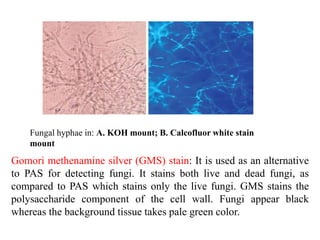
Calcofluor white stain: It is more sensitive than other stains;
binds to cellulose and chitin of fungal cell wall and fluoresce under
UV light.
Histopathological stains: They are useful for demonstrating fungal
elements from biopsy tissues. This is useful for detecting invasive
fungal infection„
.
•Periodic acid schiff (PAS) stain: It is the recommended stain for
detecting fungi. PAS positive fungi appear magenta/deep pink,
whereas the nuclei stain blue
„
Fungal hyphae in: A. KOH mount; B. Calcofluor white stain
mount
Gomori methenamine silver (GMS) stain: It is used as an alternative
to PAS for detecting fungi. It stains both live and dead fungi, as
compared to PAS which stains only the live fungi. GMS stains the
polysaccharide component of the cell wall. Fungi appear black
whereas the background tissue takes pale green color.
Lactophenol cotton blue (LPCB): It is used to study the
microscopic appearance of the fungal isolates grown in culture. It
contains:
•„
Phenol acts as disinfectant
•„
Lactic acid preserves the morphology of fungi
•„
Glycerol prevents drying
•„
Cotton blue stains the fungal elements blue.
Culture
Fungal culture is frequently performed for isolation and correct
identification of the fungi.
Culture Media
•™
Sabouraud’s dextrose agar (SDA): It is the most commonly used
medium in diagnostic mycology. It contains peptone (1%), dextrose (4%)
and has a pH of 5.6. This may not support some pathogenic fungi
•™
Neutral SDA (Emmons’ modification): It differs from original SDA in
having neopeptone (1%) and dextrose (2%) and pH of 7.2
•™
Corn meal agar and rice starch agar: They are the nutritionally
deficient media used for stimulation of chlamydospore production
•™
Brain heart infusion (BHI) agar and blood agar: They are the enriched
media, used for growing fastidious fungi like Cryptococcus and
Histoplasma.
•™
Niger seed agar and bird seed agar: They are used for the selective
growth of Cryptococcus
•™
CHROMagar Candida medium: It is used as a selective as well as a
differential medium for speciation of Candida.
Culture Condition
™
Temperature: Most of the fungi grow well at 25–30°C
except the dimorphic fungi that grow at both 25°C and
37°C.
™
BOD incubators (biological oxygen demand): It is a
special incubator used in diagnostic mycology, which is
capable of maintaining low temperature.
™
Incubation time: Culture plates should be incubated
for 2–3 weeks.
Antibiotics such as cycloheximide (actidione),
chloramphenicol and gentamicin can be added to the
culture media to inhibit bacterial growth.
Culture Identification
The correct identification of the fungus is based on the macroscopic
appearance of the colonies grown on culture and microscopic
appearance (LPCB mount of colonies).
Macroscopic Appearance of the Colony
™
. Rate of growth: Rapid growth (<5 days): It is seen in saprophytes,
yeasts and agents of opportunistic mycoses
„
. Slow growth (1–4 weeks): It is observed in dermatophytes, agents
of subcutaneous and systemic mycoses.
™
. Pigmentation: It can be seen on the reverse side of the culture
media
™
. Texture: It refers to how the colony would have felt if allowed
to touch. It may be of various types such as— glabrous
(waxy/leathery), velvety, yeast-like, cottony or granular/powdery
™
. Colony topography: Colony surface may be rugose (radial
grooves), folded, verrucose or cerebriform (brainlike).
Microscopic Appearance of Fungi
Teased mount
Slide culture
Cellophane tape mount
Other Methods of Identification
™
. For Candida: Germ tube test, Dalmau plate culture,
carbohydrate fermentation and carbohydrate assimilation tests are
done.
™
. For dermatophytes: Hair perforation test, dermatophyte test
medium and dermatophyte identification medium are used.
Urease test can be done for the fungi that produce urease enzyme,
e.g. Cryptococcus.
Immunological Methods
These tests are available to detect the antibody or antigen from serum
and/or other body fluids.
•™
. Antibody detection can be done by ELISA, immunodiffusion
test, agglutination test, and complement fixation test (CFT)
•™
. Antigen detection: Various fungal antigens can be detected in
clinical specimens such as blood, CSF, urine, etc.
•„
. Cryptococcal capsular antigen from CSF by Latex agglutination
test„
. Detection of Aspergillus specific galactomannan antigen in
patient’s sera or urine (by ELISA)
•„
. β-d-Glucan assay, detecting β-d-Glucan antigen in blood by
ELISA: It is a marker of invasive fungal infections, raised in all
invasive fungal infections, except for zygomycosis, blastomycosis
and cryptococcosis.
•™
. Immunohistochemistry: It refers to detecting antigens (e.g.
proteins) on the cells of a tissue section by using fluorescent tagged
antibodies that bind specifically to the antigens. It is useful in deep
mycoses.
Automations
Automated identification system such as MALDI-TOF and VITEK
are revolutionary in accurate identification of yeasts and to some
extent molds.
Molecular Methods
Polymerase chain reaction (PCR) and its modifications such as
multiplex PCR, nested PCR and the most advanced real time PCR
and DNA sequencing methods have been developed for accurate
identification of fungi from culture as well as from the specimens.
FUNGAL INFECTIONS
Only few are medically important. Fungal infections (or mycoses) can
be categorized into the following clinical types
Superficial mycoses
Superficial mycoses are fungal infections restricted to the stratum
corneum and to the hair shafts, with no penetration in the
epidermis
Superficial mycoses are the fungal infections involving the skin, hair,
nail and mucosa. Examples include:
•™
Tinea versicolor: It is caused by lipophilic fungus Malassezia
furfur, which is characterized by flat-round scaly hypopigmented to
hyperpigmented patches of skin.
•™
Tinea nigra: It is characterized by painless, black, nonscaly
patches present on palm and sole; caused by a black-colored yeast
like fungus Hortaea werneckii.
•™
Piedra: It is characterized by nodule formation on the hair shaft,
which may be either black in color (caused by Trichosporon beigelii)
or white in color (caused by Piedraia hortae)
Tinea versicolor Tinea nigra
Piedra
Dermatophytoses (or tinea or ringworm): It is the most
common superficial mycoses affecting skin, hair and nail; caused
by a group of related fungi (called dermatophytes) that are capable
of infecting keratinized tissues; producing annular pruritic scaly
lesions. These include:
•„
. Trichophyton species: Infect skin, hair and nail
•„
. Microsporum species: Infect skin and hair
•„
. Epidermophyton species: Infect skin and nail.
Subcutaneous mycoses
Subcutaneous mycoses are the mycotic infections of the skin,
subcutaneous tissue and sometimes bone, resulting from
inoculation of saprophytic fungi of soil or decaying matter. They
are mainly confined to the tropics and subtropics. Examples
include:
™
Mycetoma: Mycetoma, also known as Maduramycosis or
Madura foot is a chronic, slowly progressive granulomatous
infection of the skin and subcutaneous tissues; clinically
manifested as a triad of swelling, discharging sinuses and presence
of granules in the discharge. Mycetoma is of two types:
•„
Eumycetoma—caused by fungal agents such as Madurella
mycetomatis
•„
Actinomycetoma—caused by bacterial agents such as Nocardia.
•Sporotrichosis also known as Rose Gardner’s disease is caused
by a thermally dimorphic fungus, Sporothrix schenckii. It presents
as subcutaneous noduloulcerative lesions
•™
Chromoblastomycosis: It refers to slow growing chronic
subcutaneous lesions caused by group of dematiaceous or phaeoid
fungi (i.e. darkly pigmented fungi) that produce a characteristic
morphology called sclerotic body. Agents include: Fonsecaea,
Phialophora, Cladosporium and Rhinocladiella
•™
Phaeohyphomycosis: Chronic subcutaneous lesions; caused by
dematiaceous fungi such as Alternaria, Bipolaris, Curvularia,
Exophiala and Cladophialophora
•™
Rhinosporidiosis: It is caused by Rhinosporidium seeberi. It
produces large friable polyps in the nose (most common site),
conjunctiva and rarely in other sites.
Maduramycosis
Sporotrichosis
Chromoblastomycosis
Phaeohyphomycosis
Rhinosporidiosis
Systemic mycoses
Systemic mycoses is characterized by involvement of
multiple organs. Mostly they are caused by saprophytic
fungi, which spread by inhalation of spores leading to
pulmonary infection. From lungs, they disseminate to
cause various systemic manifestations. These agents are
thermally dimorphic, include—Histoplasma,
Blastomyces, Coccidioides and Paracoccidioides
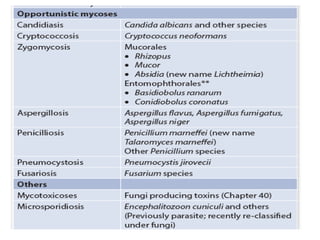
Opportunistic Mycoses
They are caused by the fungi that are normally found as human
commensals or environmental contaminants; but can act as human
pathogens in presence of opportunities such as low immunity.
Various opportunistic mycoses are as follows:
Candidiasis: Candidiasis is the most common fungal disease in
humans, affecting the skin, mucosa, and various internal organs;
caused by Candida, a yeast like fungus that produces
pseudohyphae„
. Various species include Candida albicans, C.
tropicalis, C. parapsilosis, etc.
„
. Candidiasis is common in presence of various predisposing
factors such as patients on steroid or immunosuppressive drugs,
post-transplantation, malignancy, HIV infection
Cryptococcosis: It is caused by a capsulated yeast called
Cryptococcus neoformans, which is capable of producing
potentially fatal meningitis in HIV infected people. Negative
staining (e.g. modified India ink stain) of CSF specimen is usually
performed to demonstrate the capsule, which appears as refractile
delineated clear space surrounding the round budding yeast cells
against the black background.
™
. Zygomycosis: It represents group of life threatening infections
caused by aseptate fungi; belongs to the phylum Zygomycota.
They include Rhizopus, Mucor, Rhizomucor, Lichtheimia, etc.
Mycology.pptx
Mycology.pptx

Mycology.pptx

  • 1.
    MYCOLOGY Medical mycology isthe branch of medical science that deals with the study of medically important fungi. The name ‘fungus’ is derived from Greek ‘mykes’ meaning mushroom (a type of edible fungus). Fungi differ from bacteria and other eukaryotes in many ways. ™ .Fungi are eukaryotic and they possess all the eukaryotic cell organelles such as mitochondria ™ .They possess a rigid cell wall, composed of chitin, β-glucans and other polysaccharides ™ . Fungal cell membrane contains ergosterol instead of cholesterol ™ . Fungi may be unicellular or multicellular ™ .They lack chlorophyll and divide by asexual and/or sexual means by producing spores.
  • 2.
    CLASSIFICATION OF FUNGI MorphologicalClassification Based on the morphological appearance, there are four main groups of fungi given as follows Yeast: They grow as round to oval cells that reproduce by an asexual process called budding in which cells form protuberances which enlarge and eventually separate from the parent cells. Examples include: „ . Cryptococcus neoformans (pathogenic) „ . Saccharomyces cerevisiae (non-pathogenic). Yeast-like: In some yeasts (e.g. Candida), the bud remains attached to the mother cell, elongates and undergoes repeated budding to form chains of elongated cells known as pseudohyphae. They can be differentiated from true hyphae as they have constrictions at the septa
  • 3.
    Molds: They growas long branching filaments of 2–10 μm width called hyphae •„ Hyphae are either septate (i.e. form transverse walls) or nonseptate (there are no transverse walls and they are multinucleated, i.e. coenocytic) •Molds reproduce by formation of different types of sexual and asexual spores •„ Examples of true molds include—Dermatophytes, Aspergillus, Penicillium, Rhizopus, Mucor, etc. Dimorphic fungi: They exist as molds (hyphal form) in the environment at ambient temperature (25°C) and as yeasts in human tissues at body temperature (37°C). Several medically important fungi are thermally dimorphic such as:„ . Histoplasma capsulatum, Blastomyces dermatitidis, Coccidioides immitis, Paracoccidioides brasiliensis, Penicillium marneffei, Sporothrix schenckii.
  • 5.
    Taxonomical Classification Based onthe production of sexual spores, the Kingdom Fungi has been divided into four medically important phyla. They are as follows: 1. Phylum zygomycota: They are lower fungi, produce sexual spores known as zygospores and possess aseptate hyphae, e.g. Rhizopus and Mucor 2. Phylum ascomycota: They produce sexual spores known as ascospores and possess septate hyphae, e.g. Aspergillus 3. Phylum basidiomycota: They produce sexual spores known as basidiospore e.g. Cryptococcus 4. Phylum deuteromycota (Fungi imperfecti): In majority of the medically important fungi, the sexual state is either absent or unidentified yet. Hence, they are traditionally grouped as fungi imperfecti.
  • 7.
    LABORATORY DIAGNOSIS OFFUNGAL DISEASES Specimen Collection It depends on the site of infection such as skin scraping, hair, nail, sputum, etc. For systemic mycoses, blood sample may also be collected. Cerebrospinal fluid (CSF) is collected for cryptococcal meningitis. Microscopy Fungal elements can be detected in the clinical specimens by direct microscopic examination of material from the lesion. Potassium hydroxide (KOH) preparation: Keratinized tissue specimens such as skin scrapings and plucked hair samples are treated with 10% KOH which digests the keratin material so that the fungal hyphae will be clearly seen under the microscope. Heat the slide gently over the flame and leave it aside for 5–10 minutes before examination
  • 8.
    About 10% isthe usual concentration of KOH used„ . About 20– 40% KOH is needed for the specimens such as nail that otherwise takes a longer time to dissolve. „ . Biopsy specimens as they take longer time to dissolve, are usually dissolved in 10% KOH in a test tube and examined after overnight incubation. „ . Glycerol (10%) can be added to prevent drying. DMSO (dimethyl sulfoxide) can be added to help in tissue digestion
  • 9.
    •Gram stain: Itis useful in identifying the yeasts (e.g. Cryptococcus) and yeast like fungi (e.g. Candida). They appear as gram-positive budding yeast cells. •™ India ink and nigrosin stains: They are used as negative stains for demonstration of capsule of Cryptococcus neoformans. •™ Calcofluor white stain: It is more sensitive than other stains; binds to cellulose and chitin of fungal cell wall and fluoresce under UV light. Histopathological stains: They are useful for demonstrating fungal elements from biopsy tissues. This is useful for detecting invasive fungal infection„ . •Periodic acid schiff (PAS) stain: It is the recommended stain for detecting fungi. PAS positive fungi appear magenta/deep pink, whereas the nuclei stain blue „
  • 10.
    Fungal hyphae in:A. KOH mount; B. Calcofluor white stain mount Gomori methenamine silver (GMS) stain: It is used as an alternative to PAS for detecting fungi. It stains both live and dead fungi, as compared to PAS which stains only the live fungi. GMS stains the polysaccharide component of the cell wall. Fungi appear black whereas the background tissue takes pale green color.
  • 11.
    Lactophenol cotton blue(LPCB): It is used to study the microscopic appearance of the fungal isolates grown in culture. It contains: •„ Phenol acts as disinfectant •„ Lactic acid preserves the morphology of fungi •„ Glycerol prevents drying •„ Cotton blue stains the fungal elements blue.
  • 12.
    Culture Fungal culture isfrequently performed for isolation and correct identification of the fungi. Culture Media •™ Sabouraud’s dextrose agar (SDA): It is the most commonly used medium in diagnostic mycology. It contains peptone (1%), dextrose (4%) and has a pH of 5.6. This may not support some pathogenic fungi •™ Neutral SDA (Emmons’ modification): It differs from original SDA in having neopeptone (1%) and dextrose (2%) and pH of 7.2 •™ Corn meal agar and rice starch agar: They are the nutritionally deficient media used for stimulation of chlamydospore production •™ Brain heart infusion (BHI) agar and blood agar: They are the enriched media, used for growing fastidious fungi like Cryptococcus and Histoplasma. •™ Niger seed agar and bird seed agar: They are used for the selective growth of Cryptococcus •™ CHROMagar Candida medium: It is used as a selective as well as a differential medium for speciation of Candida.
  • 13.
    Culture Condition ™ Temperature: Mostof the fungi grow well at 25–30°C except the dimorphic fungi that grow at both 25°C and 37°C. ™ BOD incubators (biological oxygen demand): It is a special incubator used in diagnostic mycology, which is capable of maintaining low temperature. ™ Incubation time: Culture plates should be incubated for 2–3 weeks. Antibiotics such as cycloheximide (actidione), chloramphenicol and gentamicin can be added to the culture media to inhibit bacterial growth.
  • 14.
    Culture Identification The correctidentification of the fungus is based on the macroscopic appearance of the colonies grown on culture and microscopic appearance (LPCB mount of colonies). Macroscopic Appearance of the Colony ™ . Rate of growth: Rapid growth (<5 days): It is seen in saprophytes, yeasts and agents of opportunistic mycoses „ . Slow growth (1–4 weeks): It is observed in dermatophytes, agents of subcutaneous and systemic mycoses. ™ . Pigmentation: It can be seen on the reverse side of the culture media ™ . Texture: It refers to how the colony would have felt if allowed to touch. It may be of various types such as— glabrous (waxy/leathery), velvety, yeast-like, cottony or granular/powdery ™ . Colony topography: Colony surface may be rugose (radial grooves), folded, verrucose or cerebriform (brainlike).
  • 15.
    Microscopic Appearance ofFungi Teased mount Slide culture Cellophane tape mount Other Methods of Identification ™ . For Candida: Germ tube test, Dalmau plate culture, carbohydrate fermentation and carbohydrate assimilation tests are done. ™ . For dermatophytes: Hair perforation test, dermatophyte test medium and dermatophyte identification medium are used. Urease test can be done for the fungi that produce urease enzyme, e.g. Cryptococcus.
  • 16.
    Immunological Methods These testsare available to detect the antibody or antigen from serum and/or other body fluids. •™ . Antibody detection can be done by ELISA, immunodiffusion test, agglutination test, and complement fixation test (CFT) •™ . Antigen detection: Various fungal antigens can be detected in clinical specimens such as blood, CSF, urine, etc. •„ . Cryptococcal capsular antigen from CSF by Latex agglutination test„ . Detection of Aspergillus specific galactomannan antigen in patient’s sera or urine (by ELISA) •„ . β-d-Glucan assay, detecting β-d-Glucan antigen in blood by ELISA: It is a marker of invasive fungal infections, raised in all invasive fungal infections, except for zygomycosis, blastomycosis and cryptococcosis. •™ . Immunohistochemistry: It refers to detecting antigens (e.g. proteins) on the cells of a tissue section by using fluorescent tagged antibodies that bind specifically to the antigens. It is useful in deep mycoses.
  • 17.
    Automations Automated identification systemsuch as MALDI-TOF and VITEK are revolutionary in accurate identification of yeasts and to some extent molds. Molecular Methods Polymerase chain reaction (PCR) and its modifications such as multiplex PCR, nested PCR and the most advanced real time PCR and DNA sequencing methods have been developed for accurate identification of fungi from culture as well as from the specimens.
  • 18.
    FUNGAL INFECTIONS Only feware medically important. Fungal infections (or mycoses) can be categorized into the following clinical types Superficial mycoses Superficial mycoses are fungal infections restricted to the stratum corneum and to the hair shafts, with no penetration in the epidermis Superficial mycoses are the fungal infections involving the skin, hair, nail and mucosa. Examples include: •™ Tinea versicolor: It is caused by lipophilic fungus Malassezia furfur, which is characterized by flat-round scaly hypopigmented to hyperpigmented patches of skin. •™ Tinea nigra: It is characterized by painless, black, nonscaly patches present on palm and sole; caused by a black-colored yeast like fungus Hortaea werneckii. •™ Piedra: It is characterized by nodule formation on the hair shaft, which may be either black in color (caused by Trichosporon beigelii) or white in color (caused by Piedraia hortae)
  • 19.
  • 20.
    Dermatophytoses (or tineaor ringworm): It is the most common superficial mycoses affecting skin, hair and nail; caused by a group of related fungi (called dermatophytes) that are capable of infecting keratinized tissues; producing annular pruritic scaly lesions. These include: •„ . Trichophyton species: Infect skin, hair and nail •„ . Microsporum species: Infect skin and hair •„ . Epidermophyton species: Infect skin and nail.
  • 21.
    Subcutaneous mycoses Subcutaneous mycosesare the mycotic infections of the skin, subcutaneous tissue and sometimes bone, resulting from inoculation of saprophytic fungi of soil or decaying matter. They are mainly confined to the tropics and subtropics. Examples include: ™ Mycetoma: Mycetoma, also known as Maduramycosis or Madura foot is a chronic, slowly progressive granulomatous infection of the skin and subcutaneous tissues; clinically manifested as a triad of swelling, discharging sinuses and presence of granules in the discharge. Mycetoma is of two types: •„ Eumycetoma—caused by fungal agents such as Madurella mycetomatis •„ Actinomycetoma—caused by bacterial agents such as Nocardia.
  • 22.
    •Sporotrichosis also knownas Rose Gardner’s disease is caused by a thermally dimorphic fungus, Sporothrix schenckii. It presents as subcutaneous noduloulcerative lesions •™ Chromoblastomycosis: It refers to slow growing chronic subcutaneous lesions caused by group of dematiaceous or phaeoid fungi (i.e. darkly pigmented fungi) that produce a characteristic morphology called sclerotic body. Agents include: Fonsecaea, Phialophora, Cladosporium and Rhinocladiella •™ Phaeohyphomycosis: Chronic subcutaneous lesions; caused by dematiaceous fungi such as Alternaria, Bipolaris, Curvularia, Exophiala and Cladophialophora •™ Rhinosporidiosis: It is caused by Rhinosporidium seeberi. It produces large friable polyps in the nose (most common site), conjunctiva and rarely in other sites.
  • 23.
  • 24.
    Systemic mycoses Systemic mycosesis characterized by involvement of multiple organs. Mostly they are caused by saprophytic fungi, which spread by inhalation of spores leading to pulmonary infection. From lungs, they disseminate to cause various systemic manifestations. These agents are thermally dimorphic, include—Histoplasma, Blastomyces, Coccidioides and Paracoccidioides
  • 25.
    Opportunistic Mycoses They arecaused by the fungi that are normally found as human commensals or environmental contaminants; but can act as human pathogens in presence of opportunities such as low immunity. Various opportunistic mycoses are as follows: Candidiasis: Candidiasis is the most common fungal disease in humans, affecting the skin, mucosa, and various internal organs; caused by Candida, a yeast like fungus that produces pseudohyphae„ . Various species include Candida albicans, C. tropicalis, C. parapsilosis, etc. „ . Candidiasis is common in presence of various predisposing factors such as patients on steroid or immunosuppressive drugs, post-transplantation, malignancy, HIV infection
  • 26.
    Cryptococcosis: It iscaused by a capsulated yeast called Cryptococcus neoformans, which is capable of producing potentially fatal meningitis in HIV infected people. Negative staining (e.g. modified India ink stain) of CSF specimen is usually performed to demonstrate the capsule, which appears as refractile delineated clear space surrounding the round budding yeast cells against the black background. ™ . Zygomycosis: It represents group of life threatening infections caused by aseptate fungi; belongs to the phylum Zygomycota. They include Rhizopus, Mucor, Rhizomucor, Lichtheimia, etc.