Medical Mycology
Overview
• Structure of fungus
• Classification of fungus
• Lab diagnosis of fungal infection
• Summary
Why should we study mycology
• Development of antifungal drugs
• Antifungal susceptibility testing : effective treatment
• Resistance to antifungal drugs
• Emerging new fungal infections : change in host/virulence factor
Properties and structure of fungus
• Ubiquitous
• Eukaryotes
• Rigid cell wall : chitinous, mannans and other polysaccharides
• Plasma mb : sterols(ergosterol, zymosterol)
• Hetrotrophic Saprophytes
Classification of fungi
• Based upon morphology
• Based upon spores
• Based upon vegetative state
• Based upon location
B/o morphology
Yeast Yeast-like Moulds Dimorphic
Complete
budding
• Cryptococcus
• Saccharomyces
cerevicae
Incomplete
budding
Pseudohyphae
• Candida
• Trichosporon
True hyphae
Septate Aseptate
Mycelium
Vegetative Aerial
On culture Above culture
Thermal dimorphism
Mould @ 25C
Yeast @ 37C
• Blastomyces
• Histoplasma
• Paracoccidioides
• Coccidioides
• Sporothrix
Mnemonic: Body
Heat Probably
Changes Shape
B/o spores
Sexual spores Asexual spores
• Zygospores
• Ascospores
• Basidiospores
Zygomycetes : Rhizopus
Ascomycetes : Aspergillus
Basidiomycetes : Cryptococcus
Arthrospores Coccidioides
Blastospores Candida
Chlamydospores Candida albicans
Macroconidia Dermatophytes
Microconidia Dermatophytes
Sporangiospores Zygomycetes
Conidiospores Asperigillus
Vegetative spores
Aerial spores
B/o vegetative state
Spiral Pectinate
Nodular
Favic
Chandelie
r
Racque
t
Tichophyton spp. Micosporon spp. Epidermaphyton
B/o location
Superficial
Subcutaneous
Systemic
Opportunistic
• Tinea vesicolor
• Dermatophytosis
• Piedra
• Mycetoma
• Rhinosporidiosis
• Chromoblastomycosi
s
• Sporotrichosis
• Blastomycosis
• Histoplasmosis
• Paracoccidioidomycosis
• Coccidioidomycosis
• Candidiasis
• Cryptococcosis
• Aspergillosis
• Pneumocystosis
• Tinea nigra
Lab Diagnosis of Mycoses
2. Direct examination : microscopy and fungal stains
1. Sample collection and transport
3. Fungus Culture and identification
4. Serological tests
5. Skin test
6. Molecular tests
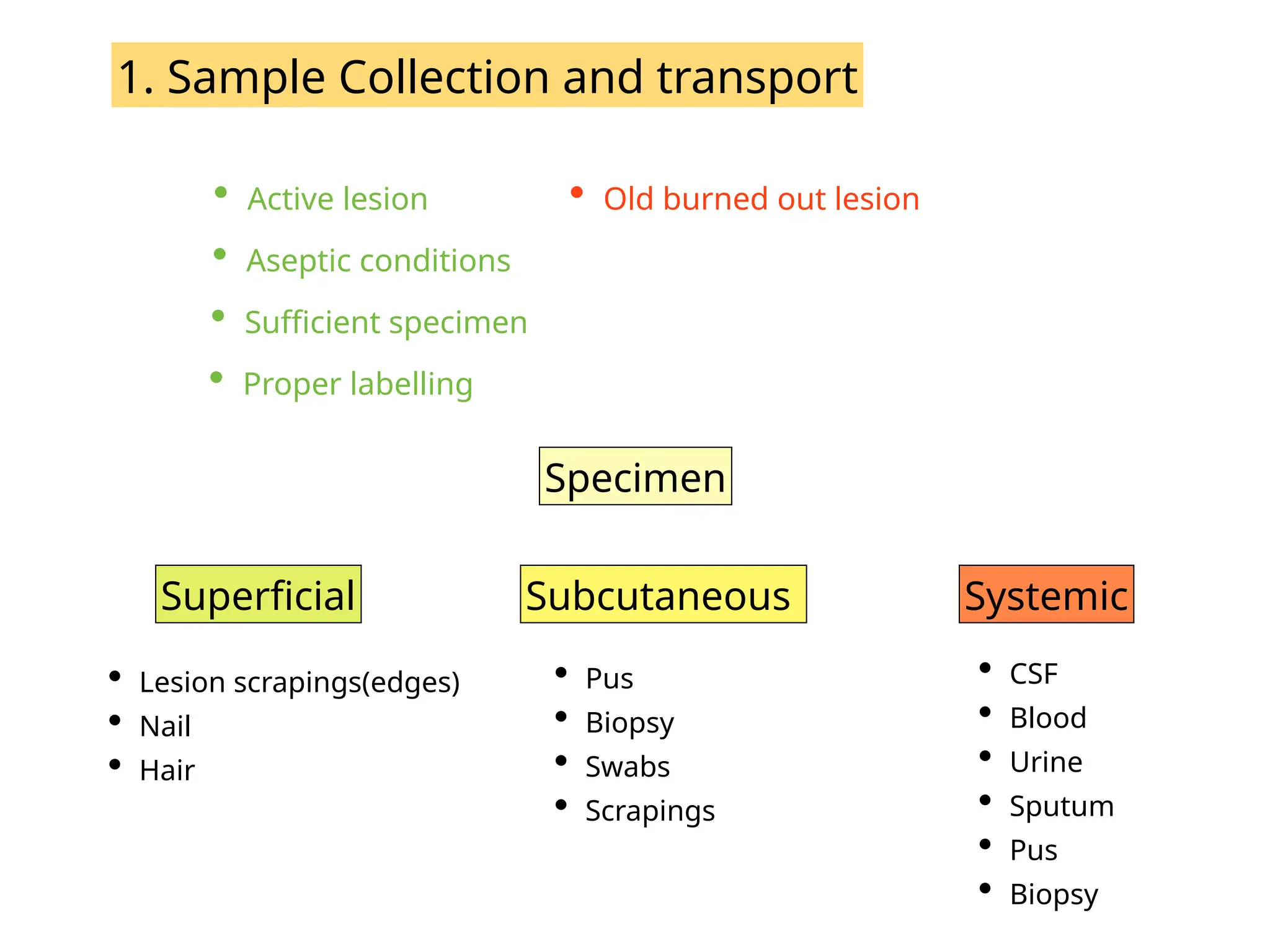
1. Sample Collection and transport
• Active lesion
• Aseptic conditions
• Sufficient specimen
• Proper labelling
• Old burned out lesion
Specimen
Superficial Subcutaneous Systemic
• Lesion scrapings(edges)
• Nail
• Hair
• Pus
• Biopsy
• Swabs
• Scrapings
• CSF
• Blood
• Urine
• Sputum
• Pus
• Biopsy
Skin scrapings for fungal identification
2. Microscopy
Wet mounts Differential stains
(Direct examination)
• KOH mount
• Lactophenol cotton blue(LPCB)
• Calcoflour white stain
• India ink stain
• Neutral red stain
• Gram stain
• H&E stain
• Giemsa stain
• PAS stain
• Gomori Methenamine
Silver(GMS) stain
• Acridine orange
• Mayer’s mucicarmine
KOH Mount LPCB
• KOH dissolves keratin
• 10% : Skin scrapings
• 20-40% :Nails and hairs
• Glycerol 10% prevents dessication
• DMSO : digests tissue
• For fungal isolates from culture
• Lactic acid : preserves morphology
• Phenol : disinfectant
• Cotton blue : stains fungus
• Glycerol prevents dessication
Calcoflour white stain India ink stain
• Binds to chitin fungal cell wall
• Fluorescent under UV light
• Negative staining
• Refractile capsule over dark backround
• Cryptococcus neoformans
Gram Stain H&E stain
• Gram positive fungi
• For yeast and yeast-like fungi
• Hematoxylin stains the hyphae
• Eosin background
GMS stain PAS Stain
• Stains both live and dead fungi
• Fungi stain black
• Background stains pale green
• Stains only live fungi
• Fungi stain magenta/deep pink
• Nuclei stain blue
3. Fungus culture
A. Basal media
B. Nutrients deficient media
C. Enriched and selective media
D. Differential media
• SDA(Sabouraud’s Dextrose Agar)
• Neutral SDA
• SDA + Antibiotics
• DTM(Dermatophyte Test Media)
• Corn meal agar
• Rice starch agar
• Brain heart infusion/blood agar
• Bird seed agar/Niger seed agar
• CHROMagar
A. Basal media
Obverse
Reverse
Colony morphology
Pigmentation
SDA : 1% peptone + 4% dextrose
pH = 5.6(inhibits bacteria)
SDA +
Chloramphenicol/Gentamycin
: inhibits bacteria
SDA +
Actidione(Cycloheximide) :
inhibits saprophytic fungi
Neutral SDA : pH= 7.2
1% Neopeptone + 2% Dextrose
Emmon’s modification
A. Basal media
DTM : SDA + Phenol red(indicator)
Uninoculated
Inoculated by
dermatophyte
(Orange) (Red)
Alkaline by products
B. Nutrients deficient media
Corn meal agar
Deficient in nutrition
Unfavourable conditions
Spore production
Chlamydospores
Anaerobic
Dalmau plate culture
C. Enriched and selective media
Bird seed agar/Niger seed agar Blood Agar
D. Differential media
CHROMagar Speciation of candida
Culture conditions
Temperature Incubation time Antibiotics
25 to 30C
Dimorphic : both 25 and
37C
2-3 weeks
24-72 hrs :
Candida&Aspergillu
s
Chloramphenical/Gentamycin
Actidione(cycloheximide)
Culture identification
Macroscopic Microscopic
1. Rate of growth
2. Colony colour
3. Pigmentation
4. Texture
5. Topography
1. Teased mount
2. Slide culture
3. Cellophane tape mount
Rapid(<5days)
Yeast, opportunistic
Slow(1-4wks)
Systemic, SubQ
On obverse side
On reverse side
Aspergillus niger Black Powdery
Aspergillus flavus Yellow green powdery
Aspergillus
fumigatus
Blue-green powdery
Teased mount
LPCB mount on slide
Observed for
hyphae and spores
Slide culture
Cellophane
tape mount
Preserves the ‘in situ’
morphology of fungal
colony
LPCB on petri dish
Take impression of
colony and LPCB
4. Serology
Antibody
detectio
n
Antigen
detectio
n
Immunohistochemistry
• Elisa
• Immunodiffusion
• Agglutination reaction
• Complement fixation
• Cryptoccocal
capsule antigen by
latex agglutination
• Galactomannan
antigen for
Aspergillus
• Beta-d-glucan
antigen for
invasive fungi
For deep mycoses
5. Skin test
Demonstrate delayed hypersensitivity
Histoplasma, Blastomyces, Coccidioides
6. Molecular tests
• PCR; multiplex PCR, Nested PCR
• Rt PCR
• DNA sequencing
Summary
• Fungal structure
• Various classifications of fungi
• Various diagnostic methods of mycoses
Viva Voce
1. Common stain for fungus isolates from culture
2. Role of Actidione added to SDA
3. Which culture methods preserves the ‘in situ’
morphology of fungal colony
4. What are some fungal biomarkers which can be
detected in patients serum
5. All are dimorphic fungi except :
a. Histoplasma
b. Sporothrix
c. Trichosporon
d. Coccidioides
Medical Mycology for 2nd year MBBS Microbiology

Medical Mycology for 2nd year MBBS Microbiology

  • 1.
  • 2.
    Overview • Structure offungus • Classification of fungus • Lab diagnosis of fungal infection • Summary
  • 3.
    Why should westudy mycology • Development of antifungal drugs • Antifungal susceptibility testing : effective treatment • Resistance to antifungal drugs • Emerging new fungal infections : change in host/virulence factor
  • 4.
    Properties and structureof fungus • Ubiquitous • Eukaryotes • Rigid cell wall : chitinous, mannans and other polysaccharides • Plasma mb : sterols(ergosterol, zymosterol) • Hetrotrophic Saprophytes
  • 5.
    Classification of fungi •Based upon morphology • Based upon spores • Based upon vegetative state • Based upon location
  • 6.
    B/o morphology Yeast Yeast-likeMoulds Dimorphic Complete budding • Cryptococcus • Saccharomyces cerevicae Incomplete budding Pseudohyphae • Candida • Trichosporon True hyphae Septate Aseptate Mycelium Vegetative Aerial On culture Above culture Thermal dimorphism Mould @ 25C Yeast @ 37C • Blastomyces • Histoplasma • Paracoccidioides • Coccidioides • Sporothrix Mnemonic: Body Heat Probably Changes Shape
  • 7.
    B/o spores Sexual sporesAsexual spores • Zygospores • Ascospores • Basidiospores Zygomycetes : Rhizopus Ascomycetes : Aspergillus Basidiomycetes : Cryptococcus Arthrospores Coccidioides Blastospores Candida Chlamydospores Candida albicans Macroconidia Dermatophytes Microconidia Dermatophytes Sporangiospores Zygomycetes Conidiospores Asperigillus Vegetative spores Aerial spores
  • 8.
    B/o vegetative state SpiralPectinate Nodular Favic Chandelie r Racque t Tichophyton spp. Micosporon spp. Epidermaphyton
  • 9.
    B/o location Superficial Subcutaneous Systemic Opportunistic • Tineavesicolor • Dermatophytosis • Piedra • Mycetoma • Rhinosporidiosis • Chromoblastomycosi s • Sporotrichosis • Blastomycosis • Histoplasmosis • Paracoccidioidomycosis • Coccidioidomycosis • Candidiasis • Cryptococcosis • Aspergillosis • Pneumocystosis • Tinea nigra
  • 10.
  • 11.
    2. Direct examination: microscopy and fungal stains 1. Sample collection and transport 3. Fungus Culture and identification 4. Serological tests 5. Skin test 6. Molecular tests
  • 12.
    1. Sample Collectionand transport • Active lesion • Aseptic conditions • Sufficient specimen • Proper labelling • Old burned out lesion Specimen Superficial Subcutaneous Systemic • Lesion scrapings(edges) • Nail • Hair • Pus • Biopsy • Swabs • Scrapings • CSF • Blood • Urine • Sputum • Pus • Biopsy
  • 13.
    Skin scrapings forfungal identification
  • 14.
    2. Microscopy Wet mountsDifferential stains (Direct examination) • KOH mount • Lactophenol cotton blue(LPCB) • Calcoflour white stain • India ink stain • Neutral red stain • Gram stain • H&E stain • Giemsa stain • PAS stain • Gomori Methenamine Silver(GMS) stain • Acridine orange • Mayer’s mucicarmine
  • 15.
    KOH Mount LPCB •KOH dissolves keratin • 10% : Skin scrapings • 20-40% :Nails and hairs • Glycerol 10% prevents dessication • DMSO : digests tissue • For fungal isolates from culture • Lactic acid : preserves morphology • Phenol : disinfectant • Cotton blue : stains fungus • Glycerol prevents dessication
  • 16.
    Calcoflour white stainIndia ink stain • Binds to chitin fungal cell wall • Fluorescent under UV light • Negative staining • Refractile capsule over dark backround • Cryptococcus neoformans
  • 17.
    Gram Stain H&Estain • Gram positive fungi • For yeast and yeast-like fungi • Hematoxylin stains the hyphae • Eosin background
  • 18.
    GMS stain PASStain • Stains both live and dead fungi • Fungi stain black • Background stains pale green • Stains only live fungi • Fungi stain magenta/deep pink • Nuclei stain blue
  • 19.
    3. Fungus culture A.Basal media B. Nutrients deficient media C. Enriched and selective media D. Differential media • SDA(Sabouraud’s Dextrose Agar) • Neutral SDA • SDA + Antibiotics • DTM(Dermatophyte Test Media) • Corn meal agar • Rice starch agar • Brain heart infusion/blood agar • Bird seed agar/Niger seed agar • CHROMagar
  • 20.
    A. Basal media Obverse Reverse Colonymorphology Pigmentation SDA : 1% peptone + 4% dextrose pH = 5.6(inhibits bacteria) SDA + Chloramphenicol/Gentamycin : inhibits bacteria SDA + Actidione(Cycloheximide) : inhibits saprophytic fungi Neutral SDA : pH= 7.2 1% Neopeptone + 2% Dextrose Emmon’s modification
  • 21.
    A. Basal media DTM: SDA + Phenol red(indicator) Uninoculated Inoculated by dermatophyte (Orange) (Red) Alkaline by products
  • 22.
    B. Nutrients deficientmedia Corn meal agar Deficient in nutrition Unfavourable conditions Spore production Chlamydospores Anaerobic Dalmau plate culture
  • 23.
    C. Enriched andselective media Bird seed agar/Niger seed agar Blood Agar
  • 24.
    D. Differential media CHROMagarSpeciation of candida
  • 25.
    Culture conditions Temperature Incubationtime Antibiotics 25 to 30C Dimorphic : both 25 and 37C 2-3 weeks 24-72 hrs : Candida&Aspergillu s Chloramphenical/Gentamycin Actidione(cycloheximide)
  • 26.
    Culture identification Macroscopic Microscopic 1.Rate of growth 2. Colony colour 3. Pigmentation 4. Texture 5. Topography 1. Teased mount 2. Slide culture 3. Cellophane tape mount Rapid(<5days) Yeast, opportunistic Slow(1-4wks) Systemic, SubQ On obverse side On reverse side Aspergillus niger Black Powdery Aspergillus flavus Yellow green powdery Aspergillus fumigatus Blue-green powdery
  • 27.
    Teased mount LPCB mounton slide Observed for hyphae and spores Slide culture Cellophane tape mount Preserves the ‘in situ’ morphology of fungal colony LPCB on petri dish Take impression of colony and LPCB
  • 28.
    4. Serology Antibody detectio n Antigen detectio n Immunohistochemistry • Elisa •Immunodiffusion • Agglutination reaction • Complement fixation • Cryptoccocal capsule antigen by latex agglutination • Galactomannan antigen for Aspergillus • Beta-d-glucan antigen for invasive fungi For deep mycoses
  • 29.
    5. Skin test Demonstratedelayed hypersensitivity Histoplasma, Blastomyces, Coccidioides
  • 30.
    6. Molecular tests •PCR; multiplex PCR, Nested PCR • Rt PCR • DNA sequencing
  • 31.
    Summary • Fungal structure •Various classifications of fungi • Various diagnostic methods of mycoses
  • 32.
    Viva Voce 1. Commonstain for fungus isolates from culture 2. Role of Actidione added to SDA 3. Which culture methods preserves the ‘in situ’ morphology of fungal colony 4. What are some fungal biomarkers which can be detected in patients serum 5. All are dimorphic fungi except : a. Histoplasma b. Sporothrix c. Trichosporon d. Coccidioides