1
DEPARTMENT OF MECHANICAL ENGINEERING
DILI INSTITUTE OF TECHNOLOGY – TIMOR LESTE
RESEARCH
The Effect of Temperature Induction Surface
Hardening To the Distortion of Gear
NATALINO FONSECA D. S. GUTERRES
2
CONCLUSION
REFERENC
ES
INTRODUCTION
EXPERIMENT
AL METHODS
RESULTS
AND
DISCUSSIONS
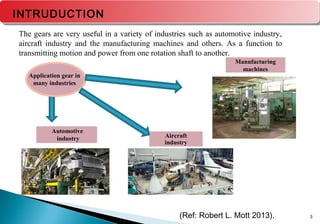
Aircraft
industry
Application gear in
many industries
3(Ref: Robert L. Mott 2013).
INTRUDUCTION
Automotive
industry
The gears are very useful in a variety of industries such as automotive industry,
aircraft industry and the manufacturing machines and others. As a function to
transmitting motion and power from one rotation shaft to another.
Manufacturing
machines
4
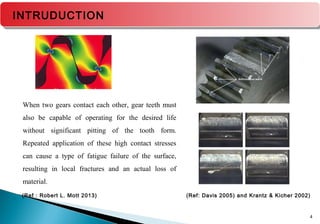
(Ref: Davis 2005) and Krantz & Kicher 2002)(Ref : Robert L. Mott 2013)
INTRUDUCTION
When two gears contact each other, gear teeth must
also be capable of operating for the desired life
without significant pitting of the tooth form.
Repeated application of these high contact stresses
can cause a type of fatigue failure of the surface,
resulting in local fractures and an actual loss of
material.
5
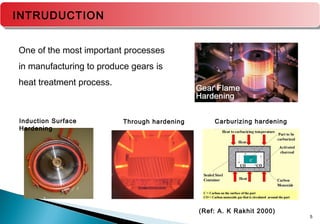
Induction Surface
Hardening
Through hardening
(Ref: A. K Rakhit 2000)
Carburizing hardening
One of the most important processes
in manufacturing to produce gears is
heat treatment process.
INTRUDUCTION
STUDI LITERATUR
6
(Rudnev, 2003)
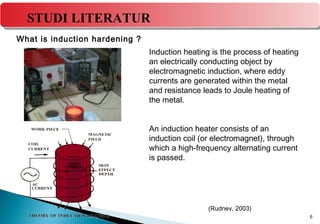
What is induction hardening ?
Induction heating is the process of heating
an electrically conducting object by
electromagnetic induction, where eddy
currents are generated within the metal
and resistance leads to Joule heating of
the metal.
An induction heater consists of an
induction coil (or electromagnet), through
which a high-frequency alternating current
is passed.
7
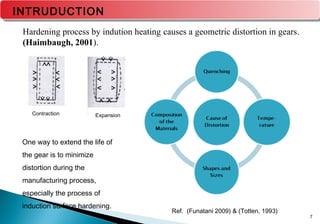
Hardening process by indution heating causes a geometric distortion in gears.
(Haimbaugh, 2001).
Ref. (Funatani 2009) & (Totten, 1993)
One way to extend the life of
the gear is to minimize
distortion during the
manufacturing process,
especially the process of
induction surface hardening.
INTRUDUCTION
ExpansionContraction
8
SPECIMENT GEARS
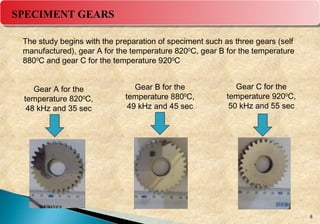
The study begins with the preparation of speciment such as three gears (self
manufactured), gear A for the temperature 8200
C, gear B for the temperature
8800
C and gear C for the temperature 9200
C
Gear A for the
temperature 8200
C,
48 kHz and 35 sec
Gear B for the
temperature 8800
C,
49 kHz and 45 sec
Gear C for the
temperature 9200
C,
50 kHz and 55 sec
9
INDUCTION HARDENING PROCESS
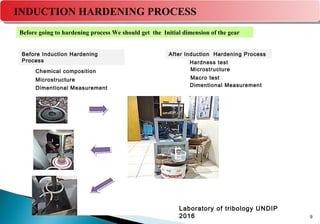
Before going to hardening process We should get the Initial dimension of the gear
Microstructure
Chemical composition
Hardness test
Dimentional Measurement
Before Induction Hardening
Process
After Induction Hardening Process
Dimentional Measurement
Macro test
Hardness test
Microstructure
Laboratory of tribology UNDIP
2016
10
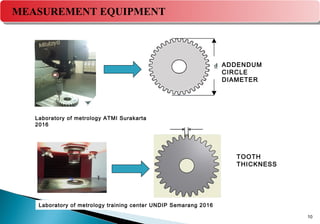
ADDENDUM
CIRCLE
DIAMETER
MEASUREMENT EQUIPMENT
TOOTH
THICKNESS
Laboratory of metrology ATMI Surakarta
2016
Laboratory of metrology training center UNDIP Semarang 2016
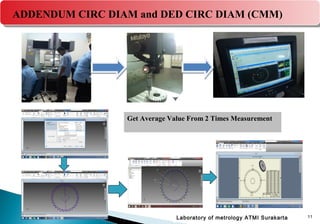
11
Get Average Value From 2 Times Measurement
ADDENDUM CIRC DIAM and DED CIRC DIAM (CMM)
Laboratory of metrology ATMI Surakarta
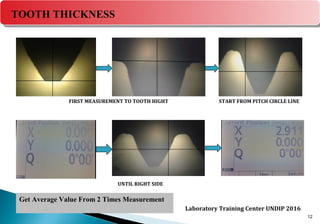
12
FIRST MEASUREMENT TO TOOTH HIGHT START FROM PITCH CIRCLE LINE
Laboratory Training Center UNDIP 2016
TOOTH THICKNESS
Get Average Value From 2 Times Measurement
UNTIL RIGHT SIDE
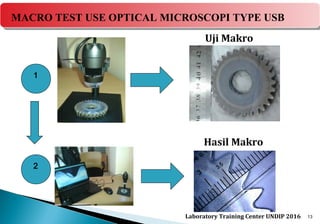
13
Uji Makro
Hasil Makro
1
2
MACRO TEST USE OPTICAL MICROSCOPI TYPE USB
Laboratory Training Center UNDIP 2016
14
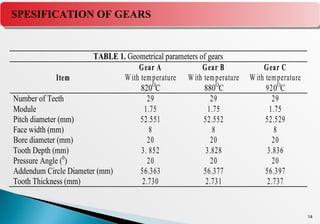
SPESIFICATION OF GEARS
TABLE 1. Geometrical parameters of gears
Item
Gear A
With temperature
820O
C
Gear B
With temperature
880O
C
Gear C
With temperature
920O
C
Number of Teeth 29 29 29
Module 1.75 1.75 1.75
Pitch diameter (mm) 52.551 52.552 52.529
Face width (mm) 8 8 8
Bore diameter (mm) 20 20 20
Tooth Depth (mm) 3. 852 3.828 3.836
Pressure Angle (0
) 20 20 20
Addendum Circle Diameter (mm) 56.363 56.377 56.397
Tooth Thickness (mm) 2.730 2.731 2.737
15
RESULTS
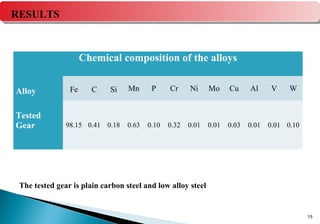
Chemical composition of the alloys
Alloy Fe C Si Mn P Cr Ni Mo Cu Al V W
Tested
Gear 98.15 0.41 0.18 0.63 0.10 0.32 0.01 0.01 0.03 0.01 0.01 0.10
The tested gear is plain carbon steel and low alloy steel
16
RESULTS
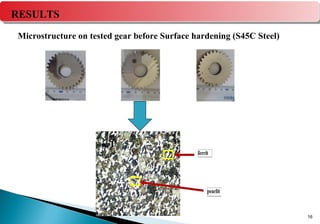
Microstructure on tested gear before Surface hardening (S45C Steel)
17
RESULTS
Tested
gear
Gear location to macro
analysis
Microstructure analysis Types of
phase
Case depth
(mm)
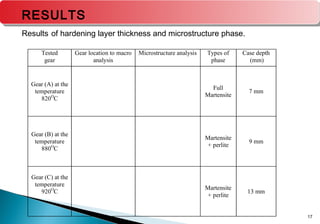
Gear (A) at the
temperature
820O
C
Full
Martensite
7 mm
Gear (B) at the
temperature
880O
C
Martensite
+ perlite
9 mm
Gear (C) at the
temperature
920O
C
Martensite
+ perlite
13 mm
Results of hardening layer thickness and microstructure phase.
RESULTS
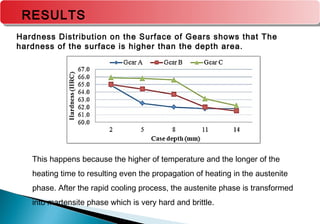
Hardness Distribution on the Surface of Gears shows that The
hardness of the surface is higher than the depth area.
This happens because the higher of temperature and the longer of the
heating time to resulting even the propagation of heating in the austenite
phase. After the rapid cooling process, the austenite phase is transformed
into martensite phase which is very hard and brittle.
RESULTS
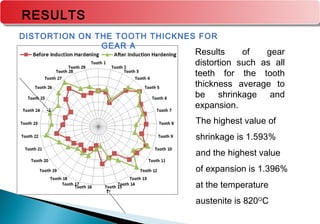
Results of gear
distortion such as all
teeth for the tooth
thickness average to
be shrinkage and
expansion.
The highest value of
shrinkage is 1.593%
and the highest value
of expansion is 1.396%
at the temperature
austenite is 820O
C
DISTORTION ON THE TOOTH THICKNES FOR
GEAR A
20
RESULTS
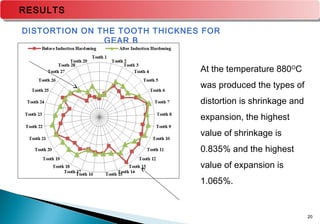
DISTORTION ON THE TOOTH THICKNES FOR
GEAR B
At the temperature 880O
C
was produced the types of
distortion is shrinkage and
expansion, the highest
value of shrinkage is
0.835% and the highest
value of expansion is
1.065%.
21
RESULTS
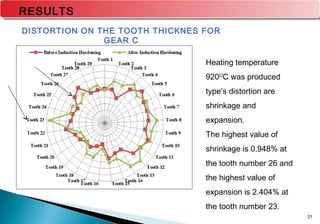
DISTORTION ON THE TOOTH THICKNES FOR
GEAR C
Heating temperature
920O
C was produced
type’s distortion are
shrinkage and
expansion.
The highest value of
shrinkage is 0.948% at
the tooth number 26 and
the highest value of
expansion is 2.404% at
the tooth number 23.
22
RESULTS
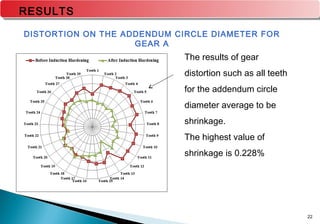
DISTORTION ON THE ADDENDUM CIRCLE DIAMETER FOR
GEAR A
The results of gear
distortion such as all teeth
for the addendum circle
diameter average to be
shrinkage.
The highest value of
shrinkage is 0.228%
23
RESULTS
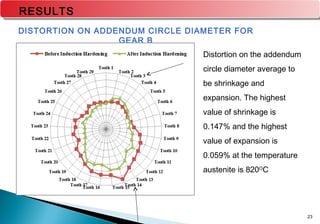
DISTORTION ON ADDENDUM CIRCLE DIAMETER FOR
GEAR B
Distortion on the addendum
circle diameter average to
be shrinkage and
expansion. The highest
value of shrinkage is
0.147% and the highest
value of expansion is
0.059% at the temperature
austenite is 820O
C
24
RESULTS
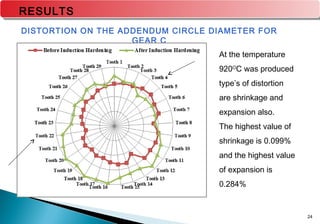
DISTORTION ON THE ADDENDUM CIRCLE DIAMETER FOR
GEAR C
At the temperature
920O
C was produced
type’s of distortion
are shrinkage and
expansion also.
The highest value of
shrinkage is 0.099%
and the highest value
of expansion is
0.284%
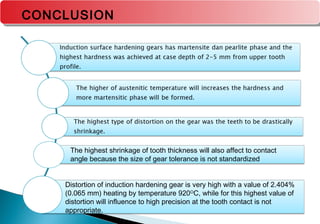
CONCLUSION
The highest shrinkage of tooth thickness will also affect to contact
angle because the size of gear tolerance is not standardized
Distortion of induction hardening gear is very high with a value of 2.404%
(0.065 mm) heating by temperature 920O
C, while for this highest value of
distortion will influence to high precision at the tooth contact is not
appropriate.
26
REFERENCE
1. Jozef Wojnarowski and Valentin Onishchenko (2003), “Tooth wear effects on
spur gear dynamics”. Pergamon; Mechanism and Machine Theory
38, 161–178.
2. Valentin Onishchenko (2015), “Investigation of tooth wears from scuffing of
heavy duty machine spur gears ” , Elsevier, Mechanism and Machine
Theory 83, 38–55.
3. A. Sugianto, M. Narazaki, M. Kogawara, S.Y. Kim, and S. Kubota, Distortion
Mechanism During Carburising-Quenching of SCr420H Helical Gear,
Proc. 16th IFHTSE Congress, Oct 30-Nov 1, 2007 (Brisbane), Materials
Australia, 2007, IFHTSE07-257.
4. A.K. Rakhit, Heat Treatment of Gears, ASM International, Materials Park, OH,
2000, p 91–100.
5. Coupard D, Palin-luc T, Bristiel P, Ji V, Dumas C. Residual stresses in surface
induction hardening of steels: Comparison between experiment and
simulation. Materials Science and Engineering A. 2008; 487:328-39.
6. Joseph E. Sighley, Standard handbook of machine design, Third edit., vol. 17,
no. 3. United States of America, 1996.
NATALINO

NATALINO

  • 1.
    1 DEPARTMENT OF MECHANICALENGINEERING DILI INSTITUTE OF TECHNOLOGY – TIMOR LESTE RESEARCH The Effect of Temperature Induction Surface Hardening To the Distortion of Gear NATALINO FONSECA D. S. GUTERRES
  • 2.
  • 3.
    Aircraft industry Application gear in manyindustries 3(Ref: Robert L. Mott 2013). INTRUDUCTION Automotive industry The gears are very useful in a variety of industries such as automotive industry, aircraft industry and the manufacturing machines and others. As a function to transmitting motion and power from one rotation shaft to another. Manufacturing machines
  • 4.
    4 (Ref: Davis 2005)and Krantz & Kicher 2002)(Ref : Robert L. Mott 2013) INTRUDUCTION When two gears contact each other, gear teeth must also be capable of operating for the desired life without significant pitting of the tooth form. Repeated application of these high contact stresses can cause a type of fatigue failure of the surface, resulting in local fractures and an actual loss of material.
  • 5.
    5 Induction Surface Hardening Through hardening (Ref:A. K Rakhit 2000) Carburizing hardening One of the most important processes in manufacturing to produce gears is heat treatment process. INTRUDUCTION
  • 6.
    STUDI LITERATUR 6 (Rudnev, 2003) Whatis induction hardening ? Induction heating is the process of heating an electrically conducting object by electromagnetic induction, where eddy currents are generated within the metal and resistance leads to Joule heating of the metal. An induction heater consists of an induction coil (or electromagnet), through which a high-frequency alternating current is passed.
  • 7.
    7 Hardening process byindution heating causes a geometric distortion in gears. (Haimbaugh, 2001). Ref. (Funatani 2009) & (Totten, 1993) One way to extend the life of the gear is to minimize distortion during the manufacturing process, especially the process of induction surface hardening. INTRUDUCTION ExpansionContraction
  • 8.
    8 SPECIMENT GEARS The studybegins with the preparation of speciment such as three gears (self manufactured), gear A for the temperature 8200 C, gear B for the temperature 8800 C and gear C for the temperature 9200 C Gear A for the temperature 8200 C, 48 kHz and 35 sec Gear B for the temperature 8800 C, 49 kHz and 45 sec Gear C for the temperature 9200 C, 50 kHz and 55 sec
  • 9.
    9 INDUCTION HARDENING PROCESS Beforegoing to hardening process We should get the Initial dimension of the gear Microstructure Chemical composition Hardness test Dimentional Measurement Before Induction Hardening Process After Induction Hardening Process Dimentional Measurement Macro test Hardness test Microstructure Laboratory of tribology UNDIP 2016
  • 10.
    10 ADDENDUM CIRCLE DIAMETER MEASUREMENT EQUIPMENT TOOTH THICKNESS Laboratory ofmetrology ATMI Surakarta 2016 Laboratory of metrology training center UNDIP Semarang 2016
  • 11.
    11 Get Average ValueFrom 2 Times Measurement ADDENDUM CIRC DIAM and DED CIRC DIAM (CMM) Laboratory of metrology ATMI Surakarta
  • 12.
    12 FIRST MEASUREMENT TOTOOTH HIGHT START FROM PITCH CIRCLE LINE Laboratory Training Center UNDIP 2016 TOOTH THICKNESS Get Average Value From 2 Times Measurement UNTIL RIGHT SIDE
  • 13.
    13 Uji Makro Hasil Makro 1 2 MACROTEST USE OPTICAL MICROSCOPI TYPE USB Laboratory Training Center UNDIP 2016
  • 14.
    14 SPESIFICATION OF GEARS TABLE1. Geometrical parameters of gears Item Gear A With temperature 820O C Gear B With temperature 880O C Gear C With temperature 920O C Number of Teeth 29 29 29 Module 1.75 1.75 1.75 Pitch diameter (mm) 52.551 52.552 52.529 Face width (mm) 8 8 8 Bore diameter (mm) 20 20 20 Tooth Depth (mm) 3. 852 3.828 3.836 Pressure Angle (0 ) 20 20 20 Addendum Circle Diameter (mm) 56.363 56.377 56.397 Tooth Thickness (mm) 2.730 2.731 2.737
  • 15.
    15 RESULTS Chemical composition ofthe alloys Alloy Fe C Si Mn P Cr Ni Mo Cu Al V W Tested Gear 98.15 0.41 0.18 0.63 0.10 0.32 0.01 0.01 0.03 0.01 0.01 0.10 The tested gear is plain carbon steel and low alloy steel
  • 16.
    16 RESULTS Microstructure on testedgear before Surface hardening (S45C Steel)
  • 17.
    17 RESULTS Tested gear Gear location tomacro analysis Microstructure analysis Types of phase Case depth (mm) Gear (A) at the temperature 820O C Full Martensite 7 mm Gear (B) at the temperature 880O C Martensite + perlite 9 mm Gear (C) at the temperature 920O C Martensite + perlite 13 mm Results of hardening layer thickness and microstructure phase.
  • 18.
    RESULTS Hardness Distribution onthe Surface of Gears shows that The hardness of the surface is higher than the depth area. This happens because the higher of temperature and the longer of the heating time to resulting even the propagation of heating in the austenite phase. After the rapid cooling process, the austenite phase is transformed into martensite phase which is very hard and brittle.
  • 19.
    RESULTS Results of gear distortionsuch as all teeth for the tooth thickness average to be shrinkage and expansion. The highest value of shrinkage is 1.593% and the highest value of expansion is 1.396% at the temperature austenite is 820O C DISTORTION ON THE TOOTH THICKNES FOR GEAR A
  • 20.
    20 RESULTS DISTORTION ON THETOOTH THICKNES FOR GEAR B At the temperature 880O C was produced the types of distortion is shrinkage and expansion, the highest value of shrinkage is 0.835% and the highest value of expansion is 1.065%.
  • 21.
    21 RESULTS DISTORTION ON THETOOTH THICKNES FOR GEAR C Heating temperature 920O C was produced type’s distortion are shrinkage and expansion. The highest value of shrinkage is 0.948% at the tooth number 26 and the highest value of expansion is 2.404% at the tooth number 23.
  • 22.
    22 RESULTS DISTORTION ON THEADDENDUM CIRCLE DIAMETER FOR GEAR A The results of gear distortion such as all teeth for the addendum circle diameter average to be shrinkage. The highest value of shrinkage is 0.228%
  • 23.
    23 RESULTS DISTORTION ON ADDENDUMCIRCLE DIAMETER FOR GEAR B Distortion on the addendum circle diameter average to be shrinkage and expansion. The highest value of shrinkage is 0.147% and the highest value of expansion is 0.059% at the temperature austenite is 820O C
  • 24.
    24 RESULTS DISTORTION ON THEADDENDUM CIRCLE DIAMETER FOR GEAR C At the temperature 920O C was produced type’s of distortion are shrinkage and expansion also. The highest value of shrinkage is 0.099% and the highest value of expansion is 0.284%
  • 25.
    CONCLUSION The highest shrinkageof tooth thickness will also affect to contact angle because the size of gear tolerance is not standardized Distortion of induction hardening gear is very high with a value of 2.404% (0.065 mm) heating by temperature 920O C, while for this highest value of distortion will influence to high precision at the tooth contact is not appropriate.
  • 26.
    26 REFERENCE 1. Jozef Wojnarowskiand Valentin Onishchenko (2003), “Tooth wear effects on spur gear dynamics”. Pergamon; Mechanism and Machine Theory 38, 161–178. 2. Valentin Onishchenko (2015), “Investigation of tooth wears from scuffing of heavy duty machine spur gears ” , Elsevier, Mechanism and Machine Theory 83, 38–55. 3. A. Sugianto, M. Narazaki, M. Kogawara, S.Y. Kim, and S. Kubota, Distortion Mechanism During Carburising-Quenching of SCr420H Helical Gear, Proc. 16th IFHTSE Congress, Oct 30-Nov 1, 2007 (Brisbane), Materials Australia, 2007, IFHTSE07-257. 4. A.K. Rakhit, Heat Treatment of Gears, ASM International, Materials Park, OH, 2000, p 91–100. 5. Coupard D, Palin-luc T, Bristiel P, Ji V, Dumas C. Residual stresses in surface induction hardening of steels: Comparison between experiment and simulation. Materials Science and Engineering A. 2008; 487:328-39. 6. Joseph E. Sighley, Standard handbook of machine design, Third edit., vol. 17, no. 3. United States of America, 1996.

Editor's Notes