CS101 Introduction to Computing Lecture 3 The World Wide Web (Web Development Lecture 1)
During the Last Lecture … We learnt about several important  milestones  on the modern computing’s journey that started with the  Analytical Engine , and as of today, has brought us to the  hand-held computer
Today’s Goal is to … Become familiar with one of the  most popular activities  on computers – the  World Wide Web We want to become familiar with the Web’s  structure About how the Web  works About its  genesis , its  evolution , and where it is  going
What is the World Wide Web? A huge resource of information Logically unified , but  physically distributed Lo g icall y  unified :  Any one from any where can access the information using a  very simple scheme  consisting of links & URLs Ph y sicall y  distributed :  The information is stored on  Internet-connected computers  that are  spread all over the globe
Who is allowed to access the Web? Any one  and  every one  with a computer and a connection to the Internet No  nationalistic ,  ideological ,  racial , or  religious  restrictions In Pakistan , Web is accessible from any city or town that has a phone available
The Web is  unlike  any  previous  human  invention . Because it is a  world-wide resource , important to  all  of the  people  in the world.
How do I visit a Web page? Turn your computer  on Connect  to the internet through a  modem  or  Local Area Network Launch the  browser  (which in most cases, will be the Internet Explorer) Type in the  URL  of the Web page that you want to visit
Browser Browser is the tool that we use to access the content of the Web Browser and the content of the Web  have the same relationship as the  TV has with cable programming 1993 - The 1 st  major browser “ Mosaic ” was developed at the National Center for Supercomputing Applications ( NCSA ) at the  University of Illinois,  Urbana-Champaign Initially handled text only, later graphics-viewing capability was added
What is a URL? U niform  R esource  L ocator The  unique   address  assigned to each unique page on the Web
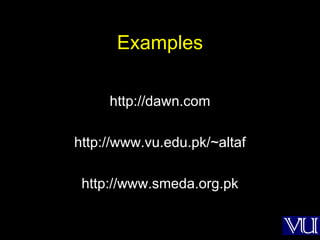
Examples http://dawn.com http://www.vu.edu.pk/~altaf http://www.smeda.org.pk
Are there any access charges? Most of the info on the Web is available for  free There is some  for-payment  content on the Web, which is generally paid with the help of a  credit card
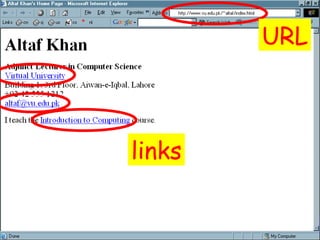
How do I navigate the Web? You go from one Web page to another my  clicking on a link For example, here is  my  Web page
links URL
Links The  underlined pieces of text in blue  are called links Each link is a  gateway  to another  Web page All you have to do is  click  on the link to go to  the page corresponding  to that link
How many Web pages are there? In 1999 there were  800 million  Web pages ( 15 terra (10 12 ) bytes of text ) In year 2002, the number is supposed to be  8 billion If you  spend a minute reviewing  each of these pages, it will take more than  15,000  years to go through them all
Tum salamat raho hazar baras Her baras kay hon din pachas hazar (140,000 normal years)
What is secret behind the explosive growth of the Web? Anarchy – any page is allowed to link to any other There are  no controls  over who puts what on the Web Everyone  can put  whatever  they want to put on the Web – and they do! DRAWBACKS: Inconsistent quality of pages Broken links
The most popular Web sites? AOL – Most popular ISP’s Web site Microsoft – Most popular software developer’s Web site Yahoo – Most popular multi-service Web site Amazon – most popular shop on the Web CNN – most popular news Web site Google – most useful search engine
What is a Web site? A collection of related documents available on the Web The first portion of the URLs in the Web pages of a Web site is the same e.g. http://www.vu.edu.pk/ http://www.vu.edu.pk/~altaf http://www.vu.edu.pk/cs101 Are the URLs of three distinct Web pages on a single Web site
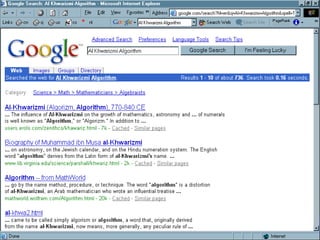
What is a Web Search Engine? Search engines  continuously scan  the Web and  compile a list  of all the Web pages that they find The search engine with the  largest  such list (or index) is  Google  – with a list of over  2 billion  Web pages and over  330 million images We use the search engine by typing a  “search key word”  or “ query ” on its Web page.  It looks for those keyword in its index, and  displays a list  of Web pages that contain that keyword


I know I can read off the Web.  Am I allowed to put my stuff on the Web? Yes .  You just need to have a computer that is hooked up to the Internet. You  do not require  anyone’s  permission  to put your Web page(s) on the Web Your Web page will be  available to all the millions  of users that have access to the Internet the  moment  you place it on the Web
Am I allowed to put my stuff on the Web?  (cont.) Next week  you’ll have the opportunity to do just that You’ll learn how to  develop your own  Web page And how to make it  available  on the Web
Internet ---- Web ?
The “Internet” and the “Web” are not the same In fact, the  “Web” is a service  that runs over the “Internet”. In addition to the Web, there are many other services that run over the Internet. Internet is like the  network of roads in a city , whereas Web is a service like the  Bus Service  that run over those roads.  Just like other services can use the roads (e.g.  wagons ), so can other services on the Internet (e.g.  ftp ).  We’ll have more to say about this  later in the course However, The following refer to the same thing: World Wide Web,  Web ,  WWW
What info is available on the Web? Information about almost  every thing known  to  mankind  and then some! The info is in the form of: Text Graphics Animation Video Sound
Impact of the Web on: Computing Society Commerce
Impact of the Web on Computing Every one wants to  use the Web That has spurred the  demand for computers That, in turn, has  reduced the cost  of computing drastically The computers are becoming easier to use because the target users are becoming  less and less sophisticated  In the olden times only techies used computers; now my  4-year  old knows things about the machine that I never did
Impact of the Web on Society User friendly  communication  has become much more  affordable  – the  global village is shrinking Business persons can  stay in touch  with their businesses even without being there – for some, that has resulted in the  destruction of their family life
Impact of the Web on Commerce Huge impact The moment I take my business to the Web, it becomes  possible  for my customers to  find out about me  without me being  physically present  in their city Suddenly, I’m running a  global business
Who invented the Web & Why? Tim Berners Lee – British physicist 1989 – At the European Center for Nuclear Energy Research ( CERN ) in Geneva He just wanted a way by which scientists could  easily share documents  over a computer network
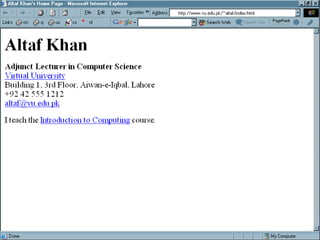
The key weakness of the Web? The Web (as it currently exists) was designed for human to read, not for computers to understand and manipulate meaningfully Computers have a great problem in dealing with the current text and graphics based Web Here is an example …
 
What’s the problem with this page? You (a human) see this page and immediately understand what my name is How would a computer know the same fact? For that, the computer needs some help Some help in form of a statement: Name=“Altaf Khan” Occupation=“Teaching” Employer=“Virtual University” And so on
The Future:  The Semantic Web What unique feature distinguishes the Web of today with the Semantic Web of tomorrow?  Whereas, today’s Web’s content is designed for humans to read;  the Semantic Web’s content will be designed for computers to understand meaningfully However, the Semantic Web is not a replacement but an extension of the present Web, in which information is given well defined meaning
The Semantic Web Some progress is already being made for adding “Semantic Content” on to the Web, but a lot more will happen in the next 5 years To find  further info about this exciting development  read Tim Berner Lee and his co-worker’s paper: “The Semantic Web” that is available on the Web as: http://www.sciam.com/2001/0501issue/0501berners-lee.html
Another useful Web page … Web page for our “Understanding Computers” text book http://www.hbcollege.com/infosys/parker2000
What have we learnt today? What is the World Wide Web? How does it work? The impact of the Web on computing, society, and commerce
Goal of the Next Lecture To become familiar with various types of computers with respect to their applications and scale To become familiar with the basic components of a computer

My lectures

  • 1.
    CS101 Introduction toComputing Lecture 3 The World Wide Web (Web Development Lecture 1)
  • 2.
    During the LastLecture … We learnt about several important milestones on the modern computing’s journey that started with the Analytical Engine , and as of today, has brought us to the hand-held computer
  • 3.
    Today’s Goal isto … Become familiar with one of the most popular activities on computers – the World Wide Web We want to become familiar with the Web’s structure About how the Web works About its genesis , its evolution , and where it is going
  • 4.
    What is theWorld Wide Web? A huge resource of information Logically unified , but physically distributed Lo g icall y unified : Any one from any where can access the information using a very simple scheme consisting of links & URLs Ph y sicall y distributed : The information is stored on Internet-connected computers that are spread all over the globe
  • 5.
    Who is allowedto access the Web? Any one and every one with a computer and a connection to the Internet No nationalistic , ideological , racial , or religious restrictions In Pakistan , Web is accessible from any city or town that has a phone available
  • 6.
    The Web is unlike any previous human invention . Because it is a world-wide resource , important to all of the people in the world.
  • 7.
    How do Ivisit a Web page? Turn your computer on Connect to the internet through a modem or Local Area Network Launch the browser (which in most cases, will be the Internet Explorer) Type in the URL of the Web page that you want to visit
  • 8.
    Browser Browser isthe tool that we use to access the content of the Web Browser and the content of the Web have the same relationship as the TV has with cable programming 1993 - The 1 st major browser “ Mosaic ” was developed at the National Center for Supercomputing Applications ( NCSA ) at the University of Illinois, Urbana-Champaign Initially handled text only, later graphics-viewing capability was added
  • 9.
    What is aURL? U niform R esource L ocator The unique address assigned to each unique page on the Web
  • 10.
  • 11.
    Are there anyaccess charges? Most of the info on the Web is available for free There is some for-payment content on the Web, which is generally paid with the help of a credit card
  • 12.
    How do Inavigate the Web? You go from one Web page to another my clicking on a link For example, here is my Web page
  • 13.
  • 14.
    Links The underlined pieces of text in blue are called links Each link is a gateway to another Web page All you have to do is click on the link to go to the page corresponding to that link
  • 15.
    How many Webpages are there? In 1999 there were 800 million Web pages ( 15 terra (10 12 ) bytes of text ) In year 2002, the number is supposed to be 8 billion If you spend a minute reviewing each of these pages, it will take more than 15,000 years to go through them all
  • 16.
    Tum salamat rahohazar baras Her baras kay hon din pachas hazar (140,000 normal years)
  • 17.
    What is secretbehind the explosive growth of the Web? Anarchy – any page is allowed to link to any other There are no controls over who puts what on the Web Everyone can put whatever they want to put on the Web – and they do! DRAWBACKS: Inconsistent quality of pages Broken links
  • 18.
    The most popularWeb sites? AOL – Most popular ISP’s Web site Microsoft – Most popular software developer’s Web site Yahoo – Most popular multi-service Web site Amazon – most popular shop on the Web CNN – most popular news Web site Google – most useful search engine
  • 19.
    What is aWeb site? A collection of related documents available on the Web The first portion of the URLs in the Web pages of a Web site is the same e.g. http://www.vu.edu.pk/ http://www.vu.edu.pk/~altaf http://www.vu.edu.pk/cs101 Are the URLs of three distinct Web pages on a single Web site
  • 20.
    What is aWeb Search Engine? Search engines continuously scan the Web and compile a list of all the Web pages that they find The search engine with the largest such list (or index) is Google – with a list of over 2 billion Web pages and over 330 million images We use the search engine by typing a “search key word” or “ query ” on its Web page. It looks for those keyword in its index, and displays a list of Web pages that contain that keyword
  • 21.
  • 22.
  • 23.
  • 24.
    I know Ican read off the Web. Am I allowed to put my stuff on the Web? Yes . You just need to have a computer that is hooked up to the Internet. You do not require anyone’s permission to put your Web page(s) on the Web Your Web page will be available to all the millions of users that have access to the Internet the moment you place it on the Web
  • 25.
    Am I allowedto put my stuff on the Web? (cont.) Next week you’ll have the opportunity to do just that You’ll learn how to develop your own Web page And how to make it available on the Web
  • 26.
  • 27.
    The “Internet” andthe “Web” are not the same In fact, the “Web” is a service that runs over the “Internet”. In addition to the Web, there are many other services that run over the Internet. Internet is like the network of roads in a city , whereas Web is a service like the Bus Service that run over those roads. Just like other services can use the roads (e.g. wagons ), so can other services on the Internet (e.g. ftp ). We’ll have more to say about this later in the course However, The following refer to the same thing: World Wide Web, Web , WWW
  • 28.
    What info isavailable on the Web? Information about almost every thing known to mankind and then some! The info is in the form of: Text Graphics Animation Video Sound
  • 29.
    Impact of theWeb on: Computing Society Commerce
  • 30.
    Impact of theWeb on Computing Every one wants to use the Web That has spurred the demand for computers That, in turn, has reduced the cost of computing drastically The computers are becoming easier to use because the target users are becoming less and less sophisticated In the olden times only techies used computers; now my 4-year old knows things about the machine that I never did
  • 31.
    Impact of theWeb on Society User friendly communication has become much more affordable – the global village is shrinking Business persons can stay in touch with their businesses even without being there – for some, that has resulted in the destruction of their family life
  • 32.
    Impact of theWeb on Commerce Huge impact The moment I take my business to the Web, it becomes possible for my customers to find out about me without me being physically present in their city Suddenly, I’m running a global business
  • 33.
    Who invented theWeb & Why? Tim Berners Lee – British physicist 1989 – At the European Center for Nuclear Energy Research ( CERN ) in Geneva He just wanted a way by which scientists could easily share documents over a computer network
  • 34.
    The key weaknessof the Web? The Web (as it currently exists) was designed for human to read, not for computers to understand and manipulate meaningfully Computers have a great problem in dealing with the current text and graphics based Web Here is an example …
  • 35.
  • 36.
    What’s the problemwith this page? You (a human) see this page and immediately understand what my name is How would a computer know the same fact? For that, the computer needs some help Some help in form of a statement: Name=“Altaf Khan” Occupation=“Teaching” Employer=“Virtual University” And so on
  • 37.
    The Future: The Semantic Web What unique feature distinguishes the Web of today with the Semantic Web of tomorrow? Whereas, today’s Web’s content is designed for humans to read; the Semantic Web’s content will be designed for computers to understand meaningfully However, the Semantic Web is not a replacement but an extension of the present Web, in which information is given well defined meaning
  • 38.
    The Semantic WebSome progress is already being made for adding “Semantic Content” on to the Web, but a lot more will happen in the next 5 years To find further info about this exciting development read Tim Berner Lee and his co-worker’s paper: “The Semantic Web” that is available on the Web as: http://www.sciam.com/2001/0501issue/0501berners-lee.html
  • 39.
    Another useful Webpage … Web page for our “Understanding Computers” text book http://www.hbcollege.com/infosys/parker2000
  • 40.
    What have welearnt today? What is the World Wide Web? How does it work? The impact of the Web on computing, society, and commerce
  • 41.
    Goal of theNext Lecture To become familiar with various types of computers with respect to their applications and scale To become familiar with the basic components of a computer