

BASICOFMUTUALFUNDSRAJESH PAUL3RD SEMISTER    IILM(BS)“Don’ttrust yourmoney,rathertrustthetrustwhichistrustworthyforyourmoneytogrow”!!!!!!!!!!!INTERNATIONAL  INSTITUTE  FOR  LEARNING  IN  MANAGEMENT
DisclaimerMUTUAL FUND IS SUBJECT  MATTER OF MARKET 			  			RISK,PLEASE READ THE OFFER    			DUCUMENT CAREFULLY BEFORE 			INVESTING………A KNOWN STATEMENT OF AN UNKNOWN INVESTMENT WORLD?????				watch out….INTERNATIONAL  INSTITUTE  FOR  LEARNING  IN  MANAGEMENT
Mutual funds & moreFlow charts of mutual fundsStructure of MFAsset management companyBrief of components of MFTypes of mutual fundBrief of various mutual fundsVarious investment plans of AMCRegulations & taxations What's  line up!!!INTERNATIONAL  INSTITUTE  FOR  LEARNING  IN  MANAGEMENT
Mutualfunds&MoreMutual funds– A  risk free investment starts here……….INTERNATIONAL  INSTITUTE  FOR  LEARNING  IN  MANAGEMENT
What is Mutual fund?Mutual fund is a collective investment  vehicle where investors money    	get invested into the market by some experienced professionals 		based on their risk appetite ,time horizon & so on for  some 	investment goal.It’s a trust that pools money of the investors 	who share common financial goal.It’s a professionally managed investment scheme 	that collects the investors money & invest 	the same into stocks, bonds, debentures, 	short-term money market instruments etc.INTERNATIONAL  INSTITUTE  FOR  LEARNING  IN  MANAGEMENT
Facts & figures of Mutual fundsFirst Mutual fund was introduced by UTI in 1964 as “UNIT 64”.First non-UTI Mutual fund was “SBI Mutual fund” in 1987 as public sector bank owned MF. First private sector with Mutual fund was “Kothari Pioneer” introduced in 1993.The ratio of MF investment to household savings in 7.9%.MF is growing in India at faster rate(22%) than USA (6.6%),France(9.8%) in 08-09Total MF industry in the world is 26 trillion USD.Total MF advisor in India is 50000.Total MF industry in India is more than five lakh crore.There are 41 MF ,maintaining more than 1000 schemes.INTERNATIONAL  INSTITUTE  FOR  LEARNING  IN  MANAGEMENT
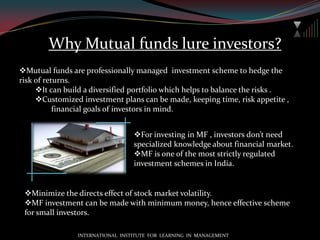
Why Mutual funds lure investors?Mutual funds are professionally managed  investment scheme to hedge the risk of returns.
It can build a diversified portfolio which helps to balance the risks .
Customized investment plans can be made, keeping time, risk appetite ,	financial goals of investors in mind.
For investing in MF , investors don’t need specialized knowledge about financial market.
MF is one of the most strictly regulated investment schemes in India.
Minimize the directs effect of stock market volatility.
MF investment can be made with minimum money, hence effective scheme for small investors.INTERNATIONAL  INSTITUTE  FOR  LEARNING  IN  MANAGEMENT
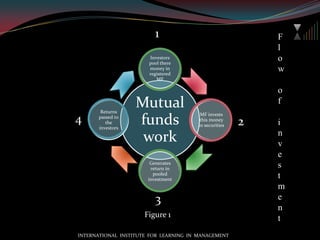
1Flow of investment423Figure 1INTERNATIONAL  INSTITUTE  FOR  LEARNING  IN  MANAGEMENT
StructureofMUTUALFUNDsponsorsBankNon bankTrusteecustodianAssets management companyDistribution  agentbankersR&T agentFigure 2INTERNATIONAL  INSTITUTE  FOR  LEARNING  IN  MANAGEMENT
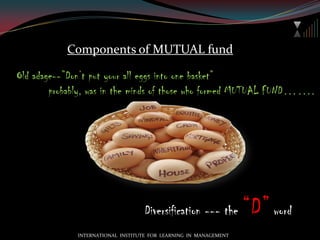
Components of MUTUAL fundOld adage--”Don’t put your all eggs into one basket”	probably, was in the minds of those who formed MUTUAL FUND……. Diversification --- the “D” wordINTERNATIONAL  INSTITUTE  FOR  LEARNING  IN  MANAGEMENT
sponsorsSponsors are similar to the promoters of the company.Sponsors can be a bank or it can be a non-bank institution.	Provides at least 40% of the total capital of AMC.	must have a good financial track records in the last 5 	years.It registers with SEBI,the market regulator, for forming MF.Bank owned MF also needs RBI permission for the same.	forms trust & appoints trustees.	1/3 of the trustees are appointed out of sponsors.INTERNATIONAL  INSTITUTE  FOR  LEARNING  IN  MANAGEMENT
Good financial track recordsFinancial activities must have carried out at least last financial years.“net worth” is positive in the all immediately preceding five years.“net worth” is [fixed assets + current assets – current liabilities]Net worth of the immediately preceding year of the year of capital contribution to AMC must be more than its contribution.The sponsor must have had positive PAT[profit after tax] at least three out of immediately preceding five years.[As per chapter II of SEBI (Mutual fund) regulations  Act 1996]INTERNATIONAL  INSTITUTE  FOR  LEARNING  IN  MANAGEMENT
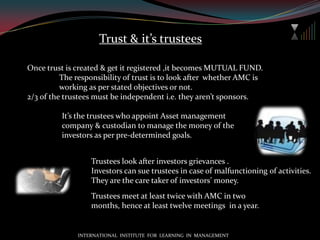
Trust & it’s trusteesOnce trust is created & get it registered ,it becomes MUTUAL FUND.	The responsibility of trust is to look after  whether AMC is 	working as per stated objectives or not. 2/3 of the trustees must be independent i.e. they aren’t sponsors.It’s the trustees who appoint Asset management company & custodian to manage the money of the investors as per pre-determined goals.Trustees look after investors grievances .Investors can sue trustees in case of malfunctioning of activities.They are the care taker of investors’ money.Trustees meet at least twice with AMC in two months, hence at least twelve meetings  in a year.INTERNATIONAL  INSTITUTE  FOR  LEARNING  IN  MANAGEMENT
Custodian & Depositary Custodian is a separate entity, which is appointed by board of trustees.	It’s main role is to keep the physical assets of the investors.		some time it also tracks various corporate actions of the companies where 	investors’ money is invested .It also works for settling the claims of investors.	Dematerialized units are held by Depositary	“Dematerialized” units are electronic form of 		   physical units. INTERNATIONAL  INSTITUTE  FOR  LEARNING  IN  MANAGEMENT
Asset ManagementCompany  AMC is the face of a Mutual fund.      AMC is appointed by Board of trustees to manage the fund of investors.       	Its issues prospectus, NFO[net fund offer, statements of offer documents    	[SID],invests investors money. In the market & so on  behalf of Trustees.           		Minimum capital of an AMC is 10 core.AMC…..It’s the responsibility of AMC to appoint intermediaries, Bankers, Resister& transfer agents.It charges expenses for managing of funds which is borne by investors.	maximum expenses charged is stipulated by SEBI.	50% of the directors should be independent.	75% of UNIT HOLDERS can terminate appointment of an AMC.	The chair man of AMC cant be a trustee of any other AMC.INTERNATIONAL  INSTITUTE  FOR  LEARNING  IN  MANAGEMENT
Distribution agent: ! Appointed by Asset management company.			     ! Helps to distribute mutual fund on behalf of AMC.Banker: ! Maintains all the bank accounts for all the schemes.		! Collection  & Redemption of money.		! Appointed by Asset management company.Registrars & transfer agent[R&T agent]: ! It maintains accounts of each unit  				        holder.					        ! Gives information regarding				                        various circulars, NAV & so on.                                                                  ! Appointed by AMC.   		                                RISK AHEAD!INTERNATIONAL  INSTITUTE  FOR  LEARNING  IN  MANAGEMENT
TypesofMutualFundOld Axiom of WALL STREET :“Buy the rumor ,sell the news.” 			choose the fund carefully, don’t get fused!INTERNATIONAL  INSTITUTE  FOR  LEARNING  IN  MANAGEMENT
INTERNATIONAL  INSTITUTE  FOR  LEARNING  IN  MANAGEMENT
Mutual fund by constitution:Open ended fund: 1.It can be bought or sold at any point of time.			            2. Units are traded on the basis on NAV, which is published   	                                 every day by AMC.			             3. Investors can sell the units to MF.	                               4. Repurchase by MF can be made at minimum price of 93% 	                                 of NAV of that unit & units can be sold at maximum price 	                                 of 107% of NAV of that unit. 			             5. Unit capital changes with every transaction.                                     6. The differences between repurchase & sale price shall not 		                  exceed 7% of sale price.Close  ended fund: a. It can be bought  or sold only at a specific period of time.	                    b. For selling of units it’s enlisted at recognized stock 		                        market.		    c. Repurchase by MF can be made at minimum price of 95% of NAV, applicable to  only those units which ware issued before amendment of SEBI (Mutual fund) Regulation 2009.d. Units has to be listed to recognized stock market at least 6 months prior to closer of fund.INTERNATIONAL  INSTITUTE  FOR  LEARNING  IN  MANAGEMENT
Mutual fund by load imposedLoad fund: load is the expenses for advertisement, distribution, fund managers’ commission etc. charged on the price of unit.ENTRY LOAD: load that’s charged at the time of buying the units at a percentage basis on NAV.. But entry load is no longer in vogue as per SEBI regulation w.e.f. Auguest,2009.EXIT LOAD: exit load is charged at the time of selling of units on price  at a percentage basis on NAV.DEFFERED LOAD: charged on price in various intervals at the time of holding.CONTINGENT DEFFERED SALES CHARGE: a type of exit load, charged at the time of selling prior to its investment period. Meant for CLOSE ENDED FUND.NO LOAD FUND: no load is charged, at any point of time.NAV is calculated after calculating of all expenses.INTERNATIONAL  INSTITUTE  FOR  LEARNING  IN  MANAGEMENT
By nature of investmentEquity fund: a fund where investment in Indian companies’ shares is minimum 65% of its average weekly NAV.Types of Equity fund           table 1INTERNATIONAL  INSTITUTE  FOR  LEARNING  IN  MANAGEMENT
Debt fund: fund is invested in a short term debt instruments such as Bonds, Treasury bills, Government securities, corporate debt papers etc.	it is less risky than Equity funds, thus less return.	since in debt instruments return is guaranteed, investors are assured of 	returns. “Slow but steady” --- what the investors believe in. How debt fund is priced?Debt fund is priced as per present value. Its valued based on present value of future flows of cash.Why Bond price & its interest have inverse relationship? If coupon rate[rate of interest on debt paper] is 10%Redemption value is Rs. 20000, time period for holding is 5 years.Present value?Redemption valuePV=5( 1 + rate of interest)2oooo12418.42=5(1+.10)INTERNATIONAL  INSTITUTE  FOR  LEARNING  IN  MANAGEMENT
Various types of Debt fundCapital protection funds: invest equity as well as debt instruments. main objective is to protect the capital value of the investment.Fixed maturity funds: a close ended fund, invest in debt instruments whose maturity period is same as period of funds.Gilt funds: invest mainly in central Govt. securities as well as state Govt securities.Balance funds: its a hybrid fund which invests partly in equity & partly on debt instruments to hedge the risk of market volatility.Monthly income plans[MIP]: a hybrid plan which gives an option to the investors to reap monthly income.Children benefit plans: invested mainly 5 to 15 years time horizon, with minimum part invested in equity with the intension to have adequate fund needed for children’ higher education. INTERNATIONAL  INSTITUTE  FOR  LEARNING  IN  MANAGEMENT
Money market  fundMoney market fund is a type of fund that invests money in “money market”.Money market is a market[not necessarily a physical place, it can be a virtual place as well ] where transactions are made through cash or cash equivalent. It lasts for a maximum period of one year. It’s a well organized market that provides short term financial support .   Money market fund are popularly known as “LIQUID FUND”Invests in commercial debt, treasury bills, certificate of deposits, interest rate swaps, collateralized borrowing & lending options for short period of time.The main advantage of liquid fund is its liquidity, i.e. it cant be sold & bought at any pint of time. How is it priced?If fund remains invested in money market instruments more than 182 days its valued as MARK-TO-MARKET & fund that remains invested in money market instruments for less than 182 days  its valued as COST PLUS INTEREST ACCRUED METHOD. INTERNATIONAL  INSTITUTE  FOR  LEARNING  IN  MANAGEMENT
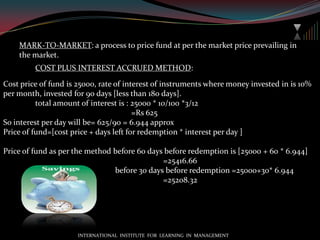
MARK-TO-MARKET: a process to price fund at per the market price prevailing in the market. COST PLUS INTEREST ACCRUED METHOD:Cost price of fund is 25000, rate of interest of instruments where money invested in is 10% per month, invested for 90 days [less than 180 days].	total amount of interest is : 25000 * 10/100 *3/12				=Rs 625So interest per day will be= 625/90 = 6.944 approxPrice of fund=[cost price + days left for redemption * interest per day ]Price of fund as per the method before 60 days before redemption is [25000 + 60 * 6.944]					=25416.66	                                        before 30 days before redemption =25000+30* 6.944		                                                =25208.32INTERNATIONAL  INSTITUTE  FOR  LEARNING  IN  MANAGEMENT
By investment objectiveGrowth fund: invest in “growth stocks” with the intension of capital appreciation.There is no scope to get monthly income like MIPs. dividend is reinvested to let the money grow. Value fund: invest in “value stocks” with the intension of booking profit in a short span of time.Income fund: invest in debt instruments to earn monthly income regularly.Growth stocks: its that type of stocks which are in present giving high return, are traded in high price. like 2008 Real estate stocks in Indian share markets.Value stocks: its that type of stocks which are in present not giving a high returns & under priced but there are high possibilities to up the price in near future. So judgment about this stocks must be firm, otherwise investors can suffer a huge loss.value stocks are like “ low hanging fruits”INTERNATIONAL  INSTITUTE  FOR  LEARNING  IN  MANAGEMENT
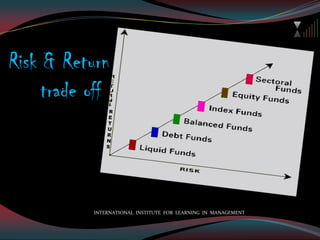
Risk & Return  	trade offRETURNSINTERNATIONAL  INSTITUTE  FOR  LEARNING  IN  MANAGEMENT
Special types of Mutual fundIndex fund:a. it’s a type of equity fund invests in stocks consist of benchmark indices like, Sensex, Nifty, Bse 500 etc.	            b. invests in stocks in the same proportion as they have on total capitalization of index. i.e. if RELIANCE ENERGY covers 20% of SENSEX[consists of 30 shares], fund manager invests 20% of its total fund in that share.	           c. as and when any scrip changes in benchmark index ,fund also changes its portfolio accordingly.                           d.  Since fund manager has very little thing to do as far as selection of shares is concerned, its known as “passively maintained fund”.     Gold ETF[exchange traded fund]: 1. ETFs are like shares , which requires DMAT & TRADING a/c for trading.2. Invests in gold & gold related securities , that gives an extra leverage to investors’ portfolio.3. Each Gold ETF has underlying gold of certain quantity somewhere. Usually one G-ETF consist of 10 gram gold as underlying assets.4. ETF is issued through authorized participants(APs). INTERNATIONAL  INSTITUTE  FOR  LEARNING  IN  MANAGEMENT
How it works?Portfolio reserve &       cash componentStep 1- authorized participants keeps gold and cash with AMC.Step 2- AMC gives some sets of units whose value of  NAV is equal to the value of gold deposited by APs. The units is known as creation units.	it should be remembered that the NAV value creation units & value of gold should be equal at any point of time.In case of any difference cash component will be used for adjustment.Step 3-APs then divides the creation units into many small units for retail investors. Line up ofGold ETFINTERNATIONAL  INSTITUTE  FOR  LEARNING  IN  MANAGEMENT
Net Annual Value[NAV]What is NAV?NAV is the net amount of assets of a scheme of a MF that remain invested in market.NAV is actually the value of an unit.	NAV=Net assets of a schemeNumbers of outstanding unitsNet assets = market value of investment + receivables +other accrued income + other assets – payables – outstanding liabilities .open ended fund issues 1000 units @ 10 each, NAV will be  Rs 10.		[1000* 10/1000]Now if market value of investment becomes Rs. 6000, previously it was Rs. 2ooo.So net increase in assets is [6000-2000]= Rs 4000. now the net assets will be Rs 14000. & NAV will be Rs. 14000/1000=Rs 14 per unit. Rs 4000 {14000-10000} is unrealized capital gain.INTERNATIONAL  INSTITUTE  FOR  LEARNING  IN  MANAGEMENT
Regulations of MUTUAL FUNDInvest in debt securities[Rated] issued by single issuer max. 10% of scheme’s NAV, extendable to 15% with the permission of Trustee. No bar in Govt. securities[G-SEC].Invest max. 10% of scheme’s NAV in unrated securities issued by single issuer. total investment in that securities is max. 25% of NAV.Maximum investment in a single security is 10% of NAV of the scheme.No fund, under all its schemes cant hold 10% of paid up capital.No scheme can invest in any unlisted securities of the Sponsors or its group companies.It can invest max 25% of NAV of scheme in listed securities of Sponsors or its group companies.Scheme can invest in unlisted securities of companies other than Sponsors or its group companies max. 5% of NAV in case of open ended funds & 10% of NAV in case of close ended fund.If scheme invests in other schemes of same or different AMC, no fees will be charged, aggregate inter  scheme transfer cant exceed 5% of NAV. INTERNATIONAL  INSTITUTE  FOR  LEARNING  IN  MANAGEMENT
Various investment plansSystematic investment plans[SIP]	1.a plan of investment where same amount of money in each month is invested in buying MF unit as per the choice of investors.              2.the main advantage of SIP is average out the cost of investment.              3. SIP is generally made for meeting some particular goal of an investor.              4.investors buy more units when NAV of any fund is low[in Bear market]   	& vice-versa [in Bull market]with same amount of money that they 	invest in every month.INTERNATIONAL  INSTITUTE  FOR  LEARNING  IN  MANAGEMENT
 units purchased based on NAV if SIP of Rs 5000 each month.INTERNATIONAL  INSTITUTE  FOR  LEARNING  IN  MANAGEMENT

mutual_fund

  • 1.
    BASICOFMUTUALFUNDSRAJESH PAUL3RD SEMISTER IILM(BS)“Don’ttrust yourmoney,rathertrustthetrustwhichistrustworthyforyourmoneytogrow”!!!!!!!!!!!INTERNATIONAL INSTITUTE FOR LEARNING IN MANAGEMENT
  • 2.
    DisclaimerMUTUAL FUND ISSUBJECT MATTER OF MARKET RISK,PLEASE READ THE OFFER DUCUMENT CAREFULLY BEFORE INVESTING………A KNOWN STATEMENT OF AN UNKNOWN INVESTMENT WORLD????? watch out….INTERNATIONAL INSTITUTE FOR LEARNING IN MANAGEMENT
  • 3.
    Mutual funds &moreFlow charts of mutual fundsStructure of MFAsset management companyBrief of components of MFTypes of mutual fundBrief of various mutual fundsVarious investment plans of AMCRegulations & taxations What's line up!!!INTERNATIONAL INSTITUTE FOR LEARNING IN MANAGEMENT
  • 4.
    Mutualfunds&MoreMutual funds– A risk free investment starts here……….INTERNATIONAL INSTITUTE FOR LEARNING IN MANAGEMENT
  • 5.
    What is Mutualfund?Mutual fund is a collective investment vehicle where investors money get invested into the market by some experienced professionals based on their risk appetite ,time horizon & so on for some investment goal.It’s a trust that pools money of the investors who share common financial goal.It’s a professionally managed investment scheme that collects the investors money & invest the same into stocks, bonds, debentures, short-term money market instruments etc.INTERNATIONAL INSTITUTE FOR LEARNING IN MANAGEMENT
  • 6.
    Facts & figuresof Mutual fundsFirst Mutual fund was introduced by UTI in 1964 as “UNIT 64”.First non-UTI Mutual fund was “SBI Mutual fund” in 1987 as public sector bank owned MF. First private sector with Mutual fund was “Kothari Pioneer” introduced in 1993.The ratio of MF investment to household savings in 7.9%.MF is growing in India at faster rate(22%) than USA (6.6%),France(9.8%) in 08-09Total MF industry in the world is 26 trillion USD.Total MF advisor in India is 50000.Total MF industry in India is more than five lakh crore.There are 41 MF ,maintaining more than 1000 schemes.INTERNATIONAL INSTITUTE FOR LEARNING IN MANAGEMENT
  • 7.
    Why Mutual fundslure investors?Mutual funds are professionally managed investment scheme to hedge the risk of returns.
  • 8.
    It can builda diversified portfolio which helps to balance the risks .
  • 9.
    Customized investment planscan be made, keeping time, risk appetite , financial goals of investors in mind.
  • 10.
    For investing inMF , investors don’t need specialized knowledge about financial market.
  • 11.
    MF is oneof the most strictly regulated investment schemes in India.
  • 12.
    Minimize the directseffect of stock market volatility.
  • 13.
    MF investment canbe made with minimum money, hence effective scheme for small investors.INTERNATIONAL INSTITUTE FOR LEARNING IN MANAGEMENT
  • 14.
    1Flow of investment423Figure1INTERNATIONAL INSTITUTE FOR LEARNING IN MANAGEMENT
  • 15.
    StructureofMUTUALFUNDsponsorsBankNon bankTrusteecustodianAssets managementcompanyDistribution agentbankersR&T agentFigure 2INTERNATIONAL INSTITUTE FOR LEARNING IN MANAGEMENT
  • 16.
    Components of MUTUALfundOld adage--”Don’t put your all eggs into one basket” probably, was in the minds of those who formed MUTUAL FUND……. Diversification --- the “D” wordINTERNATIONAL INSTITUTE FOR LEARNING IN MANAGEMENT
  • 17.
    sponsorsSponsors are similarto the promoters of the company.Sponsors can be a bank or it can be a non-bank institution. Provides at least 40% of the total capital of AMC. must have a good financial track records in the last 5 years.It registers with SEBI,the market regulator, for forming MF.Bank owned MF also needs RBI permission for the same. forms trust & appoints trustees. 1/3 of the trustees are appointed out of sponsors.INTERNATIONAL INSTITUTE FOR LEARNING IN MANAGEMENT
  • 18.
    Good financial trackrecordsFinancial activities must have carried out at least last financial years.“net worth” is positive in the all immediately preceding five years.“net worth” is [fixed assets + current assets – current liabilities]Net worth of the immediately preceding year of the year of capital contribution to AMC must be more than its contribution.The sponsor must have had positive PAT[profit after tax] at least three out of immediately preceding five years.[As per chapter II of SEBI (Mutual fund) regulations Act 1996]INTERNATIONAL INSTITUTE FOR LEARNING IN MANAGEMENT
  • 19.
    Trust & it’strusteesOnce trust is created & get it registered ,it becomes MUTUAL FUND. The responsibility of trust is to look after whether AMC is working as per stated objectives or not. 2/3 of the trustees must be independent i.e. they aren’t sponsors.It’s the trustees who appoint Asset management company & custodian to manage the money of the investors as per pre-determined goals.Trustees look after investors grievances .Investors can sue trustees in case of malfunctioning of activities.They are the care taker of investors’ money.Trustees meet at least twice with AMC in two months, hence at least twelve meetings in a year.INTERNATIONAL INSTITUTE FOR LEARNING IN MANAGEMENT
  • 20.
    Custodian & DepositaryCustodian is a separate entity, which is appointed by board of trustees. It’s main role is to keep the physical assets of the investors. some time it also tracks various corporate actions of the companies where investors’ money is invested .It also works for settling the claims of investors. Dematerialized units are held by Depositary “Dematerialized” units are electronic form of physical units. INTERNATIONAL INSTITUTE FOR LEARNING IN MANAGEMENT
  • 21.
    Asset ManagementCompany AMC is the face of a Mutual fund. AMC is appointed by Board of trustees to manage the fund of investors. Its issues prospectus, NFO[net fund offer, statements of offer documents [SID],invests investors money. In the market & so on behalf of Trustees. Minimum capital of an AMC is 10 core.AMC…..It’s the responsibility of AMC to appoint intermediaries, Bankers, Resister& transfer agents.It charges expenses for managing of funds which is borne by investors. maximum expenses charged is stipulated by SEBI. 50% of the directors should be independent. 75% of UNIT HOLDERS can terminate appointment of an AMC. The chair man of AMC cant be a trustee of any other AMC.INTERNATIONAL INSTITUTE FOR LEARNING IN MANAGEMENT
  • 22.
    Distribution agent: !Appointed by Asset management company. ! Helps to distribute mutual fund on behalf of AMC.Banker: ! Maintains all the bank accounts for all the schemes. ! Collection & Redemption of money. ! Appointed by Asset management company.Registrars & transfer agent[R&T agent]: ! It maintains accounts of each unit holder. ! Gives information regarding various circulars, NAV & so on. ! Appointed by AMC. RISK AHEAD!INTERNATIONAL INSTITUTE FOR LEARNING IN MANAGEMENT
  • 23.
    TypesofMutualFundOld Axiom ofWALL STREET :“Buy the rumor ,sell the news.” choose the fund carefully, don’t get fused!INTERNATIONAL INSTITUTE FOR LEARNING IN MANAGEMENT
  • 24.
    INTERNATIONAL INSTITUTE FOR LEARNING IN MANAGEMENT
  • 25.
    Mutual fund byconstitution:Open ended fund: 1.It can be bought or sold at any point of time. 2. Units are traded on the basis on NAV, which is published every day by AMC. 3. Investors can sell the units to MF. 4. Repurchase by MF can be made at minimum price of 93% of NAV of that unit & units can be sold at maximum price of 107% of NAV of that unit. 5. Unit capital changes with every transaction. 6. The differences between repurchase & sale price shall not exceed 7% of sale price.Close ended fund: a. It can be bought or sold only at a specific period of time. b. For selling of units it’s enlisted at recognized stock market. c. Repurchase by MF can be made at minimum price of 95% of NAV, applicable to only those units which ware issued before amendment of SEBI (Mutual fund) Regulation 2009.d. Units has to be listed to recognized stock market at least 6 months prior to closer of fund.INTERNATIONAL INSTITUTE FOR LEARNING IN MANAGEMENT
  • 26.
    Mutual fund byload imposedLoad fund: load is the expenses for advertisement, distribution, fund managers’ commission etc. charged on the price of unit.ENTRY LOAD: load that’s charged at the time of buying the units at a percentage basis on NAV.. But entry load is no longer in vogue as per SEBI regulation w.e.f. Auguest,2009.EXIT LOAD: exit load is charged at the time of selling of units on price at a percentage basis on NAV.DEFFERED LOAD: charged on price in various intervals at the time of holding.CONTINGENT DEFFERED SALES CHARGE: a type of exit load, charged at the time of selling prior to its investment period. Meant for CLOSE ENDED FUND.NO LOAD FUND: no load is charged, at any point of time.NAV is calculated after calculating of all expenses.INTERNATIONAL INSTITUTE FOR LEARNING IN MANAGEMENT
  • 27.
    By nature ofinvestmentEquity fund: a fund where investment in Indian companies’ shares is minimum 65% of its average weekly NAV.Types of Equity fund table 1INTERNATIONAL INSTITUTE FOR LEARNING IN MANAGEMENT
  • 28.
    Debt fund: fundis invested in a short term debt instruments such as Bonds, Treasury bills, Government securities, corporate debt papers etc. it is less risky than Equity funds, thus less return. since in debt instruments return is guaranteed, investors are assured of returns. “Slow but steady” --- what the investors believe in. How debt fund is priced?Debt fund is priced as per present value. Its valued based on present value of future flows of cash.Why Bond price & its interest have inverse relationship? If coupon rate[rate of interest on debt paper] is 10%Redemption value is Rs. 20000, time period for holding is 5 years.Present value?Redemption valuePV=5( 1 + rate of interest)2oooo12418.42=5(1+.10)INTERNATIONAL INSTITUTE FOR LEARNING IN MANAGEMENT
  • 29.
    Various types ofDebt fundCapital protection funds: invest equity as well as debt instruments. main objective is to protect the capital value of the investment.Fixed maturity funds: a close ended fund, invest in debt instruments whose maturity period is same as period of funds.Gilt funds: invest mainly in central Govt. securities as well as state Govt securities.Balance funds: its a hybrid fund which invests partly in equity & partly on debt instruments to hedge the risk of market volatility.Monthly income plans[MIP]: a hybrid plan which gives an option to the investors to reap monthly income.Children benefit plans: invested mainly 5 to 15 years time horizon, with minimum part invested in equity with the intension to have adequate fund needed for children’ higher education. INTERNATIONAL INSTITUTE FOR LEARNING IN MANAGEMENT
  • 30.
    Money market fundMoney market fund is a type of fund that invests money in “money market”.Money market is a market[not necessarily a physical place, it can be a virtual place as well ] where transactions are made through cash or cash equivalent. It lasts for a maximum period of one year. It’s a well organized market that provides short term financial support . Money market fund are popularly known as “LIQUID FUND”Invests in commercial debt, treasury bills, certificate of deposits, interest rate swaps, collateralized borrowing & lending options for short period of time.The main advantage of liquid fund is its liquidity, i.e. it cant be sold & bought at any pint of time. How is it priced?If fund remains invested in money market instruments more than 182 days its valued as MARK-TO-MARKET & fund that remains invested in money market instruments for less than 182 days its valued as COST PLUS INTEREST ACCRUED METHOD. INTERNATIONAL INSTITUTE FOR LEARNING IN MANAGEMENT
  • 31.
    MARK-TO-MARKET: a processto price fund at per the market price prevailing in the market. COST PLUS INTEREST ACCRUED METHOD:Cost price of fund is 25000, rate of interest of instruments where money invested in is 10% per month, invested for 90 days [less than 180 days]. total amount of interest is : 25000 * 10/100 *3/12 =Rs 625So interest per day will be= 625/90 = 6.944 approxPrice of fund=[cost price + days left for redemption * interest per day ]Price of fund as per the method before 60 days before redemption is [25000 + 60 * 6.944] =25416.66 before 30 days before redemption =25000+30* 6.944 =25208.32INTERNATIONAL INSTITUTE FOR LEARNING IN MANAGEMENT
  • 32.
    By investment objectiveGrowthfund: invest in “growth stocks” with the intension of capital appreciation.There is no scope to get monthly income like MIPs. dividend is reinvested to let the money grow. Value fund: invest in “value stocks” with the intension of booking profit in a short span of time.Income fund: invest in debt instruments to earn monthly income regularly.Growth stocks: its that type of stocks which are in present giving high return, are traded in high price. like 2008 Real estate stocks in Indian share markets.Value stocks: its that type of stocks which are in present not giving a high returns & under priced but there are high possibilities to up the price in near future. So judgment about this stocks must be firm, otherwise investors can suffer a huge loss.value stocks are like “ low hanging fruits”INTERNATIONAL INSTITUTE FOR LEARNING IN MANAGEMENT
  • 33.
    Risk & Return trade offRETURNSINTERNATIONAL INSTITUTE FOR LEARNING IN MANAGEMENT
  • 34.
    Special types ofMutual fundIndex fund:a. it’s a type of equity fund invests in stocks consist of benchmark indices like, Sensex, Nifty, Bse 500 etc. b. invests in stocks in the same proportion as they have on total capitalization of index. i.e. if RELIANCE ENERGY covers 20% of SENSEX[consists of 30 shares], fund manager invests 20% of its total fund in that share. c. as and when any scrip changes in benchmark index ,fund also changes its portfolio accordingly. d. Since fund manager has very little thing to do as far as selection of shares is concerned, its known as “passively maintained fund”. Gold ETF[exchange traded fund]: 1. ETFs are like shares , which requires DMAT & TRADING a/c for trading.2. Invests in gold & gold related securities , that gives an extra leverage to investors’ portfolio.3. Each Gold ETF has underlying gold of certain quantity somewhere. Usually one G-ETF consist of 10 gram gold as underlying assets.4. ETF is issued through authorized participants(APs). INTERNATIONAL INSTITUTE FOR LEARNING IN MANAGEMENT
  • 35.
    How it works?Portfolioreserve & cash componentStep 1- authorized participants keeps gold and cash with AMC.Step 2- AMC gives some sets of units whose value of NAV is equal to the value of gold deposited by APs. The units is known as creation units. it should be remembered that the NAV value creation units & value of gold should be equal at any point of time.In case of any difference cash component will be used for adjustment.Step 3-APs then divides the creation units into many small units for retail investors. Line up ofGold ETFINTERNATIONAL INSTITUTE FOR LEARNING IN MANAGEMENT
  • 36.
    Net Annual Value[NAV]Whatis NAV?NAV is the net amount of assets of a scheme of a MF that remain invested in market.NAV is actually the value of an unit. NAV=Net assets of a schemeNumbers of outstanding unitsNet assets = market value of investment + receivables +other accrued income + other assets – payables – outstanding liabilities .open ended fund issues 1000 units @ 10 each, NAV will be Rs 10. [1000* 10/1000]Now if market value of investment becomes Rs. 6000, previously it was Rs. 2ooo.So net increase in assets is [6000-2000]= Rs 4000. now the net assets will be Rs 14000. & NAV will be Rs. 14000/1000=Rs 14 per unit. Rs 4000 {14000-10000} is unrealized capital gain.INTERNATIONAL INSTITUTE FOR LEARNING IN MANAGEMENT
  • 37.
    Regulations of MUTUALFUNDInvest in debt securities[Rated] issued by single issuer max. 10% of scheme’s NAV, extendable to 15% with the permission of Trustee. No bar in Govt. securities[G-SEC].Invest max. 10% of scheme’s NAV in unrated securities issued by single issuer. total investment in that securities is max. 25% of NAV.Maximum investment in a single security is 10% of NAV of the scheme.No fund, under all its schemes cant hold 10% of paid up capital.No scheme can invest in any unlisted securities of the Sponsors or its group companies.It can invest max 25% of NAV of scheme in listed securities of Sponsors or its group companies.Scheme can invest in unlisted securities of companies other than Sponsors or its group companies max. 5% of NAV in case of open ended funds & 10% of NAV in case of close ended fund.If scheme invests in other schemes of same or different AMC, no fees will be charged, aggregate inter scheme transfer cant exceed 5% of NAV. INTERNATIONAL INSTITUTE FOR LEARNING IN MANAGEMENT
  • 38.
    Various investment plansSystematicinvestment plans[SIP] 1.a plan of investment where same amount of money in each month is invested in buying MF unit as per the choice of investors. 2.the main advantage of SIP is average out the cost of investment. 3. SIP is generally made for meeting some particular goal of an investor. 4.investors buy more units when NAV of any fund is low[in Bear market] & vice-versa [in Bull market]with same amount of money that they invest in every month.INTERNATIONAL INSTITUTE FOR LEARNING IN MANAGEMENT
  • 39.
    units purchasedbased on NAV if SIP of Rs 5000 each month.INTERNATIONAL INSTITUTE FOR LEARNING IN MANAGEMENT