The current issue and full text archive of this journal is available at
                                               http://www.emerald-library.com


JIC
1,1                                         Some perspectives on
                                         intangibles and intellectual
                                                capital 2000
12                                                                           Leif Edvinsson
                                     UNIC (Universal Networking Intellectual Capital), Stockholm, Sweden
                                    Keywords Intellectual capital, Organizational structure, Human capital
                                    Abstract After posing some questions regarding the nature of intellectual capital, the paper
                                    explores IC through observing the changes in market dynamics and organizational structure. An
                                    IC growth model is discussed which involves visualizing IC, human capital injection, human
                                    capital transformation into structural capital, and structural capital injection.

                                    Emerging questions ± a kind of IC quest
                                    When thinking about intellectual capital, the following questions come to mind:
                                       . What are the hidden value drivers of nations or regions? Does the old
                                         economics help to explain this?
                                       . Do we really see or have a taxonomy to describe the value drivers of
                                         companies on the stock exchange?
                                       . How do we explain the growing gap between market capitalization
                                         value and book value?
                                       . Is there another pattern of value creation and new business logic
                                         emerging, other than the often-quoted value chain logic?
                                       . Is IC about value creation versus cost savings? Is it about outside the
                                         firm versus inside the firm? Is it about communities or corporations?
                                       . Is IC only about knowledge and competence management? Or is it about
                                         future earnings capabilities and potentials?

                                    Some market observations
                                    It might look as if there is a new economy. But could it just be a new sphere for
                                    value creation? The so-called intangible sphere or intellectual capital sphere.
                                       Looking at some of the investment patterns in the USA, based on research
                                    from Professor Baruch Lev (1997) at Stern University, New York, shows a very
                                    different investment perspective since 1929. Then approximately 70 per cent of
                                    the USA investments went into tangible goods and some 30 per cent into
                                    intangibles. However, by 1990 this pattern was inverted, and today the
                                    dominant investments, both in the USA and Sweden, go into intangibles, such
                                    as R&D, education and competencies, IT software and the Internet. On average,
Journal of Intellectual Capital,    more than 10 per cent of GDP in OECD countries is estimated to go into
Vol. 1 No. 1, 2000, pp. 12-16.
# MCB University Press, 1469-1930   intangibles or IC. For countries like Sweden this input is estimated to be more
than 20 per cent of GDP. It is becoming more and more essential to visualize the     Intangibles and
IC of nations.                                                                            intellectual
   This is also reflected in stock prices. According to Professor Baruch Lev             capital 2000
(1997) , the average relationship between market value and book value in the
late 1970s was one time, in the mid-1990s it had increased to an average of three
times, and now it is more than six times the book value. For some companies,
like America Online (AOL) and Microsoft, around 90 per cent of their market                       13
capitalization value is in intangibles. Such intangibles or IC might be visualized
systematically as has been done by Skandia, as well as Turn IT, a stock market
listed company in Stockholm.
   Furthermore, a big proportion of the global stock market value is in PC
companies, estimated to have a joint market capitalization of some US$6,000
billion. This value might then be contrasted by the global market capitalization
of Internet companies, estimated to be only US$1,000 billion, i.e. around 15 per
cent of that for PC companies. What will the future earnings potential of those
companies be versus PC companies?
   These aspects are leading, among other things, to the fact that a growing
proportion of policy and political initiatives, both at the company and society
level, often are distorted due to lack of a relevant map of statistics, accounting
figures related to intangibles, value impact and effectiveness. Therefore,
several global initiatives, such as that of the Brookings Institute in
Washington, are addressing these issues.

Some organizational observations
Industrial value chain processes no longer dominate value creation. Value
creation is in the shaping of information, knowledge and innovations ±
sometimes grouped under the label of intellectual properties (IP). Value creation
or value extraction of such intangibles is also often done through another
business logic in the shape of value constellations with temporary role
participants, leading experts or unique artists. The flow is increasingly going
digital in the form of e-commerce. This new type of value transaction has been
projected to grow some 15 times over the next three years. The metaphor for
this transition is sometimes described as a shift from bricks and mortars to
clicks and portals.
    In this emerging business world, small business operations interacting in
knowledge clusters and global networks employ and engage people, while
large corporations deploy them, The average proportion of self-employed
people, often referred to as knowledge nomads, in the Group of Seven countries
is estimated to be 11 per cent by Hamish Mcrae, London. In the UK this figure is
already 15 per cent. Just imagine the potential trend in Asia for free, self-
organizing knowledge nomads. Furthermore, Asia is expected to have about
100 per cent more Internet users than the USA within five years. The new
economical sphere will be shaped by the soon-to-be 700 million new users in
myriads of organizational combinations solving old problems, shaping new
opportunities.
JIC       This trend will change the way value-creating interactions are done. New
1,1   organizational rules will emerge, such as much looser organizational structures
      based on the Internet. The Internet is described by Eric S. Raymond less as a
      global cathedral and more as a self-organizing bazaar. Sometimes described as
      chaordic ones by Dee W. Hock (1999), they are characterized by a combination
      of order and chaos. It is also a tremendous power shift, challenging traditional
14    management of both corporations and societies to a transformation policy ± to
      see the options to reshape the existing to something new and better. Old
      intangibles and intellectual properties such as brands might get new values
      through mergers with new companies with global soft technology assets. One
      illustration of this is the merger between Time Warner and AOL.
          The value creation is going to be in shaping new ideas, exchanging
      information globally, and interacting through networks with high
      organizational speed in order to take action. Therefore, it might be more
      relevant to visualize the new economical sphere from a biological perspective,
      as a nervous system with energy flows and cells being split, mutated and
      evolving. It describes life, renewal and movements. Consequently, it will
      highlight the institutional failures versus the emerging global networks.
      According to the report by Stall from the corporate executive board in
      Washington, 45 per cent of failure is related to strategic neglect, 38 per cent is
      related to organizational ineffectiveness and only 17 per cent is related to
      exogenous factors. In other words, a lack of organizational renewal or bad
      organizational float.
          Owing to demographical development there is also an emerging talent war.
      One of the leadership consequences is the need to focus competence and talent
      inflow by development of organizational or societal attractiveness, instead of
      competitiveness as a key driver for value constellations and value networks.
      This will result in more and more management attention on culture, values,
      ethos and story telling around intangibles (versus traditional historical cost
      accounting). Sometimes this is also described as an emerging Dream Society,
      according to Professor Rolf Jensen (1999), Copenhagen, Denmark, in a recent
      book with the same title.

      Global growth curve of IC
      The following pattern of market capitalization growth and IC global growth
      phases might be discernible. They are based on the above global context
      evolution and the personal experiences of being the world's first director of
      intellectual capital, starting in 1991 at Skandia AFS. There the IC value has
      grown from a very minimal value in the early 1990s into some US$15 billion at
      the beginning of the year 2000.
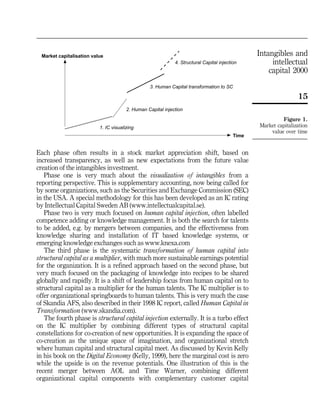
         This might be a guiding vision based on the IC logic of sustainable earnings,
      to be seen as a tree with roots to be cultivated for the future financial fruits, and
      as the IC value scheme with its various IC components, as well as the extended
      organizational capital development prototyped in the Skandia Future Center
      (see Figure 1).
Market capitalisation value                                                                     Intangibles and
                                                              4. Structural Capital injection          intellectual
                                                                                                      capital 2000
                                                  3. Human Capital transformation to SC

                                                                                                                  15
                                        2. Human Capital injection

                                                                                                           Figure 1.
                           1. IC visualizing                                                      Market capitalization
                                                                                                      value over time
                                                                                           Time


Each phase often results in a stock market appreciation shift, based on
increased transparency, as well as new expectations from the future value
creation of the intangibles investment.
   Phase one is very much about the visualization of intangibles from a
reporting perspective. This is supplementary accounting, now being called for
by some organizations, such as the Securities and Exchange Commission (SEC)
in the USA. A special methodology for this has been developed as an IC rating
by Intellectual Capital Sweden AB (www.intellectualcapital.se).
   Phase two is very much focused on human capital injection, often labelled
competence adding or knowledge management. It is both the search for talents
to be added, e.g. by mergers between companies, and the effectiveness from
knowledge sharing and installation of IT based knowledge systems, or
emerging knowledge exchanges such as www.knexa.com
   The third phase is the systematic transformation of human capital into
structural capital as a multiplier, with much more sustainable earnings potential
for the organization. It is a refined approach based on the second phase, but
very much focused on the packaging of knowledge into recipes to be shared
globally and rapidly. It is a shift of leadership focus from human capital on to
structural capital as a multiplier for the human talents. The IC multiplier is to
offer organizational springboards to human talents. This is very much the case
of Skandia AFS, also described in their 1998 IC report, called Human Capital in
Transformation (www.skandia.com).
   The fourth phase is structural capital injection externally. It is a turbo effect
on the IC multiplier by combining different types of structural capital
constellations for co-creation of new opportunities. It is expanding the space of
co-creation as the unique space of imagination, and organizational stretch
where human capital and structural capital meet. As discussed by Kevin Kelly
in his book on the Digital Economy (Kelly, 1999), here the marginal cost is zero
while the upside is on the revenue potentials. One illustration of this is the
recent merger between AOL and Time Warner, combining different
organizational capital components with complementary customer capital
JIC   potentials. Another illustration might be the proposed Deutsche Bank and
1,1   Mannesman alliance for new mobile and Internet banking. It is a shift of
      perspective from a local and physical focus to a global and intangible focus that
      will shape innovative prime movers. There also is the new, more intangible
      intellectual entrepreneurship, such as in the TIME (telecom, informatics, media
      and entertainment) sector.
16       These discernible phases of global IC growth are gradually increasing the
      value creation potential of organizations. The intangible or hidden values of the
      organizational competencies will be developed around fast learning,
      organizational networking and relationship building, as well as ethos and
      aesthetics for the brain, leading to more of a symbolic management and
      meaning of leadership.
         The challenge for the IC leadership, both on a corporate level and society
      level, is therefore both to shape the context for these growth phases, each of
      them being a huge challenge, and also to communicate these intangible value
      phases to the stakeholders in a repetitive, auditable and trustworthy way. Just
      as the old accounting system might be viewed as the first generation of
      knowledge management tools, now it is time for another generation focused on
      intellectual capital.

      References
      Hock, D.W. (1999), Birth of the Chaordic Age, Berrett-Koehler Publishing, San Francisco, CA.
      Jensen, R. (1999), The Dream Society: How the Coming Shift from Information to Imagination will
             Transform Your Business, McGraw-Hill, New York, NY.
      Kelly, K. (1999), New Rules for the New Economy: 10 Radical Strategies for a Connected World,
             Penguin, USA.
      Lev, B. (1997), ``The old rules no longer apply'', Forbes, 7 April.

Some perspectives on ic

  • 1.
    The current issueand full text archive of this journal is available at http://www.emerald-library.com JIC 1,1 Some perspectives on intangibles and intellectual capital 2000 12 Leif Edvinsson UNIC (Universal Networking Intellectual Capital), Stockholm, Sweden Keywords Intellectual capital, Organizational structure, Human capital Abstract After posing some questions regarding the nature of intellectual capital, the paper explores IC through observing the changes in market dynamics and organizational structure. An IC growth model is discussed which involves visualizing IC, human capital injection, human capital transformation into structural capital, and structural capital injection. Emerging questions ± a kind of IC quest When thinking about intellectual capital, the following questions come to mind: . What are the hidden value drivers of nations or regions? Does the old economics help to explain this? . Do we really see or have a taxonomy to describe the value drivers of companies on the stock exchange? . How do we explain the growing gap between market capitalization value and book value? . Is there another pattern of value creation and new business logic emerging, other than the often-quoted value chain logic? . Is IC about value creation versus cost savings? Is it about outside the firm versus inside the firm? Is it about communities or corporations? . Is IC only about knowledge and competence management? Or is it about future earnings capabilities and potentials? Some market observations It might look as if there is a new economy. But could it just be a new sphere for value creation? The so-called intangible sphere or intellectual capital sphere. Looking at some of the investment patterns in the USA, based on research from Professor Baruch Lev (1997) at Stern University, New York, shows a very different investment perspective since 1929. Then approximately 70 per cent of the USA investments went into tangible goods and some 30 per cent into intangibles. However, by 1990 this pattern was inverted, and today the dominant investments, both in the USA and Sweden, go into intangibles, such as R&D, education and competencies, IT software and the Internet. On average, Journal of Intellectual Capital, more than 10 per cent of GDP in OECD countries is estimated to go into Vol. 1 No. 1, 2000, pp. 12-16. # MCB University Press, 1469-1930 intangibles or IC. For countries like Sweden this input is estimated to be more
  • 2.
    than 20 percent of GDP. It is becoming more and more essential to visualize the Intangibles and IC of nations. intellectual This is also reflected in stock prices. According to Professor Baruch Lev capital 2000 (1997) , the average relationship between market value and book value in the late 1970s was one time, in the mid-1990s it had increased to an average of three times, and now it is more than six times the book value. For some companies, like America Online (AOL) and Microsoft, around 90 per cent of their market 13 capitalization value is in intangibles. Such intangibles or IC might be visualized systematically as has been done by Skandia, as well as Turn IT, a stock market listed company in Stockholm. Furthermore, a big proportion of the global stock market value is in PC companies, estimated to have a joint market capitalization of some US$6,000 billion. This value might then be contrasted by the global market capitalization of Internet companies, estimated to be only US$1,000 billion, i.e. around 15 per cent of that for PC companies. What will the future earnings potential of those companies be versus PC companies? These aspects are leading, among other things, to the fact that a growing proportion of policy and political initiatives, both at the company and society level, often are distorted due to lack of a relevant map of statistics, accounting figures related to intangibles, value impact and effectiveness. Therefore, several global initiatives, such as that of the Brookings Institute in Washington, are addressing these issues. Some organizational observations Industrial value chain processes no longer dominate value creation. Value creation is in the shaping of information, knowledge and innovations ± sometimes grouped under the label of intellectual properties (IP). Value creation or value extraction of such intangibles is also often done through another business logic in the shape of value constellations with temporary role participants, leading experts or unique artists. The flow is increasingly going digital in the form of e-commerce. This new type of value transaction has been projected to grow some 15 times over the next three years. The metaphor for this transition is sometimes described as a shift from bricks and mortars to clicks and portals. In this emerging business world, small business operations interacting in knowledge clusters and global networks employ and engage people, while large corporations deploy them, The average proportion of self-employed people, often referred to as knowledge nomads, in the Group of Seven countries is estimated to be 11 per cent by Hamish Mcrae, London. In the UK this figure is already 15 per cent. Just imagine the potential trend in Asia for free, self- organizing knowledge nomads. Furthermore, Asia is expected to have about 100 per cent more Internet users than the USA within five years. The new economical sphere will be shaped by the soon-to-be 700 million new users in myriads of organizational combinations solving old problems, shaping new opportunities.
  • 3.
    JIC This trend will change the way value-creating interactions are done. New 1,1 organizational rules will emerge, such as much looser organizational structures based on the Internet. The Internet is described by Eric S. Raymond less as a global cathedral and more as a self-organizing bazaar. Sometimes described as chaordic ones by Dee W. Hock (1999), they are characterized by a combination of order and chaos. It is also a tremendous power shift, challenging traditional 14 management of both corporations and societies to a transformation policy ± to see the options to reshape the existing to something new and better. Old intangibles and intellectual properties such as brands might get new values through mergers with new companies with global soft technology assets. One illustration of this is the merger between Time Warner and AOL. The value creation is going to be in shaping new ideas, exchanging information globally, and interacting through networks with high organizational speed in order to take action. Therefore, it might be more relevant to visualize the new economical sphere from a biological perspective, as a nervous system with energy flows and cells being split, mutated and evolving. It describes life, renewal and movements. Consequently, it will highlight the institutional failures versus the emerging global networks. According to the report by Stall from the corporate executive board in Washington, 45 per cent of failure is related to strategic neglect, 38 per cent is related to organizational ineffectiveness and only 17 per cent is related to exogenous factors. In other words, a lack of organizational renewal or bad organizational float. Owing to demographical development there is also an emerging talent war. One of the leadership consequences is the need to focus competence and talent inflow by development of organizational or societal attractiveness, instead of competitiveness as a key driver for value constellations and value networks. This will result in more and more management attention on culture, values, ethos and story telling around intangibles (versus traditional historical cost accounting). Sometimes this is also described as an emerging Dream Society, according to Professor Rolf Jensen (1999), Copenhagen, Denmark, in a recent book with the same title. Global growth curve of IC The following pattern of market capitalization growth and IC global growth phases might be discernible. They are based on the above global context evolution and the personal experiences of being the world's first director of intellectual capital, starting in 1991 at Skandia AFS. There the IC value has grown from a very minimal value in the early 1990s into some US$15 billion at the beginning of the year 2000. This might be a guiding vision based on the IC logic of sustainable earnings, to be seen as a tree with roots to be cultivated for the future financial fruits, and as the IC value scheme with its various IC components, as well as the extended organizational capital development prototyped in the Skandia Future Center (see Figure 1).
  • 4.
    Market capitalisation value Intangibles and 4. Structural Capital injection intellectual capital 2000 3. Human Capital transformation to SC 15 2. Human Capital injection Figure 1. 1. IC visualizing Market capitalization value over time Time Each phase often results in a stock market appreciation shift, based on increased transparency, as well as new expectations from the future value creation of the intangibles investment. Phase one is very much about the visualization of intangibles from a reporting perspective. This is supplementary accounting, now being called for by some organizations, such as the Securities and Exchange Commission (SEC) in the USA. A special methodology for this has been developed as an IC rating by Intellectual Capital Sweden AB (www.intellectualcapital.se). Phase two is very much focused on human capital injection, often labelled competence adding or knowledge management. It is both the search for talents to be added, e.g. by mergers between companies, and the effectiveness from knowledge sharing and installation of IT based knowledge systems, or emerging knowledge exchanges such as www.knexa.com The third phase is the systematic transformation of human capital into structural capital as a multiplier, with much more sustainable earnings potential for the organization. It is a refined approach based on the second phase, but very much focused on the packaging of knowledge into recipes to be shared globally and rapidly. It is a shift of leadership focus from human capital on to structural capital as a multiplier for the human talents. The IC multiplier is to offer organizational springboards to human talents. This is very much the case of Skandia AFS, also described in their 1998 IC report, called Human Capital in Transformation (www.skandia.com). The fourth phase is structural capital injection externally. It is a turbo effect on the IC multiplier by combining different types of structural capital constellations for co-creation of new opportunities. It is expanding the space of co-creation as the unique space of imagination, and organizational stretch where human capital and structural capital meet. As discussed by Kevin Kelly in his book on the Digital Economy (Kelly, 1999), here the marginal cost is zero while the upside is on the revenue potentials. One illustration of this is the recent merger between AOL and Time Warner, combining different organizational capital components with complementary customer capital
  • 5.
    JIC potentials. Another illustration might be the proposed Deutsche Bank and 1,1 Mannesman alliance for new mobile and Internet banking. It is a shift of perspective from a local and physical focus to a global and intangible focus that will shape innovative prime movers. There also is the new, more intangible intellectual entrepreneurship, such as in the TIME (telecom, informatics, media and entertainment) sector. 16 These discernible phases of global IC growth are gradually increasing the value creation potential of organizations. The intangible or hidden values of the organizational competencies will be developed around fast learning, organizational networking and relationship building, as well as ethos and aesthetics for the brain, leading to more of a symbolic management and meaning of leadership. The challenge for the IC leadership, both on a corporate level and society level, is therefore both to shape the context for these growth phases, each of them being a huge challenge, and also to communicate these intangible value phases to the stakeholders in a repetitive, auditable and trustworthy way. Just as the old accounting system might be viewed as the first generation of knowledge management tools, now it is time for another generation focused on intellectual capital. References Hock, D.W. (1999), Birth of the Chaordic Age, Berrett-Koehler Publishing, San Francisco, CA. Jensen, R. (1999), The Dream Society: How the Coming Shift from Information to Imagination will Transform Your Business, McGraw-Hill, New York, NY. Kelly, K. (1999), New Rules for the New Economy: 10 Radical Strategies for a Connected World, Penguin, USA. Lev, B. (1997), ``The old rules no longer apply'', Forbes, 7 April.