Eng. Mo`tasem Abushanap
  To get a list of the muslim scientistis, please go to
http://en.wikipedia.org/wiki/List_of_Muslim_astronomers

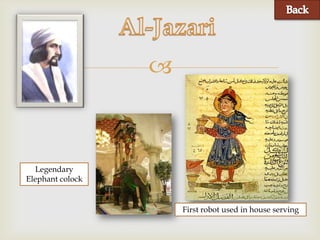
    a Muslim polymath: a scholar, inventor, mechanical engineer, craftsman, artist, mathematician


                                                 
     and astronomer from Al-Jazira, Mesopotamia, who lived during the Islamic Golden Age (Middle
     Ages). He is best known for writing the Kitáb fí ma'rifat al-hiyal al-handasiyya (Book of Knowledge of
     Ingenious Mechanical Devices) in 1206, where he described fifty mechanical devices along with
     instructions on how to construct them.
 His Works:
 Camshaft
The camshaft, a shaft to which cams are attached, was first introduced in 1206 by al-Jazari, who
employed them in his automata, water clocks (such as the candle clock) and water-raising machines.
The cam and camshaft later appeared in European mechanisms from the 14th century
 Crankshaft and crank-slider mechanism
The eccentrically mounted handle of the rotary handmill in 5th century BC Spain that spread across
the Roman Empire constitutes a crank.[10] The earliest evidence of a crank and connecting rod
mechanism dates to the 3rd century AD Hierapolis sawmill in the Roman Empire.[10] The crank also
appears in the mid-9th century in several of the hydraulic devices described by the Banū Mūsā
brothers in their Book of Ingenious Devices
 Escapement mechanism in a rotating wheel
al-Jazari invented a method for controlling the speed of rotation of a wheel using an escapement
mechanism.
 Segmental gear
A segmental gear is "a piece for receiving or communicating reciprocating motion from or to a
cogwheel, consisting of a sector of a circular gear, or ring, having cogs on the periphery

 Water-raising machines
Al-Jazari invented five machines for raising water,[21] as well as watermills and water wheels
with cams on their axle used to operate automata,[22] in the 12th and 13th centuries, and
described them in 1206. It was in these water-raising machines that he introduced his most
important ideas and components.
 Double-action suction pump with valves and reciprocating piston motion
 The first known use of a true suction pipe (which sucks fluids into a partial vacuum) in a
     pump.
 The first application of the double-acting principle.
 The conversion of rotary to reciprocating motion, via the crank-connecting rod mechanism.
 Automata
 al-Jazari built automated moving peacocks driven by hydropower.[29] He also invented the
     earliest known automatic gates, which were driven by hydropower.[28] He also created
     automatic doors as part of one of his elaborate water clocks,[1] and designed and
     constructed a number of other automata, including automatic machines, home
     appliances, and musical automata powered by water.[30] He also invented water wheels
     with cams on their axle used to operate automata.[22] According to Encyclopædia
     Britannica, the Italian Renaissance inventor Leonardo da Vinci may have been influenced
     by the classic automata of al-Jazari



  Legendary
Elephant colock


                      First robot used in house serving

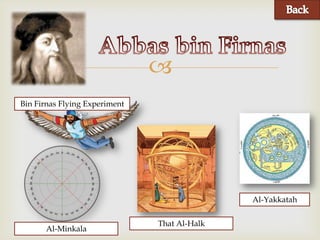
 Muslim Andalusian polymath:[1][2] an
    inventor, engineer, aviator,physician, Arabic poet, and Andalusian
    musician.[2] Of Berber descent, he was born in Izn-Rand Onda, Al-Andalus
    (today's Ronda, Spain), and lived in the Emirate of Córdoba. He is known
    for an early attempt at aviation
1- Al-Yaqatta: machine to know the time, works on hydraulics.
2- Al-Mankala: Engineering tool to know the time.
3- That Al-Halk: machine like Istterlabs, used to detect sun, moon and other
stars and planets, and their orbits.
4- Sky Dome: Beautiful paintings in the house, seems to be the sky and its
contents, and there he did the first simulation of lighting and thunder.
5- was the first to produce glass from stone and sand.
6- was the first one who thought about flying (1000 years before wrights
brothers), and he was the first astronaut, and he invented the first flying
machine.

Bin Firnas Flying Experiment


                                              Al-Yakkatah

                               That Al-Halk
      Al-Minkala

 Abu Asa`d, A`bdulrahman bin Yunus Al-Sadafi Al-Misri,
  born in Egypt in 950, and dead there in 1009.
 One of the most famous Arabs astrology scientists.
 He was the first to invent Pendulum(before Galileo by 600
  years), and he established a space center in Fostat.
 He Proofed the increases in moon motion, calculated the
  slope of horoscopes, so it came much accurate than any
  other calculations been done before the new astronomic
  devices, and one of the moon crater in the dark side has
  his name.


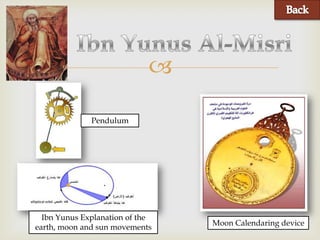
              Pendulum


  Ibn Yunus Explanation of the
                                 Moon Calendaring device
earth, moon and sun movements

 Mohammed, Ahmed and Al-Hassan bin Mousa bin
  Shakir.
 Mathematicians, astrologists, and mechanical
  engineers, From Iran (Khorasan), lived in the 9th
  century, and get connected to Al-Ma`moun
  Khalifet, there works attracted many scientists, doctors
  and translators.
 Mohammad bin Mousa (803-873), was brilliant in
  astrology, engineering, geographic and physics.
 Ahmed bin Mousa (803-873), was brilliant in
  engineering and mechanics.
 Al-Hassan bin Mousa (810-873), get used in engineering
  and geography.

 Their works:
 they studied CENTER of GRAVITIY.
 The specified the ways to use the carried body, the point that the
  weight of the body get balance with the carrier.
 They invented a method to divide the angle into 3 equal parts.
 They invent the method to draw the ellipse.
 They calculated the circumference of earth.
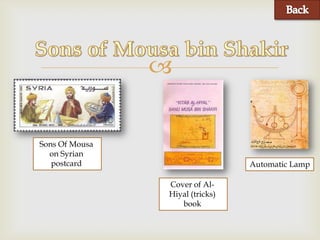
 Ahmed bin Mousa, invented a Lamp, works automatically and cant be
  off by the wind.
 For full explanations:
 ar.wikipedia.org/wiki/
 en.wikipedia.org/wiki/Mūsā_ibn_Shākir



Sons Of Mousa
  on Syrian
   postcard                      Automatic Lamp

                Cover of Al-
                Hiyal (tricks)
                   book

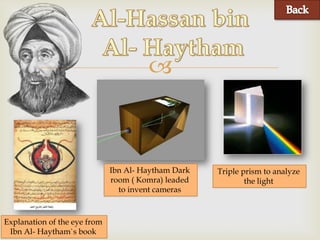
 Al- Hassan bin Al-Haytham ( 965-
  1040), mathematician, optical
  expert, Physician, anatomical, astrologist, Engineer, Doc
  tor, Oculist, Philosopher, Psychologist, and the other
  sciences in general, he did his experiments according to
  the scientific conditions and methods, and he has many
  books and scientific discoveries that had been approved
  by the modern science.
 He proofed that light comes from the bodies to the
  eye, not vice versa.
 He put the principle of cameras.
 He was the first to dissection eyes and explained jobs of
  its organs.

 Was the first to study psychology effects and factors of vision.
 In his book(Al- Manather), he showed a 4th order equation about light
  reflection on spherical mirrors, which is still known as “Ibn Al- Haytham`s
  Equation”.
 He made samples showing the movements of the 7 planets.
 He made a manuscript of the universe creation.
 In his book( Rissala fi al Makan) he proved moving bodies theory or as we
  know it newton's first law, so he said that the bodies always in motion
  unless it has been interrupted by another object so it is stopped, reduced
  its velocity, or changed direction, and that was 700 years before newton.
 He developed the analytical engineering, connect al- gebra with
  engineering, and he discovered a way to add the first 100 natural
  number, and he used engineering evidence to prove it.
 For more:
 www.ibnalhaytham.net/
 en.wikipedia.org/wiki/Alhazen



                              Ibn Al- Haytham Dark   Triple prism to analyze
                              room ( Komra) leaded           the light
                                to invent cameras


Explanation of the eye from
 Ibn Al- Haytham`s book

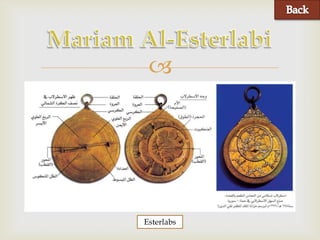
 Mariam Al- Esterlabi daughter of Koshyar al-
  Jili, Lived in the 10th century in Aleppo, Northern of
  Syria, worked on astrology in the Palace of Saif Al-
  Dawla(944-967), in that period, she developed the
  sophisticated Al- Esterlab device, which was the
  principle of todays compass and satellites.



Esterlabs

                                 
 Eng-motasem@hotmail.com
 Eng_motasem@yahoo.com
 Amman-Jordan
 Istanbul-Turkey
 Engineer: Mo’tasem Abushanap

Muslim scientists

  • 1.
    Eng. Mo`tasem Abushanap To get a list of the muslim scientistis, please go to http://en.wikipedia.org/wiki/List_of_Muslim_astronomers
  • 2.
  • 3.
    a Muslim polymath: a scholar, inventor, mechanical engineer, craftsman, artist, mathematician  and astronomer from Al-Jazira, Mesopotamia, who lived during the Islamic Golden Age (Middle Ages). He is best known for writing the Kitáb fí ma'rifat al-hiyal al-handasiyya (Book of Knowledge of Ingenious Mechanical Devices) in 1206, where he described fifty mechanical devices along with instructions on how to construct them.  His Works:  Camshaft The camshaft, a shaft to which cams are attached, was first introduced in 1206 by al-Jazari, who employed them in his automata, water clocks (such as the candle clock) and water-raising machines. The cam and camshaft later appeared in European mechanisms from the 14th century  Crankshaft and crank-slider mechanism The eccentrically mounted handle of the rotary handmill in 5th century BC Spain that spread across the Roman Empire constitutes a crank.[10] The earliest evidence of a crank and connecting rod mechanism dates to the 3rd century AD Hierapolis sawmill in the Roman Empire.[10] The crank also appears in the mid-9th century in several of the hydraulic devices described by the Banū Mūsā brothers in their Book of Ingenious Devices  Escapement mechanism in a rotating wheel al-Jazari invented a method for controlling the speed of rotation of a wheel using an escapement mechanism.  Segmental gear A segmental gear is "a piece for receiving or communicating reciprocating motion from or to a cogwheel, consisting of a sector of a circular gear, or ring, having cogs on the periphery
  • 4.
      Water-raising machines Al-Jazariinvented five machines for raising water,[21] as well as watermills and water wheels with cams on their axle used to operate automata,[22] in the 12th and 13th centuries, and described them in 1206. It was in these water-raising machines that he introduced his most important ideas and components.  Double-action suction pump with valves and reciprocating piston motion  The first known use of a true suction pipe (which sucks fluids into a partial vacuum) in a pump.  The first application of the double-acting principle.  The conversion of rotary to reciprocating motion, via the crank-connecting rod mechanism.  Automata  al-Jazari built automated moving peacocks driven by hydropower.[29] He also invented the earliest known automatic gates, which were driven by hydropower.[28] He also created automatic doors as part of one of his elaborate water clocks,[1] and designed and constructed a number of other automata, including automatic machines, home appliances, and musical automata powered by water.[30] He also invented water wheels with cams on their axle used to operate automata.[22] According to Encyclopædia Britannica, the Italian Renaissance inventor Leonardo da Vinci may have been influenced by the classic automata of al-Jazari
  • 5.
     Legendary Elephantcolock First robot used in house serving
  • 6.
      Muslim Andalusianpolymath:[1][2] an inventor, engineer, aviator,physician, Arabic poet, and Andalusian musician.[2] Of Berber descent, he was born in Izn-Rand Onda, Al-Andalus (today's Ronda, Spain), and lived in the Emirate of Córdoba. He is known for an early attempt at aviation 1- Al-Yaqatta: machine to know the time, works on hydraulics. 2- Al-Mankala: Engineering tool to know the time. 3- That Al-Halk: machine like Istterlabs, used to detect sun, moon and other stars and planets, and their orbits. 4- Sky Dome: Beautiful paintings in the house, seems to be the sky and its contents, and there he did the first simulation of lighting and thunder. 5- was the first to produce glass from stone and sand. 6- was the first one who thought about flying (1000 years before wrights brothers), and he was the first astronaut, and he invented the first flying machine.
  • 7.
     Bin Firnas FlyingExperiment Al-Yakkatah That Al-Halk Al-Minkala
  • 8.
      Abu Asa`d,A`bdulrahman bin Yunus Al-Sadafi Al-Misri, born in Egypt in 950, and dead there in 1009.  One of the most famous Arabs astrology scientists.  He was the first to invent Pendulum(before Galileo by 600 years), and he established a space center in Fostat.  He Proofed the increases in moon motion, calculated the slope of horoscopes, so it came much accurate than any other calculations been done before the new astronomic devices, and one of the moon crater in the dark side has his name.
  • 9.
    Pendulum Ibn Yunus Explanation of the Moon Calendaring device earth, moon and sun movements
  • 10.
      Mohammed, Ahmedand Al-Hassan bin Mousa bin Shakir.  Mathematicians, astrologists, and mechanical engineers, From Iran (Khorasan), lived in the 9th century, and get connected to Al-Ma`moun Khalifet, there works attracted many scientists, doctors and translators.  Mohammad bin Mousa (803-873), was brilliant in astrology, engineering, geographic and physics.  Ahmed bin Mousa (803-873), was brilliant in engineering and mechanics.  Al-Hassan bin Mousa (810-873), get used in engineering and geography.
  • 11.
      Their works: they studied CENTER of GRAVITIY.  The specified the ways to use the carried body, the point that the weight of the body get balance with the carrier.  They invented a method to divide the angle into 3 equal parts.  They invent the method to draw the ellipse.  They calculated the circumference of earth.  Ahmed bin Mousa, invented a Lamp, works automatically and cant be off by the wind.  For full explanations:  ar.wikipedia.org/wiki/  en.wikipedia.org/wiki/Mūsā_ibn_Shākir
  • 12.
     Sons Of Mousa on Syrian postcard Automatic Lamp Cover of Al- Hiyal (tricks) book
  • 13.
      Al- Hassanbin Al-Haytham ( 965- 1040), mathematician, optical expert, Physician, anatomical, astrologist, Engineer, Doc tor, Oculist, Philosopher, Psychologist, and the other sciences in general, he did his experiments according to the scientific conditions and methods, and he has many books and scientific discoveries that had been approved by the modern science.  He proofed that light comes from the bodies to the eye, not vice versa.  He put the principle of cameras.  He was the first to dissection eyes and explained jobs of its organs.
  • 14.
      Was thefirst to study psychology effects and factors of vision.  In his book(Al- Manather), he showed a 4th order equation about light reflection on spherical mirrors, which is still known as “Ibn Al- Haytham`s Equation”.  He made samples showing the movements of the 7 planets.  He made a manuscript of the universe creation.  In his book( Rissala fi al Makan) he proved moving bodies theory or as we know it newton's first law, so he said that the bodies always in motion unless it has been interrupted by another object so it is stopped, reduced its velocity, or changed direction, and that was 700 years before newton.  He developed the analytical engineering, connect al- gebra with engineering, and he discovered a way to add the first 100 natural number, and he used engineering evidence to prove it.  For more:  www.ibnalhaytham.net/  en.wikipedia.org/wiki/Alhazen
  • 15.
    Ibn Al- Haytham Dark Triple prism to analyze room ( Komra) leaded the light to invent cameras Explanation of the eye from Ibn Al- Haytham`s book
  • 16.
      Mariam Al-Esterlabi daughter of Koshyar al- Jili, Lived in the 10th century in Aleppo, Northern of Syria, worked on astrology in the Palace of Saif Al- Dawla(944-967), in that period, she developed the sophisticated Al- Esterlab device, which was the principle of todays compass and satellites.
  • 17.
  • 18.
      Eng-motasem@hotmail.com  Eng_motasem@yahoo.com  Amman-Jordan  Istanbul-Turkey  Engineer: Mo’tasem Abushanap