Chapter 5: The Renaissance Era in Music
1450 - 1600
The Renaissance Period
• Time frame
• Began in Italy around 1350
• Later spread to northern Europe
• Musical developments began around 1450
• Renaissance Definition: “Reawakening”
• Inspired by ancient Greece and Rome
• Personal achievement, intellectual
independence, discovery
New Attitudes
Humanism – prime importance placed on human
rather than spiritual matters
Exploration – men like Cortez and Columbus seeking
riches and new lands
Classicism – inspired by antiquities
Reformation – 16th
Cent. Mvt. for reform in Catholic
Church, which ended in founding of Protestant Church
Education – invention of printing press made books
accessible for many more people
Renaissance = “Rebirth”
Revival of ancient Greek and Roman culture, especially art and
literature
New focus on human experience
scientific method based on observation
arts guided by sensory experience
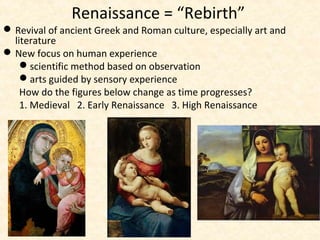
How do the figures below change as time progresses?
1. Medieval 2. Early Renaissance 3. High Renaissance
Humanism
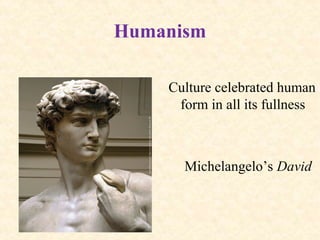
Culture celebrated human
form in all its fullness
Michelangelo’s David
Humanism
• Definition: Emphasis on personal achievement,
intellectual independence, discovery, science
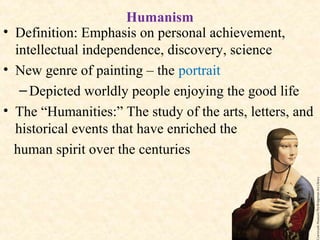
• New genre of painting – the portrait
–Depicted worldly people enjoying the good life
• The “Humanities:” The study of the arts, letters, and
historical events that have enriched the
human spirit over the centuries
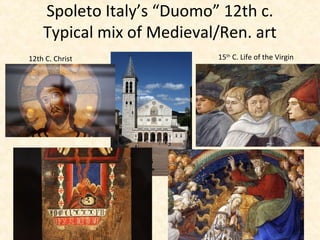
Spoleto Italy’s “Duomo” 12th c.
Typical mix of Medieval/Ren. art
12th C. Christ 15th
C. Life of the Virgin
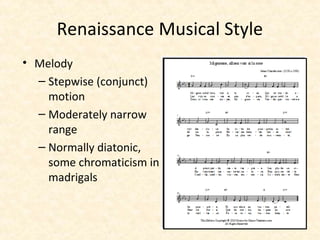
Renaissance Musical Style
• Melody
– Stepwise (conjunct)
motion
– Moderately narrow
range
– Normally diatonic,
some chromaticism in
madrigals
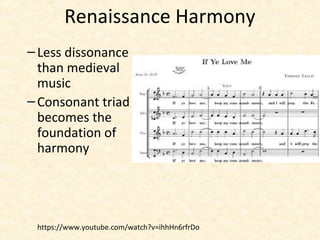
Renaissance Harmony
–Less dissonance
than medieval
music
–Consonant triad
becomes the
foundation of
harmony
https://www.youtube.com/watch?v=ihhHn6rfrDo
Rhythm
Duple meter common
as triple meter
Rhythm in sacred
music relaxed, without
strong downbeats
Rhythm in secular
music (vocal and
instrumental)
Lively
Frequent use of
syncopation
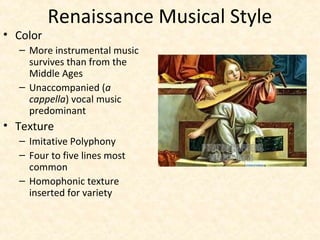
Renaissance Musical Style
• Color
– More instrumental music
survives than from the
Middle Ages
– Unaccompanied (a
cappella) vocal music
predominant
• Texture
– Imitative Polyphony
– Four to five lines most
common
– Homophonic texture
inserted for variety
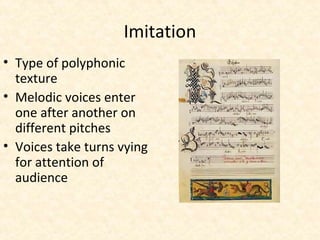
Imitation
• Type of polyphonic
texture
• Melodic voices enter
one after another on
different pitches
• Voices take turns vying
for attention of
audience
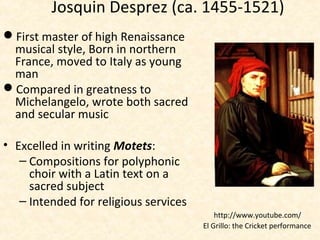
Josquin Desprez (ca. 1455-1521)
First master of high Renaissance
musical style, Born in northern
France, moved to Italy as young
man
Compared in greatness to
Michelangelo, wrote both sacred
and secular music
• Excelled in writing Motets:
– Compositions for polyphonic
choir with a Latin text on a
sacred subject
– Intended for religious services
http://www.youtube.com/
El Grillo: the Cricket performance
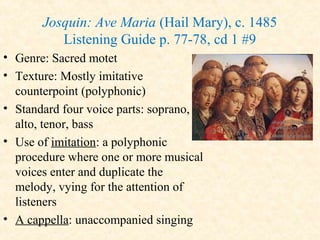
Josquin: Ave Maria (Hail Mary), c. 1485
Listening Guide p. 77-78, cd 1 #9
• Genre: Sacred motet
• Texture: Mostly imitative
counterpoint (polyphonic)
• Standard four voice parts: soprano,
alto, tenor, bass
• Use of imitation: a polyphonic
procedure where one or more musical
voices enter and duplicate the
melody, vying for the attention of
listeners
• A cappella: unaccompanied singing
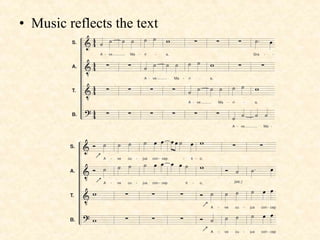
• Music reflects the text
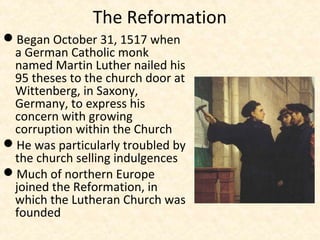
The Reformation
Began October 31, 1517 when
a German Catholic monk
named Martin Luther nailed his
95 theses to the church door at
Wittenberg, in Saxony,
Germany, to express his
concern with growing
corruption within the Church
He was particularly troubled by
the church selling indulgences
Much of northern Europe
joined the Reformation, in
which the Lutheran Church was
founded
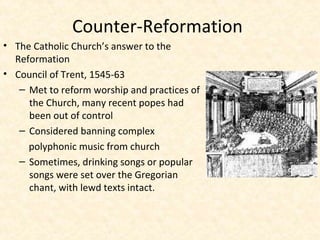
Counter-Reformation
• The Catholic Church’s answer to the
Reformation
• Council of Trent, 1545-63
– Met to reform worship and practices of
the Church, many recent popes had
been out of control
– Considered banning complex
polyphonic music from church
– Sometimes, drinking songs or popular
songs were set over the Gregorian
chant, with lewd texts intact.
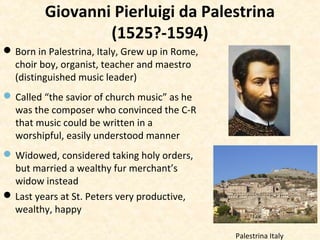
Giovanni Pierluigi da Palestrina
(1525?-1594)
Born in Palestrina, Italy, Grew up in Rome,
choir boy, organist, teacher and maestro
(distinguished music leader)
Called “the savior of church music” as he
was the composer who convinced the C-R
that music could be written in a
worshipful, easily understood manner
Widowed, considered taking holy orders,
but married a wealthy fur merchant’s
widow instead
Last years at St. Peters very productive,
wealthy, happy
Palestrina Italy
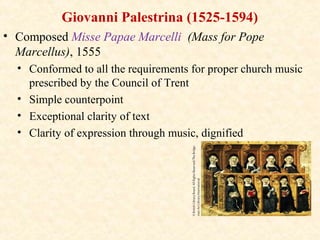
Giovanni Palestrina (1525-1594)
• Composed Misse Papae Marcelli (Mass for Pope
Marcellus), 1555
• Conformed to all the requirements for proper church music
prescribed by the Council of Trent
• Simple counterpoint
• Exceptional clarity of text
• Clarity of expression through music, dignified
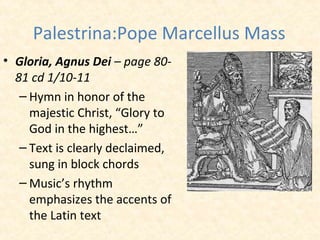
Palestrina:Pope Marcellus Mass
• Gloria, Agnus Dei – page 80-
81 cd 1/10-11
– Hymn in honor of the
majestic Christ, “Glory to
God in the highest…”
– Text is clearly declaimed,
sung in block chords
– Music’s rhythm
emphasizes the accents of
the Latin text
(No notes)
Gloria, Agnus Dei
Palestrina Pope Marcellus Mass
https://www.youtube.com/watch?v=mUiYFNIIl8s
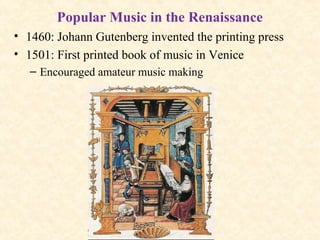
Popular Music in the Renaissance
• 1460: Johann Gutenberg invented the printing press
• 1501: First printed book of music in Venice
– Encouraged amateur music making
Popular Renaissance Dance
Genres:
• Pavane
solemn dance, slow duple meter, formal stepping
and stopping
• Galliard
lively dance, fast triple meter, kicking and leaping
steps
• Jig
very fast dance in compound meter
Pavane and Galliard,
page 82, cd #1/12 - 13
• Pavane is in slow duple meter, 3 phrases, each
one repeats
– ornamentation of repeats
• Galliard is in fast triple meter, 3 phrases, each
one repeats
– ornamentation of repeats
• (Listen to these on your cd’s)
No notes for this slide
YouTube video of Pavane and Galliard
•Listen for meter, tempo
•Observe how different the dances
look
https://www.youtube.com/watch?v=BXZrT4fMgFk
Will Kemp’s Jig
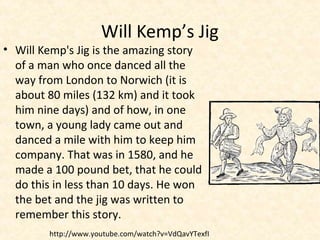
• Will Kemp's Jig is the amazing story
of a man who once danced all the
way from London to Norwich (it is
about 80 miles (132 km) and it took
him nine days) and of how, in one
town, a young lady came out and
danced a mile with him to keep him
company. That was in 1580, and he
made a 100 pound bet, that he could
do this in less than 10 days. He won
the bet and the jig was written to
remember this story.
http://www.youtube.com/watch?v=VdQavYTexfI
Genre: Madrigal
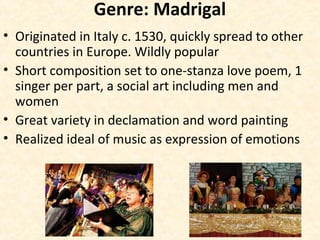
• Originated in Italy c. 1530, quickly spread to other
countries in Europe. Wildly popular
• Short composition set to one-stanza love poem, 1
singer per part, a social art including men and
women
• Great variety in declamation and word painting
• Realized ideal of music as expression of emotions
Word Painting
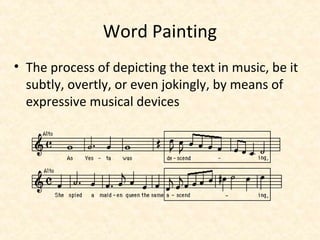
• The process of depicting the text in music, be it
subtly, overtly, or even jokingly, by means of
expressive musical devices
Thomas Weelkes, Madrigalist (1576-
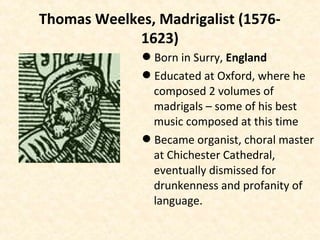
1623)
Born in Surry, England
Educated at Oxford, where he
composed 2 volumes of
madrigals – some of his best
music composed at this time
Became organist, choral master
at Chichester Cathedral,
eventually dismissed for
drunkenness and profanity of
language.
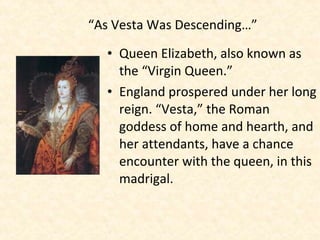
• Queen Elizabeth, also known as
the “Virgin Queen.”
• England prospered under her long
reign. “Vesta,” the Roman
goddess of home and hearth, and
her attendants, have a chance
encounter with the queen, in this
madrigal.
“As Vesta Was Descending…”
Weelkes, “As Vesta Was Descending”
Listening Guide p. 83-84 cd 1 #14
• Simple rhythms
• Clear harmonies
• Crisp, engaging melodic motives
• Accurate declamation
• Frequent word painting
http://www.youtube.com/watch?v=S_VkA_qk9os

5 listening renaissance

  • 1.
    Chapter 5: TheRenaissance Era in Music 1450 - 1600
  • 2.
    The Renaissance Period •Time frame • Began in Italy around 1350 • Later spread to northern Europe • Musical developments began around 1450 • Renaissance Definition: “Reawakening” • Inspired by ancient Greece and Rome • Personal achievement, intellectual independence, discovery
  • 3.
    New Attitudes Humanism –prime importance placed on human rather than spiritual matters Exploration – men like Cortez and Columbus seeking riches and new lands Classicism – inspired by antiquities Reformation – 16th Cent. Mvt. for reform in Catholic Church, which ended in founding of Protestant Church Education – invention of printing press made books accessible for many more people
  • 4.
    Renaissance = “Rebirth” Revivalof ancient Greek and Roman culture, especially art and literature New focus on human experience scientific method based on observation arts guided by sensory experience How do the figures below change as time progresses? 1. Medieval 2. Early Renaissance 3. High Renaissance
  • 5.
    Humanism Culture celebrated human formin all its fullness Michelangelo’s David
  • 6.
    Humanism • Definition: Emphasison personal achievement, intellectual independence, discovery, science • New genre of painting – the portrait –Depicted worldly people enjoying the good life • The “Humanities:” The study of the arts, letters, and historical events that have enriched the human spirit over the centuries
  • 7.
    Spoleto Italy’s “Duomo”12th c. Typical mix of Medieval/Ren. art 12th C. Christ 15th C. Life of the Virgin
  • 8.
    Renaissance Musical Style •Melody – Stepwise (conjunct) motion – Moderately narrow range – Normally diatonic, some chromaticism in madrigals
  • 9.
    Renaissance Harmony –Less dissonance thanmedieval music –Consonant triad becomes the foundation of harmony https://www.youtube.com/watch?v=ihhHn6rfrDo
  • 10.
    Rhythm Duple meter common astriple meter Rhythm in sacred music relaxed, without strong downbeats Rhythm in secular music (vocal and instrumental) Lively Frequent use of syncopation
  • 11.
    Renaissance Musical Style •Color – More instrumental music survives than from the Middle Ages – Unaccompanied (a cappella) vocal music predominant • Texture – Imitative Polyphony – Four to five lines most common – Homophonic texture inserted for variety
  • 12.
    Imitation • Type ofpolyphonic texture • Melodic voices enter one after another on different pitches • Voices take turns vying for attention of audience
  • 13.
    Josquin Desprez (ca.1455-1521) First master of high Renaissance musical style, Born in northern France, moved to Italy as young man Compared in greatness to Michelangelo, wrote both sacred and secular music • Excelled in writing Motets: – Compositions for polyphonic choir with a Latin text on a sacred subject – Intended for religious services http://www.youtube.com/ El Grillo: the Cricket performance
  • 14.
    Josquin: Ave Maria(Hail Mary), c. 1485 Listening Guide p. 77-78, cd 1 #9 • Genre: Sacred motet • Texture: Mostly imitative counterpoint (polyphonic) • Standard four voice parts: soprano, alto, tenor, bass • Use of imitation: a polyphonic procedure where one or more musical voices enter and duplicate the melody, vying for the attention of listeners • A cappella: unaccompanied singing
  • 15.
  • 16.
    The Reformation Began October31, 1517 when a German Catholic monk named Martin Luther nailed his 95 theses to the church door at Wittenberg, in Saxony, Germany, to express his concern with growing corruption within the Church He was particularly troubled by the church selling indulgences Much of northern Europe joined the Reformation, in which the Lutheran Church was founded
  • 17.
    Counter-Reformation • The CatholicChurch’s answer to the Reformation • Council of Trent, 1545-63 – Met to reform worship and practices of the Church, many recent popes had been out of control – Considered banning complex polyphonic music from church – Sometimes, drinking songs or popular songs were set over the Gregorian chant, with lewd texts intact.
  • 18.
    Giovanni Pierluigi daPalestrina (1525?-1594) Born in Palestrina, Italy, Grew up in Rome, choir boy, organist, teacher and maestro (distinguished music leader) Called “the savior of church music” as he was the composer who convinced the C-R that music could be written in a worshipful, easily understood manner Widowed, considered taking holy orders, but married a wealthy fur merchant’s widow instead Last years at St. Peters very productive, wealthy, happy Palestrina Italy
  • 19.
    Giovanni Palestrina (1525-1594) •Composed Misse Papae Marcelli (Mass for Pope Marcellus), 1555 • Conformed to all the requirements for proper church music prescribed by the Council of Trent • Simple counterpoint • Exceptional clarity of text • Clarity of expression through music, dignified
  • 20.
    Palestrina:Pope Marcellus Mass •Gloria, Agnus Dei – page 80- 81 cd 1/10-11 – Hymn in honor of the majestic Christ, “Glory to God in the highest…” – Text is clearly declaimed, sung in block chords – Music’s rhythm emphasizes the accents of the Latin text
  • 21.
    (No notes) Gloria, AgnusDei Palestrina Pope Marcellus Mass https://www.youtube.com/watch?v=mUiYFNIIl8s
  • 22.
    Popular Music inthe Renaissance • 1460: Johann Gutenberg invented the printing press • 1501: First printed book of music in Venice – Encouraged amateur music making
  • 23.
    Popular Renaissance Dance Genres: •Pavane solemn dance, slow duple meter, formal stepping and stopping • Galliard lively dance, fast triple meter, kicking and leaping steps • Jig very fast dance in compound meter
  • 24.
    Pavane and Galliard, page82, cd #1/12 - 13 • Pavane is in slow duple meter, 3 phrases, each one repeats – ornamentation of repeats • Galliard is in fast triple meter, 3 phrases, each one repeats – ornamentation of repeats • (Listen to these on your cd’s)
  • 25.
    No notes forthis slide YouTube video of Pavane and Galliard •Listen for meter, tempo •Observe how different the dances look https://www.youtube.com/watch?v=BXZrT4fMgFk
  • 26.
    Will Kemp’s Jig •Will Kemp's Jig is the amazing story of a man who once danced all the way from London to Norwich (it is about 80 miles (132 km) and it took him nine days) and of how, in one town, a young lady came out and danced a mile with him to keep him company. That was in 1580, and he made a 100 pound bet, that he could do this in less than 10 days. He won the bet and the jig was written to remember this story. http://www.youtube.com/watch?v=VdQavYTexfI
  • 27.
    Genre: Madrigal • Originatedin Italy c. 1530, quickly spread to other countries in Europe. Wildly popular • Short composition set to one-stanza love poem, 1 singer per part, a social art including men and women • Great variety in declamation and word painting • Realized ideal of music as expression of emotions
  • 28.
    Word Painting • Theprocess of depicting the text in music, be it subtly, overtly, or even jokingly, by means of expressive musical devices
  • 29.
    Thomas Weelkes, Madrigalist(1576- 1623) Born in Surry, England Educated at Oxford, where he composed 2 volumes of madrigals – some of his best music composed at this time Became organist, choral master at Chichester Cathedral, eventually dismissed for drunkenness and profanity of language.
  • 30.
    • Queen Elizabeth,also known as the “Virgin Queen.” • England prospered under her long reign. “Vesta,” the Roman goddess of home and hearth, and her attendants, have a chance encounter with the queen, in this madrigal. “As Vesta Was Descending…”
  • 31.
    Weelkes, “As VestaWas Descending” Listening Guide p. 83-84 cd 1 #14 • Simple rhythms • Clear harmonies • Crisp, engaging melodic motives • Accurate declamation • Frequent word painting http://www.youtube.com/watch?v=S_VkA_qk9os

Editor's Notes

  • #5 Middle Ages taught everyone that their reward was in the next life. Suffering was everywhere (plagues, poverty, poor health due to bad living conditions) The Renaissance was a celebration of life on Earth and of the senses and knowledge freed minds from superstitions of Middle Ages Golden age: Brunelleschi, Botticelli, Titian, Donatello, Raphael, Michelangelo, da Vinci Inspired by the ancients, artists depicted their world with a new realism New ideals and values focus on human experience and perception Observation the basis of scientific method Sensory experience guided the arts
  • #7 Figure 6.4 Leonardo da Vinci’s portrait of Cecilia Gallerani, called The Lady with the Ermine (1496). Cecilia was the mistress of the duke of Milan, Leonardo’s patron, and she clearly enjoyed the finer things in life, including clothing, jewelry, and exotic animals like the ermine, or mink, that she holds.
  • #8 medieval theology is represented by the blood from Christ's wounds running into the skull of Adam at the bottom -signed in 1187 by Alberto Sotio - the earliest Umbrian painter known by name. The 12th-century apse is beautifully decorated with the 15th-century Life of the Virgin fresco cycle by Filippo Lippi Filippino Lippi (c. 1457 – April 1504)
  • #10 Sacred anthem: If ye love me,keep my commandments,and I will pray the Father,and he shall give you another comforter,that he may bide with you forever,e'en the spirit of truth.
  • #11 Anon: Galliard
  • #13 Start here on Wednesday
  • #14 The Cricket (youtube), Josquin is widely considered by music scholars to be the first master of the high Renaissance style of polyphonic vocal music that was emerging during his lifetime.During the 16th century, Josquin gradually acquired the reputation as the greatest composer of the age, his mastery of technique and expression universally imitated and admired.
  • #17 A German monk by the name of Martin Luther was particularly bothered by the selling of indulgences. An indulgence, a religious pardon that released a sinner from performing specific penalties, could be bought from a church official for various fees. Martin Luther was especially troubled because some church officials gave people the impression that they could buy their way into heaven. To express his growing concern of church corruption, Martin Luther wrote his famous 95 Theses, which called for a full reform of the Christian Church. Indulgences: Giving alms to poor or other needy in exchange for forgiveness of sins
  • #18 16th-century Ecumenical Council of the Roman Catholic Church. It is considered to be one of the Church's most important[1] councils. It convened in Trento (then capital of the Prince-Bishopric of Trent, inside the Holy Roman Empire, now in modern Italy) between December 13, 1545, and December 4, 1563 in twenty-five sessions for three periods.
  • #20 Figure 6.8 Although public church choirs in the Middle Ages and Renaissance were all-male ensembles, women could be heard at home and at court. And women, too, sang in churches, specifically in convents, where they performed all of the chant and, when required, polyphony. In this illumination from a fifteenth-century English manuscript, nuns sing from their choir stalls.