Music as Math
Ancient views on Music
The ancient Greeks first saw music as a
phenomenon to be analyzed rather than as art to be
appreciated. The philosopher Pythagoras viewed music
as a branch of Mathematics. He and his followers
were the first to understand the relationship
between the pitch of a note and the length of the
string that produced it. The Pythagoreans showed
that its pitch depended in the way in which the string
vibrated. These discoveries led to the science of
Acoustics, which is still studied today.
Pythagoras also found out that the striking of
blacksmiths on metal has an explanation; and that is
about ratios. Thus, he formulated the so called
Pythagorean Scale.
Pythagorean Scale
Around 500 BC Pythagoras studied the
musical scale and the ratios between the
lengths of vibrating strings needed to produce
them. Since the string length (for equal
tension) depends on 1/frequency, those ratios
also provide a relationship between the
frequencies of the notes. He developed what
may be the first completely mathematically
based scale which resulted by considering
intervals of the octave (a factor of 2 in
frequency) and intervals of fifths (a factor of
3/2 in frequency).
How is Music related to Math?
Mathematics is involved in some way in every field
of study known to mankind. In fact, it could be argued
that mathematics is involved in some way in
everything that exists everywhere, or even
everything that is imagined to exist in any conceivable
reality. Any possible or imagined situation that has
any relationship whatsoever to space, time, or
thought would also involve mathematics.
Music is a field of study that has an obvious
relationship to mathematics. Music is, to many people,
a nonverbal form of communication, that reaches past
the human intellect directly into the soul. However,
music is not really created by mankind, but only
discovered, manipulated and reorganized by mankind.
In reality, music is first and foremost a phenomena of
nature, a result of the principles of physics and
mathematics.
How is Music related to Math?
The math / music concepts explored
include:
• Fractions / rhythm
• Sets and intersecting sets / keys and
related keys
• The relationship between ratios, fractions,
and decimals / frequency and interval
• Roots and powers / equal temperament
tuning
How is Music related to Math?
Frequency and Wave Length
As shown by the University of New South Wales and the
Peabody Conservatory of Music, every pitch has a distinct
frequency. This means that every note has a specific
wavelength. Mathematicians are able to graph these waves,
creating visual, numeric representations of sound.
Duration
A music metronome marking indicates how many beats occur
per minute. For instance, if the metronome marking indicates
sixty beats per minute, then every beat has the duration of one
second. This means that all rests and notes in music involve
mathematical divisions and multiplications of time duration.
Specific note types indicate these divisions and multiplications.
For example, the duration of a whole note lasts four times as
long as a quarter note.
How is Music related to Math?
Counting
Musicians count beats as they perform as this ensures that
they will give the correct duration of time to each rest and
pitch. Counting beats also identifies precisely where the person
is in the music. For example, if a conductor tells an orchestra to
start "at the middle of the bar" this can be ambiguous, since
some music uses multiple time signatures and complex,
overlapping rhythms. If the conductor can explain with numbers
where he is in the music based on counting procedures (e.g., "on
beat four"), then he has eliminated this ambiguity.
Engineering
The University of New South Wales shows that musical
acoustics involves how sound waves bounce off surfaces in the
environment. Engineers thus examine the precise angles at which
sound waves will hit architectural surfaces in order to get the
clearest and most efficient sound production.
How is Music related to Math?
Instrument Production
In order to achieve a uniform pitch and establish playing standards,
instrument and reed manufacturers have to make sure that instruments and
reeds have the same basic dimensions. This means that they have to make
specific calculations to keep instruments and reeds the same shape and size. For
example, oboe players want the length of their reeds to be about 72 mm, since
reed length affects pitch.
Theory and Harmony
Since the time of Pythagoras, music developed as a relationship between
ratios of frequencies. For example, doubling the frequency of any pitch will give
a pitch exactly one octave higher than the original pitch. Human ears hear these
ratios as harmony. Over thousands of years, changes in the treatment of what
ratios make up a scale have changed what sounds "in tune." If it weren't for
these changes, musicians wouldn't be able to transpose well or have scales that
start on different pitches sound the same. Musicians also wouldn't have the
modern 12-tone row, where mathematical addition and subtraction is the basis of
every scale degree, since treatment of pitch ratios is what determines how many
notes are in a scale. Math thus is the foundation for much of music theory and
harmony.
Mathematics on Music
Notation is a method of writing down
music so that it can be performed
vocally and instrumentally. It is a kind
of code that allows other people to
interpret music. These symbols tells us
three basic things about music; how long
or short is the sound (duration), how
high or low is the sound (pitch), and
how should the music be played
(expression).
Mathematics on Music
The words we say and the notes we
sing have specific duration. Duration
refers to how long tone and silence last.
Some sound duration are short while
others are long. Duration is determined
by the kind of notes and rests used. In
relation to mathematics, fractions and
whole numbers can tell how this
duration works.
Mathematics on Music
Time Signatures and Rhythm
The most fundamental use of mathematics in Western
music is its application in rhythm. Nearly all Western
music operates within time signatures, or pulses that are
grouped into sections. Most commonly, these sections
(called "measures") come in groups of two, three or four,
but can come in groups of five or seven or complex sub-
groupings of smaller numbers. The choice of time
signature determines the feel of the pulse and rhythmical
lilt of the music.
Within the measures, the timing of the notes is
measured by notation that dictates rhythm in terms of
symbols that denote, essentially, fractions. When a
musician reads rhythms, he knows how long to hold each
note and rest by calculating what fraction of the whole
measure that note or rest is indicated to last.
Mathematics on Music
Counting and Conducting
In multi-player ensembles, musicians must
count and calculate the number of measures
and beats during which they don't play in order
to stay in time with the rest of the ensemble.
In very large ensembles, a conductor helps keep
track of the numbers of measures by waving his
baton (stick) in a repetitive numerical pattern
according to the time signature with each
pattern representing one measure.
Mathematics on Music
Intervals and Chords
Mathematics plays an important role in
the analysis of melody and harmony in
music. When music theorists search for
and discern patterns in how pitch is used in
music, the relationship of different
pitches to one another is discussed in
terms of intervals and scale degree
numbers. This allows theorists to keep
track of trends and apply knowledge of
patterns to new compositions.
Mathematics on Music
Contemporary Music
Contemporary and very recent Western
music uses mathematics in what is perhaps the
most complex manner. Prominent art composers
of the 20th century created new musical forms
based in mathematics. The most famous of
these forms is 12-tone music, a system of
composition wherein each of the pitches of the
Western scale are assigned numbers and a
mathematical matrix is written to determine
the order of the notes in a composition.
Fraction and Rhythm
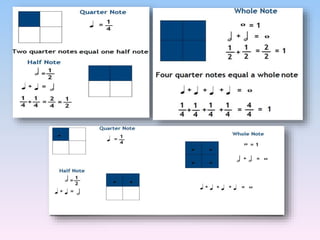
Fractions on music are the value of notes
in notation. This fractions will represent
how will the note beats.
Rhythm is a movement or procedure with
a uniform or patterned recurrence
of a beat, accent, or the like.
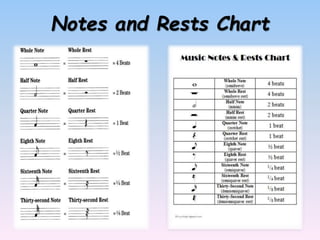
Notes and Rests Chart
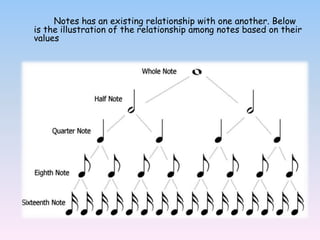
Notes has an existing relationship with one another. Below
is the illustration of the relationship among notes based on their
values
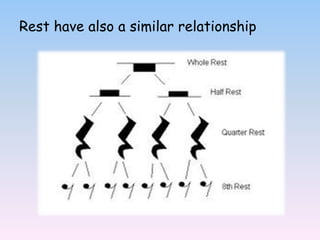
Rest have also a similar relationship
The End
Thank You for Watching.


Musicasmath kenjames11-140810225714-phpapp02

  • 1.
  • 2.
    Ancient views onMusic The ancient Greeks first saw music as a phenomenon to be analyzed rather than as art to be appreciated. The philosopher Pythagoras viewed music as a branch of Mathematics. He and his followers were the first to understand the relationship between the pitch of a note and the length of the string that produced it. The Pythagoreans showed that its pitch depended in the way in which the string vibrated. These discoveries led to the science of Acoustics, which is still studied today. Pythagoras also found out that the striking of blacksmiths on metal has an explanation; and that is about ratios. Thus, he formulated the so called Pythagorean Scale.
  • 3.
    Pythagorean Scale Around 500BC Pythagoras studied the musical scale and the ratios between the lengths of vibrating strings needed to produce them. Since the string length (for equal tension) depends on 1/frequency, those ratios also provide a relationship between the frequencies of the notes. He developed what may be the first completely mathematically based scale which resulted by considering intervals of the octave (a factor of 2 in frequency) and intervals of fifths (a factor of 3/2 in frequency).
  • 4.
    How is Musicrelated to Math? Mathematics is involved in some way in every field of study known to mankind. In fact, it could be argued that mathematics is involved in some way in everything that exists everywhere, or even everything that is imagined to exist in any conceivable reality. Any possible or imagined situation that has any relationship whatsoever to space, time, or thought would also involve mathematics. Music is a field of study that has an obvious relationship to mathematics. Music is, to many people, a nonverbal form of communication, that reaches past the human intellect directly into the soul. However, music is not really created by mankind, but only discovered, manipulated and reorganized by mankind. In reality, music is first and foremost a phenomena of nature, a result of the principles of physics and mathematics.
  • 5.
    How is Musicrelated to Math? The math / music concepts explored include: • Fractions / rhythm • Sets and intersecting sets / keys and related keys • The relationship between ratios, fractions, and decimals / frequency and interval • Roots and powers / equal temperament tuning
  • 6.
    How is Musicrelated to Math? Frequency and Wave Length As shown by the University of New South Wales and the Peabody Conservatory of Music, every pitch has a distinct frequency. This means that every note has a specific wavelength. Mathematicians are able to graph these waves, creating visual, numeric representations of sound. Duration A music metronome marking indicates how many beats occur per minute. For instance, if the metronome marking indicates sixty beats per minute, then every beat has the duration of one second. This means that all rests and notes in music involve mathematical divisions and multiplications of time duration. Specific note types indicate these divisions and multiplications. For example, the duration of a whole note lasts four times as long as a quarter note.
  • 7.
    How is Musicrelated to Math? Counting Musicians count beats as they perform as this ensures that they will give the correct duration of time to each rest and pitch. Counting beats also identifies precisely where the person is in the music. For example, if a conductor tells an orchestra to start "at the middle of the bar" this can be ambiguous, since some music uses multiple time signatures and complex, overlapping rhythms. If the conductor can explain with numbers where he is in the music based on counting procedures (e.g., "on beat four"), then he has eliminated this ambiguity. Engineering The University of New South Wales shows that musical acoustics involves how sound waves bounce off surfaces in the environment. Engineers thus examine the precise angles at which sound waves will hit architectural surfaces in order to get the clearest and most efficient sound production.
  • 8.
    How is Musicrelated to Math? Instrument Production In order to achieve a uniform pitch and establish playing standards, instrument and reed manufacturers have to make sure that instruments and reeds have the same basic dimensions. This means that they have to make specific calculations to keep instruments and reeds the same shape and size. For example, oboe players want the length of their reeds to be about 72 mm, since reed length affects pitch. Theory and Harmony Since the time of Pythagoras, music developed as a relationship between ratios of frequencies. For example, doubling the frequency of any pitch will give a pitch exactly one octave higher than the original pitch. Human ears hear these ratios as harmony. Over thousands of years, changes in the treatment of what ratios make up a scale have changed what sounds "in tune." If it weren't for these changes, musicians wouldn't be able to transpose well or have scales that start on different pitches sound the same. Musicians also wouldn't have the modern 12-tone row, where mathematical addition and subtraction is the basis of every scale degree, since treatment of pitch ratios is what determines how many notes are in a scale. Math thus is the foundation for much of music theory and harmony.
  • 9.
    Mathematics on Music Notationis a method of writing down music so that it can be performed vocally and instrumentally. It is a kind of code that allows other people to interpret music. These symbols tells us three basic things about music; how long or short is the sound (duration), how high or low is the sound (pitch), and how should the music be played (expression).
  • 10.
    Mathematics on Music Thewords we say and the notes we sing have specific duration. Duration refers to how long tone and silence last. Some sound duration are short while others are long. Duration is determined by the kind of notes and rests used. In relation to mathematics, fractions and whole numbers can tell how this duration works.
  • 11.
    Mathematics on Music TimeSignatures and Rhythm The most fundamental use of mathematics in Western music is its application in rhythm. Nearly all Western music operates within time signatures, or pulses that are grouped into sections. Most commonly, these sections (called "measures") come in groups of two, three or four, but can come in groups of five or seven or complex sub- groupings of smaller numbers. The choice of time signature determines the feel of the pulse and rhythmical lilt of the music. Within the measures, the timing of the notes is measured by notation that dictates rhythm in terms of symbols that denote, essentially, fractions. When a musician reads rhythms, he knows how long to hold each note and rest by calculating what fraction of the whole measure that note or rest is indicated to last.
  • 12.
    Mathematics on Music Countingand Conducting In multi-player ensembles, musicians must count and calculate the number of measures and beats during which they don't play in order to stay in time with the rest of the ensemble. In very large ensembles, a conductor helps keep track of the numbers of measures by waving his baton (stick) in a repetitive numerical pattern according to the time signature with each pattern representing one measure.
  • 13.
    Mathematics on Music Intervalsand Chords Mathematics plays an important role in the analysis of melody and harmony in music. When music theorists search for and discern patterns in how pitch is used in music, the relationship of different pitches to one another is discussed in terms of intervals and scale degree numbers. This allows theorists to keep track of trends and apply knowledge of patterns to new compositions.
  • 14.
    Mathematics on Music ContemporaryMusic Contemporary and very recent Western music uses mathematics in what is perhaps the most complex manner. Prominent art composers of the 20th century created new musical forms based in mathematics. The most famous of these forms is 12-tone music, a system of composition wherein each of the pitches of the Western scale are assigned numbers and a mathematical matrix is written to determine the order of the notes in a composition.
  • 15.
    Fraction and Rhythm Fractionson music are the value of notes in notation. This fractions will represent how will the note beats. Rhythm is a movement or procedure with a uniform or patterned recurrence of a beat, accent, or the like.
  • 16.
  • 17.
    Notes has anexisting relationship with one another. Below is the illustration of the relationship among notes based on their values
  • 18.
    Rest have alsoa similar relationship
  • 20.
    The End Thank Youfor Watching. 