GROUP MEMBERS-
 ZION- PROJECT LEADER
 TYRESE-CHIEF RESEARCHER
 MUSKAN-COMMUNICATIONS DIRECTOR
 GHAZAL-DIGITAL ENGINEER
“Mathematics is involved
in some way in every field
of study known to
mankind. In fact, it could
be argued that
mathematics is involved
in some way in everything
that exists everywhere, or
even everything that is
imagined to exist in any
conceivable reality. Any
possible or imagined
situation that has any
relationship whatsoever to
space, time, or thought
would also involve
mathematics.”
Math is related to everything including music. Math
relates to the rhythm, keys, and tuning. When you are
listening to music, you count the beats. When you
play the piano, you can count the keys as numbers.
The piano needs to be constructed in a way so that
when the key is hit a specific frequency is given off
frequency is measured in hertz. The 'math' of rhythm
is about the time values (note lengths);
whole, half, quarter, eighth, sixteenth, just keep
halving that and you have the nearly the whole idea.
The maths of meter, time signatures, is one of simple
fractions.
Music is a field of study that has an obvious
relationship to mathematics. Music is, to many
people, a nonverbal form of communication, that
reaches past the human intellect directly into the soul.
However, music is not really created by mankind, but
only discovered, manipulated and reorganized by
mankind. In reality, music is first and foremost a
phenomena of nature, a result of the principles of
physics and mathematics. Maths and music are
usually organized into two separate
categories, without obvious overlap.
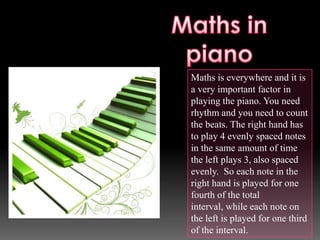
Maths is everywhere and it is
a very important factor in
playing the piano. You need
rhythm and you need to count
the beats. The right hand has
to play 4 evenly spaced notes
in the same amount of time
the left plays 3, also spaced
evenly. So each note in the
right hand is played for one
fourth of the total
interval, while each note on
the left is played for one third
of the interval.
The ‘Math' of Intervals is the distance from one pitch
to another. Intervals are 'measured' by the number of
half steps between two pitches (the distance
between any key on the keyboard on the immediate
neighbour is a half step.) Knowing the number of
letter names and how many half-steps there are
between one note and another are what allow you
to determine the interval, and what 'quality,' it
has, i.e. major, minor, diminished, augmented.
Learning intervals is simply counting and
memorizing, not anywhere near a 'math function.‘
For acoustics, the physics of sound, a much greater
degree of maths is involved. For general music
reading, writing and performing, the maths required
are basic counting, simple fractions and that is it.
You may have heard the maths / music point
exaggerated as if the combination of the two were a
key to understanding the universe.
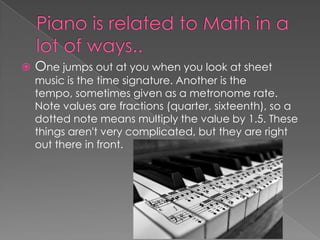
   One jumps out at you when you look at sheet
    music is the time signature. Another is the
    tempo, sometimes given as a metronome rate.
    Note values are fractions (quarter, sixteenth), so a
    dotted note means multiply the value by 1.5. These
    things aren't very complicated, but they are right
    out there in front.
   A little less visible but even more important is the
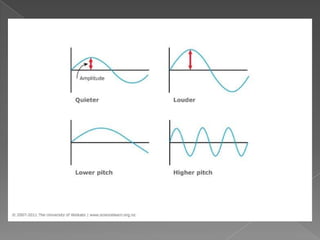
    matter of pitch. A pitch is created by a vibration. In
    the case of your piano, middle A vibrates a string
    440 times a second. Physicists call this a frequency
    of 440 hertz, or 440 cycles per second.
   If you go up an octave, you double the
    frequency. Other intervals are other ratios.
    Going up a fifth (from A to E) multiplies the
    frequency by 3/2, so E is (about) 660 hertz.
    The Greeks discovered that two strings
    played together sounded pleasant if the
    lengths of the strings were in ratios of small
    whole numbers: 2:1 (octave), 3:2 (fifth), 4:3
    (fourth), 5:4 (third).
   The interval from A to E (a fifth), in equal
    tempering, isn't exactly 3/2 = 1.5, but 2^(7/12) =
    1.4983. (The "^" represents an exponent.) The
    interval of a fourth isn't 4/3 = 1.3333, but 2^(5/12) =
    1.3348. The interval of a third isn't 5/4 = 1.25, but
    2^(4/12) = 1.2599. I won't say exactly what equal
    tempering is, but you might be able to figure it out
    from what I said, depending on your math level.
    Equal tempering is related to a "logarithmic scale."
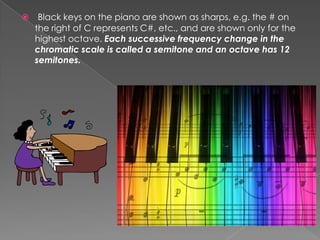
    Black keys on the piano are shown as sharps, e.g. the # on
    the right of C represents C#, etc., and are shown only for the
    highest octave. Each successive frequency change in the
    chromatic scale is called a semitone and an octave has 12
    semitones.
   The word chord here means two notes whose frequency ratio
    is a small integer. Except for multiples of these basic
    chords, integers larger than about 10 produce chords not
    readily recognizable to the ear.
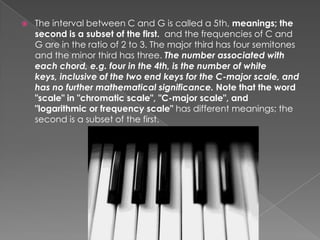
   The interval between C and G is called a 5th, meanings; the
    second is a subset of the first. and the frequencies of C and
    G are in the ratio of 2 to 3. The major third has four semitones
    and the minor third has three. The number associated with
    each chord, e.g. four in the 4th, is the number of white
    keys, inclusive of the two end keys for the C-major scale, and
    has no further mathematical significance. Note that the word
    "scale" in "chromatic scale", "C-major scale", and
    "logarithmic or frequency scale" has different meanings; the
    second is a subset of the first.
   |--Octave--
    CDEFGAB
    1
                  We can see from the " to an octave above that
   |--5th--      a 4th and a 5th "add up and a major 3rd and a
    CDEF
    2             minor 3rd "add up" to a 5th. Note that this is an
   |--4th--
    GAB
                  addition in logarithmic space. The missing integer
    3             7.
   |-Maj.3rd-
    C#D#
    4
   |-Min.3rd-
    EF#
    5
   |
    G#A#B
    6
   |
    C
    8
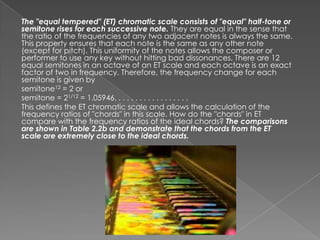
The "equal tempered" (ET) chromatic scale consists of "equal" half-tone or
semitone rises for each successive note. They are equal in the sense that
the ratio of the frequencies of any two adjacent notes is always the same.
This property ensures that each note is the same as any other note
(except for pitch). This uniformity of the notes allows the composer or
performer to use any key without hitting bad dissonances. There are 12
equal semitones in an octave of an ET scale and each octave is an exact
factor of two in frequency. Therefore, the frequency change for each
semitone is given by
semitone12 = 2 or
semitone = 21/12 = 1.05946. . . . . . . . . . . . . . . . . .
This defines the ET chromatic scale and allows the calculation of the
frequency ratios of "chords" in this scale. How do the "chords" in ET
compare with the frequency ratios of the ideal chords? The comparisons
are shown in Table 2.2b and demonstrate that the chords from the ET
scale are extremely close to the ideal chords.
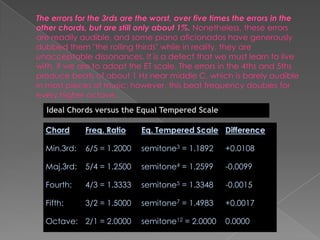
Ideal Chords versus the Equal Tempered Scale

Chord      Freq. Ratio    Eq. Tempered Scale Difference

Min.3rd:   6/5 = 1.2000   semitone3 = 1.1892    +0.0108

Maj.3rd:   5/4 = 1.2500   semitone4 = 1.2599    -0.0099

Fourth:    4/3 = 1.3333   semitone5 = 1.3348    -0.0015

Fifth:     3/2 = 1.5000   semitone7 = 1.4983    +0.0017

Octave: 2/1 = 2.0000      semitone12 = 2.0000   0.0000
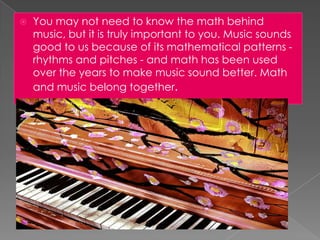
   You may not need to know the math behind
    music, but it is truly important to you. Music sounds
    good to us because of its mathematical patterns -
    rhythms and pitches - and math has been used
    over the years to make music sound better. Math
    and music belong together.
Made by-
Zion
Tyrese
GhazalAbdullah
Muskan Sethi

Group F

  • 2.
    GROUP MEMBERS-  ZION-PROJECT LEADER  TYRESE-CHIEF RESEARCHER  MUSKAN-COMMUNICATIONS DIRECTOR  GHAZAL-DIGITAL ENGINEER
  • 4.
    “Mathematics is involved insome way in every field of study known to mankind. In fact, it could be argued that mathematics is involved in some way in everything that exists everywhere, or even everything that is imagined to exist in any conceivable reality. Any possible or imagined situation that has any relationship whatsoever to space, time, or thought would also involve mathematics.”
  • 5.
    Math is relatedto everything including music. Math relates to the rhythm, keys, and tuning. When you are listening to music, you count the beats. When you play the piano, you can count the keys as numbers. The piano needs to be constructed in a way so that when the key is hit a specific frequency is given off frequency is measured in hertz. The 'math' of rhythm is about the time values (note lengths); whole, half, quarter, eighth, sixteenth, just keep halving that and you have the nearly the whole idea. The maths of meter, time signatures, is one of simple fractions.
  • 6.
    Music is afield of study that has an obvious relationship to mathematics. Music is, to many people, a nonverbal form of communication, that reaches past the human intellect directly into the soul. However, music is not really created by mankind, but only discovered, manipulated and reorganized by mankind. In reality, music is first and foremost a phenomena of nature, a result of the principles of physics and mathematics. Maths and music are usually organized into two separate categories, without obvious overlap.
  • 7.
    Maths is everywhereand it is a very important factor in playing the piano. You need rhythm and you need to count the beats. The right hand has to play 4 evenly spaced notes in the same amount of time the left plays 3, also spaced evenly. So each note in the right hand is played for one fourth of the total interval, while each note on the left is played for one third of the interval.
  • 8.
    The ‘Math' ofIntervals is the distance from one pitch to another. Intervals are 'measured' by the number of half steps between two pitches (the distance between any key on the keyboard on the immediate neighbour is a half step.) Knowing the number of letter names and how many half-steps there are between one note and another are what allow you to determine the interval, and what 'quality,' it has, i.e. major, minor, diminished, augmented. Learning intervals is simply counting and memorizing, not anywhere near a 'math function.‘ For acoustics, the physics of sound, a much greater degree of maths is involved. For general music reading, writing and performing, the maths required are basic counting, simple fractions and that is it. You may have heard the maths / music point exaggerated as if the combination of the two were a key to understanding the universe.
  • 10.
    One jumps out at you when you look at sheet music is the time signature. Another is the tempo, sometimes given as a metronome rate. Note values are fractions (quarter, sixteenth), so a dotted note means multiply the value by 1.5. These things aren't very complicated, but they are right out there in front.
  • 11.
    A little less visible but even more important is the matter of pitch. A pitch is created by a vibration. In the case of your piano, middle A vibrates a string 440 times a second. Physicists call this a frequency of 440 hertz, or 440 cycles per second.
  • 12.
    If you go up an octave, you double the frequency. Other intervals are other ratios. Going up a fifth (from A to E) multiplies the frequency by 3/2, so E is (about) 660 hertz. The Greeks discovered that two strings played together sounded pleasant if the lengths of the strings were in ratios of small whole numbers: 2:1 (octave), 3:2 (fifth), 4:3 (fourth), 5:4 (third).
  • 13.
    The interval from A to E (a fifth), in equal tempering, isn't exactly 3/2 = 1.5, but 2^(7/12) = 1.4983. (The "^" represents an exponent.) The interval of a fourth isn't 4/3 = 1.3333, but 2^(5/12) = 1.3348. The interval of a third isn't 5/4 = 1.25, but 2^(4/12) = 1.2599. I won't say exactly what equal tempering is, but you might be able to figure it out from what I said, depending on your math level. Equal tempering is related to a "logarithmic scale."
  • 14.
    Black keys on the piano are shown as sharps, e.g. the # on the right of C represents C#, etc., and are shown only for the highest octave. Each successive frequency change in the chromatic scale is called a semitone and an octave has 12 semitones.
  • 15.
    The word chord here means two notes whose frequency ratio is a small integer. Except for multiples of these basic chords, integers larger than about 10 produce chords not readily recognizable to the ear.
  • 16.
    The interval between C and G is called a 5th, meanings; the second is a subset of the first. and the frequencies of C and G are in the ratio of 2 to 3. The major third has four semitones and the minor third has three. The number associated with each chord, e.g. four in the 4th, is the number of white keys, inclusive of the two end keys for the C-major scale, and has no further mathematical significance. Note that the word "scale" in "chromatic scale", "C-major scale", and "logarithmic or frequency scale" has different meanings; the second is a subset of the first.
  • 17.
    |--Octave-- CDEFGAB 1 We can see from the " to an octave above that  |--5th-- a 4th and a 5th "add up and a major 3rd and a CDEF 2 minor 3rd "add up" to a 5th. Note that this is an  |--4th-- GAB addition in logarithmic space. The missing integer 3 7.  |-Maj.3rd- C#D# 4  |-Min.3rd- EF# 5  | G#A#B 6  | C 8
  • 18.
    The "equal tempered"(ET) chromatic scale consists of "equal" half-tone or semitone rises for each successive note. They are equal in the sense that the ratio of the frequencies of any two adjacent notes is always the same. This property ensures that each note is the same as any other note (except for pitch). This uniformity of the notes allows the composer or performer to use any key without hitting bad dissonances. There are 12 equal semitones in an octave of an ET scale and each octave is an exact factor of two in frequency. Therefore, the frequency change for each semitone is given by semitone12 = 2 or semitone = 21/12 = 1.05946. . . . . . . . . . . . . . . . . . This defines the ET chromatic scale and allows the calculation of the frequency ratios of "chords" in this scale. How do the "chords" in ET compare with the frequency ratios of the ideal chords? The comparisons are shown in Table 2.2b and demonstrate that the chords from the ET scale are extremely close to the ideal chords.
  • 19.
    Ideal Chords versusthe Equal Tempered Scale Chord Freq. Ratio Eq. Tempered Scale Difference Min.3rd: 6/5 = 1.2000 semitone3 = 1.1892 +0.0108 Maj.3rd: 5/4 = 1.2500 semitone4 = 1.2599 -0.0099 Fourth: 4/3 = 1.3333 semitone5 = 1.3348 -0.0015 Fifth: 3/2 = 1.5000 semitone7 = 1.4983 +0.0017 Octave: 2/1 = 2.0000 semitone12 = 2.0000 0.0000
  • 20.
    You may not need to know the math behind music, but it is truly important to you. Music sounds good to us because of its mathematical patterns - rhythms and pitches - and math has been used over the years to make music sound better. Math and music belong together.
  • 22.