Musculoskeletal History Taking
• Importance
• Structure
• Orthopedic hx
• History of treatment
Objective
By end of this session, you should be
able & know how to take a relevant history of
the major musculoskeletal conditions
History taking skills
• History taking is the most important step in
making a diagnosis.
• A clinician is:
 60% closer to a diagnosis with a thorough history.
 40% by (examination & investigations).
• History taking can either:
 Traumatic,
 Non-traumatic injury.
Structure Of History
• Demographic features
• Chief complaint
• History of presenting
illness
• Functional level
• MSK systemic review
• Systemic enquiry
• PMH
• PSH
• Drug Hx
• Smoking
• Occupational Hx
• Allergy
• Family Hx
• Social Hx
MSK systemic review
1. Pain
2. Stiffness.
3. Swelling
4. Instability
5. Deformity
6. Limp
7. Loss of function
8. Altered Sensation.
9. Weakness.
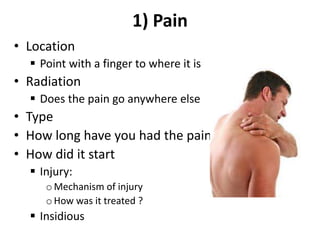
1) Pain
• Location
 Point with a finger to where it is
• Radiation
 Does the pain go anywhere else
• Type
• How long have you had the pain
• How did it start
 Injury:
oMechanism of injury
oHow was it treated ?
 Insidious
1) Pain
• Progression
 Is it better, worse or the same
• When
 Mechanical / Walking
 Rest
 Night
 Constant
• Aggravating & Relieving Factors
 Stairs
 Start up, mechanical
 Pain with twisting & turning
 Up & down hills
 Kneeling
 Squatting
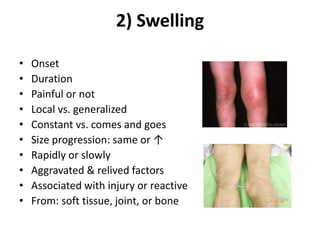
2) Swelling
• Onset
• Duration
• Painful or not
• Local vs. generalized
• Constant vs. comes and goes
• Size progression: same or ↑
• Rapidly or slowly
• Aggravated & relived factors
• Associated with injury or reactive
• From: soft tissue, joint, or bone
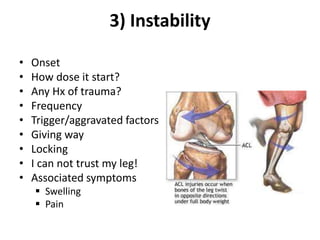
3) Instability
• Onset
• How dose it start?
• Any Hx of trauma?
• Frequency
• Trigger/aggravated factors
• Giving way
• Locking
• I can not trust my leg!
• Associated symptoms
 Swelling
 Pain
Mechanical symptoms
Locking / clicking
• Due:
 Loose body,
 Meniscal tear
• Locking vs. pseudo-
locking
Giving way
• Due:
 ACL
 Patella
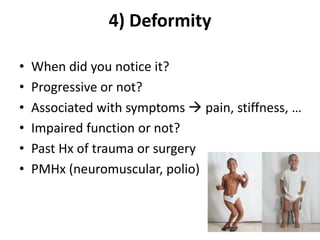
4) Deformity
• When did you notice it?
• Progressive or not?
• Associated with symptoms  pain, stiffness, …
• Impaired function or not?
• Past Hx of trauma or surgery
• PMHx (neuromuscular, polio)
5) Limping
• Onset (acute or chronic)
• Traumatic or non-traumatic ?
• Painful vs. painless
• Progressive or not ?
• Use walking aid ?
• Functional disability ?
• Associated  swelling, deformity, or fever.
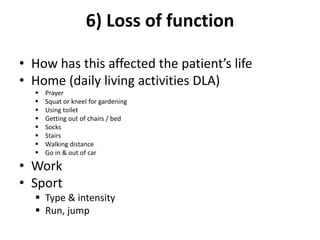
6) Loss of function
• How has this affected the patient’s life
• Home (daily living activities DLA)
 Prayer
 Squat or kneel for gardening
 Using toilet
 Getting out of chairs / bed
 Socks
 Stairs
 Walking distance
 Go in & out of car
• Work
• Sport
 Type & intensity
 Run, jump
Keep In Mind
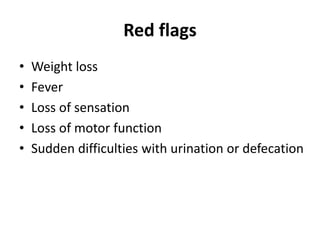
Red flags
• Weight loss
• Fever
• Loss of sensation
• Loss of motor function
• Sudden difficulties with urination or defecation
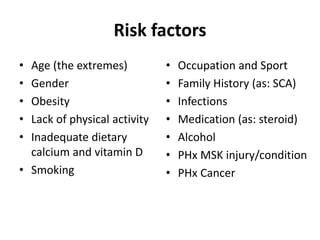
Risk factors
• Age (the extremes)
• Gender
• Obesity
• Lack of physical activity
• Inadequate dietary
calcium and vitamin D
• Smoking
• Occupation and Sport
• Family History (as: SCA)
• Infections
• Medication (as: steroid)
• Alcohol
• PHx MSK injury/condition
• PHx Cancer
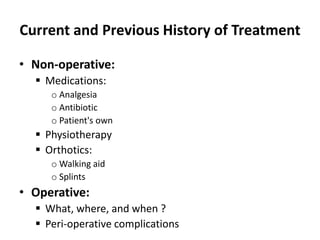
Current and Previous History of Treatment
• Non-operative:
 Medications:
o Analgesia
o Antibiotic
o Patient's own
 Physiotherapy
 Orthotics:
o Walking aid
o Splints
• Operative:
 What, where, and when ?
 Peri-operative complications
Now
You are able & know how to
take a relevant history of
the major MSK conditions

musculoskeletal history taking.ppt

  • 1.
    Musculoskeletal History Taking •Importance • Structure • Orthopedic hx • History of treatment
  • 2.
    Objective By end ofthis session, you should be able & know how to take a relevant history of the major musculoskeletal conditions
  • 3.
    History taking skills •History taking is the most important step in making a diagnosis. • A clinician is:  60% closer to a diagnosis with a thorough history.  40% by (examination & investigations). • History taking can either:  Traumatic,  Non-traumatic injury.
  • 4.
    Structure Of History •Demographic features • Chief complaint • History of presenting illness • Functional level • MSK systemic review • Systemic enquiry • PMH • PSH • Drug Hx • Smoking • Occupational Hx • Allergy • Family Hx • Social Hx
  • 5.
    MSK systemic review 1.Pain 2. Stiffness. 3. Swelling 4. Instability 5. Deformity 6. Limp 7. Loss of function 8. Altered Sensation. 9. Weakness.
  • 6.
    1) Pain • Location Point with a finger to where it is • Radiation  Does the pain go anywhere else • Type • How long have you had the pain • How did it start  Injury: oMechanism of injury oHow was it treated ?  Insidious
  • 7.
    1) Pain • Progression Is it better, worse or the same • When  Mechanical / Walking  Rest  Night  Constant • Aggravating & Relieving Factors  Stairs  Start up, mechanical  Pain with twisting & turning  Up & down hills  Kneeling  Squatting
  • 8.
    2) Swelling • Onset •Duration • Painful or not • Local vs. generalized • Constant vs. comes and goes • Size progression: same or ↑ • Rapidly or slowly • Aggravated & relived factors • Associated with injury or reactive • From: soft tissue, joint, or bone
  • 9.
    3) Instability • Onset •How dose it start? • Any Hx of trauma? • Frequency • Trigger/aggravated factors • Giving way • Locking • I can not trust my leg! • Associated symptoms  Swelling  Pain
  • 10.
    Mechanical symptoms Locking /clicking • Due:  Loose body,  Meniscal tear • Locking vs. pseudo- locking Giving way • Due:  ACL  Patella
  • 11.
    4) Deformity • Whendid you notice it? • Progressive or not? • Associated with symptoms  pain, stiffness, … • Impaired function or not? • Past Hx of trauma or surgery • PMHx (neuromuscular, polio)
  • 12.
    5) Limping • Onset(acute or chronic) • Traumatic or non-traumatic ? • Painful vs. painless • Progressive or not ? • Use walking aid ? • Functional disability ? • Associated  swelling, deformity, or fever.
  • 13.
    6) Loss offunction • How has this affected the patient’s life • Home (daily living activities DLA)  Prayer  Squat or kneel for gardening  Using toilet  Getting out of chairs / bed  Socks  Stairs  Walking distance  Go in & out of car • Work • Sport  Type & intensity  Run, jump
  • 14.
  • 15.
    Red flags • Weightloss • Fever • Loss of sensation • Loss of motor function • Sudden difficulties with urination or defecation
  • 16.
    Risk factors • Age(the extremes) • Gender • Obesity • Lack of physical activity • Inadequate dietary calcium and vitamin D • Smoking • Occupation and Sport • Family History (as: SCA) • Infections • Medication (as: steroid) • Alcohol • PHx MSK injury/condition • PHx Cancer
  • 17.
    Current and PreviousHistory of Treatment • Non-operative:  Medications: o Analgesia o Antibiotic o Patient's own  Physiotherapy  Orthotics: o Walking aid o Splints • Operative:  What, where, and when ?  Peri-operative complications
  • 18.
    Now You are able& know how to take a relevant history of the major MSK conditions