not a 101
#mumbrellaPFM
louder.com.a
good afternoon
me;
• andrew hughes
• from the UK, been in AU for 5 years
• worked media agency side for 4 years
delivering digital; search, social,
analytics, tech, data and programmatic
solutions
• @y0z2a for comments/discussion
louder;
• started in mid-2014
• independent
• working with;
– businesses of all walks
– with all vendors
• tech
• media
• data
louder.com.a
What Do Louder Think
louder.com.a
Image Credit: emotivebrand.com
our thinking - programmatic
• disclosed, and/or transparent is the right way from a marketers perspective
• marketers need to be prepared to pay for people, media, service and tech
• through the use of improved programmatic models, brands should see greater media
exposure for their $media spend & therefore improved returns
• programmatic is not just for acquisition – it delivers full funnel efficiency
• technology is driving transparency on every level – media cost / viewability /
attribution
more change management, less technology louder.com.a
our thinking - data
• ownership and control of your data is only way forward
• Remove almost all 3rd party tags, unless you control the data
• digital platforms need to be integrated and linked around a common anonymous ID
• it is useless modeling if you’re not going to action change
• you need people who know what they are doing
• data partnerships and mutually beneficial co-operatives will blossom
collect it, improve it, action it louder.com.a
our thinking - general
• brands should own their technology and data (both enable programmatic strategy) -
it can be informed and enhanced by 3rd parties, but ideally not controlled by them
• brands need to select and own the direction of their technology stack
– AdServer, conversion and general tag deployment
– DSP / exchange
– DMP / audience
– web analytics
– CMS / Cx
– Ux / CRO
– CRM / EDM
• media, digital and creative agencies (and some publishers) can help to deliver
How do we see it coming together? louder.com.a
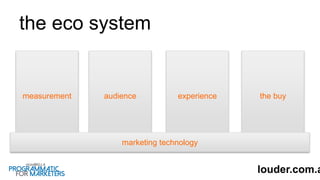
the eco system
measurement audience experience the buy
marketing technology
louder.com.a
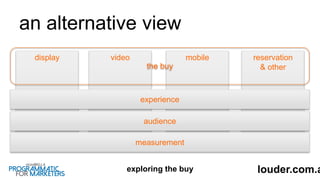
an alternative view
display video mobile reservation
& other
measurement
louder.com.a
audience
experience
the buy
exploring the buy
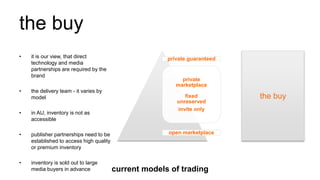
the buy
the buy
private guaranteed
private
marketplace
fixed
unreserved
invite only
open marketplace
• it is our view, that direct
technology and media
partnerships are required by the
brand
• the delivery team - it varies by
model
• in AU, inventory is not as
accessible
• publisher partnerships need to be
established to access high quality
or premium inventory
• inventory is sold out to large
media buyers in advance current models of trading
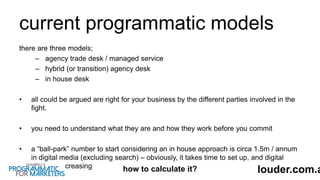
current programmatic models
there are three models;
– agency trade desk / managed service
– hybrid (or transition) agency desk
– in house desk
• all could be argued are right for your business by the different parties involved in the
fight.
• you need to understand what they are and how they work before you commit
• a “ball-park” number to start considering an in house approach is circa 1.5m / annum
in digital media (excluding search) – obviously, it takes time to set up, and digital
spend is increasing
louder.com.ahow to calculate it?
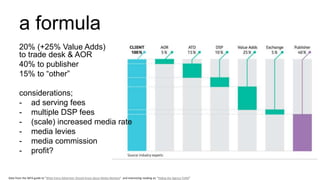
a formula
20% (+25% Value Adds)
to trade desk & AOR
40% to publisher
15% to “other”
considerations;
- ad serving fees
- multiple DSP fees
- (scale) increased media rate
- media levies
- media commission
- profit?
Data from the WFA guide to "What Every Advertiser Should Know about Media Markets" and interesting reading at; “Hiding the Agency TURD”
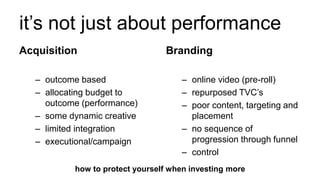
it’s not just about performance
Acquisition
– outcome based
– allocating budget to
outcome (performance)
– some dynamic creative
– limited integration
– executional/campaign
Branding
– online video (pre-roll)
– repurposed TVC’s
– poor content, targeting and
placement
– no sequence of
progression through funnel
– control
how to protect yourself when investing more
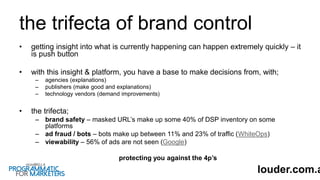
the trifecta of brand control
• getting insight into what is currently happening can happen extremely quickly – it
is push button
• with this insight & platform, you have a base to make decisions from, with;
– agencies (explanations)
– publishers (make good and explanations)
– technology vendors (demand improvements)
• the trifecta;
– brand safety – masked URL’s make up some 40% of DSP inventory on some
platforms
– ad fraud / bots – bots make up between 11% and 23% of traffic (WhiteOps)
– viewability – 56% of ads are not seen (Google)
protecting you against the 4p’s
louder.com.a
So, “how can marketers take ownership”
louder.com.a
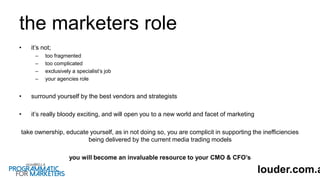
the marketers role
• it’s not;
– too fragmented
– too complicated
– exclusively a specialist’s job
– your agencies role
• surround yourself by the best vendors and strategists
• it’s really bloody exciting, and will open you to a new world and facet of marketing
take ownership, educate yourself, as in not doing so, you are complicit in supporting the inefficiencies
being delivered by the current media trading models
you will become an invaluable resource to your CMO & CFO’s
louder.com.a
3 steps to success
louder.com.a
step #1 - immediate
• create a working group – Marketing / Media / Tech / Finance
• educate the working group as much as possible
• create a centralised customer ID or identifier
• measure everything that is feasible – web, mobile, in store, sales, leads, calls
• engage your/the vendors
– be agnostic
– media (agency and publisher)
– technology (agencies and vendors)
• maximise use of existing tech
• establish ownership of your data – DMP
• assess and implement the appropriate programmatic charge model
• action what you can now, to generate media efficiencies
• develop a strategy for the 12 months, and goals for 24 / 36 months
louder.com.a
step #2 – almost immediate
• identify the resources and skills that you require
• start to act on your strategy
• utilise your customerID or identifier to link disparate systems
• assess the value of your current data – collecting richer data, action it, TEST
• consolidate your technology into a single view of your media $activity
• build relevant media and tech partnerships (strategic, NOT executional)
• either begin to use simple in stack attribution, or develop your own models
• engage a specialist if required to support out of stack media attribution, propensity
and market-mix-modeling to understand the outcomes that your media is driving
• action the learnings from your models by changing your investments… now.
louder.com.a
step #3 – the longer term
• roll out your own technology stack
• be agile – test new technology
• build stronger media relationships with successful partners
• test new partnerships and inventory regularly
• build relevant strategic media and tech partnerships
• begin to use attribution, propensity and market mix modelling to understand the
outcomes that your media is driving
louder.com.a
the future
• obviously, more digital spend, less traditional
• more channels – radio, digital panel, linear digital TV, devices, outdoor
• in-housing of digital - anticipate almost all advertisers spending >1.5m in digital in 2015 will
consider bringing it in house or hybrid
• data co-operatives and partnerships between compatible, but non-competitive businesses
• higher publisher CPM’s – audience & media bundled everywhere?
• audiences, not placements
• packaged audience (data) and media inventory partnerships
• more targeted and relevant advertising
• the challenges;
– ad blocking
– privacy laws
– no cookie tech
louder.com.a
Questions?
louder.com.aandrew hughes - @y0z2a #mumbrellaPFM
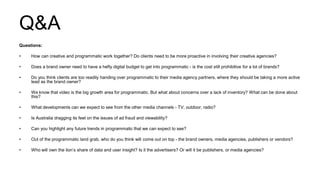
Q&A
Questions:
• How can creative and programmatic work together? Do clients need to be more proactive in involving their creative agencies?
• Does a brand owner need to have a hefty digital budget to get into programmatic - is the cost still prohibitive for a lot of brands?
• Do you think clients are too readily handing over programmatic to their media agency partners, where they should be taking a more active
lead as the brand owner?
• We know that video is the big growth area for programmatic. But what about concerns over a lack of inventory? What can be done about
this?
• What developments can we expect to see from the other media channels - TV, outdoor, radio?
• Is Australia dragging its feet on the issues of ad fraud and viewability?
• Can you highlight any future trends in programmatic that we can expect to see?
• Out of the programmatic land grab, who do you think will come out on top - the brand owners, media agencies, publishers or vendors?
• Who will own the lion’s share of data and user insight? Is it the advertisers? Or will it be publishers, or media agencies?

Mumbrella - Programmatic For Marketers

  • 1.
  • 2.
    good afternoon me; • andrewhughes • from the UK, been in AU for 5 years • worked media agency side for 4 years delivering digital; search, social, analytics, tech, data and programmatic solutions • @y0z2a for comments/discussion louder; • started in mid-2014 • independent • working with; – businesses of all walks – with all vendors • tech • media • data louder.com.a
  • 3.
    What Do LouderThink louder.com.a Image Credit: emotivebrand.com
  • 4.
    our thinking -programmatic • disclosed, and/or transparent is the right way from a marketers perspective • marketers need to be prepared to pay for people, media, service and tech • through the use of improved programmatic models, brands should see greater media exposure for their $media spend & therefore improved returns • programmatic is not just for acquisition – it delivers full funnel efficiency • technology is driving transparency on every level – media cost / viewability / attribution more change management, less technology louder.com.a
  • 5.
    our thinking -data • ownership and control of your data is only way forward • Remove almost all 3rd party tags, unless you control the data • digital platforms need to be integrated and linked around a common anonymous ID • it is useless modeling if you’re not going to action change • you need people who know what they are doing • data partnerships and mutually beneficial co-operatives will blossom collect it, improve it, action it louder.com.a
  • 6.
    our thinking -general • brands should own their technology and data (both enable programmatic strategy) - it can be informed and enhanced by 3rd parties, but ideally not controlled by them • brands need to select and own the direction of their technology stack – AdServer, conversion and general tag deployment – DSP / exchange – DMP / audience – web analytics – CMS / Cx – Ux / CRO – CRM / EDM • media, digital and creative agencies (and some publishers) can help to deliver How do we see it coming together? louder.com.a
  • 7.
    the eco system measurementaudience experience the buy marketing technology louder.com.a
  • 8.
    an alternative view displayvideo mobile reservation & other measurement louder.com.a audience experience the buy exploring the buy
  • 9.
    the buy the buy privateguaranteed private marketplace fixed unreserved invite only open marketplace • it is our view, that direct technology and media partnerships are required by the brand • the delivery team - it varies by model • in AU, inventory is not as accessible • publisher partnerships need to be established to access high quality or premium inventory • inventory is sold out to large media buyers in advance current models of trading
  • 10.
    current programmatic models thereare three models; – agency trade desk / managed service – hybrid (or transition) agency desk – in house desk • all could be argued are right for your business by the different parties involved in the fight. • you need to understand what they are and how they work before you commit • a “ball-park” number to start considering an in house approach is circa 1.5m / annum in digital media (excluding search) – obviously, it takes time to set up, and digital spend is increasing louder.com.ahow to calculate it?
  • 11.
    a formula 20% (+25%Value Adds) to trade desk & AOR 40% to publisher 15% to “other” considerations; - ad serving fees - multiple DSP fees - (scale) increased media rate - media levies - media commission - profit? Data from the WFA guide to "What Every Advertiser Should Know about Media Markets" and interesting reading at; “Hiding the Agency TURD”
  • 12.
    it’s not justabout performance Acquisition – outcome based – allocating budget to outcome (performance) – some dynamic creative – limited integration – executional/campaign Branding – online video (pre-roll) – repurposed TVC’s – poor content, targeting and placement – no sequence of progression through funnel – control how to protect yourself when investing more
  • 13.
    the trifecta ofbrand control • getting insight into what is currently happening can happen extremely quickly – it is push button • with this insight & platform, you have a base to make decisions from, with; – agencies (explanations) – publishers (make good and explanations) – technology vendors (demand improvements) • the trifecta; – brand safety – masked URL’s make up some 40% of DSP inventory on some platforms – ad fraud / bots – bots make up between 11% and 23% of traffic (WhiteOps) – viewability – 56% of ads are not seen (Google) protecting you against the 4p’s louder.com.a
  • 14.
    So, “how canmarketers take ownership” louder.com.a
  • 15.
    the marketers role •it’s not; – too fragmented – too complicated – exclusively a specialist’s job – your agencies role • surround yourself by the best vendors and strategists • it’s really bloody exciting, and will open you to a new world and facet of marketing take ownership, educate yourself, as in not doing so, you are complicit in supporting the inefficiencies being delivered by the current media trading models you will become an invaluable resource to your CMO & CFO’s louder.com.a
  • 16.
    3 steps tosuccess louder.com.a
  • 17.
    step #1 -immediate • create a working group – Marketing / Media / Tech / Finance • educate the working group as much as possible • create a centralised customer ID or identifier • measure everything that is feasible – web, mobile, in store, sales, leads, calls • engage your/the vendors – be agnostic – media (agency and publisher) – technology (agencies and vendors) • maximise use of existing tech • establish ownership of your data – DMP • assess and implement the appropriate programmatic charge model • action what you can now, to generate media efficiencies • develop a strategy for the 12 months, and goals for 24 / 36 months louder.com.a
  • 18.
    step #2 –almost immediate • identify the resources and skills that you require • start to act on your strategy • utilise your customerID or identifier to link disparate systems • assess the value of your current data – collecting richer data, action it, TEST • consolidate your technology into a single view of your media $activity • build relevant media and tech partnerships (strategic, NOT executional) • either begin to use simple in stack attribution, or develop your own models • engage a specialist if required to support out of stack media attribution, propensity and market-mix-modeling to understand the outcomes that your media is driving • action the learnings from your models by changing your investments… now. louder.com.a
  • 19.
    step #3 –the longer term • roll out your own technology stack • be agile – test new technology • build stronger media relationships with successful partners • test new partnerships and inventory regularly • build relevant strategic media and tech partnerships • begin to use attribution, propensity and market mix modelling to understand the outcomes that your media is driving louder.com.a
  • 20.
    the future • obviously,more digital spend, less traditional • more channels – radio, digital panel, linear digital TV, devices, outdoor • in-housing of digital - anticipate almost all advertisers spending >1.5m in digital in 2015 will consider bringing it in house or hybrid • data co-operatives and partnerships between compatible, but non-competitive businesses • higher publisher CPM’s – audience & media bundled everywhere? • audiences, not placements • packaged audience (data) and media inventory partnerships • more targeted and relevant advertising • the challenges; – ad blocking – privacy laws – no cookie tech louder.com.a
  • 21.
  • 22.
    Q&A Questions: • How cancreative and programmatic work together? Do clients need to be more proactive in involving their creative agencies? • Does a brand owner need to have a hefty digital budget to get into programmatic - is the cost still prohibitive for a lot of brands? • Do you think clients are too readily handing over programmatic to their media agency partners, where they should be taking a more active lead as the brand owner? • We know that video is the big growth area for programmatic. But what about concerns over a lack of inventory? What can be done about this? • What developments can we expect to see from the other media channels - TV, outdoor, radio? • Is Australia dragging its feet on the issues of ad fraud and viewability? • Can you highlight any future trends in programmatic that we can expect to see? • Out of the programmatic land grab, who do you think will come out on top - the brand owners, media agencies, publishers or vendors? • Who will own the lion’s share of data and user insight? Is it the advertisers? Or will it be publishers, or media agencies?

Editor's Notes

  • #3 Thanks to the mumbrella team – Tim, Nic, Camille for inviting me here today to talk to you. It’s exciting to see programmatic becoming mainstream – with every data summit, and programmatic event, the audience gets more and more diverse. Having gone through the attendees list, there is a vast spread of representation from all aspects of the media and marketing world, and I’m delighted to be able to share with you some of my experience, and some of my thoughts on this rapidly evolving landscape. I have about 20 slides to talk through, and I will certainly not cover everything in this landscape, but, I want to share with you the insight that I am gaining working with large advertisers and clients as they embark on this journey. Mention creative & content.
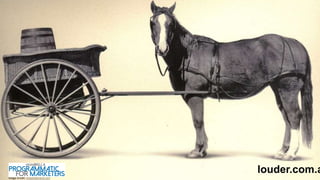
  • #4 Credit - http://www.emotivebrand.com/2014/03/18/the-cart-goes-after-the-horse-okay-which-one-is-the-horse-2/ There are many, many analogies as to how and why things are being done the way that they are, but ultimately it comes down to a couple of things… The media agencies have the spend, they control the allocation, and got rid of the ad networks very efficiently… to replace them with something very similar that they are in control of. Clients (brands) have not had either the skills, resource or bandwidth to deal with the programmatic play
  • #5 Some agencies will reject your business on the basis that you want disclosure of programmatic margins. Mention the four manners programmatic can be used for; Branding Prospecting Remarketing Post Purchase CRM There has to be an acceptance of FAILURE – I know many marketers who have never seen a campaign “fail” when the results presentation came back.
  • #6 Use ghostery and Fiddler to see what is on your website, or a crawler like Screaming Frog can go out and identify snippets of code that are deployed.
  • #8 However, these are merging into the one marketing space, with the consolidation of the cookie space into a single cross device ID or cookies that can carry multiple ID’s Essentially, what you may have heard referred to as the marketing stack.
  • #11 http://www.adnews.com.au/news/group-m-news-corp-and-fairfax-on-transparency-in-media-trading Bass said that “agencies were an easy target.” The Xaxis model is transparent, he said, but just does not disclose margin. Clients he said, “cannot go into our trade desk without opting in.” 40% of 1.6m = 0.6m
  • #12 Typically, both Agency Of Record (AOR) and ATD receive a share of advertiser spend. And as DSP software is typically licensed by ATDs, rather than owned, a share also goes to the companies providing these services. Within ‘Value-adds’ a number of companies provide additional technological services, including data enrichment, targeting, reporting, verification and others. Value-adds account for 25% of advertiser budgets on average. The exchange is the virtual marketplace itself where publishers trade impressions with media buyers. Exchanges account for around 5% of advertiser spend. After all the stakeholders present in the programmatic ecosystem have taken their share advertisers budgets, there remains just 40% received by the publisher, as so called ‘working media’.
  • #13 Everyone is focused on programmatic for acquisition. Most of the video content in the AU market is traded programmatically, and is effective sold and purchased as brand based activity. Performance video through display units (MREC) is the variation on this theme. One of the
  • #20 marketing stack – unique to each business but some common elements client owned systems and independent technology driving transparency into the murky world integration challenges & legacy systems skills shortages waiting to see the success AU IS different – publisher volumes / agency relationships / agency > publisher agency programmatic positioning may evolve once programmatic TV is available the big consultancies are going after media…