PRO FABRICATION, INC.
Multi-Stage Sheet Metal Formed Bolted Fastener Design
Pro Fabrication Quality Assurance
Mark Brooks
3/19/2014
Multi-Stage Sheet Metal Formed Bolted Fastener Design
Introduction
A lean manufacturing initiative is presented with a goal to eliminate piece parts in metal fabricated
housing assemblies. To this end, multi-stage sheet metal forming processes show promise for bolted
fastener design. Elimination of nut hardware by replacement with integrated sheet metal thread elements
are actively developed as a cost down factor in this study.
Six Simple Machines
A simple machine is a non-motorized device that changes the direction or magnitude of a force. In
general, a simple machine can be defined as one of the simplest mechanisms that provide mechanical
advantage (also called leverage):
The term refers to the six classical simple machines which were defined by Renaissance scientists:
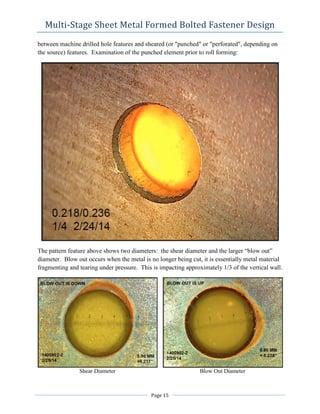
• Lever
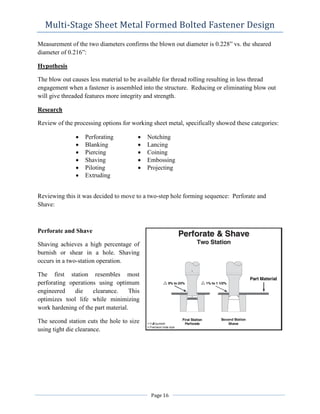
• Wheel and axle
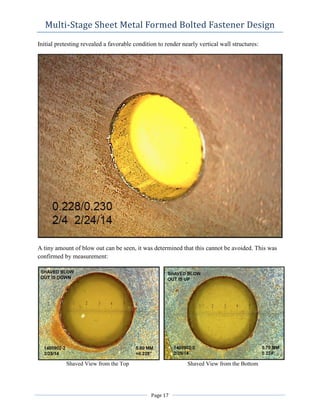
• Pulley
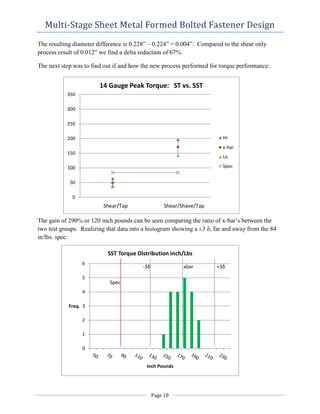
• Inclined plane
• Wedge
• Screw
Franz Reuleaux, who collected and studied over 800 elementary machines, realized that a lever, pulley,
and wheel and axle are in essence the same device: a body rotating about a hinge. Similarly, an inclined
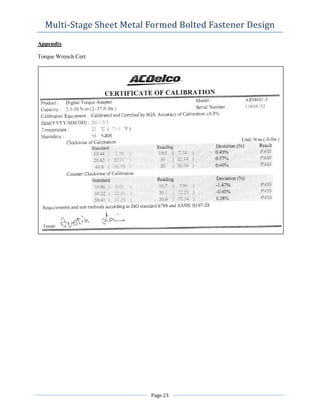
plane, wedge, and screw are a block sliding on a flat surface.
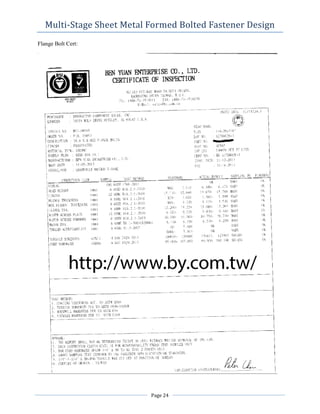
The Inclined Plane
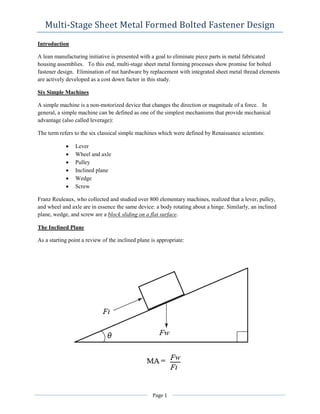
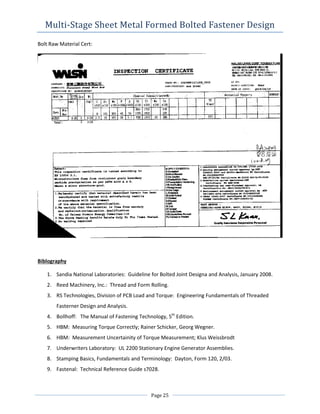
As a starting point a review of the inclined plane is appropriate:
Page 1
Multi-Stage Sheet Metal Formed Bolted Fastener Design
Mechanical Advantage
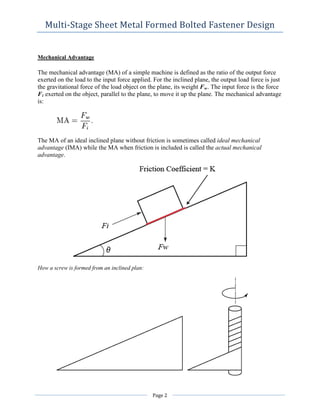
The mechanical advantage (MA) of a simple machine is defined as the ratio of the output force
exerted on the load to the input force applied. For the inclined plane, the output load force is just
the gravitational force of the load object on the plane, its weight Fw. The input force is the force
Fi exerted on the object, parallel to the plane, to move it up the plane. The mechanical advantage
is:
The MA of an ideal inclined plane without friction is sometimes called ideal mechanical
advantage (IMA) while the MA when friction is included is called the actual mechanical
advantage.
How a screw is formed from an inclined plan:
Page 2
Multi-Stage Sheet Metal Formed Bolted Fastener Design
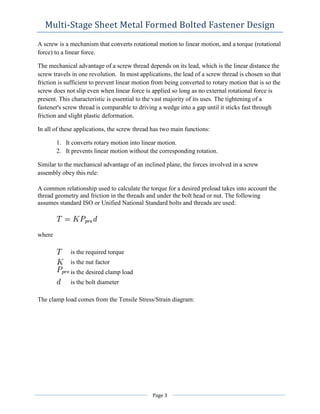
A screw is a mechanism that converts rotational motion to linear motion, and a torque (rotational
force) to a linear force.
The mechanical advantage of a screw thread depends on its lead, which is the linear distance the
screw travels in one revolution. In most applications, the lead of a screw thread is chosen so that
friction is sufficient to prevent linear motion from being converted to rotary motion that is so the
screw does not slip even when linear force is applied so long as no external rotational force is
present. This characteristic is essential to the vast majority of its uses. The tightening of a
fastener's screw thread is comparable to driving a wedge into a gap until it sticks fast through
friction and slight plastic deformation.
In all of these applications, the screw thread has two main functions:
1. It converts rotary motion into linear motion.
2. It prevents linear motion without the corresponding rotation.
Similar to the mechanical advantage of an inclined plane, the forces involved in a screw
assembly obey this rule:
A common relationship used to calculate the torque for a desired preload takes into account the
thread geometry and friction in the threads and under the bolt head or nut. The following
assumes standard ISO or Unified National Standard bolts and threads are used:
where
is the required torque
is the nut factor
is the desired clamp load
is the bolt diameter
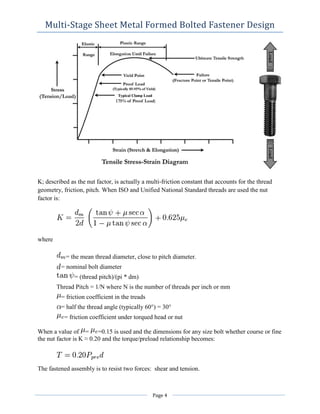
The clamp load comes from the Tensile Stress/Strain diagram:
Page 3
Multi-Stage Sheet Metal Formed Bolted Fastener Design
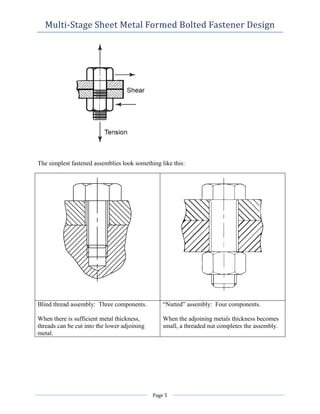
K; described as the nut factor, is actually a multi-friction constant that accounts for the thread
geometry, friction, pitch. When ISO and Unified National Standard threads are used the nut
factor is:
where
= the mean thread diameter, close to pitch diameter.
= nominal bolt diameter
= (thread pitch)/(pi * dm)
Thread Pitch = 1/N where N is the number of threads per inch or mm
= friction coefficient in the treads
= half the thread angle (typically 60°) = 30°
= friction coefficient under torqued head or nut
When a value of = =0.15 is used and the dimensions for any size bolt whether course or fine
the nut factor is K ≈ 0.20 and the torque/preload relationship becomes:
The fastened assembly is to resist two forces: shear and tension.
Page 4
Multi-Stage Sheet Metal Formed Bolted Fastener Design
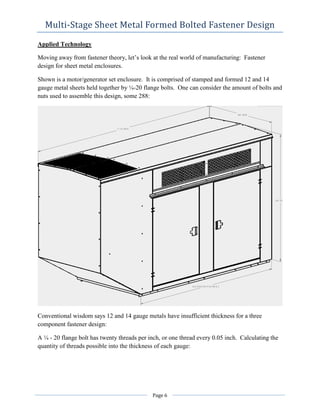
The simplest fastened assemblies look something like this:
Blind thread assembly: Three components.
When there is sufficient metal thickness,
threads can be cut into the lower adjoining
metal.
“Nutted” assembly: Four components.
When the adjoining metals thickness becomes
small, a threaded nut completes the assembly.
Page 5
Multi-Stage Sheet Metal Formed Bolted Fastener Design
Applied Technology
Moving away from fastener theory, let’s look at the real world of manufacturing: Fastener
design for sheet metal enclosures.
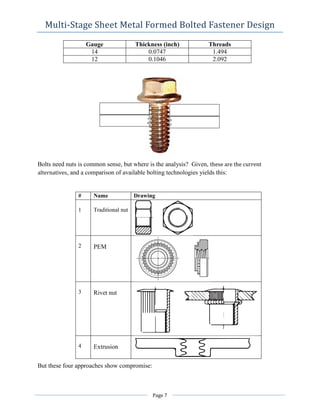
Shown is a motor/generator set enclosure. It is comprised of stamped and formed 12 and 14
gauge metal sheets held together by ¼-20 flange bolts. One can consider the amount of bolts and
nuts used to assemble this design, some 288:
Conventional wisdom says 12 and 14 gauge metals have insufficient thickness for a three
component fastener design:
A ¼ - 20 flange bolt has twenty threads per inch, or one thread every 0.05 inch. Calculating the
quantity of threads possible into the thickness of each gauge:
Page 6
Multi-Stage Sheet Metal Formed Bolted Fastener Design
Gauge Thickness (inch) Threads
14 0.0747 1.494
12 0.1046 2.092
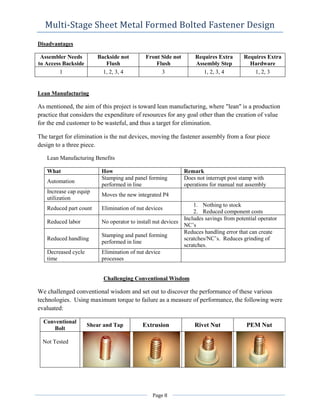
Bolts need nuts is common sense, but where is the analysis? Given, these are the current
alternatives, and a comparison of available bolting technologies yields this:
But these four approaches show compromise:
# Name Drawing
1 Traditional nut
2 PEM
3 Rivet nut
4 Extrusion
Page 7
Multi-Stage Sheet Metal Formed Bolted Fastener Design
Disadvantages
Assembler Needs
to Access Backside
Backside not
Flush
Front Side not
Flush
Requires Extra
Assembly Step
Requires Extra
Hardware
1 1, 2, 3, 4 3 1, 2, 3, 4 1, 2, 3
Lean Manufacturing
As mentioned, the aim of this project is toward lean manufacturing, where "lean" is a production
practice that considers the expenditure of resources for any goal other than the creation of value
for the end customer to be wasteful, and thus a target for elimination.
The target for elimination is the nut devices, moving the fastener assembly from a four piece
design to a three piece.
Lean Manufacturing Benefits
What How Remark
Automation
Stamping and panel forming
performed in line
Does not interrupt post stamp with
operations for manual nut assembly
Increase cap equip
utilization
Moves the new integrated P4
Reduced part count Elimination of nut devices
1. Nothing to stock
2. Reduced component costs
Reduced labor No operator to install nut devices
Includes savings from potential operator
NC’s
Reduced handling
Stamping and panel forming
performed in line
Reduces handling error that can create
scratches/NC’s. Reduces grinding of
scratches.
Decreased cycle
time
Elimination of nut device
processes
Challenging Conventional Wisdom
We challenged conventional wisdom and set out to discover the performance of these various
technologies. Using maximum torque to failure as a measure of performance, the following were
evaluated:
Conventional
Bolt
Shear and Tap Extrusion Rivet Nut PEM Nut
Not Tested
Page 8
Multi-Stage Sheet Metal Formed Bolted Fastener Design
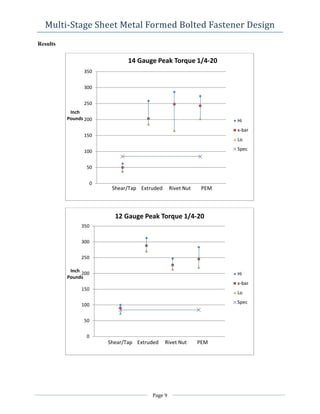
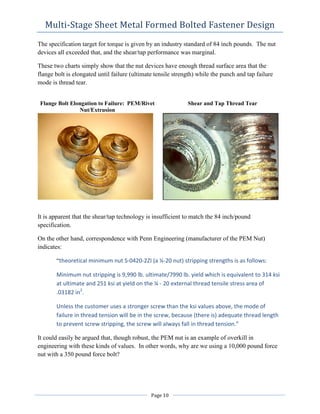
Results
0
50
100
150
200
250
300
350
Inch
Pounds
14 Gauge Peak Torque 1/4-20
Hi
x-bar
Lo
Spec
Shear/Tap Extruded Rivet Nut PEM
0
50
100
150
200
250
300
350
Inch
Pounds
12 Gauge Peak Torque 1/4-20
Hi
x-bar
Lo
Spec
Shear/Tap Extruded Rivet Nut PEM
Page 9
Multi-Stage Sheet Metal Formed Bolted Fastener Design
The specification target for torque is given by an industry standard of 84 inch pounds. The nut
devices all exceeded that, and the shear/tap performance was marginal.
These two charts simply show that the nut devices have enough thread surface area that the
flange bolt is elongated until failure (ultimate tensile strength) while the punch and tap failure
mode is thread tear.
Flange Bolt Elongation to Failure: PEM/Rivet
Nut/Extrusion
Shear and Tap Thread Tear
It is apparent that the shear/tap technology is insufficient to match the 84 inch/pound
specification.
On the other hand, correspondence with Penn Engineering (manufacturer of the PEM Nut)
indicates:
“theoretical minimum nut S-0420-2ZI (a ¼-20 nut) stripping strengths is as follows:
Minimum nut stripping is 9,990 lb. ultimate/7990 lb. yield which is equivalent to 314 ksi
at ultimate and 251 ksi at yield on the ¼ - 20 external thread tensile stress area of
.03182 in2
.
Unless the customer uses a stronger screw than the ksi values above, the mode of
failure in thread tension will be in the screw, because (there is) adequate thread length
to prevent screw stripping, the screw will always fall in thread tension.”
It could easily be argued that, though robust, the PEM nut is an example of overkill in
engineering with these kinds of values. In other words, why are we using a 10,000 pound force
nut with a 350 pound force bolt?
Page 10
Multi-Stage Sheet Metal Formed Bolted Fastener Design
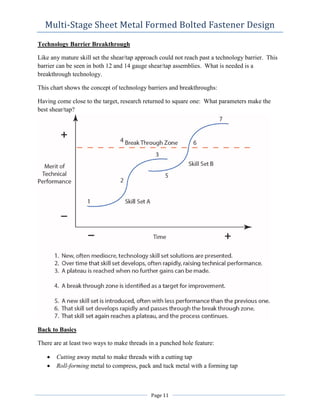
Technology Barrier Breakthrough
Like any mature skill set the shear/tap approach could not reach past a technology barrier. This
barrier can be seen in both 12 and 14 gauge shear/tap assemblies. What is needed is a
breakthrough technology.
This chart shows the concept of technology barriers and breakthroughs:
Having come close to the target, research returned to square one: What parameters make the
best shear/tap?
Back to Basics
There are at least two ways to make threads in a punched hole feature:
• Cutting away metal to make threads with a cutting tap
• Roll-forming metal to compress, pack and tuck metal with a forming tap
Page 11
Multi-Stage Sheet Metal Formed Bolted Fastener Design
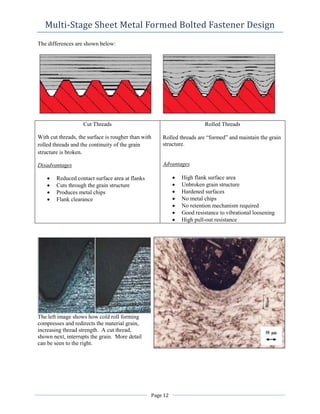
The differences are shown below:
Cut Threads
With cut threads, the surface is rougher than with
rolled threads and the continuity of the grain
structure is broken.
Disadvantages
• Reduced contact surface area at flanks
• Cuts through the grain structure
• Produces metal chips
• Flank clearance
Rolled Threads
Rolled threads are “formed” and maintain the grain
structure.
Advantages
• High flank surface area
• Unbroken grain structure
• Hardened surfaces
• No metal chips
• No retention mechanism required
• Good resistance to vibrational loosening
• High pull-out resistance
The left image shows how cold roll forming
compresses and redirects the material grain,
increasing thread strength. A cut thread,
shown next, interrupts the grain. More detail
can be seen to the right.
Page 12
Multi-Stage Sheet Metal Formed Bolted Fastener Design
Roll forming is the resident technology at Pro Fabrication on an automated shear/punch work
cell.
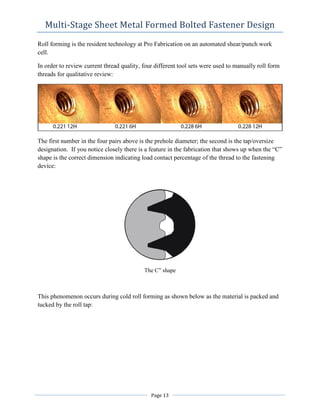
In order to review current thread quality, four different tool sets were used to manually roll form
threads for qualitative review:
The first number in the four pairs above is the prehole diameter; the second is the tap/oversize
designation. If you notice closely there is a feature in the fabrication that shows up when the “C”
shape is the correct dimension indicating load contact percentage of the thread to the fastening
device:
The C” shape
This phenomenon occurs during cold roll forming as shown below as the material is packed and
tucked by the roll tap:
Page 13
Multi-Stage Sheet Metal Formed Bolted Fastener Design
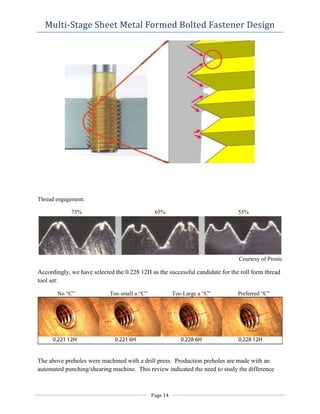
Thread engagement:
75% 65% 55%
Courtesy of Pronic
Accordingly, we have selected the 0.228 12H as the successful candidate for the roll form thread
tool set:
No “C” Too small a “C” Too Large a “C” Preferred “C”
The above preholes were machined with a drill press. Production preholes are made with an
automated punching/shearing machine. This review indicated the need to study the difference
Page 14
Multi-Stage Sheet Metal Formed Bolted Fastener Design
between machine drilled hole features and sheared (or "punched" or "perforated", depending on
the source) features. Examination of the punched element prior to roll forming:
The pattern feature above shows two diameters: the shear diameter and the larger “blow out”
diameter. Blow out occurs when the metal is no longer being cut, it is essentially metal material
fragmenting and tearing under pressure. This is impacting approximately 1/3 of the vertical wall.
Shear Diameter Blow Out Diameter
Page 15
Multi-Stage Sheet Metal Formed Bolted Fastener Design
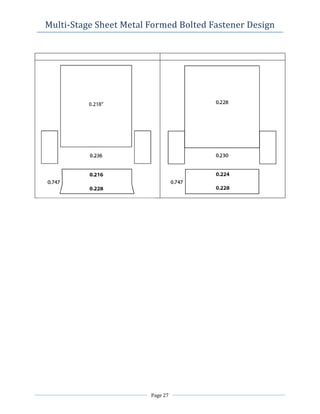
Measurement of the two diameters confirms the blown out diameter is 0.228” vs. the sheared
diameter of 0.216”:
Hypothesis
The blow out causes less material to be available for thread rolling resulting in less thread
engagement when a fastener is assembled into the structure. Reducing or eliminating blow out
will give threaded features more integrity and strength.
Research
Review of the processing options for working sheet metal, specifically showed these categories:
• Perforating • Notching
• Blanking • Lancing
• Piercing • Coining
• Shaving • Embossing
• Piloting • Projecting
• Extruding
Reviewing this it was decided to move to a two-step hole forming sequence: Perforate and
Shave:
Perforate and Shave
Shaving achieves a high percentage of
burnish or shear in a hole. Shaving
occurs in a two-station operation.
The first station resembles most
perforating operations using optimum
engineered die clearance. This
optimizes tool life while minimizing
work hardening of the part material.
The second station cuts the hole to size
using tight die clearance.
Page 16
Multi-Stage Sheet Metal Formed Bolted Fastener Design
Initial pretesting revealed a favorable condition to render nearly vertical wall structures:
A tiny amount of blow out can be seen, it was determined that this cannot be avoided. This was
confirmed by measurement:
Shaved View from the Top Shaved View from the Bottom
Page 17
Multi-Stage Sheet Metal Formed Bolted Fastener Design
The resulting diameter difference is 0.228” – 0.224” = 0.004”. Compared to the shear only
process result of 0.012” we find a delta reduction of 67%.
The next step was to find out if and how the new process performed for torque performance:
The gain of 290% or 120 inch pounds can be seen comparing the ratio of x-bar’s between the
two test groups. Realizing that data into a histogram showing a ±3 δ, far and away from the 84
in/lbs. spec:
0
50
100
150
200
250
300
350
14 Gauge Peak Torque: ST vs. SST
Hi
x-bar
Lo
Spec
Shear/Tap Shear/Shave/Tap
0
1
2
3
4
5
6
Freq.
Inch Pounds
SST Torque Distribution Inch/Lbs
Spec
-3δ +3δxbar
Page 18
Multi-Stage Sheet Metal Formed Bolted Fastener Design
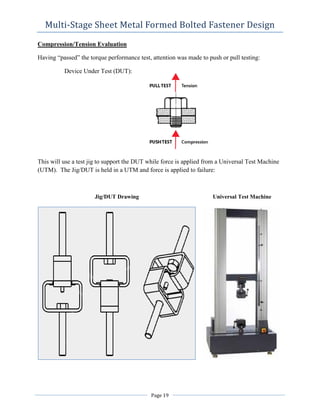
Compression/Tension Evaluation
Having “passed” the torque performance test, attention was made to push or pull testing:
Device Under Test (DUT):
This will use a test jig to support the DUT while force is applied from a Universal Test Machine
(UTM). The Jig/DUT is held in a UTM and force is applied to failure:
Jig/DUT Drawing Universal Test Machine
Page 19
Multi-Stage Sheet Metal Formed Bolted Fastener Design
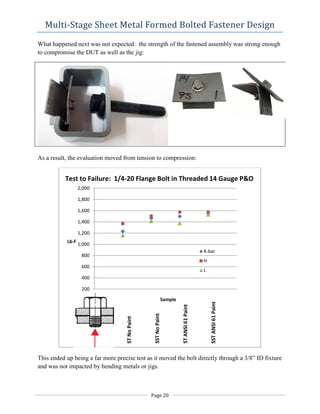
What happened next was not expected: the strength of the fastened assembly was strong enough
to compromise the DUT as well as the jig:
As a result, the evaluation moved from tension to compression:
This ended up being a far more precise test as it moved the bolt directly through a 3/8” ID fixture
and was not impacted by bending metals or jigs.
200
400
600
800
1,000
1,200
1,400
1,600
1,800
2,000
Lb-F
Sample
X-bar
H
L
STNoPaint
SSTNoPaint
STANSI61Paint
SSTANSI61Paint
Test to Failure: 1/4-20 Flange Bolt in Threaded 14 Gauge P&O
Page 20
Multi-Stage Sheet Metal Formed Bolted Fastener Design
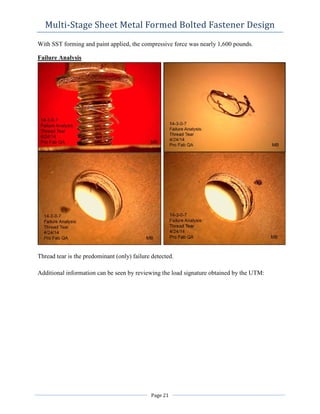
With SST forming and paint applied, the compressive force was nearly 1,600 pounds.
Failure Analysis
Thread tear is the predominant (only) failure detected.
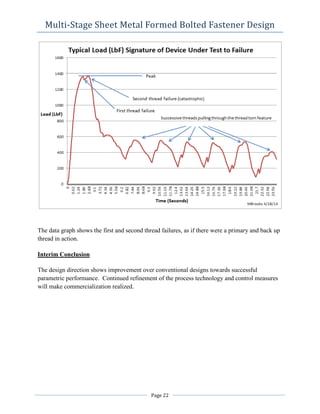
Additional information can be seen by reviewing the load signature obtained by the UTM:
Page 21
Multi-Stage Sheet Metal Formed Bolted Fastener Design
The data graph shows the first and second thread failures, as if there were a primary and back up
thread in action.
Interim Conclusion
The design direction shows improvement over conventional designs towards successful
parametric performance. Continued refinement of the process technology and control measures
will make commercialization realized.
Page 22
Multi-Stage Sheet Metal Formed Bolted Fastener Design
Appendix
Torque Wrench Cert:
Page 23
Multi-Stage Sheet Metal Formed Bolted Fastener Design
Flange Bolt Cert:
Page 24
Multi-Stage Sheet Metal Formed Bolted Fastener Design
Bolt Raw Material Cert:
Biblography
1. Sandia National Laboratories: Guideline for Bolted Joint Designa and Analysis, January 2008.
2. Reed Machinery, Inc.: Thread and Form Rolling.
3. RS Technologies, Division of PCB Load and Torque: Engineering Fundamentals of Threaded
Fasterner Design and Analysis.
4. Bollhoff: The Manual of Fastening Technology, 5th
Edition.
5. HBM: Measuring Torque Correctly; Rainer Schicker, Georg Wegner.
6. HBM: Measurement Uncertainity of Torque Measurement; Klus Weissbrodt
7. Underwriters Laboratory: UL 2200 Stationary Engine Generator Assemblies.
8. Stamping Basics, Fundamentals and Terminology: Dayton, Form 120, 2/03.
9. Fastenal: Technical Reference Guide s7028.
Page 25
Multi-Stage Sheet Metal Formed Bolted Fastener Design
10. Industrial Press Inc.: Machinery’s Handbook; 25th
Edition.
11. American Iron and Steel Institute: DETERMINATION OF THE TENSILE AND SHEAR
12. STRENGTHS OF SCREWS and THE EFFECT OF SCREW PATTERNS ON COLD-FORMED STEEL
CONNECTIONS; Marc Allen Sokol, Research Assistant; Roger A. LaBoube and Wei-Wen Yu,
Project Directors; December, 1998.
13. Illinois Department of Transportation: Fastener Identification Guide, October 2008.
14. NASA: Reference Publication1228; Fastener Design Manual; Richard T. Barrett March 1990.
15. Earle M. Jorgensen Company; Metals Reference Book; 2007.
16. United States Department of Commerce: Handbook H28 Screw-Thread Standards for Federal
Services; Unified UNJ Miniature Screw Threads, 1969.
Page 26
Multi-Stage Sheet Metal Formed Bolted Fastener Design
Page 27

Multi-StageSheet Metal Fromed Bolted Fastener Design

  • 1.
    PRO FABRICATION, INC. Multi-StageSheet Metal Formed Bolted Fastener Design Pro Fabrication Quality Assurance Mark Brooks 3/19/2014
  • 2.
    Multi-Stage Sheet MetalFormed Bolted Fastener Design Introduction A lean manufacturing initiative is presented with a goal to eliminate piece parts in metal fabricated housing assemblies. To this end, multi-stage sheet metal forming processes show promise for bolted fastener design. Elimination of nut hardware by replacement with integrated sheet metal thread elements are actively developed as a cost down factor in this study. Six Simple Machines A simple machine is a non-motorized device that changes the direction or magnitude of a force. In general, a simple machine can be defined as one of the simplest mechanisms that provide mechanical advantage (also called leverage): The term refers to the six classical simple machines which were defined by Renaissance scientists: • Lever • Wheel and axle • Pulley • Inclined plane • Wedge • Screw Franz Reuleaux, who collected and studied over 800 elementary machines, realized that a lever, pulley, and wheel and axle are in essence the same device: a body rotating about a hinge. Similarly, an inclined plane, wedge, and screw are a block sliding on a flat surface. The Inclined Plane As a starting point a review of the inclined plane is appropriate: Page 1
  • 3.
    Multi-Stage Sheet MetalFormed Bolted Fastener Design Mechanical Advantage The mechanical advantage (MA) of a simple machine is defined as the ratio of the output force exerted on the load to the input force applied. For the inclined plane, the output load force is just the gravitational force of the load object on the plane, its weight Fw. The input force is the force Fi exerted on the object, parallel to the plane, to move it up the plane. The mechanical advantage is: The MA of an ideal inclined plane without friction is sometimes called ideal mechanical advantage (IMA) while the MA when friction is included is called the actual mechanical advantage. How a screw is formed from an inclined plan: Page 2
  • 4.
    Multi-Stage Sheet MetalFormed Bolted Fastener Design A screw is a mechanism that converts rotational motion to linear motion, and a torque (rotational force) to a linear force. The mechanical advantage of a screw thread depends on its lead, which is the linear distance the screw travels in one revolution. In most applications, the lead of a screw thread is chosen so that friction is sufficient to prevent linear motion from being converted to rotary motion that is so the screw does not slip even when linear force is applied so long as no external rotational force is present. This characteristic is essential to the vast majority of its uses. The tightening of a fastener's screw thread is comparable to driving a wedge into a gap until it sticks fast through friction and slight plastic deformation. In all of these applications, the screw thread has two main functions: 1. It converts rotary motion into linear motion. 2. It prevents linear motion without the corresponding rotation. Similar to the mechanical advantage of an inclined plane, the forces involved in a screw assembly obey this rule: A common relationship used to calculate the torque for a desired preload takes into account the thread geometry and friction in the threads and under the bolt head or nut. The following assumes standard ISO or Unified National Standard bolts and threads are used: where is the required torque is the nut factor is the desired clamp load is the bolt diameter The clamp load comes from the Tensile Stress/Strain diagram: Page 3
  • 5.
    Multi-Stage Sheet MetalFormed Bolted Fastener Design K; described as the nut factor, is actually a multi-friction constant that accounts for the thread geometry, friction, pitch. When ISO and Unified National Standard threads are used the nut factor is: where = the mean thread diameter, close to pitch diameter. = nominal bolt diameter = (thread pitch)/(pi * dm) Thread Pitch = 1/N where N is the number of threads per inch or mm = friction coefficient in the treads = half the thread angle (typically 60°) = 30° = friction coefficient under torqued head or nut When a value of = =0.15 is used and the dimensions for any size bolt whether course or fine the nut factor is K ≈ 0.20 and the torque/preload relationship becomes: The fastened assembly is to resist two forces: shear and tension. Page 4
  • 6.
    Multi-Stage Sheet MetalFormed Bolted Fastener Design The simplest fastened assemblies look something like this: Blind thread assembly: Three components. When there is sufficient metal thickness, threads can be cut into the lower adjoining metal. “Nutted” assembly: Four components. When the adjoining metals thickness becomes small, a threaded nut completes the assembly. Page 5
  • 7.
    Multi-Stage Sheet MetalFormed Bolted Fastener Design Applied Technology Moving away from fastener theory, let’s look at the real world of manufacturing: Fastener design for sheet metal enclosures. Shown is a motor/generator set enclosure. It is comprised of stamped and formed 12 and 14 gauge metal sheets held together by ¼-20 flange bolts. One can consider the amount of bolts and nuts used to assemble this design, some 288: Conventional wisdom says 12 and 14 gauge metals have insufficient thickness for a three component fastener design: A ¼ - 20 flange bolt has twenty threads per inch, or one thread every 0.05 inch. Calculating the quantity of threads possible into the thickness of each gauge: Page 6
  • 8.
    Multi-Stage Sheet MetalFormed Bolted Fastener Design Gauge Thickness (inch) Threads 14 0.0747 1.494 12 0.1046 2.092 Bolts need nuts is common sense, but where is the analysis? Given, these are the current alternatives, and a comparison of available bolting technologies yields this: But these four approaches show compromise: # Name Drawing 1 Traditional nut 2 PEM 3 Rivet nut 4 Extrusion Page 7
  • 9.
    Multi-Stage Sheet MetalFormed Bolted Fastener Design Disadvantages Assembler Needs to Access Backside Backside not Flush Front Side not Flush Requires Extra Assembly Step Requires Extra Hardware 1 1, 2, 3, 4 3 1, 2, 3, 4 1, 2, 3 Lean Manufacturing As mentioned, the aim of this project is toward lean manufacturing, where "lean" is a production practice that considers the expenditure of resources for any goal other than the creation of value for the end customer to be wasteful, and thus a target for elimination. The target for elimination is the nut devices, moving the fastener assembly from a four piece design to a three piece. Lean Manufacturing Benefits What How Remark Automation Stamping and panel forming performed in line Does not interrupt post stamp with operations for manual nut assembly Increase cap equip utilization Moves the new integrated P4 Reduced part count Elimination of nut devices 1. Nothing to stock 2. Reduced component costs Reduced labor No operator to install nut devices Includes savings from potential operator NC’s Reduced handling Stamping and panel forming performed in line Reduces handling error that can create scratches/NC’s. Reduces grinding of scratches. Decreased cycle time Elimination of nut device processes Challenging Conventional Wisdom We challenged conventional wisdom and set out to discover the performance of these various technologies. Using maximum torque to failure as a measure of performance, the following were evaluated: Conventional Bolt Shear and Tap Extrusion Rivet Nut PEM Nut Not Tested Page 8
  • 10.
    Multi-Stage Sheet MetalFormed Bolted Fastener Design Results 0 50 100 150 200 250 300 350 Inch Pounds 14 Gauge Peak Torque 1/4-20 Hi x-bar Lo Spec Shear/Tap Extruded Rivet Nut PEM 0 50 100 150 200 250 300 350 Inch Pounds 12 Gauge Peak Torque 1/4-20 Hi x-bar Lo Spec Shear/Tap Extruded Rivet Nut PEM Page 9
  • 11.
    Multi-Stage Sheet MetalFormed Bolted Fastener Design The specification target for torque is given by an industry standard of 84 inch pounds. The nut devices all exceeded that, and the shear/tap performance was marginal. These two charts simply show that the nut devices have enough thread surface area that the flange bolt is elongated until failure (ultimate tensile strength) while the punch and tap failure mode is thread tear. Flange Bolt Elongation to Failure: PEM/Rivet Nut/Extrusion Shear and Tap Thread Tear It is apparent that the shear/tap technology is insufficient to match the 84 inch/pound specification. On the other hand, correspondence with Penn Engineering (manufacturer of the PEM Nut) indicates: “theoretical minimum nut S-0420-2ZI (a ¼-20 nut) stripping strengths is as follows: Minimum nut stripping is 9,990 lb. ultimate/7990 lb. yield which is equivalent to 314 ksi at ultimate and 251 ksi at yield on the ¼ - 20 external thread tensile stress area of .03182 in2 . Unless the customer uses a stronger screw than the ksi values above, the mode of failure in thread tension will be in the screw, because (there is) adequate thread length to prevent screw stripping, the screw will always fall in thread tension.” It could easily be argued that, though robust, the PEM nut is an example of overkill in engineering with these kinds of values. In other words, why are we using a 10,000 pound force nut with a 350 pound force bolt? Page 10
  • 12.
    Multi-Stage Sheet MetalFormed Bolted Fastener Design Technology Barrier Breakthrough Like any mature skill set the shear/tap approach could not reach past a technology barrier. This barrier can be seen in both 12 and 14 gauge shear/tap assemblies. What is needed is a breakthrough technology. This chart shows the concept of technology barriers and breakthroughs: Having come close to the target, research returned to square one: What parameters make the best shear/tap? Back to Basics There are at least two ways to make threads in a punched hole feature: • Cutting away metal to make threads with a cutting tap • Roll-forming metal to compress, pack and tuck metal with a forming tap Page 11
  • 13.
    Multi-Stage Sheet MetalFormed Bolted Fastener Design The differences are shown below: Cut Threads With cut threads, the surface is rougher than with rolled threads and the continuity of the grain structure is broken. Disadvantages • Reduced contact surface area at flanks • Cuts through the grain structure • Produces metal chips • Flank clearance Rolled Threads Rolled threads are “formed” and maintain the grain structure. Advantages • High flank surface area • Unbroken grain structure • Hardened surfaces • No metal chips • No retention mechanism required • Good resistance to vibrational loosening • High pull-out resistance The left image shows how cold roll forming compresses and redirects the material grain, increasing thread strength. A cut thread, shown next, interrupts the grain. More detail can be seen to the right. Page 12
  • 14.
    Multi-Stage Sheet MetalFormed Bolted Fastener Design Roll forming is the resident technology at Pro Fabrication on an automated shear/punch work cell. In order to review current thread quality, four different tool sets were used to manually roll form threads for qualitative review: The first number in the four pairs above is the prehole diameter; the second is the tap/oversize designation. If you notice closely there is a feature in the fabrication that shows up when the “C” shape is the correct dimension indicating load contact percentage of the thread to the fastening device: The C” shape This phenomenon occurs during cold roll forming as shown below as the material is packed and tucked by the roll tap: Page 13
  • 15.
    Multi-Stage Sheet MetalFormed Bolted Fastener Design Thread engagement: 75% 65% 55% Courtesy of Pronic Accordingly, we have selected the 0.228 12H as the successful candidate for the roll form thread tool set: No “C” Too small a “C” Too Large a “C” Preferred “C” The above preholes were machined with a drill press. Production preholes are made with an automated punching/shearing machine. This review indicated the need to study the difference Page 14
  • 16.
    Multi-Stage Sheet MetalFormed Bolted Fastener Design between machine drilled hole features and sheared (or "punched" or "perforated", depending on the source) features. Examination of the punched element prior to roll forming: The pattern feature above shows two diameters: the shear diameter and the larger “blow out” diameter. Blow out occurs when the metal is no longer being cut, it is essentially metal material fragmenting and tearing under pressure. This is impacting approximately 1/3 of the vertical wall. Shear Diameter Blow Out Diameter Page 15
  • 17.
    Multi-Stage Sheet MetalFormed Bolted Fastener Design Measurement of the two diameters confirms the blown out diameter is 0.228” vs. the sheared diameter of 0.216”: Hypothesis The blow out causes less material to be available for thread rolling resulting in less thread engagement when a fastener is assembled into the structure. Reducing or eliminating blow out will give threaded features more integrity and strength. Research Review of the processing options for working sheet metal, specifically showed these categories: • Perforating • Notching • Blanking • Lancing • Piercing • Coining • Shaving • Embossing • Piloting • Projecting • Extruding Reviewing this it was decided to move to a two-step hole forming sequence: Perforate and Shave: Perforate and Shave Shaving achieves a high percentage of burnish or shear in a hole. Shaving occurs in a two-station operation. The first station resembles most perforating operations using optimum engineered die clearance. This optimizes tool life while minimizing work hardening of the part material. The second station cuts the hole to size using tight die clearance. Page 16
  • 18.
    Multi-Stage Sheet MetalFormed Bolted Fastener Design Initial pretesting revealed a favorable condition to render nearly vertical wall structures: A tiny amount of blow out can be seen, it was determined that this cannot be avoided. This was confirmed by measurement: Shaved View from the Top Shaved View from the Bottom Page 17
  • 19.
    Multi-Stage Sheet MetalFormed Bolted Fastener Design The resulting diameter difference is 0.228” – 0.224” = 0.004”. Compared to the shear only process result of 0.012” we find a delta reduction of 67%. The next step was to find out if and how the new process performed for torque performance: The gain of 290% or 120 inch pounds can be seen comparing the ratio of x-bar’s between the two test groups. Realizing that data into a histogram showing a ±3 δ, far and away from the 84 in/lbs. spec: 0 50 100 150 200 250 300 350 14 Gauge Peak Torque: ST vs. SST Hi x-bar Lo Spec Shear/Tap Shear/Shave/Tap 0 1 2 3 4 5 6 Freq. Inch Pounds SST Torque Distribution Inch/Lbs Spec -3δ +3δxbar Page 18
  • 20.
    Multi-Stage Sheet MetalFormed Bolted Fastener Design Compression/Tension Evaluation Having “passed” the torque performance test, attention was made to push or pull testing: Device Under Test (DUT): This will use a test jig to support the DUT while force is applied from a Universal Test Machine (UTM). The Jig/DUT is held in a UTM and force is applied to failure: Jig/DUT Drawing Universal Test Machine Page 19
  • 21.
    Multi-Stage Sheet MetalFormed Bolted Fastener Design What happened next was not expected: the strength of the fastened assembly was strong enough to compromise the DUT as well as the jig: As a result, the evaluation moved from tension to compression: This ended up being a far more precise test as it moved the bolt directly through a 3/8” ID fixture and was not impacted by bending metals or jigs. 200 400 600 800 1,000 1,200 1,400 1,600 1,800 2,000 Lb-F Sample X-bar H L STNoPaint SSTNoPaint STANSI61Paint SSTANSI61Paint Test to Failure: 1/4-20 Flange Bolt in Threaded 14 Gauge P&O Page 20
  • 22.
    Multi-Stage Sheet MetalFormed Bolted Fastener Design With SST forming and paint applied, the compressive force was nearly 1,600 pounds. Failure Analysis Thread tear is the predominant (only) failure detected. Additional information can be seen by reviewing the load signature obtained by the UTM: Page 21
  • 23.
    Multi-Stage Sheet MetalFormed Bolted Fastener Design The data graph shows the first and second thread failures, as if there were a primary and back up thread in action. Interim Conclusion The design direction shows improvement over conventional designs towards successful parametric performance. Continued refinement of the process technology and control measures will make commercialization realized. Page 22
  • 24.
    Multi-Stage Sheet MetalFormed Bolted Fastener Design Appendix Torque Wrench Cert: Page 23
  • 25.
    Multi-Stage Sheet MetalFormed Bolted Fastener Design Flange Bolt Cert: Page 24
  • 26.
    Multi-Stage Sheet MetalFormed Bolted Fastener Design Bolt Raw Material Cert: Biblography 1. Sandia National Laboratories: Guideline for Bolted Joint Designa and Analysis, January 2008. 2. Reed Machinery, Inc.: Thread and Form Rolling. 3. RS Technologies, Division of PCB Load and Torque: Engineering Fundamentals of Threaded Fasterner Design and Analysis. 4. Bollhoff: The Manual of Fastening Technology, 5th Edition. 5. HBM: Measuring Torque Correctly; Rainer Schicker, Georg Wegner. 6. HBM: Measurement Uncertainity of Torque Measurement; Klus Weissbrodt 7. Underwriters Laboratory: UL 2200 Stationary Engine Generator Assemblies. 8. Stamping Basics, Fundamentals and Terminology: Dayton, Form 120, 2/03. 9. Fastenal: Technical Reference Guide s7028. Page 25
  • 27.
    Multi-Stage Sheet MetalFormed Bolted Fastener Design 10. Industrial Press Inc.: Machinery’s Handbook; 25th Edition. 11. American Iron and Steel Institute: DETERMINATION OF THE TENSILE AND SHEAR 12. STRENGTHS OF SCREWS and THE EFFECT OF SCREW PATTERNS ON COLD-FORMED STEEL CONNECTIONS; Marc Allen Sokol, Research Assistant; Roger A. LaBoube and Wei-Wen Yu, Project Directors; December, 1998. 13. Illinois Department of Transportation: Fastener Identification Guide, October 2008. 14. NASA: Reference Publication1228; Fastener Design Manual; Richard T. Barrett March 1990. 15. Earle M. Jorgensen Company; Metals Reference Book; 2007. 16. United States Department of Commerce: Handbook H28 Screw-Thread Standards for Federal Services; Unified UNJ Miniature Screw Threads, 1969. Page 26
  • 28.
    Multi-Stage Sheet MetalFormed Bolted Fastener Design Page 27