INDUSTRIAL TRAINING AT 
STERLING TOOLS LIMITED 
(INDUSTRIAL ESTATE, DLF 5A, FARIDABAD) 
BY: 
PRINCE NASWA 
12MEU067 
ITM UNIVERSITY GURGAON
ABOUT STERLING TOOL’S 
• Sterling tools limited (STL), is a well-established, 
dynamic and professionally managed company, is a 
leading manufacturer of fasteners in India. 
• The company was incorporated as a private limited 
company in 1979 and was turned into a public 
limited company in 1994. 
• STL is the third largest fastener manufacturing 
company in asia. 
PRODUCTS: 
1. Special Fasteners 
2. Standard Fasteners 
3. Chassis Fasteners 
4. Engine Fasteners
INTRODUCTION 
• An industrial fastener comprises a very wide 
range of items like nuts and bolts, washers, studs, 
nails etc. Nuts and bolts consist a major link in 
the family of industrial fasteners and are used by 
every industry. Bolt is a piece of metal rod, whose 
one end is unsettled and other end is threaded. 
Nut is the item, which rolls on these threads. 
RAW MATERIAL 
• Quality of bolts depends on the composition of 
various elements in raw material. According to 
the composition required there are total 17 
grades of raw material available. Grade is decided 
according to the costumer requirement.
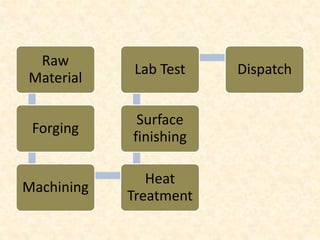
Raw 
Material 
Forging 
Machining 
Lab Test Dispatch 
Surface 
finishing 
Heat 
Treatment
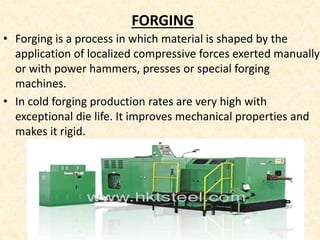
FORGING 
• Forging is a process in which material is shaped by the 
application of localized compressive forces exerted manually 
or with power hammers, presses or special forging 
machines. 
• In cold forging production rates are very high with 
exceptional die life. It improves mechanical properties and 
makes it rigid.
WIRE STRAIGHTENING: 
• The wire is in the form of rolls. So it needs to be 
straightened before being forged. 
• After straightening: 
FEED 
TUBE 
STOPPER CUTTER DIE’S
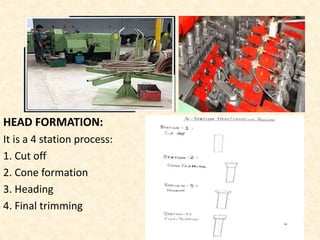
HEAD FORMATION: 
It is a 4 station process: 
1. Cut off 
2. Cone formation 
3. Heading 
4. Final trimming
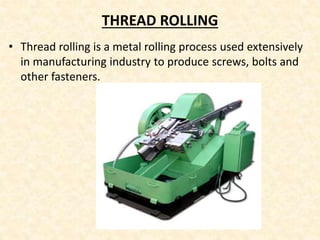
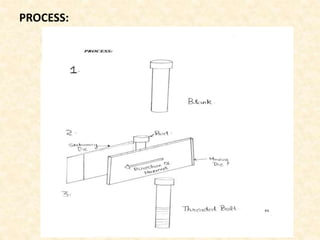
THREAD ROLLING 
• Thread rolling is a metal rolling process used extensively 
in manufacturing industry to produce screws, bolts and 
other fasteners.
PROCESS:
MACHINING 
• Machining is a metal removal process in which excess 
material is removed to obtain desired shape, size. 
Machining is done by using CNC machines which are 
highly efficient as they are more accurate, less time 
consuming. So, more productivity and are cost 
effective also. 
• OPERATIONS PERFORMED: 
1. Parting off 
2. Threading 
3. Grooving 
4. Turning 
5. Profiling 
6. Undercutting 
7. Face-grooving
LUBRICANT: 
• Cutting oil used in lubricant is Mobil Cut- 100. 
• Lubricant composition is 3 to 5% of cutting oil. 
• DM water or RO water is used in lubricant. 
• Lubricant is changed after every 6 months. 
Concentration of lubricant is checked daily using 
refractometer.
HEAT TREATMENT 
• Heat Treatment is the controlled heating and cooling 
of metals to alter their physical and mechanical 
properties without changing the product shape. 
Length of furnace is about 14.5m
PROCESS FLOW 
LOADER 
OIL 
SKIMMER 
WATER 
SUPPLY 
HARDENING 
CONVEYOR 
QUENCH IN 
OIL 
TEMPERING 
FURNACE 
DYEING 
TANK 
UNLOADING
• Gas flow meter is used to set LPG and 
Methanol concentration. 
• Minimum 100KGs stock of methanol and LPGis 
must. This prevents the entrance of oxygen 
and maintains appropriate carbon content. 
Gas flow meter Control panel
SURFACE FINISHING 
• ELECTROPLATING: 
Electroplating is the application of a metal coating 
to a metallic or other conducting surface by an 
electrochemical process.
PROCESS FLOW 
• PRE-TREATMENT: 
• PLATING:
• POST PLATING: 
• H 
HOT AIR DRYER
POLLUTION CONTROL 
• Heat treatment industry has a share in the present 
environmental degradation. 
• Two methods for control of pollution in an Industrial 
unit : 
 Use of equipment like gas scrubbers, ventilation fans, 
washers etc. require considerable capital investment 
and also in value running expenses.
 Use of high stack chimney and operating the unit 
at a time of favorable natural draught through 
chimney, helps to successfully disperse the dust 
and gases emitted from the unit at zero or 
negligible cost.
ENERGY CONSERVATION 
• It has become essential these days that the energy 
conservation efforts are needed to be strengthened 
substantially. 
• Various factors which affect fuel economy in 
industrial furnaces may be stated as : 
1. Complete combustion with minimum excess air. 
2. Proper heat distribution. 
3. Operating at the desired temperature. 
4. Reducing heat losses from openings. 
5. Minimizing wall losses. 
6. Waste heat recovery from flue gases.
THANK YOU

Sterling tools (bolt manufacturing)

  • 1.
    INDUSTRIAL TRAINING AT STERLING TOOLS LIMITED (INDUSTRIAL ESTATE, DLF 5A, FARIDABAD) BY: PRINCE NASWA 12MEU067 ITM UNIVERSITY GURGAON
  • 2.
    ABOUT STERLING TOOL’S • Sterling tools limited (STL), is a well-established, dynamic and professionally managed company, is a leading manufacturer of fasteners in India. • The company was incorporated as a private limited company in 1979 and was turned into a public limited company in 1994. • STL is the third largest fastener manufacturing company in asia. PRODUCTS: 1. Special Fasteners 2. Standard Fasteners 3. Chassis Fasteners 4. Engine Fasteners
  • 3.
    INTRODUCTION • Anindustrial fastener comprises a very wide range of items like nuts and bolts, washers, studs, nails etc. Nuts and bolts consist a major link in the family of industrial fasteners and are used by every industry. Bolt is a piece of metal rod, whose one end is unsettled and other end is threaded. Nut is the item, which rolls on these threads. RAW MATERIAL • Quality of bolts depends on the composition of various elements in raw material. According to the composition required there are total 17 grades of raw material available. Grade is decided according to the costumer requirement.
  • 4.
    Raw Material Forging Machining Lab Test Dispatch Surface finishing Heat Treatment
  • 5.
    FORGING • Forgingis a process in which material is shaped by the application of localized compressive forces exerted manually or with power hammers, presses or special forging machines. • In cold forging production rates are very high with exceptional die life. It improves mechanical properties and makes it rigid.
  • 6.
    WIRE STRAIGHTENING: •The wire is in the form of rolls. So it needs to be straightened before being forged. • After straightening: FEED TUBE STOPPER CUTTER DIE’S
  • 7.
    HEAD FORMATION: Itis a 4 station process: 1. Cut off 2. Cone formation 3. Heading 4. Final trimming
  • 8.
    THREAD ROLLING •Thread rolling is a metal rolling process used extensively in manufacturing industry to produce screws, bolts and other fasteners.
  • 9.
  • 10.
    MACHINING • Machiningis a metal removal process in which excess material is removed to obtain desired shape, size. Machining is done by using CNC machines which are highly efficient as they are more accurate, less time consuming. So, more productivity and are cost effective also. • OPERATIONS PERFORMED: 1. Parting off 2. Threading 3. Grooving 4. Turning 5. Profiling 6. Undercutting 7. Face-grooving
  • 11.
    LUBRICANT: • Cuttingoil used in lubricant is Mobil Cut- 100. • Lubricant composition is 3 to 5% of cutting oil. • DM water or RO water is used in lubricant. • Lubricant is changed after every 6 months. Concentration of lubricant is checked daily using refractometer.
  • 12.
    HEAT TREATMENT •Heat Treatment is the controlled heating and cooling of metals to alter their physical and mechanical properties without changing the product shape. Length of furnace is about 14.5m
  • 13.
    PROCESS FLOW LOADER OIL SKIMMER WATER SUPPLY HARDENING CONVEYOR QUENCH IN OIL TEMPERING FURNACE DYEING TANK UNLOADING
  • 14.
    • Gas flowmeter is used to set LPG and Methanol concentration. • Minimum 100KGs stock of methanol and LPGis must. This prevents the entrance of oxygen and maintains appropriate carbon content. Gas flow meter Control panel
  • 15.
    SURFACE FINISHING •ELECTROPLATING: Electroplating is the application of a metal coating to a metallic or other conducting surface by an electrochemical process.
  • 16.
    PROCESS FLOW •PRE-TREATMENT: • PLATING:
  • 17.
    • POST PLATING: • H HOT AIR DRYER
  • 18.
    POLLUTION CONTROL •Heat treatment industry has a share in the present environmental degradation. • Two methods for control of pollution in an Industrial unit :  Use of equipment like gas scrubbers, ventilation fans, washers etc. require considerable capital investment and also in value running expenses.
  • 19.
     Use ofhigh stack chimney and operating the unit at a time of favorable natural draught through chimney, helps to successfully disperse the dust and gases emitted from the unit at zero or negligible cost.
  • 20.
    ENERGY CONSERVATION •It has become essential these days that the energy conservation efforts are needed to be strengthened substantially. • Various factors which affect fuel economy in industrial furnaces may be stated as : 1. Complete combustion with minimum excess air. 2. Proper heat distribution. 3. Operating at the desired temperature. 4. Reducing heat losses from openings. 5. Minimizing wall losses. 6. Waste heat recovery from flue gases.
  • 21.