Laser Prepared by: Devang Bhatti
Laser Working Diagram
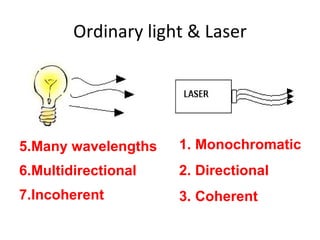
Laser and ordinary light The light emitted from a laser is  monochromatic , that is, it is of one color/wavelength. In contrast, ordinary white light is a combination of many colors (or wavelengths) of light.  Lasers emit light that is highly  directional , that is, laser light is emitted as a relatively narrow beam in a specific direction. Ordinary light, such as from a light bulb, is emitted in many directions away from the source.  The light from a laser is said to be  coherent , which means that the wavelengths of the laser light are in phase in space and time. Ordinary light can be a mixture of many wavelengths.
Ordinary light & Laser Many wavelengths Multidirectional Incoherent Monochromatic Directional Coherent
Gas Laser Architecture
Gas Laser working style Gas lasers consist of a gas filled tube placed in the laser cavity. A voltage (the external pump source) is applied to the tube to excite the atoms in the gas to a population inversion. The light emitted from this type of laser is normally continuous wave (CW).
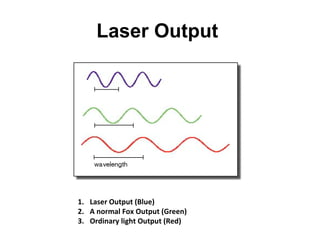
Laser Output  Laser Output (Blue) A normal Fox Output (Green) Ordinary light Output (Red)
Laser Hazards  Eye   : Acute exposure of the eye to lasers of certain wavelengths and power can cause corneal or retinal burns (or both).  Skin   : Acute exposure to high levels of optical radiation may cause skin burns. Chemical   : Some lasers require hazardous or toxic substances to operate (i.e., chemical dye). Electrical   : Most lasers utilize high voltages that can be lethal. Fire   : The solvents used in dye lasers are flammable. High voltage pulse or flash lamps may cause ignition.
Laser Class (General) The following criteria are used to classify lasers:   Wavelength .  If the laser is designed to emit multiple wavelengths the classification is based on the most hazardous wavelength.  For  continuous wave (CW)  or repetitively pulsed lasers the  average power   output   (Watts) and  limiting exposure time   inherent in the design are considered.  For  pulsed  lasers the  total energy per pulse   (Joule),  pulse duration ,  pulse repetition frequency   and  emergent beam radiant exposure   are considered.
Laser Classes (ANSI) Class 1  denotes laser or laser systems that do not, under normal operating conditions, pose a hazard. Class 2  denotes low-power visible lasers or laser system which, because of the normal human aversion response (i.e., blinking, eye movement, etc.), do not normally present a hazard, but may present some potential for hazard if viewed directly for extended periods of time.
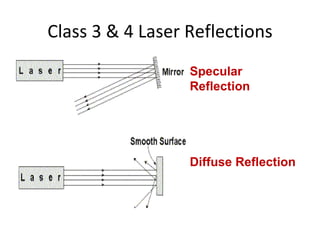
Laser Classes (ANSI) Cont… Class 3a  denotes some lasers or laser systems having a CAUTION label that normally would not injure the eye if viewed for only momentary periods (within the aversion response period) with the unaided eye. Class 3a lasers have DANGER labels and are capable of exceeding permissible exposure levels. If operated with care Class 3a lasers pose a low risk of injury. Class 3b  denotes lasers or laser systems that can produce a hazard it viewed directly. This includes intrabeam viewing of specular reflections. Normally, Class 3b lasers will not produce a hazardous diffuse reflection.  Class 4  denotes lasers and laser systems that produce a hazard not only from direct or specular reflections, but may also produce significant skin hazards as well as fire hazards.
Class 3 & 4 Laser Reflections Specular Reflection Diffuse Reflection

Laser Transmission

  • 1.
    Laser Prepared by:Devang Bhatti
  • 2.
  • 3.
    Laser and ordinarylight The light emitted from a laser is monochromatic , that is, it is of one color/wavelength. In contrast, ordinary white light is a combination of many colors (or wavelengths) of light. Lasers emit light that is highly directional , that is, laser light is emitted as a relatively narrow beam in a specific direction. Ordinary light, such as from a light bulb, is emitted in many directions away from the source. The light from a laser is said to be coherent , which means that the wavelengths of the laser light are in phase in space and time. Ordinary light can be a mixture of many wavelengths.
  • 4.
    Ordinary light &Laser Many wavelengths Multidirectional Incoherent Monochromatic Directional Coherent
  • 5.
  • 6.
    Gas Laser workingstyle Gas lasers consist of a gas filled tube placed in the laser cavity. A voltage (the external pump source) is applied to the tube to excite the atoms in the gas to a population inversion. The light emitted from this type of laser is normally continuous wave (CW).
  • 7.
    Laser Output Laser Output (Blue) A normal Fox Output (Green) Ordinary light Output (Red)
  • 8.
    Laser Hazards Eye : Acute exposure of the eye to lasers of certain wavelengths and power can cause corneal or retinal burns (or both). Skin : Acute exposure to high levels of optical radiation may cause skin burns. Chemical : Some lasers require hazardous or toxic substances to operate (i.e., chemical dye). Electrical : Most lasers utilize high voltages that can be lethal. Fire : The solvents used in dye lasers are flammable. High voltage pulse or flash lamps may cause ignition.
  • 9.
    Laser Class (General)The following criteria are used to classify lasers: Wavelength . If the laser is designed to emit multiple wavelengths the classification is based on the most hazardous wavelength. For continuous wave (CW) or repetitively pulsed lasers the average power output (Watts) and limiting exposure time inherent in the design are considered. For pulsed lasers the total energy per pulse (Joule), pulse duration , pulse repetition frequency and emergent beam radiant exposure are considered.
  • 10.
    Laser Classes (ANSI)Class 1 denotes laser or laser systems that do not, under normal operating conditions, pose a hazard. Class 2 denotes low-power visible lasers or laser system which, because of the normal human aversion response (i.e., blinking, eye movement, etc.), do not normally present a hazard, but may present some potential for hazard if viewed directly for extended periods of time.
  • 11.
    Laser Classes (ANSI)Cont… Class 3a denotes some lasers or laser systems having a CAUTION label that normally would not injure the eye if viewed for only momentary periods (within the aversion response period) with the unaided eye. Class 3a lasers have DANGER labels and are capable of exceeding permissible exposure levels. If operated with care Class 3a lasers pose a low risk of injury. Class 3b denotes lasers or laser systems that can produce a hazard it viewed directly. This includes intrabeam viewing of specular reflections. Normally, Class 3b lasers will not produce a hazardous diffuse reflection. Class 4 denotes lasers and laser systems that produce a hazard not only from direct or specular reflections, but may also produce significant skin hazards as well as fire hazards.
  • 12.
    Class 3 &4 Laser Reflections Specular Reflection Diffuse Reflection