By: Lauren Bacchus &  Casey Hansen
A chronic disease that attacks the CNS. Sclerosis = scar tissue ; The body's own defensive system attacks the myelin, that surrounds and protects the nerve fibers in the CNS. The nerve fibers are damaged
Fatigue Numbness Balance and coordination  problems Bladder dysfunction Bowel dysfunction Vision Problems Dizziness  Sexual Dysfunction Pain Cognitive function Emotional changes; depression Muscle spasms and stiffness
Involves an autoimmune process. The antigen is unknown, therefore the cause of the disease is also unknown . There is evidence pointing to a viral cause, but is yet to be proven Environmental and genetic
MS is most common in areas farther from the equator. Caucasians with European ancestry but there are exceptions  Diagnosed between ages 20-50. 2 to 3 times more women then men  Not inherited
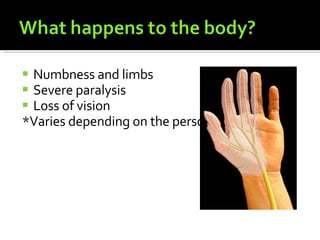
Numbness and limbs Severe paralysis Loss of vision *Varies depending on the person
Incurable;  The disease stays with you your entire life. Life expectancy is the same as the unaffected. A near normal life is possible in some cases.
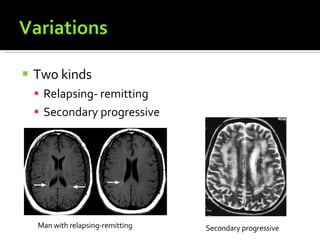
Two kinds Relapsing- remitting  Secondary progressive  Man with relapsing-remitting  Secondary progressive
There is no real cure Slowing the disease course  High doses of corticosteroids are used to reduce inflammation which can help treat attacks. Rehabilitation; helps improve body function  Exercise and healthy diet
http://www.nationalmssociety.org/about-multiple-sclerosis/index.aspx http://en.wikipedia.org/wiki/Multiple_sclerosis http://www.mayoclinic.com/health/multiple-sclerosis/DS00188

Multiple Sclerosis