International Journal JOURNAL OF COMPUTER ENGINEERING & TECHNOLOGY
  INTERNATIONAL of Computer Engineering and Technology (IJCET), ISSN 0976 –
                                           (IJCET)
 6367(Print), ISSN 0976 – 6375(Online) Volume 3, Issue 3, October-December (2012), © IAEME

ISSN 0976 – 6367(Print)
ISSN 0976 – 6375(Online)
Volume 3, Issue 3, October - December (2012), pp. 23-29                        IJCET
© IAEME: www.iaeme.com/ijcet.asp
Journal Impact Factor (2012): 3.9580 (Calculated by GISI)
www.jifactor.com
                                                                           ©IAEME


                    MULTIPLE ROUTING CONFIGURATION

         A.S.Tamboli (Asst. Professor)                   Ms. B.A.Jadhawar(Asst. Professor)
        Dept. of Information Technology                   Dept. of Information Technology
   Annasaheb Dange College of Engineering and           Annasaheb Dange College of Engineering
               Technology,Ashta                               and Technology,Ashta
           shikalgar.arifa@gmail.com                       bajdhawar123@gmail.com


 ABSTRACT
        As we know today’s world surrounded with internet and internet is the most important
 part of the communication, but some routing protocols are work slow for recover link or
 node. So we introduce new routing protocol called as “Multiple Routing Configuration”
 (MRC). MRC protocol gives the guarantees for recovering both failed nodes and failed links,
 works without knowing the root cause of failure of node or links. MRC is connectionless and
 forward packet Hop-by-Hop. MRC keeps information of routing, and allow to forward packet
 through shortest alternate link after the failure. Using MRC we also can reduce the traffic on
 network and also reduce the time of forwarding packet after failure.

 Keywords: Routing, multiple routing, shortest Path

 I. INTRODUCTION
    Today’s Internet is so fast, central and it covers large area every day. The main problem of
 the internet to fast recover from the failure. There are many protocols to forward packet after
 the failure of links and nodes but they work after the failure such as BGP and IGP. In this
 case, packet can drop during the failure. The both protocols can give a more time to detect the
 failure, to send the NACK message to source and calculate the shortest path for the specific
 Destination. IGP is a slow process, it is reactive and global because it reacts after the failure
 arises and it can involves all the nodes in the network. In case of MRC is a proactive and
 local because it can stores the additional information of routing in the nodes and send the
 packet hop-by-hop from previous node of failure node by shortest path. These shortest paths
 are already calculated so the time for calculating shortest path is minimised after the failure,
 means the time for recover the node is reduced. MRC working without knowing the root
 cause of the failure such as node failure or link failure.

                                                23
International Journal of Computer Engineering and Technology (IJCET), ISSN 0976 –
6367(Print), ISSN 0976 – 6375(Online) Volume 3, Issue 3, October-December (2012), © IAEME

II. MRC OVERVIEW
      MRC builds a set of backup routing configurations that are used to route the packet on
alternate path after failure. The backup configuration is different from original network
configuration. In observation, If traffic on a link is high then traffic doesn’t routed through
that link or node.

     MRC scheme is based on three steps. First, create a set of backup configurations for
each and every node; forward the packet using one of this after the failure of node or link.
Second, for calculating shortest path use the OSPF for each backup configuration and create
forward table for each configuration. Finally, design a packet forwarding process that shows
the advantage of backup configurations to facilities fast recovery from a component failure.

III. CREATE BACKUP CONFIGURATIONS
        MRC configuration is based on network topology; network topology is like a graph,
with collection of nodes and unidirectional links. It gives the guarantee fault tolerance; the
network topology graph must be bi-connected. Each link having the weight, this weight
necessary for deciding the node is isolated, restricted or normal. Isolated node doesn’t carry
any traffic; restricted links carry traffic at sufficient high weight. Isolated nodes are those
nodes that having only restricted or isolated nodes. Means restricted links are always between
the isolated node and non-isolated node. Isolated links between isolated node and non
isolated node or between two isolated nodes.

        Backbone:- All isolated nodes are directly connected to the backbone configuration.
Validating configurations are connected to the backbone.

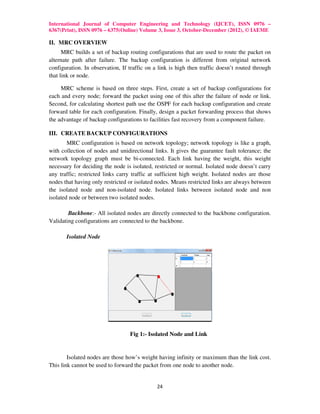
       Isolated Node


                                  Fig 1:- Isolated Node and Link


        Isolated nodes are those how’s weight having infinity or maximum than the link cost.
This link cannot be used to forward the packet from one node to another node.


                                              24
International Journal of Computer Engineering and Technology (IJCET), ISSN 0976 –
6367(Print), ISSN 0976 – 6375(Online) Volume 3, Issue 3, October-December (2012), © IAEME

        Non-isolated nodes or links either normal or restricted (nodes/links). This node and
links can be used to forward the packet from one node to another node.

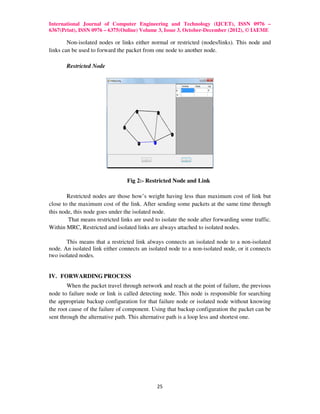
       Restricted Node


                                 Fig 2:- Restricted Node and Link

        Restricted nodes are those how’s weight having less than maximum cost of link but
close to the maximum cost of the link. After sending some packets at the same time through
this node, this node goes under the isolated node.
        That means restricted links are used to isolate the node after forwarding some traffic.
Within MRC, Restricted and isolated links are always attached to isolated nodes.

       This means that a restricted link always connects an isolated node to a non-isolated
node. An isolated link either connects an isolated node to a non-isolated node, or it connects
two isolated nodes.


IV. FORWARDING PROCESS
        When the packet travel through network and reach at the point of failure, the previous
node to failure node or link is called detecting node. This node is responsible for searching
the appropriate backup configuration for that failure node or isolated node without knowing
the root cause of the failure of component. Using that backup configuration the packet can be
sent through the alternative path. This alternative path is a loop less and shortest one.


                                              25
International Journal of Computer Engineering and Technology (IJCET), ISSN 0976 –
6367(Print), ISSN 0976 – 6375(Online) Volume 3, Issue 3, October-December (2012), © IAEME


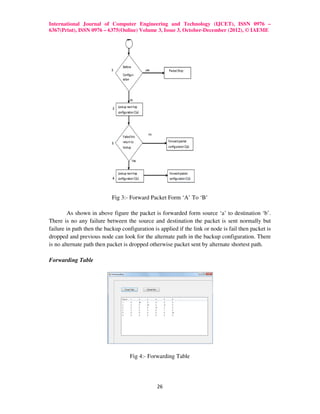
                            Fig 3:- Forward Packet Form ‘A’ To ‘B’

        As shown in above figure the packet is forwarded form source ‘a’ to destination ‘b’.
There is no any failure between the source and destination the packet is sent normally but
failure in path then the backup configuration is applied if the link or node is fail then packet is
dropped and previous node can look for the alternate path in the backup configuration. There
is no alternate path then packet is dropped otherwise packet sent by alternate shortest path.

Forwarding Table


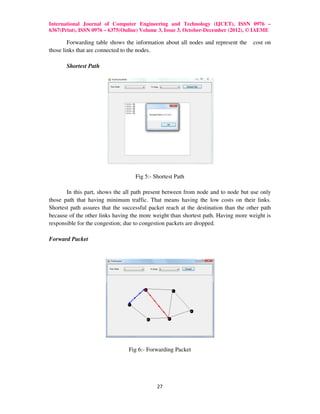
                                    Fig 4:- Forwarding Table


                                                26
International Journal of Computer Engineering and Technology (IJCET), ISSN 0976 –
6367(Print), ISSN 0976 – 6375(Online) Volume 3, Issue 3, October-December (2012), © IAEME

        Forwarding table shows the information about all nodes and represent the     cost on
those links that are connected to the nodes.

       Shortest Path


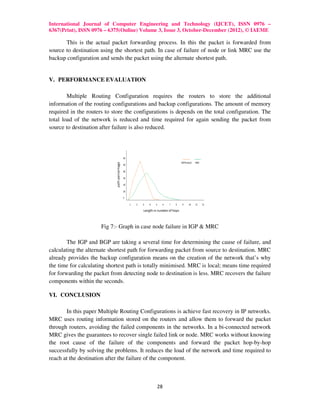
                                    Fig 5:- Shortest Path

       In this part, shows the all path present between from node and to node but use only
those path that having minimum traffic. That means having the low costs on their links.
Shortest path assures that the successful packet reach at the destination than the other path
because of the other links having the more weight than shortest path. Having more weight is
responsible for the congestion; due to congestion packets are dropped.

Forward Packet


                                 Fig 6:- Forwarding Packet


                                             27
International Journal of Computer Engineering and Technology (IJCET), ISSN 0976 –
6367(Print), ISSN 0976 – 6375(Online) Volume 3, Issue 3, October-December (2012), © IAEME

       This is the actual packet forwarding process. In this the packet is forwarded from
source to destination using the shortest path. In case of failure of node or link MRC use the
backup configuration and sends the packet using the alternate shortest path.


V. PERFORMANCE EVALUATION

        Multiple Routing Configuration requires the routers to store the additional
information of the routing configurations and backup configurations. The amount of memory
required in the routers to store the configurations is depends on the total configuration. The
total load of the network is reduced and time required for again sending the packet from
source to destination after failure is also reduced.


                      Fig 7:- Graph in case node failure in IGP & MRC

        The IGP and BGP are taking a several time for determining the cause of failure, and
calculating the alternate shortest path for forwarding packet from source to destination. MRC
already provides the backup configuration means on the creation of the network that’s why
the time for calculating shortest path is totally minimised. MRC is local; means time required
for forwarding the packet from detecting node to destination is less. MRC recovers the failure
components within the seconds.

VI. CONCLUSION

       In this paper Multiple Routing Configurations is achieve fast recovery in IP networks.
MRC uses routing information stored on the routers and allow them to forward the packet
through routers, avoiding the failed components in the networks. In a bi-connected network
MRC gives the guarantees to recover single failed link or node. MRC works without knowing
the root cause of the failure of the components and forward the packet hop-by-hop
successfully by solving the problems. It reduces the load of the network and time required to
reach at the destination after the failure of the component.


                                             28
International Journal of Computer Engineering and Technology (IJCET), ISSN 0976 –
6367(Print), ISSN 0976 – 6375(Online) Volume 3, Issue 3, October-December (2012), © IAEME

REFERENCES

1] Amund Kvalbein, Member, IEEE, Audun Fosselie Hansen, Tarik ˇ Ciˇcic´, Member, IEEE,
Stein Gjessing, Member, IEEE, and Olav Lysne, Member, IEEE

2] A. Basu and J. G. Riecke, “Stability issues in OSPF routing,” in Proc. ACM SIGCOMM,
San Diego, CA, Aug. 2001, pp. 225–236.

3] A. Markopoulou, G. Iannaccone, S. Bhattacharyya, C.-N. Chuah, and C. Diot,
“Characterization of failures in an IP backbone network,” in Proc. IEEE INFOCOM, Mar.
2004, vol. 4, pp. 2307–2317.

4] S. Nelakuditi, S. Lee, Y. Yu, Z.-L. Zhang, and C.-N. Chuah, “Fast local rerouting for
handling transient link failures,” IEEE/ACM Trans. Networking, vol. 15, no. 2, pp. 359–372,
Apr. 2007.

5] P. Francois, M. Shand, and O. Bonaventure, “Disruption free topology reconfiguration in
OSPF networks,” in Proc. IEEE INFOCOM, Anchorage, AK, May 2007, pp. 89–97

6] P. Francois, C. Filsfils, J. Evans, and O. Bonaventure, “Achieving sub-second IGP
convergence in large IP networks,” ACM SIGCOMM Comput. Commun. Rev., vol. 35, no. 2,
pp. 35–44, Jul. 2005.

7] A. Markopoulou, G. Iannaccone, S. Bhattacharyya, C.-N. Chuah, and C. Diot,
“Characterization of failures in an IP backbone network,” in Proc. IEEE INFOCOM, Mar.
2004, vol. 4, pp. 2307–2317.


                                            29

Multiple routing configuration

  • 1.
    International Journal JOURNALOF COMPUTER ENGINEERING & TECHNOLOGY INTERNATIONAL of Computer Engineering and Technology (IJCET), ISSN 0976 – (IJCET) 6367(Print), ISSN 0976 – 6375(Online) Volume 3, Issue 3, October-December (2012), © IAEME ISSN 0976 – 6367(Print) ISSN 0976 – 6375(Online) Volume 3, Issue 3, October - December (2012), pp. 23-29 IJCET © IAEME: www.iaeme.com/ijcet.asp Journal Impact Factor (2012): 3.9580 (Calculated by GISI) www.jifactor.com ©IAEME MULTIPLE ROUTING CONFIGURATION A.S.Tamboli (Asst. Professor) Ms. B.A.Jadhawar(Asst. Professor) Dept. of Information Technology Dept. of Information Technology Annasaheb Dange College of Engineering and Annasaheb Dange College of Engineering Technology,Ashta and Technology,Ashta shikalgar.arifa@gmail.com bajdhawar123@gmail.com ABSTRACT As we know today’s world surrounded with internet and internet is the most important part of the communication, but some routing protocols are work slow for recover link or node. So we introduce new routing protocol called as “Multiple Routing Configuration” (MRC). MRC protocol gives the guarantees for recovering both failed nodes and failed links, works without knowing the root cause of failure of node or links. MRC is connectionless and forward packet Hop-by-Hop. MRC keeps information of routing, and allow to forward packet through shortest alternate link after the failure. Using MRC we also can reduce the traffic on network and also reduce the time of forwarding packet after failure. Keywords: Routing, multiple routing, shortest Path I. INTRODUCTION Today’s Internet is so fast, central and it covers large area every day. The main problem of the internet to fast recover from the failure. There are many protocols to forward packet after the failure of links and nodes but they work after the failure such as BGP and IGP. In this case, packet can drop during the failure. The both protocols can give a more time to detect the failure, to send the NACK message to source and calculate the shortest path for the specific Destination. IGP is a slow process, it is reactive and global because it reacts after the failure arises and it can involves all the nodes in the network. In case of MRC is a proactive and local because it can stores the additional information of routing in the nodes and send the packet hop-by-hop from previous node of failure node by shortest path. These shortest paths are already calculated so the time for calculating shortest path is minimised after the failure, means the time for recover the node is reduced. MRC working without knowing the root cause of the failure such as node failure or link failure. 23
  • 2.
    International Journal ofComputer Engineering and Technology (IJCET), ISSN 0976 – 6367(Print), ISSN 0976 – 6375(Online) Volume 3, Issue 3, October-December (2012), © IAEME II. MRC OVERVIEW MRC builds a set of backup routing configurations that are used to route the packet on alternate path after failure. The backup configuration is different from original network configuration. In observation, If traffic on a link is high then traffic doesn’t routed through that link or node. MRC scheme is based on three steps. First, create a set of backup configurations for each and every node; forward the packet using one of this after the failure of node or link. Second, for calculating shortest path use the OSPF for each backup configuration and create forward table for each configuration. Finally, design a packet forwarding process that shows the advantage of backup configurations to facilities fast recovery from a component failure. III. CREATE BACKUP CONFIGURATIONS MRC configuration is based on network topology; network topology is like a graph, with collection of nodes and unidirectional links. It gives the guarantee fault tolerance; the network topology graph must be bi-connected. Each link having the weight, this weight necessary for deciding the node is isolated, restricted or normal. Isolated node doesn’t carry any traffic; restricted links carry traffic at sufficient high weight. Isolated nodes are those nodes that having only restricted or isolated nodes. Means restricted links are always between the isolated node and non-isolated node. Isolated links between isolated node and non isolated node or between two isolated nodes. Backbone:- All isolated nodes are directly connected to the backbone configuration. Validating configurations are connected to the backbone. Isolated Node Fig 1:- Isolated Node and Link Isolated nodes are those how’s weight having infinity or maximum than the link cost. This link cannot be used to forward the packet from one node to another node. 24
  • 3.
    International Journal ofComputer Engineering and Technology (IJCET), ISSN 0976 – 6367(Print), ISSN 0976 – 6375(Online) Volume 3, Issue 3, October-December (2012), © IAEME Non-isolated nodes or links either normal or restricted (nodes/links). This node and links can be used to forward the packet from one node to another node. Restricted Node Fig 2:- Restricted Node and Link Restricted nodes are those how’s weight having less than maximum cost of link but close to the maximum cost of the link. After sending some packets at the same time through this node, this node goes under the isolated node. That means restricted links are used to isolate the node after forwarding some traffic. Within MRC, Restricted and isolated links are always attached to isolated nodes. This means that a restricted link always connects an isolated node to a non-isolated node. An isolated link either connects an isolated node to a non-isolated node, or it connects two isolated nodes. IV. FORWARDING PROCESS When the packet travel through network and reach at the point of failure, the previous node to failure node or link is called detecting node. This node is responsible for searching the appropriate backup configuration for that failure node or isolated node without knowing the root cause of the failure of component. Using that backup configuration the packet can be sent through the alternative path. This alternative path is a loop less and shortest one. 25
  • 4.
    International Journal ofComputer Engineering and Technology (IJCET), ISSN 0976 – 6367(Print), ISSN 0976 – 6375(Online) Volume 3, Issue 3, October-December (2012), © IAEME Fig 3:- Forward Packet Form ‘A’ To ‘B’ As shown in above figure the packet is forwarded form source ‘a’ to destination ‘b’. There is no any failure between the source and destination the packet is sent normally but failure in path then the backup configuration is applied if the link or node is fail then packet is dropped and previous node can look for the alternate path in the backup configuration. There is no alternate path then packet is dropped otherwise packet sent by alternate shortest path. Forwarding Table Fig 4:- Forwarding Table 26
  • 5.
    International Journal ofComputer Engineering and Technology (IJCET), ISSN 0976 – 6367(Print), ISSN 0976 – 6375(Online) Volume 3, Issue 3, October-December (2012), © IAEME Forwarding table shows the information about all nodes and represent the cost on those links that are connected to the nodes. Shortest Path Fig 5:- Shortest Path In this part, shows the all path present between from node and to node but use only those path that having minimum traffic. That means having the low costs on their links. Shortest path assures that the successful packet reach at the destination than the other path because of the other links having the more weight than shortest path. Having more weight is responsible for the congestion; due to congestion packets are dropped. Forward Packet Fig 6:- Forwarding Packet 27
  • 6.
    International Journal ofComputer Engineering and Technology (IJCET), ISSN 0976 – 6367(Print), ISSN 0976 – 6375(Online) Volume 3, Issue 3, October-December (2012), © IAEME This is the actual packet forwarding process. In this the packet is forwarded from source to destination using the shortest path. In case of failure of node or link MRC use the backup configuration and sends the packet using the alternate shortest path. V. PERFORMANCE EVALUATION Multiple Routing Configuration requires the routers to store the additional information of the routing configurations and backup configurations. The amount of memory required in the routers to store the configurations is depends on the total configuration. The total load of the network is reduced and time required for again sending the packet from source to destination after failure is also reduced. Fig 7:- Graph in case node failure in IGP & MRC The IGP and BGP are taking a several time for determining the cause of failure, and calculating the alternate shortest path for forwarding packet from source to destination. MRC already provides the backup configuration means on the creation of the network that’s why the time for calculating shortest path is totally minimised. MRC is local; means time required for forwarding the packet from detecting node to destination is less. MRC recovers the failure components within the seconds. VI. CONCLUSION In this paper Multiple Routing Configurations is achieve fast recovery in IP networks. MRC uses routing information stored on the routers and allow them to forward the packet through routers, avoiding the failed components in the networks. In a bi-connected network MRC gives the guarantees to recover single failed link or node. MRC works without knowing the root cause of the failure of the components and forward the packet hop-by-hop successfully by solving the problems. It reduces the load of the network and time required to reach at the destination after the failure of the component. 28
  • 7.
    International Journal ofComputer Engineering and Technology (IJCET), ISSN 0976 – 6367(Print), ISSN 0976 – 6375(Online) Volume 3, Issue 3, October-December (2012), © IAEME REFERENCES 1] Amund Kvalbein, Member, IEEE, Audun Fosselie Hansen, Tarik ˇ Ciˇcic´, Member, IEEE, Stein Gjessing, Member, IEEE, and Olav Lysne, Member, IEEE 2] A. Basu and J. G. Riecke, “Stability issues in OSPF routing,” in Proc. ACM SIGCOMM, San Diego, CA, Aug. 2001, pp. 225–236. 3] A. Markopoulou, G. Iannaccone, S. Bhattacharyya, C.-N. Chuah, and C. Diot, “Characterization of failures in an IP backbone network,” in Proc. IEEE INFOCOM, Mar. 2004, vol. 4, pp. 2307–2317. 4] S. Nelakuditi, S. Lee, Y. Yu, Z.-L. Zhang, and C.-N. Chuah, “Fast local rerouting for handling transient link failures,” IEEE/ACM Trans. Networking, vol. 15, no. 2, pp. 359–372, Apr. 2007. 5] P. Francois, M. Shand, and O. Bonaventure, “Disruption free topology reconfiguration in OSPF networks,” in Proc. IEEE INFOCOM, Anchorage, AK, May 2007, pp. 89–97 6] P. Francois, C. Filsfils, J. Evans, and O. Bonaventure, “Achieving sub-second IGP convergence in large IP networks,” ACM SIGCOMM Comput. Commun. Rev., vol. 35, no. 2, pp. 35–44, Jul. 2005. 7] A. Markopoulou, G. Iannaccone, S. Bhattacharyya, C.-N. Chuah, and C. Diot, “Characterization of failures in an IP backbone network,” in Proc. IEEE INFOCOM, Mar. 2004, vol. 4, pp. 2307–2317. 29