MULTIPLE PREGNANCY
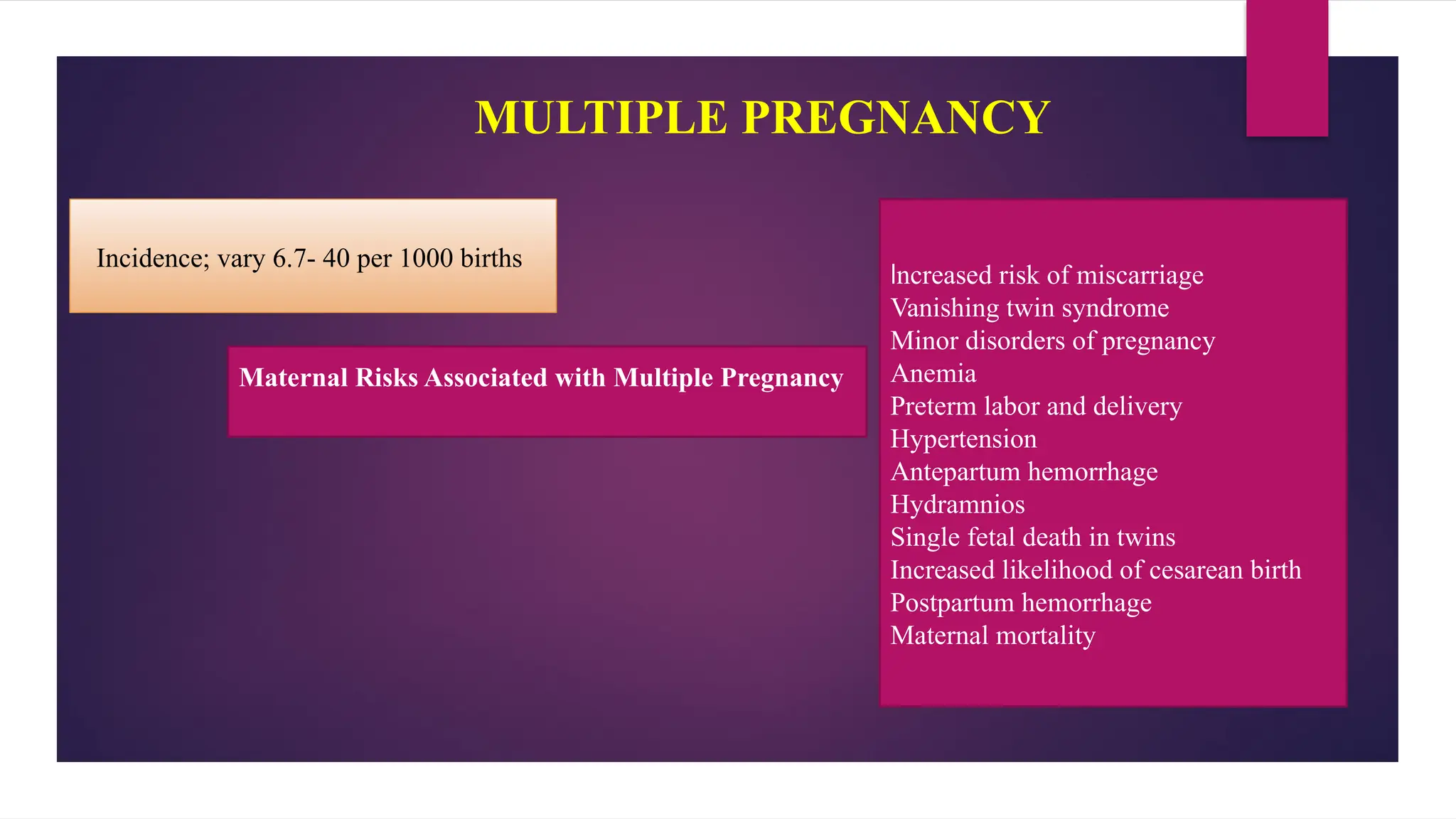
Incidence; vary 6.7- 40 per 1000 births
Increased risk of miscarriage
Vanishing twin syndrome
Minor disorders of pregnancy
Anemia
Preterm labor and delivery
Hypertension
Antepartum hemorrhage
Hydramnios
Single fetal death in twins
Increased likelihood of cesarean birth
Postpartum hemorrhage
Maternal mortality
Maternal Risks Associated with Multiple Pregnancy
Fetal Risks Associated with Multiple Pregnancy
Stillbirth or neonatal death
Preterm labor and delivery
Intrauterine growth restriction
Congenital anomalies
Congenital anomaly in one twin
Twin reversed arterial perfusion sequence
Conjoined twins
Cord accident
Monoamniotic twins
Hydramnios
Twin-twin transfusion syndrome
Risk of asphyxia
Twin entrapment
Cerebral palsy
Chorionicity and zygosity
dizygotic
two ova are fertilized and have separate
amnions, chorions, and placentas
(dichorionic diamniotic).The placentas may
fuse if the implantation sites are close
together. The majority of twin pregnancies
are dizygotic.
single fertilized ovum or zygote divides after
conception. division of the zygote within 2
days, dichorionic diamniotic twins.
monozygotic
9 and 12 days after fertilization) results in a
shared chorion, amnion, and placentation
and is rare, occurring in only 1% of
monozygotictwins(monochorionic
monoamniotic (MCMA
3– 8 days after fertilization. 70% of
monozygotic twins (monochorionic diamniotic
(MCDA) twins).
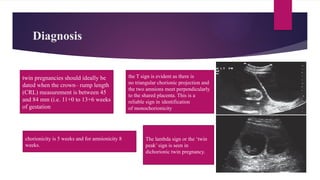
Diagnosis
twin pregnancies should ideally be
dated when the crown– rump length
(CRL) measurement is between 45
and 84 mm (i.e. 11+0 to 13+6 weeks
of gestation
the T sign is evident as there is
no triangular chorionic projection and
the two amnions meet perpendicularly
to the shared placenta. This is a
reliable sign in identification
of monochorionicity
The lambda sign or the ‘twin
peak’ sign is seen in
dichorionic twin pregnancy.
chorionicity is 5 weeks and for amnionicity 8
weeks.
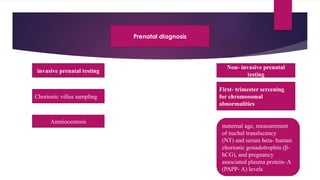
Prenatal diagnosis
First- trimester screening
for chromosomal
abnormalities
Non- invasive prenatal
testing
Chorionic villus sampling
maternal age, measurement
of nuchal translucency
(NT) and serum beta- human
chorionic gonadotrophin (β-
hCG), and pregnancy
associated plasma protein- A
(PAPP- A) levels
Amniocentesis
invasive prenatal testing
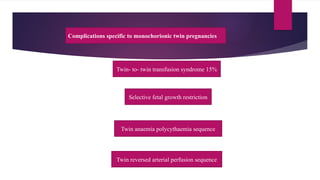
Complications specific to monochorionic twin pregnancies
Twin reversed arterial perfusion sequence
Twin anaemia polycythaemia sequence
Selective fetal growth restriction
Twin- to- twin transfusion syndrome 15%
Planning timing and method of birth
● First twin vertex, second twin vertex.
● First twin vertex, second twin
nonvertex.
● First twin nonvertex.
NICE guideline recommends delivery of dichorionic twins from 37 completed weeks’
gestation, monochorionic twins from 36 completed weeks’ gestation, and triplets
from 35 weeks’ gestation.
S U M M A R Y O F M A N A G E M E N T O P T I O N S
Prepregnancy
Counsel women who are undergoing assisted conception techniques about the risks of multiple pregnancy.
Supplement folate pre- and periconception..
Prenatal
Document zygosity or chorionicity at 10–14 wk. But no prospective data are available on whether this
documentation improves outcome.
Maintain increased surveillance if twins are monozygous or monochorionic.
Nuchal translucency measurement of each fetus identifies fetuses at risk for trisomy 21, cardiothoracic
abnormalities, and twin-twin transfusion syndrome.
 Obtain possible ultrasound assessment of cervical changes and fetal fibronectin as part of
preterm delivery screening.
 Provide prenatal corticosteroids if preterm birth before 34 wk is possible. There is no
evidence that hospitalization prevents preterm labor and delivery.
 There is no evidence that prophylactic cervical cerclage prevents preterm labor and
delivery.
 Obtain regular fetal ultrasound assessment of growth and umbilical artery Doppler.
 Hospitalize at the woman’s request or if complications are detected.
 Consider therapeutic amniocentesis (repeated if necessary) for extreme hydramnios and
maternal distress.
Labor and Delivery
 hospital delivery.
 experienced obstetrician
 Have pediatrician, neonatal nurse, and anesthetist available
 Epidural analgesia recommended
 Consider synthetic oxytocin infusion for uterine inertia, especially after the first twin is delivered
 If an infant has a nonlongitudinal lie, convert to a longitudinal lie by external version or internal
podalic version.
 elective cesarean delivery for triplets and higher-order births.
Postnatal
 Offer longer in-patient stay
 Provide adequate contraceptive advice.
References
THANK YOU

multiple_76e94ccf-5e83-426b-bf42-753863b64eb9.pptx

  • 1.
    MULTIPLE PREGNANCY Incidence; vary6.7- 40 per 1000 births Increased risk of miscarriage Vanishing twin syndrome Minor disorders of pregnancy Anemia Preterm labor and delivery Hypertension Antepartum hemorrhage Hydramnios Single fetal death in twins Increased likelihood of cesarean birth Postpartum hemorrhage Maternal mortality Maternal Risks Associated with Multiple Pregnancy
  • 2.
    Fetal Risks Associatedwith Multiple Pregnancy Stillbirth or neonatal death Preterm labor and delivery Intrauterine growth restriction Congenital anomalies Congenital anomaly in one twin Twin reversed arterial perfusion sequence Conjoined twins Cord accident Monoamniotic twins Hydramnios Twin-twin transfusion syndrome Risk of asphyxia Twin entrapment Cerebral palsy
  • 3.
    Chorionicity and zygosity dizygotic twoova are fertilized and have separate amnions, chorions, and placentas (dichorionic diamniotic).The placentas may fuse if the implantation sites are close together. The majority of twin pregnancies are dizygotic. single fertilized ovum or zygote divides after conception. division of the zygote within 2 days, dichorionic diamniotic twins. monozygotic 9 and 12 days after fertilization) results in a shared chorion, amnion, and placentation and is rare, occurring in only 1% of monozygotictwins(monochorionic monoamniotic (MCMA 3– 8 days after fertilization. 70% of monozygotic twins (monochorionic diamniotic (MCDA) twins).
  • 4.
    Diagnosis twin pregnancies shouldideally be dated when the crown– rump length (CRL) measurement is between 45 and 84 mm (i.e. 11+0 to 13+6 weeks of gestation the T sign is evident as there is no triangular chorionic projection and the two amnions meet perpendicularly to the shared placenta. This is a reliable sign in identification of monochorionicity The lambda sign or the ‘twin peak’ sign is seen in dichorionic twin pregnancy. chorionicity is 5 weeks and for amnionicity 8 weeks.
  • 5.
    Prenatal diagnosis First- trimesterscreening for chromosomal abnormalities Non- invasive prenatal testing Chorionic villus sampling maternal age, measurement of nuchal translucency (NT) and serum beta- human chorionic gonadotrophin (β- hCG), and pregnancy associated plasma protein- A (PAPP- A) levels Amniocentesis invasive prenatal testing
  • 6.
    Complications specific tomonochorionic twin pregnancies Twin reversed arterial perfusion sequence Twin anaemia polycythaemia sequence Selective fetal growth restriction Twin- to- twin transfusion syndrome 15%
  • 7.
    Planning timing andmethod of birth ● First twin vertex, second twin vertex. ● First twin vertex, second twin nonvertex. ● First twin nonvertex. NICE guideline recommends delivery of dichorionic twins from 37 completed weeks’ gestation, monochorionic twins from 36 completed weeks’ gestation, and triplets from 35 weeks’ gestation.
  • 8.
    S U MM A R Y O F M A N A G E M E N T O P T I O N S Prepregnancy Counsel women who are undergoing assisted conception techniques about the risks of multiple pregnancy. Supplement folate pre- and periconception.. Prenatal Document zygosity or chorionicity at 10–14 wk. But no prospective data are available on whether this documentation improves outcome. Maintain increased surveillance if twins are monozygous or monochorionic. Nuchal translucency measurement of each fetus identifies fetuses at risk for trisomy 21, cardiothoracic abnormalities, and twin-twin transfusion syndrome.
  • 9.
     Obtain possibleultrasound assessment of cervical changes and fetal fibronectin as part of preterm delivery screening.  Provide prenatal corticosteroids if preterm birth before 34 wk is possible. There is no evidence that hospitalization prevents preterm labor and delivery.  There is no evidence that prophylactic cervical cerclage prevents preterm labor and delivery.  Obtain regular fetal ultrasound assessment of growth and umbilical artery Doppler.  Hospitalize at the woman’s request or if complications are detected.  Consider therapeutic amniocentesis (repeated if necessary) for extreme hydramnios and maternal distress.
  • 10.
    Labor and Delivery hospital delivery.  experienced obstetrician  Have pediatrician, neonatal nurse, and anesthetist available  Epidural analgesia recommended  Consider synthetic oxytocin infusion for uterine inertia, especially after the first twin is delivered  If an infant has a nonlongitudinal lie, convert to a longitudinal lie by external version or internal podalic version.  elective cesarean delivery for triplets and higher-order births.
  • 11.
    Postnatal  Offer longerin-patient stay  Provide adequate contraceptive advice.
  • 12.
  • 13.