Information Through Multiple Lenses: Interpreting
Perspective and Bias
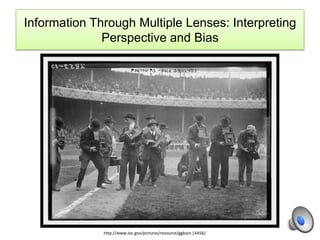
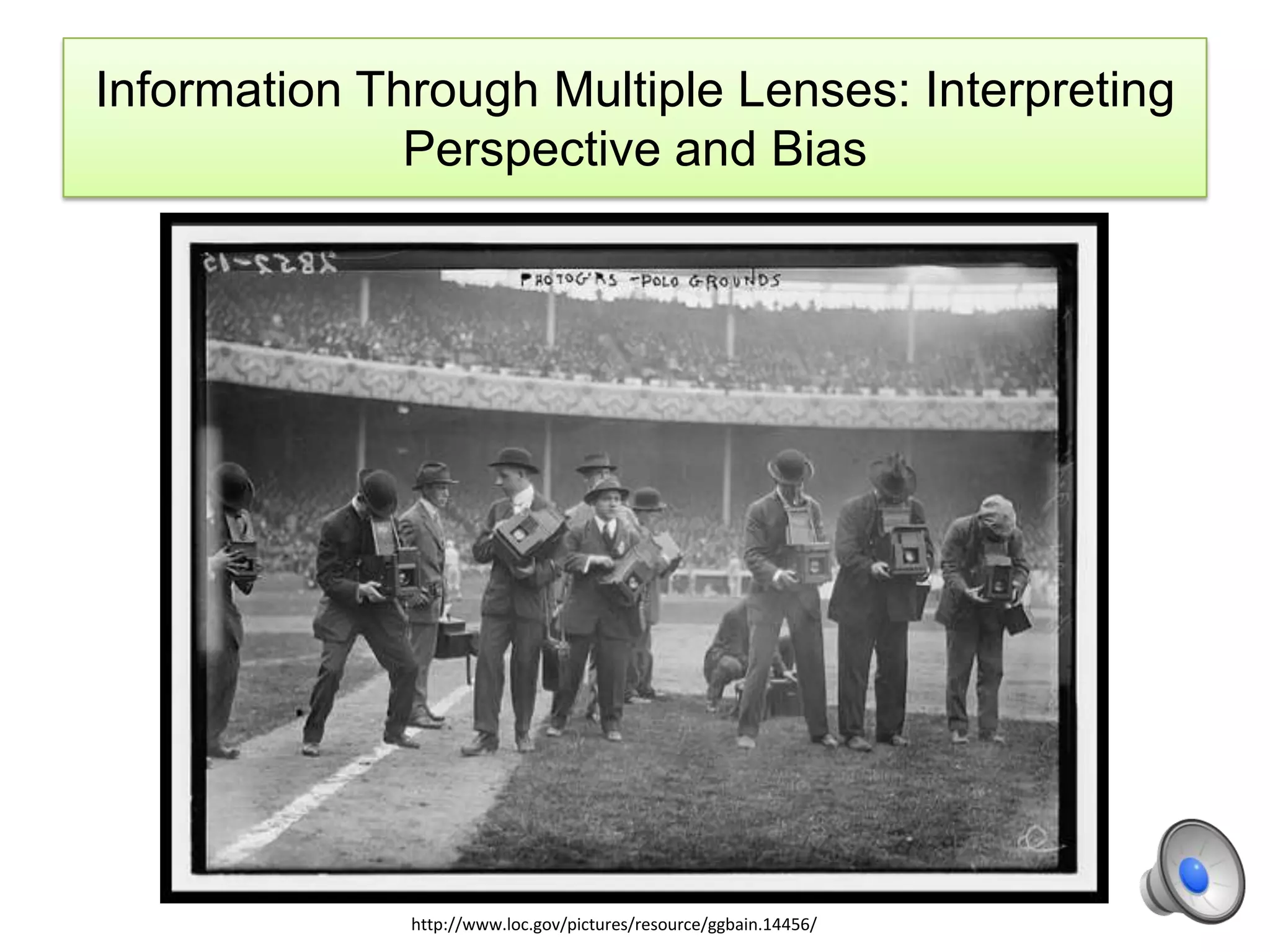
http://www.loc.gov/pictures/resource/ggbain.14456/
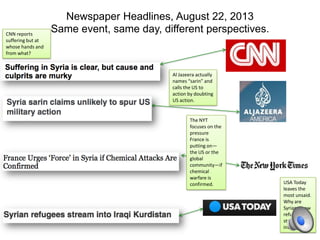
Newspaper Headlines, August 22, 2013
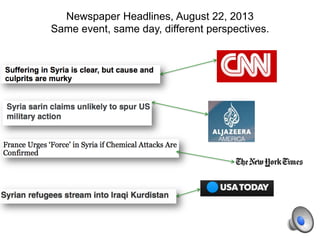
Same event, same day, different perspectives.
Newspaper Headlines, August 22, 2013
Same event, same day, different perspectives.CNN reports
suffering but at
whose hands and
from what?
Al Jazeera actually
names “sarin” and
calls the US to
action by doubting
US action.
USA Today
leaves the
most unsaid.
Why are
Syrians, now
refugees,
streaming
into Iraq?
The NYT
focuses on the
pressure
France is
putting on—
the US or the
global
community—if
chemical
warfare is
confirmed.
All information sources—not just newspapers—emphasize
some things and de-emphasize others. Sometimes we call
this bias. We might simply consider it perspective. At other
times a narrower focus on a specific issue means that the
bigger picture gets lost.
Sometimes information sources intentionally mislead or
obscure the whole story. But more often than not bias is
implicit, or in other words not intentional.
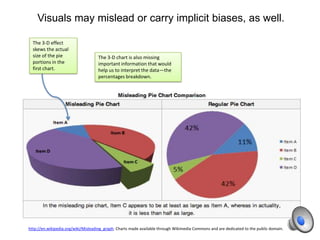
Visuals may mislead or carry implicit biases, as well.
http://en.wikipedia.org/wiki/Misleading_graph. Charts made available through Wikimedia Commons and are dedicated to the public domain.
The 3-D effect
skews the actual
size of the pie
portions in the
first chart.
The 3-D chart is also missing
important information that would
help us to interpret the data—the
percentages breakdown.
Visuals may mislead or carry implicit biases, as well.
Source: http://www.smashingmagazine.com/2010/05/10/imagine-a-pie-chart-stomping-on-an-infographic-forever/
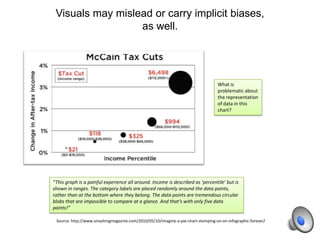
Visuals may mislead or carry implicit biases,
as well.
Source: http://www.smashingmagazine.com/2010/05/10/imagine-a-pie-chart-stomping-on-an-infographic-forever/
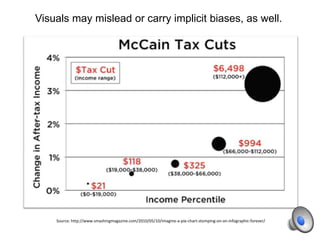
What is
problematic about
the representation
of data in this
chart?
“This graph is a painful experience all around. Income is described as ‘percentile’ but is
shown in ranges. The category labels are placed randomly around the data points,
rather than at the bottom where they belong. The data points are tremendous circular
blobs that are impossible to compare at a glance. And that’s with only five data
points!”
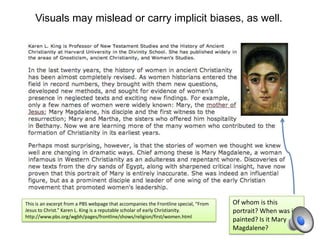
Visuals may mislead or carry implicit biases, as well.
This is an excerpt from a PBS webpage that accompanies the Frontline special, “From
Jesus to Christ.” Karen L. King is a reputable scholar of early Christianity.
http://www.pbs.org/wgbh/pages/frontline/shows/religion/first/women.html
Of whom is this
portrait? When was it
painted? Is it Mary
Magdalene?
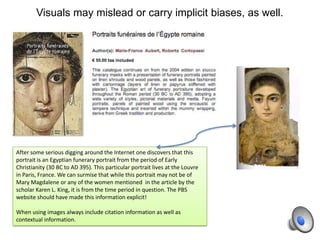
Visuals may mislead or carry implicit biases, as well.
After some serious digging around the Internet one discovers that this
portrait is an Egyptian funerary portrait from the period of Early
Christianity (30 BC to AD 395). This particular portrait lives at the Louvre
in Paris, France. We can surmise that while this portrait may not be of
Mary Magdalene or any of the women mentioned in the article by the
scholar Karen L. King, it is from the time period in question. The PBS
website should have made this information explicit!
When using images always include citation information as well as
contextual information.
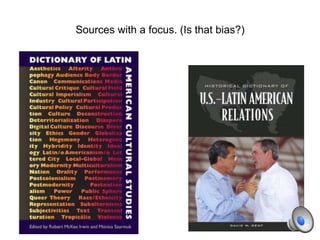
Sources with a focus. (Is that bias?)
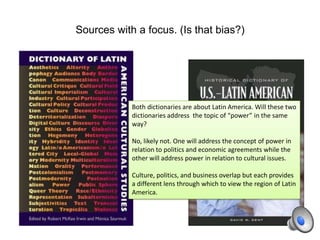
Both dictionaries are about Latin America. Will these two
dictionaries address the topic of “power” in the same
way?
No, likely not. One will address the concept of power in
relation to politics and economic agreements while the
other will address power in relation to cultural issues.
Culture, politics, and business overlap but each provides
a different lens through which to view the region of Latin
America.
Sources with a focus. (Is that bias?)
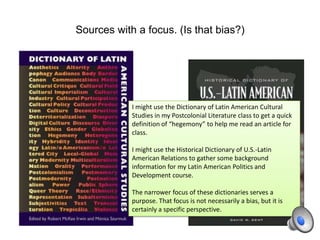
I might use the Dictionary of Latin American Cultural
Studies in my Postcolonial Literature class to get a quick
definition of “hegemony” to help me read an article for
class.
I might use the Historical Dictionary of U.S.-Latin
American Relations to gather some background
information for my Latin American Politics and
Development course.
The narrower focus of these dictionaries serves a
purpose. That focus is not necessarily a bias, but it is
certainly a specific perspective.
Why do your professors ask you to use multiple sources for
one paper?
As you study history, photography, business management, environmental studies, etc. you will
discover that there is rarely a single answer or a single solution to the questions and problems
posed by your professors and by your coursework. You will be asked to consider and analyze
questions and problems from multiple perspectives.
In Chimamanda Adichie’s TED Talk, “The Danger of a Single Story,” she illustrates the
consequences of having a single perspective from which to look at your neighbor, a culture, a
country, a political issue, etc. The single story or the single perspective cripples our ability to
interact with others, to solve problems, to make decisions, to get jobs.
Your library’s resources open up a vast world (in addition to the Internet) of perspectives on
many, many different subjects.
Why do your professors ask you to use multiple sources for
one paper?
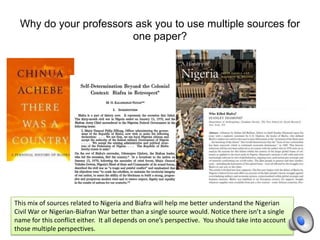
This mix of sources related to Nigeria and Biafra will help me better understand the Nigerian
Civil War or Nigerian-Biafran War better than a single source would. Notice there isn’t a single
name for this conflict either. It all depends on one’s perspective. You should take into account
those multiple perspectives.
Now it’s time to take the quiz!
Information Through Multiple Lenses: Interpreting
Perspective and Bias

Multiple lenses

  • 1.
    Information Through MultipleLenses: Interpreting Perspective and Bias http://www.loc.gov/pictures/resource/ggbain.14456/
  • 2.
  • 3.
    Newspaper Headlines, August22, 2013 Same event, same day, different perspectives.
  • 4.
    Newspaper Headlines, August22, 2013 Same event, same day, different perspectives.CNN reports suffering but at whose hands and from what? Al Jazeera actually names “sarin” and calls the US to action by doubting US action. USA Today leaves the most unsaid. Why are Syrians, now refugees, streaming into Iraq? The NYT focuses on the pressure France is putting on— the US or the global community—if chemical warfare is confirmed.
  • 5.
    All information sources—notjust newspapers—emphasize some things and de-emphasize others. Sometimes we call this bias. We might simply consider it perspective. At other times a narrower focus on a specific issue means that the bigger picture gets lost. Sometimes information sources intentionally mislead or obscure the whole story. But more often than not bias is implicit, or in other words not intentional.
  • 6.
    Visuals may misleador carry implicit biases, as well. http://en.wikipedia.org/wiki/Misleading_graph. Charts made available through Wikimedia Commons and are dedicated to the public domain. The 3-D effect skews the actual size of the pie portions in the first chart. The 3-D chart is also missing important information that would help us to interpret the data—the percentages breakdown.
  • 7.
    Visuals may misleador carry implicit biases, as well. Source: http://www.smashingmagazine.com/2010/05/10/imagine-a-pie-chart-stomping-on-an-infographic-forever/
  • 8.
    Visuals may misleador carry implicit biases, as well. Source: http://www.smashingmagazine.com/2010/05/10/imagine-a-pie-chart-stomping-on-an-infographic-forever/ What is problematic about the representation of data in this chart? “This graph is a painful experience all around. Income is described as ‘percentile’ but is shown in ranges. The category labels are placed randomly around the data points, rather than at the bottom where they belong. The data points are tremendous circular blobs that are impossible to compare at a glance. And that’s with only five data points!”
  • 9.
    Visuals may misleador carry implicit biases, as well. This is an excerpt from a PBS webpage that accompanies the Frontline special, “From Jesus to Christ.” Karen L. King is a reputable scholar of early Christianity. http://www.pbs.org/wgbh/pages/frontline/shows/religion/first/women.html Of whom is this portrait? When was it painted? Is it Mary Magdalene?
  • 10.
    Visuals may misleador carry implicit biases, as well. After some serious digging around the Internet one discovers that this portrait is an Egyptian funerary portrait from the period of Early Christianity (30 BC to AD 395). This particular portrait lives at the Louvre in Paris, France. We can surmise that while this portrait may not be of Mary Magdalene or any of the women mentioned in the article by the scholar Karen L. King, it is from the time period in question. The PBS website should have made this information explicit! When using images always include citation information as well as contextual information.
  • 11.
    Sources with afocus. (Is that bias?)
  • 12.
    Sources with afocus. (Is that bias?) Both dictionaries are about Latin America. Will these two dictionaries address the topic of “power” in the same way? No, likely not. One will address the concept of power in relation to politics and economic agreements while the other will address power in relation to cultural issues. Culture, politics, and business overlap but each provides a different lens through which to view the region of Latin America.
  • 13.
    Sources with afocus. (Is that bias?) I might use the Dictionary of Latin American Cultural Studies in my Postcolonial Literature class to get a quick definition of “hegemony” to help me read an article for class. I might use the Historical Dictionary of U.S.-Latin American Relations to gather some background information for my Latin American Politics and Development course. The narrower focus of these dictionaries serves a purpose. That focus is not necessarily a bias, but it is certainly a specific perspective.
  • 14.
    Why do yourprofessors ask you to use multiple sources for one paper? As you study history, photography, business management, environmental studies, etc. you will discover that there is rarely a single answer or a single solution to the questions and problems posed by your professors and by your coursework. You will be asked to consider and analyze questions and problems from multiple perspectives. In Chimamanda Adichie’s TED Talk, “The Danger of a Single Story,” she illustrates the consequences of having a single perspective from which to look at your neighbor, a culture, a country, a political issue, etc. The single story or the single perspective cripples our ability to interact with others, to solve problems, to make decisions, to get jobs. Your library’s resources open up a vast world (in addition to the Internet) of perspectives on many, many different subjects.
  • 15.
    Why do yourprofessors ask you to use multiple sources for one paper? This mix of sources related to Nigeria and Biafra will help me better understand the Nigerian Civil War or Nigerian-Biafran War better than a single source would. Notice there isn’t a single name for this conflict either. It all depends on one’s perspective. You should take into account those multiple perspectives.
  • 16.
    Now it’s timeto take the quiz! Information Through Multiple Lenses: Interpreting Perspective and Bias