1
Presented by :
Ahmad Raza Bajwa
Section : A
12U00231
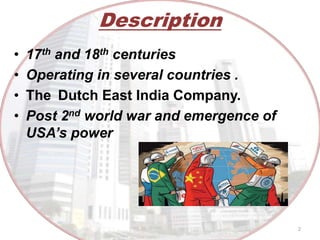
• 17th and 18th centuries
• Operating in several countries .
• The Dutch East India Company.
• Post 2nd world war and emergence of
USA’s power
Description
2
• Create employment opportunities in the host
countries..
• Helps removal of monopoly (domination)
• improve the quality of domestic made products.
• Promotes exports and reduce imports
• Goods are available at cheaper price due to economies
of scale.
• Job and career opportunities at home and abroad.
• Transfer of technology, capital and entrepreneurship.
• Greater availability of products for local consumers.
Favourable Impact of
MNCs
4
1. The host county may lose its
economic sovereignty
2. Feeling that labour is being exploited by the MNC/
Outsourcing
3. Lost of cultural moorings
4. The problem of Dumping
– Chinese products are priced low in Indian market.
 Bad business ethics
 Underestimate local culture
 Harmful to producers and consumers
Harmful effect of MNCs
5
Case study
Multinational Corporations in the Third World:
Predators or Allies in Economic Development?
by James C. W. Ahiakpor
Findings of Case study
• MNC’s were misrepresented
• Helping 3rd world countries
• Improved standard of livings
• Misleading facts regarding low wages etc.
• Natives likeness towards imported goods
• Singapore, Taiwan are enjoying
• Corporate Social Responsibility
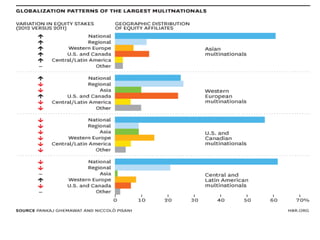
MNC’s in world
• The World Investment Report 2009, published
by the UNCTAD (United Nations Conference
on Trade and Development), states there is a
total of 889,416 multinational companies
(MNCs) around the world: 82,053 parent
corporations and 807,363 affiliates.
• In 2008, the 100 largest MNCs’™ sales
combined amounted to nearly $8.5 trillion
Sweat Shops Facts
• A "sweatshop" is defined by the US Department of Labor as
a factory that violates 2 or more labor laws.
• Sweatshops often have poor working conditions, unfair
wages, unreasonable hours, child labor, and a lack of
benefits for workers. Take a stand and protest: Ask your
school to make its apparel under fair conditions.
• In developing countries, an estimated 250 million children
ages 5 to 14 are forced to work.
• America has stronger labor laws than most undeveloped
countries, but it is not free of sweatshops. Many slip under
the radar of the US Department of Labor.
• Products that commonly come from sweatshops are shoes,
clothing, rugs, coffee, chocolate, toys,
Sweat Shops
Nike- “Just don’t do it”..
5
Social Responsibility
In context to Pakistan..
• Independence
• No capital goods
• Sends message as a good business
destination

multinational corporations

  • 1.
    1 Presented by : AhmadRaza Bajwa Section : A 12U00231
  • 2.
    • 17th and18th centuries • Operating in several countries . • The Dutch East India Company. • Post 2nd world war and emergence of USA’s power Description 2
  • 4.
    • Create employmentopportunities in the host countries.. • Helps removal of monopoly (domination) • improve the quality of domestic made products. • Promotes exports and reduce imports • Goods are available at cheaper price due to economies of scale. • Job and career opportunities at home and abroad. • Transfer of technology, capital and entrepreneurship. • Greater availability of products for local consumers. Favourable Impact of MNCs 4
  • 5.
    1. The hostcounty may lose its economic sovereignty 2. Feeling that labour is being exploited by the MNC/ Outsourcing 3. Lost of cultural moorings 4. The problem of Dumping – Chinese products are priced low in Indian market.  Bad business ethics  Underestimate local culture  Harmful to producers and consumers Harmful effect of MNCs 5
  • 7.
    Case study Multinational Corporationsin the Third World: Predators or Allies in Economic Development? by James C. W. Ahiakpor
  • 8.
    Findings of Casestudy • MNC’s were misrepresented • Helping 3rd world countries • Improved standard of livings • Misleading facts regarding low wages etc. • Natives likeness towards imported goods • Singapore, Taiwan are enjoying • Corporate Social Responsibility
  • 9.
    MNC’s in world •The World Investment Report 2009, published by the UNCTAD (United Nations Conference on Trade and Development), states there is a total of 889,416 multinational companies (MNCs) around the world: 82,053 parent corporations and 807,363 affiliates. • In 2008, the 100 largest MNCs’™ sales combined amounted to nearly $8.5 trillion
  • 10.
    Sweat Shops Facts •A "sweatshop" is defined by the US Department of Labor as a factory that violates 2 or more labor laws. • Sweatshops often have poor working conditions, unfair wages, unreasonable hours, child labor, and a lack of benefits for workers. Take a stand and protest: Ask your school to make its apparel under fair conditions. • In developing countries, an estimated 250 million children ages 5 to 14 are forced to work. • America has stronger labor laws than most undeveloped countries, but it is not free of sweatshops. Many slip under the radar of the US Department of Labor. • Products that commonly come from sweatshops are shoes, clothing, rugs, coffee, chocolate, toys,
  • 11.
  • 12.
  • 13.
  • 14.
  • 15.
    In context toPakistan.. • Independence • No capital goods • Sends message as a good business destination