Searching for opportunities for WIN

 it is more about how we do science than what

advantages of an open innovation compute space
      for building better models of disease

  beyond siloed drug discovery- Arch2POCM
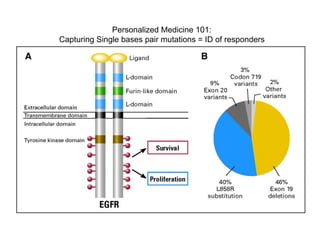
Personalized Medicine 101:
Capturing Single bases pair mutations = ID of responders
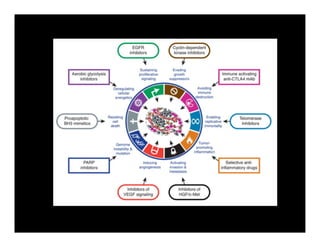
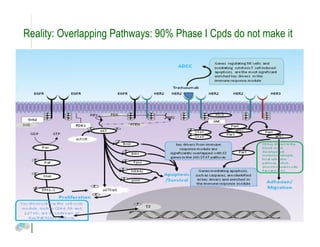
Reality: Overlapping Pathways: 90% Phase I Cpds do not make it
WHY	
  NOT	
  USE	
  	
  
      “DATA	
  INTENSIVE”	
  SCIENCE	
  
TO	
  BUILD	
  BETTER	
  DISEASE	
  MAPS?	
  
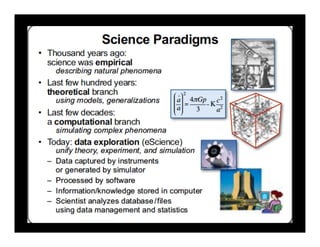
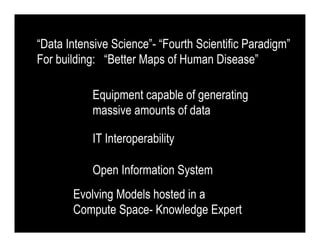
“Data Intensive Science”- “Fourth Scientific Paradigm”
For building: “Better Maps of Human Disease”

           Equipment capable of generating
           massive amounts of data

           IT Interoperability

           Open Information System
       Evolving Models hosted in a
       Compute Space- Knowledge Expert
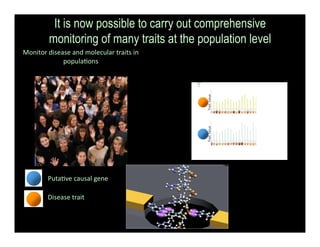
It is now possible to carry out comprehensive
            monitoring of many traits at the population level
Monitor	
  disease	
  and	
  molecular	
  traits	
  in	
  
                populaFons	


            PutaFve	
  causal	
  gene	
  

            Disease	
  trait	
  
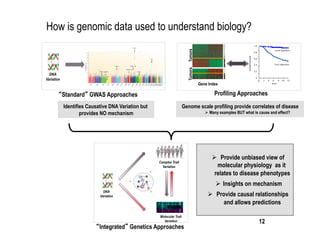
How is genomic data used to understand biology?
                                                                RNA amplification


                                                    Tumors
                                                             Microarray hybirdization


                                                    Tumors
                                                             Gene Index

   Standard GWAS Approaches                                          Profiling Approaches
   Identifies Causative DNA Variation but       Genome scale profiling provide correlates of disease
           provides NO mechanism                                  Many examples BUT what is cause and effect?


                                                                      Provide unbiased view of
                                                                      molecular physiology as it
                                                                     relates to disease phenotypes
                                      trait
                                                                        Insights on mechanism
                                                                   Provide causal relationships
                                                                       and allows predictions

                                                                                             12
                   Integrated Genetics Approaches
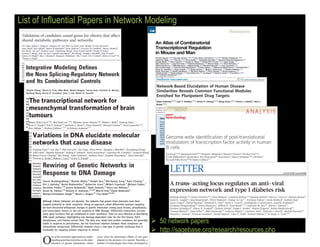
List of Influential Papers in Network Modeling


                                        50 network papers
                                        http://sagebase.org/research/resources.php
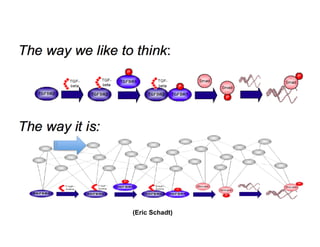
(Eric Schadt)
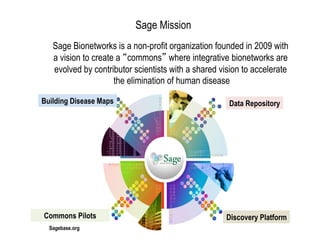
Sage Mission
   Sage Bionetworks is a non-profit organization founded in 2009 with
   a vision to create a commons where integrative bionetworks are
   evolved by contributor scientists with a shared vision to accelerate
                     the elimination of human disease

Building Disease Maps                                Data Repository


Commons Pilots                                       Discovery Platform
  Sagebase.org
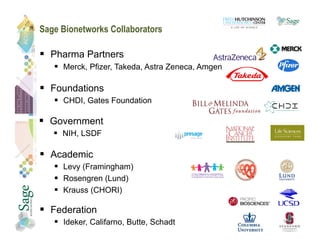
Sage Bionetworks Collaborators

  Pharma Partners
     Merck, Pfizer, Takeda, Astra Zeneca, Amgen

  Foundations
     CHDI, Gates Foundation

  Government
     NIH, LSDF

  Academic
     Levy (Framingham)
     Rosengren (Lund)
     Krauss (CHORI)

  Federation
     Ideker, Califarno, Butte, Schadt             16
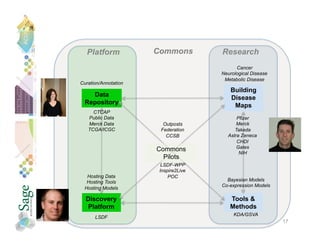
Platform            Commons         Research
                                            Cancer
                                      Neurological Disease
                                       Metabolic Disease
Curation/Annotation
                                         Building
    Data                                 Disease
  Repository                              Maps
     CTCAP
   Public Data                              Pfizer
   Merck Data           Outposts            Merck
   TCGA/ICGC           Federation          Takeda
                         CCSB           Astra Zeneca
                                            CHDI
                      Commons               Gates
                                             NIH
                        Pilots
                        LSDF-WPP
                       Inspire2Live
  Hosting Data             POC
  Hosting Tools                         Bayesian Models
                                      Co-expression Models
 Hosting Models

  Discovery                              Tools &
   Platform                              Methods
                                           KDA/GSVA
      LSDF
                                                             17
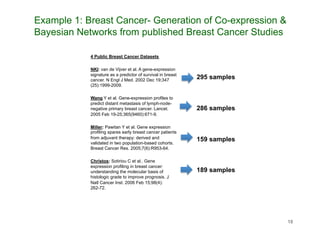
Example 1: Breast Cancer- Generation of Co-expression &
Bayesian Networks from published Breast Cancer Studies

            4 Public Breast Cancer Datasets

            NKI: van de Vijver et al. A gene-expression
            signature as a predictor of survival in breast
            cancer. N Engl J Med. 2002 Dec 19;347
                                                             295 samples
            (25):1999-2009.

            Wang Y et al. Gene-expression profiles to
            predict distant metastasis of lymph-node-
            negative primary breast cancer. Lancet.          286 samples
            2005 Feb 19-25;365(9460):671-9.

            Miller: Pawitan Y et al. Gene expression
            profiling spares early breast cancer patients
            from adjuvant therapy: derived and               159 samples
            validated in two population-based cohorts.
            Breast Cancer Res. 2005;7(6):R953-64.

            Christos: Sotiriou C et al.. Gene
            expression profiling in breast cancer:
            understanding the molecular basis of             189 samples
            histologic grade to improve prognosis. J
            Natl Cancer Inst. 2006 Feb 15;98(4):
            262-72.


                                                                           18
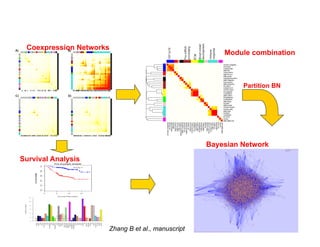
Coexpression Networks
                                                      Module combination


                                                           Partition BN


                                                  Bayesian Network

Survival Analysis


                                                                          19
                     Zhang B et al., manuscript
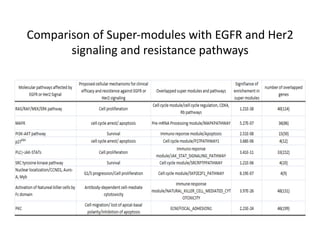
Comparison	
  of	
  Super-­‐modules	
  with	
  EGFR	
  and	
  Her2	
  
       signaling	
  and	
  resistance	
  pathways	
  
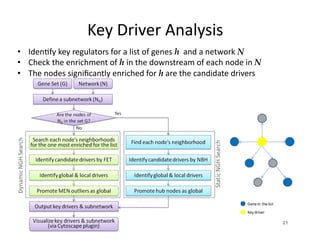
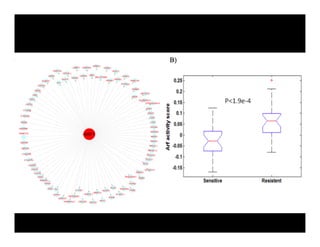
Key	
  Driver	
  Analysis	
  
•  IdenFfy	
  key	
  regulators	
  for	
  a	
  list	
  of	
  genes	
  h	
  	
  and	
  a	
  network	
  N	
  
•  Check	
  the	
  enrichment	
  of	
  h in	
  the	
  downstream	
  of	
  each	
  node	
  in	
  N	
  
•  The	
  nodes	
  significantly	
  enriched	
  for	
  h	
  are	
  the	
  candidate	
  drivers	


                                                                                                              21
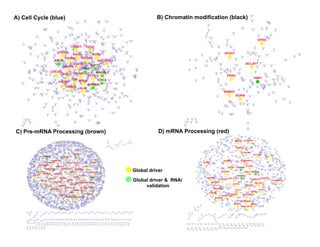
A) Cell Cycle (blue)                       B) Chromatin modification (black)


C) Pre-mRNA Processing (brown)              D) mRNA Processing (red)


                                 Global driver
                                 Global driver & RNAi
                                      validation


                                                                               23
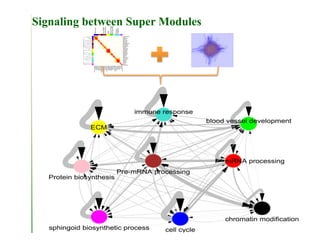
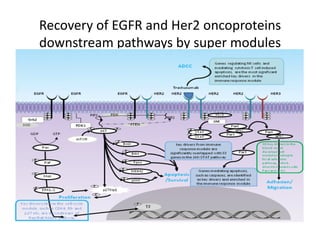
Signaling between Super Modules
Recovery	
  of	
  EGFR	
  and	
  Her2	
  oncoproteins	
  
downstream	
  pathways	
  by	
  super	
  modules	
  
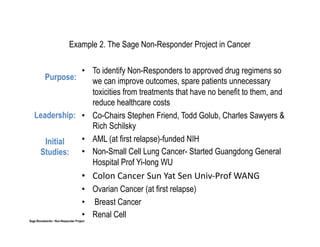
Example 2. The Sage Non-Responder Project in Cancer

               •  To identify Non-Responders to approved drug regimens so
      Purpose:    we can improve outcomes, spare patients unnecessary
                  toxicities from treatments that have no benefit to them, and
                  reduce healthcare costs
   Leadership: •  Co-Chairs Stephen Friend, Todd Golub, Charles Sawyers &
                  Rich Schilsky
      Initial  •  AML (at first relapse)-funded NIH
    Studies: •  Non-Small Cell Lung Cancer- Started Guangdong General
                  Hospital Prof Yi-long WU	
  
                                      •  Colon	
  Cancer	
  Sun	
  Yat	
  Sen	
  Univ-­‐Prof	
  WANG	
  
                                      •  Ovarian Cancer (at first relapse)
                                      •  Breast Cancer
                                      •  Renal Cell
Sage Bionetworks • Non-Responder Project
Clinical Trial Comparator Arm
        Partnership (CTCAP)
  Description: Collate, Annotate, Curate and Host Clinical Trial Data
   with Genomic Information from the Comparator Arms of Industry and
   Foundation Sponsored Clinical Trials: Building a Site for Sharing
   Data and Models to evolve better Disease Maps.
  Public-Private Partnership of leading pharmaceutical companies,
   clinical trial groups and researchers.
  Neutral Conveners: Sage Bionetworks and Genetic Alliance
   [nonprofits].
  Initiative to share existing trial data (molecular and clinical) from
   non-proprietary comparator and placebo arms to create powerful
   new tool for drug development.
Example 4: THE FEDERATION
Butte   Califano Friend Ideker    Schadt

                   vs
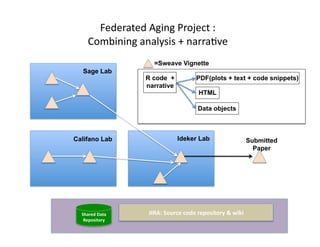
Federated	
  Aging	
  Project	
  :	
  	
  
       Combining	
  analysis	
  +	
  narraFve	
  	
  
                              =Sweave Vignette
   Sage Lab
                           R code +                  PDF(plots + text + code snippets)
                           narrative
                                                      HTML

                                                      Data objects


Califano Lab                              Ideker Lab                               Submitted
                                                                                     Paper


  Shared	
  Data    	
     JIRA:	
  Source	
  code	
  repository	
  &	
  wiki
                                                                            	
  
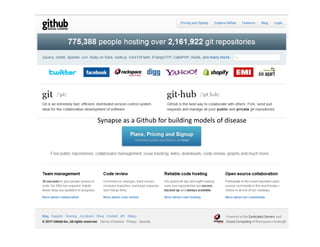
   Repository  	
  
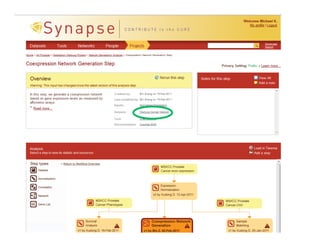
Synapse	
  as	
  a	
  Github	
  for	
  building	
  models	
  of	
  disease	
  
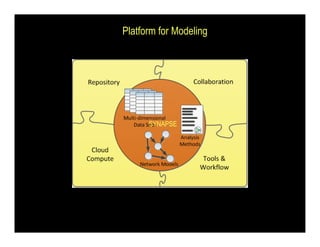
Platform for Modeling


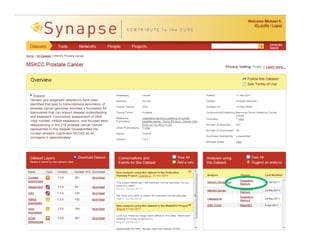
      SYNAPSE	
  
IMPACT	
  ON	
  PATIENTS	
  
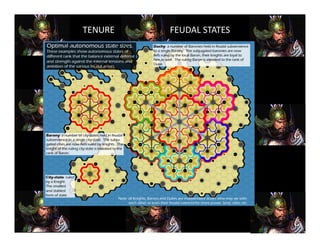
 TENURE   	
     	
  	
  FEUDAL	
  STATES	


… the world is becoming too
    fast, too complex, and too
networked for any company to have
               all the
          answers inside
        Y. Benkler, The Wealth of Networks
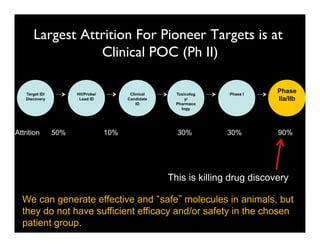
Largest Attrition For Pioneer Targets is at
                 Clinical POC (Ph II)


   Target ID/         Hit/Probe/          Clinical     Toxicolog    Phase I
                                                                                Phase
   Discovery           Lead ID           Candidate         y/                   IIa/IIb
                                             ID        Pharmaco
                                                         logy


Attrition       50%                10%                 30%         30%          90%


                                                     This is killing drug discovery

  We can generate effective and safe molecules in animals, but
  they do not have sufficient efficacy and/or safety in the chosen
  patient group.
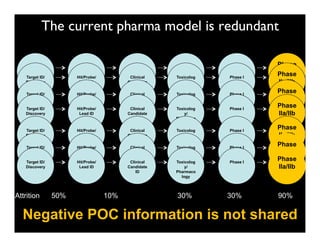
The current pharma model is redundant


   Target ID/         Hit/Probe/          Clinical   Toxicolog   Phase I
                                                                           Phase
   Discovery           Lead ID           Candidate       y/                IIa/IIb
                                                                           Phase
   Target ID/         Hit/Probe/          Clinical
                                             ID      Pharmaco
                                                     Toxicolog   Phase I
   Discovery           Lead ID           Candidate     logy
                                                         y/                IIa/IIb
                                             ID      Pharmaco
   Target ID/         Hit/Probe/          Clinical
                                                       logy
                                                     Toxicolog   Phase I
                                                                           Phase
   Discovery           Lead ID           Candidate       y/                IIa/IIb
                                             ID      Pharmaco
   Target ID/         Hit/Probe/          Clinical   Toxicolog
                                                       logy      Phase I
                                                                           Phase
   Discovery           Lead ID           Candidate       y/                IIa/IIb
                                             ID      Pharmaco
                                                       logy
   Target ID/         Hit/Probe/          Clinical   Toxicolog   Phase I
                                                                           Phase
   Discovery           Lead ID           Candidate       y/                IIa/IIb
                                             ID      Pharmaco
   Target ID/         Hit/Probe/          Clinical
                                                       logy
                                                     Toxicolog   Phase I
                                                                           Phase
   Discovery           Lead ID           Candidate       y/                IIa/IIb
                                             ID      Pharmaco
   Target ID/         Hit/Probe/          Clinical   Toxicolog
                                                       logy      Phase I
                                                                           Phase
   Discovery           Lead ID           Candidate       y/                IIa/IIb
                                             ID      Pharmaco
                                                       logy


Attrition       50%                10%               30%         30%       90%

  Negative POC information is not shared
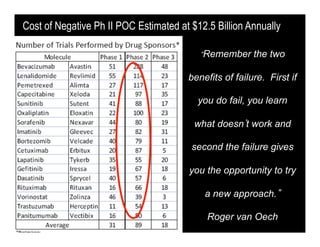
Cost of Negative Ph II POC Estimated at $12.5 Billion Annually

                                           Remember the two

                                       benefits of failure. First if

                                          you do fail, you learn

                                         what doesn t work and

                                        second the failure gives

                                        you the opportunity to try

                                           a new approach.

                                            Roger van Oech
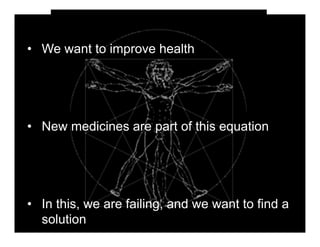
•  We want to improve health


•  New medicines are part of this equation


•  In this, we are failing, and we want to find a
   solution
Innovation is the ability to see change as an opportunity	

                       – not a threat
Let s imagine….
                                   	

•  A pool of dedicated, stable funding	

•  A process that attracts top scientists and clinicians	

•  A process in which regulators can fully collaborate to solve key
   scientific problems	

•  An engaged citizenry that promotes science and acknowledges
   risk	

•  Mechanisms to avoid bureaucratic and administrative barriers	

•  Sharing of knowledge to more rapidly achieve understanding of
   human biology	

•  A steady stream of targets whose links to disease have been
   validated in humans
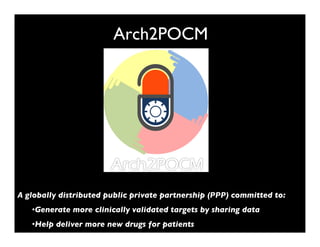
Arch2POCM	


A globally distributed public private partnership (PPP) committed to: 	

   • Generate more clinically validated targets by sharing data 	

   • Help deliver more new drugs for patients
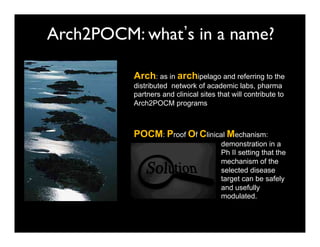
Arch2POCM: what s in a name?


           Arch: as in archipelago and referring to the
           distributed network of academic labs, pharma
           partners and clinical sites that will contribute to
           Arch2POCM programs


           POCM: Proof Of Clinical Mechanism:
                                        demonstration in a
                                        Ph II setting that the
                                        mechanism of the
                                        selected disease
                                        target can be safely
                                        and usefully
                                        modulated.
Arch2POCM: a new drug development model?	

•  Pool public and private sector funding into an independent
   organization	

    •  Public sector provides stability and new ideas	

    •  Private sector brings focus and experience	

    •  Funding can focus explicitly on high-risk targets	


•  Pre-competitive model to test hypotheses from financial gain	

    •  Will attract top scientists and clinicians	

    •  Will allow regulators to participate as scientists	

    •  Will reduce perceived conflicts of interests – engages citizens/
       patients	

    •  Will reduce bureaucratic and administrative overhead	

    •  Will allow rapid dissemination of information without restriction
       - informs public and private sectors and reduces duplication
Toronto Feb-2011 meeting:
    output on Arch2POCM Feasibility
                                  	

Pharma	


- 6 organisations supportive	

Academic Labs                 	


 - access to discovery biology and test compounds	

Patient groups	


- access to patients more quickly and cheaply	


- access to “personal data”	

Regulators	


- access to historical data	


- want to help with new clinical endpoints and study designs
Arch2POCM: April San Francisco Meeting


•  Selected Disease Areas of Focus: Oncology,, Neuroscience and
   Opportunistic (O, CNS and X, respectively)	


•  Defined primary entry points of Arch2POCM test compounds into
   overall development pipeline	


•  Committed academic centers identified: UCSF, Toronto, Oxford	


•  CROs engaged	


•  Evaluated Arch2POCM business model	


•  Two Science Translational Medicine manuscripts published
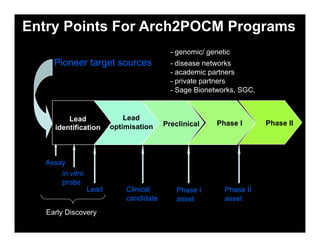
Entry Points For Arch2POCM Programs
                                          - genomic/ genetic
     Pioneer target sources               - disease networks
                                          - academic partners
                                          - private partners
                                          - Sage Bionetworks, SGC,


         Lead               Lead
                                        Preclinical     Phase I      Phase II
     identification     optimisation


  Assay
      in vitro
      probe
                 Lead       Clinical        Phase I       Phase II
                            candidate       asset         asset
   Early Discovery
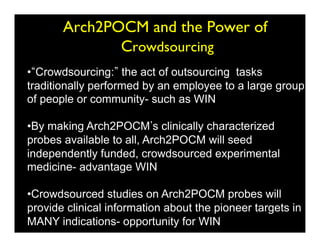
Arch2POCM and the Power of
              Crowdsourcing
                          	

•  Crowdsourcing: the act of outsourcing tasks
traditionally performed by an employee to a large group
of people or community- such as WIN

• By making Arch2POCM s clinically characterized
probes available to all, Arch2POCM will seed
independently funded, crowdsourced experimental
medicine- advantage WIN

• Crowdsourced studies on Arch2POCM probes will
provide clinical information about the pioneer targets in
MANY indications- opportunity for WIN
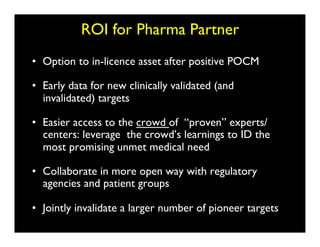
ROI for Pharma Partner	

•  Option to in-licence asset after positive POCM	


•  Early data for new clinically validated (and
   invalidated) targets	


•  Easier access to the crowd of “proven” experts/
   centers: leverage the crowd’s learnings to ID the
   most promising unmet medical need	


•  Collaborate in more open way with regulatory
   agencies and patient groups	


•  Jointly invalidate a larger number of pioneer targets
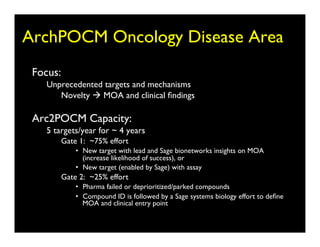
ArchPOCM Oncology Disease Area
                             	

 Focus:	

     Unprecedented targets and mechanisms	

        Novelty  MOA and clinical findings	


 Arc2POCM Capacity:	

     5 targets/year for ~ 4 years	

         Gate 1: ~75% effort	

             •  New target with lead and Sage bionetworks insights on MOA
                (increase likelihood of success), or	

             •  New target (enabled by Sage) with assay	

         Gate 2: ~25% effort	

             •  Pharma failed or deprioritized/parked compounds 	

             •  Compound ID is followed by a Sage systems biology effort to define
                MOA and clinical entry point
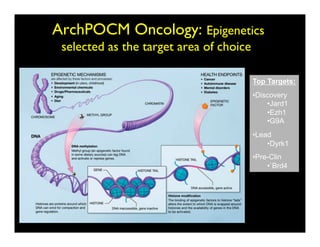
ArchPOCM Oncology: Epigenetics
 selected as the target area of choice 	


                                        Top Targets:
                                        • Discovery
                                             • Jard1
                                             • Ezh1
                                             • G9A
                                        • Lead
                                             • Dyrk1
                                        • Pre-Clin
                                             • `Brd4
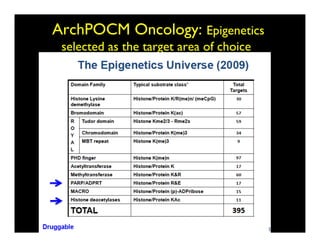
ArchPOCM Oncology: Epigenetics
 selected as the target area of choice
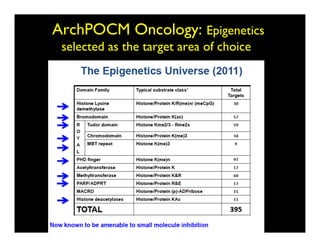
ArchPOCM Oncology: Epigenetics
 selected as the target area of choice
Arch2POCM: Next Steps
                           	

• Oncology and CNS Arch2POCM strategic design teams
to generate project workflow plans and timelines
(September)

• Define critical details of Arch2POCM leadership,
organizational and decision-making structures
• (Q3-Q4, 2011)

• Develop business case to support Arch2POCM
programs (Q3-Q4, 2011)

• Obtain financial backing and launch operations in early
2012
Arch2POCM: 
                                         	

               an idea whose time has come
In a world of abundant knowledge, hoarding technology is a self-limiting
strategy. Nor can any organization, even the largest, afford any longer to
ignore the tremendous external pools of knowledge that exist. Henry
Chesbrough


       Ideas are only as good as your ability to make
                       them happen.
it is more about how we do science than what

advantages of an open innovation compute space
      for building better models of disease

  beyond siloed drug discovery- Arch2POCM


    Each of these are opportunities
       For the WIN Consortium

Stephen Friend WIN Symposium 2011 2011-07-06

  • 1.
    Searching for opportunitiesfor WIN it is more about how we do science than what advantages of an open innovation compute space for building better models of disease beyond siloed drug discovery- Arch2POCM
  • 3.
    Personalized Medicine 101: CapturingSingle bases pair mutations = ID of responders
  • 5.
    Reality: Overlapping Pathways:90% Phase I Cpds do not make it
  • 9.
    WHY  NOT  USE     “DATA  INTENSIVE”  SCIENCE   TO  BUILD  BETTER  DISEASE  MAPS?  
  • 10.
    “Data Intensive Science”-“Fourth Scientific Paradigm” For building: “Better Maps of Human Disease” Equipment capable of generating massive amounts of data IT Interoperability Open Information System Evolving Models hosted in a Compute Space- Knowledge Expert
  • 11.
    It is nowpossible to carry out comprehensive monitoring of many traits at the population level Monitor  disease  and  molecular  traits  in   populaFons   PutaFve  causal  gene   Disease  trait  
  • 12.
    How is genomicdata used to understand biology? RNA amplification Tumors Microarray hybirdization Tumors Gene Index Standard GWAS Approaches Profiling Approaches Identifies Causative DNA Variation but Genome scale profiling provide correlates of disease provides NO mechanism   Many examples BUT what is cause and effect?   Provide unbiased view of molecular physiology as it relates to disease phenotypes trait   Insights on mechanism   Provide causal relationships and allows predictions 12 Integrated Genetics Approaches
  • 13.
    List of InfluentialPapers in Network Modeling   50 network papers   http://sagebase.org/research/resources.php
  • 14.
  • 15.
    Sage Mission Sage Bionetworks is a non-profit organization founded in 2009 with a vision to create a commons where integrative bionetworks are evolved by contributor scientists with a shared vision to accelerate the elimination of human disease Building Disease Maps Data Repository Commons Pilots Discovery Platform Sagebase.org
  • 16.
    Sage Bionetworks Collaborators  Pharma Partners   Merck, Pfizer, Takeda, Astra Zeneca, Amgen   Foundations   CHDI, Gates Foundation   Government   NIH, LSDF   Academic   Levy (Framingham)   Rosengren (Lund)   Krauss (CHORI)   Federation   Ideker, Califarno, Butte, Schadt 16
  • 17.
    Platform Commons Research Cancer Neurological Disease Metabolic Disease Curation/Annotation Building Data Disease Repository Maps CTCAP Public Data Pfizer Merck Data Outposts Merck TCGA/ICGC Federation Takeda CCSB Astra Zeneca CHDI Commons Gates NIH Pilots LSDF-WPP Inspire2Live Hosting Data POC Hosting Tools Bayesian Models Co-expression Models Hosting Models Discovery Tools & Platform Methods KDA/GSVA LSDF 17
  • 18.
    Example 1: BreastCancer- Generation of Co-expression & Bayesian Networks from published Breast Cancer Studies 4 Public Breast Cancer Datasets NKI: van de Vijver et al. A gene-expression signature as a predictor of survival in breast cancer. N Engl J Med. 2002 Dec 19;347 295 samples (25):1999-2009. Wang Y et al. Gene-expression profiles to predict distant metastasis of lymph-node- negative primary breast cancer. Lancet. 286 samples 2005 Feb 19-25;365(9460):671-9. Miller: Pawitan Y et al. Gene expression profiling spares early breast cancer patients from adjuvant therapy: derived and 159 samples validated in two population-based cohorts. Breast Cancer Res. 2005;7(6):R953-64. Christos: Sotiriou C et al.. Gene expression profiling in breast cancer: understanding the molecular basis of 189 samples histologic grade to improve prognosis. J Natl Cancer Inst. 2006 Feb 15;98(4): 262-72. 18
  • 19.
    Coexpression Networks Module combination Partition BN Bayesian Network Survival Analysis 19 Zhang B et al., manuscript
  • 20.
    Comparison  of  Super-­‐modules  with  EGFR  and  Her2   signaling  and  resistance  pathways  
  • 21.
    Key  Driver  Analysis   •  IdenFfy  key  regulators  for  a  list  of  genes  h    and  a  network  N   •  Check  the  enrichment  of  h in  the  downstream  of  each  node  in  N   •  The  nodes  significantly  enriched  for  h  are  the  candidate  drivers   21
  • 23.
    A) Cell Cycle(blue) B) Chromatin modification (black) C) Pre-mRNA Processing (brown) D) mRNA Processing (red) Global driver Global driver & RNAi validation 23
  • 24.
  • 25.
    Recovery  of  EGFR  and  Her2  oncoproteins   downstream  pathways  by  super  modules  
  • 26.
    Example 2. TheSage Non-Responder Project in Cancer •  To identify Non-Responders to approved drug regimens so Purpose: we can improve outcomes, spare patients unnecessary toxicities from treatments that have no benefit to them, and reduce healthcare costs Leadership: •  Co-Chairs Stephen Friend, Todd Golub, Charles Sawyers & Rich Schilsky Initial •  AML (at first relapse)-funded NIH Studies: •  Non-Small Cell Lung Cancer- Started Guangdong General Hospital Prof Yi-long WU   •  Colon  Cancer  Sun  Yat  Sen  Univ-­‐Prof  WANG   •  Ovarian Cancer (at first relapse) •  Breast Cancer •  Renal Cell Sage Bionetworks • Non-Responder Project
  • 27.
    Clinical Trial ComparatorArm Partnership (CTCAP)   Description: Collate, Annotate, Curate and Host Clinical Trial Data with Genomic Information from the Comparator Arms of Industry and Foundation Sponsored Clinical Trials: Building a Site for Sharing Data and Models to evolve better Disease Maps.   Public-Private Partnership of leading pharmaceutical companies, clinical trial groups and researchers.   Neutral Conveners: Sage Bionetworks and Genetic Alliance [nonprofits].   Initiative to share existing trial data (molecular and clinical) from non-proprietary comparator and placebo arms to create powerful new tool for drug development.
  • 28.
    Example 4: THEFEDERATION Butte Califano Friend Ideker Schadt vs
  • 29.
    Federated  Aging  Project  :     Combining  analysis  +  narraFve     =Sweave Vignette Sage Lab R code + PDF(plots + text + code snippets) narrative HTML Data objects Califano Lab Ideker Lab Submitted Paper Shared  Data   JIRA:  Source  code  repository  &  wiki   Repository  
  • 30.
    Synapse  as  a  Github  for  building  models  of  disease  
  • 31.
  • 36.
  • 37.
     TENURE      FEUDAL  STATES      
  • 38.
    … the worldis becoming too fast, too complex, and too networked for any company to have all the answers inside Y. Benkler, The Wealth of Networks
  • 39.
    Largest Attrition ForPioneer Targets is at Clinical POC (Ph II) Target ID/ Hit/Probe/ Clinical Toxicolog Phase I Phase Discovery Lead ID Candidate y/ IIa/IIb ID Pharmaco logy Attrition 50% 10% 30% 30% 90% This is killing drug discovery We can generate effective and safe molecules in animals, but they do not have sufficient efficacy and/or safety in the chosen patient group.
  • 40.
    The current pharmamodel is redundant Target ID/ Hit/Probe/ Clinical Toxicolog Phase I Phase Discovery Lead ID Candidate y/ IIa/IIb Phase Target ID/ Hit/Probe/ Clinical ID Pharmaco Toxicolog Phase I Discovery Lead ID Candidate logy y/ IIa/IIb ID Pharmaco Target ID/ Hit/Probe/ Clinical logy Toxicolog Phase I Phase Discovery Lead ID Candidate y/ IIa/IIb ID Pharmaco Target ID/ Hit/Probe/ Clinical Toxicolog logy Phase I Phase Discovery Lead ID Candidate y/ IIa/IIb ID Pharmaco logy Target ID/ Hit/Probe/ Clinical Toxicolog Phase I Phase Discovery Lead ID Candidate y/ IIa/IIb ID Pharmaco Target ID/ Hit/Probe/ Clinical logy Toxicolog Phase I Phase Discovery Lead ID Candidate y/ IIa/IIb ID Pharmaco Target ID/ Hit/Probe/ Clinical Toxicolog logy Phase I Phase Discovery Lead ID Candidate y/ IIa/IIb ID Pharmaco logy Attrition 50% 10% 30% 30% 90% Negative POC information is not shared
  • 41.
    Cost of NegativePh II POC Estimated at $12.5 Billion Annually Remember the two benefits of failure. First if you do fail, you learn what doesn t work and second the failure gives you the opportunity to try a new approach. Roger van Oech
  • 42.
    •  We wantto improve health •  New medicines are part of this equation •  In this, we are failing, and we want to find a solution
  • 43.
    Innovation is theability to see change as an opportunity – not a threat
  • 44.
    Let s imagine…. •  A pool of dedicated, stable funding •  A process that attracts top scientists and clinicians •  A process in which regulators can fully collaborate to solve key scientific problems •  An engaged citizenry that promotes science and acknowledges risk •  Mechanisms to avoid bureaucratic and administrative barriers •  Sharing of knowledge to more rapidly achieve understanding of human biology •  A steady stream of targets whose links to disease have been validated in humans
  • 45.
    Arch2POCM A globally distributedpublic private partnership (PPP) committed to: • Generate more clinically validated targets by sharing data • Help deliver more new drugs for patients
  • 46.
    Arch2POCM: what sin a name? Arch: as in archipelago and referring to the distributed network of academic labs, pharma partners and clinical sites that will contribute to Arch2POCM programs POCM: Proof Of Clinical Mechanism: demonstration in a Ph II setting that the mechanism of the selected disease target can be safely and usefully modulated.
  • 47.
    Arch2POCM: a newdrug development model? •  Pool public and private sector funding into an independent organization •  Public sector provides stability and new ideas •  Private sector brings focus and experience •  Funding can focus explicitly on high-risk targets •  Pre-competitive model to test hypotheses from financial gain •  Will attract top scientists and clinicians •  Will allow regulators to participate as scientists •  Will reduce perceived conflicts of interests – engages citizens/ patients •  Will reduce bureaucratic and administrative overhead •  Will allow rapid dissemination of information without restriction - informs public and private sectors and reduces duplication
  • 48.
    Toronto Feb-2011 meeting: output on Arch2POCM Feasibility Pharma - 6 organisations supportive Academic Labs - access to discovery biology and test compounds Patient groups - access to patients more quickly and cheaply - access to “personal data” Regulators - access to historical data - want to help with new clinical endpoints and study designs
  • 49.
    Arch2POCM: April SanFrancisco Meeting •  Selected Disease Areas of Focus: Oncology,, Neuroscience and Opportunistic (O, CNS and X, respectively) •  Defined primary entry points of Arch2POCM test compounds into overall development pipeline •  Committed academic centers identified: UCSF, Toronto, Oxford •  CROs engaged •  Evaluated Arch2POCM business model •  Two Science Translational Medicine manuscripts published
  • 51.
    Entry Points ForArch2POCM Programs - genomic/ genetic Pioneer target sources - disease networks - academic partners - private partners - Sage Bionetworks, SGC, Lead Lead Preclinical Phase I Phase II identification optimisation Assay in vitro probe Lead Clinical Phase I Phase II candidate asset asset Early Discovery
  • 52.
    Arch2POCM and thePower of Crowdsourcing •  Crowdsourcing: the act of outsourcing tasks traditionally performed by an employee to a large group of people or community- such as WIN • By making Arch2POCM s clinically characterized probes available to all, Arch2POCM will seed independently funded, crowdsourced experimental medicine- advantage WIN • Crowdsourced studies on Arch2POCM probes will provide clinical information about the pioneer targets in MANY indications- opportunity for WIN
  • 53.
    ROI for PharmaPartner •  Option to in-licence asset after positive POCM •  Early data for new clinically validated (and invalidated) targets •  Easier access to the crowd of “proven” experts/ centers: leverage the crowd’s learnings to ID the most promising unmet medical need •  Collaborate in more open way with regulatory agencies and patient groups •  Jointly invalidate a larger number of pioneer targets
  • 54.
    ArchPOCM Oncology DiseaseArea Focus: Unprecedented targets and mechanisms Novelty  MOA and clinical findings Arc2POCM Capacity: 5 targets/year for ~ 4 years Gate 1: ~75% effort •  New target with lead and Sage bionetworks insights on MOA (increase likelihood of success), or •  New target (enabled by Sage) with assay Gate 2: ~25% effort •  Pharma failed or deprioritized/parked compounds •  Compound ID is followed by a Sage systems biology effort to define MOA and clinical entry point
  • 55.
    ArchPOCM Oncology: Epigenetics selected as the target area of choice Top Targets: • Discovery • Jard1 • Ezh1 • G9A • Lead • Dyrk1 • Pre-Clin • `Brd4
  • 56.
    ArchPOCM Oncology: Epigenetics selected as the target area of choice
  • 57.
    ArchPOCM Oncology: Epigenetics selected as the target area of choice
  • 58.
    Arch2POCM: Next Steps • Oncology and CNS Arch2POCM strategic design teams to generate project workflow plans and timelines (September) • Define critical details of Arch2POCM leadership, organizational and decision-making structures • (Q3-Q4, 2011) • Develop business case to support Arch2POCM programs (Q3-Q4, 2011) • Obtain financial backing and launch operations in early 2012
  • 59.
    Arch2POCM: an idea whose time has come In a world of abundant knowledge, hoarding technology is a self-limiting strategy. Nor can any organization, even the largest, afford any longer to ignore the tremendous external pools of knowledge that exist. Henry Chesbrough Ideas are only as good as your ability to make them happen.
  • 60.
    it is moreabout how we do science than what advantages of an open innovation compute space for building better models of disease beyond siloed drug discovery- Arch2POCM Each of these are opportunities For the WIN Consortium