Introduction to
Multicompartment Models
Multicompartment models are powerful tools in pharmacokinetics,
providing a deeper understanding of drug distribution and elimination
within the body. This presentation explores the fundamental concepts of
multicompartment models, their applications in drug development, and
their significance in clinical settings.
by Raj Kumar Mandal
Defining Multicompartment Models
A Foundation for Understanding Drug
Behavior
Multicompartment models are mathematical representations
of how drugs move within the body. These models assume
the body can be divided into compartments, each
representing a group of tissues with similar drug distribution
properties. The model then describes the drug transfer
between these compartments.
Key Concepts
These models consider the various processes that influence
drug movement, such as absorption, distribution,
metabolism, and elimination. Parameters like volume of
distribution, clearance, and elimination rate constant are
crucial to understanding drug behavior.
Two Compartment Open Model
1
The simplest multicompartment model is the two-
compartment open model, where the body is divided into
two compartments: a central compartment representing
the bloodstream and highly perfused organs, and a
peripheral compartment representing less-well perfused
tissues.
2
The drug is absorbed into the central compartment and
then distributed to the peripheral compartment.
Elimination is typically from the central compartment,
reflecting the removal of drug from the body.
3
This model is often used to describe the pharmacokinetics
of drugs that exhibit a slow distribution phase. It helps to
understand how the drug's concentration changes over
time in different parts of the body.
IV Bolus
1
Rapid Entry
An IV bolus is a rapid injection of a drug directly into the bloodstream, bypassing absorption.
2
Distribution Phase
The drug then distributes from the central compartment to the peripheral
compartment, leading to a decrease in the concentration of the drug in the
central compartment.
3
Elimination Phase
Drug elimination from the central compartment occurs,
leading to a slow and continuous decline in blood
concentration.
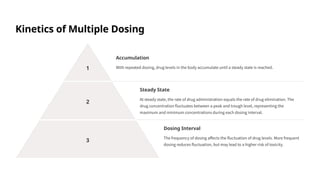
Kinetics of Multiple Dosing
1
Accumulation
With repeated dosing, drug levels in the body accumulate until a steady state is reached.
2
Steady State
At steady state, the rate of drug administration equals the rate of drug elimination. The
drug concentration fluctuates between a peak and trough level, representing the
maximum and minimum concentrations during each dosing interval.
3
Dosing Interval
The frequency of dosing affects the fluctuation of drug levels. More frequent
dosing reduces fluctuation, but may lead to a higher risk of toxicity.
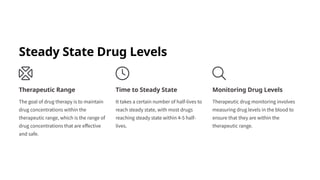
Steady State Drug Levels
Therapeutic Range
The goal of drug therapy is to maintain
drug concentrations within the
therapeutic range, which is the range of
drug concentrations that are effective
and safe.
Time to Steady State
It takes a certain number of half-lives to
reach steady state, with most drugs
reaching steady state within 4-5 half-
lives.
Monitoring Drug Levels
Therapeutic drug monitoring involves
measuring drug levels in the blood to
ensure that they are within the
therapeutic range.
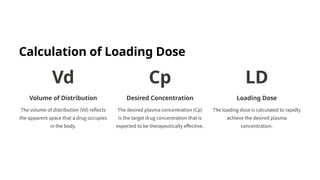
Calculation of Loading Dose
Vd
Volume of Distribution
The volume of distribution (Vd) reflects
the apparent space that a drug occupies
in the body.
Cp
Desired Concentration
The desired plasma concentration (Cp)
is the target drug concentration that is
expected to be therapeutically effective.
LD
Loading Dose
The loading dose is calculated to rapidly
achieve the desired plasma
concentration.
Maintenance Doses in
Clinical Settings
1 Dosing Regimen
Once steady state is
achieved, a maintenance
dose is used to keep the
drug concentration within
the therapeutic range.
2 Individualization
Maintenance doses are
individualized based on the
patient's age, weight, renal
function, and other factors.
3 Therapeutic Monitoring
Monitoring of drug levels is often necessary to adjust
maintenance doses and ensure optimal therapy.
Significance in Clinical Settings
Optimizing Therapy
Multicompartment models help
clinicians optimize drug therapy by
predicting drug concentration
profiles and adjusting doses to
achieve desired therapeutic
outcomes.
Understanding Variability
These models account for patient-
specific variations in drug
metabolism and elimination,
leading to more personalized and
effective treatments.
Safety and Efficacy
By predicting potential drug
accumulation and toxicity,
multicompartment models
contribute to patient safety and
optimize drug efficacy.
Practical Considerations
and Future Directions
While multicompartment models have revolutionized drug development
and clinical practice, there are still areas for improvement. New models
are being developed to incorporate complex drug interactions and to
better predict drug behavior in specific patient populations. Furthermore,
the use of sophisticated computational methods and artificial intelligence
is expanding the potential of multicompartment models for drug
discovery and personalized medicine.
Introduction to Multicompartment Models on Slideshare by Raj Kumar Mandal

Introduction to Multicompartment Models on Slideshare by Raj Kumar Mandal

  • 1.
    Introduction to Multicompartment Models Multicompartmentmodels are powerful tools in pharmacokinetics, providing a deeper understanding of drug distribution and elimination within the body. This presentation explores the fundamental concepts of multicompartment models, their applications in drug development, and their significance in clinical settings. by Raj Kumar Mandal
  • 2.
    Defining Multicompartment Models AFoundation for Understanding Drug Behavior Multicompartment models are mathematical representations of how drugs move within the body. These models assume the body can be divided into compartments, each representing a group of tissues with similar drug distribution properties. The model then describes the drug transfer between these compartments. Key Concepts These models consider the various processes that influence drug movement, such as absorption, distribution, metabolism, and elimination. Parameters like volume of distribution, clearance, and elimination rate constant are crucial to understanding drug behavior.
  • 3.
    Two Compartment OpenModel 1 The simplest multicompartment model is the two- compartment open model, where the body is divided into two compartments: a central compartment representing the bloodstream and highly perfused organs, and a peripheral compartment representing less-well perfused tissues. 2 The drug is absorbed into the central compartment and then distributed to the peripheral compartment. Elimination is typically from the central compartment, reflecting the removal of drug from the body. 3 This model is often used to describe the pharmacokinetics of drugs that exhibit a slow distribution phase. It helps to understand how the drug's concentration changes over time in different parts of the body.
  • 4.
    IV Bolus 1 Rapid Entry AnIV bolus is a rapid injection of a drug directly into the bloodstream, bypassing absorption. 2 Distribution Phase The drug then distributes from the central compartment to the peripheral compartment, leading to a decrease in the concentration of the drug in the central compartment. 3 Elimination Phase Drug elimination from the central compartment occurs, leading to a slow and continuous decline in blood concentration.
  • 5.
    Kinetics of MultipleDosing 1 Accumulation With repeated dosing, drug levels in the body accumulate until a steady state is reached. 2 Steady State At steady state, the rate of drug administration equals the rate of drug elimination. The drug concentration fluctuates between a peak and trough level, representing the maximum and minimum concentrations during each dosing interval. 3 Dosing Interval The frequency of dosing affects the fluctuation of drug levels. More frequent dosing reduces fluctuation, but may lead to a higher risk of toxicity.
  • 6.
    Steady State DrugLevels Therapeutic Range The goal of drug therapy is to maintain drug concentrations within the therapeutic range, which is the range of drug concentrations that are effective and safe. Time to Steady State It takes a certain number of half-lives to reach steady state, with most drugs reaching steady state within 4-5 half- lives. Monitoring Drug Levels Therapeutic drug monitoring involves measuring drug levels in the blood to ensure that they are within the therapeutic range.
  • 7.
    Calculation of LoadingDose Vd Volume of Distribution The volume of distribution (Vd) reflects the apparent space that a drug occupies in the body. Cp Desired Concentration The desired plasma concentration (Cp) is the target drug concentration that is expected to be therapeutically effective. LD Loading Dose The loading dose is calculated to rapidly achieve the desired plasma concentration.
  • 8.
    Maintenance Doses in ClinicalSettings 1 Dosing Regimen Once steady state is achieved, a maintenance dose is used to keep the drug concentration within the therapeutic range. 2 Individualization Maintenance doses are individualized based on the patient's age, weight, renal function, and other factors. 3 Therapeutic Monitoring Monitoring of drug levels is often necessary to adjust maintenance doses and ensure optimal therapy.
  • 9.
    Significance in ClinicalSettings Optimizing Therapy Multicompartment models help clinicians optimize drug therapy by predicting drug concentration profiles and adjusting doses to achieve desired therapeutic outcomes. Understanding Variability These models account for patient- specific variations in drug metabolism and elimination, leading to more personalized and effective treatments. Safety and Efficacy By predicting potential drug accumulation and toxicity, multicompartment models contribute to patient safety and optimize drug efficacy.
  • 10.
    Practical Considerations and FutureDirections While multicompartment models have revolutionized drug development and clinical practice, there are still areas for improvement. New models are being developed to incorporate complex drug interactions and to better predict drug behavior in specific patient populations. Furthermore, the use of sophisticated computational methods and artificial intelligence is expanding the potential of multicompartment models for drug discovery and personalized medicine.